The HOA Tore Down My Cedar Fence at 6 A.M. While I Watched From the Porch—They Had No Idea What I Was About to Build on the Same Property Line.
PART2:
I fix things when they break and try not to make other people’s problems my entertainment.
That was how my grandfather raised us.
Wendell Pruitt bought our land in 1971, two and a half acres on the outer edge of what was then an unincorporated stretch of central Tennessee.
Back then, Sycamore Ridge was not Sycamore Ridge.
It was just road, clay, trees, a few old family houses, and enough quiet to hear rain moving across pasture before it reached your roof.
Granddad built the foundation himself.
Mixed concrete in a rented drum mixer while my grandmother Loretta handed him boards and told him he was too stubborn to hire help.
The house was not fancy.
Three bedrooms.
Covered porch.
Root cellar under the back steps that still smelled like clay, old apples, and damp burlap.
But it was theirs.
Then it was my father’s.
Then, six years ago, when Dad’s knees finally gave out and he moved into assisted living in Clarksville, it became mine.
I did not inherit a mansion.
I inherited permanence.
PART3:
That matters more.
By the time the HOA came for my fence, the neighborhood had changed around us.
The new section went up east of our older properties.
McMansions with thin stone veneer.
Golf-course lawns.
Mailboxes that matched because someone had paid too much money to make them all equally boring.
Then in 2018, Sycamore Ridge HOA incorporated as part of a county rezoning deal that swallowed our little pocket of acreage into the broader subdivision framework.
I did not vote for it.
Most of the older property owners did not vote for it.
But our parcels got absorbed anyway under a new set of CC&Rs written by a property management company called Vantage Community Solutions.
Remember that name.
Nothing good in this story happens when Vantage is in the room.
The HOA president was Constance Whitfield Drake.
She moved into the new section four years before the fence came down.
Big house.
Stone veneer.
Circular driveway.
Front yard so perfect it looked computer-generated.
Constance was maybe fifty-five, immaculate in that expensive way where every hair, nail, crease, and smile had been managed by professionals.
She served on charity boards.
Attended county planning meetings.
Knew the code enforcement officer by first name…
She had the kind of public politeness that made people call her impressive before they realized she had been stepping on their neck.
Within eighteen months of joining the HOA board, she had quietly restructured the Architectural Review Committee so that her signature alone could approve or deny exterior modifications.
I did not know that at first.
What I did know was the smell of fresh-cut cedar on a Saturday morning.
That fence was not expensive by Sycamore Ridge standards.
It was not decorative.
No stone columns.
No automatic gate.
No black iron spears.
Just cedar posts, horizontal rails, and wire backing along the inside to keep my neighbor’s dogs from visiting my shop and my shop dog from returning the favor.
I built it myself.
My father sat in a lawn chair under the pecan tree while I worked, one bad knee wrapped in a brace, telling me every third post was crooked.
“It’s not crooked,” I said.
He leaned forward and squinted.
“It will be when you’re done pretending it isn’t.”
Dad had a way of making criticism sound like inheritance.
He could not help much physically by then, but he still knew how to make a line true.
He had learned it from Granddad, and Granddad had learned it from the old men before him who treated property corners like scripture.
We followed the existing survey.
Iron pin at the front near the road.
Old stone marker halfway down the east side.
Survey stake by the drainage swale in back.
Everything lined up.
The fence sat eighteen inches inside my property line because I am the sort of man who would rather give himself a buffer than argue over an inch of clay.
When it was finished, Dad ran one hand across the top rail.
“Your granddad would like that.”
That was worth more than any compliment Constance Whitfield Drake ever manufactured at a county luncheon.
For three years, the fence did what fences are supposed to do.
It marked a line.
Kept the dogs where they belonged.
Protected my work yard.
Gave my father something to admire when I drove him over for Sunday supper.
Then Vantage Community Solutions decided Sycamore Ridge needed a new “community access enhancement plan.”
That was what they called it.
Access enhancement.
I would later learn that phrases like that are how grown adults hide bad ideas from themselves.
The official explanation was drainage maintenance and emergency service access. A low strip of land ran behind several old parcels, including mine, before turning toward the new section’s retention pond. During heavy rain, water moved through that swale. Not dramatically. Not constantly. But enough that county records showed a narrow drainage easement along part of the old boundary.
Important detail.
Part of the boundary.
Not the whole eastern edge of my property.
Not my driveway.
Not my side yard.
Not my workshop access.
Not the fence line itself.
The easement allowed maintenance access to the drainage swale when necessary. It did not give the HOA permission to create a road. It did not give them control of my land. It did not allow them to demolish improvements outside the defined easement area.
But to Constance, the word easement was not a legal instrument.
It was a magic spell.
She came to my door the first time on a Thursday afternoon.
I had just finished welding a gate frame for a cattle farm outside Lebanon. My shirt smelled like hot metal, my hands were black with dust, and I still had safety glasses pushed up on my head when she knocked.
She stood on my porch like she did not trust the wood beneath her heels.
“Mr. Pruitt,” she said.
“Mrs. Drake.”
She smiled at the use of her married name, as if she preferred every title available.
“I’ll only take a moment. I’m here regarding your fence.”
I looked past her toward the cedar line.
“What about it?”
“It interferes with HOA access.”
“No, ma’am.”
Her smile tightened.
“Perhaps you haven’t reviewed the governing documents.”
“I’ve reviewed my survey.”
“The association has a recorded drainage and maintenance easement.”
“Behind the property. Not through my fence.”
“The fence blocks efficient access.”
“There’s an access point twenty yards south.”
“That access point is not suitable for equipment.”
“Then use smaller equipment.”
Her eyes hardened, but her voice stayed sweet.
“Mr. Pruitt, the board has approved improvements that require unobstructed access across the eastern maintenance corridor.”
“Show me the plan.”
“I don’t have it with me.”
“Then we don’t have much to discuss.”
She blinked.
People like Constance are not accustomed to conversations ending before they decide they are done.
“You will be receiving formal notice,” she said.
“I’ll read it.”
“I hope you’ll cooperate.”
“I always cooperate with documents that say what they are allowed to say.”
That was the first time she looked at me like I had become inconvenient.
The notice arrived the following Monday.
Vantage Community Solutions letterhead.
Formal tone.
Too many capital letters.
It stated that my cedar fence encroached upon a “community maintenance access corridor” and had to be removed within ten days to permit drainage improvements, emergency vehicle access, and landscape restoration.
I read it twice.
Then I pulled my deed, survey, and the recorded easement from the file cabinet in my office.
The easement description was narrow.
Specific.
Measured.
It followed the swale in a strip behind the older parcels, then turned southeast. My fence ran parallel to part of it but did not cross the legal access zone. At one point, the easement came close, within a few feet of the rear corner. That was likely what Constance had used to convince herself close meant inside.
Close does not count in property law.
I wrote back.
I included a copy of the survey.
Highlighted the easement.
Marked the fence location.
Stated plainly that the fence was on my property, outside the recorded easement, and that no removal was authorized.
I sent it certified mail to Constance, the HOA board, and Vantage Community Solutions.
Then I went back to work.
That was my first mistake.
Not the letter.
The assumption that facts would slow them down.
Facts do not slow people like Constance unless someone with authority forces them to stop and read.
Two weeks passed.
No response.
Then one morning, my neighbor Evelyn Cho stopped by the shop.
Evelyn lived two houses down in one of the older brick ranch homes. Retired librarian. Seventy-one. Sharp enough to slice bread just by looking at it.
She came carrying a folder and wearing the expression of a woman who had kept records since before Vantage knew what a copier was.
“Garrett,” she said, “have they contacted you about access?”
“Constance did.”
Evelyn’s lips pressed together.
“I thought so.”
She opened the folder on my workbench.
Inside were copies of HOA invoices, notices, meeting minutes, and a colored map from Vantage labeled Sycamore Ridge Eastern Access Improvement.
A red line ran across the older properties.
Not along the recorded swale.
Across yards.
Across my fence.
Across a portion of Evelyn’s back lot.
Across land they did not own.
“Where did you get this?” I asked.
“Board packet.”
“You’re on the board?”
“No. But they email documents to the wrong Evelyn sometimes.”
I looked at her.
“How many Evelyns are in Sycamore Ridge?”
“Two. The other one likes Constance.”
“That must confuse them.”
“It comforts me.”
I studied the map.
The base drawing appeared legitimate enough. Property outlines. Drainage area. Retention pond. Street names. But the red access path had been drawn much wider than the recorded easement. A label beside it read PROPOSED SERVICE ROUTE.
“Proposed,” I said.
“Notice that,” Evelyn replied.
“Not approved.”
“No.”
“Not recorded.”
“No.”
“Not in the county easement.”
“No.”
I tapped the red line across my fence.
“Who added this?”
“Vantage.”
“How do you know?”
She slid another page forward.
An email from Vantage’s regional manager, Martin Vale, to Constance.
Subject: Access corridor expansion.
Constance,
Attached revised exhibit reflects preferred contractor routing for equipment. Existing easement description may be insufficient for full-width access, but route shown should support operational need. Recommend board proceed under maintenance authority and address owner concerns individually if raised.
Martin Vale
Vantage Community Solutions
I read that last sentence three times.
Address owner concerns individually if raised.
Not resolve authority.
Not obtain permission.
Not amend easement.
Not coordinate with property owners.
Proceed.
Then handle the noise.
Evelyn watched my face.
“You understand why I brought it.”
“Yes.”
“They sent a similar notice to me last month.”
“What did you do?”
“I told them if they touched my maple tree, I would become the event their insurance carrier warned them about.”
That sounded like Evelyn.
“Did they back off?”
“From my tree. Not from the route.”
I copied every page.
Then called an attorney named Rebecca Harlan.
Rebecca had handled a contract dispute for my shop two years earlier when a client decided paying invoices was optional if he complained loudly enough. She was blunt, practical, and had the most comforting habit an attorney can have: she told me when I was wrong quickly, before I spent money proving it.
I emailed her the deed, survey, easement, Vantage notice, my response, and Evelyn’s board packet.
She called that afternoon.
“Garrett,” she said, “do not let them touch that fence.”
“That is my preference.”
“No. I mean formally. Send a stronger letter.”
“I already sent one.”
“You sent a homeowner letter. I’m sending a lawyer letter.”
“What will that do?”
“Create consequences before machinery arrives.”
She sent the letter the next day.
It warned that the fence was located outside the recorded easement, that the HOA lacked authority to remove or modify it, and that any attempt to do so would constitute trespass, conversion, property damage, and potentially civil conspiracy if Vantage directed contractors to act outside the legal easement after notice.
I liked that phrase.
After notice.
A lot of law lives there.
Before notice, people can pretend confusion.
After notice, pretending gets expensive.
Vantage acknowledged receipt.
Constance did not.
The next HOA meeting was held on a Tuesday night in the clubhouse.
I attended for the first time in over a year.
That alone caused a stir.
I usually avoided meetings because life is short, and watching people argue about fence stains while fluorescent lights hum overhead feels like a punishment invented for minor sins.
Constance sat at the front table in a crimson blazer, pearl necklace, and makeup that made her look both approachable and legally dangerous. Beside her sat Martin Vale from Vantage, a tan man with slick hair and a tablet he tapped like it was giving him strength.
The room was full.
Constance opened with community updates.
Pool furniture.
Mailbox repainting.
Holiday lighting standards.
Then she reached drainage improvements.
A slide appeared showing a neat service route behind the old properties.
My fence was not shown.
That was interesting.
Maps can lie by omission as easily as by addition.
“Our contractor will begin work next month,” Constance said. “This project is necessary to preserve drainage function, improve emergency access, and reduce maintenance delays created by noncompliant private barriers.”
Private barriers.
I raised my hand.
Constance saw me and smiled as if she had expected it.
“Mr. Pruitt.”
“Will the contractor be working inside the recorded easement only?”
Martin Vale leaned toward his microphone.
“The contractor will work within the maintenance corridor approved by the association.”
“That wasn’t my question.”
A few heads turned.
Constance said, “Garrett, the board has legal authority to maintain drainage infrastructure.”
“Inside the easement.”
“The easement supports maintenance.”
“Inside its legal description.”
Martin smiled.
“These things are not always as rigid as laypeople assume.”
I almost laughed.
Laypeople.
I had spent my life reading plans where one wrong inch could make a pipe miss a wall sleeve and cost five men an afternoon.
“Show the recorded easement overlay,” I said.
Martin tapped his tablet.
“That level of detail is not necessary for tonight’s discussion.”
“Then neither is a vote.”
The room shifted.
Constance’s smile vanished.
“Mr. Pruitt, please do not disrupt the meeting.”
“I’m not disrupting. I’m asking whether the route crosses land the HOA does not control.”
A man named Greg Hanson, who always sat near the front and laughed whenever Constance looked pleased, leaned back in his chair.
“Why are the old-section people always fighting improvements?”
Evelyn spoke from two rows behind me.
“Because some improvements arrive with bulldozers and creative paperwork.”
That got a few laughs.
Not many.
Enough to sting.
Constance lifted her hand.
“The board has reviewed this extensively.”
“With whose attorney?” I asked.
“Our management company has advised us.”
“Vantage is not your attorney.”
Martin’s face tightened.
Rebecca had told me to say that if needed.
It needed saying.
I continued, “Has the HOA obtained written permission from affected owners outside the recorded easement?”
Constance looked toward the board.
No one answered.
“That would be a no,” Evelyn said.
Constance struck the table lightly with her pen.
“We are not litigating drainage access at a community meeting.”
“You might want to,” I said. “It’s cheaper than litigating it in court.”
The motion passed anyway.
Four to one.
Only Daniel Whitaker voted against it.
Daniel was a quiet accountant in his sixties who had lived in the new section but seemed uncomfortable with loud confidence. When he voted no, Constance looked at him like he had spilled wine on her carpet.
I remembered that vote.
It mattered later.
After the meeting, Martin approached me near the door.
“Mr. Pruitt, I understand property attachment can make these things emotional.”
I looked at him.
“Don’t.”
He smiled.
“Don’t what?”
“Patronize me on your way to trespassing.”
His smile faded.
“Vantage has handled hundreds of communities.”
“Then you should be good at reading easements.”
He lowered his voice.
“Dragging this out will not serve you.”
That was the moment I decided to install more cameras.
By the following weekend, I had motion-activated trail cameras covering the fence, the rear swale, the driveway, and the shop yard. I put up signs too.
VIDEO RECORDING IN USE.
PRIVATE PROPERTY.
NO ENTRY BEYOND THIS POINT WITHOUT OWNER PERMISSION.
Then I waited.
For three weeks, nothing happened.
No trucks.
No letters.
No contractors.
Dad visited once during that lull.
I drove him over from Clarksville on a Sunday afternoon. He walked slowly along the fence with his cane, one hand touching the cedar rails.
“They still after this?” he asked.
“Yes.”
He stared toward the new subdivision roofs visible through the trees.
“Your granddad hated committees.”
“I know.”
“He said a committee once tried to tell him where to put a well on land he owned.”
“What did he do?”
“Dug it where he wanted.”
“That sounds like him.”
Dad nodded toward the fence.
“Don’t let them take more than they’re owed.”
That sentence stayed with me.
Not because he said fight.
He did not.
He said measure.
Know what is owed.
No more.
No less.
At 5:42 on a Thursday morning, my phone buzzed.
Motion alert.
East fence.
I was already half-awake because age makes sleep negotiable.
I opened the camera feed.
Headlights.
A flatbed truck.
Then another.
Then a compact excavator on a trailer.
Then Constance’s black SUV.
I got to the porch just as the excavator unloaded.
Barefoot.
Jeans.
Coffee in one hand.
Phone in the other.
The air was cool enough to show breath.
Work lights cut through the gray dawn.
The contractor was a man in his forties wearing a yellow vest and the exhausted expression of someone who had been told a job was simple by people who do not operate machines.
Constance stood beside him with her folder.
“Stop,” I called.
The contractor looked up.
Constance did not.
“Mr. Pruitt,” she said, “you received notice.”
“So did you.”
She turned then.
Her lipstick was perfect.
Of course it was.
“This fence obstructs authorized maintenance access.”
“No, it doesn’t.”
“The board has voted.”
“The board cannot vote itself onto my land.”
She looked at the contractor.
“Proceed.”
The contractor hesitated.
Good man.
He knew enough to feel trouble even if he did not yet know its name.
I walked down from the porch.
“Who are you with?” I asked him.
“Carruth Site Services.”
“Who hired you?”
“Vantage Community Solutions.”
“Do you have the approved plan?”
Constance snapped, “You are interfering with lawful association work.”
I ignored her.
“Do you have the plan?”
The contractor looked at Constance.
That told me he did not.
She opened the folder and handed him a sheet.
He unfolded it across the hood of his truck.
I stepped close enough to see.
Same colored route.
Same red line.
Same problem.
No county stamp.
No revision block.
No owner authorization.
No recorded easement overlay.
“Where is the county-approved plan?” I asked.
“This is the plan,” Constance said.
“No. This is an exhibit.”
The contractor looked from me to her.
“I was told access was cleared.”
“It is,” Constance said quickly.
I held up my phone.
“You are on camera. I am telling you this fence is outside the recorded easement. I am telling you the HOA has no authority to remove it. I am telling you Rebecca Harlan sent notice to Vantage and the board. If you proceed, you are damaging private property after notice.”
The contractor’s jaw tightened.
Constance stepped forward.
“Luis, do the job.”
Now I had his name.
Luis Carruth.
He stood there for five seconds that probably felt like five hours.
Then he said quietly, “Mrs. Drake, I need written confirmation.”
She held up the sheet.
“This is written confirmation.”
“No, ma’am. I need confirmation of property authority.”
Her face changed.
Not enough for most people to see.
I saw it.
“Your contract is with Vantage,” she said. “Your instructions are clear.”
Luis looked trapped.
Behind him, his crew waited.
Trucks idling.
Equipment unloaded.
Schedule burning money by the minute.
That is how momentum works.
It turns legal doubt into operational pressure.
Finally, Luis climbed into the excavator.
I did not step in front of it.
I was angry, not stupid.
I stood on my porch and filmed.
Constance stood beside the machine.
The bucket curled beneath the first section of cedar fence.
Lifted.
Snapped.
And there I was.
Barefoot.
Coffee burning my hand.
Watching my family’s fence come apart before sunrise.
When the first section fell, Constance looked at me and smiled.
That smile did something no legal letter had managed.
It took the issue out of the world of disagreement and put it into the world of consequence.
They tore down one hundred and twelve feet of fence that morning.
Not the whole thing.
Only the section Vantage wanted opened for service vehicles.
They dragged the cedar boards into a pile near my shop, where my dog, Boomer, barked himself hoarse from behind the barn door.
I filmed everything.
Luis looked miserable by the end.
Constance looked triumphant.
Before leaving, she walked to the porch steps.
“You could have avoided this.”
I looked past her at the broken fence.
“So could you.”
“Send your repair invoice to Vantage if you feel entitled.”
“If I feel entitled?”
She adjusted the folder against her chest.
“You have been hostile to a necessary community project from the beginning.”
“No. I have been precise.”
“Precision can become obstruction.”
That sentence told me everything about her.
To Constance, any boundary that slowed her down was not a boundary.
It was an attitude problem.
When the trucks left, they did not close anything behind them because there was nothing left to close.
My eastern side lay open.
My shop yard visible.
My property line violated.
My fence in pieces.
I stood there a long time after the engine noise faded.
Then I did what my father and grandfather taught me.
I picked up the first board.
Not because I planned to reuse it.
Because leaving it in the mud felt like letting them decide what it was worth.
By 8:30, Rebecca Harlan was on my porch.
She wore boots, jeans, and the face of an attorney whose morning coffee had been replaced by righteous anger.
She took photographs.
Measured the removed section.
Documented the piles.
Reviewed my videos.
Then she asked one question.
“Did you step in front of equipment?”
“No.”
“Threaten anyone?”
“No.”
“Touch their vehicles?”
“No.”
“Good.”
“I wanted to.”
“I bill less when you don’t.”
She sent emergency letters by noon.
To Constance.
To every board member.
To Vantage.
To Carruth Site Services.
To the HOA’s registered agent.
Cease all entry outside recorded easement.
Preserve all documents.
Preserve emails, texts, invoices, contracts, board packets, maps, and communications concerning the access route.
No further disturbance.
No debris removal without agreement.
No claim of implied permission.
No contact except through counsel.
That last part was mostly for Constance.
She ignored it within six hours.
Her email arrived at 6:19 p.m.
Garrett,
This escalation is unnecessary. The fence has been removed pursuant to board authority and maintenance necessity. The association is willing to discuss reasonable cosmetic replacement after project completion if you discontinue threats and cooperate going forward.
Constance
I forwarded it to Rebecca without replying.
Rebecca replied to me:
Do not answer.
Then, one minute later:
Actually, thank her mentally. That email helps.
The next morning, I did not rebuild the fence.
I built something else.
I opened the steel rack behind my shop and pulled out four six-inch square posts, quarter-inch wall thickness, twelve feet long. Heavy enough that most men would not want to handle them without equipment. I had bought them for a commercial gate project that got canceled after the client discovered steel prices had opinions.
Then I cut crossbeams.
Prepped plate.
Welded brackets.
Drilled anchor points.
Laid out a line eighteen inches inside my property, exactly where my cedar fence had stood.
I called a surveyor named Owen Pierce.
Owen had surveyed half the older properties in our pocket of Sycamore Ridge and did not move quickly unless money or danger was involved.
I told him both were.
He came that afternoon.
Set pins.
Flagged the line.
Confirmed what I already knew.
The removed fence stood outside the recorded easement.
The red access route crossed my property without recorded authority.
The next morning, with Rebecca’s blessing, I set steel.
Not a fence.
A wall.
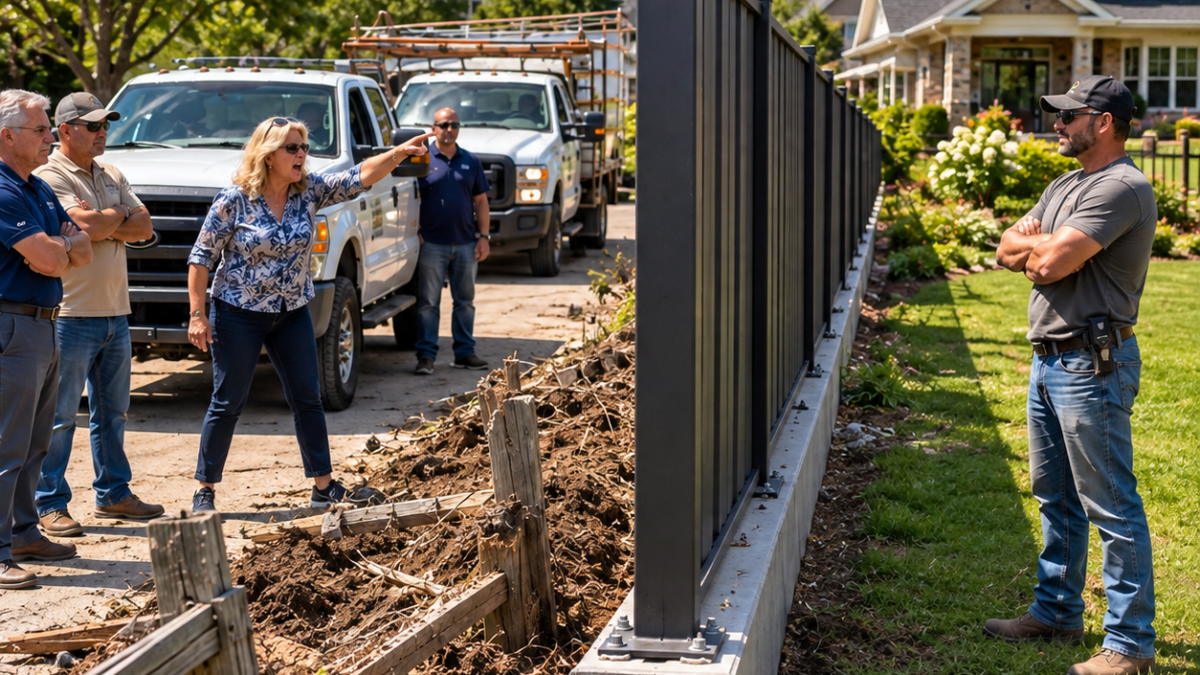
Four massive steel posts sunk into concrete, tied with welded rectangular tubing, plated across the lower section, and braced with diagonal gussets. I left space for water flow near the bottom where necessary because I am not a fool. I was not blocking drainage. I was blocking vehicles.
By Sunday evening, the structure stood across the opening they had created.
Matte black.
Industrial.
Ugly in the honest way useful things are ugly.
At the center, I welded a plate cut on my plasma table:
PRIVATE PROPERTY
NO VEHICLE ACCESS
RECORDED EASEMENT DOES NOT INCLUDE THIS ROUTE
CONTACT OWNER’S COUNSEL
Evelyn came over while I was touching up the paint.
She stood beside the steel wall, hands folded.
“Well,” she said, “that has presence.”
“It’ll stop a truck.”
“I suspect it could stop several.”
“That’s the idea.”
She looked at the sign.
“Constance will hate it.”
“I know.”
“She’ll call it hostile.”
“It is.”
Evelyn smiled.
“Good.”
On Monday morning, Vantage’s trucks returned.
Three pickups.
One dump truck.
One equipment trailer.
Luis Carruth was not with them this time.
A Vantage supervisor climbed out first, phone in hand, followed by Martin Vale.
Then Constance arrived.
She stepped from her SUV and stared at the steel wall.
For the first time since I had known her, she looked genuinely speechless.
The dump truck driver leaned out his window.
“Where do you want me?”
Martin did not answer.
Constance walked toward the wall.
Stopped.
Read the plate.
Her mouth tightened.
I stood on my porch with coffee again, shoes this time.
Rebecca stood beside me.
That had been her idea.
“Witnesses are cheaper than arguments,” she said.
Martin called out, “Mr. Pruitt, remove this obstruction.”
Rebecca answered.
“Mr. Pruitt will not be speaking directly with you.”
Constance turned.
“Rebecca Harlan, I presume.”
Rebecca smiled.
“Mrs. Drake.”
“This structure is retaliatory.”
“This structure is on my client’s property.”
“It blocks maintenance equipment.”
“It blocks unauthorized vehicle access outside the recorded easement.”
“The HOA has drainage obligations.”
“Then perform them inside your legal rights.”
Martin held up his tablet.
“Our contractors are scheduled.”
Rebecca’s smile widened.
“I’m sure the court will find your calendar compelling.”
The dump truck driver looked from one side to the other.
Then shifted into reverse.
Martin spun.
“Where are you going?”
The driver pointed at the steel wall.
“Not through that.”
“There is an authorized route.”
“Doesn’t look authorized to me.”
Constance snapped, “It is authorized by the association.”
The driver laughed once.
Not disrespectfully.
More like a man hearing nonsense too early in the morning.
“Lady, I haul gravel. I don’t fight steel.”
He backed down the drive and left.
The equipment trailer followed.
Then the pickups.
Constance stood in the gravel watching her project dissolve one vehicle at a time.
That was the first day her authority failed in public.
It would not be the last.
The temporary restraining order hearing happened four days later.
The HOA wanted the court to order me to remove the steel wall and allow immediate access for drainage work. Their petition described my structure as dangerous, retaliatory, obstructive, and harmful to community safety.
Rebecca described it as a gate replacement located on private property outside the recorded easement, built only after the HOA demolished a lawful fence despite written notice.
The judge asked one question that changed the whole hearing.
“Where is the recorded instrument showing the association may use this route for vehicle access?”
The HOA attorney looked at Martin.
Martin looked at Constance.
Constance looked at her folder.
Rebecca placed the recorded easement on the table.
“This is the instrument.”
The judge read the legal description.
Then looked at the map Vantage had used.
“Who drew the red route?”
No one answered immediately.
The judge repeated, “Who drew it?”
Martin said, “Vantage prepared the exhibit for operational planning.”
“Was it recorded?”
“No, Your Honor.”
“Was it approved by the county as an expansion of the easement?”
“No, Your Honor.”
“Did affected owners sign access agreements?”
“No, Your Honor.”
The judge looked at me.
“Mr. Pruitt, did you remove the fence?”
“No, Your Honor.”
“Did you grant permission?”
“No, Your Honor.”
“Did you receive notice and object in writing?”
“Yes, Your Honor.”
He looked back at the HOA attorney.
The restraining order was denied.
Not softly.
The judge said the association had failed to demonstrate a clear right to the vehicle route blocked by my steel wall and that its prior removal of the fence raised serious questions about unauthorized entry.
Serious questions.
That phrase followed Constance out of the courtroom like thunder.
On the courthouse steps, she tried to recover dignity.
“This is temporary,” she told a board member.
Rebecca turned to me.
“Everything is temporary until discovery.”
Discovery.
That was where the fence became the smallest part of the story.
Because once documents started moving, Vantage could no longer control what everyone saw.
The board packets showed that Constance and Martin had known the recorded easement was narrow.
A Vantage internal email stated:
Legal description may not support full proposed access width. Recommend practical implementation before owner resistance crystallizes.
Before owner resistance crystallizes.
Rebecca read that line aloud in her office and stared at the paper as if it had insulted her ancestors.
“They wrote the villain dialogue for us.”
Then came the invoices.
Survey review fee.
Access coordination fee.
Owner compliance assessment.
Emergency route planning.
Drainage mobilization surcharge.
Three different charges from Vantage billed to the HOA for reviewing and expanding access rights it did not actually have.
Then contractor invoices.
Carruth Site Services had quoted one route.
Vantage marked up the contractor’s access preparation fee by forty percent before passing the cost to the HOA.
A second company billed for “fence obstruction documentation.”
The photos attached were of my cedar fence.
Before removal.
The photo file metadata showed they were taken three weeks before Constance ever sent her final notice.
Meaning they had planned to remove it while pretending they were still asking.
Then Evelyn found the reserve reports.
That was when the whole HOA finally started paying attention.
Sycamore Ridge’s reserve account had been dropping for two years despite rising dues and no major completed projects. Vantage had been charging “project management fees,” “compliance coordination fees,” “special review fees,” and “consulting pass-throughs” on multiple initiatives.
Some were real.
Some were inflated.
Some were duplicated.
One invoice billed for mailbox compliance inspection twice under different names.
Another billed a “community boundary review” that appeared to be nothing more than the red-line map used against me.
Daniel Whitaker, the board member who had voted no, came to my shop one evening carrying a banker’s box.
He looked ashamed.
“I should have asked harder questions.”
“Probably.”
He flinched, but he deserved the truth.
“I believed Constance when she said Vantage had legal review.”
“She believed sounding certain was the same as being correct.”
Daniel set the box down on my workbench.
“I started pulling statements after the hearing.”
“And?”
His mouth tightened.
“We have paid Vantage nearly eighty-seven thousand dollars in special project fees in eighteen months.”
“For what?”
“That’s what I cannot explain.”
Inside the box were bank statements, invoices, board approvals, emails, and contracts. Rebecca later told me Daniel bringing those records voluntarily probably saved the HOA from looking worse than it already did.
Not Constance.
Not Vantage.
The HOA as a body.
There is a difference between a bad board and every homeowner in the association. That distinction matters because most residents had not known what was happening. They had trusted polished reports and rising dues because everything had been presented as necessary.
Trust is not a defense.
But it can be a starting point for repair.
The special meeting happened on a rainy Thursday night.
I almost did not go.
Then Dad called from assisted living.
“You going?”
“How did you hear about it?”
“Evelyn called me.”
Of course she did.
“What did she say?”
“That if I raised you right, you’d show up and let them see the man they tried to run over.”
“Evelyn talks too much.”
“Evelyn is usually right.”
So I went.
The clubhouse was packed.
New-section residents.
Old-section residents.
Board members.
Contractors.
People who had cheered Constance.
People who had feared her.
People who had received fines from her.
People who had never cared until their dues statement arrived with a special assessment warning.
Constance sat at the front table.
Martin Vale sat beside her, though he looked less polished than usual.
Rebecca sat next to me in the back row.
Evelyn sat on my other side.
Daniel opened the meeting because the vice president had resigned that morning, claiming “health concerns,” which apparently appeared whenever documents did.
He read the court’s denial of the restraining order.
People shifted.
Then he read the sentence about serious questions regarding unauthorized entry.
Constance interrupted.
“The order does not decide the full merits.”
Rebecca whispered, “She’s not wrong.”
“Don’t defend her.”
“I defend language.”
Daniel continued.
Then he displayed the recorded easement.
Then Vantage’s red-line exhibit.
Then the email.
Recommend practical implementation before owner resistance crystallizes.
The room went silent.
A woman in the front row raised her hand.
“What does that mean?”
Daniel answered slowly.
“It appears to mean they wanted to do the work before Garrett could stop it.”
People turned toward Martin.
He adjusted his tie.
“That phrase has been taken out of context.”
Rebecca stood.
“Then provide the context.”
Martin looked at her.
She smiled politely.
“We’d all enjoy it.”
No context came.
Then Daniel displayed the invoices.
The fees.
The markups.
The duplicated charges.
The Vantage special project billing.
A man named Bill Harper stood near the aisle.
“Are you saying our dues paid for them to tear down his fence?”
Daniel swallowed.
“In part, yes.”
Bill turned toward Constance.
“You told us he was blocking drainage work.”
“He was.”
I stood then.
Not because I wanted to.
Because silence at the wrong time lets lies settle.
“I blocked trucks from using a route the HOA did not have.”
Constance snapped, “You built a steel barricade.”
“After you tore down my fence.”
“You obstructed community access.”
I looked at the room.
“Ask her for the recording number.”
Constance’s mouth tightened.
“She knows exactly what I mean,” I continued. “If the HOA had a legal right to cross where my fence stood, there should be a deed, easement, access agreement, court order, or recorded amendment. Ask her for the number.”
No one spoke.
Then Evelyn said, “Constance?”
The softness of her voice made it worse.
Constance looked at Martin.
Martin looked at the table.
Daniel said, “There is no recording number.”
That sentence did more damage than any shouting could have.
Because for months, Constance had wrapped herself in authority. Board approval. Vantage review. Maintenance necessity. Community safety. Drainage access. Emergency route.
All of it collapsed into one absence.
No recording number.
The first resident stood.
Then another.
Questions came fast.
Who approved the route?
Who authorized fence removal?
Who approved Vantage’s additional fees?
Why was there no independent legal opinion?
Why had the HOA relied on Vantage instead of counsel?
Why had contractor concerns not been disclosed?
That last question came from Luis Carruth.
He stood near the side wall, cap in hand.
“I raised boundary concerns the morning of removal,” he said.
Constance turned sharply.
“You proceeded.”
Luis looked at her.
“Yes. Because you told me authority was confirmed.”
His voice was steady, but his face was red.
“I was wrong to accept that. But I noted it in my job log before work continued.”
Rebecca leaned toward me.
“That log is gold.”
Luis continued, “I do not want my company used as the excuse for decisions made before we arrived.”
That mattered.
Responsibility climbs toward decisions.
The men driving equipment had not invented the red line.
Martin had prepared it.
Constance had pushed it.
The board had trusted it.
The homeowners had paid for it.
The meeting lasted three hours.
By the end, Constance had lost the room.
Not because everyone suddenly liked me.
Most did not know me.
Some probably still thought my steel wall was ugly.
But people understand money.
They understand being misled.
They understand when a person who promised control has been spending their dues to create liability.
The motion came from Daniel.
Immediate suspension of Constance Whitfield Drake from the HOA presidency pending independent financial and legal audit.
Constance stood before the vote.
“You will regret letting anger override leadership.”
Evelyn whispered, “Leadership would have read the deed.”
The motion passed overwhelmingly.
Only Greg Hanson abstained.
He always had trouble laughing when power changed sides.
Vantage was terminated ninety days later.
Not immediately.
Contracts rarely die as quickly as justice would prefer.
But the independent audit made the outcome inevitable.
Vantage had overbilled, misclassified fees, failed to advise the HOA to obtain independent counsel, and created project exhibits that blurred the difference between recorded rights and operational preferences.
The management agreement was canceled for cause.
The county opened a review into the drainage project.
The state association oversight office received complaints.
The HOA’s insurance carrier raised questions nobody enjoyed answering.
Constance resigned from the board before removal proceedings finished.
She did not apologize then.
She sent a letter to homeowners blaming “hostile legacy-property resistance,” “unclear historic documentation,” and “inadequate vendor guidance.”
It was three pages long.
It said nothing.
Rebecca filed suit on my behalf for trespass, property damage, restoration costs, attorney fees, and declaratory judgment confirming the limits of the easement.
The case did not go to trial.
It did not need to.
Evidence has a way of making pride expensive.
The settlement was recorded with the county.
That mattered to me more than the check.
The HOA paid to replace the destroyed cedar fence section.
It paid for survey costs.
It paid attorney fees.
It paid damages for unauthorized entry and removal.
It paid for a new recorded access clarification stating exactly where drainage maintenance could occur and where it could not.
It reimbursed Carruth for remobilization costs after Vantage misdirected the first route, though Luis insisted on discounting part of his bill because, in his words, “I should have stopped the bucket.”
I respected him for that.
The steel wall stayed.
Not forever.
Just long enough.
Once the recorded clarification was filed, once the replacement fence was approved and installed, once the HOA acknowledged in writing that no vehicle route crossed that portion of my property, I cut the steel wall down myself.
Evelyn was disappointed.
“I had grown fond of it,” she said.
“It was temporary.”
“It had character.”
“It was ugly.”
“So are many useful things.”
I could not argue.
I reused the steel for a cattle gate and two shop projects. I kept the center plate.
PRIVATE PROPERTY
NO VEHICLE ACCESS
It hangs inside my welding shop now above the workbench.
Customers sometimes ask about it.
I tell them it is a reminder that steel can stop a truck, but paperwork stops the lie that sent it.
The new HOA president was Daniel Whitaker.
He did not want the job.
That made him better at it.
His first meeting had no fancy slides.
No dramatic language.
No Vantage representative.
Just binders, numbers, and one sentence residents needed to hear.
“We are going to stop confusing convenience with authority.”
He read the audit summary.
Line by line.
People groaned when they heard the total cost.
Legal fees.
Settlement.
Audit.
New management company onboarding.
Insurance increases.
Contractor delays.
Fence replacement.
Survey work.
Recording fees.
Money Constance could have saved by answering one simple question before sunrise:
Do we actually have the right?
The board issued a public apology to me.
I did not enjoy receiving it.
That may sound strange.
People think apology after a public wrong should feel like victory. It often feels like standing under a light you did not ask to have turned on.
Daniel read it clearly.
The association acknowledges that the fence removed from Mr. Garrett Pruitt’s property was located outside the recorded easement and was removed without lawful authority. The association further acknowledges that Mr. Pruitt objected in writing prior to removal and that those objections were not properly considered. The association regrets the damage caused and has agreed to corrective action.
No excuses.
No decorative language.
I appreciated that.
After the meeting, residents approached me.
Some apologized.
Some explained why they had believed Constance.
Some said they had no idea.
Some wanted reassurance the drainage work could still happen.
That part mattered.
Because there had been a real drainage issue.
There usually is a real issue somewhere beneath these fights. That is what makes bad authority dangerous. It attaches itself to legitimate needs.
The swale did require maintenance.
Water still needed somewhere to go.
The difference was that now the work had to happen inside the recorded easement or with actual permission.
Novel concept.
The project was redesigned.
Smaller equipment.
Proper access from HOA property.
Temporary matting.
No crossing my fence line.
No removing improvements outside the easement.
County permit.
Independent engineer.
Legal review.
Owner notice.
Written schedule.
The revised drainage work took longer and cost more than Constance’s shortcut.
That is often how doing things properly works after someone wastes money doing them wrong.
But it got done.
Without tearing down anybody’s fence.
Without fake maps.
Without sunrise excavators.
Without steel walls.
The first heavy rain after the project came in March.
A hard Tennessee storm.
Thunder rolling low.
Water moving through the swale.
I stood under my porch roof with coffee, listening.
Not worried.
Just watching.
The new fence held clean along the line.
Beyond it, water flowed through the cleared swale toward the retention pond.
No trucks.
No pearl necklace.
No clipboard.
No engine noise.
Just rain doing what rain does and a drainage system doing what it was allowed to do within the law.
Dad came by the next Sunday.
I drove him along the fence line in the side-by-side because walking had become too hard. He inspected the new cedar section and made a show of squinting at the posts.
“Well,” he said.
“Well what?”
“Third one’s crooked.”
“It is not.”
“Your granddad would still say it was.”
I laughed.
Dad reached out and touched the top rail.
“They paid for it?”
“Yes.”
“Put it in writing?”
“Yes.”
“Filed?”
“Yes.”
He nodded.
“Then it’s better than before.”
I looked at him.
“The fence?”
“The record.”
That was my father.
A man whose knees could barely hold him, still understanding the strongest thing on land is not always what stands above ground.
Sometimes it is what is written beneath it.
Constance moved six months later.
Her house sold quietly.
No farewell party.
No tribute at a meeting.
No plaque for service.
She remained the kind of woman who would probably tell new acquaintances she had resigned because small-minded people resisted progress.
Maybe she believed it.
People protect themselves with stories.
I heard later that Martin Vale left Vantage before the state review concluded. Whether he resigned or was pushed, no one seemed to know. Vantage rebranded under another name in two counties, because companies are sometimes better at changing signs than behavior.
But Sycamore Ridge changed.
Not perfectly.
No neighborhood does.
People still argued about mailbox colors and Christmas lights.
Someone still complained about a shed roof.
Evelyn still corrected meeting minutes with terrifying precision.
But there was a difference after the fence.
Whenever someone proposed a project, Daniel asked:
“What authority supports it?”
The first time he said it, half the room looked tired.
The second time, less so.
By the third time, it became normal.
That is how culture changes.
Not through one dramatic speech.
Through repeated boring questions asked before trucks arrive.
One afternoon, about a year after the fence came down, Luis Carruth stopped by my shop.
He had a trailer hitch bracket that needed welding, though I suspect he could have found five other shops closer.
I fixed it while he stood near the open barn door.
He looked toward the new fence.
“Looks good,” he said.
“Third post is crooked.”
He looked.
“No, it’s not.”
“Tell my father.”
Luis smiled faintly.
Then grew serious.
“I’m sorry again.”
“You already said that.”
“I know.”
“You kept your job log honest.”
He looked down.
“That log got me yelled at.”
“Then it mattered.”
He nodded.
“I’ve got a new policy now. If a property owner raises a boundary concern, work stops until somebody produces written authority.”
“Good.”
“My guys hate it sometimes.”
“They’ll like not being sued.”
“That’s what I tell them.”
He paid for the bracket.
Before leaving, he looked at the fence one more time.
“I wish I had stopped that morning.”
“So do I.”
He accepted that.
No defensive answer.
No excuse.
Just nodded.
That told me he had learned something real.
The fence weathered.
Fresh cedar faded from warm red to soft gray.
The posts settled.
Grass filled around the repaired ground.
If you did not know where the excavator had torn through, you might never notice.
I noticed.
Of course I did.
Every scar in land has memory attached if you were there when it was made.
But I no longer felt anger every time I saw it.
I felt alertness.
Different thing.
Anger burns.
Alertness records.
I became the man in Sycamore Ridge people called when something seemed off.
A survey stake appeared near a tree.
A contractor drove onto the wrong lot.
An HOA letter mentioned an easement nobody understood.
A neighbor found a drainage map in a packet and wanted to know if it looked real.
I helped when I could.
And when I did not know, I said so.
That mattered too.
Constance’s deepest flaw was not that she lacked intelligence.
She was intelligent.
Organized.
Effective.
Persuasive.
Her flaw was believing certainty could replace authority.
It cannot.
A confident person can still be wrong.
A board vote can still exceed legal power.
A management company can still prepare a polished exhibit that has no binding force.
A contractor can still be sent to do work nobody had the right to order.
And an old cedar fence can still be lawful even if a woman in pearls finds it inconvenient.
I kept the broken boards for a while.
Stacked behind the shop.
At first, I told myself I might reuse them.
Then I admitted I was keeping them because throwing them away felt like letting go too soon.
One evening, Evelyn came by with a jar of peach preserves and found me staring at the pile.
“You know,” she said, “wood does not become evidence forever just because someone wronged it.”
“I know.”
“Do you?”
I picked up one cracked rail.
The grain had split diagonally, rough and pale inside.
“My grandfather would have hated seeing this.”
“Yes,” she said.
“He also would have hated you turning your shop yard into a memorial for damaged lumber.”
I looked at her.
She looked back.
Retired librarians do not flinch.
The next Saturday, I cut the broken cedar into kindling.
Kept one piece.
Burned the rest in the fire pit behind the shop as evening came down.
Dad was there.
Evelyn too.
Boomer slept near the porch.
No ceremony.
No speech.
Just smoke rising into quiet air.
Dad watched the flames.
“You did all right,” he said.
That was high praise from a Pruitt man.
“I built a wall in my yard.”
“You built a question they couldn’t drive through.”
I liked that.
The next morning, I put the one saved cedar piece on a shelf below the steel plate.
Wood and steel.
What they tore down.
What stopped them.
Both taught the same lesson from different directions.
A boundary is not respected because it is fragile or strong.
It is respected because people agree truth matters.
When they stop agreeing, you document.
You measure.
You record.
You build carefully.
You do not swing first if you can avoid it.
You do not become the villain in their version of the story.
You let the facts collect weight until the lie can no longer carry itself.
That is what happened in Sycamore Ridge.
The HOA tore down my fence at sunrise and thought the sound of cedar snapping was the sound of victory.
They were wrong.
It was the sound of the record opening.
It was the sound of a contractor’s log noting boundary concern.
It was the sound of an attorney writing after notice.
It was the sound of a judge asking for the recorded instrument.
It was the sound of homeowners finally learning their dues had paid for arrogance dressed as management.
And yes, for a little while, it was the sound of steel posts setting deep into concrete, one after another, until no truck in Sycamore Ridge could pretend the route was open.
People still ask me whether I regret building the steel wall.
No.
I regret that it was necessary.
There is a difference.
A cedar fence should have been enough.
A survey should have been enough.
A certified letter should have been enough.
The recorded easement should have been enough.
But when people ignore every quiet boundary, sometimes you have to build one loud enough that even a dump truck understands it.
The new fence stands now where the old one stood.
Eighteen inches inside my line.
Cedar rails.
Wire backing.
Gate latch welded by my own hand.
Beyond it, the drainage swale carries stormwater the way it was supposed to.
Beyond that, Sycamore Ridge continues being Sycamore Ridge.
Lawns trimmed.
Mailboxes matching.
People waving a little more carefully when they pass my house.
And every time rain rolls in from the west, I stand on my porch with coffee and listen.
No excavator.
No snapping cedar.
No woman in pearls smiling over broken boards.
Just water moving through the proper channel.
A fence marking the proper line.
And a neighborhood that learned, at great expense, that permission is not created by confidence.
Authority is not created by convenience.
And a man who builds steel for a living might be quiet for a long time.
But quiet is not the same as weak.








