The HOA President Rammed Her 38-Foot Yacht Into the Memorial Bridge I Built With My Late Wife—Then Handed Me a $400-a-Day Violation Notice for the Wreckage.
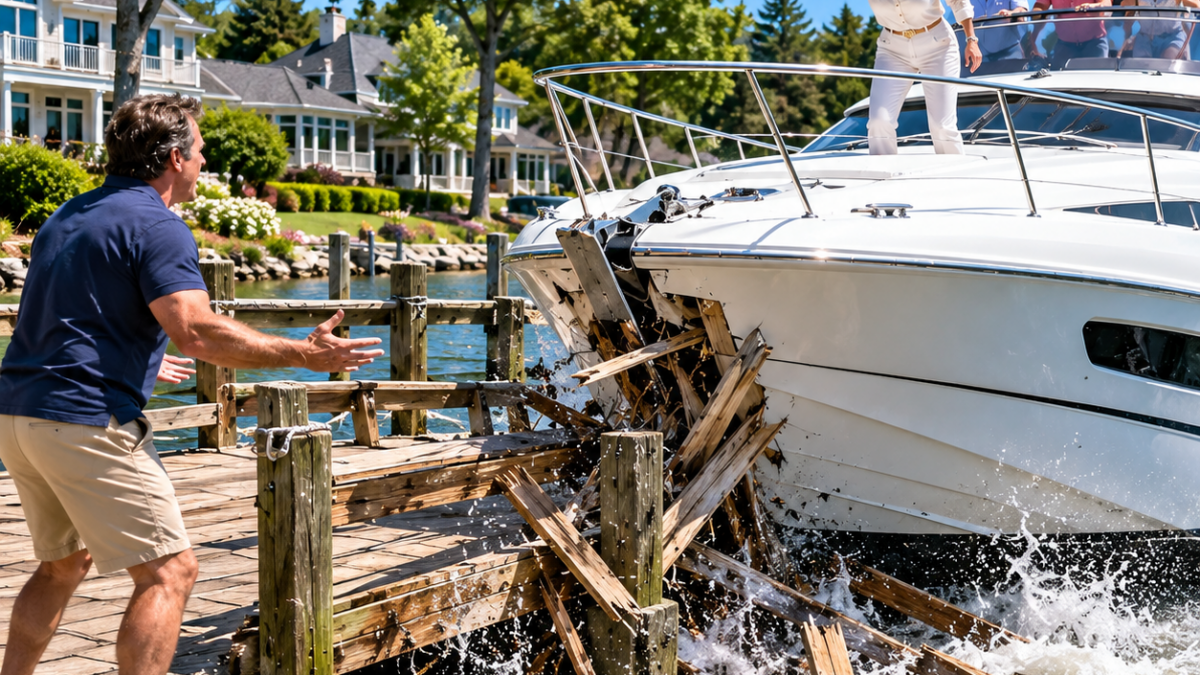
The HOA President Rammed Her 38-Foot Yacht Into the Memorial Bridge I Built With My Late Wife—Then Handed Me a $400-a-Day Violation Notice for the Wreckage.
Narin Volstrich smiled from the shoreline while splinters from my wife’s memorial bridge floated around her yacht like bones.
She thought the lake belonged to her because she had money, a board title, and resort guests paying for a view she had no right to control.
But she did not know I still held the easement to the old dam outlet, and she had just destroyed the one thing on that water I was willing to fight for.
“Remove this hazard,” Narin said, “or we’ll fine you four hundred dollars a day.”
Her sunglasses hid her eyes, but they could not hide the satisfaction in her voice.
She stood on the bank of Felmore Lake with one hand resting on her hip and the other holding a violation notice printed on HOA letterhead.
Twenty feet offshore, her thirty-eight-foot imported yacht sat idling in the morning sun.
The polished white hull gleamed like arrogance made fiberglass.
Behind it, pieces of my bridge drifted across the water.
Cedar planks.
Hand-carved rails.
A broken curved support with my wife’s initials still visible beneath the fresh scar where the yacht had struck it.
That bridge had stood for sixteen years.
Narin’s yacht had needed six seconds to gut it from below.
“It was obstructing navigational flow,” she added.
“The board reviewed the matter.”
“The vote was unanimous.”
I looked past her at the lake.
A ribbon of fog still clung to the eastern cove.
The water lilies my wife planted years ago bobbed in the wake of Narin’s engine, petals torn, stems twisted, their roots exposed like veins.
My throat tightened.
I did not give Narin the pleasure of seeing it.
“That bridge was grandfathered in before your HOA existed,” I said. “And you know it.”
Her mouth curved.
“Mr. Elleric, sentiment does not override safety.”
Sentiment.
That was what she called it.
Not memory.
Not grief.
Not the last thing my wife and I built together before cancer took her strength, then her voice, then finally her life.
Sentiment.
I stepped closer to the waterline.
Her compliance officer, Everett Crane, stood behind her with a tablet in both hands, taking pictures of the wreckage like I was the one who had committed a violation.
“This reservoir,” I said, “exists the way it does because I helped design its flow model.”
Narin gave me the faint smile rich people use when they hear facts but prefer leverage.
“That may have been relevant decades ago.”
“It’s relevant today.”
“The HOA maintains common lake standards now.”
“The HOA maintains decorative docks and picnic rules. It does not own the lake bed. It does not own the outlet. And it sure as hell does not own that bridge.”
She lowered the violation notice slightly.
“Then I suggest you prove it before the fines begin.”
That was Narin.
Always pushing a conversation until the other person either surrendered or sounded unreasonable.
She liked witnesses.
She liked cameras.
She liked meetings where she stood beneath expensive lighting and made theft sound like planning.
She liked using polite words for ugly things.
Compliance.
Improvement.
Modernization.
Lakefront harmony.
But what she had done that morning could not be softened by language.
She had taken a yacht and rammed it beneath a bridge built by a dying woman’s hands.
My name is David Elleric.
PART2:
I am sixty-three years old, and I have lived beside Felmore Lake for nearly my entire life.
My father used to say our family had mud in its blood and water in its bones. He meant it half as a joke, but he was not wrong. The Elleric place sits on the west side of the lake, below the old ridge road, where the land rolls down into cattails, cedar, and dark water.
People who came later called Felmore Lake a luxury amenity.
A view.
A marketing feature.
A destination.
To me, it was never any of those things.
It was work first.
Then home.
Then memory.
The lake had not always been as wide as people knew it now. Back when my grandfather was a boy, there was a creek running through the valley, fed by two springs and seasonal runoff from the ridge. In wet months, the low fields flooded. In dry months, the creek became a lazy ribbon full of stones and dragonflies.
In the 1950s, a small agricultural cooperative built the first dam to create a storage reservoir for irrigation. That dam failed twice before I was born. My father helped repair it once. I helped replace part of the spillway when I was twenty-two.
By the time I was grown, Felmore Lake had become part reservoir, part recreation water, part ecosystem, and part argument waiting to happen.
Water always is.
Water does not care about property lines the way people do. It moves under fences, around roots, through culverts, over spillways, below foundations, and into basements owned by people who thought drainage maps were optional.
That was how I made my living.
I became a hydrology engineer.
Not the kind who designs glittering downtown fountains.
The kind who studies stormwater, lake levels, outlet structures, culverts, flood paths, sediment, bank stability, and all the hidden decisions water makes when humans pretend they are in charge.
For thirty-eight years, counties, developers, farmers, and landowners hired me when water began reminding them who had the older claim.
I designed retention ponds.
Modeled flood events.
PART3:
Fixed culverts.
Testified in property disputes.
Stopped developers from building on soil that looked firm in August and became soup in March.
I was good at it because I respected water.
So did my wife.
Her name was Elise.
Elise Elleric had the kind of quiet beauty that did not announce itself when she entered a room. It settled there slowly until you realized the room had become kinder because she was in it. She taught elementary school for twenty-seven years. She kept handwritten thank-you notes from students in a shoebox under our bed. She sang off-key when she was cooking and denied it every time I mentioned it.
She loved Felmore Lake more than I did in some ways.
I understood its structure.
She understood its soul.
She knew where the herons nested.
She knew which cove caught moonlight first.
She knew when the lilies would bloom before the first bud opened.
She fed the ducks even after I told her bread was bad for them, then switched to oats with the dramatic seriousness of a woman complying with a federal treaty.
When Elise got sick, the lake became her refuge.
At first, she still walked the full shoreline with me.
Then half.
Then only to the old cedar bench.
Then finally no farther than the small footbridge we had begun building together across the shallow western inlet.
The bridge was her idea.
Not mine.
The inlet separated our side garden from the little peninsula where she had planted lilies, irises, and three dwarf willows that never grew as neatly as nursery labels promised.
For years, we crossed on flat stones when the water was low and used a plank when it was high.
One spring, before the diagnosis, Elise said, “We’re too old to keep pretending that plank is charming.”
“We’re not old.”
“You make a noise when you stand up.”
“That’s wisdom leaving the body.”
“That’s your knee.”
She sketched the bridge at our kitchen table.
A gentle arch.
Cedar planks.
Handrails curved just slightly, not fancy, just graceful.
Wide enough for two people standing shoulder to shoulder.
I told her we could build something simpler.
She said, “Simple is fine. Ugly is not.”
That was Elise.
We started building before we knew how little time we had.
Then came the tests.
Then the specialist.
Then words that made every room smaller.
Stage four.
Aggressive.
Treatment options.
Quality of life.
You think you know what fear is until a doctor starts speaking gently.
After that, the bridge changed.
It became a project she refused to surrender.
Some mornings she could only sit in a chair and sand one piece of railing for ten minutes before pain drained the color from her face. Some afternoons she stood beside me wrapped in a sweater, telling me the left support needed another half inch of curve because “your eye is practical, David, but mine is correct.”
It took us almost seven months.
By the end, I did most of the lifting.
She did the decisions.
And the finishing.
She carved our initials beneath the underside of the center support.
D.E. + E.E.
Then, after a pause, she added a small lily beside them.
I watched her hand tremble around the carving tool.
“You don’t have to finish that today,” I said.
She did not look up.
“Yes, I do.”
The day we placed the last cedar plank, she was too weak to stand long.
So I carried her onto the bridge.
She protested for the first three steps, then gave up and looped her arms around my neck.
“You’re going to hurt your back.”
“I’ve had worse loads.”
“That is not romantic.”
“You married a drainage engineer.”
“I know. That was my first mistake.”
I set her gently near the center rail.
The sun was going down.
The lake was bronze.
The lilies were opening along the inlet below us.
Elise rested one hand on the rail and looked over the water.
“We did good,” she whispered.
I put my arm around her.
“Yes, we did.”
She died nine months later.
After the funeral, people brought casseroles and flowers and words too soft to hold anything. I thanked them. I hugged them. I survived the way people survive when survival is not heroic but simply the body continuing without permission.
The bridge became the place I went when the house was too silent.
I drank coffee there.
I talked to Elise there.
I fixed loose planks that did not need fixing.
I oiled the cedar every spring.
On the anniversary of her death, I placed white lilies on the rail, not because she liked ceremonies, but because I needed one.
For years, nobody bothered the bridge.
Then Narin Volstrich bought the eastern shore.
She arrived with money, ambition, and a vocabulary full of words like elevated experience, curated waterfront, and lifestyle destination.
Her family had made money in commercial real estate. Narin had taken that money and turned herself into the kind of person local magazines photographed leaning against glass railings.
She bought the old Felmore Lodge property and announced a major renovation.
The lodge had been a sleepy place before her.
Fishing cabins.
A bait shop.
A dining room with mismatched chairs.
Kids swimming off the dock.
Old men playing cards under ceiling fans.
Narin turned it into Volstrich Lake Resort.
She painted everything white and charcoal.
Replaced the cabins with “premium waterfront suites.”
Built a floating lounge dock.
Imported stone for the terrace.
Installed fire bowls.
Hired a chef.
Raised prices so sharply that locals stopped going.
Tourists came instead.
Couples from the city.
Influencers.
Corporate retreats.
Guests who called the lake “the water feature.”
Narin formed the Felmore Shores Association six months after opening the resort.
At first, it was supposed to manage shared shoreline standards among newer property owners on the eastern side.
Dock lighting.
Noise limits.
Boat speeds.
Trash.
Reasonable things.
Then she became president.
After that, the association began behaving like the lake was her private stage.
She complained about old docks.
About fishing boats.
About weathered boathouses.
About my western inlet bridge.
The first notice arrived in a thick cream envelope.
It called my bridge a “nonconforming pedestrian structure visible from resort waters.”
I pinned it to the board in my workshop and went fishing.
The second notice said the bridge interfered with “open-water visual continuity.”
That one made me laugh.
The third said it created “navigation concerns.”
That one did not.
I wrote back with copies of the recorded shoreline agreement, lake use history, and the grandfathering clause from before the Felmore Shores Association existed.
I also included the survey showing the bridge crossed the shallow inlet within my property boundary and above a lakebed section tied to my family’s old water rights.
Narin responded through Everett Crane.
Everett was her compliance officer, though nobody was entirely sure whether that meant he worked for the resort, the association, or Narin’s ego. He was thin, nervous, and always holding a tablet.
His letter said the association “disputed my interpretation.”
That phrase is a coward’s way of saying, We have no proof, but we want you tired.
I ignored it.
Then came the boats.
Narin’s resort guests began cutting close to my shoreline.
Jet skis first.
Then pontoon tours.
Then Narin herself in the white yacht she called Liora.
Thirty-eight feet of polished fiberglass with a raised deck, tinted windows, and chrome rails bright enough to blind gulls.
The boat was too large for Felmore Lake.
Everyone knew it.
Narin did not care.
She liked arriving places as if water itself should part for her.
One afternoon, I stood on the bridge and watched Liora idle near the inlet.
Narin stood at the helm beside a man in linen pants.
She looked up at me.
I raised one hand.
She did not wave back.
The boat drifted closer to the bridge than it should have.
Not close enough to hit.
Close enough to say it could.
That evening, I installed another camera.
By the time Narin rammed the bridge, I had six.
A man who studies water also studies people.
Both follow pressure.
The day before the crash, Everett came to my property.
He did not knock.
He stood at the edge of the inlet taking pictures.
I found him from the camera alert.
When I walked down, he startled and nearly dropped the tablet.
“Mr. Elleric.”
“Everett.”
“I was documenting lake obstructions.”
“You were trespassing.”
“I’m on shoreline access.”
“No. You’re on my shoreline.”
He adjusted his glasses.
“The association has inspection authority.”
“Not here.”
“Mrs. Volstrich believes—”
“That’s usually where the problem starts.”
His mouth opened.
Closed.
I pointed toward the drive.
“Leave.”
He did.
But he took three more pictures first.
The next morning, at 8:14, Liora hit the bridge.
I was in the boathouse checking an old pump when I heard the engine.
Too close.
Too fast.
Then the crunch.
Not a crack.
A deep, tearing sound.
Cedar ripping.
Bolts shearing.
Water exploding against the bank.
I dropped the wrench and ran.
By the time I reached the inlet, the center arch of the bridge had buckled upward and split. One support had torn free. The south rail hung in the water. Planks floated between lilies.
Liora reversed slowly, its hull grinding against broken wood.
Narin stood at the helm.
Calm.
Completely calm.
Everett was on deck filming.
Two resort staff watched from a small chase boat.
No one yelled.
No one looked surprised.
That was what turned my grief cold.
Accidents carry panic.
This carried choreography.
Narin guided the yacht away from the wreckage and brought it near the eastern bank. Everett stepped off first, then helped her down as if she were arriving at a charity gala.
I walked along the shoreline.
For a moment, I could not speak.
My bridge was in pieces.
Elise’s bridge.
The one her hands had sanded.
The one where I still told her about my mornings like a foolish old man talking to air.
Narin waited until I came near.
Then she lifted the violation notice.
“Remove this hazard,” she said, “or we’ll fine you four hundred dollars a day.”
I looked at the paper.
Then at the yacht.
Then at the floating cedar.
“You hit it.”
“It was obstructing navigational flow.”
“You hit a stationary bridge in a shallow private inlet.”
“The board reviewed the matter.”
“When?”
“This morning.”
“You voted before or after ramming it?”
Everett’s tablet lowered slightly.
Narin’s smile did not move.
“You are emotional, Mr. Elleric.”
That was when I understood something.
She had expected anger.
She wanted me yelling on camera.
The unstable widower.
The bitter old man.
The obstructionist.
The one standing in the way of lake modernization.
I let the anger pass through my hands and into stillness.
That came from years of testifying in rooms full of lawyers.
Never give the other side the reaction they came to collect.
I took out my phone and photographed everything.
The yacht.
Its position.
Damage to the hull.
Broken support angle.
Floating debris.
Everett filming me.
Narin holding the notice.
Then I walked to the broken bridge and crouched near the central support.
The piece with Elise’s initials had cracked but not sunk.
I reached into the water and pulled it free.
Wet cedar.
Fresh break.
Old carving.
D.E. + E.E.
The little lily.
My chest clenched so hard I nearly lost my breath.
Behind me, Narin said, “Please do not remove evidence from the hazard area.”
I stood.
Water ran from the cedar onto my boots.
“This is not evidence to you.”
She tilted her head.
“No?”
“No. To you, it’s trash blocking your yacht.”
Her expression hardened.
“You have fourteen days.”
“For what?”
“To remove the remaining structure.”
“You destroyed it.”
“We documented its condition after collision.”
“After you caused the collision.”
“Your obstruction caused the collision.”
I almost smiled.
There it was.
The sentence she needed.
The wall is too close.
The mailbox was a hazard.
The gate was illegal.
The orchard was vegetation.
The bridge obstructed navigation.
Every bully with a title eventually learns the same trick.
Blame the object that refused to move.
I looked across the lake at the resort.
White buildings.
Glass railings.
Floating dock.
Guests on balconies holding coffee, watching.
A $1.9 million resort expansion had opened just two months earlier.
Narin had promoted it everywhere.
Luxury lakefront suites.
Private water access.
Exclusive boating experiences.
Sunset yacht dining.
The lake was no longer background to her.
It was the product.
And she had just forgotten who controlled one part of the product that no brochure mentioned.
I said, “You should call your attorney.”
She laughed softly.
“Oh, I already did.”
“So will I.”
I turned to leave.
Narin called after me, “Mr. Elleric?”
I stopped.
She smiled again.
“Be careful how hard you fight this. The lake is bigger than your memories.”
I looked down at the broken cedar in my hand.
Then back at her.
“No,” I said. “It isn’t.”
My attorney was Julia Madsen.
Sharp, patient, and old enough to have stopped being impressed by rich people. She had handled water rights disputes for most of her career and had once cross-examined a developer so thoroughly about culvert sizing that he tried to settle during lunch.
I sent her photographs before I drove to her office.
By the time I arrived, she had printed everything and spread it across her conference table.
She picked up the picture of Liora beside the broken bridge.
“Was anyone hurt?”
“No.”
“Was she operating?”
“Yes.”
“Witnesses?”
“Her compliance officer, resort staff, guests, cameras.”
“Your cameras?”
“Six angles.”
Julia’s eyes lifted.
“That’s helpful.”
I placed the broken cedar support on the table.
She looked at the carving.
“That from the bridge?”
“Yes.”
“Your wife?”
“Yes.”
Julia became quiet for a moment.
Then she said, “Tell me the whole history.”
So I did.
Elise.
The bridge.
The grandfathering clause.
The shoreline agreement.
Narin’s notices.
Everett’s trespass.
The yacht.
The violation letter.
When I finished, Julia tapped one finger on the table.
“She wants the bridge gone because it interferes with resort navigation?”
“That’s her claim.”
“What does she actually want?”
“The western inlet cleared. Deeper channel, maybe. Better turn radius for yacht tours.”
“On whose property?”
“Mine.”
“And lakebed?”
“Complicated.”
“Good. Complicated is where people who lie get nervous.”
Then she asked about the outlet.
Most people forgot the outlet existed because most people do not think about lakes as systems.
Felmore Lake sat at a controlled elevation because of an old dam and outlet structure on the southern end. The modern spillway handled storms, but the low-level outlet—the original drainage release—ran through a channel tied to my family’s historic easement.
My grandfather had retained rights to inspect, maintain, and operate that outlet for agricultural drainage and flood control when the cooperative dissolved and adjacent parcels were sold. Later agreements reaffirmed limited operational rights under specific conditions, including maintenance, sediment management, and protection of upstream property.
In plain English, I could not drain the lake on a whim.
But if water levels, obstruction, sediment, damage, or unsafe encroachment created a legitimate maintenance need, I had rights no HOA could erase.
Julia listened carefully.
“How long since the outlet was fully exercised?”
“Eleven years.”
“Any maintenance need?”
I thought about the bridge debris.
The damaged lily beds.
The sediment bar forming near the western inlet.
The resort’s floating dock expansions narrowing circulation near the eastern channel.
“Probably.”
“Probably is not enough.”
“No.”
“We’ll need an independent inspection.”
“I know.”
She leaned back.
“Do you want revenge, David?”
I looked at the broken cedar.
“No.”
“Good.”
Then I said, “I want the water level lowered enough to expose what she’s been hiding.”
Julia smiled faintly.
“That sounds closer to evidence.”
It took six days.
Six long days during which Narin posted nothing publicly but had Everett send two more notices.
One demanded removal of the remaining bridge structure.
One assessed the first four hundred dollar daily fine.
One claimed my “failure to maintain safe shoreline conditions” had damaged Narin’s yacht.
That third letter made Julia laugh.
Not loudly.
The dangerous kind.
The independent inspection happened on a gray Thursday morning.
Julia attended.
So did a county water resources officer named Lyle Benton, a state dam safety representative, a surveyor, and a structural engineer.
Narin appeared with Everett, two attorneys, and a resort manager named Cal Voss who looked like he had not slept in days.
Narin wore white despite the mud.
That was how committed she was to performance.
The inspectors walked the western inlet first.
They photographed bridge remnants.
Measured depth.
Checked debris location.
Inspected shoreline disturbance.
Then they moved east toward the resort.
That was when the mood changed.
The floating lounge dock extended farther than the approved permit drawings showed.
A private service pier had been added behind the kitchen wing.
Stone fill had been placed along part of the shoreline to create a cleaner guest view.
Decorative boulders had narrowed a shallow natural overflow path.
Lyle Benton stood with the permit drawings in one hand and the actual shoreline in front of him.
He looked at Narin.
“Who authorized this fill?”
Narin’s attorney stepped forward.
“We’ll need to review what you’re referring to.”
Lyle pointed.
“That.”
The attorney looked.
Everyone looked.
Even I looked, though I already knew.
Water tells you when someone has changed its path.
The state dam safety representative asked for elevation data near the outlet.
The surveyor took measurements.
The structural engineer examined the damaged bridge supports and the hull contact marks.
By noon, Narin’s confidence had begun to drain faster than the lake ever would.
At 1:30, Lyle pulled Julia and me aside.
“There are obstructions affecting circulation and emergency drawdown flow.”
Julia kept her face still.
“Related to the resort additions?”
“Appears likely.”
“Does the outlet require maintenance access?”
“Yes.”
“Can maintenance occur at current pool elevation?”
“Not completely.”
“How much drawdown?”
He looked toward the lake.
“Enough to expose the low-level outlet intake and sediment fan.”
Julia asked, “Is that consistent with Mr. Elleric’s easement rights?”
Lyle looked at me.
“I’m not your lawyer.”
“No,” Julia said, “but operationally?”
“Operationally, controlled drawdown is justified.”
There it was.
Not revenge.
Not drama.
Maintenance.
Safety.
Sediment.
Flow.
The most boring words in the world.
The words that move real consequences.
Narin learned about the drawdown order two days later.
She called me herself.
No Everett.
No letter.
No attorney.
Just Narin.
“You will not touch that outlet.”
I stood in my kitchen, looking through the window toward the broken bridge.
“You called the wrong person.”
“I know what you’re trying to do.”
“Then you know more than I do.”
“You want to ruin me because of a bridge.”
“No. You damaged the bridge. The county and state identified outlet issues.”
“Do not hide behind bureaucracy.”
I almost laughed.
That from an HOA president.
“Narin, I’ve been dealing with water law since before your resort had throw pillows. If you want to challenge the inspection, call your attorney.”
“You lower that lake, and I will sue you for every dollar my resort loses.”
“Then bring your permit drawings.”
Silence.
That landed.
She knew.
I knew she knew.
The resort had stretched its permits.
Not by accident.
By appetite.
A few feet of dock here.
A little stone fill there.
A service pier called temporary but built like it planned to outlive us both.
The lake view she sold depended partly on modifications she had no right to make.
Now, lowering the lake would reveal all of it.
The controlled drawdown began the following Monday.
I did not touch the outlet alone.
That would have been foolish.
The county was present.
A dam safety inspector was present.
Julia was present.
A contractor with the proper equipment handled the mechanism under supervision.
Everything was logged.
Time.
Level.
Flow.
Weather.
Downstream condition.
Narin stood across the water at the resort dock wearing black sunglasses and a look that could have curdled cream.
Guests gathered on balconies.
Some filmed.
At first, nothing looked dramatic.
The lake level dropped slowly.
Inches.
Then a foot.
Then more.
Water withdrew from the lilies first, leaving mud shining around their stems.
That hurt.
I will not pretend it did not.
I stood near the broken bridge and watched Elise’s plants sag as the water changed.
Julia came beside me.
“You okay?”
“No.”
“Want to stop?”
I shook my head.
“She used the lake as cover.”
Julia nodded.
“Then we let the lake tell the truth.”
By late afternoon, the western inlet was shallow enough to expose the lower support debris.
The broken bridge pieces showed clean impact shear from below.
Not rot.
Not age.
Not collapse.
A yacht strike.
The structural engineer photographed everything.
Then the lake fell another foot.
The resort’s floating lounge dock tilted.
Staff scrambled to adjust lines.
By morning, it sat awkwardly on exposed mud at the shore end.
Guests looked less enchanted.
A kayak tour was canceled.
Then the sunset yacht dining was canceled.
Then the private lake experience package disappeared from the resort website.
On the second day, the drawdown exposed the unpermitted service pier footings.
On the third, it revealed stone fill placed beyond the approved shoreline stabilization zone.
On the fourth, the low-level outlet intake was visible, partly choked by sediment and partially blocked by debris that had collected where the resort modifications had changed flow patterns.
Lyle Benton stood beside it with a clipboard.
He looked at the county inspector.
Then at Narin’s attorney.
“This is a problem.”
Narin’s attorney said nothing.
The resort manager, Cal Voss, did.
He looked exhausted.
“We told her the dock was too far out.”
Narin turned sharply.
“Cal.”
He stopped.
But the words had already landed.
Julia heard them.
Lyle heard them.
I heard them.
The lake heard them too, in its way.
The resort began losing money immediately.
Refunds.
Canceled bookings.
Bad reviews.
Guests complaining about a mudflat where the brochure showed sparkling water.
Influencers posting videos titled luxury resort lake disappears.
Narin tried to blame me publicly.
Her statement said an adjacent property owner had initiated an unnecessary and vindictive drawdown.
Julia responded with the inspection order, the maintenance justification, and photographs of unpermitted structures.
The county issued a formal correction notice to the resort.
The state opened a permit review.
The HOA board called an emergency meeting.
That was when Narin discovered titles dissolve quickly when money is involved.
Felmore Shores Association had homeowners besides the resort.
People with docks.
Boats.
Rental cottages.
Lakefront houses.
They had tolerated Narin’s control because she made the eastern shore look expensive.
They stopped tolerating it when regulatory letters arrived and their lake access dropped with the waterline.
The meeting took place in the resort conference room.
I attended with Julia because my bridge, my fines, and my property had all been dragged into the association’s records.
Narin sat at the front behind a long table.
Everett sat beside her, pale and stiff.
Cal Voss stood near the back wall, arms crossed.
The residents came angry.
Not mildly frustrated.
Angry.
One man demanded to know why the association had approved aggressive action against my bridge without verifying ownership.
A woman asked why the resort’s dock extensions did not match the permitted drawings.
Another asked whether their dues had paid Everett to pursue violations outside association authority.
Everett looked down at his tablet.
Narin tried to control the room.
“Let us remember that Mr. Elleric’s structure created a safety issue.”
Julia stood.
“No.”
The room quieted.
Narin’s eyes narrowed.
Julia walked to the front with three documents.
“First, Mr. Elleric’s bridge was grandfathered under recorded shoreline agreements and located within his property-related inlet rights.”
She placed the document on the table.
“Second, the structural engineer’s preliminary findings show impact damage consistent with Narin Volstrich’s yacht striking the bridge from below. Not structural failure.”
Second document.
“Third, the county’s drawdown order was issued based on outlet maintenance concerns and flow obstruction issues, including resort shoreline modifications now under review.”
Third document.
Then she looked at Narin.
“The lake was not lowered because my client was emotional. It was lowered because your project changed water behavior and your yacht destroyed protected private property.”
Someone in the room whispered, “Jesus.”
Narin remained still.
Only her fingers moved, tightening around a pen.
A board member named Helen Markovic spoke next.
She owned a cabin on the north shore and had previously supported Narin.
“I want to see the vote record.”
Narin said, “For what?”
“The bridge enforcement.”
“It was handled under executive authority.”
Helen’s eyes widened.
“You said the vote was unanimous.”
Narin did not answer.
I remembered her on the shoreline.
The board reviewed the matter.
The vote was unanimous.
Another lie dressed for daylight.
Helen turned toward Everett.
“Was there a vote?”
Everett swallowed.
“I prepared an enforcement memo.”
“That is not a vote.”
“No.”
The room erupted.
Narin banged the table once.
“This is not productive.”
Helen stood.
“No, Narin. What wasn’t productive was ramming a yacht into a widower’s bridge, lying about board authority, and now dragging all of us into a regulatory nightmare.”
The word widower changed the room.
People had known about Elise vaguely.
They had not cared enough to know.
Now they looked at me.
I hated that.
I did not want pity.
I wanted accountability.
But sometimes accountability arrives through the door pity opens.
Narin’s face hardened.
“I will not apologize for prioritizing safety.”
I stood then.
Not planned.
Not dramatic.
Just enough.
“You didn’t prioritize safety.”
Everyone turned.
I looked at Narin.
“You prioritized control.”
She leaned back slightly.
I continued.
“You didn’t ask about the bridge’s history. You didn’t review the recorded agreement. You didn’t hold a vote. You didn’t slow your boat. You didn’t call after you hit it. You stood on the shore and handed me a fine while my wife’s initials were floating in pieces.”
No one spoke.
Not even Narin.
“My wife built that bridge with me while she was dying. You called it sentiment because you thought that made it small. It wasn’t small. It was private property. It was grandfathered. It was lawful. It mattered.”
My voice tightened.
I let it.
“For years, I kept this lake stable for people who now sell it like scenery. I never asked for applause. I never stopped your resort from existing. I never told guests not to come. All I asked was that you leave one bridge alone.”
I looked around the room.
“She couldn’t do that.”
Helen moved first.
She made the motion to suspend Narin from all association authority pending investigation.
Another board member seconded.
Narin tried to object.
Nobody listened.
The vote passed.
Not unanimous.
But enough.
Everett resigned before the meeting ended.
The real damage to Narin came later.
Regulators ordered the resort to remove unpermitted shoreline fill, modify the dock, restore the overflow path, and fund sediment removal near the outlet.
Her insurance company denied part of the yacht collision claim after video showed intentional close navigation into a marked shallow private inlet.
The resort lost almost an entire peak booking period.
Narin’s expansion loan went into default.
The $1.9 million renovation package had been financed on occupancy forecasts that assumed full lake access, yacht service, dock dining, and uninterrupted premium views.
Without the lake at normal pool and with enforcement orders hanging over the property, the numbers collapsed.
Luxury resorts are not built on stone and glass alone.
They are built on confidence.
Narin had sold confidence.
Then she exposed mud.
My lawsuit against her was almost simple by comparison.
Bridge destruction.
Trespass.
Property damage.
Interference with quiet enjoyment.
Improper fines.
Emotional distress was discussed, but I did not like the phrase.
I did not want Elise turned into a legal category.
Julia respected that.
We focused on the bridge, the rights, the lies, and the damage.
Narin fought at first.
Of course she did.
She hired expensive counsel.
They argued the bridge was unsafe.
Then the inspection reports disagreed.
They argued she did not intentionally strike it.
Then the camera footage showed Liora adjusting course toward the inlet despite clear markers.
They argued the association had authority.
Then the missing vote record destroyed that.
They argued the drawdown was malicious.
Then the county and state orders proved otherwise.
One by one, her defenses became statements without foundations.
I knew foundations.
So did water.
Eventually, Narin settled the bridge claim.
The amount was enough to rebuild.
More importantly, the settlement required written acknowledgment that the bridge was lawful and that Felmore Shores Association held no enforcement authority over it.
Julia called that my real victory.
She was right.
Money matters.
But paper controls what happens next.
The rebuilding took almost a year.
I did not rebuild the same bridge.
I could not.
The original had Elise’s hands in it.
No carpenter could recreate that.
So I chose differently.
Same location.
Same gentle arch.
Stronger supports.
Better impact protection hidden below the waterline.
Cedar again.
Always cedar.
I used salvaged pieces where I could.
The carved support with our initials could not go back structurally, but I cleaned it, dried it, sealed it, and mounted it beneath the inside rail where only someone standing close would see.
D.E. + E.E.
The little lily.
On the day we placed the final plank, I stood alone at the center.
The lake had returned to normal level by then.
The lilies had mostly recovered.
Not all.
Enough.
Narin’s resort remained open, but smaller, quieter, humbled by debt and oversight. The yacht was gone. Sold, I heard. The floating lounge dock had been rebuilt within permitted limits. The stone fill had been removed. The view was less curated and more honest.
Mud, reeds, lilies, water, weather.
The real lake.
Helen Markovic became association president.
Her first letter to members said, “The lake is not a prop. It is a shared responsibility.”
I liked that.
I did not attend many meetings.
I had enough of those in my life.
But Helen came by once with a folder.
I almost laughed when I saw it.
“No fines?” I asked.
“No fines.”
She handed me a recorded acknowledgment of the bridge rights, signed by the new association board.
“Figured you’d want a copy.”
“I have four.”
“Then make it five.”
She looked at the bridge.
“It’s beautiful.”
“Elise designed it.”
“I’m sorry.”
“Thank you.”
She did not ask more.
Good neighbors know when not to.
As for Narin, I saw her only once after the settlement.
She stood outside the resort office while contractors removed the last section of unauthorized stone along the shoreline.
No sunglasses.
No white suit.
No yacht.
Just a woman watching men undo expensive decisions.
I walked along the opposite bank.
For a moment, she looked at me across the water.
I expected anger.
Maybe blame.
Maybe one last speech about safety or community standards.
She said nothing.
Neither did I.
The lake moved quietly between us.
That was enough.
People later said I drained the lake to ruin her.
That is not accurate.
I lowered the lake because the outlet needed inspection, because the flow path had been compromised, because bridge debris and unpermitted modifications created legitimate maintenance concerns, and because my easement gave me a right she had ignored.
But I will not lie.
When the water fell and her resort guests stood on balconies staring at exposed mud where luxury brochures had promised sparkle, I did not feel bad for her.
She had built her arrogance on water she did not control.
Then she forgot water reveals what people hide.
It revealed her dock.
Her fill.
Her false vote.
Her fake authority.
Her need to own what could only be shared.
And it revealed something in me too.
For years after Elise died, I had treated the bridge like a shrine.
Careful.
Quiet.
Private.
When Narin destroyed it, I thought she had taken the last thing Elise and I built together.
She had not.
She had taken the wood.
Not the work.
Not the memory.
Not the lesson.
Elise used to say beauty without respect is just decoration.
I understood that better after Narin.
Her resort was beautiful.
Her yacht was beautiful.
Her shoreline lights, glass railings, and floating lounge were beautiful.
But none of it had respect.
So when the lake dropped, all that beauty sat crooked in the mud.
The new bridge is stronger now.
Not better than the old one.
Stronger.
There is a difference.
Sometimes grief works that way too.
It does not become better.
But if you survive long enough, reinforce what matters, and stop letting careless people define the shape of your loss, it becomes stronger in the places that were broken.
I still go there every morning.
Coffee in hand.
Mist rising off Felmore Lake.
Herons in the shallows.
Lilies opening when the sun reaches them.
Sometimes I talk to Elise.
Sometimes I do not.
Sometimes I run my hand under the inside rail and touch the sealed cedar with our initials.
D.E. + E.E.
Still there.
Not floating in wreckage.
Not buried under Narin’s version of events.
There.
Set into the bridge.
Protected.
Part of the structure again.
That is what Narin never understood.
A thing can be sentimental and still be legally protected.
A memory can be private and still have boundaries.
A bridge can be built from grief and cedar and still stand on rights recorded long before an HOA president decided the lake should match her brochure.
She thought she was ramming an obstacle.
She hit a history.
She hit an easement.
She hit a widower’s last patient kindness.
Then she watched the lake fall and learned what every engineer, farmer, and old waterfront family already knows.
Water keeps records.
So does land.
So does love.
And when someone tries to erase all three at once, they had better be ready for what comes up when the level drops.








