The HOA President Had My Cars Towed From My Own Driveway and Filmed the Whole Thing—She Had No Idea Every Chain, Invoice, and Dispatch Call Was Already Leading Back to Her.
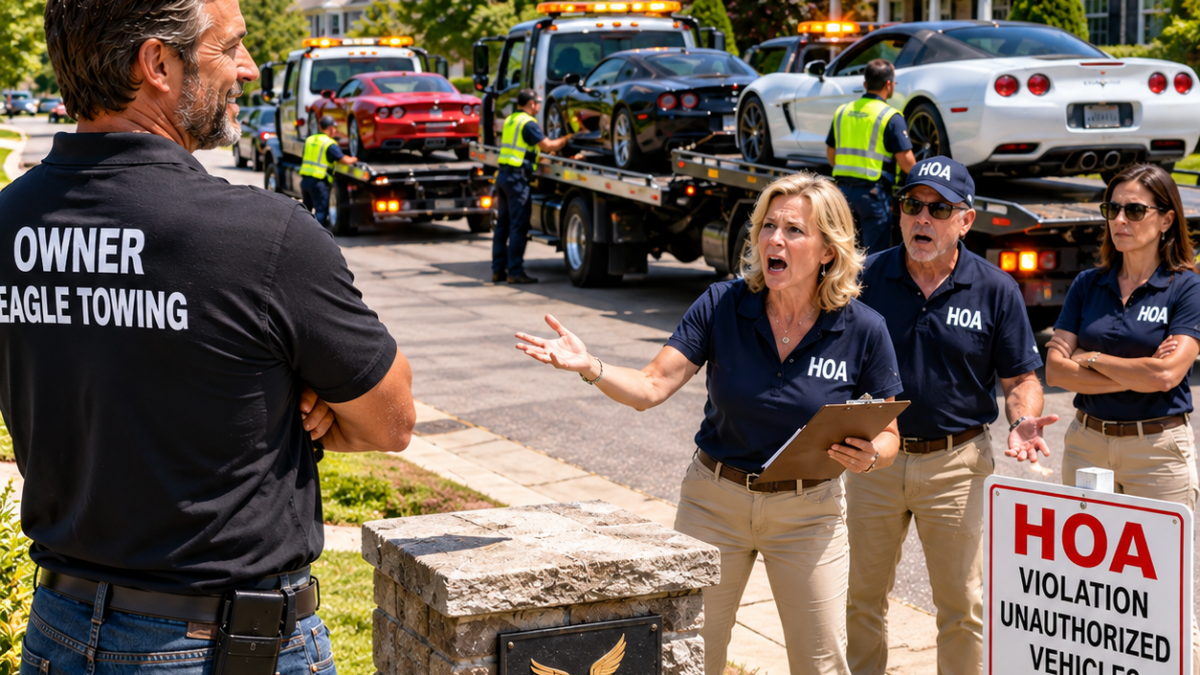
PART2:
“The one that means someone has made a terrible mistake and you’re letting them finish making it.”
I watched Austin secure the rear wheels.
Linda turned slightly so her phone could capture our front windows.
She wanted me to come outside angry.
She wanted footage.
She wanted me barefoot and furious on my driveway, yelling while she stood there in calm authority, proving to the neighborhood that Jack Mercer was exactly the kind of hostile resident she had warned them about.
I took a slow sip of coffee.
It had gone cold.
“Let her record,” I said.
Emily folded her arms.
“Is the car safe?”
“Yes.”
“How do you know?”
“Because my driver just did a proper four-point check.”
“Jack.”
“I’ll get it back.”
“That’s not what I asked.”
I looked at her.
She looked back.
That was marriage after twelve years. She could hear the parts I did not say.
“This is bigger than the Ford,” I said.
Outside, the tow truck rolled away.
Linda lowered her phone, smiled toward our house, then gave a small wave.
That wave cost her more than she could possibly imagine.
My name is Jack Mercer, and I had lived in Silver Creek Estates for eighteen months when Linda Crawford finally decided to tow my first car.
Not warn me.
Not call me.
Not knock on the door like a normal human being.
Tow it.
Silver Creek Estates was the kind of neighborhood that looked peaceful from the outside. Curved streets, brick mailboxes, clean sidewalks, two small ponds, young oak trees planted at equal intervals, and houses just different enough to let people pretend they had personality while still satisfying the architectural committee.
Emily and I moved there because it seemed quiet.
That was our first mistake.
Emily taught literature at a community college, and I ran a holding company from a small office downtown. We were not flashy people. We did not throw loud parties. We did not park boats in the driveway or paint the shutters neon green. We kept the yard trimmed, waved at neighbors, paid dues on time, and attended our first HOA meeting with the naïve optimism of people who still believed community governance meant adults solving small problems calmly.
Then we met Linda Crawford.
Linda had been president of the Silver Creek Estates Homeowners Association for three years by then, and in those three years she had transformed what used to be a friendly neighborhood into something that felt like an occupied territory with landscaping rules.
She was not greedy in the usual way.
That would have been easier to understand.
Linda was more dangerous than greedy. She was a person who had discovered that power over ordinary people gave her a sense of purpose, and once she found that purpose, she refined it into an art form.
She kept files.
She quoted bylaws from memory.
She knew which residents had late dues, which families were struggling, which widows lived alone, which people worked nights, which people hated confrontation, and which people would pay two hundred dollars just to make a letter go away.
She learned HOA law the way some people learn a second language.
Fluently.
Coldly.
Without mercy.
At meetings, she sat at the front table in tailored blazers, silver reading glasses low on her nose, pen arranged beside her agenda, and spoke in a calm voice that made every fine sound like a public service.
“Rules protect property values.”
“Consistency protects fairness.”
“Noncompliance creates community decay.”
She loved phrases like that.
Community decay.
As if a trash can visible from the street for twenty extra minutes was the first trumpet of civilization’s collapse.
When Emily and I first moved in, we tried to be friendly.
We introduced ourselves.
We attended the welcome mixer.
We asked about guidelines.
We read the community standards booklet, which was forty-six pages long and somehow managed to make mailbox placement sound morally significant.
What we did not do was act intimidated.
That, I later realized, was the beginning of Linda’s problem with us.
Linda Crawford needed residents to understand her place in the hierarchy. Her authority depended on more than official power. It depended on atmosphere. People had to feel that pleasing Linda mattered and displeasing her carried consequences.
I treated her politely, but I did not defer to her.
Emily did the same.
We said good morning.
We smiled.
We did not gossip.
We did not ask Linda for permission to exist comfortably in our own house.
To a normal person, that would have been neutrality.
To Linda, it was rebellion.
The first notice came six months after we moved in.
Trash bins visible from the street beyond the permitted window.
I checked the timestamp from our front camera. The bins had been pulled into the garage ninety minutes after collection, well within the stated rule. I wrote a polite response and attached the footage.
Linda replied with a second notice citing a different clause about “improper container staging.”
That clause did not apply to post-collection storage.
I wrote back again.
Then came the garage-door notice.
Linda claimed our garage door had remained open between 9:00 a.m. and 5:00 p.m., violating a new visual-continuity rule.
The door had been open because I was cleaning out storage bins.
On my own property.
In my own garage.
The rule had been amended three months earlier by Linda’s board to expand the HOA’s authority over visible garage use.
I paid the fine.
Emily stared at me across the kitchen table when I told her.
“Why would you pay it?”
“Because I want the receipt.”
“You’re planning something.”
“I’m documenting something.”
She leaned back.
“You have that calm voice again.”
“What calm voice?”
“The voice that makes me feel sorry for people who think they won.”
She knew me too well.
The notices continued.
A welcome mat that exceeded approved dimensions by two inches.
An “unapproved decorative object” on the porch, which turned out to be a ceramic planter Emily had bought from a local artist.
A mailbox number font allegedly inconsistent with community standards.
A driveway stain that was actually a shadow in Linda’s own photograph.
Every time, I answered.
Every time, I kept copies.
Every time, Linda escalated.
I did not discover the towing scheme until Mrs. Alvarez knocked on my door one rainy afternoon.
She was seventy-six, widowed, and lived three houses down. Her son worked nights at the hospital. His car had been towed from her driveway at 5:30 a.m. because Linda claimed it was an “unauthorized overnight vehicle.”
“He visits me after shifts,” she said, sitting at our kitchen table with both hands wrapped around the mug Emily gave her. “He checks my medication and sleeps on the couch before going home. She knows that.”
“How much did it cost?”
“Three hundred eighty dollars.”
Emily’s face tightened.
“Did the HOA reimburse you?”
Mrs. Alvarez gave a sad little laugh.
“They fined me two hundred dollars for arguing with the contractor.”
I looked at the receipt she brought.
Mercer Recovery & Transport.
My company.
I kept my face still.
“May I copy this?”
“Of course.”
When she left, Emily turned to me.
“Jack.”
“I know.”
“She’s using your company?”
“Apparently.”
“And you didn’t know?”
“I own six businesses through Mercer Holdings. I don’t personally approve every tow.”
“That sounds very rich-man evasive.”
“It is accurate.”
“It can be both.”
She was right.
I called my general manager, Paul Tennant, that evening.
Paul had run Mercer Recovery & Transport for nine years. Former Marine. Straight spine. Short sentences. Zero tolerance for sloppy paperwork.
“Paul,” I said, “do we have a contract with Silver Creek Estates HOA?”
“Stand by.”
Keyboard.
Then silence.
“Yes. Signed eight months ago. Patrol and call-in towing. Authorized agent listed as Linda Crawford, HOA president. Secondary contacts Greg Palmer and Nancy Vale.”
“What verification process?”
“Written authorization from listed agent, photo documentation, timestamp, location confirmation, and dispatch note.”
“Any complaints?”
“Some. Mostly residents claiming HOA overreach.”
“How many Silver Creek tows?”
Another pause.
“Thirty-seven in eight months.”
That number sat between us.
Silver Creek had only one hundred and twelve homes.
“Thirty-seven?”
“Yes.”
“Revenue?”
“Rough estimate, just over fourteen thousand in towing and storage. Separate administrative fees billed to HOA.”
“What administrative fees?”
“Expedited compliance processing. That was in their contract.”
“Pull the file.”
“You got a problem?”
“Yes.”
“With the contract?”
“With Linda Crawford.”
Paul went quiet.
Then said, “Understood.”
“No changes yet. No cancellations. No warning her.”
He understood faster than most.
“You want the records clean.”
“I want them untouched.”
“You got it.”
“Also pull every dispatch call, driver note, photo, invoice, GPS route, storage log, and authorization email connected to Silver Creek.”
“All of them?”
“All of them.”
Paul exhaled.
“That’s a lot of paper.”
“Good.”
For the next two weeks, I did nothing visible.
That was hard.
I wanted to march into the clubhouse with receipts, slam them on Linda’s table, and ask her who else she had humiliated for money, control, or sport.
But anger is a terrible investigator.
It moves too fast.
I needed to understand the whole system.
So I watched.
Paul sent me records every night.
Tow after tow after tow.
Mrs. Alvarez’s son.
A nurse who parked on the street during a family emergency.
A college student home for Christmas break.
A contractor’s van removed while the contractor was inside repairing a water heater.
A disabled veteran’s truck tagged for “commercial appearance” because it had a toolbox mounted in the bed.
A single mother’s car towed because it had a temporary spare tire for twenty-six hours.
Every file had the same pattern.
Linda claimed authority.
Linda signed.
Linda photographed.
Linda sometimes used the phrase “neighborhood deterioration risk.”
Sometimes “repeated noncompliance.”
Sometimes “abandoned or nuisance vehicle.”
Even when the vehicle was clearly not abandoned.
Even when it was in a private driveway.
Even when the supposed violation did not match the actual rules.
The worst file involved a man named Arthur Bell.
He had parked his late wife’s old Buick in his driveway under a cover. Linda had it towed, claiming “long-term storage of inoperable vehicle.” The Buick was registered, insured, and started fine. Arthur had left it covered because he could not bring himself to sell it.
He paid five hundred dollars to get it back.
Then sold the car two weeks later.
That one made Emily cry.
“It wasn’t just a car,” she said, reading the file at our kitchen table.
“No.”
“She knew.”
“Yes.”
“How do you know?”
I pointed to Linda’s photo.
The tow authorization included a note: Resident emotionally attached to vehicle, may resist removal. Proceed early.
Emily sat back.
“That woman is cruel.”
“Cruel with forms.”
“That’s worse.”
I agreed.
Then, on the Tuesday morning my Ford disappeared, Linda finally turned the machine on me.
The dispatch call had come in at 7:16 a.m.
Paul sent me the recording before the truck reached the storage yard.
Linda’s voice was calm.
“This is Linda Crawford, authorized agent for Silver Creek Estates. I need an immediate removal from lot 48, 1127 Briar Lane. Unauthorized vehicle in driveway, repeated violations, owner notified.”
The dispatcher asked, “Vehicle occupied?”
“No.”
“On common property or private driveway?”
“Private driveway, but subject to HOA enforcement under exterior vehicle compliance rules.”
“Tow authorization form submitted?”
“Yes. Emergency compliance tow. Resident has ignored multiple notices.”
The dispatcher followed protocol.
“Confirm HOA has authority to remove from private driveway.”
Linda replied, without hesitation, “Confirmed.”
There it was.
Confirmed.
That one word turned bad judgment into something else.
Because she had been notified.
Repeatedly.
In writing.
That my Ford did not violate the rules.
That my driveway was not common property.
That the HOA documents required hearing rights before towing from private residential lots except in genuine hazard situations.
She confirmed authority she did not have because she was used to nobody checking.
My Ford arrived at Mercer’s north yard at 8:22.
Paul called me.
“Car is here. Undamaged. We put it under camera in bay three.”
“Good.”
“You want it released?”
“Not yet.”
“Jack.”
“I know.”
“Your wife okay with that?”
I looked toward Emily, who was in the living room grading essays with the kind of forceful pen strokes that suggested every freshman paper had become Linda Crawford’s fault.
“Mostly.”
Paul sighed.
“You’re letting her hang herself.”
“No. I’m letting her finish the knot she started.”
At 10:03, Linda emailed me.
Mr. Mercer,
Your continued disregard for community vehicle standards has resulted in removal of the noncompliant vehicle from your driveway. Please contact the authorized towing provider for retrieval after payment of all applicable fees. Additional violations may result in further enforcement.
Regards,
Linda Crawford
President, Silver Creek Estates HOA
I forwarded it to Rebecca Sloan, my attorney.
Rebecca was not the same Rebecca from Garrett’s story. This Rebecca was a litigation attorney downtown, sharp as broken glass and allergic to bullies who used bylaws as weapons.
Her response came in four words.
Please tell me everything.
I did.
She came to the house that afternoon.
Emily made coffee.
I spread documents across the dining table.
HOA notices.
Receipts.
Tow logs.
Dispatch calls.
Mrs. Alvarez’s file.
Arthur Bell’s file.
The contract between Silver Creek HOA and Mercer Recovery.
Rebecca read for twenty minutes without speaking.
Then she looked up.
“She is not just overenforcing.”
“No.”
“She is creating violations, directing removals, bypassing hearings, and using towing fees as intimidation.”
“Yes.”
Rebecca tapped the contract.
“Why did your company accept this?”
“Because the paperwork from the HOA looked proper, and nobody knew the owner of lot 48 also owned Mercer Recovery.”
“That irony is almost too clean.”
“I’m aware.”
She leaned back.
“Do not retrieve your car yet.”
Emily made a strangled sound.
Rebecca looked at her.
“I know. But the cleanest evidence is the system operating exactly as Linda designed it.”
Emily closed her eyes.
“I hate that you’re right.”
Rebecca smiled faintly.
“Most people do.”
Then Linda made her second mistake.
She towed Emily’s car.
Two days after the Ford, at 6:58 a.m., another Mercer truck arrived.
This time, Emily stood at the window beside me.
Her silver Subaru sat in the driveway, parked where it always was. Current registration. No warning sticker. No notice. No hearing.
Linda stood on the sidewalk with Greg Palmer and Nancy Vale again.
This time, she did not smile toward the house.
She looked almost impatient.
The driver was different.
Marsha Tate.
Twenty years towing.
Best rollback operator in the county.
She walked around the Subaru, took required photos, then called dispatch from the driveway.
I later listened to the recording.
“Vehicle is on private driveway. Looks current. No visible hazard.”
Dispatch replied, “HOA authorization says repeat violation, fines unpaid, removal approved.”
Marsha said, “Copy, but I want a note in the file that vehicle appears operable and legally parked.”
That note would matter later.
Emily watched as her Subaru rolled away.
She did not speak until the truck turned the corner.
Then she said, “I want to ruin her.”
I put an arm around her.
“We’re getting there.”
“No, Jack. I mean emotionally, legally, financially, and narratively.”
That was the literature professor in her.
I almost smiled.
Linda’s email arrived twenty minutes later.
Mr. and Mrs. Mercer,
Your pattern of defiance leaves the association no choice but to escalate enforcement. Continued noncompliance may result in removal of additional vehicles, legal action, and suspension of community privileges.
Emily read it.
Then looked at me.
“Additional vehicles?”
We had two more in the garage.
My old 1968 Mustang, restored by my father and me over a decade.
And a company Tahoe I rarely used.
Both were behind a closed garage door.
Both invisible from the street.
Both impossible to classify as exterior violations unless someone entered or photographed through windows.
I installed additional cameras that afternoon.
Not hidden.
Visible.
Front driveway.
Garage exterior.
Side yard.
I also called Paul.
“Any towing request from Silver Creek comes to you personally before dispatch.”
“Already implemented.”
“Do not stop them unless there is safety risk. Document everything.”
“Jack, if she tries the garage, that is going to cross a line even a dispatcher can see from space.”
“I know.”
Linda crossed it on Saturday.
At 8:11 a.m., a tow truck stopped in front of my house, followed by Linda’s white SUV and a small pickup driven by a locksmith.
That was when I went outside.
Not angry.
Not loud.
Just outside.
Linda looked disappointed and pleased at the same time.
Some people enjoy being confronted when they think they already control the facts.
“Good morning, Mr. Mercer,” she said.
“No.”
She lifted her chin.
“Excuse me?”
“It is not a good morning. Why is there a locksmith at my house?”
She held up a folder.
“The association has authorized removal of additional noncompliant vehicles.”
“From inside my garage?”
“Your garage has been used to conceal vehicles associated with ongoing violations.”
Emily stepped onto the porch behind me.
Linda glanced at her, then back to me.
“Open the garage.”
“No.”
Greg Palmer crossed his arms.
“Jack, don’t make this harder than it needs to be.”
I looked at him.
“Greg, you are standing in my driveway while an HOA president tries to break into my garage. You should think carefully about how much easier you want this to be.”
The locksmith shifted.
“I was told this was a repossession support.”
Linda’s face flickered.
I turned to him.
“What company?”
“Harlan Lock.”
“Were you told this was a private residence?”
He looked at Linda.
“I was told abandoned vehicles were secured inside an association-controlled unit.”
Emily whispered, “Association-controlled unit?”
Linda said quickly, “That is not the precise wording.”
The locksmith backed away.
“I’m not opening anything.”
Linda snapped, “You were contracted.”
“Not for burglary with paperwork.”
He left.
That was the first public crack.
The tow driver followed.
Linda stood in my driveway with her folder, Greg, Nancy, and three neighbors pretending not to watch from across the street.
“You are obstructing enforcement,” she said.
“No,” I replied. “I am preventing a crime.”
“You are dramatic.”
“You brought a locksmith to my garage.”
“Because you refuse compliance.”
“Linda, do you know who owns Mercer Recovery & Transport?”
She blinked.
“What?”
I repeated it.
“Do you know who owns the towing company you’ve been using?”
Her expression shifted from irritation to confusion.
Then back to control.
“I don’t see how that matters.”
“It’s about to.”
I pulled a folded document from my pocket.
A corporate registration summary.
Mercer Recovery & Transport, LLC.
Member: Mercer Holdings Group.
Managing member: Jack Mercer.
Linda stared at it.
Greg leaned closer.
Nancy whispered, “Wait.”
I said, “Every dispatch call you made is recorded. Every tow authorization you signed is preserved. Every driver photo, GPS coordinate, storage log, invoice, and note is in my company system. Including your statements that you had authority to tow from private driveways. Including your attempt today to access my garage under a false premise.”
Linda’s face went pale in a way makeup could not cover.
“You own the towing company?”
“Yes.”
Greg stepped back.
Nancy stopped taking notes.
Across the street, Mrs. Alvarez stood at her mailbox, one hand over her mouth.
Linda recovered faster than I expected.
“That is a conflict of interest,” she said.
Emily laughed.
Not kindly.
Linda looked at her.
Emily said, “You used his company to steal his cars, and your first thought is conflict of interest?”
Linda pointed at me.
“You allowed enforcement to proceed knowing you owned the vendor.”
“I allowed evidence to remain unaltered.”
“You entrapped the association.”
“No. I drank coffee while you committed yourself in writing.”
Her voice rose.
“You are threatening me.”
“I am notifying you.”
Rebecca Sloan stepped out of a car at the curb.
Perfect timing.
She walked up the driveway carrying a leather bag and the calm expression of an attorney arriving exactly when the script required her.
“Mrs. Crawford,” Rebecca said, “I represent Mr. and Mrs. Mercer. This letter places you, the Silver Creek Estates HOA, and all board members on notice to preserve every record related to vehicle enforcement, towing contracts, fines, board votes, resident complaints, and communications with Mercer Recovery & Transport.”
Linda stared at her.
Rebecca handed her the envelope.
“Do not delete texts. Do not revise minutes. Do not destroy notes. Do not tell residents this is resolved. Do not contact my clients directly.”
Greg looked sick.
Nancy said, “Should we call the association attorney?”
Rebecca turned to her.
“Yes. Immediately.”
That afternoon, Linda called an emergency board meeting.
That evening, Rebecca sent demand letters.
The next morning, Paul suspended all Silver Creek towing pending legal review and issued an internal preservation order at Mercer Recovery.
By Monday, residents were talking.
By Tuesday, they were comparing stories.
By Wednesday, Emily had a folder thick enough to classify as a weapon.
People came to us quietly at first.
Mrs. Alvarez.
Arthur Bell.
The nurse.
The single mother.
The disabled veteran with the toolbox truck.
A college student whose car had been towed from his parents’ driveway during winter break.
A contractor fined after being towed while actively working inside a home.
Every story sounded different on the surface.
Underneath, it was the same.
Linda identified a target.
Linda issued a fine.
Linda denied appeal or delayed it until fees accumulated.
Linda authorized towing.
Residents paid because storage charges grew daily.
Then something uglier emerged.
The HOA received a “compliance recovery credit” from Mercer Recovery for each completed tow under the contract.
Not a kickback in the back-alley envelope sense.
It was written into the agreement as an administrative rebate applied to the HOA’s enforcement account.
Paul had approved it because some associations used credits to offset administrative costs. It was not inherently illegal if disclosed and properly handled.
But Silver Creek residents had never been told.
Linda had presented towing as a cost burden, not a revenue offset.
The credit did not go back to affected homeowners.
It did not reduce dues.
It sat in an enforcement account Linda controlled with minimal board oversight.
Then Rebecca found the invoices from Crawford Consulting.
Linda’s private LLC.
Crawford Consulting billed the HOA for “vehicle compliance review,” “evidence preparation,” “resident enforcement coordination,” and “appeal packet processing.”
In other words, Linda was paying herself to create the files that generated the fines that justified the tows that produced credits that funded more enforcement.
Emily read the invoice and whispered, “It’s a machine.”
Yes.
That was exactly what it was.
Not a mistake.
A machine.
The emergency HOA meeting took place eleven days after my Ford disappeared.
The clubhouse was packed so tightly people stood in the hallway.
Linda sat at the front table with Greg and Nancy. Her face was composed, but her hands gave her away. She kept aligning papers that were already straight.
The association attorney, a tired man named Martin Keller, looked like he had aged five years since taking the call.
Rebecca sat beside Emily and me in the second row.
Paul Tennant sat behind us with a banker’s box full of towing records.
That box changed the air.
People kept looking at it.
Linda opened the meeting.
“We are here to address misinformation being spread regarding lawful vehicle enforcement.”
Mrs. Alvarez stood before Linda finished the sentence.
“You towed my son’s car while he was sleeping on my couch after a hospital shift.”
Linda’s lips tightened.
“Mrs. Alvarez, individual enforcement matters are confidential.”
“No,” Mrs. Alvarez said. “They are expensive.”
A murmur moved through the room.
Arthur Bell stood next.
“You towed my wife’s Buick.”
Linda looked away.
Arthur’s voice trembled, but not from weakness.
“I told you I wasn’t ready to sell it. You said sentiment does not override standards. Then you had it taken before sunrise.”
Linda said, “Mr. Bell, the vehicle was covered and appeared stored.”
“It was in my driveway.”
“It violated—”
“It was the last car my wife ever rode in.”
Silence.
Linda had no phrase ready for that.
Rebecca stood.
She did not raise her voice.
“Silver Creek homeowners deserve answers to several factual questions tonight. First, whether the board approved towing from private driveways without hearings. Second, whether residents were informed the HOA received credits from completed tows. Third, whether the president disclosed her personal company’s billing related to vehicle enforcement. Fourth, whether the association ever obtained legal confirmation that its policies allowed removal from private residential driveways under the circumstances shown in these records.”
Martin Keller rubbed his forehead.
Linda snapped, “This is a hostile ambush.”
Emily stood.
“No, Linda. An ambush is when a tow truck shows up at sunrise.”
That line drew applause.
Not wild.
Not joyful.
Angry.
Linda struck the table with her pen.
“Order.”
The room got louder.
She struck it again.
“Order!”
This time, nobody quieted.
That was the moment her authority broke.
Not legally.
Not formally.
Socially.
People had obeyed Linda because they believed she knew the rules, controlled consequences, and could make life expensive. But now the cost of obedience was sitting in that room with receipts.
Paul opened the banker’s box.
He handed the association attorney a summary report.
Every Silver Creek tow.
Date.
Time.
Vehicle.
Location.
Authorizing party.
Stated violation.
Driver observations.
Photos.
Fees.
Storage days.
Release payment.
HOA credit.
Martin Keller read the first page.
Then the second.
Then he looked at Linda.
“You told me there had been fewer than ten tows this year.”
Linda said nothing.
Greg stared at her.
Nancy whispered, “Linda?”
Paul then produced the dispatch recordings.
He did not play all of them.
Just enough.
Linda’s voice filled the clubhouse speakers.
Confirmed authority.
Repeat violator.
Emergency compliance.
Abandoned vehicle.
Owner notified.
Tow immediately.
Then Marsha Tate’s driver note was displayed.
Vehicle appears operable and legally parked in private driveway. No visible hazard. HOA insists removal authorized.
People turned toward me.
I stood.
“Our Ford was in our driveway. Emily’s Subaru was in our driveway. Linda attempted to send a locksmith to our garage. The only reason that did not happen is because the locksmith had more sense than the HOA president.”
The locksmith, sitting near the back, raised one hand.
“Accurate.”
A few people laughed despite everything.
Then Rebecca displayed the Crawford Consulting invoices.
Linda’s composure cracked.
“Those services were disclosed to the board.”
Daniel Cho, the treasurer, stood slowly.
“No, they were not.”
Linda turned.
“Yes, they were.”
Daniel held up a binder.
“They were listed under administrative support. Not under your personal company. Not as vehicle enforcement preparation. Not as appeal packet processing. I asked twice why administrative costs were rising, and you told me Vantage software fees had increased.”
The room went still.
Emily leaned toward me.
“There it is.”
There it was.
The money trail.
Linda had not just bullied residents.
She had monetized fear.
Martin Keller asked for a recess.
The residents refused to leave.
So the board went into a side room while the clubhouse buzzed with anger, shame, and recognition.
Twenty minutes later, they returned.
Greg would not look at Linda.
Nancy had been crying.
Daniel held a printed motion.
Immediate suspension of Linda Crawford as HOA president pending independent legal and financial investigation.
Linda stood.
“You cannot remove me based on mob pressure.”
Daniel’s voice shook, but he read clearly.
“This motion is based on documented concerns regarding unauthorized enforcement, undisclosed financial conflicts, misrepresentation of towing authority, and potential misuse of association funds.”
Linda looked around the room.
For years, she had known every weakness in that neighborhood.
Who was tired.
Who was afraid.
Who was alone.
Who would pay.
Who would stay quiet.
That night, she finally saw what happens when quiet people compare receipts.
The motion passed four to one.
Linda voted against her own suspension.
Of course she did.
The investigation took two months.
My cars came home the next day, released at no cost, washed, photographed, and inspected. Paul personally drove the Ford back. Marsha brought Emily’s Subaru and apologized even though she had done her job correctly.
Emily accepted the apology.
Then made Marsha coffee.
That was Emily.
She could hate a system without hating the worker trapped inside it.
Mercer Recovery refunded improper towing charges to residents once legal review identified the problem cases. Not because every error belonged to us, but because my company had participated in removals that should have been questioned harder.
Paul changed policy immediately.
No HOA tow from a private residential driveway without legal authorization packet, notice confirmation, appeal status verification, and manager approval.
No emergency tow without actual hazard documentation.
No association credit hidden in contract language.
No more trusting a confident president with a clipboard and a grudge.
The HOA investigation found thirty-one improper or questionable tows.
Twenty-four denied or delayed appeals.
More than nineteen thousand dollars in resident towing and storage charges.
Nearly eight thousand dollars in HOA enforcement credits.
Forty-three thousand dollars billed by Crawford Consulting over two years.
Some of those bills were for work Linda had performed as HOA president, work she was already obligated to do without separate payment.
The board referred the matter to the district attorney and the state association oversight office.
The civil settlement came first.
Residents received reimbursements.
Fines tied to improper towing were reversed.
Credit damage from unpaid disputed fines was corrected.
Crawford Consulting repaid a substantial amount under settlement.
Linda resigned from the board before the formal removal hearing.
Her resignation letter blamed “a coordinated campaign by hostile residents resistant to accountability.”
Emily read that line aloud at breakfast.
“Hostile residents resistant to accountability,” she said. “That woman could describe a house fire as unauthorized combustion.”
I nearly choked on my coffee.
Linda sold her house five months later.
No one filmed the moving truck.
That showed more grace than she had ever shown anyone else.
Silver Creek changed after that.
Not completely.
Neighborhoods do not become healthy overnight just because one person loses a title.
For a while, people were embarrassed.
Some avoided me.
Some apologized too much.
Some tried to explain why they had supported Linda.
I understood part of it.
Linda had not ruled through force alone. She ruled through convenience. She made complex questions simple by giving people villains. The messy truck owner. The careless widow. The rude new couple. The resident who “refused standards.”
It is comfortable to believe the person being punished must have earned it.
Then one day the tow truck comes for you.
Daniel Cho became HOA president.
His first act was to end the towing contract with Mercer Recovery.
I supported it.
Not because Mercer had acted maliciously, but because trust needed distance.
His second act was to publish every enforcement policy in plain language.
His third was to create an independent appeal panel that Linda would have hated with her entire soul.
At the first meeting under the new board, Mrs. Alvarez spoke.
She stood at the microphone in a blue cardigan, small but steady.
“My son still visits after hospital shifts,” she said. “His car stays in my driveway. If anyone has a problem with that, come speak to me like a human being before you call a truck.”
People applauded.
Arthur Bell spoke too.
“I sold my wife’s Buick because this board made me feel ashamed of loving it.”
Nobody moved.
Arthur looked down at his hands.
“I can’t get that back.”
No policy could fix that.
No refund.
No apology.
No settlement.
Some losses are not financial, even when money caused them.
After the meeting, I found him outside near the pond.
“I’m sorry,” I said.
He nodded.
“Linda pulled the trigger, but the rest of us let her carry the gun.”
I did not know what to say to that.
Arthur smiled sadly.
“Too dramatic?”
“No,” I said. “Too accurate.”
Six months later, Mercer Recovery held a training session for all dispatchers and drivers using the Silver Creek case.
We removed names.
Not because Linda deserved privacy, but because training should teach systems, not gossip.
Paul stood in front of the room and said, “A signed authorization is not always enough. Authority has to be real.”
Marsha raised her hand.
“What if we’re pressured?”
“Escalate.”
“What if the property manager threatens the contract?”
“Lose the contract.”
The room went quiet.
Paul looked at every driver.
“A bad tow costs more than a lost customer. It costs trust. We are not hired muscle for people with paperwork.”
I stood in the back and felt proud of him.
Not for protecting the company.
For making it better after it had failed to ask enough questions.
That is harder than pretending the whole thing was someone else’s fault.
Emily and I stayed in Silver Creek.
People asked why.
Honestly, at first, I wanted to leave.
Every street corner had a memory.
Linda filming.
The Ford rolling away.
Mrs. Alvarez crying at our kitchen table.
Arthur standing in the clubhouse.
But then the neighborhood began changing in ways that mattered.
Neighbors waved differently.
Not performative.
Real.
People checked on one another before reporting one another.
When a car sat too long in a driveway, someone knocked.
When a trash bin stayed out overnight, someone asked if the family was okay.
When a young couple moved in and accidentally put up an unapproved fence stain, Daniel sent a friendly note with the correct process instead of a violation letter.
Silver Creek did not become perfect.
Perfect is suspicious.
It became more human.
That was enough.
One Saturday morning, almost a year after the first tow, Emily and I were in the driveway washing the Ford. It had become a ritual by then, partly because I loved the truck and partly because I enjoyed the quiet absurdity of cleaning the vehicle Linda had accidentally made famous.
Mrs. Alvarez walked over with a plate covered in foil.
“Empanadas,” she said.
Emily accepted them like treasure.
Arthur Bell followed a few minutes later with a cardboard box.
Inside was a framed photograph of his wife sitting in the Buick, laughing at something outside the frame.
“I found another copy,” he said.
He handed it to me.
“I thought you should see what that car was.”
I looked at the photo.
A woman in sunglasses.
One hand on the steering wheel.
Head thrown back mid-laugh.
Alive in a way no violation notice could measure.
“Thank you,” I said.
Arthur nodded.
“I bought another Buick.”
Emily smiled.
“You did?”
“Not hers,” he said. “But close enough to make the garage feel less empty.”
We stood there together for a while.
Neighbors passing.
Sun on the driveway.
Ford clean.
No tow trucks.
No Linda.
Arthur looked toward my garage.
“You still have the Mustang?”
“Yes.”
“You ever drive it?”
“Not enough.”
“Drive it.”
So I did.
That evening, Emily and I took the Mustang out with no destination. Just drove through the county roads beyond Silver Creek, windows down, engine humming, air warm.
At a stoplight, Emily looked over.
“You know what bothers me?”
“Only one thing?”
“Today? Yes.”
“What?”
“She thought towing the Ford would embarrass you.”
“It almost did.”
“No,” Emily said. “It revealed her.”
That was the truth.
Bullies depend on isolation.
One resident at a time.
One notice.
One fine.
One tow.
One quiet payment.
One embarrassed person retrieving their car from an impound lot, too ashamed or tired to compare notes.
Linda’s mistake was choosing the one driveway connected to the records she thought nobody would ever see.
Every chain.
Every invoice.
Every dispatch call.
Every driver note.
Every photo.
Every storage fee.
Every false statement.
All of it came back.
Not because I was smarter than everyone else.
Because documentation tells the truth when people finally read it together.
That is what Linda never understood.
She thought authority lived in her signature.
It did not.
Authority lives in the limits around power.
Notice.
Due process.
Transparency.
Records.
The right to appeal.
The obligation to prove what you claim before you punish someone.
Without those things, rules become weapons.
And neighborhoods become places where people watch each other suffer until it is their turn.
I still keep the first tow receipt in my office.
Not framed.
Not displayed.
Filed.
There is a difference.
On the folder tab, Emily wrote:
THE DAY LINDA TOWED HER OWN EVIDENCE.
That woman has a gift for titles.
Sometimes, when someone asks me what happened in Silver Creek, I tell the short version.
The HOA towed my cars.
I owned the towing company.
They got caught.
People like that version.
It has a clean punchline.
But the real story is not about irony.
It is about Mrs. Alvarez’s son after a hospital shift.
Arthur Bell’s Buick.
A young driver hesitating because the paperwork smelled wrong.
A dispatcher who trusted an authorized agent too quickly.
A wife who knew documentation mattered before justice had a shape.
A neighborhood that learned rules without humanity are just cruelty with formatting.
Linda Crawford wanted to humiliate me in front of everyone.
For a few minutes, she did.
I stood in my kitchen and watched my Ford leave behind a tow truck with my own company name on the door, and I felt something hot and bitter rise in my chest.
But humiliation is not defeat.
Sometimes humiliation is evidence arriving early.
Linda thought she was taking my cars.
What she really took was the cover off her own machine.
And once everybody saw how it worked, no one could unsee it again.
Silver Creek still has rules.
It should.
Communities need structure.
But now, when someone says a vehicle is noncompliant, the first question is no longer, “How fast can we tow it?”
It is, “Have we talked to the owner?”
That question would have saved a lot of pain.
It would have saved Mrs. Alvarez money.
It would have saved Arthur a memory.
It would have saved Linda her title, if not her pride.
And it would have saved me the strange experience of watching my own tow truck steal my own Ford while the woman who ordered it smiled for the camera.
But maybe some lessons only arrive on a flatbed.
At 7:43 on a Tuesday morning, Linda Crawford thought she had finally taught me my place.
She was right about one thing.
That tow changed everything.
Just not for me.








