The Girl in the Wheelchair Rejected My Princess Carriage—Then 50 Bikers Rebuilt It Until She Could Enter Alone
PART3:
He raised both hands.
“She asked who builds things.”
“You told a nine-year-old I build princess carriages?”
“I told her you could build almost anything.”
“That is not the same sentence.”
“She has imagination.”
Apparently.
Beneath the carriage, Sophie had written one more sentence.
Large block letters.
EVERY PRINCESS SHOULD ENTER BY HERSELF.
I read it twice.
Something old moved inside me.
Something I had kept buried long enough that I could usually pretend it wasn’t there.
“Where is she?”
Melissa pointed toward the parking lot.
“Van.”
“Why didn’t she come in?”
“She didn’t want to assume you’d say yes.”
“She sent you in alone?”
“She said grown-ups become more polite when children aren’t there.”
Deke snorted.
“Smart kid.”
I walked outside.
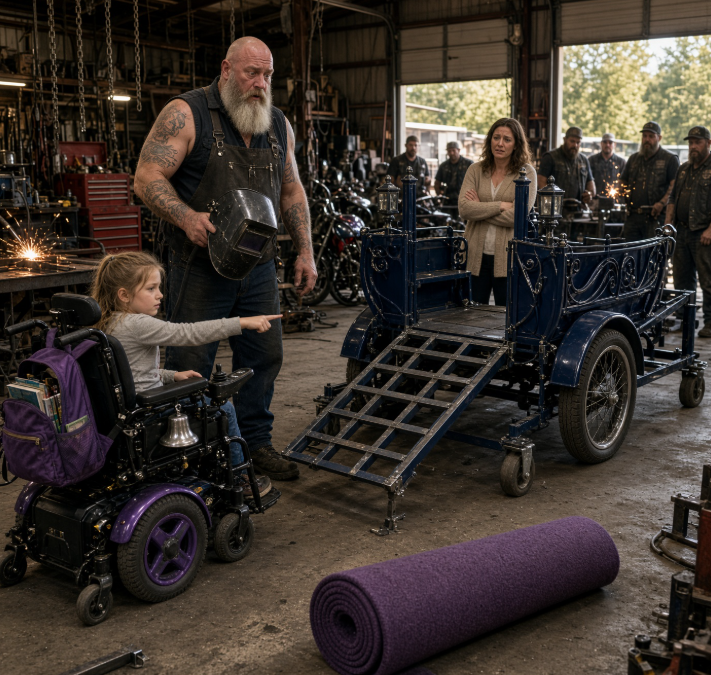
A converted white van sat near the curb.
Side lift lowered.
Inside, a girl sat in a purple powered wheelchair reading a thick book about medieval queens.
Light-brown hair.
Blue eyes.
Silver-framed glasses sitting a little crooked.
Backpack hanging from the chair.
Small silver bicycle bell attached to one armrest.
She looked up.
“You’re Anvil.”
“You’re trouble.”
“My mom says I’m persistent.”
“Same thing with better marketing.”
She smiled.
I held up the drawing.
“This yours?”
“Yes.”
“You drew my arms down to my knees.”
“You have long arms.”
“Not that long.”
“Do you want me to fix it?”
“No.”
She closed the book.
“Do you know how wide a wheelchair ramp should be?”
That caught me.
“Depends.”
“Thirty-six inches clear minimum. More is better.”
“Maximum slope?”
“One inch up for every twelve inches forward unless you’re using a powered platform or another approved system.”
“Turning radius?”
“Five feet.”
No hesitation.
I looked at Melissa.
She shrugged.
“She’s been measuring things since she was five.”
That part made sense once I knew her history.
Sophie had been healthy until four.
Then came a spinal infection.
Rare.
Fast.
At first her parents thought flu.
Then severe back pain.
By the time doctors understood what was happening, inflammation and infection had damaged her spinal cord.
She survived.
She never walked again.
At five years old, she learned something most people don’t learn until much later:
The world is full of invisible assumptions.
Steps.
Narrow bathrooms.
Heavy doors.
Tables too low.
Ramps too steep.
Elevators placed through kitchens.
“Accessible” entrances behind dumpsters.
Places where a chair technically fits only if the person using it possesses the maneuverability of a forklift operator and the patience of a saint.
Sophie had been measuring the world ever since.
“Why the carriage?” I asked.
She opened her book again.
“Founders Day.”
I knew the parade.
Everybody in Hollow Creek did.
Started in 1924.
Every October.
School band.
Historic tractors.
Local businesses.
Children dressed as founders.
One kid rode as railroad conductor.
Another as town historian.
And the student who completed the most summer reading hours became Storybook Princess.
“How many books?”
“One hundred twelve.”
I stared.
“Real books?”
Sophie looked offended.
“What kind of question is that?”
“Long books?”
“Some.”
“Picture books?”
“Three.”
“Cheater.”
“They were biographies.”
I nodded.
“Respectable.”
She had won the reading competition by thirty-seven books.
The old princess carriage was nearly a century younger than the parade but looked as if it had been designed by somebody who believed princesses were required to weigh eighty pounds and have perfect knees.
White wooden body.
Two curved steps.
Narrow side door.
Fixed velvet bench.
No wheelchair clearance.
No ramp.
No tie-downs.
No room for Sophie’s powered chair, which weighed close to three hundred pounds.
The parade committee’s solution?
Lift Sophie out.
Carry her inside.
Seat her on the bench.
Load her wheelchair onto a truck behind the carriage.
Melissa explained all this while Sophie stared at me.
“What did you say?”
Sophie answered.
“No.”
“Immediately?”
“I asked questions first.”
Of course she did.
“What questions?”
“What happens if I need to move?”
Melissa had answered:
Someone will help.
“What if there’s an emergency?”
We’ll be right there.
“What happens when photographers take pictures?”
That was the question nobody could answer.
Because Sophie understood what the adults had missed.
They wanted an image of inclusion.
A girl in a princess dress sitting inside the traditional carriage.
But to create the image, they had to remove the thing that gave her mobility.
Her chair wasn’t luggage.
It wasn’t a medical inconvenience.
It was how she moved through the world.
Taking it away so she could look like every previous princess didn’t make the tradition inclusive.
It made Sophie disappear inside it.
“So you quit?” I asked.
“I withdrew.”
“Same thing with better manners.”
She smiled slightly.
“Then I cried in the van.”
Melissa’s eyes lowered.
Sophie looked annoyed.
“Mom.”
“What?”
“He asked.”
I studied the drawing again.
“You wanted us to build something for your neighborhood?”
Melissa nodded quickly.
“I wasn’t asking you to get involved with the parade. The committee already selected another child. Sophie just wanted something for our street. Family. Friends.”
Sophie rang the bell.
One clear metallic ding.
Everybody looked.
“A princess needs witnesses.”
Deke, who had followed us outside, whispered, “We’re doomed.”
I crouched beside Sophie’s chair.
“Why fifty motorcycles?”
“Princesses have knights.”
“Fifty is excessive.”
“So is your beard.”
Deke had to turn around.
I looked at Sophie.
Then the drawing.
“Ramp in the back?”
“Drawbridge.”
“Why disguise a ramp?”
Her expression became serious.
“Not disguise.”
“Then what?”
“Make it pretty.”
She touched the drawing.
“People always act like ramps ruin buildings. So make the ramp the best part.”
There are moments when a project changes category without anybody announcing it.
It stops being a favor.
Stops being charity.
Stops being something you’re doing for somebody.
It becomes work you owe the idea itself.
That happened right there.
I carried a drafting table outside.
Set a clean sheet over Sophie’s wheelchair tray.
“All right, Your Highness.”
She straightened.
“What?”
“We build the drawbridge first.”
By ten that night, seventeen riders had committed.
By midnight, fifty.
Technically forty-nine plus me.
Black Lantern Riders weren’t all bikers who spent their days drinking beer and terrifying suburban parents.
One was a retired rehabilitation nurse.
Three were welders.
One commercial electrician.
A retired mechanical engineer.
Two machinists.
An HVAC technician.
A former paramedic.
A county roads supervisor.
Several mechanics.
A cabinetmaker.
A woman who sewed marine upholstery.
A structural engineer who rode a Gold Wing and claimed that made him more sophisticated than Harley riders.
We ignored him.
Melissa asked the question parents always ask before allowing strangers to build something around their child.
“How much?”
I looked at the whiteboard where Deke was already assigning work.
“$50.”
She blinked.
“What?”
“One dollar per knight.”
“Mr. Calder—”
“Anvil.”
“That isn’t possible.”
Sophie opened a pouch attached to her chair.
She removed a wrinkled dollar bill.
Placed it on my welding bench.
“For you.”
Deke immediately put down another.
Then Mona.
Preacher.
Within twenty minutes, fifty dollar bills were stacked beside Sophie’s.
We framed them later.
Never spent one.
That first week was design.
No welding.
I insisted.
If you start cutting metal before you understand the person using it, you’ve already decided the person’s job is to adapt to your object.
Sophie came after homework every night.
She knew what she wanted.
Midnight blue.
No pink.
Silver stars.
Purple interior.
“No throne.”
“What kind of princess doesn’t have a throne?”
“My wheelchair is the throne.”
Fair.
Rear drawbridge.
Wide enough that she could align without somebody touching her controls.
Interior turning area.
Secure rated tie-downs.
A restraint she could release when safely stopped.
Emergency medical access.
Removable roof panel.
Ventilation.
No decorative fabric anywhere near moving wheels.
Battery lanterns.
Communication headset between Sophie and driver.
And one thing she refused to compromise:
She controlled the drawbridge.
I said, “Driver controls ramp.”
Bell.
Ding.
“If someone else controls it, it’s their carriage.”
“It’s a safety system.”
“Then give me a safe switch.”
Melissa said gently, “Sophie—”
Ding.
I raised a hand.
“No, she’s right.”
Melissa stared.
I pointed at Sophie’s controls.
“Princess controls the drawbridge.”
That became our rule.
If Sophie could do a task herself, the carriage would not require an adult to do it for her.
Nobody pushes unless asked.
Nobody opens the ramp unless safety requires it.
Nobody moves her chair controls.
Nobody grabs the chair handles.
Nobody treats mobility equipment like furniture.
You’d be surprised how many adults needed practice.
So did I.
The first time Sophie came inside the shop after we began fabrication, one of the guys automatically pulled a chair out of her path.
Sophie rang the bell.
Ding.
“What?”
“You could ask.”
He froze.
“Ask what?”
“Whether I need you to move it.”
“You were coming this way.”
“I can go around.”
“But—”
Ding.
By the end of week one, everybody feared that bell.
Not Sophie.
The bell.
Deke started calling it the Voice of God.
I didn’t tell anyone why the project had gotten under my skin.
Not at first.
Inside the left interior pocket of my leather vest was a metal tiara.
Cheap thing.
Tin or plated steel.
Some fake stones missing.
One side dented.
I’d carried it for thirty-eight years.
It belonged to my little sister.
June.
She was ten when I was fifteen.
Cerebral palsy.
Manual wheelchair.
Steel frame.
Heavy enough that my father used to complain loading it into the station wagon was better exercise than his construction job.
June loved royalty.
Not modern princess stuff.
Old movies.
Castles.
Queens.
Especially anything with a dramatic staircase.
Which was ironic, and June knew it.
She once told me:
“Every castle is designed by somebody who hates wheels.”
She should have been an architect.
In 1988, her teacher nominated her to be junior princess in the same Hollow Creek Founders Day parade.
The committee agreed.
Then somebody measured the carriage.
Doorway: nineteen inches.
June’s chair: twenty-four.
Adults had meetings.
Lots of meetings.
Adults love meetings when nobody wants responsibility for saying no.
They suggested carrying her.
Borrowing a narrower chair.
Putting her in a convertible.
Letting her sit on the back seat of the mayor’s car.
Every solution required June to become less visibly herself.
Eventually they chose another girl.
Nobody called it exclusion.
They called it practicality.
That word has done a lot of damage.
On parade morning, I stole a red wagon from our shed.
Tied June’s wheelchair to it with rope.
Put her metal tiara on her head.
Hooked the wagon behind my bicycle.
“I’m entering you anyway.”
She stared.
“That’s stupid.”
“Probably.”
“Dad’s going to kill you.”
“Probably.”
“You can’t pull me down Main Street.”
“Watch me.”
We made it three blocks.
A police officer stopped us before the parade route.
I shouted.
June cried.
Spectators stared from folding chairs.
My father arrived furious.
Dragged me home by the back of my jacket.
I remember June’s face more than anything.
Humiliated.
Not because she hadn’t ridden in the parade.
Because I had turned her disappointment into my rebellion.
I didn’t understand that then.
That evening, I stole the tiara from her bedroom.
I told myself I would build her a real carriage.
Not a wagon.
Something beautiful.
Something nobody could stop.
I never did.
At seventeen, I started drinking heavily.
At nineteen, motorcycles.
At twenty-three, prison.
Roadside fight.
Tire iron.
Broken jaw.
Twenty-eight months.
June visited once.
One time.
She rolled into the visiting room.
Glass between us.
Phone receiver.
I tried explaining.
“He started it.”
She stared at me.
“I don’t care.”
“You don’t understand.”
“No, Ray. You don’t.”
She rarely called me Ray.
Usually Raymond when angry.
That day:
Ray.
“You keep building cages and acting surprised when you’re inside one.”
I wanted to argue.
Didn’t.
She hung up.
Seven months before my release, June developed pneumonia.
Complications.
Hospital.
She died at twenty.
My mother sent a letter.
Three sentences.
I read them until the paper tore along the fold.
When I got home, June’s chair was gone.
Donated.
Clothes donated.
Books split among cousins.
Most photographs eventually ruined when my parents’ storage shed roof leaked.
All I had was the tiara.
I kept it.
Moved it from jacket to jacket.
Eventually stitched a special pocket into my leather vest.
Nobody knew.
When I saw Sophie’s drawing, I wanted to believe the universe had handed me a chance to keep my promise.
That was dangerous.
I knew myself well enough by then.
Guilt makes men reckless.
Especially men like me.
We start calling urgency love.
We take shortcuts because slowing down feels like another failure.
So I pulled Deke aside.
“If I start building this for June instead of Sophie, stop me.”
He looked at my face.
“You going to listen?”
“Probably not.”
“Give me your shop keys.”
I did.
Thirty-two nights.
That’s how long we built.
Not full days.
Most riders worked regular jobs.
They came after dinner.
Weekends.
Sometimes until two in the morning.
Frame first.
Lightweight aluminum tubing.
Engineered load paths.
Composite wall panels.
Independent trailer braking.
Low floor.
Wide rear entrance.
The first ramp prototype looked good.
Sophie hated it.
“Too steep.”
“It’s within spec.”
“Empty.”
“What?”
“My chair adds weight.”
“Ramp angle doesn’t change with weight.”
“Flex does.”
She was right.
We reinforced it.
Second ramp.
Better.
Sophie drove halfway up.
Stopped.
Backed down.
“No.”
“What now?”
“My front casters hesitate.”
“It’s smooth.”
“Not smooth enough.”
We measured.
At the threshold where the folding ramp met the floor, there was a rise.
Half an inch.
Caused by the actuator assembly.
“That’s nothing.”
Sophie looked at me.
“It is if my wheel catches.”
“We can bevel it.”
“Then it still exists.”
“Carpet.”
I regretted the word before finishing it.
Her eyes moved toward the purple carpet roll.
Then back.
“Carpet doesn’t remove a barrier.”
Silence.
“It hides it.”
Deke coughed.
His signal.
Stop building for your pride.
Listen.
I stared at the ramp.
Fourteen hours of fabrication.
Custom hinge.
Actuator mount.
“$600 in hardware.”
Preacher said.
Sophie folded her arms.
I sighed.
“Take it apart.”
Everybody groaned.
We took it apart.
Moved actuator below.
Redesigned hinge geometry.
Lowered floor interface.
Machined transition plate.
Preacher donated skin from his left thumb after slipping with a file.
The third ramp was nearly flush.
Sophie lined up.
Rolled forward.
Her powered chair climbed without hesitation.
No push.
No catch.
At the top, she stopped.
Looked over her shoulder.
Then pressed the crown-shaped button beside her joystick.
The ramp rose.
Folded.
Locked.
Became the rear wall.
Sophie smiled.
The whole shop applauded.
She raised one finger.
“Not done.”
Of course.
“What now?”
She pointed at the control panel beside the driver’s location.
“What’s that?”
“Emergency override.”
“Who controls it?”
“Driver.”
Ding.
“Absolutely not.”
I crossed my arms.
“Absolutely yes.”
She stared.
“Why?”
“Because if your controller fails—”
“Then fix it.”
“If there’s a fire—”
“I open it.”
“If you’re unconscious?”
She stopped.
I continued.
“If electrical power fails?”
“Manual release.”
“If you’re panicking?”
“I’m nine, not stupid.”
“Those aren’t the same thing.”
Melissa stepped forward.
“Raymond—”
Ding.
Sophie said, “Someone can open it without telling me.”
“Emergency only.”
“How do I know?”
“Because I say so.”
She looked at me like I’d just lost forty IQ points.
“That’s not independence.”
We argued forty minutes.
A fifty-three-year-old ex-con biker and a nine-year-old princess arguing over emergency-control hierarchy.
Mona finally slammed a notebook onto the table.
“Both of you shut up.”
We did.
Rehabilitation nurses have that power.
Mona designed a solution.
Sophie’s control remained primary.
Driver override required two deliberate actions under a guarded cover.
Indicator light showed whether Sophie’s controls were active.
Any override triggered an audible tone.
No casual overrule.
Safety without silently removing control.
Sophie approved.
That changed the entire club’s understanding.
We had started believing accessibility meant space.
Wide ramp.
Wide door.
Enough turning radius.
Sophie showed us access without control can still be dependence.
We tested everything.
Tow vehicle was a heavily modified touring trike.
Not because trikes are fairy-tale appropriate.
Because stability.
Independent brakes.
Low-speed torque.
Redundant lighting.
Rated hitch.
Safety chains.
Carriage final weight: 742 pounds.
Within engineering limits.
We added 320 pounds of ballast to simulate Sophie, chair, medical equipment, and margin.
Turn tests.
Slope tests.
Emergency stops.
Electrical failure.
Manual release.
Rain simulation.
Battery backup.
Fifteen miles an hour.
Stop straight.
Eighteen.
Stable.
Twenty.
Then the left brake sensor failed.
One wheel locked.
The carriage jerked sideways.
Maybe eight inches.
Enough.
Nobody inside.
Still enough.
Cal crawled underneath.
“Sensor.”
“Why?”
“Fault.”
“Fix?”
“Replace.”
“How long?”
“Tonight.”
I said, “Stop testing.”
He looked up.
“Anvil.”
“Stop.”
“Parade route is walking speed.”
“Children run into streets.”
“We aren’t going twenty.”
“What if we have to?”
Silence.
“We replace both sensors.”
“Only one failed.”
“Both.”
“That’s three days with rewiring.”
“Then three days.”
Devin, youngest member, threw his gloves.
“You’re trying to make this perfect because of June.”
Nobody knew the name.
Not most.
The shop quieted.
Deke looked at me.
Devin realized he’d learned more than he should have somewhere.
“Who’s June?” Sophie asked.
I ignored her.
I looked at Devin.
“It doesn’t need to be perfect.”
He crossed his arms.
“Sure acts like it.”
“It needs to bring Sophie home.”
Everything stopped.
That’s the standard.
Not pretty.
Not on schedule.
Not good enough for a parade.
Bring her home.
We replaced both sensors.
Rerouted wiring.
Repeated every test.
Passed.
Then somebody took a photograph through the front windows.
Carriage under tarp.
Fifty motorcycles around it.
Bikers everywhere.
No Sophie in frame.
No explanation.
Online caption:
BLACK LANTERNS BUILD SECRET FLOAT—PLAN TO TAKE OVER FOUNDERS DAY?
Another:
MOTORCYCLE CLUB PREPARING PARADE PROTEST AFTER DISABLED GIRL REJECTED
By breakfast, half of Hollow Creek thought we planned to storm Main Street.
The other half hoped we would.
I wanted neither.
Friday afternoon, three vehicles entered my lot.
Police cruiser.
City truck.
Gray sedan.
Evelyn Price stepped out.
Parade director.
Sixty-two.
Silver hair.
Clipboard.
I recognized her immediately even though thirty-eight years had passed.
She’d been twenty-four in 1988.
Assistant parade coordinator.
Standing near the police officer who stopped me and June.
Clipboard in hand.
Evelyn recognized me too.
Neither of us mentioned it.
“You applied for a custom trailer.”
“Yes.”
“You did not disclose fifty motorcycles.”
“The form requested tow vehicle.”
“The motorcycles are part of the entry.”
“Escort.”
“You cannot insert a motorcycle club into a children’s parade.”
“We’re escorting Sophie.”
“The committee selected another princess.”
“You selected Sophie first.”
“The historic carriage couldn’t accommodate her.”
“So we built one.”
Evelyn looked at the tarp.
“In a motorcycle shop.”
Marlene would have killed her for saying that if this were Danny’s story, but this was mine.
I gestured around.
“My shop fabricates commercial equipment, mobility frames, emergency components, certified structural assemblies, and custom trailers.”
The inspector stepped forward.
“Paperwork?”
I brought him the binder.
Three inches thick.
He raised his eyebrows.
“Everything?”
“Try me.”
He did.
Three hours.
Measured ramp.
Door clearance.
Tie-down ratings.
Safety chains.
Wheel load.
Tongue weight.
Brake synchronization.
Lighting.
Emergency release.
Battery isolation.
Welds.
Tire capacity.
Turning clearance.
Then Sophie arrived.
She demonstrated entry.
No assistance.
Closed drawbridge.
Turned inside.
Activated lanterns.
Explained controls.
Even Evelyn softened.
“It’s beautiful.”
Sophie smiled.
“Would you like to see the crown lights?”
I said, “Don’t encourage her.”
She pressed button.
Silver crown shapes illuminated around the roof.
Evelyn smiled before remembering she was supposed to be difficult.
Then the inspector found the bolt.
Secondary safety-chain mount.
Correct grade.
But certification mark wasn’t visible after plating.
Could replace easily.
Then worse.
Hydraulic brake line ran half an inch from suspension bracket.
Never touched.
But under maximum compression?
Possible.
Cal crouched.
“I can reroute in twenty minutes.”
Inspector shook his head.
“Then brake system needs reinspection.”
“When?”
“Monday.”
“The parade is tomorrow.”
“I know.”
He tied a red rejection tag onto the hitch.
Sophie watched.
Her finger began tapping the wheelchair joystick.
Melissa saw.
Knelt.
“We’ll figure it out.”
Sophie looked at me.
“You said it was safe.”
My mouth went dry.
“I believed it was.”
“Is he wrong?”
Every rider looked at me.
I wanted to say yes.
The brake line had passed dozens of tests.
We’d never seen contact.
At parade speed, suspension movement minimal.
The chance was tiny.
But there was a child inside.
“No.”
Sophie went still.
“He’s not wrong.”
Devin muttered something.
I ignored him.
“We fix it.”
“When?”
“Now.”
“Inspection Monday.”
“We find another.”
“What if you can’t?”
I hated the answer.
“Then carriage doesn’t move.”
Melissa looked at me sharply.
Sophie whispered, “You promised.”
The words hit somewhere the tiara already lived.
“I promised a safe carriage.”
“You promised I’d ride.”
I crouched beside her.
“I was wrong to promise something I couldn’t control.”
Her eyes filled.
“Adults always say that after.”
She turned her chair.
Rolled out.
No bell.
That hurt worse than anything.
Devin waited until the van left.
“We fix it and tow anyway.”
“No.”
“Nobody will know.”
“I will.”
“At five miles an hour that bracket doesn’t move.”
“No.”
“The town already thinks we’re criminals.”
“Doesn’t matter.”
“June didn’t get her carriage.”
I crossed the room.
Grabbed the front of his vest.
Deke moved.
Too late.
Devin stood still.
“You think that’s what this is?”
He swallowed.
“I’m saying—”
“My sister is dead.”
The room changed.
I had never said it aloud to most of them.
“You don’t use her to make Sophie unsafe.”
My fist tightened.
Thirty-eight years of failure wanted a target.
Then I looked at Sophie’s drawing pinned above the workbench.
Sir Anvil.
Ridiculous beard.
Long wrench.
Open hand.
Not fist.
I released Devin.
“We fix the line.”
I stepped back.
“Then find an inspector.”
Next twenty-four hours were chaos.
Rerouted brake line.
Changed mount.
Replaced bolt.
Preacher called certified inspectors within 150 miles.
County office.
State trailer safety.
Mobility organizations.
Veterans groups.
At 2:20 Friday morning, somebody called back.
Teresa Alvarez.
Certified inspector in Knoxville.
Had reviewed adaptive trailers used by veteran organizations.
She could come after her regular shift.
Fee:
$1,800.
Before I could object, money started appearing on my bench.
Not single dollars this time.
Twenties.
Fifties.
Hundreds.
Deke.
Mona.
Preacher.
Rico.
Everybody.
Friday evening.
Rain.
Teresa arrived exhausted.
Didn’t care about our feelings.
Good sign.
Inspected.
Requested full brake test.
Again.
Loaded ballast.
Ten miles an hour.
Stop.
Straight.
Fifteen.
Straight.
Then emergency braking on wet pavement.
I climbed onto the trike.
Rain hit my helmet.
Fifty riders lined the private test road with headlights on.
Teresa raised hand.
I accelerated.
Signal.
I hit both brake systems.
Trike slowed hard.
Carriage stayed straight.
No sway.
No lock.
No contact.
We repeated.
Then again.
Teresa crouched under carriage with flashlight.
Twenty minutes.
Finally stood.
Removed red tag.
“You built a safe trailer.”
Nobody cheered yet.
She pointed at me.
“Don’t let costumes make you forget it’s machinery.”
“I won’t.”
I offered payment.
She refused.
“No.”
“Your fee.”
“My older sister uses a wheelchair.”
She glanced toward Sophie’s purple gloves sitting on the workbench.
“Buy the princess better gloves.”
Carriage passed.
One problem remained.
Parade entry.
Evelyn still stood between Sophie and Main Street.
She arrived under shop awning holding papers.
“The committee has already appointed Harper Lane.”
“We’re not replacing her.”
“Then where does Sophie ride?”
“Back.”
“The princess rides near the front.”
“Then call her something else.”
A voice behind Evelyn:
“I don’t want Harper removed.”
Sophie.
She’d returned.
Jeans.
Rain jacket.
No crown.
Melissa behind her.
Sophie rolled forward.
“She read eighty books.”
Evelyn said gently, “Sophie—”
“That’s still a lot.”
I almost smiled.
Sophie continued.
“Put me behind her.”
Evelyn looked around.
Fifty bikers.
Wet.
Exhausted.
Carriage glowing blue under shop lights.
Then her eyes moved to my hand.
I hadn’t realized I’d taken out the tiara.
June’s.
Dented metal.
Fake stones.
Evelyn’s face changed.
“Is that June’s?”
I stopped.
“You remember her?”
“I was there.”
“You held the clipboard.”
She nodded.
“I was twenty-four.”
“You let them remove her.”
“Yes.”
No excuse.
That was unexpected.
“My father ran the parade.”
“I know.”
“I was afraid if I challenged him, he’d remove me from the committee.”
“So you stayed quiet.”
“Yes.”
Rain hit the metal roof.
She looked at the tiara.
“I’ve regretted it for thirty-eight years.”
I wanted anger.
Clean anger.
But regret complicates enemies.
Sophie watched us.
“Who’s June?”
I closed my hand around the tiara.
“My sister.”
“Wheelchair?”
“Yeah.”
“Princess?”
“Supposed to be.”
Sophie understood.
Immediately.
“What happened?”
“The carriage had steps.”
She looked toward hers.
Then back at the tiara.
Evelyn stepped closer.
“The parade begins at ten.”
I waited.
“The accessible carriage may enter behind the school band.”
Sophie shook her head.
“Behind Harper.”
Evelyn stared.
“Why?”
“Because she didn’t do anything wrong.”
That child.
Evelyn nodded.
“Behind Harper.”
For the first time in Hollow Creek history, Founders Day would have two princesses.
Saturday morning.
Clouds.
Rain threatened.
Black Lantern Riders assembled outside my shop.
Forty-nine motorcycles.
My touring trike.
Midnight-blue carriage.
Nobody wore fake armor.
Devin had suggested it.
Sophie rejected it.
“You’re already knights.”
She gestured at our vests.
“Wear the stuff that scares people until they know you.”
Hard to argue.
Mona tied silver ribbons to handlebars.
Deke mounted purple flag.
No words.
One crown.
At 8:30, Sophie’s van arrived.
Silver dress.
Altered carefully to avoid wheels and controls.
Purple gloves.
Light-brown hair.
Glasses.
On her lap:
Plastic princess crown.
June’s tiara.
She held both up.
“Which?”
Deke said, “Dented.”
Preacher said, “Shiny.”
Sophie placed June’s tiara on her own head.
Then put plastic crown on my helmet.
“Both.”
Everyone laughed.
I didn’t.
Not immediately.
Seeing June’s tiara on Sophie nearly stopped me.
Not because Sophie became June.
She didn’t.
That was the point.
She was Sophie.
Alive.
Bossy.
Present.
Future ahead.
Deke saw my face.
He leaned close.
“You good?”
“No.”
“Need a minute?”
“No.”
“That’s not convincing.”
“Start bikes.”
Sophie approached the ramp.
Every rider became quiet.
A month of work.
Three versions.
Safety tests.
Red tag.
Arguments.
Money.
No one had yet watched her enter outside shop conditions.
She aligned chair.
My right hand reached instinctively toward ramp control.
Sophie looked at it.
I stopped.
Stepped back.
She pressed her crown button.
Drawbridge lowered.
She rolled up.
Front casters crossed threshold.
No catch.
Inside.
Turn.
Position.
Lock.
Mona checked restraints.
Emergency release.
Medical bag.
Battery monitor.
Headset.
Sophie closed ramp herself.
Click.
Crown indicator lit.
Her voice came through my helmet.
“Sir Anvil.”
“Yes, Your Highness?”
“Your crown is crooked.”
“Aerodynamic.”
She laughed.
At 9:10, we rode toward town.
First bikes entered Hollow Creek.
People came out of shops.
Police stood intersections.
Then my trike appeared.
Behind it, midnight blue.
Silver stars.
Lanterns glowing.
Open side windows.
Sophie visible inside, seated in her own wheelchair wearing June’s tiara.
Forty-four motorcycles behind.
Rumors had drawn more spectators than usual.
People expected trouble.
What they got was engineering.
We reached staging.
Historic white carriage ahead.
Harper Lane sat inside.
Eleven years old.
Pink dress.
Clearly terrified by fifty motorcycles arriving.
Sophie lowered ramp.
Harper climbed out.
Walked toward us.
“I’m sorry.”
Sophie frowned.
“For what?”
“They picked me after you.”
“You read eighty books.”
Harper nodded.
“That’s still a lot.”
I bit inside of cheek to avoid smiling.
Harper said, “I could ride with you.”
Sophie looked at interior.
We had caregiver seat.
Not second child restraint.
“No.”
Harper seemed surprised.
“Why?”
“Not safe.”
Good kid.
Harper removed silver ribbon from her hair.
Tied it around Sophie’s armrest.
“Now they match.”
Band started.
Harper’s carriage moved first.
Then ours.
Main Street.
People quiet at first.
Then Sophie waved.
A little boy near curb bowed.
His mother laughed and bowed too.
Next family copied.
Soon people lined street bowing like idiots.
Perfect.
Firefighters removed caps.
Shop owners stood outside.
Sophie rang bell.
I heard through headset.
“What?”
“Look left.”
A girl with forearm crutches stood near courthouse.
Father holding her steady at curb.
Sophie asked:
“Can she ride?”
“Not during moving route.”
“After?”
“Yes.”
“Promise?”
I paused.
“I’ve become cautious about promises.”
“Sir Anvil.”
“Yes.”
She laughed.
Near Miller Street, a dog slipped leash.
Ran toward route.
Officer caught it.
But I had already braked.
Hard.
Independent system activated.
Carriage stayed straight.
No sway.
No jerk.
Sophie secure.
Cal rode behind.
Thumb up.
I looked at brake indicator.
Green.
That red tag.
That delay.
That extra inspection.
Every frustrating hour mattered.
At final turn, rain began.
Umbrellas opened.
People stayed.
Sophie said into headset:
“Can the knights make thunder?”
I looked at police.
Children.
Evelyn.
“Small thunder.”
“Fine.”
She raised fist through side opening.
Fifty hands moved to throttles.
She dropped fist.
Engines rolled.
Deep V-twin wave.
Not violent.
Controlled.
Street vibrated.
Sophie raised both arms.
For one mile, a child once told the princess carriage had no room for her rode through her town surrounded by fifty leather-clad knights beside a drawbridge she could open herself.
People waved.
Some cried.
I didn’t.
My eyes were leaking rain.
Different thing.
After official parade, I turned toward shop.
Sophie rang bell.
“No.”
“What?”
“We’re not done.”
“What now?”
“Other people.”
We parked by courthouse on level pavement.
Sophie lowered ramp.
The girl with crutches came first.
Riley.
Eleven.
Adults moved to lift her.
Sophie raised hand.
“Ask.”
Riley chose to use handrail.
Slowly.
Entered.
Harper joined after leaving historic carriage.
Two princesses together.
Then boy in manual chair.
Twelve.
Marcus.
He stopped.
“Princesses only?”
Sophie shook her head.
“Royalty.”
We removed decorative side chair.
Adjusted restraint.
Marcus rolled in.
Wore plastic crown from my helmet.
Line grew.
Mobility scooter.
Four-year-old in braces.
Elderly Vietnam veteran with bilateral amputations who didn’t want a ride, only wanted to inspect our brakes.
He and Cal talked twenty minutes.
That afternoon carriage completed twenty-seven short loops.
Twenty-seven people.
Every one through drawbridge.
Nobody lifted merely for photo.
Nobody removed wheelchair to make tradition easier.
At sunset, Sophie removed June’s tiara.
Held it.
“I think this belongs here.”
I swallowed.
“It was hers.”
“I know.”
“Then—”
“The carriage can carry her.”
Above entrance was small protected storage panel for emergency tools.
We made space.
Mounted tiara behind clear cover.
Not permanently sealed.
Protected.
Below it, Sophie placed her original crumpled dollar.
One promise I failed.
One agreement I kept.
Back at shop, riders gathered.
Deke presented Sophie with small patch.
No club logo.
Just silver wrench under crown.
Melissa asked where to sew it.
Sophie said, “Not clothes.”
Attached it to wheelchair backpack.
Then she handed me a certificate.
Purple stars.
Crayon crown.
SIR ANVIL, KEEPER OF THE WRENCH, DEFENDER OF DRAWBRIDGES, AND LISTENER WHEN CORRECTED.
Everybody laughed hardest at last line.
I folded it.
Put it inside vest.
Same pocket where June’s tiara had lived thirty-eight years.
The pocket felt empty.
Not wrong.
Ready.
That evening we voted on carriage.
Donate to town?
Sell raffle tickets?
Use money for accessibility?
Sophie rang bell.
Nobody had officially given her voting rights.
Nobody challenged.
“You can’t keep it here.”
I frowned.
“Why not?”
“Other princesses have stairs.”
That became the Royal Road Project.
Carriage stayed based at my shop.
But traveled.
Schools.
Hospitals.
Veterans centers.
Fairs.
Parades.
Free.
Only rule:
Whenever physically possible, rider controls drawbridge.
Sophie insisted.
We kept fifty dollar build fee framed above bench.
Never spent.
One year later, Founders Day.
Rules changed.
Any selected child had to be accommodated with mobility equipment whenever reasonably possible.
Town fixed three curb ramps.
Removed two sidewalk barriers.
Created accessible viewing section.
Historic carriage stayed.
So did ours.
Sophie was ten.
Princess dress gone.
“Too itchy and structurally pointless.”
Jeans.
Purple gloves.
Midnight-blue jacket.
June’s tiara.
Fifty riders assembled.
Then I rolled something new from shop.
Small electric adaptive trike.
Three wheels.
Hand controls.
High-backed seat.
Purple wheel guards.
Engineers supervised build.
Top speed twelve miles per hour.
Sophie looked offended.
“Twelve?”
“Training.”
“For what?”
Mona said, “Not terrifying Anvil.”
“Impossible.”
It wasn’t street legal.
Not parade use.
Closed lot only.
But Sophie demanded it stand in formation.
Fifty-one machines.
Fifty riders.
One future rider.
Before leaving, Sophie touched clear panel holding June’s tiara.
By then she knew June as person.
Not symbol.
“What books?”
“Mysteries.”
“Favorite food?”
“Peanut-butter cups.”
“Did she swear?”
“Professionally.”
Sophie smiled.
“I would’ve liked her.”
“She would’ve corrected your measurements.”
“They were right.”
“She would’ve done it anyway.”
Parade began.
Harper rode with Sophie that year.
Not as replacement.
Friend.
Royal Road volunteer.
Helped paint portable ramps.
Main Street welcomed us differently.
No fear.
No police waiting for takeover.
Kids bowed.
Engines rumbled.
At courthouse, we stopped.
Sophie lowered ramp.
Rolled out.
Ignored microphone.
Went straight to a seven-year-old girl in red wheelchair scheduled for next ride.
Sophie removed June’s tiara.
Placed it on her head.
“Your carriage.”
Girl’s eyes widened.
She rolled up.
Sophie followed only because she was invited.
Deke stood beside me.
“You finally built June’s carriage.”
I watched two wheelchairs turn easily inside.
“No.”
He looked.
“June never got hers.”
My throat tightened.
“This belongs to girls who are still here.”
Crown indicator came on.
Ramp closed.
I started trike.
Forty-nine engines joined.
Then Sophie’s silver bell.
Bright.
Clear.
Alive.
There were no steps.
Years passed.
Royal Road grew.
Second carriage eventually.
Then portable ramp program.
Then technical guide.
We began teaching community groups something Sophie had taught us the first night:
You do not make something accessible by squeezing disabled people into existing tradition.
You redesign tradition.
Sometimes literally.
That sounds obvious after somebody says it.
It wasn’t obvious to us.
Adults are very good at inventing solutions that preserve systems instead of people.
Carry her.
Transfer her.
Hide the ramp.
Cover threshold with carpet.
Control switch for her.
Let someone help.
All well-intentioned.
All requiring Sophie to surrender something so everyone else could feel inclusive.
She didn’t want to be carried into somebody else’s idea of participation.
She wanted to enter.
By herself.
That’s why sentence under her original drawing matters more than every trophy, article, photograph, or award the project received.
EVERY PRINCESS SHOULD ENTER BY HERSELF.
Not because independence means never needing assistance.
Sophie needs help.
So do I.
So does everyone.
She needs equipment maintenance.
Transportation.
Medical care.
Sometimes transfers.
Sometimes an adult reaches something too high.
Sometimes battery fails.
Sometimes world breaks.
Independence does not mean isolation.
It means control over when help enters.
That’s difference.
Took me fifty-three years and a nine-year-old with a bell to learn.
Evelyn Price became one of Royal Road’s strongest supporters.
That surprised me.
For years I had carried her in memory as enemy.
Young woman with clipboard.
Standing while June cried.
But memory flattens people when anger needs simple villain.
Evelyn had been afraid.
Her father controlled parade.
She stayed silent.
Her fear harmed June.
Both true.
At the first anniversary she came to shop.
Sat near carriage.
Asked:
“What was June like?”
I almost said it was none of her business.
Then remembered Sophie asking same question.
“Mean.”
Evelyn laughed.
“She told my father the old carriage looked like a wedding cake with wheels.”
I froze.
“You remember that?”
“Very clearly.”
That sounded exactly like June.
For thirty-eight years, I had almost no new memory of her.
Then Evelyn handed me one.
June insulting carriage.
It felt like getting a photograph back.
I sat down.
“Tell me anything else.”
Evelyn did.
June refused pink sash.
Wanted blue.
She corrected announcer when he mispronounced her last name.
She told one committee member she didn’t need to be carried because “I’m not a sack of potatoes.”
I laughed until I cried.
Evelyn cried too.
Eventually:
“I’m sorry.”
“I know.”
“No.”
She looked directly at me.
“I need to say it correctly.”
I waited.
“I was old enough to know excluding her was wrong.”
Silence.
“I stayed quiet because I was afraid of my father.”
She swallowed.
“That fear explains me. It does not excuse me.”
That mattered.
I nodded.
“I forgive you.”
Didn’t feel dramatic.
Felt tired.
Good tired.
June would’ve called us both idiots.
Maybe forgiveness is sometimes allowing somebody to become more than the worst thing you remember them doing.
Devin apologized too.
For telling me to tow red-tagged carriage.
He brought beer.
Bad beer.
“I was an ass.”
“Yes.”
“I thought rules were just another way to stop us.”
“Sometimes they are.”
He looked confused.
“But not that day.”
“No.”
“Because Sophie was inside.”
“Exactly.”
Safety rules can exclude.
Safety rules can protect.
Wisdom is knowing difference.
The parade committee had once used “safety” to justify removing June without trying redesign.
Inspector used safety to identify a real brake hazard.
Same word.
Different work.
That’s another lesson.
You don’t get to hate every barrier because some barriers are wrong.
A railing can be freedom.
A brake line inspection can be dignity.
Proper tie-down can mean autonomy because person trusts machine.
We built Royal Road around that.
No stunt.
No reckless “look what bikers can do.”
Every rider deserved boring engineering.
Bring them home.
Always.
Sophie’s powered wheelchair changed over years.
First purple one replaced at twelve.
She kept bell.
Mounted it on next chair.
At thirteen, she started arguing that carriage ramp needed improved weather sealing.
At fourteen, she redesigned controller housing.
At fifteen, she interned at my shop.
Melissa objected to phrase “intern.”
Sophie demanded wages.
Correct.
I paid her.
She inspected CAD drawings and told grown welders when they were wrong.
Nobody liked it.
Everybody respected it.
At sixteen, she began talking about engineering school.
“Mechanical?”
I asked.
“Maybe rehabilitation engineering.”
“Good.”
“Or architecture.”
“Why?”
“Because buildings annoy me.”
Fair.
One afternoon, she found me holding June’s tiara compartment open.
We had removed crown for cleaning.
Sophie said:
“You still think this is her carriage.”
“No.”
“Liar.”
I looked at her.
She was sixteen.
No princess clothes.
Black hoodie.
Purple wheelchair.
Bell.
Same blue eyes.
“What do you want me to say?”
“That you miss her.”
“I miss her.”
“That building this made you feel better.”
“It did.”
“That doesn’t make it hers.”
“I know.”
Sophie rolled closer.
“You didn’t fail June because you didn’t build a carriage.”
That hit.
“Don’t.”
“You were fifteen.”
“I promised.”
“You were fifteen.”
“I still—”
“Sir Anvil.”
I hated when she used that voice.
“You failed her when you turned her parade into your fight.”
I stared.
She had heard full story.
From me.
Years earlier.
“And when you went to prison.”
Yes.
“But not because you couldn’t fix something adults should’ve fixed.”
I looked down.
“You sound like her.”
“That’s creepy.”
“She would’ve said that.”
Sophie smiled.
Then became serious.
“You can’t repair June.”
“I know.”
“You can build things for people who are here.”
There.
Again.
Girls still here.
It took years for guilt to become responsibility instead of punishment.
There is a difference.
Punishment asks:
How long can I hurt myself for what happened?
Responsibility asks:
What useful thing can I do now because I understand?
Royal Road wasn’t repayment to June.
Dead people cannot be repaid.
It was work informed by her loss.
That distinction saved project from becoming monument to me.
Sophie made sure.
At eighteen, she graduated high school.
Guess where ceremony was held.
Old civic auditorium.
Stage.
Three steps.
Temporary ramp supplied.
Too steep.
Sophie measured.
Of course.
Rejected.
District said it met temporary event guideline.
Sophie produced documentation.
Did not.
I waited.
Didn’t interfere.
That’s important.
Old me would have arrived with thirty bikers and welding rig.
Sophie handled it.
School fixed ramp.
She crossed stage herself.
After ceremony, she rolled toward me.
“Did you consider building one overnight?”
“Absolutely.”
“Did you?”
“No.”
“Growth.”
“Don’t get used to it.”
She gave me a certificate.
Not official diploma.
Handmade.
Purple stars.
SIR ANVIL — IMPROVED ABILITY TO STAY OUT OF OTHER PEOPLE’S FIGHTS.
Deke nearly died laughing.
She went to engineering school.
First semester called me at midnight.
“Statics is stupid.”
“You wanted engineering.”
“Engineers invented statics.”
“I think physics did.”
“Don’t defend it.”
Second year she joined adaptive design lab.
Third year brought three students to my shop.
They looked nervous around riders.
Sophie said:
“Don’t worry. They only bite people who hide barriers under carpet.”
I almost cried.
Instead:
“Coffee?”
Royal Road Project eventually became nonprofit.
Not because I wanted paperwork.
Because insurance and grants.
Mona insisted.
We created board.
Sophie joined when old enough.
Evelyn too.
Melissa.
Engineer.
Accessibility attorney.
And one rider seat.
I hated meetings.
June would have enjoyed that.
The original carriage kept traveling.
We replaced components.
Brakes twice.
Batteries.
Ramp actuator.
Upholstery.
But core frame remained.
Midnight blue faded.
Silver stars scratched.
Sophie refused full repaint.
“History.”
She had learned from Helen? Wrong story—but same idea.
Repair doesn’t require erasing evidence.
One year, we brought carriage to veterans center.
An older Marine used power chair.
He rolled up ramp.
Stopped inside.
Touched control.
“You letting me run this?”
“Yes.”
He pressed crown switch.
Drawbridge closed.
His face changed.
He said something I still remember.
“Nobody has let me close my own damn door in six years.”
That sentence justified entire project.
Not princesses.
Control.
Doors.
People underestimate doors.
Front doors.
Bathroom doors.
Carriage drawbridges.
They mark boundary between somebody being moved and somebody moving themselves.
Sophie knew at nine.
I learned slowly.
At twenty-two, Sophie returned to Hollow Creek Founders Day as engineer.
Not princess.
Black blazer.
Purple gloves.
Wheelchair with carbon-fiber frame.
Bell.
She was helping inspect new accessible viewing area.
The historic carriage still rolled.
Now modified.
Ramp.
Removable seating.
Secure chair space.
Not perfect.
Better.
She looked at it.
“You finally fixed the wedding cake.”
Evelyn laughed.
“June would be furious it took this long.”
“She sounds exhausting.”
“You would’ve liked her.”
“Obviously.”
That year, Storybook Princess was seven-year-old child using walker.
She had choice.
Historic carriage adapted.
Or Royal Road.
She chose old carriage because she liked white.
Good.
Accessibility isn’t forcing everyone into special accessible object.
It’s making ordinary choice possible.
Sophie watched girl enter using new side ramp.
No lifting.
No applause.
Just entered.
She leaned toward me.
“This is better.”
“What?”
“Nobody thinks it’s special.”
I understood.
The goal was never endless inspirational moments.
Goal was boring access.
Ramps nobody photographs.
Doors nobody discusses.
Controls where person expects.
Parades where committee doesn’t need emergency redesign because child uses wheels.
Ordinary.
That is success.
The original $50 is still framed in my shop.
Fifty crumpled dollars.
Sophie’s in center.
Beneath frame is first drawing.
Edges yellow now.
Every princess should enter by herself.
Visitors ask about it.
I tell story if Sophie allows.
She owns much of it.
That’s another thing I learned.
Helping someone doesn’t grant ownership of their narrative.
We don’t use her childhood photos without permission.
No surprise fundraisers with her face.
No “brave wheelchair princess” marketing.
She hates brave.
“I read books and yelled at welders. That’s not brave.”
Fair.
People call me hero sometimes.
I hate that too.
I was guy with shop.
Skills.
Friends.
Old regret.
Sophie brought requirements.
We followed them badly until we learned.
The cleverest part of carriage was not anything I designed.
It was her insistence she controlled ramp.
That idea became organizational standard.
User control whenever physically possible.
We applied it everywhere.
Portable lifts.
Adaptive carts.
Veterans transport.
School parade floats.
No hidden barrier.
No decorative solution that masks access problem.
No carpet.
Sophie still reminds me.
At thirty? Not yet; let’s not jump that far.
Current story ends closer.
Last Founders Day I attended before retiring from day-to-day shop work, clouds looked almost exactly like first parade.
Gray.
Threatening rain.
I arrived early.
Deke older.
Preacher white-bearded.
Mona walking with cane now.
Devin brought teenage daughter.
Fifty bikes became thirty-two because age and life take attendance.
Original carriage sat near staging.
Clear compartment above ramp.
June’s tiara still there.
Beside it, Sophie’s dollar.
Then Sophie arrived.
Adult now.
Engineer.
Still purple on chair because some things survive adolescence.
She rolled beside me.
“You nervous?”
“Always.”
“Why?”
“Machines fail.”
“People too.”
“More often.”
She inspected ramp.
Brake indicators.
Hitch.
Still does.
At ten, procession began.
A seven-year-old girl waited in red wheelchair.
Different child.
Different year.
She looked at carriage like castle.
Sophie rolled to her.
“Do you want help?”
Girl shook her head.
Good question.
Sophie stepped—rolled—aside.
Girl aligned.
Pressed button.
Drawbridge lowered.
She entered.
Crossed threshold smoothly.
Turned.
Locked.
Closed ramp.
Crown light came on.
No one touched her chair.
I felt June’s tiara against nothing because it wasn’t in my vest anymore.
That pocket has held Sophie’s certificate for years.
Listener When Corrected.
Maybe best title I’ve earned.
Deke stood beside me.
“You all right?”
“No.”
“Good.”
We watched carriage move.
No steps.
That was all.
No speech.
No revenge against old committee.
No ghost satisfied.
Just a child entering a parade vehicle independently because enough people finally accepted that tradition was allowed to change.
For most of my life, I believed strength meant pushing.
Against people.
Rules.
Loss.
Doors.
Anything in front of me.
June knew better.
Sophie knew better.
Sometimes strength is rebuilding something three times because a nine-year-old says you are wrong.
Sometimes it is accepting a red tag.
Sometimes it is telling forty-nine men who love you that parade can wait because a child’s safety cannot.
Sometimes it is handing control switch to person whose life everyone keeps controlling.
Sometimes it is admitting the ramp isn’t ugly.
The barrier was.
I still carry my vest.
Rarely ride long distance now.
Knees.
Back.
Age.
Inside hidden pocket where June’s tiara once lived is folded paper.
Purple stars.
The certificate.
SIR ANVIL.
Keeper of Wrench.
Defender of Drawbridges.
Listener When Corrected.
That last line is the whole story.
Because when Sophie first rolled beneath unfinished frame and told me my front threshold was wrong, I almost defended design.
I had decades more experience.
She was nine.
I had built bridges, trailers, mobility frames, motorcycle chassis, industrial racks.
She had built nothing.
But she knew what my body didn’t.
What that half-inch would feel like under her wheels.
That’s expertise too.
Maybe deepest kind.
People who use systems know where systems fail.
If you’re building for them and you don’t listen, you’re not helping.
You’re decorating your assumptions.
Sophie taught fifty bikers that in a month.
Then a town.
Then a parade committee.
Then eventually anyone who used carriage.
The carriage wasn’t miracle because bikers built it.
It mattered because we were willing to take it apart when child said:
No.
Again.
No.
Again.
Still not mine.
Until one day she rolled up ramp, closed drawbridge herself, and smiled.
That was approval.
Everything after—parade, thunder, news articles, charity, other riders—came from that.
I used to think my greatest failure was not building June a carriage.
I know better now.
At fifteen, I couldn’t have fixed 1988 alone.
My failure came afterward.
I let guilt turn me hard.
I mistook anger for loyalty.
I built cages.
June told me.
I didn’t understand.
Decades later, Sophie gave me another chance—not to save June, not to rewrite past, but to become somebody who listens before welding the next mistake in place.
That’s what I finally built.
Not a carriage.
A different response.
When a barrier appears, don’t hide it.
When someone says something doesn’t work for their body, believe them.
When safety problem appears, don’t call urgency an excuse.
When control can belong to user, give it.
When tradition excludes someone, change tradition.
When you’re wrong, take it apart.
Build again.
Those principles are not romantic.
They cost time.
Money.
Pride.
Sometimes three days before parade.
They’re worth it.
Sophie once asked me why I kept June’s tiara all those years.
I said:
“Because it was all I had.”
She shook her head.
“No.”
“What?”
“You had guilt.”
Sharp kid.
I said, “That too.”
She pointed toward clear compartment where tiara now sits.
“Now everybody has it.”
I understood.
Memory became shared without becoming burden.
June is not Royal Road mascot.
No logo bears her face.
No foundation named after her.
Sophie insisted.
“Let June be June.”
So tiara travels quietly.
People who know, know.
Children mostly see old crown.
Some ask.
We tell them:
It belonged to a girl who deserved a carriage too.
That’s enough.
At dusk after that latest parade, I stayed alone near original carriage.
Rain had passed.
Main Street wet.
Shop windows reflected lights.
I opened compartment.
Touched tiara.
Cold metal.
Dented side.
Fake stones.
Thirty-eight years against my chest once.
I expected grief.
Got gratitude.
Not gratitude she died.
Never.
Gratitude she existed.
Difference matters.
I whispered:
“Sorry it took so long.”
Behind me:
“Who are you talking to?”
Sophie.
I turned.
“Nobody.”
“Bad liar.”
She rolled closer.
Looked at crown.
“June?”
“Yeah.”
“What’d you say?”
“None of your business.”
Ding.
She still had bell.
I laughed.
“Some things never change.”
“Good.”
She looked at carriage.
Then me.
“You know you didn’t build this for her.”
“I know.”
“You sure?”
I thought.
“Mostly.”
She accepted.
“That’s probably enough.”
We stood in quiet.
Then she said:
“If you had built June’s carriage back then, it would’ve been terrible.”
I stared.
“Excuse me?”
“You were fifteen.”
“I could weld.”
“No, you couldn’t.”
“I could tack.”
“Exactly. Death trap.”
I laughed so hard I had to lean against carriage.
That kid—woman now—could still puncture nostalgia with engineering.
“She would’ve hated it.”
Sophie continued.
“Probably.”
“She hated bad ramps.”
“Didn’t everybody?”
“Apparently not.”
We looked at Main Street.
Accessible viewing area.
Curb ramps.
Old carriage modified.
New carriage ready.
No revolution.
Just changes.
Some late.
Still changes.
Sophie said:
“Do you think June would like this?”
For years I’d imagined answer.
Something sentimental.
Instead I heard June’s voice.
“She’d complain.”
Sophie smiled.
“About what?”
“Turning radius.”
“Five feet.”
“She’d want six.”
“Good woman.”
Then Sophie rolled toward her van.
Stopped.
Turned.
“Anvil.”
“Yeah?”
“You coming?”
“Where?”
“Diner.”
“I’m tired.”
“That’s not an answer.”
“I’m old.”
“Also not an answer.”
I looked once more at tiara.
Closed compartment.
Locked it.
Then followed.
Because the girls who are still here matter more than the promises we make to ghosts.
That’s the lesson.
That’s the whole thing.
I spent thirty-eight years carrying a crown because I thought remembering meant never putting it down.
Sophie taught me memory can become architecture.
A ramp.
A switch.
A policy.
A safer brake line.
A changed rule.
A carriage with no steps.
Something useful.
Something alive.
Today, if somebody walks into Mercer Fabrication and asks about the midnight-blue carriage, the riders tell the same story.
A little girl wanted to be a princess.
The old carriage had stairs.
People offered to carry her.
She said no.
Then fifty bikers spent thirty-two nights learning why “we can lift you” and “you can enter yourself” are not the same thing.
They usually make me sound wiser than I was.
I wasn’t.
I was stubborn.
Defensive.
Driven by grief.
Sophie corrected me repeatedly.
That’s why project worked.
Not because Sir Anvil built a perfect carriage.
Because Sophie refused every version that wasn’t hers.
The first one had hidden threshold.
No.
The next gave driver too much control.
No.
The brake line wasn’t safe enough.
No.
The town offered tradition on condition she leave chair behind.
No.
Every no removed something that had been built around somebody else’s comfort.
Until yes meant something.
Yes.
This is safe.
Yes.
I control ramp.
Yes.
My wheelchair belongs inside.
Yes.
The other princess keeps her place too.
Yes.
Other people can use it.
Yes.
June’s tiara can stay.
Yes.
We can change rules.
Yes.
A princess can ride with fifty bikers.
Yes.
There can be no steps.
That’s why, whenever I hear adults complain that accessibility has become too complicated, I think of Sophie sitting beneath my unfinished carriage with arms folded.
She wasn’t asking for special treatment.
She was asking me to finish job.
If I build door you can’t use, I didn’t build you a door.
If I build carriage you can enter only when carried, I didn’t build it for you.
If I build ramp but hide threshold that catches chair, I didn’t solve barrier.
If I give you space but not control, I built access on my terms.
She understood at nine.
I understand now.
And the last time original Royal Road carriage rolled onto Main Street, I stood beside forty-something fewer motorcycles than first year, because age had taken some riders and life had scattered others.
The engines weren’t as loud.
My beard was whiter.
Deke walked slower.
Mona’s cane rested against saddlebag.
But when the drawbridge lowered and another child rolled inside without anyone touching her chair, every rider went quiet.
That silence always gets me.
Because underneath it I still hear June.
I hear fifteen-year-old me shouting at police officer.
I hear my father dragging bicycle.
I hear prison phone click after June hung up.
I hear Sophie:
“Carpet doesn’t remove a barrier. It hides it.”
I hear inspector:
“The system must be reinspected.”
I hear myself:
“It doesn’t need to be perfect. It needs to bring Sophie home.”
Then I hear bell.
Silver.
Small.
Clear.
The crown light turns on.
Drawbridge closes.
Carriage moves.
No one carries the princess.
No one leaves chair behind.
No one explains why tradition cannot change.
There are no steps.
And every time that happens, I think the same thing.
Not:
I finally built June’s carriage.
I didn’t.
I never could.
June deserved hers while she was alive.
No later success changes that.
I think instead:
We listened soon enough for this child.
Sometimes that is the only repair available.
Do better while somebody is still here to use it.
So when people ask what the most important part of that midnight-blue carriage was—the aluminum frame, braking system, hydraulic drawbridge, lanterns, tie-downs, reinforced hitch, battery backup, custom trike—I tell them they’re all wrong.
The most important part was the nine-year-old inspector with purple wheel guards and a silver bell.
Because a 290-pound biker can weld metal.
Fifty riders can bring labor.
Engineers can calculate loads.
Inspectors can measure safety.
But only Sophie could tell us whether what we built actually belonged to her.
And once we finally learned to listen, everything else became possible.








