The General’s Daughter Was Declared Dead—Until the Floor Nurse Whispered Four Words and the Room Went Silent
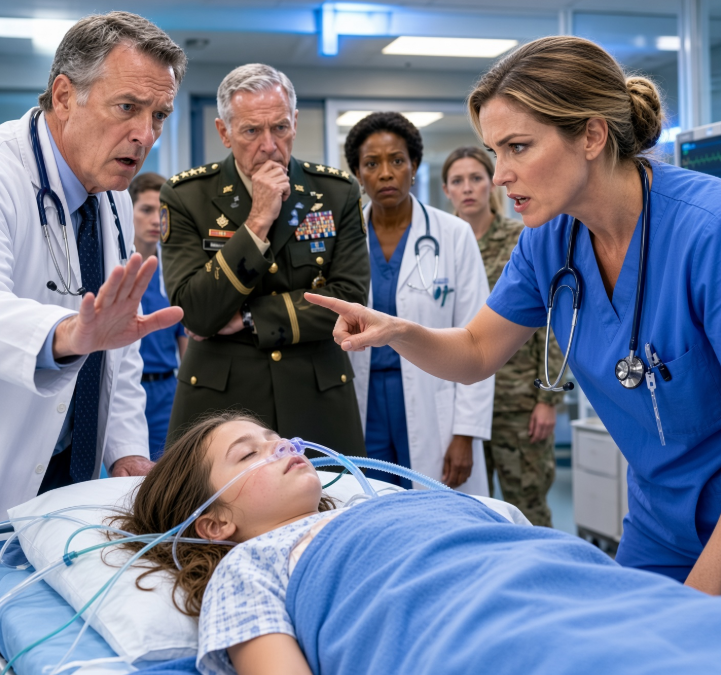
The General’s Daughter Was Declared Dead—Until the Floor Nurse Whispered Four Words and the Room Went Silent.
“She’s gone.”
Dr. Crandall said it without looking back.
The monitor beside the small body showed a flat line.
The eight-year-old girl had been pulled from near-freezing water after almost forty minutes.
Her lips were pale.
Her pupils barely reacted.
No spontaneous breathing.
No pulse anyone in the trauma bay could find.
Crandall reached for the paperwork.
“Prepare the family room.”
Then the quiet floor nurse standing three feet behind him whispered four words.
“She isn’t warm yet.”
Nobody moved.
Dr. Crandall stopped with his hand on the clipboard.
The resident near the wall looked up.
The paramedic filling out the transport sheet slowly lowered his pen.
And Major General Andrew Whitmore, who had just reached the trauma-bay doorway and seen his daughter’s motionless body for the first time, stared at the nurse as though she had just spoken in a language only he understood.
Her name was Lena Holt.
And until that night, almost nobody at Fort Belvoir Community Hospital knew anything about her.
That was exactly how Lena preferred it.
She had worked the same floor for three years.
Same blue scrubs.
Same brown hair pinned flat.
Same quiet voice.
Same habit of entering a room without drawing attention to herself.
Her personnel file said:
Lena Morrow Holt.
Registered nurse.
PART2:
Thirty-seven years old.
Three years assigned to the emergency and trauma floor.
Reliable.
Punctual.
Quiet.
Nothing unusual.
Dr. Crandall had once described her during a staff review as:
“Competent, if somewhat passive.”
Lena had read the comment.
Signed the form.
Returned it.
No argument.
That was how she handled most things.
If a physician interrupted her, she stopped talking.
If someone called her “just the floor nurse,” she let the sentence pass.
If a resident asked why she always knew where every emergency blanket, warming unit, and airway kit was stored, she simply said:
“I’ve worked here a while.”
Nobody asked why she checked exits when she entered a room.
Nobody asked about the pale scar above her right wrist.
Nobody asked why her hands sometimes became absolutely still during emergencies even though they trembled slightly when she signed routine paperwork.
And nobody asked why her legal name included Morrow when every badge, schedule, and introduction simply said Holt.
Lena was good at answering questions without giving anyone enough information to ask the next one.
That night had begun quietly.
Too quietly.
It was just after midnight.
Snow had been falling for hours.
The trauma floor smelled of disinfectant, reheated coffee, damp coats, and the faint metallic scent every emergency department eventually seemed to acquire.
PART3:
Lena was restocking IV supplies when the radio call came.
Pediatric submersion.
Cold-water exposure.
CPR in progress.
Eight-year-old female.
Estimated immersion:
Thirty-eight minutes.
Creek temperature:
Approximately thirty-one degrees Fahrenheit.
Lena stopped moving.
Something inside her became alert.
Not afraid.
Recognizing.
She walked toward the trauma bay.
Dr. Crandall was already there.
Twenty-six years in medicine.
Confident.
Fast.
Respected.
And very accustomed to being the most experienced person in the room.
The ambulance crew arrived at 12:17 a.m.
The child looked impossibly small on the gurney.
Wet hair.
Gray skin.
Tiny body beneath rescue blankets.
One paramedic continued compressions as the stretcher crossed the threshold.
Another gave the report.
“Found submerged downstream from the footbridge.”
“Witnessed?”
“No.”
“Estimated downtime?”
“Thirty-eight minutes from disappearance to recovery.”
Crandall’s expression changed.
“Thirty-eight.”
“Yes, Doctor.”
“Temperature?”
The nurse called out:
“Core temperature seventy-eight point one.”
Crandall looked at the monitor.
No useful rhythm.
No spontaneous respiration.
No detectable pulse.
The room continued working for a short time.
Then the tone changed.
Lena knew that change.
Every hospital worker did.
It was the moment a resuscitation stopped feeling like a rescue and began becoming preparation for loss.
Crandall looked at the clock.
Then at the monitor.
Then at the little girl.
“That’s enough.”
The paramedic doing compressions hesitated.
Crandall repeated:
“Stop.”
Hands came away from the child’s chest.
Silence.
The monitor continued its flat certainty.
Crandall removed his gloves.
“She’s already gone.”
He turned toward the nurses’ station.
“Get her prepped for paperwork.”
Then:
“Warm up the family room.”
He glanced toward the doorway.
“I need to speak with the general before he comes in here.”
Lena looked at the monitor.
78.1°F.
Her hands became completely still.
She knew that number.
She knew what severe cold could do to a body.
She knew how still someone could look.
How absent.
How impossible.
And she knew something else.
A memory came back before she could stop it.
Snow blowing sideways across a mountain landing zone.
Rotor wash.
A medic shouting over an engine.
A man whose skin felt like stone.
A body everyone thought had stopped fighting.
And a voice in Lena’s headset saying:
Not yet.
She returned to the trauma bay.
The child hadn’t moved.
Crandall was already reaching for his clipboard.
Lena stepped beside the bed.
“Stop.”
The word came out louder than she intended.
Crandall turned.
The room froze.
Lena almost never interrupted anyone.
Especially him.
“Nurse Holt?”
She looked at the child.
Then the temperature.
Then she said the four words that changed the night.
“She isn’t warm yet.”
Crandall stared.
Lena continued.
“Core temperature is seventy-eight point one.”
“I can read the monitor.”
“Then you know her findings can’t be interpreted the same way they would be at normal temperature.”
His expression hardened.
“Excuse me?”
“She was in near-freezing water.”
“I heard the report.”
“For thirty-eight minutes.”
“Yes.”
“With continuous resuscitation after recovery.”
“Yes.”
Lena met his eyes.
“Then we haven’t reached the point where you can make that declaration.”
The resident near the wall looked between them.
Nobody spoke.
Crandall slowly set down the clipboard.
“Nurse Holt.”
“Doctor.”
“I’ve practiced emergency medicine for twenty-six years.”
“I know.”
“You are the floor nurse.”
“I know.”
“And you’re telling me I’m wrong?”
Lena looked at the little girl.
Then back at him.
“I’m telling you she’s profoundly hypothermic.”
Crandall folded his arms.
“No pulse.”
“At that temperature, profound hypothermia can make circulation extremely difficult to detect.”
“No spontaneous breathing.”
“Same problem.”
“Fixed pupils.”
“Same problem.”
“You’re basing this on what?”
Lena stepped toward the warming cabinet.
“Cold-water resuscitation principles.”
Crandall laughed once.
Not because anything was funny.
Because disbelief was easier than reconsidering the conclusion he had already reached.
“You’re not running this resuscitation.”
Lena opened the cabinet.
“Then run it.”
Silence.
“But run the right one.”
The general appeared at the doorway.
Major General Andrew H. Whitmore.
Two stars on each shoulder.
Army service uniform thrown on so quickly that one cuff wasn’t properly fastened.
He had clearly been running before he reached the trauma floor.
Now he was trying to walk.
Trying to breathe.
Trying to remain a general for the ten feet between the doorway and the bed where his daughter lay.
His eyes found her.
Everything military disappeared from his face.
“Emily?”
No one answered.
Crandall turned toward him.
“General Whitmore—”
Lena spoke before he could finish.
“We’re not done.”
Every eye turned.
Crandall’s jaw tightened.
The general looked at Lena.
Then at the monitor.
“Who are you?”
“Lena Holt.”
“Doctor?”
“Nurse.”
Crandall stepped toward him.
“General, your daughter has been without meaningful cardiac activity after prolonged submersion.”
Lena said:
“Her core temperature is seventy-eight.”
Crandall looked at her sharply.
The general didn’t.
He continued staring at Lena.
“What does that mean?”
“It means extreme cold can suppress everything we normally use to judge whether a patient is beyond recovery.”
Crandall interrupted.
“Nurse Holt—”
She looked directly at him.
“We rewarm her.”
Then:
“We keep supporting her.”
The general’s voice was barely audible.
“Can she come back?”
Lena did not lie.
“I don’t know.”
That answer stopped everyone.
She continued.
“But I know we haven’t given her every appropriate chance yet.”
The general looked at Dr. Crandall.
“Is she wrong?”
Crandall’s mouth opened.
Nothing came out immediately.
Lena didn’t look triumphant.
She didn’t smile.
She was already moving.
“Get the active warming equipment.”
The young resident looked at Crandall.
Nobody moved.
Lena turned.
“Warm IV fluids.”
Still nothing.
The resident’s eyes returned to Crandall.
Waiting.
The general noticed.
Then he said quietly:
“She knows what she’s talking about.”
That was enough.
The resident moved.
A nurse opened the warming cabinet.
The paramedic who had been filling out paperwork put down his pen.
Another clinician returned to the bedside.
The room restarted.
Not because Lena suddenly became the attending physician.
Not because rank replaced medicine.
Because the assumption that the case was finished had finally been challenged.
Dr. Christina Abarra, chief of emergency services, arrived minutes later after being paged.
She walked in without drama.
Looked at the monitor.
Looked at Emily.
Then at Lena.
“What are we doing?”
Not:
Who authorized this?
Not:
Why is a nurse running the room?
Just:
“What are we doing?”
Lena answered clearly.
“Continuing resuscitative support while actively rewarming a severely hypothermic pediatric patient.”
“Current temperature?”
“Seventy-nine point one and rising.”
“Initial?”
“Seventy-eight point one.”
“Downtime?”
“Approximately thirty-eight minutes submerged, with field CPR after recovery.”
Abarra looked at Crandall.
“Any reason to stop while we’re still correcting profound hypothermia?”
Crandall said nothing.
Abarra turned back.
“Nurse Holt.”
“Yes?”
“Continue.”
Then to the room:
“I’ll supervise.”
Everything changed after that.
The team reorganized.
Not around rank.
Around purpose.
One person handled the airway.
Another maintained circulation support.
Another tracked temperature.
Another prepared medications and equipment.
Lena stood beside Emily’s shoulder.
She barely spoke unless something needed saying.
Numbers.
Timing.
Sequence.
Nothing wasted.
The general remained near the doorway.
He looked enormous there.
Two-star officer.
Decades of command.
Hundreds or thousands of people accustomed to waiting for his decisions.
And he could do absolutely nothing.
Lena understood that kind of helplessness.
She had seen it before.
She leaned close to Emily’s ear.
Quietly.
“I’m not walking away from you.”
The general heard.
He lowered his head.
Temperature climbed.
79.6.
80.1.
80.6.
The monitor showed a tiny flicker.
The resident looked up.
“Was that—”
“Keep going,” Lena said.
“Could be artifact.”
Another flutter.
Then another.
Not useful yet.
But something.
The room changed again.
Nobody said hope.
They didn’t need to.
At 82 degrees, the monitor showed electrical activity that hadn’t been there before.
The resident whispered:
“We have something.”
Lena nodded.
“Something isn’t stable.”
He looked at her.
“But it’s better than nothing.”
“Yes.”
Abarra was watching Lena as closely as she watched the patient now.
Not suspiciously.
Studying.
There was something in Lena’s movements that didn’t belong to three years of floor nursing.
The precision.
The calm.
The way she anticipated equipment before anyone asked for it.
The way she never overreacted to one promising sign.
The way she addressed the room when things became uncertain.
It wasn’t confidence learned in a hospital hallway.
It was older.
At one point, the resident asked:
“Where did you learn this?”
Lena didn’t answer.
“Lena?”
Her eyes stayed on the monitor.
“Later.”
The general heard that too.
At approximately eighty-five degrees—
The team reassessed.
The rhythm changed again.
More organized.
Still unstable.
But present.
Abarra gave the next orders.
The room moved.
The monitor scattered.
Then—
A rhythm.
Weak.
Irregular.
Real.
One nurse covered her mouth.
The resident stared.
The paramedic who had brought Emily in stepped backward as if he had been struck.
Lena didn’t celebrate.
She watched.
Five seconds.
Ten.
Twenty.
Thirty.
The line held.
Then she finally looked toward the doorway.
General Whitmore hadn’t moved.
One hand was pressed against the door frame.
Like the building itself was the only thing keeping him upright.
Lena spoke directly to him.
“She has a heartbeat.”
The general closed his eyes.
His face disappeared briefly into both hands.
When he looked up again, he wasn’t General Whitmore.
He was a father.
Lena continued.
“It is not stable.”
He nodded quickly.
“We have a long way to go.”
Another nod.
“But she has a heartbeat.”
He tried to speak.
Nothing came.
Lena returned to the monitor.
“Keep warming.”
The room obeyed.
Crandall stood near the wall.
His arms were crossed at first.
Then sometime after Emily’s heartbeat returned, they dropped to his sides.
Nobody commented.
Temperature:
86.4.
88.1.
89.3.
The resident beside Lena finally asked again.
“Where did you learn this?”
Lena adjusted one of the warming pads.
“Cold-weather medicine.”
“You worked emergency?”
“Yes.”
“Where?”
She paused.
The room no longer felt like a place where she could hide behind a simple answer.
“Army.”
The resident blinked.
“You were Army?”
“Yes.”
“Combat medic?”
“Flight medic first.”
His eyes widened.
“Medevac?”
Lena nodded.
Then, after a moment:
“Later, survival and recovery training.”
Abarra looked at her.
“Search and rescue?”
“Among other things.”
“Cold-weather operations?”
“Yes.”
The resident looked back at Emily.
Then at Lena.
“You’ve done this before.”
Lena didn’t answer immediately.
Her eyes dropped to the scar on her wrist.
A mountain.
Whiteout.
Rotor blades.
A man on a litter.
Someone screaming her name.
She pushed the memory away.
“Yes.”
“How many times?”
“Enough.”
Crandall heard every word.
He looked at Lena differently now.
Not impressed.
Not yet.
Recalibrating.
The way someone looks at a familiar object after realizing they’ve misunderstood its function for years.
Temperature reached 90.
Emily’s fingers moved.
Barely.
Curling inward.
The nurse at her side whispered:
“Did you see that?”
Lena nodded.
“Gentle handling.”
The room softened.
Even people’s breathing changed.
At 94 degrees, Emily’s eyelids fluttered.
The general stepped forward.
Abarra held out one hand.
“Give us another minute.”
He stopped immediately.
At 95—
Emily’s lips moved.
Nothing came out.
Then again.
A whisper.
“Dad.”
The general crossed the room before anyone could stop him.
Lena stepped back.
That was always the moment she left.
Not physically.
But emotionally.
The work belonged to the family now.
General Whitmore reached for his daughter’s hand.
Her small fingers slowly tightened around his.
His shoulders folded.
He bent over her.
“I’m here.”
Emily’s eyes barely opened.
“Dog.”
The general laughed and cried at the same time.
“What?”
“My dog.”
“You want Ranger?”
A tiny nod.
“Ranger’s home.”
Another breath.
“He’s waiting.”
Emily closed her eyes again.
But this time everyone in the room knew the difference.
Sleeping was not gone.
Lena turned toward the door.
Dr. Abarra followed.
“Lena.”
She stopped.
“Your full name.”
Lena looked back.
“You have my badge.”
“I’ve read your badge.”
Lena waited.
Abarra folded her arms.
“Who are you?”
“I’m a nurse.”
Abarra almost smiled.
“That’s clearly true.”
Silence.
“But it’s not the entire answer.”
Lena looked through the window at Emily.
The general still holding her hand.
Crandall standing near the monitor.
The resident writing orders.
Then she finally said:
“Lena Morrow Holt.”
Abarra waited.
“I was Army Medevac.”
“I gathered that.”
“Flight medic.”
“How long?”
“Eight years.”
“And after?”
Lena looked away.
“SERE medical support.”
Abarra’s eyebrows rose slightly.
Survival.
Evasion.
Resistance.
Escape.
Specialized survival training.
Remote medicine.
Cold exposure.
Hostile environments.
The kind of work most hospital nurses never touched.
Abarra lowered her voice.
“You’ve been on this floor for three years.”
“Yes.”
“And none of that is in the department skills matrix.”
“No.”
“Why?”
“Because I didn’t want it there.”
Abarra studied her.
“Why?”
Lena’s face closed.
“Because I came here to be a nurse.”
“You were already a medic.”
“Not the same.”
“No.”
Abarra softened.
“But you have expertise we’re not using.”
Lena said nothing.
“We almost declared a child dead tonight.”
Lena looked at her.
Abarra continued.
“And the person who stopped us was somebody this department had categorized as a basic floor nurse.”
Lena’s jaw tightened.
“I don’t want a ceremony.”
Abarra blinked.
“I didn’t offer one.”
“No profile.”
“I didn’t—”
“No newsletter.”
Abarra smiled faintly.
“Do you have a list?”
“Yes.”
“Anything else?”
“No public recognition.”
Abarra nodded.
“Fine.”
Then:
“But tomorrow, I want you in my office.”
“Am I in trouble?”
“No.”
“For insubordination?”
“No.”
“Overriding an attending?”
“No.”
Abarra looked toward the trauma bay.
“For preventing a catastrophic decision.”
Lena didn’t answer.
“And for exposing a training gap I need fixed.”
Then Abarra walked away.
Lena headed toward the supply closet.
Crandall was waiting in the hallway.
No clipboard.
That alone was unusual.
He leaned against the wall.
When Lena approached, he straightened.
Neither spoke at first.
Then:
“I was wrong.”
Lena waited.
Crandall looked uncomfortable.
“About her.”
“Yes.”
He breathed out.
“And about you.”
Lena said nothing.
“I’ve worked with you for three years.”
“Yes.”
“I had no idea.”
“You never asked.”
The words weren’t angry.
That made them worse.
Crandall nodded.
“I treated you like furniture.”
Lena raised an eyebrow.
“A useful piece of furniture.”
“That isn’t better.”
“No.”
He almost smiled.
Then didn’t.
“I don’t have an excuse.”
Lena looked toward the trauma bay.
“No.”
Crandall rubbed his face.
“I’d like to stop doing that.”
“Reasonable goal.”
He gave her a tired look.
“You really do talk like that all the time.”
“Yes.”
He nodded toward the room.
“What else don’t we know?”
Lena’s expression changed.
“About me?”
“About this hospital.”
She waited.
Crandall continued.
“What do people here know that we aren’t using because nobody thought to ask?”
That question made Lena look at him again.
Really look.
“That’s a better question.”
“I thought so.”
“You should ask it.”
“I intend to.”
Lena walked past him.
An hour later, she was completing documentation at the nurses’ station when General Whitmore appeared.
No entourage.
No aide.
No command voice.
He stopped across the counter.
Lena looked up.
“My daughter wants her dog.”
“That is an excellent sign.”
“She complained that we’ve kept her here too long.”
“Also excellent.”
“She says the blankets itch.”
“Best news you’ve given me yet.”
The general smiled.
Then the smile disappeared.
“She was thirty seconds from being declared dead.”
Lena didn’t answer.
“That’s what happened.”
“Yes.”
“And you stopped it.”
“We kept treating her.”
“You stopped it.”
Lena set down her pen.
“I wasn’t alone.”
“You were at the beginning.”
Silence.
Whitmore looked at her badge.
“Nurse Holt.”
“Yes?”
“Who are you?”
“Sir?”
“I don’t mean what’s printed there.”
He nodded toward her badge.
“I mean who are you?”
Lena sat back.
She had spent three years avoiding that question.
Sometimes because it hurt.
Sometimes because the answer made people treat her differently.
Mostly because she had convinced herself that the old version of Lena Holt no longer existed.
She looked toward Emily’s room.
Then answered.
“I’m a nurse.”
The general waited.
Lena sighed.
“Who used to go into bad places and bring people out.”
His expression shifted.
“Army?”
“Yes.”
“Medevac?”
“Yes.”
“Combat?”
She didn’t answer.
That was answer enough.
“Why’d you leave?”
Lena’s eyes dropped to the pale scar near her wrist.
She could have given him the short version.
Burnout.
Career change.
Family.
Better schedule.
Instead:
“I lost someone.”
The general stayed silent.
“Mission went right for the patient.”
Her voice became quieter.
“Wrong for someone I was responsible for.”
She stopped.
The old mountain returned again.
Rotor noise.
Ice.
A hand slipping from hers.
A voice telling her they had to leave.
Lena continued.
“I thought if I worked somewhere quieter, the wrong outcome would stop following me home.”
Whitmore didn’t interrupt.
“It didn’t.”
“No.”
“What changed tonight?”
Lena looked toward his daughter’s room.
“I realized I didn’t stop knowing how to bring people back just because I stopped doing it on purpose.”
The general absorbed that.
Then:
“I have a family because of you.”
Lena picked up her pen.
“You have a daughter because she’s stubborn.”
He laughed once.
“She gets that from her mother.”
“Probably.”
“You saved her.”
“I refused to call her dead before her condition had been properly reassessed after rewarming.”
“That is the most nurse answer I’ve ever heard.”
Lena smiled faintly.
Whitmore’s expression grew serious again.
“Thank you.”
No rank.
No title.
No promise.
No speech.
Just:
Thank you.
Lena nodded.
“You’re welcome.”
The next morning, Dr. Abarra’s office door closed behind Lena at 8:00.
On the desk was her personnel file.
Abarra tapped it.
“This tells me you’re a floor nurse with three years here.”
“I am.”
A second folder sat beside it.
“This tells me you served as an Army flight medic and later worked in advanced survival-medicine training.”
Lena stared.
“You pulled my military file.”
“I asked HR to verify credentials you disclosed during a critical incident.”
Lena looked unhappy.
Abarra continued.
“I’m not making you famous.”
“Good.”
“I’m not putting you in the hospital newsletter.”
“Excellent.”
“No ceremony.”
“Better.”
“But we are fixing the problem.”
“What problem?”
Abarra leaned back.
“That an eight-year-old girl’s survival depended on one quiet nurse remembering a protocol the rest of the room wasn’t prepared to use.”
Lena said nothing.
“I want a severe-environment resuscitation training module.”
Lena looked at her.
“Cold exposure.”
“Yes.”
“Submersion.”
“Yes.”
“Remote recovery.”
“Yes.”
“Hospital adaptation.”
“Yes.”
“And you want me to teach it.”
“Yes.”
Lena looked toward the window.
“I don’t like teaching.”
Abarra smiled.
“I heard you teach for forty minutes last night.”
“I was trying to save a patient.”
“Then teach like somebody’s life depends on it.”
That answer irritated Lena.
Mostly because it worked.
She agreed.
Not to a promotion.
Not to a public role.
Not yet.
Just training.
One session.
Then another if useful.
The first class filled beyond capacity.
Crandall sat in the front row.
That surprised everyone.
Lena walked to the board.
No dramatic introduction.
No biography.
She wrote one sentence.
EXTREME COLD CHANGES THE MEANING OF NORMAL FINDINGS.
Then turned.
“Let’s start.”
For the next hour, she taught.
Not stories.
Not heroics.
Principles.
Assessment.
Team coordination.
Environmental context.
When standard assumptions can become dangerous.
When to slow down.
When to ask one more question.
Crandall took notes.
The young resident from Emily’s case took more.
At the end, somebody asked:
“What is the most important thing you learned in the Army?”
Lena thought.
Then answered:
“Don’t let confidence replace verification.”
Crandall looked down at his notebook.
Nobody missed it.
Emily Whitmore stayed in the hospital for several days.
She recovered slowly.
Neurologic checks.
Monitoring.
Therapy.
Observation.
She remembered almost nothing about the creek.
That was probably a gift.
What she did remember was waking up and seeing her father crying.
She found that hilarious.
“Generals don’t cry.”
Whitmore told her:
“Generals cry when their daughters scare twenty years off their lives.”
On the fourth day, Emily asked to meet Lena.
Lena walked into the room expecting a medical question.
Instead, Emily held up a photograph.
A golden retriever.
“This is Ranger.”
Lena studied it seriously.
“Good dog.”
“He’s dumb.”
“Still looks good.”
“He ate my sock.”
“That lowers his rating.”
Emily smiled.
Then:
“Dad said you didn’t let them give up on me.”
Lena glanced toward Whitmore.
He suddenly found the window fascinating.
Lena pulled up a chair.
“You were very cold.”
“So?”
“When people get extremely cold, bodies can become very quiet.”
Emily considered this.
“Like hibernating?”
“Not exactly.”
“Close?”
“Close enough for today.”
Emily looked at her hands.
“Did I die?”
Lena did not answer quickly.
“No.”
“But people thought I did.”
“Yes.”
“You didn’t?”
“I thought you deserved more checking before anyone decided.”
Emily nodded.
Then looked at her.
“My dad says you used to jump out of helicopters.”
Whitmore coughed.
Lena slowly turned toward him.
“General.”
He raised both hands.
“She asked.”
“You could have lied.”
“I’m an officer.”
“That has never prevented one.”
Emily giggled.
Then looked at Lena.
“Were you scared?”
The question landed differently.
Lena answered honestly.
“Yes.”
Emily frowned.
“But you knew what to do.”
“Sometimes those happen together.”
That seemed to satisfy her.
She held up the dog picture again.
“Ranger would’ve saved me too.”
“Absolutely.”
“He hates water.”
“Then perhaps not.”
Emily laughed.
Two weeks later, she went home.
No parade.
No press conference.
General Whitmore made sure of that.
Lena appreciated it.
Life on the trauma floor resumed.
But it did not return completely to the way it had been.
Crandall stopped calling Lena “floor nurse” as though it meant “only.”
Residents asked more questions.
Nurses began listing specialized backgrounds on training forms.
One had worked wilderness EMS.
Another had disaster-response experience.
A respiratory therapist had military burn-unit training nobody knew about.
A technician spoke three languages.
The hospital hadn’t suddenly become more capable.
It had simply started discovering capability that had been there all along.
Months later, Lena was working a night shift when Abarra stopped beside the nurses’ station.
“You know Whitmore asks about you.”
Lena didn’t look up.
“He shouldn’t.”
“He says Emily’s doing well.”
“Good.”
“Back in school.”
“Better.”
“Apparently Ranger ate another sock.”
Lena finally looked up.
“That’s a chronic condition.”
Abarra laughed.
Then walked away.
Lena returned to her chart.
Around 2:55 a.m., an ambulance call came in.
Highway crash.
Two patients.
One unstable.
Lena stood.
Her hands were steady.
She glanced at the clock.
2:58.
For years, three in the morning had belonged to another memory.
A mountain.
Cold.
Loss.
A moment she had never fully escaped.
The clock reached 3:00.
Nothing happened.
Then 3:01.
The ambulance doors opened.
Lena walked forward.
And for the first time in years, she realized time had continued moving whether she had allowed herself to notice or not.
Later, General Whitmore would tell people the story differently.
He never said:
A nurse brought my daughter back from the dead.
Lena hated that version.
What he said was:
“My daughter was almost declared dead before her condition had been fully accounted for.”
Then:
“One nurse knew enough to ask the question the rest of us had stopped asking.”
What question?
Are we actually finished?
That was the whole story.
Not rank.
Not hidden military history.
Not a miraculous nurse.
A room full of smart people had reached an answer too quickly.
One person saw a number that changed what the answer meant.
78.1.
And she said four quiet words.
“She isn’t warm yet.”
The room went silent.
Then it went back to work.
And somewhere down the hall, hours later, an eight-year-old girl woke up asking for her dog.








