The Fourth Time Rex Came Back to Our Shelter, He Stopped Believing Anyone Would Stay—Until a Promise Began to Heal the Dog Who Had Given Up on Being Chosen
PART3:
His first adopters returned him three months later.
“Too active.”
The second kept him five months.
“Too wild.”
The third lasted almost a year.
“He’s more than we can handle.”
Every return changed him.
The first time, Rex ran straight into my arms.
The second, he approached more slowly.
The third, he sat in the center of the kennel and watched me with an uncertainty I had not seen before.
But he still wagged his tail.
This time, there was nothing.
No wag.
No glance.
No question in his eyes.
No fragile hope.
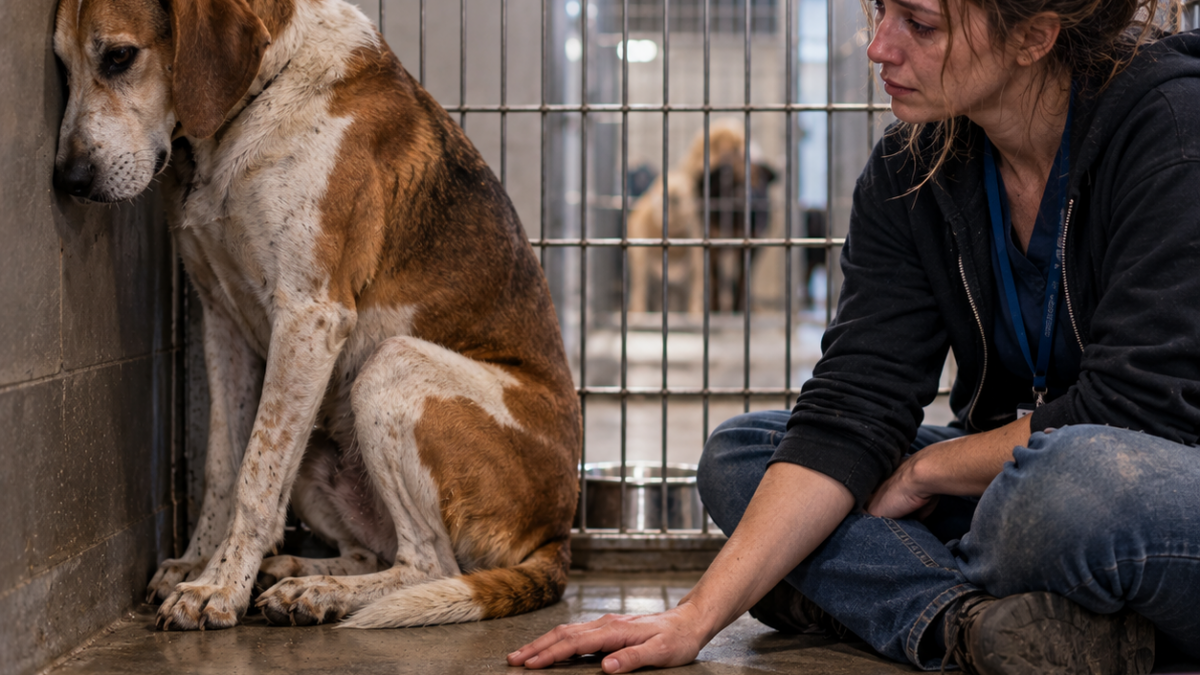
I opened the gate and went inside.
Rex did not move.
I sat several feet away.
“Hey.”
No response.
I had treats in my pocket.
I did not offer them.
I had a leash.
I did not touch it.
I could have rubbed his ears, called him a good boy, tried to convince him everything would be okay.
But Rex had heard enough promises.
So I gave him something different.
Silence.
Five minutes passed.
Then ten.
Other dogs barked around us.
A volunteer rolled a food cart down the corridor.
Someone laughed near the front desk.
A metal bowl clanged in the washroom.
Rex remained facing the wall.
I looked at the dog who had once treated every open door like an invitation to adventure, and something inside me broke.
Not because Rex was aggressive.
Not because he was unadoptable.
Because he had finally stopped asking to be chosen.
I moved my hand onto the floor between us.
Not touching him.
Just there.
“You don’t have to trust me today,” I whispered.
His ear flicked.
“I’ll come back tomorrow.”
For the first time, Rex slowly turned his head.
Our eyes met for less than a second.
Then he looked away.
But that second was enough.
Because sitting on that kennel floor, I made a decision I had not told my boss, my son, or even myself yet.
If Rex no longer believed anyone could stay, I was going to find a way to prove him wrong.
I kept my promise.
The next morning, before checking emails, before helping with medications, before even finishing my coffee, I went to kennel fourteen.
Rex was exactly where I had left him.
Back corner.
Head down.
His breakfast bowl was half full.
That worried me.
Rex had never been a dog who ignored food.
Years earlier, when he was younger, he had once managed to pull an unopened bag of treats off a shelf, tear it open, and eat enough that we had to call the veterinarian.
Now chicken and rice sat untouched six feet from him.
I opened the gate.
“Morning, troublemaker.”
Nothing.
I sat.
That became our routine.
I did not ask him to come.
I did not force eye contact.
I did not tug on his leash.
I simply occupied the same space.
For the first few days, Rex behaved as if I did not exist.
Then, on the fourth morning, I noticed his eyes following me when I stood.
On the fifth, he lifted his head when I entered the corridor.
On the sixth, he ate one treat after I placed it on the floor and backed away.
Progress with a dog like Rex could not be measured by dramatic moments.
It was inches.
Seconds.
Small decisions.
Look at the human.
Stay instead of retreat.
Eat while she is nearby.
Close your eyes for ten seconds.
Breathe.
Trust was returning in fragments.
My supervisor, David, found me sitting in the kennel one afternoon.
He leaned against the gate.
“You planning to move in there?”
“Rent’s cheap.”
“Smells terrible.”
“That’s because kennel twelve rolled in something outside.”
David looked at Rex.
“How’s he doing?”
“Better.”
“He still won’t go to the yard?”
“Not willingly.”
“Emma.”
“I know.”
We both understood the problem.
Shelter life was especially hard on dogs built to move.
Rex was an English Foxhound.
His body had been designed for distance, scent, movement, stimulation.
A kennel could keep him safe.
It could not give him what he needed.
The irony made me angry.
Three families had complained that Rex was too energetic.
Then every return put him into the least suitable environment for that energy.
“You thinking about putting him back on the adoption floor?” I asked.
David shook his head.
“Not yet.”
“Good.”
“He needs decompression.”
“He needs someone who understands him.”
“That too.”
I looked at Rex.
“What if nobody does?”
David studied me.
I knew that look.
“Don’t.”
“Don’t what?”
“You already have that face.”
“What face?”
“The face you had before you fostered that hound mix three years ago.”
“He found a home.”
“You kept him for five months.”
“He had trust issues.”
“The face you had before the shepherd.”
“That was temporary.”
“Four months.”
“He was heartworm positive.”
“And the Chihuahua?”
I pointed at him.
“That dog was nine pounds and furious. Completely different situation.”
David laughed.
Then his expression softened.
“You have Tommy to think about.”
“I know.”
My son was ten.
My entire life outside the shelter revolved around him.
Tommy was curious, funny, stubborn, and incapable of walking past a mud puddle without testing its depth.
He also loved dogs almost as much as I did.
That did not automatically mean every dog belonged in our home.
“He’s good with kids,” I said.
“Rex?”
“Yes.”
“He was before.”
“He still is.”
“You don’t know that.”
“I know him.”
“Emma.”
“I know.”
David was not criticizing Rex.
He was reminding me that damaged trust could change behavior.
And if I ever brought Rex home, love alone would not be enough.
We would need structure.
Exercise.
Training.
Patience.
Time.
Everything his previous adopters had apparently underestimated.
So for another week, I kept sitting.
Then came the first breakthrough.
I entered kennel fourteen after lunch.
Rex lifted his head.
“Hey, handsome.”
I sat in my usual place.
For several minutes, nothing happened.
Then Rex stood.
His legs stretched beneath him.
He stared at me.
I remained still.
He took one step.
Stopped.
Another.
I wanted to call him.
I did not.
Four more steps.
Then Rex sat beside me.
Not touching.
Just close.
My throat tightened.
“You’re very brave.”
His eyes stayed forward.
I slowly rested my hand palm-down on the floor.
He sniffed it.
Then turned away.
That was enough.
The next day, he sat closer.
Two days later, his shoulder touched my arm.
A week later, I was filling out paperwork inside his kennel when something warm and heavy dropped onto my thigh.
I froze.
Rex had placed his head in my lap.
My pen stopped moving.
I looked down.
His eyes were open.
Watching me.
I rested one hand gently behind his ear.
He did not move away.
“Hi.”
His tail tapped the floor.
Once.
My eyes filled immediately.
“You still remember how to do that.”
Another tap.
I bent forward, forehead almost touching his.
“You’re still in there.”
Rex closed his eyes.
That afternoon, when I tried to leave, he followed me to the kennel door.
It nearly destroyed me.
For weeks, I had wanted him to move toward me.
Now I hated walking away.
That evening, I told Tommy about him.
We were eating spaghetti at our kitchen table.
I had mentioned Rex before, but only in passing.
Tommy twirled noodles around his fork.
“So nobody wants him?”
“That isn’t exactly fair.”
“It sounds fair.”
“Families tried.”
“They gave him back.”
“Yes.”
“Four times?”
“Four.”
Tommy frowned.
“What did he do?”
“He has a lot of energy.”
“So?”
“So not every family is prepared for that.”
“Did he bite anybody?”
“No.”
“Destroy their house?”
“One family said he chewed things when he was bored.”
“What things?”
“I don’t know.”
“Did he attack another dog?”
“No.”
“Does he hate kids?”
“No.”
Tommy put his fork down.
“So his crime is running?”
I laughed despite myself.
“It’s more complicated.”
“Adults always say that when something isn’t actually complicated.”
I pointed my fork at him.
“You are ten.”
“I know.”
“You have no idea how complicated adults are.”
“Exactly.”
I should not have been amused.
But I was.
Tommy asked, “Can I meet him?”
“Not yet.”
“Why?”
“Because he’s fragile right now.”
“He’s big.”
“I don’t mean physically.”
Tommy looked confused.
I tried to explain.
“Imagine you made four best friends.”
“Okay.”
“Every one of them promised you could stay.”
His smile disappeared.
“And every one eventually brought you back somewhere and left.”
“That’s horrible.”
“It would make you cautious, wouldn’t it?”
Tommy nodded.
“So Rex needs to decide when he’s ready to trust people again.”
“Does he trust you?”
“A little.”
“Then I want him to trust me too.”
It happened three weeks later.
I brought Tommy to the shelter after school.
I gave him strict instructions in the parking lot.
“No running.”
“Okay.”
“No loud voice.”
“Okay.”
“Don’t reach for him.”
“I know.”
“Let Rex approach.”
“I know.”
“And if he doesn’t want to meet you—”
“Mom.”
“What?”
“You’ve told me six times.”
“Then you should remember.”
He rolled his eyes.
Ten-year-olds are excellent for humility.
Rex was in a quiet visiting room instead of his kennel.
I entered first.
His tail gave a small wag.
Then Tommy stepped through the door.
Rex froze.
Tommy froze too.
Neither looked at the other directly.
Tommy sat cross-legged near the wall.
I sat opposite him.
Rex walked around the room.
Sniffed a chair.
Sniffed the door.
Looked at Tommy.
Walked away.
Tommy whispered, “He’s pretending I’m not here.”
“Let him.”
Five minutes passed.
Then Rex walked behind Tommy.
Sniffed his hair.
Tommy’s eyes became enormous, but he did not move.
Rex stepped around him.
Tommy’s shoelace got a long inspection.
Then Rex sat.
Three feet away.
Tommy whispered, “Hi, Rex.”
Rex’s ears moved.
That was all.
We stayed for twenty minutes.
When I told Tommy it was time to leave, he stood slowly.
Rex watched him.
At the door, Tommy looked back.
“I’ll come again.”
Rex’s tail moved once.
Tommy saw it.
The entire drive home, he talked about nothing else.
“He wagged.”
“I know.”
“He likes me.”
“He is considering your application.”
“What?”
“Nothing.”
“Mom.”
“He likes you.”
The second visit was easier.
The third, Rex approached immediately.
By the fifth, Tommy sat on the floor reading a comic while Rex slept beside him.
Watching them, the thought I had been avoiding became impossible to ignore.
Rex already had the beginnings of a family.
Ours.
I spoke to David the next morning.
“I want to bring him home.”
He did not look surprised.
“As a foster?”
I hesitated.
“Yes.”
David smiled slightly.
“That hesitation was very convincing.”
“I need to see how he does.”
“I agree.”
“Tommy loves him.”
“I know.”
“You knew?”
“Your son told every volunteer in the building that Rex is his future dog.”
I closed my eyes.
“Of course he did.”
David became serious.
“Emma, you know his needs.”
“Yes.”
“Two long walks won’t be enough.”
“I know.”
“Scent work. Mental stimulation. Structured running.”
“I know.”
“He may have separation anxiety.”
“I know.”
“He may regress outside the shelter.”
“I know.”
“He’s been returned four times.”
“I know.”
David leaned back.
“Then why do you think you’ll be different?”
That question stung.
But it was fair.
I thought before answering.
“Because I’m not expecting him to become easier.”
David waited.
“I’m going to change my life enough to make room for who he already is.”
That answer seemed to satisfy him.
“Take him home Friday.”
Friday afternoon arrived with rain.
Tommy had made a sign for our kitchen.
WELCOME REX.
I made him take it down before Rex arrived because he had attached streamers that moved every time the air conditioner turned on.
“He’ll be scared of decorations?”
“Maybe.”
“That’s sad.”
“That’s why we keep things simple.”
I brought Rex into the house on a six-foot leash.
His body was tight.
Head low.
Every room required inspection.
Living room.
Kitchen.
Hallway.
Then he returned to the front door.
He sat.
Tommy whispered, “Is he waiting to leave?”
“I don’t know.”
Rex stared at the door.
I placed his bed near the couch.
He ignored it.
Food near the kitchen.
Ignored.
Water.
One drink.
Then back to the door.
That first evening taught me how little shelter behavior could predict home behavior.
Rex did not run.
He did not play.
He did not explore.
The supposedly impossible, hyperactive dog sat beside my front door like a suitcase waiting to be collected.
At ten, Tommy came downstairs carrying a blanket.
“What are you doing?”
“I’m sleeping here.”
“No.”
“Rex is sad.”
“He needs quiet.”
“I can be quiet.”
“Bed.”
“Mom.”
“Tommy.”
He looked at Rex.
Then at me.
“Five minutes?”
I sighed.
“Five.”
Tommy lay on the floor several feet from him.
Rex looked over.
Tommy whispered, “You don’t have to go anywhere tomorrow.”
My chest hurt.
Rex looked back at the door.
Five minutes became fifteen.
I eventually sent Tommy upstairs.
Then I sat beside Rex.
Midnight.
One.
Two.
He never slept deeply.
Every passing car made his ears lift.
At 2:17, headlights moved across the front window.
Rex stood.
His tail moved.
He stared at the door.
The car continued down the street.
His tail stopped.
He sat again.
That was when I understood.
Rex was waiting for the people who had brought him here to change their minds.
Not the last family specifically.
All of them.
Anyone.
Someone.
He had learned that new houses were temporary.
A different couch.
Different bowl.
Different humans.
Then eventually the leash came out and the car returned to the shelter.
I rested my hand on the floor.
“I’m not taking you back.”
Rex did not look at me.
“I know you don’t believe me.”
His ears moved.
“That’s okay.”
I leaned against the wall.
“You don’t have to.”
Around four in the morning, I woke with a cramp in my neck.
Rex was no longer at the door.
He was sitting beside me.
I blinked.
“Hey.”
He lowered himself.
Then placed his head across my legs.
I did not move.
We slept there until sunrise.
When Tommy came downstairs, he found us both on the floor.
His face lit up.
“He chose you.”
I rubbed my stiff neck.
“He destroyed my spine.”
Tommy sat beside us.
Rex opened one eye.
Then his tail thumped.
That was day one.
The following weeks were not magical.
They were work.
Real work.
Rex had energy.
A staggering amount.
Once he understood he was allowed to move in my house, he moved constantly.
He followed me from room to room.
Stole socks.
Opened a half-closed pantry door with his nose.
Discovered that the trash can contained treasure.
One Tuesday, I came home from taking Tommy to school and found an entire loaf of bread missing.
The wrapper lay beneath the table.
Rex looked extremely satisfied.
“You ate sixteen slices of bread.”
Tail wag.
“That is not an achievement.”
More wagging.
He stole Tommy’s soccer ball.
Dug up two flower beds.
Learned how to open the screen door if it was not latched.
And once ran through my freshly folded laundry with muddy paws.
I understood why someone unprepared might feel overwhelmed.
But I also understood the difference between difficult and wrong.
Rex was not trying to ruin my life.
He had needs.
When those needs were met, the chaos decreased.
I changed our routine.
Up at 5:30.
Long walk before breakfast.
Not just walking.
Sniffing.
Tracking.
Searching.
I hid treats in the yard.
Used puzzle feeders.
Taught Tommy simple scent games.
After work, Rex got another long outing.
Weekends meant open fields on a long training line.
His behavior transformed.
Not because I fixed him.
Because we finally stopped asking an athlete to live like a couch ornament.
One morning, after several weeks, I took him to a fenced field just outside town.
The sky was pale pink.
Dew covered the grass.
I unclipped his long line.
Rex looked at me.
I held my breath.
“Go.”
He ran.
Not away.
Just ran.
His body stretched into the movement as if somebody had opened a gate inside him.
Across the grass.
Around a tree.
Down toward the shallow creek.
Back up the hill.
Tommy shouted, “Look at him!”
I was.
Rex looked younger.
Not seven.
Two.
Maybe one.
The dog he had been before too much became the description attached to everything he did.
He disappeared briefly behind a rise.
My stomach dropped.
Then his head appeared.
He looked at me.
For one second, we stood across fifty yards of grass staring at each other.
Then Rex sprinted toward me.
Fast.
Faster.
“Rex!”
He did not slow.
He hit me square in the legs.
I fell backward into wet grass.
Tommy screamed with laughter.
Rex climbed onto my chest and licked my face.
“Get off!”
More licking.
“Rex!”
Tommy dropped beside us.
“He loves you!”
“I’m being assaulted.”
Rex moved to Tommy.
Now Tommy was the victim.
We laughed until all three of us were covered in grass.
That morning remains one of the happiest memories of my life.
Because I watched a dog return to himself.
Month by month, Rex changed.
He stopped watching the front door.
Then he stopped waking when cars passed.
One afternoon I left for the grocery store and returned forty minutes later.
Rex was asleep on the couch.
He had not been waiting at the window.
That might sound insignificant.
To me, it meant everything.
He finally believed leaving was not the same as abandonment.
Tommy and Rex became inseparable.
Homework happened on the floor beside him.
Cartoons happened with Rex’s head in Tommy’s lap.
Backyard soccer usually ended when Rex stole the ball.
When Tommy had nightmares, Rex started sleeping outside his bedroom door.
I never taught him that.
He simply chose it.
And yes, Rex was still exhausting.
My neighbor, Mrs. Holly, reminded me regularly.
She was seventy-one, lived two houses down, and had the terrifying ability to know everything happening on our street before anyone else.
One morning, she watched Rex race around my backyard.
“Emma!”
I looked over the fence.
“Yes?”
“How do you live with that animal?”
Rex sprinted past us carrying a branch almost as long as he was.
“Excellent question.”
“He never stops.”
“Eventually.”
“When?”
“Usually around midnight.”
She laughed.
“No wonder those people brought him back.”
My smile faded.
Mrs. Holly noticed.
“I didn’t mean—”
“It’s okay.”
Rex dropped the branch and found another.
I looked at him.
“They wanted a different kind of dog.”
“He is certainly enthusiastic.”
“That’s one word.”
Mrs. Holly laughed.
Then I said, “I think we get too comfortable calling an animal difficult when what we really mean is inconvenient.”
Her expression changed.
Rex raced past again.
“Maybe.”
“He’s not for everyone.”
“No.”
“But he wasn’t failing those homes by being himself.”
Mrs. Holly nodded.
“You love him.”
“I do.”
“Then I suppose the insanity is worth it.”
I smiled.
“Most days.”
She pointed toward my flower bed.
“He just dug another hole.”
I turned.
“Rex!”
He looked at me with a mouth full of dirt.
Mrs. Holly laughed so hard she had to hold the fence.
A year passed.
Rex was eight.
Healthy.
Strong.
Still energetic.
Still ridiculous.
But happy.
We stopped using the word foster.
His adoption paperwork had been finalized months earlier.
Tommy insisted on keeping a copy in his bedroom drawer because, according to him, “Nobody can return him if I have the papers.”
I did not explain property law.
I let him keep them.
Then came the Sunday that changed everything.
The morning began normally.
Toast.
Coffee.
Tommy complaining that I made him wear a helmet on his bicycle.
“You always say that.”
“Because helmets look stupid.”
“So do hospital gowns.”
“Mom.”
“Helmet.”
Rex stood by the door.
He knew.
Fields.
Sunday mornings were his favorite.
I packed water.
A small first-aid kit.
Snacks.
Rex’s leash.
I placed my phone on the kitchen counter while filling a bottle.
Then Tommy shouted from outside.
“Mom! Rex took my glove!”
I went after them.
And forgot the phone.
That single mistake still bothers me.
We headed toward the fields beyond our neighborhood.
The area was not wilderness.
But it was far enough from the houses that shouting might not carry.
A broad dirt path crossed several acres of grass before climbing low rolling hills.
Tommy rode his bike.
Rex ran on a long line until we reached the open section.
Then I released him.
He took off.
Tommy laughed.
“Race me!”
“Stay on the path.”
“I know!”
“Not too fast.”
“I know!”
I watched them move ahead.
Boy on bicycle.
Dog running alongside.
The sight filled me with that quiet kind of happiness you only recognize later because tragedy divides life into before and after.
Rex ran ahead.
Returned.
Ran again.
Tommy reached the bottom of a small hill.
“Mom!”
“What?”
“Watch!”
“Watch what?”
“I’m going down!”
“You just went up!”
“I know!”
He turned the bike.
Something in my stomach tightened.
“Slow down.”
He pushed off.
“Tommy!”
The hill was not steep.
But the trail was uneven.
He accelerated.
Rex ran beside him.
For maybe three seconds, everything looked fine.
Then the front tire hit a rock.
The handlebars snapped sideways.
The bicycle stopped.
Tommy did not.
He went over the front.
The sound he made when he hit the ground was unlike anything I had ever heard from him.
Not a scream exactly.
A sharp cry that ended too fast.
“Tommy!”
I ran.
The bicycle lay on its side.
Tommy was curled several feet away.
His face was white.
“Mom.”
“I’m here.”
“My leg.”
I looked.
My stomach turned.
His lower leg was positioned wrong.
Not grotesque.
But wrong enough.
“Don’t move.”
“It hurts.”
“I know.”
“It really hurts.”
“I know, sweetheart.”
He began crying.
I knelt beside him.
“Look at me.”
“I can’t stand up.”
“Don’t try.”
“I want to go home.”
“I know.”
I reached for my pocket.
Nothing.
Other pocket.
Nothing.
Then memory hit.
Phone.
Kitchen counter.
“No.”
“What?”
“Nothing.”
I looked around.
Empty field.
No walkers.
No houses visible beyond the rise.
We were probably less than a mile and a half from our neighborhood.
It might as well have been fifty.
Could I carry Tommy?
He weighed nearly seventy pounds.
Maybe.
For a short distance.
But with a likely fracture, moving him incorrectly could make things worse.
Could I leave him and run?
No.
Absolutely not.
“Mom, call someone.”
I swallowed.
“My phone is at home.”
Fear appeared in his eyes.
“What?”
“It’s okay.”
“How?”
“I’ll figure it out.”
“Mom.”
“I’m here.”
Rex paced around us.
He sniffed Tommy.
Whined.
Then looked at me.
“Stay.”
He did not.
He moved several yards away.
Returned.
Whined again.
I barely noticed him.
My entire world had narrowed to Tommy.
His breathing.
His tears.
His leg.
My own rising panic.
I shouted.
“Help!”
Nothing.
Again.
“Can anybody hear me?”
Wind across grass.
No answer.
Tommy cried harder.
“Don’t leave me.”
“I’m not.”
I sat beside him and placed his head in my lap.
My hands were shaking.
“I’m right here.”
Rex barked.
One sharp bark.
I looked at him.
“Rex, quiet.”
Another bark.
He ran ten feet away.
Turned.
Barked again.
“Not now.”
He came back.
Touched his nose to Tommy.
Then looked toward the path.
That was when I finally saw what he was doing.
“Rex?”
He stood perfectly still.
I pointed toward home.
It was absurd.
I had never trained him to get help.
Never practiced anything remotely like it.
Dogs do not magically understand complex emergency instructions because humans need them to.
But Rex knew our route.
He knew our house.
He knew Mrs. Holly.
He knew something was wrong.
I grabbed his collar.
“Rex.”
He looked at me.
“Go home.”
His ears lifted.
“Home.”
I pointed.
“Go find Holly.”
He stared.
I released him.
For one second, nothing happened.
Then Rex ran.
Not his joyful looping field run.
Straight.
Down the path.
Over the rise.
Gone.
My heart sank immediately.
What had I done?
Maybe he would chase a squirrel.
Maybe he would wander.
Maybe he would wait at our door.
Maybe he would not understand.
Tommy whispered, “Where did he go?”
“I sent him home.”
“Why?”
“To get help.”
“Can he do that?”
I looked at the empty hill.
“I don’t know.”
Those twenty minutes were the longest of my life.
I kept Tommy talking.
Favorite movie.
School.
What he wanted for dinner.
Anything.
His face became increasingly pale.
I worried about shock.
I used my jacket to keep him warm.
“Mom.”
“Yes?”
“What if Rex doesn’t come back?”
“He will.”
“You don’t know.”
“No.”
“But?”
“But I know Rex.”
Ten minutes.
Fifteen.
Nothing.
I screamed for help again.
Still nothing.
At some point, I started crying.
Quietly.
I turned my face away so Tommy would not see.
“I’m scared,” he said.
“So am I.”
“You are?”
“Yes.”
Adults lie to children when we think fear makes us look weak.
That day, I could not.
“But being scared doesn’t mean we stop.”
He grabbed my hand.
Then we heard barking.
Far away.
One bark.
Then another.
I stood.
“Rex?”
The barking grew louder.
Then I heard a voice.
“Emma!”
Mrs. Holly.
I almost collapsed.
“Over here!”
A figure appeared on the ridge.
Mrs. Holly.
Phone in hand.
Rex running ahead of her.
He reached us first.
He went straight to Tommy.
Sniffed his face.
Whined.
Then turned to me.
I grabbed him around the neck.
“You did it.”
His whole body shook with excitement.
“You actually did it.”
Mrs. Holly arrived, breathing hard.
“Oh my God.”
“Call 911.”
“Already did.”
“How did you know?”
She pointed at Rex.
“He nearly broke my screen door.”
Despite everything, I laughed.
“What?”
“He came to my porch barking like a lunatic. I opened the door. He ran halfway down the street, turned around, barked, came back, then ran again.”
“He led you?”
“I figured either you were dead or he had finally lost his mind.”
“Probably both.”
Her hand rested on my shoulder.
“Ambulance is coming.”
I sat back down.
Rex placed himself beside Tommy.
Tommy touched his neck.
“You got help.”
Rex licked his hand.
The ambulance arrived twelve minutes later.
Two paramedics stabilized Tommy’s leg.
Likely fracture.
Pain medication.
Splint.
Transport.
One paramedic looked at Rex.
“This the dog who brought your neighbor?”
“Yes.”
He scratched Rex’s head.
“Good boy.”
Rex wagged.
I started crying again.
Mrs. Holly took him while I rode with Tommy.
Before the ambulance doors closed, Rex tried to climb inside.
“No, buddy.”
His face changed.
Panic.
That old fear.
The fear of people leaving.
My chest cracked open.
I jumped back down for one second.
I held his face.
“I’m coming back.”
He stared at me.
“I promise.”
Mrs. Holly held his leash.
“I’ve got him.”
“Stay with him.”
“I will.”
The ambulance doors closed.
Through the window, I saw Rex standing beside her.
Watching us leave.
At the hospital, X-rays confirmed Tommy had fractured his tibia.
No surgery required.
Thank God.
He needed reduction, a cast, and weeks of limited activity.
Once the doctor said he would recover fully, my body finally allowed itself to shake.
I sat beside Tommy’s hospital bed.
He looked exhausted.
“Mom?”
“Yes?”
“Rex saved me.”
I swallowed.
“Rex got help.”
“That means saved.”
I did not argue.
Three hours later, Mrs. Holly arrived at the hospital entrance with Rex.
She was not allowed to bring him inside, so Tommy and I went out after discharge.
Tommy sat in a wheelchair with his new cast elevated.
Rex saw us through the glass doors.
He went wild.
Tail.
Barking.
Pulling.
The dog who had once shut himself in the corner of kennel fourteen now strained toward us like every cell in his body knew exactly where he belonged.
The doors opened.
Mrs. Holly released enough leash for him to reach Tommy.
Rex stopped himself before jumping.
That amazed me.
He sniffed the cast.
Whined.
Tommy wrapped both arms around his neck.
“You’re a hero.”
Rex licked his face.
I crouched beside them.
For several seconds, I could not speak.
Because suddenly, all those old complaints echoed in my memory.
Too active.
Too wild.
Never stops moving.
Too much.
The very thing people had rejected in Rex had carried him home fast enough to bring help to my son.
It would be easy to turn that into some perfect lesson.
But the truth was even simpler.
Rex had always been Rex.
The world just had not always known what to do with him.
The shelter posted a photograph the next day.
Not for attention.
Not at first.
One of our volunteers had taken a picture of Tommy sitting outside the hospital with Rex pressed against him.
The caption explained that Rex, a four-time return, had run from the field to our neighborhood and alerted Mrs. Holly after Tommy was injured.
The post spread faster than anything our shelter had ever shared.
Hundreds of comments.
Then thousands.
Local news called.
A radio station.
A newspaper.
People who had never cared about an English Foxhound suddenly wanted to know everything about him.
I almost refused all of it.
Then David said something that changed my mind.
“Use it.”
“For what?”
“Dogs like Rex.”
I looked at him.
“You know how many high-energy dogs get returned because people adopt based on appearance instead of lifestyle.”
I did.
“Tell the truth.”
So I agreed to one interview.
I sat beside Rex.
Tommy was home resting.
The reporter asked, “Would you call Rex a hero?”
“Yes.”
“Did you train him to seek help?”
“No.”
“Then how did he know?”
“I can’t tell you exactly what Rex understood. What I know is that he recognized something was wrong, ran a familiar route home, got our neighbor’s attention, and returned with her.”
“Rex was returned to the shelter multiple times?”
“Four.”
“Why?”
“Mostly because families struggled with his energy level.”
The reporter smiled toward Rex.
“The same energy that helped him run for help.”
“Yes.”
Then she asked, “Were those families wrong to return him?”
I thought carefully.
“Some homes are poor matches. Returning a dog safely can be more responsible than keeping an animal in a situation where neither the people nor the dog can succeed.”
She looked surprised.
“But?”
“But we need to stop treating predictable breed traits and unmet exercise needs as character defects.”
Rex nudged my hand.
I scratched his ear.
“He wasn’t bad. He was mismatched.”
That quote ended up everywhere.
And then something unexpected happened.
One of Rex’s former adopters contacted the shelter.
The second family.
A woman named Claire.
I remembered her.
She had returned Rex years earlier after five months.
She asked if she could speak to me.
My first instinct was no.
Then I agreed.
She came in on a Thursday afternoon.
Rex was with me behind the front desk.
The moment Claire walked through the door, he looked up.
I watched him closely.
Recognition?
Maybe.
Dogs remember scent in ways we do not fully understand.
His ears lifted.
Claire stopped.
“Hi, Rex.”
He stared.
Then came toward her.
Slowly.
She crouched.
Her eyes filled.
“I’m sorry.”
Rex sniffed her hands.
Then wagged.
Just once.
Claire laughed through tears.
“He remembers me.”
“Probably.”
She looked up.
“I saw the story.”
I said nothing.
“We weren’t good enough for him.”
“That’s not what I said.”
“I know.”
She wiped her eyes.
“But I’ve thought about it.”
Rex moved back beside me.
Claire continued.
“When we adopted him, we wanted a dog who could hike on weekends.”
I nodded.
“We worked ten-hour days.”
I remembered.
“We thought a big yard would be enough.”
“It rarely is for dogs like Rex.”
“I know that now.”
She looked at him.
“We blamed him for being bored.”
Her voice broke.
“He destroyed a couch.”
“I remember.”
“He chewed the door frame.”
“I remember.”
“And we kept saying he was impossible.”
She stared at Rex.
“But we were leaving a young hound alone most of the day.”
I did not rescue her from that truth.
She needed to say it.
“We should have researched.”
“Yes.”
“We should have trained him.”
“Yes.”
“We should have exercised him properly.”
“Yes.”
She nodded.
“I’m not asking you to forgive me.”
“It isn’t mine to forgive.”
“I know.”
She looked at Rex.
“I just needed to see him happy.”
He was.
That was the greatest answer we could give.
Claire left a donation to the shelter’s enrichment program.
Then she left.
Rex watched the door for about three seconds.
Then walked over to me and dropped a tennis ball at my feet.
No grief.
No crisis.
His home was no longer behind the door she had walked through.
It was wherever Tommy and I were.
The first family contacted us too.
Not to apologize.
They were upset.
Their name had not been used publicly, but someone who knew them recognized Rex.
The man sent an email accusing the shelter of making previous adopters look irresponsible.
David forwarded it to me.
I read it twice.
Then closed the laptop.
“Ignore it,” he said.
“I am.”
“You look angry.”
“I’m not.”
“You’re crushing a pen.”
I looked down.
The pen had cracked.
“Maybe slightly.”
The email complained that Rex had been unmanageable.
That they had done everything possible.
That we were rewriting history.
I wanted to reply.
I wanted to list everything they had not done.
But I did not know everything.
I had not lived in their home.
Facts mattered.
So instead of answering them personally, the shelter made a broader change.
Every adoption involving a high-drive dog now required a detailed lifestyle consultation.
Exercise expectations.
Time alone.
Breed tendencies.
Training plans.
Enrichment.
A mandatory trial period when appropriate.
No more vague active home preferred.
People had to understand what active meant.
Rex’s story became part of the training.
Not as a shame story.
As a matching story.
A dog can be wonderful and still wrong for a particular home.
A family can mean well and still be unprepared.
Good intentions do not replace knowledge.
That was Rex’s first real legacy.
Tommy’s recovery took seven weeks.
Those seven weeks were torture for Rex.
Not because Tommy was hurt.
Because Tommy could not run.
Rex would bring him a ball.
Tommy would say, “I can’t.”
Rex would bring another ball.
“Still can’t.”
Another toy.
“Buddy.”
Eventually, Tommy invented games he could play from the couch.
Hide treats around the room.
Toss toys down the hallway.
Scent cups.
Rex loved all of it.
One afternoon I found Tommy sitting on the floor beside him.
His cast was covered in signatures.
Rex’s paw had been traced on one side in marker.
“What is that?”
Tommy grinned.
“His autograph.”
“Of course.”
Rex looked pleased with himself.
When the cast finally came off, Tommy’s leg was weak.
He needed time to rebuild strength.
The first day he was allowed to walk farther outside, Rex stayed beside him.
Not ahead.
Beside.
Normally, Rex pulled toward every smell.
That day he matched Tommy’s slow pace.
Step.
Step.
Pause.
I watched from behind.
My throat tightened.
Mrs. Holly stood at her mailbox.
“Look at him.”
“I know.”
“He understands.”
“Enough.”
She smiled.
“I told everybody on my street he was a hero.”
“This is also your street.”
“You know what I mean.”
Then she called to Tommy.
“Don’t you go flying down hills anymore!”
Tommy groaned.
“I’m never going to escape this, am I?”
“No,” I said.
“Not even when I’m forty?”
“I’ll tell your wife.”
He stared at me.
“I’m ten.”
“Planning ahead.”
Rex barked.
Mrs. Holly laughed.
Life settled again.
But the public interest did not disappear immediately.
The town council wanted to recognize Rex.
I thought it was ridiculous.
Tommy thought it was the greatest thing that had ever happened.
“Mom, he gets a medal.”
“It’s not exactly a military decoration.”
“It’s a medal.”
“It’s a certificate.”
“And a medal.”
I gave up.
The ceremony was held at a community event benefiting local animal shelters.
Rex wore a blue bandana.
Tommy wore an outfit I had to threaten him into.
Hundreds of people came through.
Several recognized Rex.
They crouched.
Took pictures.
Asked questions.
Rex enjoyed himself for approximately nineteen minutes before becoming more interested in a hot dog someone dropped.
Then I saw a familiar face near the back.
The man who had returned Rex for the fourth time.
His name was Daniel.
My body tightened.
He stood beside a woman.
Both watched Rex.
Daniel noticed me looking.
For a moment, neither of us moved.
Then he approached.
“Emma.”
“Daniel.”
He looked at Rex.
“So it’s true.”
“What?”
“All of it.”
“Yes.”
“He ran that far?”
“Yes.”
“And got a neighbor?”
“Yes.”
Daniel laughed faintly.
“He always could run.”
The comment irritated me.
“He still can.”
His smile disappeared.
“I didn’t mean anything.”
I waited.
Daniel looked at Rex.
“He seems different.”
“He is.”
“Calmer.”
“Sometimes.”
Rex spotted a child holding popcorn and immediately attempted to investigate.
I raised an eyebrow.
Daniel almost smiled.
“Okay. Not that calm.”
“No.”
He became serious.
“I should probably say something.”
“You don’t have to.”
“I do.”
He looked down.
“When we brought him back…”
Rex glanced toward us.
Daniel continued.
“My wife had just changed jobs. I was traveling. We thought because Rex was older, he would settle.”
“He was seven.”
“I know.”
“We told you what he needed.”
“I know.”
“You said you could provide it.”
“I know.”
There was something almost painful in hearing him say those words repeatedly.
“I got angry at him,” Daniel admitted.
“For what?”
“For being exactly what you said he was.”
That silenced me.
“He paced. He stole things. He wanted to go out all the time. He howled when he was bored.”
“He’s a hound.”
“I know that now.”
“You knew it then.”
“I knew the word.”
That was an honest answer.
He looked toward Rex.
“I didn’t understand what it meant.”
His wife joined us.
She seemed embarrassed.
“We saw him online.”
I nodded.
“We almost didn’t come today.”
“Why did you?”
Daniel answered.
“Because I wanted to see if he hated me.”
I looked at him.
“You brought him back to a shelter. You didn’t beat him.”
“I know.”
“You made a bad match.”
“Four families made bad matches.”
“Yes.”
“He stopped looking at me when I left him.”
I remembered.
“You saw that?”
Daniel nodded.
“He wouldn’t look back.”
His voice broke slightly.
“I’ve thought about that a lot.”
Rex walked closer.
He sniffed Daniel’s pants.
Then his shoes.
Daniel crouched.
“Hey, buddy.”
Rex looked at him.
Tail neutral.
Then Daniel touched his chest gently.
Rex allowed it.
No dramatic reunion.
No anger.
No punishment.
After a few seconds, Rex turned.
Tommy was calling from twenty feet away.
“Rex!”
The dog’s entire body changed.
Tail up.
Ears forward.
He ran to my son.
Daniel watched.
That was the moment.
The revenge the story needed, although I did not understand it until later.
Rex did not have to punish the people who had rejected him.
He did not need to growl.
Did not need to ignore them.
Did not need them to suffer.
He simply had somewhere else he wanted to be.
Daniel stood.
“He really loves that kid.”
“Yes.”
“And you.”
“Yes.”
He looked toward the stage where Rex’s certificate waited.
“You gave him what we couldn’t.”
I shook my head.
“No.”
Daniel looked surprised.
“I gave him what my life could support.”
“What’s the difference?”
“A big one.”
I did not want Rex’s story to become an excuse to call everyone who returned him cruel.
Some had failed him.
Some had been careless.
Some had expected him to change instead of changing their routine.
But none of them had dumped him on a highway.
They had brought him back somewhere safe.
That mattered too.
“You weren’t the right home,” I said. “That doesn’t mean you were incapable of caring about him.”
Daniel nodded slowly.
“But we broke something in him.”
“Yes.”
I would not lie about that.
He looked away.
“I’m sorry.”
“So am I.”
“For what?”
“That nobody made the match clear enough before he went home with you.”
Daniel looked back at me.
“That isn’t on you.”
“Some of it is on shelters. We get desperate to place dogs. Sometimes we hear big yard and active family and we want it to work so badly that we ignore the details.”
He nodded.
“Are you saying this was everybody’s fault?”
“No.”
I looked at Rex.
“I’m saying blame is easy. Understanding is more useful.”
Then Tommy shouted.
“Mom! They’re calling us!”
I walked toward the stage.
Rex and Tommy stood together.
A council member read a short statement about the field rescue.
Then they presented Tommy with the certificate.
He frowned.
“This is Rex’s.”
The crowd laughed.
The council member handed the ribbon to him.
Tommy knelt and placed it around Rex’s neck.
Rex immediately tried to chew it.
More laughter.
Then Tommy took the microphone.
I had not approved this.
That should have terrified me.
It did.
He looked at the crowd.
“Everybody says Rex saved me because he runs really fast.”
People smiled.
“But that isn’t the whole reason.”
I stared.
Tommy continued.
“He came back.”
My chest tightened.
“He ran away from us to get help, but then he came back with Mrs. Holly.”
He put one hand on Rex.
“And people used to keep taking him back because he had too much energy.”
Silence spread through the crowd.
“I think they were wrong about the too much part.”
Rex leaned into him.
“Because when I needed him, he wasn’t too much.”
Tommy looked down.
“He was exactly enough.”
I cried in front of approximately three hundred people.
I was not alone.
Even Mrs. Holly had tears running down her face.
Later, Daniel found me before leaving.
“Your son said it better than any adult could.”
“He usually does.”
He looked toward Rex.
“Take care of him.”
“I will.”
Then he corrected himself.
“No. I can see that you already are.”
He left.
This time, Rex did not watch the door.
That night, we returned home exhausted.
Tommy hung Rex’s certificate in his room beside his old cast photograph.
I placed the medal in a drawer before Rex could eat it.
Then the three of us sat on the back porch.
No reporters.
No cameras.
No speeches.
Just home.
Rex rested his head on Tommy’s leg.
Tommy scratched his ears.
“Do you think he knows he’s famous?”
“No.”
“Good.”
“Why?”
“Because he’d become arrogant.”
I laughed.
“He already steals your food.”
“Exactly.”
Months passed.
Then years.
Rex turned nine.
Then ten.
His energy softened slightly with age.
Slightly.
He still required long walks.
Still followed scents with complete commitment.
Still believed squirrels were personally insulting him.
But he slept longer.
Gray appeared around his muzzle.
Tommy grew taller.
The dynamic between them changed.
When Tommy was twelve, he started running cross-country at school.
Guess who became his training partner.
Every morning, they ran together.
At first, Rex could outrun him easily.
Then Tommy improved.
Eventually, they moved almost side by side.
I would watch from the porch as they disappeared down the street.
A boy once carried away in an ambulance.
A dog once returned because he ran too much.
Now running together because both loved it.
There are certain images you know you will carry forever.
That is one of mine.
Our shelter changed too.
Rex’s case became a reference point.
We started evaluating energy and lifestyle much more carefully.
High-drive hounds were no longer simply advertised as active.
We explained what that meant.
A yard is not exercise.
Being outside is not stimulation.
A bored scent hound can invent a job.
You may not enjoy the job he invents.
Potential adopters had to talk through schedules.
Work hours.
Exercise.
Training.
Children.
Other pets.
We encouraged trial stays.
We created enrichment guides.
The return rate for our most active dogs dropped.
Not to zero.
Nothing ever does.
But it dropped.
A year after Rex’s rescue of Tommy, Claire—the former adopter who had apologized—returned to the shelter.
Not to see Rex.
To adopt.
She wanted a dog.
This time, she said something before we showed her any.
“I don’t want the prettiest one.”
I laughed.
“Good start.”
“I don’t want the one I think I should want.”
“Even better.”
“I want the one who fits my life.”
She worked shorter hours now.
She walked every morning.
But she still knew she did not want another dog with Rex’s intensity.
So we introduced her to Walter.
Walter was a nine-year-old mixed breed whose primary ambition was to become furniture.
Claire sat beside him.
Walter leaned against her.
She laughed.
“This is more my speed.”
Exactly.
She adopted him.
Two years later, she sent us a picture.
Walter asleep under a blanket.
Caption:
Still the best decision I ever made after finally admitting what kind of dog I actually needed.
I showed it to Rex.
He sneezed.
“Beautiful response.”
That was another part of the justice I wanted.
Not humiliating the people who had failed.
Helping them fail differently next time.
Or not fail at all.
Daniel never adopted another high-energy dog.
I learned through David that he eventually adopted an older Basset Hound from another rescue.
Apparently, they spent most evenings watching television together.
Perfect.
Rex had not been the wrong dog.
Daniel had not necessarily been the wrong person.
They had been wrong for each other.
That distinction mattered.
When Rex turned eleven, his running slowed.
The first sign came during one of Tommy’s training runs.
They returned early.
Tommy looked worried.
“What happened?”
“Rex stopped.”
“Stopped?”
“Just stood there.”
Rex walked normally into the house.
But I saw stiffness in his rear legs.
Our veterinarian confirmed arthritis.
Nothing catastrophic.
Medication.
Weight management.
Modified exercise.
Tommy looked devastated.
“Can he still run?”
“Some.”
“How much?”
“Let him tell you.”
“How?”
“Watch him.”
So Tommy did.
Runs became walks.
Long field sprints became shorter loops.
Rex adjusted better than we did.
He did not mourn speed.
He simply enjoyed whatever his body still allowed.
Smells.
Grass.
Sunlight.
Being beside us.
That taught me something else.
Humans spend enormous amounts of time comparing who we are now with who we used to be.
Dogs often seem better at accepting the day in front of them.
Rex did not stand in a field thinking, I used to run faster.
He smelled rabbit tracks.
That was enough.
Tommy turned thirteen.
Teenage years arrived.
Less talking.
More closed doors.
More headphones.
Arguments about homework.
Screen time.
Curfew.
Normal things.
But Rex remained the one creature Tommy never pushed away.
One night, we had a terrible argument.
Tommy had lied about finishing an assignment.
I found out.
Voices rose.
He shouted.
I shouted back.
He went to his room and slammed the door.
I stood in the hallway angry enough to follow.
Rex walked past me.
He sat outside Tommy’s door.
Waited.
The door opened.
Tommy looked down.
Rex entered.
Door closed again.
I stood there.
“You traitor.”
Rex did not come out.
An hour later, Tommy emerged.
Eyes red.
“Sorry.”
“For what part?”
“All of it.”
We hugged.
Rex stood between us.
That dog had once needed us to rebuild his trust.
Now he was holding our family together in small invisible ways.
Then came an anniversary I had forgotten.
Five years since Rex’s fourth return.
David remembered.
He sent me an old shelter photograph.
Rex in kennel fourteen.
Back corner.
Head down.
I stared at it.
I barely recognized him.
That evening, I showed Tommy.
He went quiet.
“That’s him?”
“Yes.”
“He looks old.”
“He was seven.”
“He looks older than he does now.”
I knew what he meant.
Hopelessness ages a face.
Even a dog’s.
Tommy stared at the picture.
“Did you know you were going to take him home?”
“No.”
“Really?”
“I suspected I was making a terrible decision.”
He laughed.
“Was it terrible?”
I looked at Rex sleeping upside down on the rug.
“No.”
“Best decision?”
“One of them.”
“What’s first?”
“You.”
He groaned.
“That was cheesy.”
“You asked.”
He looked back at Rex.
“Do you think he remembers the shelter?”
“Probably some of it.”
“Do you think he remembers getting returned?”
“I don’t know.”
“I hope not.”
I did too.
But perhaps memory was not the important part.
Maybe what mattered was that the old expectation had finally disappeared.
Doors no longer meant goodbye.
Leashes no longer meant surrender.
Cars no longer meant being taken back.
Rex knew home now.
Completely.
At twelve, he developed a heart murmur.
Mild at first.
We monitored it.
At thirteen, his arthritis required stronger medication.
Walks shortened again.
At fourteen, he could no longer climb onto Tommy’s bed without help.
Tommy built him a ramp.
A terrible ramp.
Uneven.
Too steep.
I made him rebuild it.
The second version was excellent.
Rex used it every night.
Tommy was fifteen then.
Almost as tall as me.
He still called Rex buddy.
Sometimes old man.
Never hero.
That word belonged to everyone else.
To Tommy, Rex was simply Rex.
One winter morning, I woke and found him unable to stand.
My heart stopped.
“Rex.”
He tried.
Rear legs slipped.
I helped him.
He managed a few steps.
We went to the veterinarian.
More arthritis.
Weakness.
But also something else.
A mass near his spleen.
My stomach dropped.
Tests followed.
Waiting.
Ultrasound.
Blood work.
The diagnosis was serious.
Our veterinarian discussed surgery.
Risks.
Age.
Potential outcomes.
Tommy sat beside me.
“What would you do if he were yours?”
The veterinarian paused.
“I would consider whether treatment gives Rex meaningful time he can enjoy, not simply more days on a calendar.”
That sentence stayed with me.
We chose surgery because imaging suggested it could help and Rex was otherwise stable enough.
The night before, Tommy slept beside him on the floor.
I watched from the hallway.
History repeating.
Except now, the frightened one was my son.
Rex survived surgery.
The mass was benign.
I nearly collapsed when the veterinarian told us.
Tommy cried openly.
So did I.
Rex came home wearing a recovery suit he hated.
For two weeks, the dog famous for running was ordered to rest.
It was harder than the operation.
By fourteen and a half, he had recovered.
Not young.
Not fast.
But comfortable.
Happy.
One afternoon, Mrs. Holly visited.
She was older too.
Walked with a cane now.
Rex moved toward her.
Slowly.
She sat.
“Look at us.”
I smiled.
“Two speed demons.”
She scratched his head.
“Do you remember when you came banging on my door?”
Rex rested his chin on her knee.
“You scared ten years off my life.”
“Probably gave Tommy ten more.”
She looked at me.
“You still think about it?”
“All the time.”
“If Rex hadn’t gone…”
“Don’t.”
She nodded.
We had both learned not to finish that sentence.
There was no point.
Rex had gone.
She had followed.
Help had come.
That was the story.
A few months later, the shelter asked me to speak at a training session for new volunteers.
I brought Rex.
He slept through most of it.
I told his story.
Not the heroic version.
The harder one.
The four returns.
The shutdown.
The waiting by the door.
The rebuilding.
Then I said something I had learned over all those years.
“When an adoption fails, don’t only ask what’s wrong with the dog.”
The volunteers listened.
“Ask what we misunderstood.”
I looked at Rex.
“Behavior is information.”
I explained.
A dog tearing up the house may be bored.
A dog pacing may be under-exercised.
A dog howling may be distressed.
A dog who cannot settle may need help learning how.
A dog bred for generations to move, scent, chase, or work will not stop being that dog because somebody likes the way he looks in a photograph.
Love matters.
But love without understanding can still fail.
Rex’s history proved it.
So did his recovery.
After the session, a young volunteer approached.
“I think I made a mistake.”
“What happened?”
“My family adopted a husky two months ago.”
I almost smiled.
“She’s destroying everything.”
“How much exercise?”
The volunteer looked embarrassed.
“Not enough.”
“Training?”
“Not really.”
“Can you change that?”
“I think so.”
“Then start.”
Three months later, she showed me a video.
Dog running beside her bicycle on an approved safe setup.
Training classes.
Puzzle feeders.
Scent games.
Destroyed furniture had stopped.
“Rex helped,” she said.
He had not done anything.
But perhaps that was the point.
Stories can rescue animals they never meet.
Rex turned fifteen.
We gave him a hamburger.
Veterinarian approved.
Mostly.
He wore the same blue bandana from the community ceremony.
Tommy had grown into a sixteen-year-old with long legs and a driver’s permit.
He sat beside Rex in the backyard.
“You’re ancient.”
Rex licked his hand.
I took a picture.
Then another.
I had begun taking too many photographs.
I knew why.
When you love an old dog, photography becomes a negotiation with time.
Keep this.
Keep that.
Don’t let me forget the ears.
The paws.
The way he slept.
The crooked tail.
His eyes when he heard Tommy’s voice.
But no photograph can hold a living animal.
Eventually, the day still arrives.
Rex’s arrived quietly.
Not in a field.
Not during some dramatic rescue.
A Tuesday morning.
He refused breakfast.
That alone frightened me.
Rex had once stolen an entire loaf of bread.
A dog like that does not casually refuse chicken.
I offered cheese.
Nothing.
Water.
A little.
He tried to stand.
Could not.
Tommy was at school.
I called the veterinarian.
Then Tommy.
He answered between classes.
“Mom?”
My voice broke immediately.
“Come home.”
Silence.
“Rex?”
“Yes.”
“I’m coming.”
The veterinarian came to our house.
We could have gone to the clinic.
I did not want Rex’s last car ride to feel like a question.
He had spent enough of his life being transported from one place to another without understanding whether he would return.
His final day would happen at home.
Tommy arrived twenty minutes later.
He ran through the door.
Then stopped himself when he saw Rex on the living-room rug.
He walked slowly.
Knelt.
“Hey, buddy.”
Rex’s tail moved.
Barely.
But it moved.
Tommy folded around him.
“I’m here.”
I sat on the other side.
The veterinarian examined Rex.
His heart was failing.
His body was tired.
We could hospitalize.
Oxygen.
Medication.
Perhaps gain hours.
Possibly days.
But not the life Rex knew.
Tommy looked at me.
“No cages.”
I understood.
“No cages.”
He pressed his forehead against Rex’s.
“Not again.”
Those two words destroyed me.
Rex had started our story behind bars.
He would not end it there.
We took him outside.
The day was warm.
I carried his back end while Tommy supported his chest.
We laid him on a blanket beneath the maple tree.
Mrs. Holly came.
David came from the shelter.
A few people who had loved Rex over the years stopped by quietly.
No crowd.
No ceremony.
No medal.
Just people.
Rex lay in the grass.
Nose moving.
Still smelling the world.
Tommy brought his old tennis ball.
Placed it beside him.
“You don’t have to chase it.”
Rex looked at the ball.
Then at Tommy.
His tail moved once.
Tommy laughed through tears.
“Yeah. I know.”
When the veterinarian arrived later, she gave us time.
As much as we needed.
Tommy asked me something.
“Do you think he knows we’re staying?”
I remembered our first night.
Rex beside the door.
Waiting for abandonment.
“I know he does.”
“How?”
“Because he stopped checking years ago.”
Tommy cried.
So did I.
He held Rex’s head.
“Hey.”
Rex looked at him.
“You saved me once.”
His voice shook.
“And then you kept doing it.”
I turned away for a second.
Tommy continued.
“You saved me from the field.”
He scratched Rex’s ears.
“You saved Mom from being boring.”
I laughed while crying.
“You saved every sandwich I didn’t want.”
Rex breathed slowly.
“And you stayed.”
That word.
Stayed.
The whole story came down to that.
Everyone had described Rex as too much.
Too active.
Too wild.
Too difficult.
But what Rex had always wanted was surprisingly small.
A person who stayed.
The veterinarian gave him medication to relax.
His breathing softened.
His head rested completely in Tommy’s lap.
I placed one hand against his side.
Tommy whispered, “Wherever you go, don’t think we returned you.”
I broke.
I reached across Rex and held my son.
“Nobody is returning him.”
Tommy nodded.
“I know.”
I leaned close to Rex.
“You’re home.”
His eyes were nearly closed.
“You got it right this time, buddy.”
His tail moved once against the blanket.
Maybe reflex.
Maybe not.
I choose not to decide.
Then, surrounded by the people who had become his family, Rex died peacefully beneath the tree.
For several minutes, nobody spoke.
Birds continued.
Cars moved on the street.
Somewhere, a lawn mower started.
The world had the nerve to keep functioning.
Tommy kept one hand on Rex.
Finally, he said, “He looks peaceful.”
“He is.”
“Can we keep his collar?”
“Yes.”
“And his medal?”
“Yes.”
“And the tennis ball?”
“Everything you want.”
He nodded.
We buried some of Rex’s ashes later beneath that maple tree.
The rest Tommy kept in a small wooden box on his shelf.
Beside the adoption papers.
The papers he had once said would stop anyone from returning Rex.
He was right.
No one ever did again.
Weeks later, the house still felt wrong.
No nails on the floor.
No barking when the mail came.
No long nose pushing open bathroom doors.
I stopped waking at 5:30 for walks.
That silence was unbearable.
Then David called.
“I’m not trying to do anything.”
“That is exactly what someone says before doing something.”
“There’s a dog.”
“No.”
“Emma.”
“No.”
“You haven’t even heard—”
“No.”
He sighed.
“Fine.”
I hung up.
Tommy looked at me.
“What dog?”
“No dog.”
“David said there’s a dog.”
“You were listening?”
“You put him on speaker.”
I had.
“There’s always a dog.”
“What kind?”
“I don’t know.”
“How old?”
“I don’t know.”
“Why is he calling you?”
“I don’t know.”
Tommy narrowed his eyes.
“Mom.”
I lasted one day.
The next afternoon, we went to the shelter.
Not to adopt.
Absolutely not.
David met us near the kennels.
“Don’t say anything.”
He smiled.
“I haven’t.”
The dog was in kennel fourteen.
Of course.
A young coonhound mix.
Maybe two.
Long ears.
Long legs.
Eyes full of panic.
He paced.
Back and forth.
Back and forth.
Never settling.
Tommy stood beside me.
“He’s a lot.”
“Yes.”
David said, “Returned yesterday.”
My stomach tightened.
“Why?”
“Too energetic.”
Tommy and I looked at each other.
“No,” I said.
David smiled.
“No what?”
“No.”
“I didn’t ask.”
“You’re about to.”
The young dog jumped against the gate.
Then grabbed a blanket and shook it like his life depended on destroying fabric.
Tommy laughed for the first time in weeks.
A real laugh.
The dog froze.
Looked at him.
Then wagged.
Tommy crouched.
“Hi.”
The dog came closer.
I closed my eyes.
“Absolutely not.”
David whispered, “I’m saying nothing.”
Tommy looked at me.
“We know what this means now.”
“That does not mean we adopt every hound nobody can tire out.”
“No.”
He held his hand near the gate.
The dog sniffed.
“Just this one.”
I laughed despite myself.
We fostered him.
For three weeks.
Then four.
Then six.
His name was Scout.
He was not Rex.
That mattered.
He did not sleep in Rex’s spot.
Did not respond the same way.
Did not run the same way.
He had his own fears.
Habits.
Joy.
Loving another dog did not replace Rex.
It proved Rex had left our hearts larger than he found them.
Scout was eventually adopted by a young couple who ran marathons and understood exactly what they were choosing.
I almost kept him.
Tommy did too.
But this time, matching worked.
Scout had found his people.
Watching him leave did not feel like abandonment.
It felt right.
That distinction would have been impossible for me to understand before Rex.
Years have passed since then.
Tommy is older now.
The scar on his leg from the bicycle accident is barely visible.
He still tells the story differently than I do.
I say Rex got help.
Tommy says Rex saved his life.
I no longer correct him.
Rex’s blue bandana is framed at the shelter.
His certificate hangs beside it.
But what matters most is not the word hero.
It is another sign below the frame.
We added it after his death.
It reads:
MEET THE DOG IN FRONT OF YOU. NOT THE DOG YOU IMAGINED.
Every new adoption counselor reads it.
Every volunteer hears Rex’s story.
Not because we want people to feel guilty.
Because we want them to choose better.
Some dogs need quiet homes.
Some need acres.
Some need couches.
Some need jobs.
Some need experienced handlers.
Some need somebody willing to wake before sunrise and walk until both human and dog are tired.
The question is not simply whether you love dogs.
The question is whether your life can meet the needs of the dog standing in front of you.
Rex spent years paying for people learning that too late.
I wish they had understood sooner.
I wish I had understood sooner.
But I cannot rewrite his first seven years.
I can only be grateful for the years that followed.
Sometimes I still drive past the field where Tommy fell.
There is nothing special about it.
Grass.
Hill.
Dirt road.
A few rocks.
The same path.
I park occasionally.
Walk to the place where I sat holding my son.
Then I look toward the ridge.
In memory, I can still see Rex disappear over it.
The dog nobody could handle.
The dog who ran too much.
The dog who never stopped.
Running exactly when we needed him to.
Then returning.
That is the part I remember most.
Not that he left to get help.
That he came back.
Rex spent the first half of his life being taught that people leave.
The second half, he taught us something better.
Love is not measured by how easy someone is to live with.
It is not measured by how convenient their needs are.
It is not proven by saying, “You’re family.”
It is proven the thousandth morning you wake up and care for them again.
When they are energetic.
When they are difficult.
When they are sick.
When they are old.
When they cannot give you the version of themselves you originally imagined.
You stay.
That was what Rex needed.
That was what Rex gave.
And in the end, the dog four families called too much gave my son exactly enough courage, speed, instinct, and loyalty to bring help when nobody else was there.
People once returned Rex because he would not stop running.
Years later, I watched that same dog run over a hill to save the person he loved.
There was no greater revenge than that.
Not punishment.
Not humiliation.
Not making his former families suffer.
The answer was simply Rex becoming everything they failed to see.
Faithful.
Intelligent.
Joyful.
Brave.
Completely himself.
And finally loved for it.
The fourth time Rex entered our shelter, he walked into the corner of kennel fourteen and stopped looking at people because he believed nobody stayed.
That was not the end of his story.
The end came years later beneath a maple tree, with my hand on his side and my son holding his face, while the dog who once waited for everyone to leave closed his eyes knowing something he had spent years learning.
We stayed.








