The first house sold at 9:04 on a Tuesday morning. The second sold 11 minutes later. By noon, six homes had new owners, and the president of Redstone Valley HOA was standing in the county courthouse hallway screaming that I was stealing an entire neighborhood. I did not raise my voice. I simply held up the judge’s order and said, “No, Brenda. I’m selling property the court says you actually own.” Behind her, a deputy posted another notice on the courthouse board. It listed 14 more houses, two vacant lots, the HOA maintenance building, and a lake cottage Redstone Valley had been renting to tourists for years. Every property belonged to the association or one of the companies the court had ruled was legally responsible for what happened to my farm. They had tried to take 4,800 acres from my family. Now their own property was being sold to satisfy the judgment. Brenda Wallace pushed past her attorney and pointed a shaking finger at me. “You can’t sell people’s homes.” “I’m not.” “Yes, you are.” Her attorney grabbed her arm. “Brenda, stop.” The homeowners living in the houses were not losing anything. Those were not ordinary member-owned homes. The properties being auctioned belonged directly to Redstone Valley HOA and its development company. Some were rentals, some were model homes, some had never been sold after construction, others had been taken back through foreclosure years earlier and kept as HOA assets. The deputy looked at Brenda and said, “Ma’am, these sales are lawful. ” She stared at me as another buyer signed paperwork for a three-bedroom house near Redstone Lake. Then she whispered, “You planned this.” I shook my head. “No, you planned it the day you sold land that never belonged to you.” That was when her face changed. Because a year earlier, Brenda Wallace had signed a deed selling all 4,800 acres of my family farmland to a private development group for nearly 27 million dollars. The only problem was that Redstone Valley HOA never owned one acre of it. And at the time, I had no idea the sale had even happened. My name is Daniel Lawson, and before this began, I thought the hardest part of owning 4,800 acres was keeping fences repaired. The Lawson farm sits in eastern Kansas, about 40 miles outside Wichita. My great-grandfather bought the first piece in 1927. My grandfather expanded it. Then my father bought neighboring parcels whenever families retired or moved away. By the time I took over daily operations, we had wheat fields, cattle pasture, two creeks, four barns, three grain bins, and more fence than any sane person should willingly maintain. The land was not one perfect square. It stretched across several connected parcels with county roads along the north and west sides. The southern edge bordered Redstone Lake, a man-made reservoir built decades ago. That shoreline was beautiful, but most of our farm remained exactly what it had always been, working land, wheat, cattle, hay, mud, dust, wind, nothing glamorous. Then Redstone Valley Estates arrived. A developer bought almost 900 acres east of us and built a private community with large homes, a golf course, artificial ponds, and a clubhouse that looked more like a hotel. The neighborhood had about 300 houses when the first homeowners moved in. For the first few years, we barely noticed them. Their road did not cross our farm. Their utilities stayed on their side. Their residents occasionally stopped at our roadside stand for eggs, beef, and sweet corn. Most were friendly. Frank Miller, who lived near the western entrance, became one of my best customers. Susan Parker brought her grandchildren to see newborn calves every spring. Robert Jenkins once spent half a rainy afternoon helping me move a tractor after I got it buried in mud near the creek. Redstone Valley was not the problem. Then Brenda Wallace became HOA president. Brenda had been on the board for several years before that. She was organized, energetic, and very good at making people believe every problem required immediate action. She started with ordinary things. Street parking, trash cans, fence colors, golf cart rules. None of that concerned me. I was not part of Redstone Valley. Then she started sending me letters. The first one arrived because one of my cattle trailers was visible from the neighborhood walking trail. Visual nuisance. That was the phrase. I called the HOA office. Is this a joke? The manager sounded embarrassed. Mr. Lawson, I believe it was sent automatically. My farm isn’t in Redstone Valley. I understand. The notice disappeared. Then another arrived because my western barn roof was not compliant with community architectural standards. I called again. Same answer. Mistake. Deleted. Then Brenda came personally. She drove onto the farm in a white SUV and found me repairing a water trough. Daniel Lawson? Yes. I’m Brenda Wallace, Redstone Valley HOA president. I guessed. She looked toward my cattle pasture. We need to discuss the western corridor. What western corridor? She pulled a glossy map from a folder. A red line ran from Redstone Valley’s main road across my pasture and down toward Redstone Lake. Brenda explained that the neighborhood wanted a second emergency exit. That part was reasonable. Redstone Valley had grown quickly and almost every resident used one main entrance. Wildfire, tornado damage, road accident. I could understand why they wanted another route. The problem was where they wanted it. Across my farm. Brenda said the road would use only about 20 acres. I said I would consider a narrow emergency only easement if the county fire department believed it was necessary. That surprised her. You would? Yes. I was not against helping neighbors. Then she explained the rest. The route would eventually become a full two-lane access road. Utilities would run beside it. A public walking trail would connect to the lake. A marina might be added. There would be future recreational opportunities. I handed the map back. No. Her smile faded. We can compensate you. Still no. Why? Because you’re not asking for an emergency road anymore. She tried to explain that development was coming whether I liked it or not. I told her development could come on land somebody else owned. That was our first real disagreement. It did not become a fight. Not then. Brenda left. Two weeks later, another offer arrived. Redstone Valley would buy 160 acres from me for $1.2 million. The parcel included lake frontage. I declined. Then $1.8 million. Declined. Then $2.5 million. Still no. My attorney Rebecca Hayes asked whether I understood how much money I was turning down. I understand. Good. Just checking. I did not keep the farm because land was more important than money. I kept it because I wanted the farm. That difference matters. Selling is not wrong. Refusing to sell is not wrong either. People should be allowed to decide what matters to them. Brenda did not seem to believe that. Redstone Valley began expanding south. New houses moved closer to our boundary. The HOA bought several model homes from the developer and kept them as rentals. Then it bought foreclosed houses from banks. According to Frank Miller, the board believed rental income would help keep dues low. By the time Brenda became president, Redstone Valley directly owned more than 20 houses and several vacant lots. That seemed strange for an HOA, but legal. The association had created a company called Redstone Community Holdings LLC to manage the properties. Frank hated the idea. He told me one evening while buying beef, “An HOA should fix streets and mow grass. We’re becoming a landlord.” “Why’d you vote for it?” “I didn’t.” Fair enough. Then Brenda’s husband, Richard Wallace, entered the picture. Richard owned Wallace Development Partners. His company had built subdivisions around Kansas and Oklahoma. He had not developed Redstone Valley originally, but he clearly liked the area. Richard bought 1,600 acres south of the lake. Problem? His land had poor road access. One narrow county road reached it from the east, but building hundreds of homes would require major upgrades. A road across my farm would solve everything. Suddenly Brenda’s community emergency corridor made more sense. It would help Redstone Valley. It would help Richard even more. Rebecca noticed that immediately. If you grant the road, make sure development traffic is prohibited. “I’m not granting anything.” That solves it, too. Then survey crews appeared. “Not on my land.” Along the boundary. That was legal. Still, they were measuring the exact route Brenda had shown me. I spoke to the crew supervisor. Client, Wallace Development Partners. Project, Redstone South Access Study. There it was, not fire safety, development. I asked whether they planned to enter my property. The supervisor said no. Good. They respected the line. For a while. Then Redstone Valley sent its residents It’s One section described a proposed Lawson Agricultural Integration Area. My name, my farm. No one had asked permission. The newsletter suggested future trails, lake access, conservation areas, and potential residential expansion. I called Frank. What is agricultural integration? No clue. You’re on the board. Brenda presented it as long-range planning. On my land? I voted against it. Susan called me later. She apologized. I told her she had nothing to apologize for. Most residents believed Brenda was showing possibilities decades in the future. They did not know she had already offered to buy part of the farm. That distinction mattered. The next HOA meeting was packed after I showed up. Brenda seemed unhappy to see me. I stood at the back until public comments opened. Then I walked to the microphone. My name is Daniel Lawson. I own the farm shown on your western expansion map. People turned. I continued. I am not selling it. I have not agreed to annexation. I have not agreed to residential development. I have not granted your HOA a road. The room became quiet. Brenda leaned toward her microphone. Mr. Lawson, those plans are conceptual. Then label them conceptual. They are. Your newsletter calls my lake pasture a future community shoreline. She paused, then said, “We believe cooperation will eventually benefit everyone.” I smiled. That is different from consent. Several residents nodded. That was the first time I realized Brenda had been letting people believe negotiations were farther along than they were. After the meeting, Frank walked me outside. She’s mad. I noticed. You embarrassed her. I corrected a map. To Brenda, same thing. That bothered me. Leadership should not require everyone else to pretend you are right. Still, I did not want war. The next week, I sent the HOA a simple letter. I was willing to discuss a true emergency only access route with the county. Nothing else. No marina, no development road, no utilities for Richard’s project, no HOA annexation, no residential use. That was a reasonable boundary. Brenda never replied. Instead, the problems became stranger. My property tax assessment suddenly listed one parcel as planned residential transition. That was wrong. I called the county. They corrected it. Someone had submitted a planning inquiry suggesting a portion of my farm would be incorporated into Redstone Valley. Who? The clerk would not say immediately. Then an agricultural lender called. They had received a title monitoring alert about a pending transfer interest affecting part of the farm. I almost laughed. What transfer? That’s what we’re asking you. Rebecca checked county records. Nothing recorded. Yet. Then my crop insurance company asked whether I was reducing agricultural acreage for development. No. Another planning document. Another assumption. Someone was creating a paper trail that made it look like my farm was already changing. Rebecca sent formal notices to Redstone Valley HOA and Wallace Development. Stop representing my property as available. Stop listing future rights that did not exist. Richard’s attorney replied first. He said all plans were conceptual. Brenda’s HOA attorney said the same. Good. Maybe that would end it. For almost 2 months, it did. I harvested wheat, moved cattle, helped Frank repair an old fence behind his house. Susan brought her grandkids to the farm. Life became normal. Then my father, Robert Lawson, found an old document in our records. A 1994 agricultural conservation agreement. The farm had participated in a county program protecting open land near Redstone Lake from uncontrolled development. The agreement gave a non-profit land trust limited rights to review certain subdivisions. Nothing shocking. But the land trust had dissolved years earlier. Its remaining interests were transferred to the county. Rebecca reviewed it. No HOA rights. Good. Then she noticed something. The agreement used an old legal description covering nearly the entire Lawson farm. 4,800 acres. That number would matter later. At the time it meant nothing unusual. Then Brenda started talking about conservation stewardship. She sent residents a newsletter claiming Redstone Valley had inherited responsibility for protecting western agricultural lands. I showed Rebecca. She frowned. Inherited from whom? Nobody could answer. Frank searched HOA archives. He found a folder labeled western conservation rights. Inside were copies of the 1994 agreement. Old maps, county letters, and a document Frank had never seen. Assignment of stewardship interest. According to that document, the dissolved land trust had transferred its rights to Redstone Valley HOA. That made no sense. The land trust’s interests had gone to the county. Rebecca checked. Confirmed. The assignment looks suspicious. Still, it was not recorded. Not yet. Then Brenda made a public announcement. Redstone Valley was entering a historic partnership to preserve and responsibly develop the western agricultural corridor. She did not name my farm. She did not have to. Everyone knew. Richard’s company then filed a preliminary concept for a massive lake community. Golf course, marina, hundreds of houses, school site, commercial center. The project boundary included my land. All of it. Nearly 4,800 acres. I stared at the map. This is insane. Rebecca looked calmer than I felt. Concept maps do not transfer ownership. I know. Then we respond. We did. Formal objections, title notices. County planning comments. The project hearing was postponed. Richard’s company claimed the boundary was only a study area. Another phrase. Study area. Future corridor. Integration zone. Conservation stewardship. They kept inventing softer words for the same thing. My farm. Then the county clerk called me personally. Her name was Jennifer Collins. I had known Jennifer since high school. Her voice sounded strange. Daniel, are you selling? No. All of it? What? Your loss in farm holdings. My stomach tightened. Why are you asking? Long silence. Then someone just submitted a deed. I stood up. What deed? Special warranty deed. From who? Jennifer hesitated. Redstone Valley Homeowners Association. I thought I had misunderstood. Selling what? Your farm. How much? All listed parcels. Jennifer? I know. How many acres? She checked the document, then gave me the number. Approximately 4,801.6. My entire farm. Every wheat field. Every pasture. Every barn. The lake frontage. The farmhouse. Everything. Who did they sell it to? Prairie Crest Development Group. I had never heard of them. Price? 26,800,000. My mouth went dry. Did you record it? No. I called Rebecca first because the chain looks wrong. Thank God for people who ask questions. Rebecca was already driving to the courthouse. I followed. Jennifer showed us the deed. Grantor: Redstone Valley Homeowners Association. Grantee: Prairie Crest Development Group LLC. Legal description: The full Lawson Farm. Basis of title: 1994 conservation assignment. Brenda’s signature appeared at the bottom. HOA President Notary Corporate Seal Everything looked formal. Everything was wrong. Rebecca turned page after page, then stopped. Attached was the suspicious assignment of stewardship interest, but it had changed. The version Frank found in the HOA archive described limited conservation review rights. This version described all transferable land interests, development control, and disposition authority. Disposition authority. The supposed right to sell. Rebecca looked at me. They altered the language. Can they record this? They can submit almost anything. That doesn’t make it valid. Jennifer had not completed recording because the chain raised an automatic title alert. That gave us a chance. Then the courthouse door opened. Brenda walked in with Richard and two attorneys. She looked surprised to see me. Not guilty, not scared, surprised. Then she smiled. Daniel. I held up the deed. What is this? Her attorney stepped between us. Mr. Lawson, direct questions through counsel. I ignored him. Brenda did not. She looked directly at me. You were given every opportunity to cooperate. My stomach dropped. You sold my farm? We transferred development rights lawfully. That deed says land. The conservation assignment gives Redstone Valley control. Rebecca stepped forward. No, it doesn’t. Richard smiled slightly. That will be decided. Then Jennifer appeared from behind the recording counter. She looked at Brenda. Until title is resolved, I am not recording this deed. Richard’s attorney immediately objected. Brenda became angry. The courthouse hallway filled with voices. Rebecca pulled me aside. Do not argue. They just sold 4,800 acres. They tried to. That difference mattered. For about 10 minutes. Then Jennifer’s assistant came running from the records room. Her face was pale. Jennifer. What? There’s another filing. We all stopped. A separate electronic recording had been submitted through a title company earlier that morning. Not the paper deed in front of us. Another deed. Same property. Same buyer. But this one had already passed automated review because it used a different parcel index. Jennifer rushed behind the counter. Rebecca followed. I stood there while they searched. Then Jennifer whispered one word. No. My stomach sank. What? She turned the monitor toward us. The electronic deed had been recorded 47 minutes earlier. My 4,800 acre farm now appeared in the county’s official land system under Prairie Crest Development Group. Not because they truly owned it. But because somebody had successfully placed a fraudulent transfer into the public record. Then my phone rang. My ranch manager, William Foster. I answered. Daniel, there are trucks at the south gate. What trucks? Survey crews. Excavator. Security. Do not let them in. They already cut the chain. My blood went cold. Call the sheriff. I did. Then William said something worse. There’s a man here with a recorded deed saying we have to leave. I looked across the courthouse at Brenda. She met my eyes. For the first time, I understood how far she had actually gone. This was not pressure anymore. This was not an HOA map. This was not a fake violation notice. Redstone Valley had illegally sold all 4,800 acres of my farmland. And while I stood in the courthouse holding proof that the deed was wrong, men working for the buyer had already entered my property and were telling my employees that the Lawson family no longer owned the farm. The first thing Rebecca told me was not to drive back to the farm angry. That was difficult advice to hear. While William Foster was telling me over the phone that strangers had cut my Southgate chain and entered with excavators. I wanted to leave the courthouse immediately, but Rebecca grabbed my arm and said, “Daniel, if they have a recorded deed, let the sheriff handle the property line until we get a court order. ” That felt completely backward. They were standing on my wheat field and somehow I was the person being told to wait. Still, Rebecca was right. If I raced home and physically blocked machinery, Prairie Crest Development could claim I interfered with property they believed they legally owned. The deed was false, but the county system showed their name. Until [clears throat] a judge froze things, confusion itself was dangerous. Jennifer Collins, the county clerk, printed certified copies of both filings. The paper deed Brenda brought in had not been recorded. The electronic deed had. Same acreage. Same supposed chain of title. Same false claim that Redstone Valley HOA received power to transfer the Lawson farm through the old conservation agreement. The electronic version also carried a title company certification that made it pass review faster. Rebecca stared at the title company name. SunCrest Closing Services. Richard’s attorney stopped looking comfortable. I noticed that immediately. Rebecca asked Jennifer whether SunCrest had handled other Redstone Valley transactions. Jennifer searched county records. The answer came back quickly. Yes, SunCrest had closed at least 11 property deals connected to Redstone Community Holdings LLC, the company Redstone Valley used to own rental homes and vacant lots. That did not prove SunCrest knew the deed was bad, but it gave us another place to look. Jennifer issued an administrative fraud alert on every loss and parcel. That did not erase the recorded deed, but it warned lenders, title companies, and future buyers that ownership was disputed. Rebecca then filed an emergency petition asking a district judge to block Prairie Crest from entering, selling, borrowing against, clearing, or changing any part of the farm. Meanwhile, the sheriff finally reached my south gate. William stayed on the phone with me while deputies spoke to the men who had entered. Prairie Crest site manager was named Thomas Reed. He sounded calm. That almost made it worse. Thomas showed deputies the recorded deed, a survey contract, and a work order authorizing boundary marking and preliminary soil testing. He claimed Prairie Crest had no idea the Lossing family disputed ownership until deputies arrived. I asked William, “Did they damage anything?” Chain, “Fields, not yet.” Cattle, “All fine.” That helped. Then William said, “Their excavator is parked beside the south pasture. Do not touch it.” “I know.” William had worked for my family for 19 years. He understood patience better than I did. The sheriff ordered both sides to stop changing anything until the judge ruled. Prairie Crest crews had to leave machinery where it stood and remain outside active farm operations. My employees could continue normal agricultural work. Nobody could move boundary markers or disturb the disputed gate. Not perfect, but peaceful. By late afternoon, Rebecca got us an emergency hearing. The judge was Harold Bennett, a man who looked like he had spent 40 years listening to people explain why their emergency was the most important emergency in Kansas. He read the recorded deed, then the 1994 conservation agreement, then the suspicious assignment, then my actual chain of title. His eyebrows rose slowly. Finally, he asked Redstone Valley’s attorney one question. Show me where your client obtained title to these 4,800 acres. The attorney started with the land trust. Judge Bennett stopped him. I did not ask where they obtained conservation rights. I asked where they obtained title. Silence. Richard’s attorney tried next. He argued that the old conservation agreement created transferable development control that Redstone Valley inherited. Judge Bennett nodded. Development control is not fee ownership. That sentence changed the whole room. Prairie Crest’s attorney then explained that his client had relied on Redstone Valley’s representations, the recorded assignment, and SunCrest Closing Services title work. That mattered. Prairie Crest might have been careless or deceived. We did not know yet. The judge refused to decide the entire ownership case in one afternoon, but he issued a temporary restraining order immediately. Prairie Crest could not enter the farm, could not clear land, could not transfer the deed, could not borrow against it, could not sell development interests. Redstone Valley could not file more documents affecting the property, and the county clerk was ordered to flag the recorded deed as disputed. I finally breathed. The farm was not legally restored to my name yet, but nobody could touch it. Outside the courtroom, Thomas Reed from Prairie Crest approached me with his attorney. I expected an argument. Instead, he looked angry at Brenda. We paid a deposit. How much? 4 million. I stared at him. For land you never inspected with the owner? We were told Redstone Valley controlled it. Did you meet me? No. Did that bother you? Yes. That answer surprised me. Thomas explained that Prairie Crest’s management believed the Lawson family had already transferred agricultural control to Redstone Valley years earlier through a conservation partnership. Brenda had provided board resolutions, legal opinions, and the assignment document. Then came the part I did not expect. Prairie Crest had not paid the full $26.8 million. The contract called for staged payments. $4 $8 million after title confirmation. The balance after county development approval. That meant the deal was not complete financially. Good. Then Thomas said something that made Rebecca look up. The first payment didn’t go to Redstone Valley directly. Where did it go? Redstone Community Holdings, the HOA’s property company. Frank Miller’s old complaint came back to me. The HOA had become a landlord. More than 20 houses, vacant lots, model homes, rental income. Now that same company had received $4 million from the attempted sale of my farm. Rebecca asked Thomas whether Prairie Crest could provide the wire record voluntarily. His attorney said yes. That was when things began to move quickly. The $4 million payment entered Redstone Community Holdings on Friday. By Monday morning, more than $3 million had already moved again. Where? Several places. $900,000 to Wallace Development Partners. $600,000 to SunCrest Closing Services escrow account. $425,000 to something called Western Corridor Consulting. $780,000 to pay off loans tied to HOA owned houses. Another $500,000 transferred into Redstone Valley HOA reserves. The rest scattered into smaller accounts. Rebecca stared at the wire sheet. They started distributing the money before the deed was safely recorded. Thomas nodded. We thought closing was complete. I looked toward Brenda. She was standing across the hallway with Richard. Neither looked at us. For the first time, I wondered whether the fake sale had another purpose besides stealing the farm. Maybe they needed cash. Fast. The next morning, Frank Miller called me. He had heard about the hearing from Redstone Valley residents. Daniel, people are panicking. They should call their board. They’re trying. What’s happening? The HOA portal is offline. That was strange. Then Frank told me Redstone Community Holdings had stopped responding to tenant maintenance requests. Several HOA-owned rental homes had notices posted by lenders asking for contact information. My stomach tightened. What kind of notices? Default notices. Rebecca joined the call. Frank explained that Redstone Valley’s property company had borrowed heavily against its rental homes over the last few years. More than he knew. The loans were supposed to fund acquisitions and community improvements, but the sudden $780,000 loan payoff from Prairie Crest Deposit suggested some of those debts were already in trouble. That meant the illegal farm sale may have been used to rescue Redstone Valley’s property company. Again, not proven, but the timing looked bad. Frank asked if I was going to sue the entire HOA. I answered honestly. Yes. Silence. Then I added, “But not the homeowners personally.” He exhaled. That distinction mattered. Ordinary residents had not signed my farm away. They had not received the 4 million. Most probably knew nothing. I wanted the people and entities responsible to pay, not families who happen to live behind an HOA sign. That afternoon, Redstone Valley held an emergency meeting. Rebecca told me not to go. I went anyway. As a visitor. No speech planned. The clubhouse parking lot was packed. Residents were angry. Some had already seen news reports saying the HOA attempted to sell 4,800 acres it did not own. Brenda sat at the front with Richard and two attorneys. Frank sat several chairs away. That distance said everything. The meeting opened badly. Residents shouted about dues. Rental houses. The farm lawsuit. The $4 million payment. Someone asked whether the HOA was bankrupt. Brenda said no. Another resident asked why Redstone Community Holdings needed Prairie Crest money to pay off property loans. Brenda said the payment was part of normal financial management. Frank finally spoke. Then show us the books. The room became quiet. Brenda said an audit would take time. Frank replied, “I’m treasurer. I’ve been asking for the same supporting records for 6 months.” That was new to me. Frank had been blocked, too. Then Susan Parker stood. She did not shout. That made people listen. “Did you sell Daniel’s farm?” Brenda answered carefully. “We transferred rights we believed Redstone Valley legally controlled.” Susan shook her head. “That wasn’t my question.” Brenda’s face tightened. Susan asked again. “Did you sign a deed saying Redstone Valley owned the land?” “Yes.” “And did Daniel agree?” “No.” The room erupted. Frank called for order. It took several minutes. Then Brenda made the mistake that ended her control of the meeting. She blamed me. She said I had refused reasonable offers. Blocked emergency access. Prevented community expansion. Threatened the future of Redstone Valley. I stood at the back. Said nothing. Susan turned toward her. “So because he said no, you sold his land?” That question landed harder than anything I could have said. Brenda tried to explain conservation authority. Nobody wanted to hear it anymore. The board called an executive session. An hour later, Frank came outside. Brenda had been suspended as HOA president pending investigation. Five to two. Richard had no official HOA role, but all contracts with Wallace Development were frozen. Redstone Community Holdings would undergo a full independent audit. That was a good start. Not enough, but a start. The following week became quieter. The wheat still needed attention. Cattle still needed water. Fences still broke. I spent two mornings fixing a gate in the north pasture with William. No lawyers. No courtrooms. Just steel hinges and cattle watching us like we were entertainment. That kind of ordinary work saved my sanity. William asked whether I would sell the farm if someone offered enough money. “Everything has a number,” he said. “Maybe.” “So, what’s yours?” “I don’t know.” “30 million?” “No.” “50?” “No.” “100?” I thought about it, then laughed. “Ask me after lunch.” We both knew the point. Money matters, but it does not answer every question. I had never said the farm could never be sold. I had said I wanted to decide. That was the right Brenda tried to take. Then Rebecca called. The judge had granted our request for expedited discovery. We could subpoena Redstone Valley records, Redstone Community Holdings books, SunCrest files, the conservation assignment source, and communications with Prairie Crest. That was when the story became less about one bad deed and more about a system. The suspicious assignment had not been created recently. At least not entirely. An older version existed, real paper. Real Land Trust letterhead, real signatures, but the important paragraph had been changed later. The original transferred limited conservation review duties to the county, exactly as Rebecca believed. A second version replaced county with Redstone Valley Homeowners Association and added development control and disposition authority. The signature page was copied from the original. Someone had built a new document around a real signature. That explained why it looked convincing. Then SunCrest produced its internal closing file. One employee had raised a concern. Email: Seller does not appear in fee title chain. Need ownership confirmation. Another employee replied, Wallace Council says conservation assignment controls. Proceed under special indemnity. Special indemnity. Who signed it? Redstone Community Holdings and Wallace Development Partners. They promised to protect SunCrest financially if the title claim failed. That suggested people knew the title was questionable. Then Rebecca found the biggest problem. The $4 million Prairie Crest deposit had been secured against Redstone Community Holdings assets. Not only the farm transaction. If the deal failed and Redstone Valley could not repay Prairie Crest, Prairie Crest had collateral rights against property owned by Redstone Community Holdings. Which properties? Rebecca opened the schedule. 26 houses, three vacant lots, the maintenance building, the lake cottage. Exactly the assets I would later see posted for sale. At the time I did not understand where this would lead. I only understood that Brenda and Richard had risked the HOA’s property portfolio to support a sale of land they did not own. Frank almost whispered when Rebecca explained it. So, if Prairie Crest wants its deposit back, they can pursue the collateral. And if Daniel wins damages, too? Rebecca looked at me. Then there may not be enough assets for everyone. That was when I first realized Redstone Valley’s own houses could become the center of the case. Not resident-owned homes. HOA-owned homes. Assets. Collateral. Property. The same kind of property Brenda acted like she could control without consequences. Still, I did not want those houses. I wanted my farm title corrected, my legal bills paid, my losses covered. Nothing more. Then Prairie Crest filed its own lawsuit. Not against me. Against Redstone Valley HOA, Redstone Community Holdings, Wallace Development Partners, and SunCrest Closing Services. They wanted their $4 million back. Plus expenses. Plus damages from the failed project. Now, Brenda had lawsuits coming from both directions. The buyer and the real owner. That would have been enough. Then the county prosecutor opened a fraud investigation into the recorded deed. Not because a civil title dispute automatically becomes criminal. Because the altered conservation assignment appeared to contain copied signatures and changed language. Someone had created it. Someone had submitted it. Someone had used it to transfer land. That crossed into a different kind of problem. Brenda hired a criminal defense attorney. Richard did, too. Their lawyers stopped sharing information. That told me something. Husband and wife might no longer believe their interests were identical. Then the independent HOA audit produced its first report. Redstone Community Holdings was in far worse shape than residents knew. The 26 houses were worth millions, but many carried loans. Several were behind on payments. Rental income had been used to support HOA projects. Then HOA money had been used to support the property company. Funds moved back and forth so often that even the accountants struggled to explain it. One phrase appeared repeatedly. Western expansion bridge financing. The farm sale was supposed to solve everything. Prairie Crest’s purchase money would pay off property debt, fund roads, restore reserves, repay loans, finance Richard’s access project, and leave Redstone Valley with cash. All they needed was control of my land, which they did not have. Then Rebecca found an email from Richard to Brenda, 3 months before the fake sale. “If Lawson keeps refusing, we use the stewardship path. Once Prairie Crest funds, everything stabilizes.” Brenda replied, “Can we survive challenge?” Richard, “By the time he challenges, money will be deployed and buyer will defend title. ” I read that twice. Then a third time. The plan was not only to create a fake claim, it was to move the money so fast that reversing everything became difficult. Rebecca looked at me. They expected complexity to protect them. That made me angrier than the deed itself. They were counting on exhaustion. Lawyers, banks, buyer claims, corporate layers. They thought if enough people had money tied to my farm, I might eventually settle. Maybe take a check. Maybe surrender part of the land. Maybe stop fighting. They were wrong. Then the judge scheduled the full title hearing. 2 weeks. Until then, the farm remained protected. Prairie Crest crews were gone. My gate chain was replaced. Cattle moved normally. Wheat fields kept growing. For a short time, the land looked untouched by everything happening around it. Then, 3 nights before the hearing, William called me at 1:17 in the morning. I answered immediately. “What happened?” “There are lights at the south grain field. My heart started pounding. What kind of lights? Vehicles? Prairie Crest? Don’t know. Stay back. Call the sheriff. Already did. Then I heard something through the phone. Heavy machinery. William said, “Daniel, there’s a drilling rig.” That made no sense. Nobody had authority to drill. Not Prairie Crest, not Redstone Valley, not Richard. The court order prohibited all disturbance. Then William said something worse. They’re not drilling for soil. How do you know? Because they brought pipe. I was already pulling on jeans. Rebecca answered on the second call. The sheriff arrived before I did. By the time I reached the South field, three trucks were parked beside a deep bore hole. Workers stood with their hands visible while deputies checked paperwork. The contractor supervisor insisted the job had been authorized. By whom? Wallace Development Partners. For what? He handed the deputy a work order. Western water test well. The location sat inside my farm. The permit number looked real. Rebecca arrived 20 minutes later. She checked the county database from her phone. The permit was real. Issued 6 months earlier. Before the fake sale. Applicant: Wallace Development Partners. Landowner authorization attached. Signed: Daniel Lawson. My name. My signature. I had never signed it. Then the deputy showed me the consent form. The signature looked perfect. Not almost perfect. Perfect. I knew immediately where it came from. They used a conservation form I had signed 2 years earlier. Same shape. Same break in the L. Same crooked final stroke. Copied. Again. But that was not the worst part. The permit application included a second attachment. A map titled Redstone Western Water Field. It showed 12 proposed wells across my South pasture. 12. Not one. The first drilling crew had simply started the project early. Rebecca stared at the map. Why would Richard need 12 wells? The contractor supervisor answered, “Subdivision water supply.” My stomach dropped. Prairie Crest had been planning hundreds of homes. Richard’s land needed water. My farm sat over one of the strongest groundwater zones in the county. Then William pointed toward the drilling rig. Daniel. What? Look at the storage tank. A logo on the side. Redstone Community Water Company. Frank had never mentioned that company. Neither had I. The sheriff searched state business records. Formed 8 months earlier. Owner, Redstone Community Holdings LLC. The HOA’s property company. Manager, Richard Wallace. And according to the business plan attached to the permit, the company intended to supply water not only to Prairie Crest future development, but to Redstone Valley itself. Rebecca looked toward the line of proposed wells crossing my farm. Then back at the fake deed case. They weren’t only trying to sell your land. What? They were building a utility business on it. The title hearing had suddenly become about more than 4,800 acres. It was about the water beneath them. And as the sheriff shut down the drilling rig under the court order, one of the workers pointed toward a pressure gauge beside the borehole. “Sir, you may want to get the county out here fast.” Why? He looked nervous. “We hit something.” Why? Not groundwater. A deep metallic sound came from inside the borehole. Then the ground beneath the rig gave a hard vibration. The supervisor shouted for everyone to move away. Seconds later, muddy water burst upward through the drilling pipe. Not clear groundwater, blackwater, thick, oily, smelling like fuel. Rebecca covered her nose. William stared at the field and somewhere beneath the same farmland Brenda had illegally sold, that unauthorized well had just punched into something buried deep enough that nobody on my family had known it was there. The blackwater shot nearly 20 ft into the air before the drilling supervisor managed to kill the rig. It came down across the south field in oily drops, turning the dry Kansas soil dark around the borehole. The smell hit us seconds later. Diesel, rotten eggs, and something chemical underneath it. The sheriff pushed everyone farther back while Rebecca called the county emergency number and William shut the nearest cattle gate so nothing wandered toward the spill. Nobody tried to plug the hole with whatever happened to be nearby. That would have been the fast choice and possibly the stupid one. The drilling crew lowered pressure, shut down every pump, and waited for the county environmental team. Within 40 minutes, firefighters, state environmental workers, and a Hazmat contractor were standing in one of my wheat fields under portable lights at 2:00 in the morning. The first question everyone asked was whether the drilling crew had struck an oil deposit. Eastern Kansas has old wells scattered across places where farmers barely remember them, so it was possible. The field team tested the liquid and quickly ruled out fresh crude oil. It contained petroleum residue, salty water, iron, and old industrial compounds, but it did not look like an active producing formation. Then one technician checked an old state database. There used to be disposal activity around here. I stared at him. On my farm? Maybe before it was your family’s entire tract. That made no sense at first. My great-grandfather had owned part of the Lossin property since 1927. But the full 4,800 acres had grown slowly through purchases over decades. The southern parcels were added later. The environmental team located an abandoned oil service map from 1958. A company called Prairie Fuel and Exploration had operated several shallow wells south of our current pasture. Most were plugged by the early 1970s. One disposal pit and at least two underground collection tanks had been listed near the exact area where Richard’s drilling contractor punched the unauthorized well. William stared at the map. I’ve driven over that field for 19 years. So have I. You ever see anything? No. Neither had my father. The old equipment had been buried long before we bought that part of the farm. The environmental inspector explained that the drilling rig might have penetrated a buried collection structure or a contaminated pocket around one. We would not know until excavation and testing were complete. He ordered the entire area fenced off and told us not to graze cattle there. That was painful. Not because of the fence, because someone using a forged signature had just drilled into an environmental problem that had remained safely buried for decades. Rebecca looked furious. This is exactly why landowner permission matters. The drilling supervisor heard her. He removed his hard hat. Ma’am, we were given a permit. I know. We thought Mr. Lawson signed. I know. He looked toward me. I’m sorry. I believed him. He had accepted paperwork that looked legitimate. His crew had done a job. That did not erase the damage. But blame should go where evidence points. I told him, give the investigators everything your company received. We will. That was all. By sunrise, the black water had stopped flowing. A temporary steel cap covered the bore hole. Absorbent barriers surrounded the contaminated soil. The county collected samples. The unauthorized rig remained impounded until investigators finished documenting it. I stood beside William watching morning light spread over a field my family had planted for decades. He said, “This year keeps getting better.” I laughed once. Then said, “At least the cattle are fine.” “Always the optimist. ” “No, just choosing which problem to hate first.” We moved 38 cattle to another pasture that morning. Normal work. Open gates, close gates, count animals, repair a trough. I needed it. The farm was becoming a collection of court exhibits and maps, and I refused to forget that it was still a working place. My father joined us after breakfast. He was 74 and technically retired, which meant he still worked whenever nobody could stop him. He stood near the environmental fence and looked at the warning signs. “Your grandfather hated oil companies.” “Why?” “They offered to lease the south parcels when he bought them.” “You knew there had been wells?” “Not here. ” “Farther south.” He scratched his chin. “Maybe that’s why the land was cheap.” That was possible. We went through old family files again. My father kept everything. Receipts from 1981, feed invoices, equipment manuals for tractors we no longer owned. Eventually, he found the purchase packet for the southern acreage. Inside was a faded environmental disclosure. One sentence mentioned historic petroleum exploration activity in the surrounding section. No known active contamination. No known operating wells. Nothing about buried tanks. Rebecca sent it to the state. We were not hiding information simply because it might complicate our case. That mattered. The environmental investigation eventually found two buried steel tanks. Both had been out of service for more than 50 years. One had collapsed inward. The other still contained a mixture of brine, water, and petroleum residue. The unauthorized drilling pierced the edge of the collapsed tank and opened a path for contaminated groundwater to rise through the borehole. The good news was important. The contamination was localized. It had not spread across thousands of acres. Our main cattle wells were clean. The farmhouse well was clean. The creek was clean. The wheat fields outside the fence section were safe. Clean up would be required, but the farm was not ruined. I slept better after hearing that. Then came the question of who would pay. The old oil company had disappeared decades earlier. A state legacy well program might cover part of the historic cleanup. But the new spill happened only because an unauthorized well was drilled through the site. That brought Wallace Development, Redstone Community Water Company, and their insurers directly into the problem. Richard’s lawyers argued that he relied on a valid county permit. Rebecca answered with the forged landowner consent. The permit might have been real. My signature was not. That difference became difficult for Richard to explain. Three days later, the county revoked every Redstone Community Water Company permit touching my property. All 12 planned wells canceled. The company could reapply only with legitimate landowner permission. That meant never as far as I was concerned. Frank Miller called after the news became public. You just killed their water company. No. What? They built a water plant on land they didn’t own. The county killed the permits. Same result. Different reason. That difference mattered to me more than it mattered to Frank. I was not trying to destroy Redstone Valley. I was trying to stop people using my farm without permission. If the neighborhood needed water someday, I would listen to a lawful proposal. But nobody was drilling 12 wells because someone copied my signature off a used a form. The title hearing began the following Monday. Judge Harold Bennett had set aside 3 days. It lasted five. The courtroom filled with attorneys. My team, Redstone Valley, Redstone Community Holdings, Wallace Development, Prairie Crest, Sun Crest Closing Services, insurance representatives, county council. Even the old conservation trust successor organization sent an attorney. The first day focused on something simple. Who owned the Lawson farm? Rebecca walked through our deeds parcel by parcel. Decades of recorded ownership. Taxes, surveys, inheritance records, purchases, no break, no transfer to Redstone Valley. Then the old 1994 conservation agreement went on the screen. The successor organization’s attorney explained what it actually did. It limited certain subdivision activity. It allowed conservation review. It did not transfer land. It did not grant sale authority. It did not make anyone owner. Then came the altered assignment. The document examiner explained how the genuine signature page from the county transfer document had been scanned and attached to a newly created body page. Font differences, digital artifacts, wrong page margins, a county seal copied from another filing. Even the paper version Brenda kept had toner from a modern printer that did not exist when the supposed assignment was signed. The courtroom became very quiet. Judge Bennett asked Redstone Valley’s attorney whether the HOA still claimed ownership. The attorney stood slowly. No, your honor. That was the first major collapse. Not Brenda shouting. Not Richard making a speech. One sentence from their own lawyer. The HOA was no longer willing to claim it owned my farm. Prairie Crest’s attorney immediately requested cancellation of the recorded deed. Rebecca agreed. Judge Bennett entered an order declaring the deed void and directing the county clerk to restore the Lawson ownership record. Jennifer Collins completed the correction that afternoon. For the first time since the fake deed was recorded, the county system showed what had always been true. Owner, Lawson family entities, approximately 4,800 acres. I stared at the screen longer than necessary. Rebecca said, “You can breathe now.” Owner, Lawson family entities. Rebecca said, “You can breathe now.” I’ve been breathing, not correctly. She was probably right. That evening, I drove alone to the highest pasture on the farm. No lawyers, no board members, no developers. I parked beside an old cottonwood tree and watched the sun go down over the fields. The land looked exactly the same. That was almost strange. Millions of dollars had moved. Companies had sued each other. People had forged documents. The county title had changed and changed back. Yet the weeds still moved with the wind like none of it mattered. That gave me perspective. Ownership on paper matters because people need rules, but caring for land happens every day whether a courtroom is open or not. My family had cared for it before Brenda. We would care for it after her. The next phase of the hearing was not as simple. Damages. Prairie Crest wanted its $4 million deposit returned. Sun Crest wanted protection under the indemnity agreement. I wanted compensation for legal costs, crop disruption, gate damage, environmental response costs not covered elsewhere, title damage, forged permit consequences, and the months of interference. Punitive damages were also possible if the court later found intentional fraud. Rebecca warned me not to start spending imaginary money. I’m not. Good. I’m buying a helicopter. She stared at me. Very funny. The audit of Redstone Community Holdings became central. The property company owned 26 houses, not member-owned homes. That point was repeated constantly. These were houses the HOA acquired through foreclosure purchases, developer transfers, or investment decisions. Some were rented to families. Some were empty. Two were model homes. One served as temporary housing for visiting contractors. Redstone Valley homeowners still owned their own houses normally. Nobody was proposing to take them. But the 26 association-owned houses were assets, and the company had borrowed heavily against them. The audit showed something worse than high debt. Richard and Brenda had used the same properties to support multiple obligations. First loans, then the Prairie Crest Indemnity, then a private credit line tied to Western Expansion. Some houses appeared on two different collateral schedules. A few appeared on three. Frank looked physically sick when the accountant explained it. We own millions in real estate and somehow have no money? The accountant answered, “You own heavily leveraged real estate.” That was different. The rental income should have helped. Instead, much of it paid debt service and development expenses. The entire system depended on the Western Expansion succeeding. My farm was supposed to become the solution. Sell it. Use Prairie Crest’s money. Pay down the houses. Fund Richard’s roads. Stabilize HOA reserves. Then everyone looks successful. Except the person whose farm was sold, me. The email Rebecca already found became even more important. Once Prairie Crest funds, everything stabilizes. That was not an exaggeration. Their finances had been balanced on my land. Then Sun Crest produced another set of closing notes. One sentence stood out. Seller requests expedited recording due liquidity event. Liquidity event. They needed cash fast. Why? Because three Redstone Community Holdings loans were already approaching default. PrairieCrest’s 4 million saved them temporarily. When the farm deed collapsed, PrairieCrest demanded repayment. Redstone Community Holdings could not return it. The money was gone. PrairieCrest then asked the court for attachment of the pledged properties. 26 houses, three vacant lots, maintenance building. Lake cottage. The same portfolio. At first I thought PrairieCrest would take everything. Then their attorney surprised us. They wanted money, not houses. Managing 26 rentals was not their business. They proposed a court-supervised sale if repayment could not be arranged. Rebecca whispered, “Pay attention.” Why? Because your damages come from the same asset pool. That sentence stayed with me. The court did not order sales yet. There were too many competing claims. Banks came first on some properties. Tax liens existed on two. PrairieCrest had collateral rights. My claim was still being calculated. The HOA had legitimate obligations, too. The judge appointed a temporary financial monitor over Redstone Community Holdings. That was a major step. The company could collect rent and maintain houses. It could not sell, mortgage, transfer, or hide property without court approval. Brenda hated that. She was no longer HOA president, but she still appeared at hearings. One afternoon, she cornered Frank outside the courthouse. “You’re letting Daniel destroy Redstone Valley.” I heard her from 15 feet away. Frank answered, “Daniel didn’t mortgage 26 houses. You voted for the holding company. I voted to buy rentals. I didn’t vote to gamble them on his farm. That was fair. Then Brenda saw me. For a moment, I expected another argument. Instead, she said, “Families live in those houses.” “Yes.” “You’ll throw them out. ” “No.” “You’re suing the owner.” “I’m suing entities that tried to steal my farm.” “Same thing.” “It isn’t.” That distinction would become one of the most important parts of the final outcome. Tenants did not forge my signature. Tenants did not sell my farm. If properties eventually changed ownership, I wanted existing leases protected whenever possible. Rebecca agreed. So did Prairie Crest. Even Judge Bennett raised the issue before anyone asked. Innocent tenants are not leverage. “Exactly.” If houses were sold later, buyers would take them subject to valid leases. Nobody would wake up because of our case and find a sheriff throwing their furniture into the street. That was kindness with boundaries. People who did wrong would face consequences. People who simply rented a house would not become collateral damage. Then the criminal investigation produced its first charging documents, not final convictions, charges. The county alleged that the forged landowner consent used for the water wells had been created inside Wallace Development’s office. Digital records showed my USDA signature file had been copied from a public financing attachment Richard Staff obtained during an earlier property review. One employee admitted being told to drop Lawson’s signature onto the consent page. By whom? That question remained disputed. The employee said Richard’s project director instructed her. The project director said Richard approved everything. Richard denied knowing the signature was copied. That would take time. The altered conservation assignment had a different trail. Its metadata pointed to a computer used by Redstone Valley’s former property manager. The manager claimed Brenda provided the language. Brenda claimed Richard’s attorney provided it. Richard’s attorney denied that. Everyone had started pointing in different directions. That usually means investigators finally reached the part people cannot explain together. Then Rebecca discovered the attempted escape. The court monitor noticed a batch of documents submitted to another county late Friday evening. Redstone Community Holdings had created a new company. Redstone Residential Trust LLC. The paperwork proposed transferring all 26 HOA owned houses into the trust. Transfer price. $10 each. $10 each. The documents claimed it was an internal restructuring. The timing was unbelievable. The judge had already placed restrictions on the holding company. Maybe the transfers had been prepared before the order. Maybe someone hoped to argue that later. Either way, the monitor stopped them before recording. Judge Bennett called an emergency hearing Monday morning. I had never seen him that angry. He asked Redstone Community Holdings attorney who authorized the transfers. The attorney requested a brief recess. The judge said, “No.” “Who authorized them?” Finally, Richard Wallace signed the restructuring resolution. Richard was not even supposed to control the company alone anymore. Frank stood behind the lawyers looking stunned. The judge asked whether Brenda knew. The attorney would not answer without consulting her counsel. That was answer enough for the room. Judge Bennett placed Redstone Community Holdings into temporary receivership. Not bankruptcy. Receivership. A court-appointed professional would now control its assets. Rent, repairs, insurance, loans, property sales if approved. No Brenda. No Richard. No secret transfers. No $10 houses. The receiver’s name was Laura Mitchell. She had spent years fixing troubled property companies. Her first report arrived 10 days later. It was worse than expected. Of the 26 houses, 24 had debt. Eight were seriously underwater after loans and fees. 12 had meaningful equity. Six had substantial equity. The vacant lots were almost debt-free. The lake cottage was valuable. But total claims against Redstone Community Holdings now exceeded what it could pay from cash. Prairie Crest wanted nearly 4 million back. Banks wanted overdue balances. Contractors wanted unpaid invoices. The HOA itself was owed money. And my damages claim had grown after the forged well permit and contamination event. Laura Mitchell wrote one sentence near the end. Orderly liquidation of non-essential real estate holdings may be necessary. There it was. Liquidation. Still, nothing had been decided. Then Judge Bennett issued the ruling on my civil liability claims. The void deed had slandered my title. The forged documents had caused measurable financial harm. The unauthorized entry damaged crops and property. The drilling caused environmental response costs. The attempted water project interfered with agricultural operations. He found enough evidence of intentional misconduct to allow punitive claims to proceed against certain defendants. Final amounts would come after another hearing. But Redstone Valley HOA and Redstone Community Holdings were both held legally responsible for part of the damage. I did not celebrate. Frank did not either. The neighborhood had reached the point where every legal victory exposed another financial hole. Then Laura Mitchell called Rebecca, not me. Rebecca drove to the farm that evening carrying a thick folder. She put it on my kitchen table. What? The receiver wants to settle. With what money? She doesn’t have enough cash. Then how? Rebecca opened the folder. Property schedule. 26 houses, three lots, maintenance building, lake cottage, every HOA-owned residential property. Laura’s proposal was simple in theory. Sell enough assets under court supervision. Pay secured lenders. Return Prairie Crest’s deposit. Pay valid creditors. Resolve my judgment. Whatever remained would go back to Redstone Community Holdings for legitimate HOA purposes. I stared at the house list. How many would she sell? Rebecca hesitated. All of them may need to go. I leaned back. Every house they owned. Exactly the portfolio Brenda once used to support the deal involving my farm. Then my phone rang. Frank. He sounded breathless. Daniel, turn on the local news. Why? Someone leaked the receiver report. I opened the television. The headline filled the screen. Redstone Valley HOA may lose entire rental home portfolio. Then the camera cut to Brenda standing outside the clubhouse. She pointed directly at reporters and shouted something I could hear even before they raised the microphone. Daniel Lawson is trying to take people’s homes. My stomach turned. It was false. Again. These were HOA-owned rental properties. Nobody’s privately owned home was being seized. Existing tenants had protections. But fear travels faster than corrections. Within an hour, residents filled the clubhouse. Some believed their own houses were next. Others thought I had somehow won power to auction the entire neighborhood. Frank tried to calm them. Then someone threw a rock through the HOA office window. That was when I realized the final battle would not only be legal. It would be about stopping Brenda from turning a court-supervised sale of property her own company owned into a lie that I was coming for innocent families. And the next morning, Judge Bennett ordered every one of Redstone Community Holdings 26 houses frozen for possible judicial sale. Judge Bennett’s order did not mean 26 families were about to be dragged into the street. That was the first thing Rebecca made me understand, and it became the first thing I wanted Redstone Valley residents to understand, too. The court had frozen 26 houses owned by Redstone Community Holdings. It had not frozen the 300 privately owned homes inside Redstone Valley. Those belonged to the people who had bought them, and our lawsuit had nothing to do with those deeds. Still, fear had already taken over the neighborhood. Brenda Wallace’s television interview made it sound like I was standing outside Redstone Valley with a list of addresses and plans to take everyone’s property. By sunrise, my farm office had received 37 calls. Some were angry. Some were confused. One elderly woman was crying because she believed the court was going to sell the house she had paid off 10 years earlier. I called her back personally. Her name was Linda Harper. Mrs. Harper, do you own your house? Yes. Is Redstone Community Holdings on your deed? No. Then your home is not part of this. She became quiet. Are you sure? Yes. But Brenda said, I know what Brenda said. I did not insult Brenda. I did not tell Linda she was foolish for believing her. When people are frightened, humiliation does not make them listen better. I simply explained the difference between a privately owned home and an HOA owned rental property. By the end of the call, Linda was calm. Then she apologized for calling me a thief in a neighborhood Facebook post. I laughed. Just fix it when you have time. She did. That afternoon, Frank Miller and the receiver, Laura Mitchell, held a public meeting at the clubhouse. Rebecca encouraged me to attend because the same false rumor was spreading through the entire community. Every chair filled. People stood along the walls. Tenants from the 26 HOA-owned houses came, too, because they had the most reason to worry. Laura spoke first. She was exactly the right person for the job. Calm, direct, no drama. She explained that Redstone Community Holdings owned 26 houses as investment property. Those houses had been pledged against debts and obligations. The company could no longer pay everyone it owed. A court-supervised sale might be required. Then she explained the part Brenda had left out. Existing valid leases would be protected. A house could be sold with a tenant still living inside. The new owner would become the landlord. Nobody would be thrown onto the sidewalk simply because the owner changed. One tenant raised her hand. Her name was Amy Wilson. She lived with her two children in one of the rental houses. What if someone buys it and wants to live there? Laura answered honestly. Your current lease still controls until it ends. After that, normal landlord and tenant law applies. Amy looked nervous. That’s not perfect. No. I appreciated Laura for saying it. People deserve truth more than false comfort. Then Frank stood. He told residents that no privately owned Redstone Valley
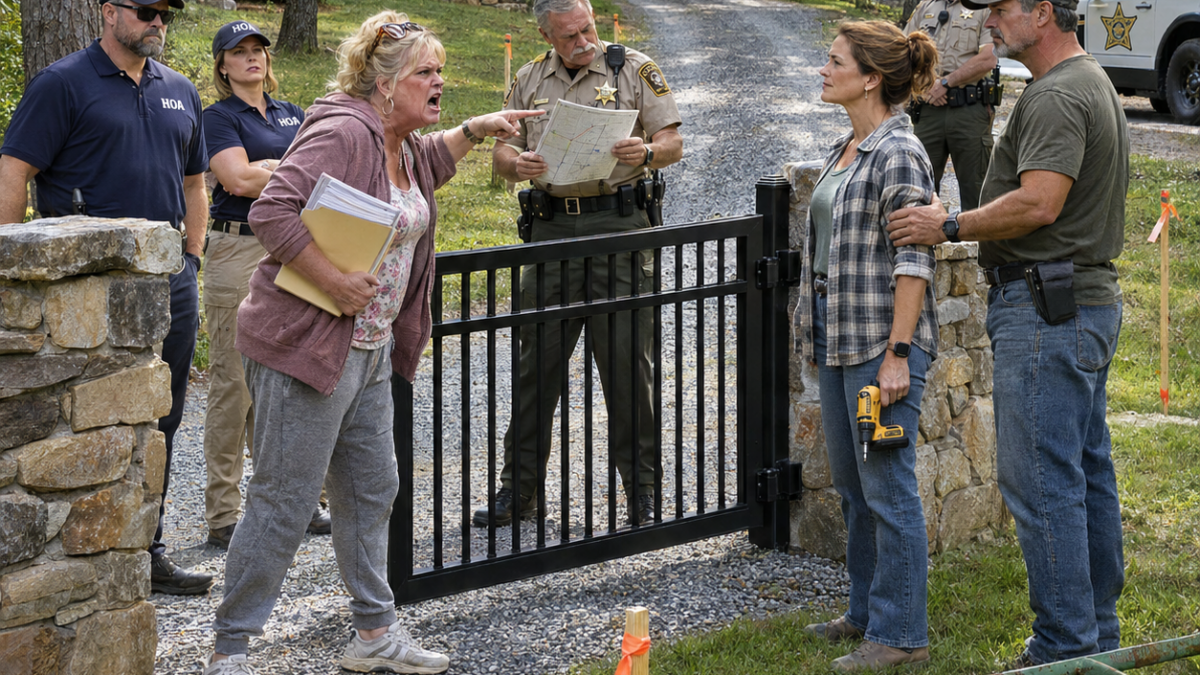
HOA Karen Called 911 on My Wife for Replacing Our Cabin Gate—Then the Deputy Asked, “Do You Know Who You Just Accused?”
**“ARREST HER! SHE DESTROYED HOA PROPERTY, BLOCKED OUR EMERGENCY ROAD, AND BECAME HOSTILE WHEN I TOLD HER TO STOP!” Brenda Whitmore screamed as the first sheriff’s cruiser rolled into our gravel driveway and my wife, Rachel, calmly set her cordless drill on the hood of my truck.**
**Brenda had already told 911 that Rachel and I might be armed, all because we replaced a rusted gate that had nearly fallen on my wife—even though both stone posts stood well inside our surveyed eighteen-acre property and the HOA had ignored every request to prove it owned the gate.**
**Then the older deputy studied Brenda’s homemade “emergency access” map, looked at Rachel for a long second, and asked, “Ma’am, before you called 911… did you bother finding out who these people are?”—and before Brenda could answer, a dark county SUV came around the bend carrying someone she definitely recognized.**
My name is Nathan Cole.
Three months before Brenda Whitmore called the sheriff on my wife, Rachel and I bought an old cabin on Lake Waverly in northern Georgia because we wanted something painfully simple.
Quiet.
We had been married sixteen years.
We lived outside Atlanta most of the time, and our jobs had kept us moving for so long that there were stretches when eating breakfast together felt like something we needed to put on a calendar.
We had talked about slowing down for years.
Then Rachel found the listing.
Eighteen wooded acres at the end of an old gravel road.
A cedar cabin built in 1959.
Stone chimney.
Two bedrooms.
Wide porch.
Private cove.
Old dock.
Oak and pine trees everywhere.
Nothing luxurious.
That was exactly why we wanted it.
Rachel texted me the listing while I was working.
“We need this.”
I replied:
“We need a roof inspection.”
Her answer:
“You have no romance in your soul.”
Six weeks later, we owned it.
The property had belonged to the Bennett family for more than sixty years.
Their grandfather built the original cabin long before Lakeshore Heights existed.
That history mattered.
Lakeshore Heights came later, starting in the 1990s when a developer bought several hundred acres east of the Bennett property and divided the land into lake homes.
Our cabin was never incorporated into the HOA.
The deed said that.
The survey said that.
The county parcel map said that.
We did share one thing.
The road.
Bennett Lake Road started at the county highway, ran through part of Lakeshore Heights, then continued another half mile through woods to our property.
An old recorded road agreement gave Lakeshore residents rights to the first portion while preserving permanent access for the Bennett property.
Nothing unusual.
At least that was what we thought.
Then there was the gate.
About three hundred feet before our cabin driveway, two stone pillars marked the entrance to the original Bennett tract.
Between them hung a heavy green steel gate.
Probably installed around 1980.
PART2.
It was held together by rust, old welds, and optimism.
Our home inspector grabbed one hinge during the inspection.
A flake of metal the size of a quarter fell off.
“This thing is going to fall.”
Rachel asked:
“Soon?”
He laughed.
“Maybe now.”
We added it to the repair list.
Roof flashing.
Dock boards.
Water heater.
Gate.
Normal cabin problems.
Our first neighbor was Frank Miller.
Seventy-one.
Retired hardware-store owner.
Knew everything happening within five miles whether anyone asked him or not.
He appeared our second weekend carrying a toolbox.
“You’re the Coles?”
“Yes.”
“Gate sticks.”
“We noticed.”
“You need grease.”
“We need a new gate.”
Frank stared at the rust.
“Also true.”
He helped me adjust the hinge enough that one person could open it without wrestling the entire frame.
Rachel brought lemonade.
We sat on the porch afterward.
That was when Frank gave us our first warning.
“You met Brenda yet?”
Rachel asked:
“Who’s Brenda?”
Frank smiled slowly.
“You’ll know.”
Two days later, we knew.
Blue golf cart.
LAKESHORE HEIGHTS HOA printed across the windshield.
Brenda Whitmore stepped out wearing the expression of someone arriving at a meeting she already intended to control.
Late fifties.
Clipboard.
Neat clothes.
Confident walk.
She stopped outside the open gate.
“Are you the new owners?”
Rachel smiled.
“Yes. Rachel Cole. My husband’s Nathan.”
“I’m Brenda Whitmore, president of Lakeshore Heights.”
“Nice to meet you.”
Brenda looked past us toward the cabin.
“Have you submitted your renovation plans?”
Rachel looked at me.
“What renovation plans?”
“Anything you intend to change.”
“We’re replacing several dock boards.”
“That requires architectural approval.”
I answered.
“We’re not in the HOA.”
Brenda gave me the patient expression adults use when speaking to a child who has misunderstood something obvious.
“Everyone on Bennett Lake Road is under Lakeshore review.”
“Our closing attorney says otherwise.”
“That is a common misunderstanding.”
The confidence was impressive.
Rachel remained polite.
“Send us whatever document you think applies. We’ll review it.”
That was Rachel.
Never fight somebody when they are willing to put their mistake in writing.
Brenda nodded.
Then pointed toward the old green gate.
“You cannot alter that.”
Rachel looked at it.
“Why?”
“Community access.”
First time we heard those words.
Brenda claimed Lakeshore Heights had used the road and gate for decades for emergency access, shoreline inspections, maintenance vehicles, and access to the western side of the lake.
That was possible.
Old lake properties accumulate strange easements.
We did not dismiss it.
We asked for documentation.
She promised to send it.
That night I checked our closing file again.
Both stone pillars sat inside our parcel.
The gate itself sat inside our parcel.
The recorded road agreement did not give Lakeshore ownership of it.
Still, ownership and access are different things.
Maybe an easement existed.
Rachel called Rebecca Hayes, the attorney who handled our closing.
Rebecca reviewed everything again.
“They may have some limited road rights.”
“Gate ownership?”
“I see none.”
“Could another agreement exist?”
“Absolutely.”
“So we wait for Brenda.”
“Exactly.”
We waited.
Nothing.
Then we received an HOA violation notice.
UNAUTHORIZED GATE MODIFICATION.
Fine:
$500.
The funniest part was that we had not modified anything.
Not one screw.
Not one hinge.
Rachel called Brenda.
“I think you sent this too early.”
“No.”
“We haven’t changed the gate.”
“Planning an unauthorized alteration is still a violation.”
Rachel laughed.
She tried not to.
She really did.
Brenda did not appreciate it.
Rachel again requested the documents proving HOA authority.
Nothing arrived.
Rebecca sent a formal letter.
Our parcel stood outside Lakeshore Heights.
Any claimed access right, easement or ownership interest should be identified by deed or recorded agreement.
The $500 fine disappeared.
For about two weeks, peace returned.
Rachel painted the porch rail.
I repaired the dock steps.
Frank helped clear a fallen tree from the road.
Susan Parker, another Lakeshore resident, brought peach cobbler and apologized for Brenda.
Rachel said:
“You didn’t send the fine.”
Susan smiled.
“You two are going to fit in better than Brenda expects.”
Most Lakeshore residents were good people.
That mattered.
It would have been easy to decide that because the HOA president was difficult, the whole neighborhood was against us.
It was not.
People are not their HOA.
An HOA is supposed to serve a neighborhood.
It should not become the neighborhood’s entire personality.
Then the gate nearly injured Rachel.
Rainy Thursday afternoon.
Delivery truck left.
Rachel went down to close the old gate.
The lower hinge snapped.
The entire steel frame dropped toward her.
She jumped backward.
The corner caught her jacket.
Ripped the sleeve.
Missed her body.
Another foot and I might have been calling an ambulance.
That was enough.
“We’re replacing it.”
Rachel nodded.
“Tomorrow.”
We hired a local gate company.
The replacement would use the exact same stone posts.
Same width.
Same road opening.
No change in alignment.
No obstruction of any proven legal easement.
Black steel instead of rusted green.
Solar-powered operator.
Keypad.
Camera.
Temporary codes.
We even offered to provide access codes to anyone who demonstrated a legitimate legal right.
Before installation, Rebecca sent Lakeshore a notice.
Not a request.
Notice.
The unsafe private gate would be replaced.
If Lakeshore claimed an easement requiring access, provide the document and identify authorized users.
Three days.
Nothing.
Then Brenda arrived with Frank.
Frank looked uncomfortable before he even got out of the golf cart.
Brenda pointed toward the contractor marks near the stone pillars.
“You were specifically told not to touch this gate.”
Rachel stayed calm.
“We own it.”
“The community has used it for thirty years.”
“That doesn’t make it community property.”
“We have emergency rights.”
“Then show us.”
Frank cleared his throat.
“Brenda, that’s what I’ve been asking too.”
She turned sharply.
“Not now, Frank.”
That sentence told us more than she intended.
Frank sat on the HOA board.
He had not seen the documents either.
Then Brenda introduced something new.
Lakeshore supposedly needed unrestricted access through our gate to reach an old emergency lake-pump station.
I asked:
“What pump station?”
She gestured vaguely toward our woods.
“Near the cove.”
There was no pump station on our survey.
No structure listed by the inspection.
No equipment we had seen.
Rachel asked:
“Does the HOA have equipment on our property?”
Brenda immediately changed her words.
“Adjacent to your property.”
“Where?”
“That isn’t relevant.”
It became extremely relevant.
After Brenda left, Frank stayed.
“You ever heard of that pump station?”
I asked.
“No.”
“How long have you lived here?”
“Twenty-six years.”
“Ever seen a Lakeshore pump station down there?”
“No.”
Rebecca checked county utility records.
Nothing.
Lakeshore fire hydrants were supplied from the public water system.
No registered lake intake.
No emergency pumping station.
Then Rachel found the trail.
Behind thick mountain laurel about fifty feet inside our gate, an old gravel path disappeared north through the woods.
Barely visible.
We followed it several hundred feet.
At the end:
Concrete foundation.
Rusted bolts.
An old metal pipe disappearing underground.
Nothing more.
County records eventually identified it.
1978 Bennett survey.
BENNETT IRRIGATION HOUSE.
Original farm infrastructure.
Abandoned before the HOA existed.
That should have ended Brenda’s pump-station argument.
Instead we received another letter.
The gate was now:
COMMUNITY HERITAGE INFRASTRUCTURE.
Rachel stared at the page.
“What does that even mean?”
I said:
“It means she still doesn’t have a deed.”
Rebecca laughed when we sent it to her.
Then she found something useful.
Lakeshore’s declaration did reference a western emergency route.
But the route ended at another parcel.
Not ours.
Over the years, residents or contractors might simply have begun using the Bennett gate because it was convenient.
Convenience becomes habit.
Habit becomes expectation.
Expectation starts feeling like ownership.
Legally, those are not the same thing.
We scheduled the gate replacement for Saturday.
Friday night, Frank called.
“Brenda is telling residents you’re locking the neighborhood away from the lake.”
“We aren’t.”
“I know.”
“We offered codes for anyone with legal access.”
“I know.”
“Does anybody actually have that easement?”
Long pause.
“Not that I’ve found.”
That was enough for me.
Saturday morning was cool and bright.
The contractor arrived at seven.
Rachel was ridiculously excited.
“It has solar power.”
“Yes.”
“Remote access.”
“Yes.”
“Camera.”
“Yes.”
“Temporary codes.”
“You’ve told me fourteen times.”
She ignored me.
By ten, the old gate was down.
Rebecca had advised us to preserve it until the access dispute was resolved, so the contractor placed it carefully on the grass.
The stone posts stayed exactly where they had always been.
The new gate went into the same opening.
Frank came by.
Susan too.
Susan admired the design.
Frank admired the motor.
Then Brenda arrived.
The moment she saw the black steel gate, her face changed.
“What have you done?”
Rachel stood beside the control box holding a cordless drill.
“Replaced our unsafe gate.”
“You had no authority.”
“It’s ours.”
“I told you this is HOA property.”
“And we asked for proof.”
Brenda pulled out her phone.
“I’m giving you one chance to remove it.”
Rachel looked at the beautiful new gate.
“You want me to remove the safe gate and reinstall the one that nearly fell on me?”
“Yes.”
“No.”
One word.
Brenda stared.
Then dialed.
Rachel looked at me.
“Is she calling the board?”
I watched Brenda.
“No.”
Seconds later Brenda spoke loudly.
“Yes, I need police immediately. There is an active property crime happening on Bennett Lake Road.”
Frank’s eyes widened.
“Brenda.”
She turned away.
“A woman is destroying HOA property and blocking emergency access.”
Rachel whispered:
“She called 911?”
“Yes.”
Frank stepped closer.
“That is not an emergency.”
Brenda ignored him.
Then she made it worse.
“Yes, she became hostile when confronted.”
Rachel looked at me.
I said:
“No.”
“I know.”
Then Brenda told dispatch:
“Her husband is here too. I don’t know if they’re armed.”
That changed everything.
I stopped feeling amused.
Rachel’s expression changed too.
Not fear.
Disappointment.
There is a difference between exaggerating an HOA argument and telling emergency dispatch that two people might be armed when you have absolutely no reason to believe it.
We stopped talking to Brenda.
Rachel placed the drill on my truck.
I called Rebecca.
Frank and Susan agreed to remain as witnesses.
The contractor stopped working.
Then we waited.
Two sheriff’s vehicles arrived.
Brenda moved toward them before the first deputy had both feet on the gravel.
“I’m Brenda Whitmore, president of Lakeshore Heights Homeowners Association. That woman destroyed HOA property and threatened me. I need her arrested for vandalism, trespassing, and interfering with community access. Her husband helped her, so you should probably detain him too.”
The younger deputy looked toward us.
The older deputy looked toward the cabin.
Then the boundary stakes.
Then the new gate.
Then Rachel.
His expression changed slightly.
Recognition.
Rachel saw it.
She gave him the smallest shake of her head.
Let this proceed normally.
The deputy’s name was James Walker.
He kept everybody separated.
Asked questions.
Professional.
Exactly how it should have been.
Rachel asked permission before reaching into the truck for our documents.
Deed.
Survey.
Road agreement.
Contractor paperwork.
Rebecca’s letters.
Brenda produced an HOA map.
James unfolded it.
It did not show a property boundary.
It showed a red route labeled:
COMMUNITY EMERGENCY ACCESS.
The line crossed our gate.
Followed Bennett Lake Road.
Turned onto the abandoned irrigation trail.
Then ended at a shaded rectangle near the old concrete foundation.
FUTURE LAKE ACCESS FACILITY.
Rachel leaned closer.
“That’s on our property.”
Brenda pulled the map back.
James stopped her.
“Leave it.”
Then the younger deputy noticed the date.
Four months earlier.
Not thirty years ago.
Not from the subdivision’s original plans.
Created four months before we bought the cabin.
Frank stared.
“I’ve never seen that.”
Brenda said:
“The board discussed it privately.”
“No, we didn’t.”
James asked whether a current emergency required access.
Brenda said:
“Fire protection.”
He checked with dispatch.
County fire department.
No current emergency.
No officially designated route through our parcel.
No fire-access order.
Nothing.
James looked at Brenda.
“Why did you call 911?”
“They’re interfering with community safety.”
“That isn’t what I asked.”
Then the dark county SUV arrived.
Brenda saw it.
Her face changed.
A tall man stepped out wearing a county jacket and carrying a rolled map case.
Deputy Director David Reynolds.
He saw Rachel.
Stopped.
Then smiled.
“Rachel?”
Brenda looked between them.
David said:
“I thought you two were supposed to be taking a month off.”
Brenda stared.
“A month off from what?”
Nobody answered yet.
David had come because Bennett Lake Road was already part of an active county land review.
He opened his map.
Our property.
Old trail.
Concrete foundation.
Surrounding Lakeshore parcels.
Then Brenda’s proposed route.
“This route was never approved.”
Frank stepped closer.
“What is it?”
David looked at Brenda.
“You tell me.”
Then the future facility.
County planning had rejected it six months earlier.
Reason:
Applicant did not control the land.
Six months earlier.
Before Rachel and I bought the cabin.
Somebody had already tried planning a lake-access facility on the Bennett property.
Rachel asked:
“Who applied?”
David read the file.
“Lakeshore Recreation Partners LLC.”
Frank frowned.
“Never heard of it.”
Ownership:
Fifty-one percent Whitmore Development Group.
Brenda’s husband Richard.
He developed vacation homes.
Small marinas.
Boat storage.
Suddenly her emergency route looked less like a fire-access concern and more like infrastructure for a private project.
Rachel said:
“So the emergency road leads to Richard’s proposed development?”
David answered carefully.
“That is what the rejected plan appears to show.”
Brenda snapped:
“It would have benefited Lakeshore.”
Frank turned toward her.
“What community project? The board never approved this.”
Then James asked the simplest questions of the morning.
“Do you own the gate?”
Silence.
“Does Lakeshore Heights own the land beneath it?”
Silence.
“Do you have an easement giving you unrestricted access through it?”
Brenda flipped papers.
Nothing.
Rachel said:
“We asked three months ago.”
James nodded.
Brenda pointed at her.
“She still had no right to interfere with the route.”
David looked confused.
“She owns the route.”
Then he looked at me.
“Actually, they both do.”
Brenda finally asked:
“Who exactly are you people?”
Rachel looked at me.
Not yet.
Our jobs were irrelevant to whether we owned the gate.
Then one deputy crouched beside the old green gate.
“What’s this?”
A small black box.
Hidden underneath.
Wires disappeared into the hollow steel tubing.
The gate contractor shook his head.
“Not mine.”
I had never seen it.
Rachel spotted another device hidden under ivy on the stone post.
Nobody touched anything until photographs were taken.
James wore gloves.
Thin cable inside the gate.
Data.
Not power.
David stared.
“That shouldn’t be there.”
Brenda denied knowing about any monitoring equipment.
Too quickly.
Frank looked at her.
“I watched your contractor work on that post last summer.”
The device turned out to be a wireless vehicle counter with a small camera.
Gate openings.
Vehicle times.
Possibly plates.
Years of stored records.
Photos of the Bennett family.
Delivery trucks.
County workers.
Then Rachel and me.
Our vehicles.
Our guests.
Our movements.
Susan whispered:
“That’s creepy.”
Nobody disagreed.
Then another folder appeared.
PROJECT ACCESS.
Nighttime images.
Pickup trucks.
Utility trailers.
Excavator.
One small excavator leaving at 2:14 in the morning.
Another photo:
Truck beside the abandoned irrigation foundation.
Logo:
WHITMORE DEVELOPMENT GROUP.
David’s expression hardened.
“Your husband’s company entered this parcel after the planning application was denied?”
Brenda finally stopped arguing about the gate.
Then Rachel received a call.
County survey crew at the old foundation.
Fresh concrete underground.
Less than a year old.
A utility vault.
Locked.
Another photograph arrived.
Steel door.
Sign:
LAKESHORE HEIGHTS — EMERGENCY USE ONLY.
Below it:
AUTHORIZED BY PRESIDENT B. WHITMORE.
Frank went silent.
The woman who had called police because Rachel replaced a gate appeared to have used that same gate to conceal access to an underground facility on property the HOA did not own.
Nobody opened the vault immediately.
Sheriff.
County utilities.
Fire marshal.
Everybody followed procedure.
Electricity present.
Buried lake-side pipe.
Another line toward Lakeshore.
Another toward Richard’s property.
Brenda shouted that it was an emergency water system.
Frank said:
“The board never authorized that.”
Brenda changed her explanation.
Emergency presidential authority.
More contradictions.
A locksmith opened the vault under sheriff supervision.
Stairs went eight feet below ground.
Modern pipes.
Valves.
Electrical panels.
Large pressure tank.
Installation dates only months old.
The utility inspector read the labels.
LAKE INTAKE.
BOOSTER PUMP.
PRESSURE CONTROL.
He checked the gauge.
“This system is active.”
Frank stared.
“Active how?”
“Water is moving.”
From Lake Waverly.
Through our property.
Toward Lakeshore Heights.
Non-potable.
Likely irrigation.
No current county permit.
No recorded easement allowing the vault.
Then the second outgoing line.
North.
Toward Richard’s sixty-acre development tract.
The same development that had been rejected partly because it lacked dependable utilities and legal lake access.
Now the gate fight made sense.
The old gate used a commercial lock from the same master-key system Whitmore Site Services used.
Rachel’s new keypad had eliminated their silent access.
The gate was not important because of nostalgia.
It was important because somebody else had a key.
The county shut the intake down.
Within twenty minutes Lakeshore irrigation pressure dropped.
Entrance fountain stopped.
Clubhouse landscaping lost water.
Then a construction dust-control system on Richard’s land shut down too.
Richard’s development filings claimed construction water would come primarily from a private well.
County inspectors checked.
The well barely produced anything.
Most water appeared to have come from the hidden lake line.
Frank turned HOA finances over to an independent accountant.
Payments surfaced.
$24,500.
$18,200.
$31,700.
$16,900.
Western drainage improvement.
Emergency access maintenance.
Drought preparation.
Shoreline stabilization.
Over eighteen months:
More than $180,000.
Much of it to Whitmore Site Services or related contractors.
No invoice said:
SECRET UNDERGROUND LAKE INTAKE BUILT ON PRIVATE LAND.
Then another entry.
Lakeshore had received $95,000 from Whitmore Development.
FUTURE AMENITY CONTRIBUTION.
Money entered a reserve account Brenda and a former property manager controlled.
Some paid for legitimate neighborhood projects.
Playground repairs.
Storm cleanup.
Landscaping.
That complicated the story.
Residents had benefited.
Then the agreement appeared.
Whitmore Development would contribute as much as $250,000 to community improvements.
In exchange, Lakeshore Heights promised to support and facilitate:
WESTERN LAKE ACCESS INTEGRATION.
And:
Reasonable cooperation securing emergency, utility and recreational connectivity through Legacy Bennett access.
Our road.
Our gate.
Our land.
Frank searched board minutes.
No approval for that agreement.
The board had voted only to explore a potential developer partnership.
Nothing more.
Then Brenda made the mistake that finally exposed why Deputy James had recognized Rachel.
During the county review, Rachel started asking detailed questions about water-source certifications.
Brenda snapped:
“You don’t understand development.”
David Reynolds looked at the floor to hide a smile.
Two days later, everybody met formally at the county office.
Lakeshore representatives.
Whitmore Development attorneys.
County engineers.
Sheriff.
Fire marshal.
Rachel and me as landowners.
Brenda sat beside Richard.
David started introductions.
Then:
“For disclosure, Mrs. Cole is currently on approved leave from her position as deputy counsel with the Georgia Environmental Protection Division.”
Brenda’s face changed.
Rachel worked in land-use, water and environmental enforcement.
Exactly the kind of issues now sitting beneath our cabin.
Then David looked at me.
“And Mr. Cole is on leave from the U.S. Army Corps of Engineers, where he serves as a senior civil engineer overseeing reservoir access, shoreline structures and dam-safety projects across the Southeast.”
Richard looked at me for the first time.
Brenda froze.
Completely.
Rachel leaned toward me.
“There it is.”
“What?”
“The face.”
That was the moment Brenda finally understood who she had accused of vandalism and trespassing.
But I want to make something very clear.
Our jobs did not make us right.
Our deed did.
Our survey did.
Rachel would have had exactly the same right to replace that gate if she had been a kindergarten teacher.
I would have had the same property rights if I repaired refrigerators.
Our professional backgrounds only helped us recognize what questions needed to be asked.
Nothing more.
The county meeting continued.
And the situation got worse.
A Corps representative—not me—reviewed the location of the vault.
The excavation sat inside a federally controlled shoreline buffer.
No permit had been issued.
Then Rachel noticed another pipe on the plan.
Southwest.
Away from Richard’s property.
Toward the Lakeshore dam.
“What’s that?”
Richard answered:
“Old drainage.”
The Corps engineer leaned closer.
“That isn’t drainage.”
“How do you know?”
“Drainage lines generally don’t terminate at a gated intake below normal lake level.”
Frank found the same pipe on an old Lakeshore map.
Label:
WESTERN EMERGENCY BYPASS.
Then a county technician entered with a laptop.
Although the vault was supposed to be shut down, water had started moving again.
Remote access.
Somebody still had control credentials.
The second line led to a buried structure near Lakeshore’s private earthen dam.
Pressure climbed.
No rain.
Yet the retention lake behind the dam began rising.
David ordered the lower road evacuated.
Brenda jumped up.
“What is happening?”
“Your dam is taking water from Lake Waverly.”
She stared at me.
“How bad?”
I did a rough flow calculation.
“If the pump is operating near full capacity, tens of thousands of gallons an hour.”
Emergency alerts went out.
Then another valve opened.
Outlet beneath Bennett Lake Road.
Directly beneath our new gate.
Frank’s phone rang.
His face turned white.
“The road under the gate just lifted.”
By the time we arrived, the gravel had risen nearly eight inches.
Water bubbled through cracks.
County crews backed everyone away.
The hidden pipe sat almost six feet below the road.
Rachel’s new gate installation had not touched it.
The danger had been there before us.
Thomas Reed, a county utility engineer, located the buried junction.
One branch:
Lakeshore dam.
Other:
Richard’s development.
Our gate sat almost directly above the pressure fork.
Then Richard surprised everyone.
“There’s another shutoff.”
“Where?” Thomas asked.
“My property.”
County crews and the sheriff escorted him there.
He gave them the cabinet code.
Valve closed.
Pressure dropped.
Then the lake intake was isolated manually.
Eventually:
Zero.
The dam had risen nearly two feet.
But it held.
No homes flooded.
Nobody injured.
The road needed repairs.
One stone gatepost shifted.
That was all.
At the emergency HOA meeting that night, an elderly resident named Howard Jenkins revealed something important.
The Western Emergency Bypass had originally been real.
But its function had been the opposite.
It was an outlet.
If the Lakeshore retention lake rose dangerously during storms, gravity could move water away from the dam toward the Bennett side and Lake Waverly.
The bypass had been abandoned after a new spillway was built.
Someone later reused the old route.
Instead of moving water away from the dam, the new pressurized system could move lake water into it.
That was why the situation had become so dangerous.
Richard agreed to provide all Whitmore Development records.
Not because he had suddenly become generous.
Because the evidence might show that somebody had connected his construction-water system to the dam without his approval.
The audit became more complicated.
The vault cost far more than anyone initially knew.
HOA payments:
About $180,000.
Whitmore Development:
Another $340,000.
Blue Ridge Water Solutions:
Another $125,000.
More than $645,000 total.
Blue Ridge was owned by William Parker, Susan’s brother-in-law.
Susan looked horrified.
Nobody blamed her.
Family connection is not guilt.
William’s original engineering drawings turned out to be important.
They showed the vault.
Lake intake.
Development branch.
Western bypass.
But on his original plan, the bypass had a permanent closed block valve.
A red note:
DO NOT CONNECT TO HOA BASIN WITHOUT SEPARATE ENGINEERING APPROVAL.
That approval never existed.
So who changed it?
Records initially pointed toward Whitmore Site Services.
Then Richard’s attorney produced the subcontract change order.
Approved by:
Brenda.
Handwritten note:
MAINTAIN EMERGENCY FLEXIBILITY FOR HOA USE.
Another note:
KEEP WB PATHWAY LIVE.
That did not prove Brenda intended to flood the dam.
But it proved she knew the connection existed.
Which made the 911 story even worse.
She had called our gate an emergency-access issue without telling anyone an actual unauthorized emergency system had been routed beneath it.
Then the audit uncovered something neither side expected.
The remote water system had older roots.
A recurring $4,800 maintenance payment went to Blue Ridge Water Solutions.
Remote users included William.
Richard’s site manager.
And:
Patricia Whitmore Wells.
Brenda’s older sister.
Former Lakeshore president.
2012 to 2018.
Patricia had started a drought project years earlier after Lakeshore suffered water restrictions.
Landscaping had died.
Fire-water planning had become a concern.
Residents actually voted to explore alternative water supply.
That beginning was legitimate.
Frank looked almost relieved.
“So the entire thing didn’t start as some scheme?”
Maybe not.
Rachel said:
“Bad outcomes don’t require bad beginnings.”
That became the sentence I remembered most.
The original plan had been simple.
Clubhouse irrigation.
Entrance landscaping.
Emergency fire-water storage.
Then the project got expensive.
Permits became difficult.
The Bennett property stood between the lake and the neighborhood.
Instead of stopping and getting proper easements, people started taking shortcuts.
Historic route.
Temporary access.
Emergency authority.
Unrecorded infrastructure.
Then Richard saw the system as a possible water source for his development.
More purpose.
More pipes.
More money.
More excuses.
By the time we bought the cabin, no single person could explain the whole thing honestly.
The county ordered every unapproved connection removed.
Richard agreed to disconnect his development line.
The dam branch was permanently capped.
The WB2 valve beneath our gate was removed.
The main lake intake stayed closed.
Our gatepost was rebuilt.
For a few days, Rachel and I finally used the cabin for what we bought it for.
We fished.
I repaired a dock board.
Susan brought peach cobbler.
Frank complained that the HOA could have avoided hundreds of thousands of dollars in trouble if someone had simply asked the Bennett family for a proper easement years earlier.
He was probably right.
Then Rebecca found a document that helped Lakeshore.
A real 1986 easement.
Signed by Thomas Bennett.
It allowed maintenance of one underground drainage pipe across the property.
Not a pressurized intake.
Not construction access.
Not marina use.
Not gate ownership.
Drainage.
We could have kept quiet because it weakened the cleanest version of our argument.
We did not.
Rebecca immediately gave it to the county and Lakeshore attorney.
Frank looked surprised.
“That could help us.”
“It’s the truth.”
The old easement might have expired when Lakeshore built a permanent alternative spillway in 2004.
That legal question could be resolved later.
No emergency.
Just paperwork.
Then the sheriff completed its initial review of Brenda’s 911 call.
Rachel had not threatened Brenda.
Frank said so.
Susan said so.
The gate contractor said so.
Body-camera footage showed Rachel cooperative.
Dispatch recording captured Brenda telling police we might be armed without any factual basis.
Brenda received a citation for misuse of emergency services and the matter went through local review.
Not prison.
Not a dramatic arrest.
A citation.
Consequences matching what investigators could prove.
Rachel did not celebrate.
“I hope she learns something.”
I asked:
“That’s it?”
“She called because she was angry and scared. She made it worse. She got consequences.”
That was Rachel.
Then Brenda asked to meet.
Through attorneys.
Neutral county conference room.
She apologized first to Rachel.
“I should not have called 911.”
Rachel nodded.
“No.”
“I believed you were blocking emergency access.”
“You also said I threatened you.”
Brenda looked down.
“I was angry.”
“That is not the same thing as threatened.”
“I know.”
Then she admitted what we had suspected.
The old gate’s master-key system allowed maintenance crews to reach the hidden vault without asking the Bennett owner each time.
Rachel’s keypad destroyed that convenience.
Brenda panicked.
The gate did not belong to Lakeshore.
It simply no longer obeyed Lakeshore.
That difference was the entire dispute.
I asked:
“Who opened the remote valves when the road lifted?”
Brenda looked up.
“I don’t know.”
“You had access?”
“Yes.”
“Richard?”
“Yes.”
“William?”
“Yes.”
“Anyone else?”
She hesitated.
“Patricia.”
Her sister.
The former president living in Florida.
“Were her credentials removed when she left?”
“No.”
Terrible security.
Then:
“Patricia came back to Georgia last week.”
Rachel leaned forward.
“Why?”
“She thinks shutting the system down destroys years of work.”
“Where is she now?”
“I don’t know.”
Brenda looked genuinely frightened.
“She stopped answering me.”
David Reynolds entered the room carrying an emergency notice.
“Someone accessed the intake controls again.”
Rachel stood.
“The branches were disconnected.”
“The known branches.”
David placed another map down.
A fourth line.
West.
Away from Lakeshore.
Away from Richard.
Through our woods.
Toward an old Bennett cattle reservoir.
I had never heard of it.
Overgrown.
Dry for decades.
Someone had opened a hidden valve and started filling it directly from Lake Waverly.
County crews reached it.
The earthen embankment was weak.
Tree roots.
Animal burrows.
No maintenance in forty years.
Thousands of gallons entering.
Then the call came.
Water at the top.
Embankment leaking.
We ran.
Before we reached the cabin, I heard the sound.
Like distant thunder.
Clear sky.
I knew what it was.
Earth moving under water pressure.
Rachel knew too.
The old reservoir wall failed.
Not all at once.
It sagged.
Cracked.
Then folded inward.
Brown water rushed through the trees.
Branches.
Rocks.
Leaves.
County crews had already evacuated the danger area.
Rachel and I stopped at the roadblock instead of trying to reach our cabin.
Hardest decision of the day.
But uncontrolled water does not care whether the landowner thinks he can help.
The flow split around a natural rise.
One branch crossed our driveway.
Another went behind the cabin.
The porch survived.
Cabin survived.
Gate survived.
Our storage shed did not.
Water moved it about twenty feet and dropped it against two trees.
We lost fencing.
Tools.
Firewood.
Half of Rachel’s new garden.
Compared with what might have happened:
Nothing.
No injuries.
No foundation failure.
No lives lost.
“We got lucky,” Rachel said.
“Yes.”
“Again.”
That word mattered.
The broken reservoir revealed a modern connection.
Recent valve.
Recent pipe.
Construction drawings labeled the old basin:
FUTURE RAW WATER STORAGE.
Blue Ridge’s original drawing contained one giant red warning:
DO NOT ACTIVATE — EMBANKMENT UNSAFE.
Someone knew.
Repair estimate had once been almost $190,000.
Rebuild embankment.
Remove trees.
Install emergency spillway.
Instead, the reservoir was supposed to remain abandoned.
Frank looked at Brenda.
“Patricia knew it was unsafe?”
“Yes.”
“You knew?”
“Yes.”
“Then why wasn’t it on the current system map?”
“Because it wasn’t supposed to be connected.”
That answer was true.
Control logs showed the hidden reservoir valve was opened remotely from an old administrator account.
Username:
P. WELLS.
Patricia Wells.
An account alone was not enough.
Passwords can be shared.
But the login originated from a phone number still registered to Patricia.
Investigators located her at a hotel near Gainesville.
Laptop.
Old Lakeshore project files.
Attorney present.
Digital records showed she had logged into the drought-control system repeatedly even after moving to Florida.
She still considered it her project.
When Brenda and the county began dismantling connections, Patricia believed years of work were being destroyed.
She returned to Georgia.
Started opening valves.
At first she said she was testing the system.
That could explain the first remote opening.
It did not explain activating a reservoir she knew was unsafe.
Then investigators found her email to Brenda.
“They are cutting everything apart. Once the Bennett line is removed, we lose western capacity forever.”
Brenda replied:
“Do not touch anything. County has control.”
Patricia:
“They don’t understand what we built.”
Brenda did not answer.
That email mattered.
Brenda had done plenty wrong.
Secret access agreement.
Undisclosed contracts.
Hidden project connections.
911 exaggerations.
Gate pressure.
But she had explicitly told Patricia not to touch the system.
Patricia’s later actions were Patricia’s.
People should be judged for what they did.
Not every bad thing that happened near them.
That principle became important because the whole mess had never been one giant evil plan.
The original drought project began with a legitimate problem.
Then costs increased.
Permits became difficult.
People cut corners.
A private landowner stood in the way.
Instead of asking, someone assumed.
Then someone else expanded.
Then somebody reused an old pipe.
Then another person connected a development.
Then old access became “historic.”
Temporary became permanent.
Convenient became entitled.
Each shortcut made the next shortcut easier to justify.
Until Rachel replaced one broken gate and the whole structure started showing itself.
Insurance handled our cabin repairs.
Lakeshore’s insurer covered part of the road and gate damage because HOA-connected infrastructure contributed.
Blue Ridge Water Solutions and Whitmore Site Services faced separate liability issues.
No magical multimillion-dollar settlement.
Just engineering reports.
Insurance claims.
Civil payments.
Restoration.
That was fine.
Rachel and I had no interest in bankrupting ordinary Lakeshore homeowners.
Most knew nothing about the system.
They already faced audit expenses.
Repairs.
Insurance increases.
Our goal was simple.
Restore our property.
Remove the danger.
Make sure nobody could quietly use our land again.
The old Bennett reservoir was not rebuilt.
County crews lowered the embankment so it could never hold dangerous water again.
The intake pipe was cut.
Capped.
Filled in several places.
The basin became a shallow wet-weather area covered with native grass.
The underground vault was removed.
Every pipe mapped.
Every connection documented.
No mystery.
No remote valve.
No secret water capacity.
The steel sign that had said:
LAKESHORE HEIGHTS — EMERGENCY USE ONLY
ended up with Frank.
“Why do you want that?”
“Board training.”
Fair.
Richard’s development did not vanish.
His company still owned sixty acres.
He still had the legal right to submit new proposals.
What he did not own:
Our road.
Our gate.
Our shoreline.
Our lake intake.
He had to start over.
Legal access.
Approved utilities.
Real water source.
Proper permits.
Without shortcuts through our land, his marina concept became too expensive.
He eventually submitted a smaller development using a road farther north.
Rachel did not review it.
She had returned to the Georgia Environmental Protection Division and formally recused herself from anything connected with our dispute.
My return to the Army Corps worked the same way.
I did not review Lakeshore’s dam case.
Someone else did.
Professional knowledge is not a private weapon.
We were determined not to turn our jobs into the very thing we had criticized Brenda for doing with her title.
Lakeshore changed too.
Brenda resigned before the final board hearing.
She stayed in the neighborhood.
Awkward.
But legal.
Frank became interim president.
Then residents elected him properly.
Jennifer became treasurer.
Susan refused every office.
Her explanation:
“I like the neighbors too much to join the board.”
Probably the smartest person in Lakeshore.
The forensic audit found Brenda had approved contracts that should have gone before the full board.
Several involved her husband’s companies.
Some disclosures were incomplete.
The developer agreement created serious conflict-of-interest issues.
She faced civil consequences and local penalties.
The false 911 claims remained separate.
She paid her citation.
Completed a diversion program.
No jail.
Rachel was satisfied.
Patricia’s case was more serious.
Her remote actions directly caused dangerous pressure events and the reservoir failure.
Her lawyers argued she never intended to damage our property.
Maybe true.
Intent did not change the fact that she knowingly activated infrastructure after county authorities shut it down.
Her case ended with criminal and civil penalties.
Restitution.
Strict restrictions involving utility systems.
No dramatic courtroom screaming.
No speech from me.
Evidence did the work.
Richard faced financial penalties tied to unapproved construction and related-party contracts.
His company paid part of restoration.
William Parker’s engineering firm faced professional review over record keeping and project oversight.
But investigators also found his original plan clearly warned against activating the unsafe reservoir.
That mattered.
Details always matter.
The old green gate sat behind our barn for months.
Rachel refused to let me throw it away.
I finally asked:
“Why are we keeping the object that nearly fell on you?”
“It started everything.”
“Brenda started everything.”
“No.”
She pointed at the rusted hinge.
“The gate showed us everything.”
She was right.
If that hinge had not broken, we might never have replaced it.
If we had not replaced it, the Whitmore master key would still have worked.
Maintenance crews could continue entering quietly.
Brenda might never have panicked.
No 911 call.
No deputy studying the map.
No hidden camera.
No secret route.
No vault.
No pipes.
No audit.
No Patricia login.
One broken hinge opened the whole story.
Eventually we gave the gate to Frank.
He cut off a small section.
Mounted it in the Lakeshore HOA meeting room.
Below it:
ASK FIRST.
That became the unofficial neighborhood rule.
Need access?
Ask.
Need an easement?
Ask.
Need to inspect private land?
Ask.
Want to run a half-million-dollar utility system across somebody else’s property?
Definitely ask.
The official rules became boring.
Which meant they were good.
No related-party contracts without full disclosure.
No utility work without board approval and permits.
No private-property entry without permission or genuine emergency authority.
No contractor master keys.
No remote utility credentials left active after board members leave.
Every easement mapped.
Every access code documented.
Independent review for major infrastructure.
Rachel and I kept the cabin.
Of course we did.
We rebuilt the storage shed.
Repaired the garden.
Reset the stone gatepost.
Then Rachel installed a small metal sign on the inside of the new gate.
PRIVATE PROPERTY
PLEASE CALL FIRST.
Frank saw it.
“Too subtle.”
“It’s not for you.”
“What’s my code again?”
“You don’t have one.”
He did.
Of course.
Susan did too.
Emergency services had secured county access.
We did not become less generous because people had abused generosity.
We just made the rules clear.
That may be the biggest lesson I took from the whole thing.
Boundaries do not make kindness smaller.
They make kindness safer.
Almost one year after Brenda called 911, Rachel and I sat on the porch watching sunset across Lake Waverly.
The woods had started recovering.
Native grass covered the old reservoir.
The hidden utility trail was becoming woods again.
Rachel held iced tea.
“You know what still bothers me?”
“What?”
“She called me hostile.”
I laughed.
“That’s the part?”
“I said no.”
“Very aggressively.”
“I said it once.”
“Terrifying.”
She kicked my chair.
Then became serious.
“She really thought saying no made me the problem.”
That was true.
And not only in HOA disputes.
People become accustomed to access.
Control.
Agreement.
Then the first person who sets a boundary suddenly looks difficult.
Rachel had not threatened Brenda.
Had not blocked a legal emergency.
Had not destroyed community property.
She replaced a dangerous gate she owned.
Everything that followed began because someone could not accept the word no.
People still tell this story as if Brenda realizing our jobs was the best part.
The environmental enforcement attorney.
The Army Corps engineer.
The couple who happened to understand water, shorelines, dams, permits, access and infrastructure far better than she expected.
Yes.
Her expression at the county meeting was unforgettable.
But that is not why we prevailed.
Our jobs did not create our deed.
They did not draw the property boundary.
They did not make Brenda’s 911 claims false.
They did not create the missing permits.
The evidence did that.
Survey.
Title.
Property markers.
Invoices.
Control logs.
Old drought plans.
Real drainage easement.
Missing access rights.
Permit history.
Even documents that helped Lakeshore mattered.
Truth cannot depend on whether a fact helps your side.
A few months after everything settled, Brenda came back to the cabin alone.
She stopped outside the gate.
Then called.
That made me smile.
Rachel opened it remotely.
Brenda parked near the porch.
No clipboard.
No HOA folder.
No badge of office.
She stayed inside her car for almost a minute before getting out.
Then apologized again.
Not through attorneys.
She told us she had convinced herself the project protected Lakeshore Heights.
Losing access felt dangerous.
Richard’s development became attached.
Then Patricia’s old drought system.
Then HOA money.
Then the gate.
“At some point,” she said, “I stopped asking whether I had the right to do something. I only asked whether I could justify doing it.”
Rachel listened.
Then said:
“That’s how boundaries disappear.”
Brenda nodded.
We did not become friends.
We did not need to.
An apology does not erase consequences.
Forgiveness does not mean giving somebody another key.
We treated her respectfully.
Then she left.
Through the same gate she had once called 911 over.
This time she waited for it to open.
That was enough.
Today the cabin is finally what Rachel wanted when she sent me the listing.
Quiet.
Frank visits too often.
Susan still brings enough food for six people.
Rachel checks the gate camera even though nothing suspicious has happened in months.
I inspect the slope after heavy storms because once you have watched a forgotten reservoir wall collapse, that habit probably never leaves.
But the problems are normal now.
Branches.
Dock boards.
Fishing line around a propeller.
Storm cleanup.
Things a lake cabin should be about.
Sometimes new Lakeshore residents hear the story and ask Rachel:
“What did you do when Brenda called 911?”
Rachel always says:
“I waited for the deputies.”
They expect more.
A badge.
A powerful phone call.
A threat.
Some secret government connection.
No.
We waited.
Rachel put down her drill.
We showed the sheriff our deed.
We showed the survey.
We let the process work.
That answer disappoints people who want revenge.
I prefer it.
Because the victory was never embarrassing Brenda Whitmore.
The victory was proving that a calm boundary can survive a loud accusation.
The underground system is gone.
Richard’s development now has its own approved road and utilities.
Lakeshore uses legal irrigation.
The dam has independent monitoring.
The abandoned reservoir cannot hold dangerous water.
The HOA records are open to residents.
Our new gate works perfectly.
And the only reason anyone calls 911 from our cabin now is if there is an actual emergency.
So yes.
An HOA president called 911 on my wife because Rachel replaced a dangerous gate on our own property.
She expected deputies to force us to undo it.
Instead, that call exposed a hidden access route, surveillance equipment, an underground lake-water vault, a private development agreement, an unsafe bypass, old remote-control accounts, and years of people using property they had never properly asked permission to use.
And yes.
Brenda froze when she finally realized who Rachel and I were.
But the most important thing she learned had nothing to do with our titles.
You do not need to be an environmental attorney.
You do not need to be a federal engineer.
You do not need to know county officials.
You do not need an important job at all.
To deserve respect on your own property, sometimes all you need is a valid deed, a clear boundary—
and enough courage to say no.








