The Family Almost Laughed at Their Cat’s Swollen Face—Then the Vet Shaved His Cheek and Found Two Rattlesnake Bites Meant for Their 18-Month-Old Daughter
PART3:
Adventure might involve leaving the place where food appeared at six every morning.
He patrolled the porch.
The garden border.
The chicken run.
The patch beneath the mesquite tree where lizards made serious tactical errors.
And the grass line behind the patio.
He knew every sound.
Every smell.
Every fence post.
He knew which neighbor’s dog sometimes pushed its nose through the wire.
Which mockingbird would attack him during nesting season.
Which corner of the shed stayed warm in winter.
He had been born there.
As far as Waylon was concerned, the house belonged to us because he permitted the arrangement.
We never really made him an indoor cat.
We tried.
The first time, he shredded a window screen.
The second, he sat beside the door from sunset until two in the morning without moving.
Not meowing.
Not scratching.
Just staring.
I lasted six hours.
Sarah lasted another forty minutes.
“Let him out.”
“He’ll learn.”
“He is learning.”
“What?”
“That if he stares at you long enough you surrender.”
We let him out.
Waylon never forgot the lesson.
He came inside during freezes.
Thunderstorms.
The occasional brutal August afternoon when even he admitted air-conditioning was an invention worth respecting.
Otherwise he belonged to the porch.
Then Rosie was born.
Our daughter.
Our first.
And Waylon reacted to her arrival in the same way he reacted to most changes.
Deep suspicion.
For the first three weeks he would sit outside the nursery door and stare at the baby.
If Rosie cried, Waylon’s ears flattened.
If she stopped, they came back up.
Once, at two in the morning, Sarah found him standing beside the bassinet.
She nearly screamed.
Waylon was not touching Rosie.
He simply stood there.
Watching.
Sarah whispered:
“Waylon.”
He looked at her.
Then at the baby.
Then jumped down and left as if embarrassed to have been caught performing unpaid work.
By the time Rosie could crawl, she considered Waylon part furniture and part toy.
He considered Rosie an unpredictable weather system.
Their relationship required compromise.
Rosie would grab toward his tail.
Waylon would move.
Rosie would crawl after him.
Waylon would move farther.
Rosie would corner him near the couch.
Waylon would jump onto the armrest and stare down at her with open disappointment.
He never scratched her.
Not once.
Never hissed in her face.
Never swatted.
He simply removed himself from situations he considered undignified.
“That cat has more patience than either of us,” Sarah once said.
“Only because he doesn’t pay the mortgage.”
Waylon looked at me.
I swear he looked offended.
By the spring Rosie was eighteen months old.
Walking.
Running badly.
Falling constantly.
Talking in the private language toddlers develop before adults become competent enough to understand them.
She could say Mama.
Dada.
More.
No.
Chicken.
And “Way-way.”
Waylon.
He pretended not to respond.
He always did.
The Saturday everything happened was April 23.
I remember because the following Monday was my brother’s birthday and I had forgotten to buy a card.
I remember the weather too.
First genuinely hot week of the year.
Not summer hot.
Hill Country April hot.
Low nineties.
Sun bright enough to make limestone glare.
The kind of weather that tells snakes winter is over.
We knew snakes were around.
Everybody living outside town does.
Western diamondbacks are part of the landscape.
You keep grass short near the house.
You watch where you put your hands.
You teach children when they are old enough.
You wear boots in brush.
We had found shed snake skins before.
Once I killed a small rattler near the shed after it cornered itself beside a feed bag.
I didn’t enjoy it.
I also wasn’t going to relocate a venomous snake ten feet from where my child played.
Still, there is knowing rattlesnakes exist.
And then there is looking at one three feet from your daughter.
I wasn’t outside when it began.
That fact bothered me for years.
It still does sometimes.
I was in the garage changing oil in our mower.
Sarah was behind the house hanging laundry.
Our dryer had broken the previous week.
Repair part delayed.
So we had dragged out an old clothesline Sarah’s grandmother gave us.
It ran from a cedar post near the patio to a metal pole eight steps into the backyard.
Sarah has counted those steps many times.
Eight.
She can still show you.
One.
Two.
Three.
Four.
Five.
Six.
Seven.
Eight.
Rosie sat in the grass beside the patio with a plastic bucket and three wooden blocks.
The grass there was short.
Maybe two inches.
Safe yard.
Ten feet farther west, beyond the maintained strip, the grass grew knee-high near the old fence.
Waylon lay in the shade beneath the patio chair.
Typical Saturday.
Nothing dramatic.
Sarah hung one shirt.
Then another.
Two shirts.
That became another measurement.
Eight steps.
Two shirts.
She turned her back for maybe four seconds.
She never heard a rattle.
That bothered her afterward.
For months she would say:
“How did I not hear it?”
Maybe the wind.
Maybe lawn equipment down the road.
Maybe the snake never rattled.
Rattlesnakes do not always announce themselves.
But Sarah heard Waylon.
She says she will hear that sound until she dies.
Not a normal cat noise.
Not a hiss.
Not yowl.
Not growl.
Something between all three.
Deep.
Continuous.
Desperate.
The sound of an eight-pound animal trying to become larger than he was.
Sarah dropped the shirt.
Turned.
Rosie was still sitting in the grass.
Waylon was no longer beneath the chair.
He was three feet in front of her.
Low to the ground.
Moving sideways.
And between Waylon and the tall grass was a rattlesnake.
Coiled.
Thick-bodied.
Dark diamonds.
Head raised.
Sarah says the scene did not make sense at first.
Her brain identified things separately.
Rosie.
Cat.
Snake.
Then assembled them.
She screamed my name.
I heard it through the garage.
Not the word.
The tone.
There are tones your spouse uses that remove thought from your body.
I dropped the wrench.
Ran.
By the time I reached the back door, Sarah had covered the eight steps.
She grabbed Rosie under both arms.
Lifted her.
Then did something I still find almost funny because it was completely instinctive.
She climbed onto the patio table.
Not chair.
Table.
Rosie against her chest.
Bare feet kicking.
Sarah yelling.
“Snake!”
“Snake!”
“Snake!”
I came through the door.
Waylon was fighting it.
That is the word I use, though fighting doesn’t describe it correctly.
He wasn’t attacking in the way cats attack prey.
He wasn’t trying to kill.
He was moving.
Fast.
Low.
Sideways.
The snake struck.
Waylon shifted.
The strike missed.
The snake recoiled.
Waylon moved again.
But there was a pattern.
He never moved toward Rosie.
He gave ground only toward the grass.
Away from the patio.
Away from Sarah.
Away from our daughter.
At the time I did not understand that.
I just saw orange blur and snake.
Later, watching the security-camera clip, the direction became obvious.
Every movement.
Every retreat.
Every feint.
The cat was pulling the snake west.
The closest comparison I can make is a matador redirecting a bull.
Not because Waylon understood bullfighting.
Because he understood attention.
If the snake watched him, it wasn’t watching Rosie.
If it struck him, it wasn’t striking Rosie.
The snake lunged.
Waylon twisted.
I heard Sarah scream.
Something happened too fast to see.
Waylon jumped backward.
The snake recoiled.
Then Waylon moved forward again.
That was the part I remembered afterward.
He could have left.
There was open patio behind him.
Furniture.
Porch.
House.
He could have cleared six feet in one jump.
Instead he moved toward the snake.
Not straight.
Angled.
Enough to keep its head following him.
I grabbed the shovel leaning beside the door.
By the time I reached the yard, Waylon had driven the confrontation into taller grass.
I stopped.
That sounds cowardly.
Maybe it was.
But charging blind into knee-high grass where a rattlesnake had just disappeared would have created another emergency.
Waylon vanished too.
Grass shook.
Then stopped.
I heard one dry rattle.
Short.
Then nothing.
“Waylon!”
No response.
Sarah was crying now.
Rosie crying because Sarah was crying.
I stood five yards from the grass holding a shovel like an idiot.
Thirty seconds.
Maybe less.
Felt like five minutes.
Then the grass moved.
Orange appeared.
Waylon walked out.
Alone.
Slowly.
He came back onto the short grass.
Sat.
Faced the grass line.
Tail wrapped around his feet.
Guarding it.
I thought he was fine.
That is what destroys me in the memory.
For maybe thirty seconds, I thought we had gotten lucky.
“Waylon.”
His left ear flicked.
I moved closer.
“Come here.”
He did not.
He watched the grass.
Then I noticed the cheek.
At first just slight fullness beneath the fur.
Like he had been stung.
Then more.
And beneath his jaw, another swelling started.
“Sarah.”
She looked.
“What?”
“Get inside.”
“What happened?”
“Get Rosie inside.”
Waylon stood.
Took two steps.
Stumbled.
My stomach dropped.
I approached slowly.
He normally hated being picked up.
That day he let me.
The moment I touched him, I felt how hard his body was shaking.
Not visible.
Internal.
His heart beating unbelievably fast.
I carried him inside.
Sarah set Rosie in the playpen.
Her hands shook so badly she missed the latch twice.
“Snakebite?”
“I think.”
“How many?”
“I don’t know.”
“Call Dr. Parker.”
I already was.
Hill Country Veterinary Clinic was forty minutes away under normal driving.
Saturday emergency hours.
Dr. Caleb Parker answered personally.
I said:
“Rattlesnake.”
“Cat.”
“Face swelling.”
His voice changed.
“How long ago?”
“Minutes.”
“Respiratory distress?”
“Not yet.”
“Do not give medication.”
“Do not cut anything.”
“Do not apply ice.”
“Keep him quiet.”
“Drive.”
We drove.
I carried Waylon to my truck.
Sarah stayed with Rosie.
She wanted to come.
I told her not to.
She hated me for about three seconds.
Then understood somebody had to stay with our daughter and watch the yard until we knew where the snake was.
I wrapped Waylon in an old bath towel.
Set him on the passenger seat.
He immediately climbed down into the footwell.
Typical.
Even half-poisoned, he objected to arrangements made on his behalf.
His face kept swelling.
By the time I reached Highway 290, the left cheek looked huge.
The jaw followed.
His eye narrowed.
He breathed through his nose.
I kept one hand on the steering wheel.
The other near him.
Not touching unless he wanted.
“Stay with me, buddy.”
Waylon stared up.
Angry.
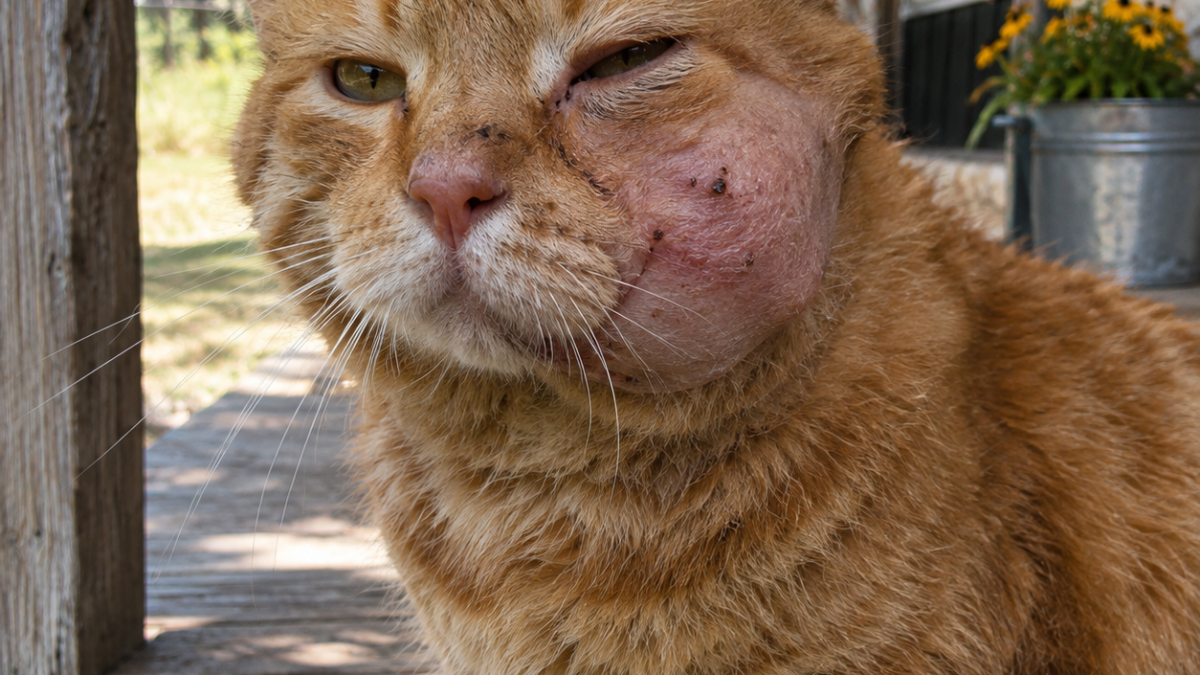
I took the photograph at a red light.
People later asked why.
I don’t know.
Maybe because Sarah was texting every thirty seconds.
How is he?
Is he awake?
Can he breathe?
I sent the picture.
Her reply came immediately.
OH MY GOD.
Then:
I’M SORRY BUT HE LOOKS RIDICULOUS.
I looked down.
He did.
His head looked enormous.
One side round like a balloon.
Whiskers pushed forward.
If you removed the context, it could have been a cat reacting to an insect sting in a comedy.
I almost laughed.
A tiny breath through my nose.
Then Waylon’s head dropped.
No humor remained.
“Hey.”
I reached down.
He opened his eyes.
“I’m sorry.”
I don’t know what I was apologizing for.
The laugh.
Not reaching Rosie sooner.
Letting the grass grow.
Not seeing the snake.
All of it.
“Stay awake.”
He did.
Hill Country Veterinary was waiting.
Technician met me at the door with a carrier.
I said:
“He hates carriers.”
She looked at the swollen cat.
“I think today he can file a complaint later.”
Waylon growled.
The technician smiled.
“Good.”
“What?”
“Attitude.”
“Really?”
“I’ll take attitude.”
They weighed him.
Eight pounds, eleven ounces.
Normal temperature.
Heart rate too fast.
Blood pressure low.
Dr. Parker came in.
Mid-fifties.
Tall.
Gray hair.
Boots under scrubs.
He had treated ranch animals and pets in Gillespie County for almost thirty years.
Nothing dramatic about him.
That was why people trusted him.
He examined Waylon.
“Possible envenomation.”
“Possible?”
“I need the wounds.”
The swelling made finding punctures difficult beneath orange fur.
He asked a technician for clippers.
Waylon objected.
Even poisoned, he considered shaving an insult.
I held his shoulders gently.
Dr. Parker shaved the left cheek.
Orange fur fell away.
Pink skin appeared.
Then two punctures.
Deep.
Dark.
Separated farther than I expected.
Dr. Parker stopped.
Shaved lower.
Second set beneath the jaw.
He stared.
Measured.
Checked again.
I had never seen him become quiet like that.
“What?”
He did not answer immediately.
“Doctor?”
He looked at Waylon.
Then me.
“How big was the snake?”
“Maybe four feet.”
“I didn’t measure.”
“He was between it and my daughter.”
Dr. Parker looked again at the wounds.
“One strike here.”
He touched without pressing.
“Another here.”
“Two?”
“Yes.”
My stomach turned.
“Both venomous?”
“We treat based on signs.”
“Swelling, circulation, pain.”
“But these are consistent with significant envenomation.”
I sat.
The room tilted slightly.
Dr. Parker looked toward the door.
“Your daughter how old?”
“Eighteen months.”
“And the snake was close?”
“Three feet.”
He studied the spacing.
Then said the sentence I have repeated ever since.
“Those strikes were meant for something small.”
I looked at him.
He continued.
“Anything this size that takes two of them and keeps engaging knew where the danger was.”
I swallowed.
“You think he did it for Rosie?”
Dr. Parker was careful.
Veterinarians are scientists.
Good ones don’t turn behavior into fairy tales just because clients need them.
“I can’t tell you what was inside a cat’s mind.”
He nodded toward Waylon.
“But cats understand territory.”
“They understand threat.”
“They understand who belongs inside that territory.”
He touched one shaved edge gently.
“And he did not leave.”
That was enough.
They started IV fluids.
Antivenin.
Pain management.
Monitoring.
Waylon hated the catheter.
Hated the pump.
Hated the thermometer.
Hated everyone except one technician named Marisol, whom he tolerated enough to glare at from her lap.
I called Sarah.
“Two bites.”
Silence.
Then:
“Two?”
“Face and jaw.”
“Oh God.”
“He’s getting antivenin.”
“Will he live?”
I looked at Dr. Parker.
He held up one hand.
Not promise.
Not hopeless.
“Parker says he has a chance.”
Sarah started crying.
I stepped into the hallway.
“He got Rosie away.”
“I know.”
“I watched him.”
“I know.”
“I should have been—”
“Stop.”
She was quiet.
“Don’t do that.”
“But—”
“You were eight steps away.”
“I turned around.”
“To hang laundry.”
“I left her—”
“For four seconds.”
Another silence.
“Sarah.”
“Yeah.”
“The snake was there whether you looked at it or not.”
She cried harder.
“I know.”
“Waylon was there too.”
That was the first time either of us understood what those facts meant together.
Dr. Parker kept Waylon overnight.
Then another.
Then a third.
The swelling worsened before improving.
The left side of his face became so large the eye closed completely.
Tissue around the bite started draining.
A small tube was placed near the lower wound.
Blood tests repeated.
Clotting monitored.
Kidney values watched.
I visited twice a day.
Waylon greeted me by turning his back.
Dr. Parker called that encouraging.
“If he has energy to resent you, I like him.”
The famous photograph happened before anyone knew whether he would survive.
That matters.
People later saw it after the ending.
Cute ugly cat.
Hero cat.
Happy ending.
At the moment I took it, Waylon might have died.
The picture is funny only because the future turned kind.
That first night, I barely slept.
Neither did Sarah.
At 1:18 a.m., she whispered:
“What if he dies?”
I stared at the ceiling.
“He doesn’t.”
“You can’t know.”
“No.”
“But I’m choosing that answer.”
She turned toward me.
“I laughed.”
“So did I.”
“For a second.”
“I know.”
“I feel horrible.”
“He would absolutely laugh at us if our faces looked like that.”
She almost smiled.
Then covered her face.
“I keep seeing Rosie in the grass.”
I did too.
For weeks.
Sometimes still.
The security camera had caught part of the confrontation.
We didn’t watch immediately.
Dr. Parker wanted to know whether Waylon had possibly been struck elsewhere, so on the second day I downloaded the recording.
Camera mounted above the back door.
Wide angle.
No sound worth using.
Timestamp.
10:43:16.
Sarah at clothesline.
Rosie beside patio.
Waylon beneath chair.
At 10:43:20, Waylon’s head snaps toward the grass.
Before the snake is visible.
He knew.
At 10:43:21, Waylon moves between Rosie and the grass.
Snake emerges.
At 10:43:22, Sarah turns.
The rest happens almost too quickly.
But slowing the video reveals the pattern.
Strike.
Waylon moves west.
Strike.
West again.
Sarah reaches Rosie.
Waylon advances.
Snake tracks him.
Both enter grass.
I watched fifteen times.
Then stopped.
Not because it was graphic.
Because it destroyed the comforting idea that Waylon had simply blundered into danger.
He saw it first.
Positioned himself first.
Stayed after Rosie was removed.
That last part mattered most.
Sarah had Rosie on the patio table.
Safety achieved.
Waylon still followed the snake toward the grass.
Why?
Territory?
Predatory instinct?
Adrenaline?
Protection?
Probably some mixture.
Animals are allowed to have complicated reasons too.
But after he came out, poisoned and swelling, he did not crawl under the porch.
He sat facing the grass.
Guarding.
That is the image we don’t have a photograph of.
I wish we did.
Waylon.
Eight pounds.
Face beginning to swell.
Back straight.
Watching the place the threat disappeared.
On day three, Dr. Parker called.
I answered before the first ring finished.
“He ate.”
“What?”
“Half a can.”
“Is that good?”
“For him?”
Dr. Parker laughed.
“He bit Marisol when she moved the bowl.”
“Waylon bit somebody?”
“Warning bite.”
“She still likes him?”
“She called him emotionally complex.”
“That means difficult.”
“Yes.”
I sat down in my work truck.
“So he’s okay?”
“I did not say okay.”
“But?”
“But I think he’s turning the corner.”
I cried.
Quietly.
Forty-year-old man in a utility truck outside a plumbing-supply warehouse.
Did not care.
I called Sarah.
“He ate.”
She knew immediately.
“He ate?”
“Half a can.”
“Oh my God.”
From the background I heard Rosie.
“Way-way?”
Sarah started crying too.
“Yes, baby.”
“Way-way.”
On the fourth day, we brought him home.
His left cheek had been shaved almost completely.
Drain site visible.
One little scar near the jaw.
His face was still swollen but recognizably cat-shaped again.
Dr. Parker gave us medication instructions.
Warning signs.
Follow-up schedule.
Then looked at Waylon.
“You are going to keep this animal indoors for at least a week.”
Waylon stared at him.
Dr. Parker looked at me.
“Good luck.”
The first night home, Waylon sat beside the back door.
Not meowing.
Staring.
Same strategy as years earlier.
Sarah crossed her arms.
“No.”
Waylon stared.
“No.”
He continued.
“You got bitten by a rattlesnake four days ago.”
Stare.
“You have stitches.”
Stare.
“You are not going outside.”
Waylon looked at me.
“Don’t involve me.”
Stare.
Sarah pointed upstairs.
“You nearly died.”
Waylon yawned.
We lasted thirty-eight minutes.
Before anyone judges us, Dr. Parker had said supervised outdoor time on the porch could be acceptable if Waylon was calm and confined.
We opened the screened porch.
Waylon stepped out.
Walked slowly toward his usual corner.
Sat.
Looked toward the grass line.
Sarah and I stared.
“You’re kidding me.”
He stayed there until sunset.
The next day I cut the tall grass.
All of it.
Not trimmed.
Scalped.
From the patio to the western fence.
I removed brush.
Stacked rocks.
Cleared wood.
Called a wildlife-control company.
We installed snake-resistant mesh along the areas nearest the yard and poultry run.
I sealed gaps under the shed.
Moved feed.
Cleaned everything.
I probably overreacted.
No regrets.
Sarah bought snake-awareness books.
Rosie was eighteen months old and therefore learned almost none of the material.
But we learned.
Waylon watched us reorganize his kingdom with deep suspicion.
He did not understand why his hunting grass disappeared.
Did not approve of the new fencing.
Did not appreciate temporary restrictions.
Nobody asked his permission.
For once.
Spring became summer.
His fur grew back.
The scar remained.
Small line on the left cheek.
You wouldn’t notice unless you knew.
The photograph escaped our phones in June.
My brother shared it with a coworker.
Coworker sent it to someone.
Somebody posted it on Facebook with:
MY SISTER’S CAT AFTER SAVING HER BABY FROM A RATTLESNAKE.
Not accurate relationship.
Internet rarely waits for accuracy.
Within days, thousands of shares.
Then Reddit.
Instagram.
Meme pages.
Someone added:
HE PROTECC
HE ATTACC
BUT MOST IMPORTANT
HE FACE GO BIG MAC
I laughed.
I admit it.
Waylon had survived.
Now the swollen face was allowed to be funny again.
Sarah laughed too.
“Waylon would hate the internet.”
“He hates the vacuum cleaner.”
“He has range.”
Local television called.
We declined.
Then accepted one newspaper interview after Dr. Parker said the story might help remind people to seek veterinary care quickly after snakebites.
That mattered.
People sometimes treat venomous snakebites with folk remedies.
Cutting.
Suction.
Ice.
Tourniquets.
Waiting.
All things capable of making an already dangerous situation worse.
The reporter asked:
“Do you think Waylon knew he was protecting Rosie?”
I looked at him sitting beneath the porch chair.
“I don’t know what a cat knows the way a person knows.”
I pointed toward the grass.
“But I know where he was.”
“I know where Rosie was.”
“And I know which direction he kept moving.”
The reporter used that quote.
Good.
Because I’ve never wanted to make Waylon supernatural.
He wasn’t Lassie.
He didn’t understand human morality.
He was a cat.
Stubborn.
Territorial.
Impatient.
Self-interested in the ordinary ways cats are.
That is what makes it better.
He did not need to become human to do something remarkable.
He just needed to be Waylon.
Rosie grew.
By two, she had developed a ritual.
She would find Waylon lying on the porch.
Point to his left cheek.
“Snake.”
Then kiss the scar.
The first time, I lunged forward expecting Waylon to leave.
He didn’t.
Rosie put one hand on his shoulder.
Kissed his cheek.
Waylon stared into the distance.
Endured it.
When she tried to hug him afterward, he left immediately.
Boundaries.
Heroism did not eliminate personality.
At three, Rosie’s vocabulary expanded enough to tell her version.
“Waylon fight snake.”
Technically.
“Snake bite Waylon.”
Correct.
“Waylon big face.”
Very correct.
“Doctor shave him.”
Yes.
“Daddy cry.”
Unnecessary detail.
I objected.
Sarah encouraged her.
“Daddy cried a lot.”
Betrayal.
Rosie thought this was hilarious.
Waylon slept through the entire conversation.
Some people online wrote that Waylon must have killed the snake.
We don’t know.
I never found it.
That afternoon, once Waylon was on the way to the clinic and Sarah’s sister arrived to stay with Rosie, I searched the grass carefully with a neighbor.
Nothing.
No body.
No skin.
No clear blood trail.
The snake probably escaped.
Which is fine.
I did not need revenge on an animal doing what rattlesnakes do.
That took me a while.
At first I wanted every rattlesnake within five miles dead.
Fear does that.
Then Dr. Parker said:
“Snake didn’t come looking for your baby.”
“It was surviving too.”
“He’s not wrong,” Sarah said.
“I know.”
“Then stop looking annoyed.”
“I can know he’s right and dislike how calm he is about it.”
We adjusted the habitat around the house instead.
Removed hiding places.
Maintained distance.
Protected the play area.
Educated ourselves.
Waylon returned to patrol.
Every warm month.
Same place.
Grass line.
Sometimes I wonder whether he remembers.
Science can answer parts of animal memory.
Not that part.
Not for me.
Does he remember the snake?
The strikes?
Venom?
Hospital?
Maybe.
He became more alert around the western fence afterward.
That could be coincidence.
Could be scent.
Could be learned caution.
I know one thing.
He never stopped going there.
That became important to me.
I spent months avoiding the exact patch of grass where it happened.
Waylon didn’t.
I would stand on the patio and feel my stomach tighten.
He would walk out.
Sit.
Wash one paw.
Watch a grasshopper.
Exist.
Animals don’t always show us courage through dramatic action.
Sometimes they show it by returning to ordinary life without turning one terrible day into every future day.
I needed that.
Sarah did too.
She blamed herself longer than I realized.
A year after the bite, we were hanging laundry.
Dryer working now.
She chose the clothesline anyway.
Rosie played inside.
I was trimming grass.
Sarah stopped with a shirt in her hands.
“Eight steps.”
I knew exactly.
She looked at me.
“If I’d turned ten seconds later—”
“But you didn’t.”
“If Waylon had been asleep somewhere else—”
“But he wasn’t.”
“You always answer like that.”
“Because those are the facts.”
She looked toward the porch.
Waylon slept in sunlight.
“You think I was a bad mother?”
“No.”
“Not even then?”
“Especially not then.”
She started crying.
I put down the trimmer.
“You were hanging laundry eight steps from your child.”
“I didn’t check the grass.”
“It was our yard.”
“I should have—”
“You cannot mother a child by preventing every danger in Texas.”
She laughed through tears.
“That’s unfortunately true.”
“You can make the yard safer.”
“We did.”
“You can learn.”
“We did.”
“You can be grateful.”
She looked at Waylon.
“We are.”
By then Rosie had stopped grabbing his tail.
Mostly.
She carried books to the porch and “read” to him.
Waylon appeared indifferent.
Then one afternoon Rosie went inside for juice and left the book open.
Waylon moved onto it.
Sat directly over the pages.
Typical cat method of literary criticism.
When Rosie returned, she squealed:
“Waylon reading!”
Waylon stared at me.
I took his side.
“He’s advanced.”
Sarah posted that photograph too.
It got thirty-seven likes.
Nobody cared.
The internet preferred his giant poisoned face.
I liked the book picture better.
It showed the life after.
That’s the part viral stories lose.
The event happens.
Heroism.
Emergency.
Happy ending.
People scroll.
But then there are antibiotics at six in the morning.
A cat refusing pills.
A toddler learning not to touch shaved skin.
Follow-up visits.
Grass cutting.
Nightmares.
A mother replaying eight steps.
A father staring at a frozen photograph and imagining a different ending.
And eventually:
Nothing.
Gloriously ordinary nothing.
Waylon sleeps.
Rosie grows.
Laundry dries.
The grass stays short.
That is what survival becomes if you are lucky.
Normal.
Two years after the bite, Dr. Parker came to our property for a livestock call at the neighboring ranch.
He stopped by.
Waylon sat under the patio.
Parker crouched.
“Still alive?”
Waylon walked away.
Dr. Parker nodded.
“Good to see his bedside manner hasn’t improved.”
Rosie, now three, ran over.
“Waylon got snake.”
“I heard.”
“Doctor fixed him.”
Dr. Parker smiled.
“Waylon did most of the hard part.”
Rosie pointed at the scar.
“He saved me.”
Parker looked at me.
I shrugged.
That was her version.
He crouched to Rosie’s level.
“He was very brave.”
“Waylon brave.”
“Yes.”
“Waylon mean sometimes.”
Dr. Parker laughed.
“Those things can both be true.”
That line stayed with me.
Brave and difficult.
Protective and impatient.
Loving and not especially interested in showing it.
Humans tend to want heroes polished.
Good all the time.
Affectionate.
Selfless.
Waylon was none of those things consistently.
He stole chicken from cooling trays.
Killed lizards despite our objections.
Once urinated in my work boot after I kept him inside during a thunderstorm.
He bit Dr. Parker during a booster vaccination.
He fought another tomcat behind the garage despite being neutered and old enough to know better.
And when a venomous snake appeared near Rosie, he stood between them.
Both things can be true.
That made me think differently about people too.
We are often cruel in our accounting.
One bad habit becomes character.
One failure becomes identity.
One frightened decision becomes a lifetime label.
Waylon reminded me that a difficult creature can still make one beautiful decision when it matters most.
Maybe that is true of us too.
Rosie remembers none of the actual incident.
That’s another strange part.
For her, the story existed before memory.
She knows it because we told it.
Because of the scar.
Because of the photograph.
Because strangers occasionally recognize Waylon online.
Once, when Rosie was five, we were eating at a barbecue place in Fredericksburg.
A couple at the next table was looking at a phone.
The woman laughed.
Then showed her husband.
I saw the orange face.
I whispered to Sarah:
“You’re kidding.”
The woman noticed me staring.
“Have you seen this cat?”
I smiled.
“Once or twice.”
She turned the phone.
“This poor thing got stung by something.”
Rosie looked.
“That’s Waylon.”
The woman laughed.
“No, honey, that’s a famous internet cat.”
Rosie frowned.
“He lives at my house.”
The woman looked at me.
I nodded.
Her mouth opened.
“No way.”
I showed her another picture.
Waylon normal-sized.
Waylon on our porch.
Waylon sitting beside Rosie.
The woman gasped.
“This is him?”
“This is him.”
“What happened?”
Rosie immediately took over.
“Snake tried to get me.”
Sarah corrected gently.
“We don’t know what the snake was trying to do.”
“Waylon fought it.”
“He redirected it.”
This distinction did not impress a five-year-old.
“He fought it.”
The couple listened.
When Rosie got to the veterinarian part, she touched her own cheek.
“Then his face got HUGE.”
The entire nearby table laughed.
Rosie laughed too.
I did.
Sarah.
And that was okay.
The picture had changed.
We no longer saw the possibility of losing him.
We saw the animal who came home.
Later the woman asked:
“Did he really know your daughter was in danger?”
I answered the same way.
“I don’t know exactly what he knew.”
“But he was between her and the snake.”
“He stayed there.”
“That’s enough for me.”
It was.
Years passed.
Waylon slowed.
Patrol territory remained twenty yards.
Speed decreased.
Jumping onto the porch rail became a two-stage operation.
Rosie learned to lift him only when he allowed it.
He learned that children eventually become people capable of opening tuna cans.
Their relationship matured.
When Rosie was seven, she came home from school crying because another child had told her the story about Waylon was fake.
“Cats don’t save people.”
She threw her backpack onto the couch.
I looked at Sarah.
Dangerous question.
Not because the answer was difficult.
Because children deserve truth more than mythology.
I sat beside Rosie.
“Do you want to know what we know for sure?”
“Yes.”
“Waylon saw the snake before your mother did.”
“Yes.”
“He moved between you and it.”
“Yes.”
“The snake struck him twice.”
“Yes.”
“He kept moving away from you.”
“Yes.”
“He came out of the grass and watched where it disappeared.”
“Yes.”
“Those things happened.”
“So he saved me.”
I smiled.
“I think he protected what belonged to him.”
She frowned.
“I belonged to Waylon?”
“You lived inside his twenty yards.”
Rosie considered.
“That’s rude.”
“Waylon has never believed in modern parenting language.”
She laughed.
Then became serious.
“Would I have died?”
I hated the question.
Children eventually find the dark edges of their own stories.
“I don’t know.”
“But rattlesnakes are dangerous.”
“Yes.”
“To babies?”
“Yes.”
“Waylon could have died.”
“Yes.”
She looked toward the porch.
Waylon slept in an old chair.
“So he could have died instead.”
My throat tightened.
“Maybe.”
Rosie went outside.
Sat beside him.
Did not touch him.
Just sat.
After several minutes Waylon opened one eye.
Saw her.
Closed it again.
That was his version of a hug.
The scar became harder to see as he aged.
Orange fur lightened around the muzzle.
By ten, his face had gone almost pale along the whiskers.
But Rosie could still find the spot.
“Snake.”
Kiss.
Every time.
Waylon allowed it.
Only from her.
Once I tried.
Mostly as a joke.
Waylon slapped me in the mouth.
No claws.
Just enough paw to make his position clear.
Sarah nearly fell over laughing.
“Special privilege revoked.”
“I never had it.”
“Correct.”
I stared at the cat.
“After everything I paid in vet bills.”
He walked away.
Heroism apparently does not include gratitude toward financial sponsors.
Eventually the original viral post resurfaced again.
Someone claimed Waylon had saved “a newborn baby from a six-foot rattlesnake in Arizona.”
Almost every detail wrong.
Then another version said he had died from the venom.
That bothered Rosie.
She was eight.
“Tell them he’s not dead.”
“It’s the internet.”
“Tell them.”
So we made one post.
Not asking people to share.
Not trying to restart the viral story.
Just truth.
Photo one:
Swollen Waylon.
Photo two:
Waylon sitting beside eight-year-old Rosie on the porch.
Caption:
This is Waylon.
He is alive.
The little girl he stood between and a rattlesnake is my daughter, Rosie.
She is alive too.
The snake was not six feet long.
We live in Texas, not Arizona.
Waylon was treated by a veterinarian immediately and survived.
Please do not use snakebite photos as evidence that veterinary treatment is unnecessary. We were fortunate, and we sought emergency care.
Also, he remains rude.
Especially before breakfast.
That post spread farther than I expected.
Veterinarians shared it.
Animal clinics added safety information.
One message came from a woman whose dog had been bitten by a rattlesnake.
She said Waylon’s story convinced her husband not to “wait and see.”
They drove straight to an emergency clinic.
Dog survived.
That meant more to me than all the memes.
I showed Sarah.
She read the message twice.
“That makes the whole internet thing worth it.”
“Even Big Mac?”
She groaned.
“Especially not Big Mac.”
Waylon reached twelve.
Then thirteen.
His kidneys started showing age.
Dr. Parker had retired by then.
His daughter, Dr. Elise Parker, had taken over part of the practice.
Waylon hated her too.
Tradition.
He needed special food.
Medication.
More indoor time during extreme heat.
The grass-line patrol became morning and evening only.
Rosie, now nine, took responsibility for his evening food.
She measured it carefully.
Sat beside him while he ate.
One night she asked:
“Do you think he knows I’m the baby?”
I leaned against the kitchen counter.
“What do you mean?”
“Like when he looks at me.”
“Does he remember me being little?”
“I think animals remember people.”
“But does he remember the snake?”
“I don’t know.”
She stroked the top of his head.
Waylon allowed three strokes before moving exactly six inches away.
Rosie smiled.
“He remembers enough.”
At fourteen, Waylon stopped sleeping beneath the porch.
He preferred the chair.
Then the rug inside the back door.
His territory shrank.
Twenty yards became ten.
Then five.
Nobody said it aloud.
One August afternoon, I found him sitting at the edge of the patio.
Looking toward the western fence.
Hot wind moving through grass beyond the snake barrier.
He was thinner.
Old.
The left cheek scar barely visible.
I sat beside him.
“You can retire.”
Waylon looked at me.
“You know.”
“No patrol.”
“Management has approved it.”
He stared toward the grass.
“Unpaid position anyway.”
One ear moved.
“You’re impossible.”
Waylon lowered himself.
Front paws stretched ahead.
Kept watching.
Some jobs people choose.
Some they simply become.
Rosie came outside.
She was eleven then.
She sat on his other side.
Waylon now had both of us flanking him.
Not exactly dignified.
He tolerated it.
Rosie touched the scar.
“Snake.”
Then kissed it.
Waylon closed his eyes.
She leaned her head against my shoulder.
“Dad?”
“Yeah.”
“When he dies, don’t tell people he died saving me.”
I looked at her.
“Why?”
“Because he didn’t.”
She stroked his back.
“He lived after.”
That might be the wisest thing anyone has ever said about Waylon.
We like defining animals and people by their biggest moment.
The rescue.
The accident.
The battle.
The photograph.
But Waylon’s life was not one rattlesnake.
He lived years afterward.
He slept in sun.
Stole chicken.
Killed one unfortunate mouse inside our house and deposited it beside Sarah’s shoe.
Developed an unreasonable hatred for the delivery driver.
Sat on homework.
Ignored expensive toys.
Loved cardboard.
Allowed Rosie to kiss one scar and nobody else.
That life mattered as much as the thirty seconds in the grass.
Maybe more.
Because courage is a moment.
Living is everything around it.
Waylon died at fifteen.
Not dramatically.
Not during a patrol.
Not protecting anybody.
Kidney disease.
Old age.
A body that had simply done enough.
We knew the week before.
He stopped eating properly.
Started sleeping more.
Dr. Elise came to the house.
Rosie was twelve.
Old enough to understand exactly what was happening.
She refused to leave.
Waylon lay in his porch chair.
The same one near where he had been sleeping the morning of the rattlesnake.
Sarah sat on the floor.
I sat beside Rosie.
Elise explained everything before she did it.
Waylon’s breathing slowed.
Rosie held one hand against his shoulder.
“Can I kiss his scar?”
“Yes.”
She leaned forward.
Found the faint line beneath pale orange fur.
“Snake.”
Kissed it.
Waylon did not move away.
For the first time in his life, he didn’t have to.
Rosie whispered:
“You got me home.”
My chest broke.
Then:
“You can go now.”
Waylon died with her hand on him.
Afterward, Sarah cried so hard she couldn’t stand.
I carried Waylon to the blanket we had prepared.
He weighed almost exactly what he weighed the day of the bite.
Eight pounds.
A little less.
For a second, I was back in the snowless April heat.
Carrying him to the truck.
Face swelling.
Heart racing.
Stay with me, buddy.
This time I didn’t ask.
He had stayed long enough.
We buried him beneath the porch.
Exactly where he had been born.
Rosie insisted.
It seemed right.
We put a small limestone marker there.
Nothing fancy.
WAYLON
2008–2023
Then Rosie asked for another line.
I expected:
HERO.
Or:
HE SAVED ME.
Instead she chose:
HE KEPT WATCH.
That is what the stone says.
Because that is what he did.
From birth to old age.
Twenty yards.
Porch.
Garden.
Chicken run.
Grass.
Family.
He kept watch.
The famous picture still circulates.
Every few months, somebody sends it.
Once, years after Waylon died, a new employee at my company messaged me:
Have you seen this cat? 😂
I stared at the swollen orange face.
Then at the limestone marker visible through my office-window photo background.
I replied:
Yeah.
I knew him.
The coworker sent:
No way.
I sent the photograph of Rosie sitting beside Waylon when she was eight.
His normal face.
Her hand on his back.
The scar faintly visible.
Then I told the story.
Not all of it.
You cannot fit fifteen years into a message.
I told him:
The face swelled because he took two rattlesnake bites after getting between the snake and my toddler.
He got antivenin and veterinary treatment and lived another ten years.
The coworker answered:
That cat was a legend.
I thought about it.
Then typed:
He was mostly a jerk.
Both are true.
The next spring, Rosie helped me replace a section of snake fencing.
She was thirteen.
Almost as tall as Sarah.
She complained the entire afternoon.
Mosquitoes.
Heat.
Gloves.
Wire cutting her sleeve.
At one point she sat in the grass.
I immediately said:
“Not there.”
She looked at me.
“Dad.”
“Move.”
“Snake paranoia.”
“Move.”
She moved.
Some lessons last.
We finished before sunset.
She stood beside Waylon’s marker.
The porch shadow stretched across it.
“Do you think he would’ve liked this fence?”
“No.”
“Why?”
“It limits hunting.”
“He’d hate it.”
“Deeply.”
Rosie laughed.
Then went quiet.
“I wish I remembered him doing it.”
“I’m glad you don’t.”
“Why?”
“Because if you remembered it, you’d probably remember being afraid.”
She looked toward the grass.
“I only remember him afterward.”
“That’s better.”
She touched the stone.
“He kept watching.”
“Yes.”
I thought about Dr. Parker shaving the cheek.
The punctures.
His silence.
Those strikes were meant for something small.
Anything this size that takes two of them and keeps engaging knew where the danger was.
I still repeat the quote.
But age has changed how I hear it.
For years, I heard:
Waylon knew he might die and chose Rosie.
I don’t know that.
That gives him too much human calculation.
Now I hear something simpler.
Waylon knew what belonged inside his world.
Porch.
House.
Chickens.
Garden.
Rosie.
He knew danger had entered that world.
And he moved toward it.
Maybe animals do not need our language for sacrifice.
Maybe they do not need to imagine funerals, futures, moral duty, or heroism.
Maybe belonging is enough.
Rosie belonged inside his twenty yards.
So when something dangerous entered those twenty yards, Waylon responded with the only tools an orange tomcat had.
Teeth.
Claws.
Speed.
Attention.
Stubbornness.
He pulled the threat away.
Then sat guard while venom moved through his body.
Nobody trained him.
Nobody commanded him.
Nobody promised a reward.
Nobody was filming for the internet.
He did what he did before anyone knew it would become a story.
That matters.
People sometimes ask whether we named another cat Waylon.
Absolutely not.
There was one.
You do not recycle certain names.
We eventually adopted a gray female from a shelter.
Rosie named her Cricket.
Cricket is affectionate.
Polite.
Indoor.
Terrified of grasshoppers.
She has never defended anyone from anything.
We love her completely.
Not every animal needs a legendary act.
Sometimes existence is enough.
Waylon’s life taught us that too.
But every April, when the first truly warm week reaches the Hill Country and snake season begins, I walk the western fence.
Check the mesh.
Cut grass.
Remove brush.
Look beneath the porch.
The old patrol route.
Twenty yards.
No farther.
And every time I reach the place where Sarah says the snake first coiled, I remember the measurements.
Eight steps.
Two shirts.
Three feet between a toddler and danger.
Two bites.
Forty minutes to the clinic.
Three days in the hospital.
Ten more years of life.
Numbers make the story sound clean.
It wasn’t.
Real stories rarely are.
There was fear.
Guilt.
Luck.
Fast veterinary care.
A mother who moved quickly.
A father who drove too fast.
A veterinarian who knew what to do.
And an orange cat who happened to be in exactly the right place.
I don’t know which part deserves the most credit.
Maybe none of them alone.
That is how survival often works.
Many small things go right at once.
Sarah turned after two shirts.
Waylon noticed the snake first.
Rosie stayed sitting.
The cat drew the strikes.
The clinic answered.
Antivenin was available.
Waylon’s body held.
Change one thing and maybe I’m telling a different story.
I don’t like thinking about that.
So I think about what actually happened.
Rosie came home.
Waylon came home.
For many years after, during warm months, that orange tomcat walked to the edge of the patio every morning.
He sat facing the grass.
Scar beneath his fur.
Tail wrapped around his paws.
The yard changed around him.
The tall grass disappeared.
The fence improved.
Rosie became taller.
Safer.
Older.
But Waylon never asked whether somebody else had taken over the job.
He simply kept watching.
And whenever Rosie came outside, found the little scar on his cheek, and kissed it, the cat who usually moved away from every unnecessary display of affection stayed exactly where he was.
Every single time.
Maybe that was memory.
Maybe it was patience.
Maybe he simply loved her in the only language he had.
We never asked him to explain.
He had already said enough.








