The Dying Stray Cat Who Crawled to an Empty Bowl — and the Secret That Made a Whole Town Answer for Him
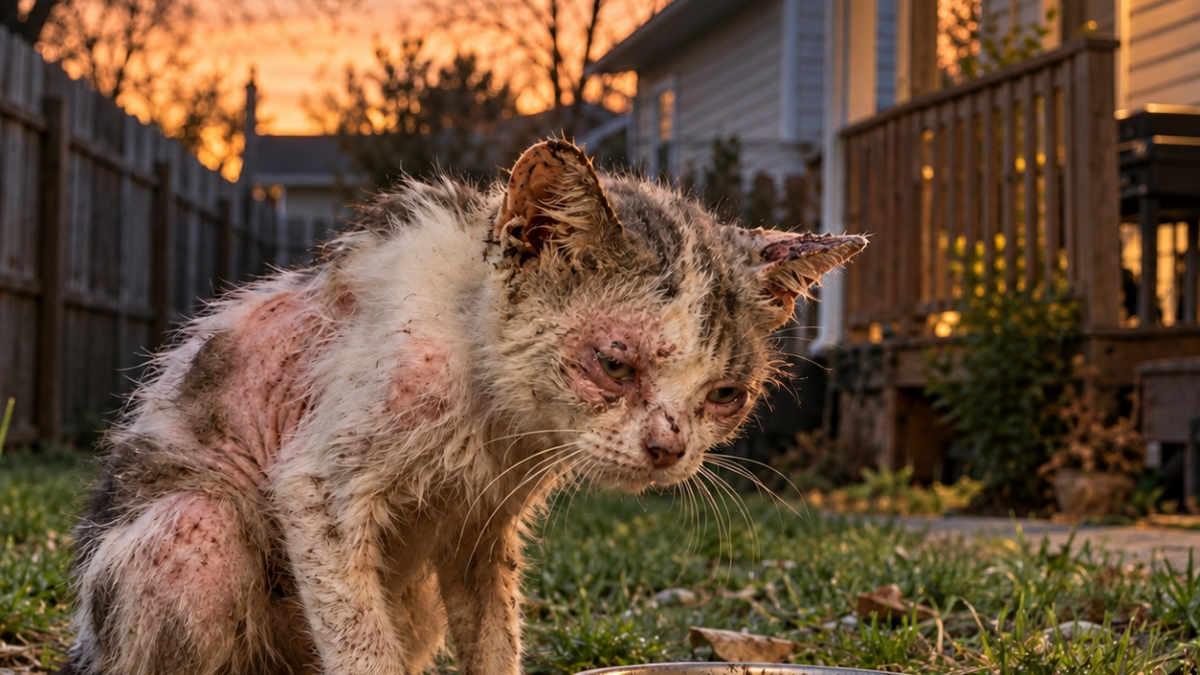
PART3:
“I can try. He’s weak. He doesn’t seem aggressive.”
“Use gloves if you have them. Put food inside. Move slowly. If he runs, don’t chase him.”
A pause.
Then:
“I don’t think he can run.”
I closed my eyes.
There are sentences that stay with you forever because they reveal the depth of suffering in the space between the words.
I do not think he can run.
I called him.
Michael answered on the second ring.
He sounded like a man trying to remain calm because panic would not help.
“I’m sorry to bother you,” he said.
“You didn’t bother me. Where exactly are you?”
He gave me the address.
“I can come in the morning,” I said. “Tonight, keep him somewhere warm if you can. Garage, bathroom, laundry room. Away from other pets. Do you have a carrier?”
“My sister left one here years ago. I found it in the basement.”
“Good. Put a towel in it. Don’t force him unless you have to. If he’s too weak, lift him with the towel.”
“He keeps looking at me,” Michael said.
His voice changed.
“He’s so… I don’t know. He’s so tired.”
I leaned against the counter.
“I know.”
“No, I mean, he looks like he’s been waiting for someone to notice him for a long time.”
I looked again at the photo.
The empty bowl.
The curled body.
The lowered head.
“Yes,” I whispered. “He does.”
Michael managed to get him safely into the carrier just after nine.
He sent me one more photo: a dark carrier lined with a blue towel, and in the farthest corner, the cat curled into himself like he was trying to disappear.
“He’s inside,” Michael wrote. “I put food and water near the door. He ate again. Should I sit with him?”
I thought about that fragile body, that ruined skin, those inflamed eyes, the terror that must live in an animal who had survived alone for so long.
“Yes,” I wrote. “But don’t crowd him. Just be near enough that he knows he isn’t alone.”
Then I sat at my kitchen table and cried.
Not loudly.
Not dramatically.
Just the tired, angry tears of someone who had seen too many animals reach the edge of death before one human being decided they were worth stopping for.
I barely slept that night.
Every time I closed my eyes, I saw him sitting beside the empty bowl.
I thought about the road near Michael’s property.
The fields.
The cold nights.
The rain we had gotten the week before.
The coyotes people mentioned in neighborhood groups with a strange sort of pride.
I thought about how long it takes a cat to become that thin.
How long skin disease takes to spread that badly.
How many porches he might have crossed.
How many windows he might have passed.
How many people might have thought, That’s not my problem.
Maybe some had not seen him.
Maybe some had seen only a flash of movement.
Maybe some had been afraid to get involved.
But someone had known.
That was the thought I could not escape.
Animals do not become that broken in one night.
Somewhere, at some point, someone had looked at that suffering and turned away.
At six the next morning, I packed my rescue bag: gloves, towels, wet food, syringes, a heating pad, disinfectant wipes, pee pads, a spare blanket, and a small fleece bed I had washed the night before. I called the clinic as soon as they opened.
“Brighton Animal Hospital, this is Kelsey.”
“It’s Anna Mercer. I have a severe stray coming in. Possible mange, dehydration, eye infection, malnutrition. I’m picking him up now.”
Kelsey’s voice softened.
“How bad?”
“Bad.”
“We’ll tell Dr. Reyes.”
“Thank you.”
“Anna?”
“Yes?”
“Is this one… critical?”
I looked at the carrier in the photo again.
“Yes,” I said. “But he’s eating.”
“Then we fight.”
That was why I loved Brighton Animal Hospital.
They never promised miracles.
But they fought.
The drive to Michael’s house took forty-three minutes. I counted every one of them. The morning was gray, low clouds pressing over the fields, the kind of early spring cold that feels damp even inside a car. I passed school buses, gas stations, a closed produce stand, a church sign that read KINDNESS IS NEVER WASTED, and for once I did not roll my eyes at a church sign.
Michael’s house sat at the end of a gravel drive lined with bare trees. He was waiting outside the garage when I arrived, wearing a faded flannel jacket and the expression of a man who had not slept either.
“You’re Anna?” he asked.
“Yes.”
He shook my hand quickly.
“I’m sorry. I didn’t know what else to do.”
“You did the right thing.”
He glanced toward the garage.
“I put a heater in there, not too close. He ate twice during the night. Drank a little. He hasn’t made a sound.”
“Has he moved much?”
“Only when I opened the door. He curled tighter.”
Inside the garage, the air smelled of sawdust, motor oil, and wet earth. The carrier sat on a workbench covered with an old quilt. A small space heater hummed nearby. Michael had placed a bowl of water near the carrier door and another paper plate with wet food. The plate was empty.
The cat was in the back corner.
At first, all I saw was shadow and eyes.
Then my vision adjusted.
He was smaller than he had looked in the photo.
That happens sometimes. Pain makes animals seem larger in pictures because suffering fills the frame. In person, he was tiny. Fragile. Almost weightless-looking. His head seemed too big for his body. His paws were crusted. His skin looked hot and sore. His eyes were barely open, but he watched me.
Not with anger.
Not even with fear exactly.
With exhaustion so deep it had gone quiet.
“Hey, sweetheart,” I said softly.
He did not move.
I crouched so I was lower than the carrier, keeping my hands visible.
“My name is Anna. I’m going to help you.”
Michael stood behind me, silent.
I unlatched the carrier door slowly.
The cat lowered his head.
He did not hiss.
He did not scratch.
He simply pressed himself farther into the corner and went completely still.
That surrender broke something in me.
Not because he trusted us.
Because some animals stop resisting not when they feel safe, but when life has taught them resistance does not matter.
I reached in with a towel, moving inch by inch.
“It’s okay,” I whispered. “Nobody is going to hurt you here.”
I had no idea whether he understood me.
But I wanted those to be the first words of his new life.
When I touched the towel to his side, he flinched once.
Then he let me lift him.
He weighed almost nothing.
I have lifted kittens heavier than that cat.
Under the towel, his body felt like twigs and fever. His skin trembled. His breathing was shallow but steady. He smelled of infection, dirt, old hunger, and the strange metallic scent of a body that has been fighting too long without help.
Michael turned away.
I saw him wipe his face with his sleeve.
“I should have seen him sooner,” he said.
“You saw him when you saw him.”
“I walked that back fence last week.”
“Michael.”
He looked at me.
“If guilt could save animals, none of us would ever lose one.”
He swallowed.
“I put food out for raccoons sometimes. Scraps. I thought maybe that’s what I saw at first.”
“You stopped.”
He nodded.
“That matters.”
On the drive to the clinic, the cat stayed silent in the carrier beside me. Every few minutes, I glanced over to make sure he was still breathing. Each time, I saw the faint rise and fall of the towel.
Somewhere between Michael’s house and Brighton Animal Hospital, I decided to call him Jasper.
I do not know why.
The name simply arrived.
It felt solid. Warm. Like something that belonged to an animal who had survived stone, cold, and sharp edges but still had color hidden beneath the damage.
“Jasper,” I said softly, testing it.
His ear twitched.
Not much.
Enough.
At the clinic, Kelsey met me at the side door with a warmed towel and a face already braced for sadness.
“Oh, baby,” she whispered when she saw him.
Dr. Elena Reyes was waiting in Exam Room 2. She was a small woman in her forties with dark curls clipped messily behind her head and the calm, focused intensity of someone who had learned that panic wastes precious time.
“Let’s see what we’ve got,” she said.
I placed the carrier on the table.
When I opened the door, Jasper did not move.
Dr. Reyes put on gloves and gently lifted the towel.
Her face did not change, but her eyes did.
That was how I knew it was bad.
“Male,” she said quietly. “Adult. Neutered, maybe. Hard to tell with the condition. Severe dermatologic disease. Likely mange, secondary infection. Eyes inflamed. Dehydrated. Emaciated. We need weight.”
Kelsey lifted him onto the scale.
“Five pounds, two ounces.”
Dr. Reyes paused.
“He should be at least nine.”
I felt sick.
Jasper stood for maybe half a second, then sank down.
“Temperature?”
Kelsey checked.
“Low-normal.”
“Heart?”
Dr. Reyes listened.
Jasper’s eyes were almost closed, but he did not fight. He let them touch him. He let them examine his ears, his mouth, his paws, his spine. He let strangers handle a body that had every reason to expect pain from human hands.
Then Dr. Reyes began stroking his head with two fingers, very gently, avoiding the worst crusted areas.
And Jasper purred.
At first, I thought the sound was from the exam table.
A vibration.
A machine.
Something in the wall.
Then Kelsey looked up at me with tears in her eyes.
“He’s purring.”
It was barely audible.
A tiny, broken motor inside a body that had been starved, infected, exposed, ignored.
Dr. Reyes closed her eyes for one second.
“Oh, Jasper,” she whispered.
I had to turn away.
I stood facing the cabinet full of syringes and gauze and medications, breathing through my mouth, trying not to fall apart in a room where Jasper needed everyone steady.
But the question in my mind was too painful to contain.
How can an animal who has received so little kindness still have so much trust left to give?
Dr. Reyes ran tests.
No microchip.
No fever.
No FIV or FeLV, thank God.
Bloodwork showed dehydration, anemia, inflammation, and evidence of prolonged malnutrition, but his organs were still trying. His kidneys were not failing. His liver values were concerning but not hopeless. His mouth had ulcers. His claws were overgrown, some curling toward the pads. He had fleas, ear mites, a respiratory infection, severe mange, and wounds from scratching himself raw.
“He’s very sick,” Dr. Reyes said.
I nodded.
“But?”
She looked at Jasper.
“But he is eating. He is responsive. He has a chance.”
A chance.
I held on to those words like a railing over deep water.
“What does he need?”
“A quiet isolation space. Small frequent meals. Fluids today. Antibiotics. Eye medication. Skin treatment. Pain relief. Parasite control, carefully. Warmth. Monitoring. Patience.”
“I can do that.”
Dr. Reyes studied me.
“You say that too quickly.”
“I know what it means.”
“You think you do. This will be weeks. Maybe months. He may get worse before he gets better. His skin will look terrible while it heals. He may have setbacks. He may not make it.”
I forced myself to meet her eyes.
“Then if he doesn’t, he won’t die alone beside an empty bowl.”
Dr. Reyes looked down.
Jasper was still purring faintly under her hand.
“No,” she said. “He won’t.”
That evening, I brought him home with medication, special food, printed instructions, and a fear so large it felt like another passenger in the car.
My spare bathroom became his recovery room.
It was the warmest, quietest room in my apartment, with no carpet and no hiding places I could not reach. I scrubbed it, laid down soft washable blankets, placed a heated pad under half of one bed so he could move away if he got too warm, set food and water close enough that he would not have to cross the room, and taped the medication schedule to the mirror.
Jasper watched from the carrier.
When I opened the door, he stayed inside.
“That’s okay,” I said. “Take your time.”
He looked out at the blankets.
At the food.
At me.
Then he crawled out.
Not walked.
Crawled.
Every movement looked deliberate and exhausting. He made it only a few inches before stopping. I had placed the food nearby, and when he smelled it, his body changed. He lowered his head and began eating with the desperate focus of an animal who did not believe food could remain available.
He ate too fast.
I had to pull the bowl gently away after a few bites, wait, then offer more.
He looked at the bowl as I moved it, and the expression in his swollen eyes nearly destroyed me.
“No,” I whispered. “I’m not taking it away forever. Just slow, sweetheart. You’ll get more.”
He did not know that yet.
For several days, our world became very small.
Jasper and me.
Medicine.
Food.
Fresh blankets.
Warm water.
Quiet words.
Patience.
Every few hours, I offered him another small meal. He ate as if someone might suddenly snatch the bowl from him. He pushed his face so deeply into the dish that food smeared across his nose. Sometimes he coughed because he swallowed too fast. Sometimes he fell asleep with his chin near the plate, too tired to lift his head but unwilling to move away from the proof that he had eaten.
At first, giving medication felt like betrayal.
He did not fight me, and somehow that made it worse. I would wrap him loosely in a towel, clean his eyes, apply ointment, give antibiotics, treat his ears, and he would endure it silently, paws tucked, body stiff. Afterward, I always offered food. Not as a bribe, I told myself, but as reassurance.
“I’m sorry,” I whispered every time.
He would blink through swollen lids.
“I know it hurts.”
He would lower his head.
“You’re safe.”
He did not believe me yet.
But he kept breathing.
On the fourth day, Michael came by with a bag of cat food donations and a box of old towels from his sister.
He stood in my hallway, twisting his cap in his hands.
“Can I see him?”
I hesitated.
Jasper was fragile. Visits were stressful. But Michael had been the first person to stop. He deserved to see that stopping had mattered.
“Quietly,” I said.
We stood in the bathroom doorway.
Jasper was curled on the fleece bed, his body still too thin beneath the blanket. His eyes were closed. His ears, newly cleaned and medicated, looked raw but less crusted. He heard us and lifted his head slightly.
“Hey, buddy,” Michael whispered.
Jasper looked toward his voice.
Michael’s face crumpled.
“He looks better,” he said, though Jasper still looked terrible.
“He ate four meals today.”
“That’s good.”
“It’s very good.”
Michael crouched but did not enter.
“I’m sorry I didn’t know you were out there,” he said to Jasper.
Jasper blinked.
“I’m sorry it took me all day to understand what I was seeing.”
His voice broke.
I put a hand on his shoulder.
“You fed him. You called. You got him inside. That is the part of his story you own.”
Michael nodded, wiping his eyes.
“What if someone did this to him?”
I looked at Jasper.
That question had been living in my chest too.
“Then we find out.”
The first clue came a week later.
Jasper had begun responding to his name. Not reliably. Not with energy. But if I said “Jasper” softly before entering the bathroom, one ear turned toward me. His appetite remained fierce. His skin still looked painful, but the angry redness had begun to calm in patches. His eyes opened a little wider each morning.
One afternoon, while cleaning his bedding, I noticed something around his neck.
At first, I thought it was another crusted patch of skin.
But when I parted what little fur remained, I found a thin line embedded beneath scabbing.
A collar mark.
Not a collar.
A mark.
A band of damaged skin circling his neck where something had once rubbed for a very long time.
My stomach turned.
Jasper had belonged to someone.
Maybe not recently. Maybe not kindly. But at some point, someone had placed a collar around his neck and either failed to remove it or let it tighten as he lost weight and grew sick.
I took photos.
Then I called Dr. Reyes.
“Could a stray get that from debris?” I asked.
“Possibly,” she said. “But a full circular mark usually means a collar or something similar.”
“So he had an owner.”
“Likely.”
The word settled over the room like smoke.
Likely.
That evening, I posted on the rescue page.
FOUND CAT — Cedar Ridge area near County Road 18. Adult male, gray/brown tabby, severely ill, no microchip. Currently receiving medical care. Proof of ownership required.
I did not post the worst photos.
I posted one from after treatment began, where Jasper was wrapped in a towel, eyes half-open, looking like a cat someone might recognize without turning away in horror.
The comments came quickly.
Poor baby.
Thank you for helping him.
How can people be so cruel?
Looks like a cat I saw near the old Maplebrook Rentals.
Check with the trailer park off Route 6. Lots of cats dumped there.
Is that the cat from the blue house that got foreclosed?
The blue house.
I clicked the last comment.
A woman named Teresa wrote: “There was a man on Juniper Lane with a tabby named Bandit. I remember the crooked stripe on the nose. House got foreclosed or condemned or something. Haven’t seen the man in months. Cat used to sit in the window.”
My heart began to pound.
Jasper did have a crooked stripe on his nose, mostly hidden now beneath damaged skin but visible if you knew to look.
I messaged Teresa privately.
She replied with a photo taken through a car window the previous summer.
A healthier cat sat in the front window of a small blue house with peeling shutters. He was gray-brown with a white chin, bright eyes, full cheeks, and a crooked dark stripe down his nose.
He looked nothing like Jasper.
And exactly like him.
I sat on the bathroom floor with the phone in my hand.
Jasper was eating from a saucer inches away, thin shoulders moving with each bite.
“Bandit,” I whispered.
He did not look up.
Maybe he did not know that name anymore.
Or maybe he had left it behind with the house that failed him.
Teresa told me the man’s name was Carl Dutton. He had lived alone in the blue house on Juniper Lane. People described him as strange, unfriendly, and often drunk, though I had learned not to trust neighborhood descriptions too quickly. He had several cats at one point. Maybe five. Maybe eight. Nobody knew exactly. Last fall, the county posted a notice on the door. Then he disappeared.
“What happened to the cats?” I asked.
Teresa sent three dots.
Then: “I don’t know. I assumed animal control came.”
Animal control had not.
I called.
No record of cats removed from Juniper Lane.
No welfare report.
No intake.
No complaint.
Nothing.
That was how cruelty often survived.
Not because no one saw.
Because everyone assumed someone else had handled it.
Michael and I drove to Juniper Lane two days later.
I told myself I was going only to gather information. To see the house. To maybe speak with neighbors. To understand where Jasper had come from.
But as we turned onto the street, my hands tightened around the steering wheel.
The blue house sat near the end of the block, half-hidden behind overgrown shrubs. One front window was cracked and patched with cardboard. The porch sagged. A county notice, faded and curling, was still taped to the door. The grass had gone wild around the walkway. Empty beer cans lay near the steps.
And on the porch, near the boarded window, sat a bowl.
Bone dry.
Beside it was a second bowl tipped on its side.
Something had scratched at the doorframe.
Michael swore under his breath.
I parked across the street.
A neighbor came out before we crossed.
She was an older woman with a tight perm, wearing a pink sweatshirt and house slippers despite the cold.
“You looking at Carl’s place?” she called.
“Yes,” I said. “Did he have cats?”
She looked defensive immediately.
“Everybody’s asking about cats now.”
“Who else asked?”
She shrugged.
“Some lady from the county maybe. Months ago. I don’t know.”
“When did Carl leave?”
“Back before Christmas.”
My stomach clenched.
It was March.
“Were the cats left inside?”
“How would I know?”
“Did you see any?”
She folded her arms.
“Cats come and go.”
“One of them was found near Cedar Ridge, nearly dead.”
Her face flickered.
“Gray tabby?”
“Yes.”
She looked toward the blue house.
“That one used to sit in the window. My granddaughter liked him.”
“Did anyone feed them after Carl left?”
“I put scraps out once or twice.”
“Once or twice?”
Her face hardened.
“Don’t you come judging me. I got my own problems. I called the property company.”
“What property company?”
“Reed & Sons. They took over after the bank thing. I told them there were cats. They said they’d handle it.”
Michael stepped forward.
“When?”
“December. Maybe January.”
“And no one came?”
“I don’t sit at the window all day.”
But her eyes slid away.
I took photos of the porch, the bowls, the scratches, the county notice. I wrote down the property company name.
As we walked back to the car, Michael said, “There could be more.”
“I know.”
“Inside.”
“I know.”
My voice sounded strange.
We called animal control again from the car. We called the police non-emergency line. We called Reed & Sons Property Management. The receptionist at Reed & Sons put me on hold twice, then transferred me to a man named Dennis Reed, who spoke in the polished tone of someone who considered compassion a clerical inconvenience.
“The property is secured,” he said.
“There may have been animals left inside.”
“We found no animals during assessment.”
“When was assessment?”
“January twelfth.”
“Did you enter every room?”
“That is not information we release.”
“Neighbors reported cats.”
“Neighbors report many things.”
“One cat from that house was found starving and severely ill.”
A pause.
Then his voice cooled.
“Ma’am, outdoor cats roam. Unless you have proof this animal belonged to the former tenant, I suggest you refrain from making accusations.”
“I have a photo.”
“I’m not interested in speculation.”
“Were food and water left?”
“This conversation is over.”
He hung up.
Michael looked at me.
“He knows.”
“I don’t know that.”
“Anna.”
I stared at the blue house.
A curtain moved in an upstairs window.
Not from wind.
Something inside me went cold.
“Did you see that?” I whispered.
Michael followed my gaze.
The curtain moved again.
A small dark shape appeared behind the dirty glass.
Then vanished.
There were cats inside.
What followed was one of the longest afternoons of my life.
Animal control could not enter without authorization or law enforcement. Police needed probable cause. The property company refused access at first, then claimed no manager was available. Dr. Reyes wrote a statement documenting Jasper’s condition and likely prolonged neglect. Michael knocked on neighbors’ doors. Teresa drove over with the old photo of Jasper in the window. The woman in the pink sweatshirt admitted, reluctantly, that she had heard scratching from inside the house in January but assumed it was squirrels.
By five o’clock, enough pressure had gathered that the city sent an officer and an animal control supervisor to meet a representative from Reed & Sons.
Dennis Reed arrived in a black SUV, wearing a wool coat and irritation like cologne.
“This is absurd,” he said as he unlocked the door.
The smell hit us first.
Even from the porch.
Old waste.
Rotting food.
Stale air.
Sickness.
The animal control supervisor, a woman named Patrice, put on a mask and looked at Dennis.
“You assessed this property?”
Dennis said nothing.
Inside, the house was a nightmare made of neglect and paperwork.
There were empty food bags in the kitchen, torn open. Bowls scattered across the floor. A litter box overflowed beyond use. Cabinet doors hung open. Scratch marks covered several interior doors. In the living room, a faded cat tree stood by the window where Teresa’s photo had been taken.
We found three cats alive.
A black cat hiding in a kitchen cabinet.
A tortoiseshell behind the washing machine.
A young orange cat in the upstairs bedroom, so thin he could barely stand.
We found evidence there had been more.
I will not describe all of it.
Some memories do not need to be handed to other people in detail to be understood.
Patrice carried the orange cat out wrapped in her jacket, tears running beneath her mask.
Dennis Reed stood in the yard saying, “We were not informed of animals inside,” until Michael turned on him.
“You were informed.”
Dennis looked at him.
“You don’t know anything about this.”
Michael’s voice shook with rage.
“I know one of them crawled onto my property because your company locked him out or left him behind.”
Dennis stepped back.
I held up Teresa’s photo and the photo of Jasper from Michael’s porch.
“This cat lived here,” I said. “His name was Bandit.”
Dennis glanced at the photos and looked away.
“Take it up with Carl Dutton.”
“We will,” I said. “But he didn’t change the locks in January. Your company did.”
That was the first time Dennis looked afraid.
Not sorry.
Afraid.
There is a difference.
The surviving cats were rushed to Brighton Animal Hospital. Dr. Reyes and her team stayed late. The black cat, a female, was dehydrated but stable. The tortoiseshell had an infected wound but ate immediately. The orange cat was critical.
We named them after trees because no one wanted to keep the names from the house, if they ever had names at all.
Ash.
Maple.
Cedar.
Jasper remained Jasper.
When I came home that night, the bathroom light was on low. Jasper was asleep in his bed, paws tucked beneath him. He looked up when I entered, eyes more open than they had been the week before.
I sat on the floor and began to cry.
He watched me.
Then, slowly, painfully, he stood.
He walked toward me.
Not crawled.
Walked.
Three uneven steps.
Then four.
He reached my knee, lowered his head, and leaned against me.
I covered my mouth with both hands.
“Jasper,” I whispered.
He purred.
It was still faint.
But it was stronger than before.
The investigation became public faster than I expected.
A local reporter named Dana Wells called after seeing the emergency animal removal listed in the police activity log. At first, I did not want to speak. I was tired, angry, and afraid that public attention would turn Jasper into a spectacle rather than a survivor.
But Patrice said, “Sunlight helps cases like this.”
Dr. Reyes said, “People need to understand what neglect looks like before the dramatic rescue photo.”
Michael said, “If that property company gets to pretend they didn’t know, they’ll do it again.”
So we spoke.
Carefully.
Factually.
No gore.
No exaggeration.
Just truth.
A tenant died or disappeared. Cats were left behind. Neighbors reported concerns. A property company secured a house without ensuring no animals remained. A starving cat survived long enough to crawl to a stranger’s bowl. Three more were found alive because one person stopped.
The town reacted the way towns often do: with grief, outrage, defensiveness, denial, and casseroles.
Some people donated food.
Some asked why nobody had checked sooner.
Some blamed Carl Dutton, though no one seemed to know where he was.
Some blamed Reed & Sons.
Some blamed “cat people” for caring too much.
Dennis Reed released a statement claiming his company had followed “standard vacancy procedures.” The statement referred to the cats as “unclaimed animals allegedly associated with a former occupant.”
Allegedly.
That word made me shake with anger.
I posted the photo of Jasper in the window, healthy and whole, beside the photo Michael had sent from the porch.
“This is not an allegation,” I wrote. “This is what happens when living beings become someone else’s paperwork.”
The post spread.
By the next morning, donations filled the clinic lobby. Blankets, food, litter, money for veterinary bills. A retired carpenter offered to build outdoor feeding stations. A teenager started a fundraiser at school. Mrs. Ruiz, the neighbor who had worn the pink sweatshirt and avoided my eyes, brought a box of cat food to my apartment and cried so hard in the hallway that I let her sit at my kitchen table.
“I heard them,” she whispered.
I did not speak.
“In January. I heard scratching. I told myself it was mice. I told myself property management would handle it.”
I poured tea because I needed something to do with my hands.
“My granddaughter asked about the window cat. I told her he probably found a new home.”
She covered her face.
“I lied because I didn’t want to feel bad.”
I thought of Jasper sitting beside the empty bowl.
“I’m not the person you need to confess to,” I said.
“I know.”
Her shoulders shook.
“What do I do now?”
It would have been easy to be cruel in that moment.
A part of me wanted to be.
But Jasper had purred under a veterinarian’s hand. Jasper had leaned against my knee after surviving what human avoidance had done to him. If he could still offer trust, then maybe I could offer Mrs. Ruiz something more useful than punishment.
“You tell the truth,” I said. “When people say they didn’t know, you say you did. When they say someone else should have handled it, you say that’s what you thought too, and it wasn’t enough.”
She nodded.
“And then?”
“Then you help.”
She did.
That was one of the surprises of the whole terrible story.
Mrs. Ruiz became one of the strongest voices for change in Cedar Ridge. She spoke at the city meeting. She told everyone, publicly, that silence had made her complicit. She organized a neighborhood watch list for abandoned houses, not to shame people, but to make sure animals were not left trapped inside again.
“I don’t get to undo what I ignored,” she said at the meeting, standing under fluorescent lights with her hands trembling around a typed statement. “But I can become the kind of neighbor I should have been.”
That sentence changed the room.
Dennis Reed was at that meeting too.
He sat near the back with a lawyer.
When the city council asked whether Reed & Sons had a written animal-check protocol for vacant properties, his lawyer answered.
When asked whether the company had received neighbor complaints, his lawyer answered.
When asked why no one contacted animal control before securing the property, his lawyer said, “We are reviewing internal procedures.”
Reviewing internal procedures is what people say when conscience has to be translated into liability.
But the evidence was there.
Phone logs.
Emails.
Neighbor statements.
Photos.
The lock-change record.
Jasper’s medical report.
And one maintenance note, uncovered because a junior employee at Reed & Sons sent it anonymously to Dana Wells.
“Cats observed inside. Advise: do not delay turnover.”
Do not delay turnover.
Four words.
Four words weighed against hunger, thirst, infection, terror, and the slow destruction of a trusting animal’s body.
When Dana read that line to me over the phone, I had to sit down on the bathroom floor.
Jasper was beside the heat pad, licking gravy from his bowl.
He looked up at me, sauce on his chin, eyes clearer than they had ever been.
“They knew,” I whispered.
He blinked slowly.
The city fined Reed & Sons. Not enough, in my opinion. It is shocking how small the official price of suffering can be. But the story did not end with the fine. Their contract with two local banks was suspended. The county opened a review of vacant property practices. Animal control implemented a mandatory welfare checklist for foreclosures, evictions, and condemned houses. Landlords and property managers would now have to document that no animals were inside before securing a building.
It was not perfect.
Nothing is.
But because Jasper survived long enough to be seen, the system changed.
And Jasper?
Jasper changed too.
At first, every change was tiny.
A scab falling away.
One eye opening a little more.
A patch of soft gray fur appearing where raw skin had been.
A few steps across the bathroom without resting.
A meal eaten more slowly.
The first time he left food in his bowl, I stared at it like a miracle.
It was only a teaspoon of wet food, drying at the edge of the saucer.
But to me, it was proof of a new thought forming inside him.
There will be more later.
I crouched in the doorway, smiling like an idiot.
“You left some,” I whispered.
Jasper sat beside the bowl, looking faintly annoyed by my emotional reaction to leftovers.
“That’s good,” I said. “That’s so good.”
He washed one paw.
I cried anyway.
After three weeks, he began meeting me at the bathroom door.
Not with energy. Not yet. But when I opened it in the morning, he would be sitting on the blanket, eyes open, waiting. His eyes were still cloudy from inflammation, still healing, but they were eyes now. Not sealed pain. Not swollen slits. Eyes.
“Good morning, beautiful,” I whispered the first time.
Jasper blinked slowly.
I sat beside him and cried.
Again.
At some point, I realized my life had rearranged itself around his recovery without asking my permission.
I woke early for medication.
I came home at lunch to feed him.
I canceled dinner plans because he had a bad skin day.
I texted photos to Dr. Reyes like a nervous parent.
I celebrated bowel movements with a level of enthusiasm that would have horrified my younger self.
My friends asked how the rescue cat was.
I said, “Improving.”
What I meant was:
He looked at me today.
He slept with his belly partly exposed.
He did not flinch when I changed the blanket.
He followed my hand with his head.
He is beginning to believe the world is not only pain.
One evening, about five weeks after Michael’s message, I left the bathroom door open while I folded laundry in the hallway. Jasper had been cleared to explore small areas under supervision, though he moved carefully and tired quickly.
I heard a sound.
A soft click of claws on the floor.
I turned.
Jasper stood in the doorway.
He looked very serious.
His fur had begun growing back in uneven patches, making him look like a badly sewn stuffed animal. His eyes were open now, still a little watery but bright. His ears, once crusted and awful, were healing into soft triangular shapes. He was still too thin, still fragile, still clearly a cat who had traveled through hell.
But he was standing.
In my hallway.
By choice.
“Hi,” I said, afraid to move.
He took one step.
Then another.
He walked past the laundry basket, paused to sniff a sock, then continued into the living room.
I followed at a distance.
He inspected the coffee table.
The rug.
The leg of the couch.
Then he found a square of late-afternoon sunlight on the floor.
He lowered himself into it with great care.
And fell asleep.
Right there.
In the open.
Not hidden behind a toilet.
Not curled in the farthest corner.
In the middle of my living room, where light touched his recovering body.
I sat on the couch and covered my mouth.
Some victories are so quiet that if you are not paying attention, you miss them.
But they are everything.
Jasper discovered the couch two days later.
Then my bed.
Then the windowsill.
Before long, he had apparently decided that every blanket, pillow, and comfortable piece of furniture in the apartment belonged to him, including the clean laundry, the chair where I paid bills, and the laptop keyboard if I had the nerve to work during breakfast time.
His personality did not return all at once.
It arrived in fragments.
First curiosity.
He began sniffing doors, corners, shoes, grocery bags.
Then stubbornness.
If I placed him back on the floor after he climbed onto the counter, he gave me a look of profound disappointment and tried again the moment I turned away.
Then affection.
Not lap-cat affection at first.
He preferred sitting near me, not on me. He followed me from room to room but pretended he had business there. If I went to the kitchen, he went to inspect the water bowl. If I sat at my desk, he sat under it facing the doorway like a tiny security guard. If I went to bed, he climbed onto the corner and slept with his back touching my ankle.
The first time he put his head in my palm, I froze.
He had been sitting beside me on the couch while I watched a movie I was not really watching. His fur was growing back soft and silver-gray, darker along his spine, lighter under his chin. His body had filled out enough that petting him no longer felt like touching a bird.
I lowered my hand slowly.
He sniffed my fingers.
Then he pushed his forehead against them.
Just once.
A simple request.
Continue.
I did.
He closed his eyes.
And purred.
Not the tiny broken purr from the exam table.
A real purr.
Low, steady, alive.
That sound filled the room.
It filled parts of me I had not realized were empty.
Jasper was not the only one healing.
I did not admit that easily.
Before Jasper, I had become very good at being useful and very bad at being reached. Rescue gave me purpose, but it also gave me a place to hide. If I was always answering emergencies, always cleaning, driving, trapping, feeding, medicating, fundraising, then I did not have to sit still with the quieter griefs in my own life.
The marriage that ended three years earlier because my husband wanted children and then decided he did not want them with me.
The mother who had taught me tenderness but died before I could repay it.
The apartment that was functional but not warm.
The birthdays I spent pretending I preferred solitude.
It is possible to rescue animals while secretly believing you are beyond rescue yourself.
Jasper did not believe that.
Or maybe he did not care.
He simply arrived broken and demanded, by surviving, that I become present.
He needed me.
Not as a volunteer answering a call.
As a person.
There is a difference.
The other cats from Juniper Lane survived too.
Ash, the black female, went to Michael after weeks of recovery. He claimed he was “just fostering,” which lasted exactly four days before he bought a cat tree taller than his television and admitted defeat. Maple, the tortoiseshell, was adopted by Mrs. Ruiz’s granddaughter and became, according to reports, “bossy in a healing way.” Cedar, the orange cat, had the hardest road. He spent nearly two months at Dr. Reyes’s clinic, then went to a foster home with Kelsey, who sent photos of him learning to play with a feather toy like it was a scientific mystery.
We never found Carl Dutton.
Not in any way that brought answers.
Someone said he moved to Kentucky. Someone else said he had gone to rehab. A cousin claimed he had mental health issues and had “lost control of everything.” Maybe that was true. Maybe he had suffered too. Human stories are rarely simple, even when their consequences are terrible.
But suffering does not excuse abandonment.
Pain does not grant permission to leave helpless lives locked behind doors.
I hope Carl got help.
I also hope he remembers every cat that waited for him.
Both things can be true.
As for Reed & Sons, Dennis Reed resigned six months later after the bank contracts fell through. His company rebranded under a new name, as companies often do when they want fresh paint over old rot. But the county protocols stayed. That mattered more than his embarrassment.
Dana Wells wrote a final follow-up titled “The Cat Who Changed the Locks,” which made me laugh through tears. It included a photo of Jasper sitting in my windowsill, fur grown back, eyes clear, looking regal and mildly annoyed that the photographer existed.
People loved that photo.
Some commented that he looked unrecognizable.
They were right.
And also wrong.
Because when I looked at Jasper, I could still see the cat beside the empty bowl.
Not because he still looked broken.
Because I never wanted to forget what it meant that he survived.
One evening, I sat on the floor scrolling through the old photographs from the day he was found. I had not looked at them in weeks. Maybe months. At first, I told myself it was because I did not need to. But truthfully, I had been afraid.
Afraid that the images would drag me backward.
Afraid they would make me see him as fragile again.
Afraid of remembering too clearly how close he had come to never becoming the cat sprawled across my bed demanding breakfast at unreasonable hours.
In the first photo, he sat beside Michael’s empty bowl, eyes nearly sealed, body collapsed inward.
In another, he was in the carrier corner, a small bundle of pain.
In another, Dr. Reyes’s gloved hand rested gently near his head while he purred.
I stared at that one longest.
Then Jasper walked over.
He had been sleeping on the couch, or so I thought. Without hesitation, he climbed into my lap, circled once, and pressed himself against my chest. He was warm, solid, soft. His fur had grown in thick and plush except for a few scars near his ears where it remained thin. His body had filled out to a healthy weight. His tail curled around my wrist.
He started purring.
I looked at the photograph on my phone.
Then I looked down at him.
And the tears came.
In that photograph was an animal who looked as though the world had completely forgotten him.
In my arms was a cat sleeping so peacefully that he did not even flinch when I moved.
He finally felt safe enough to sleep without fear.
I whispered, “You made it.”
Jasper tucked his face under my chin.
“I know,” I said, crying harder. “You did all the work.”
But that was not entirely true.
Survival is not a solo act.
Jasper had crawled toward food.
Michael had stopped.
Dr. Reyes had fought.
Kelsey had stayed late.
Patrice had entered that house.
Teresa had found the photo.
Mrs. Ruiz had told the truth.
Dana had written the story.
People had donated, driven, called, cleaned, witnessed, changed rules.
And I had opened my bathroom door again and again until Jasper believed tomorrow would not hurt like yesterday.
Maybe rescue is not one person saving one animal.
Maybe rescue is the moment a circle forms around a life the world has pushed to the edge and says, not this one, not today.
I always told myself Jasper was temporary.
That was the agreement I made at the beginning.
I would help him recover. I would get him healthy. I would take beautiful photos once his fur grew back. I would write a careful adoption post that told enough of his story to find the right family without making him sound like a tragedy. I would screen applicants. I would choose someone patient, gentle, responsible, someone with sunny windows and soft blankets and a history of caring for senior or special-needs cats.
That was the plan.
Then one rainy afternoon, I opened my laptop to write the post.
Jasper was asleep beside me, one paw resting against my thigh.
I typed:
Meet Jasper.
I stopped.
That was easy enough.
Meet Jasper, a brave survivor with a gentle heart.
I stared at it.
Deleted brave survivor.
He was brave, yes. He had survived, yes. But he was also bossy, opinionated, dramatic about medication, deeply committed to stealing my chair, and convinced that closed bathroom doors were a personal betrayal. I did not want strangers to love only his sadness.
I tried again.
Jasper is looking for his forever home.
My fingers froze.
The words sat on the screen.
Jasper is looking for his forever home.
Beside me, Jasper shifted in his sleep and pressed closer.
I looked around the apartment.
At the heated bed he no longer used because he preferred my pillow.
At the windowsill where he watched birds every morning.
At the rug where he sprawled in sunlight.
At the medication chart still taped inside the cabinet.
At the tiny scars on my hands from the one time he objected strongly to ear drops and then immediately looked guilty.
At the bowl he now left unfinished because he knew more food would come later.
Forever home.
I deleted the sentence.
Then I closed the laptop.
Jasper opened one eye.
“You knew, didn’t you?” I asked.
He blinked.
“I wasn’t looking for your forever home.”
His purr began before I finished the sentence.
“You were already in it.”
That evening, I emailed the rescue board and told them Jasper was staying.
Marlene replied first with eleven crying emojis and the words FINALLY, WOMAN.
Michael replied: “Ash says congratulations, but she still thinks she was the best rescue.”
Dr. Reyes replied: “I knew at the first purr.”
She probably did.
Today, Jasper stretches across my bed like a cat who has never known an uncomfortable day in his life.
He complains when breakfast is late.
He steals my favorite spot on the couch.
He follows me from room to room with the intense dedication of a small supervisor.
He sits in the window every afternoon, whole and warm and safe, watching the same kind of world that once ignored him.
Sometimes, when he is sleeping peacefully beside me, I look at his old photographs.
Not often.
But sometimes.
It is difficult to believe they show the same cat.
The body in those photos looked like an ending.
The cat beside me is a beginning that kept going.
People sometimes ask me, “How did you save him?”
I never really know how to answer.
Because there was no single magical moment.
There was no overnight miracle.
There was one person who stopped.
One bowl of food.
One carrier.
One veterinarian.
One safe room.
One meal after another.
One gentle touch after another.
One frightened animal slowly learning that tomorrow was not something he needed to fear anymore.
Jasper did not need someone to change the whole world.
He needed someone to change his.
But in the end, that changed more than I expected.
It changed Michael, who now keeps carriers in his garage and food in his truck because he says, “You never know who might need you to be ready.”
It changed Mrs. Ruiz, who became the neighbor who checks abandoned houses before anyone asks.
It changed a county protocol, a clinic’s emergency fund, a rescue’s intake process, and the way people in Cedar Ridge talk about animals left behind.
It changed me.
Because the night I first heard about him, I thought I was going to help a dying stray cat.
I thought I was giving him a second chance.
I thought kindness meant opening a door, setting down food, paying the vet bill, and doing the next right thing.
I did not know kindness could crawl back into your life on damaged paws, curl beside your heart, and teach you that broken things are not always asking to be fixed.
Sometimes they are asking to be chosen.
Sometimes they are asking someone to stay long enough for trust to grow back.
Sometimes they are asking for a life where an empty bowl is not the end of hope, but the beginning of a promise:
There will be more.
You will not be hungry again.
You are not alone anymore.
Jasper is asleep beside me now, one healed paw stretched across my blanket, his fur silver in the afternoon light. His ears still carry scars. His eyes still water when the weather changes. His body still remembers things I wish I could erase.
But he dreams deeply.
He eats slowly.
He leaves food in his bowl.
And when I come home, he is always at the door, not waiting in fear, but waiting because he knows I will return.
I thought I was saving Jasper.
But in the end, we simply found each other.
And maybe that is what rescue really is — not one life reaching down to lift another, but two lonely hearts meeting at the edge of suffering and deciding, together, that the story is not over yet.








