The Dying Shelter Cat Used Her Last Strength to Reach Her Kitten—Then a Man Came Back for Both of Them
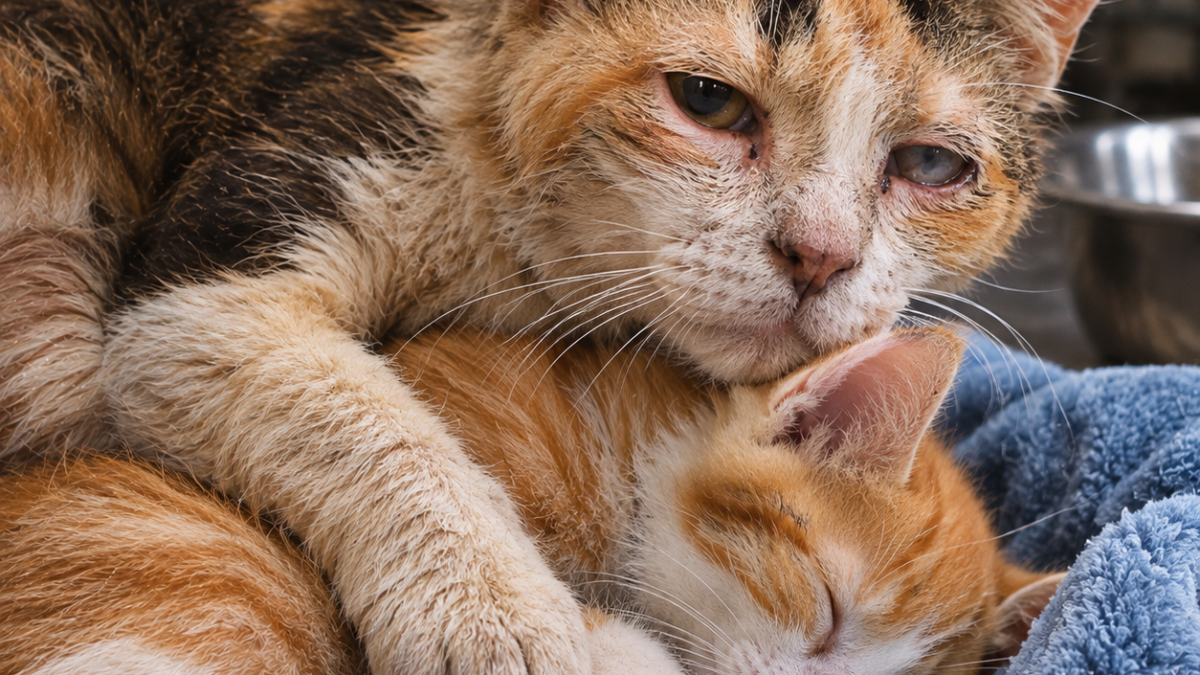
The elderly calico was barely breathing when I reached for her eight-week-old kitten, but somehow she dragged her failing body across the shelter floor and stretched one trembling paw toward him.
I thought she was afraid I was taking away the only thing she had left, so I promised her that her baby would be safe—even though I had no idea whether she could understand a single word.
Then a man came to adopt the kitten, walked out without him, and returned the next morning carrying a large pet carrier and a blue blanket because he had realized there was one thing the old mother cat needed more than medicine.
For nearly twelve years, I had worked at a small animal shelter on the coast of Maine.
By then, I thought I understood heartbreak.
I had seen dogs wait beside doors for owners who were never coming back.
I had watched frightened cats press themselves against the rear walls of kennels because they had learned that hands were something to fear.
I had bottle-fed kittens through the night.
I had sat beside elderly animals during their final hours.
I had watched families surrender pets they genuinely loved because rent was due, medical bills had piled up, or life had become impossible in ways nobody wanted to admit.
You learn certain things working in a shelter.
You learn that grief does not always look dramatic.
Sometimes it looks like an untouched bowl of food.
Sometimes it looks like a dog refusing to sleep.
Sometimes it looks like a cat sitting beside an empty carrier long after her kittens have been adopted.
And sometimes it arrives in a wet cardboard box on a freezing November morning.
That was how Winnie came to us.
I arrived at the shelter just after seven.
The harbor was covered in fog.
A cold Atlantic wind pushed mist against the windows, and the parking lot glittered with a thin crust of frost.
I almost missed the box.
Someone had left it beside the employee entrance beneath the narrow overhang.
The cardboard had absorbed so much moisture that the bottom sagged when I touched it.
There was no note.
No name.
No blanket.
Just two small breathing creatures pressed together inside.
The kitten was the first thing I heard.
Tiny cries.
Sharp and frightened.
I pulled open the top flaps.
An elderly calico lay curled around a little orange-and-white kitten.
The kitten couldn’t have been more than eight weeks old.
His mother looked ancient.
Her fur was dull and matted.
Her hip bones showed beneath her coat.
One eye was cloudy.
The other barely opened.
She was so still that for a moment I thought she had died protecting him sometime during the night.
“Hey, sweetheart.”
No response.
I reached toward the kitten.
PART2:
That was when the old cat moved.
One paw lifted.
Slowly.
Painfully.
It touched the back of my hand.
Not a scratch.
Not a swat.
Just a weak little barrier between me and her baby.
I froze.
The kitten continued crying.
The old cat’s paw trembled against my skin.
“Okay.”
My voice broke before I expected it to.
“Okay, sweetheart. I’m not taking him away.”
Her paw remained there another second.
Then dropped.
I carried the entire box inside.
Our veterinarian, Dr. Julian Reeves, arrived twenty minutes later.
He had been working with us long enough to recognize my expression.
“That bad?”
“I don’t know.”
He looked into the box.
Then stopped smiling.
PART3:
We warmed the room first.
No rushing.
No separating them.
The kitten received fluids and food.
The mother received warm towels, a heating pad, bloodwork, and the gentlest examination Dr. Reeves could manage.
She never tried to bite.
Never scratched.
She simply watched the kitten.
Even when Dr. Reeves lifted her.
Even when he checked her mouth.
Even when he listened to her heart.
Her good eye remained on her baby.
Eventually he sat back.
“She’s old.”
“How old?”
“Sixteen at least.”
He looked again.
“Maybe seventeen.”
I stared at her.
Seventeen years.
For a cat found in a wet cardboard box, that felt almost impossible.
“What’s wrong with her?”
“Everything that happens when an old body has been struggling too long.”
He pointed gently.
“Severely underweight.”
“Dehydrated.”
“Advanced dental disease.”
“Arthritis.”
“Possible kidney failure.”
“Her left eye is mostly blind.”
He paused.
“And I don’t like her heart.”
I looked at the kitten.
“What about him?”
“Surprisingly okay.”
“Thin.”
“A little dehydrated.”
“But strong.”
The old cat heard him squeak and tried lifting her head.
It took everything she had.
Dr. Reeves looked at her.
Then at me.
“That’s probably why.”
“Why what?”
“He’s okay.”
I understood.
Whatever food she found, he probably ate first.
Whatever shelter she found, he probably got the protected side.
Whatever strength she had left had gone into keeping one small kitten alive.
We named her Winnie.
I don’t remember who suggested it.
Maybe one of the volunteers.
It just fit.
The kitten became Button because he was tiny, round-faced, and obsessed with climbing onto people’s clothes and attacking every button he could reach.
For the first several days, we kept them together in a quiet room away from the main cat population.
Winnie had a heated bed.
Button had toys.
Technically.
In reality, Button believed everything was a toy.
Blankets.
Shoelaces.
Paper towels.
The drawstrings on my hoodie.
My hair.
Winnie’s tail.
Especially Winnie’s tail.
Winnie tolerated all of it.
She would lie there exhausted while Button bounced around her like a little orange tornado.
If he moved too far away, however, something changed.
Her head would rise.
She would make a soft, cracked sound.
Not a full meow.
More like a whisper.
Button always heard it.
He would stop.
Look back.
Then return.
Every time.
That became their routine.
Button explored.
Winnie called.
Button returned.
At mealtimes, Winnie waited.
It did not matter how hungry she was.
We could place two dishes in front of them and she would watch Button begin eating before touching hers.
Sometimes he pushed his face into her bowl.
She let him.
When he fell asleep, he usually curled against her belly.
Then Winnie would slowly place one front paw across his back.
The first time I saw it, I smiled.
“Your momma paw.”
After that, I called it that every day.
“There’s the momma paw.”
Volunteers started saying it too.
Winnie never cared what we called it.
She just kept doing it.
One paw across Button.
Every nap.
Every night.
As if she needed to physically confirm he was still there.
Two weeks passed.
Button transformed.
His coat became soft and bright.
He gained weight.
He learned the sound of food containers.
He discovered the joy of attacking shadows.
He would charge across the room, skid on the floor, crash gently into the wall, then look offended as though the wall had moved.
Winnie moved in the opposite direction.
She ate less.
Slept more.
Sometimes she stared at food for several minutes before taking one bite.
Other days she refused entirely.
Dr. Reeves adjusted medications.
We tried different foods.
Warm chicken.
Fish.
Kitten food.
Broth.
Everything.
She would eat just enough to keep going.
And then look at Button.
That was when I began wondering whether she was staying alive because he still needed her.
I knew that sounded sentimental.
People who work with animals learn to be careful about projecting human stories onto them.
Cats don’t understand adoption paperwork.
They don’t understand death the way we do.
They do not sit around thinking in paragraphs about responsibility or sacrifice.
But they understand attachment.
Safety.
Separation.
Familiar scent.
The presence or absence of the creature beside them.
And Winnie understood Button.
One afternoon, I moved him into a small playpen three feet away while I changed their bedding.
I had done it before.
That day, Winnie reacted differently.
The moment Button disappeared from beside her, she raised her head.
He chirped from the playpen.
Winnie tried standing.
Her front legs straightened.
Her back legs did not.
They collapsed beneath her.
She fell onto her side.
“Winnie.”
I dropped the blanket.
She pushed herself upright again.
One step.
Her rear legs buckled.
She dragged herself forward anyway.
Button called.
Winnie answered.
Weak.
Hoarse.
She pulled herself another few inches.
I felt something inside me break.
“You don’t have to.”
Of course she did not know what I meant.
She kept crawling.
So I picked Button up.
The kitten immediately climbed my sweatshirt.
“Come here, little man.”
I set him beside Winnie.
He pushed beneath her chin.
Winnie stopped trying to stand.
Just stopped.
Her body relaxed.
Her head lowered.
And after a few seconds, her paw slowly moved over his back.
Momma paw.
I sat there longer than I should have.
There were kennels to clean.
Medications to give.
Phones ringing.
Someone waiting at the front desk.
I did not care.
I stroked Winnie’s head.
She opened her good eye.
“Someone will take care of him.”
I don’t know why I said it.
Maybe because I needed to.
“You hear me?”
She blinked slowly.
“Someone’s going to love him.”
Another blink.
“He won’t be alone.”
My voice started shaking.
“I promise.”
That promise terrified me the moment it left my mouth.
Shelter workers learn not to make promises we cannot control.
We cannot promise every animal a home.
We cannot promise every sick animal recovery.
We cannot promise people will make the right choices.
But I had promised Winnie.
So I began looking harder for Button’s adopter.
Not just anyone.
Someone patient.
Someone stable.
Someone who understood that Button’s first months mattered.
Someone who would not return him because kittens climb curtains or wake people at four in the morning.
Then Thomas Reed walked through our front door.
Thomas was fifty-four.
Large hands.
Heavy work jacket.
Gray beginning in his beard.
He repaired fishing boats near the harbor.
I recognized him vaguely because Maine coastal towns are like that.
You may not know someone personally, but you’ve seen their truck, heard their name, or know someone who went to school with their cousin.
He stood awkwardly in the lobby.
“I’m looking for a cat.”
“That usually works out well here.”
He smiled slightly.
“Older, maybe.”
I liked him immediately for saying older.
Most people wanted kittens.
“Any reason?”
Thomas looked toward the cat rooms.
“My girl died in March.”
“What was her name?”
“Lucy.”
“How old?”
“Nineteen.”
I softened.
“Nineteen is a good life.”
“Yeah.”
He looked down.
“Still wasn’t long enough.”
No.
It never was.
Thomas told me Lucy had slept on the same corner of his bed for almost two decades.
After she died, he kept waking at night expecting to feel her jump beside him.
For months he had refused to adopt again.
Then winter came.
The house became too quiet.
“I don’t need another Lucy.”
He said that carefully.
“I know there isn’t another one.”
“I just think maybe I have room for somebody.”
I showed him several cats.
A seven-year-old tabby.
A ten-year-old tuxedo.
A quiet black cat named Pearl.
He liked them all.
Then Button saw his bootlaces.
That ended the orderly adoption tour.
Button came flying across the room.
Hit Thomas’s boot.
Climbed his pant leg halfway to his knee before I caught him.
Thomas startled.
Then laughed.
A full laugh.
Warm and surprised.
Button immediately tried again.
“Well.”
Thomas crouched.
“Who are you?”
Button climbed directly into his lap.
Purring.
Thomas stared down.
“I thought I wanted an older cat.”
“Apparently nobody told Button.”
The kitten rolled over.
Thomas scratched his chest.
Button grabbed his finger with both paws.
Thomas laughed again.
“Looks like this little guy picked me.”
I should have been thrilled.
This was exactly what I had wanted.
A safe home.
A gentle man.
Someone experienced with cats.
But as Thomas lifted Button, I heard Winnie’s voice.
One broken cry.
Then another.
I turned.
She had raised her head.
Thomas stopped.
“What’s wrong?”
I looked at Winnie.
Her chest moved rapidly from the effort.
Button twisted toward her.
Winnie tried standing.
Her front legs shook.
Thomas lowered the kitten.
“Is that his mother?”
“Yes.”
I explained.
Everything.
The cardboard box.
Her age.
Her health.
The way she let Button eat first.
The way she panicked when he was moved.
The momma paw.
Thomas listened without interrupting.
Then he walked closer.
He did not reach for Winnie.
He crouched several feet away.
She stared at Button in his arms.
Thomas looked at me.
“Can I put him down?”
“Yes.”
He placed Button beside her.
The kitten immediately tucked himself beneath her chin.
Winnie lowered her face into his fur.
Then one paw moved slowly across his back.
Thomas stared.
Nobody spoke.
A minute passed.
Then another.
Finally he stood.
“I can’t take him today.”
My heart dropped.
I understood.
But I was disappointed anyway.
“Okay.”
He looked embarrassed.
“I’m sorry.”
“You don’t owe me an apology.”
“I just…”
He looked at Winnie.
“I need to think.”
I nodded.
Thomas left.
Button remained with his mother.
That night Winnie’s breathing changed.
You learn that sound.
Anyone who has cared for dying animals learns it.
Not necessarily pain.
The body becoming tired.
I called Dr. Reeves.
He examined her again.
“Could be tonight.”
I looked at Button.
“What do we do?”
“Keep her comfortable.”
We had already made the decision not to pursue aggressive hospitalization.
Winnie hated separation.
IV treatment at an emergency hospital might buy hours.
Maybe days.
But it would remove her from Button.
At seventeen, with failing organs and almost no reserve, Dr. Reeves believed comfort was kinder.
So I stayed.
The shelter closed.
Volunteers left.
Lights went off one room at a time.
The harbor fog thickened outside.
I sat on the floor beside Winnie.
Button slept against her chest.
Momma paw across his back.
I whispered:
“I really thought he was the one.”
Winnie opened one eye.
“Thomas.”
“You liked him, didn’t you?”
No answer.
“I think he liked you too.”
She breathed.
“I promised you.”
My eyes burned.
“I know.”
“I promised.”
Somewhere around eleven-thirty, Button woke.
He climbed over Winnie.
Bit my shoelace.
Chased a toy mouse.
A perfectly healthy kitten doing perfectly healthy kitten things beside his dying mother.
Winnie watched him.
That broke me more than anything else.
Her body was shutting down.
Yet every time Button ran past, her eye followed.
At midnight, I finally went home because Dr. Reeves promised to check them before sunrise.
I kissed Winnie’s head.
“Make it until morning.”
Another promise I had no right to ask.
She blinked.
At 6:52 the next morning, I pulled into the shelter lot and saw a truck already parked outside.
Thomas stood beside it.
Large pet carrier in one hand.
Bag in the other.
A folded blue blanket tucked beneath his arm.
I stared.
He looked terrible.
Red eyes.
Unshaven.
“Thomas?”
He shifted the carrier.
“I didn’t sleep.”
My heart started pounding.
“What happened?”
“Nothing.”
He looked toward the shelter.
“I kept seeing that old cat.”
I said nothing.
He continued.
“I went home.”
“House was warm.”
“Heat was running.”
“Lucy’s old bed is still beside the heater because I haven’t been able to move it.”
He swallowed.
“And I kept thinking about that cat spending seventeen years getting to wherever she is now, then ending up in a cardboard box.”
My throat tightened.
Thomas looked at me.
“I thought about taking the kitten.”
“And every time I did, I saw her trying to stand.”
He looked embarrassed by his own emotion.
“I can’t do it.”
For one horrible second I misunderstood.
Then he lifted the carrier.
“I want both.”
I stared.
“What?”
“Both of them.”
“Thomas…”
“If she’s got a day, she gets a day.”
“If she’s got a week, she gets a week.”
“If she’s got an hour…”
He stopped.
His voice cracked.
“Then she gets an hour in a house.”
I could not speak.
Thomas continued.
“I’ve got room.”
“I’ve got heat.”
“I know old cats.”
He smiled sadly.
“Probably better than I know young ones.”
I laughed through tears.
He looked at the carrier.
“And Button doesn’t have to lose his mother and his home on the same day.”
“Thomas, you understand Winnie’s condition?”
“Yes.”
“She may die today.”
“I know.”
“She may need medication.”
“I know.”
“She might not eat.”
“I know.”
“Emergency care could be expensive.”
“I know.”
“You might take her home and lose her tonight.”
Thomas looked at me.
“Then she dies home.”
That sentence ended the conversation.
Dr. Reeves examined Winnie once more.
He explained comfort medications.
Warning signs.
What to expect.
When to call.
Thomas wrote everything down.
Every word.
No pretending.
No heroic promises.
Just care.
Then we finalized the adoption.
Two cats.
One healthy kitten with his whole life in front of him.
One seventeen-year-old mother who probably had only hours left.
I spread Thomas’s blue blanket inside the carrier.
Button went in first.
Immediately tried chewing the zipper.
Then I lifted Winnie.
She felt impossibly light.
I placed her beside him.
Button curled against her.
Winnie lifted her head.
Looked toward me.
Then toward Thomas.
He crouched.
“You don’t know me yet.”
He touched one finger gently to the blanket.
“But I’ve got a warm spot waiting for you.”
Winnie sniffed him.
Then lowered her head.
Her eyes closed.
And something happened that I had not seen since she arrived.
She stopped fighting sleep.
At the shelter, even when exhausted, Winnie always seemed partly alert.
Checking.
Listening.
Making sure Button remained near.
Now Button was beside her.
The carrier was closed.
Thomas was carrying both.
She simply rested.
I watched his truck leave.
Then went into the bathroom and cried.
At 6:14 the next morning, my phone rang.
Thomas.
I knew.
Before answering, I knew.
“Hello?”
“Clara.”
His voice was quiet.
“I wanted you to hear from me.”
I sat on the edge of my bed.
“Winnie?”
“She passed.”
I closed my eyes.
“When?”
“Some time during the night.”
“Was she comfortable?”
“Yes.”
Thomas inhaled slowly.
“She had a good evening.”
He told me everything.
He had placed the blue blanket near the heater.
Winnie lay there.
Button explored.
Of course he did.
He ran from room to room.
Discovered curtains.
Found Thomas’s work boots.
Attacked a toy mouse Thomas bought on the way home.
Ate dinner.
Drank water.
Climbed onto the sofa.
Fell off.
Tried again.
Thomas said Winnie watched all of it.
“She looked tired.”
“But she watched him.”
At one point Button ran into the kitchen.
Winnie tried raising her head.
Thomas carried her blanket slightly closer so she could see him.
Later Button returned.
Curled against her.
Thomas turned off most of the lights.
Sat in his chair nearby.
He read.
Watched them.
Around ten, he checked Winnie.
Still breathing.
Around midnight.
Still breathing.
At 2:00, Button remained asleep against her.
Thomas eventually went to bed.
When he returned at dawn, sunlight was beginning to enter the windows.
Button was awake.
Quiet.
Still beside his mother.
Winnie was gone.
Thomas’s voice broke.
“Clara.”
“Yeah?”
“Her paw.”
I already knew.
“It was across him.”
I covered my mouth.
Momma paw.
All the way to the end.
Thomas remained quiet.
Then he said:
“At least she got to see him home.”
That sentence has stayed with me longer than almost anything anyone has ever said inside that shelter.
Not adopted.
Not rescued.
Home.
Winnie had one night.
That was all.
One night without wet cardboard.
One night without cold.
One night beside a heater.
One night with food close enough that Button did not have to search for it.
One night where her kitten could run out of sight and come back because the walls around him were safe.
Maybe Winnie understood none of that in the human way.
Maybe she did not know Thomas had signed paperwork.
Maybe she did not understand that Button would never sleep outside again.
But she understood warmth.
She understood Button eating.
She understood his scent returning to her.
She understood that no one was pulling him away.
And sometime during that first night, her body finally stopped fighting.
Thomas had Winnie cremated.
He kept a small urn beside the photograph of Lucy.
That surprised me.
“You barely knew her.”
He looked offended.
“I knew her long enough.”
Fair.
Three weeks later, he sent me a photograph.
Button was asleep on the same blue blanket.
Bigger already.
One paw stretched into the air.
Thomas’s caption said:
Apparently this is his blanket now.
I saved it.
A month later came another.
Button inside a cardboard box.
I called immediately.
“Why is he in a box?”
Thomas laughed.
“It held boat parts.”
“Get him out.”
“He refuses.”
“That animal was abandoned in a box.”
“And apparently took no lesson from it.”
Button remained obsessed with boxes for the rest of his life.
Thomas sent photographs for years.
Button at one.
Button watching snow.
Button asleep inside the bathroom sink.
Button sitting on a windowsill overlooking the harbor.
Button sprawled across Thomas’s chest while Thomas tried reading.
Button at five, considerably less button-sized.
Button at eight.
At ten.
Gray beginning around his muzzle.
Every birthday, Thomas sent one photograph.
Sometimes only two words.
Still spoiled.
Or:
Still stealing fish.
One year:
Still hers.
That one showed Button asleep beneath a framed photograph of Winnie.
I cried again.
Years after Winnie’s death, Thomas told me something I had never known.
On the night he first met them, after leaving the shelter, he drove halfway home and pulled into the harbor parking lot.
He sat there for almost an hour.
He kept thinking about Lucy.
During her final year, she needed medication twice a day.
People occasionally asked why he spent so much money on an old cat.
One man at work once said:
“She’s nineteen, Tom. At some point she’s just old.”
Thomas hated that sentence.
Just old.
As if age transformed love into waste.
As if years already lived made remaining days less valuable.
So when he saw Winnie struggling to reach Button, he drove home carrying that old sentence with him.
He walked through his empty house.
Saw Lucy’s bed.
Saw the heater.
Saw two clean bowls still stored beneath the sink.
Then realized something.
He had everything Winnie needed.
Except time.
And time was the one thing nobody could give her.
But perhaps time was not the only thing that mattered.
That was why he came back.
Not because he believed he could save Winnie.
Because he finally understood he did not have to save her to help her.
That distinction changed me too.
Shelter work trains you to measure success.
Adoptions.
Recovery.
Weight gain.
Negative tests.
Animals moving from intake to foster to permanent homes.
More days.
More years.
We want survival because survival feels measurable.
But Winnie taught me that rescue sometimes looks completely different.
Sometimes there is no cure.
Sometimes the body is already too tired.
Sometimes the animal arrives after the window for more years has already closed.
Then the question becomes:
What can we still give?
Warmth.
A quiet room.
A familiar scent.
Pain relief.
A full stomach.
A hand nearby.
The creature they love beside them.
One night in a house.
That counts.
Years later, new volunteers sometimes asked me which shelter animal I remembered most.
They expected some dramatic rescue.
A dog pulled from an icy river.
A kitten revived after nearly freezing.
A burned cat who survived months of treatment.
I remembered all of them.
But I usually told them about Winnie.
The old calico in the wet box.
The mother who raised one paw when I reached for her kitten.
The cat whose body was failing but who kept spending whatever strength remained making sure Button ate first.
The cat who tried crawling across a floor because her baby was three feet away.
I told them about Thomas too.
The man who originally came looking for a cat to fill an empty house.
The man who thought he wanted one animal.
The man who walked away because he did not know what to do with the heartbreak in front of him.
And then came back.
That part matters.
We sometimes judge people by their first reaction.
Thomas’s first reaction was to leave.
His second was to think.
His third was to return.
Sometimes compassion needs a night to catch up with fear.
When Button was fourteen, Thomas called me.
By then, I no longer worked full time at the shelter.
I still volunteered.
Still knew the staff.
Still kept Winnie’s picture on my phone.
Button had developed kidney disease.
Thomas’s voice sounded exactly as it had all those years earlier.
Tired.
Afraid.
“I think we’re getting close.”
I drove over.
Button was enormous compared with the little kitten I remembered.
Orange-and-white.
Gray around his face.
Slower.
Still beautiful.
The blue blanket remained beside the heater.
Faded.
Patched twice.
Button lay on it.
I sat down.
He sniffed my hand.
I doubt he remembered me.
That was okay.
Thomas sat in his chair.
“He had a good run.”
“Fourteen years.”
“Fourteen years and three months.”
Of course Thomas knew the months.
He looked at Button.
“You remember his mother?”
“Yes.”
“Every time he sleeps like that, I do.”
Button stretched one paw across the blanket.
Thomas smiled.
“Same paws.”
A week later, Button died at home.
On the blue blanket.
Thomas beside him.
When Thomas called, we both cried.
Then he said:
“I hope Winnie knows I kept my promise.”
I told him something I normally would not claim to know.
“I think she knew before you did.”
Thomas laughed through tears.
Maybe that was sentimental.
I no longer cared.
Button lived more than fourteen years after Winnie got one night.
Fourteen winters beside the heater.
Fourteen summers watching gulls from the window.
Thousands of meals.
Thousands of naps.
Boxes.
Toy mice.
Fish stolen from plates.
Years of being loved by a man who came into the shelter thinking he needed an older cat and walked out carrying an old mother and her kitten together.
That was Winnie’s legacy.
Not the way she died.
The life that continued beside her.
I still have the first photograph Thomas sent.
Button asleep on the blue blanket.
Sometimes I open it after a difficult day.
Especially when an elderly animal arrives and someone asks:
“Is there really anything we can do?”
There is almost always something.
Maybe not enough to change the ending.
But enough to change how the ending feels.
Winnie did not need us to make her young.
She did not need seventeen more years.
She needed safety.
She needed warmth.
Most of all, she needed to know—in whatever way an old mother cat can know—that Button was no longer depending only on her.
For weeks she had kept herself between that kitten and the world.
In a cardboard box.
On a shelter bed.
Across a cold floor.
Every time Button moved, Winnie watched.
Every time he slept, that paw came down across his back.
Then Thomas carried them into a warm house.
Button ate.
Played.
Explored.
Came back.
Curled beside her.
And Winnie placed her paw over him one final time.
By morning, she was gone.
For years, I thought the saddest part was that Winnie only got one night in her new home.
I don’t anymore.
Now I think about what that night contained.
Her kitten was fed.
Her body was warm.
No kennel door.
No wet cardboard.
No cold harbor wind.
No strangers reaching in to separate them.
Just Button breathing beneath her paw.
Maybe rescue is not always measured in how much time comes afterward.
Sometimes it is measured in whether the last night contains fear or peace.
Winnie only had one night.
Button had an entire lifetime.
And after watching her fight so hard for him, I like to believe that sometime before dawn, in a warm room beside a heater, Winnie finally understood the one thing she had needed to know from the moment I found her.
Her baby was safe.
So she stopped fighting.
She closed her eyes.
And for the first time in a very long while, she rested.








