The Dog Left to Die in a Ditch Ran Again—and Exposed the Man Who Threw Him Away
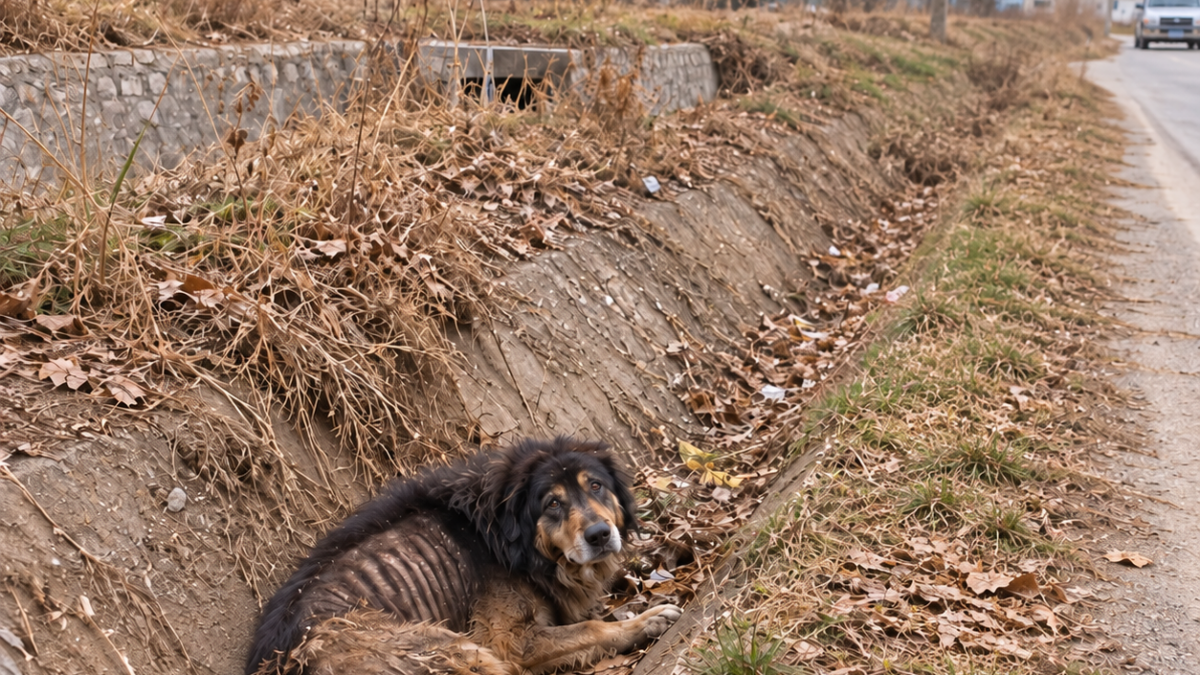
The Dog Left to Die in a Ditch Ran Again—and Exposed the Man Who Threw Him Away
He was too broken to stand when I found him in the mud, but his eyes held on to me like he had been waiting for one person in the world who would not look away.
The man who left him there thought an old injured dog was nothing more than a useless expense, something to be dragged out of sight and forgotten before morning.
But that forgotten country road became the beginning of a fight that would expose a cruel secret, destroy a powerful business, and teach me what a life is really worth.
My name is Sebastian Cole, and I was thirty-four years old when a construction detour sent me down a road I was never supposed to take.
Until that morning, I had never thought of myself as the kind of man who rescued animals. I liked animals well enough. I donated ten dollars at the grocery-store register when the cashier asked if I wanted to help the shelter. I slowed down for deer. I had once stopped traffic so a turtle could cross a two-lane road while three drivers behind me honked like I had committed treason.
But I was not one of those people who built their lives around saving things.
My life was controlled, quiet, and efficient. I lived alone outside Boulder, Colorado, in a small house with a slanted roof, a cracked driveway, and a view of the mountains that looked beautiful enough to make loneliness seem intentional. I worked as a project estimator for a construction firm, which meant I spent my days calculating materials, timelines, labor costs, mistakes, delays, and everything people forgot until it became expensive.
I was good at it.
Numbers made sense to me. Plans made sense. Budgets made sense. People were harder.
After my father died suddenly when I was twenty-seven, I learned to make my life smaller in ways I didn’t recognize at first. I told myself I enjoyed independence. I told myself I liked coming home to silence. I told myself relationships were complicated, friendships were difficult to maintain, and needing anyone was just another way of giving life permission to hurt you.
I built routines instead.
Coffee at 5:40. Shower by 6:05. Work shoes by the door. Same breakfast. Same route. Same gas station. Same woman behind the counter who called me “hon” even though we had never learned each other’s names.
That Tuesday morning, rain had hammered the foothills all night. The kind of cold, relentless rain that turned ditches into brown rivers and made every windshield wiper sound desperate. By dawn, the sky had cleared, but everything else was soaked. My normal route into Boulder was blocked by a construction crew repairing a washed-out shoulder, so a flagger in a neon vest waved me toward a detour I didn’t want to take.
I remember being irritated.
That embarrasses me now.
A man’s life can change completely while he is annoyed about being twelve minutes late.
The detour road was narrow and uneven, winding past horse properties, open fields, rusted fences, and stretches of scrub brush that looked silver under the wet morning light. My tires hissed over the pavement. Mud splashed up the sides of my truck. I had one hand on the wheel and the other wrapped around a travel mug of coffee that had already gone lukewarm.
I was thinking about a bid due by ten.
I was thinking about the furnace I needed to replace before winter.
I was thinking about anything except the dark shape lying below the drainage embankment on the right side of the road.
At first, I thought it was a discarded blanket.
That was the reasonable explanation. People dumped things on back roads all the time. Mattresses. Tires. Trash bags. Once, a couch with three missing cushions and a raccoon sitting on the arm like it owned the place.
I drove past.
Then the shape moved.
Not much.
Just enough.
My foot hit the brake before my brain caught up. The truck slid a few inches on the wet shoulder, gravel cracking under the tires. I looked in the rearview mirror, heart suddenly pounding, and saw that dark shape again through the back window.
It moved once more.
I put the truck in reverse.
“Don’t be a body,” I whispered.
I don’t know why I said that.
Maybe because people say stupid things when fear arrives before language.
I backed up until I was parallel with the ditch. The embankment dropped about eight feet below the road, covered in weeds, mud, broken branches, and storm runoff. The dark shape lay half-hidden near the bottom.
Then I saw fur.
A dog.
A huge dog.
I turned on my hazards and got out.
The morning air smelled like wet dirt and cold grass. Water dripped from fence wires. Somewhere far off, a cow bawled in that low, hollow way that always sounds sad even when nothing is wrong.
I stepped closer to the edge.
The dog lifted his head.
I froze.
He was enormous, or he had been once. Even buried under mud and rainwater, I could tell he was a massive black-and-rust animal, the kind of dog that looked built for mountains, fences, livestock, and winter. His coat was thick but filthy, clumped against his ribs and hips. One hind leg lay at an angle that made my stomach twist. His sides moved in shallow, careful pulls.
He did not bark.
He did not growl.
He just looked at me.
PART2:
I had seen fear before. In people. In animals. In myself, though I would not have admitted it then.
This was different.
His eyes were amber-brown, deep and steady despite the pain. He looked at me as if he understood exactly what kind of decision was forming inside me. As if he knew I could climb back into my warm truck, call someone else, and drive away with a story I would tell later in a regretful voice.
Poor thing.
I hope somebody helped him.
I stood there for maybe five seconds.
Maybe less.
Then I started down the embankment.
My work shoes sank immediately into the mud.
“Easy,” I said, though I had no idea whether I was talking to him or myself. “Easy, big guy. I’m not going to hurt you.”
The dog’s ears shifted weakly. His eyes stayed on mine.
Halfway down, my foot slipped and I grabbed a wet branch to stop myself from falling. Mud smeared across my pants. My coffee mug, still sitting in the cupholder above, seemed suddenly like an artifact from a previous life.
When I reached him, the full extent of his condition hit me like a physical blow.
He was older than I had first thought. His muzzle was streaked with gray beneath the mud. His body was too thin under all that heavy fur. His back legs trembled even though he wasn’t trying to move. There were raw patches along his side, and when I crouched near his head, I saw a deep, angry ring around his neck where something had rubbed through the skin.
A short piece of frayed nylon hung from a metal tag beneath the mud.
I swallowed.
“Who did this to you?”
His nostrils flared. His eyes followed my hand when I reached slowly toward his face.
He flinched so hard his front paws dug into the mud.
I stopped immediately.
“Okay,” I whispered. “Okay. I’m sorry.”
He did not snap. He did not bare his teeth. He did not even whine.
Somehow, that made it worse.
Pain had taught him silence.
I pulled out my phone.
PART3:
One bar.
Of course.
I called 911 because my brain could not produce a better idea. The dispatcher transferred me to county animal control. A calm woman asked for my location, my name, whether the dog appeared aggressive, and whether I could keep visual contact until an officer arrived.
“How long?” I asked.
“There’s an animal-control officer responding from the north side of the county,” she said. “Possibly forty-five minutes.”
I looked at the dog’s breathing.
Short.
Shallow.
Careful.
“I don’t think he has forty-five minutes.”
“I understand, sir, but please do not attempt to move him yourself. If he has spinal or pelvic injuries—”
“He’s freezing.”
“Can you cover him with anything?”
I looked toward my truck, then at the slope.
“I have a jacket.”
“Use that if you can do so safely.”
Her voice stayed professional, but something in it softened.
“Sir, I’m also going to give you the number of the nearest veterinary clinic that handles emergency large-dog trauma. They may be able to advise you.”
I saved the number with hands that were not steady.
The clinic was called Flatirons Veterinary Surgical and Emergency Care. A technician named Nathan answered on the second ring, sounding rushed until I described the dog’s leg, his breathing, and the raw injury around his neck.
Then Nathan’s voice changed.
“Where exactly are you?”
I told him.
“Stay with him,” he said. “I’m coming.”
“You’re coming here?”
“Yes.”
“I thought I wasn’t supposed to move him.”
“You aren’t. I am.”
“How long?”
“Twenty-five minutes if I don’t get arrested.”
He hung up.
I stared at my phone.
Then I took off my jacket.
It was stupid. The jacket was not big enough for a dog his size. It was not medical care. It was barely useful.
But when I laid it gently over his shoulders, something in his eyes changed.
Not trust.
Not yet.
But recognition, maybe.
Like he knew I had chosen a side.
I sat in the mud beside him because there was nowhere dry, nowhere comfortable, and no way I could stand above him like a spectator. The wet seeped through my pants almost immediately. My shoes were ruined. My socks turned cold. I didn’t care.
“All right,” I said. “My name is Sebastian. I’m not a vet. I’m not even especially useful before coffee, but help is coming.”
The dog watched me.
“I know,” I said. “You probably expected someone more qualified.”
His eyes blinked slowly.
“Yeah. Me too.”
For the next twenty-eight minutes, I talked to a dog I had never seen before as if we were old friends trapped in a bad situation together.
I told him the storm had made a mess of the roads. I told him my boss was going to ask why I missed the ten o’clock bid meeting and I was going to say, “Because I met a giant dog in a ditch,” which sounded like the kind of excuse people used when they wanted to get fired creatively.
Once, his eyelids started to lower.
“Hey,” I said sharply.
His eyes opened halfway.
“No. Stay with me.”
I placed my hand near his face but not touching him.
“Look at me.”
His gaze drifted back.
“That’s it. Keep looking at me.”
A truck appeared at the top of the road twenty minutes later, tires crunching over gravel. A man in navy scrubs and a rain jacket jumped out with a medical bag and a folded stretcher. He slid down the embankment with more confidence than I had, then stopped when he saw the dog.
“God,” he muttered.
That was Nathan.
He was younger than me, maybe late twenties, with sandy hair, tired eyes, and the expression of someone who had chosen a job that broke his heart regularly and kept showing up anyway.
He knelt beside the dog.
“Hey, buddy,” he said softly. “You’re a big one, aren’t you?”
The dog’s eyes flicked toward him, then back to me.
Nathan noticed.
“You’ve been talking to him?”
“Yeah.”
“Keep doing it.”
He examined the dog with careful hands. He checked gums, pupils, breathing, pulse, limbs. When he reached the broken rear leg, his jaw tightened.
“He’s been here a while.”
“You think he was hit by a car?”
Nathan looked at the raw band around the dog’s neck and the frayed nylon attached to the muddy tag.
“Maybe.”
The way he said it made my skin prickle.
“What does that mean?”
“It means I don’t want to guess in a ditch.”
Together, we maneuvered the stretcher under him.
I will never forget the sound he made when we lifted him.
It was low, broken, and brief, as if he had tried to swallow the pain but one piece escaped.
His head pressed weakly into my forearm.
“I know,” I whispered, my throat tightening. “I know. I’m sorry.”
Nathan drove. I followed.
My truck smelled like mud and wet wool from my soaked clothes. My hands gripped the steering wheel so hard my knuckles hurt. At the clinic, two assistants were waiting outside with a rolling gurney. They moved fast, not dramatic, not frantic, just efficient in a way that made me both grateful and terrified.
I stood in the lobby dripping mud onto the floor while a receptionist handed me a clipboard.
“Are you the owner?”
“No.”
She paused.
“Do you know who is?”
“No.”
“Do you authorize emergency stabilization?”
“Yes.”
“You understand financial responsibility may—”
“Yes.”
She looked at me.
“Sir, this can become expensive very quickly.”
Behind the swinging doors, the dog cried out once.
I signed.
An hour later, Dr. Evelyn Carlson brought me into a consultation room.
She was in her late fifties, tall and composed, with silver-blond hair pulled back at the nape of her neck and the calmest eyes I had ever seen. Not cold. Calm. There was a difference.
She sat across from me with X-rays on a tablet.
“His rear leg is broken in two places,” she said. “His pelvis is cracked. Several ribs show trauma. He’s severely underweight, dehydrated, and likely nine or ten years old.”
I stared at the images even though I barely understood them.
“What can we do?”
Her gaze lifted to mine.
“Multiple surgeries. First, we stabilize the leg and pelvis. We manage pain, dehydration, infection risk, and shock. If he survives the first operation, recovery will take months. And I need to be honest. His age and condition make everything harder.”
“How much?”
She hesitated.
That hesitation told me more than the number did.
When she finally said it, my chest tightened.
It was more money than I had ever spent on anything that did not have a mortgage attached to it.
I thought about my savings account. My truck, which needed work. My furnace, which rattled every time it came on. My life, which had been arranged carefully around not needing anyone and not being needed too much in return.
Then I thought about the dog’s eyes in the ditch.
“I’ll find a way,” I said. “Do whatever gives him a real chance.”
Dr. Carlson studied me for a moment, perhaps measuring whether I understood what I was promising.
Then she slid the consent forms toward me.
Before I could sign, Nathan appeared in the doorway holding a small clear evidence bag.
Inside was the frayed piece of nylon from the dog’s neck.
Attached to it, cleaned enough now to read, was a small rectangular metal tag.
Nathan held it under the fluorescent light.
“There’s writing,” he said.
I stood.
On the tag were stamped four words and a seven-digit identification number.
NORTH RIDGE K9 SERVICES.
“So somebody owned him,” I said.
Nathan looked at Dr. Carlson.
“Somebody definitely knew him.”
I turned toward the narrow window in the exam-room door. Across the hall, assistants moved around the huge dog while monitors blinked beside him. His body was covered in blankets now. An IV line ran into his leg. His eyes were closed.
A tag should have made me feel relieved.
A tag meant history.
A name.
Records.
Someone searching.
Someone frantic with worry.
But something cold settled in my stomach instead.
“Why would a dog with an identification tag be lying half-dead in a ditch?”
Nobody answered.
Dr. Carlson pulled the consent form closer.
“Right now, the most important thing is stabilizing him,” she said. “We can deal with the rest afterward.”
I signed.
The estimate at the bottom looked impossible.
I signed anyway.
Nathan watched me.
“You sure?”
“No.”
He blinked.
“I’m absolutely not sure,” I said. “But do it.”
For the first time that morning, Nathan smiled.
“Fair enough.”
They took the dog into surgical preparation, and I sat alone in the waiting room beneath a television showing a cooking show with the sound off.
I had been awake for less than six hours.
Somehow, in that time, I had gone from being a man irritated by a road detour to being financially responsible for an injured giant dog whose actual name I didn’t know.
I should have called my boss.
I should have gone home and changed clothes.
I should have eaten.
Instead, I stared at the swinging doors through which they had taken him.
Nathan came back about twenty minutes later holding his phone.
“We scanned him,” he said.
“And?”
“No microchip.”
I frowned.
“With a professional tag?”
“Apparently.”
“Can we call the company?”
“I searched them first.”
He sat beside me and showed me the website.
North Ridge K9 Services had a polished homepage full of mountain light, split-rail fences, barns, and enormous working dogs standing beside men in canvas jackets. The business was about seventy miles north of the clinic. Training. Breeding. Security dogs. Livestock guardians.
The owner’s name was Douglas Vance.
Nathan scrolled past pictures of puppies, adult dogs, dogs standing proudly beside gates and sheep and snowy fields.
Then his thumb stopped.
My breath caught.
The photograph showed an enormous black-and-rust dog standing beside a wooden gate. He was younger there, heavier, clean, powerful. His ears stood alert. His coat shone. His eyes were the same.
“That’s him,” I said.
Nathan nodded.
The caption below read:
TENZIN — SENIOR GUARDIAN MALE.
“Tenzin,” I whispered.
For the first time, the dog had a name.
The photo was dated almost two years earlier. In it, Tenzin looked strong enough to move a bear. Nothing about that animal resembled the broken body I had found in the mud.
“What happened to you?” I said.
Nathan clicked the phone number on the website.
“Should we call?”
I thought about the raw circle around Tenzin’s neck. The dehydration. The ribs. The broken leg. Dr. Carlson’s face when she listed the injuries.
“No.”
Nathan looked up.
“Not yet.”
“Why?”
“Because if somebody is looking for him, animal control can contact them. And if somebody did this to him, I don’t want to warn them.”
Nathan held my gaze for a second.
“Good answer.”
He called the county officer who had originally been dispatched to the ditch.
Her name was Maya Hernandez.
She arrived forty minutes later in a brown county uniform, dark hair pulled into a tight ponytail, camera hanging from one shoulder, notebook in hand. Officer Hernandez had the calm expression of someone used to arriving after people had already made terrible decisions.
She photographed the nylon and tag. Then she asked me to describe exactly how I had found Tenzin.
Where my truck had been.
Where he had been lying.
How the mud looked.
Which direction his body faced.
Whether I had seen tire tracks.
I hadn’t paid attention.
“I’m sorry,” I said.
“You were trying to keep an injured dog alive,” she replied. “That’s more useful than most people manage.”
She turned to Nathan.
“Any chance the injuries came from a vehicle?”
“We don’t know yet,” he said.
Dr. Carlson joined us.
“There are fractures consistent with major blunt trauma,” she said, “but that doesn’t automatically mean a vehicle strike.”
Officer Hernandez looked at her.
“What concerns you?”
“The dog is badly underweight. That did not happen overnight. There are pressure sores. The neck lesion is older than today. Several ribs appear to have injuries at different stages of healing.”
Different stages.
The phrase turned my stomach.
“So this wasn’t just one accident?” I asked.
Dr. Carlson’s face remained careful.
“Some damage happened before whatever caused the current fractures.”
Officer Hernandez wrote that down.
“Could he have been roaming for weeks?”
“Possible,” Dr. Carlson said. “But I wouldn’t assume it.”
“Any signs he was dragged?”
Silence.
Dr. Carlson glanced at me, then back at the officer.
“There is abrasion along the right side of his body and debris embedded in the coat. We’ll know more after we shave and clean the area.”
“You think someone dragged him?” I asked.
“I think we need facts before we decide what happened.”
That became a sentence I would hear many times over the next few months.
Facts before conclusions.
It sounded reasonable.
It was also unbearable.
Because facts lived in reports and evidence bags and court filings.
Anger lived in the body.
Officer Hernandez sealed the nylon tag.
“I’ll contact North Ridge.”
“Today?” I asked.
“Yes.”
“Will you tell me what they say?”
“If I can.”
That frustrated me more than it should have. I had known Tenzin only a few hours, and already I felt protective enough to resent anyone withholding information about him.
Dr. Carlson touched my arm.
“We’re ready.”
“For surgery?”
She nodded.
“We need to repair the rear leg first and stabilize what we can. It’s going to take several hours.”
I asked if I could see him.
They let me into surgical prep for less than a minute.
Tenzin lay on a padded table, sedated but not fully under. His eyes opened when he heard my voice.
“Hey,” I whispered.
Nothing moved except his eyes.
I put my hand beside his face.
“They tell me your name is Tenzin.”
His breathing stayed slow.
“Tenzin.”
The name fit him strangely well. I would later learn it carried meanings connected with holding teachings or keeping faith, but at that moment it simply felt like a name too strong to belong to an animal who had given up.
“You don’t know me,” I said. “But I’m going to be here when you wake up.”
His eyelids lowered.
I stayed until they wheeled him away.
Then I sat in that waiting room for four hours.
Nathan brought me a sandwich. I held it for twenty minutes and never took a bite.
“You need to eat,” he said.
“I’m not hungry.”
“You’re not helping him by passing out.”
“I’m fine.”
Nathan sat beside me.
For a while, neither of us spoke.
Then he said, “You know you didn’t have to do this.”
“I know.”
“Most people would have called animal control and left.”
“I know.”
“Why didn’t you?”
I looked at the swinging doors.
“I don’t know.”
That was the truth.
There was nothing heroic about my decision. No sudden music. No spiritual revelation. No voice from above telling me to save the dog.
I had simply looked into a ditch and realized I could not drive away.
Maybe morality is usually less dramatic than people make it sound. Maybe sometimes it is just the inability to live comfortably with yourself if you keep moving.
Dr. Carlson finally emerged a little after three.
Her surgical cap was off, and strands of gray-blond hair stuck to her forehead.
I stood too quickly.
“Well?”
“The first operation went well.”
I exhaled so hard my knees weakened.
“But,” she continued, “he is not out of danger. His body has been under enormous stress. We repaired the leg and stabilized what we could. The pelvic injury will require careful management. We may need another procedure depending on how he responds.”
“Can I see him?”
“Briefly.”
Tenzin looked smaller under blankets.
That sounds impossible for a dog his size, but pain does that. It reduces living things.
He was in a recovery kennel with IV lines, bandages, monitors, and warm bedding tucked around his body. I sat on the floor beside him and slipped two fingers through the bars.
“I said I’d be here.”
One ear twitched.
That was enough.
I went home after midnight.
My house had never felt empty before. Quiet, yes. Controlled, yes. Empty, no.
That night, it did.
I showered mud from my legs, threw away my ruined shoes, and stood in the kitchen staring at a bowl of cereal I did not want. Then my phone rang.
Officer Hernandez.
I answered immediately.
“Is Tenzin okay?” she asked.
“Surgery went well.”
“Good.”
She paused.
“I spoke with Douglas Vance.”
My fingers tightened around the counter.
“And?”
“He confirms Tenzin was one of his dogs.”
“Was?”
“He says he transferred the dog approximately six months ago.”
“To who?”
“He wouldn’t give me a name.”
“Why not?”
“He claims it was a private cash sale and he no longer has the paperwork.”
I laughed once.
It wasn’t humor.
“He runs a dog business but has no record of selling one of his dogs?”
“That is one of the questions I asked.”
“What did he say?”
“That his bookkeeping is not my concern.”
I pictured Tenzin in the recovery kennel.
“Did you tell him where we found him?”
“Yes.”
“And?”
Another pause.
“He said, ‘Not my dog anymore.’”
Something inside me changed.
Maybe I had been hoping for shock. Horror. A man saying, My God, is he alive? Where is he? Can I see him?
Instead, I got four words.
Not my dog anymore.
Officer Hernandez heard the anger in my silence.
“Sebastian, don’t contact him.”
“I wasn’t planning to.”
“I mean it.”
“I said I wasn’t.”
“I looked at the website. I know what you saw. Let us work.”
“What happens now?”
“I verify his story.”
“And if he’s lying?”
“Then we find out why.”
I slept badly.
The next morning, I was at the clinic before they unlocked the front door.
Nathan saw me through the glass.
“You know visiting hours start at nine,” he said after letting me in.
“It’s nine somewhere.”
“It’s seven thirteen.”
“You opened the door.”
“That was my mistake.”
For the next three weeks, the clinic became the center of my life.
I went before work whenever they allowed it. I returned after work. On Saturdays and Sundays, I went twice.
At first, Tenzin barely moved. His entire rear half was bandaged and supported. His body seemed exhausted by the effort of continuing. But every time I entered the room, his eyes opened.
I began to recognize the question in them.
You came back?
“Yes,” I would say.
Every time.
“I came back.”
I brought my laptop and did paperwork beside his kennel. My boss, Eric, noticed my sudden pattern of vanishing every afternoon.
“You disappearing every day for the dog?” he asked, leaning against my cubicle wall.
“After five.”
“Four forty-five.”
“I work through lunch.”
“How much is this costing you?”
“That’s a strange thing to ask.”
“That means a lot.”
“Yes.”
Eric shook his head.
“You don’t even own the dog.”
“I’m beginning to think ownership is an overrated word.”
He stared at me.
“What happened to you?”
I looked back at my screen.
“I took a detour.”
He laughed.
I didn’t.
The bills climbed. I emptied most of the savings account I had planned to use for a new truck. I postponed the furnace replacement. I canceled a trip with friends.
Every time someone asked whether it was worth it, I thought of Tenzin opening his eyes when I walked through the clinic door.
Yes.
It was worth it.
Not because recovery was guaranteed.
It wasn’t.
It was worth it because he had already spent too much of his life being treated like a calculation. I refused to become another person who measured him that way.
Officer Hernandez called every few days.
Douglas Vance’s story kept changing.
First, Tenzin had been sold to a rancher in Wyoming. Then maybe northern Colorado. Then Vance claimed an employee had handled the transaction. The employee no longer worked for him. No receipt existed. No phone number. No name.
Nothing.
“But that doesn’t prove he dumped him,” Hernandez warned me.
“I know.”
“Do you?”
“Yes.”
I hated that she was right to ask.
Anger had already convicted Douglas Vance in my head.
Evidence had not.
Twelve days after I found Tenzin, Officer Hernandez returned to the ditch. The storm damage had dried. The mud that had been soft was hard. Twenty yards beyond the place where Tenzin had been lying, caught beneath a blackberry bush, she found a broken section of heavy nylon lead.
Same color.
Same weave.
It matched the piece around Tenzin’s neck.
More important, the metal clip still attached to the lead carried dried dark material.
Testing confirmed it was Tenzin’s blood.
That suggested he had still been attached to the lead after being injured.
But it still did not tell us who had held the other end.
The breakthrough came from a farm two miles away.
An elderly man named Leonard Pike had a driveway camera pointed toward the road because people had been stealing diesel from equipment sheds in the area. Officer Hernandez reviewed footage from the night before I found Tenzin.
At 11:42 p.m., a white pickup truck drove past.
At 11:56, it returned.
It stopped near the ditch for less than two minutes.
The camera was too far away to show exactly what happened, but the truck had a distinctive black utility rack and damage above the right rear wheel.
North Ridge K9 Services owned three white pickups.
One matched.
I learned all of this in Dr. Carlson’s office while Tenzin slept in the next room.
“So that’s it?” I asked. “He did it?”
Officer Hernandez held up one hand.
“It is evidence. It is not yet enough for me to tell you who was driving.”
“But it’s his truck.”
“It is registered to his business.”
“Which means—”
“It means I’m getting a warrant for additional records.”
I stood and paced.
Nathan watched me from the doorway.
“Sebastian.”
“What?”
“Sit down.”
“I don’t want to sit down.”
From the adjoining room came a low sound.
Not a bark.
Barely a whine.
I stopped.
Then I went to him.
Tenzin was awake, his eyes following me.
I sat beside his kennel.
My anger did nothing for him.
My presence did.
That became one of the first things Tenzin taught me.
Justice matters. But if rage consumes the part of you capable of caring for the wounded, then the person who caused the wound has taken something else too.
On the nineteenth day, Tenzin was well enough to leave the clinic.
Dr. Carlson brought me into an exam room and handed me three pages of instructions. Medication. Food. Position changes. Restricted movement. Physical exercises. Warning signs. Follow-up visits.
She spoke for fifteen minutes.
I wrote everything down.
Then she looked at me.
“Do you understand how difficult the next month will be?”
“No.”
She smiled faintly.
“At least you’re honest.”
Nathan helped me prepare my living room. We moved the coffee table. Rolled up rugs that could bunch under Tenzin’s feet. Built a low padded area near the window. Placed water within easy reach. I bought more orthopedic bedding than I had ever purchased for myself.
When Nathan and I carried Tenzin inside on a support sling, he went rigid.
His eyes moved from the couch to the window to the hallway.
He did not relax.
We lowered him gently onto the bed.
Nathan crouched beside him.
“He thinks this might disappear.”
“What?”
“All of it. Comfort. Safety. You. Dogs that have been bounced around or neglected sometimes don’t trust good things. They wait for the next bad thing.”
Tenzin stared at the front door.
I sat on the floor beside him.
“You’re staying.”
His eyes shifted toward me.
Nathan stood.
“I’m going to leave you two alone.”
“Thanks.”
At the door, he turned.
“Call me if you panic.”
“I’m not going to panic.”
“You called me yesterday because he sneezed.”
“It was a strange sneeze.”
Nathan shook his head and left.
The first night, I slept on the couch.
Tenzin did not eat.
He drank only a little.
At midnight, I gave medication. At two thirty, I woke because I thought his breathing sounded different. At four, I checked again. At five thirty, I gave up pretending I was sleeping.
That became my life.
Every few hours, I helped shift his body. I used a towel and sling beneath his rear end when he needed to move. I learned exactly how much support to give without frightening him.
At first, he hated it.
He would stiffen when I reached under him.
“I know,” I said. “You don’t like this.”
His eyes accused me.
“I don’t particularly enjoy carrying your rear end either.”
One ear twitched.
“Good. We understand each other.”
I talked constantly.
I told him about work. About my mother calling and asking whether I had joined “some kind of dog cult.” About the woman at the grocery store who parked her cart sideways across the entire aisle. About my father, who had died suddenly on a Thursday morning after telling me he would call me back later.
About things I had not spoken aloud in years.
Tenzin listened because he had nowhere else to go.
Eventually, I think he listened because he wanted to.
Three days after Tenzin came home, Officer Hernandez called.
“We executed the warrant.”
I stepped onto the porch so my voice would not wake him.
“At North Ridge?”
“Yes.”
“And?”
She hesitated.
“We removed four dogs.”
My grip tightened around the phone.
“Four?”
“They are alive.”
“That wasn’t my question.”
“I know.”
Her voice was controlled, but I could hear anger under it.
“Two are significantly underweight. One has an untreated ear infection. Another has an old leg injury. None were in the condition Tenzin was in.”
“Where’s Vance?”
“Cooperating through an attorney.”
“Which means what?”
“It means don’t expect a confession.”
I looked through the window at Tenzin.
“Did you find anything about him?”
“Yes. We found veterinary records for Tenzin. He belonged to North Ridge for at least eight years.”
“So Vance lied about selling him.”
“We found no sale record.”
“Then he lied.”
“We also found a medical invoice dated six weeks before you discovered Tenzin. A veterinarian examined him after a rear-leg injury.”
“What kind?”
“The note says suspected ligament damage and possible fracture. The veterinarian recommended imaging.”
“Did Vance do it?”
“No.”
“Why?”
“The file says declined due to cost.”
I closed my eyes.
Six weeks.
Tenzin had been hurt long before the ditch.
“How did he get the fractures I found him with?”
“We’re still working on that.”
“Officer—”
“Sebastian, listen to me. We now have enough to build an abandonment and neglect case. Potentially more. But building it correctly matters.”
“He left Tenzin there.”
“I believe someone from North Ridge left Tenzin there.”
“Same thing.”
“No. Not in court.”
I hated courts already, and I had never been in one.
“Can he get Tenzin back?” I asked.
The question came out before I could stop it.
Hernandez was quiet for a second.
“Has he tried?”
“No.”
“Then don’t borrow trouble. Document your expenses. Keep every medical record. And Sebastian?”
“Yes?”
“Take care of your dog.”
My dog.
I looked through the window.
Tenzin was awake, staring at me.
My dog.
Something about those words frightened me more than the bills.
Because ownership meant loss was possible.
I went inside.
“You hear that?”
His tail moved once.
“Apparently, you’re my dog.”
Another weak movement.
“I hope you’re contributing to the mortgage.”
Nothing.
“Typical.”
Near the end of the first week at home, I was sitting beside him when his tail moved.
Just once.
A weak sweep against the bedding.
I froze.
“Tenzin?”
Nothing.
“You did that.”
He closed his eyes.
“Fine. Pretend you didn’t.”
The next day, it happened again.
Then a third time.
Tiny things became victories.
He finished half a bowl of food.
Victory.
He drank without me bringing the bowl to his mouth.
Victory.
He shifted his own front paws.
Victory.
He slept through three continuous hours.
Victory.
Before Tenzin, I thought progress meant large visible results. Promotions. Raises. Completed projects. Finished goals.
He taught me progress can be one inch.
One bite.
One tail movement.
One more morning.
At the end of the first month, Dr. Carlson allowed us to begin structured rehabilitation.
Tenzin still could not stand alone. I supported his rear half with a wide sling while he planted his front paws. At first, we managed five seconds. Then ten. Then fifteen.
His injured leg trembled violently.
Each time he sagged, I lowered him.
“No shame,” I said. “We try again tomorrow.”
Some days were worse.
That surprised me.
I had assumed recovery would move in a clean upward line.
It didn’t.
One Monday, Tenzin stood twenty-eight seconds.
Tuesday, twelve.
Wednesday, he refused.
I became frustrated.
Not with him.
With myself. With the process. With the injustice of asking a dog who had already endured so much to endure more pain simply to recover what someone had taken from him.
One night I sat beside his bed with my head in my hands.
“I don’t know if I’m helping you.”
Tenzin lifted his head.
“I don’t know if putting you through all this is fair.”
He watched me.
“What if you’re tired?”
His front paw moved forward slowly.
Then rested on my shoe.
I laughed through tears.
“That’s manipulative.”
His paw stayed there.
“You know that?”
His tail moved once.
“All right.”
I rubbed his head.
“One more day.”
The next morning, we tried again.
The criminal investigation continued quietly.
Douglas Vance’s attorney claimed Tenzin had escaped from North Ridge after the earlier leg injury. That story lasted nine days.
Then investigators obtained maintenance records for the white pickup. On the morning after Tenzin was dumped, one of Vance’s employees had submitted a repair request for damage to the truck’s right rear tail light.
The employee’s name was Caleb Morris.
He was twenty-three years old.
Officer Hernandez interviewed him twice. The second time, he asked for an attorney. The third time, he asked for immunity from the most serious charges in exchange for telling the truth.
I did not learn his full account until weeks later.
But when Hernandez called, her first sentence was, “We know what happened.”
I sat down.
Tenzin was sleeping beside the couch.
“Tell me.”
She took a breath.
“Tenzin injured his leg about six weeks before you found him. Vance didn’t want to pay for diagnostic imaging. He kept using Tenzin as a breeding male and property guardian.”
I shut my eyes.
“Then?”
“According to Morris, Tenzin’s condition deteriorated. He was losing weight. He had trouble standing. Vance told employees the dog was becoming useless.”
Useless.
I looked at Tenzin. His paws moved slightly in sleep.
“Keep going.”
“On the night before you found him, Vance loaded Tenzin into the truck.”
“Alive.”
“Yes.”
“Injured.”
“Yes.”
“For what?”
“He told Morris they were taking him to a private buyer.”
My throat tightened.
“They weren’t.”
“No.”
“What happened on that road?”
Hernandez’s voice became quieter.
“Morris says Tenzin resisted getting out of the truck. Vance pulled him using the nylon lead. Tenzin slipped or fell from the tailgate.”
“That caused the fractures?”
“Dr. Carlson believes it could account for several of them.”
“And then?”
“Vance dragged him away from the road.”
For a second, I stopped breathing.
“He dragged him?”
“Morris says he told Vance the dog was badly hurt and needed a veterinarian.”
“And Vance?”
A pause.
“He said there was no point spending another dollar on an old dog.”
The room blurred.
I looked down and realized my hands were shaking.
“And they left him.”
“Yes.”
“In the ditch.”
“Yes.”
“Alive.”
“Yes.”
I stood and walked into the kitchen.
I wanted to break something.
For the first time in my adult life, I understood how rage could become physical. It filled my arms. My jaw. My chest. I wanted Douglas Vance to experience every second Tenzin had experienced. The pain. The cold. The helplessness. The sound of a truck driving away.
“Sebastian.”
Officer Hernandez’s voice came through the phone.
“I’m here.”
“Don’t do anything stupid.”
I laughed bitterly.
“You keep saying that.”
“Because this is the moment people do stupid things.”
“What’s going to happen to him?”
“We’re submitting charges. Felony aggravated animal cruelty is being reviewed. Abandonment. Neglect. There may be business licensing violations connected to the other dogs.”
“And Morris?”
“His cooperation will be considered.”
“He helped.”
“Yes.”
“He watched it happen.”
“Yes.”
“Then he left too.”
“Yes.”
I hated the calmness of her answers.
Then I understood she was not defending him.
She was forcing me to accept something I did not want to accept.
Justice was going to be imperfect.
People would receive deals. Lawyers would use careful language. No punishment would put Tenzin back on his feet. Nothing would erase the ditch.
“What do I do?” I asked.
“Take care of Tenzin.”
Again.
Always that.
Take care of the living thing in front of you.
So I did.
At the end of the second month, something happened that I still replay in my mind.
It was early Saturday morning. I had coffee in one hand and a book open on my lap. Tenzin lay on his bed across the room. Sunlight came through the window and made copper streaks in his dark coat.
I was half-reading when I noticed him watching me.
“What?”
His ears lifted.
“Breakfast was an hour ago.”
He kept staring.
Then he shifted his front legs beneath his chest.
I set the mug down.
“Tenzin?”
He pushed.
His shoulders rose.
Then his rear legs came underneath him.
No sling.
No towel.
No hands.
I stopped breathing.
He stood.
Every muscle in his body trembled. His injured rear leg shook so hard I expected it to collapse. I slid off the couch but did not approach.
“Easy.”
He looked at me.
“Easy, buddy.”
He moved one paw.
A single step.
His body swayed.
I put both hands over my mouth.
He took another.
Then another.
He crossed perhaps six feet.
Six feet that might as well have been six miles.
When he reached me, he lowered his enormous head onto my knees.
I put my arms around his neck.
“You did it.”
My voice broke.
Tenzin breathed against my shirt.
“You actually did it.”
His tail moved.
I cried.
Not polite tears.
Not cinematic tears.
I cried so hard I frightened him.
He lifted his head.
“I’m okay,” I said. “I’m okay. You’re the one who just walked.”
He licked my chin.
I laughed.
Then cried harder.
I called Nathan.
He answered sounding asleep.
“Somebody better be dying.”
“He walked.”
Silence.
“What?”
“He stood up by himself and walked to me.”
“No sling?”
“No sling.”
“How many steps?”
“I don’t know. Six? Eight?”
“Did you record it?”
“No.”
“You didn’t record it?”
“I was busy having a nervous breakdown.”
Nathan laughed.
Then I heard him inhale sharply.
“You did it, man.”
“No.”
I looked at Tenzin.
“He did.”
That afternoon, Nathan came over with Dr. Carlson. They evaluated him carefully. Dr. Carlson watched Tenzin take three assisted steps.
She smiled.
Not the professional half-smile she used when giving cautious good news.
A real one.
“This is excellent.”
“Does this mean he’ll run?”
I regretted asking as soon as I said it.
She looked at me.
“Sebastian.”
“I know.”
“One step at a time.”
Tenzin stared at her.
She scratched his cheek.
“But,” she said softly, “I have underestimated him before.”
The third month introduced water therapy.
The rehabilitation center had an underwater treadmill and a pool designed for canine patients. The first time Tenzin saw the water, he planted all four feet.
“No,” Nathan translated.
Tenzin stared at the pool.
“Come on,” I said.
Nothing.
“You survived surgery.”
Nothing.
“You survived me learning how to give medication.”
Nothing.
“You can handle water.”
He looked at me as if I had become stupid.
The therapist, a patient woman named Lisa, slowly guided him down the ramp. When water touched his belly, Tenzin froze. Then his feet lifted. Instinct took over.
He paddled.
Awkwardly.
Slowly.
But he moved.
I stood at the edge laughing.
“That’s it!”
Lisa smiled.
“He’s doing well.”
“He’s swimming.”
“Yes, Sebastian. That is generally what happens in pools.”
“I know. I can see that.”
Tenzin paddled toward me. The determination in his face was almost comical.
I reached down and touched his head.
“Show-off.”
Week by week, his muscles returned. His coat thickened. His ribs became less visible. He began waiting near the kitchen at mealtimes. He learned the sound of the treat jar. He discovered squirrels and developed a personal vendetta against one that lived in my fence.
He started sleeping beside my bed instead of in the living room.
And with each ordinary behavior, the ditch seemed farther away.
But Douglas Vance was not finished.
When the charges became public, a local reporter called me after seeing the court filing.
I declined.
Then another reporter called.
I declined again.
I did not want Tenzin turned into entertainment. I did not want photographs of his injuries spread everywhere. I did not want strangers arguing online about whether I had spent too much money saving an old dog.
Then Vance’s attorney sent me a letter.
Douglas Vance claimed legal ownership of Tenzin.
I read the first paragraph three times.
Then I called Officer Hernandez.
“He wants him back.”
“I know.”
“You knew?”
“His attorney contacted the county too.”
“He left him in a ditch.”
“I know.”
“He dragged him by the neck.”
“I know.”
“And now he wants him?”
“Sebastian, calm down.”
“I am calm.”
“You are yelling.”
“I’m calmly yelling.”
She sighed.
“What exactly does the letter say?”
“That Tenzin is valuable breeding property belonging to North Ridge and was unlawfully retained.”
The silence on her end lasted several seconds.
Then Hernandez said very quietly, “Keep that letter.”
“Obviously.”
“No. I mean keep the original. Don’t write on it. Don’t damage the envelope. Send my office a copy.”
“Why?”
“Because his attorney may have just made my job easier.”
I stared at the paper.
“How?”
“If Vance is asserting continuous ownership, it becomes much harder for him to maintain that he sold Tenzin six months earlier.”
For the first time since opening the letter, I smiled.
A week later, Vance filed a civil claim demanding Tenzin’s return or monetary compensation.
His attorney argued that I had interfered with valuable property.
My attorney, Rachel Kim, read the complaint at my kitchen table while Tenzin lay at my feet.
Rachel was a small woman with sharp eyes, blunt bangs, and the calm, terrifying confidence of someone who could slice a lie into clean pieces before the liar finished talking.
She turned one page, then another.
“He put a breeding value on him.”
“How much?”
She turned the paper toward me.
Twenty-eight thousand dollars.
I laughed.
Rachel did not.
“He’s serious.”
“He wouldn’t spend money on an X-ray.”
“I know.”
“He called Tenzin useless.”
“I know.”
“He dumped him.”
“I know.”
“And now he says he’s worth twenty-eight thousand dollars?”
Rachel folded her hands.
“People often discover the value of something after somebody else saves it.”
I looked down at Tenzin.
His tail tapped the floor.
“What are the chances he gets him?”
“Low.”
“Low isn’t zero.”
“No lawyer should promise you zero.”
That night, I barely slept.
Every time Tenzin shifted beside the bed, I woke. I had spent months helping him understand this house was safe. Now a man who had left him injured in a ditch wanted a court to order me to hand him back.
It was the first time since finding Tenzin that fear became larger than anger.
The next morning, I sat on the floor beside him.
“If somebody comes for you, I need you to know something.”
He licked his paw.
“I am going to fight.”
No reaction.
“Legally.”
Tail.
“Mostly legally.”
He looked at me.
“That was a joke.”
He rested his head on my leg.
The civil case and criminal case began moving at the same time. Rachel requested North Ridge business records. The prosecution requested veterinary documents. Officer Hernandez produced photographs. Dr. Carlson prepared a medical report explaining that Tenzin’s condition showed prolonged neglect before the acute trauma. Caleb Morris gave a sworn statement.
Then Douglas Vance made his biggest mistake.
He spoke publicly.
A television reporter caught him outside the courthouse. I saw the clip online.
Vance was in his late fifties, broad-shouldered, silver-haired, wearing a clean work jacket with the North Ridge logo stitched over the chest. He looked like a man who had spent decades being believed.
He looked directly into the camera.
“That dog was stolen from my business,” he said. “We cared for him for years. I made one difficult decision during a medical emergency, and now people are turning me into a monster.”
I watched it twice.
A difficult decision.
That was what he called it.
Not dragging an injured dog from a truck.
Not refusing medical care.
Not leaving him in a drainage ditch.
A difficult decision.
Then he said something else.
“Tenzin was a working animal. People need to understand that working dogs are not children.”
I shut the laptop.
Tenzin was chewing his red rubber ball near the fireplace.
I looked at him.
“Congratulations. You’re not a child.”
He stopped chewing.
“Apparently that makes it okay.”
He resumed.
I wanted revenge.
There is no noble way to phrase that.
For months I had told myself I wanted justice. That afternoon, I wanted humiliation. I wanted Douglas Vance’s business gone. I wanted everyone who had ever purchased a dog from him to know what he had done. I wanted him to lose money, reputation, sleep. I wanted him to look into the same helpless eyes I had seen in the ditch and understand that his own choices had destroyed the life he had built.
Then Tenzin got up.
He walked across the room, slowly, still limping, and dropped his ball at my feet.
I realized he did not care what Douglas Vance had said on television.
Tenzin wanted me to throw the ball.
I picked it up.
Maybe that was another lesson.
Revenge lives in yesterday.
Dogs live almost entirely today.
I threw the ball.
Tenzin chased it.
Not running yet.
A fast, uneven trot.
But close.
Very close.
By the middle of the fourth month, Dr. Carlson approved limited off-leash activity in my fenced yard.
On a Sunday morning, I carried coffee outside while Tenzin wandered through the grass. His red ball lay near the porch. I picked it up.
He noticed immediately.
“You sure?”
His ears rose.
I tossed it.
Not far.
Maybe twenty feet.
Tenzin moved.
At first, it was the familiar trot.
Then something changed.
His stride lengthened. His rear legs pushed harder. His ears lifted in the wind.
And suddenly Tenzin was running.
Running.
I dropped the coffee.
I did not care.
He reached the ball, grabbed it, turned, and ran back. A slight hitch remained in his rear leg, but he was running.
He came toward me with his tail high and the ball in his mouth.
I sank into the grass.
Tenzin stopped in front of me.
I grabbed both sides of his face.
“You ran.”
His tail whipped.
“You ran!”
He dropped the ball.
I threw it again.
He ran again.
I laughed until tears blurred the yard.
Four months earlier, I had found him unable to lift himself from the mud.
Now the same dog was crossing my lawn with sunlight on his coat.
If the story had ended there, it would have been enough.
But three days later, Rachel called.
“The civil hearing is next Thursday.”
My joy disappeared.
“Does Tenzin have to be there?”
“No.”
“Good.”
“Actually, the other side requested permission to inspect him.”
“Absolutely not.”
“Sebastian.”
“No.”
“It may help us.”
“How?”
“They are claiming you exaggerated his condition.”
I stared at the phone.
“They have his medical records.”
“They’re arguing he recovered so well because his original condition was not as severe as described.”
“That doesn’t even make sense.”
“I agree.”
“So why let Vance near him?”
“Because we can control the setting.”
I hated it.
But Rachel was right.
The inspection was scheduled at Dr. Carlson’s clinic. Vance would not touch Tenzin. His veterinarian could observe. Dr. Carlson would supervise. I would be present. Officer Hernandez arranged to attend because the criminal case remained open.
The morning arrived cold and clear.
I barely ate.
Tenzin seemed delighted to go for a car ride. He had changed that much. The dog who once trembled when I opened a vehicle door now put his front paws against the back window and watched the world pass.
At the clinic, we entered through a side door.
Dr. Carlson examined him first.
“He’s fine.”
“I’m not.”
“I noticed.”
Nathan appeared.
“You look terrible.”
“Thank you.”
“Want coffee?”
“No.”
“Sedative?”
“For me?”
“Obviously.”
I almost laughed.
Then the front door opened.
Douglas Vance walked in.
Tenzin heard his voice before he saw him.
His entire body froze.
I felt the leash tighten.
The change was instant.
Tail down.
Head lowered.
Weight shifting backward.
A deep sound came from his throat.
Not aggression.
Fear.
Pure fear.
My anger became ice.
Vance stopped.
For the first time since this began, I saw uncertainty on his face.
“Tenzin,” he said.
The dog backed into my legs.
I bent down.
“It’s okay.”
Vance took one step forward.
Tenzin recoiled.
“Don’t,” I said.
Vance looked at me.
“He knows me.”
“I can see that.”
His attorney murmured, “Mr. Vance, please remain where you are.”
Dr. Carlson was watching Tenzin closely.
So was Officer Hernandez.
Vance stared at the dog.
“Tenzin, come.”
The command was sharp. Automatic. The kind of tone used hundreds of times.
Tenzin shook.
Then something happened I will never forget.
He looked at Vance.
Then he looked at me.
For several seconds, he seemed caught between an old command and the new life standing beside him.
I did not pull the leash.
I did not say his name.
I let him choose.
Tenzin stepped toward me.
Then he moved behind my legs.
The room went silent.
Vance’s face changed.
Maybe that was the revenge I had wanted.
Not violence. Not humiliation engineered by me.
Choice.
The dog he had treated as property chose where he felt safe.
Vance looked away first.
His veterinarian completed the inspection without touching Tenzin unnecessarily. Rachel documented his gait. Dr. Carlson explained the surgical repairs.
Then Vance made another mistake.
He looked at the faint limp in Tenzin’s rear leg and muttered, “He was never going to be worth the treatment.”
Officer Hernandez’s head turned.
Rachel went completely still.
I said, “What?”
Vance realized too late.
His attorney stepped closer.
“Doug, don’t.”
But I had heard him.
So had everyone else.
“You left him because you didn’t think he was worth the money,” I said.
Vance’s jaw tightened.
“I made a business decision.”
There it was.
Rachel did not say a word.
She simply wrote it down.
Vance’s attorney closed his eyes.
The civil hearing took less than two hours.
Rachel introduced Vance’s contradictory statements. First, he had claimed he sold Tenzin months earlier. Then, when criminal charges threatened him, he claimed Tenzin escaped. Then, when Tenzin’s value became public, he asserted continuous ownership.
The judge asked Vance one question.
“If you believed this dog remained your property, why did you not report him missing?”
Vance shifted.
“I believed an employee had handled it.”
“Which employee?”
No answer.
“And why did you tell investigators you sold the dog?”
“My recollection was unclear.”
The judge looked over his glasses.
“Your recollection concerning ownership of property you now claim is worth twenty-eight thousand dollars was unclear?”
Vance’s attorney stood.
“Your Honor—”
“I asked your client.”
Vance had no good answer.
Then Rachel presented the letter asserting Tenzin’s breeding value. She placed beside it the veterinary record where Vance had declined imaging due to cost. Then the photographs from the ditch. Then Dr. Carlson’s invoices. Finally, she placed the still image from Leonard Pike’s camera showing the North Ridge truck stopped near the ditch.
Vance stared straight ahead.
The judge denied his claim.
Legally, Tenzin would remain with me.
I should have felt triumphant.
Instead, I felt weak.
I walked outside and sat on the courthouse steps.
Rachel came beside me.
“You won.”
“I know.”
“You don’t look happy.”
“I think I’m tired.”
She nodded.
“That happens.”
The criminal case did not end as quickly.
Vance fought. His attorney attacked Caleb Morris’s credibility, claimed the camera footage showed only a truck, argued Tenzin’s injuries could have worsened naturally.
Then investigators found something no lawyer could explain away.
North Ridge kept fuel-card records.
The white truck used Vance’s personal fuel card forty minutes before it appeared on Leonard Pike’s camera. Security video from the gas station showed Vance driving. Caleb Morris sat in the passenger seat.
The prosecution had the truck.
The time.
The driver.
The witness.
The medical records.
The abandoned dog.
Vance accepted a plea agreement three weeks before trial.
Felony animal cruelty. Animal abandonment. Multiple counts related to neglect at North Ridge. He surrendered his state kennel and breeding licenses. He was prohibited from owning or commercially handling animals for years under the court order. The surviving North Ridge dogs were permanently removed. He paid restitution toward their veterinary care.
His business closed.
Was that revenge?
At the time, part of me wanted to call it that.
But sitting in court during sentencing changed something.
Vance stood before the judge without the North Ridge jacket. Without the website photographs. Without employees. Without the authority he once carried.
Just a man facing consequences.
The judge asked whether he wanted to speak.
Vance nodded.
“I spent thirty years working with dogs,” he said.
I expected excuses.
He looked toward the floor.
“I started believing that made me an expert on what their lives were worth.”
No one moved.
“I thought because I fed them, trained them, bred them, and paid the bills, I had earned the right to decide when one stopped being useful.”
His voice became rough.
“I was wrong.”
I did not know whether he meant it.
Maybe he did.
Maybe he was saying what his attorney told him to say.
Forgiveness did not require me to decide.
He continued.
“I saw Tenzin at the clinic last month.”
My body stiffened.
“He was afraid of me.”
Vance swallowed.
“I had owned that dog almost nine years. He had guarded my property. He had slept outside my office door. He had followed me across snowstorms. And when he saw me again, he hid behind a stranger.”
I felt my throat tighten.
“That was the punishment I understood.”
He looked toward me.
I did not look away.
The judge imposed the sentence. There would be probation after a short custodial term, substantial fines, restitution, mandatory counseling, and the animal-ownership prohibition.
Some people later told me it was too lenient.
Others said it was too harsh.
I stopped caring about strangers’ opinions.
The real consequence could not be measured in months or dollars.
Douglas Vance had once believed Tenzin belonged to him because a record said so.
In the end, Tenzin had answered that question himself.
After the court case ended, life became quiet.
Wonderful, ordinary, quiet life.
Tenzin woke me every morning by placing his giant muzzle against the edge of my mattress. If I ignored him, he breathed directly into my face.
“You know there are alarm clocks,” I would say.
Tail.
“They’re cheaper.”
Tail.
“And they don’t drool.”
He sneezed on me.
We walked before work. At first, only around the block. Then farther. His limp never disappeared completely, especially on cold mornings, but it became part of him rather than something that defined him.
Neighbors learned his name. Children asked to pet him. Tenzin approached them with solemn dignity, then leaned his entire weight against their legs until they nearly fell over.
The dog who had once flinched when I reached toward his neck began pushing his head under strangers’ hands demanding scratches.
I still took him to rehabilitation once a week. Lisa became one of his favorite people. Nathan visited often. Dr. Carlson pretended she did not spoil him and kept treats in two different drawers.
One afternoon, a reporter named Claire Donovan called.
She worked for a local newspaper.
“I’d like to write about Tenzin.”
“I’m not interested in making him famous.”
“That isn’t what I want.”
“What do you want?”
“To write about second chances.”
I almost refused.
Then she said, “The county shelter has had nine senior dogs surrendered this month. People assume older animals aren’t worth the cost.”
I looked at Tenzin sleeping in a patch of sunlight.
“Come tomorrow.”
Claire spent three hours at my house.
She never asked Tenzin to pose. She sat on the floor until he approached her. She spoke with Dr. Carlson. Nathan. Officer Hernandez.
She asked me what I wanted people to understand.
I thought for a long time.
“Don’t write that I saved him.”
“Why?”
“Because that makes it sound like he was passive.”
“What would you say?”
“I stopped the car. Doctors repaired his body. But Tenzin did the hard part.”
Claire smiled.
“What was the hard part?”
“Choosing to trust again.”
The article ran that Sunday.
The headline was simple.
THE DOG WHO RAN AGAIN.
There were two photographs. One showed Tenzin shortly after surgery. The second showed him standing in my yard with his red ball.
Calls started.
Emails.
Letters.
People offered money.
I declined most of it.
The bills had already been paid.
Then Dr. Carlson called me.
“Stop declining.”
“What?”
“The clinic has six rescue patients whose owners cannot afford treatment.”
I understood.
We created a small emergency fund.
The first donation came from a seventy-one-year-old widower named Walter, who wrote only:
I lost my dog last winter. Tenzin reminded me why loving them is worth the ending.
I read that sentence three times.
Then I put the letter in a drawer I still keep today.
More donations followed. Five dollars. Twenty. A hundred. One anonymous envelope contained eight hundred dollars and a note:
For the next dog in the ditch.
Within a year, the fund helped pay for surgery on a shepherd hit by a truck, dental treatment for an elderly beagle, emergency care for a puppy with pneumonia, and rehabilitation for a dog rescued from an abandoned property.
That became Tenzin’s real revenge.
Not destroying the man who abandoned him.
Helping animals that man would have considered not worth the money.
North Ridge had reduced dogs to usefulness.
Tenzin’s story created something that measured them differently.
Simply alive.
Simply hurting.
Simply deserving a chance.
Caleb Morris contacted me months later.
I nearly deleted his email.
The subject line said:
ABOUT TENZIN.
I opened it.
Sebastian,
I don’t expect forgiveness. I was in the truck. I told myself Doug was my boss, that I needed the job, that it wasn’t my dog, that someone would find him. I have replayed that night almost every day. I should have gotten out of the truck. I should have called the police. I should have gone back. I did none of those things.
Please don’t tell me it wasn’t my fault. Part of it was.
I just want you to know I’m sorry.
Caleb
I did not answer for three days.
When I finally did, I wrote:
You’re right. You should have stopped him.
Then I stared at the screen.
Eventually I added:
But you told the truth when it mattered, and that helped save other dogs. What you do next matters too.
He responded once.
Thank you.
We never spoke again.
I did not forgive him because I thought he deserved relief. I answered because Tenzin had taught me that a life should not be judged only by its worst moment if there is still time to make another choice.
A year after I found him, Tenzin and I drove the same country road.
I had avoided it.
Every time my GPS suggested that route, I chose another.
Eventually, I realized I was the one afraid of the ditch.
Not him.
So on a cool September evening, I put Tenzin in the truck.
“Want to take a drive?”
He climbed in.
We passed the construction zone that had originally sent me there. The road looked smaller than I remembered.
Ordinary.
That bothered me.
Places where terrible things happen should look different. There should be scars in the ground. Signs. Something.
Instead, the grass grew. Cars passed. Birds sat on fence posts.
Life does not preserve our tragedies as carefully as we do.
When we reached the ditch, I pulled over.
Tenzin stood in the back seat.
His body became alert.
I clipped on his leash.
“You don’t have to get out.”
He jumped down.
We walked along the shoulder. Then Tenzin stopped. He looked toward the embankment.
I knew the exact spot.
I could still see it in my mind.
Mud.
Rain.
His broken leg.
Those eyes.
Tenzin moved toward it.
I followed.
He stood at the top of the ditch and looked down.
For perhaps ten seconds, he did nothing.
I wondered what dogs remember. Do they replay events the way we do? Do places carry fear? Do smells bring back pain?
I will never know.
Tenzin looked at the ditch.
Then he looked at me.
His tail moved once.
After that, he turned away.
He started walking down the road.
I laughed softly.
“All right.”
He kept going.
I followed.
At some point, I realized he was ahead of me.
The dog who once could not stand was leading me away from the place where he had nearly died.
His gait was uneven. His rear leg still carried that slight hitch. But his head was high. His ears moved in the wind.
I thought about the first morning. About Dr. Carlson telling me his age would make recovery difficult. About the operations. The bills. The nights I woke three times to reposition him. The first tail movement. The first time he stood. The first step. The first swim. The first run.
Every difficult part of the road had become part of the distance behind us.
When we returned to the truck, I sat on the tailgate. Tenzin rested his head on my knee.
“You know what’s funny?”
He looked up.
“I thought I stopped for you.”
His tail moved.
“Turns out you stopped me.”
That was true in more ways than I understood at first.
Before Tenzin, I had built my life around avoiding dependence. My father died suddenly when I was twenty-seven, and afterward I became very good at leaving first.
Relationships.
Friendships.
Plans.
Anything that might become important enough to hurt.
I called it independence.
It was fear with better marketing.
Tenzin changed that.
Caring for him meant accepting that one day I would lose him. There was no contract protecting me. No guarantee. Saving him did not mean he would live forever. It meant choosing him despite knowing he wouldn’t.
That frightened me.
It also made my life larger.
Two years passed.
Tenzin slowed.
Not dramatically.
Age arrived quietly. He slept longer. Needed more time on cold mornings. His muzzle turned gray. Sometimes he looked toward the red ball and decided the effort was not worth it.
I understood.
My knees had begun making similar calculations.
He remained enormous. Still dignified. Still convinced the entire bed belonged to him despite having his own orthopedic mattress that cost more than mine.
The emergency fund grew. We named it the Tenzin Second Chance Fund. I resisted having my name anywhere near it.
Dr. Carlson agreed immediately.
“It was never going to be called the Sebastian Fund.”
“Good.”
“Not memorable.”
“Thank you.”
“Also, Tenzin photographs better.”
“Now you’re being hurtful.”
She smiled.
The fund eventually helped dozens of animals.
Some survived.
Some did not.
That was difficult.
The first dog we could not save was a fourteen-year-old shepherd named Molly. Her family had no money for emergency treatment after internal bleeding was discovered. The fund paid for everything. The surgeons tried.
Molly died anyway.
I sat in my truck afterward feeling as though we had failed.
Dr. Carlson found me.
“You understand that money cannot buy outcomes.”
“I know.”
“Do you?”
“I wanted her to live.”
“So did I.”
“What was the point if she still died?”
Dr. Carlson looked through the windshield.
“The point was that her family did not have to decide whether they loved her enough to become poor.”
I said nothing.
“The point was that Molly received care instead of being denied care because somebody put a price ceiling on her life.”
I thought of Douglas Vance.
No point spending another dollar on an old dog.
Dr. Carlson continued.
“Second chances are chances, Sebastian. Not guarantees.”
That sentence stayed with me.
Tenzin had been lucky.
Very lucky.
His recovery could have gone differently.
That would not have made saving him a mistake.
Years later, people still sometimes recognized Tenzin from the newspaper article.
One afternoon at the park, a man approached us.
“Is that the ditch dog?”
I hated that name.
“He has a name.”
The man looked embarrassed.
“Tenzin. Sorry.”
Tenzin sniffed his shoe.
The man crouched.
“My daughter read about him.”
“That so?”
“She volunteers at a rescue now.”
He scratched Tenzin’s neck.
“You probably hear stuff like that all the time.”
I didn’t.
“Not enough.”
The man smiled.
“My wife says your dog changed my daughter’s life.”
I looked down at Tenzin. He was trying to investigate the man’s pocket for treats.
“He changes lives mostly by demanding snacks.”
The man laughed.
When he walked away, I stood there thinking about how far consequences travel.
Douglas Vance had made a decision on a dark road because an old injured dog no longer seemed valuable.
He could not have known that decision would close his business.
He could not have known it would create a fund.
He could not have known a teenager would begin volunteering.
He could not have known strangers would pay veterinary bills for animals they would never meet.
Cruelty had consequences.
But kindness did too.
That may be the most satisfying justice I ever received.
Not that Vance lost something.
That Tenzin created more than Vance had tried to discard.
On the fifth anniversary of the day I found him, I woke before sunrise.
Tenzin was lying beside the bed.
He did not rise when I did.
That was unusual.
“Tenzin?”
His eyes opened.
His tail moved.
But he stayed down.
I knelt beside him.
“You okay?”
He tried to stand.
His rear legs failed.
My heart stopped.
“No.”
He tried again.
I supported him.
We made it outside. He urinated, then looked exhausted.
I called Dr. Carlson.
We had been through scares before. Arthritis. A stomach infection. A torn nail that made me behave as though the world were ending while Tenzin seemed mostly annoyed.
This time felt different.
Dr. Carlson examined him. Blood work. Ultrasound. More tests.
Then she brought me into the same small consultation room where, years earlier, she had explained his fractures.
I knew from her face.
“What?”
“There’s a mass on his spleen.”
My mouth went dry.
“Cancer?”
“We won’t know for certain without further testing, but I’m concerned.”
“Surgery.”
“Sebastian.”
“What?”
“He’s fourteen or perhaps fifteen now.”
“I know.”
“His heart isn’t what it was.”
“He survived worse.”
“Yes.”
“So operate.”
She was quiet.
I hated her silence.
“Say something.”
“I need you to think about whether you’re asking for the surgery because it gives Tenzin the best chance, or because you cannot imagine saying goodbye.”
I stood.
“That’s not fair.”
“No.”
Her eyes softened.
“It isn’t.”
I walked out.
Nathan was in the hallway.
He had more gray hair now.
He looked at me.
“You heard?”
I nodded.
“I’m doing the surgery.”
He did not answer.
“What?”
“Nothing.”
“Don’t do that.”
“Do what?”
“Look at me like I’m being irrational.”
“You once spent forty minutes driving back to the clinic because Tenzin hiccupped.”
“He had never hiccupped before.”
Nathan smiled sadly.
Then he sat beside me.
“You fought for his life when he couldn’t.”
“Yes.”
“At some point, fighting for him may mean something different.”
I hated everyone that day.
Dr. Carlson.
Nathan.
Age.
Time.
Biology.
The entire architecture of living things.
I took Tenzin home.
For three days, he improved with medication. He ate. Walked. Even carried his red ball into the living room.
I convinced myself the doctors were wrong.
Then one evening, he collapsed.
I dropped beside him.
“Tenzin!”
His eyes were open.
His breathing was fast.
I knew.
I called Dr. Carlson from the floor.
She came to my house. She examined him beside the fireplace. Afterward, she sat back.
“The mass is bleeding.”
“What can you do?”
“We can take him to surgery.”
“Then go.”
“But Sebastian, listen to me.”
I looked at Tenzin.
She continued.
“The odds of him surviving anesthesia are poor. Even if he survives, if this is the cancer I suspect, we may be buying days or weeks with a painful recovery.”
Something inside me broke.
“No.”
“I’m sorry.”
“No.”
Tenzin lifted his head.
Barely.
I put my hand under his muzzle.
Five years earlier, he had been the one who could not stand while I told him not to quit.
Now I had to decide whether asking him to keep fighting was courage or selfishness.
That was harder than every court hearing.
Harder than the bills.
Harder than facing Vance.
Because there was no villain.
Nothing to defeat.
Just love reaching the place where it could no longer protect us from loss.
I pressed my forehead against his.
“You tired?”
His breathing slowed slightly.
I closed my eyes.
“I know.”
Dr. Carlson waited.
“Can he stay here?” I asked.
“Yes.”
“No clinic.”
“He can stay.”
Nathan arrived twenty minutes later.
I had not called him.
Dr. Carlson had.
He sat on the floor opposite me.
For a while, nobody spoke.
I brought Tenzin’s red ball and placed it beside his paw.
He smelled it.
His tail moved once.
That almost changed my mind.
Then he tried to breathe.
I knew.
I had promised him a second chance.
I had never promised myself forever.
I lay beside him.
“You remember the ditch?”
His eyes found mine.
“I told you to keep looking at me.”
My voice cracked.
“So look at me now.”
His gaze stayed on mine.
“I’m still here.”
Dr. Carlson administered the medication that relaxed him first.
The tension left Tenzin’s body. His head became heavy against my arm.
I stroked the place around his neck where the nylon scar had once been. The hair had grown back years earlier. You could barely find it anymore.
“You were never useless.”
His tail moved faintly.
“You hear me?”
I was crying too hard to see clearly.
“You were never too old. You were never too expensive. You were worth every mile. Every dollar. Every sleepless night.”
I kissed his forehead.
“And if I had to drive that road again knowing exactly how this ends, I’d stop every single time.”
Dr. Carlson waited until I nodded.
Then she gave the final medication.
I held Tenzin’s face.
His eyes stayed on mine.
The same eyes I had seen from the roadside.
The same question.
Are you still here?
“Yes,” I whispered.
His breathing softened.
“I’m still here.”
His chest rose once.
Fell.
Then became still.
No dramatic final movement.
No miracle.
Just quiet.
For a long time, I did not move.
Nathan eventually placed a hand on my shoulder.
“He knew.”
I stared at Tenzin.
“Knew what?”
“That you stayed.”
I buried my face in Tenzin’s fur.
For five years, I had believed the greatest thing I gave that dog was the chance to run again.
I was wrong.
The greatest thing I gave him was what he had asked for from the beginning.
Someone who stayed.
We cremated Tenzin. I kept his red ball, his collar, and a small clay impression of his paw that Dr. Carlson made for me. His ashes stayed on my bookshelf for almost a year because I could not decide what to do.
Then, on the sixth anniversary of the morning I found him, I knew.
I drove the country road alone.
The ditch was green. Wildflowers grew along the edge. I carried a small portion of Tenzin’s ashes in a wooden box.
At first, I thought I would scatter them there.
Then I stood above the ditch and changed my mind.
“No.”
The wind moved through the grass.
“You don’t belong here.”
I drove to the rehabilitation center instead.
Behind the building was a wide fenced meadow where recovered dogs sometimes exercised. Lisa met me there. So did Nathan. Dr. Carlson. Officer Hernandez. Claire Donovan. A few families whose animals had been helped by the Tenzin Fund.
We planted a tree near the fence.
Under it, we placed a small stone.
It did not say RESCUE DOG.
It did not mention the ditch.
It said:
TENZIN
HE RAN AGAIN
AND HE TAUGHT OTHERS TO KEEP GOING
I scattered part of his ashes beneath the tree.
The rest I kept.
Some things you do not have to let go of all at once.
The Tenzin Second Chance Fund continued. By the seventh year, it had helped more than a hundred animals receive treatment.
Typos in donation checks became a running joke.
TENZEN.
TENSION.
TENZAN.
One check was made out to “Tenzin Dog Money.”
We deposited all of them.
Douglas Vance completed his sentence and probation. I heard through Officer Hernandez that he moved out of state. He never returned to commercial breeding.
Years later, I received a letter.
No return address.
I recognized the name.
Douglas Vance.
For several days, I left it unopened.
Then I read it.
Sebastian,
I don’t expect you to answer this.
I saw an article about the veterinary fund.
I saw Tenzin’s picture.
I have spent years trying to understand how I became the kind of person who could leave him on that road.
I kept telling myself it was money.
Then business.
Then stress.
Those were explanations, not excuses.
The truth is I stopped seeing him as a life and started seeing him as an expense.
You saw him for one minute and understood something I had forgotten after nine years.
I’m sorry.
I know that isn’t enough.
Douglas
I read it twice.
Then I folded it.
I did not forgive him in some dramatic burst of peace.
I did not throw the letter away either.
I placed it in the same drawer as Walter’s old donation note.
For the next dog in the ditch.
One letter represented the worst thing people could become when they measure a life by usefulness.
The other represented what people can become when they stop long enough to care.
Both belonged in the story.
I never answered Douglas.
Not because I hated him.
Because nothing I wrote could give him what he needed.
Forgiveness from me was not the final judgment on his life.
What he did next was.
A few months later, I adopted another dog.
Not because I was ready.
I don’t think “ready” exists after a dog like Tenzin.
His name was Milo. He was seven, awkward, one-eyed, and terrified of vacuum cleaners.
The shelter volunteer said, “He’s not Tenzin.”
“I know.”
That was why I chose him.
Love should not require replacements to resemble what we lost.
Milo walked into my house, smelled Tenzin’s old bed, turned three circles, and collapsed on it.
I stood there laughing and crying.
“Okay.”
He looked up.
“Apparently it’s yours.”
That night, Milo slept beside the bed.
I reached down in the darkness and touched his head.
For one instant, I remembered mud.
Rain.
A huge black-and-rust dog staring at me from a ditch.
I had thought Tenzin needed me to save him.
The truth was more complicated.
Before him, I moved through life quickly. Efficiently. I noticed problems only when they belonged to me.
Tenzin forced me to stop.
Once.
Then again.
Then for years.
He taught me that compassion is not a feeling.
It is an interruption.
Something happens that was not on your schedule, not in your budget, not your responsibility, and you decide whether another life matters enough to inconvenience yours.
That morning, I stopped the car.
That was all.
Everything else came afterward.
Surgeries.
Fear.
Anger.
A criminal investigation.
A courtroom.
Recovery.
A fund.
Hundreds of animals.
Five years of mornings with a giant dog breathing into my face.
People sometimes ask whether I regret the money.
Never.
They ask whether I regret fighting the court case.
Never.
They ask whether losing him made the whole thing harder.
Of course.
Love does not become worthwhile because grief is easy.
Love becomes worthwhile despite the certainty that grief will come.
One evening, years after Tenzin died, I took Milo walking along the same road.
I had not planned to.
A detour sign appeared.
I laughed when I saw it.
“Seriously?”
Milo looked at me.
“Fine.”
We followed the detour.
The light was fading when we reached the ditch.
I stopped.
Milo sniffed weeds. He had no idea why the place mattered.
I stood on the shoulder.
For years, I had remembered that ditch as the location where Tenzin’s life almost ended.
That evening, I finally saw it differently.
It was where his second life began.
And mine.
I could still picture him as he was that first day. Broken leg. Mud-caked fur. Too weak to move.
But I no longer remembered the helplessness first.
I remembered his eyes.
They had not promised he would survive.
They had not promised he would walk.
They certainly had not promised he would run.
They had simply refused to look away.
Maybe that was hope.
Not believing everything will work out.
Not pretending pain isn’t real.
Not knowing the ending.
Just looking at another living being and saying:
I’m still here.
Milo tugged the leash.
I smiled.
“Okay.”
We continued walking.
The road stretched ahead beneath an orange evening sky. My new dog limped slightly because of an old injury from before I knew him.
I noticed it.
Then I laughed.
Of course he did.
Apparently perfectly healthy dogs were not how my life worked anymore.
We walked slowly.
No reason to hurry.
Behind me was the ditch.
Ahead of me was a dog who needed dinner.
Between those two things was everything Tenzin had taught me.
A life does not become worthless because it is old.
It does not become worthless because recovery is expensive.
It does not become worthless because someone stronger has decided it is inconvenient.
And sometimes the most powerful revenge against cruelty is not returning cruelty.
It is proving, day after day, that the life someone discarded could still become beautiful.
Douglas Vance left Tenzin in a ditch because he believed an injured old dog had nothing left to offer.
Tenzin answered him by walking again.
Then swimming.
Then running.
Then helping save animals he would never meet.
He answered by trusting me.
By sleeping in sunlight.
By chasing his red ball.
By growing old in a home where nobody calculated whether he had become worth less than yesterday.
And when his body finally could not carry him anymore, he did not die alone beside a road.
He died in his own home.
With my hands around him.
Hearing the same promise I had made in the mud years earlier.
“I’m still here.”
My name is Sebastian Cole.
I was thirty-four when a construction detour sent me down a road I was never supposed to take.
I thought I had found a dying dog there.
What I actually found was the life I had been avoiding.
Tenzin could not walk when I met him.
Four months later, I watched him run across my yard with his ears in the wind.
Years later, after everything else was gone, that remained the image I carried with me.
Not the ditch.
Not Douglas Vance.
Not the courtroom.
Not the scars.
Tenzin running.
Because in the end, the people who tried to break him did not get the final scene.








