The Deputy Suspended the Disabled Nurse in Front of Everyone—Then a K9 Crossed the Clinic and Refused to Leave Her Side
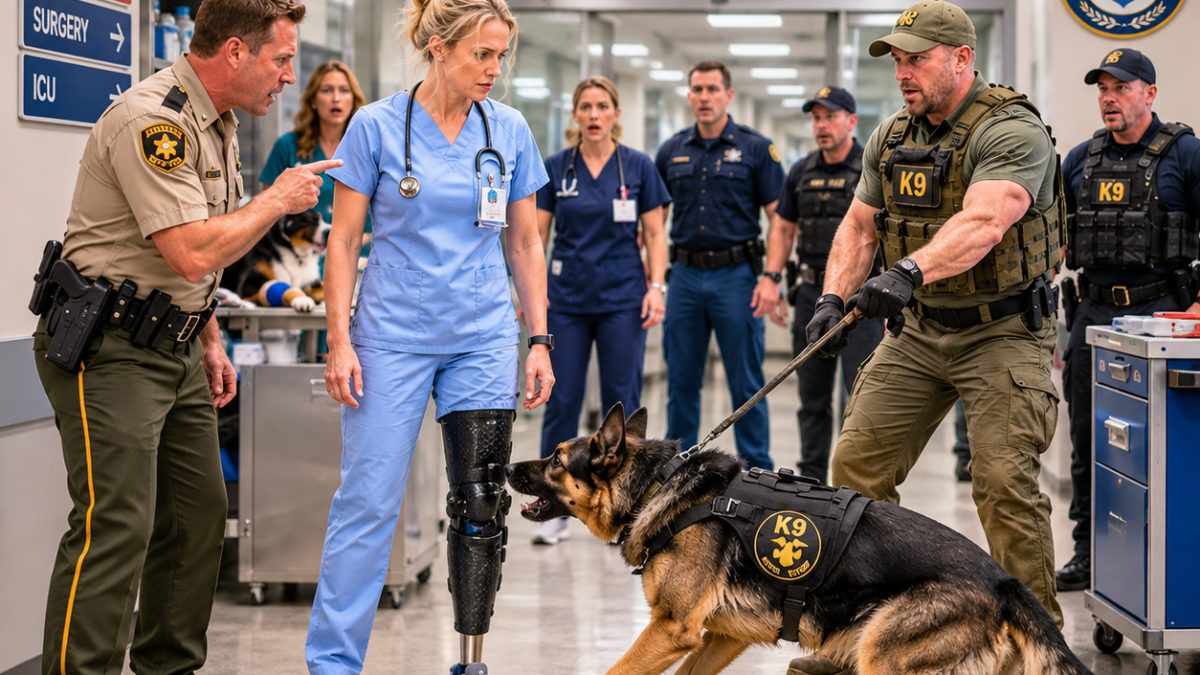
The Deputy Suspended the Disabled Nurse in Front of Everyone—Then a K9 Crossed the Clinic and Refused to Leave Her Side.
The sheriff’s deputy looked at the carbon-fiber brace on Mara Solless’s leg, accused her of falsifying controlled-drug records, and suspended her badge in front of the entire veterinary clinic before she could prove that the computer system itself was generating the false entries.
Mara never raised her voice, never signed the statement he pushed across the desk, and quietly wrote down every word he said—because long before she became a disabled trauma nurse in Colorado, she had learned exactly what happens when the wrong person controls the official record.
Then an injured K9 unit rushed through the clinic doors, and one gray-muzzled Belgian Malinois ignored his commander, crossed the room at a run, and pressed his head against Mara’s brace as if he had finally found the person he had been searching for since Afghanistan.
At 5:45 that morning, Mara Solless was already working.
She was not scheduled until seven.
That did not matter.
The overnight technician had called out sick at 4:58, and Crestston Valley Veterinary Trauma Center had two recovering surgical patients, one elderly shepherd on supplemental oxygen, and a medication inventory that had been wrong often enough lately that Mara no longer trusted the computer unless she checked the physical log herself.
So she drove eighteen minutes from her apartment in Dunore, Colorado, parked beneath the clinic’s flickering rear light, pulled on navy scrubs, and started work before sunrise.
The carbon-fiber brace on her left leg clicked once every few steps.
Click.
Step.
Click.
Step.
She barely heard it anymore.
Other people did.
Clients sometimes looked down.
New employees always noticed eventually.
Most were polite enough not to ask.
The few who did received the same answer.
“Old nerve damage.”
If they pushed:
“Military.”
And if they pushed again, Mara looked at them long enough that they usually discovered something else they urgently needed to do.
She had been at Crestston Valley for three years.
Lead trauma nurse for most of two.
She was thirty-six, compact, dark-haired, precise with her hands, and almost aggressively uninterested in being impressive.
She came early.
Stayed late.
Remembered drug dosages without showing off about it.
Could stabilize a panicking Belgian Malinois while three grown handlers argued around her.
Could insert an IV in a dehydrated cat with veins like thread.
Could tell the difference between an animal frightened by pain and one preparing to bite before most people had noticed either.
Dr. Nadia Oay trusted her.
That mattered more to Mara than any title.
Crestston Valley itself was nothing glamorous.
Two trauma bays.
One surgery suite.
Four recovery kennels.
A cramped triage station near reception.
A medication room that always smelled faintly of alcohol wipes and refrigerated antibiotics.
The building sat between a feed warehouse and a self-storage complex on the edge of a commercial district.
Easy to miss.
Working-dog handlers did not miss it.
Neither did ranchers.
Neither did search-and-rescue teams.
The county K9 unit had used Crestston Valley for years.
Mara knew most of their dogs.
PART2:
Not personally enough to remember every handler’s birthday or coffee preference.
Enough to remember which shepherd hated nail trims and which Malinois needed sedation before anyone touched his ears.
That morning, she was in the medication room reconciling controlled substances.
Ketamine.
Butorphanol.
Midazolam.
Everything physical matched.
The software did not.
Again.
The digital system showed duplicate administrations.
Same drug.
Same patient.
Same timestamp.
Sometimes two entries.
Sometimes three.
Some attached to employee IDs belonging to people who had not even worked that day.
Mara had first noticed the problem eight weeks earlier.
She documented it.
Submitted a written report to clinic administrator Damon Farre.
No response.
She submitted another.
Then another.
Then a fourth.
PART3:
Farre’s reply each time had been verbal.
“It’s on the list.”
The clinic had a lease dispute.
A billing review.
Staffing shortages.
Technology problems.
Mara understood triage better than almost anyone.
So she did not make noise.
She created a manual correction log.
Every false entry.
Every legitimate dose.
Date.
Time.
Patient.
Employee.
She backed the records up because trusting one system after it had already failed was, in Mara’s opinion, not optimism.
It was negligence.
At 7:20, she heard Priya’s voice from reception.
Priya had been at the clinic five months and still sounded twelve whenever a uniformed official asked her something unexpected.
“Um… I don’t think I’m authorized to release that.”
A man replied.
“I’m not requesting private client information. I’m requesting your controlled-substance dispensing logs.”
Mara stepped into the hall.
The deputy stood at the front desk.
Tall.
County sheriff’s uniform.
Clipboard.
Broad shoulders.
Forties.
Nameplate:
GREER.
Holt Greer.
He looked at Mara.
His eyes dropped immediately to the brace.
Then back to her face.
“You the charge nurse?”
“Lead trauma nurse.”
“Administrator?”
“Not here yet.”
“I need controlled-medication records for the last sixty days.”
“What’s the inquiry?”
His expression suggested he had expected less resistance from a veterinary clinic before breakfast.
“Anonymous complaint.”
“About?”
“Potential falsification of controlled-substance records.”
Mara looked at him for one second.
Then said:
“The software is producing duplicate entries.”
Greer glanced at his clipboard.
“That your explanation?”
“It’s a documented technical problem.”
“I’ll determine that.”
“I’m telling you before you look at it because otherwise the logs appear to show twice the actual usage.”
He watched her.
Not like someone receiving information.
Like someone measuring a suspect.
“Show me.”
She took him to the medication room.
Pulled up the report.
“Here.”
She pointed.
“Ketamine. March twenty-second. One actual administration at 08:14. The second line generated automatically.”
“How do you know?”
“Physical log.”
She opened the binder.
“Signed once. Witnessed once. Inventory matches one dose.”
Another example.
Then another.
A duplicate attached to Darla’s employee ID on a day Darla had been off.
Then Mara opened her reports.
Four documents.
Timestamped.
Sent to Farre.
Greer leaned toward the screen.
“Did administration acknowledge these?”
“Not in writing.”
“So nobody confirmed they reviewed them.”
“The server confirms I filed them.”
“That wasn’t my question.”
“No.”
He pointed at a ketamine entry.
“Your ID?”
“Yes.”
“The duplicate also has your ID.”
“Yes.”
“So you’re saying one of the entries under your credentials is false.”
“The system generated it.”
He wrote something.
Mara watched.
“What are you writing?”
“Notes.”
“About what?”
“My review.”
“That’s not an answer.”
He looked at her.
“Ms. Solless, I need you to move away from the medication room while I conduct the preliminary assessment.”
“We open in forty minutes.”
“I understand.”
“We need access to these medications.”
“I’m securing the area.”
“You can preserve evidence without interfering with clinical care.”
His jaw tightened.
“I’m not asking you.”
Silence.
Mara felt an old sensation move through her.
Not fear.
Not quite anger.
Recognition.
A man had arrived with a conclusion.
Now he was fitting facts into it.
She had seen that pattern before in places where the consequences were much worse than a veterinary clinic.
She stepped back.
Kept her hands visible.
“Fine.”
Greer closed the door halfway.
Mara remained in the hall.
Priya walked up carrying intake forms.
“Is this bad?”
Mara looked toward the medication room.
“It’s inconvenient.”
“That doesn’t sound reassuring.”
“Go prep triage.”
Priya did.
At 8:15, Greer emerged holding printed pages.
He found Mara at the front desk.
“I need a statement.”
He placed a form in front of her.
Mara read it.
Once.
Then again.
It asked her to acknowledge that she had identified irregularities in medication dispensing associated with her employee credentials.
The wording was careful.
Too careful.
She slid it back.
“No.”
Greer’s face hardened.
“This is standard procedure.”
“This says I observed irregularities in my own dispensing.”
“You did.”
“No. I observed software-generated duplicate entries.”
“That distinction can be clarified later.”
“No.”
“You’re refusing to cooperate?”
“I’m refusing to sign an inaccurate statement.”
He leaned one hand on the desk.
“People who have nothing to hide generally don’t make this this difficult.”
Mara looked up.
Priya stopped typing.
A technician walking through the hall slowed.
Mara said quietly:
“You don’t know what you’re looking at.”
At 8:47, Holt Greer suspended her badge access.
He did it at reception.
In front of Priya.
Darla.
Ramos.
And a client named Mr. Hatcher, who was sitting beside a wire crate containing a frightened border collie.
Greer held the access scanner.
“Pending investigation, Ms. Solless is restricted from the medication room, surgery suite, and controlled supply storage.”
Mr. Hatcher looked at Mara.
Then at her brace.
Mara saw it.
The calculation.
Badge suspended.
Medication investigation.
Disabled nurse.
Something suspicious.
Darla looked at the floor.
That hurt more than Mr. Hatcher staring.
Greer handed Mara the dead badge.
“You can wait in the staff lounge.”
“I’ll stay at triage.”
“That’s unnecessary.”
“It isn’t restricted.”
He looked as though he considered changing that simply because she had noticed.
Instead, he walked away.
Mara sat down.
Pulled a blank incident report toward herself.
And started writing.
07:20 — Deputy Holt Greer arrived.
07:24 — Stated anonymous controlled-substance complaint.
07:31 — Shown duplicate software entries.
07:36 — Shown physical medication log.
07:41 — Shown written software reports.
08:15 — Requested signed statement.
Exact wording where she remembered it.
No adjectives.
No anger.
No speculation.
She did not write:
Deputy behaved like an arrogant idiot.
Even though parts of her considered the phrasing efficient.
She wrote only what another person could later verify.
That was a habit from another life.
At 9:15, Dr. Nadia Oay walked in.
One glance at the room told her something was wrong.
Mara at triage with paperwork.
Deputy at medication room.
Staff avoiding eye contact.
Oay walked directly to Greer.
Their conversation lasted four minutes.
Mara caught pieces.
“Known software defect.”
“Clinical continuity.”
“Authority.”
“Patient care.”
Then Oay came to Mara.
“Are you okay?”
“I’m fine.”
“Did you sign anything?”
“No.”
Mara handed her the incident report.
Oay read all four pages.
“You wrote this already?”
“Yes.”
“Accurate?”
“As close to verbatim as possible.”
Oay looked toward Greer.
“He suspended you in front of clients.”
“Yes.”
“That was unnecessary.”
“Yes.”
“I’m calling legal.”
“Good.”
At 9:50, Greer approached again.
“I’m not here to cause problems.”
Mara looked at him.
“Then we agree on at least one goal.”
“I have an obligation to investigate a complaint.”
“I understand.”
“Then cooperate.”
“I have.”
“You refused the statement.”
“I refused your wording.”
Greer’s eyes moved to her brace again.
Mara noticed.
Once.
Then again.
Then a third time.
Finally she said:
“My leg has nothing to do with the medication logs.”
His expression changed.
“I didn’t say it did.”
“You looked at it four times in two minutes.”
“That’s ridiculous.”
“I notice things.”
He left.
At 10:20, the county radio clipped to Greer’s belt erupted.
Multi-vehicle collision.
Highway Nine southbound.
Several vehicles.
County patrol involved.
Officer injuries.
Possible K9 casualties.
Request veterinary trauma support.
The entire clinic changed instantly.
Priya straightened.
Darla abandoned her coffee.
Oay stepped out of an exam room.
Mara was already moving.
Trauma kit.
IV sets.
Oxygen.
Bandages.
She reached toward the controlled cabinet.
Stopped.
Badge restricted.
Fine.
She grabbed what she could legally access from trauma stock.
Greer stepped into her path.
“You’re restricted.”
“From medication storage and surgery.”
“You’re under investigation.”
“And three working dogs are inbound.”
He opened his mouth.
Oay said from behind him:
“Deputy.”
He turned.
“She is my lead trauma nurse.”
“She’s currently—”
“If you have clinical authority over this facility, show me.”
Greer said nothing.
“If not, move.”
He moved.
The first truck arrived at 10:38.
A handler climbed out with blood on his forehead and a Belgian Malinois limping beside him.
“His name?”
“Bricks.”
“Mechanism?”
“We went through the windshield.”
“You need an ER.”
“I’m going when he’s stable.”
Mara did not argue.
She knew men like him.
Had known them in deserts.
Mountains.
Helicopter pads.
Places where people would ignore their own blood until the animal beside them was safe.
She examined Bricks.
Shoulder laceration.
Right foreleg pain.
Respiration elevated.
Possible fracture.
“Easy.”
She placed one hand on his back.
Bricks trembled.
Then exhaled.
The handler watched her.
“You’ve done this before.”
“Yes.”
More vehicles arrived.
Another K9.
Then another.
One shepherd went directly to surgery.
Handlers filled the hall.
County EMS came and went.
The clinic became controlled chaos.
Mara forgot Greer existed for twenty minutes.
Then she heard engines outside.
Not one.
Several.
Heavy tires on gravel.
Organized arrival.
Through the window she saw tactical green.
County K9 insignia.
The first man through the door wore a dark green shirt beneath a tactical vest.
Commander insignia.
Behind him came a Belgian Malinois on a thick leash.
Older.
Gray around the muzzle.
Powerful.
Mara saw the scar first.
Left side of the neck.
A short pale line beneath the ear.
Her hands stopped.
No.
The dog cleared the doorway.
Looked directly at her.
Everything inside Mara went quiet.
The commander gave a command.
“Rook. Heel.”
The dog did not move.
His entire body stiffened.
Ears forward.
Eyes fixed on Mara.
“Rook.”
One step.
The leash tightened.
The commander corrected.
“Rook, halt.”
The dog started trembling.
Not fear.
Restraint.
A working animal fighting training.
Mara stood eight feet away in blue gloves.
Her brace clicked once as she shifted weight.
Rook’s head snapped toward the sound.
Then he broke.
Four strides.
The commander lost the leash.
Someone shouted.
Greer reached instinctively toward his radio.
Rook hit Mara’s shoulder.
Hard enough to move her half a step.
Not attack.
Greeting.
Then the dog immediately dropped his head.
Pressed his gray muzzle against the carbon-fiber brace on her left leg.
And became perfectly still.
The entire treatment room stopped.
Handlers stared.
Priya lowered her clipboard.
Darla’s mouth opened.
Commander Devlin Marsh looked like someone had just removed all the blood from his face.
Mara looked down.
At the scar.
At the dog.
At the same dark eyes she had last seen through dust and blood under a headlamp in Kandahar.
She placed one hand on his head.
“Hey, Rook.”
The commander’s voice came slowly.
“What did you call him?”
Mara looked up.
“Rook.”
“Who told you his name?”
“Nobody.”
Marsh stared.
Rook leaned harder against her brace.
Greer stepped forward.
“Commander, this nurse is currently under—”
“Quiet.”
Marsh did not look at him.
Greer stopped.
Marsh looked at Mara.
“Where did you serve?”
“That’s a long answer.”
“Short version.”
Mara kept one hand on Rook.
“Sixty-Eighth Joint Medical Evacuation. Kandahar Province. 2014 to 2017.”
Marsh’s expression changed.
Tiny.
But Mara saw it.
“You were medical?”
“Yes.”
“Staff Sergeant?”
She looked at him.
“Yes.”
Marsh looked at Rook’s scar.
Then at her brace.
“I have a report.”
Mara said nothing.
“2016 convoy ambush.”
Still nothing.
“Joint evacuation point.”
Mara’s right hand began to tremble.
She tucked it against her hip.
Marsh continued.
“Three service members stabilized under fire.”
Pause.
“One military working dog with shrapnel trauma to the left neck.”
Rook’s scar.
“The field medic sutured the dog before evacuation.”
Mara looked down.
“Rook was bleeding badly.”
Marsh stared at her.
“You did it.”
“I closed the wound.”
“You saved him.”
“I treated him.”
“You saved three people too.”
“Three.”
Marsh frowned.
“The report lists two.”
“The third walked out later.”
She looked at him.
“Femoral bleed. He wouldn’t have made it without pressure.”
Marsh was silent.
Then:
“Why wasn’t your name in the report?”
Mara returned her attention to Rook.
“I didn’t need it there.”
Greer made the mistake of speaking again.
“Commander, regardless of whatever military connection exists, she’s under an active compliance investigation.”
Marsh finally turned toward him.
“What clinical suspension order do you have?”
Greer hesitated.
“I restricted badge access.”
“That wasn’t my question.”
“I’m conducting—”
“Did you suspend her nursing authority?”
Greer looked at his clipboard.
He had not.
Could not.
Marsh nodded once.
Then to Mara:
“Do your job.”
The next two hours disappeared.
Four dogs.
Two handlers.
One emergency surgery.
Mara moved through it all.
Rook stayed close.
Not in the way.
Never interfering.
But every time Mara crossed the room, he tracked her left side.
Gray muzzle near the brace.
Marsh watched.
At 12:40, the acute wave eased.
Mara sat at triage writing notes.
Marsh approached.
Set an old photograph on the desk.
Military documentation.
Rook.
Younger.
Fresh scar visible.
“This was two weeks after he transferred to us.”
Mara touched the edge of the photograph.
“I’ve been trying to identify the medic in the report for four years.”
She looked up.
“Mara Solless.”
He waited.
“Staff Sergeant. Sixty-Eighth Medical. Medically discharged February 2017.”
Marsh looked toward the brace again.
This time differently.
Not curiosity.
Understanding.
“You were injured in the same incident.”
“Yes.”
“Blast?”
“Nerve damage.”
“And concussion?”
“Yes.”
“You stayed?”
“Until evacuation was complete.”
He looked at her for several seconds.
Then said:
“There was a commendation.”
Mara frowned.
“What?”
“After-action review generated three citations. Two attached to known names. One listed ‘unconfirmed medic, 68th Medical.’”
“I never heard about it.”
“You were already discharged when it cleared.”
“That sounds plausible.”
“They had the wrong forwarding address.”
“That sounds even more plausible.”
For the first time, Marsh almost smiled.
Then he turned toward Holt Greer.
“Deputy.”
Greer looked up.
“I want your complete complaint file.”
“That’s internal.”
“So is half the K9 documentation on my desk.”
Marsh’s voice remained level.
“But when an investigation potentially targets a decorated disabled veteran using incomplete records tied to county K9 controlled-medication billing, it becomes my operational concern.”
Greer’s jaw shifted.
Marsh extended his hand.
“The complaint.”
Greer gave it to him.
Marsh read.
First page.
Second.
Then stopped.
“What is this?”
He pointed to a faint reference number near the bottom.
Greer looked.
“Cross-file notation.”
“For what case?”
“I don’t know.”
“Pull it.”
“It’s probably administrative.”
“Pull it.”
Greer used his phone.
The prior case was eight months old.
Anonymous complaint.
General medication-management concerns at Crestston Valley.
Reviewed.
Closed.
No findings.
Investigating deputy:
Willard Foss.
Retired four months earlier.
Marsh looked at Greer.
“Who would know this reference number?”
Greer did not answer immediately.
“Anyone with access to closed compliance files.”
“Meaning?”
“Professional Standards. Compliance intake. Some supervisory personnel.”
Mara pulled her own incident report from the folder.
Placed it beside the complaint.
Marsh read hers.
Then the complaint.
Then hers again.
“Security footage.”
Mara looked up.
“What?”
“I want the last six weeks.”
Oay obtained it within fifteen minutes.
They crowded into the administrator’s office.
Footage confirmed everything Mara had said.
Week one.
Mara documenting duplicates.
Week three.
Mara showing Priya how the software repeated entries.
Week five.
Mara stopping Torres from entering a dose because the system had already generated a false line.
Then footage from four weeks earlier.
11:18 p.m.
Clinic closed.
A person in a non-staff jacket at the medication room.
Old badge code.
Door opened.
Six minutes inside.
Oay leaned toward the screen.
“That code isn’t current.”
“Can it be traced?” Marsh asked.
“Yes.”
The badge had belonged to a technician who left fourteen months earlier.
Supposedly returned.
Supposedly disabled.
County IT traced it further.
Reactivated three days before the late-night entry.
Administrative credentials.
Not Oay.
Damon Farre.
The clinic administrator.
The man Mara had sent all four software reports to.
The man who had said:
It’s on the list.
Greer stared at the screen.
For the first time all day, he stopped looking certain.
He looked at Mara.
“The statement I asked you to sign…”
She waited.
He swallowed.
“I shouldn’t have framed it that way.”
“No.”
“I was working from the complaint.”
“I know.”
“I also shouldn’t have suspended your badge in front of clients.”
“No.”
Mara did not rescue him from the silence.
He needed to sit in it.
Then Marsh asked:
“Where is Farre?”
Oay checked.
“Called out sick.”
“When?”
“Before seven.”
Mara and Marsh looked at each other.
Before Greer arrived.
At 2:30, Oay reinstated Mara’s badge in writing.
At 3:10, county audit investigators began reviewing the clinic server.
At 3:42, Mara stepped outside with Marsh and Rook.
Colorado mountains sat blue against the distance.
Storm clouds building.
Rook kept nudging Mara’s brace with his muzzle.
“He remembers the sound,” she said.
Marsh looked down.
“The brace?”
“He was sedated when I treated him.”
“That was nine years ago.”
“Dogs remember strange things.”
“He’s been transferred twice.”
“I know.”
Marsh looked at her.
“How?”
“I checked once.”
“When?”
“After I got home.”
She paused.
“Then I stopped.”
“Why?”
“Because that life was over.”
Marsh was quiet.
Then reached inside his vest.
He gave her a folded document.
The citation.
Mara did not open it.
“You carried this?”
“Two years.”
“Why?”
“In case I found the medic.”
“You expected to?”
“No.”
She put it in her pocket.
At 3:58, Priya appeared at the back door.
“Mara.”
Something in her voice changed the air.
“What?”
“Farre’s here.”
Marsh straightened.
“He came through the back.”
“Where?”
“Administrator’s office.”
Priya swallowed.
“He’s deleting files.”
Mara moved.
Brace clicking.
Rook beside her.
Marsh behind.
The administrator’s door was partly open.
Damon Farre sat at the computer wearing his jacket.
Car keys on the desk.
Deletion window open.
Folder:
MEDICATION MANAGEMENT / STAFF REPORTS.
Mara’s reports.
All four.
Farre looked up.
Startled.
Then immediately calm.
Too calm.
“Mara.”
She looked at the screen.
Then at him.
“Don’t.”
“I’m cleaning outdated records.”
Marsh stepped forward.
“Step away from the computer.”
Farre noticed the tactical vest.
Recalculated.
“I’m the administrator of this facility.”
“Your credentials were suspended ninety minutes ago.”
“I didn’t receive—”
“Email went to your registered administrative account at 1:17.”
Farre’s hand moved toward the mouse.
Marsh placed one palm on the desk.
No threat.
No grabbing.
Just a barrier.
Farre stopped.
Greer appeared in the doorway.
Marsh said:
“Secure this workstation.”
Greer did it immediately.
No argument.
Whatever Holt Greer had been at seven that morning, he was at least making different choices by four.
The county forensic investigator arrived at 4:10.
Bellamy Voss.
Sharp eyes.
No wasted conversation.
She secured the computer.
Preserved the deletion queue.
Interviewed Mara.
Mara gave facts.
Only facts.
Direct observation separated from inference.
At one point Voss asked:
“You filed four reports without receiving written confirmation anyone reviewed them.”
“Yes.”
“Why continue?”
“Because unread documentation is still documentation.”
Voss stopped writing.
Mara continued:
“The timestamp does not care whether somebody opened the file.”
At 5:15, the first forensic result arrived.
Farre had scheduled 211 files for deletion at midnight.
Forty-seven potentially relevant.
Among the metadata:
Emails.
Fifteen months.
One subject line:
SOLLESS DISABILITY ACCOMMODATION REVIEW.
Thirteen months old.
Long before the drug investigation.
Long before Mara’s reports.
Someone had been looking at her for more than a year.
Mara read the subject line twice.
“They chose me before the software problem became visible.”
Marsh said:
“Looks that way.”
“Why?”
They did not know.
Yet.
Another email thread appeared.
SOFTWARE PATCH — LOGGING BEHAVIOR.
Nine months old.
Oay stared.
“You’re telling me the duplicate-entry problem may have been created?”
Voss held up one hand.
“I’m telling you someone discussed modification of logging behavior before your staff reported errors.”
Mara looked at the timeline.
Something opened in her mind.
The anonymous complaint.
Old closed-case reference.
The routing note.
Farre’s ignored reports.
The late-night access.
Software duplicates.
She looked at Voss.
“Pull the complaint portal metadata.”
“What specifically?”
“Submission IP.”
Voss watched her.
“If the current complaint came from the clinic network, that matters.”
“Yes.”
“And compare the prior complaint.”
“Yes.”
Voss nodded.
“Good.”
Greer was watching Mara.
Different expression now.
Not suspicion.
Recalibration.
At 7:00, most staff went home.
Mara stayed.
Rook slept near triage.
Marsh took calls.
Voss worked.
At 9:58, Marsh returned from the parking lot.
“The complaint came from a public network.”
“Where?”
“Coffee shop on Alderman.”
Four blocks away.
“Farre?”
“Probably not.”
“Then someone filed for him.”
Marsh nodded.
“And we found county-domain correspondence in his deleted email.”
Mara went still.
“Sheriff’s office?”
“Yes.”
“Whose?”
“Subdomain only so far.”
Then the rear door opened.
A woman walked in.
Mid-fifties.
Dark jacket.
Civilian clothes.
County sheriff lanyard partially hidden.
She stopped when she saw Marsh.
Half a second.
Enough.
“Lieutenant Puit,” Marsh said.
The woman recovered.
“Commander.”
Serena Puit.
Professional Standards.
Twenty-two years.
The office that processed external complaints.
The office capable of seeing old case numbers.
The office that created routing sheets for deputies like Holt Greer.
“I heard the clinic had a difficult day,” she said.
Marsh did not smile.
“At ten at night?”
“I keep late hours.”
“The county IT division is identifying the departmental email addresses corresponding with Damon Farre.”
Puit’s face did not move.
“The forensic team has the metadata.”
Still nothing.
“Subpoena’s processing.”
There.
A flicker.
Tiny.
But Mara saw it.
Puit said:
“That sounds like an internal matter.”
“It is.”
Marsh’s voice stayed calm.
“You should speak to counsel before morning.”
She left.
Mara looked at Marsh.
“You think it’s her.”
“I think she knew why I mentioned the subdomain.”
“Why would Professional Standards help a clinic administrator frame a nurse?”
Marsh exhaled.
“Because this may not be a clinic fraud.”
He sat across from her.
“The K9 service contract.”
“What about it?”
“Crestston Valley bills the county for working-dog care.”
“Yes.”
“The county pays from operational budget.”
“Yes.”
“There’s been a discrepancy in those budget lines for two fiscal years.”
Mara stared.
“Puit?”
“Budget oversight committee.”
“So the audit here…”
“Could expose discrepancies there.”
Mara leaned back.
Pieces aligned.
“If the clinic’s records are unreliable…”
“The county can argue the source data is bad.”
“If the errors look like staff mistakes…”
“Then financial inconsistencies can be blamed on documentation.”
“And if one person becomes the visible problem…”
“Everyone stops asking where the software error came from.”
Mara looked at her own brace.
Then back at Marsh.
“They didn’t choose me because I was weak.”
“No.”
“They chose me because I kept filing reports.”
Marsh nodded.
“You were creating a paper trail that could force technical review.”
“So they had to make the paper trail look like evidence against me.”
“Yes.”
At 2:17 a.m., Voss called.
Email attribution complete.
Most correspondence came from Serena Puit’s administrative office.
But there was a second address.
Personal.
Registered to Marcus Wilford.
Retired captain.
Former budget oversight.
Former head of the K9 operational committee.
Now board member of a private veterinary services company.
A company that had lost the county K9 care contract to Crestston Valley.
Mara felt the whole structure lock into place.
“Money.”
Marsh nodded.
“It usually is.”
Wilford’s company had continued receiving payments through a subcontracting structure even after losing the primary contract.
Puit had approved portions of the arrangement.
Farre joined later when county auditors started closing in from the clinic side.
Three people.
Three different incentives.
Same goal.
Make the records unreliable.
And Mara had become dangerous because she was making them reliable again.
Then came the part that disturbed her more.
Wilford had access years earlier to military logistics records.
Records connected to Kandahar.
Records containing an unidentified medic.
An injured medic.
A K9 evacuation.
Mara said:
“He knew there was someone from the Sixty-Eighth.”
Marsh said:
“Possibly.”
“He needed a target inside the clinic.”
“Yes.”
“He searches staff backgrounds.”
“Speculation.”
“He finds a disabled former Sixty-Eighth medic who already documents everything.”
Marsh said nothing.
Mara continued.
“And somebody decides quiet plus disabled equals easy to discredit.”
Marsh looked at her.
“That calculation failed.”
Mara glanced at Rook.
“Barely.”
At three in the morning, Marsh finally told her to go home.
“You’ve done enough.”
“There’s more coming.”
“There always is.”
She stayed seated.
He said:
“You’ve been fighting since seven this morning with every tool except the right audience.”
Mara looked at him.
“You have the audience now.”
She looked down at Rook.
“He’s been following me all day.”
“He’s been looking for you for years.”
That almost made her smile.
She went home.
Made tea.
Sat at her kitchen table.
Opened the citation Marsh had given her.
Commendation for actions under fire.
Three personnel stabilized.
One military working dog evacuated.
Medic sustained serious injury.
Declined evacuation until other casualties were secured.
Mara read the language twice.
Then noticed the handwritten note at the bottom.
Marsh.
This was owed to you years ago.
I’m sorry it took this long to find you.
She folded it.
At 6:42, Bellamy Voss called.
The software modification was confirmed.
Custom script.
Installed remotely.
Administrative credentials.
Ten months earlier.
Designed to create duplicate medication entries slowly.
Not all at once.
Enough to build a pattern without triggering immediate alarms.
Mara sat at her kitchen table in silence.
“So it was intentional.”
“Yes.”
“And my reports?”
“Were a problem for them.”
The financial analysis went deeper.
Twenty-seven months of questionable K9 service billing.
Payments routed indirectly to Wilford-linked entities.
Puit involved in budget approval.
Farre recruited once the clinic audit threatened the arrangement.
Then Voss said:
“We have warrants moving.”
By noon, Damon Farre was in custody.
Serena Puit was placed on administrative suspension.
Marcus Wilford’s property and business records were under federal review because investigators had uncovered evidence that an old clearance-access relationship had been used to obtain protected military personnel information.
Holt Greer was not arrested.
His role was different.
He had been manipulated.
But he had also allowed himself to be manipulated because he liked the story he had been handed.
The sheriff’s office opened a misconduct review.
Mara returned to work at seven.
Of course she did.
Priya stared when she walked in.
“You slept?”
“Enough.”
“That means no.”
“Correct.”
Her badge worked.
The medication-room door opened.
Mara stood there for one second.
Then walked in.
Nothing dramatic.
She checked the log.
Because the animals still needed medication.
Two days later, Holt Greer came back.
No clipboard.
No swagger.
He stood near triage until Mara finished with a patient.
“Can I talk to you?”
“You’re already doing it.”
He accepted that.
“I need to tell you something.”
Mara waited.
“The routing packet I received had a note.”
“What note?”
He handed her a copy.
Handwritten.
SUBJECT HAS DOCUMENTED HISTORY OF NONCOMPLIANCE RELATED TO DISABILITY ACCOMMODATION. EXPECT RESISTANCE.
Mara read it.
Then looked at him.
“You saw this before you met me.”
“Yes.”
“And when you saw my brace?”
Greer looked away once.
Then back.
“I thought the note was being confirmed.”
“No.”
“I know that now.”
“You saw what you expected to see.”
“Yes.”
Mara returned the page.
“That’s a dangerous habit for someone with a badge.”
He took the hit.
Did not defend himself.
“I know.”
“No. You’re learning.”
He nodded.
“I filed it with the misconduct review.”
“Good.”
“I also amended my report.”
“Good.”
He hesitated.
“I’m sorry.”
Mara looked at him.
Not warmly.
Not cruelly.
“I believe that you are.”
He waited.
She gave him nothing else.
Forgiveness was not part of her job description.
Three weeks later, the investigation became public.
Farre had agreed to cooperate.
Puit did not.
Wilford hired federal counsel.
The paper trail was ugly.
Emails.
Budget approvals.
Software access.
Deleted files.
Old badge credentials.
Complaint routing.
Protected personnel information.
The entire scheme had depended on nobody looking at all the records at once.
Mara had spent eight weeks creating exactly the records that made that possible.
The clinic staff began treating her differently.
She disliked it.
People became careful.
Too respectful.
Darla apologized again.
“I should have said something when Greer suspended you.”
Mara shook her head.
“You were twenty-three and scared.”
“That doesn’t make it okay.”
“No.”
Darla looked surprised.
Mara continued.
“But you get another chance every time you’re in a room and something wrong happens.”
Darla nodded.
“Okay.”
“Use the next one.”
That became their whole conversation.
Commander Marsh started bringing Rook to the clinic twice a week.
Officially:
Senior working-dog assessment.
Unofficially:
Rook had apparently decided Mara belonged to him.
Every visit, same thing.
Door opens.
Gray muzzle.
Direct line to the left leg.
Head against brace.
Mara complained once.
“You’re encouraging him.”
Marsh said:
“I gave up commanding him where you’re concerned.”
“Excellent leadership.”
“He has strong opinions.”
“So do I.”
“I noticed.”
Rook’s old injuries were catching up with him.
Neck stiffness.
Early arthritis.
Changes in gait.
Mara built a rehabilitation plan.
Hydrotherapy.
Controlled mobility.
Pain assessment.
Strength work.
Rest periods.
Handlers began asking if she could do the same for other retired working dogs.
Then Oay approached Mara one evening.
“I want to build something.”
Mara looked suspicious immediately.
“That tone usually costs money.”
“Rehabilitation program.”
“For dogs?”
“Working dogs.”
Mara waited.
“And veterans.”
Mara looked up.
Oay continued.
“K9 handlers. First responders. People transitioning out of service. Paired recovery where appropriate. Not therapy theater. Clinical rehabilitation.”
Mara’s expression changed.
“Who told you that idea?”
“No one.”
“Marsh?”
“He agreed it was good.”
“That means Marsh told you.”
“He may have described an operational need.”
Mara sighed.
“Budget?”
“County is revising the entire K9 care contract.”
“Documentation structure?”
“I thought you might design it.”
“Staff?”
“We’d hire.”
“Clinical authority?”
“Yours.”
Mara looked at her.
Oay smiled.
“You’ve been running half this place unofficially for two years.”
“I don’t want a ceremony.”
“Obviously.”
“Or a plaque.”
“Fine.”
“Or a story about overcoming disability.”
Oay’s face became serious.
“I would never insult you like that.”
Mara nodded once.
“I’ll think about it.”
Oay turned toward the door.
“That means yes.”
“It does not.”
“It absolutely does.”
Three months after the morning Holt Greer suspended her badge, Crestston Valley opened its K9 and Veteran Rehabilitation Program.
Small ceremony.
Folding chairs.
Decent coffee.
Plain sign.
Mara had personally rejected three versions because two contained silhouettes of saluting soldiers and one looked, in her words, “like somebody designed a nonprofit inside a sporting-goods catalog.”
The final sign simply read:
CRESTSTON VALLEY
K9 & VETERAN REHABILITATION PROGRAM.
That was enough.
Mara was clinical director.
She wore the same navy scrubs.
Same brace.
Same click when she walked.
Nothing about the leg had changed.
The nerve damage remained.
The tremor in her right hand appeared when she was tired.
The scar on her shoulder still tightened in cold weather.
What had changed was the room.
People knew what they were looking at now.
Devlin Marsh arrived with Rook.
Rook walked directly across the room.
No command needed.
Pressed against Mara’s brace.
She scratched behind his ears.
“You’re getting predictable.”
His tail moved once.
At the back of the room sat a young woman with a retired detection dog at her feet.
Early thirties.
Veteran.
Medically separated.
She watched Mara carefully.
Not the program.
Mara.
The brace.
The title.
The way staff deferred to her.
The same calculation Mara had watched people make for years.
After the short ceremony, Mara sat beside her.
The dog between them sniffed Rook.
The woman asked:
“How long did it take?”
“To do what?”
“Figure out where you belonged after.”
Mara knew exactly what she meant.
“Longer than I wanted.”
The woman looked at her dog.
“I keep getting told I’m not injured enough for some programs.”
Mara waited.
“And too injured for the work I used to do.”
There it was.
The impossible middle.
Mara looked at her.
“People like putting other people into categories they already understand.”
The woman smiled faintly.
“Yeah.”
“Sometimes the category is wrong.”
“What changed for you?”
Mara looked across the room.
Priya at registration.
Darla running intake.
Oay arguing with the county veteran-services director over a budget line.
Marsh showing a handler something on a tablet.
Rook leaning against her leg.
Then she said:
“The record caught up to the truth.”
The woman frowned.
Mara continued.
“For years, the record said disabled veteran. Medical discharge. Nerve injury.”
She touched the carbon-fiber brace.
“All true.”
Then she nodded toward the clinic.
“It didn’t say what came after.”
The woman looked around.
“You built this.”
“With a lot of people.”
“But you built the system.”
“Yes.”
“Why?”
“Because records matter.”
The woman laughed softly.
“That doesn’t sound inspirational.”
“Good.”
Mara leaned back.
“Here’s the useful version. People will tell you what your limits are. Some will wear uniforms. Some will sit behind desks. Some will have clipboards and a great deal of certainty.”
The woman watched her.
“They may even be right about some things.”
Mara paused.
“My leg will never work normally.”
She said it without sadness.
“That’s real.”
Then:
“But somebody else doesn’t get to take one true limitation and build an entire false story around it.”
The young woman looked down at her dog.
Something in her face loosened.
Not dramatically.
Just enough.
Mara stood.
Brace clicked.
“Come back Thursday.”
“For what?”
“Intake.”
The woman looked surprised.
“You mean for her?”
Mara nodded toward the retired detection dog.
“And you.”
Silence.
“Both?”
“That’s the program.”
The woman smiled.
Small.
Uncertain.
Mara knew that smile.
It belonged to people who had heard no enough times that yes sounded suspicious.
“Thursday,” Mara repeated.
The woman nodded.
“Thursday.”
Across the room, Priya raised a clipboard.
“Three new referrals.”
Mara sighed.
“Of course.”
She walked toward her.
Rook stood immediately.
Followed at her left side.
Three months earlier, a deputy had looked at the clicking brace and seen weakness.
Damon Farre had looked at her quiet personality and seen someone easy to blame.
Serena Puit had looked at her service history and seen a profile that could be manipulated.
Marcus Wilford had looked at an old military record and seen an anonymous medic whose name could remain buried.
Every one of them had made the same mistake in a different form.
They confused quiet with passive.
Disability with helplessness.
Documentation with bureaucracy.
They had not understood that Mara Solless had survived most of her life by doing one thing exceptionally well.
She kept track of what was true.
She had done it under fire.
She had done it in a field medical tent while Rook bled onto her gloves.
She had done it after discharge when her left leg stopped obeying her the way it once had.
She had done it at Crestston Valley when software logs began producing numbers that did not make sense.
And she had done it when Holt Greer stood in front of an entire clinic and tried to make her sign a sentence that was not true.
No.
One word.
That was where everything turned.
Not when Rook recognized her.
Not when Marsh found the Kandahar report.
Not when Farre was caught at the computer.
Not when Puit’s email address surfaced.
Those things exposed the truth.
But the truth had survived long enough to be exposed because Mara had refused to sign it away.
Weeks after the program opened, Holt Greer came to the clinic again.
This time as a client.
He stood at reception holding the leash of a middle-aged Labrador with a swollen paw.
Priya recognized him.
So did Mara.
Greer looked uncomfortable.
“County K9?”
Mara asked.
“My dog.”
“Name?”
“Cooper.”
“What happened?”
“Jumped off the deck.”
“Weight-bearing?”
“Barely.”
She took the leash.
“Come on.”
Greer blinked.
“That’s it?”
“What were you expecting?”
“I don’t know.”
“An execution?”
He almost smiled.
“No.”
She examined Cooper.
Soft tissue injury.
No fracture.
Rest.
Anti-inflammatory medication.
Follow-up.
Greer listened.
When she finished, he stood near the door.
“My review ended.”
“I heard.”
Written reprimand.
Mandatory retraining.
Disability accommodation.
Evidence evaluation.
Still employed.
Mara had given a formal statement saying she believed the consequence was lighter than the conduct deserved.
She had also included one sentence investigators had not expected.
Deputy Greer’s later decision to preserve and flag the routing note materially assisted the investigation.
Both were true.
He had harmed her.
Then helped uncover part of what had happened.
Mara refused to simplify either fact.
Greer said:
“I don’t expect you to think the outcome was enough.”
“It wasn’t.”
He nodded.
“I figured.”
She gave him Cooper’s discharge instructions.
He looked at the paper.
“You know, before all this, I thought good investigators were the ones who trusted their instincts.”
Mara leaned against the counter.
“And now?”
“I think instincts are where you start.”
“Not where you finish.”
He nodded.
“That.”
He left.
Mara watched through the window as he helped Cooper into his truck.
No redemption speech.
No dramatic friendship.
That was fine.
Justice did not require everybody to become better friends afterward.
Sometimes it meant the record finally said what happened.
Farre eventually pleaded guilty to four charges and agreed to testify.
Puit went to trial.
The thirteen months of email.
Complaint routing.
Handwritten disability note.
Budget approvals.
All entered into evidence.
Wilford faced federal charges tied to unauthorized protected-record access and financial misconduct.
The details moved slowly through courts.
Mara stopped following every filing.
She had patients.
The first year of the rehabilitation program was messy.
Budget too small.
Waiting list too long.
Documentation templates revised four times.
One retired shepherd hated hydrotherapy.
A bomb-detection Labrador refused to use a ramp because someone had apparently taught him long ago that ramps were suspicious.
A former K9 handler named Caleb spent three weeks refusing to speak during sessions and then unexpectedly talked for forty minutes while brushing his dog.
Nothing happened cleanly.
Mara loved it.
The work was difficult in ways she recognized.
Not combat.
Not Kandahar.
Not emergency evacuation.
Still work that mattered.
Rook became the unofficial elder of the program.
His gray muzzle whitened.
Arthritis progressed.
Mara adjusted treatment.
Marsh brought him twice a week.
Then once.
Then every other week.
One afternoon, Rook walked into the clinic more slowly than usual.
Mara crouched.
He pressed his head against the brace.
Same place.
Every time.
“You know this isn’t the leg you treated.”
Marsh said:
“He doesn’t care.”
“He’s associating the brace with me.”
“Or you with safety.”
Mara looked up.
“That sounded sentimental.”
“I regret it already.”
Rook sat.
Mara touched the scar on his neck.
The old field sutures had been removed years earlier.
Only the line remained.
A piece of Afghanistan carried in skin.
Her brace was another.
Two bodies.
Two records of the same day.
One visible to everyone.
One nearly lost in a file.
Mara had spent years believing the anonymous citation did not matter because she knew what she had done.
That remained partly true.
But she had learned something else.
Records matter not because they create truth.
Because power often pretends truth does not exist unless it is written somewhere power recognizes.
That realization shaped the rehabilitation program.
Every patient assessment documented.
Every accommodation recorded.
Every injury described accurately.
Every veteran given copies.
Every handler involved in planning.
No vague labels.
No “difficult.”
No “noncompliant” without context.
No reducing a person to one line.
If someone refused something, the chart recorded what they refused and why.
Mara taught staff:
“Never write a conclusion when you can write an observation.”
Priya wrote it on a whiteboard.
Darla rolled her eyes.
Then used it.
Years later, one of the first program veterans returned.
The young woman from opening day.
Her name was Erin.
Her retired detection dog was Luna.
Erin no longer sat folded inward.
She walked with a cane now.
Had resisted using one for years because people stared.
Mara understood.
Erin had eventually accepted a job training working-dog handlers in scent-change recognition.
Not her old military job.
Not a consolation prize.
Something new.
Luna slept beneath her desk most days.
Erin stood beside Mara in the rehab room.
“You know what you told me?”
Mara looked suspicious.
“I say many questionable things.”
“You said the record caught up to the truth.”
“Unfortunately memorable.”
Erin smiled.
“I finally got my medical separation review corrected.”
Mara looked at her.
“Good.”
“That’s all?”
“What do you want?”
“I don’t know. Fireworks?”
“No pyrotechnics around working dogs.”
Erin laughed.
Then became serious.
“I almost gave up.”
Mara’s expression softened.
“I know.”
“You really do.”
“Yes.”
Across the room, an older dog barked once.
Staff moved.
Phones rang.
A handler asked a question.
The clinic kept going.
That was the life Mara had wanted when she left the military.
Not recognition.
Not medals.
Work.
Useful work.
What she had not expected was that quiet work could still require courage.
Different kind.
No gunfire.
No blast.
Sometimes courage was simply refusing a signature.
Writing four pages while humiliated.
Keeping timestamps when nobody answered.
Saying:
No, that is not what happened.
Rook died peacefully years later.
Old age.
Marsh called Mara before the final appointment.
She went to his home.
Rook lay on a thick blanket.
Gray almost white now.
Mara sat on the floor.
He lifted his head.
Slowly.
Pressed it against her brace one final time.
She laughed through tears.
“You are absurdly consistent.”
Marsh sat nearby.
“He found you once.”
“He recognized me.”
“No.”
Marsh looked at Rook.
“I think he found you.”
Mara did not answer.
She put her hand against the old scar.
Rook’s breathing slowed.
No emergency.
No field tent.
No blood.
No command.
Just two people and one old dog in a quiet room.
When he was gone, Mara stayed for a while.
Marsh eventually handed her Rook’s retired collar.
She shook her head.
“No.”
“He’d want you to have it.”
“He’s a dog.”
“You know what I mean.”
Mara took it.
She hung it later in her office.
Not beneath the commendation.
That stayed in a drawer.
Rook’s collar went beside the rehabilitation program’s first intake protocol.
Two things that mattered.
One because an animal remembered her before the system did.
The other because she built something that meant the next person did not have to depend on luck.
Years after the morning Holt Greer entered Crestston Valley, Mara still walked with the same click.
Step.
Click.
Step.
People still noticed.
New clients sometimes stared.
New veterans noticed too.
That mattered.
They saw the brace.
Then the director badge.
Then the clinical floor she ran.
The contradiction existed only if they believed disability and authority were opposites.
Mara never corrected them verbally unless she had to.
She let the room do it.
One winter morning, a new trainee followed her through intake.
Young.
Nervous.
Trying too hard.
He noticed the framed photo of Rook near the hallway.
“Was he yours?”
“No.”
“Military?”
“Yes.”
“He looks old.”
“He was.”
“What’s the story?”
Mara looked at the photograph.
Rook standing beside her.
Gray muzzle.
Head against brace.
Devlin Marsh in the background pretending not to smile.
She thought about giving him the short version.
Instead she said:
“He reminded a room full of people to check their assumptions.”
The trainee waited for more.
Mara handed him a clipboard.
“Room three needs vitals.”
That was enough.
The clinic doors opened.
A handler entered with an injured shepherd.
Mara moved toward them.
The brace clicked.
The trainee followed.
She did not slow down.








