The Deaf Kitten Everyone Wanted — And the Forgotten Stray Who Refused to Let Her Face the World Alone
PART3:
“Poppy was found behind a closed restaurant downtown,” she said. “The place had been shut down for months, but someone heard crying near the dumpsters. She was alone. Tiny. Covered in grease and dust. We think she was born deaf, but she had infections too, and she had no idea when cars were nearby or when people were approaching.”
Poppy batted at a felt mouse, missed completely, and then looked at Rowan as if asking whether that had been embarrassing.
Rowan nudged the mouse back toward her.
“And Rowan?” I asked.
“Found near a farm after that big storm last February. A woman saw him under a collapsed piece of siding. He was soaked, half-starved, and shaking so badly she thought he might not survive the drive here.”
As if he understood his own introduction, Rowan glanced at Mara and took two careful steps closer to Poppy.
“We put them in the same recovery room because we were out of space,” Mara said. “Not because we thought anything special would happen. We were just trying to keep them warm.”
“What happened?”
Mara’s eyes softened.
“They invented each other.”
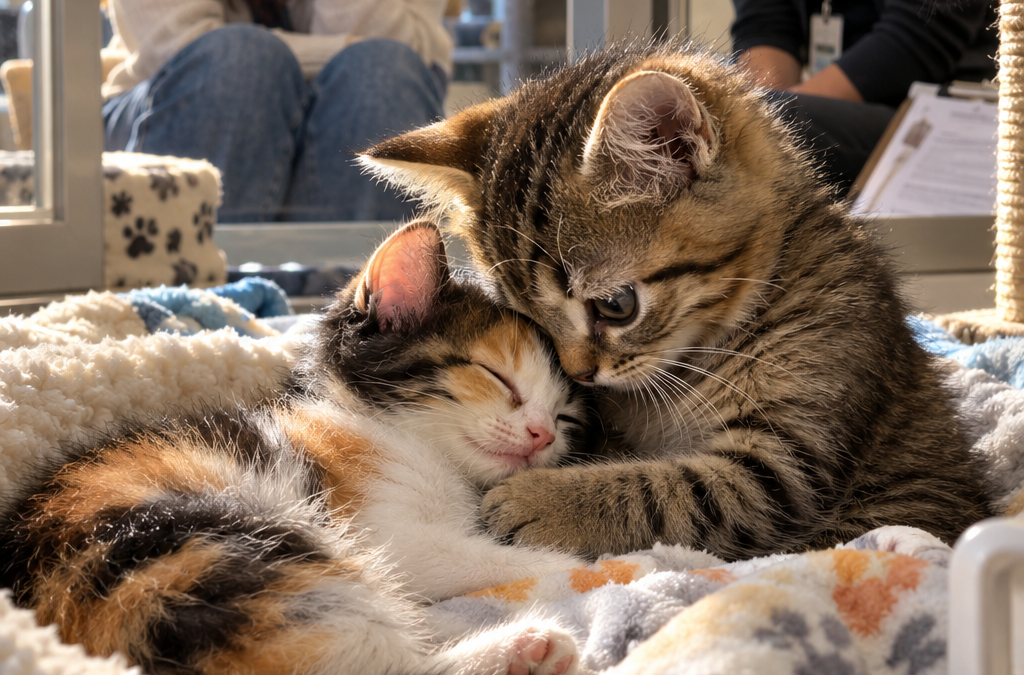
Poppy rolled onto her back. Rowan tapped her paw. She grabbed his face between her front legs and kicked at him with her back paws, silent and delighted. He let her win for a few seconds, then flopped dramatically beside her as if defeated by a warrior half his size.
I laughed before I could stop myself.
It surprised me, that laugh. It came out rusty and unfamiliar.
Mara noticed, but she was kind enough not to mention it.
“Rowan is nervous with people,” she said. “But not with her. When someone enters the room, he goes to Poppy first. If she’s sleeping, he touches her so she doesn’t wake up alone. If there’s a new toy, he tests it first. If a door slams, he watches her, then moves closer. She reads his face.”
Poppy sat up, saw Rowan relaxed, and immediately relaxed too.
“He’s her ears,” I whispered.
Mara nodded.
“And she’s his courage.”
That was when a woman behind me said, “Oh my God, she’s perfect.”
I turned.
A blonde woman in a cream-colored coat stood in the doorway, holding a phone with a glittering case. She was beautiful in a polished, expensive way, the kind of woman whose hair looked professionally arranged even in a shelter full of fur and chaos. Her nails were glossy. Her boots looked too clean for the gravel lot outside.
Behind her stood a man with silver hair and a tired expression, holding a leather folder.
The woman did not look at Rowan.
She looked only at Poppy.
“What’s her name?” she asked.
“Poppy,” Mara said.
The woman smiled as if the name had been chosen for her personally.
“Poppy,” she repeated, lifting her phone to record. “You are going to be famous, sweetheart.”
Something about the way she said famous made Rowan stand up.
Mara’s face changed. It was subtle, but I noticed. Her polite volunteer smile stayed in place, while her eyes grew guarded.
“This is Mrs. Lila Whitcomb,” Mara said to me. “She’s one of our donors.”
Lila extended her hand without really looking at me.
“Lila is fine,” she said. “Everyone calls me Lila.”
I shook her hand. It was cold and dry.
“I’m Clara.”
Lila’s eyes flicked over my jeans, my old cardigan, the coffee stain on my sleeve I had not noticed until that moment.
“Nice,” she said, in a voice that made the word sound unfinished.
Then she turned back to Poppy.
“I saw her photo on your website,” Lila said to Mara. “The moment I saw that face, I knew. My followers are going to melt. A deaf rescue kitten? That’s meaningful content.”
Poppy, unaware of her future as meaningful content, was trying to climb into a cardboard tunnel backward.
Rowan placed one paw against the tunnel to hold it steady.
Lila laughed and filmed Poppy struggling.
“Adorable,” she said. “Absolutely adorable.”
Mara stepped slightly in front of the kittens.
“We should talk in the office,” she said. “Poppy and Rowan are a bonded pair.”
Lila lowered her phone.
“I’m sorry?”
“They’ll need to be adopted together.”
For the first time, Lila looked at Rowan.
Not the way you look at a living thing.
The way you look at an unexpected fee on a bill.
“That one?” she asked.
Rowan shrank back half an inch.
“Yes,” Mara said evenly. “Rowan.”
“But I only want the calico.”
“I understand, but Poppy relies on Rowan. They’re deeply bonded.”
Lila gave a small laugh.
“They’re kittens. They’ll adjust.”
Mara’s voice stayed kind, but something in it became steel.
“Not these kittens.”
The man with the leather folder cleared his throat.
“Lila, perhaps we should let them explain the policy.”
Lila ignored him.
“I’ve sponsored two kennels here,” she said. “I paid for the new washing machine, didn’t I?”
“You did,” Mara said. “And we’re grateful.”
“Then you know I can provide a wonderful home.”
“No one is questioning your home.”
“Then what exactly is the problem?”
Mara did not move.
“The problem is that Poppy’s home includes Rowan.”
For a moment, the room was quiet except for the scratch of tiny claws in the cardboard tunnel.
Then Lila looked at me.
“Are you interested in them?”
The question was simple, but the contempt under it was not.
I should have said no. I should have remembered I came for an old quiet cat. I should have stepped back and let shelter policy handle wealthy women in cream coats and kittens I had known for less than ten minutes.
Instead, I looked down.
Poppy had reached the end of the tunnel and realized she was stuck. Rowan leaned in, tapped her cheek, then backed out slowly. She followed his movement, wiggled, and freed herself.
The two of them sat side by side as if nothing in the world could possibly matter more than being together.
“Yes,” I heard myself say. “I think I am.”
Lila’s mouth tightened.
Mara turned to me, surprised.
“You are?”
I swallowed.
“I want to know more. About both of them.”
Lila gave a little laugh again, but this one was sharper.
“You came in for an adult cat.”
I looked at her. “I did.”
“And now suddenly you want two special-needs kittens?”
“Rowan isn’t special-needs.”
“No,” she said, glancing at him. “He’s just extra.”
I felt my face get hot.
Mara stepped in before I could answer.
“Clara, why don’t we go fill out a pre-adoption form? Nothing is final today. We do home checks for bonded pairs, especially when one has a disability.”
“That sounds good,” I said.
Lila’s eyes narrowed.
“I’d like an application too.”
“Of course,” Mara said.
Lila smiled at me then, the kind of smile that contains no warmth at all.
“May the best home win.”
I did not know then that those words were not a figure of speech to her.
I did not know that Lila Whitcomb was used to winning because people around her had learned the cost of telling her no.
I did not know that two small kittens had already been failed by people with polished smiles and spotless houses.
All I knew was that when I stood up to leave the kitten room, Rowan moved closer to Poppy, and Poppy leaned into him with total trust.
And I knew, with a sudden aching certainty, that if anyone separated them, something sacred would be broken.
The adoption process took nine days.
In those nine days, I cleaned my house like I was preparing for a royal inspection. I bought baby gates, soft beds, a low-sided litter box, a cat tree, stainless steel bowls, toys without tiny bells because Poppy could not hear them, toys with textures she could feel, and a little vibrating collar recommended by a deaf-cat support group online.
I read everything I could find about deaf cats.
Do not startle them awake. Approach where they can see you. Use floor vibrations. Flash lights gently. Build routines. Protect them from open doors. Never let them outside unsupervised.
I read about anxious cats too, about trauma and slow introductions and safe spaces. I cleared the closet in my office and made it into a cave with blankets and a heated pad. I placed one bed beside my desk and one near the window, though I suspected they would only use one if they could share it.
Every night, I dreamed of Poppy and Rowan.
Every morning, I told myself not to get attached before approval.
But the human heart is not good at obeying paperwork.
On the third day, Mara called.
“You should know Lila is pushing hard,” she said.
I was standing in the pet aisle at Target, holding two ceramic bowls, one blue and one yellow.
“How hard?”
Mara sighed.
“She offered to pay Poppy’s adoption fee, fund her medical care for life, and donate five thousand dollars if we would place Poppy with her.”
I looked at the bowls in my hands.
“And Rowan?”
“She suggested we keep him here until someone else takes him.”
I closed my eyes.
“She said that?”
“Yes.”
“What did the rescue say?”
“The rescue said no,” Mara replied. “But she has friends on the board. I don’t want to scare you, Clara. I just want you to be prepared.”
“For what?”
A pause.
“For people who confuse money with love.”
On the fifth day, the home visit happened.
Mara came with another volunteer named Denise, a blunt older woman with short gray hair and sneakers covered in paw-print stickers. They inspected windows, checked screens, asked about my work schedule, emergency plans, vet preferences, and finances. Denise asked me what I would do if Poppy hid for a week. Mara asked what I would do if Rowan never became cuddly. Denise asked how I would prevent escape. Mara asked how I planned to help Poppy communicate.
I answered every question honestly.
I told them I was not rich. I told them I had savings, pet insurance lined up, and a stable job. I told them I lived alone, that I worked from home, that my life was quiet.
Too quiet, maybe.
At the end, Denise stood in my living room looking at the two kitten beds I had placed beside each other.
“You know,” she said, “they’ll probably ignore those and sleep in a cardboard box.”
“I know,” I said.
She nodded, satisfied.
Mara lingered by the front door after Denise stepped outside.
“There’s something else,” she said.
I waited.
“Lila called the director yesterday. She said you seemed emotionally unstable.”
I stared at her.
“She said that?”
“She said she saw you crying in the kitten room.”
“I didn’t cry.”
“I know.”
“I laughed.”
“I know.”
My hands curled at my sides.
“She doesn’t even know me.”
“No,” Mara said gently. “But she knows how to make herself sound concerned.”
That sentence stayed with me.
There are people who hurt you by shouting.
And there are people who hurt you by sounding concerned.
On the eighth day, I received the call.
“We approved you,” Mara said.
For a second, I could not speak.
“Clara?”
“Yes,” I whispered. “I’m here.”
“You can bring them home tomorrow afternoon.”
I sat down on my kitchen floor because my knees had gone weak. The house was quiet around me, sunlight falling across the boards in clean yellow squares. I thought of Poppy learning the vibration of my footsteps. I thought of Rowan discovering that storms could happen outside the window without taking his whole world away.
“Both of them?” I asked, though I knew the answer.
Mara’s voice warmed.
“Both of them.”
The next day, I arrived at Willow Creek with two carriers, though Mara laughed and said they would probably want one.
The lobby was busier than usual. A local news crew had come to film a segment about the open house donations. There were cameras near the front desk, volunteers trying to look casual, and Lila Whitcomb standing in the center of everything wearing a pale blue dress and a smile made for television.
My stomach sank.
Mara met me halfway down the hall.
“I am so sorry,” she whispered.
“For what?”
Before she could answer, Lila saw me.
“Oh,” she said loudly, turning just enough for the camera to catch the moment. “There she is.”
The room shifted.
People looked.
I felt every eye land on my worn sneakers, my canvas tote, the carriers in my hands.
Lila walked toward me slowly, her expression arranged into heartbreak.
“I hope you understand,” she said, loud enough for the camera microphone. “I only wanted what was best for Poppy.”
I looked at Mara.
Mara’s face was pale with anger.
“Lila,” she said quietly. “Not here.”
But Lila had an audience now, and audiences changed everything for people like her.
“I offered her a home with full-time care,” Lila continued. “Medical specialists. A custom cat room. A platform to raise awareness for deaf animals. And instead…” She looked at me with sad eyes. “The rescue decided to place her with someone who can barely afford two carriers.”
Heat rushed up my neck.
A volunteer gasped.
Mara stepped forward. “That is completely inappropriate.”
Lila held up a hand, as if she were the wounded party.
“I’m not trying to be cruel. I’m just heartbroken. Sometimes rescues become so attached to rules that they forget what quality of life means.”
The news cameraman did not lower his camera.
The reporter looked uncomfortable, but not uncomfortable enough to stop filming.
I wanted to disappear.
It is one thing to be judged privately. It is another thing to be measured in public by someone who has already decided you are small.
My divorce had taught me the particular humiliation of being spoken about like furniture. My ex-husband, Daniel, had been skilled at that. He never screamed. He simply explained me to people. Clara is sensitive. Clara takes things personally. Clara struggles with stress. Clara means well. By the time he was finished, any anger I showed looked like proof.
Standing in the shelter lobby with Lila Whitcomb’s pity wrapped around my throat, I felt that old helplessness rising.
Then from the hallway came a tiny scratching sound.
Poppy and Rowan were in a large carrier near the front desk, waiting for me.
Rowan was standing at the door, his striped body tense. Poppy was behind him, unable to hear Lila, unable to know why the room had changed, but watching Rowan’s face.
Watching her world.
I took one breath.
Then another.
“I may not have a custom cat room,” I said.
My voice trembled, but it carried.
Lila blinked, surprised I had spoken.
“I may not have a platform,” I continued. “I may not have five thousand dollars to offer when I don’t get my way. But I listened when the people who know these kittens said they love each other. I listened when they said Poppy trusts Rowan. I listened when they said Rowan is not extra.”
The room went very still.
Mara’s eyes filled with tears.
I looked directly at Lila.
“You wanted the kitten everyone would admire. I wanted the family they had already become.”
For the first time, Lila’s smile slipped.
“That is a very sentimental way to avoid the issue,” she said.
“No,” I said. “It is the issue.”
Denise appeared from the back hallway like a storm in orthopedic sneakers.
“Cameras off,” she snapped.
The reporter startled.
“You can’t film adopters without consent,” Denise said. “And you definitely can’t film an animal transfer while a donor publicly harasses the approved adopter.”
The cameraman lowered the camera.
Lila’s face hardened.
“This rescue will regret this.”
Denise smiled.
“Put it in writing, honey. We love documentation.”
That was how I walked out of Willow Creek Animal Rescue with Poppy and Rowan in one carrier, Mara beside me crying quietly, Denise carrying my second empty carrier like a trophy, and Lila Whitcomb standing in the lobby looking as though she had just discovered the world contained doors that did not open for her.
In the car, Poppy pressed herself against the carrier door, curious about the light moving through the windshield. Rowan stayed behind her, one paw resting lightly against her back.
“It’s okay,” I whispered, though I knew Poppy could not hear me. “You’re both coming home.”
The first night was not magical.
That is something people forget about rescue stories.
They want the moment of adoption to heal everything.
But love does not erase fear in one scene.
Poppy explored immediately, stepping cautiously from the carrier into my living room, sniffing the rug, the sofa, the legs of the coffee table. She looked back often, checking for Rowan.
Rowan did not move.
He sat inside the open carrier with his pupils huge and his body flat.
Poppy returned to him three times.
Each time, she touched her nose to his.
Each time, he blinked slowly but stayed where he was.
I placed food nearby and backed away. I sat across the room on the floor and opened a book I did not read.
For nearly an hour, Rowan watched the house breathe.
When he finally stepped out, it was because Poppy had climbed onto the sofa and turned around to look at him.
He walked to her because she expected him to.
That was the beginning.
The first week, Rowan hid whenever delivery trucks drove by. Poppy slept deeply and woke confused if she opened her eyes and could not see him. I learned to tap the floor lightly before approaching her. I learned to flick the hallway light once before entering a room where she was asleep. I learned that Rowan hated sudden movement but loved the smell of tuna. I learned that Poppy liked to put one paw on my wrist while I typed, as if feeling the rhythm of my work.
They learned me too.
They learned the vibration of my footsteps. They learned the soft thud of my office chair rolling back. They learned that the kitchen light at six meant dinner, and the lamp beside the sofa at nine meant quiet time. They learned that my house had no shouting.
Maybe I learned that too.
For the first time in months, the silence in my home changed.
It was still quiet, but it was no longer empty.
It held the patter of paws, the rustle of paper bags, the scratch of claws on sisal, the small chirping sounds Rowan made when he wanted Poppy to follow him. Poppy herself was nearly silent, but her presence filled rooms. She would appear in doorways like a little painted ghost, blinking at me with total seriousness, then launch herself at a toy mouse as though saving the world.
At night, they slept pressed together on the quilt at the foot of my bed.
Sometimes I woke in the dark and saw Rowan sitting upright, watching the window. If a car passed, its headlights slid across the ceiling. Poppy slept through it, curled safely against him.
One night, during a thunderstorm, I woke to find Rowan trembling beside my pillow.
Poppy was standing over him.
The thunder meant nothing to her, but his fear did.
She pressed her little body against his and stayed there until his shaking stopped.
He was her ears.
She was his courage.
I thought, not for the first time, that humans make love sound complicated because we are embarrassed by how simple it asks us to be.
Show up.
Pay attention.
Stay.
Three weeks after the adoption, Lila posted the video.
I did not see it first. My sister Beth did.
Beth lived in Denver and had never trusted my ex-husband, my landlord, or anyone who used the phrase “with all due respect.” She called me at 7:12 in the morning, which meant something was wrong.
“Have you been online?” she asked.
“No. Why?”
“Don’t panic.”
That is one of the worst sentences in the English language.
“Beth.”
“There’s a video.”
My stomach dropped.
She sent me the link.
It was from Lila’s public page, where she posted carefully lit videos about charity, home design, and what she called compassionate living. The video title read: “When Rescue Politics Put a Deaf Kitten at Risk.”
I watched it sitting at my kitchen table while Poppy batted a bottle cap under the refrigerator and Rowan supervised.
The video began with Lila in her perfect white kitchen, eyes glossy with manufactured sorrow.
“I wasn’t going to speak about this,” she said, which of course meant she had planned every word. “But sometimes silence makes us complicit.”
Then came shelter footage.
Me in the lobby, holding the carriers.
Me looking stunned and red-faced.
Me saying, “I may not have a custom cat room.”
She had edited out everything before and after.
Then Lila reappeared.
“A deaf kitten named Poppy was denied a home with resources because of outdated shelter thinking,” she said. “Instead, she was placed with an adopter who admitted she lacked proper facilities.”
Admitted.
As if I had confessed.
The comments were worse.
Poor baby.
Some rescues are power hungry.
Why wouldn’t they give a deaf kitten to someone with money?
That woman looks overwhelmed already.
Where is the other kitten? Probably forced on her.
Someone should check on Poppy.
My hands shook.
By nine, the rescue’s phone was ringing nonstop.
By noon, someone had found my last name through a tagged shelter post.
By evening, there were messages in my inbox calling me selfish, unstable, jealous, cruel.
A woman from three states away told me deaf animals needed “special people,” not “lonely divorcees trying to fill a hole.”
I sat on the bathroom floor and cried with the shower running so my own house would not have to hear me.
Poppy pushed the bathroom door open with her head.
She could not hear the water. She could not hear me crying. But she saw me.
She walked right to me and placed one paw on my knee.
A moment later, Rowan appeared behind her. He took one look at me, one look at Poppy, and climbed into my lap with the stiff determination of a cat doing something terrifying because it mattered.
I held them both and cried harder.
That night, Mara called.
“I am so sorry,” she said.
“It’s not your fault.”
“She’s attacking the rescue too. The board is meeting tomorrow.”
“What does that mean?”
A pause.
“It means they may ask to do a welfare check.”
I wiped my face.
“Good,” I said. “Let them.”
“You don’t have to sound brave with me.”
“I’m not brave,” I said. “I’m angry.”
Mara exhaled.
“Good. That helps too.”
The welfare check happened two days later.
A county animal services officer named Mr. Alvarez arrived with Mara and Denise. He was kind and professional, with tired eyes that suggested he had seen real cruelty and did not confuse it with a modest living room full of cat toys.
He checked food, water, litter, vaccination records, screens, toys, sleeping spaces, and Poppy’s safety setup. He watched me flick the light before entering the office. He watched Rowan tap Poppy before she jumped down from the cat tree. He watched Poppy follow Rowan to the window and sit beside him, their tails touching.
After thirty minutes, he closed his notebook.
“These cats are fine,” he said.
Denise snorted.
“These cats are better than fine. They have more furniture than I do.”
Mr. Alvarez allowed himself a small smile.
“I’ll file the report today.”
“Will it stop her?” I asked.
He looked at me with gentle honesty.
“Facts don’t always stop people who prefer stories.”
That sentence landed hard.
Because that was what Lila had made.
A story.
In her story, she was the savior. The shelter was corrupt. I was pathetic. Poppy was a tragic object waiting to be rescued.
Rowan barely existed.
In the real story, two kittens had survived abandonment and built a bond no one had the right to dismiss.
I knew which story was true.
But truth, I was learning, sometimes needed evidence louder than cruelty.
The first crack in Lila’s version came from an unexpected place.
A message appeared in my inbox from a woman named Hannah Price.
I almost deleted it unread because I had started expecting hate from strangers. But the subject line stopped me.
“I know where Poppy came from.”
My heart began to pound.
The message was short.
Clara, you don’t know me. I used to work at Bellamy’s, the restaurant where Poppy was found. I saw the posts about her. I think there’s more to the story. Please call me. I don’t trust Lila Whitcomb.
I stared at the last line.
I don’t trust Lila Whitcomb.
My first thought was that it was a trap.
My second thought was Rowan.
He was sitting beside Poppy on the windowsill, watching a squirrel with the intensity of a detective.
Sometimes trust starts not as belief, but as the possibility that someone else is finally seeing what you see.
I called Hannah.
Her voice was young, nervous, and exhausted.
“I’m sorry,” she said immediately. “I didn’t know who else to tell.”
“Tell me what?”
“I worked at Bellamy’s until it closed,” she said. “The restaurant downtown. The one where Poppy was found behind the dumpster.”
“Yes.”
“Lila Whitcomb owned part of it.”
I stood up slowly.
“What?”
“Not publicly. Her husband’s company did. It was one of their investment properties. She used it for events. Charity brunches, influencer nights, that kind of thing.”
I looked at Poppy.
She had fallen asleep against Rowan’s shoulder.
“Hannah, why does that matter?”
The line went quiet.
“Because there were cats behind that restaurant for months,” she said. “A whole colony. Staff fed them. Lila hated it. She said strays made the place look dirty. When the restaurant closed, she told management to stop letting anyone feed them.”
I pressed my free hand to the counter.
“Was Poppy one of them?”
“I don’t know,” Hannah whispered. “Maybe. There was a calico mother. I remember her because she used to sit by the back steps. After the closure, I went by with food when I could, but security started chasing people off.”
My chest tightened.
“Do you have proof?”
“I have emails,” she said. “Screenshots. Not everything, but enough to show they knew there were cats there.”
“Why didn’t you say something before?”
Her breath shook.
“I needed that job. Then I lost it anyway. And Lila… she ruins people who embarrass her.”
I thought of the video.
“She tries,” I said.
Hannah gave a sad little laugh.
“Yeah. She tries.”
The second crack came from Rowan.
Or rather, from the storm that had brought him to the shelter.
Mara called me the next afternoon.
“You need to come in,” she said.
“Is something wrong?”
“I found Rowan’s intake file.”
“I thought you already had it.”
“We had the basic one. But the woman who found him brought in photos. They were misfiled under farm supplies because someone scanned the folder wrong.”
“Mara.”
“One of the photos shows the property sign.”
I waited.
“The farm where Rowan was found belonged to Whitcomb Equine Foundation.”
I sat down so fast the chair scraped the floor.
“Lila’s foundation?”
“Yes.”
The room seemed to tilt.
Rowan, who hated sudden noises, ran under the table. Poppy looked around, confused, then followed his movement and ducked beneath the chair after him.
“I scared them,” I whispered.
“Clara?”
“I’m here.”
Mara’s voice was low.
“We don’t know what it means yet.”
“It means both kittens came from places connected to her.”
“It might be a coincidence.”
I thought of Lila looking through Rowan as if he were nothing.
“It might not.”
Mara was quiet.
Then she said, “Denise knows a retired investigator who volunteers with animal cruelty cases.”
Of course Denise did.
The retired investigator’s name was Frank Malloy, and he had the posture of an old cop and the patience of a librarian. He met us in a diner two towns over because, according to Denise, “Nobody discusses rich people’s secrets in places with cloth napkins.”
Frank listened while Mara laid out the intake files, Hannah’s emails, the shelter timeline, and the public harassment.
I sat beside them, hands wrapped around a mug of coffee I could not drink.
Frank read everything twice.
Then he tapped Rowan’s photo with one finger.
“Found after the February storm,” he said.
“Yes,” Mara replied.
“On a foundation property that claims no feral animals were present.”
“Yes.”
“And this one.” He tapped Poppy’s photo. “Found behind a closed restaurant connected to the same family.”
“Yes.”
Frank leaned back.
“Could be neglect. Could be coincidence. Could be that someone ordered staff to stop feeding animals on properties before redevelopment or sale.”
Hannah’s emails had shown something close to that.
One message from Bellamy’s management read: “Per LW, no further feeding stations are permitted behind the building. Remove bowls before investor walkthrough.”
LW.
Lila Whitcomb.
Another said: “Animal issue must not be visible during Sunday event.”
Animal issue.
I thought of tiny Poppy behind the dumpsters, unable to hear traffic, crying in a world that had been ordered not to see her.
Frank looked at me.
“Why did she want Poppy so badly?”
“Because she’s beautiful,” I said. “Because she’s deaf. Because she would look good online.”
Frank nodded slowly.
“Maybe. Or maybe she recognized her.”
A chill moved through me.
“What do you mean?”
“If someone knew there had been cats on her property, and one of the kittens became public, adopting it could control the story.”
The diner noise seemed to fade.
Control the story.
That was exactly what Lila did.
She controlled the frame, the lighting, the captions, the audience. She turned harm into charity and witnesses into enemies.
“She didn’t want Rowan,” I said.
“Maybe she didn’t know Rowan’s connection,” Frank replied. “Or maybe he wasn’t useful to the story.”
Useful.
That word made me want to throw the coffee mug across the room.
Instead, I thought of Rowan touching Poppy awake.
I thought of him trembling in storms.
I thought of him being called extra by a woman whose foundation property had left him under collapsed siding in February rain.
“What happens now?” I asked.
Frank gathered the papers.
“Now we verify.”
Verification took three weeks.
Three weeks of waiting. Three weeks of hateful comments slowing but not stopping. Three weeks of Lila posting smiling videos about rescue ethics and donor accountability. Three weeks of me learning to live with the strange exhaustion of being lied about publicly.
But inside my house, something else was happening too.
Poppy and Rowan were growing.
Poppy’s legs got longer. Rowan’s face lost some of its sharp kitten angles. Poppy learned hand signals faster than I did. A raised palm meant wait. Two fingers tapping my wrist meant come. Lights flickering meant dinner. She learned that when I stomped gently on the floor twice, she should look at me.
Rowan learned that my hands did not grab. He learned that guests did not have to stay if he hid. He learned that the vacuum was evil but temporary.
And I learned that healing is not dramatic most days.
It is buying more litter.
It is sitting still while a frightened animal decides whether your lap is safe.
It is laughing when a deaf kitten attacks a sunbeam with total confidence.
It is answering another cruel message with silence because your peace is finally becoming more important than your defense.
Still, I was not at peace.
Not completely.
Because Lila had not just humiliated me.
She had tried to separate them.
And every time I saw Rowan wake Poppy gently, every time I saw Poppy lean into his trust, I felt the rage return.
The truth finally broke open on a Thursday afternoon.
Frank called while I was working.
“Can you come to the shelter?” he asked.
“What happened?”
“County confirmed the foundation inspection reports. And Hannah found the original maintenance log from Bellamy’s.”
My heart started pounding.
“And?”
“And Lila knew about both colonies.”
The drive to Willow Creek blurred.
When I arrived, Mara, Denise, Frank, Hannah, Mr. Alvarez, and the shelter director were gathered in the back office. On the table were printed emails, inspection forms, photographs, and maintenance notes.
Hannah looked pale but steady.
Frank began calmly.
“Bellamy’s had a managed cat colony behind the restaurant for at least eight months before closure. Staff documented it. A calico mother with kittens was photographed twice. After closure, Lila Whitcomb instructed management to remove all feeding stations.”
He placed one photo in front of me.
It was grainy, taken near dusk behind a dumpster.
A calico cat stood near the back steps. Beneath her, barely visible, were tiny shapes.
One of them had orange and black markings across a white face.
My throat closed.
“We can’t prove this is Poppy with absolute certainty,” Frank said. “But the timing and location fit.”
I touched the edge of the photo.
“What happened to the mother?”
No one answered.
That was answer enough.
Frank continued.
“The farm where Rowan was found had a barn collapse after the February storm. The Whitcomb Equine Foundation filed an insurance report for property damage. In that report, a maintenance contractor noted ‘multiple barn cats displaced.’ The foundation response stated, ‘No animals housed in that structure.’”
Mara’s jaw tightened.
“But Rowan was found under that structure,” she said.
“Yes,” Frank replied.
Denise muttered something under her breath that would have horrified the children at the open house.
Frank placed one more document on the table.
“This is the part that matters legally. Two days before the shelter posted Poppy’s profile, Lila’s assistant emailed Willow Creek asking whether any kittens had recently been brought in from Bellamy’s or Whitcomb properties. The shelter replied with intake numbers but no photos because of privacy policy. Then Poppy’s photo went online.”
“She recognized her,” I said.
Frank nodded.
“Likely.”
“And wanted to adopt her before anyone connected her to Bellamy’s.”
“Likely.”
The room was silent.
I thought I would feel triumphant.
I did not.
I felt sick.
Because truth did not undo hunger. It did not undo storms. It did not bring back Poppy’s mother or erase Rowan’s first terror. It did not make abandonment less real.
But it did something.
It gave cruelty a name.
And named things could be confronted.
The shelter board meeting was scheduled for the following Monday.
Lila attended.
So did I.
I did not want to go. Every anxious part of me wanted to stay home with my cats and let stronger people handle public rooms. But Denise called the night before and said, “You don’t have to speak, but you deserve to sit where she can see you.”
So I went.
The meeting was held in the community room of the public library, because interest had outgrown the shelter office. Word had spread that Willow Creek would address donor conduct, adoption ethics, and the viral video. Local reporters came. Volunteers came. Supporters came. A few of Lila’s followers came too, dressed like they were attending a trial where facts were optional.
Lila arrived with her husband, Grant Whitcomb, the silver-haired man I had seen that first day. He looked more tired than ever. She wore navy this time, serious and elegant, her face arranged into wounded dignity.
When she saw me, her expression flickered.
Just once.
Enough.
The board president, a retired teacher named Mrs. Henley, began with a statement about animal welfare, responsible adoption, and misinformation. Then she asked Mara to present the adoption timeline.
Mara stood with shaking hands but a steady voice.
She explained Poppy’s deafness. Rowan’s trauma. Their bond. The policy requiring bonded pairs to remain together. My application. The home visit. The welfare check report confirming proper care.
Then Lila asked to speak.
She walked to the podium like someone accepting an award.
“I want to be clear,” she said. “My concern has always been Poppy’s welfare. Any attempt to paint me as vindictive is not only false, but cruel.”
She turned slightly toward the audience.
“I have given thousands of dollars to this rescue. I have opened my home, my platform, and my heart to animals in need. What happened here was not about me wanting my way. It was about a disabled kitten being placed in a home without adequate resources.”
My face burned, but I stayed still.
“Furthermore,” she continued, “I find these accusations about my properties deeply offensive. Anyone can twist old emails to create a narrative. Businesses deal with pest issues. Foundations deal with property damage. That does not mean I harmed anyone.”
Pest issues.
Across the room, Mara closed her eyes.
I felt something inside me go cold.
Not hot anger.
Cold clarity.
Lila kept speaking.
“If anything, this situation proves my point. Animal welfare should be managed by people with the means and education to make difficult decisions, not by emotional volunteers who let sentiment override standards.”
That was when Grant Whitcomb stood up.
At first, I thought he was leaving.
So did Lila.
“Grant,” she said softly, warning in her voice.
But he did not leave.
He walked to the podium.
For the first time since I had seen him, he looked directly at the room instead of at the floor.
“My wife is correct about one thing,” he said quietly. “Difficult decisions were made.”
Lila’s face drained.
“Grant.”
He did not look at her.
“I was aware of concerns at Bellamy’s,” he said. “I was aware staff had been feeding cats after the closure. I was told it was being handled humanely.”
The room was utterly still.
“When the video about Poppy went public, I asked for internal records. I did not like what I found.”
Lila stepped toward him.
“This is not the place.”
He turned then, and there was grief in his face, but also exhaustion so old it had become courage.
“No, Lila. This is exactly the place. Because you made it public.”
She froze.
Grant looked back at the board.
“I have provided Mr. Malloy and animal services with emails from my wife’s office, including one instructing property staff to ‘eliminate feeding and visibility’ of stray animals before investor and donor events. I have also provided foundation maintenance records documenting cats present in the storm-damaged barn before its collapse.”
Lila’s voice cut through the room.
“You had no right.”
Grant looked at her sadly.
“No. They had no voice.”
The words landed like a stone dropped into deep water.
For a moment, I could not breathe.
Lila grabbed her purse.
“This is absurd. This is a coordinated attack.”
Hannah stood from the second row. Her voice trembled, but it carried.
“I fed those cats after closing shifts. You told us they made the restaurant look cheap.”
Lila spun toward her.
“You were an hourly hostess who repeatedly violated policy.”
“I was twenty-two,” Hannah said. “And I knew starving kittens was wrong.”
A murmur rose.
Denise leaned toward me and whispered, “Well, I like her.”
Mrs. Henley called for order.
Frank presented the documentation. Mr. Alvarez confirmed the county had opened an inquiry into animal neglect on the associated properties. Mara read the welfare report clearing my home and noting the bond between Poppy and Rowan. The shelter’s attorney stated that Lila’s edited video had created targeted harassment against a private adopter and damaged the rescue’s operations.
Lila’s supporters grew quieter with every document.
Lila herself did not.
People like her do not surrender when exposed. They escalate.
“So this is what we’re doing?” she said, voice sharp now. “We’re pretending every stray cat near a commercial property is my personal responsibility? We’re pretending this woman”—she pointed at me—“is some saint because she took two kittens she can barely handle?”
I stood before I knew I was going to.
My legs felt weak.
My hands did not.
“I’m not a saint,” I said.
Every face turned.
“I’m not rich. I’m not powerful. I don’t have a foundation or a platform. I’m a woman in a small house who came to the shelter because my life was quiet and lonely, and I thought an old cat might sit beside me while I worked.”
A few people smiled softly.
I looked at Lila.
“Then I met Poppy and Rowan. And they had already survived more than they should have had to. Poppy survived a place where people decided hungry animals were bad for appearances. Rowan survived a property where frightened animals were denied until a storm exposed the truth.”
Lila opened her mouth.
I kept going.
“You called him extra.”
My voice broke, but I did not stop.
“You looked at the kitten who wakes Poppy gently so she is never startled, the kitten who stands between her and every unfamiliar thing, the kitten who trembles at storms but still comforts her when she is scared, and you called him extra because you could not use him.”
The room was silent.
“You wanted Poppy because she was beautiful. Because her deafness made a good story. But Rowan loved her before anyone was watching. He loved her when there were no cameras. He loved her when love meant touching her shoulder and waiting.”
Tears blurred my vision.
“And if there is one thing I know now, it is this: the quietest love is often the most real.”
No one spoke.
Then Hannah began to cry.
Mara covered her mouth.
Even Grant Whitcomb looked down.
Lila stared at me with pure hatred.
But hatred, once stripped of charm, is not as powerful as it thinks it is.
The board voted that evening to suspend Lila Whitcomb’s donor privileges, remove her name from the kennel sponsorships, and refer all documentation to county authorities. The rescue issued a public statement with the unedited context of the adoption, the welfare check, and the importance of bonded-pair placements. They did not release my address or personal details. They did not need to.
The local news aired a follow-up segment.
This time, Mara spoke on camera.
This time, Denise stood behind her with her arms crossed, looking like she hoped someone would try something.
This time, the story was not about a wealthy woman denied a deaf kitten.
It was about bonded animals, ethical rescue, and the danger of treating living beings like content.
The internet changed direction with dizzying speed.
People who had called me selfish apologized. Some sincerely. Some because everyone else was watching. Donations came into Willow Creek for the bonded-pair program. Someone started a fund for deaf and disabled animals in Poppy’s name, but Mara insisted Rowan’s name be on it too.
Poppy & Rowan’s Second Chance Fund.
When I saw the name, I cried again.
Not the broken bathroom kind of crying.
The kind that rinses something clean.
Lila deleted her video.
Then she posted a statement claiming she had been misunderstood.
Then she deleted that too.
County authorities did not throw her in jail, because real justice is rarely as dramatic as stories want it to be. But there were fines. Investigations. Lost contracts. Donors withdrew from her foundation. The restaurant redevelopment deal stalled. Grant Whitcomb separated from her publicly and pledged money toward managed community cat programs at all commercial properties his company owned.
Hannah got a job at Willow Creek.
She was the first person Poppy allowed to touch her after me and Mara.
I liked to think Poppy remembered a kindness from behind the restaurant, not in sound, but in the language of hands.
Months passed.
Summer softened into fall.
The maple tree outside my office window turned gold, then red, then bare. Poppy discovered leaves stuck to the window screen and became deeply offended by them. Rowan gained weight, confidence, and a habit of stealing pens from my desk. My quiet adult-cat fantasy became laughable. There was nothing quiet about two growing kittens at three in the morning when one of them decided the hallway runner was an enemy.
But I was happier than I had been in years.
Not healed completely.
Healing is not a door you walk through once.
But I had begun.
Poppy and Rowan had routines now.
Every morning, Rowan jumped onto the windowsill first. Poppy waited below, watching him. He would look outside, check the street, then turn and tap the sill with one paw. Only then would she leap up beside him. They would sit shoulder to shoulder while the neighborhood woke: school buses, dog walkers, joggers, trash trucks, squirrels behaving like criminals.
Poppy could not hear any of it.
But she knew the world through Rowan’s attention.
And Rowan, who had once feared every sudden thing, now watched the world with his body relaxed because Poppy was beside him.
One October afternoon, Mara called.
“We’re doing an event,” she said.
“What kind of event?”
“A bonded-pair awareness day. Nothing huge. Some local families, a few volunteers, maybe the news if they behave.”
“That sounds wonderful.”
“I want you to come.”
I looked at Poppy, who was asleep half inside a paper grocery bag. Rowan sat beside the bag like a guard.
“With them?”
“If you’re comfortable.”
I hesitated.
The thought of cameras still made my stomach tighten.
Mara seemed to hear the pause.
“You don’t have to speak. You don’t have to be filmed. I just thought… people should see what staying together looks like.”
People should see what staying together looks like.
So we went.
I bought a soft double stroller made for pets, which I had once mocked online and now owned with no shame. Poppy wore a tiny harness because she was fearless in ways that shortened my lifespan. Rowan wore his harness because Poppy did, though he considered it a personal insult.
Willow Creek looked different that day.
There were no balloons this time, no frantic open-house energy. Just a banner reading “Better Together Adoption Day,” tables with educational handouts, and cages where bonded pairs rested side by side: senior cats curled together, shy brothers, a rabbit pair, two small dogs who panicked if separated by more than six feet.
People stopped when they saw Poppy and Rowan.
Children asked questions. Parents listened. Mara explained deaf-cat care with practical warmth. Hannah showed visitors how to approach Poppy visually, palm low, no grabbing. Denise told one man that no, adopting bonded animals was not “getting stuck with two,” it was “being trusted with a relationship.”
I stayed near the stroller, ready to protect my cats from too many hands.
Then a little boy in a red hoodie approached.
He could not have been older than seven.
His mother signed something to him.
He signed back.
Mara leaned toward me and whispered, “He’s deaf.”
The boy looked at Poppy with wide eyes.
His mother asked softly, “Can he meet her?”
I crouched beside the stroller.
“Poppy is deaf too,” I said, then remembered he might not read lips clearly and looked to his mother.
She signed.
The boy’s face changed.
It was not pity.
It was recognition.
I opened the stroller flap. Rowan immediately moved closer to Poppy, alert but not afraid. Poppy blinked at the boy.
He held out his hand, palm low.
Poppy sniffed him.
Then she placed one paw on his fingers.
The boy smiled so brightly that something in my chest hurt.
He signed to his mother.
She began to cry.
“What did he say?” I asked gently.
She wiped her cheek.
“He said, ‘She has a friend who listens for her.’”
I looked at Rowan.
His paw rested against Poppy’s side.
“Yes,” I whispered. “She does.”
The local reporter captured that moment from a respectful distance, with the mother’s permission. The photo ran the next day under a headline about bonded rescue animals and the families who understand them.
But my favorite response came in a letter delivered to Willow Creek two weeks later.
It was addressed to me.
The handwriting was careful, uneven, clearly written by a child.
Dear Poppy’s person,
My name is Eli. I met Poppy at the shelter. I am deaf too. My mom says Rowan is not her ears because Poppy has her own brain, but Rowan is her friend who tells her when the world changes. I like that. Sometimes my sister taps me when people say my name. She is not extra. Please tell Rowan he is important. Please tell Poppy I think she is brave.
From,
Eli
I read the letter at my kitchen table and cried into my coffee.
Then I read it to Poppy and Rowan, though only Rowan heard my voice.
Poppy watched my face.
Rowan watched Poppy.
When I finished, Poppy yawned and put one paw on the paper.
I framed the letter and hung it in my office.
Winter came.
The first snow made Poppy suspicious. She sat at the window for twenty minutes watching flakes fall without sound. Rowan looked from the snow to Poppy, then back again, as if deciding whether weather could be trusted.
I thought often about Poppy’s mother that winter.
Maybe because motherhood, even animal motherhood, leaves ghosts in stories. I imagined a calico cat behind a restaurant, hungry and watchful, doing her best in a world that saw her as a nuisance. I imagined her hiding kittens beneath steps, moving them from rain, teaching them warmth. I imagined the day she did not come back.
There are losses we can never fix.
That is the hardest truth in rescue.
You can save what remains, but you cannot unmake what happened before.
Still, saving what remains matters.
It matters more than people know.
One night in January, a storm rolled in.
Wind rattled the windows. Ice ticked against the glass. The old house creaked and sighed. Rowan had grown braver, but storms still found the old fear inside him. I woke to the feel of him climbing onto my chest, trembling.
Poppy followed, stepping carefully across the quilt.
She could not hear the storm.
But she could feel him.
She pressed herself against his side and began grooming the top of his head with fierce concentration. Rowan lowered himself until his chin rested on my collarbone. I placed one hand near them, not touching, just there.
Outside, branches scraped the siding.
Inside, a deaf calico comforted a storm-frightened tabby who had once taught her the world could be trusted.
I lay still in the dark, listening to the ice and the soft rasp of Poppy’s tongue against Rowan’s fur, and I thought about how love moves in circles.
Sometimes the one who saves you will need saving too.
Sometimes the strongest thing you can do is receive comfort without shame.
A year after I adopted them, Willow Creek held another spring open house.
This time, I volunteered.
I wore a blue T-shirt with fur already stuck to it by nine in the morning. I helped families fill out forms. I carried laundry. I explained to a teenage girl that shy cats were not broken, just careful. I told a man looking for a “low-maintenance pet” that a stuffed animal might suit him better, and Denise laughed so hard she had to sit down.
Poppy and Rowan stayed home that day because the crowd would have been too much for them, but their photo hung on the bonded-pair board.
In the picture, Poppy sat at the window with her eyes half closed in sunlight. Rowan sat beside her, his head resting against hers.
Underneath, Mara had written: “Adopt the love they already know.”
Near closing time, a woman came in with her teenage daughter.
They were looking for one cat.
“Maybe a kitten,” the mother said. “Something pretty.”
I felt a strange twist of memory.
Then they stopped in front of a kennel where two adult cats sat pressed together. One was a sleek black cat with a cloudy eye. The other was an orange tabby missing half an ear.
The daughter crouched.
“What about them?”
The mother read the card.
“They have to go together.”
The girl looked up.
“Why?”
I knelt beside her.
“Because they’ve been together through some hard things,” I said. “And sometimes the kindest thing we can do is not ask someone to lose the only family they understand.”
The girl looked back at the cats.
The black one leaned into the orange one.
The mother was quiet for a long moment.
Then she said, “Can we meet both?”
I had to turn away before they saw my face.
That evening, I drove home exhausted, covered in fur, and happier than I had any right to be. The house glowed warmly from the lamp I had left on timer. When I opened the door, Poppy was waiting in the hallway because she had felt the vibration of my car door. Rowan stood behind her, tail high.
“I’m home,” I said.
Poppy blinked.
Rowan chirped.
I put down my bag and sat on the floor. They both climbed into my lap, too large now to fit the way they once had, but determined to try.
A year earlier, I had walked into a shelter asking for a quiet adult cat because I thought quiet meant peace.
I did not understand then that peace was not the absence of sound.
Peace was the absence of fear.
Peace was a home where no one had to earn gentleness.
Peace was two food bowls filled every night. A light flickered before a room was entered. A storm survived together. A frightened animal learning that footsteps could mean safety. A deaf kitten learning that the world still had a language for her.
Later that night, after dinner, Poppy led Rowan to the window.
That was new.
Usually he went first.
But this time she jumped onto the sill, turned, and waited.
Rowan sat on the floor, watching her.
Poppy lifted one paw and tapped the wooden sill.
Once.
Then again.
Come on.
Rowan jumped up beside her.
He looked outside, then looked at her. She touched her forehead to his.
The street beyond the glass was ordinary. A porch light across the way. A car passing slowly. A woman walking a dog beneath the maple tree. Nothing dramatic. Nothing anyone would film. Nothing that would go viral unless the world suddenly learned to value tenderness without spectacle.
But I stood in the doorway with tears in my eyes.
Because I remembered the first day in the shelter.
Rowan had tapped Poppy’s shoulder before she woke.
Rowan had tested the world first.
Rowan had waited for her.
And now Poppy was waiting for him.
Love had become a language both of them spoke.
The next morning, a letter arrived from Grant Whitcomb.
I almost threw it away unopened.
Curiosity won.
Inside was a short note and a cashier’s check made out to Willow Creek Animal Rescue for Poppy & Rowan’s Second Chance Fund.
The amount was large enough that I sat down.
The note read:
Ms. Miller,
You owe me nothing, including forgiveness. I am writing only to say that I have spent much of my life mistaking comfort for goodness and reputation for character. What happened to those animals happened on properties attached to my name. I cannot undo that. I can only spend the rest of my life refusing to look away again. Thank you for saying what no one in my circle was brave enough to say. Rowan was never extra.
Grant Whitcomb
I read it twice.
Then I looked at Poppy and Rowan, who were wrestling inside an empty laundry basket, completely uninterested in rich people, public apologies, or moral reckonings.
I mailed the check to Willow Creek.
I kept the note in a drawer.
Not because it fixed anything.
Because accountability, even late, deserved to be remembered.
Two months later, Hannah called me from the shelter.
“You need to see something,” she said.
Her voice sounded strange.
“Good something or bad something?”
“Good. I think. Bring tissues.”
At Willow Creek, she led me to the recovery room where Poppy and Rowan had first met.
Inside was a calico cat.
Not Poppy’s mother. I knew that immediately. This cat was younger, thinner, with a torn ear and guarded green eyes. Beside her, in a heated bed, were four kittens.
One was orange.
Two were black.
One was calico.
My knees weakened.
“She came from the Bellamy’s area,” Hannah said. “Part of the last group from the colony. The managed-care team trapped her yesterday. She’s safe now. So are the babies.”
The calico mother watched us with exhausted suspicion.
Good, I thought. Be suspicious. Make the world earn you.
“She’ll be spayed when the kittens are weaned,” Hannah said. “Then she’ll go to a barn-cat program if she doesn’t socialize. But the kittens…”
She smiled through tears.
“The kittens will never know dumpsters.”
I covered my mouth.
For a moment, grief and relief braided together so tightly I could not tell them apart.
“Does Poppy know?” Hannah asked softly, then laughed at herself. “Sorry. That’s silly.”
“No,” I said. “It’s not.”
Because Poppy would not understand lineage or rescue operations or the miracle of one colony finally being seen.
But she knew what it meant to be safe.
That night, when I came home, I sat on the floor and let Poppy climb into my lap. Rowan pressed against my side.
I told them about the calico mother.
I told them about the kittens.
I told them there were still sad stories in the world, but this one had bent toward mercy.
Poppy watched my hands.
Rowan listened to my voice.
Neither of them understood the words.
Both of them understood something.
A few weeks later, Eli and his mother visited my house.
His family had begun volunteering at Willow Creek, helping create visual guides for deaf and hard-of-hearing adopters and children. Eli had drawn a picture of Poppy and Rowan for my office. In it, Poppy wore a superhero cape, and Rowan wore one too, though his was labeled NOT EXTRA in large block letters.
Poppy greeted Eli with cautious interest. Rowan hid behind the sofa for exactly seven minutes, then emerged because Poppy walked over and stared at him as if embarrassed by his manners.
Eli laughed silently, shoulders shaking.
His mother signed, “She told him to come out.”
“I think she did,” I said.
Eli sat on the rug. Poppy approached him. He tapped the floor gently with two fingers, a vibration she could feel. Her eyes brightened. She patted the floor back.
That became their game.
Tap.
Tap.
Tap-tap.
Tap-tap.
Rowan watched from beside the coffee table, then joined by placing one paw on Poppy’s tail.
Eli signed something.
His mother smiled.
“He says Poppy talks with her feet.”
I nodded, trying not to cry.
“She talks with everything.”
Before they left, Eli gave me a folded piece of paper.
Inside was one sentence, written carefully.
“When people cannot hear you, love can still find another way.”
I taped it below his first letter in my office.
By then, my office had become less a workspace and more a museum of unexpected grace. There were photos of Poppy and Rowan, letters from children, a postcard from a woman who adopted two senior cats after reading their story, and a thank-you note from Willow Creek saying the Second Chance Fund had paid for surgeries, foster supplies, and accessibility tools for disabled animals.
Sometimes I looked around and thought of the woman I had been that first day.
Lonely. Careful. Trying to choose a life that would not ask too much of her.
I did not judge that woman.
She had been tired.
She had been surviving.
But I wished I could go back and tell her that love does not always enter gently.
Sometimes it arrives as two kittens in one carrier, a public humiliation, a rich woman’s cruelty, a retired investigator’s folder, and a deaf child’s letter.
Sometimes it wrecks the quiet life you planned and gives you a truer one.
One evening in late spring, almost exactly a year and a half after the adoption, I received a small package from Mara.
Inside was Poppy’s original intake photo and Rowan’s.
Poppy’s broke my heart.
She was tiny, dirty, eyes too big, fur clumped around her face. She sat in a metal exam cage on a towel, looking not afraid exactly, but disconnected, as if the world had always happened around her without explanation.
Rowan’s photo was worse.
He was soaked, wrapped in a towel, ears flattened, one paw extended as if bracing against whatever came next.
On the back of Mara’s note, she had written: Look how far they came.
I placed the photos on the table and called the cats.
Rowan arrived first, because he always did when I called. Poppy followed because Rowan moved with purpose.
They jumped onto the table, immediately violating every rule.
Poppy sniffed her old photo.
Rowan sniffed his.
Then Poppy stepped directly on both of them and tried to steal Mara’s note.
I laughed until I cried.
“Fine,” I said, rescuing the paper. “No tragic reflection for you.”
But later, after they slept, I looked at the photos again.
There is a particular kind of pain in seeing how small someone was when the world failed them.
And a particular kind of awe in seeing who they became anyway.
Poppy had become bold, funny, stubborn, affectionate in sudden bursts, and deeply offended by closed doors. Rowan had become gentle, observant, loyal, and brave in ways that would never impress people who mistook loudness for courage.
They were not symbols to me.
They were not content.
They were not a lesson first.
They were Poppy and Rowan.
Living beings with preferences, fears, jokes, routines, and a love story written in taps, glances, and waiting.
Still, they had taught me.
They taught me that being needed is not the same as being trapped.
That protection is not control when it leaves room for the other to grow.
That dignity sometimes looks like standing in a public room with your voice shaking and telling the truth anyway.
That justice does not always roar; sometimes it arrives through records, witnesses, emails, and one honest person finally refusing to protect a lie.
And they taught me that no soul who loves faithfully should ever be called extra.
The final time I saw Lila Whitcomb was outside the courthouse.
It was not a dramatic confrontation.
No shouting. No cameras. No satisfying movie speech.
She had attended a civil hearing related to the county’s animal neglect inquiry. I was there only because Frank asked if I would provide a statement about the harassment, though in the end my written statement was enough.
Lila stood near the steps wearing dark sunglasses and a tailored black coat. She looked smaller somehow, though maybe that was because no one surrounded her.
For a moment, we simply saw each other.
Then she said, “I hope you’re happy.”
There were so many things I could have said.
I could have said yes.
I could have said happier than when you tried to shame me.
I could have said Poppy is safe, Rowan is loved, and your name is no longer on the shelter wall.
But none of those felt right.
So I said, “I hope someday you understand the difference between owning something and loving someone.”
Her mouth tightened.
She turned away.
I did too.
That was enough.
Some people want your anger because it proves they still matter in your story.
Lila did not get to be the center of mine anymore.
That evening, I drove home through soft rain.
Not a storm. Just rain gentle enough to shine on the streets and blur the porch lights. When I opened my front door, Poppy felt me arrive before Rowan heard me. For once, she ran first.
Rowan followed, chirping.
They met me in the hallway, two grown cats now, no longer the fragile kittens from the shelter but still carrying their history in invisible ways. Poppy pressed her forehead to my shin. Rowan stood behind her, tail curled, eyes bright.
I knelt and touched the floor twice.
Hello.
Poppy tapped my knee.
Rowan bumped my hand.
Home.
That was our language now too.
Not perfect. Not spoken by sound alone. Built slowly, clumsily, faithfully.
In the months that followed, the story faded from the internet, as all stories do. New scandals came. New heroes. New villains. New videos for people to argue about over coffee and lunch breaks and sleepless nights.
But at Willow Creek, the changes stayed.
Bonded pairs were no longer treated like harder sells. Their board had photos, explanations, and success stories. Donors could sponsor medical care but not influence placement. Property-related rescue reports were tracked more carefully. The Second Chance Fund grew enough to cover emergency care for animals whose needs once made them less adoptable.
Hannah eventually became adoption coordinator.
Mara became director after the old one retired.
Denise remained Denise, which was best for everyone and terrifying for anyone who tried to adopt a kitten as a birthday surprise without asking their spouse.
And me?
I kept working from home in my little bungalow on Maple Street.
I kept the old cat beds no one used.
I kept Eli’s letters on the wall.
I kept learning.
One morning, years from that first shelter day, I woke before dawn to a strange softness in the room.
Snow had fallen overnight.
The whole street was white and silent, the kind of silence that feels held rather than empty.
At the foot of my bed, Poppy and Rowan slept curled together, older now, fuller, safe.
Rowan’s paw rested over Poppy’s shoulder.
Poppy’s chin rested on Rowan’s leg.
The world outside was soundless under snow, and for once I imagined Poppy knew it the same way I did.
Not through ears.
Through stillness.
I got up carefully and walked to the window. My footsteps vibrated through the floor. Poppy opened her eyes. Rowan lifted his head. For a moment, neither moved.
Then Rowan stood, stretched, and looked at Poppy.
Poppy looked at me.
I tapped the windowsill twice.
Come see.
Poppy jumped down first.
Rowan followed.
They climbed onto the window bench together and looked out at the white morning.
No fear.
No hunger.
No locked restaurant door.
No collapsed barn.
No woman deciding one was valuable and the other was extra.
Just two cats watching snow fall over a quiet American street, together.
I stood behind them with my hands wrapped around a mug of coffee and felt the kind of gratitude that hurts because it has roots in everything that almost did not happen.
I had gone to the shelter looking for a quiet adult cat.
I came home with a deaf calico who taught me that silence is not emptiness, and a frightened brown tabby who taught me that courage can be as small as a paw on a shoulder.
The shelter told me one kitten could hear the world, and the other could teach her how to trust it.
But they were wrong in one beautiful way.
Poppy and Rowan did not just teach each other.
They taught everyone willing to pay attention.
They taught a shelter to fight harder for the bonds animals build when humans fail them. They taught a wealthy man that reputation without responsibility is just another kind of neglect. They taught a frightened young woman named Hannah that telling the truth can save lives. They taught a deaf little boy that being different does not mean being alone. They taught me that love is not always loud, not always convenient, not always the life you thought you were ready for.
Sometimes love is a tap on the shoulder before the world changes.
Sometimes it is waiting at the window until the one you love is beside you.
Sometimes it is choosing the overlooked soul, the difficult truth, the second carrier, the harder road.
And sometimes, when the world tries to separate what was meant to stay together, love simply plants its paws, lifts its trembling little head, and refuses to move.








