The Cat Reached Through the Bars for 500 Days—Then One Person Finally Reached Back
PART3:
Then, clipped to the back of the paperwork, was a note written in shaky handwriting on pale blue stationery.
He likes holding hands. Please find him someone.
That sentence haunted me before I even met him.
He likes holding hands.
Not treats.
Not toys.
Not windows.
Hands.
I first saw him on a Tuesday morning in February.
He was sitting at the front of cage 14, perfectly still, while a young couple walked down the aisle carrying an adoption folder. They had already chosen a calico kitten from cage 3. The woman was laughing. The man was filming the kitten through the bars while it chased a plastic ball.
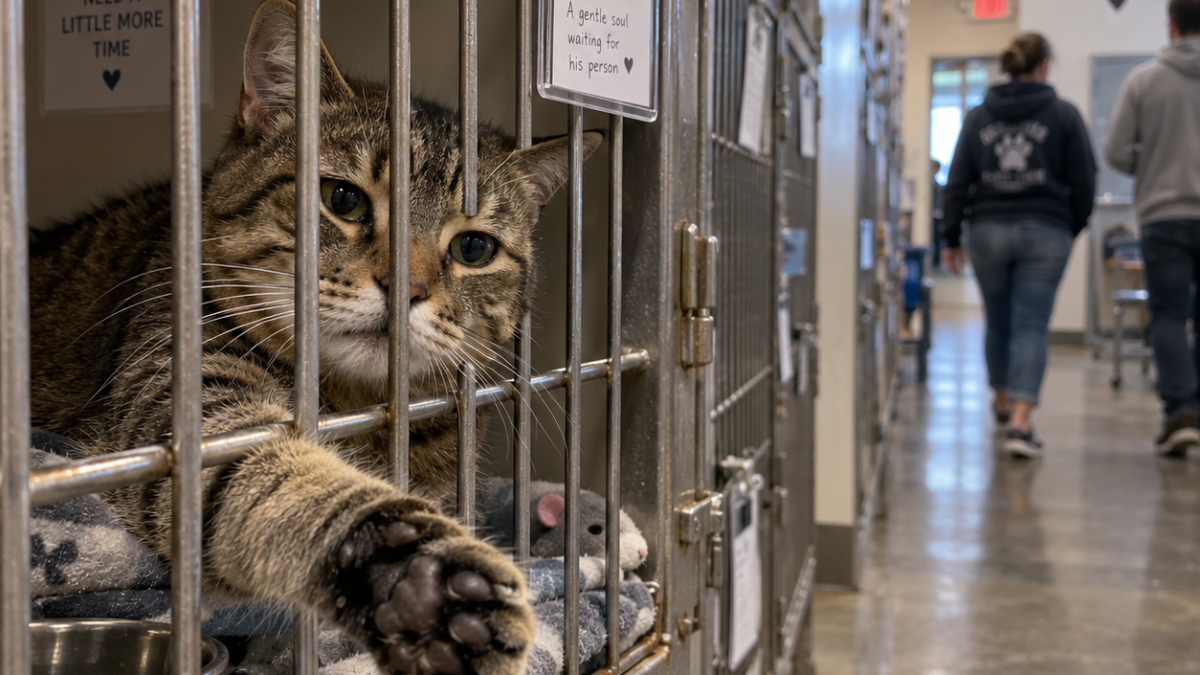
As they passed cage 14, Reach lifted one paw.
Not dramatically.
Not desperately.
He simply slid it between the bars.
Pads facing up.
Toes relaxed.
A small brown tabby paw suspended in the air, waiting.
The couple did not look down.
They passed him.
Reach kept his paw there for three seconds after they were gone.
Then five.
Then he slowly pulled it back and rested it on the folded towel beneath him.
Something inside me shifted.
I walked to his cage and crouched.
“Hello there.”
Reach looked at me.
He had a soft face, not the striking kind that made people stop from across the room, but the kind that became beautiful only after you had looked long enough to understand it.
Green-gold eyes.
White around his muzzle.
Dark stripes across his forehead like careful brushstrokes.
One ear with a tiny notch near the tip.
He lifted his paw again.
I placed my fingers against the bars.
He hooked his paw gently over them.
No claws.
No grabbing.
Just contact.
Like a handshake.
Like a question.
Like a prayer.
“Oh,” I whispered.
His eyes half-closed.
He held my fingers for nearly a minute.
That was Reach.
He did not demand love.
He offered it.
And somehow that made watching people ignore him even harder.
The staff had named him Reach because of the paw.
At first, everyone found it sweet.
“Look,” they’d say to visitors. “He reaches for you.”
Some people smiled.
Some took photos.
Some said, “That’s adorable.”
Then they adopted someone else.
Days became weeks.
Weeks became months.
Reach kept reaching.
He reached for children carrying stuffed animals.
He reached for teenagers taking selfies.
He reached for elderly couples who said they wanted a calm cat, then chose younger ones.
He reached for a man who stood in front of his cage for nearly five minutes talking about how much he loved tabbies, then left because his apartment charged a pet fee.
He reached for a woman who cried while petting him through the bars, then admitted she was “just looking.”
He reached for everyone.
Every time.
At first, I thought hope made him do it.
After two hundred days, I wondered if habit did.
After three hundred, I stopped trying to decide because either answer hurt.
Some animals change in shelters.
They withdraw.
They overgroom.
They stop eating.
They become frantic or numb.
Reach did none of those things.
That was almost worse.
He remained gentle.
He remained clean.
He ate his food, used his litter box, accepted chin scratches, purred when held, and returned to the front of his cage whenever footsteps entered the room.
Every person was possible.
Every shadow in the hallway might be the one.
That kind of hope can break a witness.
Around day one hundred and twenty, I started taking pictures.
I told myself it was for the website.
Good photos help adoptions.
Everyone knows that.
A clear face.
A sweet pose.
A little story.
But the first picture I took was not of his face.
It was of his paw.
Reach had stretched it through the bars toward a family walking away with a kitten carrier. In the background of the picture, the family was blurred, already turning the corner. In the foreground, his paw hung open.
Waiting.
I looked at the photo later that night at my kitchen table.
The house was quiet except for the refrigerator hum.
I zoomed in on his paw.
Tiny wrinkles in the pads.
One white toe.
Soft fur between the claws he never used.
I saved it in a folder on my phone.
I called the folder Cage 14.
The next Tuesday, I took another.
Same angle.
Same cage.
Same paw.
Different person walking past.
Then another the week after that.
Then another.
I did not plan anything.
I did not think, One day this will matter.
I was only trying to hold evidence of something that felt unbearable when seen one moment at a time.
A cat reached.
People walked by.
That was the whole story.
Except it happened again.
And again.
And again.
By the time Reach had been at the shelter for five hundred days, I had seventy-one photographs.
Seventy-one.
The same cage.
The same bars.
The same brown tabby paw.
The hallway changing only in small ways.
A woman’s red coat.
A child’s sneakers.
A man’s work boots.
A blurred stroller.
A volunteer’s purple scrubs.
A carrier leaving with another cat inside.
Seventy-one photos of a gesture unanswered.
I did not post them immediately.
I almost deleted them.
Something about placing his longing online felt exploitative, as if I were turning his loneliness into content. The internet can be cruel even when it is moved. People share sadness quickly, then scroll away faster than the animal can be adopted.
But that Tuesday, something happened.
A family came in just before closing.
Mother.
Father.
Two children.
The little girl wanted a kitten. The boy wanted “a big orange one.” The father wanted whatever would make the visit end before dinner. The mother looked tired but kind.
They walked the row.
Stopped at the kittens.
Stopped at the orange cat.
Stopped at a young black cat named Pepper who performed acrobatics against the bars like an unpaid circus act.
Then they reached cage 14.
Reach stood.
He stretched his paw through the bars.
The little girl saw him.
For one second, I thought this was it.
She stopped walking.
Her eyes widened.
“He’s holding his hand out.”
Reach kept his paw there.
The girl stepped closer.
Then her father called from the front of the room.
“Honey, come on. The kitten paperwork is ready.”
The girl looked toward him.
Then back at Reach.
“Can I pet him?”
“Not now,” the father said. “We already picked one.”
She hesitated.
Reach’s paw trembled slightly.
Not from fear.
From holding it there too long.
The girl whispered, “Bye, kitty.”
Then she left.
Reach kept his paw through the bars until the front door bell chimed.
After they were gone, he withdrew it slowly, curled into the back corner, and rested his chin on the towel.
He did not cry.
He did not scratch.
He did not make a sound.
I stood in the hallway holding a clean litter scoop and felt something inside me finally become too heavy to carry quietly.
That night, I made the grid.
Seventy-one photos.
It took me almost two hours because my eyes kept filling.
I arranged them in rows.
Same cage.
Same paw.
Same reaching.
Different people walking away.
When I finished, I stared at it until the repetition became almost unbearable.
One photograph was sad.
Seventy-one photographs were an accusation.
Not against one person.
Against all of us.
Against how easily we miss quiet hope when it is not placed at eye level.
I wrote the caption slowly.
This is Reach. He has been in cage 14 for 500 days. Every time someone walks past him, he stretches his paw through the bars. No claws. No grabbing. Just one paw, pads up, asking someone to stop. I have taken the same photo every Tuesday for 71 weeks. It looks like the same picture because nothing has changed. Please help us make sure I do not take photo number 100.
I posted it to the shelter’s page at 9:13 p.m.
Then I closed my laptop.
Made tea I did not drink.
And cried in my kitchen because a cat I had not been able to save from waiting still believed someone might come.
By morning, my phone would not stop buzzing.
At first, I thought something was wrong.
Technically, something was.
The post had been shared hundreds of times overnight.
Then thousands.
Local pages picked it up.
Then regional rescue groups.
Then cat accounts with names like Whisker Watch and Adopt Don’t Shop Daily.
People commented from states I had never visited.
I’m sobbing.
Someone please get Reach.
That paw.
I can’t handle this.
How is he still there?
I wish I lived closer.
I’ll pay his adoption fee.
I’ll sponsor his food.
Please update us.
By noon, the shelter phone was ringing constantly.
Our director, Marla, stood behind the front desk looking both overwhelmed and terrified.
“Pam,” she said, holding two ringing phones and staring at three new emails. “What did you do?”
“I posted pictures.”
“You broke the internet.”
“No, dear. Cats did that years ago.”
She did not laugh because the phone rang again.
For the first time in five hundred days, people came asking for Reach.
At first, I was thrilled.
Then I became afraid.
Viral attention is not the same as love.
People love a story.
A symbol.
A moment.
But Reach was not a symbol.
He was a six-year-old brown tabby who liked holding hands, got nervous around loud dogs, needed urinary health food, hated being picked up too quickly, and had spent nearly a year and a half learning that people left.
He did not need a fan.
He needed a person.
That afternoon, the cat room filled with visitors.
Too many.
Marla had to limit access.
Reach sat at the front of cage 14, blinking at the sudden crowd.
He reached for everyone.
That nearly undid me.
Even after five hundred days, even after being passed by thousands of times, he did not become selective with hope.
A woman from Portland drove two hours and cried when she saw him, but she had four large dogs at home with no cat history.
A college student wanted him desperately but lived in a dorm.
A family with three toddlers thought the viral cat would be “so fun for TikTok.”
No.
A man said he wanted to adopt him for his girlfriend’s birthday surprise.
Absolutely not.
One woman asked whether Reach would “keep doing the paw thing” for videos.
I walked away before my face said something my mouth should not.
By Friday, Marla closed applications temporarily.
“We need to screen carefully,” she said.
“Yes.”
“This cannot become a circus.”
“No.”
Reach slept through most of the afternoon with one paw resting outside the bars.
Not reaching.
Just resting there.
As if he had grown tired but did not want to miss his chance.
That was when I noticed an email sitting unread in the shelter inbox.
Subject line:
I think I know Reach’s first owner.
The message was from a woman named Claire Whitcomb.
My heart tightened at the last name.
She wrote:
My grandmother was Eleanor Whitcomb. She went into hospice nearly two years ago and passed away shortly after. I was living overseas when everything happened, and by the time I came home, her apartment had been cleared. I was told her cat had gone to a rescue, but no one could tell me which one. I have been searching on and off for over a year. I saw your post. The note you mentioned sounds like my grandmother’s handwriting. The cat’s name was not Reach. His name was Henry. He used to hold my grandmother’s hand every morning while she drank tea.
I read the email three times.
Then I called Marla.
Then I called the number Claire had included.
She answered on the second ring.
“Hello?”
“Is this Claire Whitcomb?”
“Yes.”
“My name is Pam. I volunteer at Franklin County Animal Rescue.”
Silence.
Then a breath.
“Is it him?”
I looked through the office window toward the cat room.
Reach was sitting at the front of cage 14.
His paw was between the bars.
“I think it might be.”
Claire made a sound.
Small.
Hopeful.
Terrified.
“I can come now.”
“Claire,” I said gently, “we’ll need to verify some things.”
“I have photos. Vet records. My grandmother’s lease listed him. I have videos of him holding her hand.” Her voice cracked. “I thought he was gone.”
My own voice softened.
“He’s here.”
She began crying.
“I didn’t know where to look.”
“I know.”
“No, I should have—”
“Come in,” I said. “Bring what you have.”
She arrived an hour later.
I watched her get out of a silver sedan and stand in the parking lot for several seconds with one hand on the car door, trying to gather herself.
She was in her early thirties, dark hair pulled back, face pale from emotion. She carried a folder under one arm and a small blue blanket pressed against her chest.
When she entered the lobby, she looked like someone walking into a place where the past might either forgive her or punish her.
Marla greeted her.
I stood nearby, holding Reach’s file.
Claire’s hands shook as she opened the folder.
Photographs spilled across the counter.
An elderly woman in a floral robe sitting by a window with a brown tabby paw resting in her palm.
The same cat curled beside a teacup.
The same cat as a younger adult, lying on a blue blanket.
The same green-gold eyes.
The same notch in one ear.
On the back of one photo, in shaky handwriting, were the words:
Henry holding my hand again. Best part of the morning.
Claire placed a printed veterinary record beside the photos.
Henry Whitcomb.
Brown tabby.
Neutered male.
Microchip number.
Marla checked the records.
The chip number matched.
Reach was Henry.
I turned away for a moment because I did not want Claire’s first memory of me to be an old woman crying over paperwork.
Marla’s voice softened.
“We believe this is your grandmother’s cat.”
Claire covered her mouth.
“Can I see him?”
I led her to the cat room.
The hallway felt different with her beside me.
Longer.
Quieter.
Every cage seemed to understand something was happening.
Kittens tumbled.
Young cats meowed.
An orange cat batted his toy against the bars.
Claire saw none of them.
We reached cage 14.
Reach was sitting in his usual place.
At the front.
Waiting.
When he saw us, he lifted his paw.
Pads up.
Claire stopped breathing.
“Oh my God.”
Reach stared at her.
His paw remained suspended between the bars.
Claire sank to her knees.
“Henry?”
The name entered the room like a key.
Reach froze.
His ears lifted.
His eyes widened.
He pulled his paw back.
For one horrifying second, I thought he did not remember.
Then he pressed his whole body against the front of the cage and let out a sound I had never heard from him before.
Not a meow.
Not a cry.
A broken, trembling trill.
Claire sobbed.
“Henry.”
He reached both paws through the bars this time.
Both.
Claire pressed her hands against them.
He hooked his paws around her fingers with such careful urgency that everyone in the room went silent.
“I’m sorry,” Claire cried. “I’m so sorry. I didn’t know where you were.”
Reach rubbed his face against the bars, trying to reach her.
I opened the cage door.
He stepped out slowly at first.
Then climbed directly into her lap.
Claire folded around him.
He pushed his face under her chin and began purring so loudly that I heard it over the kittens.
Marla stood behind me, crying openly.
One of the technicians whispered, “He remembered.”
Of course he did.
For five hundred days, he had been holding out the gesture he knew best.
The last language his first person had taught him.
Hold hands.
Stay gentle.
Someone will come.
Claire sat on the floor for nearly an hour.
She told us everything in pieces.
Her grandmother, Eleanor, had raised her after her mother died. Henry had belonged to both of them, technically, though Eleanor always said he had chosen her because she was slower and easier to supervise.
Every morning, Eleanor sat by the kitchen window with tea. Henry jumped onto the table, placed one paw in her palm, and stayed there while she read the newspaper.
When Eleanor entered hospice, Claire was in Ireland for work. Her aunt handled the apartment. There had been confusion, rushing, grief, family tension. Claire was told Henry had gone “to a rescue.”
No one knew which one.
Or no one took the time to find out.
By the time Claire came home, Eleanor had passed.
The apartment was empty.
Henry was gone.
“I searched online,” Claire said, stroking Reach’s back. “But I searched for Henry. Not Reach. I called places near Grandma’s apartment, but maybe he was transferred. I thought maybe he’d been adopted. Then I thought maybe he’d died, and I couldn’t make myself keep asking.”
Reach pressed his paw against her wrist.
She looked down and cried harder.
“He did this with her every day.”
“I know,” I said.
“He’s been doing it here?”
“Every day.”
“For how long?”
I hesitated.
“Five hundred days.”
Claire closed her eyes.
The guilt hit her visibly.
I touched her shoulder.
“You didn’t leave him here.”
“I didn’t find him.”
“You found him now.”
“That’s not the same.”
“No,” I said. “It isn’t.”
She looked at me.
I continued gently.
“But it matters more to him than the part you can’t change.”
Reach headbutted her chin as if agreeing.
The adoption was not immediate.
Even with proof of connection, the shelter had procedures. Home check. Medical review. Updated records. Microchip transfer. We moved quickly, but carefully.
Claire came every day.
Every single day.
The viral crowd faded after a while, as viral crowds do. The internet moved on to another heartbreak. But Claire kept coming.
Morning before work.
Evening after.
She brought the blue blanket from Eleanor’s apartment, the one in the photos. Reach knew it instantly. The first time she placed it in his cage, he stepped onto it, lowered his body, and kneaded the fabric like his paws were remembering years.
After three days, we stopped calling him Reach when Claire was there.
She called him Henry.
He answered.
I still thought of him as Reach sometimes.
Not because Henry was wrong.
Because Reach was who he had become while waiting.
Some names are homes.
Some names are survival.
He had both.
On the day Claire was approved to take him home, I took one last photograph.
I had promised myself I would stop when someone stopped.
So I stood in the cat room with my phone and watched Claire kneel in front of cage 14.
But this time, Reach was not behind the bars.
He sat in an open carrier lined with Eleanor’s blue blanket. Claire had placed her hand inside. His paw rested in her palm.
No bars.
No hallway.
No blurred stranger walking away.
Just a hand reaching back.
I took the photo.
Then I posted the update.
This is photo number 72. I promised I would stop when someone stopped. Today, someone did. Reach’s name was Henry before he came to us. His first owner, Eleanor, loved holding his paw every morning. Her granddaughter saw the post and found him after searching for over a year. He is going home with the family he remembered. For 500 days, he reached. Today, someone reached back.
The post spread even faster than the first.
But this time, I did not close the laptop and cry from helplessness.
I cried because the picture had changed.
The comments poured in.
I’m sobbing again but happy.
Photo 72 broke me.
He waited for her.
He never stopped believing.
Please frame this.
Claire sent us updates every week.
At first, Henry hid under her bed for two hours.
Then he came out when she made tea.
That was the detail that undid me.
Claire wrote:
I sat by the window with a mug, like Grandma used to. He jumped up, stared at me for a long time, then put his paw in my hand. I don’t think he was waiting for just anyone. I think he was waiting for someone who knew how to hold it.
Attached was a photo.
Henry on a kitchen table.
Sunlight on his brown tabby fur.
One paw resting in Claire’s palm.
A blue blanket on the chair beside them.
I printed it and taped it inside my volunteer locker.
Then, after a week, I printed the seventy-one-photo grid and the seventy-second photo beside it.
Marla framed them for the hallway.
Not to make visitors sad.
To make them look down.
The display sits near the entrance to the cat room now.
Above it are the words:
Sometimes the one waiting for you is at the end of the row.
Cage 14 did not stay empty long.
Shelters never have that luxury.
The next cat placed there was a nine-year-old black female named Myrtle with cloudy eyes and a bad attitude she had earned honestly. People passed her too, at first. Black cats are often overlooked. Older cats more so. Older black cats with medical notes might as well be invisible in some rooms.
But something had changed.
Visitors began walking all the way to the end.
The photo display forced them to.
Children tugged parents toward cage 14 and said, “That’s where Reach was.”
Some asked to meet Myrtle.
She hissed at most of them.
I respected that.
Hope does not have to be polite to be valid.
After three weeks, Myrtle was adopted by a retired schoolteacher who said, “I also have cloudy eyes and a bad attitude.”
Perfect match.
Then came Jasper, a twelve-year-old orange cat whose owner had died.
Adopted in two months.
Then Bean, a shy gray cat who hid under his towel.
Adopted by a young man who sat on the floor for forty minutes waiting for him to emerge.
Cage 14 became famous in a small, quiet way.
Not because every animal there was adopted quickly.
They weren’t.
But people stopped assuming the end of the row meant the end of possibility.
Claire visited three months later with Henry.
Not into the cat room. That would have been unfair to him and chaotic for everyone. She brought him in a soft carrier to the lobby for a short visit with staff.
He looked healthier.
Fuller.
His coat shone.
His eyes were brighter.
When I opened the carrier door in the private meet room, he stepped out, looked around, saw me, and reached one paw toward my hand.
I laughed and cried at once.
“Hello, sweetheart.”
He placed his paw in my palm.
No bars.
Claire smiled.
“He still does it every morning.”
“I hope he always does.”
“He does it when I cry too.”
I looked at her.
She glanced down.
“I cry less now. But sometimes missing Grandma catches me sideways.”
“That will happen.”
“Henry helps.”
“He had practice.”
She nodded.
“I think they saved each other, Grandma and him.”
“Animals often do.”
Claire hesitated.
“I used to feel guilty that I couldn’t say goodbye to her properly. I got back too late. She was already mostly asleep. I don’t know if she knew I was there.”
I placed my thumb gently over Henry’s paw.
“She knew you loved her.”
“You can’t know that.”
“No,” I admitted. “But I know she wrote that note.”
Claire’s eyes filled.
He likes holding hands. Please find him someone.
“She trusted someone would.”
“And he kept asking,” Claire whispered.
“Yes.”
Henry purred between us.
A bridge made of one small paw.
After Henry went home, I continued volunteering.
Tuesday.
Thursday.
Laundry.
Bowls.
Litter.
Photos.
Hands through bars.
Life did not become less sad because one cat found home. That is another truth rescue teaches you. A happy ending does not empty the building.
There is always another cage.
Another intake form.
Another animal confused by loss.
Another person at the desk crying because illness, eviction, death, money, or age has made love impossible to keep in the shape it once had.
But Reach changed how I carried it.
Before him, I sometimes thought hope was a fragile thing, something that needed constant proof to survive.
Reach taught me hope could be stubborn.
Maybe even unreasonable.
Five hundred days.
Seventy-one photos.
Thousands of footsteps.
No explanation.
No guarantee.
And still he reached.
That does not mean waiting is always rewarded.
I know better than that.
Some animals wait and do not get the ending they deserve. Some stories remain unfair no matter how beautifully we tell them. I will not lie about shelter work.
But I also know this.
If Reach had stopped reaching on day four hundred ninety-nine, Claire might have walked past the post without feeling the same pull. If I had stopped photographing on Tuesday seventy, photo seventy-one might never have existed. If one person had not shared the grid, Claire might never have seen it. If Eleanor had not written that note, we might never have understood what the paw meant.
Love survives in strange systems.
Notes.
Photographs.
Habits.
Microchips.
Old blankets.
A paw between bars.
A granddaughter scrolling at midnight, stopping because the gesture looks like childhood.
A volunteer too tired to watch quietly anymore.
I still have the original seventy-one photos on my phone.
I cannot delete them.
Sometimes, when I am having a hard day, I open the folder and scroll slowly.
Not because I want to feel sad.
Because I want to remember what repetition can reveal.
One ignored gesture can be explained away.
A busy day.
A distracted family.
A kitten chosen first.
Seventy-one ignored gestures become something else.
They become evidence.
They become witness.
They become a question we should all be brave enough to ask.
Who have I walked past because they were not loud enough to stop me?
Years from now, people may forget Reach’s viral post.
That is all right.
The internet forgets almost everything.
But at Franklin County Animal Rescue, his story remains in the hallway.
The grid.
The final photo.
The sentence above it.
Sometimes the one waiting for you is at the end of the row.
New volunteers ask about it.
I tell them.
I tell them about Mrs. Eleanor Whitcomb and the note in shaky handwriting.
I tell them about cage 14 and the lower row and the families who never looked down.
I tell them about Claire arriving with photographs and grief.
I tell them about the moment Henry heard his old name.
I tell them about photo number 72.
And then I tell them the most important part.
“Do not assume quiet means hopeless.”
One Tuesday morning, almost a year after Henry went home, I received a letter.
Handwritten.
Blue stationery.
Claire had found a box of her grandmother’s things in storage. Inside were old cards, recipes, medical papers, and a half-finished letter Eleanor had written but never mailed before hospice.
Claire sent me a copy.
The letter was addressed to whoever adopts Henry.
I read it in the shelter office with Marla beside me.
To the person who chooses my cat,
His name is Henry, though he will answer to almost anything if said kindly. He likes sunny windows, soft blankets, and people who sit still long enough for him to decide they are safe.
He likes to hold hands.
I know that may sound silly. Cats are not supposed to hold hands, but Henry does. Every morning while I have tea, he places his paw in my palm and stays there until I tell him my old bones are ready to start the day.
I am afraid he will not understand where I have gone.
I am more afraid he will think he was left because he did something wrong.
Please do not let him think that.
If he reaches for you, hold his paw.
It means he is trying.
It means he is asking whether you might stay.
I had to stop reading.
Marla finished aloud, voice shaking.
He has been my good boy through lonely years. I hope he can be someone’s good boy again.
Thank you for seeing him.
Eleanor
Thank you for seeing him.
I sat there for a long time after Marla left.
Outside the office, the shelter continued.
Phones rang.
Dogs barked.
A kitten knocked over a metal bowl.
Someone laughed.
Someone cried.
Somewhere in the cat room, an animal waited to be noticed.
I folded the letter carefully.
Then I went to the hallway and placed a copy beside the framed photos.
Visitors read it now.
Some cry.
Some walk into the cat room afterward and go straight to the end of the row.
That is enough.
Not everything.
But enough.
Henry is old now.
Older, anyway.
Claire says he has a little arthritis and complains when breakfast is late. He still sleeps on Eleanor’s blue blanket. He still sits by the window. He still holds Claire’s hand during tea.
Every Christmas, Claire sends a card.
The most recent photo showed Henry wearing a red bow he clearly hated. His paw rested in Claire’s palm. Behind him, on the wall, was a framed picture of Eleanor.
Three generations in one image.
A woman gone.
A granddaughter returned.
A cat who kept reaching until time bent back toward him.
I keep that card on my refrigerator.
My house is still quiet sometimes.
Daniel is still gone.
Grief does not vanish because you help someone else. Anyone who says that has not understood grief. It changes rooms. It changes shape. It becomes less like drowning and more like weather.
Some nights are still hard.
But now, when the silence gets too wide, I think about Reach.
I think about his paw between the bars.
I think about how many times he offered love without evidence it would be returned.
And I think maybe that is not foolish.
Maybe that is the bravest thing any living creature does.
To stay gentle after being overlooked.
To ask again after silence.
To keep some part of yourself extended toward the world, even when the world keeps walking past.
People say Reach was lucky the post went viral.
Maybe.
But I think we were the lucky ones.
Lucky he did not stop.
Lucky Eleanor taught him that hands could mean safety.
Lucky Claire recognized the gesture.
Lucky photo number 72 exists.
Because somewhere, every one of us has a cage 14.
A place where we wait.
A place where we wonder if anyone will look down.
A place where we keep one small hope extended through the bars because pulling it back forever would hurt worse than being ignored.
Reach never knew he became famous.
He never knew seventy-one photographs broke thousands of hearts.
He never knew people across the country cried over his paw, donated food in his name, or began walking to the end of shelter rows because of him.
He only knew this.
For a long time, people passed.
Then one day, someone stopped.
Someone said his old name.
Someone opened the door.
Someone reached back.
And after five hundred days in cage 14, the cat who liked holding hands finally went home with his paw in someone’s palm.








