The Boy Wouldn’t Survive Another Crash—Then His K9 Gave Me One Warning No Doctor Wanted to Trust
PART3:
His face went pale beneath his mask.
Ethan’s hand stayed on the rail.
At the end of the hall, the elevator doors opened.
“Are you telling me the lab is wrong?” he asked.
“No,” I said. “I’m telling you we haven’t earned the right to trust it.”
That was the sentence that changed the room.
Not because it was dramatic.
Because it was specific.
Ethan looked from me to Owen, then toward the open elevator where the transport tech was holding the doors with one shoulder.
“What do you want?”
“One clean drop of blood.”
“Mercer—”
“One clean drop,” I said. “Then we move.”
His eyes held mine for half a second.
In that half second, I felt all three weeks of being new.
All three weeks of proving I could keep up.
All three weeks of being watched by people who had worked together long enough to communicate through eyebrows and shoulder movements while I was still memorizing where Radiology kept spare pediatric collars.
I also felt something older.
A desert night.
A military clinic half a world away.
A Belgian Malinois refusing to leave a Marine’s cot while two officers argued he was only anxious.
A medic muttering, “Dogs don’t diagnose,” right before a blood pressure reading proved the dog had noticed deterioration before any of us did.
I had not been a handler.
I had not been anything heroic.
But I had learned one thing around working dogs and wounded people.
A dog can change the question.
He never owns the answer.
Ethan nodded once.
“Do it while they switch him to transport monitoring.”
I was already pulling on fresh gloves.
I took Owen’s left hand as the tech disconnected the wall leads. His skin was cold. Too cold. Ranger remained several feet behind us with the security officer, leash loose now, eyes fixed on the boy.
I cleaned one fingertip.
The lancet clicked.
Blood touched the strip.
Five seconds.
The elevator doors started to close.
The tech caught them with his shoulder.
The meter beeped.
54.
Everything inside me dropped.
“Fresh site,” Ethan said immediately.
No disbelief.
No argument.
That was when I first respected him.
I grabbed a new lancet, new strip, new finger.
Owen barely reacted.
The second meter counted down.
52.
Ethan looked at the original lab result glowing on the screen.
248.
“That’s not noise,” he said.
“No.”
“But two bedside readings still don’t tell me which number is wrong.”
“Agreed.”
I reached for a peripheral blood draw kit.
“So we get one sample that never touched that line.”
Ethan glanced toward the elevator.
“While we move.”
“While we move.”
I handed the kit to Miles.
“Opposite arm. Clean site. Label collection site and time.”
Miles moved fast now.
His hands shook once, but he recovered.
Ethan noticed.
Said nothing.
That mattered too.
A good trauma room does not punish nerves in the middle of a save. It corrects mistakes and keeps moving.
Behind us, Ranger stood.
Paw down.
Stare.
Reset.
I saw it again.
This time I said nothing.
The dog had given me a reason to question the first number.
Now the evidence had to survive without him.
Miles labeled the tube.
Ethan took it from him and handed it back immediately.
“Straight to the lab. Call me with the result.”
“I’ll miss CT.”
“You’re not needed in CT. Go.”
Miles ran.
Owen’s bed rolled into the elevator.
I stepped in beside the right rail. Ethan entered at the foot and hit the radiology floor. The doors closed, leaving Ranger and the security officer behind.
For a second, Owen’s hand moved weakly against the sheet.
Then stilled.
“We still image,” Ethan said.
“Absolutely.”
“A glucose in the fifties does not explain unequal pupils after a rollover.”
“I know.”
He looked at me.
“You just stopped a trauma transport and now you’re agreeing with me.”
I checked Owen’s oxygen tubing because my hands needed something to do.
“I wasn’t trying to stop the CT.”
The elevator began rising.
“I was trying to stop one contaminated number from closing another possibility.”
Ethan’s face changed slightly.
Not softer.
More focused.
“If the clean lab confirms he’s low, what changes?”
“Not the trauma workup.”
“Then what?”
“It means we have two problems until one proves otherwise.”
For the first time that night, he nodded like I had given the right kind of answer.
Not certainty.
A boundary.
“And Ranger?” he asked.
I glanced at the elevator doors even though the dog was gone from sight.
“He got us to ask the question. He doesn’t get to answer it.”
The elevator slowed.
Ethan reached for the bed rail.
“Good.”
Radiology swallowed us in cold light.
CT rooms always feel too clean for the terror they hold. Everything white, silver, humming. The kind of place where fear has to stand behind lines on the floor while machines look inside bodies and tell truths people are not ready to hear.
We pushed Owen through the doors.
The techs moved fast.
Transfer board.
Monitor.
Oxygen.
Collar check.
Ethan stayed at the head, watching Owen’s face as if he could will consciousness back into the boy by refusing to look away.
Just before I followed, he stopped me.
“Mercer.”
I turned.
“If that peripheral sample comes back low, I want the EMS glucose history, what they gave him, and when that insulin pump came off.”
“Insulin pump?”
He looked toward the paramedic by the CT control desk.
“EMS said he had one damaged in the crash. Find out more.”
“I’ll reconstruct it.”
“Facts first.”
I nodded.
“You’ll get a timeline.”
He disappeared into CT.
He was not asking me to prove I had been right anymore.
He was giving me the next uncertainty to protect from becoming an assumption.
I started with the paramedic’s run sheet, not his memory.
That was one of the first things trauma taught me and military medicine had carved deeper: memory in a crisis is a witness, not a record. It means well. It lies anyway.
The lead paramedic was named Dale Morris. Forty-something, rainwater still darkening his collar, face gray with the kind of adrenaline debt that comes after extricating a child from twisted metal.
“When you reached Owen, was he talking?” I asked.
“Yeah. Confused, but talking.”
“Pump still attached?”
“Yes.”
“First glucose?”
He scrolled his tablet.
“Meter errored during extrication. Rain, blood, movement. We couldn’t get a reliable reading.”
“Then he got worse?”
“Less responsive. Medical control approved dextrose for altered mental status with diabetes history and no reliable glucose.”
“When did you start D10?”
“8:20.”
“And the insulin pump came off when?”
He frowned.
I waited.
Do not fill silence for a witness.
“After the dextrose started,” he said. “Maybe five minutes. We removed it when we saw the housing was cracked.”
That was the first detail I underlined.
Not because it proved anything.
Because it created a question we had not known to ask.
“Was the screen working?”
“Partly.”
“Any alarm?”
He thought about it.
“There was beeping during extrication. I can’t swear it came from the pump.”
I wrote: Possible alarm, source unknown.
Beyond the CT doors, the scanner hummed.
At the far end of the corridor, security arrived with Ranger.
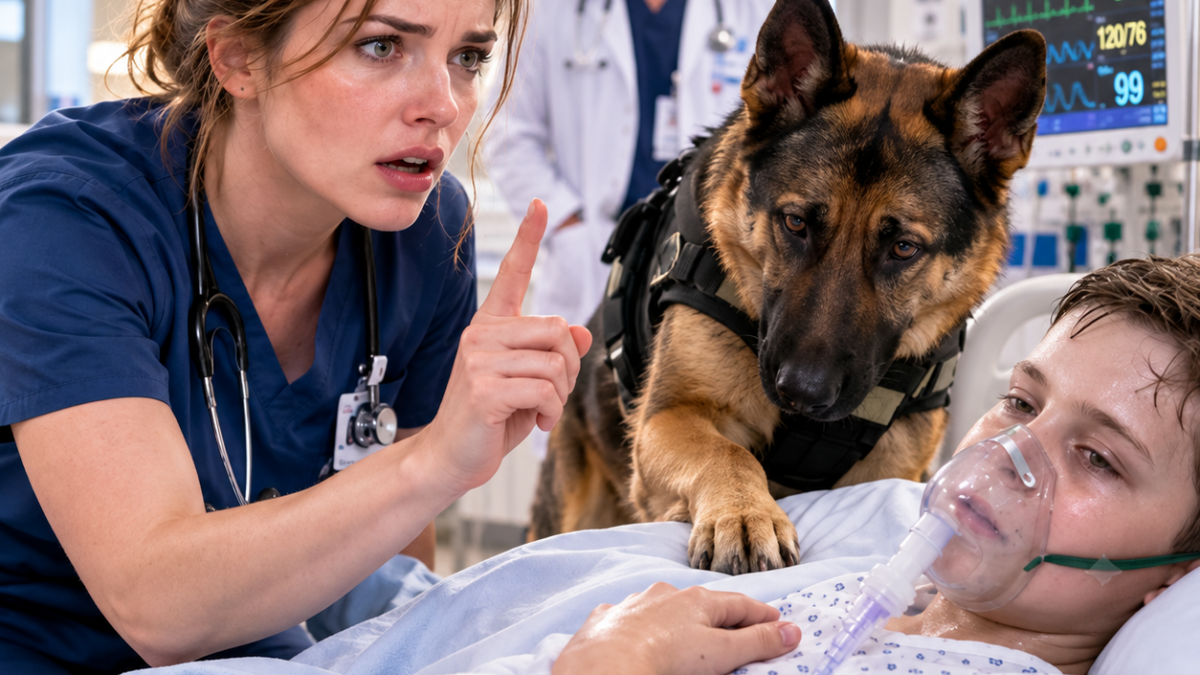
The German Shepherd stopped the second he saw Owen’s empty transport bed outside the CT room. His body shifted forward, then froze. His leash was loose, but all of him leaned toward the door where Owen had vanished.
I noticed.
Then I looked back at the flow sheet.
I could not turn every movement into evidence just because I wanted the dog to be right.
My phone rang.
Miles.
He did not waste time.
“Clean serum glucose is 49. Peripheral draw. Collection site documented.”
I looked at the bedside readings already on my sheet.
54.
55.
Now 49.
“Good,” I said. “Call it to Ethan too.”
“Already did.”
I ended the call.
Dale stared at me.
“So the 248 was wrong.”
“Contaminated is most likely.”
I did not draw a line through the original result. I circled it, marked the likely contamination source, and kept it on the timeline. Bad data does not disappear just because you identify it. It stays on the page so nobody repeats the mistake by forgetting where it came from.
“But fixing that,” I said, “doesn’t explain why he’s still dropping.”
The CT doors opened.
Ethan stepped into the corridor, pulling off gloves.
“Preliminary scan shows swelling but no large bleed explaining this degree of decline,” he said. “Radiology is still reviewing.”
I handed him the new result.
“Clean peripheral glucose 49.”
His eyes moved over my timeline.
“So the first lab is out as a reliable glucose.”
“Yes. EMS reached Owen conscious but confused. They couldn’t get a reliable glucose during extrication, started D10 at 8:20, and the damaged insulin pump stayed attached for roughly five minutes after that.”
Ethan’s eyes stopped on the underlined line.
“Was it delivering?”
“Unknown.”
“Did it alarm?”
“Maybe. EMS heard beeping but can’t confirm source.”
He looked at Dale.
“Where’s the pump?”
“In our equipment bag downstairs.”
Ethan turned back to me.
“Could it have delivered insulin during that window?”
The room wanted an answer.
I could feel it.
Dale wanted absolution.
Miles, wherever he was, probably wanted his contaminated draw to become a side note instead of part of a chain.
Ethan wanted a path.
I wanted Ranger to be proven right because I had risked time on him and because the dog was still standing ten feet away, watching CT doors like loyalty could become x-ray vision if he held still enough.
But wanting is not evidence.
“It could have,” I said. “I don’t know that it did.”
Ethan held my gaze.
Then nodded.
“Good. Don’t turn possibility into fact.”
“I need the pump.”
“Get it.”
He handed the timeline back to me.
“I’ll stay on the neurologic workup. You own the glucose history and whatever we can actually verify from that device. Information, not insulin decisions.”
“Correct.”
Someone called Ethan from inside CT.
He turned, then stopped.
“Mercer.”
I looked up.
“If you find something that changes the question, don’t wait for me to ask.”
“I won’t.”
He disappeared through the doors.
Dale radioed for the pump.
Ranger lowered himself beside the security officer, eyes fixed on the room where Owen had vanished.
I did not call him over.
Minutes earlier, I had stopped a bed because nobody noticed a contaminated number. Now Ethan was not trusting me because I had been right. He was trusting me not to claim more than I knew.
That distinction mattered.
The insulin pump came back in a clear property bag.
Its screen was cracked under a layer of road dust. One corner of the case had split. A smear of dried blood marked the clip.
Dale set it on the counter outside CT.
“Want me to see if the history still opens?”
His thumb moved toward the controls.
“Don’t touch it yet.”
He stopped.
I turned the bag under the light without opening it. Part of the display still glowed behind the crack. Numbers appeared in broken fragments, unreadable where the glass had spiderwebbed.
Ethan emerged again.
“Radiology agrees there’s swelling, no large bleed. What do you have?”
“Clean glucose 49. Pump stayed on Owen roughly five minutes after D10 started. Damaged during crash. EMS heard an alarm, source unconfirmed. We have the device, but I can’t tell whether it delivered insulin from this screen.”
“Can you pull the history?”
“Someone who knows the device can.”
I slid the bag toward the center of the counter.
“I can preserve the information. I’m not going to interpret a damaged insulin pump outside my role.”
Ethan looked at me.
I had caught the contaminated sample. Reconstructed the EMS timeline. Found a plausible second problem. It would have been easy now to reward that success by reaching farther, to let confidence turn into overreach because everyone in the corridor was watching and a child’s life was still hanging in the space between numbers.
I did not.
“I’ll own what I can verify,” I said. “I’m not owning an insulin decision.”
Ethan nodded.
“Fair.”
He pointed to Dale.
“Get pharmacy or endocrine on the phone.”
The security officer approached before Ethan could turn away.
Ranger walked beside him, quiet and controlled.
The officer held out a laminated card.
“Found this tucked in his harness pocket.”
I took it.
Owen Parker.
Type 1 Diabetes.
Emergency contact information.
Below that were two trained responses.
Low glucose: paw indication after scent check.
High glucose: nose target response.
I read the card once.
Then again.
“Put this with Owen’s chart,” Ethan said.
Through the glass, Owen was being transferred back onto his bed.
Ranger saw him.
His body changed before the leash did.
Weight forward.
Eyes locked on Owen.
One paw lifted slowly from the tile.
Ethan noticed.
“That’s the low response?”
“Part of the pattern on the card.”
“Can we use him?”
I looked at Ranger instead of answering.
The dog lowered his paw.
Reset.
Then raised it again.
Nobody had spoken to him.
Nobody had pointed toward Owen.
The security officer looked between us.
“Should I bring him closer?”
“No.”
My answer came immediately.
Ethan turned to me.
“Why not?”
“Because he’s giving us something on his own.”
“Isn’t that what we want?”
“Only if we don’t contaminate it.”
His expression tightened.
“Meaning?”
I glanced at the damaged pump on the counter.
“We already have one piece of evidence we can’t interpret cleanly. I don’t want to create another by cueing Ranger before we know exactly what question we’re asking him.”
The phone on the counter rang.
Dale answered, listened, then held it toward me.
“Pharmacy.”
We put the call on speaker.
With the pharmacist guiding, Dale accessed the pump history without changing settings. Most recent entries were readable. One delivery entry near the crash was not. The crack crossed the amount.
“Can you recover it from the pump?” I asked.
“Not reliably from that display,” the pharmacist said. “The paired device may have a complete record.”
Dale checked the property list.
“We don’t have his phone.”
I wrote a single line on the timeline.
Final delivery amount unknown.
That was enough.
We did not need the pump to become a mystery we worshipped. It had given us a possibility. Not proof.
Another nurse approached with a glucometer.
“Fresh finger stick. Clean site.”
51.
Ethan looked at the result.
Then at the damaged pump.
“So he’s still low, and the device gives us no clean answer.”
“Correct.”
His eyes shifted to Ranger, who was still watching Owen through the glass.
Paw down.
Hold.
Reset.
Ethan looked back at me.
“And you still don’t want to test him.”
“Not yet.”
“Even though he may be telling us something useful.”
“Especially then.”
For a moment, nobody moved.
I could have brought Ranger to Owen and tried to turn his behavior into proof. I could have used the dog to strengthen a theory I had already helped uncover. I could have let everyone in that corridor feel better because a loyal animal gave them a story with a clean emotional center.
But medicine is not saved by emotion alone.
Neither are children.
“Keep Ranger close,” I told the security officer. “Loose leash. Nobody gives him a command.”
Ethan studied me for one second.
Then turned to security.
“You heard her. No commands.”
The officer relaxed his grip.
Ranger remained where he was, watching Owen without making a sound.
I returned the alert card to the chart.
The broken pump had offered a possibility we could not prove.
Ranger was offering something different.
My next job was not to make him useful.
It was to make sure that when we finally used him, we would know what his answer actually meant.
That boundary became the center of the next twelve minutes.
It sounds absurd to say twelve minutes can contain a lifetime, but anyone who has worked in trauma knows time changes shape around a child in danger. Seconds stretch when a number falls. Minutes collapse when an elevator opens. A doctor’s decision can hang in the air long enough to feel like weather.
Owen came back from CT paler than before, oxygen mask still fogging, collar still locked, lashes dark against his cheeks.
Ranger held his position as Owen’s bed passed.
No barking.
No pulling.
Just eyes on the boy and one paw resting against the tile.
The security officer looked at me.
“Still no command?”
“Still no command.”
Owen passed them.
Ranger lowered his paw, followed two steps, then stopped and raised it again.
Ethan saw the movement.
“That matches the card.”
“The low pattern, yes. Not the full check. Not until we ask for it.”
The bed stopped near the elevators as the team adjusted Owen’s oxygen mask and prepared for transfer toward pediatric ICU.
Ethan looked at the latest glucose reading.
51.
“Could Ranger tell us if he’s dropping?”
“Not as a number,” I said. “He can give us a trained response. That’s all.”
“Then why not use it now?”
“Because now you’re ready to believe him.”
Ethan’s eyes narrowed slightly.
“And that’s dangerous?”
“It can be.”
I handed him the laminated card.
“Ignore a trained signal because it comes from a dog and you can miss useful information. Trust it because you want certainty and you can make a different mistake.”
He studied me.
“You’ve worked with trained dogs before.”
I watched Ranger reset beside the officer.
“Before civilian nursing, I worked around military medical teams that used working dogs.”
“You were a handler?”
“No.”
I left it there.
No unit.
No story.
No desert.
No Marine on a cot.
No dog that stopped eating for three days after his handler died despite everyone saying he was “just a dog” and would adjust with routine.
Nothing about the years before that hospital changed what Owen needed now.
“What did they teach you?” Ethan asked.
I looked at Ranger.
“The dog can change the question. He never owns the answer.”
Ethan handed back the card.
“So what question would make him useful here?”
I looked at Owen.
“We already know Owen is low. Asking Ranger to prove that tells us nothing.”
“Then what are we waiting for?”
“A mismatch.”
“Between what?”
“Between the number we have and what Owen does next.”
I checked the clock.
“If he stays stable, we follow the plan and recheck on schedule. If his condition changes before then, Ranger’s trained response could give you another reason to verify sooner.”
“And if he alerts, fresh glucose.”
“We treat the measurement, not the dog.”
“If he doesn’t?”
“One command means one command. We don’t repeat it until he gives us the answer we want.”
Ethan nodded.
That was enough.
He turned to the bedside nurse.
“Continue the current plan. Next glucose stays on schedule unless something changes.”
Ranger raised his paw again.
The security officer instinctively shortened the leash.
I saw it.
“Keep it loose.”
He relaxed his hand immediately.
“Sorry.”
“You’re fine. Just don’t interpret for him.”
Ethan watched that correction, then looked at me.
“When the time comes, you control the conditions and the cue. I decide what we do with the information.”
“Yes.”
Owen made a faint sound under the mask.
Ethan stepped to the bed.
“Owen.”
The boy’s eyelids opened slowly.
For several seconds, his eyes seemed unable to find the voice calling him.
Then his gaze settled on Ethan.
“Can you tell me your name?”
A pause.
“Owen.”
Soft.
Correct.
Ethan checked his pupils.
“Good. Stay with me.”
Owen’s eyes closed almost immediately.
Ethan looked at the monitor.
No sudden change.
Then at the clock.
The next glucose check was still more than ten minutes away.
“Owen.”
This time the boy opened his eyes only halfway before drifting.
Ethan did not call for another glucose yet.
He looked at me instead.
I looked at Ranger.
The dog had gone completely still.
No paw now.
No movement.
Just fixed attention.
The boundary we had spent the last minutes defining was no longer theoretical.
Now we had to decide when uncertainty was enough to use it.
Ethan called again.
“Owen, eyes open.”
The boy obeyed after a pause, then lost focus almost immediately.
His hand moved weakly across the sheet, fingers curling around nothing.
Ethan held two fingers in Owen’s palm.
“Can you squeeze my hand?”
Owen squeezed.
Weak.
Delayed.
Then released.
Heart rate elevated but steady.
Blood pressure unchanged.
Nothing had suddenly collapsed.
That was what made the change harder to read.
Head injury could do that.
Exhaustion could do that.
Falling glucose could do it too.
I checked the clock.
Eleven minutes until the scheduled recheck.
Last clean reading: 51.
Ethan looked at me.
“There’s the mismatch.”
I nodded.
Ranger stood ten feet away, completely still.
I did not point to him.
“Do you want to check glucose early?” I asked.
Ethan looked at the clock, then at Owen.
“I want to know whether we have enough reason to break the interval.”
That was different from refusing the test.
He was asking the question we had defined before the pressure arrived.
I picked up Ranger’s laminated card and placed it beside a fresh glucometer.
“Then we use him once.”
Ethan’s eyes moved to Ranger.
“One command.”
“One command. No repetition. If he gives the trained low response, you decide whether that justifies an immediate clean check. If he doesn’t, we don’t keep asking until he tells us what we want to hear.”
“Agreed.”
I turned to the security officer.
“Bring him to the doorway. Loose leash. Don’t point at Owen. Don’t talk to Ranger.”
The officer moved forward.
Ranger entered the bay, nails clicking softly against the tile.
I raised one hand.
He stopped several feet from the bed.
I checked the space around Owen.
No open glucose gel near his face or hands.
Dextrose tubing secured away from the side Ranger would approach.
Rolling stand moved.
Bed rail accessible.
Resident ready with fresh meter, fresh strip, fresh lancet.
“Nobody touches him once he starts,” I said. “No encouragement. No second cue.”
Ethan motioned to the resident.
“Fresh meter ready.”
Miles set supplies beside the bed.
I looked at Ethan.
“If Ranger alerts, the dog gives you a reason to measure. The blood gives you the fact.”
“And I own what we do with it,” Ethan said.
“Yes.”
Nothing else needed explaining.
Ethan returned his attention to Owen.
“Owen.”
The boy opened his eyes slower again.
“Stay with me.”
Owen tried.
His gaze held for two seconds, then slipped away.
Ethan checked the clock.
Ten minutes remained.
He looked once at the glucometer, then at Ranger.
“If he gives the trained low alert, I’m ordering the early check.”
I nodded.
The decision was made before the dog moved.
That mattered.
Ranger would not be asked to diagnose Owen. He would be asked one controlled question, and Ethan had already defined what he would do with the answer.
I crouched beside Ranger without touching his harness.
The security officer loosened the leash until it hung in a shallow curve.
The room became quiet enough for me to hear Ranger breathing.
His ears turned toward me.
I waited one beat.
Ethan gave a single nod.
I looked at Ranger.
“Check.”
One word.
Once.
The dog moved immediately.
The security officer let the leash run loose through his hand without releasing it. Ranger crossed the cleared space to Owen’s bed, stopped beside the rail, and lifted his muzzle toward the boy’s face.
No one spoke.
I stayed where I was.
No pointing.
No second cue.
Ranger drew two short breaths near Owen’s oxygen mask, shifted closer to the boy’s shoulder, then returned to the same position.
His right paw rose.
Pressed against the lower edge of the mattress.
And held there.
I did not reach for the glucometer.
I looked at Ethan.
The choice was his now.
Ethan glanced at the alert card beside the meter, then at Ranger’s sustained paw.
“Immediate glucose. Fresh site.”
The resident inserted the waiting strip.
I was already at Owen’s left hand.
I cleaned a fingertip we had not used.
Lanced.
Collected.
The meter began its countdown.
Eleven minutes had disappeared from the schedule because Ethan had acted on information I had protected long enough to make useful.
The meter beeped.
31.
For half a second, no one breathed.
Ethan stepped closer.
“Repeat it.”
New strip.
New finger.
New sample.
Ranger remained beside the bed, paw against the mattress.
The second meter counted down.
32.
Ethan’s focus left the dog completely.
“Confirmed severe hypoglycemia. Dextrose now, per protocol.”
The resident reached for the ordered medication.
I moved aside.
I had done exactly what I had agreed to do and no more.
Ranger had justified checking early.
Clean blood had given the fact.
Ethan made the treatment decision.
Dextrose entered through the verified line.
I watched Owen instead of Ranger.
His heart rate remained elevated for several seconds.
Then began to ease.
Ethan leaned over him.
“Owen, open your eyes.”
Nothing.
“Come on, buddy. Owen.”
The boy’s brow tightened.
His fingers curled against the sheet.
Then his eyelids opened a fraction.
Ethan stayed close.
“That’s it. Look at me.”
Owen’s gaze wandered, unfocused first, then settled briefly on Ethan’s face.
Ranger lowered his paw.
He sat beside the bed without being told.
I checked the clock.
“We recheck on protocol timing from treatment.”
“Yes,” Ethan said.
He turned to Miles.
“Document the 31 and 32 as clean bedside readings. Document the K9 response separately as the reason we checked ahead of schedule.”
Miles started typing.
Ethan pointed toward the original plan.
“And note we did not treat from the dog’s alert. We verified first.”
“Got it.”
The security officer shortened the leash slightly.
“Should I take Ranger back out?”
Ethan looked at the space beside Owen’s bed.
Then he moved a stool out of the dog’s path himself.
“No. Leave him with Owen as long as he stays controlled and doesn’t interfere with care.”
The officer relaxed the leash again.
Minutes earlier, Ethan had needed a defined reason before he would interrupt the glucose schedule.
Now he had one.
And he preserved the same boundary after it worked.
I did not have to remind him.
Owen’s eyes opened again.
This time, they moved past Ethan toward the side of the bed.
His lips shifted beneath the oxygen mask.
I leaned close enough to hear him.
“Ranger.”
The dog’s ears lifted.
Owen’s hand moved weakly across the sheet.
I guided nothing.
Ethan stepped back from the rail and gave the boy space.
Ranger rested his chin beside Owen’s hand.
I felt the whole room change.
Not relax.
We were not done.
The CT findings still mattered. Swelling still mattered. Diabetes still mattered. The damaged pump still mattered. Pediatric ICU still waited upstairs, and Owen’s parents had not even reached the hospital yet because they had been in a second ambulance after the rollover.
But the room no longer saw Ranger as a problem in the doorway.
He had become what he always should have been.
Part of Owen’s medical reality.
Not a magic answer.
Not a mascot.
Not an inconvenience.
A trained piece of information with fur, discipline, and a boy’s life tied to his harness.
I prepared the next scheduled meter strip.
Ethan looked at the IV.
“Peripheral from here forward. No draws through an active dextrose line.”
Miles entered the instruction without asking why.
I returned the alert card to Owen’s chart.
One command had moved one measurement eleven minutes earlier.
That measurement had changed what Ethan did next.
Now the room no longer needed Ranger to be right again.
When the next glucose check came due, I reached for the meter.
Ethan glanced at the IV.
“Peripheral.”
Miles was already opening a fresh lancet.
“Fresh site.”
I took the sample.
Ranger lifted his head but stayed down.
The meter beeped.
73.
Ethan did not look relieved yet.
He leaned toward Owen.
“Tell me your last name.”
The boy swallowed.
“Parker.”
“Where are you?”
Owen blinked slowly at the ceiling.
“Hospital.”
Ethan checked his pupils.
“Good.”
Owen’s hand found the edge of Ranger’s harness again.
This time, no one asked the dog to confirm the number.
Ranger had already done his part.
The damaged pump went to endocrine.
The glucose trend stabilized.
The neurologic exam stayed concerning but no longer free-falling.
When the pediatric ICU transport nurse arrived, she stopped at the sight of Ranger beside the bed.
“I’ll have security take him downstairs before we move.”
“Check PICU policy first,” Ethan said.
The nurse paused.
He handed her Ranger’s laminated card.
“He’s a documented diabetic alert service dog. If he can stay with Owen without interfering with care, don’t separate them for convenience.”
I said nothing.
The nurse read the card, made the call, and returned less than a minute later.
“He can go with him.”
She looked at the tubing, then Ranger.
“We’ll keep him on the left side away from the lines.”
“Good,” Ethan said.
She repositioned the transport bed herself, clearing a path for Ranger. The security officer loosened the leash instead of pulling the dog away. Owen’s hand slipped from the harness when the side rail came up, and his eyes opened.
“Ranger?”
“He’s coming with you,” the transport nurse said.
Owen looked toward the dog until Ranger stepped alongside the bed.
Then he settled back against the pillow.
I watched the exchange without stepping in.
At the beginning of the night, I had needed five seconds just to keep Ranger from being dragged away.
Now a nurse who had not been in the trauma bay for any of it was arranging transport around him.
Miles approached Ethan.
“How do you want the K9 alert documented?”
Ethan answered without looking to me first.
“Record the trained response and the time separately. The glucose readings are the medical confirmation.”
I glanced at him.
He had kept the distinction.
No reminder needed.
The elevator arrived.
I walked beside Owen’s right rail. Ranger moved along the left with security, his pace matching the bed. At the elevator, the transport nurse stopped long enough to separate the leash from the IV tubing, then waved them forward.
Owen’s fingers reached through the rail until they found the edge of Ranger’s harness again.
I watched his hand settle there.
The crisis had needed me to notice what everyone else had missed.
What came after required something quieter.
The right people carrying the right responsibilities.
Nobody needed me to defend the dog’s place beside the boy anymore.
By the time I finished the PICU handoff, Owen was awake enough to complain about the blood pressure cuff.
“Too tight,” he whispered.
The receiving nurse checked it without removing it.
“I know, sweetheart. I need one more reading, then I’ll give your arm a break.”
Owen accepted that and turned his head toward Ranger.
The dog lay beside the bed, harness resting against the floor, close enough for Owen’s fingertips to reach one strap.
I stood at the workstation with the PICU nurse and finished the last line of the glucose timeline.
“First hospital glucose came from the line receiving dextrose,” I said. “Everything after that is marked by collection site. The 31 and 32 were clean bedside checks. Treatment followed confirmation.”
The nurse followed the timestamps.
“And the early check was triggered by Ranger’s alert.”
“Yes. His behavior is documented separately. It justified checking early. The glucose determined treatment.”
She nodded.
“Understood.”
She entered the next scheduled check without asking me to explain the distinction again.
Ethan arrived with the neurologic handoff and stopped beside the workstation.
“You finished?”
“Almost.”
He waited while I completed the nursing report.
He did not interrupt.
He did not take over.
I handed the final sheet to the PICU nurse.
“Pump follow-up belongs with endocrine. Glucose trending is here. Ranger’s service documentation is scanned. CT findings are with Dr. Cole.”
“I’ve got it.”
I released the paper.
“Then that’s everything I own.”
Ethan stepped forward only after I moved away.
He gave the receiving physician the CT findings and current neurologic exam. When the physician reached the glucose orders, Ethan said, “Clean peripheral samples. Don’t draw through an active dextrose line.”
The PICU nurse was already placing a reminder beside the collection schedule.
Ethan nodded.
No discussion followed.
Owen shifted beneath the blanket.
“Nurse Hannah?”
I walked to him.
“Yeah, Owen?”
He looked down at Ranger.
“Is he in trouble?”
“Ranger?”
Owen nodded weakly.
“For coming in here.”
I glanced at the German Shepherd stretched comfortably beside the bed.
“No,” I said. “He’s not in trouble.”
Owen rubbed one finger against the harness strap.
“He hates hospitals.”
“He’s doing a pretty good impression of someone who belongs.”
Owen gave the smallest smile.
It was not much.
But after watching him drift toward a place no child should have to approach, that tiny smile felt like sunrise.
I straightened the pulse ox cable where it had twisted around his hand.
The PICU nurse checked the clock, opened a clean testing kit, and placed it beside the glucometer for the next scheduled reading.
I saw it.
Said nothing.
I did not need to.
Before Ethan and I left, another nurse entered pushing a supply cart. She stopped when she saw Ranger.
“Does the dog need to go outside during rounds?”
I turned toward her, but the PICU nurse answered first.
“No. He stays with Owen unless a procedure requires the space. His service documentation is in the chart.”
The nurse nodded, shifted her cart to the opposite side of the bed, and continued working.
Ranger never lifted his head.
I watched for a moment.
At the beginning of the night, I had needed five seconds just to keep someone from taking him away.
Now a nurse who had never met me adjusted her position around him without argument.
That was what real change looked like most of the time.
Not applause.
Not speeches.
Just the next person doing it right without needing a fight.
Ethan held the door open.
I looked back at Owen.
The boy’s eyes had closed, but his breathing was even now. His hand rested loosely against Ranger’s harness. The dog’s head lay across his front paws. Beside them, a fresh lancet and unopened glucose strip waited for the next routine check.
I reached up and switched off the extra exam light above the bed.
The hard white glare disappeared.
“Let him sleep,” I said.
The PICU nurse kept working.
“We’ve got him.”
I looked once at the chart.
Once at Owen.
Then let both go.
I walked through the doorway.
Ethan followed, allowing the door to close quietly behind us.
Inside, nobody moved Ranger from the bedside.
For three full seconds, I stood in the PICU hallway and did nothing.
No charting.
No checking lines.
No following alarms.
Just stood there with my hands at my sides while the adrenaline began to leave my body in small, humiliating tremors.
That is one of the secrets hospitals do not put in training manuals.
You can be calm while a child is dying and start shaking only after he is safer.
Ethan noticed.
He said nothing at first.
Then he handed me a paper cup of water from the dispenser by the nurses’ station.
“Drink.”
I did.
The cup bent in my hand.
He leaned one shoulder against the wall, arms folded, eyes on the closed PICU door.
“You were right about the contaminated sample.”
“I was right to question it.”
He looked at me.
I looked back.
The distinction mattered.
He nodded once.
“You were right to question it.”
That was enough.
More than enough, honestly.
From a doctor like Ethan Cole, it was nearly a parade.
I thought that would be the end of it.
I should have known better.
In hospitals, the moment a crisis passes, the paperwork begins sharpening its teeth.
The first question came from the charge nurse twenty minutes later.
“You delayed CT?”
Her name was Paula Jenkins, and she had been a trauma charge nurse long enough to make seasoned surgeons lower their voices. She did not yell. She did not need to. Her eyebrows carried more authority than most administrators.
“I requested five seconds for a clean bedside glucose.”
“That is not what I asked.”
“Yes,” I said. “The bed stopped.”
“Who ordered the stop?”
My mouth went dry.
“I put my hand on the rail.”
Ethan, who had been signing an order at the counter, looked up.
“I authorized the check.”
Paula turned to him.
“Before or after she stopped the bed?”
The silence that followed was not friendly.
Ethan set down the pen.
“After she identified the active dextrose line as the source of the first draw.”
Paula looked back at me.
“And before CT?”
“Yes.”
“And the glucose?”
“54, repeated at 52. Peripheral serum 49. Later drop to 31 confirmed by clean bedside check after trained K9 alert justified early testing.”
Paula’s face did not change.
“That entire sentence better be in the chart.”
“It is.”
“Good.”
She turned to Ethan.
“Family just arrived. They’re asking why their dog was almost taken away and why their son is in PICU when EMS told them the first scan was urgent.”
Of course they were.
Because medicine is a chain of terrifying half-explanations delivered to people in hallways while their lives collapse.
Ethan stood.
“I’ll speak to them.”
Then he looked at me.
“You’re coming.”
My stomach tightened.
“Me?”
“You reconstructed the glucose timeline.”
“I’m the rookie nurse.”
His expression sharpened slightly.
“That’s not a medical category.”
Paula gave a sound that might have been approval if she had been raised by wolves.
“Go,” she said. “And do not improvise anything you can’t prove.”
That was the best advice anyone had given me all night.
Owen’s parents were in a family room near the PICU.
His mother stood when we walked in.
She was still wearing a rain-soaked sweater under a hospital blanket, one side of her face bruised, hair stuck to her cheek. His father sat in a chair with his left wrist splinted and his right hand pressed against his mouth. They both had the stunned look of people whose ordinary family drive had become a timeline strangers were now documenting in medical language.
Mrs. Parker’s eyes found Ethan first.
“Is he awake?”
“Intermittently,” Ethan said. “He’s responding better than he was downstairs.”
That was a careful sentence.
Not false hope.
Not cold.
“Is his brain bleeding?” Mr. Parker asked.
“The preliminary CT shows swelling but no large bleed requiring immediate surgery. Radiology and neurology are continuing to evaluate him. He is still very sick, but he is more stable than he was an hour ago.”
Mrs. Parker closed her eyes.
Her hand went to her mouth.
“And Ranger?”
“He is with Owen,” Ethan said.
The father broke then.
Not loudly.
His shoulders folded forward, and a sound came out of him that belonged to the moment after terror lets go just enough for grief to move.
Mrs. Parker gripped the edge of the table.
“They tried to take Ranger,” she said.
Ethan did not look away.
“At first, we did not have enough information to keep him in the trauma bay safely. Nurse Mercer noticed his trained behavior and also identified a problem with Owen’s first glucose result.”
The mother turned to me.
I suddenly became intensely aware of my hands.
“What problem?”
I explained it simply.
The first hospital glucose had been drawn through an IV line that had dextrose running. That likely contaminated the sample and made Owen’s glucose look high. Because Ranger was showing a low-glucose alert pattern and the first number did not fit cleanly, we checked from a clean site. Owen was low. Later, when his responsiveness slowed again before the next scheduled check, Ranger was given one controlled command. He alerted. We checked early and found Owen severely low.
I kept the wording clean.
No drama.
No “your dog saved him,” even though every parent in that room wanted the sentence.
Mrs. Parker’s voice trembled.
“So Ranger was right.”
Ethan answered before I had to.
“Ranger gave us useful information. Nurse Mercer protected that information from being overused or dismissed. The blood tests told us what to treat.”
Mrs. Parker looked at him for a long moment.
Then she looked at me.
“He always knows,” she whispered.
I did not argue.
People deserve some truths in the language they can survive.
Mr. Parker lifted his head.
“We told EMS he had a pump. We told them Ranger alerts low.”
“You did,” I said gently. “It’s in the EMS note that Owen has Type 1 diabetes and a service dog. But the crash damaged the pump, they couldn’t get a reliable field glucose, and Owen was deteriorating. They had to act with incomplete information.”
His eyes reddened.
“Did we do something wrong?”
“No,” I said immediately.
Too quickly, maybe.
But some questions do not deserve to stand in the room unchallenged.
“You got him out. You told EMS what you knew. You sent his medical card with Ranger. You did not do anything wrong.”
Mrs. Parker sank into the chair beside her husband.
“Can we see him?”
“Yes,” Ethan said. “Briefly. PICU will guide you.”
Before we left, Mrs. Parker reached for my hand.
Her grip was cold and strong.
“Thank you for listening to his dog.”
I held her hand carefully.
“I listened to the question Ranger raised,” I said. “Then we checked.”
Her eyes filled.
“Thank you for that too.”
Outside the family room, Ethan and I walked in silence.
Halfway down the hall, he said, “You always answer the same way.”
“What way?”
“You keep giving the dog credit without giving him authority.”
I let out a breath I had been holding for two hours.
“That’s the only way people will keep him in the room.”
Ethan stopped.
So did I.
He looked at me, and for the first time that night, the question in his face was not clinical.
It was personal.
“What happened before?”
I knew what he meant.
Nobody develops that boundary from nowhere.
I looked toward the PICU doors.
“We misused a dog once.”
He waited.
I should have walked away.
The hospital hallway was not the place for old ghosts.
But Owen was alive behind those doors partly because an old lesson had made it into my hands before fear did. Maybe Ethan deserved to know where the lesson came from.
“When I was with a military medical support team,” I said, “there was a working dog named Atlas. He kept alerting around a handler after an explosion. The handler had normal vitals at first. Some people dismissed Atlas. Some people went the other way and started treating every movement from him like a diagnosis.”
Ethan listened.
“The truth was in the middle. Atlas had noticed something. But because everyone wanted either to ignore him or worship him, the room got messy. Orders blurred. People argued. A medication decision got delayed for the wrong reason. The handler lived, but the review afterward was brutal.”
I swallowed.
“I learned then that respect for a working dog means discipline. You define the question. You control contamination. You verify with human responsibility. Otherwise the dog becomes either a superstition or a scapegoat.”
Ethan looked down the hall toward Owen’s room.
“And tonight?”
“Tonight Ranger changed the question. You owned the answer.”
He nodded slowly.
“Noted.”
That was all he said.
But the next day, when the department review began, it became clear Ethan had heard every word.
The review was held in a small conference room with too many chairs and not enough oxygen. Paula sat at one end. Ethan beside her. Dr. Hargrove from pediatric critical care joined by video. Risk management sent a woman named Ms. Bell, who had perfect posture and a pen that clicked whenever somebody said anything legally interesting.
Miles sat across from me looking like he had not slept.
Dale Morris from EMS attended with his supervisor.
I sat with my hands folded around a paper cup of coffee I did not want.
The phrase on the agenda was “process review.”
In hospitals, process review can mean many things.
Sometimes it means learning.
Sometimes it means blame hunting in professional clothing.
Paula began.
“We are reviewing the Parker case from arrival in Trauma Two through PICU handoff. Focus points: contaminated glucose sample, damaged insulin pump, use of service animal alert, CT timing, and documentation.”
Ms. Bell clicked her pen.
There it was.
The legal sound of interest.
Miles spoke first.
He admitted he drew the initial labs from the IV line and did not identify that dextrose had been running through the access. His voice shook at first, then steadied.
“I should have verified the source and the running fluids before drawing,” he said. “I didn’t. Nurse Mercer caught it.”
No one jumped on him.
That mattered.
A culture that destroys people for admitting mistakes teaches everyone else to hide theirs.
Ethan leaned forward.
“The system allowed the mistake. The second bag was partially hidden behind the pump. The line labeling was unclear during transport prep. The room was under CT pressure. We correct the individual action and the setup.”
Paula nodded.
“We’ll add a visible running-fluid callout before transport labs are drawn in pediatric trauma.”
Dale reviewed EMS’s timeline.
He had started D10 because Owen’s diabetes history, altered mental status, and unreliable meter reading made hypoglycemia a real concern. He had left the pump on during extrication because the scene was unstable and access was difficult, then removed it once damage became apparent.
Dr. Hargrove said, “Reasonable under field conditions.”
Dale’s shoulders dropped a fraction.
Then came Ranger.
Ms. Bell looked up from her notes.
“I need to understand the decision to rely on a dog in an emergency setting.”
“We did not rely on a dog,” Ethan said.
Her pen paused.
“Nurse Mercer?”
I straightened.
“Ranger’s spontaneous behavior initially prompted reassessment of the glucose data because it conflicted with the documented high result. That led me to identify the sample contamination risk. Later, after we had confirmed hypoglycemia with clean samples and defined specific conditions, Ranger was given one trained command. His low-glucose alert justified an early bedside check. Treatment was based on confirmed glucose readings of 31 and 32.”
Ms. Bell watched me.
“So the dog did not determine treatment.”
“No.”
“But his behavior altered timing.”
“Yes.”
“Under whose authority?”
Ethan answered.
“Mine.”
I looked at him.
He did not look at me.
Ms. Bell clicked her pen once.
“And if the dog had not alerted?”
“We would not have repeated the command to force a response,” Ethan said. “We would have continued the scheduled recheck unless Owen’s clinical status independently justified earlier testing.”
Paula said, “That’s documented.”
Ms. Bell wrote something down.
I could not tell whether it saved me or doomed me.
Then Dr. Hargrove spoke from the screen.
“What interests me is not just that the dog alerted. It’s that Nurse Mercer prevented the team from overinterpreting him after the first alert was useful.”
His video froze for half a second, leaving his mouth open in a deeply unflattering way.
Then he continued.
“That may have been the safest part of the process.”
I looked down at my coffee.
Ethan said nothing.
But I felt his eyes on me.
After the review, Miles followed me into the hall.
“Hannah.”
I turned.
He looked awful.
“I’m sorry.”
“You already said that in the review.”
“No, I mean…” He pushed both hands through his hair. “I keep thinking if you hadn’t caught the line—”
“Stop.”
He froze.
“You made a mistake,” I said. “You admitted it. Now change your practice. Don’t build a whole identity around one error. That helps nobody.”
His eyes reddened.
“I could have killed him.”
The sentence was too raw to dismiss.
So I did not.
“Yes,” I said quietly. “And I could have cost him CT time if I’d been wrong about stopping. Ethan could have missed the low if he dismissed Ranger completely. EMS could have disconnected the pump sooner or later and changed the timeline. Trauma is full of could-have. That’s why we build process around what happened, not just shame around who touched what.”
Miles swallowed.
“I don’t know how you stay calm.”
I almost laughed.
“I don’t. I just shake later.”
He looked at my hands.
Still trembling around the coffee.
For the first time since I had met him, he smiled a little.
“Good to know.”
By noon, word had already spread through the hospital.
It always does.
Hospitals are just small towns with worse lighting and more hand sanitizer.
In the cafeteria, two nurses from another unit whispered when I passed. A respiratory therapist gave me a thumbs-up, which was kind but mortifying. Someone I did not know said, “You’re the dog nurse, right?”
I said, “Please don’t call me that.”
By three, someone had apparently told the story wrong enough that a tech asked whether Ranger had “diagnosed an insulin pump malfunction and saved a kid from brain surgery.”
“No,” I said.
The tech looked disappointed.
“Way less viral,” Denise from registration said from behind her computer.
“I’m hoping for medically accurate, not viral.”
“Good luck with that.”
By evening, a local reporter called the hospital asking about “a heroic K9 who overruled doctors.”
I heard about it because Paula walked into the nurses’ station holding the message slip like it had personally offended her ancestors.
“No one,” she said, looking at all of us, “is speaking to media.”
Nobody argued.
Then she looked at me.
“Especially you.”
“I wasn’t planning to.”
“You look like someone who apologizes to vending machines. I don’t trust you under pressure.”
“That seems fair.”
The hospital issued a short statement with parental permission two days later. It said a pediatric patient was recovering after a coordinated emergency response involving trauma staff, EMS, and recognition of a trained service dog’s alert behavior. It emphasized that treatment decisions were confirmed by medical testing.
Ethan had clearly influenced the wording.
No hero dog overruled a doctor.
No rookie nurse defied the system.
No miracle.
Just a team almost missing something, then correcting course fast enough.
That was less dramatic.
It was also true.
Owen stayed in PICU three days.
Then stepped down to pediatrics.
His brain swelling improved without surgery. The endocrine team confirmed the pump had been damaged in the crash and might have delivered an unreadable dose around the time EMS started dextrose, though the exact amount remained unknown. His glucose stabilized on hospital-managed insulin until a replacement pump could be programmed.
Ranger stayed with him almost the entire time.
Hospital policy had to bend carefully, not break. Infection control reviewed. Service animal rules were clarified. Nursing staff made pathways around lines and equipment. Ranger was taken outside on schedule by Owen’s father, brushed, checked, and kept clean. He never once got in the way of care.
That did not surprise me.
What surprised me was how quickly staff stopped thinking of him as extraordinary.
By the second day, people simply worked around him.
Not carelessly.
Correctly.
A phlebotomist entered, glanced at the chart, saw the service dog documentation, and moved to the opposite side.
A pediatric resident crouched to speak to Owen, then remembered not to pet Ranger without permission.
A night nurse taped a note above Owen’s glucose schedule:
Peripheral only. No active dextrose line draws.
Below it, someone had added:
Ranger is not the glucometer.
Paula saw it and almost smiled.
Almost.
On the fourth day, Owen asked to see me.
I found him sitting up in bed, pale but awake, with a bruise fading yellow along his jaw. Ranger lay beside the bed, head on paws, eyes tracking me when I entered.
Owen’s mother sat by the window with a cup of coffee untouched in her hands. His father was asleep in a chair, mouth open, wrist splint resting on his stomach.
Owen looked embarrassed when I walked in.
That is how I knew he was getting better.
“Hi,” I said.
“Hi.”
His voice was stronger.
He picked at the edge of his blanket.
“My mom said you believed Ranger.”
I sat in the chair near his bed.
“I believed Ranger knew something might be wrong.”
“That’s different?”
“It is.”
He thought about that.
“Did he save me?”
I looked at Ranger.
The dog looked back steadily.
Then I looked at Owen.
“He helped us ask a question sooner.”
Owen frowned.
“That sounds like hospital talk.”
“It is.”
His mother laughed softly for the first time I had heard.
I smiled.
“He did his job,” I said. “Very well. And then we did ours.”
Owen seemed to consider that more seriously.
“Did I mess up?”
“No.”
“Because my pump broke?”
“You were in a rollover crash, Owen. You didn’t do anything wrong.”
He looked down.
“Ranger kept trying to get to me. I heard him once. I couldn’t open my eyes.”
His mother’s face crumpled, but she stayed silent.
I leaned forward.
“You called his name.”
“I did?”
“You did.”
Ranger’s ears lifted.
Owen’s hand found the harness strap.
“Good,” he whispered. “He gets worried.”
“I noticed.”
That made him smile.
A small, tired, ten-year-old smile with a missing baby tooth near the side.
Then he said, “You’re not a rookie anymore.”
I blinked.
His mother covered her mouth.
“What?”
“Dad said you were new, but you were brave.”
Heat rushed to my face.
“Your dad should not discuss staffing seniority in front of patients.”
Owen grinned.
Then winced because bruises do not appreciate jokes.
“I’m serious,” he said.
“So am I.”
But walking out of that room, I carried his words all the way to the nurses’ station.
You’re not a rookie anymore.
I knew, logically, that one case did not transform a nurse into a legend. I knew hospitals were dangerous places for ego. I knew pride could be as risky as doubt if you let it make your hands sloppy.
But I also knew something had changed.
Not because I had been right.
Because I had learned I could speak before I had permission when the evidence deserved a voice.
There is a difference.
That night, after my shift, Ethan found me in the stairwell.
Not because I was hiding.
I was absolutely hiding.
I had taken the stairs down one floor, sat on the landing, and let the fluorescent light buzz overhead while the hospital moved around me. My legs ached. My head felt packed with cotton. I had eaten half a granola bar in twelve hours and could not remember where I had put my water bottle.
The door opened.
Ethan stepped in.
He looked at me.
I looked at him.
“You always find people in stairwells?” I asked.
“Only when Paula says, ‘Your nurse looks like she’s about to pass out or resign.’”
“I’m not your nurse.”
He leaned against the wall.
“No. You’re not.”
That could have sounded cold.
It did not.
It sounded like respect.
He handed me a wrapped sandwich from the cafeteria.
“Turkey. No tomato. I guessed.”
“I like tomato.”
“Then suffer.”
I took it anyway.
For a while, we sat without talking.
Then he said, “I owe you an apology.”
I stopped unwrapping the sandwich.
“For what?”
“For hearing ‘dog’ instead of ‘data.’”
That was not what I expected.
He looked down at his hands.
“When you first stopped security, I thought you were reacting emotionally. Rookie nurse, scared kid, loyal dog. I thought you were trying to make the room kinder when it needed to be faster.”
He glanced at me.
“You were trying to make it safer.”
I swallowed.
“I also almost hesitated too long because you were reasonable.”
His mouth twitched.
“That might be the strangest insult I’ve gotten.”
“It’s not an insult.”
“I know.”
“I knew CT mattered. I knew the neuro signs mattered. For half a second, I wondered if I was about to become the nurse who delayed imaging because of a dog.”
“And?”
“And then I saw D10.”
He nodded.
“Then it wasn’t about the dog.”
“No.”
“But if Ranger hadn’t done that pattern…”
“I might not have looked hard enough at the first number.”
That sentence hurt to say.
Because it was true.
Ethan did not soften it.
“Then he belonged in the room.”
“Yes.”
“But not in charge of it.”
“Also yes.”
He looked at the stairwell door.
“I’m drafting a protocol clarification.”
“For service animals?”
“For trained medical alert animals in acute care settings. Recognition, contamination control, documentation, limits of interpretation. Paula will tear it apart, then make it usable.”
“That sounds like Paula.”
“I want your input.”
I stared at him.
“My input?”
“You’re the one who understood the boundary before the rest of us did.”
The sandwich wrapper crinkled in my hands.
For a moment, I was back in my first week on that team, standing by the supply wall while two senior nurses discussed me like weather.
She’s good, but she’s green.
Military-adjacent doesn’t mean trauma-ready.
Cole will eat her alive if she guesses.
Maybe they were not wrong.
Maybe I had been green.
Maybe I still was in plenty of ways.
But I was not the same nurse who had walked into Trauma Two three weeks earlier trying to earn the right to be trusted by staying quiet.
“Okay,” I said.
Ethan stood.
“Good. Eat the sandwich before Paula reports me for staff neglect.”
“Is that a real form?”
“If Paula wants it to be.”
After he left, I sat there a while longer.
Then I ate the sandwich.
Even the tomato-free parts.
Two weeks later, the protocol draft had become a monster of tracked changes.
Paula hated half of Ethan’s wording.
Risk management hated anything that sounded like a dog could influence medical care.
The service animal coordinator hated anything that sounded like hospitals could ignore trained alerts.
I hated the phrase “animal input,” because Ranger was not a suggestion box.
Eventually we found language that did what good language in medicine should do: it kept people from making easy mistakes under pressure.
Recognize trained behavior.
Verify the animal’s role if documentation is available.
Avoid cueing, prompting, or repeating commands outside defined conditions.
Treat medical measurements, not animal behavior.
Document trained responses separately from clinical confirmation.
Do not separate a service animal from a patient for convenience if safety and care can be maintained.
It looked dry on paper.
Most important things do.
A month later, Paula taped the final version to the trauma staff board with a note:
Read it before you need it.
That was pure Paula.
Owen came back to the hospital six weeks after the crash for follow-up appointments.
He walked slowly but on his own.
Ranger beside him.
No oxygen.
No collar.
No trauma lights.
Just a boy in a hoodie with a fading scar near his hairline and a German Shepherd who moved like duty had bones.
He brought cookies.
His mother said they were homemade. His father admitted they were from the grocery store but “placed lovingly on a plate.”
Owen handed me one in a napkin.
“Ranger wanted to bake, but we said no.”
“Good call.”
Ranger sat at Owen’s left side.
I looked at him.
“Good to see you too.”
He blinked.
I chose to take that as professional acknowledgment.
Owen had written a thank-you card. The front had a drawing of Ranger beside a hospital bed. The dog was about three times the size of the bed and had a cape.
Inside, in uneven handwriting, Owen wrote:
Thank you for not making Ranger leave when he was trying to tell you something.
Under that, in smaller letters:
Thank you for checking.
That second line made me cry in the medication room later.
Not the dog.
Not the drama.
The check.
Because that was the part that mattered.
Listening is not believing blindly.
Listening is allowing information to change what you verify.
That lesson stayed with me beyond Owen.
It changed the way I heard families.
The mother who insisted her baby’s cry sounded different.
The elderly man who said his wife “wasn’t herself,” even though her vitals looked decent.
The teenager who whispered that his chest pain only happened after his stepfather came home.
The paramedic who could not explain why a patient scared him but said, “Something’s off.”
The nursing assistant who noticed a patient stopped making jokes before the monitor showed trouble.
None of those things were diagnoses.
But they were questions.
And questions deserve respect before they become regret.
Months passed.
Owen recovered enough to send a photo from a hiking trail, Ranger standing proudly beside him with a red bandana. His mother included a note saying his new pump was working well, his neurologist was pleased, and Owen had started telling everyone Ranger was “not in trouble.”
That became a joke on the unit.
Whenever someone caught an early warning sign, Paula would say, “Not in trouble.”
If a tech noticed a subtle change before a monitor alarm, not in trouble.
If a family member pushed back respectfully and turned out to be right, not in trouble.
If a nurse stopped a line draw because something about the setup looked wrong, not in trouble.
The phrase meant something to us.
It meant: thank you for noticing before the crisis became louder.
It meant: useful information is not an inconvenience.
It meant: do not punish the warning because it arrives in a form you did not expect.
The night Owen returned to school, his mother sent a video through the hospital’s patient message system.
In it, Owen stood in front of his classroom while Ranger lay beside his chair. He told his class that Ranger helped him with diabetes. He explained that Ranger could smell changes sometimes before he felt them. Then he said, “But doctors and nurses still check, because Ranger is smart but he is not a blood test.”
I laughed so hard I had to sit down.
Ethan watched it at the nurses’ station.
When Owen said that line, Ethan pointed at the screen.
“That should be the title of the protocol.”
Paula said, “Absolutely not.”
But she smiled.
Really smiled.
That was almost as shocking as the original glucose discrepancy.
A year later, I still think about that night.
Not every shift.
Not every patient.
But often enough.
I think about Owen’s finger pointing toward the doorway.
Ranger’s paw on the tile.
Ethan saying, “We move.”
My own hand on the rail.
The D10 label turning just enough.
The meter beeping 54.
Then 52.
Then later, 31.
I think about how close we came to trusting the wrong number because it appeared official and dismissing the right warning because it arrived on four legs.
That is not only a medical problem.
People do that everywhere.
They trust what looks official.
They dismiss what looks emotional.
They ignore children until children break.
They ignore animals until animals bite.
They ignore nurses until nurses become loud enough to be called difficult.
They ignore mothers who say something is wrong because the chart does not yet agree.
They ignore old people because their fear sounds repetitive.
They ignore quiet warnings because quiet warnings do not enter rooms with authority.
Then afterward, when the truth finally becomes undeniable, everyone says, “Why didn’t anyone say something sooner?”
Most of the time, someone did.
Someone said it in the wrong tone.
The wrong role.
The wrong body.
The wrong language.
The wrong kind of evidence.
A rookie nurse.
A frightened parent.
A tired aide.
A dog at the doorway.
The world is full of warnings that get dismissed because they do not arrive wearing the right badge.
That night taught me to be careful with certainty.
Not afraid of it.
Careful.
Certainty is useful when earned.
Dangerous when borrowed.
The first glucose looked certain.
It had a number.
A timestamp.
A lab source.
A place on the screen.
Ranger had a pattern.
A paw.
A stare.
A reset.
Neither one was enough alone.
The truth lived in the conflict between them.
That is where good care often begins.
Not in certainty.
In the refusal to let one piece of information silence another too soon.
I am not a rookie anymore.
Owen was right about that, though I still hate that he said it with a bruised face and an oxygen mask line across his cheek.
I have trained new nurses now.
I have watched them stand too quietly in rooms where they noticed something but were afraid of being wrong. I have seen their eyes flick toward a line, a pump, a patient’s hand, a mother’s face, then away again because hierarchy is loud even when no one is speaking.
When I see it, I ask, “What did you notice?”
Not, “What do you think?”
That can feel too big.
Not, “Are you sure?”
That shuts people down.
What did you notice?
A concrete question.
A doorway.
Sometimes they say, “Probably nothing.”
I tell them, “Probably nothing still gets checked if it could become something.”
That is how we keep people safe.
Not by making every concern an emergency.
By creating rooms where information can survive long enough to be tested.
Ranger knew Owen was in trouble.
I believe that.
I also believe Ranger could not order dextrose, interpret CT findings, assess collection sites, or document the difference between a trained response and a treatment indication.
I believe both because both are true.
That is the kind of thinking people resist because it does not fit cleanly on a poster.
They want the dog to be the hero.
Or the doctor.
Or the rookie nurse.
Or the lab mistake.
But real saves rarely belong to one hero.
They belong to a chain of almost-missed things corrected in time.
Ranger alerted.
I noticed.
The D10 label turned.
Ethan paused.
Miles redrew.
Dale told the timeline.
Pharmacy helped preserve pump data.
PICU maintained the distinction.
Owen’s parents had sent the card.
Every link mattered.
Remove one, and the story changes.
Maybe Owen still survives.
Maybe he does not.
That is the part I never say casually.
Because there is no comfort in almost.
One evening, almost eighteen months after Owen’s crash, I ran into him at a community health event the hospital hosted at a school gym. He was taller, still thin, hair flopping into his eyes, Ranger’s muzzle graying slightly around the edges. Owen was demonstrating service dog etiquette to younger kids, explaining that they should not distract a working dog.
A little girl asked, “Did Ranger save your life?”
Owen glanced across the gym and saw me.
He smiled.
Then he looked back at the little girl.
“Ranger warned them,” he said. “Nurse Hannah checked.”
My throat tightened so suddenly I had to look down at the pamphlets in my hand.
Ethan happened to be beside me, because life has a sense of timing that would feel unrealistic if you put it in a movie.
He heard it too.
“Still hospital talk,” he said.
I laughed.
“Still accurate.”
Across the gym, Ranger rested his head against Owen’s leg.
The boy absently touched the harness.
Not because he was scared.
Because trust becomes ordinary when it is protected long enough.
That is what I wanted for them.
For Owen.
For Ranger.
For every patient whose warning sign arrives before the chart catches up.
I wanted the warning to be allowed in the room.
I wanted the answer to be verified.
I wanted nobody to be removed for convenience when their presence might matter.
That night in Trauma Two, the doctor said Owen would not survive another crash.
He was right.
But the crash we almost missed was not on the highway.
It was the second one.
The quiet one.
The one happening inside his blood while we were all looking at his brain.
The one hidden behind a contaminated number.
The one his dog smelled before our system corrected itself.
Ranger gave me one warning.
Not a diagnosis.
Not a miracle.
A warning.
And because for once the room let a warning become a question, a boy woke up in PICU with his hand on his dog’s harness instead of disappearing under trauma lights while we trusted the wrong certainty.
That is why, even now, I still hear that monitor sometimes when I try to sleep.
I still see Ranger’s paw.
I still feel the bed rail under my hand.
And I still remember the five seconds Ethan gave me.
Five seconds is nothing.
Five seconds is everything.
Five seconds is the difference between being dismissed and being checked.
Between a warning ignored and a warning tested.
Between a dog dragged from a doorway and a boy waking up to ask if his best friend was in trouble.
Ranger was not in trouble.
Neither was I.
Not for stopping the bed.
Not for asking the question.
Not for refusing to let the dog become proof before the blood confirmed it.
We were all just trying to keep Owen alive long enough for the truth to catch up.
And that night, thank God, it did.








