The Boy Wouldn’t Let Go of the Military K9—Then the Rookie Nurse Recognized the Handler’s Dog Tags
PART3:
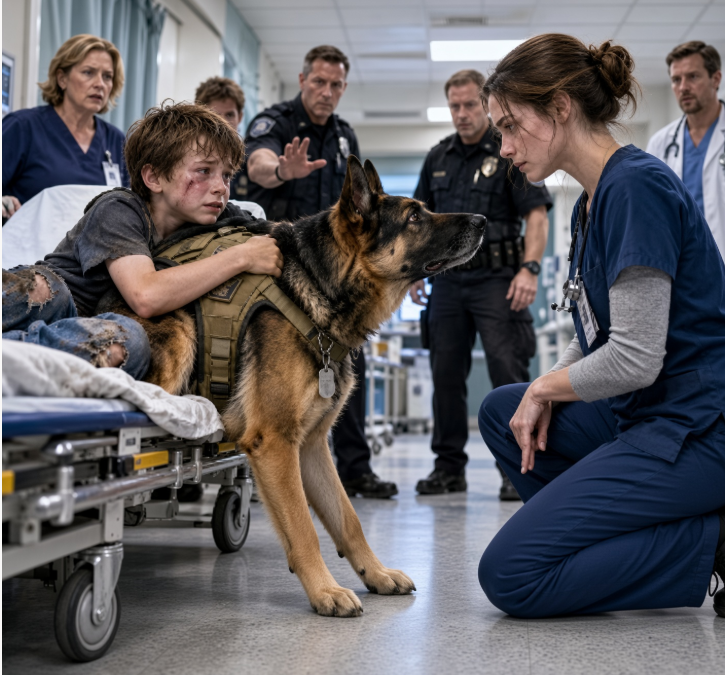
“No,” I said. “Nursing school teaches you not to stick your hand into a warning you don’t understand.”
The laugh died halfway.
I crouched several feet from the stretcher.
Not close enough to trap the dog.
Not far enough to make the boy feel abandoned.
“What’s your name?” I asked.
The boy watched me with the flat suspicion of a child who had already met too many adults with kind voices and bad news.
“Ulysses.”
“Okay, Ulysses. I’m Lorraine. I’m not going to touch Valor. I need to check you. He stays for now.”
His eyes narrowed.
“That means you’re taking him later.”
“It means I don’t promise things I don’t control.”
Something changed in his face.
Small.
Important.
Children who have been lied to often recognize honesty even when they hate it.
I held both hands visible.
“Can I check your pulse?”
He hesitated.
Valor’s eyes stayed on mine.
Then Ulysses offered his wrist.
His pulse was fast. Skin warm. Fingers cold. Dehydration, stress, exposure. Possibly low blood sugar. Scraped forearm. Bruising along one cheek. No obvious head wound, but I did not like the dullness around his eyes.
I reached for the pulse oximeter.
Behind me, metal rattled.
An orderly had rolled a kennel gate across the bay entrance.
Valor’s posture changed instantly.
Chest lowered.
Feet widened.
Head dropped slightly.
Ulysses pulled him closer.
I knew that posture.
Not from nursing school.
For half a second, the treatment bay disappeared.
Red dust.
Floodlights.
Rotor wash beating canvas flat.
Another dog lowering the same way while men around me went silent because the wrong barrier in the wrong place could turn an extraction into a fight.
“Move the gate back,” I said.
Margaret frowned.
“Why?”
“He thinks you’re closing his exit.”
The same orderly muttered, “The rookie can read minds now.”
I looked at him.
“No. I can read feet.”
Margaret’s eyes flicked to Valor.
Then to the gate.
“Move it.”
The orderly rolled it back.
The entrance opened.
Valor’s shoulders lowered immediately.
The laughter stopped.
Ulysses looked at me differently.
Not trusting.
Not yet.
But measuring.
“Pulse first,” I said. “Then water. Then I clean your arm.”
“Valor gets water too.”
“Yes.”
“Same time.”
“Same time.”
I reached beneath the supply cart for a stainless steel bowl.
Valor’s attention snapped to me.
Until then, he had watched everyone.
Now he watched only me.
I lowered the bowl.
Valor rose.
“Valor, no,” Ulysses said, gripping the vest.
The shepherd took one step toward me.
Then another.
“Lorraine,” Margaret warned.
I set the bowl down slowly.
Valor stopped.
His eyes dropped to my left hand.
I followed his gaze.
My fingers rested against the seam of my scrub pants.
Thumb folded in.
Two fingers angled down.
An old signal.
An old habit.
One I had not realized I was using.
My blood went cold.
I opened my hand slowly.
Valor’s ears came forward.
Then he left Ulysses, crossed the tile, stopped directly in front of me, and sat perfectly.
The room went still.
Ulysses stared.
Margaret’s arms fell from her chest.
Security froze at the doorway.
Valor looked up at me, waiting beneath his faded vest.
Two worn metal tags slipped free and clicked against his chest.
I saw the scratched service markings first.
Then the symbol stamped beside them.
A narrow triangle crossed by two short lines.
My left hand closed into a fist.
Margaret’s voice lowered.
“Lorraine.”
I kept my eyes on the mark.
“What?”
“Why does that dog know you?”
I did not answer.
Valor remained seated in front of me.
Still waiting.
Margaret asked again.
“Why does that dog know you?”
“I didn’t say he does.”
“He crossed the room when you moved your hand.”
“Maybe he knows the signal.”
“What signal?” the orderly asked.
I looked down at my fingers.
“I don’t know.”
It was a lie.
Valor seemed to know it.
His head tilted slightly, the way working dogs do when a handler’s body says one thing and her mouth says another.
Ulysses slid off the stretcher.
“Valor.”
The shepherd looked back but stayed seated.
“Come.”
Nothing.
Fear flashed across Ulysses’s face.
He was not afraid Valor would attack.
He was afraid Valor had chosen someone else.
I recognized that too.
The terror of being left by the one thing you are still holding.
“Don’t call him again,” I said.
“Why?”
“Because he heard you.”
“Then why isn’t he coming?”
I glanced at the faded vest.
“Something has his attention.”
Margaret stepped closer.
“You seem to know a lot about his attention.”
I ignored that.
“Ulysses, stay there.”
I turned my left palm outward and lowered it.
Valor rose.
Two fingers changed angle.
The shepherd turned and returned to Ulysses’s side.
This time nobody laughed.
Ulysses dropped to his knees and wrapped his arms around Valor.
“How did you do that?”
I picked up the water bowl because if I kept my hands busy, maybe they would stop shaking.
“He’s trained.”
Margaret’s voice was sharp but quieter now.
“So are lots of dogs. They don’t all take hand signals from nurses.”
“Maybe whoever trained him used something similar.”
Margaret watched me.
“Maybe.”
Valor drank only after Ulysses touched the rim.
That told me enough about their bond.
The dog could work.
The boy could anchor him.
Neither should have been separated casually, no matter what policy said.
I cleaned the scrape on Ulysses’s arm.
He never stopped watching me.
“Were you in the Army?”
My hand paused.
“I’m your nurse.”
“That’s not what I asked.”
“It’s what matters right now.”
Ulysses reached under Valor’s vest and pulled out the worn tags.
“These were on him when I found him.”
One carried a faded service number. The other had been damaged across the center, scratched nearly illegible, but the symbol remained clear.
The narrow triangle.
Two short lines.
Margaret leaned closer.
“Military unit?”
“Could be,” I said.
“You recognize it.”
I taped the dressing over Ulysses’s arm.
“I recognize that it isn’t standard identification.”
True.
Incomplete.
A sharp crash came from the corridor.
Valor was on his feet before anyone turned.
His body swung toward the sound, then immediately back toward Ulysses.
I rose at the same instant.
Eyes to doorway windows.
Security.
Nearest exit.
Margaret caught it.
“Lorraine, what?”
“You checked the exits before you checked the patient.”
“He’s fine.”
“You knew that already.”
Silence returned.
Valor moved beside my leg.
Shoulder aligned.
Eyes fixed on the corridor.
Not guarding me.
Working with me.
For one second, an old rhythm returned so completely I nearly stepped into it.
I shifted half a step left.
Valor shifted with me.
Ulysses stared.
“He only does that with me.”
I looked down at the shepherd.
I should have stepped away.
Instead, for one heartbeat, I stood exactly where Valor expected me to stand.
Margaret saw it.
“You’ve done this before.”
Before I could answer, Valor’s ears snapped forward.
A scream came from the veteran’s ward.
Then the lights went out.
The scream came again in the dark.
I was already moving.
“Nobody run. Margaret, keep Ulysses here. Security, clear the doorway.”
“Lorraine, someone fell.”
“I heard metal first. Then a body.”
The emergency lights flickered red as I pulled a penlight from my pocket and crossed into the corridor.
Valor followed.
“Valor!” Ulysses shouted.
I stopped.
So did the dog.
I looked back at the boy, then toward the dark corridor.
Whatever Valor remembered about me, he belonged beside Ulysses now.
I pointed back.
“Back.”
Valor returned immediately.
Margaret stared at me, but another cry came from the ward.
“Go,” she said.
The corridor beyond intake was chaos in half-light.
A medication cart lay on its side.
Beyond it, Luther Hayes was on the floor beside his wheelchair, one hand pressed to his chest. Samuel Ortiz was trapped near a fallen portable oxygen rack, his tubing kinked beneath it.
“Don’t move him yet,” I said.
I dropped beside Luther and checked his pulse.
Fast.
Present.
“Luther, look at me.”
His eyes opened.
“I’m fine.”
“Where does it hurt?”
“Chest.”
I looked toward Samuel, who was pulling uselessly at his cannula.
“Get that rack off the tubing. Two people. Lift straight. Don’t drag it.”
A nurse hesitated.
“Shouldn’t we wait for maintenance?”
“He’s losing oxygen now.”
Margaret arrived with a flashlight.
“What happened?”
“Luther fell. Samuel’s oxygen line is pinned. I need portable oxygen and Dr. Reed.”
Security and the nurse lifted the rack.
The tubing came free with a hiss, and Samuel’s breathing began to ease.
I turned back to Luther.
“Pressure in your chest before you fell?”
“Maybe.”
“Maybe isn’t useful.”
He grimaced.
“Yes.”
I took Margaret’s emergency radio.
“Dr. Reed to veterans corridor. Possible cardiac event. Patient conscious, pulse rapid. Bring the emergency cart.”
Margaret looked at me.
“You called that without an ECG.”
“I called a possible cardiac event. If I’m wrong, we lose thirty seconds. If I’m right, we don’t waste them.”
Footsteps sounded behind us.
Ulysses had left the treatment bay with Valor beside him.
Margaret frowned.
“I told you to stay back.”
Ulysses pointed down the corridor.
“There’s smoke.”
A thin gray layer spread beneath the laundry room door.
Security reached for his radio.
I stood.
Blackout.
Elderly patients.
Oxygen nearby.
Possible fire.
My mind went still in the old way.
The useful way.
“No elevators. Ambulatory patients to the east exit. Wheelchairs single file. Move every oxygen cylinder away from that door.”
Staff began moving before Margaret could respond.
I looked at her.
“Take medical command here.”
She blinked.
“And you?”
I looked toward the smoke.
Valor lowered beside Ulysses, waiting without thinking.
My left hand formed the old signal.
Two fingers down.
Palm angled.
Valor’s eyes locked onto it.
Margaret saw.
So did Ulysses.
“Lorraine,” Margaret said quietly, “what exactly did you do before nursing?”
I kept my eyes on the smoke curling beneath the door.
“Not now.”
Something heavy crashed behind the laundry room door.
Security reached for the handle.
“Don’t open that.”
The officer stopped.
“Someone could be inside.”
“Opening it could feed the fire.”
I touched the lower part of the door with the back of my fingers.
Warm.
Not hot.
Smoke leaked beneath it, but the rated door was still containing the source.
“Fire department already coming,” security said.
“Then keep this corridor clear.”
Margaret returned fast.
“Reed has Luther. Samuel’s stable. Two patients missing. Harold Mason and Calvin Brooks. Rooms fourteen and sixteen. Harold uses a walker. Calvin needs a wheelchair and oxygen. Both rooms are beyond the laundry area.”
“There’s another route through physical therapy,” Margaret said.
I checked the layout in my head.
Longer.
Separated from the laundry room by two fire doors.
Light smoke migrating into the far corridor.
Still passable.
Not for long.
“Move.”
Margaret grabbed my arm.
“You’re not going alone.”
“Then send security.”
“I’m going.”
I looked at her.
Twelve days ago, Margaret had questioned how I stocked a crash cart.
Now she was waiting for my plan.
“Fine. Stay behind me. Flashlight low.”
Ulysses appeared at the junction with Valor beside him.
“Go back,” Margaret ordered.
“Valor can find people,” Ulysses said.
I looked at the shepherd.
Maybe he could.
Maybe was not enough.
“I don’t know what he’s trained to do.”
“You knew the signals.”
“Not enough to risk him.”
Ulysses hesitated, then nodded.
“Keep him with you,” I told him.
Margaret and I passed through the first fire door.
Emergency lighting was dead beyond it. Her flashlight swept over therapy tables, walkers, abandoned chairs.
I raised one hand.
“Listen.”
Metal tapped twice ahead.
Then a voice.
“Help.”
We found Harold beside his walker near room fourteen, conscious but unable to stand.
“My hip,” he said through clenched teeth.
His left leg was rotated outward.
“Don’t move it.”
Smoke hazed the far end of the corridor.
I pulled a transfer sheet from a therapy cart.
“We drag him behind the fire door. Support the leg. No twisting.”
Margaret looked at me.
“You’ve done this before.”
“Take his shoulders.”
Together, we moved Harold into the protected section.
Margaret checked the corridor again.
“Calvin’s still in sixteen.”
Room sixteen sat farther down, near the edge of the migrating smoke.
No flame visible.
Barrier behind us intact.
Visibility worsening.
I calculated distance, time, air.
Short route.
One missing patient.
Maybe two minutes before the corridor became unacceptable.
Then a sharp bark sounded behind us.
Valor stood beyond the inner door, with Ulysses several yards back.
“I told you to stay back,” I said.
“I did. Valor didn’t.”
The shepherd was not looking at us.
His attention fixed toward room sixteen.
He struck the floor once with his paw.
I froze.
Margaret caught it.
“You know what that means?”
Valor struck the floor again.
I made the decision.
“Ulysses stays behind this door.”
I looked at Margaret.
“Hold the barrier. If the smoke thickens or you see flame, close it. Don’t wait for me.”
“Lorraine—”
“The fire is still contained. I have a short window.”
She looked through the glass.
Then at me.
She understood the calculation even if she hated it.
I turned to Valor.
Until then, I had refused to risk him on a guess. But his behavior was no longer random. He had identified the same room as the missing patient.
I raised my left hand.
This time, the signal was deliberate.
Valor came immediately to my side.
Ulysses stared at us.
“Bring him back.”
I looked at the boy.
I would not promise what I could not control.
“I’ll try.”
Then Valor and I moved through the fire door toward room sixteen.
Smoke closed around us.
I stayed low.
Valor did the same.
“Easy.”
The word came out in a tone I had not used in years.
One hand to the wall, I counted doors by touch.
Fifteen.
Sixteen.
The door stood partly open.
Valor reached it first and stopped.
“Wait.”
I checked the door.
Warm, but cooler than the laundry entrance. Smoke migrating through the corridor, not originating inside.
I pushed in.
“Calvin?”
No answer.
Valor turned toward the far side of the room.
I followed and struck an empty wheelchair with my knee.
Then Valor lowered his head beside the bed.
Calvin Brooks lay between the mattress and the wall, oxygen cannula gone, one arm trapped under him.
I checked his neck.
Weak pulse.
Still there.
“Calvin, can you hear me?”
His eyelids moved.
I found the portable oxygen cylinder near the wheelchair, checked the gauge, connected a spare mask, and placed it over his face.
Less than half a tank.
Enough if we moved now.
I freed his arm and worked a blanket beneath his shoulders and hips.
Smoke thickened at the doorway.
I pulled.
Calvin moved inches.
I pulled again.
Too slow.
Valor circled near his feet, then stopped beside a reinforced strap hanging from the blanket.
I looked at him.
“No.”
Valor waited.
His eyes stayed on the strap.
For an instant, another room flashed through my mind.
Canvas.
Sand.
A casualty on a litter.
A working dog waiting while an extraction route closed.
I forced the memory down.
Then threaded the strap through the lower blanket handles and looked at Valor.
“Take.”
The shepherd closed his jaws around the strap.
I moved backward.
“Easy.”
Valor pulled only when I pulled.
Controlled.
Steady.
Calvin slid toward the doorway, oxygen secured beside him.
At the corridor, Valor suddenly stopped.
I almost ordered him forward.
Then I heard it.
A strained metallic groan somewhere above the smoke.
“Hold.”
A section of ceiling material crashed several yards ahead, scattering debris across the path I would have taken.
Valor backed away from the noise.
I did not hesitate.
“Other side.”
We redirected around the obstruction and kept moving.
Behind the fire door, Margaret’s hand stayed on the release.
Ulysses stood beside her.
“How long?” he asked.
“Almost two minutes,” Margaret said.
“She said you’d close it.”
“If this corridor becomes unsafe, I have to.”
“Valor’s in there.”
“So is Lorraine.”
Then Valor appeared first, backing toward them with the blanket strap in his jaws.
I followed, pulling Calvin by the shoulders.
“Open it.”
Margaret pulled the door wide.
Security rushed forward.
Together, we dragged Calvin into the protected corridor and shut the barrier behind us.
Dr. Reed dropped beside Calvin.
I stayed on one knee, coughing into my sleeve.
Valor released the strap and went straight back to Ulysses.
The boy buried both hands in his fur.
“Pulse is weak but improving,” I said. “He was off oxygen when I found him. Cylinder stayed running during extraction.”
Dr. Reed checked Calvin and nodded.
“Good call.”
Margaret stared at me.
“Where did you learn that?”
“Learn what?”
“Moving through smoke. Casualty extraction. Those signals.”
I said nothing.
Margaret stepped closer.
“Lorraine.”
Before I could answer, Luther’s voice came from behind them.
“Stop asking where she learned it.”
He was pale, ECG leads still attached beneath his gown, but he was not looking at Calvin.
He was staring at my left wrist.
My scrub sleeve had torn during the extraction.
Part of the faded tattoo showed.
The narrow triangle.
Two short lines.
The same symbol stamped into Valor’s damaged tag.
I pulled the sleeve down.
Too late.
Luther’s expression had already changed.
“Ask her,” he said quietly, “why she covered that tattoo.”
Margaret looked from my wrist to the metal tag beneath Valor’s vest.
“That’s the mark.”
I was still catching my breath.
Luther watched me.
“You knew it when you saw those tags.”
Ulysses looked up.
“You said you didn’t.”
I met his eyes.
“I said I didn’t know why Valor responded to me.”
“That wasn’t true.”
“No.”
He pulled Valor closer.
Margaret lowered her voice.
“Who were you?”
I glanced toward Calvin. Dr. Reed and two nurses had him on oxygen. His pulse was improving.
“We still have patients to move.”
“Fire crews have the west corridor. Reed has Calvin.”
Margaret waited.
No accusation now.
Just the question.
I pushed myself upright.
“I was an Army medic.”
The orderly who had laughed earlier went still.
Margaret looked at the tattoo.
“Army medics don’t all know K9 signals.”
“No.”
Luther shook his head.
“Not with that mark.”
I gave him a warning look.
“You know enough not to say more.”
Luther fell silent.
Ulysses studied the symbol on my wrist.
“What does it mean?”
“It belonged to a medical recovery team. We sometimes worked with military dogs.”
Margaret started to ask something else.
I stopped her.
“That’s enough.”
The room had changed.
Nobody was laughing now.
I could feel them looking at me differently, and I hated it.
“Don’t do that.”
Margaret frowned.
“Do what?”
“Decide who I am because you saw a tattoo.”
I nodded toward Calvin.
“Five minutes ago, I was the same nurse who pulled him out of that room.”
Margaret absorbed that.
Then nodded once.
Ulysses cared about something else.
“Did you know Valor?”
I looked at the shepherd.
Gray around the muzzle.
Scar under the eye.
Old working-dog posture beneath exhaustion.
“I don’t know.”
Ulysses tightened his grip.
“But he knows you.”
“We worked with different dogs. Sometimes for hours. Sometimes only minutes.”
Ulysses pulled Valor’s damaged tag into view.
“Then look.”
I leaned closer.
Beneath years of scratches, four small characters remained beside the symbol.
My breath caught.
“Hold that still.”
He did.
I read them again.
Rain hit canvas in my memory.
Rotor wash tore across a dark landing zone.
A wounded handler lay on a litter while a younger shepherd fought to remain beside him.
I remembered kneeling in mud, one hand working on the casualty, the other giving the dog a signal to stay.
I remembered those eyes.
I remembered the handler gripping my vest, fighting to remain conscious.
Take him first if I don’t make it.
I went very still.
Ulysses saw it.
“What is it?”
Before I could answer, Valor stepped away from him.
The shepherd crossed to me, lowered his nose to the faded mark on my wrist, and sat perfectly.
I closed my eyes for one second.
When I opened them, Ulysses was watching me.
“You do know him.”
I looked down at Valor.
Older now.
Gray around the muzzle.
But waiting exactly as he had all those years ago.
This time I did not hide behind another answer.
“Yeah,” I said quietly. “I think I do.”
Ulysses stared at me.
“Then you knew my dad?”
That question hit harder than recognizing Valor.
I crouched in front of him.
“I don’t know yet.”
“You remember him?”
“I remember a handler. I’m not going to tell you the rest until I’m sure.”
Valor stayed between us, one shoulder against Ulysses’s knee.
Margaret waited instead of pressing.
I searched the memory.
Rain.
Landing zone.
A wounded handler.
Valor refusing to leave his litter.
Someone calling over rotor wash.
“Carter,” I whispered.
Ulysses went still.
“My dad was Nathan Carter.”
The first name settled something in me.
Nathan.
Ulysses moved closer.
“You knew him?”
“For one night.”
I turned to Margaret.
“Photograph Valor’s tag. Have the service number checked through the proper military contact. No guessing.”
Margaret nodded immediately.
“I’ll handle it.”
No challenge.
No reminder that I was the rookie.
She turned to security.
“Nobody moves Valor until we verify this.”
I looked back at Ulysses.
“Your father came through our recovery point after an extraction went bad. He was badly hurt. Valor stayed beside him.”
Ulysses rested a hand on the dog’s neck.
“Like he stayed with me.”
“Yeah.”
“Did Dad talk about me?”
I remembered Nathan Carter fighting to stay conscious, trying to say something that had nothing to do with the mission.
“He said he had a son.”
Ulysses swallowed.
“What else?”
Fragments came.
Blood.
Rain.
A hand gripping my vest.
The dog snarling at anyone who approached too fast.
A man trying to stay alive because someone at home needed him.
But fragments were not promises.
“He wanted to get home.”
Ulysses’s eyes filled.
“He didn’t.”
“No.”
“Did you save him?”
I held his gaze.
“We kept him alive long enough to evacuate him. After that, I don’t know.”
Ulysses wiped his face with his sleeve.
“What happened to Valor?”
“I had to leave him too.”
“Why?”
“Another casualty came in.”
I did not defend the choice.
He stroked Valor’s fur.
“Did he want to stay with Dad more than anything?”
“Yes.”
“Then why did he listen to you?”
I looked at the shepherd.
“He was trained to.”
Ulysses thought about that.
“Maybe Dad showed him you were safe.”
I had no answer.
Margaret returned with a tablet.
“The military contact confirmed the service number.”
She turned the screen toward us.
A photograph showed a younger Valor beside a soldier in field gear.
Nathan Carter.
Ulysses drew a small breath.
My eyes moved to the notation beneath the photo.
Valor’s service number.
Medical recovery attachment.
And the same symbol hidden beneath my sleeve.
My old team.
Margaret read enough to understand.
She did not ask my rank.
She did not ask what else was restricted.
She simply lowered the tablet.
“What do you need from us?”
I looked down the corridor.
Patients were still being moved. Staff who had questioned every decision I made earlier were now waiting for one.
“Finish the evacuation.”
Margaret nodded.
“You heard her.”
People moved.
I turned back to Ulysses.
Valor remained against his leg, exactly where he belonged.
The past had found me again.
It had explained the tattoo, the signals, the tags, even why an old military dog remembered me.
But it did not get to decide what came next.
There were still patients in the building.
And I was still on shift.
The fire department cleared the west corridor twenty-three minutes later.
The laundry room motor had burned out, but the rated door had contained the fire.
No patients were lost.
Calvin went for observation.
Harold for a fractured hip.
Luther to the cardiac unit, despite his complaints.
By 9:11 p.m., the veterans ward had been moved into the rehabilitation gym, where oxygen tanks, wheelchairs, blankets, and folding screens formed a temporary unit.
I was checking medication lists when Margaret placed a clipboard beside me.
“Reed wants you coordinating the respiratory patients.”
I looked up.
“You’re charge.”
“I know.”
“Then why me?”
“Because you’ve been tracking them since the power failed.”
No apology.
Just trust placed where it was useful.
I studied the board.
“Samuel stays closest to portable oxygen. Mrs. Grant needs the quiet side or she’ll keep trying to leave. Put Luther where someone can see him.”
Across the gym, Luther raised a hand.
“I heard that.”
“Good.”
Margaret almost smiled.
I glanced toward Ulysses sitting against the wall with Valor beside him and Nathan Carter’s photograph on the tablet.
“Give me five minutes.”
“Take ten.”
I crossed the gym and sat beside the boy.
Valor rested his head across Ulysses’s legs.
“I was four when that picture was taken,” Ulysses said.
“Do you remember him?”
“Some things. His boots by the door. His hands. He made terrible eggs.”
I smiled.
“That sounds like him.”
Ulysses studied the photo.
“Was he scared that night?”
I could have given him the easy answer.
I didn’t.
“Yes.”
He looked surprised.
“But he was a soldier.”
“Soldiers get scared.”
“What did he do?”
I looked at Valor.
“His job.”
Ulysses thought about that.
“Like you tonight?”
“Like everybody tonight. Margaret kept patients moving. Reed stayed with Luther and Calvin. Security got Harold out. Fire crews contained the smoke. And you went back for Calvin.”
“Yes. With Valor.”
Ulysses ran his hand through the shepherd’s fur.
“Did Dad trust him completely?”
“Even when he was hurt. Especially then.”
I remembered Nathan on the litter, Valor refusing to leave him.
“Your father couldn’t stand, but he trusted Valor beside him. Valor stayed until he was ordered away.”
Ulysses looked down.
“He stayed with me too.”
“I noticed.”
Margaret approached but stopped several feet from the dog.
“County shelter called.”
Ulysses immediately tightened his grip on Valor.
Margaret saw it.
“They’re not coming tonight. The military identification changed his custody status. Nobody moves him until the review is complete.”
“So he stays with me tonight?”
“Yes.”
She paused.
“I won’t promise more than that.”
I looked at Margaret.
The same words, almost, that I had given Ulysses hours earlier.
She had listened after all.
Ulysses slowly relaxed.
“Okay.”
Margaret turned to me.
“Reed needs you.”
I stood, but Ulysses caught my sleeve.
“Valor remembered you.”
I looked at the shepherd.
“Maybe.”
“You always say maybe.”
“Keeps me out of trouble.”
He glanced around the gym.
“Doesn’t seem to be working.”
I laughed quietly.
Then he released me.
I crossed back toward the patients.
Nobody asked about my old unit.
Nobody stared at the tattoo.
Margaret handed me the respiratory chart.
Dr. Reed asked for my assessment.
The orderly who had laughed earlier studied an oxygen cart while I checked the regulator.
That was enough.
For the first time that night, I stopped thinking about who I had been.
There was work in front of me.
I did it.
Three weeks later, I arrived for evening intake seven minutes early.
My navy scrubs were clean.
The faded tattoo on my left wrist was covered.
My badge still said exactly what it had before the blackout.
Lorraine Reed, RN.
No rank.
No unit.
No explanation.
I clocked in, tied back my hair, and checked the assignment board.
Margaret came around the nurse’s station with two charts.
“Room three needs a wound check. Room six is waiting on transport.”
She placed a third chart in front of me.
“And you have a visitor.”
I read the name.
Ulysses Carter.
Medical follow-up.
Margaret walked away.
No senior nurse assigned to watch me.
No reminder that I was still the newest person on evening intake.
I took the chart to room four.
Ulysses sat on the examination table with Valor beside him, still wearing the faded service vest. The damaged tags were gone, replaced by a clean identification plate after the military review.
Ulysses grinned.
“You’re late.”
I checked the clock.
“I’m thirty seconds early.”
“Felt late.”
“Sounds like a personal problem.”
Valor lifted his head at my voice.
I stopped inside the doorway.
The shepherd stood, crossed the room, and sat in front of me.
Ulysses smiled.
“He remembers.”
“Apparently.”
I gave one small hand signal.
Valor returned to Ulysses and lay down.
This time, nobody in the hallway stopped to stare.
I opened the chart.
“Arm?”
“Fine.”
“Eating?”
“Yes.”
“Water?”
“Yes.”
“Dizziness?”
“No.”
“Running into burning buildings?”
He rolled his eyes.
“No.”
“Good. I hate paperwork.”
The scrape had healed.
His lungs were clear.
When I finished, Ulysses pulled a metal chain from beneath his shirt.
Nathan Carter’s old tag rested against his chest.
“They gave it to me.”
I nodded.
“I see that.”
“And Valor gets to stay with me for now.”
He emphasized the last two words.
“For now,” I repeated. “They still have to decide permanently. How do you feel about that?”
He looked at Valor.
“I don’t like it.”
“Okay.”
“You’re supposed to tell me everything will work out.”
“Am I?”
“Adults do that.”
I closed the chart.
“Then you already have plenty of adults.”
Ulysses laughed.
After a moment, he touched his father’s tag.
“I asked the military people about you.”
My expression changed before I could stop it.
“Why?”
“I wanted to know what unit you were in.”
“And?”
“They wouldn’t tell me. Said some records were restricted.”
I pulled my sleeve slightly lower.
“Then leave them restricted.”
He studied me.
“Do you miss it?”
I looked through the open door.
Nurses moved between rooms.
Carts rolled beneath fluorescent lights.
Margaret fought with a printer.
Dr. Reed read an ECG.
Patients called.
Phones rang.
Life continued in its fluorescent, imperfect way.
“Parts of it.”
“Valor?”
“Dogs are usually easier than people.”
“I knew it.”
He smiled, then grew serious.
“My dad trusted you.”
“Your dad trusted a lot of people that night.”
“But Valor remembered you.”
I could have corrected him.
Instead, I looked at the shepherd.
“Valor remembered something.”
Ulysses seemed satisfied with that.
Margaret appeared at the doorway and knocked against the frame before entering.
“Lorraine, when you’re finished, room six needs you.”
“I’ll be there.”
Margaret nodded and left.
Ulysses watched her go.
“She listens to you now.”
I signed the chart.
“You’re ten. Stay out of workplace politics.”
He laughed.
“You’re done.”
Ulysses jumped down.
At the doorway, he stopped with Valor beside him.
“Lorraine?”
“Yeah?”
“If he has to leave someday, I’ll be okay.”
I considered him.
“You don’t have to be okay the day it happens.”
He looked down at Valor.
“But eventually.”
“Probably.”
He smiled faintly.
“There’s the maybe again.”
Then he walked out with Valor beside him.
I watched until they turned the corner.
I did not follow.
At the nurse’s station, the orderly who had laughed at me three weeks earlier pushed an oxygen cart toward me.
“Room six is ready.”
I took the chart.
“Thanks.”
That was all.
No apology.
No salute.
No questions about the tattoo.
I entered the next room, introduced myself to a veteran who had never met me, and washed my hands before examining him.
Somewhere down the corridor, Valor’s new tag made one faint metallic sound as he followed Ulysses toward the exit.
My hand paused for half a second.
Then I reached for my stethoscope and went back to work.
That is what people misunderstand about the past.
They think it returns like an explosion.
Sometimes it does.
Sometimes it returns as a dog sitting perfectly in front of you because your hand remembered a signal before your mouth remembered the truth.
Sometimes it returns as a boy wearing his father’s tag and asking whether soldiers get scared.
Sometimes it returns not to destroy the life you built, but to prove you are still the person who knows what to do when the lights go out.
I remained the new nurse a little while longer.
Then I was simply Lorraine.
The one Margaret trusted with respiratory patients.
The one Luther called “the quiet medic” even though I told him not to.
The one Ulysses visited when Valor had follow-ups.
The one who still kept her tattoo covered because some things did not need to become hallway conversation.
Valor did stay with Ulysses.
Not immediately.
Not easily.
There were reviews, signatures, custody questions, medical clearances, housing exceptions, and people who wanted to make the decision simple because simple decisions look safer on paper.
But Valor had chosen once in an ambulance bay.
Then again in a smoke-filled corridor.
Then again in every room where he placed himself between Ulysses and a world that had already taken too much.
Eventually, the paperwork caught up with what the dog already knew.
Ulysses had lost his father.
Valor had lost his handler.
Neither of them needed another separation disguised as procedure.
Months later, Ulysses came back to the hospital carrying a school backpack and half a sandwich wrapped in foil because Valor had a checkup and Ulysses said hospital cafeterias were “financial crimes.”
He was taller.
Still too thin.
Still too watchful.
Valor moved slower, gray bright around his muzzle, but his eyes remained sharp.
When they reached intake, Valor paused, lifted his nose, found me, and sat.
Ulysses sighed.
“He does that every time.”
“He has good manners.”
“He ignores everybody else.”
“Even better manners.”
Ulysses rolled his eyes.
Then he said, “I wrote about my dad for school.”
I set down the chart.
“Yeah?”
“And Valor.”
“That makes sense.”
“And you.”
My hands stilled.
“Me?”
“Not the secret stuff.”
“There is no secret stuff.”
He looked at me the way only a ten-year-old can look at an adult lying politely.
“Right.”
“What did you write?”
He shrugged.
“That my dad trusted people I never met. And one of them turned out to be real.”
I did not speak for a moment.
Valor leaned against my leg.
Ulysses pretended not to notice my eyes.
Then he said, “Also, my teacher cried, so I probably got an A.”
I laughed.
A real one.
Margaret looked up from the desk.
“What’s funny?”
“Workplace politics,” Ulysses said.
“Out,” I told him.
He grinned and followed Valor toward exam room four.
That night, after my shift, I sat in my car for a while before driving home.
Rain tapped the windshield.
Not hard.
Enough.
The kind of rain that used to send me back to places I did not want to revisit.
For once, I did not fight the memory.
I let it come.
Nathan Carter on a litter, fighting to stay conscious.
Valor refusing to leave him.
My hand giving the signal.
The handler gripping my vest.
Take him first if I don’t make it.
I had not known what happened after evacuation.
For years, that had been one more unfinished name in a long list of unfinished names.
Now I knew part of it.
Nathan had a son.
Valor had found him.
And somehow, years later, both of them had found me.
Not for closure.
I do not trust that word.
Some doors do not close.
Some losses remain open because love remains open.
But the past had returned with work attached.
A boy to treat.
A dog to understand.
Patients to evacuate.
A chart to finish.
A next room waiting.
That I understood.
I started the car.
Before pulling out, I pushed my sleeve back and looked at the faded tattoo.
The narrow triangle.
Two short lines.
For the first time in years, I did not immediately cover it.
Then I drove home through the rain, not healed, not fixed, not transformed into someone who wanted to explain everything.
Just steady.
Just useful.
Just still here.
And sometimes, that is the closest thing to peace a person gets.








