The Botanist Found a Dying Navy SEAL and His German Shepherd After the Flood—Then the Dog Dragged Her Toward a Buried Child No One Knew Was Missing
PART3:
The call lasted twenty-three seconds before it dropped.
“You okay?” she asked.
“I’m fine.”
“You always say that.”
“Because I usually am.”
“Claire—”
Then silence.
I tried again.
Nothing.
By midnight, the creek was roaring.
Around two in the morning, something farther up the mountain gave way.
I felt it through the floor before I heard it.
A deep vibration.
The glasses on the shelf trembled.
Then came a sound like a freight train moving through the trees.
I stood in the center of the cabin with both hands gripping the oak table while muddy water struck the foundation.
The building shook.
A jar fell from a shelf and shattered.
I remember thinking, absurdly, that the moss inside had taken me three days to find.
Then the porch railing disappeared past the window.
For the next several hours, I stopped thinking about moss.
I thought about my mother in Asheville, who would be awake now.
I thought about all the messages I had answered with, Busy this week. Talk Sunday.
I thought about Evan, not because I wanted him back but because disaster has a strange way of summoning everyone who ever knew your name.
Mostly I thought about how silence feels different when you choose it and when the world imposes it.
At dawn, the rain softened.
The cabin was still standing.
That felt impossible.
I opened the door.
Laurel Hollow had become a landscape I barely recognized.
The footbridge across the creek was gone.
Two enormous tulip poplars lay uprooted along the bank.
The slope above my research plots had collapsed into a ridge of mud, roots, and broken stone.
The creek had changed course.
Entire sections of trail had vanished.
My truck was still parked uphill, but a fallen oak blocked the road beyond it.
I went outside to inspect the spring line because losing clean water would become a serious problem within a day.
That was when I found them.
At first I saw the dog.
A dark shape beneath the branches of a fallen sycamore.
Then the man.
I ran.
The German Shepherd lifted his head before I reached them.
The growl came low.
Warning.
Not rage.
His body told me the truth.
He was terrified.
The man looked to be somewhere in his thirties.
Maybe thirty-five.
Tall.
Broad shoulders.
Short dark hair plastered against his forehead.
His skin was cold under my fingers.
But he was breathing.
There was a cut above his left eyebrow.
His right leg was badly injured.
His hands were scraped raw.
A faded tattoo appeared beneath the torn sleeve of his shirt, though mud covered most of it.
I checked his neck carefully.
No obvious catastrophic bleeding.
His pulse was weak but present.
The dog wore a heavy working collar.
The metal tag said one word.
RANGER.
“Okay, Ranger,” I said. “I need your help.”
He lowered his head onto the man’s shoulder.
“I’m moving him.”
Growl.
“If I don’t, the creek gets him.”
His ears twitched.
“You probably understand more English than half the graduate students I teach, so I’m going to assume we have an agreement.”
Ranger blinked.
That was the closest thing to consent I was likely to get.
I ran back to the shed.
There was a canvas tarp, climbing rope, and a hauling strap I used for moving equipment.
My wilderness first-aid training had never involved someone this large, this cold, or this badly injured.
Every rule told me not to move a trauma victim unnecessarily.
The water six feet away told me necessity had already been decided.
I positioned the tarp.
Supported his neck.
Tried to keep his injured leg stable.
He outweighed me by at least seventy pounds.
Maybe more.
The first pull barely moved him.
The second made my shoulders scream.
I wrapped the strap around my hips and leaned forward.
Mud sucked at my boots.
Ranger crawled beside us.
The man groaned.
It was the most reassuring sound I had ever heard.
“Good,” I gasped. “You hate this. That means something still works.”
Getting him over the cabin threshold nearly finished me.
I collapsed onto the floor beside him.
For perhaps fifteen seconds, I simply stared at the ceiling.
Then I looked outside.
Ranger had stopped halfway between the creek and cabin.
His legs would not carry him farther.
“I said both of you,” I muttered.
I went back.
Ranger tried to growl when I slid the tarp beneath him.
“You can complain after you’re dry.”
His head dropped.
By the time I shut the door, my hands were raw and my back felt as though someone had driven nails through it.
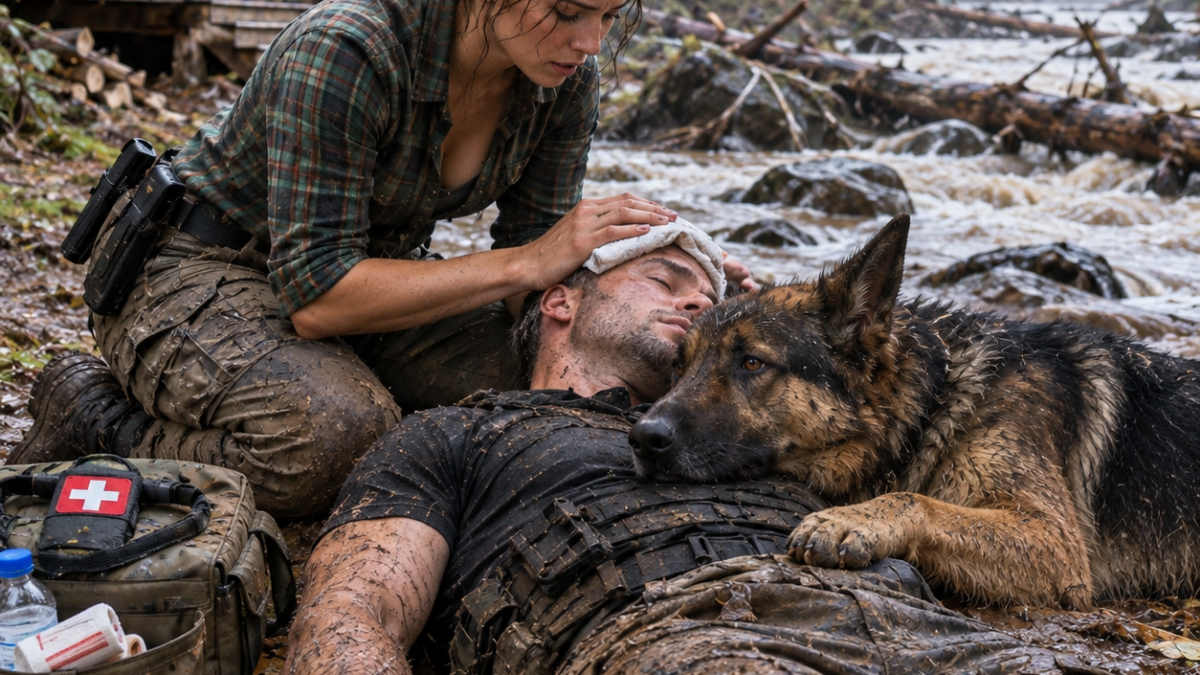
I worked on the man first.
Cut away soaked fabric around his right leg.
Checked circulation.
Improvised a padded splint without trying to straighten the injury.
Removed wet outer layers.
Wrapped him in blankets.
Then Ranger.
The dog had multiple abrasions and one deeper laceration along his flank, but I saw no exposed bone.
His paws were torn.
He was dehydrated.
I cleaned what I could.
He watched my hands.
Never snapped.
Never relaxed either.
The cabin smelled of wet fur, mud, wood smoke, and fear.
My emergency satellite messenger should have been on the charging shelf.
It wasn’t.
I found it under a cabinet that had fallen during the night.
The screen was shattered.
My phone showed no service.
The weather radio produced static with occasional fragments of emergency broadcasts.
I sat between my two strangers and watched them breathe.
Around noon, the man opened his eyes.
He stared at the ceiling first.
His pupils moved.
Focused.
Then confusion vanished.
Training replaced it.
His gaze swept the room.
Door.
Windows.
Fire.
Me.
Then he said one word.
“Ranger?”
“He’s here.”
He tried to sit up.
I pushed a hand against his shoulder.
“Don’t.”
“Where?”
Ranger lifted his head.
The man saw him.
Something in his face loosened.
He reached out.
Pain hit him so violently his teeth clenched.
He kept reaching.
I dragged Ranger’s blanket closer.
The dog crawled until his nose touched the man’s hand.
The man buried his fingers in the wet fur behind Ranger’s neck.
Only then did he look at me properly.
His eyes were blue-gray.
Sharp despite exhaustion.
“Who are you?”
“Claire Bennett.”
“Where?”
“My research cabin. Laurel Hollow.”
His expression changed.
“North Carolina?”
“Yes.”
“What day?”
“Friday.”
“What time?”
“A little after noon.”
He closed his eyes.
I thought he might pass out again.
Then he whispered something.
“What?”
“Eli.”
I leaned closer.
“What did you say?”
He opened his eyes.
“Did you find anyone else?”
“No.”
The fear that moved across his face had nothing to do with his broken leg.
“Did you search the creek?”
“I found you twenty yards downstream from the spring line.”
“Boy.”
My stomach tightened.
“What boy?”
He inhaled carefully.
“Eight years old. Maybe nine.”
“Was he with you?”
“Yes.”
“Where?”
“I don’t know.”
His eyes shut.
Memory hurt him differently than the injury.
I waited.
He forced them open again.
“Red jacket.”
“What happened?”
The man looked at Ranger.
The dog’s ears had risen.
“We were looking for him.”
I stared.
“You were already searching before the flood?”
“Yes.”
“Who is he?”
“Eli Mercer.”
The surname meant nothing to me.
“Your son?”
“No.”
He tried to move again.
Pain stopped him.
“I need to go.”
“You need a hospital.”
“So does he.”
“You have a broken leg.”
“I’ve moved on worse.”
“Congratulations. You’re still not walking.”
His eyes narrowed.
Under different circumstances, he might have been intimidating.
At that moment he was pale, shaking, and wrapped in one of my grandmother’s quilts.
I folded my arms.
“You can threaten me after your lips stop turning blue.”
He stared at me.
Then, unexpectedly, the corner of his mouth moved.
Not quite a smile.
“What are you?”
“A botanist.”
That got a longer look.
“Of course you are.”
“What does that mean?”
“Nothing.”
“It sounded like something.”
He sank back.
“My name is Luke Mercer.”
“Mercer?”
“Yes.”
“The boy?”
“My nephew.”
That changed everything.
“How long has he been missing?”
Luke looked toward the window.
“Since yesterday afternoon.”
I felt the room tilt slightly.
“Before the storm?”
“Yes.”
“Why was an eight-year-old outside before a flash flood?”
Luke’s jaw tightened.
“That’s what I’d like to know.”
I waited.
He looked away.
“My sister called me at 4:12 yesterday.”
“What happened?”
“Eli didn’t get off the school bus.”
The cabin suddenly felt smaller.
“She called police?”
“Yes.”
“Search teams?”
“Started before dark.”
“And you?”
“I was two hours away.”
“Doing what?”
He hesitated.
That was when I noticed the marks more clearly.
Not just muscles.
Not just the way his eyes checked the room.
His watch.
The old tattoo.
The calm under pain.
“You’re military.”
“Was.”
“What branch?”
“Navy.”
I looked at Ranger.
“And him?”
“Mine.”
“Police?”
“No.”
“Military?”
Luke was quiet.
Then nodded.
“Retired.”
I glanced between them.
“You too?”
Another nod.
“What did you do?”
He looked at me.
“Things that don’t matter right now.”
Later I learned that Lieutenant Commander Luke Mercer had served fifteen years in Naval Special Warfare.
A Navy SEAL.
Multiple deployments.
Decorations he never mentioned.
Injuries he did.
Ranger had worked beside him through his final operational years.
Luke had left the Navy eighteen months earlier after a mission in which another teammate died.
Ranger retired with him.
But none of that mattered to me then.
What mattered was a little boy somewhere beneath a mountain full of floodwater.
“What was the last place anyone saw Eli?”
“School bus camera showed him getting off at his normal stop.”
“Where?”
“Pine Creek Road.”
I knew it.
“Six miles east.”
Luke nodded.
“Witness said a gray pickup stopped near him.”
I felt something cold settle in my stomach.
“Someone took him?”
“We don’t know.”
“You said you were searching for him out here.”
“Ranger found scent near an old logging road.”
“That road washed out years ago.”
“Someone had been using it.”
“How do you know?”
“Tire tracks.”
The storm hit the windows again.
Luke’s face darkened.
“Ranger tracked Eli into the hollow.”
“And then?”
“The rain got worse.”
His breathing changed.
I saw the memory returning.
“We found a small hunting cabin. Empty. Child’s backpack inside.”
My stomach tightened.
“Eli’s?”
“Yes.”
“Then he was kidnapped.”
“Probably.”
“What happened next?”
“Ranger picked up his trail beyond the cabin.”
Luke stared toward the fire.
“We followed.”
He paused.
“The slope came down.”
The freight-train sound.
The vibration.
Around two in the morning.
“You were above me.”
“Probably.”
“What happened to Eli?”
“I lost him before the slide.”
“Lost him?”
Luke shook his head.
“We heard a child.”
“Eli?”
“I think so.”
“Where?”
“Across the creek. Ranger took off. Then everything moved.”
His hand tightened in Ranger’s fur.
“When I woke up, I was downstream.”
“And Eli?”
“Gone.”
I stood.
The cabin suddenly felt unbearably warm.
Luke watched me.
“What?”
I walked to the window.
Beyond it, mud filled half the valley.
“If he was across the creek before the slide, then the terrain between here and the old service ridge…”
“What?”
I knew plants.
That sounds useless in a disaster.
It wasn’t.
Vegetation tells you where water moves.
Where soil holds.
Where it fails.
What ground stays wet in drought.
Where springs emerge underground.
What looks like forest can be a map if you know how to read it.
I had spent six months studying Laurel Hollow.
I knew where rhododendron colonies followed old drainage channels.
Where sycamores marked seasonal flow.
Where sedges appeared in places that looked dry on the surface.
I turned.
“There are limestone pockets east of here.”
Luke stared.
“So?”
“Small cavities. Not caves exactly. Old seep channels beneath the ridge.”
“Could a child fit?”
“Yes.”
“Could one survive?”
My answer took too long.
Luke saw it.
“How long?”
“With air?”
“Yes.”
“Potentially.”
“With the flood?”
“That depends on where the water went.”
Luke pushed himself upright.
“Then we go.”
“No.”
His face hardened.
“Claire.”
“You cannot stand.”
“I can direct.”
“From where?”
He looked at Ranger.
The dog was already trying to rise.
His legs shook.
Luke said, “He can find him.”
“Ranger can barely walk.”
“He’ll walk for Eli.”
“That isn’t the same as being able to.”
Luke’s voice dropped.
“You don’t understand him.”
I looked at the dog.
“No. But I understand what collapse looks like.”
Silence.
Ranger slowly stood.
For three seconds.
Then five.
His hindquarters trembled.
He took one step toward the door.
Luke looked at me.
I hated the expression in his eyes because I recognized it.
Not stubbornness.
Desperation.
“He knows,” Luke said.
“How?”
“He heard Eli before the slide.”
“That doesn’t mean—”
Ranger limped to the door.
Scratched once.
Then again.
A sound came from deep in his throat.
Not a growl.
A whine.
Luke whispered, “He knows.”
I did not want him to be right.
Because if Ranger knew where Eli was, then there was a child alive somewhere outside.
And every minute I spent arguing mattered.
I pulled on my jacket.
Luke said, “Take my pack.”
“You’re staying.”
“Claire.”
“You’re not getting off that floor.”
“Then take the radio.”
“What radio?”
“Pack. Side pocket.”
I found a waterproof tactical bag near the blanket where I had piled his belongings.
Inside was a compact radio.
Battery still worked.
I stared at him.
“You had this the whole time?”
“Range is limited.”
“Could you have mentioned it?”
“You didn’t ask whether I was carrying encrypted military-grade communications equipment.”
Despite everything, I almost laughed.
“Anything else you forgot?”
“Flare.”
“Wonderful.”
“Tourniquet.”
“Less wonderful.”
“Signal mirror.”
“You’re a depressing backpack.”
Luke ignored me.
“Channel three. Search teams may be on county rescue frequency if the storm hasn’t killed repeaters.”
I clipped the radio to my jacket.
Then took a coil of rope.
First-aid supplies.
Headlamp.
Water.
A pry bar.
Hand saw.
Luke watched every movement.
“Stay above the current.”
“I know.”
“Don’t cross moving water above your knees.”
“I know.”
“If Ranger stops—”
“I know.”
His expression sharpened.
“No. You don’t.”
I stopped.
Luke looked at the dog.
“If he stops and stares at something, don’t pull him away.”
“Why?”
“He’s telling you something.”
I nodded.
Luke reached for Ranger.
The dog limped closer.
Luke held his face between both hands.
For a moment neither moved.
Then he said, “Find Eli.”
Ranger’s ears lifted.
His entire posture changed.
Pain remained.
Exhaustion remained.
But purpose entered the room.
The dog turned toward the door.
I opened it.
Cold air rushed inside.
Luke called after me.
“Claire.”
I looked back.
His face had changed again.
Not operator.
Not SEAL.
Uncle.
“Bring him home.”
I wanted to promise.
I didn’t.
Promises made in disasters are dangerous things.
I said, “I’ll follow Ranger.”
Then we left.
The valley was worse than it had looked from the cabin.
Ranger moved slowly at first.
Nose low.
He crossed the muddy area near the creek, stopped beside the sycamore where I had found Luke, then turned uphill.
I followed.
Every twenty yards, he paused.
Sniffed.
Moved again.
His training was astonishing.
Rain had destroyed most scents.
Floodwater should have erased everything.
Still he found something.
Maybe Eli.
Maybe Luke.
Maybe the route from the night before.
I trusted him because there was nothing else to trust.
After twenty minutes, we reached the first slide zone.
The earth had torn open from the ridge to the creek.
Trees lay sideways.
Roots exposed.
Mud deep enough to swallow my boots.
Ranger stopped.
He stared east.
Then west.
Whined.
I waited.
“Show me.”
He moved east.
We climbed.
My knowledge of the slope mattered immediately.
The obvious route crossed a field of smooth mud.
I avoided it.
Smooth mud after a slide often means water beneath.
Instead I followed a strip where mountain laurel roots still held the soil.
Ranger glanced back twice.
Checking me.
“I’m coming.”
The radio crackled.
Static.
Then a voice.
“…county rescue… anyone receiving…”
I grabbed it.
“This is Claire Bennett at Laurel Hollow research station. Do you copy?”
Static.
Then:
“…repeat…”
“Claire Bennett. Laurel Hollow. I have an injured adult male at my cabin and I am searching for a missing child, Eli Mercer, with a German Shepherd.”
The response broke apart.
“…Mercer… missing… command…”
“I’m east of Laurel Hollow creek, heading toward the old service ridge.”
More static.
Then a clearer voice.
“Claire Bennett, do not continue. Repeat, do not continue. Terrain unstable. Rescue teams attempting access from north.”
I looked at Ranger.
He kept moving.
“How far are you?”
“Minimum three hours.”
Three hours.
I looked at the mountain.
“Child may be trapped.”
“Ma’am, do not—”
The radio died into static.
I clipped it back.
“Sorry,” I muttered.
Ranger limped onward.
We found the first proof fifteen minutes later.
A red strip of fabric.
Caught on blackberry thorns.
I knelt.
Children’s nylon.
Jacket material.
My hands started shaking.
“Ranger.”
He sniffed it.
Then pulled forward so sharply his injured leg almost buckled.
“Easy.”
He ignored me.
The terrain narrowed.
On my left, the hillside rose.
On my right, the flooded creek raged below.
We passed a crushed plastic water bottle.
A child’s footprint preserved beneath an overhang.
Then something else.
A boot print.
Adult.
Larger.
I crouched.
Ranger smelled it.
A low growl vibrated in his chest.
That changed everything.
Eli had not been alone.
I followed the prints as far as I could.
Child.
Adult.
Then flood damage erased both.
My heart hammered.
Someone had brought him here.
Why?
Kidnapping for ransom?
Custody dispute?
Something worse?
The radio crackled.
“Claire Bennett, respond.”
I answered.
“This is Claire.”
A different voice.
Male.
Calm.
“This is Sheriff Daniel Holt. Where exactly are you?”
“East slope, maybe three-quarters mile from the cabin.”
“You need to turn around.”
“I found Eli’s jacket fabric.”
Silence.
Then, “Are you certain?”
“Red nylon caught on thorns. Luke said red jacket.”
“Luke Mercer is with you?”
“Injured at my cabin.”
Another pause.
“How injured?”
“Possible fractured right femur or tibia, hypothermia, head trauma.”
“We need coordinates.”
I gave him the cabin coordinates from memory.
“Claire, listen carefully. We have teams coming, but the roads are gone. You need to return to shelter.”
“Ranger is tracking.”
“The dog?”
“Yes.”
“Luke’s dog?”
“Yes.”
The sheriff’s voice changed slightly.
“You cannot know what that dog is following.”
I looked at Ranger.
“I trust him.”
“You don’t know the terrain.”
That almost irritated me.
“I’ve been mapping this watershed for six months.”
“Still—”
“Sheriff, if Eli is buried in a seep cavity, three hours could matter.”
Silence.
I heard someone speaking behind him.
Then Holt returned.
“Keep the radio open. Do not enter unstable structures. Do not cross floodwater. If conditions worsen, retreat immediately.”
It was not permission.
But it was no longer an order to stop.
“Understood.”
Ranger climbed.
Thirty minutes later, he froze.
Luke’s warning returned.
If he stops and stares at something, don’t pull him away.
Ranger stared at a mound of debris.
Mud.
Branches.
A section of corrugated metal.
Nothing else.
He moved closer.
Sniffed.
Then barked.
Once.
Twice.
Then began digging.
My entire body went cold.
“Eli?”
No response.
I moved beside Ranger.
Listened.
Water.
Wind.
Branches rubbing.
Then—
A sound.
So faint I thought I imagined it.
Tap.
Tap.
Tap.
I dropped to my knees.
“Eli!”
Nothing.
I pressed my ear against the metal.
Tap.
Tap.
My chest tightened.
“Eli! My name is Claire! Can you hear me?”
For five terrible seconds, nothing happened.
Then a voice came from beneath the earth.
“Ranger?”
I started crying instantly.
“Yes!”
The dog barked.
The sound under the debris changed.
A child crying.
“Ranger!”
“He’s here, sweetheart. He found you.”
“Uncle Luke?”
I closed my eyes.
“He’s alive.”
“Is he coming?”
“He’s hurt, but he’s alive.”
Silence.
Then the little voice whispered, “Mr. Wade said he was dead.”
I stopped breathing.
“Who is Mr. Wade?”
Nothing.
“Eli?”
A scraping sound.
Then, “Please don’t let him find me.”
Every hair on my arms rose.
I reached for the radio.
“Sheriff Holt.”
Static.
“Holt, respond.”
After several seconds:
“Go.”
“I found him.”
The radio erupted with voices behind Holt.
“You have Eli?”
“He’s trapped under slide debris. Conscious.”
“Location?”
I described landmarks and elevation.
“Claire, do not move heavy debris until rescue arrives.”
“There’s something else.”
“What?”
“Eli says a man named Wade told him Luke was dead.”
Silence.
Too long.
“Sheriff?”
Holt answered carefully.
“Did he give a first name?”
I looked toward the debris.
“Eli! What’s Mr. Wade’s first name?”
No answer.
Ranger whined.
I pressed closer.
“Sweetheart?”
“Tom.”
The radio in my hand suddenly felt heavier.
“Tom Wade.”
Another long silence.
“Sheriff?”
When Holt answered, his voice was different.
“Claire, listen to me very carefully.”
I stared into the trees.
“Okay.”
“Do you have any weapon?”
“No.”
“Stay with the boy.”
“Why?”
“Thomas Wade is one of our volunteer search coordinators.”
My stomach dropped.
“He was searching for Eli?”
“Yes.”
“Then why—”
“We don’t know.”
Ranger suddenly turned.
His ears snapped toward the trail behind us.
A growl rolled through him.
Not warning.
Threat.
I stopped speaking.
Holt heard.
“What is it?”
“I don’t know.”
Ranger moved in front of me.
His posture transformed.
The injured animal I had dragged into my cabin disappeared.
In his place stood something trained for a world I knew nothing about.
Head low.
Body still.
Eyes fixed on the trees.
Then I heard footsteps.
Slow.
Careful.
Coming toward us.
“Claire?” Holt whispered through the radio.
I lowered the volume.
Ranger’s growl deepened.
A man appeared between two broken pines.
He wore a fluorescent volunteer rescue jacket.
Mud covered his pants to the knees.
A rifle hung from a sling across his chest.
He stopped when he saw me.
Then smiled.
“You found him.”
I did not answer.
The man was in his forties.
Heavy beard.
Broad face.
Blue baseball cap.
His rescue vest read WADE.
Thomas Wade.
Ranger stepped forward.
Wade looked at the dog.
“Oh.”
His smile weakened.
“That one survived too.”
My mouth went dry.
I shifted slightly, placing myself between Wade and the debris.
“Sheriff Holt is on the radio.”
Wade looked at the device in my hand.
“That right?”
“Yes.”
He nodded.
“Good.”
Nothing about his face matched the word.
“He knows where we are.”
“Even better.”
Ranger growled.
Wade moved one hand toward the rifle.
I raised the radio.
“Holt, Thomas Wade is here.”
Wade’s eyes changed.
The smile disappeared.
Holt’s voice blasted from the speaker.
“Tom, step away from Ms. Bennett and the child.”
Wade stared at me.
Then laughed.
“You have got to be kidding me.”
“Tom.”
Holt’s voice was sharp now.
“Do not touch that rifle.”
Wade looked toward the debris.
“Kid’s confused.”
I said nothing.
“Flood shock.”
Ranger’s teeth showed.
Wade pointed at the dog.
“That animal is dangerous.”
“He seems to have excellent judgment.”
Wade’s eyes moved to me.
I had never been particularly brave.
That is important.
People often retell dangerous moments as though courage arrives like a transformation.
It did not.
I was terrified.
My legs shook.
My tongue felt numb.
I kept thinking of my mother getting a phone call.
But fear and action are not opposites.
Sometimes you act while every part of you begs not to.
Wade said, “Move away from that hole.”
“No.”
“I’m part of the rescue team.”
“The sheriff just told you to step back.”
“Holt doesn’t understand.”
“Then explain it from there.”
He looked at the radio.
Then at the trees.
“How far are they?”
I did not answer.
His mouth tightened.
“Three hours?”
My stomach dropped.
He had heard our earlier transmission.
Or knew rescue access times.
Wade sighed.
“Claire, right?”
“How do you know my name?”
“Radio traffic.”
He took one slow step.
Ranger lunged forward.
Not attacking.
Warning.
Wade stopped.
“You think that dog can protect you?”
I looked at Ranger’s injured flank.
His trembling legs.
“No.”
Wade almost smiled.
“I think he’ll try.”
Something about that answer bothered him.
Good.
I needed time.
“Why did you take Eli?”
His face hardened.
“Who said I took him?”
“He did.”
“Children lie.”
“About being kidnapped during a flood?”
“He wasn’t kidnapped.”
“Then what happened?”
Wade glanced toward the debris.
“He saw something.”
The words came before he could stop them.
I felt my heartbeat change.
“What?”
He smiled again, but badly.
“Move.”
“No.”
The radio crackled.
Holt’s voice:
“Tom, units are moving toward you. Put the rifle on the ground.”
Wade looked around.
“Units.”
He almost laughed.
“Nobody’s crossing Laurel Creek for hours.”
Ranger barked sharply.
Wade flinched.
Then the child beneath the debris shouted.
“He killed my dad!”
Everything stopped.
Wade’s face emptied.
I stared at the metal.
“What?”
Eli began sobbing.
“He killed Dad!”
Wade raised the rifle.
Ranger moved before I did.
The dog hit him low.
Not full force.
He was too injured for that.
But enough.
Wade stumbled.
The rifle fired.
The shot cracked across the valley.
I dropped.
Ranger clamped onto Wade’s forearm.
Wade screamed.
He struck the dog with his free hand.
“Ranger!”
I grabbed the nearest thing I could reach.
The pry bar.
Wade kicked the dog.
Ranger lost his grip.
Wade turned toward me.
I swung.
The bar hit the rifle, not him.
The weapon flew sideways into the mud.
Wade lunged.
I fell backward.
He caught my jacket.
His face was inches from mine.
“Stupid—”
Ranger hit him again.
This time Wade went down.
I crawled for the rifle.
He grabbed my ankle.
I kicked.
Missed.
He pulled.
My chin struck mud.
Then another sound thundered across the slope.
A gunshot.
Wade froze.
So did Ranger.
A man stood thirty yards uphill.
Orange rescue jacket.
Sidearm extended.
Behind him were two more people.
Sheriff Daniel Holt shouted, “Hands where I can see them!”
Wade released my ankle.
For a moment he looked toward the trees.
Running crossed his mind.
Ranger growled.
Wade looked at the dog.
Then at the armed sheriff.
Slowly, he raised his hands.
Holt reached us in seconds.
One deputy cuffed Wade.
Another secured the rifle.
A paramedic dropped beside me.
“You hit?”
“No.”
“Dog?”
“Ranger!”
He was lying in the mud.
My heart stopped.
I crawled toward him.
“Ranger.”
His eyes opened.
He tried to rise.
“Don’t.”
He ignored me.
Of course he did.
He looked toward the debris.
Eli.
Even then.
I put both hands on his face.
“He’s here. You did it.”
Ranger’s breathing slowed.
The rescue team began working.
Carefully.
The metal sheet was part of an old drainage structure built into the hillside decades earlier.
The landslide had collapsed the entrance without crushing the cavity beneath.
Eli had crawled inside during the storm.
There was enough air.
Barely.
Water had risen to his waist during the night and then receded.
He had been trapped more than fourteen hours.
It took forty-three minutes to reach him.
I heard everything.
Tools.
Commands.
Eli crying whenever the debris shifted.
Holt asking me questions while someone bandaged my wrist.
Wade sitting handcuffed beneath a tree with two deputies beside him.
Then a rescuer shouted.
“We have him!”
A tiny hand appeared through the opening.
Mud-covered.
Shaking.
I began crying again.
They widened the gap.
A boy emerged.
Eight years old.
Red jacket torn.
Dark hair plastered to his forehead.
Lips blue.
He looked around wildly.
“Ranger?”
The dog lifted his head.
Eli pushed away from the paramedic.
“Ranger!”
He fell beside him.
Ranger licked his face.
The boy wrapped both arms around the German Shepherd’s neck.
Every person on that hillside stopped for half a second.
Even the sheriff.
Even the paramedics.
Because sometimes the end of a search does not look heroic.
It looks like a freezing child crying into an exhausted dog’s fur.
Then Eli asked, “Where’s Uncle Luke?”
I knelt beside him.
“He’s waiting for you.”
“Is he really alive?”
“Yes.”
“Mr. Wade said the mountain killed him.”
“He was wrong.”
Eli looked toward Wade.
Fear passed over his face.
Ranger felt it.
His body stiffened.
Wade looked away.
We could not carry everyone down the route I had used.
Rescue teams had established a safer approach from the north ridge.
Eli was placed in a litter.
Ranger refused the first stretcher they brought for him.
The dog kept trying to remain beside the boy.
Finally a paramedic laughed in frustration.
“Fine.”
They carried Ranger on a second litter directly next to Eli.
The boy kept one hand resting against the dog’s paw.
I walked behind them.
Sheriff Holt joined me.
He was fifty-something, tired-eyed, with rain soaked through his uniform.
“You disobey instructions.”
“I’ve been told.”
“You walked into an unstable slide area.”
“Yes.”
“You confronted an armed suspect with a pry bar.”
“That part was not planned.”
He looked at me.
Then smiled despite himself.
“Botanist?”
“Unfortunately.”
“What did you expect to do with the pry bar?”
“I had no broader strategy.”
“Good to know.”
We walked several more yards.
Then I asked, “What did Eli mean about his father?”
Holt stopped smiling.
“We’re trying to determine that.”
“Is his father missing?”
“Dead.”
My stomach tightened.
“When?”
“Three months ago.”
“How?”
“Vehicle accident.”
I looked back at Wade.
Holt followed my gaze.
“You think it wasn’t?”
“I think an eight-year-old just said Wade killed him.”
“So do I.”
That was when I understood the flood had not begun this story.
It had only torn open the ground covering it.
Luke was conscious when we returned to the cabin.
Barely.
I heard him before we entered.
“Eli?”
The boy’s face crumpled.
“Uncle Luke!”
Every medic in the room immediately lost control of the situation.
Eli climbed off the litter before anyone could stop him.
Luke tried to rise.
I shouted, “Absolutely not.”
He ignored me.
Eli reached him.
Luke pulled the boy against his chest.
Pain crossed his face so violently I thought he would pass out.
He held on anyway.
The child cried into his neck.
“You’re alive.”
“Yeah.”
“Mr. Wade said—”
“I know.”
“I thought—”
“I know, buddy.”
Luke pressed his face against the boy’s wet hair.
“I’ve got you.”
Ranger was brought in moments later.
Luke looked toward him.
The dog’s tail moved once against the stretcher.
Luke laughed.
Then covered his eyes with one hand.
I turned away because some moments belong partly to strangers and partly to family.
An hour later, a National Guard helicopter reached a clearing above the cabin.
Eli went first.
Then Luke.
Ranger was sedated enough for transport.
Before they carried Luke outside, he grabbed my wrist.
“Claire.”
I looked down.
His face was pale.
“You found him.”
“Ranger found him.”
“You followed.”
“That seems easier than arguing with him.”
Luke looked at the dog.
“Usually.”
His grip tightened slightly.
“Thank you.”
I did not know what to say.
So I said the simplest thing.
“You’re welcome.”
Then he was gone.
The cabin became silent.
For twenty-four hours it had held disaster.
A Navy SEAL.
A military dog.
A kidnapped boy.
Paramedics.
Police.
Mud.
Fear.
Then suddenly there was only me.
I sat on the floor.
The fire had burned low.
One of Ranger’s bloody paw prints remained near the doorway.
I stared at it.
Then started shaking so hard I could not stand.
I cried for nearly an hour.
Not gracefully.
Not quietly.
I cried because I had been afraid.
Because a gun had fired three feet from me.
Because a boy had been alive underground.
Because Ranger had looked at me as though trusting me was a decision.
Because Luke had said thank you.
Because my mother still did not know whether I was alive.
By evening, cell service partially returned.
My phone exploded with messages.
My mother had called forty-seven times.
The first thing she said when I reached her was my full name.
“Claire Elizabeth Bennett.”
“I’m okay.”
She started crying.
So did I.
“You are coming home.”
“Mom—”
“You are twenty-six years old, and I understand legally I cannot drag you home by your ear.”
“Correct.”
“I am willing to test that.”
I laughed through tears.
It felt wonderful.
Then she asked, “What happened?”
I looked at the muddy cabin.
“That may take a while.”
The story came out over the next several weeks.
Not all at once.
Truth rarely does.
Eli’s father, Michael Mercer, had not simply died in a car accident.
He had been an accountant.
For twelve years, he worked for a regional construction company called Blue Ridge Infrastructure.
The company held contracts for road stabilization, county drainage projects, and emergency erosion control.
Thomas Wade was not just a volunteer search coordinator.
He was a subcontractor.
Michael discovered that Wade and two company executives had been billing counties for reinforcement work that was never completed.
Retaining walls.
Culvert replacements.
Slope anchors.
Entire projects certified on paper and skipped in reality.
One of those projects was in Laurel Hollow.
The old service ridge.
The same slope that collapsed during the flood.
Michael copied documents.
Invoices.
Inspection reports.
Photographs.
He planned to give them to investigators.
Then his truck left a mountain road one night.
Police initially ruled it an accident.
Eli had been in the truck.
He survived with a broken wrist.
For three months, everyone believed his memory of the crash was fragmented by trauma.
It wasn’t.
He remembered another vehicle.
A gray pickup.
He remembered Wade arguing with his father at a gas station earlier that evening.
He remembered his father saying, “You don’t scare me.”
And he remembered headlights striking their truck from behind before it went through the guardrail.
Eli told no one.
Because after the funeral, Wade attended the service.
He knelt beside the boy.
Put one hand on his shoulder.
And whispered, “Accidents happen to people who talk too much.”
Eli became quiet after that.
Luke noticed.
Everyone did.
They blamed grief.
Then, two days before the flood, Eli found a flash drive taped beneath the bottom drawer of his father’s old desk.
Michael had hidden it there.
The boy recognized Wade’s company logo on some documents.
He told a school friend he had found “proof about Dad.”
The friend told an older sibling.
The information moved.
Somehow, Wade heard.
He intercepted Eli after the school bus.
Told him Luke had sent him.
Drove him to the hunting cabin.
Tried to find out where the flash drive was.
Eli had hidden it somewhere else.
When the boy refused to tell him, Wade kept him overnight.
Then the storm worsened.
Wade panicked.
He moved Eli deeper into Laurel Hollow because the abandoned roads had no cameras.
Luke and Ranger tracked them.
Before Luke reached the cabin, Wade forced Eli onward.
Then the mountain came down.
Wade escaped.
Luke and Ranger were swept downstream.
Eli crawled into the drainage cavity.
Wade assumed everyone was dead.
Until emergency radio traffic reported an injured man and a botanist searching with a dog.
He returned to finish what the flood had failed to do.
The flash drive was eventually found inside Eli’s school locker.
It contained enough documentation to trigger state and federal investigations.
Blue Ridge Infrastructure executives were charged.
Several county contracts were audited.
Millions in fraudulent billing were uncovered.
Most painfully, investigators confirmed that sections of flood-control work in Laurel Hollow had never been completed despite being certified.
Could proper stabilization have prevented the landslide?
No engineer would say with absolute certainty.
Nature does not cooperate with courtroom simplicity.
But investigators concluded the missing reinforcement substantially increased the slope’s vulnerability.
People had died elsewhere in the county during that flood.
Families learned that money intended to protect them had been stolen.
Wade was later charged in connection with Michael Mercer’s death, Eli’s kidnapping, fraud, and multiple other offenses.
His gray pickup still carried damage consistent with contact from Michael’s truck.
Paint transfer survived in a wheel well.
So did a witness.
A gas station clerk remembered the argument.
A security camera had recorded part of it.
Wade had spent months believing fear erased evidence.
It had only delayed it.
Luke spent three weeks in the hospital.
His leg required surgery.
Ranger needed stitches, treatment for dehydration, and weeks of rehabilitation.
Eli developed pneumonia but recovered.
I visited once.
That was my intention.
Once.
I brought a plant.
A ridiculous thing to bring to a hospital, considering my profession.
Eli was sitting in bed when I arrived.
Ranger lay on a padded mat nearby despite hospital rules that had apparently surrendered under pressure.
Luke was in a wheelchair.
He looked better.
Annoyingly better.
“You came.”
I held up the plant.
“I brought vegetation.”
Eli smiled.
Luke looked at the pot.
“What is it?”
“Christmas fern.”
“Is that symbolic?”
“No. It survives neglect.”
Luke stared at me.
“You’re making a point.”
“I don’t know you well enough to make points.”
Eli whispered loudly, “She’s making a point.”
Luke looked betrayed.
“Whose side are you on?”
“Ranger’s.”
The dog’s tail thumped once.
That became the beginning.
Not romance.
Not yet.
Something quieter.
I visited again.
Then Luke called.
Sometimes about Eli.
Sometimes about the investigation.
Sometimes because Ranger refused physical therapy unless someone held a specific canvas tug.
Once because he wanted to know whether a plant growing beside his sister’s porch was poison ivy.
It was Virginia creeper.
“You’re sure?”
“Yes.”
“Five leaves?”
“Usually.”
“This has five.”
“Then stop staring at it like it’s an explosive device.”
“I’ve survived explosive devices.”
“Plants are apparently harder.”
He laughed.
The first time I heard him laugh fully, I understood how little of him I had seen in the cabin.
Luke carried grief with military efficiency.
Everything had a compartment.
His teammate who died.
His divorce years earlier.
His decision to leave the Navy.
His guilt about not seeing Eli’s fear sooner.
His guilt about the flood.
His guilt about Ranger’s injuries.
His guilt about almost everything.
One evening, three months after the storm, we sat on my rebuilt porch.
The creek had returned to something resembling its old course.
Ranger slept beside Luke’s chair.
Luke still used a cane.
Snow remained on the higher slopes.
He asked, “Why did you stay alone out here?”
“Research.”
“That’s what you tell people.”
I looked at him.
“What do you tell people about why you left the Navy?”
His mouth closed.
“Fair.”
We sat quietly.
Then I said, “I thought solitude meant independence.”
“And?”
“I think maybe I liked not having anyone close enough to disappoint me.”
Luke looked toward the creek.
“That works.”
“For a while.”
“Then?”
“Then a flood drops a half-dead SEAL and his dog in your yard.”
He smiled.
“Technically beside the creek.”
“Do not correct the person who dragged you uphill.”
“Yes, ma’am.”
I nudged his boot.
He became serious.
“I thought being useful was the same thing as being okay.”
That sentence stayed between us.
“I spent fifteen years becoming someone people could rely on when things were bad,” he continued. “Then I left and had no idea who I was when nothing was on fire.”
“You had Ranger.”
“Ranger had me.”
The dog lifted one ear.
Luke smiled.
“See?”
I looked at him.
“And Eli?”
His face changed.
“I almost failed him.”
“No.”
“I should have known.”
“You can’t know what a frightened child doesn’t tell you.”
“I’m trained to notice.”
“You’re also his uncle, not an interrogation team.”
Luke stared at the trees.
“Michael was my older brother.”
“I know.”
“He used to say I made every problem tactical.”
“Did you?”
“Yes.”
“What did he do?”
“Made everything a spreadsheet.”
I laughed.
Luke smiled faintly.
“He was boring.”
“You loved him.”
“Yeah.”
His voice broke slightly.
“Very much.”
I did not tell him he was allowed to cry.
That phrase has always sounded like permission nobody needs.
I simply moved my chair closer.
Ranger rested his head on Luke’s boot.
We stayed that way until dark.
In May, Eli came to Laurel Hollow for the first time since the flood.
He was terrified.
Nobody said it.
You could see it.
The moment the creek became visible from the truck, his hands clenched.
Luke noticed.
So did Ranger.
The dog pressed against Eli’s knee.
I had planned an easy walk.
No mention of the drainage cavity.
No old hunting cabin.
No questions.
We followed a trail through trillium and spring beauty.
I showed Eli how bloodroot flowers close in cool weather.
He asked why.
I explained pollination.
He listened.
Then asked, “Do plants get scared?”
Luke looked at me.
I considered the question seriously.
“Not the way we do.”
“But they know when something’s bad?”
“In a way.”
“How?”
“They respond to damage. Drought. Heat. They send chemical signals. Some warn nearby plants.”
Eli thought about that.
“So they talk.”
“Sort of.”
“Without words.”
“Yes.”
He looked at Ranger.
“Like him.”
I smiled.
“Exactly like him.”
That afternoon, Eli asked to see the place where we found him.
Luke immediately said, “You don’t have to.”
“I know.”
“We can go another time.”
“I want to.”
Luke looked at me.
I nodded.
The terrain had changed.
Rescue crews had stabilized access.
Investigators had removed sections of debris.
The old drainage cavity remained.
Eli stopped twenty yards away.
Ranger stood beside him.
Luke stayed back.
So did I.
Eli walked forward.
One step.
Then another.
He touched the bent metal edge.
His breathing quickened.
Ranger leaned against him.
The boy put one hand in the dog’s fur.
“I thought nobody was coming.”
Luke’s face tightened.
Eli looked at me.
“But Ranger did.”
“Yes.”
“He always finds me.”
Luke said softly, “Always.”
Eli looked toward the hillside.
Then he did something none of us expected.
He took the red jacket from his backpack.
The same one.
Repaired.
Cleaned.
He placed it on the ground near the cavity.
Luke started forward.
“Eli?”
The boy shook his head.
“I don’t want it anymore.”
No one argued.
We left it there.
By the following morning, rain had fallen.
When we passed again, the jacket was dark against the earth.
By summer, vines began growing around it.
By the next year, you could barely see it.
That mattered to Eli.
Not forgetting.
Changing what the memory looked like.
The investigation ended nearly two years after the flood.
Thomas Wade was convicted.
So were two Blue Ridge executives.
Michael Mercer’s death certificate was amended.
Accidental death became homicide.
Luke stood beside his brother’s grave the day the amended record became official.
Eli held his hand.
Ranger lay in the grass.
I remained several feet away.
Luke eventually looked toward me.
I started to leave.
He shook his head.
Stay.
So I stayed.
That became something of a pattern.
Three years after the storm, Laurel Hollow looked almost ordinary again.
Nature is unsettling that way.
Trees grow around scars.
Water chooses new paths.
Moss covers broken concrete.
People driving through would never know which slope had moved.
My research project became a permanent conservation position.
I stayed.
Not because I was hiding anymore.
Because I wanted to.
The cabin was repaired.
Then expanded.
Luke claimed this was necessary because apparently a retired Navy SEAL required more storage than an entire botanical research program.
He moved in after eighteen months.
Ranger moved in first.
That distinction mattered.
Eli spent weekends with us.
Later summers.
He developed an obsession with salamanders that I consider my greatest professional achievement.
Luke considered it deeply inconvenient because Eli kept placing temporary habitat containers on the kitchen table.
Ranger grew older.
Gray appeared around his muzzle.
He stopped jumping into the truck.
Then stopped climbing the porch steps without help.
The dog who crossed a flood to find a child eventually needed someone to lift his back legs into bed.
Luke did it every night.
Never complained.
One October morning, almost seven years after the flood, Ranger did not eat breakfast.
Luke knew.
So did I.
Eli was fifteen.
He drove up with his mother that afternoon.
We carried Ranger to the porch.
The creek moved quietly below us.
Autumn leaves covered the slope.
Eli lay beside him.
Luke sat on the other side.
I rested one hand against Ranger’s shoulder.
The old dog looked toward each of us.
No fear.
Just exhaustion.
Luke whispered, “You did good.”
Ranger’s ear moved.
Luke’s voice broke.
“You did so good.”
Eli cried silently.
I remembered the first time I saw the dog.
Mud-covered.
Bleeding.
Trying to stand between me and an unconscious man.
I remembered him clawing at my door.
Leading me through the mountain.
Standing over a buried child.
Throwing his broken body at an armed man because that was what love looked like to him.
Ranger died with Luke’s hand in his fur and Eli’s forehead pressed against his neck.
We buried him above the creek.
Not near the flood site.
Luke chose a sunny place beneath a white oak.
Eli made the marker.
Simple stone.
One word.
RANGER.
Beneath it:
HE FOUND US.
I asked Eli why he wrote us.
He shrugged.
“Because he did.”
I understood.
Ranger found Eli beneath the mountain.
But that was not the only thing he found.
He found a Navy SEAL who had spent years believing usefulness was his only value.
He found a botanist who had mistaken isolation for strength.
He found a frightened child carrying a truth too dangerous to speak.
He found evidence.
He found trust.
He found a family none of us knew we were missing.
Years later, people would still ask me about the flood.
News stories occasionally resurfaced on anniversaries.
They always focused on the dramatic parts.
The kidnapped boy.
The Navy SEAL.
The military dog.
The armed confrontation.
The landslide.
Reporters liked asking whether I considered myself brave.
I always said no.
Not because I wanted to sound humble.
Because it was true.
I was terrified that day.
Luke was terrified too, though it took years for him to admit it.
Eli certainly was.
Even Ranger was afraid.
Courage was never the absence of fear in Laurel Hollow.
It was movement despite it.
A broken man trying to rise because his nephew was missing.
An injured dog walking because a child needed finding.
A boy surviving alone in darkness because he believed someone might still come.
A woman following a dog into a ruined mountain because turning back felt worse.
The most important things I learned that year had nothing to do with botany.
Though, strangely, plants helped me understand them.
After a flood, some forests look destroyed.
Trees torn out.
Soil stripped away.
Roots exposed.
You think nothing familiar will grow there again.
Then spring comes.
Not the same forest.
Never the same.
But fireweed appears in disturbed soil.
Ferns emerge where sunlight reaches the ground for the first time.
Seeds buried for decades germinate after disruption.
Life does not always return by rebuilding what was lost.
Sometimes it returns by making something new in the space loss opened.
Luke kept a photograph of Ranger beside the front door.
Eli eventually went to college.
Environmental engineering.
I accused him of betraying botany.
He said somebody had to build bridges that stayed up.
Luke laughed for five full minutes.
The morning Eli left for school, he stood beside Ranger’s grave before getting into the truck.
I watched from the porch.
Luke stood behind me.
“He okay?”
“No.”
Luke nodded.
“Good.”
I looked at him.
“You’ve developed a strange definition of good.”
“He’s supposed to be sad.”
“I know.”
“He loved him.”
“I know.”
Luke slipped his hand into mine.
A silver wedding band touched my finger.
We had married quietly the year before.
No grand ceremony.
No uniforms.
No television.
Just family, friends, and a ridiculous number of wildflowers because apparently marrying a botanist creates expectations.
After Eli drove away, Luke and I walked down toward the creek.
The morning was cold.
Water moved around stones.
Somewhere above us, a woodpecker hammered against a dead pine.
Luke stopped near the place where I had found him all those years ago.
“You know what I remember?”
“What?”
“Waking up in your cabin.”
I smiled.
“You were rude.”
“I was concussed.”
“You were rude while concussed.”
“I remember asking what you were.”
“You said, ‘Of course you are’ when I told you.”
Luke laughed.
“I thought I was hallucinating.”
“Why?”
“Because what were the odds?”
“Of a botanist?”
“Of finding exactly the person who knew that mountain better than anyone.”
I looked at the slope.
“I didn’t find you.”
“No?”
“Ranger found me.”
Luke considered that.
Then nodded.
“Fair.”
We walked back toward the cabin.
Halfway up the hill, I turned once toward the creek.
For years I had remembered it as the place disaster arrived.
I no longer did.
Disaster came there.
So did something else.
A dog dragged himself out of a flood because someone he loved still needed him.
A broken man refused to believe his nephew was gone.
A frightened child kept tapping against metal in the darkness.
And a woman who believed strength meant needing nobody finally learned the opposite.
Sometimes strength is knowing when to follow.
Sometimes it is letting somebody carry you.
Sometimes it is surviving long enough for help to hear you.
And sometimes, when the road is gone, the radios fail, the mountain comes down, and every sensible reason says nobody is coming, hope arrives on four injured legs, puts its nose to the ground, and starts searching.








