The Blind Cat Everyone Called Broken Stopped Eating—Until One Little Boy Found a Way to Reach Her
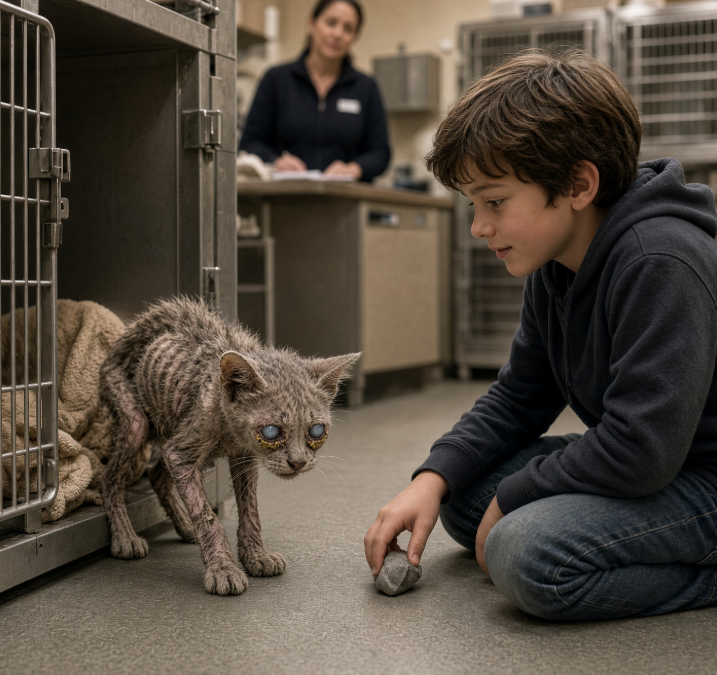
The Blind Cat Everyone Called Broken Stopped Eating—Until One Little Boy Found a Way to Reach Her.
I couldn’t see the empty bowl, but I heard the silence beside it—and that was how I knew the only person who had ever made the dark feel safe was gone.
At the shelter, strangers called me blind, old, damaged, and difficult, never realizing I had spent years finding someone who thought the whole world had forgotten her.
Then a quiet boy rolled one tiny stone toward my cage, and for the first time since I lost everything, somebody asked what I could still do instead of what was wrong with me.
My name is Pixie.
I am a small gray cat with a torn left ear, a tail that bends sideways near the end, and eyes that stopped working long before this story began.
People always assume blindness must be the saddest thing that ever happened to me.
It isn’t.
Darkness is only frightening when you do not know what waits inside it.
I had known darkness for years.
I knew where the couch ended.
I knew where the kitchen began.
I knew that there were thirteen careful steps from my bed to the water bowl if I followed the edge of the rug.
I knew that the third floorboard near the refrigerator squeaked.
I knew the warm rectangle of sunlight that appeared on the living-room carpet every afternoon, even though I could not see the light itself.
Warmth has a location.
So does safety.
So does love.
Blindness did not take those things from me.
What hurt was silence.
The wrong kind.
The kind that appears where a familiar person should be.
Before everything changed, I lived with an old woman named Margaret.
I never saw Margaret’s face.
Not even once.
By the time she found me, the world had already faded from shapes into shadows and then from shadows into nothing.
But I knew her more completely than many humans know people they look at every day.
Margaret smelled like lavender hand lotion, coffee with too much cream, clean cotton, and the peppermint candies she carried everywhere.
She walked slowly.
Her left foot landed heavier than her right.
Step.
Step.
Pause.
Step.
Sometimes her knee clicked.
Every morning at exactly 6:40, her alarm played three soft piano notes.
She would sigh.
The mattress would creak.
Her feet would search for slippers.
Then she would shuffle toward the kitchen.
I always reached my bowl before she did.
Not because I could see.
Because routines create maps stronger than eyes.
Margaret would laugh.
“Of course you’re already there.”
Then came my favorite sound.
Tap.
Tap.
A metal spoon against the side of my ceramic bowl.
“There you are, Pixie girl.”
Her fingers would touch the top of my head.
Two fingers.
Always two.
Never grabbing.
Never surprising.
Margaret understood me.
She had learned quickly that blind cats do not like hands arriving from nowhere.
So she spoke before touching me.
She tapped furniture before moving around me.
She never rearranged the apartment unless she absolutely had to.
If a chair moved, she guided me around it afterward so I could learn.
Humans like to call that accommodation.
To me, it was simply love translated into behavior.
I came to Margaret when I was already old enough to have stopped expecting kindness.
Before her, I had belonged to another family.
I remember children.
Noise.
A dog.
Doors opening too fast.
I remember being able to see once.
Not perfectly.
But enough.
Then came the infection.
Pain.
Medicine sometimes.
Sometimes not.
By the time somebody finally took me to a clinic, there was little to save.
One eye went first.
Then the other.
My old family said they were overwhelmed.
That was the word.
Overwhelmed.
Humans have many elegant words for leaving.
Overwhelmed.
Complicated.
Not the right fit.
Unable to provide care.
They carried me into an animal shelter and walked out without me.
I knew because their smell disappeared.
PART2:
You do not need eyes to understand abandonment.
There is a sound people make when they leave forever.
It is not the door.
It is the silence afterward.
I stayed at that shelter for almost a month.
People liked my gray fur.
Until they read the card.
BLIND.
SENIOR.
SPECIAL-NEEDS HOME PREFERRED.
Then voices changed.
“Oh.”
Poor thing.
Sweet girl.
That’s sad.
What happened to her?
Does she use the litter box?
Will she walk into walls?
How much medical care will she need?
I became a collection of concerns.
Then Margaret arrived.
She did not sound young.
Her breathing was slightly heavy from walking.
She wore shoes with thick soles.
A volunteer brought her down the row.
“You said you wanted an older cat?”
“Yes.”
“Any preference?”
“No.”
“Longhair? Shorthair?”
PART3:
“Whichever one has been waiting longest.”
That made my ears lift.
The volunteer stopped outside my enclosure.
“Well, Pixie has been here twenty-seven days.”
Margaret came closer.
I smelled peppermint.
Coffee.
Lavender.
“She’s blind,” the volunteer explained.
Margaret was quiet.
I waited for the usual response.
Poor thing.
Instead she asked, “Does that bother her?”
The volunteer hesitated.
“What do you mean?”
“Is she frightened all the time?”
“No. Actually, once she knows a space, she navigates very well.”
“Does she like people?”
“When she trusts them.”
“Does she bite?”
“She has opinions.”
Margaret laughed.
I liked that laugh immediately.
“Good. So do I.”
She crouched outside my cage.
Her knees cracked loudly.
“Oh, wonderful,” she muttered. “Getting old is glamorous.”
I moved toward the front.
“Hello, Pixie.”
I froze.
She had spoken before reaching.
Good.
Her fingers touched the bars.
I smelled them.
Lotion.
Peppermint.
Something else.
Loneliness.
Humans do not realize loneliness has a scent.
It does.
Closed rooms.
Old fabric.
Meals cooked for one.
Tears washed away before company arrives.
Margaret waited.
She did not try to touch me.
Eventually I pressed my forehead against one finger.
Her breath caught.
“Oh.”
The volunteer said, “That’s a good sign.”
Margaret whispered, “I think she found me.”
She was wrong.
I had only smelled her.
Finding came later.
Margaret signed the papers that afternoon.
Her apartment was quiet.
No children.
No dogs.
No furniture moved without warning.
The first night, she placed me in the living room and let me explore.
I moved slowly.
Whiskers forward.
Nose working.
Couch.
Rug.
Wall.
Chair.
Table leg.
Hallway.
Kitchen.
Water.
Food.
Litter.
I mapped everything.
Margaret followed at a distance.
Whenever I approached something dangerous, she tapped it gently.
“Careful.”
She did not pick me up.
That mattered.
She allowed me to learn the world instead of carrying me through it.
By the second day, I knew the apartment.
By the third, I knew Margaret.
By the end of the first week, I had learned that she talked to herself.
A lot.
“Where did I put my glasses?”
Pause.
“On my head. Excellent.”
Or:
“Margaret, if you buy cookies, you will eat cookies.”
Pause.
“Obviously.”
Sometimes she spoke directly to me.
“Pixie, we need to discuss rent.”
I purred.
“You contribute absolutely nothing.”
I purred louder.
“That is not a defense.”
But there were quieter days too.
Days when the phone did not ring.
Days when Margaret sat by the window for hours.
I would hear the clock.
The refrigerator.
Cars outside.
And her breathing.
Too still.
Those days, I found her.
Couch edge.
Chair leg.
Her slipper.
Then lap.
I climbed slowly.
She always helped only at the very end, one hand beneath my chest.
I pressed my head under her chin.
Margaret would sigh.
Then she would whisper the sentence that became ours.
“You found me again.”
Of course I did.
Blind cats still know where love is.
Eventually I learned pieces of Margaret’s life.
Her husband, Walter, had died six years before she adopted me.
Her daughter lived in California.
Her son had not spoken to her regularly in years.
I never understood why.
Humans can love one another and still build walls they do not know how to cross.
Margaret kept photographs.
I knew because she touched them often.
Sometimes she would take one from the shelf.
Sit.
Run a thumb over the frame.
“He was handsome, Pixie.”
Walter, probably.
“Stubborn man.”
Pause.
“I miss him.”
I climbed into her lap.
“You didn’t even know him.”
No.
But I knew her.
That was enough.
Years passed.
Margaret got slower.
So did I.
She started using a cane after one winter.
I hated it at first.
It tapped the floor in unexpected places.
Eventually I learned its rhythm.
Tap.
Step.
Tap.
Step.
Sometimes she laughed because we were both navigating by sound.
“Look at us, Pixie. Two old ladies trying not to hit furniture.”
Her phone rang less often.
I could tell.
Not because I counted calls.
Because every ring surprised her.
Sometimes it was her daughter.
Those conversations were complicated.
“Hello, sweetheart.”
Then listening.
“Yes.”
Long pause.
“No, I’m fine.”
Another pause.
“I said I’m fine.”
Her voice would become hard.
Later, she would sit still.
I would find her.
“You found me again.”
Always.
Then came the morning everything ended.
The alarm sounded.
Three piano notes.
I lifted my head.
Usually I heard the mattress move immediately.
That morning, nothing.
I waited.
No slippers.
No sigh.
No bathroom door.
No tap of the cane.
No coffee machine.
I walked toward the kitchen anyway.
My bowl was empty from the night before.
I sat.
Waited.
No spoon.
Tap.
Tap.
Nothing.
At first I thought she had overslept.
So I meowed.
Margaret had never ignored my breakfast voice.
I meowed again.
Silence.
Then I heard something from the bedroom.
Breathing.
Wrong breathing.
Thin.
Uneven.
A soft wet sound after every few breaths.
I stood.
My paws knew the path.
Rug.
Wood.
Squeaky board.
Hallway.
Cold patch near the vent.
Door frame.
Bedroom rug.
I found the bed.
Margaret was still.
Her arm hung over the side.
I touched her fingers with my nose.
Cold?
Not completely.
But wrong.
I pushed harder.
No movement.
I meowed.
Nothing.
I put one paw on her hand.
“Margaret.”
I could not say it.
But I called anyway.
Louder.
Again.
Again.
I climbed onto the bed.
That was difficult by then.
I pressed against her chest.
There was movement.
Barely.
I cried beside her until my throat hurt.
Time passed strangely.
Then pounding.
The front door.
“Mrs. Bennett?”
A voice.
More pounding.
“Margaret?”
Keys.
Door opening.
Heavy footsteps.
“Ma’am?”
Another voice.
Then everything became noise.
Medical equipment.
Radios.
Questions.
“Pulse is weak.”
“Call it in.”
“Ma’am, can you hear me?”
Someone moved me.
I hissed.
“Cat.”
“Careful, she’s blind.”
“How do you know?”
“Tag says it.”
I struggled.
Not hard.
I am small.
Old.
I knew claws would not fix this.
The bed rolled.
Margaret’s smell moved toward the front door.
I followed.
Someone blocked me.
“Easy, sweetheart.”
The apartment door opened.
Cold hallway air entered.
Margaret disappeared through it.
I cried.
The door closed.
I waited.
She had left before.
Doctor appointments.
Groceries.
Church.
But always:
Key.
Door.
“Pixie girl?”
That day, nothing.
Hours later, strangers returned.
A woman.
A man.
They talked quietly.
“She passed at the hospital.”
“I’m sorry.”
“Her daughter is flying in tomorrow.”
“What about the cat?”
Pause.
“I don’t know.”
My ears lifted.
“Animal control?”
“Probably.”
“What’s her name?”
“Tag says Pixie.”
The woman approached.
“Hi, Pixie.”
Not Margaret.
I backed away.
“I’m going to pick you up.”
She warned me first.
That was kind.
I still resisted.
She wrapped me in a towel.
I smelled the apartment as she carried me toward the door.
The rug.
The coffee.
Margaret’s lotion.
Peppermint.
Home.
Then the door closed behind us.
Her smell remained on the other side.
That was the first time I cried without making a sound.
The new shelter was louder than the old one.
Dogs barked somewhere down the hall.
Metal doors rattled.
Phones rang.
People hurried.
I could smell fear from cages around me.
A young cat cried every few minutes.
Another hissed whenever anyone passed.
A shelter worker named Elena carried me carefully.
“We’ll put you in the quieter room, okay?”
I did not care.
There is no quiet room inside grief.
They gave me a soft towel.
Food.
Water.
A litter box with low sides.
Someone examined me.
“She’s dehydrated.”
“Any medical notes?”
“Blind. Arthritis. Probably fourteen or fifteen.”
“Owner died?”
“Yeah.”
“Oh.”
That word.
People said it around me often.
Oh.
As if my whole life could fit inside one sad syllable.
On the first day, families passed.
A woman stopped.
“She’s pretty.”
“She’s blind.”
“Oh.”
Footsteps leaving.
A man.
“How old?”
“Probably fourteen.”
“Oh.”
Leaving.
A little girl.
“Can I pet her?”
“Very gently.”
The girl touched my back too fast.
I jumped.
“She doesn’t like me.”
“She’s blind, sweetheart. She gets startled.”
“Oh.”
Leaving.
Another couple.
“Medical costs?”
“Possibly.”
Leaving.
Leaving.
Leaving.
Humans think blind animals cannot watch people walk away.
We can.
Not with eyes.
With everything else.
By the third day, I stopped approaching the cage door.
People discussed me in front of me.
“She’d be hard.”
“Someone patient.”
“Poor thing.”
“Maybe a rescue group?”
“Senior foster?”
Nobody asked who I was before Margaret died.
Nobody asked what I loved.
Nobody asked whether I slept curled against her stomach.
Whether I knew when medication time came.
Whether I could navigate an apartment after one afternoon of exploring.
Whether I had spent years keeping an old woman company through nights nobody else knew were lonely.
They saw disability.
Not history.
On the fourth day, I stopped eating.
Elena noticed.
“Come on, Pixie.”
She tapped the dish.
Tap.
My body froze.
Tap.
Margaret.
For half a second, home returned.
Then the shelter smell swallowed it.
I turned away.
Elena tried wet food.
Tuna.
Chicken.
Warm food.
Nothing.
“She’s grieving,” someone said.
“We need to watch her. Older cats can crash fast.”
“She has to eat.”
I knew.
I simply could not remember why.
Then, late that afternoon, came the sound.
Tick.
Tick.
Tick.
Something small rolled across the floor.
Stopped.
My ears turned.
Again.
Tick.
Tick.
Tick.
Not metal.
Not plastic.
Stone.
A boy whispered, “She heard it.”
Another voice.
Adult male.
“Noah, don’t bother her.”
“I’m not.”
“Come look at the kittens.”
“No.”
Silence.
Then the stone rolled again.
Tick.
Tick.
Tick.
I lifted my head.
It stopped near my cage.
I stood.
My legs felt weak.
I moved toward the sound.
Slowly.
Straight.
My whiskers touched the bars exactly where the stone rested outside.
The boy inhaled sharply.
“She knew where it was.”
A shelter volunteer said, “Her hearing is excellent.”
The boy crouched.
I could smell him.
Grass.
Pencil shavings.
Peanut butter.
Rain from his jacket.
And nervousness.
Children smell nervous differently than adults.
Sharper.
Faster.
He did not reach through the bars.
Good.
He picked up the stone.
Rolled it again.
Tick.
Tick.
Tick.
I turned.
Followed.
Stopped.
Again.
He laughed.
Not loud.
A little breath of a laugh.
His father said, “Noah, she can’t see.”
The boy answered, “I know.”
“You wanted to look at cats.”
“I am.”
“I meant one we can actually—”
His voice stopped.
Elena stepped closer.
“One he can actually what?”
The father sounded embarrassed.
“Nothing.”
I understood.
One he can actually play with.
One he can actually adopt.
One that actually works.
Noah rolled the stone again.
I followed.
Then he whispered:
“She’s not broken.”
My entire body became still.
Humans had called me many things.
Poor.
Blind.
Old.
Special-needs.
Sweet.
Difficult.
Sad.
Nobody had ever defended me from a word before someone said it.
“She’s not broken.”
The father sighed.
“I didn’t say she was.”
“You were going to.”
“Noah.”
The boy stopped talking.
His silence changed.
Closed.
I knew that kind too.
The footsteps left a few minutes later.
But the next afternoon, Noah returned.
This time without his father.
Another woman brought him.
She smelled like vanilla, paper, and cold air.
“My aunt Lisa,” Noah said quietly to Elena.
“Hi, Lisa.”
“I told his dad I was taking him to the library.”
Noah whispered, “She lies.”
Lisa laughed.
“I adapt.”
She sat in a chair.
Noah sat on the floor.
Tick.
Tick.
Tick.
I approached immediately.
His breathing changed.
“You remember.”
Yes.
He stayed forty minutes.
He talked very little.
That was fine.
Some people treat silence like a problem requiring repair.
Cats do not.
Noah rolled the stone.
Sometimes he tapped the floor gently.
One tap meant left.
Two meant right.
He invented the system slowly.
I learned.
Soon we had a game.
Stone rolls.
I follow.
Tap.
Turn.
His voice:
“Good girl.”
I began eating again that night.
Elena noticed.
She told Noah the next day.
“She ate a whole serving after you left.”
Noah’s voice became brighter.
“Really?”
“Really.”
“Because of me?”
“Maybe.”
I wanted to tell him yes.
Not because he fed me.
Because he reminded me I could still move toward something.
Noah came every day for a week.
Sometimes with Lisa.
Sometimes with his father, though his father rarely looked comfortable.
His name was David.
David wanted a young cat.
I learned that from conversations outside my cage.
“We talked about this, buddy.”
“I want Pixie.”
“She’s old.”
“So?”
“She has medical needs.”
“So?”
“She’s blind.”
“I know.”
“She might not live very long.”
Noah became silent.
David sighed.
“I’m not trying to be mean.”
“You are.”
“Noah.”
“I don’t want another kitten.”
“I thought you did.”
“I thought I did too.”
David lowered his voice.
“You barely talk to people anymore. I wanted something playful. Something that might get you moving.”
Noah said, “Pixie gets me moving.”
“You know what I mean.”
“No.”
There was pain underneath David’s frustration.
I could smell it.
I began wondering about Noah.
He was maybe eleven.
His sneakers dragged slightly when he walked.
He startled when adults raised their voices.
Sometimes he sat beside my cage without playing.
Just breathing.
One afternoon, he whispered:
“My mom used to tap on my door.”
I lifted my head.
He rolled the stone once.
“She died last year.”
There it was.
The smell I recognized.
Grief.
“I don’t like when people say she’s in a better place.”
He waited.
“I liked her place here.”
I moved toward the bars.
Noah put one finger near them.
He waited until I sniffed.
Then I pressed my face against him.
His breath caught.
“I don’t like people touching me when I’m sad.”
I understood.
“They always hug me.”
Pause.
“Even when I don’t want it.”
I rubbed his finger.
“You don’t.”
No.
I would never arrive without warning.
“You wait.”
Yes.
He whispered, “Mom used to wait too.”
After that, I understood why Noah knew not to grab me.
Why he did not pity silence.
Why his father wanted a playful kitten.
David was trying to repair his son.
That is what frightened adults do when grief lasts longer than expected.
They search for activities.
Sports.
Therapy.
Pets.
Vacations.
Anything that looks like movement.
But Noah did not need to be repaired.
He needed somewhere grief did not make him unusual.
I knew that place.
The shelter became more complicated after two weeks.
My food had improved.
My coat looked better.
I walked confidently inside the visitation room.
But nobody else wanted me.
Noah watched family after family pass.
One Saturday, a couple asked to meet me.
Noah was there.
He sat in the corner while they talked to Elena.
The woman seemed kind.
She stroked my back carefully.
“How does she do with stairs?”
“She can learn them.”
“Does she need medication?”
“Pain medication for arthritis as needed.”
The man asked, “What happens if she gets confused?”
Elena explained.
The woman sighed.
“I just don’t know.”
The man said, “We wanted something lower maintenance.”
Noah whispered, “Then get a plant.”
Everyone heard.
David closed his eyes.
“Noah.”
The couple left.
I purred.
He had earned it.
But later David and Noah argued in the parking lot.
We could hear part of it through the shelter doors.
“You cannot insult people.”
“They insulted her.”
“They asked questions.”
“They called her maintenance.”
“Noah.”
“She heard them.”
David’s voice softened.
“She’s a cat.”
Silence.
Wrong thing.
Very wrong.
Noah said nothing for the rest of the afternoon.
When he sat by my cage, he did not roll the stone.
I found him anyway.
He was close enough that I smelled peanut butter.
I walked toward the bars.
He pressed his forehead carefully against them.
“I know you hear.”
Yes.
He cried quietly.
I stayed.
Three days later, a shelter employee I did not know stopped outside my enclosure with Elena.
“We’re full.”
“I know.”
“We have three owner surrenders coming tomorrow.”
“I know.”
“What’s the plan for Pixie?”
My body tightened.
Elena’s voice changed.
“Senior foster list.”
“No responses.”
“Rescue partners?”
“Two declined. One’s full.”
“What about the boy?”
“His father hasn’t agreed.”
Pause.
“We can’t keep a kennel indefinitely.”
Elena became angry.
“She is eating, stable, social.”
“I’m not saying today.”
“Then don’t say it like that.”
“I’m saying we need a plan.”
They walked away.
Humans think animals do not understand conversations because we do not understand every word.
We understand tone.
Urgency.
Fear.
Endings.
That afternoon Noah came.
Tick.
Tick.
Tick.
I did not move.
He rolled again.
Nothing.
He crawled closer.
“Pixie?”
I turned my head.
“What’s wrong?”
I stayed.
He reached one hand toward the bars, then stopped before touching.
“Can I?”
He had learned to ask even though I could not answer in words.
I leaned forward.
He touched my head.
Two fingers.
Exactly two.
My body went rigid.
Margaret.
Noah pulled back.
“Sorry.”
I moved toward his hand.
Again.
Two fingers.
Tap.
Tap.
Everything inside me broke open.
I began purring louder than I had since the apartment.
Noah laughed.
“There you are.”
The exact rhythm of Margaret’s words.
Not the same voice.
Not the same person.
But something in me answered.
That night, Noah apparently made his case at home.
I learned the details later from the conversations adults had near me.
David said no.
Noah did not yell.
He wrote a list.
FEEDING.
LITTER.
MEDICINE.
STAIRS.
HOW TO HELP A BLIND CAT LEARN A HOUSE.
HOW MUCH SENIOR CAT FOOD COSTS.
He calculated allowance.
He promised chores.
David still said no.
Then Noah asked the question that changed him.
“Is it because you think losing her will hurt me?”
David did not answer immediately.
“Yes.”
Noah said, “I already know what losing someone hurts like.”
Silence.
“I don’t need you to protect me from loving things because they might die.”
David apparently left the room.
Later, Lisa told Elena he cried in the garage.
Adults cry in hidden places when they believe children need them to be stronger than they actually feel.
The next day David came alone.
He stood outside my cage.
I smelled him before he spoke.
“Hi, Pixie.”
I stayed on my towel.
He crouched.
“I think I owe you an apology.”
Interesting.
“I wanted Noah to get a kitten because I thought a kitten would make him happy.”
He rubbed his hands together.
“His mother died fourteen months ago.”
I knew.
“He stopped playing baseball.”
Pause.
“Stopped having friends over.”
Another pause.
“Some days he barely talks to me.”
David’s voice cracked.
“I keep thinking if I find the right thing, I’ll get him back.”
I walked toward the front.
“But maybe that’s the problem.”
He exhaled.
“I keep trying to get back the boy he was before she died.”
Yes.
“Maybe that boy isn’t coming back.”
Not exactly.
People do come back.
But changed.
There is no return to a place grief has burned through.
Only rebuilding.
David put his fingers near the cage.
I sniffed.
“He doesn’t need a kitten, does he?”
I rubbed once.
David laughed quietly.
“You are manipulative.”
Correct.
That afternoon, the shelter began the adoption process.
It should have been simple.
It wasn’t.
My age concerned the veterinarian.
My blindness concerned David’s landlord.
The apartment complex required pet approval.
There was a deposit.
Medical records.
An adoption counselor asked whether the family understood senior care.
David nearly backed out when he heard the estimated cost of future bloodwork.
Noah went silent again.
Then Lisa said, “I’ll cover the adoption fee.”
David objected.
She said, “Then call it Noah’s birthday present for the next three years.”
Noah said, “That’s okay.”
Everyone laughed except David.
“I was joking,” Lisa said.
“I wasn’t,” Noah answered.
There was also another problem.
David’s house had stairs.
Lots of them.
The counselor recommended restricting me to one floor initially.
Noah asked questions.
So many questions.
“How do I teach her?”
“Use texture markers.”
“What’s that?”
“Different rugs near important areas.”
“Can I tap the bowl?”
“Yes.”
“Twice?”
“Sure.”
My ears lifted.
Tap.
Tap.
Noah smiled toward me.
“Twice.”
The adoption was scheduled for Friday.
Thursday night, a severe storm rolled through.
Thunder shook the shelter.
Dogs barked.
Cats cried.
I had never liked storms after losing my sight.
The pressure changes first.
Then air.
Then noise arrives from nowhere.
I curled against the back wall.
Elena stayed late.
She moved through the room checking everyone.
“It’s okay, Pixie.”
No.
It was not.
Thunder hit.
I jumped.
Then another sound came.
Tick.
Tick.
Tick.
Impossible.
I lifted my head.
Again.
Tick.
Tick.
Tick.
Then Noah.
“Pixie?”
I stood.
Elena said, “What are you doing here?”
David answered.
“He wouldn’t sleep.”
“You came in this weather?”
“I’m beginning to understand I don’t make all the decisions anymore.”
Noah sat outside the cage.
He rolled the stone.
I came forward.
Thunder struck.
I flinched.
Noah did not touch me.
He simply stayed.
“Mom hated storms too.”
He rolled the stone.
“She pretended she didn’t.”
Another roll.
“We used to count seconds.”
Thunder.
“One.”
Rain.
“Two.”
Thunder.
“Okay, that one cheated.”
I pressed against the bars.
Noah rested his hand near my paw.
That was the first night I realized something important.
He did not need me because I was helpless.
He needed me because I understood how to sit inside fear without trying to make it disappear.
There is a difference.
Friday afternoon, the cage door opened.
I heard papers.
Pens.
Adult voices.
David.
Elena.
Lisa.
Noah.
I waited.
The door opened wider.
My body moved backward.
Not because I did not want Noah.
Because open doors had become dangerous things.
One had closed behind Margaret.
One had closed when my first family left me.
Open doors meant change.
Change meant losing maps.
Losing smell.
Losing certainty.
Elena whispered, “It’s okay.”
I stayed.
Then:
Tick.
Tick.
Tick.
The stone rolled across the visitation room.
I turned.
Again.
Tick.
Tick.
Tick.
Toward Noah.
I stepped out.
One paw.
Then another.
My legs shook.
The room fell silent.
I followed the stone.
No cage wall.
No towel.
Open floor.
My whiskers worked.
My ears measured the room.
Noah rolled the stone again.
I followed.
Until I reached his shoes.
Grass.
Pencil.
Peanut butter.
Grief.
Home beginning.
He crouched.
“Hi.”
I rubbed his ankle.
His breath broke.
“Can I pick you up?”
I waited.
His hands slid gently beneath me.
Slow.
Predictable.
He lifted me.
I pressed against his chest.
His heart was beating fast.
“There you are, Pixie.”
Something inside me came undone.
Cats do not always show where pain lives.
We can purr while frightened.
Eat while lonely.
Sleep while grieving.
But inside me, an old knot loosened.
Margaret was gone.
That did not change.
My apartment was gone.
That did not change.
But for the first time since I heard that terrible silence beside my empty bowl, being alive no longer felt like waiting for something that would never return.
Noah’s house sounded wrong.
At first.
Every new home does.
The refrigerator hummed lower than Margaret’s.
The heating vent clicked.
The carpet was thicker.
There were stairs.
So many stairs.
Noah placed me in his bedroom initially.
One room.
Simple.
Bed.
Rug.
Desk.
Water.
Food.
Litter.
He showed me each one.
He did not carry me between them.
He tapped.
“Water.”
Tap.
“Food.”
Tap.
“Bed.”
He placed different-textured mats near each station.
A rough mat by the door.
Soft by water.
Rubber under food.
I learned them in two days.
Then the hallway.
Then the upstairs bathroom.
Then, eventually, stairs.
Nine steps.
Landing.
Turn.
Four steps.
Noah sat below me the first time.
Not touching.
“One.”
I stepped.
“Two.”
Step.
“Three.”
He counted all nine.
At the landing:
“Turn.”
Then four.
When I reached the bottom, David applauded.
I startled so violently I almost fell over.
Noah yelled, “Dad!”
“Sorry!”
I hissed.
David said, “Fair.”
The first morning, I woke before everyone.
I found the rough mat.
Hallway.
Stairs.
I did not go down.
Too soon.
I waited.
Then footsteps.
Noah.
Soft.
Bare feet.
He crouched beside me.
“Morning.”
We descended together.
Kitchen.
He opened food.
Ceramic bowl.
Spoon.
Then:
Tap.
Tap.
My whole body froze.
For one moment, Margaret stood behind me.
Coffee.
Lavender.
Peppermint.
“There you are, Pixie girl.”
I heard it so clearly that I turned.
Nothing.
Then Noah whispered:
“There you are, Pixie.”
I walked to the bowl.
Ate.
Noah sat on the floor.
David stood in the doorway.
He did not say anything.
But I smelled tears.
Adults think children are the only ones being healed in stories like ours.
They are often wrong.
Noah had grief.
David had guilt.
His wife’s death had broken the house in two different directions.
Noah went inward.
David became busy.
Repairs.
School emails.
Appointments.
Groceries.
Laundry.
He solved.
Solved.
Solved.
Because the one problem he could not solve was death.
So he tried solving everything around it.
When Noah stayed in bed, David suggested soccer.
When Noah cried, David suggested therapy.
When Noah stopped eating breakfast, David bought different cereal.
When Noah said nothing, David asked more questions.
Love had become pressure.
I changed that accidentally.
Noah talked to me.
Not because I demanded it.
Because I did not.
At night, he lay in bed.
I learned the route.
Rug.
Backpack.
Bed frame.
Jump.
His mattress dipped.
I climbed onto his chest.
Sometimes his heart beat quickly.
On those nights, I tucked my head under his chin.
The first time, he froze.
Then whispered:
“You found me again.”
My purr started before I decided to.
He did not know those had been Margaret’s words.
I never told him.
Some sentences belong to more than one love.
School was difficult for Noah.
I learned from the way he came home.
Good days:
Door.
Backpack dropped.
“Pixie?”
Quick steps.
Bad days:
Door.
Long silence.
Backpack placed carefully.
Bedroom.
No voice.
I always waited a few minutes.
Then found him.
One afternoon, he came home smelling of rain and anger.
He closed his bedroom door.
I scratched once.
Nothing.
Again.
“No.”
I scratched.
“Pixie.”
Again.
The door opened.
“I said no.”
He did not sound angry at me.
He sat on the floor.
I walked onto his lap.
His hands stayed at his sides.
“They called me Blind Boy.”
I lifted my head.
“Because of you.”
Interesting.
“They said I adopted a broken cat because I’m broken too.”
My claws flexed.
I suddenly wished cats could attend middle school.
“There’s this kid, Mason.”
Noted.
“He said I should’ve gotten a normal pet.”
Noah’s breathing shook.
“I punched him.”
Oh.
“Not hard.”
Better.
“He pushed me first.”
Convenient.
“Dad’s mad.”
Noah buried his face near my neck.
“I hate school.”
I stayed.
Later, David entered.
“Noah.”
Silence.
“We need to talk.”
“I know.”
David sat.
He smelled tired.
“Did Mason say those things?”
“Yes.”
“Why didn’t you tell the principal?”
“Because everybody always wants me to tell.”
David paused.
“That’s generally how adults find out things.”
“I wanted him to stop.”
“I know.”
“I hate when people call Pixie broken.”
David looked toward me.
“So do I.”
Noah sniffed.
“You used to think it.”
David was quiet for a long time.
“Yes.”
Noah looked up.
David did not defend himself.
“That was my mistake.”
Something softened.
“I thought normal meant easier.”
He rubbed his hands together.
“But easier isn’t always better.”
Noah leaned against the bed.
David continued.
“You still can’t punch people.”
“I know.”
“You can tell them to stop.”
“I did.”
“You can walk away.”
“I tried.”
“You can get a teacher.”
“They don’t listen.”
David’s voice hardened in a new direction.
“Then I’ll make them.”
Justice, I learned, is sometimes a grieving father arriving at a middle school office at 8:05 on Monday morning carrying printed emails.
Mason was disciplined.
Not destroyed.
Not expelled.
Real life rarely produces perfect villains.
His mother apologized.
Mason eventually muttered something resembling sorry.
Noah did not forgive him immediately.
That was okay.
He did something more important.
For a school presentation two months later, Noah chose the topic:
“How Blind Animals Navigate the World.”
He practiced in his bedroom.
I was his audience.
“Blind cats use whiskers.”
I cleaned my paw.
“Their hearing helps them locate movement.”
I yawned.
“They can create mental maps.”
I scratched.
“Pixie, take this seriously.”
No.
He brought a recording of my stone game.
Tick.
Tick.
Tick.
He explained texture markers.
Routine.
Scent.
Sound.
He ended by saying:
“Disability changes how an animal does things. It doesn’t erase who they are.”
His teacher asked if he wrote that.
“Yes.”
He did.
After the presentation, Mason came over.
Noah tensed.
Mason said, “Your cat’s kind of cool.”
Noah replied, “She was cool before you knew.”
Correct.
Months passed.
I learned the whole house.
The sunny patch appeared in the living room around 2:00.
I knew because the carpet warmed.
David’s office had a rolling chair I despised.
The laundry room smelled like Margaret’s clean towels enough that I sometimes stood there longer than necessary.
Noah’s backpack lived in random places.
I tripped over it twice.
After the second time, David said, “If the blind cat keeps finding your backpack before you do, we have a problem.”
Noah moved it.
I became part of the house.
Not inspiration.
Not tragedy.
Cat.
I stole chicken.
I scratched one dining chair.
I woke David at 4:30 because breakfast expectations should be clear.
I knocked a glass from the coffee table.
David yelled:
“Pixie!”
Then immediately:
“Sorry, did that scare you?”
I purred.
Training humans takes time.
One evening, a box arrived.
It smelled old.
Dust.
Paper.
Peppermint.
I froze.
David opened it.
“What is this?”
Noah approached.
“There’s a note.”
Paper unfolded.
David read quietly:
“Dear Mr. Carter, my name is Emily Bennett. Margaret Bennett was Pixie’s owner. I recently learned through the shelter that Pixie was adopted by your family. I found several of her things while cleaning out my mother’s apartment. I don’t know whether they would help or upset her, so I’m sending only a few items. Please use your judgment. Thank you for giving her a home.”
Margaret.
My legs weakened.
Noah knelt.
“What is it?”
I smelled the box.
Lavender.
Faint.
Almost gone.
Peppermint.
Fabric.
Home.
Inside was a small blanket from Margaret’s chair.
My old ceramic food bowl.
And something else.
A spoon.
Noah picked it up.
“Why a spoon?”
I walked toward it.
My nose touched metal.
Memory came so fast I almost cried aloud.
Tap.
Tap.
Morning.
Margaret.
“There you are, Pixie girl.”
Noah looked at David.
“She knows it.”
David opened the second paper.
A note from Margaret herself.
Found in a drawer.
Her daughter had included a copy.
David read:
“If anything happens to me, please make sure Pixie goes to someone patient. She is not helpless. She knows more than people think. Tap her bowl twice so she knows where breakfast is. Speak before touching her. Do not move furniture too often. She likes warm laundry, hates vacuum cleaners, and knows when you are sad even if you lie about it. Please don’t let anyone pity her. She has never pitied me.”
The room went silent.
Noah started crying.
David stopped reading.
I stood beside the spoon.
Noah took a breath.
“Keep going.”
David did.
“Pixie found me at a time in my life when I thought being alone was something I had to get used to. Every day she reminded me that needing company is not weakness. If she outlives me, I hope whoever gets her understands that she has already lost enough. Give her time. She will find you.”
David lowered the paper.
Noah looked at me.
“You did.”
I walked toward him.
He touched two fingers to my head.
“There you are.”
I pressed into his hand.
Margaret had not disappeared.
Not completely.
Love leaves instructions.
That may be one of the kindest things humans can do.
Emily visited several weeks later.
Margaret’s daughter.
She stood in the living room.
I smelled lavender lotion.
Not the same.
Similar.
My head lifted.
Emily gasped.
“Pixie?”
I approached slowly.
She crouched.
Her breathing changed.
“She looks exactly the same.”
David laughed.
“According to the vet, she absolutely does not.”
Emily cried.
I sniffed her hand.
Peppermint.
She had brought one.
“Oh, Mom.”
I pressed my forehead into her fingers.
Emily made the sound people make when regret finally meets something gentle.
“I should’ve visited more.”
Noah sat nearby.
Nobody corrected her.
“I kept telling her to move closer.”
Emily’s voice shook.
“She wouldn’t.”
David understood too well.
“She said this apartment was where she knew everything.”
I understood that.
Maps matter.
Emily stroked my head.
“I was so angry.”
Tears.
“I thought she chose stubbornness over me.”
Pause.
“Then she died.”
I leaned against her knee.
“I’m sorry, Pixie.”
No.
The apology did not belong to me.
But I accepted the touch.
Emily stayed for dinner.
She told stories about Margaret.
Young Margaret.
Loud Margaret.
Margaret who danced badly in kitchens.
Margaret who once drove four hours because Emily’s college roommate dumped her.
Margaret who could hold grudges for years.
Margaret who loved fiercely and apologized poorly.
A person I had known differently.
That is another strange thing about love.
Nobody knows the same person.
We each carry a version.
Mine smelled like coffee, lotion, peppermint, and morning spoon taps.
Emily’s version sang Motown too loudly.
Noah’s version existed only in stories.
All were true.
Before Emily left, she handed Noah the spoon.
“You keep it.”
He looked at me.
“Are you sure?”
“My mother would want Pixie to have it.”
Every morning after that, Noah used Margaret’s spoon.
Tap.
Tap.
Breakfast.
Sometimes grief does not disappear.
It changes jobs.
What used to hurt becomes ritual.
Years moved.
I got older.
Noah got taller.
His footsteps changed.
His voice changed.
Peanut butter became less common.
Pencil shavings stayed.
He started high school.
Made friends again.
Not many.
Enough.
He joined an audio club because he liked recording sounds.
Rain.
Trains.
Birds.
City streets.
He once recorded my purring for a project.
Title:
“Home Frequency.”
Ridiculous.
I approved.
David laughed more too.
He dated once.
Then stopped.
Then later met a woman named Rachel.
Rachel spoke before touching me.
Smart woman.
Noah liked her slowly.
That was wise.
Nobody tried to replace his mother.
That mattered.
People are not positions.
Love is not furniture.
You do not remove one chair and slide another into the exact spot.
You build a bigger room.
One winter, my legs became much worse.
The stairs grew difficult.
Noah noticed immediately.
He was sixteen by then.
He built me a small ramp.
David said, “You know they sell those.”
Noah replied, “This one fits.”
I used it.
Mostly.
Sometimes pride required ignoring useful objects for several days first.
My kidneys weakened.
My hearing softened slightly.
The world became smaller.
But never empty.
Noah moved my food upstairs when necessary.
Then slept on the floor beside me one particularly bad night.
I woke and heard his breathing.
For a moment, I remembered Margaret.
The old apartment.
Her hand beside the bed.
I reached one paw toward Noah.
Touched his wrist.
He woke.
“Hey.”
His voice was older.
Still him.
“You okay?”
I pressed closer.
He understood.
By then, he always did.
A few months later, the veterinarian had a long conversation with David and Noah.
Quality of life.
Pain.
Appetite.
Good days.
Bad days.
Words humans never want.
Noah cried in the car afterward.
“I’m not ready.”
David said, “I know.”
“What if she’s not ready?”
“I don’t know.”
Noah leaned his head against the window.
“I don’t want to do what happened with Mom.”
David’s breathing changed.
His wife’s death had been sudden.
No choice.
No goodbye.
No preparation.
David said quietly, “This is different.”
“How?”
“We get to protect Pixie from pain.”
Noah cried harder.
“That doesn’t feel like protection.”
“No.”
David’s voice broke.
“It doesn’t.”
I listened from my carrier.
The irony was not lost on me.
Years earlier, David had resisted adopting me because he feared Noah would be hurt when I died.
He had been right.
Noah was going to hurt.
But that did not make adopting me a mistake.
Pain at the end does not invalidate love before it.
Humans know this and forget it constantly.
They want guarantees.
Long enough.
Safe enough.
Easy enough.
There are none.
There is only whether the love was worth the eventual missing.
For us, it was.
My final morning came quietly.
No shelter.
No strangers deciding fast.
No empty apartment.
No cage.
I woke in Noah’s room.
Sun warmed part of the carpet.
I could feel it.
David made coffee downstairs.
Rachel spoke softly in the kitchen.
Noah sat beside me.
He was seventeen.
His hand rested near my paw.
He had the little stone.
The same one.
He had kept it all those years.
He rolled it gently.
Tick.
Tick.
Tick.
I lifted my head.
He laughed through tears.
“You still hear it.”
Of course.
Again.
Tick.
Tick.
Tick.
I tried to stand.
My legs failed.
Noah stopped rolling.
“No.”
I pushed again.
He put one hand near me but did not lift.
He waited.
Always waiting.
I got up.
One step.
Another.
Toward the stone.
Noah cried openly.
“You’re so stubborn.”
Yes.
I reached it.
Touched it with one paw.
Then lay down.
Noah whispered:
“She’s not broken.”
The same words.
Years apart.
His voice was older now.
But I remembered.
He picked me up.
This time I did not shake.
He carried me downstairs.
David had arranged for the veterinarian to come to the house.
At home.
Like Margaret would have wanted.
Like Noah needed.
I lay on a blanket.
Margaret’s old blanket.
The ceramic bowl sat nearby.
The spoon rested beside it.
Noah held the stone.
David knelt.
Rachel stayed close but gave us room.
The veterinarian explained.
Noah listened.
Then asked:
“Will she know I’m here?”
“Yes.”
His face collapsed.
He leaned toward me.
“Good.”
He touched two fingers to my head.
“Pixie.”
I heard him.
“You found me when I didn’t think anybody could.”
No.
You found me first.
“I know that sounds stupid.”
It did not.
“You were there when I missed Mom.”
Yes.
“When school sucked.”
Yes.
“When Dad didn’t get it.”
David made a wounded sound.
Noah laughed through tears.
“He gets it now.”
Good.
David put one hand on Noah’s shoulder.
“I love you, buddy.”
“I know.”
Noah looked down at me.
“You taught me blind doesn’t mean lost.”
I purred.
Barely.
“You taught me old doesn’t mean finished.”
My breathing slowed.
“And you taught me that if somebody moves differently, you don’t drag them.”
His voice broke.
“You learn how to call them.”
He picked up the stone.
Rolled it one final time.
Tick.
Tick.
Tick.
It stopped beside my paw.
I touched it.
The first medicine made my body lighter.
Pain moved farther away.
Noah held me.
My head rested below his chin.
His heart beat quickly.
Lonely.
Scared.
Alive.
I pressed upward as much as I could.
My head touched him.
He whispered the sentence.
The one Margaret had said.
The one Noah had unknowingly inherited.
“You found me again.”
Of course I did.
That was what I did.
I found love in rooms I could not see.
I found Margaret.
I found Noah.
And in the end, they had both found me.
My last clear sound was not crying.
Not the veterinarian.
Not traffic.
Not even Noah’s voice.
It was the spoon.
David had lifted it.
He tapped the ceramic bowl gently.
Tap.
Tap.
Breakfast.
Morning.
Home.
Margaret.
Noah.
Every life I had lived folded into two tiny sounds.
Tap.
Tap.
Then quiet.
But not the wrong quiet.
Not abandonment.
Not an empty apartment.
Not a cage after someone walked away.
This silence had hands around me.
It had Noah’s heartbeat.
David’s hand on my back.
Rachel crying somewhere close.
A stone beside my paw.
The silence was full.
That made all the difference.
Months later, Noah went back to the shelter.
Elena still worked there.
She recognized him immediately.
“Oh my God.”
He laughed.
“Hi.”
“How’s Pixie?”
Silence.
Elena knew.
Her voice softened.
“Oh, Noah.”
“She made it almost six years with us.”
“That’s incredible.”
“Yeah.”
He cried.
No shame.
Elena hugged him only after asking.
He said yes.
Then he walked through the cat room.
Not looking for replacement.
You cannot replace a history.
He simply wanted to be there.
Near the end of the row, something caught his attention.
Not sight.
Sound.
A cage.
A cat inside refusing to come forward.
Young.
Black.
Missing a back leg.
People passing.
Noah stopped.
The card said:
MARBLE.
SHY.
TRIPOD.
NEEDS PATIENT HOME.
Noah crouched.
He reached into his pocket.
The stone was still there.
He rolled it carefully across the floor outside the cage.
Tick.
Tick.
Tick.
Inside, the frightened cat’s ears moved.
Noah smiled through tears.
He did not say:
Poor thing.
He did not say:
Broken.
He did not ask what was wrong.
He waited.
The cat came closer.
One cautious step.
Then another.
Elena watched from down the hall.
Noah whispered:
“There you are.”
And maybe that is what a life leaves behind.
Not only memories.
Methods.
Patience.
The knowledge that there are different ways to move through the same world.
The understanding that what looks damaged from a distance may only need a different map.
I spent years without sight.
But I was never without direction.
Love has sound.
A spoon against ceramic.
A stone crossing tile.
A boy breathing beside a cage.
An old woman whispering from a chair.
Two fingers touching fur after warning first.
A heartbeat beneath your head.
People believe sight is how you recognize home.
They are wrong.
Home is repetition.
Home is the person who learns where you are afraid.
Home is somebody adjusting instead of demanding you become easier.
Home is being known closely enough that your limitations stop being the most interesting thing about you.
Margaret knew that.
Noah learned it.
And I lived it.
I was Pixie.
Blind.
Old.
Torn ear.
Crooked tail.
Arthritic legs.
A medical file full of problems.
Those facts were true.
They were never the whole truth.
I was also the cat who found an old woman in her loneliness.
The cat who learned an apartment without eyes.
The cat who survived being left twice.
The cat who followed a stone through grief.
The cat who taught a boy that love does not need to arrive loudly to change a life.
I could not see the world.
But I knew where breakfast was.
I knew where warmth gathered.
I knew when a person needed company.
I knew when a hand was afraid.
I knew grief.
I knew trust.
And until my last breath, I knew exactly where love was.
Sometimes the lives people call broken are not broken at all.
They are simply waiting for someone patient enough to learn how they work.
Someone who does not grab.
Does not pity.
Does not walk past because the story looks harder than the pretty one in the next cage.
Someone willing to sit on a shelter floor.
Someone willing to roll one small stone.
Tick.
Tick.
Tick.
And wait.
Because sometimes that is all a lost heart needs.
Not eyes.
Not fixing.
Not rescuing.
Just one sound worth walking toward.








