The Baby Monitor Caught Our Cat at 3:11 A.M.—What She Was Doing Terrified Us Until We Understood
PART3:
Eli sobbed harder.
“She woke me up.”
I lifted her off him, and she twisted in my hands, not scratching, but fighting to get back down.
“Out,” I told her.
I put her in the hallway and closed Eli’s door.
She sat outside and meowed.
Not her usual low complaint.
A sharp, urgent sound.
Eli’s crying quieted after a few minutes. I tucked him in, kissed his forehead, and went back to bed.
In the morning, he seemed fine.
Tired, maybe.
A little grumpy.
But six-year-olds are often tired and grumpy, especially in winter when school, darkness, and indoor recess conspire against everyone.
The second night, Pepper did it again.
This time at 2:26.
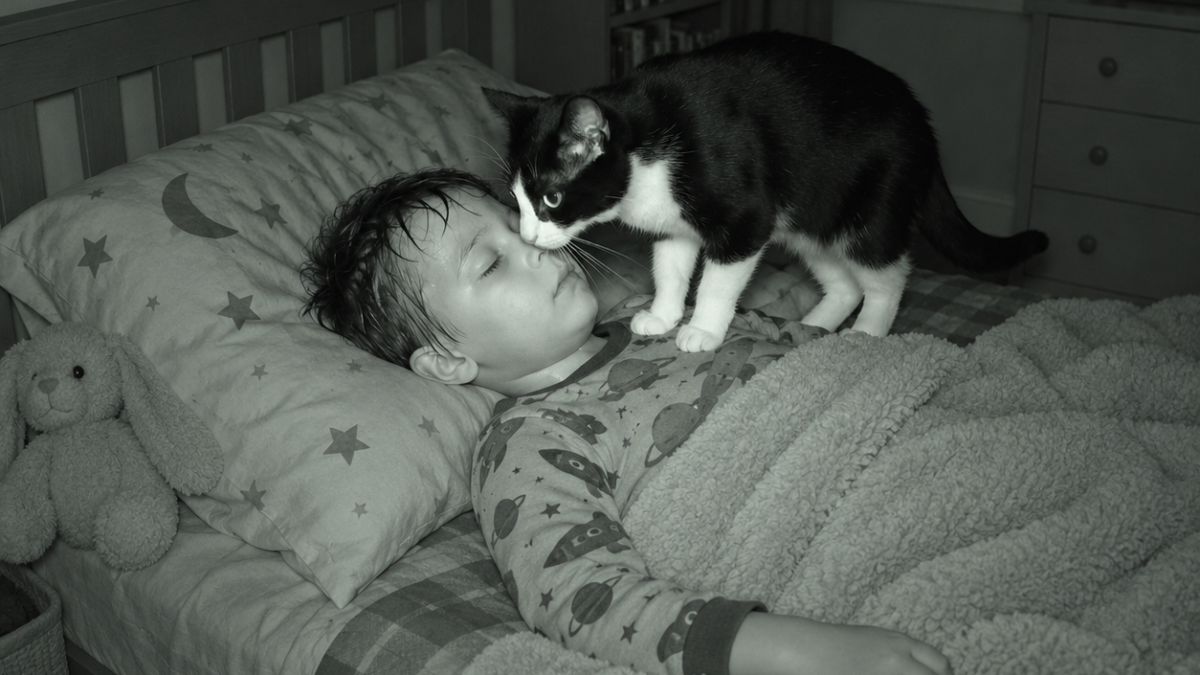
The baby monitor caught part of it before I entered the room: Pepper slipping through the partially open door, jumping onto the bed, walking up Eli’s blanket with terrible purpose, then placing her front paws on his chest and pressing her nose to his mouth.
Eli stirred.
Pepper pushed harder.
He woke crying.
I was frightened that time.
Not rationally, maybe, but deeply.
Something about the monitor image—my child asleep in the dark, the cat’s body rigid above him, her face pressed to his—made my skin crawl.
I scooped her up and shut her out again.
She clawed the door for nearly an hour.
Mark finally got up and carried her downstairs.
“She’s obsessed,” he muttered when he came back.
“She’s never done this before.”
“Exactly.”
By the third night, we closed Eli’s door firmly.
Pepper scratched at it.
Not casually.
Desperately.
She dug at the wood until Mark went out and hissed her name.
“Pepper. Stop.”
She looked up at him and meowed once.
Then scratched again.
He locked her in the laundry room.
She howled.
Pepper, who had spent three years proving she could go ten hours without acknowledging us, howled through the laundry room door like something had broken inside her. Mark put a towel along the bottom of the door to muffle the sound. I lay awake staring at the ceiling, irritated, exhausted, guilty, and unnerved.
The next morning, Eli came downstairs pale and quiet.
“You okay, buddy?” I asked.
He shrugged.
“My stomach feels weird.”
“No school?”
He looked panicked at that.
Eli hated missing school. He loved his teacher, loved library day, loved being line leader with the seriousness of a small public servant.
“I can go,” he said quickly.
I touched his forehead.
No fever.
He ate two bites of cereal and said he was full.
I blamed tiredness.
I blamed winter.
I blamed growth.
I did not blame anything serious because parents survive ordinary life by believing ordinary explanations first.
Pepper sat under his chair and watched every bite he did not take.
For about two weeks, life became a tense negotiation with a cat.
Pepper followed Eli constantly.
She tried to climb on him whenever he lay down.
She sniffed his breath.
She cried at his door.
She paced between his room and ours.
She became, in Mark’s words, “the problem.”
At first, he said it jokingly.
By day seven, he meant it.
“I can’t keep doing this,” he said one morning after a night of Pepper scratching and meowing. “Nobody is sleeping.”
“I know.”
“She’s scaring Eli.”
“I know.”
“She bit me when I tried to move her.”
“She didn’t break skin.”
“That’s not the point.”
He looked exhausted. We both were.
Eli sat at the table in dinosaur pajamas, picking at a waffle while Pepper sat beside his chair, her tail wrapped tight around her paws.
“Maybe she’s sick,” I said.
“Then take her to the vet.”
“I called. They can see her Friday.”
“That’s four days.”
I looked toward Eli.
He had dark circles under his eyes.
So did I.
Mark lowered his voice.
“I’m not saying today. But if this doesn’t stop, maybe we need to think about another home.”
The sentence landed between us like a plate dropped on tile.
I stared at him.
“You mean give her away?”
“I mean if she’s suddenly aggressive and fixated on Eli, we can’t ignore that.”
“She’s been with us three years.”
“And Eli is our child.”
That was the argument no parent can easily answer, because of course your child comes first. Always. Instantly. Without question.
But Pepper was not attacking him.
Not exactly.
She was waking him.
Scaring him.
Disturbing him.
Making nights impossible.
But she was also doing it with an intensity that felt almost purposeful, and somewhere deep down, beneath exhaustion and fear, I knew the shape of the behavior did not match cruelty.
Still, I was tired.
Tired people choose easy explanations because they are easier to act on.
We kept Pepper out of Eli’s room.
When that did not work, we shut her in the basement at night.
The basement was warm and finished, with her litter box moved down there, food, water, her favorite towel, and enough space to make us feel less guilty.
She hated it.
Every night, she sat at the bottom of the stairs and cried.
Every night, I told myself she was fine.
Every night, Eli slept behind a closed door.
Or seemed to.
The baby monitor had been leftover from when Eli was smaller. We had stopped using it regularly when he turned five, but during a winter stomach bug we plugged it back in, and somehow it stayed. The camera sat on a shelf across from his bed, slightly angled down. Mostly, it showed nothing. A sleeping boy. A blanket. Blue night-light glow. Sometimes the top of Pepper’s head before we banned her.
On the ninth night, the video began at 3:11 a.m.
I know because the time stamp is burned into my memory.
03:11:07.
The hallway was dark except for the night-light glow under Eli’s door.
Pepper was supposed to be in the basement.
I still do not know how she got out.
Mark swears he latched the door.
I believe him.
Pepper had never been clever in an obvious way, but determination teaches intelligence quickly. Maybe the latch did not catch. Maybe she pulled at the gap. Maybe the house shifted. Maybe we will never know.
The camera captured Eli’s closed bedroom door from a sliver of hallway reflection in the mirror on his dresser. For the first few seconds, nothing moved.
Then Pepper appeared.
A black-and-white shape in the hall.
She ran at the door.
Not walked.
Ran.
She threw her body against it with a force so hard the monitor shook slightly from the vibration.
The sound woke me.
A dull thud from down the hall.
I sat up in bed.
“What was that?” I whispered.
Mark groaned beside me.
Then Pepper hit the door again.
Thud.
This time he sat up too.
“Oh my God,” he muttered. “The cat.”
Before either of us moved, Pepper did something she had never done in three years.
She came to us.
I heard claws on the hallway floor, fast and frantic. Then she burst through our half-open bedroom door, jumped onto the bed, and landed on my legs. I gasped and shoved upright.
“Pepper!”
She ran up the blanket toward me.
Her eyes were wide.
Her body stiff.
Before I could grab her, she bit my hand.
Not hard enough to break skin.
Hard enough to shock me.
Deliberate.
Then she turned and ran out of the room.
I stared after her, heart hammering.
Mark cursed and threw back the blankets.
“That’s it. I’m putting her in the carrier.”
I was angry too.
Scared.
Half awake.
My hand stung where her teeth had pressed.
I followed him into the hallway, already planning to lock Pepper in the garage until morning, call the vet, call the shelter, call someone who could tell us why our normal cat had become a nightmare.
Pepper stood outside Eli’s door.
She looked back at me.
Meowed once.
Then scratched.
Not wild.
Not angry.
Insistent.
Mark reached for her.
She darted away from his hand and hit the door again with both front paws.
That was when I heard Eli.
Not crying.
Not calling.
Breathing.
A strange, wet, uneven breathing through the monitor speaker on the hallway table.
I do not know why that sound cut through my anger when the scratching had not.
Maybe because mothers know the rhythm of their child’s sleep without realizing they know it until the rhythm changes.
I grabbed the doorknob.
“Eli?”
The room was dim and blue.
The air felt too warm.
Eli lay tangled in his blanket, soaked through his pajamas with sweat. His hair stuck to his forehead. His face was pale—not normal pale, not winter pale, but gray, waxy, wrong. His lips looked faintly bluish at the edges. His eyes were half-open but unfocused.
For one second, my mind refused what it saw.
Then I was beside him.
“Eli.”
I touched his cheek.
Cold and damp.
“Eli, wake up.”
He did not.
I shook his shoulder gently.
Nothing.
Mark turned on the lamp.
The light made everything worse.
Our son looked like a child made of paper.
“Eli!” I screamed.
His eyelids fluttered.
His mouth moved.
A sound came out, thick and slurred.
Not words.
Not really.
Mark was already grabbing his phone.
“I’m calling 911.”
Pepper jumped onto the bed.
I almost shoved her away by instinct, but she did not climb onto him this time. She stood near his legs, tail puffed, body rigid, staring at his face.
Watching.
Waiting.
The dispatcher’s voice came through Mark’s phone.
“What is the address of your emergency?”
I lifted Eli against me. His body was limp in a way I had never felt before and pray never to feel again. He mumbled something that sounded like “cold,” though he was drenched in sweat.
The dispatcher asked questions.
Was he breathing?
Yes.
Was he conscious?
Barely.
Fever?
No.
Seizure?
No, not yet, not that we knew.
Had he eaten?
Not much.
Any known medical conditions?
No.
No.
That word would soon become the most dangerous one.
No known medical conditions.
The ambulance arrived fast and still not fast enough. By then, Eli had become slightly more responsive but confused. He cried weakly when the EMT pricked his finger.
The EMT looked at the meter.
Then looked again.
His face changed.
“Blood glucose is thirty-eight.”
I did not know what that meant.
Not really.
I knew blood sugar existed. I knew diabetics checked it. I knew low numbers were bad in the vague way you know things before they become your life.
“Is that bad?” I asked.
The EMT was already moving.
“It’s very low.”
Everything became motion.
Glucose gel.
Questions.
Mark grabbing Eli’s shoes.
Me trying to answer while watching my son’s eyes.
Pepper sitting in the hallway, silent now.
The same cat who had screamed for nights made no sound while strangers carried my child out of the house.
At 3:40 a.m., we were on our way to the emergency room.
I rode in the ambulance.
Mark followed in the car.
I remember fluorescent lights streaking over Eli’s face. I remember the EMT telling me his sugar was coming up. I remember Eli trying to ask where Pepper was, but his words came out mushy and broken. I remember saying, “She’s home, baby. Pepper’s home,” while my brain replayed every night we had locked her away.
At the hospital, they ran tests.
More finger sticks.
Blood draws.
Urine sample.
Questions I answered badly because my mind kept getting stuck on the number thirty-eight.
A doctor with kind eyes and tired shoulders came in around dawn.
“Your son’s blood sugar dropped dangerously low tonight,” she said.
I held Eli’s hand. He was sleeping by then, color better, IV in place, cheeks no longer gray.
“What caused it?”
“We’re still confirming with labs, but given his symptoms and current values, we are concerned about new-onset type 1 diabetes.”
Diabetes.
The word entered the room and rearranged the future.
I looked at Mark.
His face had gone blank with fear.
“But he’s six,” I said.
The doctor nodded gently.
“It often appears in children. Sometimes the early signs are subtle or develop over weeks. Increased thirst, increased urination, weight changes, fatigue, changes in appetite, mood shifts.”
Every sentence struck a memory.
Eli asking for water more often.
Eli wetting the bed once and crying from embarrassment though he had not done that in years.
Eli eating less some days, then suddenly wanting snacks.
Eli seeming tired.
Cranky.
Pale.
I had seen the pieces.
Pepper had smelled the pattern.
The doctor continued, “A blood glucose of thirty-eight in a sleeping child is concerning. Severe hypoglycemia can progress to seizure, loss of consciousness, or worse if untreated.”
My hand tightened around Eli’s.
Mark whispered, “How did this happen?”
The doctor misunderstood.
She began explaining the immune system, insulin, beta cells, monitoring, education, hospitalization, stabilization.
But Mark’s eyes were not on her.
They were on me.
We were both thinking the same thing.
How did this happen under our roof while only the cat noticed?
We spent three days in the hospital.
Three days learning a new language.
Insulin.
Basal.
Bolus.
Carbs.
Correction factor.
Ketones.
Hypoglycemia.
Hyperglycemia.
Finger stick.
CGM.
Glucagon.
Juice boxes became medicine.
Numbers became weather.
Food became math.
Sleep became fragile.
Eli adjusted better than we did at first, partly because children are adaptable and partly because he was relieved to understand why his body had felt strange. He did not like the injections. He hated the finger sticks. He cried the first time a nurse said he would have diabetes forever.
I cried later in the bathroom, silently, with my fist pressed against my mouth.
Mark became practical because fear made him need tasks.
He made charts.
Downloaded apps.
Asked the diabetes educator questions until she started smiling whenever he raised his hand.
At night, after Eli fell asleep in the hospital bed, Mark and I sat in the dim room whispering about Pepper.
Not at first.
At first, we were too busy being terrified.
But by the second night, when the nurses had checked Eli’s glucose twice and adjusted things, Mark said, “Laura.”
I looked up.
“She knew.”
I closed my eyes.
“I know.”
“She knew before we did.”
“I know.”
“We locked her in the basement.”
I pressed my hands over my face.
“I know.”
That was the worst part.
Not simply that Pepper had warned us.
That we had punished her for it.
For nine nights, she had tried to reach him.
For nine nights, she had smelled something changing in his breath, his sweat, his skin—something dogs are trained for years to detect, something no one had trained Pepper to notice. And instead of asking why, we called her the problem.
We shut doors.
We yelled.
We threatened to rehome her.
We locked her below us while our son’s body drifted into danger above.
Guilt is a blunt instrument.
That week, it hit everything.
When Mark went home to shower and feed Pepper, he called me from the house.
“She won’t eat,” he said.
My throat tightened.
“What?”
“She’s sitting outside Eli’s room.”
“Let her in.”
“He’s not there.”
“I know. Just let her in.”
He opened the door.
I heard it over the phone: Pepper’s urgent little chirp, her paws on the floor, Mark’s shaky breathing.
“She’s on his bed,” he said after a moment.
Then quieter, “She’s smelling his pillow.”
I turned away from Eli so he would not see my face.
“Tell her he’s okay.”
Mark let out a broken laugh.
“I’m serious.”
“I know.”
A pause.
Then I heard my husband, who had called Pepper the problem, whisper into our son’s empty room, “He’s okay, Pepper. You did good. He’s okay.”
When Eli came home, Pepper was waiting at the top of the stairs.
Not in the laundry room.
Not hiding.
Waiting.
Eli was tired from the hospital and overwhelmed by everyone’s careful voices. He had a small bandage on one arm, a diabetes bag bigger than his backpack, and a look in his eyes that made him seem older than he had been three days earlier.
Pepper walked straight to him.
I froze.
Not from fear this time.
From reverence.
She sniffed his shoes.
His hands.
His shirt.
Then she stood on her hind legs, placed her front paws gently against his thigh, and meowed.
Eli crouched.
“Hi, Pepper.”
She pressed her forehead against his chest.
He wrapped both arms around her.
Pepper did not pull away.
For three years, she had treated affection like a tax she refused to pay.
Now she stood there in my son’s arms and let him cry into her fur.
That night, we left Eli’s bedroom door open.
Pepper walked in before he finished brushing his teeth.
She jumped onto the bed, circled once, and settled near his feet. Eli looked at me from the doorway.
“She can stay?”
I swallowed.
“Yes.”
Mark stood behind me.
“With your permission,” he said carefully. “It’s your room.”
Eli nodded.
“She saved me.”
Neither of us corrected him.
Because she had.
The baby monitor stayed on.
So did the new glucose monitor once we got it.
The continuous glucose monitor, or CGM, attached to Eli’s arm with adhesive and sent readings to a receiver and our phones. It had alarms for low blood sugar and high blood sugar. It was technology I was deeply grateful for and deeply afraid to trust all at once.
For the first few weeks, I barely slept.
I checked the app constantly.
Mark and I took shifts.
Midnight.
Two.
Four.
Every beep sent adrenaline through my body. Every meal became a math problem. Every birthday invitation became a logistical event. Every gym class, recess, stomachache, and bedtime snack came with calculations.
Pepper adapted faster than we did.
She stopped waking Eli every night.
But she did not stop watching him.
She slept in his room with his permission, usually on the blanket near his side or curled at the foot of the bed facing the door. Sometimes, she moved closer and sniffed his face. If he was fine, she settled again. If she was unsettled, she let us know.
The first time it happened after the diagnosis, the CGM alarm had not yet gone off.
It was 1:48 a.m.
I woke to Pepper meowing in the hallway.
Not the old frantic scream.
A firm, sharp call.
I checked my phone.
Eli’s number was dropping but not technically low yet.
Seventy-six with a downward arrow.
I got up and went to his room. Pepper stood on his chest, exactly as she had in the video, nose near his mouth, one paw pressed against his pajama shirt.
“Okay,” I whispered. “I’m listening now.”
Five minutes later, the CGM alarm sounded.
By then, Eli was already sipping juice.
Mark stood in the doorway, hair messy, face pale.
“She beat the machine,” he said.
Pepper sat beside Eli, tail wrapped around her paws, looking deeply unimpressed by the technology we had clearly overpaid for.
It happened again three weeks later.
Pepper woke Mark before the low alarm.
Again, Eli was trending down.
Again, we treated him before the sensor screamed.
Again, Pepper stayed beside him until his number rose.
After that, Mark stopped calling the CGM the main system.
“That’s the backup,” he said, pointing to the receiver.
Then he nodded toward Pepper.
“That’s the primary.”
I laughed, but my eyes filled.
Because he meant it.
Our vet, Dr. Kline, was fascinated.
We brought Pepper in after Eli’s diagnosis, partly because I wanted to apologize through medical care and partly because I needed someone to tell me she was not sick, anxious beyond help, or neurologically changed.
Dr. Kline listened to the whole story without interrupting.
Then she sat back.
“Animals can notice changes we miss,” she said. “Dogs are trained for glucose alert work because they can detect scent changes associated with blood sugar shifts. Cats aren’t commonly trained for it, but that doesn’t mean they can’t notice patterns. Especially if they are closely bonded.”
“Pepper wasn’t closely bonded,” Mark said.
Dr. Kline smiled.
“Maybe not in the way you recognized.”
That sentence stayed with me.
Maybe Pepper had always been more connected than we knew. Maybe she had watched from laundry baskets and doorways, cataloging our habits, our moods, our scents, with the quiet precision of a creature we had mistaken for indifferent because she did not perform affection in ways we expected.
Maybe she had loved Eli all along.
Or maybe something about his changing body called her to him, and concern became attachment.
We will never know.
Pepper offered no explanation.
Only behavior.
And behavior, when listened to, saved our son.
Life after Eli’s diagnosis was not simple, but it became livable.
The first months were hard.
There were tears over injections.
Arguments over snacks.
A terrifying stomach virus that sent us back to the emergency room.
School meetings.
A nurse training session.
A diabetes care plan.
A box in the classroom labeled with Eli’s name and full of juice, glucose tabs, snacks, backup supplies, and instructions I checked three times.
Eli learned to tell us when he felt shaky.
Then when he felt “floaty.”
Then when he felt “low.”
He named his CGM receiver Buzz because it would not stop bothering people. He named his insulin pen Captain Poke, which made me laugh and then cry in the pantry because children should not have to make jokes around needles to make adults less sad.
Pepper stayed close.
Not always touching.
Not clingy.
She remained Pepper: aloof when she wished, opinionated about food, violently opposed to closed laundry baskets. But Eli became her assignment. She followed him with calm purpose. She sat under the kitchen table during meals. She slept in his room. She came to us if something changed at night.
We learned to listen.
That was the difference.
The first time Pepper meowed at Eli during the day, I stopped what I was doing and checked.
He was fine.
A little high, actually.
I gave Pepper a treat anyway because I was not interested in discouraging communication.
The second time, he was low after playing outside.
The third, he had a fever.
It was not always blood sugar.
Sometimes she simply noticed wrongness.
A mother should have noticed too.
That thought haunted me.
Therapy helped.
Yes, therapy.
For me.
Not because I caused Eli’s diabetes. I know that now. Type 1 was not my fault. I did not create it by missing signs or feeding him the wrong things or failing some invisible test of motherhood.
But guilt does not disappear just because facts correct it.
I needed help holding both truths:
I did not cause the illness.
I did miss signs.
I did ignore Pepper.
I did punish the alarm.
My therapist said, “You responded based on the information you understood at the time.”
I said, “Pepper understood more.”
“She wasn’t interpreting it through fear of danger.”
That stopped me.
Because that was exactly what we had done.
We saw Pepper on Eli’s chest and interpreted threat.
We saw scratching and interpreted misbehavior.
We saw obsession and interpreted danger.
Pepper smelled illness and interpreted emergency.
Same facts.
Different understanding.
After that, I began watching the world differently.
When a child changed behavior, I asked what the behavior might be saying.
When Pepper acted strange, I asked why before reacting.
When my own body felt tense or frightened, I asked what it had noticed before my mind caught up.
Eli changed too.
In ways both hard and beautiful.
He became more aware of his body than any six-year-old should have to be. He learned numbers and carbs and symptoms. He learned that adults could be loving and still scared. He learned some friends were kind and some were curious in exhausting ways. He learned Pepper was allowed on his bed but not his pillow, though that rule failed frequently.
He also became proud of her.
At school, when his teacher asked students to bring a picture of something important to them, Eli brought a photo of Pepper sitting beside his glucose monitor.
“This is my cat,” he told the class. “She knew I was sick before everybody.”
A boy asked, “Is she magic?”
Eli thought about it.
“No,” he said. “She pays attention.”
His teacher called me afterward and repeated that sentence.
I wrote it down.
She pays attention.
That is what love does when it is at its best.
It pays attention without demanding to be praised for noticing.
Pepper became famous in our neighborhood after that, though she did not enjoy fame.
Mark made the mistake of telling our neighbor Denise the story while putting out trash cans. By dinner, three people had texted asking if it was true that our cat “detected diabetes.” One neighbor brought cat treats. Another asked if Pepper could meet her husband because he snored and maybe the cat could diagnose him with something.
Pepper declined all social appointments.
Denise’s daughter drew a picture of Pepper wearing a superhero cape. Eli taped it to his bedroom door.
Pepper scratched it off within an hour.
“She doesn’t like capes,” Eli said solemnly.
Apparently not.
Six months after the diagnosis, I finally watched the full baby monitor video.
I had only seen pieces before, enough to know what happened, not enough to sit with the whole thing. I waited until Eli was at school and Mark was at work. Pepper sat on the back of the couch in the dining room sun, washing one paw.
I opened the file.
03:11:07.
The hallway.
The door.
Pepper’s small body running into frame.
The first impact.
The second.
Her sprint to our room.
Then, from the bedroom camera angle after we opened Eli’s door, the blur of us rushing in. Me at the bed. Mark with the phone. Pepper jumping onto the blanket. Eli’s pale face caught in blue light.
I paused the video there.
For months, I had remembered terror.
Watching it again, I saw something else.
Pepper was not frantic in the way I thought.
She was urgent, yes. Desperate, yes. But once we entered the room, she did not attack, did not interfere, did not panic.
She stood guard.
At the foot of Eli’s bed, she watched us finally do what she had been trying to get us to do for nine nights.
I turned toward the couch.
Pepper looked at me.
“I’m sorry,” I said.
She blinked once.
Not forgiveness.
Not understanding.
Just Pepper.
I got up, took one of her treats from the cabinet, and placed it beside her.
She sniffed it, ate it, then returned to washing her paw.
That was the closest thing to absolution I was going to get.
It was enough.
Every year now, on the anniversary of that night, we do something small.
Not a party.
Not a dramatic retelling.
We make pancakes for dinner because Eli loves them and because we have learned how to count the carbs properly. Pepper gets a spoonful of plain chicken on a tiny plate because she saved a human life and remains convinced this should have improved her regular menu.
Eli calls it Pepper Day.
The first year, he made her a card.
Dear Pepper,
Thank you for waking me up and biting Mom.
Love, Eli.
Mark laughed so hard he had to sit down.
“I was part of the emergency response too,” I said.
“You were asleep,” Eli replied.
“Because it was night.”
“Pepper wasn’t.”
Fair.
The second year, Eli added a line:
Thank you for being annoying until they listened.
That one went on the fridge.
Because that is another thing love sometimes has to be.
Annoying.
Persistent.
Unwelcome.
The scratch at the door.
The alarm you want to silence.
The truth that keeps returning after you have decided it is inconvenient.
Pepper is older now.
She is seven, nearly eight.
Still black and white.
Still not cuddly with anyone except Eli, and even with him, on terms negotiated by her royal household. She sleeps in his room every night. Not because we force it. Because they both want it. The door stays cracked. The CGM receiver sits on his nightstand. My phone is charged beside my bed. Juice boxes sit in a basket on the dresser.
The backup systems are better now.
So are we.
Pepper still wakes us sometimes.
Not often.
But when she does, we move.
No debate.
No “she’s just being weird.”
No “the sensor hasn’t gone off.”
We check.
Every time.
Sometimes the number is fine and she is offended that we doubted her medical judgment. Sometimes he is trending down. Once, he was low enough that I felt that old cold fear flood me again, but we caught it early, because Pepper stood on Mark’s chest and yelled into his face until he woke.
He opened one eye and said, “Okay, nurse.”
She bit his beard.
Gently.
Mostly.
When people hear our story, they often want it to be simple.
Cat saves boy.
Family loves cat.
Happy ending.
But the real story is more complicated.
The real story includes two exhausted parents who almost made the worst decision of their lives because the warning sounded like a problem.
It includes a child whose body was changing in ways we did not understand.
It includes a cat adopted as a mouser, dismissed as furniture with opinions, who noticed what the humans missed.
It includes guilt.
Apology.
Learning.
Medical training.
Technology.
Fear.
Trust rebuilt between people and an animal who had never asked to be understood in the first place.
The real story is not that pets are magic doctors.
They are not.
Pepper is not a replacement for Eli’s endocrinologist, his CGM, his insulin, his care plan, or the emergency supplies we carry everywhere now. We do not rely on her alone. We do not romanticize danger or pretend love can manage a chronic illness without science.
But we also do not dismiss her.
Not anymore.
Because Pepper knew something was wrong before the machines entered our house.
Before the diagnosis had a name.
Before the adults caught up.
She knew enough to climb on a sleeping child’s chest.
Enough to press her nose to his breath.
Enough to scratch a door until her paws must have hurt.
Enough to bite the hand of the mother who kept ignoring her.
That bite was the best thing she ever did to me.
I mean that.
She did not wound me.
She woke me.
There is a difference.
The scar never formed on my skin, but the memory stayed.
A small pressure mark.
A shock.
A warning.
A message delivered in the only language she had left after nine nights of being misunderstood.
Now, when I see Pepper asleep beside Eli, I sometimes think about the shelter worker who called her “independent” and “low-touch.” She was not wrong. Pepper is still independent. Still not interested in strangers. Still likely to leave the room if anyone says, “Here, kitty kitty,” in a voice she finds insulting.
But she is also something else.
A watcher.
A guardian.
A witness.
The quiet life in the corner that turned out to be paying closer attention than anyone knew.
That is what I tell other parents now, when the topic comes up carefully in conversations about pets and children and illness.
Not that every strange animal behavior is a diagnosis.
Not that a cat knows more than a doctor.
But this:
When an animal’s behavior toward a person changes suddenly and persistently, notice it.
Say it out loud.
Mention it to a professional.
Ask the extra question.
It costs one sentence.
We nearly paid far more because we did not ask ours.
The sentence could have been simple:
Our cat has suddenly become obsessed with waking our son at night.
Maybe the pediatrician would have asked about thirst, appetite, sweating, fatigue. Maybe not. Maybe we still would have missed it until the emergency. I cannot rewrite the past into certainty.
But I know I wish I had said it.
I wish I had listened sooner.
I wish Pepper had not spent nine nights trying to save my child while we treated her like the danger.
That regret lives with me.
So does gratitude.
The two are roommates now.
Some nights, after Eli falls asleep, I stand in his doorway and watch the soft glow of the CGM receiver on his nightstand. His room is different than it was that first night. Older now. More books. Fewer stuffed dinosaurs. Soccer cleats near the closet. A poster of planets on the wall. A basket of medical supplies that has become so ordinary it sometimes breaks my heart.
Pepper lies on the blanket beside him, her black-and-white body curved toward his chest, ears flicking at small sounds in the house.
She almost always faces the door.
Always watching.
I whisper, “Goodnight, Pepper.”
Sometimes she opens one eye.
Sometimes she does not.
Either way, I know she hears me.
And I know this, too:
On the night of 3:11 a.m., I thought I was walking down the hall to punish a cat.
Instead, I opened a door and found the truth.
My son was in danger.
The alarm had fur.
The warning had whiskers.
The creature we almost gave away had been the only one paying attention closely enough to know that a little boy’s life was quietly slipping out of balance in the dark.
Pepper is not a piece of furniture with opinions anymore.
She never was.
She is the reason my son woke up.
She is the reason we learned what his body needed.
She is the reason we keep the video, even though it still frightens me.
Because terror is not the only thing on that screen.
So is love.
Not soft, pretty, greeting-card love.
A fierce little black-and-white body launching itself against a closed door.
A warning refused again and again.
A bite on my hand.
A mother finally waking.
A child saved because the smallest member of the house refused to be ignored.
That is why I keep the video.
That is why Pepper sleeps wherever she wants.
That is why, when the CGM receiver glows beside my son’s bed and our cat lifts her head before it alarms, I do not question her anymore.
I get the juice.
I check the number.
I listen.
Because Pepper knew before we did.
And she never stopped trying to tell us.








