The $300 Shelter Puppy Everyone Had Given Up On Clung to a Former Navy SEAL—and Refused to Let Him Walk Away
PART3:
Tyson ended the evaluation.
His report read:
Severe generalized anxiety.
Extreme startle response.
Fear-reactive tendencies.
No reliable working drive observed.
High rehabilitation burden.
Unsuitable for law enforcement.
Liability risk.
The final recommendation consisted of three words.
Wash him out.
That phrase followed Tag 42 everywhere.
The washout.
The defective shepherd.
The dog who had all the breeding and none of the nerve.
Because he was purebred, the shelter initially placed a $300 adoption fee on him.
Management hoped appearance might accomplish what personality could not.
For the first few weeks, visitors stopped at his kennel.
“He’s gorgeous.”
“Look at those ears.”
“He’s going to be huge.”
Then someone would open the door.
Tag 42 would retreat.
A hand would reach toward him.
He would shake.
A child would squeal.
He would press himself into the corner.
Potential adopters wanted loyalty.
Confidence.
A dog trotting happily beside a backyard fence.
They did not want an animal who looked at a human hand as though it might explode.
By October, his coat had lost its shine.
Stress shedding left uneven patches along his flanks.
He ate inconsistently.
His ribs began showing.
The other dogs barked when families came through.
Some spun circles.
Some shoved paws through kennel bars.
Some performed every trick they knew.
Tag 42 turned away.
He faced the wall.
He had learned that being unnoticed was safer.
Sara Jenkins, one of the shelter volunteers, spent more time with him than anyone.
She never forced contact.
Every morning she sat outside his run for ten minutes reading whatever book she had brought.
She did not even look at him.
Eventually he started eating while she sat there.
Months of damage measured its progress in inches.
One afternoon he moved close enough to sniff her shoe.
Sara went home and cried in her car because it felt like winning a championship.
Then the Hendersons came.
Richard and Laura Henderson lived in a large suburban home with a fenced yard.
Laura wanted to “save something nobody else wanted.”
Richard liked the idea of a German Shepherd guarding the house.
They paid the $300.
Sara spent forty minutes explaining Tag 42’s history.
“No sudden confinement.”
Richard nodded.
“He needs decompression time.”
“We understand.”
“Don’t leave him isolated right away.”
“We won’t.”
“He may destroy things if he panics. That isn’t defiance.”
Richard smiled impatiently.
“We’ve had dogs before.”
Tag 42 left Oak Creek at 4:10 on a Wednesday afternoon.
He returned at 3:42 Friday morning.
Richard Henderson came through the front doors red-faced and furious.
The puppy stumbled behind him on a slip lead.
“You people sold me an insane animal.”
Sara hurried from behind the desk.
“What happened?”
“What happened?”
Richard slammed the leash onto the counter.
“We went to dinner.”
Sara stared.
“For how long?”
“Two hours.”
“You left him alone?”
“In the laundry room. I’m not leaving a new dog loose in my house.”
Sara looked down.
Tag 42 was panting so hard strings of saliva hung from his mouth.
His gums were red and raw.
“What did he do?”
“He ate through the wall.”
Richard laughed angrily.
“Literally. Through the drywall. Then he tore half the door casing off.”
Sara crouched.
There was dried blood around the dog’s mouth.
“He tried to get out.”
“He destroyed my house.”
“He panicked.”
“Call it whatever you want. I want my money back.”
Tag 42 returned to Kennel 18.
Something changed after that.
Before the Hendersons, he hid when people approached.
Afterward, he began shaking as soon as footsteps entered the hallway.
Shelter management faced a decision they hated but made every week.
Oak Creek was overcrowded.
Strays filled temporary crates.
Three cruelty seizures had arrived within ten days.
There were more animals than kennels.
A dog returned for destructive panic was difficult enough.
A large shepherd with severe fear responses and no rescue commitment was almost impossible.
A red sticker appeared on Tag 42’s clipboard.
FRIDAY, NOVEMBER 12.
5:00 P.M.
Sara found it before lunch.
She marched into the manager’s office.
“He’s five months old.”
“I know.”
“He hasn’t bitten anybody.”
“I know.”
“So what exactly are we killing him for?”
The manager looked exhausted.
“For being unable to live safely in a normal home.”
“He needs the right home.”
“We’ve been looking for three months.”
“Then look longer.”
“Where do I put tomorrow’s dogs?”
Sara had no answer.
The manager rubbed his face.
“You think I want this?”
“No.”
“Then don’t talk to me like I do.”
Sara’s anger disappeared.
That was the cruelty of overcrowded shelters.
There did not always have to be a villain.
Sometimes there were simply too many animals, too little money, too few homes, and a clock.
By the morning of November 12, somebody had drawn a line through the $300 fee.
Underneath, in red marker, was one word.
URGENT.
Three families walked past Tag 42 that morning.
One man asked about him.
The shelter staff explained.
The man chose a Labrador mix instead.
At noon, Tag 42 slept against the back wall.
At two, he refused food.
At three, Sara sat outside his kennel reading but realized she had stared at the same paragraph for fifteen minutes.
Thirty miles away, David Caldwell woke from a nightmare at 3:07 that morning and never went back to sleep.
His body came upright before consciousness arrived.
Hands reached for a rifle that was not beside the bed.
For ten seconds, the ceiling fan became helicopter blades.
The cabin became a burning vehicle.
The cold Appalachian darkness became Iraq.
David heard Ramirez screaming.
Then somebody else.
Maybe himself.
He stumbled from the bed.
His shoulder struck the wall.
“Not there.”
He said it aloud.
His voice sounded foreign.
“Not there.”
He forced himself into the breathing exercise Dr. Mitchell had given him.
Four seconds in.
Hold.
Four seconds out.
Again.
His pulse gradually slowed.
The room returned.
One bed.
One dresser.
One old quilt.
A pair of boots beside the door.
No weapon.
No burning vehicle.
No blood.
David was thirty-four.
At twenty-two, he had joined the Navy.
At twenty-five, he earned the trident he had wanted since high school.
Four deployments followed.
He became good at doing difficult things while exhausted.
Good at functioning inside chaos.
Good at carrying weight.
Good at being the man others trusted when plans disintegrated.
Then a roadside bomb outside Ramadi turned a vehicle into twisted metal.
David remembered light.
Impact.
Nothing.
Then waking in a military hospital unable to remember the name of the nurse standing over him.
The injuries were visible and invisible.
Shrapnel scars spread across his left shoulder.
Two fingers occasionally went numb.
His left ear never regained full hearing.
The traumatic brain injury caused migraines, memory gaps, and sensory overload.
Then there was PTSD.
David hated the acronym.
It sounded small.
Clinical.
Orderly.
Nothing about it explained what happened when a shopping cart hit a metal display and his body decided he was under attack before his mind knew where he was.
Nothing about it explained why he had abandoned a cart full of groceries and spent twenty minutes behind a grocery store vomiting.
Nothing explained why sleep felt dangerous.
Why silence felt crowded.
Why being home sometimes felt harder than war.
The Navy medically retired him.
Everyone congratulated him for surviving.
David almost resented them.
Surviving had been the easy part.
Living afterward was what he had not trained for.
He bought an isolated cabin near the Appalachian foothills because he thought distance from people would make him feel safer.
It did.
For a while.
Then safety became isolation.
Isolation became routine.
Routine became something darker.
Some weeks the only person David spoke to face-to-face was Dr. Aris Mitchell, his VA psychiatrist.
Mitchell was patient in the way David sometimes found infuriating.
“You need an anchor,” Mitchell had told him four days earlier.
David sat with his arms crossed.
“I have a house.”
“Not that kind.”
“A truck.”
Mitchell stared.
David sighed.
“You’re going to say dog again.”
“I am.”
“I don’t need a babysitter.”
“A psychiatric service dog is not a babysitter.”
“I’ve seen the brochures.”
“Then you know what they can do.”
“I also know they cost more than my truck.”
“There are programs.”
“I don’t want one.”
Mitchell leaned back.
“Why?”
David opened his mouth.
No answer came.
Mitchell waited.
Finally David said, “Because everything I get attached to dies.”
The room went quiet.
Mitchell’s expression softened.
David immediately hated that he had said it.
“Forget it.”
“I’m not going to forget it.”
“I’m not getting a dog.”
“Then go look at dogs.”
David frowned.
“That makes no sense.”
“Go to a shelter.”
“For what?”
“Practice being around something alive.”
“I’m around trees.”
“Trees don’t need you.”
David looked away.
Mitchell continued.
“You’ve built your entire life so nothing can ask anything of you.”
“That sounds efficient.”
“It sounds like you’re disappearing.”
David said nothing.
“You’re surrounded by ghosts,” Mitchell said. “Maybe go somewhere that has a pulse.”
At 3:20 on November 12, David stood in his kitchen staring at truck keys.
He had no intention of adopting a dog.
He barely liked dogs.
Military dogs, yes.
He respected them.
But pet ownership?
Food schedules.
Veterinary appointments.
Hair on furniture.
No.
He picked up the keys anyway.
The drive to Oak Creek took forty minutes.
He almost turned around twice.
At 3:45, David pushed through the shelter’s front doors.
Noise hit him like physical force.
Barking.
Whining.
Metal bowls sliding.
Kennel gates rattling.
A dog howled somewhere in the rear.
Bleach.
Wet fur.
Disinfectant.
His nervous system ignited.
David froze.
The lobby became too bright.
Every bark stacked on top of the next.
His vision narrowed.
He searched for exits automatically.
Front door.
Side hall.
Behind reception.
Potential obstacles.
People.
A child.
A metal chair.
His heart accelerated.
No.
Not here.
He turned toward the door.
Abort.
That was how his brain framed everything when panic rose.
Abort.
Leave.
Get clear.
Survive.
He reached for the handle.
At that same moment, Sara opened the kennel wing door.
Tag 42 was on the end of her leash.
It was 4:31.
She had delayed as long as she could.
She had volunteered to walk him to the medical wing because she refused to let his final human contact be somebody he did not know.
“Come on, sweetheart.”
Tag 42 flattened himself.
His claws scraped across linoleum.
Sara’s tears blurred her vision.
“I’m sorry.”
The barking overwhelmed him.
He twisted.
His breathing became frantic.
Then David’s boots struck the floor.
Heavy.
Rhythmic.
Tag 42 looked up.
David turned.
Their eyes met.
Years later, David could never explain what happened in those next seconds without feeling ridiculous.
He did not believe in destiny.
He had seen too many good men die randomly to believe the universe arranged meetings for sentimental reasons.
But he knew what he saw.
Fear.
Not animal fear.
Not cowardice.
Recognition.
Tag 42 looked exactly how David felt inside his own body.
Trapped.
Overwhelmed.
No safe direction.
Every sound dangerous.
Every exit uncertain.
A prisoner inside a nervous system that had forgotten the war was over.
Tag 42 stopped resisting Sara.
Then he lunged.
Sara lost the lead.
“Hey!”
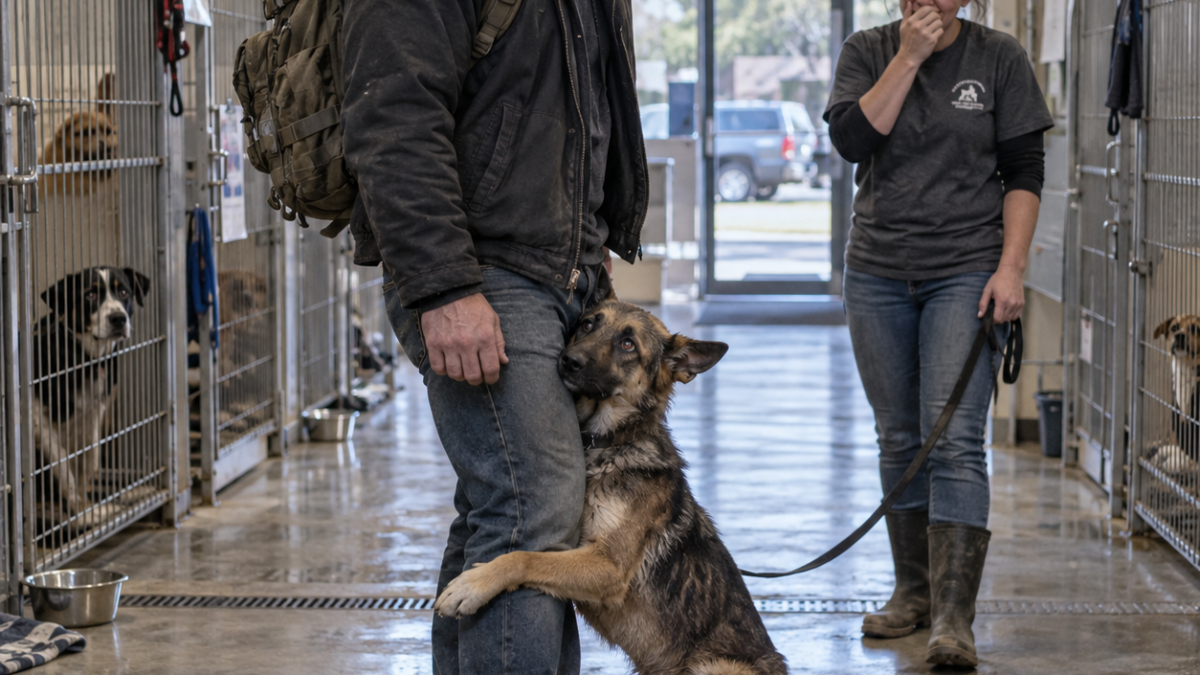
The shepherd ran straight at David.
David’s body tensed.
The dog did not bite.
He slammed into David’s leg.
Then wrapped both front legs around his calf.
David stared down.
Tag 42 buried his face behind David’s knee.
His body shook so violently David could feel it through denim.
A sound came from the puppy’s throat.
Low.
Broken.
Pleading.
Sara hurried forward.
“Oh my God. Sir, don’t move. I’m sorry. He’s extremely fearful and—”
“Stop.”
David’s voice was quiet.
Command carried anyway.
Sara froze.
David’s breathing was still fast.
His vision still tunneled.
But something had interrupted the panic.
Weight.
Warmth.
Need.
The dog was not asking David to feel better.
He was not asking David to explain anything.
He simply needed him not to leave.
David slowly crouched.
Tag 42 released his leg.
For one terrifying instant, Sara thought he might bolt.
Instead, the puppy climbed into David.
Sixty pounds of frightened shepherd pressed against his chest.
Front paws over David’s shoulders.
Face buried against his neck.
David’s hands lifted instinctively.
Then closed around the dog.
The shaking transferred between them.
And David’s panic attack stopped.
Not gradually.
It broke.
He could hear the shelter again as a shelter.
Dogs.
Not gunfire.
He smelled bleach.
Not diesel.
The floor under his knee was linoleum.
Not sand.
David buried one hand in the puppy’s neck.
“Easy.”
The word came out rough.
“Easy, buddy.”
The dog clung harder.
Sara covered her mouth.
She had spent three months watching Tag 42 recoil from touch.
Now he was wrapped around a stranger.
David looked at her.
“Where were you taking him?”
Sara’s eyes filled.
She did not answer.
David’s gaze dropped to the clipboard.
Red sticker.
His face changed.
“Where?”
Sara swallowed.
“The medical room.”
“For what?”
“It’s scheduled.”
David understood.
His jaw tightened.
“What time?”
“Five.”
He looked at his watch.
4:34.
Then at Tag 42.
“How much?”
“Sir…”
“How much?”
“He has severe behavioral problems.”
“How much?”
“He’s destroyed property. He has panic episodes. We don’t know if he’ll ever function normally.”
David’s expression hardened.
“I didn’t ask whether he was convenient.”
Sara stared.
“The original fee was three hundred.”
David shifted the dog with one arm.
Pulled out his wallet.
Three hundred-dollar bills.
He held them out.
Sara almost laughed through tears.
“It doesn’t work exactly like that.”
“Then make it work.”
“We need an application.”
“Give me one.”
“Home address.”
“I have one.”
“Veterinary reference.”
“I don’t have a dog.”
“That’s fair.”
“Anything else?”
Sara looked at the puppy hanging on him.
“I guess we find out.”
David completed the fastest emergency adoption Oak Creek had ever processed.
The manager personally reviewed it.
He looked at David’s veteran ID.
Then his rural property address.
Then Tag 42.
“You understand what you’re taking home?”
“No.”
The manager blinked.
David continued.
“But neither do you.”
That shut the room up.
The manager leaned back.
“Fair enough.”
“What’s his name?”
“Tag 42.”
“That isn’t a name.”
“It’s the number from the seizure.”
David looked at the dog.
The puppy had finally moved off his lap but remained pressed against his boot.
“Bravo.”
Sara smiled.
“Bravo?”
David nodded.
“He made it out.”
At 4:58, the red sticker came off the clipboard.
At 5:11, Bravo left Oak Creek County Animal Control alive.
David expected the hard part to be over.
He was wrong.
The first forty-eight hours nearly broke them both.
Bravo refused to enter the cabin.
David opened the truck door.
The dog stared at the doorway twenty feet away.
“Come on.”
Nothing.
David stepped toward the porch.
Bravo flattened himself inside the truck.
David stopped.
He understood.
A doorway.
Unknown interior.
Confinement.
He sat on the porch instead.
Twenty minutes passed.
Then forty.
The mountain air cooled.
Finally Bravo jumped from the truck.
One step.
Stop.
Another.
Stop.
It took nearly an hour to cross the yard.
David never pulled the leash.
When Bravo finally crossed the threshold, the click of the deadbolt sent him into panic.
He scrambled across hardwood.
Hit a chair.
Knocked over a lamp.
Then wedged himself beneath the dining table.
David stood motionless.
Bravo panted in the darkness.
“Okay.”
No response.
David backed away.
He did not reach.
He did not coax.
He understood enough about fear to know that choice mattered.
He brought water.
Placed it six feet from the table.
Then food.
Bravo ignored both.
Night came.
David went to bed.
Five minutes later, scratching began.
He returned to the living room.
Bravo remained beneath the table.
David stared at him.
Then at the bedroom.
He brought out a sleeping bag.
Bravo watched.
David spread it ten feet away.
Lay down.
“We hold here.”
The dog’s ears moved.
“Nobody comes in.”
David turned onto his back.
“Nobody gets to you.”
He stared at the ceiling.
“You have my word.”
At two in the morning, David woke screaming.
He came upright swinging.
His hands searched for something that was not there.
Breathing exploded.
“Ramirez!”
Silence.
Then nails clicked.
Bravo stood beside the sleeping bag.
Not touching.
Watching.
David lowered his hands.
“Sorry.”
Bravo took one step back.
David slowed his breathing.
“You saw that, huh?”
The dog remained.
“Embarrassing.”
Bravo sat.
David looked at him.
For the first time in months, he laughed.
Barely.
But it counted.
The next morning, food was gone.
David never saw Bravo eat it.
On the third day, Bravo drank while David sat across the room.
On day six, he took chicken from David’s fingers.
Day nine, he followed David into the kitchen.
Day twelve, he slept outside the bedroom door.
Day seventeen, David woke from a nightmare and found Bravo lying against his back.
The dog was trembling too.
David rested one hand on his shoulder.
“You don’t sleep much either.”
Bravo exhaled.
“Team insomnia.”
By December, their routines had merged.
David woke early.
Bravo followed him outside.
David split wood.
Bravo watched.
David drove into town.
Sometimes Bravo came.
Sometimes the truck itself was too much.
David never forced it.
In return, Bravo began forcing things on David.
When David stopped breathing normally during early stages of panic, Bravo pressed against his legs.
The first time it happened, David thought it accidental.
The third time, he called Dr. Mitchell.
“You are not going to believe this.”
Mitchell laughed.
“You adopted one.”
“That’s not the point.”
“You absolutely adopted one.”
“Can you listen?”
David explained.
Mitchell became serious.
“He may be responding to physiological changes.”
“He has no training.”
“Dogs don’t need certification to notice heart rate, breathing, scent changes.”
David looked at Bravo.
The shepherd sat beside the fireplace chewing an old rope.
“He puts pressure on me.”
“Deep pressure behavior.”
“He just does it.”
“Then reinforce it.”
David frowned.
“So now I’m training the dog you told me not to buy from a shelter.”
“I told you to look.”
“You knew.”
“I hoped.”
“You’re manipulative.”
“I went to medical school.”
David hung up.
Bravo looked at him.
“Don’t trust psychiatrists.”
Bravo sneezed.
“I agree.”
The dog changed David’s life in embarrassingly practical ways.
Bravo needed food.
That meant David had to remember meals.
Bravo needed exercise.
That meant David had to leave the cabin.
Bravo needed veterinary care.
That meant appointments.
Bravo hated being left alone.
That meant David could not disappear into bed for thirty hours during bad stretches.
Responsibility became structure.
Structure became motion.
Motion became something close to living.
Then David noticed the triggers.
The first occurred while he split firewood.
The axe cracked through oak.
Bravo did not flinch.
That surprised David.
Sudden sounds usually bothered him.
Then an old gray diesel pickup moved along the highway below the ridge.
Bravo froze.
Not cowered.
Froze.
His posture transformed.
Ears forward.
Mouth closed.
Head high.
The fur along his spine lifted.
A growl emerged.
David lowered the axe.
“Bravo.”
The truck disappeared around the bend.
Bravo ran to David.
Grabbed his jeans.
Pulled.
“What?”
Bravo pulled toward the cabin.
David’s instincts sharpened.
He followed.
Inside, Bravo paced between the windows.
Not panic.
Surveillance.
That bothered David more.
The next trigger was ammonia.
David used a strong cleaner in the workshop.
Bravo smelled it from the doorway.
His entire body collapsed.
He backed away.
Urinated.
Then hid beneath the porch for two hours.
The third trigger was geographical.
The northern ridge.
Bravo watched it.
Every day.
Sometimes for minutes.
Sometimes an hour.
At night he would stand at the window facing north.
David started watching too.
One evening he called Detective Ray Donovan.
The number came from Bravo’s seizure paperwork.
“Donovan.”
“My name’s David Caldwell. I adopted Dog 42 from Oak Creek.”
Silence.
“The shepherd?”
“Yeah.”
“He alive?”
David glanced down.
Bravo was asleep against his boot.
“Very.”
Donovan exhaled.
“Good.”
“I need information about Arthur Hayes.”
“That case is closed.”
“I don’t care about the breeder.”
Another pause.
“What do you care about?”
David described the triggers.
Diesel.
Ammonia.
Ridge fixation.
Donovan stopped interrupting.
When David finished, the detective was quiet for several seconds.
“Where do you live?”
David gave the road.
Donovan swore.
“What?”
“Hayes didn’t just breed dogs.”
“I figured.”
“We suspected his land was being used by Caleb Rollins.”
“Who’s that?”
“Local meth producer. Violent. Smart enough to stay one step outside evidence.”
“Your raid miss him?”
“He vanished the night before.”
David stared toward the northern window.
“What were the dogs for?”
“Security.”
“Trained?”
“Some.”
“Bravo wasn’t.”
“No.”
Donovan’s voice lowered.
“But that may be why he survived.”
David said nothing.
“Hayes was trying to produce aggressive alarm dogs. Gun-shy dogs, unstable dogs, dogs that would respond violently to strangers.”
“Bravo failed.”
“Maybe.”
David looked down.
“He’s terrified of diesel engines.”
“Rollins used diesel generators at remote cook sites.”
“Ammonia?”
“Common around meth production.”
David felt cold.
“And my ridge?”
Donovan did not answer immediately.
“David, the northern boundary of your land connects to old timber property.”
“So?”
“Hayes’s operation was seventeen miles from there by road.”
“How far through the mountains?”
“Less.”
David stood.
Bravo woke instantly.
“How much less?”
“Maybe five.”
The cabin suddenly felt exposed.
“Why wasn’t I told any of this when I bought the property?”
“Because suspicion isn’t a property disclosure.”
“Is Rollins still missing?”
“Yes.”
“Then reopen your suspicion.”
“I can’t reopen a case because a dog looks at trees.”
David’s voice hardened.
“This dog spent his first twelve weeks in that environment. He recognizes something.”
“I believe you.”
“Doesn’t sound like it.”
“I believe the dog. I still need probable cause.”
David stared through the window.
“Fine.”
“Do not go looking.”
“I didn’t say I would.”
“You were a SEAL.”
“So?”
“So every former operator I’ve ever met thinks ‘do not investigate’ means ‘investigate quietly.’”
David almost smiled.
“I’m retired.”
“That makes you worse.”
After the call, David walked the northern fence line.
Bravo came until they reached the upper slope.
Then stopped.
David continued three steps.
Bravo whined.
“Come on.”
The dog refused.
David studied him.
“Okay.”
He turned around.
Bravo immediately moved.
That settled something.
David stopped walking the northern boundary.
He installed trail cameras instead.
He called Donovan and told him.
Donovan complained.
Then admitted it was legal.
For eight days, nothing happened.
Deer.
A black bear.
Two teenagers on dirt bikes.
Then a gray diesel truck appeared on the far access road at 2:14 in the morning.
No license plate visible.
The following night, it returned.
David sent both images to Donovan.
The detective called within twenty minutes.
“I know that truck.”
“Rollins?”
“Associated vehicle.”
“Enough now?”
“Maybe.”
“Maybe?”
“I’m working on it.”
Three nights passed.
Then the snowstorm came.
By sunset on December 14, the mountain road disappeared beneath ice.
Power failed at 8:20.
David started the generator.
Bravo paced.
Not storm anxiety.
Something else.
“Easy.”
No effect.
Bravo moved from northern window to front door.
Back.
Window.
Door.
At 9:11, the generator coughed.
Then stopped.
David frowned.
Fuel tank had been half full.
Bravo stood rigid.
David smelled something faint.
Diesel.
Then silence.
Someone had cut the generator.
His training returned.
Not violently.
Cleanly.
He extinguished the lantern.
Moved away from windows.
Phone.
No service.
Radio backup.
Weak.
He reached for the emergency satellite unit kept in a drawer.
Before activating it, Bravo barked.
One enormous bark.
The front door exploded inward.
Wood splintered across the floor.
Two men entered.
One carried a shotgun.
The second held a compact weapon David did not immediately identify in the dark.
Flashlights hit his face.
“Hands!”
David’s body betrayed him.
The door blast.
Light.
Shouting.
Burnt powder.
His nervous system left Georgia.
Ramadi.
Burning vehicle.
Metal crushing his leg.
Ramirez shouting.
David’s handgun slipped from his hand.
He dropped to one knee.
“No.”
He knew it was happening.
That made no difference.
Panic did not care what he knew.
“Look at this guy,” one intruder said.
“Some badass.”
Laughter.
David covered his ears.
The second man approached.
Bravo backed against the wall.
He was shaking.
Caleb Rollins looked at him.
“Hayes dog.”
David heard the words through the flashback.
Rollins smiled.
“No kidding.”
Bravo’s eyes shifted.
Rollins pointed.
“That’s one of Arthur’s failures.”
The other man laughed.
Bravo trembled harder.
Rollins looked at David.
“You bought garbage.”
Something changed in the dog.
The second intruder moved closer to David.
Weapon lowered toward him.
Bravo saw it.
Fear did not disappear.
That was the important part.
He remained terrified.
His legs shook.
His ears flattened.
His breathing was fast.
But underneath the terror existed something else now.
Memory.
Three weeks on the cabin floor.
Chicken from a hand that never forced him.
A man sleeping ten feet away because a closed door was too much.
A voice in darkness.
Nobody hurts you here.
You have my word.
Bravo moved.
He crossed the room so fast Rollins shouted too late.
The shepherd collided with the second man.
The weapon discharged into the ceiling.
Wood and insulation rained down.
The man fell backward across the broken doorway.
Bravo clamped onto the padded sleeve of his winter coat and held.
Not tearing.
Not mauling.
Holding.
The man screamed.
Rollins swung the shotgun.
A blast tore into the floor.
Bravo released and jumped aside.
That sound broke David’s flashback.
Not because it was less frightening.
Because Bravo was in danger.
David saw him.
Really saw him.
The dog was terrified.
Still fighting.
David inhaled.
Cabin.
Georgia.
December.
Bravo.
He moved.
He struck Rollins from the side before the man could chamber another shell.
Both hit the floor.
The shotgun slid under a chair.
Rollins fought wildly.
David did not become some invincible battlefield machine.
His injured shoulder screamed.
His balance was worse than years earlier.
His head spun.
But training did not vanish simply because trauma existed.
He controlled Rollins’s arm.
Turned him.
Pinned him.
The second intruder crawled toward his weapon.
Bravo barked.
The man stopped.
“Don’t!”
David grabbed the shotgun.
He did not point it at Rollins’s face.
He kept distance.
“Hands where I can see them.”
Rollins laughed breathlessly.
“You’re shaking.”
David looked at his own hands.
They were.
“Still holding the gun.”
Rollins stopped laughing.
David secured both men using heavy zip ties from his workshop.
Then he checked Bravo.
The dog limped.
A piece of wood had cut his flank during the breach.
One paw bled from glass.
David knelt.
Bravo immediately leaned into him.
“You stayed.”
His voice broke.
The dog pressed harder.
“You crazy bastard.”
Bravo licked his chin.
David laughed and cried at once.
Then he activated the satellite emergency unit.
Donovan reached the cabin four hours later with county deputies and a tactical medical team.
The storm slowed everything.
When he entered, he stopped.
Rollins sat zip-tied to a structural post.
His accomplice sat against the opposite wall.
David was on the floor beside Bravo.
A medic treated the dog’s paw.
Donovan removed his snow-covered hat.
“You always ignore instructions?”
David looked up.
“You took four hours.”
“There was a blizzard.”
“Excuses.”
Donovan almost smiled.
Then his attention shifted to Rollins.
Years of investigation stood twenty feet away wearing zip ties.
“What were they doing here?”
David looked toward the northern ridge.
“Ask him.”
The investigation that followed exposed more than Donovan expected.
Rollins had been using abandoned hunting structures across the mountain corridor to move drugs and equipment since Hayes’s arrest.
Hayes’s property had not merely supplied dogs.
It provided temporary holding runs and an intimidation tool.
Puppies were exposed to engines, chemicals, strangers, and deliberate fear conditioning.
The ones that became aggressive were kept.
The ones that shut down were discarded.
Bravo had shut down.
That failure saved him.
Investigators recovered buried containers near an abandoned blind north of David’s property.
Cash.
Chemicals.
Weapons.
Records.
Hayes, already facing animal cruelty charges, gained federal problems.
Rollins’s network collapsed.
David barely cared.
Bravo spent three days at a veterinary hospital.
Sara drove through freezing rain to visit.
She brought expensive treats and cried before she reached the recovery room.
David sat asleep in a plastic chair beside Bravo’s bed.
One hand rested on the blanket.
Bravo was awake.
Watching the door.
When Sara entered, his ears lifted.
Then he looked toward David.
Sara whispered, “Hey, Tag.”
Bravo’s tail moved.
David opened one eye.
“Name’s Bravo.”
Sara smiled.
“Right.”
She sat.
For several minutes, neither spoke.
Finally Sara looked at the dog.
“I don’t understand.”
David rubbed his face.
“Neither do I.”
“He couldn’t walk down the shelter hallway.”
“I know.”
“He was afraid of everything.”
“No.”
Sara frowned.
David looked at Bravo.
“He was afraid of specific things and we kept calling it everything.”
She thought about that.
“He saved you.”
David’s expression changed.
“Before the cabin.”
“What?”
“He saved me in the shelter.”
Sara smiled gently.
“You saved him too.”
David shook his head.
“I bought him.”
“You stopped them from taking him to that room.”
“Because he grabbed me.”
“David.”
He looked at her.
“Why do you have such a hard time admitting you did something good?”
That sounded suspiciously like Dr. Mitchell.
David narrowed his eyes.
“You two know each other?”
Sara laughed.
“No.”
“Good. One psychiatrist is enough.”
When Bravo came home, the cabin felt different.
Not because the broken door had been replaced.
Not because Donovan had arranged additional patrols.
Because the fear around the place had changed.
Before, David had considered the cabin a bunker.
A place to hide.
Now it was home.
There was a dog bed near the fireplace.
A scratched section of floor beneath the table.
A food bowl beside the kitchen wall.
A rope toy in the hallway that David tripped over at least twice a week.
Evidence of life.
Bravo’s recovery took time.
So did David’s.
Neither became magically cured.
That was the version strangers preferred later.
Broken veteran meets broken dog.
Dog becomes heroic.
Veteran heals.
Happy ending.
Reality was less tidy.
Bravo still panicked when trapped behind certain closed doors.
David removed several interior doors instead of insisting the dog “get used to it.”
Bravo still hated gray diesel trucks.
David never laughed at him for it.
David still had nightmares.
Bravo could interrupt some of them.
Not all.
David still mapped exits in restaurants.
Eventually he mapped them once instead of every thirty seconds.
The first time he made it through an entire grocery trip, he sat in his truck afterward and cried.
Bravo rested his head on David’s thigh.
“You tell anybody about this, I’ll deny it.”
Bravo yawned.
Dr. Mitchell helped them turn instinct into skill.
A service-dog trainer named Emily Park came to the cabin twice a week.
She refused to treat Bravo like a miracle.
“He has serious issues.”
David nodded.
“So do I.”
“I’m not joking.”
“Neither am I.”
Emily crouched several yards from Bravo.
“He cannot be your psychiatric service dog unless he can function safely in public.”
“Then we train.”
“He may never get there.”
“Then we train anyway.”
She looked at him.
“You really were military.”
“What gave it away?”
“The stubbornness.”
Training began with almost nothing.
Eye contact.
Touch.
Pressure.
Following.
Interrupting repetitive behavior.
Creating space in crowds.
Locating exits on command rather than allowing David to obsessively search for them himself.
Bravo learned faster than anyone expected.
Not because his trauma vanished.
Because David never punished fear.
That distinction mattered.
When Bravo froze, David waited.
When he succeeded, David marked the moment.
When he failed, they went home.
No yelling.
No dominance games.
No forced flooding.
Months passed.
Bravo’s coat filled out.
His ribs disappeared beneath muscle.
The dull sable became rich and glossy.
The dog that once faced shelter walls started looking at people.
Not trusting everyone.
He did not need to.
But looking.
Choosing.
One spring afternoon, David and Bravo returned to Oak Creek.
Sara spotted them before they reached reception.
She covered her mouth.
Bravo wore a fitted training harness.
David looked healthier too.
Not transformed.
Still scarred.
Still tired.
But present.
Sara crouched.
Bravo approached.
Slowly.
He sniffed her.
Then nudged her hand.
Sara burst into tears.
“You remember me.”
David leaned against the desk.
“He remembers everybody who sat outside his cell reading terrible romance novels.”
Sara looked up.
“You saw me reading?”
“I read the shelter notes.”
She laughed through tears.
“You read his entire file?”
“Three times.”
“He was listed as zero working drive.”
David looked down.
Bravo stood beside him calmly.
“People confuse terrified with useless.”
Sara’s expression softened.
David understood he was no longer talking only about the dog.
Word of what happened eventually spread.
Not because David wanted it to.
Donovan mentioned Bravo during testimony.
A local paper wrote a piece about the shelter dog involved in Rollins’s arrest.
Then a veterans’ organization called.
David refused the first interview.
Then the second.
He accepted the third only because they agreed to discuss shelter dogs and trauma instead of calling him a hero.
The interviewer asked the obvious question.
“How did you fix Bravo?”
David looked down.
The shepherd’s head rested on his boot.
“I didn’t.”
The interviewer waited.
David continued.
“Everybody kept asking what was wrong with him.”
He touched the dog’s neck.
“We should’ve asked what happened to him.”
The room became quiet.
“That’s different.”
“How?”
“If you think something is wrong with a dog, you try to correct it.”
David looked at Bravo.
“If you understand something happened to him, you try to make him feel safe.”
The interviewer lowered her notes.
“And you?”
David smiled faintly.
“I’m working on applying the same logic.”
Bravo received his psychiatric service-dog certification eleven months after David brought him home.
Emily handed David the final evaluation.
“He passed.”
David read it.
Then again.
“You sure?”
“No.”
He looked up.
Emily smiled.
“Yes, I’m sure.”
David crouched beside Bravo.
The dog watched him.
“Apparently you have a job.”
Bravo sneezed.
“Don’t get arrogant.”
His official tasks included panic interruption, deep-pressure therapy, nightmare response, positional blocking in crowds, and guiding David away from escalating sensory environments.
But there were other things no certificate measured.
Bravo made David laugh.
Bravo forced him outside during bad mornings.
Bravo created conversations with strangers.
People who would never approach the intimidating six-foot-two former SEAL with tattooed arms would approach the man beside the calm German Shepherd.
At first David hated that.
Then he learned to tolerate it.
Then sometimes enjoy it.
A little girl in a grocery store once asked, “Is he a police dog?”
David said, “No.”
“What kind is he?”
David thought.
“A second-chance dog.”
The child nodded as though that were an established breed.
Her mother smiled.
David continued shopping.
He did not leave the cart.
That mattered.
Two years after the adoption, Oak Creek invited David to speak at a fundraiser.
He said no.
Sara asked again.
He said no.
Then she sent him a photograph.
Kennel 18.
Another shepherd sat inside.
Different dog.
Same posture.
Back wall.
Shaking.
David called her.
“That’s dirty.”
“I learned manipulation from psychiatrists.”
“I hate all of you.”
“So you’ll come?”
He came.
The room held shelter volunteers, rescue groups, veterans, donors, and county staff.
David stood behind a podium looking as uncomfortable as he felt.
Bravo sat against his left leg.
David had prepared notes.
He did not use them.
“They told me this dog cost three hundred dollars.”
A few people smiled.
David looked down.
“That wasn’t true.”
The room quieted.
“He cost me a door.”
Laughter.
“Half a floor.”
More laughter.
“Several years off my life.”
Bravo looked up.
“And every decent blanket I owned.”
The laughter eased his chest.
Then David’s expression changed.
“But the three hundred dollars is the part people remember.”
He looked around.
“Because people like stories where value is hidden. Cheap dog turns out extraordinary. Rejected animal becomes heroic.”
He paused.
“That isn’t the lesson.”
No one moved.
“Bravo would have been worth saving if he never protected me from anybody.”
Sara’s eyes filled.
“He was worth saving when he was under that table.”
David’s voice roughened.
“He was worth saving when he couldn’t walk down a hallway.”
He rested one hand on Bravo’s head.
“He was worth saving before he did anything useful.”
David looked down for a moment.
“So was I.”
Silence.
Not awkward.
Human.
“I spent years thinking the only reason I had value was because I could do things other people couldn’t.”
His fingers moved through Bravo’s fur.
“Fight. Lead. Finish missions. Carry somebody else out.”
He swallowed.
“Then I couldn’t.”
Bravo leaned against him.
“And I didn’t know who I was anymore.”
Someone in the audience wiped tears.
“This dog didn’t care.”
David smiled.
“He just needed me to sit on the floor.”
Laughter returned softly.
“That was the first job I’d had in years that I actually believed I could do.”
Afterward, a veteran approached him.
Young.
Maybe twenty-seven.
Hands shaking.
He looked at Bravo instead of David.
“I haven’t left my apartment except appointments in three months.”
David did not offer inspiration.
Did not say it would get better.
Did not say everything happened for a reason.
He hated those phrases.
Instead he said, “That sounds hard.”
The veteran looked up.
David continued.
“You have anybody helping?”
“VA.”
“Good.”
“They want me to join a group.”
“You going?”
“No.”
“Neither would I.”
The veteran laughed unexpectedly.
David gave him Emily’s training-program card.
“You don’t have to get a dog.”
The man looked at him.
“But?”
“But maybe go somewhere with a pulse.”
He heard Dr. Mitchell’s words leaving his own mouth.
That annoyed him.
Later David called Mitchell.
“I owe you an apology.”
“I’m recording this.”
“Don’t ruin it.”
“I’m listening.”
“You were right.”
Long silence.
Then Mitchell said, “I’m sorry, can you repeat that?”
David hung up.
Life kept moving.
Rollins was convicted.
Hayes lost every remaining animal and received prison time related to the criminal network in addition to cruelty charges.
Detective Donovan occasionally visited David’s cabin.
The first time Bravo saw his patrol vehicle, he barked for three straight minutes.
Donovan waited outside.
Eventually Bravo approached.
Donovan crouched.
“You remember me?”
Bravo sniffed his hand.
David watched from the porch.
“He probably remembers your hat.”
“What’s wrong with my hat?”
“Everything.”
Donovan laughed.
Over time, Bravo became comfortable around him.
One summer evening, the three sat on the porch while sunlight disappeared behind the ridge.
Donovan looked at Bravo.
“I keep thinking about that first kennel.”
David said nothing.
“I thought he was gone.”
“You were wrong.”
“Yeah.”
Donovan looked at David.
“So were a lot of people about you, apparently.”
David stared toward the mountains.
“I was wrong too.”
“About?”
“Myself.”
Neither man said anything after that.
They did not need to.
On November 12, three years after Bravo’s scheduled euthanasia date, David woke before dawn.
No nightmare.
Just awake.
He walked to the kitchen.
Bravo followed more slowly now.
The shepherd was no longer a five-month-old puppy.
He had grown into the body Hayes originally bred for.
Large.
Powerful.
Controlled.
But the strongest thing about him was not his bite.
It was trust.
David made coffee.
Then drove to Oak Creek.
Sara was waiting.
“What are we doing?”
David handed her an envelope.
Inside was a check.
She looked at the amount.
“David.”
“No speeches.”
“This is—”
“Use it for behavior cases.”
Her eyes widened.
“Dogs like Bravo?”
“Dogs people are in a hurry to label.”
Sara hugged him.
David stiffened.
She immediately stepped back.
“Sorry.”
He surprised both of them by pulling her back into the hug.
“Still hate surprises.”
“I know.”
The shelter used the money to establish a rehabilitation fund.
Donors added to it.
The county partnered with trainers and foster homes.
Not every dog was saved.
David understood reality too well to pretend otherwise.
Some animals were dangerous beyond the shelter’s resources.
Some were too ill.
Some decisions remained heartbreaking.
But more dogs received time.
More evaluations happened over days instead of minutes.
More people learned the difference between aggression and terror.
Bravo became the fund’s unofficial face.
David objected to the phrase.
“Face?”
Sara shrugged.
“He photographs better than you.”
“That’s insulting.”
“It’s true.”
Five years after David first walked into Oak Creek, another storm rolled across the mountains.
He sat on the cabin porch.
Bravo lay beside him.
Gray had appeared around the dog’s muzzle.
David’s own hair had changed too.
The old northern ridge was dark.
Once, Bravo would have stared at it for hours.
Now he slept.
David listened to thunder.
A few years earlier, thunder made his shoulders tighten automatically.
Sometimes it still did.
Healing did not erase reflex.
It created distance between reflex and action.
A truck backfired on the highway below.
David startled.
Bravo raised his head.
David rested his hand on the dog.
“I’m good.”
Bravo watched him.
David smiled.
“Mostly.”
The dog placed one paw across David’s boot.
“That’s dramatic.”
The paw stayed.
David looked toward the mountains.
He thought about the shelter hallway.
The red sticker.
Three hundred dollars.
A terrified animal wrapped around his leg.
David had believed he was making an impulsive decision.
Maybe he had been.
He had thought:
I can keep this dog alive tonight.
He had never imagined Bravo would keep him alive afterward.
Not with heroic attacks.
Not primarily.
By needing breakfast.
By needing walks.
By waking from nightmares too.
By sitting beside him without asking for explanations.
By forcing David to recognize fear in another living thing without despising it.
That may have been Bravo’s greatest gift.
David had spent years hating the frightened version of himself.
He called it weakness.
Damage.
Failure.
Then he met a puppy who trembled so badly he could barely stand.
David never once thought the puppy was weak.
He thought the puppy had been hurt.
Eventually the contradiction became impossible to ignore.
If Bravo deserved patience because somebody had injured him, perhaps David did too.
If Bravo’s nervous system could learn safety slowly, perhaps his could too.
If a creature could be afraid and brave at the same time, maybe courage had never meant what David thought it did.
He looked down.
Bravo had fallen asleep again.
“You know something?”
One ear moved.
“You were never a washout.”
Bravo opened one eye.
David laughed.
“Yeah, yeah. I know.”
He leaned back.
For years, David Caldwell believed survival belonged to people who could stand alone.
The teams he served with should have taught him otherwise.
No one survived alone.
Not in war.
Not afterward.
Sometimes survival looked like a medic.
Sometimes a teammate.
Sometimes a psychiatrist who refused to stop asking questions.
Sometimes a shelter volunteer sitting outside a kennel reading a bad novel.
And sometimes it looked like a frightened $300 German Shepherd wrapping both paws around a stranger’s leg because neither of them could survive one more abandonment.
The storm rolled farther into the valley.
Bravo shifted closer.
David rested his hand on the old dog’s shoulder.
He no longer checked every exit in his cabin.
He no longer slept with his boots beside the bed.
He still had difficult nights.
He still carried scars.
So did Bravo.
Neither became who they had been before.
That was another lie people liked telling about healing.
Back to normal.
Back to who you were.
David did not want to go backward anymore.
Neither did Bravo.
They had built something else.
Something scarred.
Imperfect.
Alive.
At Oak Creek, Tag 42 had once faced the wall whenever footsteps approached because people meant danger.
Now Bravo walked beside David through crowded stores, veterans’ centers, hospitals, and shelter fundraisers.
Not fearless.
Fear was still part of him.
But fear no longer chose everything.
The same was true of David.
And whenever someone asked who had rescued whom, David stopped trying to answer.
Because that question assumed rescue moved in one direction.
It did not.
One man walked into a shelter because his doctor told him he needed something alive around him.
One dog was being led toward a room he would never leave.
They met in a hallway at the exact moment both were trying to escape.
Bravo grabbed David first.
Maybe that was the truth.
The dog chose him.
Not because David was a Navy SEAL.
Not because he looked strong.
Not because Bravo somehow knew he would become a protector.
The terrified puppy saw another terrified living thing.
And for reasons no behavioral assessment could measure, he decided not to let him walk away.
David had spent years believing the strongest thing he had ever done was survive war.
He no longer believed that.
The strongest thing he ever did might have been much smaller.
He dropped to one knee on a dirty shelter floor.
Wrapped his arms around an animal everyone else had given up on.
And stayed.
Bravo did the same for him.
Every day afterward.








