The 290-Pound Biker Built a Princess Carriage With No Steps—Then the City Red-Tagged It Before the Parade
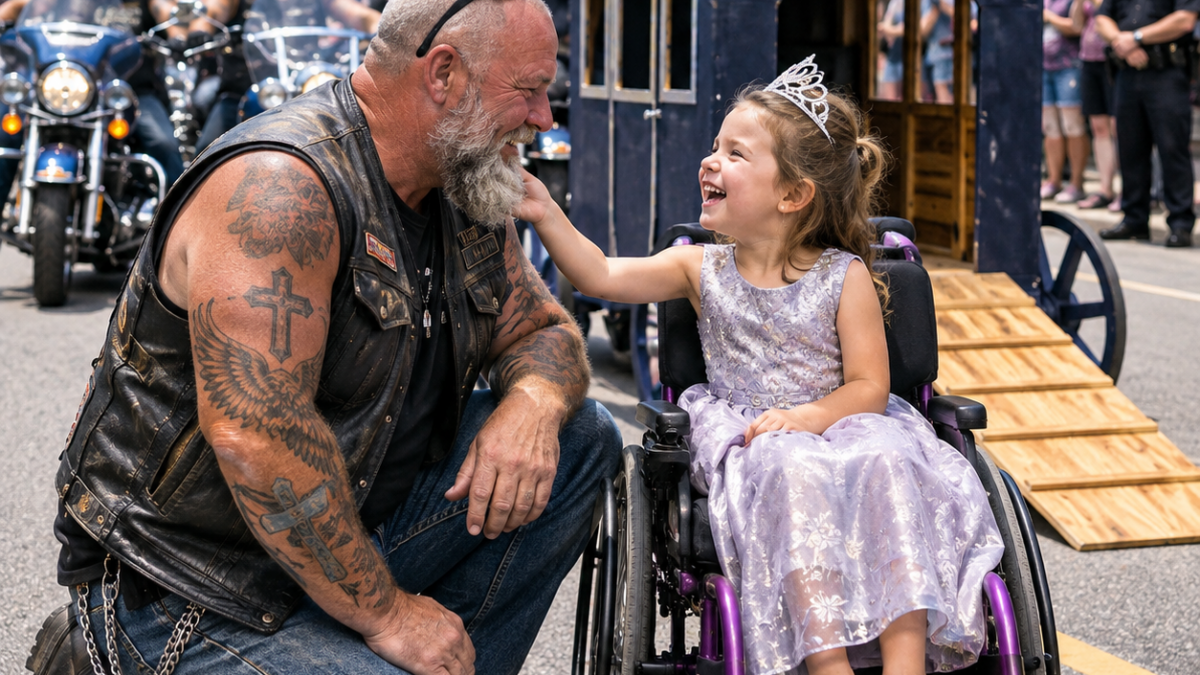
The 290-Pound Biker Built a Princess Carriage With No Steps—Then the City Red-Tagged It Before the Parade.
The 290-pound biker stopped welding when the nine-year-old girl in the wheelchair rolled beneath his unfinished princess carriage and pointed at the ramp.
“If it has even one step, then you didn’t build it for me.”
Nobody had spoken to me like that in my own fabrication shop for years.
Not customers.
Not club members.
Not the county inspector who once threatened to close Mercer Fabrication because he disliked the skull painted on my garage door.
But Sophie Bennett rolled underneath the aluminum frame, studied my work with serious blue eyes, and pointed toward the raised threshold.
“My front wheels will catch there.”
“I’m fixing it.”
“You were going to put carpet over it.”
I looked at the roll of purple carpet lying beside my welding table.
Sophie folded her arms.
Her mother started apologizing.
I stopped her.
The kid was right.
My name is Raymond Calder.
Most people call me Anvil.
I’m six-foot-four.
Two hundred ninety pounds.
Shaved head.
Gray beard nearly to my chest.
Tattoo sleeves.
Black chain tattoo around my neck.
For years, people in Hollow Creek, Tennessee, crossed the street when they saw me coming.
Sophie Bennett never even lowered her voice.
She had been paralyzed from the waist down after a spinal infection when she was four.
Her powered wheelchair had purple wheel guards, a backpack filled with library books, and a silver bicycle bell mounted beside her joystick.
She rang it whenever adults stood in her way and pretended not to notice.
Sophie’s dream was simple.
She wanted to ride in the Hollow Creek Founders Day parade.
Not beside it.
Not carried through it.
In it.
Every October, the town selected children for different ceremonial roles.
Town historian.
Railroad conductor.
Harvest ambassador.
PART2:
And the child who logged the most summer reading hours became the Storybook Princess.
Sophie had read 112 books.
She won by thirty-seven.
There was one problem.
The Storybook Princess had ridden in the same white wooden carriage for generations.
It had narrow doors.
Curved steps.
A fixed velvet bench.
No wheelchair tie-down points.
No accessible entrance.
No room for Sophie’s powered chair.
The parade committee offered what they believed was a reasonable compromise.
Volunteers could lift Sophie inside.
Her wheelchair could ride behind the carriage in a pickup.
Her mother, Melissa, almost accepted.
Sophie didn’t.
“What if I need to move?”
“Someone will help you.”
“What if there’s an emergency?”
“We’ll be right there.”
“What happens when everyone takes pictures?”
That question ended the conversation.
PART3:
Without her chair, Sophie wouldn’t be riding as herself.
She would look included while losing the independence that made inclusion mean anything.
She withdrew.
The committee selected another girl.
Sophie cried afterward.
Not in front of the committee.
In her mother’s van where nobody could see.
That was how Melissa Bennett arrived at my fabrication shop one Tuesday evening carrying a folded piece of paper and apologizing before she had even reached my workbench.
“I don’t know if your club does this sort of thing.”
I lifted my welding mask.
“What sort of thing?”
Melissa swallowed.
“Princesses.”
Behind me, fourteen Black Lantern Riders stopped working.
Deke Rollins froze with a wrench in his hand.
Mona Reyes looked over her glasses.
Preacher coughed to hide a laugh.
I said:
“Depends on the princess.”
Melissa unfolded the drawing.
Midnight-blue carriage.
Silver stars.
Purple interior.
Fifty motorcycles around it.
The biker at the front had arms nearly touching the ground, flames coming from his beard, and a wrench longer than his body.
Above him Sophie had written:
SIR ANVIL
KEEPER OF THE WRENCH
I stared.
“How does she know my name?”
Every head in the shop turned toward Preacher.
He shrugged.
“Met her at the library.”
“What’d you tell her?”
“That you could build almost anything.”
“You left out ‘almost.’”
“I figured she’d negotiate.”
Melissa pointed beneath the carriage.
There, in careful block letters, Sophie had written:
EVERY PRINCESS SHOULD ENTER BY HERSELF.
That sentence did something to me.
I walked outside.
Sophie waited in a converted white van.
She sat behind the controls of her purple power chair reading a book about medieval queens.
Silver-framed glasses.
Light-brown ponytail.
She closed the book.
“You’re Anvil.”
“You’re trouble.”
“My mother says persistent.”
“Same thing with better public relations.”
She smiled.
I held up the drawing.
“How wide?”
“Thirty-six inches clear minimum.”
I stopped.
“Ramp slope?”
“One inch of rise for every twelve inches forward unless you use another system.”
“Turning radius?”
“Five feet.”
She answered everything without hesitation.
Sophie had spent half her life measuring a world designed by people who assumed every body moved the same way.
Doorways.
Bathrooms.
Sidewalks.
School aisles.
Hotel rooms.
She understood accessibility better than most architects I’d worked with.
I pointed at the motorcycles.
“Why fifty?”
“Princesses have knights.”
“Fifty knights is excessive.”
She looked at my beard.
“So is that.”
Behind me, Deke turned away.
His shoulders started shaking.
Sophie pointed to the back of her drawing.
“The ramp should close like a drawbridge.”
“Why?”
“So ramps don’t look like something we’re supposed to hide.”
That was the moment the project stopped being a favor.
I put drafting paper across the tray of her wheelchair.
We started designing.
Low aluminum frame.
Composite panels.
Wide rear entrance.
Independent trailer brakes.
Four rated wheelchair tie-down points.
Emergency access.
Battery-backed lighting.
A folding ramp that became the carriage wall.
No fixed throne.
Sophie’s wheelchair would be the throne.
“Color?”
“Midnight blue.”
“Pink?”
She looked offended.
“Absolutely not.”
“Gold?”
“Silver.”
“Interior?”
“Purple.”
I nodded.
“Who operates the ramp?”
“I do.”
Melissa started:
“Sophie—”
Ding.
The little silver bell.
“If somebody else controls the door,” Sophie said, “then it belongs to them.”
I looked at her.
Then her drawing.
“All right.”
I wrote it down.
THE PRINCESS CONTROLS THE DRAWBRIDGE.
Before leaving, Melissa asked:
“How much?”
I looked behind me.
Deke was already writing measurements on a whiteboard.
Mona was listing accessibility requirements.
Preacher had his phone out researching electrical components.
“Fifty dollars.”
Melissa blinked.
“That can’t possibly—”
“One dollar for each knight.”
Sophie opened the pouch attached to her wheelchair.
She removed a wrinkled dollar bill.
Placed it on my workbench.
“For you.”
By midnight, forty-nine more dollars lay beside it.
Fifty Black Lantern Riders had joined the build.
What I did not tell them was why Sophie’s drawing had nearly knocked the air out of me.
Thirty-eight years earlier, I knew another girl who wanted to ride in Hollow Creek’s parade.
My little sister June.
June was ten.
I was fifteen.
She had cerebral palsy and used a heavy manual wheelchair with steel rims.
She loved movies with castles.
Queens.
Ballrooms.
Crowns too large for human heads.
Her teacher nominated her as junior princess.
The parade committee accepted.
Until they measured the carriage.
Doorway:
Nineteen inches.
June’s chair:
Twenty-four.
The adults discussed solutions.
Lift June out.
Borrow a narrower chair.
Put her in a convertible.
Every solution required June to become less like herself so the parade wouldn’t have to change.
Eventually, they chose another girl.
Nobody said:
We excluded June.
They said:
It’s unfortunate.
It’s complicated.
It’s practical.
On parade morning, I put a metal tiara on June’s head.
Then tied her wheelchair to my red wagon.
I tried towing her down Main Street behind my bicycle.
We didn’t reach the first intersection.
A police officer stopped me.
I shouted.
June cried.
My father dragged me home by the back of my jacket.
I stole June’s tiara that night.
Hid it beneath my mattress.
I told myself:
One day I’ll build her a real carriage.
I didn’t.
At seventeen, I started drinking.
At nineteen, I found motorcycles.
At twenty-three, I put a tire iron across another man’s jaw during a roadside fight.
Prison followed.
June visited once.
She sat behind thick glass.
I tried explaining that the other man started it.
June listened.
Then said:
“I don’t care who started it.”
I stopped.
“You keep building cages and acting surprised when you’re inside one.”
Those were the last words my sister ever spoke to me.
Seven months before I got out, June died from pneumonia.
My mother donated her wheelchair.
Her clothes disappeared into charity bags.
Most photographs were later destroyed when my parents’ storage room leaked.
I kept one thing.
The dented metal tiara.
For thirty-eight years, it stayed inside a hidden pocket sewn into my leather vest.
Every ride.
Every state.
Every funeral.
Every club meeting.
Nobody knew.
When I saw Sophie’s carriage drawing, the old promise came roaring back.
That terrified me.
Because guilt makes men stupid.
A man driven by guilt will call recklessness love.
I had done that often enough already.
So I gave Deke my shop keys.
“If I start building this for June instead of Sophie, stop me.”
Deke studied me.
“You gonna listen?”
“Probably not.”
“Then keys.”
I gave them to him.
For thirty-two nights, the Black Lantern Riders built under stricter rules than any commercial job I’d run.
Mona, a retired rehabilitation nurse, handled the accessibility checklist.
Cal Rourke designed the braking system.
Preacher, who’d spent twenty-eight years as an electrician, handled wiring and emergency power.
Eight riders fabricated the frame.
Six shaped body panels.
Three women sewed the purple interior.
Others cooked.
Cleaned.
Fetched parts.
Handled paperwork.
One rule stood above all others.
Nobody changed Sophie’s design without asking Sophie.
She inspected after homework.
That was how she found my threshold.
I had raised the ramp entrance slightly to fit the actuator.
Half an inch.
Barely visible.
“My front wheels will catch.”
“It’s half an inch.”
“It’s still a step.”
“I can carpet it.”
She looked at the purple roll.
“Carpet doesn’t remove a barrier.”
Pause.
“It hides one.”
Deke coughed once behind me.
Our signal.
You’re doing it again.
I stared at the ramp.
Then removed it.
Moving the actuator cost fourteen hours.
Six hundred dollars.
Most of the skin on Preacher’s left thumb.
Worth every bit of it.
Sophie rolled up without assistance.
No jolt.
No catch.
At the top, she hit the crown-shaped switch.
The ramp rose behind her.
The carriage closed.
Her smile lasted four seconds.
Then she saw the driver’s control near my seat.
“What is that?”
“Emergency override.”
“Who uses it?”
“Me.”
Ding.
“No.”
“Yes.”
“No.”
“Sophie, if something happens—”
“If you can open my door whenever you want, then I don’t control it.”
“I’m driving seven hundred pounds of trailer.”
“I’m sitting inside it.”
We argued for forty minutes.
She was nine.
She won most of it.
Mona finally designed a guarded emergency override requiring two deliberate actions.
A dashboard light showed whether Sophie’s control was active.
I could intervene in a real emergency.
I could not casually take control away from her.
Sophie approved.
That argument taught fifty bikers more about accessibility than a month of seminars could have.
We thought accessibility meant leaving enough room for a wheelchair.
Sophie taught us it also meant leaving enough control with the person using it.
Two weeks before the parade, the carriage was complete.
Weight:
742 pounds.
Within limits.
Custom touring trike.
Independent brakes.
Emergency release.
Safety chains.
Lights.
Tie-downs.
We tested everything.
Ten miles per hour.
Fine.
Fifteen.
Fine.
Twenty.
Fine.
Then during a braking run, the left wheel sensor failed.
One brake locked.
The carriage jerked sideways.
Empty carriage.
No Sophie.
Still enough to turn my stomach cold.
Cal examined it.
“Sensor.”
“Replace both.”
“One failed.”
“Replace both.”
“The parade route is flat.”
“Children run into streets.”
“We’ll never reach twenty.”
“We test again from zero.”
That cost three days.
Some riders got frustrated.
Devin finally said:
“You’re trying to make this perfect because you couldn’t save June.”
I looked at him.
He was right about one part.
Wrong about the other.
“It doesn’t have to be perfect.”
The shop went quiet.
“It has to bring Sophie home.”
We replaced both sensors.
Rewired.
Retested.
Passed.
Then someone photographed the carriage through my shop window.
By morning, the picture was everywhere.
Fifty motorcycles.
Black Lantern cuts.
A large object hidden under a tarp.
Someone captioned it:
BIKER CLUB PLANNING PARADE TAKEOVER?
Nobody mentioned Sophie.
They saw bikers.
Fear wrote the rest.
Parade director Evelyn Price arrived with two police officers and the city inspector.
I remembered Evelyn.
Thirty-eight years earlier, she had been twenty-four, standing with a clipboard while that police officer stopped me and June.
Now she was sixty-two.
Silver hair.
Same posture.
She looked at me.
I looked at her.
Neither mentioned June.
“You applied for a custom-trailer permit.”
“Yes.”
“You did not disclose fifty motorcycles.”
“Form asked for tow vehicle.”
“You’re planning to surround children.”
“We’re escorting one.”
“The committee already has a princess.”
“It had Sophie first.”
“The historic carriage couldn’t safely accommodate her.”
“So we made one that can.”
Evelyn looked at the tarp.
“You made a trailer in a motorcycle shop.”
That irritated me.
“My shop builds certified mobility equipment, emergency-vehicle parts, and commercial fabrication systems.”
I handed the inspector a binder.
It was thick enough to stop a tire.
Engineering review.
Load calculations.
Brake specifications.
Electrical diagram.
Weld documentation.
Tie-down ratings.
Inspection took three hours.
Sophie demonstrated the ramp.
Rolled in herself.
Closed it.
Then asked Evelyn:
“Want to see the crown lights?”
Tiny lanterns illuminated the midnight-blue ceiling.
Evelyn forgot to be angry.
“It’s beautiful.”
Sophie smiled.
“The lights have their own battery.”
She pointed toward me.
“So they still work if Sir Anvil’s motorcycle breaks.”
“My motorcycle doesn’t break.”
Every biker in the shop laughed.
Then the inspector found two problems.
One safety-chain bolt lacked a visible certification mark.
Easy.
The second wasn’t.
The hydraulic brake line passed within half an inch of a moving suspension bracket.
It hadn’t touched during testing.
But on a hard enough bump—
It could.
Cal said:
“Twenty-minute fix.”
Inspector shook his head.
“Modification requires reinspection.”
“When?”
“Monday.”
The parade was Saturday.
He tied a red tag around the hitch.
Sophie watched.
Her index finger started tapping the wheelchair joystick.
Melissa knelt beside her.
“We’ll fix it.”
Sophie looked at me.
“You said it was safe.”
I swallowed.
“I believed it was.”
“Is he wrong?”
I wanted to say yes.
I wanted to say half an inch was plenty.
We’d tested it repeatedly.
The route was smooth.
We’d travel walking speed.
Then I imagined that steel bracket moving beside a brake line while Sophie sat inside.
“No.”
The word hurt.
“He isn’t wrong.”
Sophie stared.
“If the parade’s Saturday, fixing it Monday doesn’t matter.”
“We’ll find another inspector.”
“What if you don’t?”
I knew the answer before I spoke.
“Then the carriage doesn’t move.”
Melissa looked sharply at me.
Sophie went still.
“You promised.”
“I promised you a safe carriage.”
“You promised I’d ride.”
I took a breath.
“I was wrong to promise something I couldn’t completely control.”
Sophie’s eyes filled.
She turned her chair.
Rolled away.
No bell.
That was worse.
After she left, Devin threw his gloves onto the bench.
“We reroute the line and pull it anyway.”
“No.”
“At five miles an hour—”
“No.”
“The whole town already thinks we’re criminals. Since when does a red tag matter?”
“It matters because Sophie will be inside.”
Cal stepped beside me.
“He’s right.”
Devin pointed toward the empty doorway.
“June never got her carriage.”
My jaw tightened.
“Now Sophie won’t either.”
I crossed the shop before Deke could reach me.
Grabbed Devin’s vest.
For one second, thirty-eight years of rage returned to my hands.
Then I saw Sophie’s drawing above the workbench.
Sir Anvil.
Keeper of the Wrench.
His hands were open.
I let Devin go.
“We fix the line.”
Then:
“We find another inspector.”
The next twenty-four hours tested the Black Lantern Riders harder than any highway fight ever had.
Cal redesigned the brake-line route.
Preacher called certified inspectors across three states.
Deke contacted county transportation.
Melissa sent the engineering documents to an accessibility organization in Nashville.
Nobody slept.
At 2:20 Friday morning, someone finally called back.
Teresa Alvarez.
Certified trailer inspector.
Experience with mobility equipment for veterans organizations.
She agreed to drive from Knoxville after finishing work.
Fee:
$1,800.
Before I could complain, money began landing on my workbench.
Not one-dollar bills this time.
Fifties.
Twenties.
Hundreds.
At 6:40 Friday evening, Teresa arrived in rain.
She reviewed the repair.
Then said:
“I want another complete braking test.”
Of course she did.
We loaded 320 pounds of secured steel into the carriage.
Ten miles per hour.
Stop.
Straight.
Fifteen.
Stop.
Straight.
Then Teresa looked at the rain.
“Emergency stop.”
I stared at her.
“Wet pavement?”
“Children don’t wait for dry weather.”
Fair.
Fifty riders lined the test road.
Their headlights cut through the rain.
I accelerated.
Teresa raised her hand.
Dropped it.
I hit both brake systems.
The trike slowed hard.
Carriage stayed directly behind me.
No swing.
No lock.
No pull.
Straight.
Teresa walked around the carriage.
Checked the line.
Checked temperatures.
Checked fittings.
Then cut off the red tag.
“You built a safe trailer.”
I finally breathed.
She pointed at me.
“Don’t let the stars and crowns make you forget it’s still a machine.”
I handed her payment.
She pushed it back.
“My older sister uses a wheelchair.”
Then looked at Sophie’s purple gloves sitting on the workbench.
“Buy the princess better gloves.”
We had approval.
One problem remained.
Evelyn controlled the parade.
She stood beneath the awning.
Sophie’s rejection letter in her hand.
“The committee already selected another child.”
“We aren’t taking her place.”
“Then where does Sophie ride?”
“At the back.”
Evelyn frowned.
“The Storybook Princess rides near the front.”
“Not this princess.”
A voice behind us said:
“I don’t want the other girl removed.”
Sophie.
Rain jacket.
Jeans.
No crown.
Melissa stood behind her.
“Put me at the back with my knights.”
Evelyn looked toward the fifty bikers.
Then toward the carriage.
Then at my hand.
I hadn’t realized I was holding something.
June’s tiara.
I must have pulled it from my vest while waiting.
Evelyn stared.
“Is that June’s?”
I looked at her.
“You remember it?”
She nodded.
“I was there.”
“You were holding the clipboard.”
“Yes.”
“You watched them take her out.”
Evelyn swallowed.
“I was twenty-four.”
“So?”
“My father ran the parade.”
“I remember.”
“I was afraid he’d remove me from the committee if I challenged him.”
I waited for the excuse.
None came.
“So I stayed quiet.”
Her eyes met mine.
“And June paid for my fear.”
Thirty-eight years.
I had flattened Evelyn into the villain standing beside that police officer.
Anger likes simple enemies.
Real people are rarely that convenient.
She had been afraid.
Her fear had hurt my sister.
Both things could be true.
Evelyn stepped toward Sophie.
She took June’s dented tiara from my hand.
Then placed it gently on Sophie’s lap.
“The parade starts at ten.”
Sophie waited.
“The accessible carriage can join behind the school band.”
Sophie shook her head.
“Behind the other princess.”
Evelyn looked at her.
Then nodded.
“Behind the other princess.”
For the first time in Hollow Creek history—
There would be two.
Saturday arrived beneath gray clouds.
At eight in the morning, forty-nine motorcycles stood outside my shop.
My touring trike made fifty.
Nobody wore costume armor.
Sophie had rejected it.
“You’re already knights.”
She looked around at the tattoos.
Leather.
Chains.
Scars.
“Just wear the stuff people are afraid of until they know you.”
So we did.
Mona tied one silver ribbon to each handlebar.
Deke mounted a purple flag with a single crown.
At 8:30, Melissa’s van arrived.
Sophie rolled out.
Silver dress adapted so fabric couldn’t touch her wheels.
New purple gloves.
Two crowns in her lap.
Plastic princess crown.
June’s dented metal tiara.
Deke pointed.
“Metal.”
Preacher said:
“Plastic.”
Sophie placed the plastic crown on my helmet.
Then June’s tiara on herself.
“Both.”
She approached the carriage.
Fifty bikers stopped talking.
For thirty-two nights we’d built.
Failed.
Rebuilt.
Tested.
Argued.
Been inspected.
Failed inspection.
Corrected it.
Tested again.
Yet Sophie had never taken a real ride.
She aligned her wheelchair.
I instinctively reached toward the ramp control.
She looked at my hand.
I pulled it back.
Sophie pressed the crown-shaped switch.
The drawbridge lowered.
She rolled upward.
Reached the threshold she had made us rebuild.
Crossed without a jolt.
Inside, she positioned her chair.
Mona checked every restraint.
Medical equipment.
Emergency release.
Battery.
Communication headset.
Sophie closed the ramp herself.
The carriage became whole around her.
My headset crackled.
“Sir Anvil.”
“Yes, Your Highness?”
“Your crown is crooked.”
“It’s aerodynamic.”
She laughed.
At 9:10, we rolled toward Hollow Creek.
People came outside.
At first they just stared.
Fifty bikers.
One midnight-blue carriage.
Silver stars.
Purple interior.
Warm lanterns glowing beneath the crown.
And Sophie sitting in the center in her own wheelchair.
Not lifted.
Not carried.
Not hidden.
At the staging area, we stopped behind the historic carriage.
The other Storybook Princess was eleven-year-old Harper Lane.
Pink dress.
Nervous smile.
When she saw Sophie, she climbed out.
“I’m sorry they chose me after you.”
Sophie shrugged.
“You read eighty books.”
Harper looked surprised.
Sophie continued:
“That’s still a lot.”
“I could ride with you.”
Sophie looked inside our carriage.
Then shook her head.
“We don’t have a safe second seat.”
Harper smiled.
Relieved.
Sophie didn’t require guilt as proof of friendship.
Harper removed a silver ribbon from her hair.
Tied it to Sophie’s armrest.
“Now our carriages match.”
The band began.
Historic white carriage first.
Midnight-blue carriage second.
Then the motorcycles.
The V-twins stayed low.
More heartbeat than thunder.
At the first intersection, a child bowed dramatically toward Sophie.
She laughed.
His mother bowed.
Then the people beside them.
The gesture traveled down Main Street.
Firefighters removed caps.
Store employees came outside.
Older couples waved from folding chairs.
Sophie waved until her arm grew tired.
Then rang the silver bell.
Ding.
My headset crackled.
“Sir Anvil.”
“Faster?”
“No.”
“Good.”
“Look left.”
A girl stood near the courthouse steps using forearm crutches.
Her father had positioned her where she could see.
Sophie pointed.
“Can she ride?”
“Not while we’re moving.”
“Why?”
“No safe restraint.”
“After?”
“Yes.”
“Promise?”
I hesitated.
Sophie said:
“Sir Anvil.”
“All right.”
I smiled.
“After.”
Near Miller Street, a dog slipped its leash.
It darted toward the road.
Police officer caught it before it reached us.
But I braked.
Harder than expected.
The trike slowed.
The carriage brakes activated.
Straight.
Perfectly aligned.
Sophie stayed secure.
Cal rode behind me.
He looked at the wheels.
Then gave one thumbs-up.
The brake line mattered.
The inspection mattered.
The red tag mattered.
Every miserable lost hour mattered.
At the final turn, rain began.
Nobody left.
Umbrellas opened.
Water darkened black leather.
Sophie remained dry beneath the carriage canopy.
She touched the headset.
“Can the knights make thunder?”
I looked at the crowds.
Police.
Children.
Evelyn.
“Gentle thunder.”
Sophie’s fist rose.
Fifty right hands moved toward throttles.
Her fist dropped.
The engines answered in sequence.
Not a deafening explosion.
A rolling, deep V-twin rumble beginning at the front and traveling backward through the formation.
The pavement vibrated.
Sophie raised both arms.
For one mile, a girl who had once been told the princess carriage had no room for her rode through Hollow Creek surrounded by fifty leather-clad knights.
Inside a carriage with a drawbridge she controlled herself.
The whole town waved.
But the parade wasn’t the part I remember most.
Afterward, I prepared to take Sophie home.
She rang the bell.
Ding.
“No.”
“No what?”
“Park.”
“Why?”
She pointed toward the courthouse.
“Other people are waiting.”
We parked on level pavement.
Sophie lowered the drawbridge.
The girl with crutches came first.
Her name was Riley.
Adults immediately reached to lift her.
Sophie stopped them.
“Ask her.”
Everyone froze.
Riley chose the handrail.
She climbed in.
Harper joined after leaving the historic carriage.
For several minutes, two princesses shared the midnight-blue space.
Then a twelve-year-old boy approached in a manual wheelchair.
He looked at the carriage.
“Princesses only?”
Sophie stared at him.
“Royalty.”
Pause.
“Princes count.”
We adjusted the securement points.
Marcus rolled inside.
He wore my plastic crown.
Then came a retired teacher on a mobility scooter.
A four-year-old boy with leg braces.
An elderly Vietnam veteran who had lost both legs and cared more about Cal’s braking system than the crown.
One parade lap.
Twenty-seven riders around the courthouse square by the end of the day.
Everybody entered through the drawbridge.
Nobody was lifted simply because lifting them made the photograph easier.
Evelyn stood near me.
Sophie had placed June’s tiara on the dashboard between rides.
Evelyn stared at it.
“I should’ve said something in 1988.”
“Yes.”
“I was scared.”
“I know.”
“My father probably would’ve kicked me off the committee.”
“He might have.”
“I kept telling myself I’d change things later.”
I looked toward the line waiting for the ramp.
“Later showed up.”
Evelyn looked at me.
“What happened to June?”
“Pneumonia.”
“When?”
“While I was in prison.”
She closed her eyes.
“I’m sorry.”
I nodded toward the old white carriage.
“She would’ve hated that thing.”
Evelyn laughed unexpectedly.
“She did.”
I looked at her.
“She told my father it looked like a wedding cake with wheels.”
I laughed.
That sounded exactly like June.
At sunset, Sophie asked me to kneel beside her.
She held the old metal tiara.
“I think this belongs in the carriage.”
“It belonged to my sister.”
“Then let the carriage carry her too.”
Above the entrance was a small compartment originally intended for emergency tools.
We mounted the tiara behind a clear protective panel.
Not permanently sealed.
Just safe from weather.
Beside it, Sophie placed the wrinkled one-dollar bill she’d given me the first night.
One old promise.
One new agreement.
Back at the shop, Deke gave Sophie a tiny patch.
Silver wrench.
Crown.
No Black Lantern logo.
Melissa asked where she wanted it sewn.
Sophie attached it to the backpack on her wheelchair.
Then she gave me a paper certificate covered with purple stars.
SIR ANVIL
KEEPER OF THE WRENCH
DEFENDER OF DRAWBRIDGES
AND LISTENER WHEN CORRECTED
The club laughed loudest at the last line.
I folded the certificate.
Placed it inside the hidden pocket of my vest.
The pocket where June’s tiara had rested for thirty-eight years.
The empty space felt strange.
But not bad.
Like it had finally finished carrying what it was meant to carry.
That evening, the club argued about the carriage.
Donate it to Hollow Creek?
Auction it?
Raise money?
Sophie rang her bell.
Ding.
Nobody had officially given her voting rights.
Nobody was stupid enough to continue talking.
“You can’t keep it here.”
“Why not?”
“Other princesses have stairs too.”
That was how the Royal Road Project started.
The carriage stayed based at my shop.
But we took it wherever it was requested.
Schools.
Hospitals.
County fairs.
Veterans centers.
Parades.
No rental fee.
No appearance fee.
One rule:
Whenever physically possible, the rider controls the drawbridge.
The original fifty dollars remained framed above my workbench.
We never spent it.
One year later, the carriage returned to Founders Day.
The rules had changed.
Any float carrying a selected child now had to accommodate that child’s mobility equipment without unnecessary transfer.
Three bad curb ramps had been repaired.
Several barriers along Main Street were removed.
An accessible viewing area had been created.
Sophie and Riley had helped plan it.
The old white carriage remained.
So did ours.
Sophie was ten now.
She had retired the silver princess dress.
“Too itchy.”
She wore jeans.
Purple gloves.
Midnight-blue jacket.
June’s tiara.
“Still royalty?” I asked.
“Obviously.”
Fifty Black Lantern Riders gathered.
But there were fifty-one machines.
Near the shop door sat a little electric three-wheeled adaptive cycle.
Hand controls.
High-backed seat.
Purple wheel guards.
Built with two rehabilitation engineers.
Top speed:
Twelve miles per hour.
Sophie considered that personally insulting.
“Too slow.”
“Training,” Mona said.
“For what?”
“Not frightening Anvil.”
Sophie looked at me.
“Impossible.”
She wasn’t allowed to use it on public roads yet.
Not even in the parade.
But she insisted it be placed in formation.
Fifty riders.
One future rider.
Before we left, Sophie touched the clear panel holding June’s tiara.
She never treated my sister like a symbol.
That mattered.
“What books did June like?”
“Mysteries.”
“Favorite food?”
“Peanut-butter cups.”
“Did she swear?”
“Professionally.”
Sophie smiled.
“I would’ve liked her.”
“She would’ve corrected your measurements.”
“My measurements were right.”
“She would’ve corrected them anyway.”
At ten, we rolled out.
Harper rode with Sophie that year.
Not because she felt guilty about having been the replacement princess.
She had joined the Royal Road Project and spent her summer helping paint portable ramps.
At the first intersection, Sophie raised her fist.
Fifty Harley engines answered.
Gentle thunder.
I watched the mirrors constantly.
Hitch.
Wheels.
Clearance.
Ramp indicator.
Crown-shaped light confirming Sophie still controlled the drawbridge.
Everything held.
At the courthouse, we stopped.
Sophie lowered the ramp.
Rolled out.
People cheered.
She ignored the microphone waiting onstage.
Instead, she crossed the square toward a seven-year-old girl in a red wheelchair.
The child was scheduled to ride next.
Sophie removed June’s dented tiara.
Placed it gently on the girl’s head.
“Your carriage.”
The girl rolled up the ramp.
Sophie followed because the new princess asked her to.
Deke stood beside me.
We watched the two wheelchairs turn easily inside.
“You finally built June’s carriage,” he said.
“No.”
He looked at me.
I watched the drawbridge begin closing.
“June never got hers.”
Deke said nothing.
I continued.
“This belongs to the girls who are still here.”
The crown light came on.
I started the touring trike.
Forty-nine Harley engines joined behind me.
Then came the bright silver ring of Sophie’s bell through the headset.
The carriage moved toward Main Street again.
Two children inside.
One old tiara above the doorway.
One crumpled dollar beside it.
And after thirty-eight years of people explaining why inclusion had to be complicated—
There wasn’t a single step.








