Someone Threw This Little Cat From a Car—Then He Walked Straight to My Door
PART3:
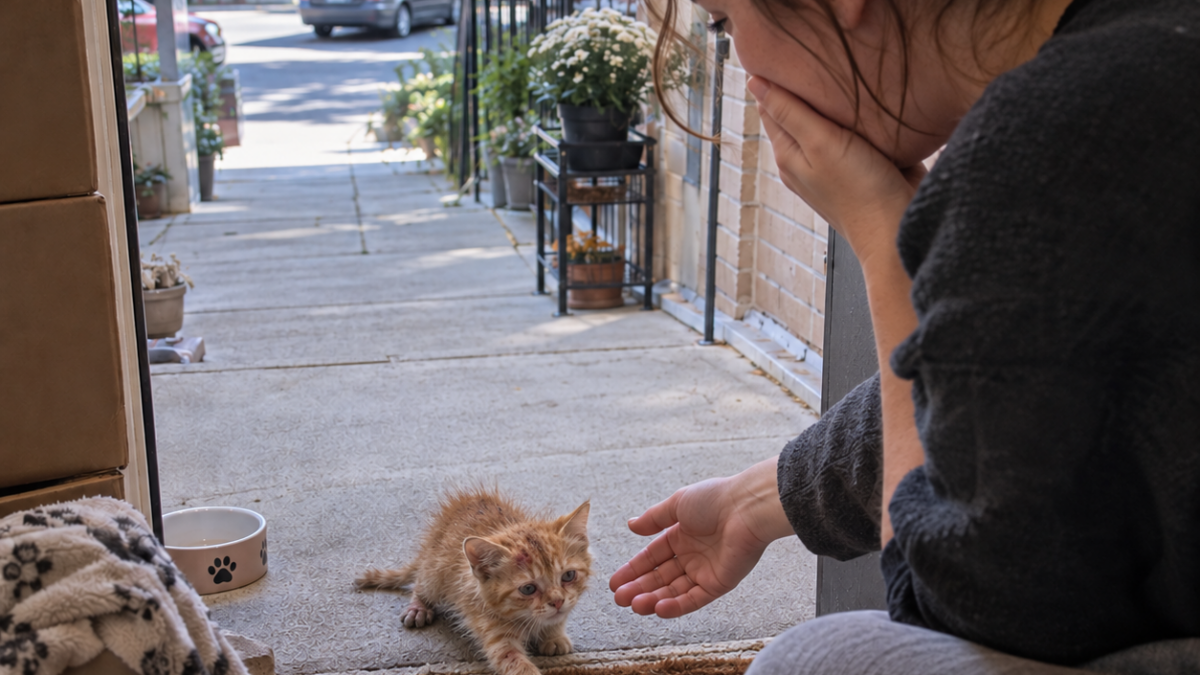
But when I returned, he was still there.
Sitting by the entrance.
Waiting.
The sight of him waiting did something strange to me.
It made the situation feel less accidental.
He ate politely, which somehow made me sadder. He did not attack the food the way some starving animals do, but he did not ignore it either. He lowered his head and ate with quick little bites, glancing up every few seconds to make sure I was still there. I sat on the step beside him, one hand resting close but not crowding him.
When he finished, he stepped over the empty dish and climbed directly into my lap.
Not near me.
Into my lap.
As if that had been the plan all along.
I froze.
He turned around once, kneaded my jeans, tucked himself against me, and kept purring.
That was the moment I knew I was in trouble.
Not practical trouble.
Not logistical trouble.
Heart trouble.
The kind where you know your brain is about to spend the next several days listing reasons why something cannot work, while your heart has already opened the door and started making space.
I sat there with this abandoned little cat in my lap, boxes waiting upstairs, deadlines pressing on me, phone buzzing with moving-related messages, and all I could think was, Who could leave you?
Who could look at this small trusting creature and decide the street was where he belonged?
The answer was someone.
That was the terrible part.
Someone could.
Someone had.
I stayed outside with him longer than I meant to.
A neighbor from the second floor came in carrying groceries and stopped when she saw us.
“Oh,” she said. “Is that your cat?”
I looked down at him.
He looked up at me like he was interested in the answer too.
“I don’t know,” I said.
The neighbor stepped closer. Teddy did not run. He stretched one paw against my leg.
“He’s friendly.”
“Very.”
“He wasn’t here this morning.”
“No?”
She shook her head.
“I would have noticed. I always notice cats.”
That was how the first little circle formed around him.
The neighbor’s name was Hannah. She had two cats of her own and immediately knew more than I did about what to do next. She brought down a small bowl of dry food, a towel, and the serious expression of someone already making a plan.
“He needs to be checked for a microchip,” she said. “And we should see if anyone posted about a missing cat nearby.”
I nodded, grateful for someone thinking clearly.
“I’m moving,” I said, as if confessing a crime. “My apartment is chaos. I don’t even have supplies.”
“We can manage a few days,” Hannah said.
She said it simply.
We.
Not you.
We.
That mattered.
Another neighbor, Marcus from the first floor, came out to smoke and ended up not smoking because Teddy walked straight to his shoes and rubbed his cheek against them.
Marcus stared down at him.
“I don’t like cats,” he said.
Teddy purred louder.
Marcus looked at me.
“He does not care about my boundaries.”
“He has a strong personality.”
“He’s tiny.”
“He seems aware.”
Marcus sighed and crouched awkwardly, holding out two fingers like he was greeting a suspicious business partner. Teddy bumped his head against them.
Marcus melted so visibly that Hannah and I both pretended not to notice.
“Okay,” Marcus muttered. “Maybe I like this one.”
By evening, three people in the building knew about him.
By the next morning, nearly everyone did.
That is one thing I will say about apartment buildings: people can ignore one another for months, passing in hallways with polite nods and locked lives, but put one abandoned animal near the entrance and suddenly names appear. Schedules appear. Bowls appear. Someone has a spare blanket. Someone knows a vet. Someone remembers a lost-and-found group. Someone says they saw a camera near the corner store. Someone else volunteers to ask.
Teddy, meanwhile, behaved as if this entire community had been assembled for his convenience.
He greeted everyone.
He accepted food.
He gave head bumps.
He made biscuits on towels, cardboard, shoes, and once on Marcus’s backpack while Marcus was trying to leave for work.
But mostly, he stayed near my apartment.
That was the part everyone noticed.
During those first few days, because my place was full of moving boxes and I still needed to figure out whether he was healthy, Teddy could not simply move in. I hated that. Every time I went upstairs and left him by the door, guilt followed me like a shadow.
I would tell myself I was being responsible.
He needed a vet.
He needed to be checked for contagious illnesses.
He might belong to someone.
He might have a microchip.
He might need a foster arrangement until I finished moving.
All of that was true.
None of it helped when I opened my apartment door and heard him meowing softly from the hallway.
He chose my door.
Not the warmest spot.
Not the busiest corner.
My door.
Sometimes I would look through the peephole and see him sitting there, tail wrapped around his paws, as if he had decided waiting was his job now.
The first night, I barely slept.
Every sound woke me.
A car outside.
A door closing.
A voice in the hallway.
I kept imagining him alone near the entrance, confused that the person he had chosen kept disappearing behind a door. Around midnight, I went downstairs in sweatpants and a hoodie, carrying another towel. He was curled against the wall near my apartment door, not fully asleep. When he saw me, he stood and stretched, then walked toward me with a sleepy chirp.
That sound nearly ruined me.
I sat on the floor.
He climbed into my lap again.
The hallway was quiet. A fluorescent light flickered near the stairwell. Somewhere above us, water moved through pipes. The whole building slept while I sat there with a cat I had known for less than a day, feeling as if my life had been interrupted by something small and sacred.
“I don’t know what I’m doing,” I whispered to him.
He placed one paw on my arm.
I cried then.
Not loudly.
Not dramatically.
Just enough that Teddy lifted his face and touched his nose to my chin.
I had been trying so hard to keep moving forward. Packing. Planning. Handling. Solving. I had not allowed myself to feel how overwhelmed I was. Then this little animal, who had every reason to collapse into fear, sat purring in my lap like trust was the easiest thing in the world.
It made me feel ashamed of how guarded I had become.
It made me feel protective.
It made me feel chosen.
The next day, Hannah helped me post in local groups.
Found cat.
Small, friendly, neutered-looking male, found near our apartment building.
We kept the description simple and held back some details in case someone claimed him. We checked lost pet pages. We asked around. A woman from a building two streets over said she had heard about a car stopping near the corner and something being left behind. Another person mentioned a camera outside a shop that might have captured part of it.
That was when the word abandoned became more than a fear.
It became likely.
I remember standing outside the shop while the owner, an older man with tired eyes and a kind voice, told us he had heard the same thing.
“I don’t usually get involved,” he said. “But if someone dumped an animal, that isn’t right.”
He could not show us everything immediately, and I will not pretend I had some dramatic moment watching the footage myself. But the report came back clearly enough from people who saw it: a car had stopped, someone had left a cat behind, and then the car had driven away.
I thought hearing confirmation would make me furious.
It did.
But beneath the anger was something heavier.
A sadness so deep it felt almost physical.
Because confirmation took away the softer possibilities.
He was not lost after slipping out.
He was not wandering from a nearby home.
He had not simply strayed too far and gotten confused.
Someone left him.
Someone knew he existed and chose to remove him from their life by placing him in danger.
That evening, when Teddy came running toward me from near the entrance, I saw him differently.
Not as a stray.
Not as a mystery.
As a survivor of a decision he had no power to understand.
And still, he ran toward me with his tail lifted.
Still purring.
Still making biscuits as soon as I crouched.
The resilience of animals can be beautiful, but it can also be heartbreaking. People like to say animals live in the moment, and maybe they do in some ways. But Teddy was not blank. He was not unaffected. Sometimes, during those first days, he would startle at car doors slamming outside. He would freeze for half a second when an engine revved too close. Then he would look at me, and if I spoke softly, he would come back to himself.
That tiny pause told a whole story.
I do not know whether he remembered the exact car.
I do not know whether he expected someone to come back.
I only know that a sound could pass through his body like an old fear.
And then he would choose trust again.
Over and over.
That choice humbled me.
People in the building began helping more deliberately.
Hannah brought extra litter and a small carrier she had used years earlier.
Marcus bought wet food and left it outside my door with a note that said, “For the cat I do not like.”
The college student on the third floor, Priya, printed flyers even though we suspected no one would come looking.
Mrs. Alvarez, who lived across from me and rarely spoke more than good morning, knocked one afternoon holding a folded fleece blanket.
“My granddaughter left this here,” she said. “For the baby.”
“The cat?”
She looked offended.
“Obviously.”
Teddy accepted the blanket like he had commissioned it.
For a few days, he became the building’s shared secret and shared concern. Not quite inside, not quite outside. Fed, watched, checked on, spoken to, protected in the limited ways we could manage until the vet appointment came.
But the emotional truth was less shared.
Because Teddy waited for me.
Everyone saw it.
If I came home from carrying boxes, he appeared. If I went downstairs with trash, he came trotting from wherever he had been resting. If other people fed him, he ate. If I sat down, he climbed into my lap. If my apartment door opened, he tried to step through like he had finally reached the correct answer and was waiting for me to stop arguing with it.
I kept saying, “Not yet.”
He kept hearing, “Soon.”
Maybe he was right.
The day before the vet visit, I almost broke.
Moving had become more chaotic. The new apartment needed paperwork corrected. A delivery arrived at the wrong time. I misplaced important documents and found them in a box labeled “kitchen,” which made no sense and somehow perfect sense. My phone kept ringing. My body hurt. My patience was gone.
Then I opened the door and nearly tripped over Teddy.
He looked up with his usual bright little face and chirped.
I sat down in the hallway surrounded by boxes, and he immediately climbed into my lap.
“I can’t do this right now,” I told him.
He purred.
“I don’t have room.”
He kneaded my sleeve.
“I don’t have supplies.”
He pressed his face into my arm.
“I don’t even know if I’m allowed to keep a cat at the new place yet.”
He closed his eyes.
I laughed through tears because he seemed so entirely unconcerned with my list.
Animals do not care about timing.
They do not care about leases, moving trucks, deposit deadlines, or whether you believe you are emotionally prepared. They arrive with need and trust, and suddenly your excuses have to stand in front of a heartbeat.
That night, I emailed the new landlord.
I asked about the pet policy.
Then I sat staring at the sent message, terrified of the answer.
It came the next morning.
Cats allowed with a deposit.
I read the email twice.
Then I looked down at Teddy, who was sitting beside my shoe like he had been expecting administrative progress.
“Well,” I said, “you’re very expensive for someone who arrived without an appointment.”
He blinked.
I took that as agreement.
The vet appointment was scheduled for the afternoon.
Getting him into the carrier worried me more than I admitted. Friendly cats can still hate carriers. Abandoned cats can panic when confined. I prepared myself for claws, twisting, desperate cries, and the possibility that trust would break the moment I tried to put him inside.
Hannah came down to help.
“Go slow,” she said.
“I know.”
“Don’t chase him.”
“I won’t.”
“If he gets scared, stop.”
“I know.”
I knew all of it, and still my hands shook.
Teddy sat on the fleece blanket Mrs. Alvarez had given him, washing one paw with complete serenity while three humans silently prepared for emotional disaster.
I crouched.
“Okay, baby,” I said. “We’re going to the doctor.”
He looked at me.
I picked him up.
No struggle.
Not even a twist.
He let his body settle into my hands as if being lifted by me was already normal. I held him against my chest for one second longer than necessary, feeling the warmth of him, the small vibration of a purr starting again.
Then I placed him inside the carrier.
He walked in.
Turned around.
Sat down.
Hannah stared.
“Well,” she said softly. “He trusts you.”
I had to look away.
At the vet clinic, Teddy was curious but calm. He watched dogs from inside the carrier with wide eyes but did not panic. He sniffed the air. He accepted treats from the technician. When the vet opened the carrier door, Teddy stepped out cautiously, then rubbed his face against the edge of the exam table.
The vet laughed.
“Oh, he’s a sweetheart.”
“Yes,” I said, too quickly. “He really is.”
They scanned him for a microchip.
Nothing.
They checked his teeth, ears, eyes, skin, heart, belly.
No contagious illnesses.
Already neutered.
No obvious injuries.
A little underweight, maybe.
A little stressed, certainly.
But healthy.
Healthy.
I did not realize how tightly I had been holding myself until that word entered the room.
Healthy meant possibility.
Healthy meant I could bring him inside without risking other animals in the building. Healthy meant the plan could move forward. Healthy meant the person who abandoned him had not managed to break his body, at least.
Already neutered meant something else.
It meant he had belonged somewhere once.
Maybe to the same person who abandoned him.
Maybe to someone before them.
Maybe there had been a home where he slept on furniture, chased string, ate from a bowl, and learned that human hands could be gentle. That would explain his trust. That would explain how quickly he leaned into affection. That would explain why he did not know how to be outside.
That thought made me angry all over again.
Not loud anger.
Cold anger.
The kind that sits behind your ribs.
Because if Teddy had been wild, the street would still have been cruel. But if Teddy had known a home, then the street must have been terrifying in a completely different way. A cat who has always lived outside knows hiding places. Knows danger. Knows how to vanish. Teddy knew people. Doors. Voices. Bowls. Laps.
He did not know abandonment.
Until someone taught him.
The vet handed me paperwork, vaccine recommendations, and practical advice. I nodded through all of it, trying to listen like a responsible adult while Teddy rubbed his cheek against my sleeve.
“Are you keeping him?” the vet asked gently.
I looked at Teddy.
He looked at me.
The answer seemed to have existed before the question.
“Yes,” I said. “I think he already decided.”
The vet smiled.
“They do that.”
On the ride home, Teddy sat quietly in the carrier. Every now and then, he made a small questioning sound, and I answered each time.
“You’re okay.”
“We’re going home.”
“You’re safe.”
The word home felt strange.
Not because it was untrue.
Because it had changed.
My apartment was temporary. Boxes everywhere. Half-empty shelves. Tape on the floor. A place I was actively leaving. And yet, when I said home, I meant wherever Teddy would no longer have to wait outside a door.
When we returned to the building, Marcus was near the entrance pretending to check his mail even though the mail had already come hours earlier.
“How’d it go?” he asked.
“Healthy. No chip. Already neutered.”
Marcus nodded.
“Good.”
There was a pause.
Then he said, “So he’s yours.”
I opened my mouth to qualify it.
Well, pending moving logistics.
Well, if everything works.
Well, I need to get supplies.
Well, I should think carefully.
Teddy pressed his face against the carrier door and meowed.
“Yes,” I said.
Marcus smiled without looking at me.
“Good.”
That evening, Teddy came inside my apartment for the first time.
I had cleared the bathroom and set it up as best as I could: litter box borrowed from Hannah, food and water bowls, the fleece blanket, a cardboard box turned on its side, a towel, and one toy Priya had bought from the corner shop, a tiny stuffed mouse with a bell inside.
It was not perfect.
Nothing was.
But it was a room with a door that closed gently and no cars driving away.
I opened the carrier.
Teddy stepped out.
He sniffed the floor.
Sniffed the base of the sink.
Sniffed the litter box.
Sniffed the blanket.
Then he turned around, walked back to me, and pressed his forehead against my ankle.
I sat on the closed toilet lid and cried again.
He climbed onto my feet.
That was his first night inside.
I expected him to hide.
Instead, he explored for ten minutes, ate a little, used the litter box like a gentleman, then settled on the fleece blanket and purred himself to sleep.
I sat on the bathroom floor longer than made sense, back against the tub, watching him.
He looked so small in there.
Small enough that the idea of him outside near traffic seemed impossible now.
Small enough that I felt guilty for every hour he had spent waiting in the hallway.
Small enough that I wanted to find the person who left him and ask whether they had noticed his little paws, his trusting eyes, the way he purred before he knew whether he was safe.
But there would be no answer that made it understandable.
There are explanations for hardship.
There are explanations for surrendering an animal properly when you cannot care for them.
There are shelters, rescues, neighbors, posts, calls, difficult conversations, painful but responsible choices.
There is no explanation that turns throwing a trusting animal from a car into anything other than abandonment.
I had to accept that I might never know who did it.
Teddy did not need me to know.
He needed me to stay.
So I stayed.
The days that followed were a strange mixture of moving chaos and new-cat tenderness.
I packed boxes while Teddy sat inside them.
I sealed boxes, then heard scratching from inside because he had silently climbed in at the last second like a tiny inspector.
I tried to sort clothes, and he lay down in the middle of the pile.
I lost the tape dispenser twice and found it near his blanket once, though I still maintain he looked too innocent.
He followed me from room to room with the confidence of someone who had promoted himself to supervisor. Every new sound made him pause, but every time I spoke, he relaxed. When movers came to carry furniture, Teddy stayed safely in the bathroom with soft music playing from my phone and a sign on the door that said, “Cat inside. Do not open.”
Marcus saw the sign and added below it in pen, “Manager on duty.”
Teddy earned the title.
The building helped until the last day.
Hannah gave me a list of cat supplies.
Priya brought a second toy.
Mrs. Alvarez kissed Teddy on the head and told him in Spanish to be good, though her tone suggested she expected no such thing.
Marcus carried two boxes to my car and then crouched to Teddy’s carrier.
“I still don’t like cats,” he said.
Teddy blinked slowly.
Marcus sighed.
“Fine. I like one cat.”
When I drove to the new apartment, Teddy rode beside me.
I secured the carrier carefully and talked to him almost the whole way.
I told him about the new place.
About the window that got morning sun.
About how I would buy him a proper bed even though he would probably choose a cardboard box.
About how he was not being left anywhere.
At a stoplight, a car door slammed nearby.
Teddy flinched inside the carrier.
I saw it.
His body lowered.
His eyes widened.
For a second, he was somewhere else.
Back at that street.
Back at the moment he did not understand.
My hands tightened on the steering wheel.
“You’re okay,” I said softly. “I’m right here. We’re not stopping like that. I promise.”
The light turned green.
I drove on.
He settled after a minute, but I did not.
That tiny flinch stayed with me.
Healing is not the same as forgetting.
Trust can exist beside fear.
I think people sometimes want rescued animals to become proof that love fixes everything quickly. They want before-and-after pictures. Dirty to clean. Scared to cuddly. Abandoned to adored. They want the pain to vanish because the ending is good now.
But Teddy taught me that a good ending does not erase the beginning.
It gives the beginning somewhere safe to rest.
The new apartment was brighter than the old one.
Smaller in some ways, better in others. The living room had a wide window that caught morning light and looked down over a quiet street with trees along the sidewalk. The kitchen had less storage than I wanted, but the bedroom felt peaceful. Boxes arrived in uneven stacks. Furniture looked strange in new corners. My life had technically moved, but it would take time for my nervous system to believe it.
Teddy adjusted faster than I did.
At least outwardly.
I started him in the bathroom again, the recommended safe room. Food. Water. Litter. Blanket. Carrier open. Toy mouse. A shirt that smelled like me because Hannah said it might help. He sniffed everything, then began making biscuits on the shirt as if blessing the space.
Within two days, he wanted out.
Within four, he owned the hallway.
Within a week, he had discovered the morning window and claimed it with such authority that I stopped thinking of it as my window.
He became part of the apartment’s rhythm.
Breakfast at seven, though he believed six-thirty showed better discipline.
Window patrol after breakfast.
Nap on the folded blanket I had placed on the couch temporarily and then never moved because he loved it.
Supervised exploration of open boxes.
Evening zoomies that suggested he had been storing lightning in his bones.
Bedtime purring near my shoulder.
The first time he slept beside me all night, I woke up stiff because I had refused to move and disturb him.
He was stretched along my side, warm and heavy in the way only a small animal can feel heavy when trust gives them weight.
I watched him sleep.
His whiskers twitched.
One paw flexed.
I wondered what he dreamed of.
I hoped it was not the car.
I hoped it was chicken, sunlight, blankets, and doors opening toward warmth.
As the weeks passed, more of his personality appeared.
Teddy was affectionate, yes, but not helpless. He liked to supervise. He chirped more than meowed. He had strong opinions about closed doors. He preferred drinking from a wide ceramic bowl and treated the metal one as an insult. He made biscuits whenever he was happy, sleepy, hungry, emotionally moved, or simply standing on a soft surface with a sense of purpose.
He loved cardboard more than any toy I bought.
He hated the broom.
He liked visitors if they sat down and ignored him properly.
He adored Hannah when she visited because she spoke fluent cat and brought treats.
He tolerated Marcus during one visit only after Marcus pretended not to care whether Teddy approached. Teddy immediately approached. Marcus looked betrayed by his own delight.
“He knows,” Marcus said.
“Yes.”
“He knows I like him.”
“Yes.”
“That’s manipulative.”
“That’s cats.”
Teddy also had moments of fear.
Not constant.
Not dramatic.
But real.
A sudden engine backfiring outside could send him low to the floor. The sound of dragging furniture made him hide under the bed. A delivery driver dropping a heavy package outside the door caused him to vanish for twenty minutes.
At first, I panicked when he hid.
I would crouch near the bed and call him softly, trying to coax him out. But eventually I learned that safety sometimes means giving someone control over when they return. So I sat nearby. I talked quietly. I let him decide.
He always came back.
Sometimes after five minutes.
Sometimes after an hour.
He would crawl out low, blink at me, then press his head against my hand as if checking whether the world was still kind.
“It is,” I would tell him.
I could not promise that everywhere.
But I could promise it here.
One afternoon, about a month after Teddy came home, I received a message from the shop owner near the street where he had reportedly been left. He had heard from someone who recognized the car in the footage. Not enough for legal certainty. Not enough for anything official. Just enough to suggest that Teddy had likely belonged to someone who had recently moved out of a nearby apartment and did not want to take him.
Did not want to take him.
That phrase sat with me all day.
I kept looking at Teddy.
At how he followed me into the kitchen.
At how he stretched in the sun.
At how he ran to greet me when I came back from taking out trash.
At how he trusted the sound of my footsteps now.
Someone did not want to take him.
I wanted to be careful with anger because anger can become a room you live in if you decorate it too much. But some anger is clean. Some anger tells you where your values are. Mine told me this: an animal is not an object that becomes inconvenient when your plans change. A living being who trusts you deserves more than being removed from your life like unwanted furniture.
I filed what information I could with the appropriate local channel, knowing nothing might come of it.
Then I went home.
Teddy was waiting by the door.
Not outside anymore.
Inside.
That difference mattered.
He greeted me with a chirp and walked in a small circle, tail high.
I picked him up.
He allowed it for exactly twelve seconds before deciding dignity required release. But in those twelve seconds, he rested his chin on my shoulder.
“I wanted to take you,” I whispered. “Just so we’re clear.”
He purred once, as if the matter had been legally settled.
The story of Teddy spread among my friends and former neighbors. Not because I tried to make it big, but because people like stories where something abandoned becomes treasured. Photos helped. Teddy had a face made for sympathy and mischief. I sent pictures of him sleeping in boxes, making biscuits on the fleece blanket, sitting in the window with the seriousness of a neighborhood watch captain.
People wrote back things like, He found you for a reason.
I never knew what to say to that.
Part of me believed it.
Part of me resisted it.
Because saying Teddy found me for a reason can sound beautiful, but it can also accidentally soften what happened to him. He should not have needed to find me. He should not have needed a reason. He should have been safe with whoever had promised him care before I ever knew he existed.
And yet.
He did find me.
That truth remained.
Maybe both things can be true.
Maybe something can be wrong and still lead to something loving.
Maybe the ending can be meaningful without making the cruelty necessary.
I thought about that often.
Especially during the first winter morning when Teddy saw rain at the new apartment.
It tapped gently against the window, turning the street silver. He sat on the sill, eyes wide, ears forward, watching water streak down the glass. I wondered whether he had been outside in rain before I found him. Whether he had known where to hide. Whether he had curled under a parked car or pressed against a wall.
I moved his blanket closer to the window.
He stepped onto it, turned twice, and settled down.
Warm.
Dry.
Watching the rain from the right side of the glass.
That image became one of my favorite things in the world.
There is a special kind of peace in seeing a rescued animal safe from something that once could have harmed them. Not because you are powerful. You are not. You cannot fix every animal’s story. You cannot undo the bad chapter. You cannot make the world fair.
But you can change the ending for one.
Teddy’s ending changed slowly, through ordinary things.
A collar with a tiny tag.
A microchip registered in my name.
A vet record with “Teddy” printed officially at the top.
A scratching post he ignored until I sprinkled catnip on it, at which point he treated it like a spiritual experience.
A food routine.
A favorite sunspot.
A drawer of toys.
A blanket washed and returned to him with great ceremony.
A holiday photo in which he looked deeply disappointed by a festive bow I placed near him but not on him because I respected the limits of our friendship.
A home is not created in one dramatic moment.
It is built by repetition.
Food appearing every morning.
A voice answering every cry.
A door opening when footsteps approach.
Hands that do not hurt.
Time.
The longer Teddy stayed, the more he seemed to believe in permanence.
At first, he followed me anxiously if I moved from room to room. If I closed the bathroom door, he waited outside and meowed like I had entered another dimension. If I put on shoes, he watched me carefully. If I picked up keys, he sat straighter.
Leaving made him nervous.
Coming back taught him.
Every return was a stitch.
Every return said, See? I leave, but I come back.
It took months.
Then one day, I picked up my keys and Teddy did not run to the door.
He opened one eye from the couch, considered me, and went back to sleep.
I stood there holding my keys, suddenly emotional over being ignored.
Trust looks strange sometimes.
Sometimes it looks like excitement.
Sometimes it looks like an animal no longer believing every departure is abandonment.
That was a milestone I had not known to hope for.
I still talked to him before leaving.
“I’ll be back.”
He did not understand the words, maybe.
But I think he understood the pattern.
And Teddy loved patterns.
Morning coffee meant he sat on the counter stool he was not technically allowed to sit on.
Work calls meant he climbed into the background like an unpaid assistant.
Grocery bags meant inspection.
Laundry meant nesting.
Clean sheets meant immediate occupation.
Any box entering the apartment became his until proven otherwise.
He also developed a habit of greeting delivery packages with suspicion, which I considered reasonable given his personal history with unexpected arrivals.
Once, a friend joked, “He acts like he owns the place.”
I said, “He does.”
The friend laughed.
I did not.
There was something healing for me in letting him own space. Maybe because someone else had taken his space away so casually. Maybe because I knew what it felt like to be between homes, uncertain where life would settle. Maybe because I wanted him to never again wonder if a place was temporary.
So yes.
The window was his.
The blanket was his.
The chair became his.
A corner of my bed became his, then most of the bed, then whatever arrangement he considered fair, which usually left me curved around him like furniture.
I did not mind.
People sometimes asked why I named him Teddy.
I wish I had a dramatic answer.
The truth is, he looked like one.
Soft, gentle, comforting, a little round in the face, with the kind of presence that made you want to hold him carefully even though he was perfectly capable of walking away from affection when he had enough. The name came naturally. I tried it once.
“Teddy?”
He looked at me.
That was that.
Later, I learned he came when called only when he felt like making me happy, which was not the same as obedience. But the first time he responded to Teddy, it felt like he had accepted not just the sound but the belonging underneath it.
Names matter.
Especially for animals whose past you do not fully know.
Maybe Teddy had another name before.
Maybe someone called him something else when he was a kitten. Maybe he slept in another lap, ate from another bowl, looked out another window. I will never know. That used to make me sad because it meant part of him would always be hidden from me.
But now I think his name is not a replacement.
It is a new chapter.
The past existed.
Teddy does not owe me the details.
He only needs to know that when I say his name now, it means safety.
One of the first times I truly felt he had settled was on a quiet Sunday evening. The apartment was finally unpacked. Not perfectly organized, but livable. The last box had been broken down. The floor was clear. The window was open a little, letting in cool air and the faraway sound of traffic.
Teddy jumped onto the couch beside me.
He did not immediately demand attention. He simply sat there, looking around the room. His room. Our room. Then he stretched, pressed his paws into the blanket, and began making biscuits with slow, sleepy concentration.
I watched him.
The same motion he had made on the concrete outside my building.
The same little paws pressing down, lifting, pressing again.
But everything around him had changed.
No hallway.
No uncertainty.
No open street.
No cars.
No waiting outside a door.
Just a couch, a blanket, evening light, and me.
He purred.
I placed my hand lightly on his back.
“I’m glad you came toward me,” I said.
He blinked slowly.
There are moments when love for an animal arrives so sharply that it almost hurts. This was one of them. I thought about how easily I could have missed him. If I had left ten minutes earlier. If I had used another entrance. If someone else had frightened him away. If he had hidden instead of walking toward me.
Life can turn on tiny hinges.
A car door.
An apartment door.
A cat deciding to trust.
I began volunteering occasionally with a local rescue after Teddy settled. Not because I became some perfect animal-saving person overnight. I did not. I still had bills, work, exhaustion, and limits. But Teddy made it harder to look away. Once you have held a small abandoned creature and felt him purr against you, the word stray changes. It stops meaning background. It starts meaning somebody.
Somebody hungry.
Somebody scared.
Somebody with a story.
Somebody who might still be willing to trust if the right door opens.
I helped transport supplies sometimes. Shared posts. Donated when I could. Learned about TNR programs, microchips, fostering, and how overwhelmed rescue workers are almost all the time. I learned that many people care deeply, and many animals still fall through every crack because caring people cannot be everywhere.
That knowledge can feel unbearable.
Teddy helped me keep it specific.
I could not save every cat.
But I had saved him.
Or maybe we had saved each other in different ways.
That sounds sentimental, and maybe it is. But the truth is that Teddy arrived when I was in the middle of losing my own sense of place. I was moving, overwhelmed, lonely in ways I had not named, trying to prove I could handle everything alone. Then this tiny creature came straight toward me with absolute trust, and suddenly I had to become steadier for both of us.
He gave me routine when my life felt scattered.
He gave me a reason to slow down when stress made me frantic.
He gave my new apartment warmth before my furniture knew where it belonged.
He gave me the strange comfort of being needed by someone who did not care whether my boxes were unpacked or my plans were perfect.
He just wanted me.
Not a more prepared version of me.
Not a wealthier version.
Not someone with a bigger apartment or better timing.
Me.
The imperfect person standing outside with a dish of chicken and no idea what to do next.
There is grace in being chosen before you feel ready.
One evening, months later, Hannah visited the new apartment. She had helped so much during those first chaotic days that I wanted her to see Teddy fully settled. He greeted her at the door, sniffed her shoes, accepted praise, and then performed a dramatic flop on the rug as if he had personally invited her.
“He looks good,” she said.
“He knows.”
“He looks like he’s always lived here.”
I looked at him.
Teddy rolled onto his back, showing his belly with reckless confidence.
“Sometimes I forget how it started,” I said.
Hannah nodded.
“That’s good.”
“Is it?”
“Not forgetting what happened. But not seeing him only as what happened to him.”
I thought about that for a long time after she left.
She was right.
At first, every sweet thing Teddy did made me think of the abandonment.
He trusted me despite being left.
He purred despite being thrown away.
He made biscuits despite the concrete.
His joy was always attached to his hurt in my mind.
But slowly, Teddy became more than the story of how he arrived.
He became Teddy who yelled at closed doors.
Teddy who tried to steal noodles.
Teddy who chirped at birds with deep moral concern.
Teddy who knocked one pen off my desk every morning like it was a job.
Teddy who slept with one paw over his eyes.
Teddy who greeted me at the door unless he was too comfortable, in which case he acknowledged me from the couch with royal restraint.
He was not only rescued.
He was alive.
Fully.
Ridiculously.
Beautifully alive.
That mattered.
Survival should lead to more than being remembered for pain.
Teddy deserved a whole identity beyond what someone did to him.
So I started telling the story differently.
Not less honestly.
But more completely.
Yes, someone abandoned him.
Yes, he was reportedly thrown from a car.
Yes, he waited outside my apartment and trusted me in a way I still cannot explain.
But also, Teddy is obsessed with cardboard.
Teddy thinks 5:30 a.m. is a reasonable time to discuss breakfast.
Teddy has a favorite sock.
Teddy once scared himself by sneezing.
Teddy sits in the window like he owns the street.
Teddy is not the sad little cat outside anymore.
He is home.
That does not erase the cruelty.
It refuses to let cruelty have the final word.
Sometimes I wonder what Teddy thought the first time he realized he was not leaving again.
Was there a moment?
A specific day?
Did he understand when his food bowl stayed in the same spot? When the blanket remained his? When my scent became familiar in every room? When my leaving was followed by my return enough times that fear loosened?
Or did safety enter him gradually, so slowly that one day his body simply stopped preparing for loss?
I hope it was gentle.
I hope home arrived not as a shock but as warmth.
There are still moments when he reminds me of the beginning. A car door slams outside and his ears flatten. A stranger’s voice in the hallway makes him pause. When I carried a suitcase out months later for a short trip, he hid under the bed, and I had to sit on the floor explaining over and over that he was not being packed away, not being left, not being removed from the life we had made.
My friend stayed with him while I was gone.
I came back two days later.
Teddy ignored me for fifteen minutes.
Then he climbed into my lap and pressed his forehead against my chest with such force I almost tipped backward.
I apologized anyway.
I think he accepted.
Trust after abandonment is not a straight line.
It has loops.
Setbacks.
Strange fears.
Tiny victories.
Teddy taught me patience with all of it.
With him.
With myself.
I became softer because of him, but not weaker. Softer in the way a blanket is softer than concrete. Softer in the way a hand can be strong enough to protect without closing too tightly. I learned that rescue is not just the dramatic moment of picking an animal up from danger. It is the quiet work after. The vet appointments. The food choices. The routine. The cleaning. The waiting under the bed. The choosing again and again to be safe.
And Teddy chose too.
That is important.
People say I rescued him, and yes, in practical terms, I did. I brought him inside. I took him to the vet. I gave him food, shelter, and a name. But Teddy also did something brave.
He walked toward a person.
After someone had taught him that people could leave.
He could have hidden.
He could have disappeared.
He could have let fear make the next decision.
Instead, he came forward.
That does not mean every scared animal can or should. Some need distance. Some need traps, patience, silence, weeks of food left at the edge of safety. Trust looks different for every creature.
For Teddy, trust looked like a small cat walking straight toward me and making biscuits on concrete.
I still see that moment sometimes when I close my eyes.
The walkway.
The tired light.
His little paws.
The purr starting before I had earned it.
Maybe that was the part that changed me most.
He gave trust before proof.
I have tried to be worthy of it ever since.
On the anniversary of the day he appeared, I bought strawberries for myself and a special cat treat for him, though Teddy would have preferred chicken and tried to make that clear by sniffing the treat with polite disappointment. I placed his fleece blanket by the window and took a picture of him sitting in the morning sun. His fur looked golden at the edges. His eyes were half closed. He looked peaceful in the deeply serious way cats look peaceful, as if rest itself were a responsibility.
I thought about posting the picture with the whole story again.
Then I sat with him instead.
Not every moment needs to become a public lesson.
Some are allowed to be private gratitude.
Still, later that night, I wrote down what I wanted to remember.
I wanted to remember that I was not ready.
I wanted to remember that help came from neighbors I barely knew.
I wanted to remember that being busy was not a good enough reason to ignore a life asking for safety.
I wanted to remember Marcus saying he did not like cats while buying wet food.
I wanted to remember Hannah’s calm competence.
I wanted to remember Mrs. Alvarez’s blanket.
I wanted to remember the vet saying healthy.
I wanted to remember the carrier, and how Teddy trusted me even then.
Most of all, I wanted to remember that Teddy waited outside my door until I understood it was his door too.
People sometimes talk about fate as if it is always grand.
But maybe fate can be small.
A cat on a sidewalk.
A person carrying too many worries.
A door.
A few neighbors.
A bowl of water.
A decision made not all at once, but in tiny acts until it becomes undeniable.
I did not wake up that morning planning to adopt a cat.
Teddy did not wake up that morning planning to be abandoned.
Only one of us got a choice at first.
By the end, we both did.
Someone chose to leave him behind.
He chose to walk toward me.
I chose to open the door.
And every day since, we have been choosing the same home.
Now Teddy is asleep as I write this.
He is stretched across the blanket he claimed months ago, one back paw hanging off the edge, whiskers twitching at some dream only he understands. The apartment is quiet. Outside, a car passes, then another. He does not wake.
That feels like victory.
Not loud.
Not dramatic.
Just a small sleeping body no longer afraid of every engine.
I look at him and think about the person who left him.
I hope they never get another chance to make an animal feel disposable.
But I do not want to spend Teddy’s life focused on them.
They were the worst moment in his story.
They do not get to be the center of it.
Teddy is the center.
His courage.
His trust.
His purr.
His ridiculous little biscuit-making paws.
His ability to walk out of abandonment and still look for love.
That is the story.
A few streets from my apartment, someone threw away a cat who should have been cherished.
Instead of disappearing, he came straight toward me.
For a few days, he waited outside my door while people in the building fed him, watched him, and quietly became part of saving him.
At the vet, we learned he had no microchip, no contagious illness, and no reason not to begin again.
When I picked him up to place him in the carrier, he did not fight.
He trusted.
And when I finally brought him inside, he did not act like a guest.
He acted like a little soul who had known all along that he was only waiting for me to understand.
Teddy has a home now.
A real one.
A place where food appears and doors do not close against him. A place where blankets belong to him, windows are for watching birds, and hands mean comfort. A place where his name is spoken gently. A place where he can sleep through passing cars because no one is going to put him back outside.
Someone chose to leave him behind.
But Teddy found the one door where he was welcomed in.
And sometimes, when he climbs into my lap and starts making biscuits with those tiny paws, I think about the concrete where he first did that. I think about how hard and cold it must have felt beneath him. I think about how he looked up at me, purring like he had already forgiven a world that did not deserve it.
Then I look around at the home we have now.
The blanket.
The window.
The food bowl.
The toys.
The quiet.
The safety.
And I understand something Teddy seemed to know before I did.
Home is not always the place where your story begins.
Sometimes home is the place where the worst thing that happened to you finally stops being the most important thing about you.
Sometimes home is a person who was not prepared but opened the door anyway.
Sometimes home is found after being left behind.
And sometimes, a little cat thrown away by someone cruel still carries enough hope in his heart to walk straight toward love.








