Someone Super-Glued a 5-Week-Old Kitten to a Sidewalk Overnight—At 5:15 A.M., One Jogger Heard the Cry Everyone Else Might Have Missed
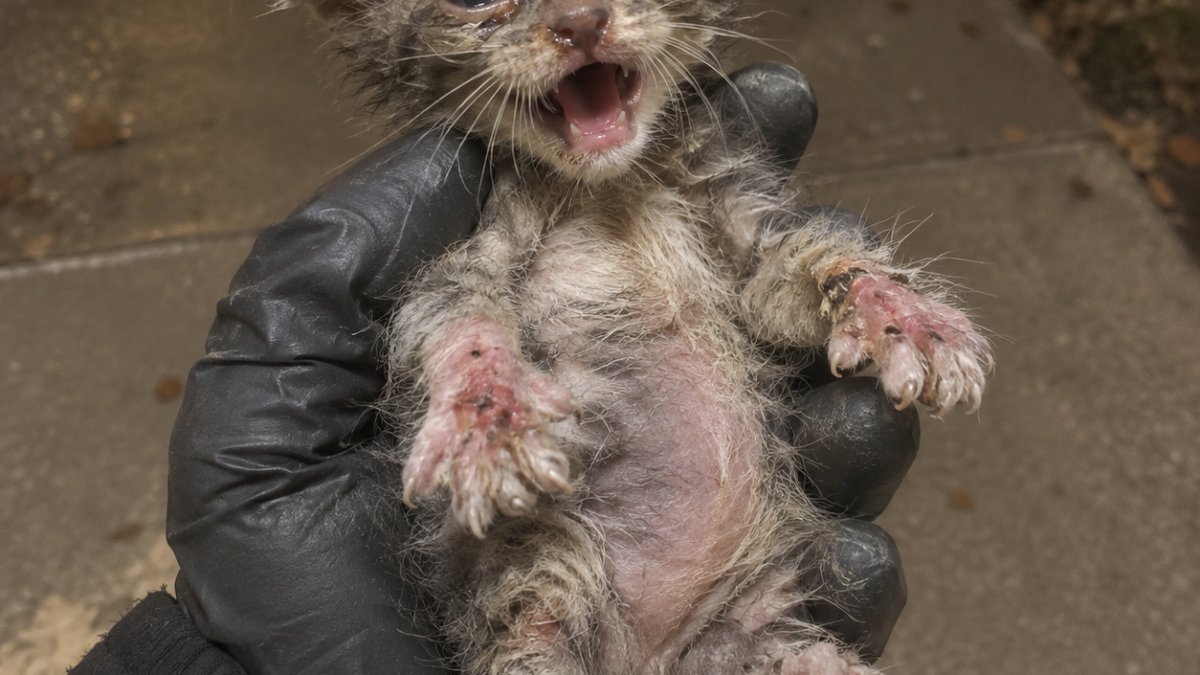
Someone Super-Glued a 5-Week-Old Kitten to a Sidewalk Overnight—At 5:15 A.M., One Jogger Heard the Cry Everyone Else Might Have Missed
At 5:15 on a dark residential street, a woman out for her usual morning run heard a thin scream coming from the sidewalk and found a five-week-old gray kitten with all four paws and his belly super-glued to the concrete.
Every time the tiny animal tried to pull free, his skin stretched against hardened adhesive, his cries became sharper, and tufts of gray fur remained trapped beneath him like a shadow he could not escape.
The jogger dropped to her knees, reached for her phone, and realized that if she had taken another route—or simply put in the earbuds she almost always carried—the sound beneath her feet might never have been heard.
The woman had been running before sunrise for almost six years.
It had started after her doctor told her she needed to move more.
Nothing dramatic.
No health scare.
No frightening diagnosis.
Just the ordinary middle-aged conversation people have when blood pressure begins creeping upward and sleep gets worse and the body starts collecting small warnings that are easy to ignore because none of them, by themselves, seem urgent.
So she began walking.
Then jogging.
Then running.
At first she hated mornings.
She hated the alarm.
Hated the cold floor beneath her feet.
Hated tying shoes while the rest of the house slept.
Hated those first five minutes when every muscle in her body seemed to argue that there was absolutely no reason a sane person should be outside before dawn.
But eventually the quiet became the reason she kept doing it.
There was something about a neighborhood at five in the morning that did not exist later.
No lawn mowers.
No school buses.
No delivery vans blocking driveways.
No children calling to one another.
No televisions leaking through open windows.
No pressure to respond to messages.
The world had not yet started asking things from her.
Most mornings she ran the same route.
Out her front door.
Left at the stop sign.
Past the elementary school.
Across a small bridge.
PART2:
Through a neighborhood of one-story ranch houses and older maples.
Around a community park.
Then back home.
Four and a half miles.
About forty-five minutes.
She knew almost every crack in the pavement.
She knew which porch light stayed on all night.
Which house had a German shepherd that barked through a front window.
Which corner collected rainwater.
Which maple roots had lifted the sidewalk enough to become a tripping hazard.
She ran without headphones.
People thought that was strange.
Her sister had bought her wireless earbuds the previous Christmas.
Good ones.
Noise-canceling.
Sweat resistant.
The kind everybody seemed to wear while exercising.
She tried them twice.
Both times she pulled them out after less than ten minutes.
She did not like not hearing cars.
She did not like not hearing bicycles.
She did not like being sealed inside music while moving through a dark neighborhood alone.
Her sister teased her.
“You run in silence?”
“I listen to the world.”
“That sounds painfully wholesome.”
PART3:
“It keeps me from getting flattened by a pickup truck.”
So the earbuds stayed in a kitchen drawer.
That decision would later be discussed by strangers online as if it were fate.
At the time, it was simply habit.
That Monday morning was cool.
Not freezing.
But cold enough that her breath showed when she first stepped outside.
The sky was black.
A thin moon hung above the roofs.
Porch lights created pale circles on sidewalks.
She checked the time.
5:07.
Later than usual.
She almost shortened the route.
She had a meeting at eight-thirty and still needed to shower, feed the dog, pack lunch, and answer an email she had ignored the night before.
She considered skipping the loop through the older neighborhood.
Cutting across the park instead.
Saving ten minutes.
Then she thought about the extra piece of pie she had eaten Sunday afternoon.
She kept the full route.
Seven minutes later, she turned onto Briarwood Lane.
The houses there had been built in the 1960s.
Small front yards.
Wide sidewalks.
Large trees.
Most lights were off.
A television flickered blue in one living room.
Somewhere far away, a train horn sounded.
She heard her own shoes touching pavement.
Breathing.
A sprinkler clicking.
Then another sound.
At first she thought it was a bird.
High.
Thin.
Almost constant.
She slowed.
The sound stopped.
She looked toward the trees.
Nothing.
She started running again.
There.
A cry.
Not a bird.
She stopped completely.
The sound came from ahead.
Low.
Near the ground.
She took her phone from the running belt around her waist and turned on the flashlight.
The beam swept across a lawn.
A parked SUV.
A recycling bin.
Sidewalk.
Nothing.
Then the sound came again.
Sharp.
Desperate.
She moved closer.
The light crossed something gray.
She almost missed it because the shape was so small.
Then two eyes reflected back.
A kitten.
The woman’s first reaction was relief.
A stray.
Lost.
Maybe injured.
She walked toward him slowly.
“Hey, baby.”
The kitten tried to move.
His entire body jerked.
He screamed.
The woman stopped.
“What happened?”
The kitten pulled again.
Front legs stretching.
Shoulders shaking.
Nothing below his chest moved.
The woman crouched.
Her phone light trembled across the sidewalk.
The kitten was tiny.
Five weeks, maybe six.
Gray fur.
Large ears.
Blue-gray kitten eyes.
His head looked too big for his body in the way very young kittens often do.
His ribs were visible beneath thin fur.
He was lying flat against the concrete.
Not resting.
Stuck.
The woman moved the light closer.
One front paw was spread unnaturally wide against the sidewalk.
Every pad pressed flat.
The other front paw was the same.
His back legs were splayed slightly outward.
His belly touched the pavement.
The woman reached toward him.
He screamed before her fingers made contact.
She pulled her hand back.
“Okay.”
Her heart began pounding harder than it had during the run.
“Okay, sweetheart.”
She leaned down.
There was something shiny around the paws.
Clear.
Hard.
A strange glossy patch on the concrete.
She touched the edge with one fingertip.
Her finger stuck for half a second.
She jerked back.
Glue.
She stared.
No.
That was impossible.
She moved the light.
The shiny material surrounded both front paws.
Both back paws.
Beneath the kitten’s belly.
Not spilled randomly.
Not one accidental patch the animal had stepped into.
Several areas.
The kitten had been pressed into adhesive.
The woman sat back on her heels.
For a few seconds, she could not form a useful thought.
Someone had put glue on a sidewalk.
Then placed a kitten into it.
Or put glue directly onto the kitten.
Either way, somebody had made a choice.
Repeated choices.
Buy glue.
Open it.
Apply it.
Handle the animal.
Press him down.
Leave.
The kitten tried pulling again.
His body rose perhaps half an inch.
The skin beneath his belly stretched.
He screamed.
“Stop.”
The woman’s voice broke.
“Please stop.”
Of course the kitten did not understand.
He only understood that he could not move.
Animals trapped by pain do not preserve themselves logically.
They fight.
The harder he fought, the more he risked tearing his own skin.
The woman took out her phone.
Her first thought was animal control.
Then she remembered the time.
Five-fifteen in the morning.
She did not know whether anyone would answer.
She called emergency dispatch.
“I’m sorry,” she said immediately when someone picked up. “I don’t know who else to call.”
“What is the emergency?”
“There’s a kitten.”
A pause.
“Is someone injured?”
“The kitten is glued to the sidewalk.”
Another pause.
“What?”
“Someone glued a kitten to the sidewalk.”
The operator’s tone changed.
“Can you repeat your location?”
The woman gave the street.
“He’s alive?”
“Yes.”
“Are you able to move him?”
“No. His feet and stomach are stuck. If he pulls, he screams.”
“Do not try to remove him.”
“I won’t.”
“Animal services will be contacted.”
“How long?”
“I can’t give an exact estimate.”
The woman looked at the kitten.
His chest moved quickly.
“Please hurry.”
The operator asked whether she felt safe.
That question surprised her.
She looked around.
Dark houses.
Empty street.
Whoever had done this might still be nearby.
The thought arrived late.
Suddenly every shadow felt different.
“I think so.”
“Stay in a well-lit area if possible.”
“I’m not leaving him.”
“I understand. Just remain aware of your surroundings.”
The call ended.
The kitten cried again.
The woman sat beside him.
She took her water bottle from her waist belt.
She knew water would not dissolve cyanoacrylate glue.
She had used super glue at home.
She knew how stubborn it was.
But the kitten’s paws looked dry.
The skin around them was beginning to stretch every time he moved.
She poured a small amount of water around the edges.
Not enough to soak him in the cold.
Just enough to dampen the fur and concrete.
“Easy.”
The kitten looked at her.
His mouth opened.
A sound came out that did not sound like a normal meow.
Too high.
Too strained.
The woman’s stomach turned.
She took off her lightweight running jacket and folded it beside him, creating a barrier against the cold where she could without touching the glued areas.
She checked the temperature on her phone.
Forty-seven degrees.
Not freezing.
But the concrete held night cold.
The kitten’s body was so small.
He had almost no insulation.
She placed one hand near his face.
Not touching at first.
The kitten turned toward it.
Sniffed.
Then tried to crawl.
His front paw did not move.
Another scream.
The woman cried.
She did not realize it until a tear dropped onto the pavement.
“Don’t move.”
The kitten panted.
She stroked only the top of his head.
Very gently.
He stopped pulling for a few seconds.
That became her job.
Not rescue.
Not yet.
Stillness.
Every time he began struggling, she spoke.
Sometimes he paused.
Sometimes not.
Minutes feel different when an animal is in pain.
Five minutes became enormous.
Cars began appearing occasionally.
A sedan passed.
Then another.
Neither stopped.
The woman wondered whether anyone had seen the kitten during the night.
Maybe there had been no one walking.
Maybe somebody noticed and assumed trash.
Maybe the person who did it had chosen the place because it was quiet.
A residential sidewalk.
Far enough from the nearest porch that nobody would hear easily.
No streetlight directly overhead.
The kitten’s gray fur nearly invisible in darkness.
She looked at the houses.
Someone could be sleeping twenty feet away.
Unaware.
The kitten cried again.
The woman called dispatch a second time.
“They’re on the way,” the operator said.
“He’s getting weaker.”
“Keep him calm.”
“I’m trying.”
The kitten stopped fighting.
For a moment, the woman was relieved.
Then she realized his head had lowered.
“Hey.”
She touched his forehead.
Cold.
Not ice cold.
But wrong.
“Stay with me.”
His eyes opened.
She exhaled.
“Good.”
She took a photograph.
Not because she wanted one.
Because some part of her understood evidence would matter.
The flash illuminated everything too clearly.
The gray kitten flattened against concrete.
Paws spread.
Belly fur embedded.
Hard adhesive catching the light.
She almost deleted it immediately.
Instead she saved it.
Then another picture from farther back.
The location.
The sidewalk.
The curb.
The nearby houses.
Maybe police would need it.
Maybe animal services.
She hated herself slightly for thinking like that while the kitten suffered.
But later everyone would be grateful she had.
At 5:36, headlights turned onto Briarwood.
A white animal services truck stopped at the curb.
Two officers stepped out.
One carried a medical kit.
The other had towels and gloves.
The woman stood.
“Here.”
The officers approached.
The first crouched.
His face changed.
“How long have you been here?”
“About twenty minutes.”
“How long has he?”
“I don’t know.”
One officer touched the concrete around the adhesive.
“Looks like cyanoacrylate.”
“Super glue?”
“Yes.”
“Can you get him off?”
“We can.”
The answer came quickly.
The woman needed that.
“Will it hurt?”
The officer did not lie.
“Probably.”
They worked carefully.
The first plan was to soften the adhesive gradually with a solvent safe enough to use around skin in controlled amounts.
The officer explained that pure acetone could irritate tissue and had to be applied carefully.
They used cotton applicators.
Tiny amounts.
Starting with one paw.
The woman stayed nearby.
“You don’t have to watch,” an officer said.
“I’m not leaving.”
“All right.”
The first front paw had the worst adhesion.
Glue covered the pads.
Fur between the toes.
Part of the lower leg.
The officer worked millimeter by millimeter.
Apply.
Wait.
Separate.
The kitten screamed.
The jogger put both hands over her mouth.
The officer stopped.
“Let him settle.”
The kitten panted.
His eyes were wide.
“Good boy,” the officer whispered.
Another drop.
Another millimeter.
The woman watched the officer’s gloved fingers.
The process was painfully slow.
Anything fast would tear skin.
The glue was stronger than fur.
Stronger than the thin outer layer of paw pad.
The first paw came free after several minutes.
When it lifted, some gray fur remained on the sidewalk.
The woman looked away.
The officer immediately wrapped the paw in damp gauze.
“One.”
Three more.
The second front paw.
The kitten tried biting.
Not hard.
Pure panic.
The officer adjusted.
Towel near the head.
Soft restraint.
“Almost.”
The kitten screamed again.
A porch light came on across the street.
A man stepped outside wearing sweatpants.
“What’s happening?”
The woman turned.
“Someone glued a kitten to the sidewalk.”
The man stared.
“What?”
He walked closer.
Then stopped when he saw.
“Oh my God.”
Another light came on.
Then another.
The quiet street began waking around the rescue.
A woman in a robe stood on her porch.
Someone took out a phone.
The jogger wanted to yell at them not to film.
She did not.
The officers needed concentration.
Second paw free.
Then one back paw.
The adhesive beneath the belly was more complicated.
Fur could be sacrificed.
Skin could not.
They clipped small sections where possible.
Used solvent around the edges.
The kitten’s cries weakened.
That frightened the jogger more than the screaming had.
“Is he okay?”
“He’s exhausted.”
“Is he dying?”
“No.”
The officer looked up.
“Not if we can help it.”
The last back paw remained.
By then, dawn had begun lightening the sky.
Blue replaced black.
Birds started.
Sprinklers clicked on somewhere down the street.
The absurd normality of the morning felt offensive.
People would soon make coffee.
Drive children to school.
Complain about traffic.
And here, on a public sidewalk, two officers were dissolving glue from the paws of a kitten somebody had intentionally pressed into concrete.
The final paw released.
The officer lifted him.
Not yet fully.
His belly was still stuck.
The kitten screamed.
“Wait.”
Back down.
More solvent.
More clipping.
The woman saw the outline beneath him.
Gray fur embedded in glue.
A patch shaped almost exactly like the underside of the kitten’s body.
The officer worked around the ribs.
Then the lower abdomen.
Slowly.
Finally:
“Got him.”
The kitten lifted free.
A thin sheet of fur remained behind.
The woman gasped.
The officer held the kitten in one gloved hand.
That was how small he was.
His entire body fit across the palm and wrist.
His legs hung awkwardly.
Paws red.
Raw.
Some outer skin peeled.
His belly had a bald patch where fur remained glued to the sidewalk.
The kitten opened his mouth.
A scream.
The jogger started crying again.
One officer wrapped him in a warm towel.
The other looked at the pavement.
There was an outline.
Four patches where paws had been.
A larger gray patch in the center.
Fur stuck permanently in hardened adhesive.
For a second, everyone stood staring.
It looked like evidence from something impossible.
The woman took one photograph.
Later it would be the image people shared most.
Not the kitten.
The sidewalk.
A gray shadow where his body had been.
The animal services officer rushed him into the truck.
“You can follow us if you want.”
The woman looked down at herself.
Running shoes.
Leggings.
Phone.
No car.
“I ran here.”
The officer almost smiled despite everything.
“Right.”
The man from across the street said, “I’ll drive her.”
She looked at him.
“You don’t have to.”
“I know.”
He grabbed keys from his house.
Five minutes later, the jogger sat in the passenger seat of a stranger’s pickup truck following an animal services vehicle toward the emergency veterinary clinic.
She texted her husband.
Emergency. I’m okay. Found an injured kitten. Going to vet.
He called immediately.
“What happened?”
She told him.
Silence.
Then:
“Someone did what?”
“I’ll explain later.”
“Are you okay?”
“No.”
That was the honest answer.
At the clinic, technicians took the kitten immediately.
The jogger remained in the waiting room.
She had no legal ownership.
No connection.
Technically, she could have gone home.
Instead she sat.
Her meeting at eight-thirty disappeared from her mind.
Her boss texted.
Take the day.
She stared at the message.
Then put the phone away.
An hour later, a veterinarian came out.
“He’s alive.”
The woman stood so fast the chair scraped.
“How bad?”
The veterinarian sat across from her.
“Let me start with the good.”
No broken bones.
No internal trauma detected.
No major tissue tearing on the abdomen.
The kitten had not aspirated glue.
Nothing indicated ingestion.
No eye exposure.
No mouth exposure.
“That’s the good?”
“That is very good.”
The woman nodded.
“And the bad?”
His paw pads had chemical irritation and superficial-to-moderate burns.
Some layers of skin had been damaged during adhesion and removal.
The abdominal skin was raw but intact.
He was dehydrated.
His body temperature was low.
“How low?”
“Hypothermic, but responding to warming.”
“Was he there all night?”
The veterinarian paused.
“We estimate six to eight hours based on dehydration, temperature, and the condition of the glue.”
The woman imagined midnight.
One in the morning.
Two.
Three.
The kitten awake.
Unable to stand.
Unable to crawl.
Cold concrete under his body.
No mother.
No littermates.
No way to hide.
Every instinct telling him to move.
Every attempt hurting.
“He was there all night.”
“Most likely.”
The woman looked down.
“Why?”
The veterinarian did not pretend to know.
“I can’t answer that.”
“Could he have stepped in glue accidentally?”
“Not like this.”
The woman knew.
Four paws.
Belly.
Pattern.
“Someone did it.”
“Yes.”
The veterinarian’s voice remained clinical.
But her face did not.
“How old?”
“Probably five to six weeks.”
“Weight?”
“Just under a pound.”
The woman closed her eyes.
Less than a pound.
Someone had taken an animal that could fit in one hand and fixed him to concrete.
“Will he walk?”
“We believe so.”
“Will his paws heal?”
“We think they will.”
“Scars?”
“Possibly.”
“Pain?”
“Managed.”
“Can I see him?”
The veterinarian hesitated.
“You’re not the owner.”
“I know.”
Then she added:
“I’m the one who found him.”
The veterinarian’s expression softened.
“Give us a little time.”
The kitten spent the morning in warming blankets.
Fluids.
Pain medication.
Paw treatment.
Tiny bandages.
Antibiotic ointment.
His body temperature rose.
He began responding more.
At eleven-thirty, the jogger was allowed into the treatment area.
The kitten lay inside a warm incubator.
Four tiny paws wrapped.
Belly treated.
A towel around him.
His eyes opened when she approached.
“Hi.”
He looked at her.
She knew she was projecting human meaning onto the expression.
Recognition.
Relief.
Trust.
Animals do not always give us those stories.
Maybe he simply saw movement.
But his head lifted.
The woman put one finger near the opening.
The kitten moved toward it.
Not far.
His body hurt.
Still, he moved.
She touched his forehead.
The kitten began to purr.
A barely audible vibration.
The woman froze.
“How?”
The technician beside her smiled.
“Kittens purr for lots of reasons.”
“Even hurt?”
“Yes.”
“Why?”
“Comfort. Self-soothing. Sometimes because touch helps.”
The woman cried again.
She had cried more before noon than during the previous year.
The technician handed her a tissue.
“What are you calling him?”
“I’m not calling him anything.”
“You found him.”
“That doesn’t mean I own him.”
“No.”
The technician smiled.
“But somebody has to put something on the chart.”
The temporary chart said:
UNKNOWN GRAY KITTEN — BRIARWOOD.
That lasted two hours.
Then one of the officers returned with paperwork.
The case needed an identifier.
Someone suggested “Glue.”
Everyone rejected it immediately.
“Lucky.”
Too obvious.
“Briar.”
Maybe.
“Dawn.”
The jogger looked through the window.
The morning had become bright.
“He was found before sunrise.”
The technician nodded.
“Dawn?”
“He’s male.”
“That doesn’t matter.”
Another tech said, “What about Scout?”
The kitten opened his mouth.
Tiny meow.
The jogger smiled.
“Scout.”
It stayed.
By afternoon, the story had reached the neighborhood community group.
The man who had driven her to the clinic posted that animal services had rescued a kitten from Briarwood Lane.
The jogger added a short explanation.
No exaggeration.
No speculation.
She included the photograph of the outline on the sidewalk.
Within an hour, hundreds of comments appeared.
People were horrified.
Some demanded cameras be checked.
Others asked whether the kitten needed donations.
One person claimed no human could do something like that.
Another replied that a human obviously had.
Arguments started.
The jogger stopped reading.
She had already spent hours wondering about the person.
Man?
Woman?
Teenager?
Child?
Someone intoxicated?
Someone angry?
Someone experimenting with cruelty?
Someone who thought the kitten was disposable?
She did not know.
Speculation did not help Scout.
Animal services canvassed the street.
No doorbell camera covered the exact sidewalk.
One house had a camera facing its driveway.
The edge of the frame showed part of the sidewalk.
At 11:48 the previous night, a dark shape moved near the lower corner.
Too blurry.
Could be a person.
Could be nothing useful.
Another camera recorded a car passing at 12:12.
Then another at 1:03.
No stopping visible.
A homeowner remembered hearing a cat crying around two.
He had thought it was somewhere behind the houses.
He did not go outside.
That fact destroyed him when he learned what happened.
“I heard him.”
The jogger stood on his porch while he cried.
“You didn’t know.”
“I heard him.”
“You thought it was a cat outside.”
“I could’ve looked.”
She understood why he blamed himself.
Still, she said:
“You didn’t put him there.”
The man shook his head.
“I could’ve found him three hours earlier.”
Maybe.
Or maybe the kitten had not begun crying yet.
Maybe the sound traveled.
Maybe he would have looked in the wrong direction.
Grief and guilt love certainty after the fact.
Real life rarely offers it.
The police collected glue residue.
But super glue is common.
Sold everywhere.
Hardware stores.
Pharmacies.
Discount stores.
Grocery stores.
No packaging left behind.
No fingerprints useful.
No clear footage.
No witness who had seen someone place the kitten.
The sidewalk became evidence.
For several days, yellow tape surrounded the patch.
Gray fur remained visible beneath dried adhesive.
Neighbors stopped.
Children pointed.
Adults took photographs.
The jogger hated that.
Not the evidence.
The spectacle.
Scout had become a story before he had even learned to eat properly.
At the clinic, he spent the first twenty-four hours mostly sleeping.
He woke for formula mixed with soft kitten food.
At first he had to be encouraged.
Then hunger returned.
By Tuesday morning, he was demanding meals.
That was the first update the jogger posted.
Scout screamed at breakfast today.
Apparently he has opinions.
People loved it.
Thousands reacted.
She regretted making him public almost immediately.
Then the rescue coordinator explained something.
“Public attention can be ugly.”
“I know.”
“But it can also pay for care.”
Donations had started arriving.
Enough to cover his emergency treatment.
Then more.
The rescue created a fund restricted to Scout and future cruelty cases.
The jogger agreed only after they promised any excess money would help other animals.
“He doesn’t need to become merchandise.”
“He won’t.”
She visited every day.
Not because anyone asked.
Because she could not stop thinking about him.
Wednesday, Scout stood for the first time after bandage changes.
His paws trembled.
The technician placed him on a padded towel.
He took one step.
Then another.
Stopped.
Looked confused.
The jogger held her breath.
“Come on.”
The kitten sat.
Everyone laughed.
“Good enough,” the veterinarian said.
Thursday, he walked five steps.
Friday, eight.
He hated bandages.
Every kitten does.
He chewed them.
They fitted soft protective wraps.
He chewed those too.
The fact that he had enough energy to be difficult delighted everyone.
“Your victim is becoming a criminal,” one tech told the jogger.
“Good.”
Scout began kneading blankets.
At first only with his front paws.
Slowly.
The motion fascinated the jogger.
Those pads had been glued to concrete.
Now they pressed into fleece.
Release.
Press.
Release.
Nothing holding them down.
The first time he did it, she filmed ten seconds.
Then she put the phone away.
Some moments deserved to exist without witnesses.
A foster volunteer took Scout home after six days.
She had bottle-raised kittens for eleven years.
Her spare bathroom had seen everything.
Orphaned litters.
Upper respiratory infections.
Broken legs.
Ringworm.
A kitten found inside a storm drain.
She thought she had become difficult to shock.
Then she met Scout.
“He’s smaller than I expected.”
Everybody said that.
Pictures distorted scale.
A human hand beside him corrected it.
At six weeks, Scout weighed a little over a pound after fluids and several days of food.
Still tiny.
The foster woman set up a low-sided litter box because his paws remained tender.
Soft bedding.
Heat pad.
Food.
Water.
No hard surfaces.
Scout emerged from the carrier immediately.
That surprised her.
He sniffed.
Walked.
His gait was awkward.
Bandaged feet changed balance.
But he did not hide.
He went straight to food.
Then climbed into the foster woman’s lap.
“You don’t know me.”
Scout purred.
“That is not a survival skill.”
He fell asleep.
The foster woman looked down at him.
Some abused animals arrived terrified of hands.
Some did not.
She had learned not to judge their history by behavior.
Trust did not prove absence of abuse.
Fear did not prove it either.
Animals responded according to temperament, developmental stage, circumstance, and whatever had happened before anyone met them.
Scout was simply Scout.
Young.
Social.
Desperate for warmth.
He followed people.
If the foster woman left the bathroom, he cried.
The first nights she slept on the floor beside him.
Not because medically necessary.
Because he would not settle otherwise.
At 2 a.m., Scout crawled beneath her chin and slept.
She sent the jogger a photograph.
The jogger stared at it in bed.
Her husband looked over.
“You’re crying again?”
“No.”
“You are.”
“I’m tired.”
“He looks good.”
“I know.”
“You saved him.”
She immediately shook her head.
“Don’t.”
“What?”
“Don’t make me into that.”
“You found him.”
“Yes.”
“You called.”
“Yes.”
“If you hadn’t—”
“I know.”
“Then why can’t I say it?”
Because the sentence felt too large.
Saved him.
It turned one random decision into heroism.
She had gone running.
He had cried.
She had heard him.
She called people who knew what to do.
That mattered.
Of course it mattered.
But the officers dissolved the glue.
The veterinarian managed burns.
Technicians fed him.
Foster volunteers sat awake.
Donors paid bills.
No single person owned survival.
“I stopped,” she finally said.
Her husband looked at her.
“What?”
“I stopped.”
“That’s not nothing.”
“No.”
She looked at the photograph.
“It’s enough.”
The community wanted answers.
Weeks passed.
No suspect.
The lack of a villain frustrated everyone.
People like cruelty stories to have clean endings.
Monster identified.
Arrest.
Courtroom.
Sentence.
Animal recovered.
Justice.
Real cases are rarely that cooperative.
No camera.
No witness.
No confession.
No packaging.
No owner.
Scout was not microchipped.
He was too young.
No lost-litter reports matched.
Nobody admitted knowing where he came from.
Animal services checked nearby colonies.
No nursing mother missing a gray kitten that they could identify.
Maybe Scout had been taken from a litter.
Maybe someone had found him stray first.
Maybe he had belonged to someone.
Nobody knew.
The jogger returned to Briarwood after the tape came down.
The sidewalk looked almost normal.
Almost.
The glue remained.
So did fur.
Rain had not removed it.
Gray tufts still flattened into the adhesive.
Four paw shapes.
Belly.
She stood over it.
The outline was smaller than she remembered.
That hurt.
Memory had enlarged Scout.
Reality reminded her he had been tiny.
She crouched.
Touched one patch beside the fur.
Hard.
Someone had left a living animal there like an object.
She sat on the curb.
A woman from the neighborhood approached.
“Are you the runner?”
The jogger nodded.
“I live three houses down.”
They looked at the pavement.
“My daughter won’t walk this side anymore.”
“How old?”
“Nine.”
“I’m sorry.”
“No.”
The neighbor shook her head.
“She asked me why somebody would do it.”
“What did you say?”
“I said some people make cruel choices.”
“That’s probably enough.”
“She asked if Scout hates people now.”
The jogger smiled sadly.
“No.”
“That’s what I told her.”
Scout did not hate people.
If anything, he loved them too much.
At foster care, he became increasingly demanding.
He climbed pants.
Attacked shoelaces.
Tried eating the corner of a paper towel.
Fell asleep inside a slipper.
Chased his own tail and toppled over.
His paws healed.
Bandages came off one at a time.
The first exposed pad looked bright pink.
Tender.
New.
He licked it constantly.
The foster woman redirected him.
By week three, all four paws were uncovered.
He walked normally most of the time.
Sometimes a slight hesitation on hard floors.
The veterinarian expected that to fade.
His belly fur began regrowing.
At first, dark fuzz.
Then gray.
The outline on the sidewalk remained more visible than the injury on the kitten.
That contrast became important to the jogger.
The concrete held evidence longer than Scout’s body did.
Scout moved forward.
The sidewalk stayed.
People online called him Miracle Kitten.
The jogger hated it.
Not because survival was not remarkable.
Because miracle erased labor.
There had been no miracle solvent.
No magical recovery.
There had been twenty-eight minutes of painstaking separation.
Burn treatment.
Fluids.
Warmers.
Pain medication.
Bandage changes.
Feedings.
Foster care.
Money.
Time.
Skill.
Calling it a miracle made it sound effortless.
Scout had worked too.
Healing hurts.
Learning to walk on tender pads hurts.
Eating enough to grow requires a body to keep going.
He had kept going.
At seven weeks, he discovered running.
Not graceful running.
Kitten running.
A sudden sideways explosion across the room for no apparent reason.
The foster woman filmed him once.
Scout launched from a blanket.
Slid on hardwood.
Corrected.
Charged toward a cardboard tunnel.
Disappeared.
Then emerged from the same opening backwards.
The video reached the jogger.
She watched it twelve times.
Her husband said, “That’s the same kitten?”
“Yes.”
“He moves fine.”
“Yes.”
“You’re crying.”
“Yes.”
She no longer denied it.
Scout’s story changed online.
The original photograph had made people furious.
The new videos made them happy.
The jogger watched this happen in real time.
Cruelty attracted attention.
Recovery kept some of it.
Then interest faded.
A new outrage appeared.
Another rescue.
Another viral photo.
Another argument.
Scout’s posts received fewer comments.
The jogger found that comforting.
An ordinary kitten should eventually become boring to strangers.
That meant his worst day was no longer the only interesting thing about him.
The foster woman began accepting adoption applications.
That surprised the jogger.
“He’s ready?”
“Medically, almost.”
“He’s so little.”
“He’s a kitten.”
“He’s been through…”
“I know.”
The foster woman smiled.
“He doesn’t know he’s famous.”
That was true.
Scout did not know thousands of people had seen the outline of his body on concrete.
He did not know local television had run the story.
Did not know people debated punishment.
Did not know somebody had called him “proof humanity is evil” in a comment with ten thousand likes.
He knew breakfast.
Warm laps.
Fleece.
Toy mice.
The sound of the refrigerator.
A foster cat named Benny who tolerated being climbed.
That was healthier.
Several excellent applications arrived.
Families.
Singles.
A retired couple.
A veterinary technician.
The rescue screened carefully.
Then the foster woman called the jogger.
“I have a strange question.”
“What?”
“Do you want him?”
Silence.
The jogger looked across her kitchen.
Her own dog, a nine-year-old Labrador mix, slept beside the refrigerator.
Her husband was washing dishes.
They had never discussed adopting Scout.
Not seriously.
She had told herself from the beginning:
I found him.
That does not mean he is mine.
“I don’t know.”
“That’s fair.”
“I have a dog.”
“Scout has met dogs.”
“My dog is old.”
“He’s calm?”
“Very.”
“You don’t have to.”
The jogger felt unexpected panic.
“What happens if I say no?”
“He goes to another good home.”
“Do you have one?”
“Yes.”
That helped.
And hurt.
“Can I meet him again?”
The foster woman laughed.
“You visit twice a week.”
“I mean at my house.”
They arranged a trial visit.
Scout arrived in a carrier.
The jogger’s dog sniffed.
Scout puffed to twice his size.
The dog sneezed.
Scout hissed.
The dog walked away.
Twenty minutes later, Scout followed him.
An hour later, Scout slept against the dog’s rear leg.
Her husband looked at her.
“No.”
She whispered, “I didn’t say anything.”
“You’re thinking loudly.”
Scout stayed three hours.
When the foster woman took him back, the house felt strangely empty.
The jogger stood by the front window.
Her husband said:
“You found him.”
“That’s not a reason.”
“You keep saying that.”
“Because it isn’t.”
“What is a reason?”
She turned.
“I don’t want to adopt him because I feel guilty.”
“Do you?”
“No.”
“Because you think he owes you?”
“No.”
“Because you think nobody else can love him?”
“No.”
“Do you want him?”
She looked out the window.
“Yes.”
“Then that sounds inconveniently like a reason.”
The adoption became official two weeks later.
The jogger insisted the rescue still review their application like everyone else.
Home check.
Veterinary records.
References.
Everything.
“Are you serious?” the coordinator asked.
“Yes.”
“You are the person who found him glued to pavement.”
“That does not automatically make me qualified to care for him for fifteen years.”
The coordinator smiled.
“Fair.”
They passed.
Scout came home permanently on a Saturday.
The jogger placed the carrier in the living room.
Opened it.
Scout emerged.
Tail up.
Walked directly to the dog’s bed.
The old Lab lifted his head.
Scout climbed in.
The dog sighed.
“Excellent,” the husband said. “We’ve adopted a parasite.”
Scout purred.
His name remained Scout.
The jogger had considered changing it.
But he had become Scout at the clinic.
The name belonged to the version of him that came after the sidewalk.
She kept it.
The first night, Scout slept on her chest.
At 3 a.m., she woke to kitten paws against her neck.
Tiny pads.
Soft.
He stretched.
Flexed his toes.
The jogger touched one paw.
No bandage.
No raw skin.
No glue.
She cried quietly so she would not wake her husband.
Scout woke anyway.
He licked her chin.
Over the next months, the last visible signs faded.
The belly fur returned.
Paw pads toughened.
A few pale irregular areas remained.
The veterinarian said they might always look slightly different.
Scout did not care.
He ran.
Climbed.
Jumped.
Scratched.
Destroyed a roll of toilet paper.
Knocked a glass from the kitchen counter.
Attacked the Christmas tree.
Pulled ribbon from a gift.
Climbed curtains once.
The jogger found him hanging halfway up.
“Are you kidding?”
Scout looked delighted.
Her husband said, “At least he’s not stuck.”
She laughed despite herself.
There were moments the joke felt allowed.
Not because what happened stopped mattering.
Because Scout had become larger than it.
On the first cold night of winter, the jogger worried about his paws.
“They’re healed.”
The vet had already told her.
“I know.”
“He has fur.”
“I know.”
“He’s indoors.”
“I know.”
Still, she picked him up.
Checked each pad.
Scout bit her finger gently.
“Rude.”
He bit again.
“Good.”
Normal kitten behavior became a gift.
Not saintly gratitude.
Not permanent sweetness because he had suffered.
He was allowed to be annoying.
That mattered.
People often expect rescued animals to perform gratitude.
As though survival creates a debt.
Scout owed nobody perfect behavior.
He was allowed to scratch furniture.
Wake people.
Refuse food.
Knock things over.
Run away from medicine.
Be a cat.
The jogger’s daughter came home from college for Thanksgiving.
She had followed Scout’s story through photos.
The first time she held him, she stared at his paws.
“You can’t tell.”
“Not much.”
She touched one gently.
“He fits in both my hands.”
“He used to fit in one.”
Her daughter’s face changed.
“Don’t.”
“I know.”
They sat quietly.
Scout fell asleep.
Then the daughter asked:
“Do you still think about who did it?”
“Yes.”
“Every day?”
“No.”
“Good.”
The jogger considered.
“Not good exactly.”
“What then?”
“Necessary.”
She explained.
For weeks she had imagined the unknown person constantly.
Face.
Hands.
Store purchase.
Street.
Night.
She had mentally created a hundred versions.
None useful.
Eventually she realized that every hour spent imagining the abuser was an hour Scout himself was not at the center of the story.
The investigation mattered.
Accountability mattered.
But obsession did not protect him.
So she stopped giving the stranger a starring role.
The person had owned perhaps ten terrible minutes of Scout’s life.
Maybe an hour.
Maybe more.
The sidewalk held six to eight painful hours afterward.
But Scout, if fortunate, might live fifteen years.
The math mattered.
A single cruel night did not deserve ownership of every year that followed.
The first anniversary came quietly.
The jogger woke at 4:45.
Habit.
She laced running shoes.
Scout, now more cat than kitten, watched from the kitchen counter.
“You’re not coming.”
He blinked.
She left.
No headphones.
She had never worn them again.
Not because she believed every morning contained an animal needing rescue.
Because silence had become sacred.
She ran the old route.
Left at the stop sign.
Past the school.
Across the bridge.
Onto Briarwood.
At 5:15 almost exactly, she reached the spot.
The glue had darkened.
Weather had removed much of it.
Most fur was gone.
A faint discoloration remained in the concrete.
She stopped.
A year earlier, a kitten had screamed here.
Now:
Nothing.
Birds.
Distant traffic.
Her breathing.
A garage door opening.
Ordinary sounds.
She stood there.
No flowers.
No memorial.
No sign.
She was glad.
Scout was alive.
Living animals did not need monuments at places they nearly died.
She resumed running.
When she returned home, Scout waited inside the window.
The moment she opened the door, he ran toward her.
Not because he remembered.
Not because he knew the date.
Breakfast.
That was probably it.
She picked him up anyway.
“You have terrible priorities.”
Scout climbed onto her shoulder.
The old dog walked into the kitchen.
Her husband appeared.
“Coffee?”
“Yes.”
“Anniversary?”
“Don’t call it that.”
“Normal Monday?”
She smiled.
“Normal Monday.”
Scout jumped down.
Ran toward his bowl.
No hesitation in the paws.
No memory visible in the movement.
That afternoon, a local reporter contacted her.
They wanted a one-year follow-up.
At first she declined.
Then she reconsidered when the rescue mentioned donations had slowed.
She agreed with rules.
No reenactment.
No sensational footage.
No repeated close-up of the original injuries.
Show Scout now.
The reporter came to the house.
Scout refused to cooperate.
He climbed behind the couch.
Then attacked the microphone cable.
The reporter laughed.
“This is perfect.”
The segment opened with only a brief still photograph of the sidewalk.
Then Scout running.
Jumping.
Playing with the dog’s tail.
Sleeping in sunlight.
The reporter asked:
“What do you remember most from that morning?”
The jogger expected herself to say the glue.
The screaming.
The tiny body.
Instead:
“The sound.”
“What sound?”
“The first cry.”
She looked toward Scout.
“If I had been listening to music, I might not have heard it.”
The reporter asked the question everyone eventually asked.
“Do you think you were meant to be there?”
The jogger smiled politely.
“No.”
The reporter seemed surprised.
“No?”
“I think I happened to be there.”
“Does that make it less meaningful?”
“No.”
She thought about it.
“Maybe more.”
“How?”
“Because if you believe everything happens for a reason, you can accidentally make cruelty part of some plan.”
She shook her head.
“I don’t believe that kitten was glued to a sidewalk so I could find him.”
The reporter waited.
“I believe someone did something terrible.”
She continued.
“And then someone else happened to hear.”
“That’s all?”
“That’s plenty.”
The clip spread.
People quoted her.
She disliked that too.
But donations increased.
The rescue funded emergency care for three more animals that winter.
Scout remained unaware.
He had discovered the washing machine lid as a sleeping platform.
At eighteen months, he became a large gray cat.
Larger than anyone expected.
The kitten who fit in one hand now weighed eleven pounds.
His paws were enormous.
The veterinarian laughed during a checkup.
“Apparently trauma did not stunt his appetite.”
Scout bit the corner of the exam table paper.
“Stop eating the clinic.”
The jogger watched him.
Sometimes she could still see the five-week-old kitten beneath the adult face.
The ears.
The eyes.
But bodies move forward.
They insist.
Hair changes.
Bones lengthen.
Scars stretch.
Time rewrites proportions.
At two years, the pale marks on his paw pads remained.
You had to know where to look.
The jogger knew.
She checked them sometimes while Scout slept.
Not because necessary.
Because memory needed somewhere to go.
One evening, her sister visited.
The sister who had bought the earbuds.
They sat on the porch.
Scout watched through the screen.
Her sister said:
“I still feel weird about those headphones.”
The jogger laughed.
“You didn’t do anything.”
“I gave them to you.”
“So?”
“If you’d worn them…”
“I didn’t.”
“But if you had.”
“You could do that forever.”
“What?”
“Build alternate worlds.”
She looked at her sister.
“If I’d left five minutes earlier.”
“If I’d turned around because it was cold.”
“If Scout hadn’t cried right then.”
“If the person who heard him at two had looked outside.”
“If animal services had been farther away.”
“If.”
She shrugged.
“None of those worlds happened.”
Her sister nodded.
“I just think it’s crazy.”
“It is.”
“You not wearing headphones saved him.”
The jogger thought.
“No.”
“No?”
“Not wearing headphones let me hear him.”
“What’s the difference?”
“A lot.”
She pointed toward Scout.
“After that, dozens of people had to do their part.”
Her sister smiled.
“You really hate being called a hero.”
“Yes.”
“Why?”
“Because heroes make everyone else feel like they’re allowed to keep walking.”
That sentence surprised even her.
Her sister went quiet.
The jogger continued.
“I did something ordinary.”
“You stopped for a screaming kitten glued to pavement.”
“Yes.”
“That is not ordinary.”
“It should be.”
That was what she wanted people to understand.
You did not need special training to notice.
You did not need to know how to dissolve glue.
She had not.
You did not need to personally perform the rescue.
You needed to stop.
Call.
Stay.
Let trained people take over.
Ordinary responsibility.
Not heroism.
Years passed.
Scout grew into his life.
The old Labrador died when Scout was three.
Cancer.
The loss hit the household hard.
For days, Scout searched the dog bed.
Sniffed rooms.
Waited near the back door.
The jogger watched and thought about that first morning.
Loss did not belong only to humans.
Neither did confusion.
She sat on the floor with Scout.
“He’s not coming back.”
The cat climbed into her lap.
She cried.
Scout kneaded her leg.
Four paws.
Press.
Release.
Press.
Release.
The movement still had power over her.
Those paws once unable to lift from concrete.
Now choosing pressure.
Choosing release.
The distinction almost always brought tears.
After the dog died, Scout became more attached.
He slept beside her.
Waited by the bathroom.
Followed her husband into the garage.
Sat on the kitchen island despite repeated objections.
Life became routine.
Years after the case went inactive, animal services called.
The jogger’s heart jumped when she saw the number.
“Did you find someone?”
“No.”
The officer who had worked Scout’s case was retiring.
He wanted to return some copies of non-evidentiary photographs and ask whether she wanted the original community flyer saved for records.
They met at the animal services office.
He looked older.
She probably did too.
“Still have him?”
She pulled out her phone.
Scout asleep upside down on a couch.
The officer laughed.
“That’s him?”
“Twelve pounds of entitlement.”
“Good.”
They talked about the case.
No suspect ever developed.
The officer admitted it still bothered him.
“I remember the sidewalk.”
“So do I.”
“We had worse cases.”
“I believe you.”
“But that one…”
“The size.”
“Yes.”
He looked down.
“And the planning.”
The jogger understood.
Impulse cruelty was terrible.
Planned cruelty disturbed people differently.
Someone had needed glue.
A place.
A kitten.
Time.
Then had walked away.
“Do you think they did it again?”
She asked.
The officer was honest.
“I don’t know.”
That was the hardest answer.
No justice.
No reassurance.
Only uncertainty.
The jogger thanked him.
“For what?”
“You were gentle.”
“With Scout?”
“Yes.”
“That’s the job.”
“No.”
She shook her head.
“That should be the job.”
Difference.
He smiled.
When Scout was five, the family moved.
Different neighborhood.
The old Briarwood route disappeared from daily life.
The jogger still ran.
Still without headphones.
People continued asking why whenever she joined running groups.
“Safety.”
Sometimes she told Scout’s story.
Usually not.
A person did not need trauma attached to every preference.
At the new house, Scout discovered a sunroom.
It became his kingdom.
He spent afternoons stretched across a wicker chair.
The scars on his paws had faded almost completely.
His belly fur thick.
Nothing in his appearance announced what happened unless someone already knew.
The jogger liked that.
Healing did not need to remain visually impressive.
One summer evening, a teenage neighbor knocked.
She held a shoebox.
Inside were three newborn kittens.
Found beneath a shed.
Mother nowhere visible.
The teenager knew the jogger “helped cats.”
That was not technically true.
Still, she helped call a rescue.
They created a warm nesting box.
Waited nearby to see whether mother returned.
Eventually she did.
The rescue helped trap the mother and reunite them safely.
The teenager said:
“How do you know all this?”
“I don’t.”
“You knew who to call.”
“That’s different.”
Scout watched from behind the window.
The jogger smiled.
The skill she had actually learned from him was not veterinary medicine.
It was connection.
Know who to call.
Know when not to improvise.
Know when stopping is enough.
At eight years old, Scout developed early arthritis in one hip.
Nothing related to the glue.
Just age and genetics.
The veterinarian recommended supplements.
Weight control.
Movement.
The jogger stared at the x-ray.
“His paws are okay?”
The vet smiled.
“His paws have been okay for years.”
“I know.”
“Then why do you ask every visit?”
The jogger laughed.
“Because I’m annoying.”
“Correct.”
Scout lived comfortably.
The jogger aged too.
Her runs became slower.
Then alternated running and walking.
Knees.
Nothing dramatic.
The same body accumulating years.
She still left before sunrise some mornings.
Not every day.
One morning, more than a decade after Scout had been found, she drove through the old neighborhood.
Briarwood Lane.
The houses looked almost the same.
One had been painted blue.
A giant maple had been removed.
The sidewalk where Scout had been glued had been replaced.
New concrete.
The city had repaired the block after tree-root damage.
The old patch was gone.
She parked.
Walked over.
No fur.
No glue.
No stain.
Nothing.
She had expected sadness.
Instead she felt relief.
Concrete should not carry memory forever.
People could.
Animals did not need to.
She stood there.
A young woman pushed a stroller past.
A dog barked behind a fence.
Someone started a lawn mower.
Normal morning.
She took no photograph.
Then she drove home.
Scout was asleep in the sunroom.
Older.
Gray hairs appearing strangely against gray fur.
He opened one eye.
She sat beside him.
“You know they replaced it.”
Scout yawned.
“The sidewalk.”
No interest.
“Exactly.”
She touched one paw.
He pulled it away because he had never liked his feet being handled.
That made her laugh.
“Still opinionated.”
Scout rolled onto his side.
She scratched his cheek.
Purr.
The story people knew about Scout began with glue.
But his actual life did not.
There had been something before.
A mother cat.
Littermates.
Milk.
Warmth.
Maybe a house.
Maybe outdoors.
Nobody ever discovered it.
And the life after became much longer.
Food bowls.
Veterinary visits.
Christmas trees destroyed.
A dog friend.
A sunroom.
A move.
Thousands of naps.
Years of ordinary days.
The terrible night became a fraction.
Important.
Never erased.
But mathematically small.
That was what the jogger wished people understood about survivors.
Human or animal.
The worst thing that happened may become the story strangers repeat.
It does not deserve to become the whole life.
At twelve, Scout slowed.
Kidney values changed.
The veterinarian monitored him.
More water.
Diet.
Medication eventually.
The jogger knew this stage.
She had loved enough animals by then to understand what aging asked.
Patience.
Observation.
Acceptance.
Scout still kneaded blankets.
Slower.
Press.
Release.
Press.
Release.
One night, the jogger woke to find him beside her.
His paw rested on her wrist.
She remembered another paw.
Tiny.
Fixed against pavement.
She cried without waking her husband.
Not from sadness exactly.
From scale.
One life.
One sound.
One morning.
So much came after.
When Scout eventually died years later, it was at home.
Old.
Warm.
Not young.
Not trapped.
Not alone.
The veterinarian came to the house.
Scout lay in the sunroom.
His favorite blanket beneath him.
The jogger sat beside him.
Her husband on the other side.
Scout had stopped eating two days earlier.
His kidneys were failing.
He was tired.
The decision was clear.
Still unbearable.
The jogger held one paw.
The pads were rough now.
Old-cat rough.
Normal.
The veterinarian administered sedation.
Scout relaxed.
The jogger whispered:
“You can move.”
Her husband looked at her.
She repeated it.
“You can move, baby.”
The words came from somewhere seventeen years old inside her memory.
Scout breathed out.
His paw loosened in her hand.
The veterinarian listened.
Waited.
Then nodded.
The jogger cried into Scout’s fur.
Later, after the veterinarian left, her husband sat beside her.
“You found him.”
She nodded.
“At five-fifteen.”
“Yes.”
“Because you didn’t wear headphones.”
She almost corrected him.
Then stopped.
That fact could be true without becoming destiny.
“Yes.”
Her husband squeezed her hand.
The next morning, she woke before sunrise.
Habit survives grief.
For a long time she lay in bed.
Then she put on running shoes.
Her body was older.
She no longer ran four and a half miles.
Two miles.
Mostly walking.
Enough.
She stepped outside.
No headphones.
The street was dark.
She heard sprinklers.
A truck.
Birds beginning.
Her own footsteps.
She thought about the sentence people had repeated for years.
Sometimes the difference between life and death is a pair of earbuds somebody chose not to wear.
It was a good line.
True in one narrow sense.
But after Scout’s whole life, she understood something bigger.
The difference had never been the earbuds alone.
It was hearing.
Stopping.
Calling.
Waiting.
An officer choosing patience instead of ripping a paw free.
A veterinarian staying after shift.
A foster home saying yes.
A rescue screening adopters.
A family turning a traumatic story into ordinary years.
Thousands of small decisions.
No single one looked heroic by itself.
Together they became a life.
She reached the corner.
Paused.
Somewhere nearby, a bird made a sharp cry.
For half a second her heart jumped.
Then the bird called again from a tree.
She smiled.
Kept walking.
The world made many sounds before sunrise.
Most meant nothing urgent.
Some did.
You could not rescue everything.
You could not hear everything.
You could not always arrive in time.
But when something reached you—
a cry,
a person,
an animal,
a moment asking you not to keep moving—
you could stop.
That was the only lesson Scout had ever needed her to learn.
The kitten somebody once tried to turn into a helpless shape on concrete had grown into an old cat who spent years walking wherever he pleased.
Across floors.
Onto couches.
Up stairs.
Through doorways.
Into laps.
Across an entire ordinary life.
And in the end, the image that stayed with her was not the gray outline left in hardened glue.
It was Scout running through the living room years later, paws striking the floor so fast they blurred, chasing nothing anyone else could see.
Free to stop.
Free to turn.
Free to jump.
Free to move.








