Someone Spray-Painted a Missing Cat Gold and Left Her to Suffocate—Then a Road Worker Found the Clue Her Abuser Forgot
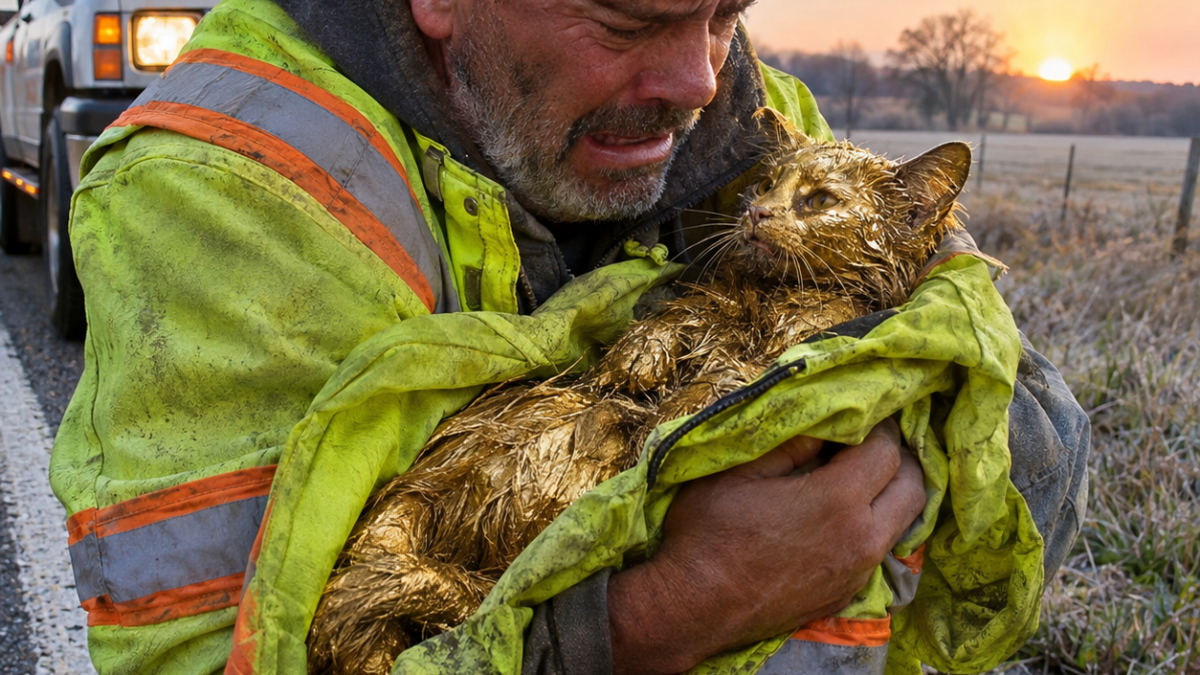
Someone Spray-Painted a Missing Cat Gold and Left Her to Suffocate—Then a Road Worker Found the Clue Her Abuser Forgot
At 6:03 in the morning, highway worker Daniel Harper nearly drove past what looked like a piece of metallic-gold trash on a frozen Pennsylvania roadside—until the shape lifted its head and tried to breathe through nostrils clogged with hardened spray paint.
By noon, veterinarians had discovered that the cat beneath the paint was Midnight, a beloved black house cat whose family had spent three desperate weeks hanging missing posters across their neighborhood, but the humiliation grew worse when someone uploaded a five-second video of young people laughing while Midnight cowered beneath a can of gold paint.
Then investigators enlarged one frame of that deleted video and noticed a detail reflected in a garage window that none of the people responsible had thought to hide, turning what they had treated as a cruel joke into the evidence that would eventually bring every one of them to a courtroom.
Daniel Harper had been driving the same section of County Route 18 for almost eighteen years.
He knew every curve.
Every broken guardrail.
Every drainage ditch that flooded after two days of rain.
Every place deer tended to cross before sunrise.
He knew where teenagers dumped old couches when they did not want to pay the county transfer station.
He knew which farmer left equipment too close to the shoulder.
He knew where black ice formed first in January.
Most mornings, Daniel noticed things before other people did because that was part of his job.
A branch hanging too low.
A dead animal in the lane.
A damaged sign.
A piece of metal that could puncture a tire.
At 6:03 on a Wednesday morning in late February, he thought the gold shape beside the road was nothing more important than a torn piece of insulation.
He almost kept driving.
The maintenance truck rolled past at thirty-eight miles an hour.
Daniel’s headlights swept across the shoulder.
Something moved.
He lifted his foot from the accelerator.
The gold shape rose slightly.
Then collapsed.
“What the hell?”
Daniel checked the mirror.
No vehicle behind him.
He braked.
Put on the hazard lights.
Backed carefully along the shoulder.
The road was still mostly dark.
A thin blue-gray line had begun forming behind the hills, but sunrise remained almost an hour away.
Daniel stepped out wearing heavy work boots, orange reflective pants, and a fluorescent jacket over a thick brown hoodie.
Cold air hit him immediately.
Twenty-four degrees.
Wind coming across open fields.
He walked toward the shape.
At ten feet, he stopped.
It had ears.
Small triangular ears.
Rigid.
Gold.
Daniel’s stomach dropped.
“No.”
He moved faster.
The animal tried to stand.
Front legs worked.
Back legs shook.
PART2:
It stumbled toward him and fell sideways.
Daniel crouched.
The first thing he understood was that it was a cat.
The second was that the cat had not been born that color.
Metallic gold paint covered nearly everything.
Head.
Back.
Sides.
Tail.
Legs.
Even the whiskers had hardened into stiff little wires.
The coat underneath looked black where the paint had cracked near one paw.
Daniel could see raw skin around the mouth.
The nostrils were partially blocked.
Every breath made a wet, whistling sound.
“Jesus Christ.”
The cat lifted her head.
Her eyes were open.
Barely.
Daniel reached slowly.
She flinched.
PART3:
Then did something that stayed with him long after the investigation, after the trial, after nearly everyone else had moved on.
She tried to crawl toward him.
Not away.
Toward.
Daniel swallowed.
“All right.”
His voice softened.
“All right, sweetheart.”
He removed one glove.
Held his hand near her face without touching.
The cat sniffed.
Or tried to.
The sound was terrible.
He pulled out his phone.
Dialed 911.
The dispatcher answered.
“County emergency.”
“My name is Daniel Harper. Highway maintenance. I’m on Route 18, about half a mile east of Miller’s Creek Road.”
“What’s the emergency?”
“I found a cat.”
Pause.
Daniel almost heard the dispatcher deciding how seriously to take that.
“She’s been spray-painted.”
Another pause.
“What?”
“Gold.”
Daniel looked down.
“Someone covered the entire cat in spray paint.”
The dispatcher’s voice changed.
“Is the animal alive?”
“Yes.”
“Any immediate traffic hazard?”
“No.”
“She breathing?”
“Barely.”
“I’m notifying animal control. Can you transport?”
“I can.”
“Do you know the emergency vet in Cedar Ridge?”
“Yes.”
“Take her there if you can safely handle her. An animal control officer will meet you.”
Daniel hung up.
The cat tried to move again.
He opened his jacket.
“Okay.”
He had handled injured animals before.
Not professionally.
But road workers find things.
Dogs hit by cars.
Deer caught in fencing.
Once, an injured owl that nearly removed part of his thumb.
He knew scared animals could bite.
He also knew this cat did not have much fight left.
Daniel slid his hands beneath her.
She weighed almost nothing.
Her body trembled against him.
The gold paint cracked at one shoulder when she bent.
He winced.
“Sorry.”
She did not struggle.
He wrapped her inside his jacket, leaving only the face exposed.
The cat pressed her forehead against his forearm.
Daniel froze.
For some reason, that simple movement upset him more than everything else.
She trusted the first warm thing that stopped.
“Yeah.”
He looked toward the empty road.
“I know.”
He carried her to the truck.
County policy did not technically include transporting cats in maintenance vehicles.
Daniel did not care.
He placed her on a folded emergency blanket in the passenger seat.
Turned the heater toward her.
Then called his supervisor.
“Frank.”
“You better have a good reason for stopping that truck.”
“I do.”
“What?”
“I found a gold cat.”
Silence.
Daniel closed his eyes.
“I realize how that sounds.”
“A what?”
“Someone spray-painted a cat gold.”
Longer silence.
“Alive?”
“Yes.”
“Go.”
That was all Frank said.
The Cedar Ridge Veterinary Emergency Center opened its side door before Daniel had fully stopped.
A technician named Mara Ellison came out carrying towels.
Behind her was Dr. Nora Callahan.
Daniel knew neither woman.
They knew what they were seeing immediately.
“Oh my God.”
Mara opened the passenger door.
The cat made a faint rasping sound.
Nora said:
“Treatment room now.”
Daniel followed them inside.
He still wore no jacket.
Did not notice.
The veterinary team moved quickly.
Oxygen first.
Temperature.
Heart rate.
Hydration.
Eyes.
Mouth.
Skin.
The paint around the nose worried Nora most.
“Do not scrub this.”
A younger assistant had reached for gauze.
“Anything aggressive can damage the skin.”
Mara nodded.
“What do you want?”
“Warm saline around the nostrils. Slowly.”
They worked millimeter by millimeter.
The paint had hardened around the muzzle and whisker pads.
Some could be softened.
Other areas would need careful clipping after stabilization.
Daniel stood near the door.
He wanted to leave.
Not because he did not care.
Because the treatment room felt like a place where trained people were doing useful things, and he was a fifty-one-year-old highway worker standing in dirty boots trying not to get in the way.
Nora looked at him.
“You found her?”
“Yes.”
“Any container?”
“No.”
“She was on the shoulder?”
“About six feet off the lane.”
“Any vehicle nearby?”
“No.”
“Blood?”
“Not much.”
“Anything else?”
Daniel thought.
“She was walking.”
“Walking?”
“Trying.”
Mara looked over.
“You think she was dumped there?”
Daniel shook his head.
“I don’t know.”
Nora said:
“Animal control will ask.”
Daniel nodded.
“I called.”
Nora returned to the cat.
For forty minutes, nobody said much.
Then the whistling breaths began sounding less severe.
Mara looked at the oxygen reading.
“Better.”
Nora nodded.
“Still not good.”
Daniel exhaled without realizing he had been holding his breath.
The cat opened one eye.
Yellow-green.
She looked straight at him.
Daniel whispered:
“Hey.”
Her ear moved.
Mara noticed.
“She knows your voice.”
“She heard it for fifteen minutes.”
“Sometimes fifteen minutes is enough.”
Nora began examining the coat more closely.
“Paint is almost full-body.”
Mara frowned.
“Accident?”
Nora looked at her.
“No.”
Daniel’s jaw tightened.
“How do you know?”
“Coverage.”
She pointed carefully.
“Back.”
“Flanks.”
“Head.”
“Tail.”
“Legs.”
“Whiskers.”
“An accidental spill doesn’t evenly coat an animal from multiple angles.”
Daniel stared at the cat.
“So someone held her.”
Nora did not answer immediately.
Then:
“That would be my concern.”
Daniel looked away.
He had seen cruelty.
People dumping dogs.
Abandoning litters.
Throwing garbage onto public roads.
But there was something uniquely ugly about the amount of time this would have required.
Someone had looked at the cat.
A living animal.
Scared.
Probably struggling.
Then continued.
Not one second of harm.
Many.
Mara found the collar line first.
“Wait.”
Nora leaned closer.
“What?”
“There.”
Beneath the neck, hidden under a narrow nylon collar, was a strip of black fur untouched by paint.
Nora carefully unclipped the collar.
No identification tag.
But the black fur beneath revealed a distinctive white patch at the center of the chest.
Not large.
A thin crescent.
Like a curved moon.
Mara said:
“That could help.”
“With what?”
Daniel asked.
“If she’s missing.”
They scanned for a microchip.
Nothing.
The cat was not chipped.
At 7:18, County Humane Officer Rachel Bennett arrived.
Daniel recognized her from a loose-dog incident years earlier.
Rachel photographed everything.
The road-worker jacket.
The collar.
The pattern of paint.
The untouched black fur.
The white crescent.
She interviewed Daniel while Nora continued treatment.
“Exact location?”
He told her.
“Anything lying nearby?”
“No.”
“Spray can?”
“No.”
“Footprints?”
Daniel hesitated.
“It was dark.”
“Think.”
He closed his eyes.
Shoulder.
Dry gravel.
A strip of frost.
“There might have been tire marks near the ditch.”
“Fresh?”
“I don’t know.”
Rachel nodded.
“We’ll check.”
She looked through the treatment-room glass.
“Any idea how long paint’s been on?”
Nora answered from inside.
“Likely hours, not days.”
“Condition otherwise?”
“Underweight but not severely.”
“Any evidence of long-term neglect?”
“Not obvious.”
Rachel looked at Daniel.
“So maybe owned.”
That was the first hopeful thing anyone said.
Maybe someone was searching.
By nine that morning, Cedar Ridge Animal Services posted one photograph online.
Not the worst image.
Rachel refused to use those.
It showed the untouched fur beneath the collar.
Black coat.
White crescent.
Caption:
FOUND INJURED BLACK FEMALE CAT — ROUTE 18 / MILLER’S CREEK AREA. Distinctive white crescent marking at chest. Contact County Humane Investigations if you recognize her. Proof of ownership required.
The post spread faster than anyone expected.
By ten thirty, a woman named Sarah Lawson called.
She was crying so hard the dispatcher could barely understand her.
“My cat.”
“What?”
“The marking.”
“She has that marking.”
“Name?”
“Midnight.”
“When did she go missing?”
“Three weeks ago.”
“Location?”
“Willow Creek subdivision.”
Five miles from the roadside.
Rachel asked for photographs before giving details.
Sarah sent twenty-three.
Midnight on a couch.
Midnight asleep beside a little girl.
Midnight standing in a kitchen sink.
Midnight wearing a purple collar.
And one clear photograph of her chest.
Black fur.
White crescent.
Exact.
Rachel walked into the clinic at 11:07.
“She has a family.”
Daniel was still there.
His supervisor had told him not to return until he knew the cat was stable.
Nora looked up.
“You sure?”
Rachel showed the photograph.
Mara whispered:
“Oh.”
Daniel stared.
Healthy Midnight was glossy black.
Muscular.
Bright-eyed.
The cat in treatment looked like a gold-painted ghost.
“Who owns her?”
“Sarah Lawson.”
“Coming?”
“On her way.”
“Tell her to prepare herself.”
Rachel nodded.
“She has a ten-year-old daughter.”
Nora closed her eyes.
“Maybe daughter stays home.”
“That’s what I told her.”
Sarah arrived alone.
Thirty-eight.
Brown hair pulled into a hurried ponytail.
Winter coat unzipped.
Missing one glove.
She walked into the lobby carrying a folder.
Missing posters.
Vaccination records.
Photos.
Proof of everything nobody had asked for yet.
“My name is Sarah.”
Rachel met her.
“I’m Officer Bennett.”
“Is she alive?”
“Yes.”
Sarah covered her mouth.
“Can I see her?”
“The veterinarian needs to talk to you first.”
“No.”
Sarah shook her head.
“I need to see her.”
Nora came out.
“Mrs. Lawson?”
“Sarah.”
“I’m Dr. Callahan.”
“Please.”
Nora touched her arm.
“She’s alive.”
Sarah began crying.
“That’s all I needed.”
Nora explained.
Paint.
Breathing issues.
Skin irritation.
Possible chemical exposure.
Dehydration.
Stress.
Good news:
No major fractures.
No internal trauma.
No obvious burns from heat.
Most skin damage appeared chemical and mechanical from paint and removal attempts before arrival.
Sarah nodded without processing.
“Can I see her?”
“Yes.”
They brought her to the recovery room.
Midnight lay beneath a warming blanket.
Gold still covered much of her coat.
Only small sections had been cleaned.
Sarah stopped at the door.
For several seconds, she did not breathe.
Then:
“Midnight?”
The cat’s head moved.
Sarah made a sound between a sob and a laugh.
“Oh, baby.”
Midnight tried to stand.
Nora reached to steady her.
Sarah crouched.
“I’m here.”
The cat stretched one front paw.
Sarah slid her hand through the opening.
Midnight pressed her face into her fingers.
The entire room changed.
Daniel looked away.
Mara cried openly.
Rachel kept her face professional and failed.
Sarah whispered:
“We looked everywhere.”
Midnight’s paw curled around her finger.
“Lily put your bed by the window.”
Another sob.
“She still checks the porch every morning.”
Daniel left the room.
Not because he did not want to see.
Because some moments belonged to the people who had earned them before he ever arrived.
He sat in the lobby.
Five minutes later Sarah came out.
Her eyes were red.
“You found her?”
Daniel stood.
“Yeah.”
She hugged him.
No warning.
No introduction.
Just arms around an orange highway vest.
Daniel froze.
Then hugged back carefully.
“Thank you.”
“You don’t have to—”
“Yes.”
She stepped away.
“You stopped.”
Daniel looked toward the recovery room.
“Almost didn’t.”
“But you did.”
He nodded.
Sarah sat.
Daniel sat too.
“How’d she get out?”
“Screen door.”
Sarah wiped her face.
“Lily had a friend over.”
“They were going in and out.”
“The screen didn’t latch.”
“Midnight slipped through.”
“How long before you noticed?”
“Twenty minutes.”
Daniel knew that twenty minutes had probably been replayed a thousand times in Sarah’s head.
She continued.
“We searched until two in the morning.”
“Then every day.”
“She’s indoor.”
“Never gone farther than our yard.”
“We put up posters.”
“Neighborhood apps.”
“Shelters.”
“Rescues.”
“We checked roadkill lists.”
Her voice broke.
“I checked roadkill lists.”
Daniel looked down.
“I’m sorry.”
Sarah nodded.
“My daughter thinks it’s her fault.”
“It isn’t.”
“I know.”
“She doesn’t.”
Daniel thought of his own daughter, Emily, now twenty-four.
Children can carry blame no adult gave them.
He knew that too.
Sarah looked through the glass.
“Who did this?”
Nobody answered.
By noon, photographs of the rescued cat had spread online.
That was both good and terrible.
Good because tips came.
Terrible because cruelty attracts attention from people who turn pain into entertainment.
Comments appeared.
“Probably fake.”
“Owner did it for money.”
“Bet this is a fundraiser scam.”
“Why was the cat outside?”
“Responsible owners keep cats indoors.”
Sarah saw them.
Daniel watched her face as she scrolled.
“Stop reading.”
She did not.
A comment said:
If she cared so much, why’d she let her cat disappear for three weeks?
Sarah’s hand shook.
Daniel took the phone.
“Give me that.”
She looked at him.
“I did let her out.”
“No.”
“The door—”
“You did not spray paint your cat.”
“That doesn’t erase—”
“No.”
His voice became firmer.
“A door didn’t do this.”
She looked through the window.
“No.”
Daniel placed the phone face down.
“Then blame the person who did.”
The first major break came at 2:41 that afternoon.
Rachel received a message from a high school senior named Owen Mercer.
He had seen a video the previous night.
Five seconds.
Posted to a private social media story.
Deleted within minutes.
He screen-recorded it because something felt wrong.
The video showed a garage.
Concrete floor.
Music playing.
Three young adults laughing.
Midnight crouched in a corner.
Still black.
A man’s hand held a can of metallic gold spray paint.
The clip ended before paint was applied.
Rachel watched once.
Then again.
She paused on the clearest frame.
Midnight’s white crescent visible.
Purple collar.
Sarah confirmed.
“That’s her.”
Her face went pale.
“My God.”
One male voice in the video said:
“Make her expensive.”
Another voice laughed:
“Gold edition.”
The third said:
“Bro, she hates you.”
Then the clip ended.
Rachel asked Owen:
“Who posted this?”
He gave a username.
Account belonged to nineteen-year-old Mason Trent.
Local community college student.
Rachel knew not to move too quickly.
A disturbing video was evidence.
Not yet full proof of who painted Midnight or abandoned her.
She contacted detectives.
They preserved the recording.
Requested platform records.
Interviewed Owen formally.
Sarah asked:
“Can you arrest them?”
Rachel said:
“Not yet.”
“They had my cat.”
“Yes.”
“They were holding spray paint.”
“Yes.”
“What else do you need?”
“Enough evidence that the right people are held responsible for the right things.”
Sarah turned away angrily.
Daniel understood both sides.
Justice feels unbearably slow when someone you love is still wearing the evidence on her skin.
That night, Midnight worsened.
Her breathing became irritated again.
Nora suspected she had inhaled aerosolized paint or fumes.
They monitored closely.
Sarah refused to leave.
The clinic eventually brought her a blanket.
Daniel went home at six that evening.
He returned at 5:40 the next morning.
Mara stared at him.
“You work here now?”
“No.”
“You were here twelve hours yesterday.”
“I brought coffee.”
“That qualifies you.”
He carried a cup to Sarah.
She had slept twenty minutes.
Maybe.
“How is she?”
“Stable.”
“Nora says better.”
“That’s good.”
Sarah nodded.
Daniel sat beside Midnight’s kennel.
The cat opened one eye.
“Morning.”
Ear movement.
“You look terrible.”
Sarah laughed softly.
“She always hated mornings.”
“Good.”
Midnight shifted.
Daniel placed his hand near the bars.
She did not approach.
He did not push.
He talked.
Highway stories.
Weather.
A ridiculous story about a mattress that flew off a pickup and landed upright against a road sign.
Sarah eventually asked:
“Why do you keep coming?”
Daniel shrugged.
“I don’t know.”
“Yes, you do.”
He looked at Midnight.
“My wife died eight years ago.”
Sarah waited.
“Cancer.”
“I’m sorry.”
“Thanks.”
He rubbed his hands.
“Toward the end, everybody kept trying to help.”
“Meals.”
“Appointments.”
“Advice.”
“People always doing something.”
He looked at Sarah.
“One nurse used to just sit.”
“No advice.”
“No questions.”
“If my wife slept, the nurse sat.”
“If she wanted to talk, she talked.”
“After Beth died, I remembered that woman more than half the people who said the perfect thing.”
Sarah looked at Midnight.
“So you’re sitting.”
“Pretty much.”
“That’s your strategy?”
“I work for PennDOT.”
“We don’t have many strategies.”
She smiled.
Midnight did not approach Daniel that day.
Or the next.
On the third morning, she did.
One step.
Then another.
Her coat remained patchy with gold because the veterinary team refused to rush removal.
Some fur had been clipped.
Some paint washed gradually with safe methods.
Her skin underneath was sore.
The transformation looked worse before it looked better.
Black patches.
Gold patches.
Shaved areas.
Pink irritated skin.
She looked nothing like Sarah’s photographs.
Daniel sat beside the kennel.
Hand resting near the opening.
Midnight stood.
Sniffed.
Then pressed the top of her head against his fingers.
Daniel froze.
Sarah saw.
“Oh.”
Daniel’s eyes filled.
He rubbed gently between the ears where most paint had been removed.
Midnight closed her eyes.
Purr.
Weak.
But real.
Daniel laughed.
“Okay.”
His voice broke.
“All right.”
Sarah said:
“She remembers you.”
“Maybe.”
“She does.”
Daniel shook his head.
“She remembers somebody stopped.”
That was enough for him.
The investigation accelerated.
Mason Trent admitted being in the garage.
Claimed the cat belonged to another friend.
Said he thought spray paint was “washable pet color.”
It was not.
The can recovered later was standard metallic enamel.
Toxic.
Industrial.
He claimed Midnight ran away before anyone used it.
The video contradicted part of that.
But not enough.
Then police identified the garage.
It belonged to the father of twenty-year-old Trent Maddox.
Different Trent.
That confused everyone for a day.
Trent Maddox was the young man seen holding the can.
His father owned an auto-detailing business.
The garage window in the video showed a reversed company logo painted on a delivery van outside.
That was the clue nobody in the group noticed.
Investigators enlarged the frame.
Reflected letters:
MADDOX AUTO DETAIL.
Search warrant.
Inside the garage, investigators found metallic gold overspray on cardboard sheets.
A trash bag containing black and gold fur.
A purple cat collar clasp.
Two empty gold aerosol cans.
And, on the concrete floor behind a workbench, a white crescent-shaped tuft of fur.
Midnight’s coat had literally remained in the room.
Trent still denied intentional cruelty.
He said it was a prank.
That word made Sarah furious.
She was watching the news when his attorney used it outside the courthouse.
“A stupid prank by young people who did not appreciate the seriousness of the situation.”
Sarah turned off the television.
“Prank?”
Daniel sat at her kitchen table.
Midnight was still hospitalized.
Lily, Sarah’s ten-year-old daughter, sat upstairs with Sarah’s sister.
Daniel had come over because Sarah did not want to watch the first report alone.
“He says prank.”
Daniel nodded.
“You hear what that word does?”
“What?”
“It puts the whole thing after the laugh.”
She stared.
“He makes it sound like the harm was an accident.”
Daniel understood.
The spray paint had been the point.
Midnight’s fear had been entertainment.
What happened afterward was not accidental either.
The deleted video.
The dumping.
The silence.
Police eventually reconstructed most of the night.
Midnight had been missing three weeks because she had been picked up by Mason Trent after wandering near a convenience store.
He said he thought she was a stray.
Instead of taking her to a shelter, he brought her to Trent Maddox’s garage.
For several days, she was fed there.
Nobody checked for an owner.
Nobody posted her as found.
The group began treating Midnight as a garage cat.
Then one night, after drinking and filming prank videos, Trent suggested painting her gold for a social media clip.
Two others laughed.
One filmed.
One sprayed.
Midnight fought.
She scratched Trent.
That made him angry.
He continued.
They sprayed her body.
Her head.
Her tail.
When she tried licking the paint, they wrapped a towel around her.
At some point, paint got heavily around her nose.
She began struggling to breathe.
The room changed.
The laughter stopped.
One person suggested a vet.
Trent refused.
Why?
Because the cat had scratched him.
Because they had filmed it.
Because they could get in trouble.
Because a veterinarian might call authorities.
So instead of seeking help, they tried washing the paint off with harsh household cleaner.
That irritated Midnight’s skin.
She screamed.
One of them panicked and left.
Another deleted the video.
Around 4:50 a.m., Trent put Midnight in a plastic storage tub.
Drove out toward Route 18.
Dumped her on the shoulder.
Alive.
Still coated.
Still struggling.
At 6:03, Daniel nearly drove past.
The complete sequence came from more than one confession.
The weakest member of the group, eighteen-year-old Kayla Morris, broke first.
She was the one who had filmed.
She cooperated after investigators showed her the search-warrant evidence.
She cried through most of the interview.
“I told him to stop.”
The detective asked:
“When?”
“After she couldn’t breathe.”
“Before that?”
Kayla looked down.
“No.”
“Did you laugh?”
Silence.
“Yes.”
“Did you film?”
“Yes.”
“Did you call a veterinarian?”
“No.”
“Did you call police after Trent dumped the cat?”
“No.”
“Why?”
“I was scared.”
That sentence would matter later.
People are often scared after they participate in cruelty.
The question is what they do with that fear.
Kayla had protected herself until police arrived.
Then she told the truth.
Mason Trent had held Midnight down for part of the spraying.
He claimed he thought it was harmless.
Investigators found messages from him afterward:
delete everything
if anyone asks cat ran
and:
trents dad will kill us if cops show
The messages made innocence harder to argue.
Trent Maddox’s messages were worse.
At 5:18 a.m., after dumping Midnight:
problem gone
At 7:02, after the first rescue post began circulating:
no way lol
At 7:09:
she lived?
That message hit Sarah hardest.
She read it once from the police report.
“She lived?”
Daniel sat beside her.
Sarah’s eyes filled.
“He was surprised.”
Daniel said nothing.
“He left her because he thought she’d die.”
“Yes.”
Sarah pressed both hands against her face.
For weeks, she had imagined cruelty in broad terms.
The messages made it personal.
He knew she might die.
That had been convenient.
The public attention grew.
Too much.
Reporters parked near Sarah’s house.
One tried to interview Lily while she was getting off the school bus.
Sarah exploded.
She walked into the road and told the reporter never to approach her daughter again.
The clip aired.
Some viewers called her rude.
Others defended her.
Sarah stopped reading comments.
This time permanently.
At school, Lily suffered a different humiliation.
A boy showed her a screenshot of Midnight covered in gold.
Asked:
“Is that your cat?”
She cried.
Then punched him.
Sarah got called to the principal’s office.
The principal explained violence was unacceptable.
Sarah agreed.
Then asked why another student had been allowed to display graphic images of an abused animal connected to Lily’s family.
The room became uncomfortable.
Lily sat silently.
Afterward, in the car, Sarah said:
“You cannot hit people.”
Lily looked out the window.
“I know.”
“Even when they’re cruel.”
“I know.”
“Why’d you?”
Lily whispered:
“He laughed.”
Sarah’s anger softened.
“He said she looked stupid.”
Sarah pulled over.
Turned off the engine.
Lily started crying.
“She doesn’t look stupid.”
“No.”
“She looks hurt.”
“Yes.”
“I left the door open.”
There it was.
Three weeks of guilt.
Sarah had known it existed.
Not how deep.
“No.”
Lily looked at her.
“Yes.”
“You had Sophie over.”
“The screen—”
“Was broken.”
“I knew.”
Sarah stared.
“What?”
“I knew it didn’t close right.”
Lily cried harder.
“I forgot.”
Sarah unbuckled.
Turned toward her.
“Listen to me.”
Lily shook her head.
“Look at me.”
Eventually she did.
“You made a mistake with a door.”
“But—”
“You did not steal Midnight.”
“You did not keep her.”
“You did not spray her.”
“You did not dump her.”
“But if I closed—”
Sarah’s voice broke.
“Then maybe none of this happens.”
Lily stared.
Sarah continued:
“But that is not the same as causing what they did.”
“Do you understand?”
Lily cried.
Sarah pulled her close.
“I am not letting the people who hurt Midnight hand you their guilt.”
That sentence became something Sarah repeated to herself too.
Because parents do it.
If I had replaced the screen sooner.
If I had checked earlier.
If I had searched the right street.
If I had found Midnight before them.
Guilt loves a vacuum.
Cruel people create one and leave good people to fill it.
Daniel helped her understand that.
Midnight came home after twelve days.
Not fully healed.
But stable.
Most of the paint removed.
Some fur shaved.
Skin treatments ongoing.
Medication.
Quiet room.
No direct sunlight on damaged areas.
No bathing beyond veterinary instructions.
Lily waited on the living-room floor.
Daniel had driven Midnight home because Sarah’s hands shook too much.
The carrier door opened.
Midnight did not move.
Lily stayed six feet away.
“Hi.”
The cat’s eyes moved.
Lily whispered:
“It’s me.”
No movement.
Sarah’s heart broke.
She had imagined the reunion differently.
Midnight running out.
Jumping into Lily’s arms.
Home fixing everything.
Instead, the cat remained pressed against the back of the carrier.
Trauma had come home too.
Daniel crouched near Lily.
“Give her time.”
“She knows me.”
“Probably.”
“Then why—”
“She had people she knew for weeks too.”
Lily looked at him.
Daniel immediately regretted how harsh that sounded.
He softened.
“I mean she had people around her who hurt her.”
“So she has to figure out safe again.”
Lily nodded.
She did not reach into the carrier.
That was her first act of love after Midnight came home.
Not touching.
They left the door open.
Forty-two minutes passed.
Midnight stepped out.
Crouched low.
Sniffed the rug.
Sarah sat on the couch.
Lily remained on the floor.
Daniel leaned against the kitchen counter.
Midnight walked two feet.
Stopped.
Looked at Lily.
Lily’s lips trembled.
“Hey, Mid.”
The cat took another step.
Then another.
Reached Lily.
Sniffed her knee.
Lily did not move.
Midnight pressed her face into the fabric of Lily’s jeans.
The child started crying silently.
Sarah covered her mouth.
Daniel looked away.
Lily whispered:
“I’m sorry.”
Midnight rubbed again.
That was the reunion.
Not dramatic.
Not perfect.
Better.
Because Midnight chose it.
Recovery took months.
Black fur returned unevenly.
The first new growth looked gray against damaged skin.
The ears remained slightly scarred.
Some whiskers broke off and regrew.
The breathing recovered fully.
Her lungs had been irritated, not permanently destroyed.
Her personality returned slower.
At first, spray sounds terrified her.
Aerosol cooking spray.
Hair spray.
Even the hiss of compressed air from a keyboard cleaner.
Sarah banned aerosol cans from the house.
Months later, when a contractor used spray paint on a fence across the street, Midnight vanished under Lily’s bed for six hours.
Lily stayed on the floor nearby.
Did not pull her out.
She learned Daniel’s strategy.
Sit.
Wait.
Be there.
Daniel visited every Saturday.
At first Midnight approached him immediately.
Later, as home became safe again, she sometimes ignored him completely.
He loved that.
“You’ve been demoted.”
Sarah smiled.
“To what?”
“Guy with boots.”
“That’s healthy.”
One Saturday, Daniel brought a small black fleece blanket.
“Road department gave us new emergency kits.”
“And?”
“I stole the old blanket.”
Sarah raised an eyebrow.
“Government theft.”
“Taxpayer redistribution.”
He placed it on the couch.
Midnight sniffed.
Then curled up.
Daniel smiled.
“That’s what I wrapped her in.”
Sarah looked at him.
The original jacket had been ruined by paint and veterinary cleaning.
He had thrown it away.
This blanket was not the same.
It did not matter.
Lily asked:
“Were you scared?”
“When I found her?”
“Yes.”
Daniel thought.
“Mostly mad.”
“At them?”
“At whoever did it.”
“Were you scared she’d die?”
He nodded.
“Very.”
Lily looked at Midnight.
“Did she know?”
“Know what?”
“That you were helping.”
Daniel considered.
“I don’t know.”
“But she stopped fighting when I picked her up.”
“So maybe she knew I was warmer than the road.”
“That was enough.”
The criminal case moved toward trial.
Kayla took a cooperation agreement.
She pleaded guilty to a lesser cruelty-related charge, completed community service, animal-welfare education, probation, and testified.
Mason entered a plea on charges tied to restraint, failure to seek care, and evidence deletion.
Trent refused.
He told friends the case was exaggerated.
Called Midnight “that gold cat.”
Claimed Sarah was using publicity for money.
That reached Sarah through someone she trusted.
It enraged her enough that she almost responded publicly.
Rachel stopped her.
“Don’t.”
“He’s lying.”
“Yes.”
“I want people to know.”
“They will.”
“When?”
“In court.”
“That could take a year.”
“Yes.”
Sarah laughed bitterly.
“So he gets to talk.”
“He gets to talk.”
“That’s not justice.”
“No.”
Rachel’s voice remained calm.
“Justice is not controlling everything an accused person says.”
“It is proving what happened.”
Sarah hated the answer.
Later she respected it.
The trial began eleven months after Daniel found Midnight.
By then, Midnight’s coat was almost entirely black again.
The only visible reminders were pale scars beneath the fur and one small patch near the left ear where hair grew thin.
The prosecution did not bring Midnight into court.
Sarah refused any suggestion.
“She has done enough.”
They used photographs.
Medical records.
Video.
Messages.
Recovered spray cans.
Fur evidence.
Metadata.
Security footage from a gas station showing Trent’s truck traveling toward Route 18 at 4:43 a.m.
County traffic camera showing it returning at 5:27.
Daniel testified about finding Midnight.
He wore a suit.
Hated it.
The prosecutor asked:
“What did you first believe you saw?”
“Trash.”
“What kind?”
“Gold-colored plastic or insulation.”
“Why did you stop?”
“It moved.”
“What did you observe?”
Daniel described her breathing.
Body.
Paint.
The defense attorney asked:
“You are not a veterinarian?”
“No.”
“Not an animal cruelty investigator?”
“No.”
“So you cannot say who applied that paint.”
“No.”
“Cannot say when.”
“Not exactly.”
“Cannot say whether my client intended the cat to suffer.”
Daniel looked toward Trent.
“No.”
The attorney nodded.
“Thank you.”
Daniel added:
“But I can tell you what it sounds like when a cat can barely breathe.”
The attorney turned.
“Mr. Harper—”
“And I can tell you she was alone on a road at twenty-four degrees.”
“Objection.”
Sustained.
Daniel apologized.
He was not trying to perform.
That made it stronger.
Nora testified about medical condition.
Evelyn, consulted later, testified about chemical irritation and injury patterns.
Kayla testified about the spraying.
She cried.
The defense attacked her.
“You participated.”
“Yes.”
“You laughed.”
“Yes.”
“You filmed.”
“Yes.”
“You deleted the video.”
“Yes.”
“And now you receive a reduced charge for blaming Mr. Maddox.”
Kayla looked at Trent.
Then at the jury.
“I’m blaming him for what he did.”
“What did you do?”
Kayla swallowed.
“I stayed.”
The courtroom went quiet.
“I should’ve taken the cat.”
“I should’ve called somebody.”
“I didn’t.”
She looked down.
“I was a coward.”
The defense attorney paused.
Kayla continued:
“But he sprayed her.”
“He kept spraying when she screamed.”
“And he dumped her.”
That testimony mattered.
Not because Kayla became a hero.
She did not.
She became accountable.
Sarah found that more believable.
The prosecution played the five-second video.
Midnight black.
Cornered.
Gold spray can entering frame.
Laughter.
“Make her expensive.”
Then they showed the recovered extended version from cloud storage.
Forty-seven seconds.
The courtroom became silent.
Midnight attempted to escape.
Mason blocked her.
Trent sprayed.
Kayla laughed once.
Then said:
“Dude, stop.”
Trent continued.
Midnight hissed.
Someone said:
“Look at her.”
More laughter.
Then the clip ended.
Sarah squeezed Daniel’s hand so hard his fingers hurt.
Lily did not attend.
Sarah had refused.
Some things children do not need to prove they can survive.
The strongest evidence was not the video.
It was Trent’s own messages.
problem gone
she lived?
The prosecutor placed those words on a screen.
Asked:
“When you wrote ‘problem gone,’ what problem?”
Trent said:
“The situation.”
“What situation?”
“The cat.”
“So after leaving an injured cat beside a rural highway in freezing weather, you told your friends the problem was gone.”
“I was scared.”
There it was again.
Scared.
The prosecutor asked:
“What were you afraid of?”
“Getting arrested.”
“Were you afraid Midnight would die?”
Trent hesitated.
“I didn’t think she would.”
“Then why did you write ‘she lived?’ with a question mark?”
Silence.
The jury convicted him on the major cruelty and abandonment charges.
Not every count.
That mattered too.
The law did not exist to satisfy an emotional story.
It existed to match evidence to offenses.
Trent received a custodial sentence, probation after release, mandatory mental-health and animal-cruelty evaluation, restitution, and a long prohibition on possessing animals.
Mason received a lesser sentence and probation.
Kayla’s cooperation agreement stood.
People online argued.
Too harsh.
Too lenient.
Sarah stopped caring.
Outside court, a reporter asked:
“Do you forgive them?”
Sarah stared.
“No.”
The reporter seemed surprised.
“Do you think you ever will?”
“I don’t know.”
She looked directly at the camera.
“But forgiveness is not something Midnight needs from me.”
“She needed medical care.”
“She needed safety.”
“She needed the truth.”
“They finally gave us the truth.”
“That’s enough for today.”
Daniel liked that answer.
Months later, Kayla wrote Sarah a letter.
Sarah almost threw it away.
Then read.
I am not asking you to forgive me.
I laughed before I understood how far it was going.
Then I understood and still did not stop it.
That is the part I am most ashamed of.
I have spent a year telling myself Trent was worse so I could feel less responsible.
The court made me stop doing that.
I am sorry to Midnight.
I am sorry to Lily.
I am sorry I was more afraid of losing friends than I was afraid of what was happening to your cat.
Sarah read it twice.
Then gave it to Lily, who was eleven by then.
“Do I have to write back?”
“No.”
“Are you?”
“No.”
“Why keep it?”
Sarah thought.
“Because sometimes an apology is still useful even if it doesn’t fix anything.”
Lily nodded.
They kept it in a drawer.
No reconciliation.
No staged meeting.
No viral photograph.
Accountability did not require access to the people you hurt.
Midnight became ordinary again.
That may have been the best outcome.
She regained weight.
Slept in sunbeams.
Stole chicken from Sarah’s plate.
Waited outside the bathroom because privacy offended her.
Became obsessed with a cardboard shipping box despite Sarah initially panicking at the sight.
Lily grew taller.
Started middle school.
The guilt faded slowly.
Not completely.
One evening Sarah found her daughter looking at an old missing poster.
MIDNIGHT — BLACK FEMALE CAT — WHITE CRESCENT ON CHEST.
Lily asked:
“Do you think if I hadn’t left the door open, nothing bad would have happened?”
Sarah did not lie.
“Probably.”
Lily looked down.
Sarah sat beside her.
“But that still doesn’t make what they did yours.”
“I know.”
“Do you?”
“Mostly.”
Sarah nodded.
“That’s enough.”
Lily looked toward Midnight sleeping across the couch.
“I still hate the screen door.”
“So do I.”
They had replaced it.
Twice.
Daniel’s life changed less dramatically.
He kept working roads.
Kept waking before sunrise.
Kept seeing things other drivers missed.
But after Midnight, his crew started carrying small animal rescue kits in two maintenance trucks.
Gloves.
Towels.
Foldable carrier.
Emergency veterinary numbers.
Frank called it “Daniel’s Cat Department.”
Daniel pretended to hate that.
Two years later, one kit helped save a beagle hit by a truck.
Then an owl.
Then three kittens found in a drainage culvert.
Daniel told Sarah:
“Midnight created bureaucracy.”
Sarah smiled.
“Her greatest achievement.”
The highway department gave him a commendation.
He hated the ceremony.
A county commissioner said:
“Mr. Harper demonstrated extraordinary compassion.”
Daniel leaned toward Frank.
“I stopped a truck.”
Frank whispered:
“Shut up and take the plaque.”
Daniel did.
The plaque spent six months in his truck before his daughter Emily stole it and hung it in his kitchen.
Midnight visited Daniel’s house once.
Sarah brought her for a small backyard dinner.
The cat spent twenty minutes beneath Daniel’s couch.
Then emerged.
Walked around.
Jumped into the empty chair where Daniel’s late wife Beth used to sit.
Daniel stopped.
Sarah noticed.
“You okay?”
“Yeah.”
Midnight curled up.
Daniel laughed softly.
“Beth hated cats.”
Sarah smiled.
“Maybe Midnight knows.”
“No.”
Daniel shook his head.
“She likes the cushion.”
“Reality enough?”
He looked at her.
“Reality’s usually enough.”
That became something both of them understood.
People wanted Midnight’s story to become mystical.
They said she knew Daniel was good.
Maybe.
They said she chose the road because she knew help would come.
No.
She had been dumped.
Terrified.
Trying to breathe.
They said her black fur growing back symbolized darkness defeating gold.
Sarah hated that one.
Midnight was beautiful before.
During.
After.
The paint did not make her valuable.
Removing it did not restore her worth.
It restored her health.
That distinction mattered.
The strangest part of the whole story was how often strangers called Midnight lucky.
Lucky Daniel stopped.
Lucky the veterinarian was open.
Lucky Owen saved the video.
Lucky investigators found the reflection.
Lucky Kayla cooperated.
Sarah understood the word.
She also hated it.
A cat should not need extraordinary luck to survive ordinary human cruelty.
Still, on bad days, she admitted it.
They had been lucky.
Daniel could have looked away.
The video could have vanished.
The garage could have been cleaned.
Midnight could have died on the shoulder.
Instead, she lived long enough for people to choose differently.
That mattered.
Midnight turned eight.
Then nine.
The scars became difficult to see.
Only Sarah and Lily knew exactly where to part the fur.
Daniel always looked at the left ear.
The thin patch remained.
One morning, years after the rescue, Sarah received a call from Cedar Ridge Animal Services.
Rachel Bennett had been promoted.
“Remember me?”
“Unfortunately.”
Rachel laughed.
“We have something weird.”
“What?”
“A black cat came in sprayed with blue paint.”
Sarah went silent.
Alive?
“Yes.”
Stable?”
“Yes.”
“Family?”
“Unknown.”
Sarah closed her eyes.
“What do you need?”
“Nothing.”
Pause.
“Actually, maybe something.”
Sarah drove to the shelter.
The blue-painted cat looked terrified.
Not as severe as Midnight had been.
But frightened.
Rachel said:
“College prank.”
“Again?”
“Different people.”
Sarah felt old anger rise.
She stood outside the kennel.
Then understood what Rachel wanted.
Not money.
Perspective.
The cat’s foster family had never handled a traumatized animal.
Sarah met them.
Explained.
Do not force touch.
Do not treat fear like disobedience.
Avoid aerosols.
Let the animal choose distance.
Expect progress to move backward sometimes.
One woman asked:
“How long until he’s normal?”
Sarah looked through the glass.
“Stop aiming for normal.”
“What do you mean?”
“Aim for safe.”
That sentence traveled.
The foster family remembered it.
The cat eventually recovered.
Went home.
Sarah realized Midnight’s story had become useful in a new way.
Not as content.
As experience.
Lily grew up around that lesson.
At sixteen, she volunteered at Second Chance Rescue.
At eighteen, she studied animal behavior.
Not because everyone expected her to become a veterinarian.
She did not want to.
She liked behavioral rehabilitation.
Sarah worried it was because of Midnight.
Lily said:
“Obviously it’s because of Midnight.”
Sarah laughed.
“At least pretend I gave you something.”
“You gave me anxiety.”
“Wonderful.”
“And good hair.”
“Better.”
Midnight aged beside them.
Black coat eventually sprinkled with white.
The old gold disappeared completely except in photographs nobody displayed in the house.
Sarah kept one medical photo in a folder for legal records.
Lily never wanted to see it again.
They framed another photograph instead.
Midnight six months after recovery.
Sitting in Daniel’s lap.
Black fur bright.
White crescent clear.
Daniel laughing because she had just bitten one of his jacket strings.
That was the photograph on the mantel.
Not cruelty.
Survival.
At fourteen, Midnight developed kidney disease.
Ordinary.
Age.
Nothing to do with the abuse.
Sarah cried with relief when Nora explained that.
It sounded strange.
“You’re relieved?”
“Yes.”
“Why?”
“Because for once something happened to her that nobody did.”
Nora understood.
They managed the disease.
Diet.
Fluids later.
Medication.
Lily, now in college, came home on weekends.
Daniel still visited.
Older.
Retired from highway work.
He complained retirement was boring.
Midnight sat in his lap.
“You’re both retired.”
Sarah said.
Daniel looked at the cat.
“She has better benefits.”
When Midnight stopped eating reliably, everyone knew the road ahead.
Nora did not rush them.
Neither did she offer false hope.
“Days to weeks.”
Sarah sat very still.
Lily cried.
Daniel stared through the window.
Midnight was curled on a blanket.
Black coat thin.
Eyes still bright enough.
They brought her home.
For her last week, nobody tried to make it ceremonial.
She ate rotisserie chicken because renal diets no longer mattered.
Slept wherever she wanted.
Scratched the couch.
Sarah allowed it.
Lily protested on principle.
“You yelled at her for ten years.”
“She earned tenure.”
Daniel visited every day.
On the final morning, Midnight struggled to breathe slightly.
Not like the road.
Nothing that severe.
But Sarah could not bear the sound.
Nora came to the house.
The same veterinarian who had first removed gold paint from Midnight’s nose years earlier.
She was older too.
They sat in the living room.
Sarah.
Lily.
Daniel.
Nora.
Midnight lay on Daniel’s old emergency blanket, the black fleece one from the highway department.
Daniel touched her head.
“First time I saw you, I thought you were trash.”
Sarah laughed through tears.
“Beautiful speech.”
“I’m working up to it.”
Midnight’s tail moved weakly.
Daniel continued.
“Turns out I was an idiot.”
Lily smiled.
“Still are.”
“Thank you.”
Sarah placed a hand on Midnight’s side.
“You’re home.”
Midnight opened her eyes.
No dramatic miracle.
No sudden energy.
Just recognition of familiar voices.
Maybe.
Or simply comfort.
Lily whispered:
“I’m sorry about the door.”
Sarah closed her eyes.
After all these years.
Still there.
Daniel looked at Lily.
“No.”
She looked at him.
“You don’t take that with you.”
Her face broke.
Daniel’s voice softened.
“You hear me?”
Lily nodded.
“He painted her.”
“He dumped her.”
“You loved her.”
“Those facts belong to the people who did them.”
Lily cried.
Sarah took her hand.
Midnight breathed slowly.
Lily leaned close.
“I love you.”
The cat’s paw moved.
Touched Lily’s wrist.
That was enough.
Nora asked:
“Ready?”
No one was.
Sarah nodded.
The medication relaxed Midnight first.
Her breathing softened.
Daniel stroked the thin fur near her left ear.
The place where gold once clung.
Sarah kissed her head.
Lily rested her forehead against Midnight’s.
Then the second medication.
One breath.
Another.
Stillness.
Nobody spoke for a long time.
Finally Daniel whispered:
“She never needed to be gold.”
Sarah cried harder.
“No.”
“She was perfect black.”
Lily laughed through tears.
“Mostly.”
Daniel nodded.
“Mostly.”
Midnight’s ashes were divided.
Most stayed with Sarah and Lily.
A small portion went beneath the maple tree in Daniel’s backyard.
He objected.
“She wasn’t my cat.”
Sarah said:
“She was a little.”
He stopped arguing.
On the stone beneath the tree, Lily chose the words.
Not:
SHE SURVIVED.
Not:
JUSTICE FOR MIDNIGHT.
Not:
THE GOLD CAT.
Only:
MIDNIGHT
SOMEONE STOPPED.
Years later, Daniel sometimes drove old Route 18 even though retirement gave him no reason.
The shoulder had been repaved.
The ditch widened.
New reflective markers installed.
There was no sign.
No memorial.
Most drivers passed at fifty miles per hour without knowing a black cat once lay there covered head to tail in metallic gold paint.
Daniel preferred that.
Not every place of suffering needed to become sacred.
Sometimes it was enough that suffering ended there.
He still remembered 6:03.
The shape moving.
The thought:
Trash.
Then the head lifting.
That moment bothered him for years.
How easily distance changes what we think we are looking at.
From inside a warm truck, Midnight looked like debris.
Up close, she had eyes.
Breath.
Pain.
A family.
A child who had spent three weeks blaming herself.
A mother driving neighborhood streets every night.
A name.
A favorite blanket.
A white crescent beneath her collar.
A life already attached to other lives.
Daniel had not created any of those things by stopping.
He had simply gotten close enough to see them.
That became the part of Midnight’s story he told whenever someone called him a hero.
“I wasn’t.”
People usually protested.
“You saved her.”
“No.”
He would shake his head.
“I stopped.”
“Then veterinarians saved her.”
“Investigators worked the case.”
“Her family brought her home.”
“Everybody wants one person to be the hero because that makes kindness look unusual.”
He would pause.
“The important part is that stopping shouldn’t be unusual.”
Once, a high school class invited him to speak about civic responsibility.
He hated the phrase.
He told them the story anyway.
A student asked:
“What if you had kept driving?”
Daniel answered honestly.
“She probably would have died.”
The room became quiet.
Another student asked:
“Do you think that means you were supposed to find her?”
Daniel thought.
“No.”
They looked disappointed.
He continued:
“I think I happened to be there.”
“And when something helpless was in front of me, I had a choice.”
“That’s enough responsibility for one person.”
The teacher later told him that was the best part.
Daniel did not know.
He was not trying to create philosophy.
He was describing a road.
Sarah’s version was different.
When animal-welfare groups asked her to speak, she talked about blame.
How easily victims’ families inherit responsibility for what abusers do.
How quickly strangers asked why Midnight had gotten outside before asking why anyone sprayed her.
How Lily carried guilt for years over a broken screen door.
How Sarah blamed herself for not searching the right place.
How even Kayla spent months insisting Trent was the real monster before she could admit she had laughed too.
Responsibility mattered.
But responsibility had to be placed accurately.
The person who left the door open made a mistake.
The person who filmed made another choice.
The person who laughed made another.
The person who continued spraying made another.
The people who refused veterinary help made another.
The person who dumped Midnight made another.
Then Daniel made his.
Stop.
That was the story.
Not that cruelty exists.
Everyone knows that.
The story was how many decisions exist between cruelty and rescue.
Some people use those moments to protect themselves.
Some use them to protect the vulnerable thing in front of them.
Midnight lived because enough people eventually chose the second.
And if you had seen her years later, sleeping black and glossy in a patch of sunlight, you would never have guessed what strangers once tried to turn her into.
That was the point.
The gold was never her identity.
The cruelty was never her identity.
Even survival was not her entire identity.
She was Midnight.
A cat who hated closed bathroom doors.
Loved chicken.
Slept on Lily’s homework.
Preferred Daniel’s lap even after Sarah insisted she was the one buying the food.
A cat who once had gold paint hardened across her whiskers and then spent years growing black fur back over the scars.
A cat who belonged to people before strangers hurt her and belonged to them afterward too.
Someone had tried to turn her suffering into a joke.
They failed.
Because the joke lasted less than a minute.
Midnight’s life lasted years.
And in the end, that was the only reversal that mattered.
The people in the garage had sprayed her gold because they thought it was funny to change how she looked.
Daniel stopped because he finally saw what she actually was.
Not gold.
Not trash.
Not content.
Not evidence.
A frightened living animal trying to breathe.
Someone’s missing cat.
Someone’s family.
A life worth pulling the truck over for.
Daniel stopped.
Others followed.
And Midnight finally got to spend the rest of her life being exactly what she had always deserved to be.
Not a symbol.
Not a viral story.
Not a golden cat.
Just home.








