Someone Shoved a Tiny Cat Through a Library Book Return Slot at 3:12 A.M.—Four Hours Later, the Librarian Found Her Sitting Quietly on a Stack of Novels
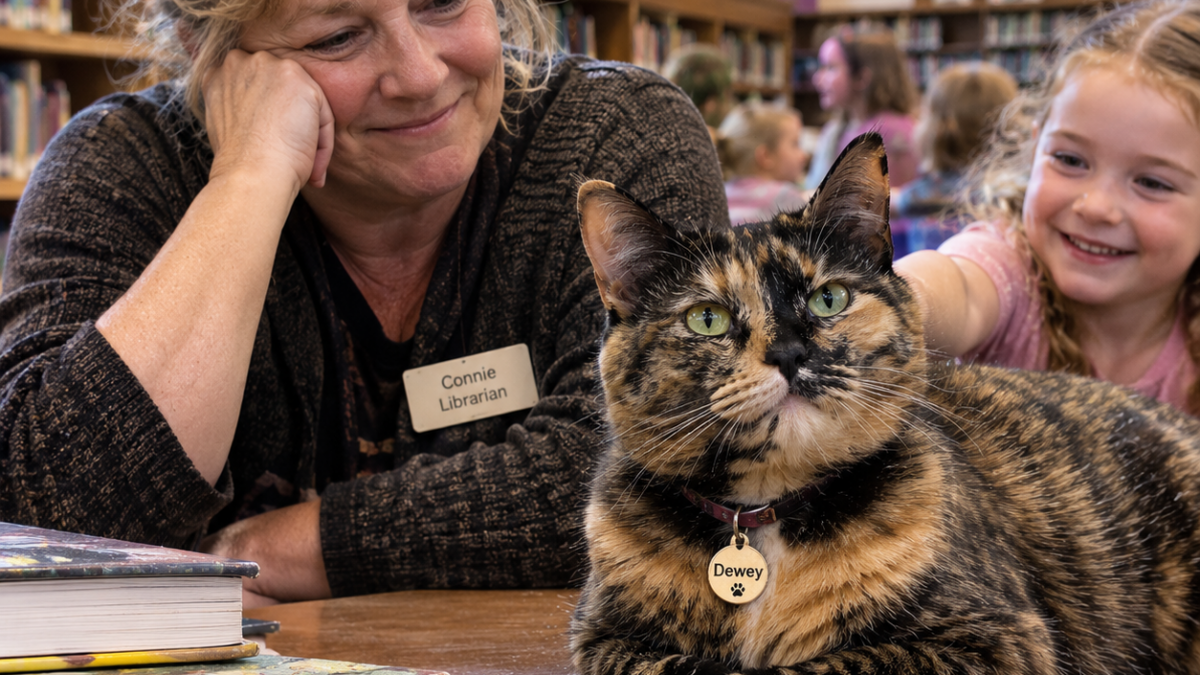
Someone Shoved a Tiny Cat Through a Library Book Return Slot at 3:12 A.M.—Four Hours Later, the Librarian Found Her Sitting Quietly on a Stack of Novels.
At 7:15 on a Monday morning, librarian Connie Mercer opened the overnight return bin at a small Indiana library and found a tiny tortoiseshell cat sitting silently on top of a stack of hardcover novels.
Security footage would later show that someone had driven into the parking lot at 3:12 a.m. with the headlights off, forced the little cat headfirst through a ten-inch book-return slot, and left her alone in the dark for four hours.
But by the time animal control arrived that afternoon, the cat was asleep in the children’s section, a three-year-old girl had already decided she belonged there, and Connie had made a decision of her own.
Nobody was taking her anywhere.
Connie Mercer had worked at the Fairbanks Branch Library in Terre Haute, Indiana, for nineteen years.
Long enough to recognize the personality of every season.
September smelled like wet jackets and sharpened pencils.
December brought salt tracked across the tile and children arriving with mitten strings hanging from their sleeves.
Summer meant air-conditioning battles, teenagers escaping the heat, retirees reading newspapers beneath the vents, and mothers trying to keep toddlers quiet long enough to choose books.
Mondays had their own personality too.
Monday mornings were returns.
Stacks of them.
Books people had finished Sunday night.
DVDs dropped off on the way to work.
Mysteries with bent corners.
Romance novels with coffee rings.
Children’s books containing crackers, stickers, crayon marks, and occasionally substances Connie had learned not to identify too closely.
She had seen almost everything come through the return slot.
Car keys.
Wallets.
A wedding invitation.
Three unopened cans of soup.
A television remote.
An empty prescription bottle.
A child’s left shoe.
Once, approximately eleven years earlier, a set of dentures wrapped in a paper towel.
Those became legendary.
Nobody claimed them for six days.
Connie kept them in a plastic container behind the desk because nobody could agree on a better procedure.
When an embarrassed seventy-eight-year-old man finally arrived, he said:
“I knew I’d left them somewhere literary.”
Connie still thought about that sentence occasionally.
But in nineteen years, she had never opened the overnight return bin and found something breathing.
That Monday began normally.
October.
Cold enough that Connie wore a light brown cardigan over her navy blouse.
Leaves had started gathering along the curb outside.
PART2:
The library did not open until nine, but Connie liked arriving early.
The building sounded different before patrons came.
Heating system ticking.
Fluorescent lights warming.
Copy machine humming.
Occasional creak from shelves settling.
Quiet without being empty.
Connie liked that.
She unlocked the employee entrance at 7:08.
Turned off the alarm.
Started the circulation computers.
Put coffee on in the staff room.
Then walked behind the circulation desk to empty the overnight bin.
The metal door stuck slightly.
It always did when humidity changed.
Connie pulled once.
Nothing.
Pulled harder.
The door opened.
A pair of yellow-green eyes looked back at her.
Connie screamed.
Not dramatically.
PART3:
A short, involuntary sound.
“Ah!”
The eyes blinked.
Connie froze.
There was a cat sitting on the books.
Tiny.
Tortoiseshell.
Mostly black and brown with patches of orange around one eye and across her chest.
Maybe six pounds.
Wet fur near her paws.
Whiskers bent slightly on one side.
She sat directly on top of three hardcover novels and a cookbook as if she had been placed there for display.
Her paws were tucked beneath her chest.
Tail curled around her body.
She did not run.
Did not hiss.
Did not flatten her ears.
She simply stared at Connie.
Connie stared back.
“Oh, honey.”
That was the first thing she said.
Not:
How did you get in there?
Not:
What the hell?
Not:
Who puts a cat in a book return?
Just:
“Oh, honey.”
The cat blinked slowly.
Connie reached inside.
Stopped.
Changed her mind.
She had been bitten by enough frightened animals in childhood to know good intentions did not override panic.
She spoke softly.
“Okay.”
“You don’t know me.”
“That’s fair.”
“I don’t know you either.”
The cat remained still.
“You are definitely not library property.”
No movement.
“Probably.”
Connie took off her cardigan.
Folded it over both hands.
Reached slowly.
The cat did not resist.
That surprised her.
Connie slid one hand beneath the chest, another under the hindquarters, and lifted.
The cat weighed almost nothing.
Not emaciated.
Just small.
She pressed herself briefly against Connie’s arms.
Then relaxed.
Connie carried her to the circulation desk.
Set her down on a pile of checkout receipts.
The cat circled once.
Lay down.
Started purring.
Loudly.
Connie put both hands on the desk.
“You are kidding me.”
The purring continued.
At 7:19, assistant librarian Marcus Bell entered carrying two coffees.
He stopped six feet inside the door.
Looked at Connie.
Looked at the cat.
Looked back at Connie.
“No.”
“Yes.”
“No.”
“Yes.”
“Where?”
Connie pointed toward the return bin.
Marcus stared.
“Someone returned a cat?”
“Apparently.”
“Was she overdue?”
“Marcus.”
“I’m processing.”
He set the coffees down.
The cat lifted her head.
Marcus walked closer.
“Is she hurt?”
“I don’t know.”
“Did she get in there herself?”
Connie looked toward the exterior wall.
The outside return slot was approximately ten inches high and fourteen inches wide.
Designed for books.
Angled metal chute.
Heavy rubber flap.
A cat would not casually decide to climb through it.
“No.”
“Security cameras.”
Connie’s stomach tightened.
“Yeah.”
Marcus stopped smiling.
They went to the manager’s office.
Opened the overnight footage.
Rewound.
2:50 a.m.
Empty lot.
Streetlight.
Leaves blowing.
2:58.
Nothing.
3:05.
Nothing.
3:11.
A vehicle appeared at the far edge of the frame.
Dark sedan.
It entered the parking lot slowly.
Headlights off.
Marcus leaned closer.
“Why are their lights off?”
Connie said nothing.
The vehicle stopped near the book-return lane.
Driver’s door opened.
A person stepped out.
Hooded sweatshirt.
Dark pants.
Face turned away from the camera.
Something moved in their arms.
Connie felt cold.
“No.”
The person approached the slot.
The cat became visible.
Same tortoiseshell markings.
Held around the body.
She was struggling now.
Not violently.
But enough.
The person lifted her.
Pushed her head toward the flap.
The cat’s front legs spread.
Caught the edge.
The person shoved harder.
Marcus whispered:
“Jesus.”
Connie’s hand covered her mouth.
The little cat disappeared halfway into the slot.
Back legs kicking.
Tail twisting.
The person pushed again.
Then again.
The cat vanished.
The rubber flap dropped.
The person stood there for half a second.
Turned.
Walked back to the car.
Drove away.
3:12 a.m.
Connie rewound.
Watched again.
Marcus put one hand on the desk.
“They forced her through.”
“Yes.”
“That slot is ten inches.”
“I know.”
“They could’ve broken her ribs.”
“I know.”
“Did they even check whether the bin was empty?”
Connie looked at the screen.
At 3:12:17, the flap moved.
Then nothing.
The camera did not cover the interior.
Four hours.
The cat had fallen onto a pile of returned books.
Then sat there in darkness.
No water.
No sound except HVAC vibration and occasional cars passing outside.
Waiting.
The word made Connie angry.
Because she did not know whether the cat had been waiting.
Animals do not necessarily construct abandonment narratives the way people do.
But something about those tucked paws on top of the books made it impossible not to imagine.
Waiting for the person to come back.
Waiting for light.
Waiting for the metal door to open.
Waiting because there was nowhere else to go.
Marcus said:
“We call police?”
“And animal control.”
“Could identify the car?”
“Plate’s hard to see.”
“Maybe enhance.”
“Marcus.”
He looked at her.
“Not like TV enhance.”
“Fair.”
Connie returned to the circulation desk.
The cat had moved.
She was sitting directly on the keyboard.
Connie stopped.
“Ma’am.”
The cat stared.
“That is government equipment.”
Purr.
“Move.”
Nothing.
“You’re already causing administrative problems.”
Marcus laughed quietly.
Connie lifted the cat.
Set her beside the monitor.
The animal immediately curled on the checkout receipts again.
At 7:42, Connie called Vigo County Animal Control.
She explained.
Library.
Book return.
Cat.
Abandonment footage.
There was a pause.
Then:
“I’m sorry, where did you find her?”
“In the return bin.”
“Like a book return?”
“Yes.”
Another pause.
“Inside?”
“Yes.”
The dispatcher clearly covered the receiver.
Connie heard faint voices.
Then the woman returned.
“All right.”
“We’ll send someone.”
“When?”
“Probably noon to three.”
Connie looked at the cat.
The cat licked one paw.
“All right.”
“Keep her contained.”
“Any obvious injuries?”
“None that I can see.”
“Don’t feed too much if you don’t know her condition.”
“Water is fine.”
“Okay.”
“Officer will scan for a microchip.”
Connie hung up.
Contained.
That lasted approximately one hour.
They closed the staff-room door and placed the cat inside with water.
Marcus found an empty cardboard box and lined it with an old towel.
The cat stepped into the box.
Sat for two minutes.
Then jumped out.
At 8:05, Marcus opened the door to retrieve printer paper.
The cat walked between his ankles.
He attempted to intercept her.
She accelerated.
Not running.
Just moving with the quiet confidence of an animal who had apparently decided library regulations applied to others.
“Connie.”
“What?”
“We’ve had a breach.”
Connie turned.
The tortoiseshell walked past the circulation desk.
Across the lobby.
Paused under the New Releases display.
Looked around.
Then continued toward the children’s room.
Connie followed.
“Come here.”
The cat ignored her.
Marcus whispered:
“She’s browsing.”
“Not helping.”
The children’s room occupied the east corner of the building.
Low shelves.
Bright carpet patterned with letters.
Beanbags.
Small wooden tables.
A puppet theater.
Windows facing the parking lot.
Morning sun had begun to spread across one windowsill.
The cat jumped onto it.
Turned twice.
Lay down.
Connie stopped.
The animal closed her eyes.
That was it.
As though she had been coming to that window for years.
Marcus stood behind Connie.
“So.”
“No.”
“I didn’t say anything.”
“You were going to.”
“I was going to say she looks comfortable.”
“She is temporary.”
“Obviously.”
“Animal control is coming.”
“Of course.”
“We are not keeping a cat.”
Marcus sipped coffee.
“Never crossed my mind.”
Connie looked at him.
“You’re terrible.”
“I’m supportive.”
At eight-thirty, other staff arrived.
By eight-forty-five, all seven employees knew.
At eight-fifty, circulation assistant Denise Alvarez had already taken fourteen photographs.
Connie caught her.
“No social media.”
“I wasn’t—”
“You absolutely were.”
Denise lowered the phone.
“Fine.”
“Until animal control evaluates her.”
“Fine.”
“And we don’t know if she belongs to someone.”
Denise looked toward the security office.
“Someone shoved her through a slot.”
“That person might not be the owner.”
“Okay.”
Connie sighed.
“After.”
At nine, the doors opened.
The first patron was Mr. Wallace, seventy-six, who arrived every weekday morning at exactly 9:03 to read the Terre Haute Tribune-Star and complain about print journalism while consuming all of it.
He approached the desk.
“Morning, Connie.”
“Morning.”
He stopped.
“Is that a cat?”
Connie looked toward the children’s room.
The tortoiseshell was visible on the windowsill.
“No.”
Mr. Wallace looked at her.
Connie sighed.
“Yes.”
“Library cat?”
“Temporary cat.”
Mr. Wallace nodded.
“Good.”
“Good?”
“Libraries need cats.”
“Says who?”
“Civilization.”
He continued toward newspapers.
At 9:20, a college student noticed her.
At 9:35, a mother with two children.
At 9:50, three retirees from the quilting group.
Nobody touched the cat without asking.
Connie made sure of that.
The cat seemed unbothered.
She stayed in sunlight.
Eyes half closed.
Then at ten o’clock, story time began.
Twelve children.
Ages two through five.
Parents.
Grandparents.
One exhausted father carrying twins.
Connie normally led Monday story time.
She considered moving the cat.
Decided not to unless necessary.
Children entered.
The first one to notice was three-year-old Maisie Brooks.
Yellow rain boots.
Purple jacket.
Hair in two uneven ponytails.
She stopped in the doorway.
Pointed.
“Kitty.”
Every child immediately turned.
Disaster.
“Kitty!”
“There’s a cat!”
“CAT!”
One boy dropped his dinosaur.
Connie raised both hands.
“Everybody stays calm.”
This was foolish.
No group of preschoolers has ever improved because an adult requested calm.
The cat opened one eye.
Watched the advancing children.
Connie moved between them.
“She’s nervous.”
“Only one person at a time.”
“Gentle hands.”
“Let her come to you.”
Maisie had already reached the windowsill.
Her mother moved to stop her.
The cat stayed.
Maisie raised one small hand.
Paused.
Then touched the edge of one tortoiseshell ear with a single finger.
The cat closed her eyes again.
Maisie smiled.
“Soft.”
“Yes,” Connie whispered.
“Very.”
The rest of story time changed.
Nobody listened properly to Goodnight Moon.
The cat was more compelling than literary classics.
Connie eventually moved a chair near the window and read from there.
The tortoiseshell slept through the entire session.
Children whispered whenever turning pages.
A miracle.
After story time, Maisie refused to leave until she said goodbye.
“Bye, Kitty.”
The cat opened her eyes.
Maisie waved.
“See you Wednesday.”
Connie felt something uncomfortable happen in her chest.
Not yet.
She reminded herself.
Temporary.
At 10:47, animal control called.
Officer delayed.
Still coming.
Connie said:
“That’s fine.”
Too quickly.
Marcus heard.
Raised one eyebrow.
She ignored him.
Around noon, the cat finally left the window.
She walked to the circulation desk.
Jumped onto the counter.
Sat beside the barcode scanner.
A patron approached with four mysteries.
The cat sniffed them.
Connie scanned each book.
Beep.
Beep.
Beep.
The cat’s ears moved with every sound.
Mr. Wallace returned from the newspaper section.
“She working now?”
“No.”
“She looks more productive than Marcus.”
Marcus called from behind the desk:
“I heard that.”
Mr. Wallace smiled.
“Good.”
At 12:20, Denise opened a tuna packet.
Connie appeared immediately.
“No.”
“She’s hungry.”
“We don’t know dietary issues.”
“She’s a cat.”
“Denise.”
“Half?”
“Two tablespoons.”
The cat ate like she had not eaten in days.
Then licked the plate for another minute.
Connie watched.
Too fast.
Too focused.
Her anger returned.
Someone had not simply abandoned an animal.
They had chosen a method requiring force.
Dark parking lot.
Headlights off.
Hood up.
Three in the morning.
They knew what they were doing was wrong.
That was different from desperation.
Different from a confused person leaving a cat at a shelter door.
This had secrecy inside it.
Connie hated secrecy used against something defenseless.
At 1:14, a white county vehicle entered the parking lot.
Connie saw it through the window.
Her stomach dropped.
The tortoiseshell sat on the desk licking one shoulder.
Marcus noticed Connie’s face.
“You’re doing something.”
“No.”
“You have the expression.”
“What expression?”
“The expression you had when headquarters wanted us to remove the banned-books display.”
“That was policy.”
“You hid it behind local-history pamphlets.”
“It remained available.”
“Exactly.”
Connie straightened.
Animal-control officer Jasmine Reed walked in carrying a hard plastic carrier.
Mid-thirties.
Brown uniform.
Dark braid.
Friendly face.
She looked toward the desk.
Then at the cat.
“I’m guessing that’s her.”
Connie said:
“Yes.”
The cat looked at Jasmine.
Jasmine smiled.
“Well, you’re tiny.”
She approached slowly.
Let the cat smell her fingers.
Then scanned for a microchip.
Nothing.
She examined the ears.
Teeth.
Paws.
Abdomen.
“Female.”
“Maybe a year old.”
“Not pregnant.”
“Looks reasonably healthy.”
“No obvious trauma from the slot.”
Connie exhaled.
Jasmine looked toward the security office.
“You have video?”
They watched.
Jasmine’s face changed.
“That’s intentional abandonment.”
“Yes.”
“Could’ve killed her.”
“I know.”
“We’ll make a report.”
“Can you identify the car?”
“Maybe.”
“Police may be able to pull neighboring footage.”
Connie nodded.
Then Jasmine picked up the carrier.
“Okay.”
The cat was still on the desk.
Connie said:
“Where would she go?”
“County shelter.”
“Then what?”
“Stray hold.”
“If nobody claims?”
“Behavior assessment.”
“Adoption.”
Connie looked at the cat.
Jasmine waited.
“How full are you?”
“Honestly?”
“Yes.”
“Very.”
Connie disliked that answer.
“But she’s friendly.”
“She’ll probably place well.”
“Probably?”
Jasmine smiled gently.
“I can’t promise outcomes.”
Connie looked toward the children’s windowsill.
At ten, a three-year-old had said:
See you Wednesday.
Stupid reason.
Emotional.
Not library policy.
Not responsible management.
Connie knew all of this.
She also knew something else.
At 3:12 that morning, somebody had decided this cat was an object that could be pushed through a slot.
At 7:15, Connie had lifted a living animal from returned books.
By 1:15, that animal had spent six hours choosing every warm place in the building.
The story-time window.
The checkout receipts.
The circulation counter.
People.
She had not hidden.
Not once.
Connie looked at Jasmine.
“I changed my mind.”
“About?”
“Taking her.”
Jasmine blinked.
“You want to adopt her?”
Connie looked around the library.
Staff pretending not to listen.
They were terrible at it.
Marcus had stopped typing.
Denise stood frozen beside the copier.
Even Mr. Wallace had lowered his newspaper.
Connie said:
“No.”
Jasmine frowned.
“Not me.”
Connie pointed toward the floor.
“She stays here.”
Marcus covered his mouth.
Jasmine smiled despite herself.
“A library cat.”
“A temporary—”
Connie stopped.
Everybody waited.
She sighed.
“A library cat.”
Denise whispered:
“Yes.”
Connie shot her a look.
Jasmine leaned one elbow against the counter.
“Does your administration allow animals?”
“Service animals.”
“Therapy programs with permission.”
“Resident cats?”
Connie looked at her.
“I’m guessing that specific policy does not exist.”
“Usually because nobody expected this conversation.”
“Exactly.”
“You’ll need veterinary care.”
“Yes.”
“Vaccinations.”
“Yes.”
“Litter.”
“Yes.”
“Emergency plan.”
“Yes.”
“Allergy accommodations.”
“Yes.”
“Board approval maybe.”
Connie’s jaw tightened.
Jasmine laughed.
“You’ve decided.”
“Yes.”
“I can tell.”
“What happens now?”
Jasmine thought.
“I can document her as found and transfer temporary foster custody.”
“To whom?”
Connie looked at Marcus.
Marcus immediately stepped backward.
“Do not volunteer me legally.”
Jasmine laughed.
“To an adult.”
Connie raised her hand.
“Fine.”
“You’ll need an address for the form.”
“My home?”
“For paperwork.”
“She’s not living at my house.”
“Paperwork rarely understands nuance.”
Connie filled it out.
Temporary foster.
Microchip pending if no owner identified.
Veterinary appointment.
Shelter notified.
Then Jasmine packed the empty carrier back into the county vehicle.
Before leaving she looked at the tortoiseshell.
“Good luck, little bookworm.”
Connie froze.
Bookworm.
No.
Too obvious.
Marcus said:
“Dewey.”
Everyone looked at him.
He shrugged.
“Library.”
“Dewey Decimal System.”
Denise groaned.
“That is so painfully librarian.”
Mr. Wallace said from his chair:
“Perfect.”
Connie looked at the cat.
“Dewey is usually a male name.”
Marcus said:
“She was pushed through a metal flap at three in the morning.”
“I doubt she’s worried about conventional naming.”
Connie looked at the cat.
“Dewey?”
The cat jumped onto a stack of circulation forms.
Sat.
Marcus nodded.
“She has accepted.”
That afternoon, branch manager Gloria Chen called.
Gloria supervised four branches and possessed a talent for sounding calm even when discussing budget cuts large enough to cause nausea.
“Connie.”
“Hi.”
“I received a call from Animal Control.”
“That was fast.”
“Yes.”
“Apparently Fairbanks Branch now has a cat.”
“Correct.”
There was a pause.
“Why?”
Connie explained.
Book-return slot.
Security video.
Morning.
Children.
Animal control.
Gloria listened.
Then asked:
“Is a public library allowed to have a cat?”
Connie looked at Dewey sleeping beside the printer.
“This one is.”
“Connie.”
“I’m serious.”
“So am I.”
“We need to consider allergies.”
“We will.”
“Health department.”
“I called.”
“You already called?”
“Yes.”
“What did they say?”
“No food-preparation access.”
“Fine.”
“Separate feeding area.”
“Done.”
“Veterinary records.”
“Appointment tomorrow.”
“Insurance.”
“Marcus is reviewing.”
From across the desk Marcus whispered:
“I am?”
Connie covered the receiver.
“You are now.”
Then back:
“We can do this responsibly.”
Gloria sighed.
“I’m coming tomorrow.”
“That sounds threatening.”
“It is management.”
“Same thing.”
Gloria laughed despite herself.
“Twenty-four hours.”
“If this becomes a problem—”
“I know.”
“If patrons complain—”
“I know.”
“If staff can’t manage—”
“I know.”
“Fine.”
The line disconnected.
Connie looked at Dewey.
“You have twenty-four hours to become indispensable.”
Dewey yawned.
By closing time, she had already made progress.
Twenty-three patrons asked about her.
Seven requested photographs.
One elderly woman brought a small fleece blanket from her car.
A teenage boy who normally returned books through self-checkout sat on the floor beside Dewey for fifteen minutes.
He said nothing.
The cat sat beside him.
A mother told Connie her autistic son had touched Dewey gently despite usually avoiding animals.
One patron complained.
Not about allergies.
About taxpayer money.
“Are my taxes paying to feed that cat?”
Connie answered:
“No.”
“How do you know?”
“Because I bought the food.”
“Oh.”
The man seemed disappointed.
“You should have a sign.”
“About?”
“That taxpayers aren’t feeding it.”
Connie considered.
“No.”
At six, they closed.
Problem.
Where did Dewey sleep?
Connie intended to take her home.
Responsible.
Supervised.
Safer.
Dewey strongly disagreed with the carrier.
She planted all four feet against the entrance.
Marcus pushed gently from behind.
Dewey reversed.
Denise tried treats.
Dewey took the treat.
Left the carrier.
Connie said:
“We are being manipulated by six pounds.”
Finally they got her inside.
Connie drove home.
Her husband, Ed, opened the front door.
He knew.
Of course he knew.
Marcus had texted him.
Ed looked at the carrier.
“You found something at work.”
“Yes.”
“Something alive.”
“Yes.”
“Something we discussed not bringing home?”
“We never discussed cats in book returns.”
“Because I foolishly believed that was covered by common sense.”
Connie carried Dewey inside.
Their golden retriever, Walter, approached.
Dewey saw him.
Expanded to twice her size.
Hissed.
Walter fled into the dining room and refused to return.
Ed nodded.
“Successful introduction.”
“It’s one night.”
“Sure.”
Dewey spent the night on top of the refrigerator.
At 2:11 a.m., Connie woke.
Walked into the kitchen.
Dewey was still there.
Eyes open.
Not sleeping.
Watching the dark room.
Connie remembered 3:12 a.m.
The book slot.
The fall.
Four hours.
She pulled a chair near the refrigerator.
Sat.
“Couldn’t sleep either?”
Dewey looked down.
Connie stayed.
After fifteen minutes, the cat climbed down onto the counter.
Then chair.
Then Connie’s lap.
Curled.
For the first time since arriving, she slept deeply.
Connie remained in the kitchen until four.
Her legs went numb.
She did not move.
The next morning Dr. Melissa Grant examined Dewey.
Healthy.
Slight bruising across the ribs.
Nothing broken.
Some tenderness around the shoulders likely from being forced through the return flap.
Underweight by about a pound.
No chip.
No spay scar.
No obvious previous injuries.
Dr. Grant looked at Connie.
“Friendly animal.”
“Very.”
“Probably lived indoors.”
“That makes it worse.”
“Yes.”
The vet did not argue.
Vaccinations.
Testing.
Scheduled spay.
Microchip.
Connie selected owner name:
Fairbanks Branch Library.
Receptionist stared.
“Organization?”
“Yes.”
The computer rejected it.
Connie entered herself temporarily.
She took this personally.
At eleven, Gloria arrived.
Professional blazer.
Clipboard.
The expression of a woman expecting chaos.
She entered.
Dewey was sleeping in the circulation desk chair.
Not on it.
In it.
Marcus was standing.
Gloria pointed.
“Why are you standing?”
“She took my chair.”
“And this improves your case how?”
“It demonstrates occupancy.”
Gloria toured.
Food stored in staff room.
Litter box in locked utility room with ventilation.
Handwashing procedures.
No kitchen access.
Carrier available.
Cleaning schedule.
Patron notice about resident animal.
Allergy accommodation plan.
Connie had stayed up at five drafting policy.
Gloria read it.
“You wrote six pages.”
“Seven.”
“Of course.”
Then story time began.
Gloria stayed.
Maisie arrived.
Entered children’s room.
Looked immediately toward the windowsill.
Empty.
Her face fell.
“Where Kitty?”
Dewey jumped from behind the puppet theater.
Maisie gasped.
“There!”
The cat approached the child.
Rubbed once against her yellow boots.
Then returned to the window.
Gloria watched.
Story time had eighteen children.
Normal attendance was ten to twelve.
Parents whispered about the “book-return cat.”
Afterward Gloria stood beside Connie.
“This cannot become a gimmick.”
“Agreed.”
“No costumes.”
“Obviously.”
“No forced interactions.”
“Absolutely.”
“No social media exploitation.”
“Yes.”
“Cat gets quiet retreat space.”
“Yes.”
“Veterinary costs cannot come from general operating budget without board approval.”
“Already planning donations.”
Gloria sighed.
“I hate that you’re prepared.”
“That’s why you hired me.”
“I inherited you.”
“Even better.”
Gloria looked at Dewey.
“Thirty-day pilot.”
Connie smiled.
“Seven months.”
“Thirty days.”
“Six.”
“Connie.”
“Fine.”
Thirty days.
The announcement went online that afternoon.
FAIRBANKS BRANCH HAS A NEW TEMPORARY RESIDENT.
The post included no abandonment footage.
Only a picture of Dewey sleeping on the children’s windowsill.
It explained that she had been found in the return bin, had received veterinary care, and would remain at the branch during a monitored trial period.
The post was shared twelve hundred times.
The following morning, twenty people arrived before opening.
Connie immediately regretted everything.
Some came only to see the cat.
She discouraged crowding.
No tapping on windows.
No picking up Dewey.
No flash photography.
No feeding without staff approval.
Dewey controlled most interactions anyway.
If she wanted attention, she approached.
If not, she went behind the desk.
The quietest patrons became her favorites.
She liked people who read.
Possibly because readers stay still.
Her first chosen person was Mr. Wallace.
Every morning, he sat in the same chair with the newspaper.
On day four, Dewey jumped into the empty chair beside him.
On day eight, she climbed into his lap.
Mr. Wallace froze.
Connie whispered:
“Don’t panic.”
“I am not panicking.”
“You stopped breathing.”
“I have been selected.”
Dewey fell asleep.
Mr. Wallace remained under the cat for forty-two minutes.
When his right leg cramped, he refused to move.
“This is medically irresponsible,” Connie told him.
“Some burdens are civic.”
Dewey became routine.
At nine, patrol circulation desk.
At ten, children’s window.
Around noon, inspect staff lunches.
One-thirty, sleep near Large Print.
Three, sit beside homework students.
Around five, disappear behind the circulation desk and make staff believe she had escaped.
She had not.
She was usually inside the empty paper box.
But the first week included one serious incident.
A man entered on Thursday afternoon.
Mid-forties.
Baseball cap.
Work jacket.
He saw Dewey.
Stopped.
Then approached the desk.
“That cat yours?”
Connie looked up.
“Library resident.”
“Where’d you get it?”
“Found here.”
The man’s expression changed.
“Someone dumped it?”
“Yes.”
“Could be mine.”
Connie’s body tightened.
“Do you have proof?”
“I had a cat like that.”
“Photographs?”
“No.”
“Veterinary records?”
“No.”
“Name?”
He hesitated.
“Molly.”
Connie looked toward Dewey.
The cat sat near the printer.
No reaction.
“How long missing?”
“Month.”
“From where?”
“South side.”
“Male or female?”
“Female.”
“What markings?”
“Like that.”
Connie did not like him.
That was irrelevant.
People who lose animals can appear nervous.
Confused.
Defensive.
She called animal control.
Jasmine came.
The man left before she arrived.
“Interesting,” Jasmine said.
“He might’ve been legitimate.”
“Maybe.”
“Could he be the person on video?”
“Maybe.”
Police eventually obtained a partial plate from traffic cameras.
Registered to a vehicle sold privately months earlier.
Dead end.
The abandonment investigation remained open.
No owner came forward with credible proof.
Connie gradually stopped looking at every unfamiliar patron as a suspect.
Dewey never appeared to.
She trusted easily.
That worried Connie sometimes.
How could an animal shoved through metal at three in the morning still walk toward people?
Dr. Grant answered when Connie asked.
“Because animals aren’t obligated to organize themselves around our worst behavior.”
Connie thought about that for days.
At the end of the thirty-day trial, Gloria returned.
She had numbers.
Visits up eleven percent.
New library cards up seven.
Children’s attendance up twenty-three.
But she warned Connie:
“Correlation.”
“I know.”
“Not necessarily the cat.”
“I know.”
“You’re smiling.”
“I know.”
Gloria approved three more months.
Nobody called it temporary after that.
The branch board voted formally in January.
Six yes.
One abstention.
The abstaining board member said:
“I’m not opposed to the animal. I simply do not wish to create precedent for livestock.”
Connie asked what kind of livestock he imagined entering a library.
He refused to answer.
Dewey became officially:
Resident Library Cat and Literacy Ambassador.
Connie hated the second title.
Marcus loved it.
He made a small badge.
DEWEY
LITERACY AMBASSADOR
Connie removed it from the cat after four minutes.
“No costumes.”
“It’s identification.”
“She knows who she is.”
Dewey’s bed arrived from a patron named Eleanor Price.
Eleanor was eighty-two and quilted with a local church group.
She walked in carrying a small folded quilt patterned with books.
“I heard the cat sleeps in a dog crate.”
“It’s an open crate.”
“I know.”
“That sounds sad.”
“She likes it.”
“Still sounds sad.”
Eleanor unfolded the quilt.
Tiny fabric books.
Cats between shelves.
Gold thread.
Connie touched it.
“You made this?”
“Yes.”
“For Dewey?”
“No, I made it for the IRS.”
Connie laughed.
The quilt went into the crate.
Dewey ignored it for six days.
Eleanor came in daily to check.
On day seven, Dewey slept there for three hours.
Connie called Eleanor.
“She’s using it.”
“I knew she had taste.”
By December, Fairbanks Branch began changing.
Not dramatically.
But noticeably.
Teenagers who usually arrived only for computers stopped at the desk.
Adults who had not held library cards in years came because their children wanted to see Dewey.
Story time expanded to two sessions.
Then both filled.
For the first time in six years, there was a waiting list.
Connie disliked denying anyone.
So she added a Wednesday afternoon session.
Maisie attended both.
Her mother apologized.
“She thinks Dewey is her coworker.”
Maisie had begun bringing a toy stethoscope.
She examined Dewey after story time.
Dewey tolerated it with the stoicism of a cat who had decided preschool medicine was beneath formal objection.
One morning Maisie listened to her chest.
“Kitty heart.”
Connie asked:
“Is it working?”
Maisie nodded seriously.
“Very much.”
Connie looked away.
Some sentences were unfairly effective.
Not every change was cute.
They dealt with allergies.
A regular patron complained of symptoms.
Connie created cat-free zones.
Added HEPA filtration.
Increased cleaning.
Restricted Dewey from certain study rooms.
They respected people who did not like cats.
That mattered to Connie.
Dewey was not more important than the people the library served.
The point was not forcing affection.
The point was making room.
For everybody.
One teenager, Jordan, disliked animals.
He told Connie this directly.
“They’re weird.”
“You’re entitled to that.”
“Cat keeps staring at me.”
“You’re also wearing a hoodie with a giant fish on it.”
Jordan looked down.
“That’s not why.”
“Could be.”
Dewey never approached him.
For two months.
Then one afternoon Jordan sat alone near Young Adult fiction.
He had been crying.
Connie noticed.
Did not interfere.
Dewey noticed too.
She walked past him.
Stopped.
Sat two feet away.
Not touching.
Jordan looked at her.
“You can leave.”
Dewey remained.
Ten minutes later his hand rested on the carpet between them.
Dewey moved forward.
Placed one paw on his sleeve.
Jordan cried harder.
Connie kept shelving books.
Privacy is a form of kindness.
Later Jordan checked out three graphic novels.
He stopped at the desk.
“I still don’t like cats.”
“Obviously.”
“Dewey’s okay.”
“High praise.”
“Don’t tell anyone.”
“Confidential library record.”
He smiled.
Dewey’s reputation grew beyond Terre Haute.
Local television eventually covered the story.
Connie agreed only after insisting the abandonment footage be shown carefully and not repeatedly.
She did not want Dewey’s worst moment turned into entertainment.
The reporter asked:
“What did you think when you saw the footage?”
Connie answered:
“I thought someone had treated a living creature like something unwanted.”
“And now?”
Connie looked toward Dewey sleeping on the circulation desk.
“Now she works in public service.”
That quote spread.
So did the original photograph.
Dewey on returned books.
Small.
Composed.
Paws tucked.
People sent donations.
Food.
Toys.
Blankets.
Too many toys.
Connie began donating extras to the county shelter.
A local pet store offered lifetime food.
She accepted with conditions.
No advertising signs inside the library.
The owner said:
“Not even one?”
“No.”
“What if it’s tasteful?”
“No.”
“Tiny?”
“No.”
“Connie.”
“How do you know my name?”
“Everybody knows your name.”
She disliked that.
The attention eventually calmed.
Dewey became less of an event.
More of a fact.
Like the copy machine.
Except warmer.
Seven months after her arrival, Connie reviewed circulation statistics.
Visitor count up fourteen percent over the same period the previous year.
Children’s attendance dramatically higher.
New card registrations up.
Program participation up.
Did Dewey cause all of it?
Probably not.
New outreach mattered.
Additional story times.
Local publicity.
The branch had also begun a weekend reading club.
But the cat had opened a door.
People came once for Dewey.
Then discovered something else.
A mystery series.
Free tax-prep assistance.
Genealogy databases.
Children’s crafts.
A quiet table.
Internet access.
Community.
That pleased Connie more than any percentage.
A library should be a place people discover they need after entering for a completely different reason.
Maybe that applied to cats too.
The security footage remained stored in an evidence file.
Connie rarely watched it.
Once was enough.
But she printed one still.
Not the worst frame.
She would never display that.
Instead she selected the image from just after the person pushed Dewey inside.
The rubber flap falling closed.
Only the person’s sleeve visible.
Nothing graphic.
She pinned it to the staff bulletin board.
Underneath she placed a small white card.
Marcus watched.
“What are you writing?”
Connie held the pen.
Thought.
Then smiled.
Four words.
RETURNED IN PERFECT CONDITION.
Marcus read it.
“That’s terrible.”
“It’s accurate.”
“Emotionally manipulative.”
“Yes.”
“I approve.”
The note stayed.
New employees asked about it.
Connie told the story.
Not dramatically.
3:12 a.m.
Return slot.
Four hours.
7:15 discovery.
Animal control.
Windowsill.
Maisie.
Thirty-day pilot.
The rest.
One new page asked:
“Do you ever wonder who did it?”
“Yes.”
“Are you angry?”
Connie looked across the circulation desk.
Dewey was sleeping on a stack of withdrawal forms.
“Yes.”
“Still?”
“Yes.”
“Would you want to meet them?”
Connie thought.
“I don’t know.”
“What would you say?”
She looked at Dewey.
“Probably nothing useful.”
The page laughed.
Connie didn’t.
Because some questions did not have satisfying answers.
People imagined she wanted confrontation.
Why?
How could you?
Look at what you threw away.
But anger was easy.
What Connie really wanted was impossible.
She wanted the person to understand before they did it.
Before the parking lot.
Before the hood.
Before the ten-inch slot.
Before the shove.
She wanted them to understand that inconvenience does not erase responsibility.
That fear does not excuse cruelty.
That an animal being unwanted by one person does not make her worthless.
Too late.
So Connie stopped spending much energy on the stranger.
Dewey did not appear to.
She lived forward.
Sunlight.
Children.
Receipts.
Books.
One Monday morning, exactly one year after the abandonment, Connie arrived at 7:08.
Same time.
Same employee entrance.
Same alarm code.
She walked behind the circulation desk.
Dewey followed.
Connie opened the overnight return bin.
Books.
Only books.
She laughed quietly.
“What a relief.”
Dewey jumped onto the returned stack.
Sat.
Paws tucked beneath her.
Almost identical to the first morning.
Connie froze.
For one second she saw both versions.
The tiny animal waiting in darkness.
The healthy cat sitting by choice.
Same place.
Different meaning.
Marcus arrived carrying coffee.
Stopped.
“Oh, no.”
Connie smiled.
“She went in voluntarily.”
“That feels legally important.”
“It does.”
Dewey jumped out.
Walked toward the children’s section.
Maisie would arrive at ten.
Now four years old.
She no longer simply called Dewey “Kitty.”
She had learned the full title.
“Dewey the Library Cat.”
Sometimes she added:
“My friend.”
Dewey never corrected her.
At story time, Connie read a book about finding home.
Not because of the anniversary.
She told herself.
She was halfway through when Dewey jumped onto the windowsill.
Sunlight warmed her tortoiseshell coat.
Maisie smiled.
Another child whispered:
“Does Dewey live here?”
Connie lowered the book.
“Yes.”
“Why?”
There were many answers.
Because somebody abandoned her.
Because animal control came late.
Because Connie changed her mind.
Because Gloria approved the pilot.
Because patrons adapted.
Because Dewey chose the sunny window.
But Connie said:
“Because this became her place.”
The child nodded.
Perfectly satisfied.
Children sometimes understand belonging faster than adults.
After story time, Connie returned to the desk.
She looked at the bulletin board.
Security still.
White card.
RETURNED IN PERFECT CONDITION.
The line had begun as a joke.
Library humor.
A way to take something cruel and turn it around.
But after a year, Connie understood it differently.
Dewey had not been returned in perfect condition.
Not really.
She had been frightened.
Bruised.
Underweight.
Abandoned.
Perfection had nothing to do with being unharmed.
Maybe it meant something else.
Still able to trust.
Still willing to lie in sunlight.
Still willing to purr on someone’s paperwork.
Still willing to let a three-year-old touch one ear.
Still capable of choosing people after one person had chosen cruelty.
Connie considered changing the note.
She didn’t.
Because perhaps the joke had been right in the way jokes sometimes accidentally become true.
Someone had pushed a living creature through a slot intended for objects.
The library had simply corrected the classification.
Not unwanted.
Not trash.
Not a problem to be disposed of.
A cat.
A resident.
A small warm body sleeping between books and people.
Something alive.
Something worth making room for.
That afternoon, Connie found Dewey asleep on the circulation desk.
One paw resting on a library card application.
Marcus looked over.
“You know she’s technically obstructing public services.”
Connie adjusted the paper around the paw.
“No.”
“She’s participating.”
Dewey purred without opening her eyes.
Outside, someone returned three books through the overnight slot.
Metal flap opened.
Closed.
Dewey’s ears moved once.
Then relaxed.
She did not wake.
And Connie realized that might be the best ending of all.
The sound that once meant darkness no longer meant anything frightening.
It was just a book being returned.
Nothing more.
Exactly as it should have been.








