Someone Sealed a Cat Inside an Amazon Box in 85-Degree Heat—Then a Store Employee Heard Scratching at 6:15 A.M.
PART3:
Then around the box itself.
Several layers.
Sarah crouched.
The scratching stopped.
She stared at the box.
“Hello?”
For a few seconds, nothing happened.
Then:
Scratch.
Scratch.
A thump.
Sarah jumped backward.
She called me immediately.
My phone rang at 6:18.
I had just turned into the shopping center.
I answered through the car speaker.
“Morning.”
“Megan.”
Her voice sounded wrong.
“What happened?”
“Come around the side.”
“Why?”
“Just come here.”
“What is it?”
“There’s a box.”
I laughed nervously.
“A box?”
“There’s something alive inside it.”
That got my attention.
I parked near the loading area instead of my usual space.
By the time I reached Sarah, she was standing three feet from the box with both hands over her mouth.
Scratch.
Scratch.
Then another thump.
I looked at her.
“What is that?”
“I don’t know.”
“Did you open it?”
“It’s taped shut.”
I crouched.
The box had no holes.
Not one.
No punctures.
No open corner.
Nothing.
I put my ear close.
The scratching became frantic immediately.
Something inside could hear us.
“Jesus.”
Sarah whispered:
“Is it an animal?”
“It has to be.”
I tried pulling the tape.
Too many layers.
I didn’t have a knife.
Sarah didn’t either.
I grabbed my car keys.
One had a sharp enough edge.
I started sawing through the center strip.
Whatever was inside began scratching harder.
The sound is difficult to explain if you have never heard an animal trying to get out of a confined space.
It wasn’t casual movement.
It wasn’t curiosity.
It was desperation.
Scrape.
Scrape.
Scrape.
Pause.
Then faster.
The cardboard shook beneath my hands.
“Careful,” Sarah said.
“I know.”
I cut the first layer.
Then the second.
There was more tape underneath.
“Who does this?”
Sarah whispered.
I didn’t answer.
Because by then I knew something important.
This box had not accidentally closed.
Somebody had deliberately sealed it.
Again and again.
I finally cut through the last strip.
The flaps were still stuck.
Sarah helped pull one side.
I lifted the other.
The box opened.
And everything stopped.
The scratching.
Our talking.
Even the parking lot seemed silent.
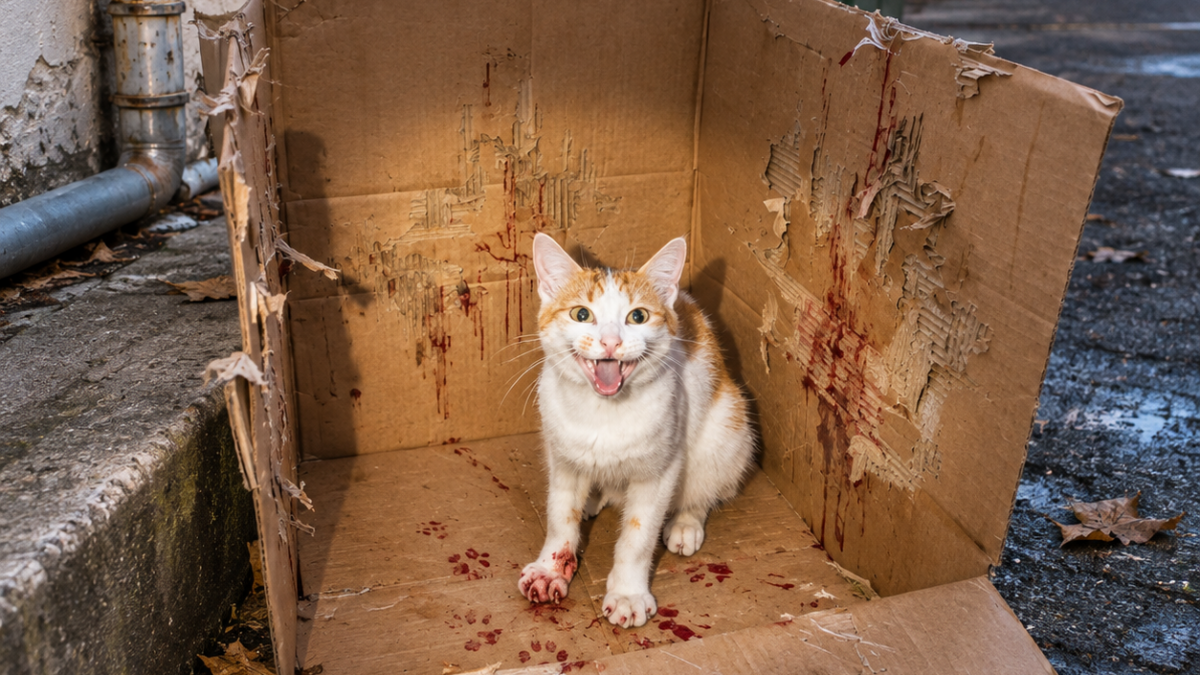
A cat was crouched at the bottom.
Orange and white.
Young.
Maybe two years old.
His body was pressed against one shredded corner.
His mouth was open.
He was panting.
Cats should not be sitting inside cardboard boxes panting like dogs.
His eyes were huge.
He looked at us.
Then at the opening above him.
The inside of that box was destroyed.
Every wall.
Every flap.
Cardboard had been shredded into strips.
Long claw marks covered all four sides.
Pieces were scattered beneath him.
And there were dark smears near the bottom.
His front paws.
That was where the blood had come from.
He had scratched until his claws were damaged.
Two appeared badly torn.
Some of his paw pads were raw.
Sarah whispered:
“Oh, baby.”
The cat did not try to jump out.
That frightened me.
Most healthy cats trapped in a box would have exploded upward the second it opened.
This one simply stared.
Mouth open.
Breathing fast.
Completely exhausted.
Sarah reached slowly inside.
I said:
“Careful.”
She nodded.
Her hands went beneath his chest.
He didn’t hiss.
Didn’t scratch.
Didn’t bite.
He didn’t fight at all.
Sarah lifted him.
The moment he reached her chest, his entire body seemed to collapse.
He pressed his head beneath her chin.
Sarah started crying.
I had known Sarah for four years.
I’d seen her deal with angry customers, shoplifters, broken pipes, a small electrical fire, and one Black Friday morning I still refuse to discuss.
I had never seen her cry at work.
She stood beside the dumpster with that cat against her chest and tears running down her face.
“What kind of person does this?”
I looked at the empty box.
I had no answer.
The sun was beginning to clear the buildings.
The asphalt already felt warm through my shoes.
I checked my phone.
6:24.
Our weather app showed eighty-four degrees.
Forecast high:
ninety-seven.
The box had been placed beside a dumpster where the morning sun would hit it directly.
No shade after seven.
No ventilation.
No water.
No way out.
Sarah kept holding him.
I called the closest veterinary clinic.
Closed.
Second one.
Closed.
Third.
Voicemail.
Then I found a twenty-four-hour emergency clinic about thirty minutes away.
I explained the situation.
The receptionist said:
“Bring him now.”
I looked at Sarah.
“We’re going.”
She nodded.
“What about opening?”
“I’ll call Jason.”
Jason was our district manager.
He answered sounding half asleep.
“Megan?”
“I need someone else to open.”
“Why?”
“We found a cat sealed inside a box.”
Silence.
“What?”
I repeated it.
Jason stopped sounding sleepy.
“Is it alive?”
“Yes.”
“Go.”
Same answer.
Go.
We wrapped the cat in an old sweatshirt Sarah kept in her car.
She sat in the passenger seat.
He remained against her chest.
I expected him to become restless once the air conditioning cooled him.
He didn’t.
For the entire drive, he barely moved.
His breathing slowed.
That was good.
But he looked exhausted.
Every few minutes Sarah whispered:
“You’re okay.”
Then:
“We’ve got you.”
Then:
“Nobody’s putting you back in there.”
I drove.
At one red light, I looked over.
The cat’s eyes were closed.
“Is he breathing?”
Sarah put a hand against his side.
“Yes.”
The light turned green.
We reached the emergency clinic around 7:20.
A technician met us immediately.
They took his temperature.
Checked breathing.
Examined the paws.
Started fluids.
Sarah looked terrified when they carried him into the treatment area.
“Is he going to die?”
The veterinarian, Dr. Laura Chen, answered carefully.
“He’s overheated and dehydrated.”
Sarah’s face fell.
“But he is responsive.”
“What about his paws?”
“We’ll clean them.”
She paused.
“Two front claws are severely damaged.”
I asked:
“Heatstroke?”
“Not yet.”
That phrase stayed with me.
Not yet.
He had been heading there.
His body temperature was elevated, but he had not crossed into the severe organ-damage stage Dr. Chen was worried about.
We had found him in time.
She asked:
“How long was he inside?”
“We don’t know.”
“Any idea when the box appeared?”
“No.”
“Security footage?”
“Not where it was left.”
She nodded.
Then looked at the paws again.
“Based on dehydration and how extensively he’s damaged the inside of the box trying to escape, he may have been in there for several hours.”
Sarah stared at her.
“How many?”
“Impossible to say exactly.”
“Three?”
“Maybe.”
“Four?”
“Possible.”
Sarah covered her mouth.
I pictured the box.
Dark.
Sealed.
Hot.
The cat scratching.
Stopping.
Starting again.
Nobody hearing.
Dr. Chen continued:
“If that box had remained in direct sun for another couple of hours, I’d be much more worried.”
She didn’t need to finish.
We understood.
Two hours later.
Maybe one.
Maybe even less once the sun became stronger.
Different story.
They sedated him lightly so they could treat his paws without causing more stress.
Both front paws were irritated.
Several claws had been worn or torn badly.
Two needed significant treatment.
But there were no fractures.
No internal injuries that they could detect.
No evidence of poisoning.
He was thin but not emaciated.
Teeth looked relatively good.
Estimated age:
around two.
Male.
Neutered.
No microchip.
No collar.
That surprised me.
“Someone had him neutered?”
“Yes.”
“So he belonged to somebody.”
Dr. Chen shrugged.
“At some point, probably.”
That made everything worse.
It is terrible imagining a feral animal abused.
There is something uniquely disturbing about imagining an animal who had once lived inside a home.
Someone may have fed him.
Named him.
Watched him sleep.
Then another human—or perhaps the same one—put him into a box.
Closed the flaps.
Wrapped tape around it until air could barely move.
And left.
I went back to the store around ten.
Sarah stayed at the clinic.
Before I left, I walked into the treatment room.
The cat was lying on a padded surface.
Bandages around both front paws.
IV line.
Eyes half closed.
He looked at me.
I crouched.
“Hey.”
His ears moved.
“You caused a lot of trouble this morning.”
Sarah glared at me.
“He did not.”
I smiled.
“I know.”
The veterinarian asked:
“Does he have a name?”
Sarah answered before I could.
“Box.”
I turned.
“Box?”
She nodded.
“His name is Box.”
“You’re serious?”
“Yes.”
“That’s terrible.”
“He likes it.”
“He has no idea what we’re saying.”
Sarah looked at the cat.
“Box.”
One ear moved.
She pointed at me.
“See?”
I laughed for the first time that morning.
“Fine.”
Box.
It stayed.
Back at the store, I went directly to the dumpster.
The cardboard box remained where we had opened it.
Animal control was on the way.
I did not touch anything.
I stood over it.
The inside looked worse in daylight.
Every wall was covered in claw marks.
Some deep enough that only the outer paper layer remained.
One corner was almost torn through.
Almost.
That word bothered me.
If he had been stronger.
If the cardboard had been weaker.
If one strip of tape had failed.
Almost.
But it hadn’t.
I photographed it.
Not because I wanted social-media content.
Because I wanted evidence.
Animal control arrived.
Officer Renee Walsh photographed everything again.
Measured.
Bagged pieces of tape.
Took the box.
Asked about cameras.
Our parking lot had several.
The loading dock had one.
Front entrance.
Side entrance.
Employee parking.
Unfortunately, the dumpster corner itself was just outside the nearest camera’s field of view.
“Whoever did it may have known that,” Renee said.
I hated the possibility.
We checked nearby businesses.
One camera showed headlights entering the shopping center sometime before dawn.
Too far away.
No readable plate.
Another captured part of a vehicle leaving.
Possibly a dark sedan.
Nothing useful enough to identify anyone.
No witness came forward.
For days, I kept hoping.
Nothing.
Sarah called around noon.
“He ate.”
I smiled.
“Really?”
“Little bit.”
“How is he?”
“Sleeping.”
Then:
“Megan?”
“What?”
“I’m taking him.”
I leaned against the office desk.
“What do you mean?”
“When he’s released.”
“You’re adopting him?”
“Yes.”
“Sarah.”
“What?”
“You have two cats.”
“I have three now.”
“You haven’t asked your husband.”
“He’ll live.”
I laughed.
Then realized she was completely serious.
“You decided this morning?”
“I decided when I heard the scratching.”
“That was before you even saw him.”
“I know.”
“Sarah.”
“He’s mine.”
That was it.
Not:
Maybe.
Not:
If nobody claims him.
Not:
We’ll see.
“He’s mine.”
Animal control had procedures.
There was a required hold.
The investigation remained open.
Sarah could foster once medically cleared, but formal adoption had to wait.
She accepted all of it.
Box remained at the clinic overnight.
Then another.
His temperature normalized.
Hydration improved.
He began eating more.
His paws would take longer.
Dr. Chen warned that healing damaged claws can be painful.
He received medication.
Bandages.
Follow-up visits.
The clinic staff adored him.
Not because his story was dramatic.
Because he was gentle.
Every person who handled him said the same thing.
“He just wants to be held.”
That destroyed Sarah.
The first evening Box was discharged into foster care, she carried him into her house.
Her husband, Michael, stood in the kitchen.
Two resident cats watched from behind a baby gate.
Michael looked at Box.
Then Sarah.
Then the bandaged paws.
“You already decided, didn’t you?”
Sarah nodded.
Michael sighed.
“I knew when you said ‘we found a cat’ instead of ‘there’s a cat.’”
That was probably the shortest adoption discussion in history.
They set up Box in a quiet spare bedroom.
Soft bed.
Litter box.
Food.
Water.
No cardboard boxes.
That last part happened instinctively.
Sarah had thrown out every shipping box in the room before bringing him home.
The first night, Box slept beneath the bed.
The second, on a blanket.
Third night, he climbed onto the bed beside Sarah when she sat with him.
He did not climb into her lap.
He rested one bandaged paw against her thigh.
Then fell asleep.
Sarah sent me the picture.
Caption:
He knows.
I replied:
Or your leg is warm.
She wrote:
Let me have this.
Fair.
The original photograph spread farther than any of us expected.
I posted it after animal control said it would not compromise the investigation.
I did not post the exact store.
No address.
No identifying landmarks.
Just the photograph.
Box on the veterinary table.
Orange-and-white face.
Exhausted eyes.
Bandaged paws not yet applied in that first image.
Behind him, you could see part of the shredded cardboard.
I wrote:
Someone sealed this cat inside an Amazon box and left him beside our dumpster before sunrise today.
No air holes.
No water.
Already almost 85 degrees.
My coworker heard him scratching at 6:15 a.m.
He is alive.
That was enough.
People shared it.
Thousands.
Then tens of thousands.
Comments were furious.
Some I refused to repeat.
People offered money.
Food.
Toys.
Veterinary costs.
Sarah declined most of it.
The clinic bill had already been covered partly by us and later by rescue donations.
What she wanted was information.
Who left him?
Nobody knew.
Then another kind of comment began appearing.
People accused Amazon.
Ridiculous.
Others claimed the image was staged.
Also ridiculous.
Some asked why the cat could not tear through cardboard.
Those bothered me.
Because they had not seen the box.
He had tried.
Every inch proved it.
He had shredded layers from the inside.
But a cardboard box taped repeatedly around all sides becomes surprisingly strong.
Especially for an overheated animal with no leverage.
He had fought.
He had fought until his front paws were injured.
The evidence was literally written into the walls around him.
A week later, animal control allowed Sarah to take the empty box home after the evidence collection was complete.
She didn’t want it.
Neither did I.
Eventually Renee disposed of it.
Good.
Some things do not need memorials.
Box himself was enough.
His paws healed slowly.
For the first several days, Sarah changed dressings under veterinary guidance.
Box hated the wraps.
Loved the attention afterward.
By week two, he was walking comfortably.
By week three, the bandages came off for good.
The missing claws would take time.
Some might regrow imperfectly.
But his feet worked.
He ran for the first time on day twenty-six.
Sarah sent me a video.
Box exploded from one end of the hallway to the other.
Slid on hardwood.
Nearly hit a laundry basket.
Turned.
Ran back.
Michael’s voice in the background:
“He’s supposed to be resting!”
Sarah laughed.
Box ran again.
That was the first time I stopped seeing him as the cat from the box.
He was just a young idiot running down a hallway.
Exactly what we wanted.
But some things stayed.
Cardboard frightened him.
The first time an Amazon delivery arrived after his adoption, Michael opened the package in the kitchen.
The tape ripped.
Box was asleep on the couch.
The sound of tape peeling made him bolt.
He disappeared behind the washing machine.
Sarah found him shaking.
After that, packages were opened in the garage.
For months.
Eventually he improved.
At first, seeing a box made him leave the room.
Then he could remain if it was open.
Then sniff one.
Sarah never forced him.
Never put treats inside boxes to “teach” him.
She said:
“He doesn’t need to learn boxes are safe.”
“He just needs to know he never has to go inside one.”
I thought that was smart.
The other cats accepted him slowly.
Lucy, a twelve-year-old tabby, ignored him.
Benny, four, hated him for a week.
Box loved Benny immediately.
This was inconvenient.
Box followed him.
Benny hissed.
Box followed.
Benny swatted.
Box sat down.
Benny moved.
Box followed.
After twelve days, Sarah found them sleeping six inches apart.
By the second month, they shared a window.
By the fourth, Benny groomed Box’s head.
Nobody celebrated too loudly.
Cats hate ceremonies.
Sarah officially adopted Box when his legal hold ended.
On the form:
Name: Box Mitchell.
Age: approximately two years.
Color: orange/white.
Microchip implanted.
Emergency contact:
Michael Mitchell.
Sarah showed me.
“You gave him our last name?”
“Obviously.”
“He sounds like an attorney.”
“Box Mitchell, Esquire.”
“He’d lose every case.”
“Still cute.”
The investigation eventually stalled.
No plate.
No clear suspect.
No confession.
No useful fingerprint evidence on the tape.
People think crimes always leave dramatic clues.
Often they don’t.
Especially when someone chooses darkness, a parking-lot blind spot, and a disposable box.
I hated not knowing.
Sarah handled it better.
One night after work, I asked:
“Doesn’t it bother you?”
“What?”
“That whoever did it got away.”
She thought.
“Yes.”
“But?”
She looked at me.
“They didn’t get what they wanted.”
I waited.
“They wanted him gone.”
She smiled.
“He’s on my pillow.”
That changed something for me.
Not everything.
Accountability still mattered.
Animal cruelty should have consequences.
But Sarah was right about one thing.
The person who sealed that box had made a decision about Box’s future.
They had decided he could disappear.
They did not get the final decision.
Sarah did.
Dr. Chen did.
Renee did.
Every person who helped after six-fifteen did.
And Box himself did.
He survived long enough to scratch once more.
That mattered.
The exact time became almost mythological in our store.
6:15.
Employees started arriving earlier for a while.
Not officially.
Nobody ordered them.
People just did.
The maintenance crew began walking behind the dumpster every morning.
We adjusted one security camera to cover the blind spot.
Then added another.
Jason approved it without arguing.
One month later, the new camera caught somebody illegally dumping an old mattress.
Not exactly the crime of the century.
Still satisfying.
Sarah taped a small note near the employee entrance.
CHECK BEHIND DUMPSTER BEFORE OPEN.
Not because we expected another animal.
Because once you find one living thing where nobody should have left it, you stop assuming trash is only trash.
That habit saved another animal eight months later.
A tiny kitten.
Different story.
Not sealed.
Someone had left her in an open laundry basket with food and a note.
Still irresponsible.
But survivable.
The opening employee found her immediately.
Sarah fostered that one too.
Michael complained that our store had become a cat distribution center.
He was not entirely wrong.
Box grew into a beautiful cat.
Thick orange patches.
White chest.
Amber eyes.
Healthy paws.
One front claw grew back slightly crooked.
Sarah called it his “bad decision claw.”
I told her that made no sense.
She didn’t care.
His favorite sleeping place became the top of their couch.
His favorite person was Sarah.
Michael claimed otherwise because Box slept on his side of the bed.
Sarah said that was territorial conquest, not affection.
Box had one deeply irritating habit.
He liked grocery bags.
Paper ones.
Sarah would bring groceries home and Box would immediately stick his head inside.
The first time she saw him do it, she panicked.
Then stopped herself.
The bag was open.
He could leave.
Box climbed completely inside.
Sat.
Looked at her.
Sarah laughed so hard she cried.
She sent me a picture.
I texted:
Apparently packaging isn’t the issue.
She replied:
Freedom is.
I saved that message.
Freedom is.
Maybe that’s why the story stayed with me.
A box by itself is nothing.
Cats love boxes.
Everybody knows that.
They sleep in them.
Play in them.
Hide in them.
A cardboard box becomes terrifying only when someone removes the exit.
That distinction is bigger than cats.
Safety is often choice.
Can I leave?
Can I move?
Can I say no?
Box did not hate cardboard.
He hated being trapped.
Over time, even his fear of boxes faded.
Not because Sarah trained him.
Because every box in his new home stayed open.
One Christmas, Sarah sent me a photograph.
Box asleep inside a large open gift box.
Ribbon beside him.
The lid nowhere near.
I stared at it for a long time.
Then sent back:
You sure that’s the same cat?
Sarah:
He checked for exits first.
That detail broke my heart a little.
Checked for exits.
Then slept.
Trust does not always mean forgetting what happened.
Sometimes it means learning you can verify you’re safe and then rest anyway.
One year after Box was found, we had a small anniversary nobody planned.
Sarah came into work carrying cupcakes.
I asked:
“Whose birthday?”
“Box.”
“We don’t know his birthday.”
“His second birthday.”
“What?”
She put a cupcake on my desk.
“The day we opened the box.”
I understood.
Not birth.
Beginning.
At 6:15 that morning, she sent Michael a message:
Give him the good breakfast.
Michael replied with a photograph.
Box sitting beside an expensive plate of wet food looking completely unimpressed.
That afternoon, Sarah and I walked behind the dumpster.
The spot looked ordinary.
Gray asphalt.
Concrete wall.
Dumpster.
No trace.
“Was it right here?”
She pointed.
“About there.”
We stood silently.
I remembered the sound.
Scratch.
Scratch.
Scratch.
Sarah said:
“You know what bothers me?”
“What?”
“If I’d been on time.”
I knew.
“Don’t.”
“My normal arrival was 6:30.”
“I know.”
“What if—”
“Sarah.”
She stopped.
I looked at her.
“You weren’t.”
She nodded.
“But fifteen minutes.”
“I know.”
We stood there.
Fifteen minutes.
That number had become hard to think about.
Dr. Chen never said Box would definitely have died by 6:30.
Nobody could know.
But we knew the temperature was climbing.
We knew the box had no ventilation.
We knew he was already overheated.
We knew exhaustion had set in.
And we knew that every minute mattered.
People sometimes build life-changing moments into something mystical.
Fate.
Destiny.
Everything happens for a reason.
I don’t know about that.
Sarah arrived early because her husband needed the car.
That is all.
A normal scheduling inconvenience.
Fifteen minutes.
Then she happened to hear something.
That is how fragile some outcomes are.
No grand plan.
Just being there.
And paying attention.
Two years after the rescue, Box became sick unexpectedly.
Nothing related to the original abuse.
Urinary blockage.
Emergency.
Sarah called me crying.
“This can’t happen.”
“What?”
“After everything.”
I understood.
It feels unfair when survivors suffer anything ordinary.
As if surviving one terrible thing should purchase immunity from every future one.
Life does not work that way.
Box needed emergency treatment.
He recovered.
Sarah spent a ridiculous amount of money.
Michael pretended not to look at the bill.
Box returned home and immediately demanded dinner.
Normal life again.
That episode taught Sarah something too.
“You know what I realized?”
“What?”
“I keep thinking he’s supposed to get a perfect life because of what happened.”
“And?”
“He doesn’t need perfect.”
She looked toward him.
“He just needs his life.”
Exactly.
Box’s story did not have to remain a rescue story forever.
He deserved boring problems.
Vet appointments.
Hairballs.
Weight gain.
Knocking over water.
Stealing Sarah’s pillow.
Arguing with Benny.
Normal.
That became the goal.
Three years after we found him, Box is still with Sarah.
He’s about five now.
A little overweight.
Dr. Chen says “solidly built.”
Sarah prefers that terminology.
His paws are fine.
One claw still looks unusual.
He lets Dr. Chen examine it without complaint.
The old injuries are difficult to notice unless you know where to look.
He still dislikes packing tape.
Not terrified anymore.
Just leaves the room when he hears it.
Fair.
Amazon boxes enter the house constantly.
Box usually waits until they have been opened.
Then inspects them.
Always open.
Always an exit.
Sometimes he sleeps inside.
Sometimes he destroys them.
Sarah says that feels like justice.
I agree.
The photograph from that first morning still exists on my phone.
I rarely open it.
When I do, I’m surprised by how young he looks.
Tiny inside the shredded box.
Eyes wide.
Mouth open.
Everything around him bearing evidence of how hard he had tried to escape.
People see that photograph and focus on what someone did to him.
I understand.
It is difficult not to.
But now, when I see it, I notice something else.
The open flaps.
That is what matters to me.
The box is open.
Sarah’s hands are reaching inside.
The worst part of the photograph has already ended.
People looking at a still image do not always realize that.
They see a terrified cat.
I see the exact second he stopped being trapped.
There is a difference.
Sometimes rescue photographs look heartbreaking because they capture the last second before everything changes.
That was ours.
Box inside.
Flaps open.
Air entering.
Two strangers above him.
He had no way to know what came next.
Veterinarian.
Bandages.
Fluids.
Food.
A home.
Two cat siblings.
A man named Michael pretending he did not want a third cat.
A woman named Sarah who had already decided he belonged to her before she even knew whether he would survive.
Years of sunlight.
Open cardboard boxes.
A full stomach.
Choice.
He knew none of that.
All Box knew at 6:18 that morning was that after hours of scratching in darkness, the ceiling suddenly opened.
I think about that often.
Especially when people ask why I posted the photograph.
Not to make people angry.
Anger happens on its own.
Not for attention.
Definitely not because I enjoy seeing what happened.
I posted it because cruelty depends on being unseen.
Whoever taped that box shut chose the side of a commercial building before dawn.
A camera blind spot.
A place near garbage.
They expected the box to look like trash.
Maybe they expected somebody to throw it away without opening it.
Maybe they assumed nobody would hear.
But Sarah did.
One person heard.
That was enough.
The person who sealed Box inside probably thought their part of the story ended when they drove away.
It didn’t.
The story kept going without them.
At 6:15, Sarah walked around the building.
At 6:18, she called me.
Minutes later, the tape was cut.
Then a veterinarian.
Then a foster home.
Then an adoption.
Then years.
That is the part I want people to remember.
Not every cruel person gets caught.
Not every animal gets found.
I wish both of those statements were different.
But sometimes a terrible act is interrupted by something very ordinary.
Someone arrives early.
Someone hears scratching.
Someone bothers to check.
Someone cuts the tape.
Someone says:
“He’s mine.”
And suddenly the person who tried to erase a life no longer gets to decide how that life ends.
Box never went back into a sealed carton.
He never will.
Every box in Sarah’s house has an open top.
Every room has a doorway.
Every person he trusts lets him walk away whenever he wants.
Maybe he doesn’t understand why that matters.
Maybe animals understand more than we think.
I only know that when he climbs into an open cardboard box now, he always does one thing first.
He looks over the edge.
Checks the room.
Checks the opening.
Then lowers himself down.
Sometimes he sleeps.
Because this time, if he wants out, he can leave.
And this time, nobody closes the lid.








