Someone Left a Groomed Cat in a Costco Cart With a “FREE” Sign—Nine Hours Later, He Was Still Waiting
PART3:
Cars moving.
People walking.
One woman loading groceries into an SUV.
A man putting a child into a car seat.
Nobody paying attention to the cat.
I stepped closer.
“Hey, buddy.”
The cat looked at me.
No fear.
No aggression.
Just looked.
I put my hand near him.
He sniffed my fingers.
Then sat exactly as before.
The sign shifted slightly against his chest.
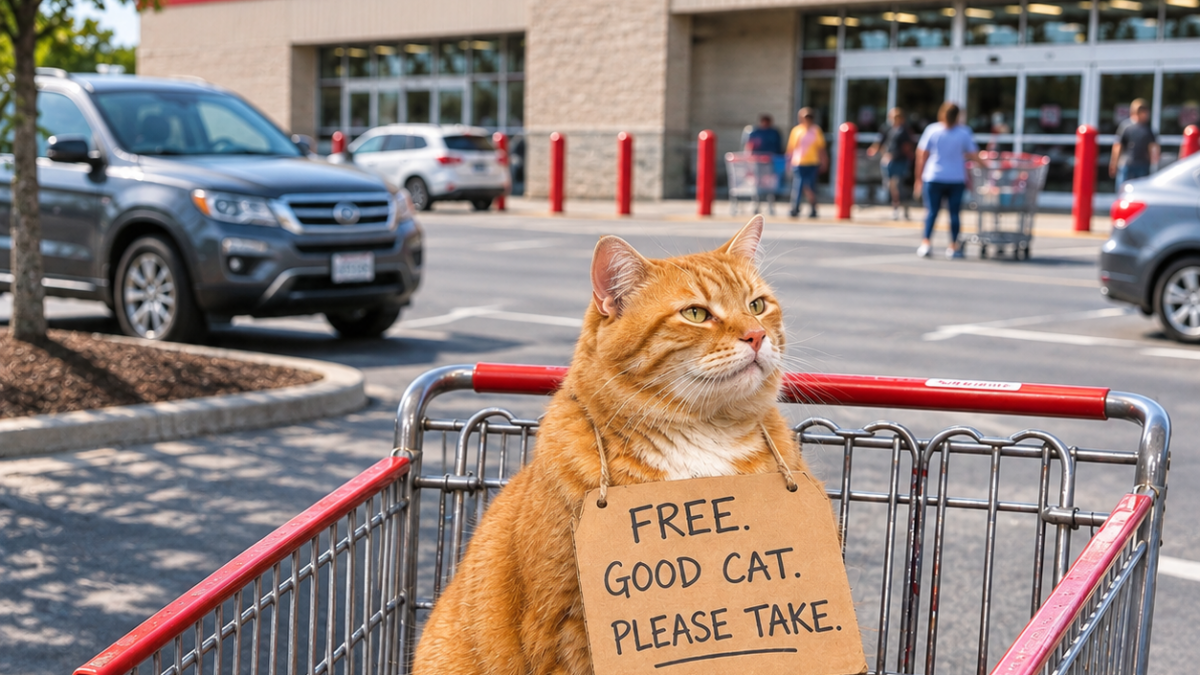
FREE.
That word bothered me immediately.
Not because people don’t rehome animals.
They do.
Life changes.
People get sick.
Lose housing.
Develop allergies.
Sometimes keeping a pet becomes impossible.
I understand that.
But this wasn’t rehoming.
This was leaving.
Someone had driven into a Costco parking lot early on a Saturday morning.
Taken their cat out of the car.
Placed him in a shopping cart.
Tied a sign around his neck.
Then disappeared.
I called my supervisor.
“Mike?”
“Yeah?”
“There’s a cat outside.”
Pause.
“A what?”
“Cat.”
“Like a stray?”
“No.”
“How do you know?”
“He’s in one of our shopping carts.”
Longer pause.
“What?”
“And he has a sign.”
“What kind of sign?”
I looked down.
“Free. Good cat. Please take.”
Mike came outside.
He stared at the cart.
Then at me.
Then at the cat.
“Seriously?”
“Apparently.”
The cat looked at him too.
Mike sighed.
“We can’t bring him inside.”
“What am I supposed to do with him?”
“I don’t know.”
“Animal control?”
“Call them.”
We did.
No immediate pickup available.
Weekend.
Limited staff.
They said someone might come later.
Might.
I asked if I could bring him into the vestibule.
Management said no animals inside unless service animals or approved situations.
I understood the rule.
Food store.
Health regulations.
Liability.
All the boring reasons that seem reasonable until you’re looking at an abandoned cat sitting in ninety-degree heat.
So I moved the cart.
Not far.
Just closer to the side of the building where there was some morning shade.
I found a disposable bowl from the break room.
Filled it with water.
The cat drank.
A lot.
Then he sat back down.
I had work to do.
That bothered me.
I didn’t want to walk away.
But I was twenty-two.
Hourly employee.
I couldn’t stand beside an abandoned cat for an entire shift.
So I went back to collecting carts.
At nine, I checked again.
Still there.
The water was half gone.
He had changed position.
Nothing else.
A woman was standing nearby reading the sign.
For a second, I thought:
Great.
Maybe she’s taking him.
She pulled out her phone.
Took a picture.
Then walked away.
The cat watched her leave.
At ten, I checked again.
Still there.
A family with two little girls stopped.
The younger girl reached toward him.
Her mother said:
“Don’t touch, honey. We don’t know where he’s been.”
The girl asked:
“Can we take him?”
The mother looked at the sign.
Then at her husband.
“No.”
“Why?”
“We already have a dog.”
They left.
The cat watched them too.
At eleven, he was still there.
By then, customers had started noticing.
Some people came over specifically because they’d heard there was a free cat in the parking lot.
One older man scratched his head.
“Somebody really left him?”
“Looks that way.”
“Healthy?”
“I don’t know.”
“He friendly?”
“Very.”
The man pet him.
The cat leaned slightly into his hand.
My heart jumped.
Maybe.
Then the man said:
“My wife would kill me.”
And walked toward the store.
That happened repeatedly.
“Beautiful cat.”
“I wish we could.”
“Our apartment doesn’t allow animals.”
“We’ve got three already.”
“My daughter would love him.”
“Maybe someone else will take him.”
Someone else.
That phrase stayed with me.
Everyone believed there would be someone else.
Somebody with more room.
More money.
More time.
Fewer pets.
A house instead of an apartment.
No allergies.
No landlord.
No complicated life.
Someone else would stop.
At noon, I checked again.
Still there.
The shade had moved.
So had he.
The cart was partly exposed to sunlight now.
The metal felt hot.
I moved it again.
He didn’t fight me.
Didn’t jump.
Didn’t hiss.
He just shifted slightly as the cart rolled.
That trust was unsettling.
He acted like being moved around by strangers was normal.
Like humans put him places and he simply accepted that whatever happened next was out of his control.
I gave him more water.
One of the bakery employees brought out a little plain cooked chicken she’d bought from the food court.
He ate slowly.
Not desperately.
That told me he probably hadn’t been without food for long.
He wasn’t feral.
That was obvious.
His claws were trimmed.
His coat was clean.
He smelled faintly like pet shampoo.
Someone had brushed him.
He had been cared for.
Recently.
That made the sign worse.
A truly neglected animal is heartbreaking.
But this cat looked like somebody had prepared him to be given away.
As if they’d thought:
Let’s make him presentable.
Maybe someone will want him.
Then instead of finding that person, they placed him in a cart and trusted a parking lot to finish the job.
Around one, somebody posted a picture online.
I didn’t know until later.
The photo showed the cat sitting in the cart.
Sign around his neck.
Cars blurred behind him.
That photograph started spreading through a local community group.
Comments poured in.
Someone please save him.
This is disgusting.
Where exactly is this?
Has anyone taken him?
I wish I lived closer.
I would if my landlord allowed cats.
Poor baby.
Hundreds of comments.
But at two o’clock, when I checked?
Still there.
That’s when the whole thing started bothering me in a different way.
Online, everyone wanted him rescued.
In the parking lot, nobody was taking him home.
I’m not criticizing every person who walked past.
Most people have legitimate reasons they can’t suddenly adopt a cat.
I did too.
At least I thought I did.
I shared a small apartment with my girlfriend, Kelsey.
We weren’t exactly wealthy.
My Costco paycheck was decent for where I was in life, but rent ate a lot of it.
Car insurance.
Student loans.
Groceries.
Everything adds up.
We had talked about getting an animal someday.
Someday meaning:
When we had more money.
When we had a bigger place.
When life felt settled.
That wonderful imaginary point when becoming responsible for something else would somehow become convenient.
At three, I took my break.
Most people spent theirs inside.
Air-conditioning.
Phone.
Food.
I went outside.
The cat was still there.
Seven hours.
He had shifted to the narrow strip of shade cast by the side of the cart.
That’s what I remember most clearly.
Not the sign.
Not yet.
The way he had positioned himself.
His body pressed into maybe eight inches of shade because the sun had moved again.
I moved the cart closer to the building.
Then sat on the curb beside him.
“Why hasn’t anybody taken you?”
He looked at me.
I scratched beneath his chin.
He closed his eyes.
I felt for a collar beneath the cardboard.
Nothing.
No tag.
No name.
The sign was tied loosely enough that it wasn’t choking him.
I slid one finger beneath the string.
Whoever had done this had taken care with that too.
That disturbed me.
The handwriting was neat.
The string wasn’t too tight.
The cat was groomed.
Everything about the abandonment was strangely careful.
Like somebody wanted credit for doing a bad thing politely.
I read the sign again.
FREE. GOOD CAT. PLEASE TAKE.
Good cat.
I wondered what his name had been.
Because obviously he had one.
Nobody owns a cat for five years without naming him.
Had he slept on someone’s bed?
Did he have a favorite window?
Did somebody know which food he liked?
Had children grown up with him?
Did he wait beside a door at dinner?
Had somebody said goodbye before putting him in the cart?
Or did they just drive away?
I hated that I was thinking about it.
The cat couldn’t read the sign.
That fact suddenly felt enormous.
He didn’t know he was free.
He didn’t know he was unwanted.
He didn’t know the person who placed him there had made a permanent decision.
As far as he understood, maybe this was just another strange errand.
Maybe the person would come back.
Maybe he was doing exactly what he’d been taught.
Stay.
Wait.
Be good.
So he did.
For seven hours.
At four, another employee asked:
“What happens when we close?”
I said:
“We’re not leaving him here.”
“You taking him?”
“No.”
But I heard how uncertain that sounded.
I texted Kelsey.
Hypothetical question.
She replied:
No.
I laughed.
You don’t even know the question.
Whenever you start like that, it’s either furniture or an animal.
I sent the photograph.
Three dots appeared.
Stopped.
Appeared again.
Then:
Oh no.
I wrote:
He’s been here all day.
She replied:
Don’t.
Then:
How old?
That was progress.
Maybe 5? Don’t know.
Friendly?
Very.
Pause.
Do NOT name him.
I looked at the shopping cart.
Then typed:
Too late.
What did you name him?
I hadn’t.
But the answer came immediately.
Cart.
Her reply:
Absolutely not.
I smiled.
The cat blinked at me.
“Cart.”
His ear moved.
That was enough.
At five, my shift ended.
Nine hours after I’d first seen him.
I clocked out.
Changed shirts.
Walked outside.
He was still there.
Parking lot had changed.
Morning crowd gone.
Different cars.
Different people.
Nine hours of movement around one animal who had nowhere to go.
I stood in front of the cart.
“Okay.”
Cart looked at me.
“Apparently we’re doing this.”
I untied the string.
The cardboard came away.
For the first time all day, he wasn’t wearing the word FREE.
I remember how strangely relieved that made me feel.
I folded the sign.
Put it in my pocket.
Then lifted him.
He didn’t resist.
Large cat.
Warm from the July air.
He put both front paws against my chest.
No claws.
I carried him to my car.
Opened the passenger door.
Put him inside.
I expected panic.
Cats usually don’t love cars.
He simply sat on the seat.
I drove home.
He stared out the window the entire way.
Never meowed once.
That silence bothered me more than crying would have.
It felt like resignation.
Like the last time he’d trusted a car ride, it ended with him sitting alone in a shopping cart.
Kelsey was waiting outside our apartment.
She saw him through the passenger window.
Then saw me.
“No.”
I got out.
“Just overnight.”
She crossed her arms.
“Tyler.”
“Animal control couldn’t come.”
“Tyler.”
“He was there nine hours.”
She looked through the glass.
Cart looked back.
Kelsey closed her eyes.
“Oh, come on.”
“What?”
“He’s orange.”
“Yes.”
“I love orange cats.”
“That’s convenient.”
“I still hate the name.”
We carried him upstairs.
He walked into the apartment.
Sniffed the living room.
Found the couch.
Jumped onto it.
Circled once.
Lay down.
Kelsey stared.
“He lives here now, doesn’t he?”
“I think so.”
She sighed.
“We don’t even have litter.”
Twenty minutes later, I was at a pet store buying:
Litter.
Box.
Food.
Bowls.
Scratching pad.
Carrier.
Toy mouse.
And somehow seventy dollars of additional things I did not remember putting in the cart.
The cashier asked:
“New cat?”
“Apparently.”
Cart used the litter box immediately.
A point in his favor.
He slept on our couch that night.
Not hidden beneath it.
On it.
Stretched out like he’d signed the lease.
The next morning, we took him to a veterinarian.
No microchip.
That disappointed me.
Part of me had hoped the whole thing had been some misunderstanding.
Maybe he’d been stolen.
Maybe someone had found him.
Maybe the sign wasn’t from his actual owner.
The vet estimated about five years old.
Male.
Neutered.
Healthy.
Slightly dehydrated.
Good teeth.
Trimmed claws.
Clean ears.
Brushed coat.
The vet ran her hand along his back.
“Someone took care of this cat.”
I said:
“That’s what bothers me.”
She looked at me.
“How was he found?”
I showed her the sign.
Her expression changed.
“Wow.”
Kelsey said:
“Can you tell how recently he was groomed?”
The vet examined him.
“Not exactly.”
Then:
“But this isn’t a cat that’s been wandering outside for weeks.”
That confirmed what we already knew.
Someone had cared for him.
Then stopped.
Maybe they had a reason.
I still try to remember that.
I don’t know their life.
Maybe eviction.
Maybe illness.
Maybe desperation.
Maybe something happened that made keeping a cat genuinely impossible.
I can understand needing to surrender an animal.
What I cannot understand is the shopping cart.
There were shelters.
Rescues.
Veterinary offices.
Community groups.
People who could have helped.
Even walking into Costco and asking an employee would have been better than quietly leaving him outside.
Instead, they made a sign.
A careful one.
That detail stayed with me.
The letters were straight.
Even.
Whoever wrote it had used a ruler or something similar to keep the lines neat.
FREE.
Centered.
GOOD CAT.
Centered.
PLEASE TAKE.
Centered.
They had taken time.
That’s what I couldn’t understand.
They groomed him.
Trimmed his claws.
Made a neat sign.
Tied it loosely enough not to hurt him.
Then walked away.
Care and cruelty existing in the same act.
I kept the sign.
Kelsey asked why.
“I don’t know.”
“You hate it.”
“Yes.”
“Then throw it away.”
I couldn’t.
Maybe part of me wanted proof.
Maybe because I knew Cart would eventually become comfortable enough that the parking lot wouldn’t seem real anymore.
Maybe I wanted to remember where his second life began.
The photo somebody took at Costco kept circulating.
Eventually one of my coworkers told the local community group that the cart employee had taken the cat home.
Comments changed.
THANK GOD.
What an amazing young man.
Hero.
I hated that word.
I wasn’t a hero.
I was a guy making sixteen dollars an hour who happened to be standing closest to the problem for nine hours.
For most of that day, I did exactly what everyone else did.
I waited for someone else to solve it.
That truth matters.
At eight, I saw him.
At nine, I checked.
At ten.
Noon.
Three.
I kept thinking:
Animal control will come.
A customer will take him.
Someone online will show up.
Someone more prepared.
Someone with a house.
Someone with money.
Someone who already knows cats.
Someone.
Eventually, I ran out of someones.
There was just me.
Cart adjusted faster than expected.
For the first week, he slept more than any cat I’d ever seen.
Couch.
Bed.
Window.
He didn’t care.
As long as it was indoors.
He never tried rushing the front door.
Not once.
If we opened it, he backed away.
Kelsey noticed.
“He doesn’t want outside.”
“Can you blame him?”
“No.”
At night, he slept near our feet.
Within two weeks, he began greeting us when we came home.
Not dramatically.
He’d walk toward the door.
Sit.
Wait.
That bothered me the first few times.
Because I imagined him doing the same thing for whoever owned him before.
Waiting.
Maybe that’s what he’d been doing in the cart.
Kelsey wanted to rename him.
She made a list.
Milo.
Pumpkin.
Archie.
Oliver.
Winston.
I rejected all of them.
“You named him after the worst day of his life.”
“No.”
I scratched his head.
“I named him after where I met him.”
“That’s the same thing.”
“Not anymore.”
She looked at me.
I continued:
“Cart used to mean where somebody left him.”
“Now it means where we found him.”
Kelsey thought about that.
Then sighed.
“Still a terrible name.”
Cart purred.
Name stayed.
A month later, he developed a habit.
Every evening, when I came home from work, he’d jump onto the couch beside me.
Not Kelsey.
Me.
He would press one side of his body against my leg and sleep.
Sometimes I’d sit there longer than I intended because moving felt rude.
Kelsey would walk past.
“You’re trapped?”
“Yes.”
“Cat law?”
“Cat law.”
She’d bring me water.
Cart gained weight.
His coat became shinier.
We bought him a cat tree that cost more than the first television I owned.
He ignored it for three weeks.
Then claimed the top level permanently.
The first Christmas, Kelsey put a small stocking with his name on it beside ours.
I said:
“You realize you’re now emotionally invested in a cat named after retail equipment.”
She said:
“Shut up.”
Two years later, we moved into a larger apartment.
Cart inspected every room.
Then went straight to the couch.
Different couch.
Same behavior.
He had become ours so completely that sometimes I forgot the parking lot.
Then I’d open the kitchen drawer.
The sign was still there.
Folded.
The string beside it.
I’d see those words.
FREE. GOOD CAT. PLEASE TAKE.
And remember.
Nine hours.
That’s the number everybody focuses on.
Nine hours alone.
But what I think about now is how many times he must have expected somebody to return.
At first?
Maybe every car door.
Every familiar voice.
Every person walking from the store.
Perhaps he looked up.
Then eventually stopped.
We’ll never know.
Cats don’t explain abandonment.
They just adapt around it.
Years later, I took Cart back near that Costco.
Not into the parking lot.
That would’ve been strange.
We were driving home from the veterinarian and passed the entrance.
I looked over at him in his carrier.
He was sleeping.
Didn’t recognize anything.
Or didn’t care.
I was glad.
Some places don’t deserve to be remembered.
The employee who originally photographed him eventually sent me the first picture.
I had seen versions online.
But this was the original.
High resolution.
Cart in the child seat.
Orange fur glowing in morning light.
Sign hanging against his chest.
Behind him, people walking toward the store.
That photograph broke me in a way it hadn’t before.
Because by then I knew him.
I knew he hated tuna but loved chicken.
I knew he snored.
I knew he liked having the base of his ears scratched.
I knew thunder made him hide inside the closet.
I knew if I stayed in bed past eight, he would sit on my chest.
I knew he disliked cardboard boxes that were too small but insisted on entering them anyway.
The cat in the photograph wasn’t just “a cat.”
He was Cart.
And whoever left him knew things like that too.
That is the part I still struggle with.
Someone knew his personality.
Someone probably knew how he slept.
Someone knew his favorite food.
Someone had clipped those claws.
Brushed that coat.
Maybe called him by a different name for five years.
Then one Saturday morning, they decided his entire identity could fit on three lines of cardboard.
Free.
Good cat.
Please take.
They couldn’t even give strangers his name.
So I did.
The story became popular online for a while.
Then, like everything online, people moved on.
Another rescue.
Another scandal.
Another photograph.
Cart didn’t know.
He had food at six.
Window at noon.
Couch at night.
That was his world.
I think that’s one reason animals forgive more easily than people.
They don’t need every answer before accepting safety.
We do.
I wanted to know why he had been left.
Cart just wanted to know where dinner was.
Maybe he was wiser.
One afternoon, several years after I found him, a young coworker asked me about the story.
He’d heard from someone else.
“You’re the Costco cat guy?”
“Unfortunately.”
“He really sat there nine hours?”
“Yes.”
“Nobody took him?”
“No.”
“That’s messed up.”
“Yeah.”
Then he asked:
“Why did you?”
I almost gave the easy answer.
Because nobody else did.
Instead I thought about it.
Then said:
“I think eventually I realized I was one of the people walking past him.”
He frowned.
“What?”
“I kept waiting for someone better positioned to help.”
“But you were working.”
“Everybody had a reason.”
He nodded.
“That doesn’t make everyone bad.”
“No.”
“It just means sometimes helping starts when you stop assuming someone else has more responsibility than you do.”
He looked thoughtful.
Then said:
“So you kept him because you felt guilty?”
I laughed.
“At first?”
“Maybe a little.”
“Now?”
Cart was at home asleep on a blanket that cost forty dollars.
“No.”
“Now he owns my apartment.”
Cart eventually became an older cat.
Orange fur lightened around his muzzle.
Jumping onto the counter became less graceful.
Then stopped completely.
We bought stairs for the bed.
He ignored them for months.
Of course.
The veterinarian started calling him “senior.”
I hated that.
Kelsey and I got married.
Cart appears in several wedding-preparation photographs because Kelsey insisted on getting ready at home.
In one picture, she’s wearing her wedding dress and Cart is sitting on the train.
His original owner never saw that.
Maybe they wouldn’t care.
Maybe they would.
I can’t know.
When our daughter was born, I worried about how he’d react.
He sniffed her once.
Then slept beside the bassinet.
As she grew, Cart became strangely patient.
Tiny hands touching his fur.
Toddler footsteps.
Dropped crackers.
He accepted all of it.
Our daughter learned his story when she was old enough to understand.
She found the sign.
I had moved it from the apartment drawer to a box in our new house.
She was six.
She held it up.
“Daddy, what’s this?”
My stomach tightened.
I took it from her.
“That was around Cart’s neck when I found him.”
She read slowly.
“Free.”
Then:
“Good cat.”
Then:
“Please take.”
She looked confused.
“Why?”
I sat beside her.
“Someone couldn’t keep him.”
“So they gave him to you?”
“Not exactly.”
I explained.
As gently as I could.
She became angry.
Children understand abandonment before they understand complexity.
“That’s mean.”
“Yes.”
“Did he cry?”
“I don’t know.”
“Was he scared?”
“Probably.”
She walked into the living room.
Cart was asleep in sunlight.
Our daughter sat beside him.
Then whispered:
“It’s okay.”
He opened one eye.
She stroked his back.
“You’re not free.”
I almost corrected her.
Then she added:
“You’re ours.”
I had to leave the room for a minute.
Cart died at around fifteen.
Maybe sixteen.
Without a microchip or records, his exact age was always an estimate.
Cancer.
Fast.
The veterinarian gave us options.
None were miracles.
We kept him comfortable.
His final week, he slept mostly on the couch.
Same place where he’d slept his first night with us.
Our daughter made him a blanket nest.
Kelsey sat with him.
I sat on the floor.
At one point, I went into the kitchen.
Opened the drawer where I’d moved the sign temporarily while organizing old things.
There it was.
Still neat.
Still awful.
FREE. GOOD CAT. PLEASE TAKE.
I stood there holding it.
Then suddenly understood why I had kept it.
Not because I wanted to remember the cruelty.
Because those words had stopped being true.
Free?
No.
He belonged somewhere.
Good cat?
Absolutely.
Please take?
Someone finally had.
I carried the sign into the living room.
Kelsey saw it.
“You still have that?”
“Yeah.”
“Why?”
I sat beside Cart.
He was breathing slowly.
Our daughter rested one hand on his back.
I looked at the sign.
“I think I needed to know the ending.”
Kelsey understood before I explained.
The sign had been an unfinished sentence for years.
Someone had written:
PLEASE TAKE.
And eventually, I did.
Not just from the parking lot.
I took responsibility.
Took him to the vet.
Took him home.
Took him through three apartments and one house.
Through a wedding.
Through the birth of our daughter.
Through ordinary Tuesday nights.
Through veterinarian visits.
Through aging.
Through the end.
He had been somebody else’s cat for around five years.
Then ours for almost ten.
The parking lot became nine hours out of a life much bigger than that.
When Cart died, we buried his ashes beneath a small maple tree behind our house.
Our daughter made a stone.
She wrote:
CART
GOOD CAT
I laughed and cried at the same time.
Kelsey looked at it.
“Perfect.”
I agreed.
I did not put FREE.
Some words don’t deserve a second life.
The original sign remains in a box.
I still occasionally think about the person who wrote it.
I’ve become less angry over the years.
Not because what they did became acceptable.
It didn’t.
But adulthood teaches you how many terrible decisions are made by frightened, desperate, overwhelmed people who don’t know what to do next.
Maybe Cart’s owner lost housing.
Maybe domestic violence.
Maybe medical bills.
Maybe mental illness.
Maybe they simply didn’t care.
I don’t know.
I’ll never know.
So I try not to invent monsters when ignorance is enough.
But I wish they had asked.
Anyone.
A rescue.
A shelter.
A neighbor.
An employee.
Because there were other choices.
That’s what I want people to understand whenever Cart’s old photograph resurfaces.
Don’t abandon an animal and hope kindness eventually wanders past.
Ask.
Call.
Tell someone you’re struggling.
There are people who will help.
Sometimes not immediately.
Sometimes imperfectly.
But leaving an animal waiting isn’t a plan.
Cart was lucky.
Nine hours could have ended differently.
July heat.
Cars.
Dogs.
Someone cruel.
Someone careless.
He happened to remain in that cart long enough for my shift to end.
That’s not a rescue system.
That’s luck.
And luck is a terrible thing to depend on when another living creature trusts you.
I also think about all the people who walked past.
I no longer judge them the way I did at twenty-two.
Maybe the mother with two children had an allergic husband.
Maybe the older man had a sick cat already.
Maybe the teenager lived with parents who’d say no.
Maybe people truly couldn’t help.
You can care and still be unable to take something home.
That’s real.
But helping doesn’t always mean adoption.
You can call somebody.
Bring water.
Find shade.
Contact a rescue.
Share accurate information.
Stay until help arrives.
Do one thing.
That’s the lesson Cart left me.
Not that everybody should save every animal they see.
Impossible.
It’s that responsibility can begin smaller than we imagine.
One bowl of water.
One phone call.
One hour of waiting.
One decision not to assume someone else is coming.
The photograph that started everything still circulates occasionally.
People see an orange cat sitting quietly in a Costco shopping cart.
They see the cardboard sign.
They see abandonment.
I see more now.
I see a five-year-old cat who stayed where somebody put him because he trusted people.
I see a twenty-two-year-old cart employee who kept telling himself somebody more qualified would handle it.
I see nine hours of strangers carrying groceries to their cars.
Then I see five o’clock.
My shift ends.
The parking lot is still hot.
I walk toward the cart.
Untie the string.
Lift the cardboard away.
The word FREE disappears from his chest.
I pick him up.
He puts his paws against me.
And without knowing it, both of us stop waiting for somebody else.
Years later, people would tell me I rescued Cart.
Maybe.
But the sentence always feels incomplete.
At twenty-two, I thought being a good person meant caring about bad things.
Cart taught me caring and stopping are different actions.
A parking lot full of people cared.
They frowned.
Took pictures.
Posted comments.
Said someone should help.
I did some of that too.
Then eventually there was nobody left for me to point toward.
So I opened my car door.
That’s all.
No money.
No house.
No perfect plan.
No heroic moment.
Just a guy making sixteen dollars an hour and an orange cat who had been waiting since breakfast.
Sometimes the person who stops isn’t the person with the most resources.
They’re simply the person who finally realizes that “someone should do something” has quietly become “I can do one thing.”
Cart spent nine hours waiting for someone to choose him.
In the end, I don’t think I was the best person who could have stopped.
I was just the one who finally did.








