Someone Left 4 Kittens in a Wet Box Under a Porch—Then the Most Frightened One Refused to Leave the Other Three Behind
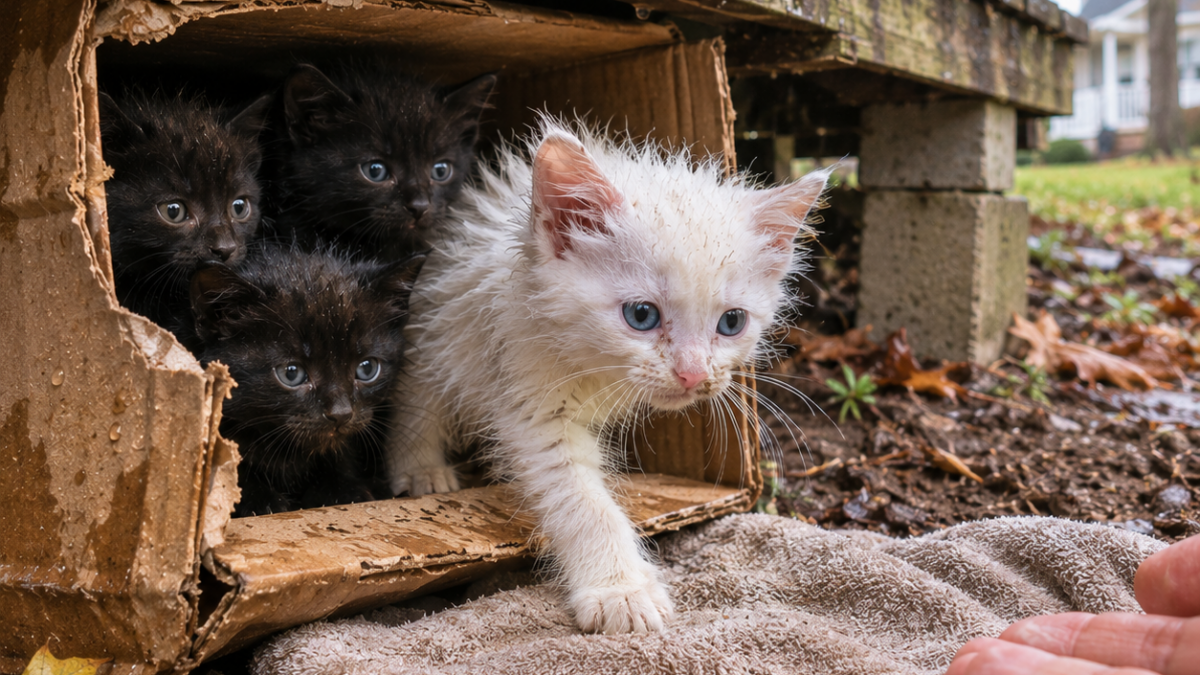
Someone Left 4 Kittens in a Wet Box Under a Porch—Then the Most Frightened One Refused to Leave the Other Three Behind.
The storm was already swallowing the mountain when I realized the tiny stray kitten behind me had made a decision neither of us could take back—he was following me down.
I had no cell service, the trail was turning slick under icy rain, and every time I walked faster, his little paws slipped farther behind until I understood that getting myself safely off that mountain was no longer the only problem.
But when darkness started closing over the trees and the kitten suddenly disappeared beneath an abandoned ranger-station bench, I had to choose whether to keep moving toward safety or risk the one thing I had spent years becoming very good at avoiding: being responsible for someone who needed me.
My name is Calder.
I was thirty-two when this happened.
At the time, I lived in Phoenix and worked the kind of schedule that made days off feel less like leisure and more like emergency maintenance.
Long shifts.
Phones.
Problems.
People needing answers.
People needing things fixed immediately.
By the time I finally got twenty-four hours to myself, I did not want another person asking me anything.
I wanted air.
Cold air.
Quiet.
Real quiet.
The kind that did not buzz in your pocket.
The kind that did not come with a notification.
So I drove north.
Flagstaff was close enough to reach without turning the trip into a production and high enough that the desert heat disappeared almost completely.
I had hiked the area before.
Nothing extreme.
I was not trying to conquer a mountain or collect some dramatic summit photo.
I just wanted to walk until my head stopped sounding like work.
The morning had started gray.
Not threatening.
Just heavy.
By afternoon, the clouds sat lower over the ridge.
Wind moved through the pines in hard, uneven bursts.
I noticed.
I also kept going.
That is the part I always admit when I tell this story.
I saw the weather changing.
I knew mountain weather could turn quickly.
I simply believed I had enough time.
Most bad decisions start with some version of that sentence.
The trail had emptied out.
No families.
No runners.
No voices ahead.
Just wind.
My hands stayed in my jacket pockets.
PART2:
I remember thinking how nice it was that nobody needed anything from me.
Then I heard him.
A thin sound.
Sharp.
Small.
Not really a meow.
More like a complaint.
One quick little noise that seemed strangely irritated.
Like:
You walked right past me.
I stopped.
Listened.
Nothing.
Wind moved again.
Branches knocked together.
Then the sound came a second time.
I stepped off the trail.
A few yards through the trees stood an old picnic shelter.
“Shelter” was generous.
Half the roof sagged.
One support post leaned.
PART3:
The picnic table underneath had faded warning stickers peeling from the wood.
It looked like a structure the park had forgotten but weather had not.
Something moved underneath.
I crouched.
Two eyes.
Then a tiny pale face.
Kitten.
Cream tabby.
Maybe a few months old.
Small enough that his ears looked oversized.
His fur was clumped around the legs and belly, as if he had spent time in damp leaves or wet grass.
Not soaked.
Not yet.
His eyes looked clear.
Alert.
And completely fixed on me.
“Hey.”
He moved backward immediately.
Two quick hops.
Then stopped.
He had enough energy to run.
Not enough confidence to waste it.
For several seconds, we looked at each other.
My first thought was not heroic.
It was practical.
Ugly, but practical.
If I stay here too long, weather gets worse.
If I leave, that animal spends the night on this mountain.
I checked the sky.
Darker.
Wind stronger.
The kitten trembled once.
Maybe cold.
Maybe fear.
Probably both.
I crouched sideways instead of facing him directly.
Slow.
No reaching.
I unscrewed my water bottle.
Poured a little into the cap.
Placed it on a flat rock.
Then broke a couple pieces from the granola bar in my pack and set them nearby.
Not ideal cat food.
It was what I had.
The kitten watched everything.
He did not approach while I was looking.
I waited.
Nothing.
“Fine.”
I turned my head.
Still nothing.
He remained beneath the table.
Wind pushed cold air underneath the shelter.
His body shook.
I reached toward him without thinking.
Only a few inches.
He hissed.
Tiny.
Not aggressive.
Not wild.
It sounded exhausted.
And very clear.
Don’t.
I stopped instantly.
Pulled my hand back.
“Okay.”
That became the first thing he taught me.
Helping does not always mean reaching.
Sometimes reaching is the exact thing that makes help impossible.
I stood.
Adjusted my pack.
I could not spend an hour trying to coax him out.
Daylight was already going.
The safest decision for me was to start descending.
So I turned toward the trail.
Took several steps.
Then heard:
Scritch.
I stopped.
Looked back.
The kitten was outside the shelter.
He froze when he saw me looking.
Half behind a rock.
Only his face visible.
I waited.
He stayed.
I turned forward again.
Walked.
Scritch.
Scritch.
I looked back.
He had moved another six feet.
Still not close.
Still not committing.
But following.
“Well.”
He ducked behind another rock.
“You coming?”
Obviously he had no idea what I said.
Or maybe he did not care.
I started walking.
The little paws moved again.
That was how our agreement began.
No touching.
No carrying.
No ownership.
Just:
I walk.
You decide whether to follow.
For the first quarter mile, he kept maybe fifteen feet between us.
Sometimes twenty.
I would hear his paws on gravel.
Turn.
He would vanish behind a stone or tree trunk like I had caught him doing something embarrassing.
Then I would start again.
He would reappear.
I pulled out my phone.
One weak bar.
I raised it.
Turned in a circle.
Nothing stronger.
Tried to send a text.
Failed.
Map would not load.
Tried a call.
Nothing.
The first icy drops hit my hood.
Not hard rain.
Almost worse.
Cold needles.
The kind that looks harmless until you realize your shoulders are wet.
I increased my pace instinctively.
Behind me, the little footsteps became irregular.
I stopped.
The kitten was farther back.
He stood with ears pinned against the wind.
I looked downhill.
Then at him.
That was the moment I understood what had changed.
I could get down faster.
He could not.
If I walked at my normal pace, eventually he would disappear behind me.
And if he disappeared in weather like that, I could not assume he would find the trail again.
So I slowed.
That sounds simple.
It did not feel simple.
Everything in me wanted to move faster because the mountain was becoming less comfortable by the minute.
But speed that left him behind was not really progress anymore.
“Okay.”
I said it partly to him.
Mostly to myself.
“We’re moving.”
Three steps.
I paused.
Behind me:
Three smaller steps.
Another three.
Pause.
He matched rhythm better than language.
When I stopped, he stopped.
When I moved carefully, he followed.
So I started talking.
Not baby talk.
Not calling him.
Just steady words.
The same tone I used at work when somebody panicked and I needed them to slow down enough to think.
“Easy.”
Step.
“Keep coming.”
Step.
“That’s it.”
He probably heard rhythm more than meaning.
Maybe that was enough.
The trail narrowed.
Loose scree.
Wet rock.
The kitten approached the drop.
Tried to hop down.
His back feet slid.
His little body twisted sideways.
My hand shot forward.
Then I remembered the hiss.
I stopped myself.
Instead, I ripped off my jacket.
Dropped it between him and the steep edge.
The kitten slid another few inches.
Hit the jacket.
Fabric bunched.
Stopped him.
He scrambled upright.
Pressed against the rocks.
His sides moved fast.
I stood several feet away in my base layer while cold rain hit my arms.
He stared at me.
There was something almost offended in his expression.
Like I had personally arranged the slippery mountain.
“You’re welcome.”
He blinked.
I picked up the jacket only after he moved clear.
Put it back on.
Wet now.
The light was thinning.
Not sunset yet.
But storm clouds make afternoon disappear early.
Wind became loud enough that speaking felt pointless.
At one familiar junction, I stopped.
The trail sign was down.
Flat in the dirt.
One corner broken.
Painted trail marks on surrounding stones had either worn away or become invisible in rain.
I had been there before.
In summer.
Different conditions.
There were two possible routes.
One was shorter.
Steeper.
A cutoff that would save time.
I stood looking toward it.
My phone still useless.
The kitten hovered behind me.
Wet grit darkened his paws.
He took one step closer.
Then stopped when I looked at him.
The shortcut would be faster for me.
For him?
Loose descent.
Slippery rocks.
One bad scramble.
One gap he could not cross.
I felt that old instinct again.
Push harder.
Force the problem.
Get down.
Then I looked at this kitten who had somehow made my walking speed his survival plan.
“We’re taking the long way.”
He sat down.
“Glad you agree.”
We took the wider trail.
It added distance.
But distance was not the only measure of safe.
We dropped into a shallow basin.
Every rock had a wet shine.
The kitten moved from stone to stone.
Stopping to sniff grass occasionally as if he wanted me to believe he was absolutely not following me.
Then I would get too far ahead.
He would hurry.
I started noticing prints.
Fresh boot tracks in soft dirt.
Beside them, smaller paw marks.
Dog.
Someone had come through recently.
That meant people might be nearby.
Good.
Or it meant a dog.
Potentially bad.
A minute later, we rounded a bend.
Two hikers approached.
Man and woman.
Both wearing rain shells.
Between them, a leashed Australian Shepherd.
The dog saw the kitten immediately.
Head up.
Ears forward.
Body leaning.
The kitten froze.
Then angled toward rocks.
If he bolted there, I might never get him back.
I raised one hand.
“Hey.”
The hikers stopped.
“Quiet, please.”
The man shortened the leash.
Good.
The woman saw the kitten.
Her whole expression changed.
“Oh my God.”
Her hands came up instinctively.
“Don’t.”
It came out sharper than I intended.
She froze.
I softened my voice.
“Sorry.”
I pointed toward the rocks.
“He’s right on the edge.”
She lowered her hands.
“If anybody reaches, he’s going to bolt.”
“Got it.”
The Australian Shepherd pulled slightly.
The man brought the dog right beside his leg.
“What do you need?”
That question nearly made me laugh from relief.
Not:
Can I pet him?
Not:
Where did you get him?
What do you need?
“Can you keep the dog back a few feet?”
“Yeah.”
“And maybe just stand here.”
They looked confused.
“Why?”
“Wind.”
They understood.
They shifted.
Two adults.
Rain jackets.
Dog.
They formed a partial wall against the gusts.
For the first time in several minutes, the air around us calmed.
The kitten noticed.
He did not move toward any hand.
He approached my jacket.
One pocket hung slightly open.
The fabric still held warmth from my body.
He sniffed it.
Then pressed his face against the pocket.
The woman covered her mouth.
She did not move closer.
That restraint mattered.
I asked:
“Any cell service lower down?”
The man checked his phone.
“Sometimes.”
“Ranger station?”
“There’s a small one farther down.”
“Open?”
He looked at the sky.
“This time of year? Maybe not.”
Still.
Landmark.
Roof.
Possible phone.
Parking lot.
We began walking.
The couple stayed several steps ahead.
Australian Shepherd beside the man.
I followed.
The kitten threaded along the trail edge behind me.
Not beside.
Not yet.
The weather kept getting worse.
The station finally appeared through the trees.
My relief lasted about ten seconds.
Dark windows.
Empty parking lot.
Information board covered with plywood.
Vending machine turned off.
A curled paper notice taped to the glass.
Closed.
The hikers stood beneath the overhang.
The woman checked her watch.
“We were supposed to be back before dark.”
I heard the meaning.
They had their own problem.
Their own car.
Their own schedule.
They had already helped far more than they needed to.
I looked toward the road.
Then toward the kitten.
He slipped along the building wall.
Crawled under a bench.
This time, he did not look stubborn.
He looked exhausted.
His belly pressed to the ground.
Head low.
I crouched several feet away.
Nothing.
He did not move.
Night was coming.
I felt the decision dividing me.
Wait at the closed station?
Maybe somebody arrived.
Maybe not.
Leave with the hikers?
The kitten might bolt the second I tried to move him.
Stay overnight?
Terrible idea.
The temperature was dropping.
I finally asked the practical question.
“Could you drive us into Flagstaff?”
The man answered immediately.
“Yeah.”
I almost did not believe him.
“Really?”
“We can.”
“Nearest place that can take him.”
“Sure.”
“I’ll handle everything after that.”
The woman nodded.
“Let’s get him in the car.”
Simple sentence.
Complicated kitten.
I crouched near the bench.
“Hey.”
His eyes stayed on me.
“We’re getting warm.”
He moved one paw forward.
Then backed deeper under the bench.
I could feel myself becoming impatient.
Not angry at him.
Afraid.
Darkness.
Cold.
Wet clothes.
The hikers waiting.
Car waiting.
Warmth thirty feet away.
Everything in me wanted to reach underneath and pull him out.
That would have been faster.
It might also have ended with him disappearing into the foundation gap behind the building.
So I stopped talking.
Stopped reaching.
I thought about what had worked.
Distance.
Options.
Warmth.
No hands.
I took off my jacket again.
Laid it on the ground.
Opened it into a low folded shape.
Almost like a cave.
Then I loosened the cap on my water bottle.
Wrapped the bottle in a spare shirt from my pack to take some of the chill off the fabric around it.
Placed it inside the jacket folds.
Not hot.
Just less cold.
An option.
Then I sat sideways.
Did not face him.
Started adjusting my backpack strap as if it were suddenly the most important job in Arizona.
The hikers stayed silent.
Australian Shepherd in the car now.
The kitten watched.
One paw came forward.
Back.
Forward.
Back again.
He seemed to rehearse courage.
Then his body appeared.
Low.
Slow.
Belly almost touching the pavement.
He crawled toward the jacket.
Stopped.
Sniffed.
One paw onto the fabric.
Then another.
He eased himself onto it.
And froze.
Watching me.
Waiting for the trick.
There wasn’t one.
I waited several seconds.
Then moved slowly.
Hands to the outer edges of the jacket.
Not touching him.
I lifted the fabric like a hammock.
His body went rigid.
I stopped.
Held steady.
He felt the support.
Did not fight.
I lifted again.
Slowly.
The hikers opened the back door.
Australian Shepherd stayed in front.
Good.
No barking.
No sudden head turning into the rear seat.
I carried the jacket hammock into the back.
Sat beside the kitten.
The woman drove.
The man sat with the dog.
Nobody celebrated.
No:
We got him!
No applause.
No phones shoved into his face.
Quiet.
The car started downhill.
For the first ten minutes, the kitten stayed buried in the folds.
Then, halfway toward town, his head rose.
He looked at me.
Just looked.
Like he was checking something.
You’re still here?
“Yes.”
I said it quietly.
“I am.”
Flagstaff felt bizarre after the mountain.
Streetlights.
Gas stations.
Wet pavement glowing orange.
Cars.
People carrying groceries.
Normal life continuing while the last two hours had felt like the whole world had narrowed to one trail and four tiny paws.
The hikers found a small pet-services facility with a night sign lit in the window.
They stopped.
I thanked them.
It felt inadequate.
The woman smiled.
“Just get him warm.”
The man added:
“Text us if you can.”
We exchanged numbers.
Then they drove away.
No giant emotional goodbye.
Just people helping because help was needed.
Inside, the air smelled like disinfectant and tired coffee.
I carried the kitten in the jacket.
At the desk, I explained.
“Found him on the trail outside Flagstaff.”
The employee looked down.
“How long outside?”
“I don’t know.”
“Weather exposure?”
“Yes.”
“Any injury?”
“Nothing obvious.”
“Eating?”
“Not really.”
“Drinking?”
“A little earlier.”
They brought out a carrier.
Warm towel.
The kitten transferred reluctantly.
No biting.
No screaming.
He sat inside.
Eyes wide.
Watching me.
That was when the mountain problem ended and the real-world problem started.
Forms.
Questions.
Responsibility.
They explained the options.
He could enter the normal stray-intake process.
That meant documentation, appropriate holding procedures, evaluation, and whatever placement steps followed.
Or, if their process allowed it and I was willing, I could sign for temporary foster care while the normal steps continued.
Temporary.
That word should have made it easier.
Instead it made everything real.
“I live in Phoenix.”
“That doesn’t automatically prevent fostering.”
“I work shifts.”
“We can explain what care he’d need.”
“I’ve never had a cat.”
“That can be learned.”
I looked at him.
He leaned toward the carrier door.
Pressed his nose once against the plastic.
Then sat back.
Still looking at me.
Maybe I projected meaning onto it.
People do that.
But after spending a storm adjusting every decision around that animal, I knew exactly what it felt like he was asking.
We were going together.
Right?
I heard myself speak before I fully decided.
“I’ll foster him.”
The employee looked up.
“Temporarily?”
“Yes.”
The word felt safe.
Temporary.
A bridge.
Not forever.
Not a life promise.
Just:
I will not disappear tonight.
The paperwork was surprisingly ordinary.
Boxes.
Contact information.
Signatures.
Care instructions.
Follow-up.
Stray procedures.
No dramatic music.
Serious decisions often look boring on paper.
By the time I drove south toward Phoenix, the storm was far behind us.
The kitten rode in a secured carrier on the passenger seat.
Quiet.
Every turn made his eyes shift.
Every change in headlights caught his attention.
He was mapping another unfamiliar world.
I talked sometimes.
Not because he needed conversation.
Because the rhythm had worked on the mountain.
“Easy.”
Highway.
“Still here.”
City lights.
“We’re almost home.”
Home.
I noticed the word.
Ignored it.
My apartment had a spare room.
That became his.
Water.
Appropriate food.
Litter box.
Carrier open.
Cardboard box turned on its side.
Towel over a chair to create another hiding spot.
Nothing fancy.
I opened the carrier.
He stayed inside.
I sat on the floor.
Waited.
Ten minutes.
Nothing.
I stood.
Immediately he moved backward.
I sat again.
Eventually, one nose appeared.
Then disappeared.
One paw.
Gone.
I laughed quietly.
“Fine.”
The first night, I left him alone except for checks.
Second day, almost the same.
Every instinct told me to speed things up.
Offer food from my hand.
Reach under the chair.
Pick him up so he learned I was safe.
I remembered the hiss under the picnic shelter.
Don’t.
So I stopped trying to manufacture trust.
I showed up.
Same time.
Same movements.
Food.
Water.
Clean litter.
Sit on floor.
Read.
Leave.
Third evening, I sat with a book.
Not looking directly at him.
The kitten emerged.
Walked toward the food.
Stopped.
Looked at me.
I kept reading.
He took one bite.
Then another.
A full minute passed.
I did not move.
That was the first meal he ate while I was in the room.
It felt absurdly important.
A few days later, he appeared in the spare-room doorway while I made dinner.
Tail low.
Body ready to retreat.
But there.
I looked once.
Then went back to chopping vegetables.
He stayed.
Another night, I was on the couch.
I looked up.
He was on the opposite cushion.
Not touching.
Not even close.
But we were sharing furniture deliberately.
I smiled.
He closed his eyes.
That was enough.
A week after the hike, my phone buzzed.
Text from the two hikers.
Glad you both made it.
That was all.
I stared at it longer than necessary.
No huge speech.
No request for credit.
They had stepped into a storm, made themselves into a windbreak, controlled their dog, and driven a stranger and a stray kitten into town.
Then returned to their lives.
Quiet help still counts.
Sometimes it counts more.
The kitten’s foster status remained temporary.
I told myself that whenever I bought anything.
Food.
Temporary.
Better litter.
Temporary.
Small scratching pad.
Temporary.
One toy.
Very temporary.
Then a second toy because apparently the first toy needed a colleague.
Still temporary.
I was careful not to name him immediately.
That felt like a line.
At work, somebody asked:
“How’s the trail cat?”
“Fine.”
“You name him?”
“No.”
“Why?”
“Foster.”
“So?”
“So temporary.”
They looked at me.
“You drove him from Flagstaff to Phoenix.”
“Yes.”
“You rearranged a room.”
“Yes.”
“You sent me a picture of him asleep.”
“That was documentation.”
“Sure.”
I ignored them.
The kitten improved.
Fur cleaned up.
Energy returned.
He began exploring.
He also remained suspicious of hands.
If I walked toward him too directly, he moved away.
If I sat quietly, he approached.
One evening he came within two feet.
Next evening, one foot.
Then he sniffed my sock.
Huge milestone.
My life changed around these tiny increments.
That surprised me most.
I had gone to Flagstaff because I wanted nothing to need me.
Now I came home wondering whether a four-pound animal had eaten enough.
Whether he had used the litter box normally.
Whether he had moved closer while I was gone.
I should have felt trapped.
Instead, my apartment felt less like a place I stored myself between shifts.
The foster organization checked in.
No verified owner had come forward during the required process.
The kitten would eventually become eligible for placement if nobody claimed him.
That conversation tightened my chest.
I asked:
“What happens then?”
“He can be listed for adoption.”
I looked toward the couch.
The kitten was watching a ceiling fan.
“Okay.”
“Unless you want to continue fostering.”
“I can.”
“Or apply to adopt if that becomes appropriate.”
I was quiet too long.
The coordinator laughed softly.
“You don’t need to decide today.”
“Good.”
Temporary.
I held onto that word.
Not because I wanted him gone.
Because forever frightened me more than I expected.
That was not really about the kitten.
I had become skilled at keeping life manageable.
Work.
Apartment.
Days off alone.
No one depending on me beyond professional obligations I could clock out from.
The mountain kitten had entered through a loophole.
He did not ask permission to matter.
One night, maybe ten days after the hike, I woke around two.
Heard movement.
Walked toward the spare room.
Stopped.
The kitten was asleep in the hallway.
Not hiding.
Stretched on the carpet.
I backed away before waking him.
Next morning, he was on the couch.
Few days later, he followed me into the kitchen.
Still maintaining distance.
Exactly like the trail.
That made me laugh.
“You’re still doing this?”
He sat.
“Following but pretending not to?”
Blink.
“Okay.”
Eventually I named him Ridge.
Not dramatic.
Not original.
It fit.
I told everyone it was only for paperwork convenience.
Nobody believed me.
Ridge started responding to the sound.
Not perfectly.
Cats have standards.
But his ears moved.
Sometimes he appeared.
One afternoon I sat on the floor sorting gear from the hike.
My jacket still had a faint stain from wet trail dirt.
I laid it beside me.
Ridge walked over.
Sniffed.
His body changed.
Not fear.
Recognition, maybe.
He climbed onto the fabric.
Turned once.
Lay down.
I remembered the ranger station.
Same jacket.
Same kitten.
That night it had been a bridge.
Warmth without hands.
An option.
Now he slept on it because he wanted to.
I sat beside him for almost half an hour.
Did not touch.
Eventually he stretched.
One paw came against my leg.
Accidental maybe.
I did not move.
Another week passed.
Then came the first voluntary contact.
I was on the couch reading.
Ridge jumped up on the far end.
Normal now.
He sat.
Washed one paw.
Looked at me.
Then walked halfway across.
Stopped.
I stayed still.
He moved closer.
One step.
Another.
His side brushed my thigh.
I forgot to breathe.
He stood there.
Then continued past me.
That was it.
Three seconds.
Maybe less.
I smiled like an idiot.
Trust is strange.
People imagine it as a door.
Closed.
Then open.
With Ridge, it was more like weather.
Small changes.
Pressure.
Temperature.
One day you suddenly realize the season shifted.
The foster coordinator eventually called with the question I had been avoiding.
Ridge had completed the required stray process.
No owner with valid proof had been found.
He could move toward adoption placement.
“We have interested adopters when he’s ready.”
I looked at him.
He sat near the balcony door watching a pigeon with murderous concentration.
“Okay.”
“Do you want us to start arranging meet-and-greets?”
My throat tightened.
I could not immediately answer.
The coordinator waited.
That was kind.
I said:
“Can I ask something?”
“Of course.”
“What happens if I want him?”
Another small pause.
“You mean adopt him?”
“Yes.”
The word sounded bigger than it should.
“We can discuss that.”
“Okay.”
“Do you?”
I looked at Ridge.
He turned at my voice.
Walked toward the couch.
Sat three feet away.
Watching.
My mind went back to the mountain.
Picnic shelter.
Cold wind.
Granola pieces.
That first hiss.
Then paws behind me.
The steep section.
Jacket catching him.
Two hikers forming a wall.
Closed ranger station.
Warm fabric.
The carrier.
That look in the car.
You’re still here?
I realized I had already been answering the question for weeks.
“Yes.”
I said it before fear could edit me.
“I want him.”
The adoption process was almost disappointingly simple compared with what the decision felt like.
More forms.
Fees.
Records.
Commitment.
The coordinator reminded me:
“Cats can live a long time.”
“I know.”
“Work schedule?”
“I’ve adjusted.”
“Travel?”
“I’ll plan.”
“Emergency care?”
“Covered.”
Then she smiled.
“Sounds like you thought about this.”
I looked at Ridge.
“Apparently.”
That evening, nothing magical happened.
I did not hold up adoption papers and cry.
Ridge did not somehow understand legal status.
I put food in his bowl.
He ate.
I sat on the couch.
He jumped onto the far cushion.
Normal.
That was what made it important.
We had built normal.
Weeks later, the hikers came through Phoenix.
They texted.
Asked if we wanted coffee.
I said yes.
They came to my apartment.
The Australian Shepherd was not with them.
Probably easier.
The woman stepped inside.
Ridge disappeared instantly.
Behind the couch.
She laughed.
“That’s him.”
“Very brave.”
“Clearly.”
We drank coffee.
Talked about the storm.
They told me how close they had been to deciding not to hike that afternoon.
I told them how close I had been to continuing past the picnic shelter.
The man said:
“Funny.”
“What?”
“Everybody thinks rescues happen because someone makes one huge decision.”
I nodded.
He continued.
“Mostly it’s a bunch of small ones.”
He was right.
I did not rescue Ridge once.
I decided to pour water.
Then decided not to reach.
Then decided to walk slowly.
Then chose the longer trail.
Then asked strangers to control their dog.
Then asked for a ride.
Then built a jacket cave.
Then signed a temporary foster form.
Then sat on the floor.
Then waited.
Then waited again.
Eventually, all those small choices became a life.
After coffee, Ridge appeared.
Cautiously.
He recognized no one except me.
The woman crouched automatically.
Then caught herself.
She sat instead.
Hands in lap.
Ridge watched.
After several minutes, he came closer.
She smiled.
“He remembers the rules.”
“No sudden movements.”
“No grabbing.”
“No making everything about what we want.”
“Pretty much.”
The man laughed.
“Useful rules generally.”
Very.
Months passed.
Ridge became bolder.
He developed opinions about breakfast times.
Strong opinions.
The kitten who barely made a sound on the mountain eventually discovered a small rough chirp he used when I was late with food.
He started sleeping in my bedroom.
First on the floor.
Then foot of bed.
Then, one night, against my ankle.
I woke up afraid to move.
He did not.
I thought about the trail again.
How desperately I wanted to pick him up.
How badly that would have gone.
The thing I wanted most eventually happened only after I stopped forcing it.
There was a lesson there I was not enthusiastic about applying to the rest of my life.
Still.
It stayed with me.
A year after the storm, I drove back to Flagstaff.
Not for some anniversary ceremony.
I had another day off.
Weather clear.
Trail open.
I left Ridge home with a trusted sitter because I had learned enough not to bring a house cat onto a mountain for symbolism.
The old picnic shelter still stood.
Still ugly.
Roof still sagging.
I stopped beneath it.
The table looked smaller.
I found the flat stone where I had placed water.
Probably not actually the same stone.
But close enough.
I sat.
Wind through pines.
Quiet.
The exact quiet I had originally driven there to find.
Only this time it felt different.
Back then, I thought quiet meant nobody asking anything from me.
Now I understood there were different kinds.
Empty quiet.
Peaceful quiet.
They are not the same.
My apartment had stopped being empty.
It was often still quiet.
Ridge was not exactly conversational.
But the silence had another heartbeat in it.
That changed everything.
I walked the same route downhill.
At the scree section, I found myself looking toward the edge where I had thrown my jacket.
I remembered his tiny feet sliding.
My hand reaching.
Then stopping.
That moment still mattered to me.
Not because I was clever.
Because I resisted the instinct to make him trust me faster than he could.
At the old ranger station, the bench remained.
The facility had been repaired a little.
New notice board.
Fresh paint.
Still seasonal.
I stood where I had laid my jacket.
That was where the biggest decision happened.
Not when I signed the foster form.
Not adoption.
There.
Sitting sideways.
Looking away.
Giving him warmth without forcing contact.
He chose the jacket.
I chose to wait.
Maybe trust always requires two choices.
One person offering.
Another person deciding the offer is safe.
I used to think caring meant doing more.
Now I think sometimes it means doing less.
Hold still.
Make space.
Let the frightened thing decide.
When I returned to Phoenix that evening, Ridge met me near the door.
Not dramatically.
He was sitting six feet away.
He looked at me.
I put down my bag.
“Hey.”
He stood.
Walked over.
Rubbed once against my shin.
Then went toward the kitchen.
Apparently the reunion had concluded.
I laughed.
“Good to see you too.”
Dinner.
Routine.
Normal.
That is still my favorite part of the story.
Not the storm.
Not the mountain.
Not the dramatic decision.
The ordinary afterward.
Food bowls.
Vacuuming cat hair.
Trying to work while Ridge sleeps on paperwork.
Leaving cardboard boxes around because he likes them more than anything I buy.
Checking a pet camera on long shifts.
Returning home to somebody who notices the door opening.
Responsibility became routine.
Then routine became connection.
People sometimes tell me:
“He saved you.”
I do not like saying that.
Ridge did not rescue me from the mountain.
I was physically capable of hiking down without him.
He did not fix my life.
He did not magically heal some hidden wound.
That gives him too much responsibility for being a cat.
What he changed was smaller.
And maybe more important.
He interrupted one decision.
Walk past.
Keep going.
Not my problem.
I could have made that choice.
Maybe someone else would have found him.
Maybe he would have survived.
Maybe not.
I will never know.
Instead, I stopped.
Then he followed.
And every step after that became a negotiation between my fear of getting trapped by responsibility and his fear of getting trapped by people.
Somehow, we met in the middle.
I learned not to grab.
He learned not to run.
I slowed down.
He came closer.
That was our entire relationship for months.
Maybe it still is.
The biggest difference is that now he sleeps on my couch as if he pays rent.
A few years later, I still have that jacket.
It is worn.
One zipper sticks.
There is a faint stain near the lower pocket from wet grit.
I have better jackets.
I keep that one anyway.
Ridge occasionally sleeps on it if I leave it somewhere accessible.
I do not know whether he remembers the mountain.
People love asking that.
I cannot answer.
Maybe scent triggers something.
Maybe not.
Maybe the jacket is simply soft.
It does not matter.
I remember enough for both of us.
I remember the sky lowering.
The first icy rain.
The failed text.
The broken trail sign.
The Australian Shepherd leaning against the leash.
Two strangers quietly turning themselves into a wall against the wind.
The dark ranger station.
The kitten beneath the bench.
His paw moving forward.
Back.
Forward again.
The jacket.
His body finally settling when the fabric held him.
The carrier under bright indoor light.
And the question I imagined in his eyes.
You said we were going together.
Where are you now?
For a while, temporary foster was my answer.
Then one day temporary stopped being honest.
So I changed the answer.
I’m here.
Years after that storm, my life still gets loud.
Work still calls.
People still need answers.
Schedules still collapse.
Some days I come home wanting nothing except quiet.
The difference is that now when I unlock the door, I usually hear small paws somewhere inside.
Sometimes Ridge comes running.
Usually he does not.
He has dignity.
But eventually he appears.
Doorway.
Hall.
Edge of the couch.
Watching.
Making sure I came back.
On difficult nights, I sit on the floor.
Same thing I did during his first week.
He approaches when he feels like it.
Sometimes lies beside me.
Sometimes not.
No reaching.
No forcing.
We got good at that.
I went to Flagstaff because I wanted a day when nothing needed me.
The mountain gave me the exact opposite.
A tiny wet kitten who could not safely get down alone.
At the time, that felt like terrible luck.
Now I think about the first moment I turned toward the trail.
I had decided to leave.
I had given him water.
Food.
More than nothing.
I could have told myself that was enough.
Then I heard those paws.
One step.
Then another.
He was frightened.
Cold.
Suspicious.
And still willing to follow.
So I changed my pace.
That was all.
No promise.
No adoption.
No grand plan.
I simply walked slowly enough that he could keep up.
Everything else came later.
Maybe that is why I still think the real rescue happened before either of us understood what we were doing.
He did not need me to know the whole future.
He needed me not to disappear around the next bend.
And I did not need to promise forever.
I only needed to make the next safe choice.
Then another.
Then another.
Until the mountain was behind us.
Until the storm became headlights in the rearview mirror.
Until temporary became home.
Sometimes the biggest climb is not the trail in front of you.
It is letting something small and scared matter enough to change your direction.
And sometimes staying does not begin with a promise.
It begins with slowing down, hearing four tiny paws behind you, and deciding not to walk away.








