Someone Chained a Cat to a Parking Meter With Food Just Beyond Her Reach—For Two Days, Hundreds of People Walked Past
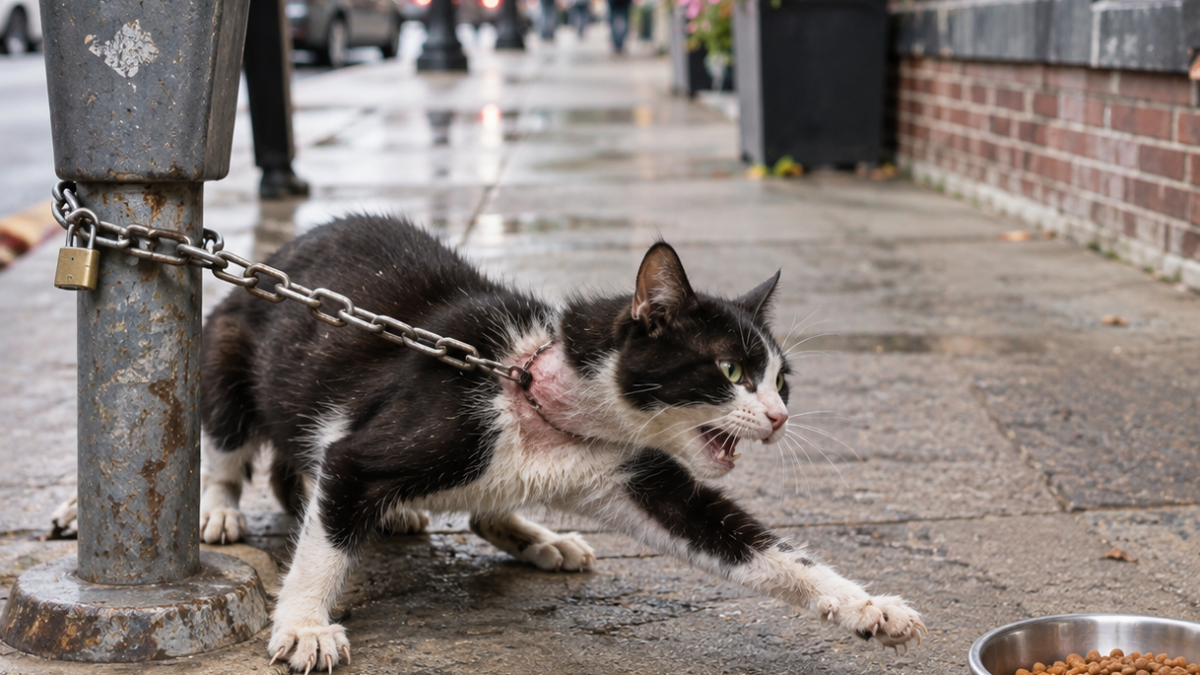
Someone Chained a Cat to a Parking Meter With Food Just Beyond Her Reach—For Two Days, Hundreds of People Walked Past.
The little black-and-white cat had been chained to a downtown parking meter for nearly forty-eight hours, with a full bowl of food placed just far enough away that she could smell every piece but never reach it.
By Monday morning, the fur around her neck had been rubbed away, her front claws were worn from fighting for another few inches, and hundreds of people had apparently passed the same stretch of sidewalk without setting her free.
Then one woman on her usual walk to work noticed something that made her stop—not the cat, not the chain, but the untouched bowl sitting at the exact edge of what the animal could never reach.
At 7:30 on Monday morning, the downtown sidewalks were already beginning to fill.
Coffee shops had their doors propped open.
Delivery trucks occupied half the curb.
Office workers walked quickly with phones in one hand and paper cups in the other.
A city bus exhaled at the corner.
Traffic lights changed.
Crosswalk signals chirped.
Nothing about the morning looked unusual.
The woman walking toward work had taken the same route for almost three years.
Same intersection.
Same coffee shop.
Same row of storefronts.
Same parking meters spaced along the curb.
She knew the sidewalk well enough that she no longer consciously noticed most of it.
That was why the cat caught her attention.
The animal had not been there Friday.
The woman was certain of that.
Now, on Monday morning, a small black-and-white cat stood beside one of the metal parking meters.
At first glance, she assumed it was a stray.
Cities have cats.
Most people who walk downtown regularly have seen one slipping beneath a parked car or disappearing behind a restaurant dumpster.
She would later explain that simply seeing the animal would probably not have stopped her.
Then the cat moved.
Not away.
Forward.
Hard.
Her body stretched toward something on the sidewalk.
Then snapped backward.
The woman stopped walking.
The cat tried again.
Front paws braced.
Back arched.
Neck extended.
A metallic sound came from the base of the parking meter.
The woman looked down.
Chain.
Not a leash.
Not a collar attached to a leash.
PART2:
A thin metal chain had been looped around the cat’s neck and secured to the parking meter.
There was a small combination padlock.
For several seconds, the woman simply stared.
Her brain seemed unwilling to arrange what she was seeing into something that made sense.
Someone had chained a cat to a parking meter.
In the middle of downtown.
She stepped closer.
The cat immediately tried to move again.
That was when the woman noticed the bowl.
A cheap plastic food bowl sat on the pavement.
Full.
Dry cat food piled almost to the rim.
The cat was pulling toward it.
She could not reach.
The woman looked from the bowl to the chain.
Then back again.
The distance was not large.
That somehow made it worse.
Maybe two feet separated the cat from the food.
Close enough that she could see it.
Close enough to smell it.
Close enough to stretch one front paw toward it.
Too far to eat.
PART3:
The chain tightened.
The cat strained.
One paw scraped across concrete.
Nothing.
The woman dropped her work bag onto the sidewalk.
“Oh my God.”
The cat looked at her.
Black across the back and ears.
White chest.
White paws.
Small.
Too small.
Her eyes looked enormous in her narrow face.
The woman crouched.
“Hey.”
The cat recoiled.
The chain rattled.
“No, no. It’s okay.”
She reached toward the lock.
The cat flinched again.
That was when she saw the neck.
The fur beneath the chain was missing in places.
Pink skin showed through.
There was a raw ring where metal had rubbed repeatedly against the same area.
The woman stopped moving.
“Oh, sweetheart.”
The cat looked past her.
At the bowl.
Then tried again.
Pull.
Scrape.
Chain tight.
The woman grabbed the bowl and slid it closer.
The cat startled backward.
For half a second she did not move toward the food.
She stared at it.
Almost suspicious.
Then hunger won.
She approached.
Fast.
She ate so quickly that pieces of kibble scattered onto the pavement.
The woman pulled out her phone.
She called animal protection services.
Then she called work.
“I’m going to be late.”
Her supervisor asked what happened.
“There’s a cat chained to a parking meter.”
Silence.
“A what?”
“A cat.”
“What do you mean chained?”
“Literally chained.”
Another pause.
“Do what you need to do.”
The woman stayed.
People walked past.
Some slowed now because she was crouched beside the animal.
One man asked, “Is that your cat?”
“No.”
“What happened?”
“I don’t know.”
A woman carrying coffee stopped.
“Someone left her?”
“She’s locked to the pole.”
The woman stared.
“That’s sick.”
Then she continued toward the intersection.
Another passerby looked.
Another took out a phone.
Within minutes, several people had gathered.
The cat stopped eating after only a small amount and drank from a cup of water the woman poured into the food bowl.
She drank.
And drank.
And drank.
Too quickly.
The woman pulled the bowl away briefly because she worried the cat might make herself sick.
“I know.”
The animal stared at the water.
“I know, baby.”
She slid it back.
The cat drank again.
There was no water anywhere else beside the meter.
Only the bowl of food.
Full.
Clean.
Untouched until that morning.
The woman began looking around.
Storefronts.
Windows.
Upper floors.
Cameras.
Someone had done this.
Someone had stood on this sidewalk.
Handled the cat.
Wrapped chain around her neck.
Closed a lock.
Then placed food nearby.
The woman looked at the bowl.
That was the detail she would later say she could not stop thinking about.
If someone had simply abandoned the cat, it would have been terrible.
If someone had tied her and walked away, terrible.
But the bowl was different.
The bowl required another decision.
Whoever had done this had brought food.
Poured it.
Placed it down.
Not beside the cat.
Not within the length of the chain.
Outside it.
Only slightly.
Just enough.
The animal could see what she had been denied.
The woman tried the combination lock.
Nothing.
She tugged gently on the chain to see whether there was any way to slip it free.
The cat panicked.
Her body flattened.
The woman released it immediately.
“Okay. I won’t.”
She sat on the pavement instead.
The cat stayed near the bowl.
A few minutes later, she lay down.
Not comfortably.
She seemed exhausted.
People continued walking.
The woman wondered how many had done exactly that during the weekend.
Saturday night crowds.
Sunday brunch.
Bar customers.
Joggers.
Delivery workers.
Tourists.
People leaving restaurants.
People looking for their cars.
People feeding parking meters.
How many had seen her?
Perhaps some thought she belonged to someone nearby.
Perhaps some did not notice the chain.
Perhaps some assumed somebody else would help.
Perhaps somebody had called and never stayed.
There was no way to know.
But the cat had been there long enough that her body had begun showing the time.
Animal protection officers arrived with a truck and equipment.
One knelt several feet from the cat.
The other looked at the chain.
“How long has she been here?”
“Saturday maybe,” the woman said.
“How do you know?”
“I don’t. She wasn’t here Friday.”
The officer examined the cat without touching her.
“Any water?”
“None when I got here.”
“Food?”
The woman pointed.
“That bowl was there.”
The officer looked.
Then at the length of chain.
His expression changed.
“It was there?”
“Yes.”
“She couldn’t reach it?”
“No.”
The second officer measured roughly with his eyes.
The chain gave the animal less than two feet from the pole.
The bowl had originally been farther.
Close.
But outside that circle.
The first officer put on gloves.
“We’re going to cut this.”
Bolt cutters came from the truck.
The woman moved back but refused to leave.
One officer spoke quietly to the cat.
The other positioned the cutter around a chain link.
The cat pulled.
The metal went tight.
“Easy.”
Snap.
The chain separated.
For one second, nothing happened.
Then the cat collapsed.
Her legs simply folded.
The woman gasped.
“Is she—”
“She’s breathing.”
The officer immediately scooped the animal into a towel.
The cat did not fight.
That worried everyone more than if she had.
Her body felt almost weightless.
At the veterinary clinic, she weighed just over five pounds.
Too little.
Dehydrated.
Exhausted.
The injury around her neck was worse beneath the fur than it had appeared on the sidewalk.
The metal had rubbed repeatedly against the same band of skin.
Every time the cat pulled toward food.
Every time she tried to change position.
Every time she panicked and moved away from a noise.
The chain tightened across the wound.
The veterinarian shaved the surrounding fur.
A raw pink line circled the neck.
Not deep enough to require major surgery.
Deep enough to hurt.
Her front claws were worn.
Some had been scraped down from bracing against the pavement.
Her paw pads were irritated.
There was dirt beneath her claws.
The vet checked her kidneys.
Gums.
Heart.
Body temperature.
She was weak but responsive.
The dehydration told a story.
Not an exact clock.
Bodies do not work that way.
But the estimate was roughly two days.
Around forty-eight hours.
The woman who found her had been right.
Friday afternoon, the parking meter had been empty.
Sometime afterward, someone had brought a cat downtown.
And left her there.
The clinic gave fluids slowly.
Cleaned the neck.
Pain medication.
Food in small amounts.
Water monitored carefully.
When a technician placed the first dish in front of her, something happened.
The cat flinched.
Not from the person.
From the bowl.
The technician paused.
The cat stared at it.
Then stepped forward.
A few bites.
Looked up.
Another few.
She kept checking.
The technician did not move the dish.
The cat finished.
A second small portion came later.
Again, she startled when the bowl touched the floor.
Again, she approached cautiously.
Again, she ate.
The shelter staff gave her a temporary name.
Lily.
Not because they knew anything about her.
They did not.
No microchip.
No identification.
No missing-pet report matching her description.
No one came forward.
Lily simply sounded soft.
Something gentle after something that had not been.
The photograph from the sidewalk began circulating.
Someone had taken it before the officers arrived.
The image was simple.
Parking meter.
Concrete sidewalk.
Black-and-white cat.
Chain stretched tight.
Full bowl.
Her body leaned forward.
One paw reaching.
That was why people responded so strongly.
You did not need an explanation.
The geometry told the story.
Pole.
Chain.
Cat.
Food.
Distance.
Someone had calculated enough.
The photograph was shared again and again.
Comments accumulated.
People wanted to know who had done it.
Had anyone checked cameras?
Did nearby businesses have footage?
Was the lock traceable?
Could fingerprints be recovered?
Could the person be prosecuted?
Animal protection officers checked.
The parking meter was in a commercial area.
No residence directly overlooked the spot.
Some businesses had cameras.
Angles were wrong.
Others retained footage for only a short period.
One camera showed pedestrians but not the base of the meter.
Another had been blocked by a delivery vehicle for part of the relevant period.
Nothing clearly showed the person who had secured the cat there.
The lock was an ordinary combination model.
Hardware-store type.
Common.
The chain was common too.
Nothing distinctive.
No note.
No name.
No explanation.
Only the arrangement itself.
Chain.
Lock.
Food.
The woman who stopped kept returning to the same thought.
Somebody wanted her to see it.
That was what she told one of the officers.
“See what?”
“The food.”
She looked at the photograph on her phone.
“She wasn’t just abandoned beside food.”
The officer listened.
“She was attached where she could almost reach it.”
The woman pointed at the image.
“Look at her body.”
The cat was stretched forward.
Every inch.
“Someone wanted her to know it was there.”
The officer did not disagree.
The story spread because people understood that immediately.
Cruelty does not always require a complicated weapon.
Sometimes it is measured in inches.
Two days after rescue, Lily entered foster care.
Her foster home was quiet.
No other animals at first.
A spare bedroom.
Soft bed.
Litter box.
Low scratching post.
Two food dishes.
Water fountain.
The foster woman set the carrier on the floor and opened it.
Lily stayed inside.
Nobody pulled her out.
After twenty minutes, a black-and-white face appeared.
Then one paw.
Another.
She sniffed.
Walked toward the bed.
Stopped.
Changed direction.
Went under a chair.
Stayed there.
The foster woman sat across the room reading.
No reaching.
No coaxing.
After an hour, Lily emerged again.
Her neck had been covered with a soft protective wrap after treatment.
She moved cautiously.
The foster woman placed food nearby.
Lily jumped when the bowl touched the floor.
The woman froze.
“It’s okay.”
Lily stared.
The woman backed away.
The cat stepped toward the food.
Ate.
Stopped.
Looked around.
Ate again.
That became the pattern.
Morning meal.
Bowl down.
Flinch.
Pause.
Eat.
Evening.
Bowl down.
Flinch.
Pause.
Eat.
The bowl never moved.
Not once.
The foster woman began sitting several feet away during meals.
Not because Lily needed company.
Because she seemed to need witnesses.
As though some part of her had learned that food was not necessarily an offer.
Sometimes it might be a trick.
So the woman remained still.
Day four.
Bowl.
Flinch.
Eat.
Day six.
Smaller flinch.
Day nine.
Lily approached before the foster woman had fully stepped away.
“Good girl.”
Lily looked up.
Then continued eating.
Her neck began healing.
The pink skin dried.
Swelling decreased.
The veterinarian expected hair to regrow over most of it.
One section might remain thinner.
A faint ring.
Physical evidence of something the cat would never be able to explain.
Her weight began increasing.
Slowly.
She slept a lot.
For the first week, she rarely climbed.
She preferred low places.
Bed.
Carpet.
Window ledge only after the foster woman put a small stool beneath it.
Then one afternoon, sunlight filled the room.
Lily climbed onto the stool.
Then the ledge.
She sat there for almost an hour.
Watching traffic.
Cars.
Pedestrians.
People walking dogs.
The foster woman took a photograph.
Not for social media.
Just for herself.
The cat looked ordinary.
That was the beautiful part.
Not chained.
Not reaching.
Not an image people shared because something terrible had happened.
Just a cat in sunlight.
The woman who found Lily visited a week later.
She had asked the officers several times whether the cat was safe.
Eventually the foster coordinator invited her over.
When she entered the room, Lily was under the chair.
The woman sat on the floor.
“Hi.”
No response.
“You probably don’t remember me.”
Lily’s eyes watched from the darkness.
“That’s okay.”
The woman placed her hands in her lap.
“I remember you.”
She waited.
Ten minutes.
Fifteen.
Lily emerged.
Not to greet her.
To eat.
The foster woman placed the bowl down.
Lily flinched.
The rescuer saw it.
Her face changed.
“She still does that?”
“Every meal.”
The woman covered her mouth.
The foster woman nodded.
“She eats.”
“That’s good.”
“It is.”
Lily approached the bowl.
She looked at the food.
Then at the women.
Then ate.
The woman who had found her began crying silently.
“She thought it would disappear.”
“Maybe.”
“Or move.”
The foster woman said nothing.
There are moments when guessing what an animal remembers can become unfair.
Humans need stories.
Animals need safety.
Whatever Lily expected, her body still reacted.
That was enough.
The woman stayed almost an hour.
Before leaving, she put on her coat.
Lily remained near the window.
The woman paused.
“You know what keeps bothering me?”
“The bowl?”
“Yes.”
Always the bowl.
Not the chain?
The chain was obvious.
Chains are supposed to horrify people.
The bowl looked like kindness.
That was why it disturbed her.
Food usually means care.
Someone had turned care into part of the punishment.
A full bowl.
Clean food.
Almost reachable.
The image stayed online.
News pages reposted it.
People argued.
Some insisted someone must have seen the person.
Others blamed every passerby.
Why did nobody stop sooner?
The woman who found Lily refused to participate in that part.
She did not know what each passerby had seen.
She did not know whether someone had already called.
She did not know if the cat had been hidden by parked vehicles at times.
She knew only what she had done.
She noticed.
She stopped.
Sometimes that is the only useful place to begin.
The officers continued investigating.
No owner emerged.
No credible witness identified the person.
Tips came in.
Most led nowhere.
Someone claimed to have seen a man near the meter Saturday night.
Another said a woman.
One person remembered a dark car.
Another remembered no vehicle.
Memory gets unreliable quickly when photographs become famous.
People start remembering what they think they might have seen.
The investigation remained open.
Lily kept healing.
The raw ring around her neck faded from angry pink to pale rose.
Tiny black hairs began appearing at the edges.
Her claws grew.
She gained almost a pound.
She discovered the foster home’s radiator.
She liked sitting beside it.
She discovered cardboard boxes.
Like most cats, she preferred them to every expensive bed purchased for her.
She started playing at night.
The foster woman heard something at two in the morning.
A plastic ball.
Rolling.
Then silence.
Then rolling again.
She opened the bedroom door.
Lily froze.
One paw resting on the ball.
The foster woman smiled.
“I didn’t see anything.”
She closed the door.
A minute later:
Roll.
Thump.
Roll.
Normal.
Normal became the victory.
Not revenge.
Not finding the person responsible.
Not viral attention.
Lily playing with a plastic ball at two in the morning.
Lily sleeping on her side instead of curled defensively.
Lily sitting near the foster woman’s feet.
Lily discovering that hands sometimes meant scratching beneath the chin.
Lily learning that a bowl placed down stayed where it was placed.
Three weeks after rescue, the foster woman decided to move Lily’s food dish.
Not while she ate.
Between meals.
Only about a foot.
She set it against another wall because it was easier to clean there.
At dinner, Lily entered the kitchen.
Stopped.
The bowl was not where it normally sat.
The foster woman saw the panic instantly.
Lily looked at the old spot.
Then the new one.
Back.
New.
Her body lowered.
The foster woman’s heart broke.
She moved the bowl back.
Immediately.
Same spot.
Lily waited.
Then approached.
Ate.
After that, the bowl did not move again.
“Okay,” the woman whispered.
“You win.”
Weeks passed.
The story disappeared from social media feeds.
That is what happens.
Something terrible becomes visible.
People react.
Share.
Comment.
Become furious.
Then another story arrives.
Another photograph.
Another outrage.
The algorithm moves.
But Lily’s recovery did not happen at algorithm speed.
Healing rarely does.
Her neck needed weeks.
Trust longer.
Some mornings she startled at the sound of keys.
Metal against metal.
The foster woman stopped hanging her key ring near Lily’s room.
Once, a delivery driver dropped a metal package cart outside.
Lily vanished beneath the bed.
It took two hours before she returned.
Another time, the foster woman accidentally dragged a spoon across a metal sink.
Lily froze.
She was learning.
But bodies remember before minds understand.
The veterinarian checked her again at six weeks.
Weight improved.
Hydration normal.
Neck almost healed.
“No infection.”
“Will the fur come back?”
“Most likely.”
“All of it?”
The veterinarian examined the narrow band.
“Maybe not here.”
She touched the area gently.
“There may always be a thin line.”
The foster woman looked at Lily.
“A scar?”
“Possibly.”
The cat purred.
The veterinarian smiled.
“She doesn’t care what it looks like.”
Humans did.
Humans looked at scars and saw stories.
Cats lived inside the body carrying them.
The foster woman began thinking about adoption.
That had always been the plan.
Foster.
Heal.
Find permanent home.
She told herself that repeatedly.
Then one morning Lily jumped onto her bed.
First time.
The woman woke to find the little black-and-white cat sitting near her feet.
Not touching.
Watching.
“Good morning.”
Lily walked forward.
One step.
Then another.
Curled near her knees.
The foster woman lay completely still for twenty minutes because she was terrified of ruining it.
Later that afternoon, the adoption coordinator called.
“We have an application.”
The foster woman stared at Lily sleeping on the couch.
“Oh.”
“Good application.”
“That’s good.”
“Quiet home. No dogs. Retired woman. Indoor only. Excellent vet reference.”
“That’s really good.”
Silence.
The coordinator laughed gently.
“You want me to reject a perfect applicant?”
“No.”
Another silence.
“Yes.”
“I knew it.”
“I’m terrible at fostering.”
“You’re extremely predictable.”
The foster woman looked at Lily.
The cat opened one eye.
“I think she’s already home.”
The adoption paperwork was finalized quietly.
No big event.
No cameras.
No dramatic announcement.
Lily stayed exactly where she was.
Her foster home became simply home.
The woman who had found her received a photograph.
Lily stretched across a couch.
No chain.
Neck almost completely covered with new fur.
A ceramic bowl sat nearby.
Full.
Within reach.
The rescuer stared at the image for a long time.
Then saved it to her phone beside the original.
Two photographs.
Same cat.
In one, every muscle in her body pulled toward something denied.
In the other, she slept while food sat nearby.
She did not need to rush toward it anymore.
That was perhaps the clearest evidence that something inside her had begun changing.
Not hunger.
Expectation.
The rescuer walked past the parking meter again months later.
Of course she did.
Same route.
Same job.
Same corner.
The meter looked ordinary.
That bothered her at first.
It seemed wrong that something so terrible could happen in a place and the place simply continue being a place.
Cars parked.
People paid.
Coffee spilled.
Rain washed the pavement.
Nothing marked where Lily had stood.
No plaque.
No stain.
No warning.
The woman stopped.
She looked at the distance from the pole.
Then imagined the chain.
She could still see the bowl.
Not literally.
In memory.
Full.
Clean.
Close.
Someone had arranged those inches.
But someone else had changed them.
One person had crouched.
Moved the bowl.
Made a call.
Stayed.
That was the part the photograph did not capture.
The famous image showed cruelty.
It did not show what came afterward.
Bolt cutters.
A towel.
Fluids.
Medication.
A quiet foster room.
Bowls that did not move.
A radiator.
A plastic ball at two in the morning.
New fur growing across injured skin.
A cat learning to sleep deeply enough that food could sit nearby without being guarded.
People sometimes asked the rescuer whether she thought Lily remembered the parking meter.
She always gave the same answer.
“I don’t know.”
Then she would add:
“But she remembers something.”
You could see it when the food bowl came down.
For months, Lily still startled.
Less dramatically.
But enough.
A tiny recoil.
Eyes on the bowl.
Then forward.
The woman who adopted her never tried to force that reaction away.
She simply repeated the new truth.
Bowl down.
Food stays.
Water stays.
Nobody pulls it away.
Nobody measures the chain.
Nobody laughs.
Nobody leaves her hungry.
Day after day.
The same truth.
Until one evening, months after rescue, the woman placed Lily’s dinner on the kitchen floor.
Ceramic touched tile.
Click.
Lily did not jump.
The woman froze.
She waited.
Lily walked toward the bowl.
Calmly.
Tail upright.
And ate.
The woman sat down at the kitchen table.
She began crying.
Lily looked back once, probably annoyed by the unnecessary emotion.
Then returned to dinner.
The bowl stayed exactly where it was.
Full until Lily decided otherwise.
Close enough.
Always close enough.
No chain.
No lock.
No measured cruelty.
Just food.
Just home.
Just an ordinary cat having an ordinary meal.
And maybe that was the ending Lily deserved most.
Not to spend the rest of her life as the cat from that photograph.
Not to become forever defined by the parking meter.
Not the chain.
Not the wound.
Not the two days.
The person who left her there had tried to reduce her world to a few cruel inches.
Pole.
Chain.
Bowl.
Reach.
Fail.
Try again.
But that was not where her world ended.
It widened.
First by the length of one woman’s arm when she moved the food closer.
Then by the open doors of an animal-protection truck.
Then a veterinary room.
A foster bedroom.
A window.
A couch.
A whole house.
A life in which bowls did not retreat.
No one ever discovered with certainty who had chained her there.
That part remained unfinished.
There was no satisfying confrontation.
No explanation that made the act understandable.
No reason could have.
Some stories refuse to give us the punishment we want.
So the people who cared for Lily stopped letting the unknown person occupy the center of hers.
The chain belonged to the past.
The bowl belonged to her.
That distinction mattered.
Months later, her adopter sent one more picture to the woman who had rescued her.
Lily was lying on the kitchen floor.
Her food bowl several inches from her nose.
Still half full.
She was asleep.
The rescuer smiled when she saw it.
Because once, Lily had nearly injured herself trying to reach a bowl that somebody had intentionally placed beyond her.
Now food could sit beside her unfinished.
She knew she could come back to it.
There would be more.
Tomorrow too.
And the day after that.
Security, it turned out, could be measured in inches as well.
Not the cruel inches between a chain and an unreachable meal.
The gentle ones between a sleeping cat and a bowl she no longer feared losing.
The photograph that first circulated showed a full bowl and a starving animal unable to reach it.
If someone photographed Lily now, there would be nothing shocking to see.
A small black-and-white cat.
A warm kitchen.
A faint line hidden beneath new fur.
A bowl sitting exactly where it should be.
Ordinary.
Safe.
Within reach.
And this time, nobody was going to move it.








