Six Retired Military K9s Had Become Too Dangerous for Anyone to Approach—Then an Old Farmer Walked Toward Their Kennel and Spoke One Forgotten Command That Changed Everything
PART3:
“I know.”
“Titan had over forty confirmed explosive detections. Apollo saved a squad in Helmand. Duke tracked a missing civilian child through flooded terrain for seven miles when he was on a stateside support assignment.” Tommy looked at the dogs. “They earned better than a needle because we don’t understand what happened to them.”
“I agree.”
“But?”
Sonia opened the folder.
“The general reviewed the footage. He has command pressure above him. Sector Four is costing personnel, equipment, and manpower we don’t have. The pack has been designated an active threat.”
Tommy turned slowly.
“How long?”
Sonia swallowed.
“Seventy-two hours.”
The corridor seemed to narrow.
“Three days?”
“If we cannot demonstrate a significant breakthrough in rehabilitation, command signs the euthanasia order.”
Tommy looked back through the glass.
Titan had not moved.
Neither had the others.
“They won’t separate them,” Sonia added quietly. “I argued for sanctuary transfer, but every facility refused after seeing the attack footage. Command believes separating them could make them worse. Keeping them together is too dangerous. Keeping them alive here is considered unacceptable.”
“Unacceptable,” Tommy repeated.
The word tasted like rust.
Through the glass, Titan finally looked away.
He turned and resumed pacing.
The pack followed.
For the next forty-eight hours, Tommy and Sonia worked like people trying to hold back a tide with bare hands.
They tried everything that should have worked.
Distance feeding.
No-pressure exposure.
Scent familiarization using items from former handlers.
High-value food rewards.
Visual barriers.
Soft voice protocols.
Medical support to lower anxiety.
Modified enrichment.
Sound dampening.
Controlled human presence.
Nothing held.
The moment any person entered the outer transition cage, Titan changed.
His head lowered.
His body tightened.
A low growl rolled through the enclosure.
The others responded immediately.
Not chaos.
Formation.
Brutus angled left.
Shadow disappeared behind him.
Rex began pacing the fence line, searching for weakness.
Duke and Apollo held rear positions.
Titan confronted the threat.
It was not random aggression.
That made it worse.
Random aggression could sometimes be redirected.
This was strategy.
The trainers knew they were looking at animals.
Their bodies knew they were looking at soldiers.
By the evening of the second day, Tommy sat alone in his cramped office staring at a framed photograph on the shelf.
Titan as a young dog.
Miles Keene kneeling beside him, one arm around the shepherd’s chest, both of them covered in mud after a training evolution. Miles had written on the back of the photograph before deployment:
He’s stubborn, sir, but he’s mine.
Tommy lowered the frame.
“I’m sorry,” he whispered.
He was not sure whether he meant it for Miles, Titan, the five other dead handlers, or every dog he had ever told to run toward the sound of men screaming.
Outside the base, beyond the western perimeter fence, Caldwell Farm rolled across three hundred acres of pasture, old barns, hay fields, cattle, mud, wind, and quiet.
Henry Caldwell had lived there for nearly fifty years.
Most people on base knew him only as the old farmer who ignored Fort Brayburn as thoroughly as Fort Brayburn ignored him. He was in his late seventies, with a thick shock of white hair, weathered skin, and a limp so pronounced that new soldiers sometimes offered help before someone smarter told them not to.
Henry walked with a carved wooden cane darkened by years of use. He rose before dawn, fed cattle, repaired fences, cursed machinery, drank coffee strong enough to qualify as a weapon, and spoke to almost no one unless speaking became more efficient than silence.
His wife, Evelyn, had died ten years earlier.
After that, Henry’s world narrowed to the farm.
Base helicopters passed overhead.
Convoys moved beyond the wire.
Gunfire sometimes carried faintly from distant training ranges.
Henry did not look up.
The land had its own demands.
Cattle did not care about classified operations.
Fence posts rotted regardless of command schedules.
Engines failed without respect for rank.
Most days, Henry preferred the honesty of stubborn machines and weather.
But he heard the dogs.
Not every night.
Not always.
Only sometimes, when the wind came from the east and carried sound across the pasture.
Howling.
Low, broken, not like coyotes.
Not like farm dogs.
The first time, Henry had stopped beside the barn door and stared toward the base until Evelyn’s old wind chime moved in the porch shadow behind him.
He had not heard that kind of sound in decades.
He had hoped never to hear it again.
On the third evening, the storm came in hard from the coast.
By late afternoon, the sky over the Pacific Northwest hills had turned a bruised purple. Wind bent the pasture grass flat. The first thunderclap rattled windows across the base and sent cattle bunching near the lower fence.
Inside Sector Four, the storm became war.
The dogs had endured gunfire.
Explosions.
Rotor wash.
Mortars.
Metal tearing.
Men shouting.
Handlers dying.
Thunder did not sound like weather to them.
It sounded like memory.
Titan slammed himself against the inner kennel door so hard the hinges shrieked.
Brutus barked in short, brutal bursts.
Rex threw himself at the corner seam.
Shadow spun tight circles, teeth flashing.
Duke howled.
Apollo bit at the steel grating until blood appeared at the gumline.
Tommy and Sonia ran down the corridor as the storm intensified, trying to manually deploy the sound-dampening shutters.
“Sector Four power is unstable,” Sonia shouted over the alarm.
“I see it.”
The lights flickered once.
Then a lightning strike hit the primary transformer fifty yards from the kennel block.
The explosion lit the windows white.
Every light died.
Emergency systems clicked.
Then failed.
Somewhere deep in the wall, a generator tried to start and choked silent.
Sonia’s face went pale in the flashlight beam.
“The magnetic locks.”
A metallic clank echoed down the corridor.
For one second, nothing moved.
Then came the screech of steel against concrete.
Tommy knew the sound before he saw it.
Titan had hit the door.
Once.
Twice.
A third impact shook the corridor.
“Security room,” Tommy barked, grabbing Sonia’s sleeve.
They barely made it behind the reinforced observation door before the Sector Four kennel door gave way.
A blur of black-and-tan muscle shot past the glass.
Then another.
And another.
Six dogs loose in blackout conditions.
No handler.
No leash.
No containment.
No understanding that the war had ended years ago.
“Thermal feed!” Sonia shouted.
Tommy shoved open the emergency panel and slapped the battery backup monitor. The screen flickered, cut out, returned in ghostly green shapes.
Six heat signatures moved fast through the facility.
Not toward the inner compound.
Toward the damaged ventilation access near the west service corridor.
Tommy’s stomach dropped.
“They’re going for the outer fence.”
“If they breach—”
“Command authorizes lethal force.”
They ran.
Outside, rain hit with the force of thrown gravel. Tommy and Sonia jumped into an electric utility cart, grabbed tranquilizer rifles from the emergency locker, and sped toward the western perimeter, mud spraying behind them.
A mile away, Henry Caldwell was in the lower pasture trying to chain a gate the storm had blown open.
He wore a heavy yellow raincoat, rubber boots, and the expression of a man deeply offended by weather that lacked manners. Mud sucked at his bad leg. Every step sent pain up through his hip and into the old injury he rarely discussed. Wind slapped rain into his face.
“Stupid gate,” he muttered.
The chain finally caught.
Henry pulled it tight, looped it twice, and turned toward the farmhouse.
Lightning split the sky.
For half a second, the base fence line burned silver in the rain.
Henry stopped.
Six German Shepherds paced along the inside of the chain-link perimeter.
Huge.
Muddy.
Frantic.
Titan threw himself against the fence, jaws snapping at the wire. The others clustered close, barking at the sky, not the farm. Their bodies were charged with terror disguised as violence.
Henry saw the utility cart headlights bouncing toward them from deeper inside the base.
Someone shouted through the storm.
“Get away from the fence!”
Henry barely heard the words.
He heard the dogs more clearly.
Not the barking.
The pattern beneath it.
The formation.
The pacing.
The way one dog struck the wire while the others guarded his flanks.
The way each thunderclap drove them tighter together.
Henry’s face changed.
For fifty years, he had tried to forget a language the military once asked him to invent.
The dogs spoke it anyway.
Tommy slammed the utility cart to a halt when he saw the figure in the yellow raincoat.
Horror went through him so sharply he nearly dropped the tranquilizer rifle.
“Sir!” he screamed. “Get back! Get away from the fence!”
The old man did not retreat.
Instead, he leaned his cane against a fence post.
Then he unbuttoned the heavy yellow raincoat and let it slide off his shoulders into the mud.
Sonia shouted, “What is he doing?”
Henry stood in the rain wearing a soaked flannel shirt and suspenders.
Then he walked toward the fence.
Straight toward Titan.
“Stop!” Tommy yelled.
Titan saw the movement.
His barking stopped.
That silence terrified Tommy more than the noise.
The massive alpha lowered his head. His ears flattened. A guttural growl vibrated in his chest.
The other five dogs aligned beside him.
Coiled.
Ready.
Henry reached the chain-link fence.
Less than a foot separated him from Titan’s teeth.
Titan lunged.
Ninety pounds of muscle crashed into the fence hard enough to make the posts shudder.
Henry did not flinch.
He stood impossibly straight, pain forgotten, rain running down his face.
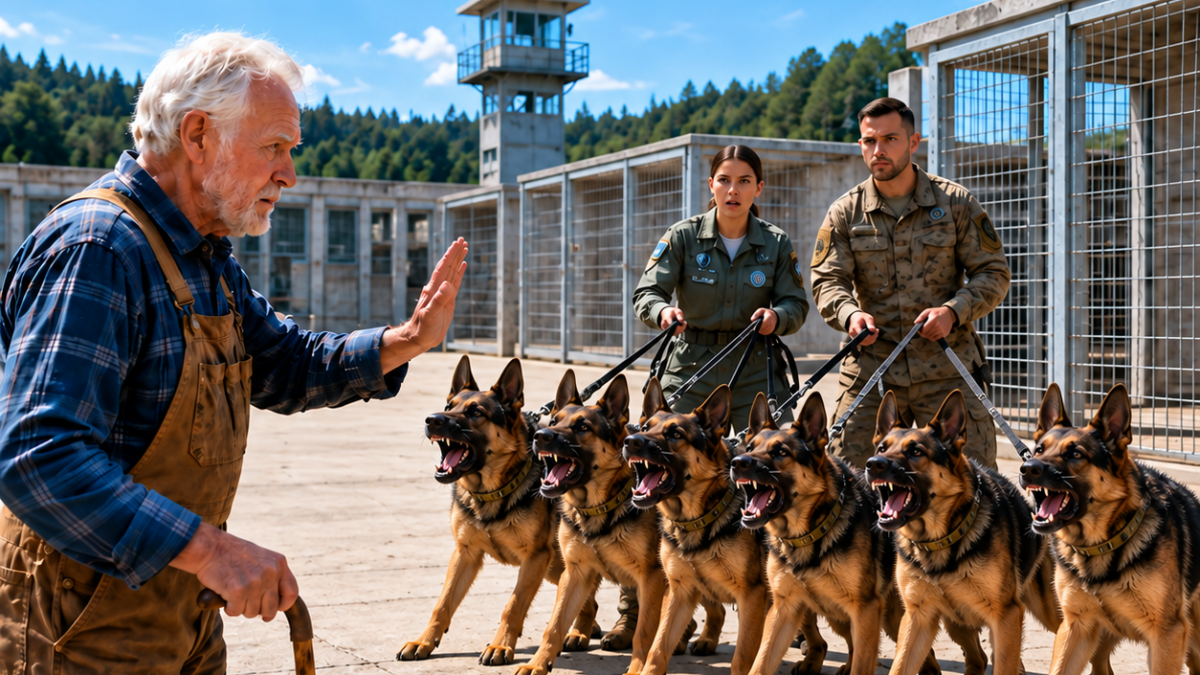
Then he lifted his right hand.
His fingers formed a rigid signal no one at Fort Brayburn had taught in decades.
His voice cut through thunder.
Not English.
A sharp, low German phrase, old and precise.
The effect was immediate.
Titan froze mid-snarl.
His paws hit the mud.
The growl died in his throat.
The wildness in his eyes broke apart, not into obedience exactly, but recognition.
Henry held the signal.
Then gave a two-toned whistle and tapped his thigh once.
Titan’s ears shifted.
A sound came from him that no one had heard in Sector Four.
A whine.
The giant shepherd lowered his head, stepped close, and pressed his wet nose gently against the fence where Henry’s hand rested.
Behind him, Brutus sat.
Then Rex.
Then Shadow.
Duke.
Apollo.
One by one, the six dogs fell into a straight line behind Titan, rain streaming off their coats, eyes fixed on the old farmer as if the storm, the fence, the base, and the men with rifles had disappeared.
Tommy’s tranquilizer rifle slid from his hands into the mud.
Sonia stared, mouth open.
For several seconds, nobody spoke.
Henry kept his palm against the fence.
Titan kept his nose pressed to it.
Then the old man turned his head toward Tommy.
“Open the perimeter gate.”
His voice was not loud, but command carried inside it like iron.
Tommy blinked rain from his eyes.
“What?”
“Open the gate. I’m walking them back.”
Sonia stumbled forward.
“Sir, you cannot enter the base. Those dogs are classified as aggressive military working animals. You can’t just—”
“Doctor,” Henry cut in sharply.
Sonia stopped.
“These dogs are not aggressive. They are executing a last-stand directive.”
Tommy felt the phrase hit some half-buried part of his memory.
A rumor from old manuals.
A training myth.
Something mentioned once by an instructor who said Cold War handlers had strange ideas nobody used anymore.
Henry’s eyes stayed on him.
“They believe they are still deployed. They believe the bodies they guarded are still behind them. They are waiting for someone with the authority to relieve them.”
Sonia’s face changed.
Tommy looked at the dogs.
At Titan.
At the formation.
At the way their panic had organized itself around a duty no one had dismissed.
His voice came out hoarse.
“How do you know that?”
Henry looked back at Titan.
“Because I helped write the damn protocol.”
Tommy did not ask another question.
He keyed his radio with shaking fingers and overrode the western service gate.
The heavy gate buzzed, shuddered, and slid open.
Henry stepped through.
He did not hesitate.
The six dogs shifted at once.
For one terrible second, Tommy thought they would realize Henry stood inside the fence, inside their space, vulnerable.
Instead, they reformed around him.
Titan moved to the front.
Brutus and Shadow took the flanks.
Rex and Duke aligned behind.
Apollo stayed close to Henry’s bad side, matching the rhythm of the limp as if he had been assigned there.
Henry retrieved his cane and began walking toward Sector Four.
No leash.
No treats.
No muzzle.
Only hand signals, low words, and a calm older than the storm.
The pack followed.
Tommy and Sonia trailed at a distance, too stunned to speak.
Rain hammered the ground.
Base personnel gathered behind security doors and windows, watching six dogs everyone had been prepared to kill walk peacefully behind a limping farmer in suspenders.
When they reached Sector Four, Henry guided each dog into a holding cell.
Titan last.
The alpha paused at the threshold, looking back at Henry.
Henry whispered something too low for Tommy to hear.
Titan entered.
The steel door locked.
Only then did Henry lean against the concrete wall, suddenly looking every bit his age.
His soaked shirt clung to his shoulders. His hands trembled. His bad leg shook violently beneath him.
Tommy stepped closer.
“Who are you?”
Henry wiped rain from his face with a handkerchief.
“My name is Henry Caldwell.”
“I know your name,” Tommy said. “I mean who are you?”
Henry looked through the glass at the dogs.
“In 1968, I was a master sergeant stationed at Camp Pendleton. I worked under William Keller.”
Sonia gasped.
Tommy stared.
William Keller was legend in military K9 history. Half the modern training doctrine could be traced to his research and field programs. Men talked about him like a founder, a myth, a ghost behind every kennel standard and operational command.
“You worked with Keller?” Sonia asked.
“I did more than work with him.”
Henry’s voice thinned with memory.
“I helped build the early combat integration program.”
Tommy looked at the old man’s cane.
His limp.
The farm beyond the fence.
The decades of silence sitting on his shoulders.
“You were one of the original architects.”
Henry nodded once.
“Bill taught me how to read a dog’s soul. The military wanted weapons. We tried to give them partners instead. Some days we succeeded. Some days…” He looked toward Titan. “Some days we gave them burdens no living creature should carry.”
They moved into Tommy’s office because Henry’s leg was nearly giving out.
Sonia brought a towel and black coffee. Henry accepted both without thanks or protest.
For several minutes, no one spoke.
The storm passed slowly over the base.
Finally, Tommy said, “Tell us.”
Henry stared into the coffee as if the answer lay at the bottom.
“During the height of the war, command worried about dogs breaking contact if handlers were killed deep behind enemy lines. They wanted a contingency. Something that would keep a K9 from fleeing, surrendering, or being captured before friendly forces arrived.”
He swallowed.
“We developed a reinforcement loop. Handler bond, body protection, pack fallback, command override. It was never meant for broad use. It was meant for rare operations where recovery delays were likely and mission compromise could cost more lives.”
Sonia’s face tightened.
“The last-stand directive.”
Henry closed his eyes.
“That wasn’t the official name. Soldiers gave it that later.”
Tommy leaned forward.
“What did it do?”
Henry’s hands tightened around the mug.
“If a handler died and no human command structure remained, the dog would default to guard behavior. If multiple dogs experienced handler loss in the same operational environment, the protocol encouraged unit cohesion. They would form a temporary pack around the fallen and hold position until relieved by a recognized authority signal.”
Sonia whispered, “Temporary.”
“It was supposed to be temporary.”
“But these dogs were behind enemy lines for three days,” Tommy said.
Henry nodded.
“Long enough for survival to fuse with grief. Long enough for the directive to become their whole reality.”
Tommy thought of Titan guarding Miles Keene’s body for three days.
No water.
Wounded.
Explosions.
The smell of blood.
Enemy movement.
The other five dogs doing the same around their handlers.
“Why doesn’t anyone know about this?” Sonia asked.
“Because we buried it.” Henry’s voice sharpened. “I begged command to destroy the protocol after I saw what it did to dogs who came back. They didn’t return proud. They returned trapped. They guarded empty rooms. Refused new handlers. Attacked anyone who approached gear belonging to the dead. They weren’t disobedient. They were waiting for a command no one remembered how to give.”
He looked at Tommy.
“By the time I resigned, the documents had been classified, misfiled, renamed, sanitized—take your pick. Most of the people who understood it died, retired, or learned to keep quiet.”
“And you bought the farm next door,” Tommy said.
Henry’s laugh held no humor.
“I bought silence. Land. Distance. Thought if I stayed close enough, maybe I could make peace with what I helped create.”
“Did you?”
Henry looked toward Sector Four.
“No.”
Morning came cold and clear.
The storm had stripped leaves from trees and left the base shining with puddles. Sector Four smelled of wet concrete, ozone, and disinfectant. The dogs were calm but watchful. They had eaten during the night for the first time in two days, though only after Henry stood outside the viewing glass and gave a soft command.
At 0750, three black military SUVs arrived.
General Arthur Clayton stepped out first.
He was rigid, gray-haired, and precise, the kind of officer who looked as if even his shadow should request permission before moving. Two military police followed him. Behind them came the base veterinarian assigned to carry out the euthanasia order, holding a steel case that made Sonia turn pale.
Tommy stood outside Sector Four.
Sonia beside him.
Henry slightly behind them in the shadows.
The old farmer had changed.
He no longer wore muddy farm clothes. He wore a vintage dress uniform so perfectly pressed it looked preserved by memory itself. Medals lined his chest. His cane remained in his right hand. His white hair was combed back. His posture, despite the limp, was straight enough to make younger men unconsciously adjust their own.
General Clayton stopped when he saw him.
For the first time Tommy had ever witnessed, the general looked uncertain.
“Master Sergeant Caldwell.”
Henry’s expression did not change.
“General.”
“I was told you were dead.”
“I’ve been told many things by the Army. Most were inaccurate.”
Clayton’s jaw shifted.
“This matter is under current command authority.”
“It is also under my conscience.”
Clayton looked past him toward the kennel.
“The animals have been deemed an unacceptable risk.”
“The animals are executing an obsolete directive I helped design.”
“I reviewed Captain Ridge’s request. It does not change the attack footage.”
“No,” Henry said. “But it changes what the footage means.”
Clayton’s eyes narrowed.
“Meaning does not reduce risk.”
“Understanding does.”
The corridor went silent.
Henry stepped closer.
“Give me five minutes in the main enclosure.”
“No.”
“If I fail, proceed.”
Sonia’s face snapped toward him.
“Henry—”
He lifted one hand.
“If I succeed, the dogs are discharged from military service and released into my custody. All six. Together.”
Clayton stared at him.
“You go in there without protective equipment, they may kill you.”
Henry glanced through the glass.
Titan paced inside, eyes fixed on him.
“No, General. They may decide I deserve it.”
Nobody spoke.
Then Clayton said, “You accept full responsibility?”
“I accepted responsibility fifty years ago. I’m only now doing something useful with it.”
Before anyone could stop him, Henry took Tommy’s key card from his hand and swiped the door.
The lock disengaged.
“Henry!” Sonia shouted.
The heavy steel door opened.
Henry stepped into the exercise yard.
The door shut behind him.
Inside, the six dogs reacted instantly.
Titan hit the concrete first, teeth bared, a roar tearing out of him that echoed off the walls. Brutus surged left. Shadow right. Rex circled. Duke and Apollo closed the rear. Within seconds, Henry stood inside a ring of muscle, teeth, scars, and unresolved grief.
General Clayton’s hand moved toward his sidearm.
Tommy whispered, “Don’t.”
Henry did not raise his cane.
He did not shout.
He did not challenge Titan’s space.
Instead, he let the dogs circle.
Let them smell the rain still in his clothes, the old leather of his uniform belt, the faint scent of cattle, hay, gun oil long embedded in medals and cloth no washing could fully erase.
Titan rushed forward, jaws snapping inches from Henry’s chest.
Henry did not flinch.
He slowly lowered his cane.
It clattered onto the concrete.
Then the old man sank to one knee.
Not collapse.
Not weakness.
A deliberate posture.
He made himself smaller.
Less threat.
More witness.
He removed his white gloves and extended his bare hands, palms down, fingers relaxed.
Titan’s growl faltered.
Henry looked into the dog’s eyes.
Not dominating.
Not pleading.
Recognizing.
Then he spoke.
One short German command, older than everyone outside the glass except him.
Titan froze.
Henry reached into his breast pocket and withdrew a small leather pouch.
From it, he poured six brass dog tags into his palm.
They clinked together.
The sound cut through the room.
All six dogs stopped.
Tommy’s chest tightened.
Those tags had been pulled from archive storage the night before. The handlers’ tags. Keene. Alvarez. Price. Donnelly. Hayes. Morrison. Cleaned but not stripped of what little scent memory might remain to a dog’s extraordinary nose.
Henry held them out.
His voice broke.
“Mission complete.”
Titan’s ears shifted.
Henry repeated it, softer.
“Your watch is ended.”
Titan took one trembling step forward.
Then another.
He lowered his nose to the tags.
Smelled brass, leather, age, memory, and the ghost of the man he had guarded long after death.
A sound came out of him that made Sonia cover her mouth.
Not a bark.
Not a growl.
A question breaking into grief.
Titan’s body shuddered.
Then the massive alpha folded.
He lowered himself to the concrete and placed his heavy head on Henry Caldwell’s knee.
And howled.
The sound was agony.
Months of locked muscles, barred teeth, failed rehab, sedatives, bite suits, fear, and command reports tore open into one long, devastated cry.
Brutus moved next.
He pressed against Henry’s side and shook.
Apollo crawled forward on his belly and buried his nose beneath Henry’s arm.
Rex circled twice, confused, then dropped beside Titan.
Shadow leaned his black head against Henry’s shoulder.
Duke lay across the old man’s boots.
The pack did not attack.
It collapsed into mourning.
Outside the glass, the corridor was silent.
Sonia wept openly.
Tommy felt tears slide down his face and did nothing to stop them.
General Clayton slowly removed his hand from his sidearm.
Inside the enclosure, Henry knelt beneath six broken dogs and whispered to them in a voice too low for anyone else to hear.
Maybe names.
Maybe apologies.
Maybe words old soldiers say when they finally understand the cost of orders obeyed too well.
Twenty minutes later, the door opened.
Henry walked out first, leaning heavily on his cane.
Behind him came Titan.
Loose-bodied.
Head low.
Then Brutus, Rex, Shadow, Duke, and Apollo.
No formation.
No lethal V.
No combat spacing.
Just six tired dogs walking close because closeness no longer meant war.
General Clayton stood perfectly straight.
Then, to Tommy’s astonishment, he saluted Henry.
“Paperwork will be filed by noon, Master Sergeant,” Clayton said quietly. “The dogs are officially discharged.”
Henry returned the salute slowly.
“Thank you.”
Tommy stepped toward Titan.
For months, the dog had treated him as an enemy outside the glass.
Now Titan paused.
He looked at Tommy for a long moment.
Then nudged his hand with a wet nose.
A small gesture.
A truce.
Tommy bent his head.
“Good boy,” he whispered.
Titan moved on, hurrying to catch up with Henry.
Caldwell Farm changed after that.
Not all at once.
Sanctuary is not a switch flipped from danger to peace.
The dogs arrived in a convoy that afternoon, not in cages but in open-backed transport under Henry’s instruction. The old farmer stood at the gate as each dog stepped onto the land.
Titan first.
He sniffed the pasture air.
No concrete.
No disinfectant.
No alarms.
No fluorescent hum.
Only wet grass, cattle, wind, old wood, and distance.
He looked back once toward the base.
Henry stood beside him.
“Not there anymore,” he said.
Titan’s ears moved.
“Here.”
The first nights were difficult.
The dogs slept in the old lambing barn because walls mattered at first. Too much openness made them restless. Henry laid thick straw, set water troughs, and built individual spaces without doors, so each dog could retreat without feeling confined.
He did not allow strangers.
He did not allow pity.
He did not allow anyone to call them “dangerous” on his land.
“Words matter,” he told Tommy on the second day when the captain visited. “You call a dog dangerous long enough, you stop noticing when he’s afraid.”
Tommy stood near the barn entrance, watching Titan sleep with his head on his paws.
“What do we call them?”
Henry leaned on his cane.
“Retired.”
Weeks passed.
At first, the dogs moved as one everywhere.
To the water.
To the shade.
To the barn.
To the pasture fence.
If Titan rose, all rose.
If Titan startled, all braced.
Thunder sent them into tight formation the first time it rolled over the hills. Henry walked into the barn wearing his old uniform coat, sat on an overturned bucket, and spoke low until the storm passed.
The second storm, he did not wear the coat.
The third, he brought coffee and a blanket.
By the fourth, Titan slept through half of it.
Brutus discovered cattle and decided they were suspicious but not worth war.
Rex began chasing swallows along the fence line, never catching them, never learning from failure.
Shadow adopted the porch steps, lying where he could see both the driveway and the kitchen door.
Duke liked Henry’s truck and would climb into it whenever the door opened, regardless of whether anyone intended to go somewhere.
Apollo, the youngest, became fascinated by Evelyn’s old wind chime. He sat beneath it when the breeze moved, head tilted, listening as if the sound contained a language softer than commands.
Henry did not force affection.
That mattered.
He knew too well how many people mistook control for healing.
He let the dogs approach.
Some did sooner than others.
Apollo leaned against him within a week.
Duke followed him to the mailbox after ten days.
Brutus allowed one hand on his shoulder by the end of the first month.
Rex stole a glove and refused accountability.
Shadow took three months to put his head in Henry’s lap.
Titan took the longest.
The alpha slept near Henry’s bedroom door but did not come inside. He watched. Listened. Stayed close without surrendering the last piece of distance.
Then one winter morning, Henry fell.
It happened in the barn before sunrise. Ice had formed beneath a thin layer of mud near the feed room. His bad leg slipped first. The cane went sideways. He hit the ground hard enough to knock the breath out of him.
For a moment, Henry lay staring at the rafters while cold pain flashed through his hip.
“Damn it,” he whispered.
Titan appeared above him.
Then Brutus.
Apollo.
Rex.
Shadow.
Duke.
Six shepherds formed a circle around him.
Henry tried to sit up and failed.
“Easy,” he said, mostly to himself.
Titan lowered his head.
Pressed his nose against Henry’s chest.
Then let out one sharp bark.
Not panic.
Command.
Apollo bolted toward the farmhouse.
He hit the porch door with both paws until the latch rattled. Tommy Ridge, who had spent the night in the guest room after helping repair storm damage, woke to the sound and ran outside barefoot.
He found Henry in the barn surrounded by six dogs who did not block him this time.
They parted just enough.
Tommy knelt.
“Henry?”
“Pride’s broken,” the old man muttered. “Hip might be negotiating.”
Tommy laughed despite the fear.
An ambulance came.
The dogs hated it.
Titan placed himself between Henry and the paramedics until Henry lifted one shaking hand and gave a soft release word. Even then, the shepherd stayed close enough to touch the stretcher with his nose.
At the hospital, Henry argued with nurses, refused extra blankets, and demanded someone check the farm gate before noon.
His hip was bruised but not fractured.
When he returned two days later, Titan walked into the farmhouse behind him as if he had always lived there.
That night, for the first time, the old alpha slept at the foot of Henry’s bed.
Not guarding bodies.
Not holding a battlefield.
Just sleeping.
In spring, Fort Brayburn held a formal recognition ceremony for the six discharged K9s.
Henry refused to attend at first.
“No dog wants applause,” he said.
Tommy replied, “This isn’t for applause. It’s for record.”
That changed Henry’s mind.
The ceremony took place not on base, but at Caldwell Farm.
General Clayton came.
So did handlers, trainers, medics, administrative personnel, and the families of the six fallen soldiers.
That was Henry’s condition.
“If you’re honoring the dogs,” he said, “you honor the men they were waiting for.”
Six framed photographs stood on a long table beneath the old oak tree.
Miles Keene.
Javier Alvarez.
Owen Price.
Daniel Donnelly.
Marcus Hayes.
Ethan Morrison.
Beside each photograph lay a folded flag, a set of handler gloves, and a copy of the dog’s service record.
The families arrived quietly.
Miles Keene’s daughters were teenagers now. The younger one had her father’s eyes and held herself so tightly Tommy had to look away. Mrs. Alvarez brought a rosary. Owen Price’s father wore a suit too large for him. Donnelly’s wife stood with one hand on her son’s shoulder. Hayes’s brother stared at Brutus as if afraid grief might knock him down. Morrison’s mother carried a photograph of Apollo as a puppy with Ethan laughing beside him.
Henry stood apart near the barn.
Titan beside him.
Tommy approached.
“You okay?”
“No.”
“Want to cancel?”
“No.”
The ceremony was simple.
No speeches about glory.
No polished language about sacrifice that made death sound cleaner than it was.
Tommy spoke first.
He told the truth.
That these dogs served with courage.
That they survived something no animal should have been asked to survive.
That they were misunderstood because people mistook grief for aggression.
That they were officially and permanently retired.
Then Henry walked forward.
His limp was worse that day.
Or maybe he simply looked older beneath all those watching eyes.
He stopped before the families.
“I owe you an apology,” he said.
The crowd stilled.
General Clayton’s expression tightened, but he did not interrupt.
Henry’s voice remained steady.
“I was part of the generation that built the systems these dogs were trained under. We told ourselves we were making sure no soldier was left behind. We did not ask enough what it meant for the dogs ordered to stay with them.”
Miles Keene’s older daughter began crying silently.
Titan watched her.
Henry continued.
“Your sons, husbands, brothers, and fathers were not abandoned. These dogs stayed with them until help came. They did their duty. Then they waited too long for someone to tell them duty was over.”
He turned toward the six shepherds lying near the oak.
“Today, in front of the families they served, I say it clearly. Their watch has ended. Their service is honored. Their war is over.”
No one clapped.
The silence that followed was too full for applause.
Then Miles Keene’s younger daughter stepped forward.
Her name was Lily.
Tommy remembered from the file.
She approached Titan slowly.
Henry watched the dog.
Titan stood.
The girl froze.
Henry said softly, “Let him come the rest of the way.”
Titan took one step.
Then another.
He sniffed the air near Lily’s hand.
The girl held out a folded piece of paper.
“My dad drew him in letters,” she said, voice shaking. “Not good drawings. Really bad ones. But he drew him.”
Titan sniffed the paper.
Then pressed his head gently against her chest.
Lily wrapped both arms around his neck and sobbed into his fur.
Titan stood still.
Not trapped.
Not braced.
Just there.
Around them, the other families began approaching the dogs.
Brutus leaned into Hayes’s brother.
Apollo placed his head in Morrison’s mother’s lap.
Duke sat beside Donnelly’s son, who whispered something no one else heard.
Rex licked Mrs. Alvarez’s hand and made her laugh through tears.
Shadow rested at Owen Price’s father’s feet.
The ceremony ended with no music.
No parade.
No rifles.
Just families, dogs, and the unbearable mercy of being allowed to grieve together.
After that day, Caldwell Farm became something unofficial at first.
Then unavoidable.
Handlers from Fort Brayburn began visiting when they had dogs nearing retirement. Sonia came weekly to document the rehabilitation progress, though she often ended up sitting on the porch while Apollo put his head in her lap. Tommy helped build new runs that looked nothing like kennels and more like shaded resting areas with open gates.
Henry complained about all of it.
Then designed most of it himself.
The six shepherds became the heart of the place.
Not perfect.
Never that.
Titan still disliked sudden shouting.
Shadow still left the room when certain helicopters passed overhead.
Duke panicked once when a metal feed pan fell and clattered across concrete.
Rex could not tolerate being enclosed alone.
Brutus guarded sleeping dogs from visitors until Henry reminded him visitors were not enemy movement.
Apollo sometimes woke from dreams whining, then crawled into the old farmer’s room and slept beside the bed.
Healing did not erase training.
It gave the dogs new answers when old alarms sounded.
Years later, Tommy would think often about the first night in the storm.
How close they had come.
Six syringes.
Six bodies.
Six service records closed with the word unmanageable.
He thought about the arrogance of believing that because humans could not interpret pain, the pain itself had no language.
Henry had read it.
Not because he was magical.
Because he had spent a lifetime carrying the consequence of what he helped teach dogs to endure.
One evening, nearly two years after the storm, Henry sat on the farmhouse porch as sunset burned orange behind the pasture.
His cane rested against the railing.
Titan lay beside his chair, muzzle white now around the edges.
The other five dogs were scattered across the yard. Brutus asleep near the barn. Rex watching swallows. Shadow at the steps. Duke inside Henry’s truck because someone had left the door open. Apollo beneath the wind chime.
Tommy sat in the second chair with a cup of Henry’s terrible coffee.
Sonia leaned against the porch post, reading through updated notes she no longer really needed.
“You ever regret opening that gate?” Tommy asked.
Henry did not look at him.
“The night of the storm?”
“Yes.”
Henry watched Titan breathe.
“No.”
“You could’ve died.”
“Many people could have. I was already old.”
“That’s not an answer.”
“It’s the one you’re getting.”
Sonia closed the folder.
“Do you regret designing the directive?”
Henry’s face changed.
Tommy thought perhaps she had gone too far.
But Henry answered.
“Every day.”
Titan lifted his head slightly.
Henry placed one hand on the dog’s neck.
“But regret is useless if you only use it to punish yourself. Took me fifty years to learn that.”
He looked across the pasture toward Fort Brayburn’s distant fence.
“I made something I thought would protect loyalty. Instead, I trapped it. Those dogs gave their hearts to men who died. Then we punished them because they wouldn’t stop loving on command.”
No one spoke.
Henry continued softly.
“People like calling dogs loyal because it makes us feel worthy of it. But loyalty isn’t simple. Sometimes it holds too long. Sometimes it hurts. Sometimes it needs someone kind enough to say, ‘You can stop now.’”
Titan sighed.
His head settled against Henry’s boot.
The sunset deepened.
In the far pasture, cattle moved like dark shapes through gold grass.
The base loudspeaker carried faintly on the wind, distant and harmless.
Apollo’s wind chime rang once.
A soft, bright sound.
Henry closed his eyes.
For the first time in decades, Tommy thought the old man looked almost peaceful.
The military had trained Titan, Brutus, Rex, Shadow, Duke, and Apollo for war.
War had nearly destroyed them.
But an old farmer who knew the language of their burden walked through rain, opened a gate, knelt where everyone else saw only danger, and gave them the command they had been waiting for since the battlefield.
Mission complete.
Your watch is ended.
You are relieved.
And after months of snarling through reinforced glass, six broken K9s finally understood that they were allowed to become dogs again.
They were allowed to sleep without guarding the dead.
Allowed to walk under open sky.
Allowed to lean against hands that did not ask them to fight.
Allowed to grieve.
Allowed to live.
People later called Henry Caldwell a hero.
He hated that.
“Hero makes it sound clean,” he told anyone foolish enough to use the word. “There was nothing clean about it.”
Maybe he was right.
Maybe the better word was witness.
He witnessed what war had done.
What training had demanded.
What grief had disguised itself as.
And when everyone else stood ready with rifles, syringes, reports, and final orders, Henry witnessed six dangerous dogs closely enough to see the truth.
They were not lost causes.
They were soldiers still standing at a post no one had relieved.
So he relieved them.
And when he walked out of Fort Brayburn toward the bright fields of Caldwell Farm, Titan at his side and five shepherds following behind, it did not look like a victory parade.
It looked like a funeral finally ending.
It looked like mercy.
It looked like six loyal hearts, wounded by commands they had obeyed too well, learning one slow step at a time that the battlefield was behind them.
And it looked like an old man, bent by age and regret, carrying home the very burden he had once helped create—this time not as doctrine, not as duty, but as redemption.








