Simba Couldn’t Run, Jump, or Even Leave His Corner—Then His Caregivers Noticed Something They Almost Missed.
PART3:
She slid one hand beneath his chest and another beneath his hips.
The kitten did not resist being lifted.
His body felt disturbingly light.
He could not have been more than eight or nine weeks old.
A kitten that age should have been chaos.
At that age they were supposed to climb curtains, attack shoelaces, knock bowls over, chase dust, disappear under refrigerators, and somehow appear three feet higher than anyone thought they could jump.
This one rested in Maya’s arms as though movement belonged to somebody else.
During the twenty-minute drive to the veterinary clinic, Maya kept one hand inside the carrier.
The kitten pressed his chin against her fingers.
No purring.
No kneading.
Just contact.
When the car turned, his body shifted.
He could not correct his position easily.
Maya steadied him.
“You don’t have to do anything right now.”
The kitten looked at her.
“We’ll do it for you.”
At the clinic, Dr. Elaine Chen examined him slowly.
Reflexes.
Spine.
Hips.
Paws.
Temperature.
Hydration.
Bladder.
She pinched gently between his toes.
One hind leg twitched faintly.
Maya saw it.
“You saw that.”
“I did.”
“So he can feel it?”
“Possibly.”
“That’s good, right?”
Dr. Chen gave Maya the look veterinarians use when they want hope without promising something medicine cannot guarantee.
“It’s information.”
Maya hated that answer.
She also trusted it.
X-rays showed no obvious fresh fracture.
There were signs suggesting a neurologic problem affecting the kitten’s hindquarters, but the precise cause was not immediately clear.
It could have resulted from trauma.
It could have been congenital.
It could have involved an injury that happened weeks earlier.
More evaluation might narrow it down.
But even with more tests, nobody could promise he would ever walk normally.
Maya looked through the clinic window toward the exam room.
The kitten had been placed on a folded blanket.
He was watching a technician prepare supplies.
“So what kind of life does he have?”
Dr. Chen turned.
“What do you mean?”
“If the legs never work.”
“He can still have a life.”
“A good one?”
“Yes.”
The answer came so quickly that Maya looked at her.
Dr. Chen continued.
“It may require more care.”
“How much?”
“That depends.”
“Diapers?”
“Possibly.”
“Bladder expression?”
“Maybe.”
“Therapy?”
“Yes.”
“Wheelchair?”
“Potentially, later.”
Maya looked back through the glass.
“He’s a baby.”
“I know.”
“Who adopts a cat that needs all that?”
Dr. Chen did not answer.
Not because she did not know.
Because they both did.
Somebody could.
But finding that somebody might take a long time.
Maya had watched healthy black cats wait months.
Senior cats wait longer.
Cats with kidney disease.
Cats missing eyes.
Cats requiring medication twice daily.
Special-needs kittens drew sympathy easily.
Commitment was harder.
The kitten looked toward the window.
Maya could have sworn his eyes found her.
“What are we calling him?”
Dr. Chen asked.
Maya looked at his orange fur.
His oversized ears.
The tiny serious face.
“Simba.”
Dr. Chen smiled.
“Of course.”
“What?”
“Orange kitten named Simba.”
“It fits.”
“It is statistically unavoidable.”
Maya almost laughed.
That was how Simba got his name.
Not from bravery.
Not from destiny.
Not because anybody knew he would become extraordinary.
Because he was orange.
For the first several days, extraordinary was the last word Maya would have used.
Simba needed help with almost everything.
He could pull himself forward using his front legs.
Slowly.
His hindquarters dragged behind him.
If he turned too sharply, his body twisted awkwardly.
He could not climb into a normal litter box.
He could not reposition himself easily when tired.
He sometimes soiled himself.
His skin required frequent cleaning.
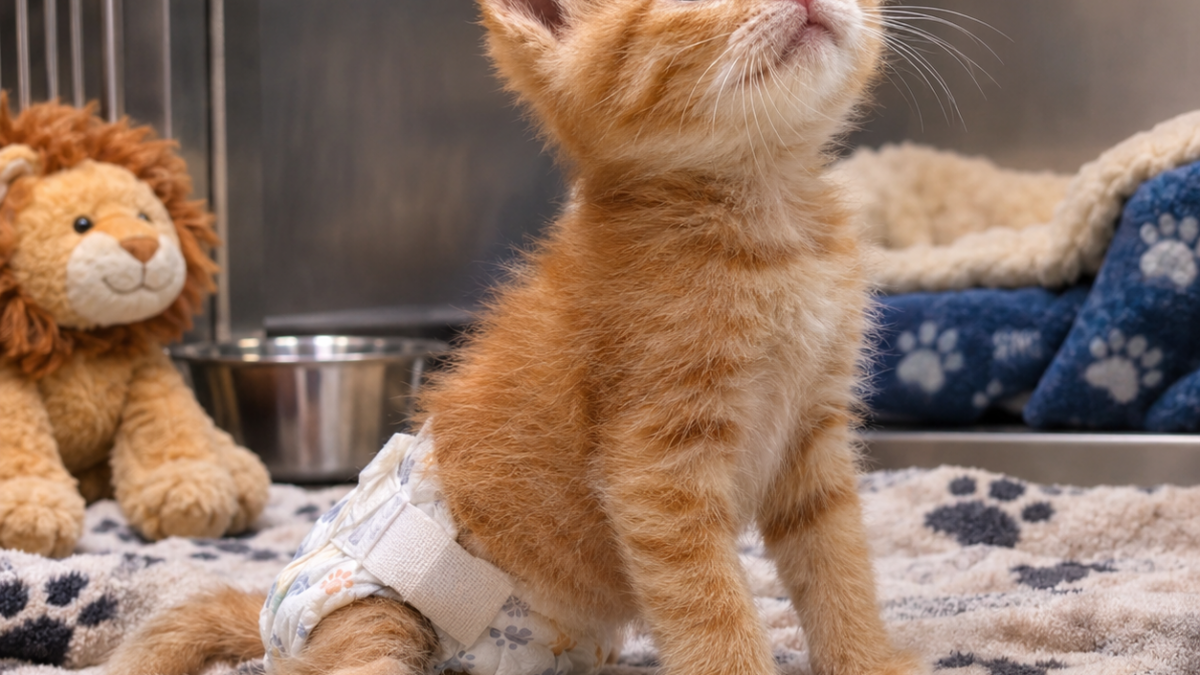
Maya learned how to place a tiny diaper without rubbing his legs.
The first time she put one on him, she stared at the absurdly small white diaper and felt tears burn her eyes.
Jenna noticed.
“You okay?”
“Fine.”
“You’re crying over a diaper.”
“I hate tiny medical supplies.”
“That’s strangely specific.”
Maya laughed through her tears.
Simba watched them.
Then tried to bite the diaper tab.
Maya froze.
Jenna laughed.
“There.”
“What?”
“Attitude.”
Simba bit it again.
For the first time since his arrival, Maya saw something beyond stillness.
Annoyance.
Curiosity.
Maybe even mischief.
“Good,” Maya whispered.
Simba chewed harder.
“Be difficult.”
He did.
That became the first thing Maya loved about him.
Not his helplessness.
His inconvenience.
By day four, he had learned exactly how far his front legs could drag his body before someone intervened.
By day five, he discovered the food preparation counter.
Not physically.
Visually.
Whenever Maya prepared wet food, Simba’s head followed every movement.
His appetite improved.
At first he ate only when food was held close.
Then he began crawling toward the bowl.
Six inches.
Ten.
Sometimes more.
It took effort.
His back legs slid uselessly behind him.
But he moved.
Maya stopped placing the bowl directly in front of his face.
She put it a short distance away.
Jenna objected.
“That’s cruel.”
“It’s six inches.”
“He’s tiny.”
“He’s motivated.”
Simba stared at the bowl.
Then at Maya.
“Don’t look at me like that.”
He pulled himself forward.
Front paw.
Front paw.
Drag.
Pause.
Again.
When he reached the bowl, he ate like he had crossed a desert.
Jenna crossed her arms.
“Monster.”
Maya smiled.
“He did it.”
“He moved six inches.”
“Yesterday he didn’t.”
Progress with Simba became like that.
Tiny.
Easy to dismiss.
Impossible to ignore once you cared enough.
The rescue created a therapy plan with Dr. Chen and a rehabilitation technician named Laura Benton.
Laura was thirty-two and treated every animal like an athlete regardless of species or ability.
The first session took place on a soft blue balance cushion.
Simba hated it.
Maya placed his front paws on the surface.
His body wobbled.
He immediately tried to crawl off.
Laura stopped him gently.
“Nope.”
Simba stared at her.
“We’re working.”
He tried again.
“Nope.”
He attempted to bite her thumb.
Laura smiled.
“Excellent.”
Maya raised an eyebrow.
“You enjoy this?”
“Angry patients participate.”
The goal was not to force his rear legs to work.
The goal was to support his body, encourage balance, strengthen what he could control, maintain flexibility, and see whether any neurologic response could be encouraged.
They moved slowly.
Very slowly.
A few minutes at a time.
Then rest.
Massage.
Gentle range-of-motion exercises.
Maya learned how to move each hind leg carefully.
Flex.
Extend.
Pause.
Never force.
Simba often watched her hands.
At first with uncertainty.
Later with recognition.
Every evening, Maya took him back to her foster room.
The rescue had offered to find a different foster home.
Someone with fewer animals.
More time.
Maya said no.
“You already have four fosters,” Jenna reminded her.
“Three.”
“You have four.”
“Ralph is practically adopted.”
“Ralph has been practically adopted for two months.”
“He’s emotionally halfway out the door.”
Jenna stared.
“You are keeping Simba.”
“No.”
“You said that too quickly.”
“I foster.”
“You fail.”
“I place animals.”
“You own seven former fosters.”
“That is irrelevant.”
Jenna smiled.
Simba slept in Maya’s lap during the entire argument.
The first breakthrough came after twelve days.
It was almost nothing.
Maya nearly missed it.
Simba was lying on his stomach while she moved his right hind leg.
Flex.
Extend.
Flex.
Then she stopped.
His tail flicked.
Maya froze.
A tail movement was not unusual in a cat.
Except Simba’s tail had barely moved intentionally since arrival.
She waited.
Nothing.
“Simba.”
His ears turned.
“Do that again.”
Obviously, he did not.
Maya felt foolish.
Then his tail moved again.
Small.
One deliberate sweep against the blanket.
“Laura!”
Her voice was so loud Simba startled.
Laura ran in from the hall.
“What happened?”
“Tail.”
“What?”
“His tail moved.”
Laura crouched.
“Maybe reflex.”
“It happened twice.”
“Show me.”
“I can’t make him do it.”
Laura laughed.
“Helpful.”
They waited.
Simba looked at them both as if adults were exhausting.
Then Maya opened a container of chicken.
His tail flicked.
Laura stared.
Maya whispered:
“You saw it.”
“I saw something.”
“What does it mean?”
“It means he moved his tail.”
“That is not enough enthusiasm.”
“It means exactly what it means.”
Laura smiled.
“But yes.”
Maya’s eyes filled.
“That’s good.”
“That is good.”
Simba got chicken.
Possibly more chicken than medically justified.
The tail flick became the first milestone.
Then another.
During a balance session three days later, his left hind leg pulled slightly inward.
Not enough to stand.
Barely enough to see.
Laura recorded it.
They replayed the video four times.
Maya sent it to Dr. Chen.
Dr. Chen replied:
Encouraging. Keep expectations realistic. Continue therapy.
Maya complained aloud.
“Veterinarians are allergic to excitement.”
Simba was chewing her sweatshirt string.
“You agree?”
He pulled harder.
Therapy expanded.
Laser sessions.
Carefully targeted.
Acupuncture under veterinary supervision.
Massage.
Supported standing.
Balance work.
Short sessions several times a day rather than exhausting ones.
Nothing dramatic happened.
That became important.
People online love before-and-after stories.
Day one: paralyzed.
Day thirty: running.
Real life rarely cooperates.
Simba had good days.
Bad days.
Days when a leg seemed stronger.
Days when nothing responded.
Once, after a week of progress, he stopped using one hind leg almost entirely.
Maya panicked.
Dr. Chen examined him.
No new injury.
Fatigue and inflammation were possibilities.
“Give him rest.”
Maya hated resting.
Rest felt like doing nothing.
But Simba did not exist to satisfy her need for visible improvement.
That was another lesson.
On rest days, she sat beside him.
Talked.
Read.
Answered emails.
Simba watched.
Eventually, he began reaching toward her sleeve.
One paw.
Hook claws lightly into fabric.
Pull.
“Needy.”
He pulled again.
“You were mysterious for about three days.”
Simba climbed partially onto her lap using his front legs.
Maya lifted his hips.
He settled against her.
Then purred.
The first real purr.
Deep.
Uneven.
Almost rusty.
Maya stopped breathing.
Simba’s eyes closed.
She did not move for nearly an hour.
Her phone rang twice.
She ignored it.
Jenna entered.
Saw them.
Whispered:
“He’s purring?”
Maya nodded.
Jenna’s eyes watered.
Neither woman said anything else.
That purr mattered more than the tail.
Because movement told them something about his body.
Purring told Maya something about his sense of safety.
The kitten found in the corner had finally relaxed enough to make himself heard.
Weeks passed.
Simba developed opinions.
Very strong ones.
He hated cold wipes.
Loved warm blankets.
Preferred chicken over turkey.
Despised one specific rehabilitation ball.
Liked acupuncture more than anyone expected because he usually fell asleep during it.
He discovered shoelaces.
He discovered cardboard.
He discovered that if he knocked a fuzzy mouse within reach, somebody would bring it back.
Then he discovered he did not need somebody every time.
Maya rolled a soft ball toward him.
Simba reached.
Missed.
Tried again.
Hooked it with one front paw.
Pulled it toward himself.
Bit it.
Then pushed it away accidentally.
The ball rolled six inches.
He stared.
Maya resisted helping.
Simba looked at her.
Then the ball.
Then dragged himself after it.
This became play.
Different from other kittens.
Still play.
He could not leap.
Could not sprint.
Could not pounce normally.
But he hunted that ball with absolute seriousness.
The rescue posted a short video.
Not dramatic.
No sad music.
No exaggerated caption.
Just Simba dragging himself toward a toy and catching it.
The video reached thousands of people.
Comments appeared.
“Poor baby.”
“He deserves a miracle.”
“I hope he walks.”
“Please fix him.”
That last one bothered Maya.
Fix him.
As though Simba were waiting to become acceptable.
She understood the instinct.
She wanted improvement too.
She wanted him to stand.
Walk.
Run.
Jump.
But something had changed in her.
She no longer viewed his future as a question with only one successful answer.
One afternoon, an adopter emailed.
Young couple.
Large home.
Experience with cats.
They loved Simba’s story.
Maya called.
The conversation went beautifully until she explained his care.
“He still needs assistance with hygiene.”
Pause.
“Meaning diapers?”
“Sometimes.”
“And he may always?”
“Yes.”
“Will he walk?”
“We don’t know.”
“But probably?”
“We don’t know.”
Long silence.
Then:
“We were hoping for something more temporary.”
Maya understood.
She did not blame them.
But after hanging up, she sat beside Simba.
He was asleep under a fleece blanket.
“Apparently you are inconvenient.”
One orange ear moved.
“Terrible quality.”
No response.
“Somebody will want you.”
She said it confidently.
She did not feel confident.
Other inquiries came.
Some people wanted a dramatic rescue animal.
They liked the idea of Simba more than the reality.
One woman asked whether she could adopt him only if he eventually stopped needing diapers.
Another wanted him for her children because “special-needs pets teach empathy.”
Maya disliked that instantly.
Simba was not educational equipment.
Another applicant lived alone, worked twelve-hour shifts, and had no realistic plan for his care.
No.
Weeks became months.
Simba remained with Maya.
His therapy continued.
He gained weight.
His fur became brighter.
His eyes changed most.
At first they always watched from a distance.
Now they demanded.
Food.
Attention.
Play.
If Maya entered the room without greeting him, Simba made a tiny rasping meow.
The first time, she spun around.
“Was that you?”
Another meow.
“Oh, now you speak.”
Meow.
“For weeks you gave me nothing.”
Meow.
Jenna called from the hall:
“He found customer service.”
Simba became loud around meal times.
The kitten who once seemed afraid to occupy space now announced his dissatisfaction if breakfast was three minutes late.
Maya loved every complaint.
Then came the first supported stand.
Laura positioned Simba over the balance cushion.
Maya supported his hips lightly with a sling.
Front paws steady.
Rear legs beneath him.
Usually they folded quickly.
That morning, his right leg pushed.
Laura stopped.
“Wait.”
Maya held still.
Simba’s body trembled.
Left leg shifted.
For two seconds, he supported part of his own weight.
Then collapsed into the sling.
Maya gasped.
Laura laughed.
“Again.”
They reset.
Simba glared.
“Sorry, buddy.”
Second attempt.
Nothing.
Third.
One second.
Fourth.
No.
Session ended.
Maya hugged him.
Laura said:
“Careful.”
“I know.”
“Do not turn two seconds into a prediction.”
“I know.”
“Say it.”
“Two seconds means two seconds.”
“Good.”
Maya kissed Simba’s head.
“It was an excellent two seconds.”
Over time, two seconds became five.
Then eight.
Progress plateaued.
Then returned.
One hind leg remained significantly weaker.
He still could not walk normally.
But he began controlling his hips slightly.
He could reposition himself more independently.
He could lift his chest high.
He could push his rear body enough to make turns easier.
His tail moved regularly.
Every improvement changed his daily life.
Not dramatically to strangers.
Dramatically to Simba.
Maya noticed the first time he moved himself off a wet pad.
Something so basic.
He had previously needed someone to notice discomfort.
Now he could remove himself.
Independence was not always running.
Sometimes independence was six inches away from something unpleasant.
That night Maya cried again.
Jenna found her.
“What now?”
“He moved off his pad.”
Jenna stared.
“That’s why you’re crying?”
“Yes.”
“You need hobbies.”
“I have cats.”
“That is the problem.”
Simba eventually got a small mobility cart for supervised use.
It looked ridiculous at first.
Tiny wheels.
Light frame.
Harness supporting his hindquarters.
Simba froze when they put him in it.
Maya placed chicken several feet away.
He stared.
Then took one front step.
The wheels moved.
Simba stopped.
Another step.
Wheels.
His eyes widened.
Maya laughed.
“Yeah.”
Another step.
Then another.
Suddenly Simba realized something.
His front legs could make the rest of him travel.
Fast.
He began moving.
Not smoothly.
He veered left.
Hit a cushion.
Corrected.
Moved again.
Laura followed.
“Slow down.”
Maya laughed so hard she had to sit.
Simba crossed the room.
Reached the food.
Turned badly.
Nearly tipped.
Recovered.
Then headed somewhere else.
For ten minutes, he explored.
Everything he had watched from the floor became reachable.
Chair legs.
Toy basket.
Open doorway.
Jenna’s shoelaces.
Especially Jenna’s shoelaces.
He chased her across the therapy room.
“This is your fault!”
Jenna shouted.
Maya could barely speak.
“He likes you!”
“He’s attacking me!”
“Participation!”
That evening, Simba slept harder than Maya had ever seen.
Cart beside his bed.
Front paws dirty from exploring.
Maya watched him.
The question that had followed them from the beginning returned.
What kind of life can a kitten like this have?
Now the answer felt obvious.
His.
Not somebody else’s version.
His own.
A family visited two weeks later.
Mother.
Father.
Teenage daughter named Lucy.
They had experience with a senior cat who required bladder care.
They had read Simba’s full medical profile.
Not just the video.
They understood.
Maya watched Lucy sit on the floor.
Simba approached with his cart.
Sniffed her hand.
Lucy did not grab.
Did not squeal.
Did not call him poor baby.
She simply said:
“Hi, Simba.”
He sniffed.
Then rolled past her.
Maya smiled.
Good.
She liked adopters who allowed cats to be unimpressed.
After twenty minutes, Simba returned.
Lucy held a toy.
He grabbed it.
They played.
Maya felt something in her stomach.
Fear.
This was what she wanted.
Wasn’t it?
A capable home.
People prepared for his care.
A family willing to adapt.
After they left, Jenna found Maya cleaning bowls aggressively.
“They’re good.”
“Yes.”
“You hate them.”
“No.”
“You do.”
“I like them.”
“That’s worse.”
Maya set down the bowl.
Simba was sleeping near the heater.
“I’m his foster.”
Jenna nodded.
“Yes.”
“We place fosters.”
“Yes.”
“The point is goodbye.”
“Sometimes.”
Maya glared.
“Do not.”
Jenna lifted both hands.
“I said nothing.”
Maya spent the night thinking.
She imagined Simba in another house.
Lucy learning his routine.
Parents scheduling therapy.
His cart near a different wall.
His orange head appearing in someone else’s doorway.
She hated every image.
Then she hated herself for hating it.
Love was not ownership.
If they were right for him, Maya had to let him go.
The next morning, she called the family.
“I want you to come again.”
They did.
Then again.
Each visit went well.
Too well.
On the fourth, Lucy lifted Simba into her lap.
He purred.
Maya looked away.
Later, Lucy asked:
“Does he sleep with you?”
“Sometimes.”
“Will he be scared somewhere new?”
“Probably.”
“Can we bring his blanket?”
“Yes.”
“His balance cushion?”
“We’ll give you one.”
“What about his favorite toy?”
Maya looked toward the green fuzzy mouse.
“You’ll take everything.”
Lucy smiled.
That night Simba crawled into Maya’s lap without being invited.
He pressed his head under her chin.
Purred.
Maya whispered:
“You’re making this difficult.”
His paw reached toward her face.
“You’re supposed to go have your beautiful adoption.”
Purr.
“I’m supposed to cry and then rescue another animal.”
Purr.
“That’s how this works.”
Simba fell asleep.
Maya stayed awake.
At 1:17 a.m., she texted Jenna.
ARE YOU AWAKE?
Immediate reply.
YOU ARE KEEPING HIM
Maya stared.
I DIDN’T SAY THAT
YOU DIDN’T NEED TO
THE FAMILY IS GOOD
YES
THAT MAKES THIS WORSE
YES
YOU ARE NOT HELPING
I HAVE BEEN WAITING THREE MONTHS FOR YOU TO NOTICE
Maya looked down at Simba.
The kitten’s hind legs lay beneath the blanket.
Still different.
Still needing care.
Still hers?
No.
That was the wrong word.
But family?
Maybe.
The next morning Maya called Lucy’s mother.
Hardest call.
“I need to apologize.”
The woman became quiet.
“Something wrong?”
“No.”
“His health?”
“No.”
Maya swallowed.
“I think I failed at fostering.”
Long pause.
Then laughter.
Warm.
“Oh.”
“I’m sorry.”
“Are you adopting him?”
“I think so.”
“You think?”
Maya looked at Simba.
He was screaming at the breakfast bowl.
“Yes.”
The woman laughed again.
“Lucy said this would happen.”
“What?”
“She told us after the second visit that Simba already had a mom.”
Maya cried.
Embarrassing amount.
The family did not get Simba.
They adopted another special-needs cat from Harbor Street two months later.
A gray adult with one eye and chronic digestive problems.
Lucy sent photos.
Maya saved all of them.
Simba officially became Maya’s cat on a Thursday.
The adoption paperwork felt absurd.
She already knew his medications.
His diaper size.
His therapy schedule.
His favorite food.
Which side he preferred sleeping on.
How his ears looked right before he complained.
Still, she signed.
Owner:
Maya Reynolds.
Animal:
Simba.
Special needs:
Ongoing neurologic mobility impairment.
Maya stared at the word.
Owner.
Then crossed it out on her personal copy and wrote:
Family.
Nobody at the rescue was surprised.
Jenna brought cupcakes.
Laura gave Simba a new cart attachment.
Dr. Chen pretended surprise for approximately one second.
“I thought you fostered.”
“I do.”
“Interesting.”
“I place animals.”
“Clearly.”
“Stop.”
Simba tried to climb into Dr. Chen’s pocket.
Life afterward did not become easy.
That matters.
Special-needs adoption did not transform care into a montage.
There were infections.
Skin irritation.
Unexpected veterinary bills.
Therapy appointments.
Laundry.
So much laundry.
Simba once escaped his diaper and dragged it through half the apartment before Maya found him.
He looked delighted.
She did not.
His cart needed adjustment as he grew.
One wheel broke.
Replacement took a week.
He gained strength but never developed a normal gait.
Some days he tired quickly.
Certain surfaces were hard.
He needed help.
But help became routine.
Routine became life.
Simba learned the apartment.
Every inch.
He could move across rugs more easily than smooth floors, so Maya created pathways.
Cheap runners.
Yoga mats.
Carpet squares.
The apartment looked ridiculous.
Simba did not care.
He learned where sunlight landed.
Where food came from.
Where Maya kept toys.
How to drag himself onto a low cushion.
How to use a small ramp.
How to turn his cart without hitting the wall most of the time.
Most.
He still hit the wall when excited.
He became obsessed with a window overlooking the courtyard.
Birds.
Squirrels.
Leaves.
Other cats.
For a kitten who once watched the world because watching was the only thing he could do, the window became different now.
Choice.
He could leave it.
Move to his bed.
Follow Maya.
Chase a toy.
Come back.
That difference mattered.
One afternoon, a sparrow landed outside.
Simba’s whole body tensed.
His tail flicked.
Front paws lowered.
He made the tiny clicking sound cats make when watching prey.
Maya laughed.
“You think you’re getting that bird?”
Chatter.
“Absolutely not.”
Simba launched forward in the cart.
Hit the window cushion.
Maya laughed harder.
“Predator.”
Simba stared at the sparrow as though gravity was personally offensive.
His personality continued unfolding.
He was impatient.
Greedy.
Affectionate.
Territorial about blankets.
Loved men with beards.
Hated vacuum cleaners.
Became fascinated with running water.
Once rolled his cart through a shallow water bowl and spent fifteen minutes chasing the wet wheel marks.
Maya filmed it.
That video went viral.
Millions of views.
This time the comments felt different.
Not:
Poor kitten.
Instead:
“Look at him go.”
“He’s hilarious.”
“Simba has places to be.”
“Bro thinks he owns the hallway.”
Maya loved that.
People were seeing him.
Not only his diagnosis.
One commenter wrote:
“Does he know he’s disabled?”
Maya stared at that question for a long time.
Then answered:
“He knows what works.”
That became the simplest truth.
Simba did not compare himself to cats on the internet.
He did not know he was supposed to jump onto kitchen counters.
He knew his front legs worked.
His cart worked.
His ramps worked.
His humans helped.
Food arrived.
Sunlight was warm.
Hands were gentle.
Life made sense.
Years passed.
Simba remained smaller than average.
His coat deepened from pale orange to rich marmalade.
He learned to demand his cart by crawling toward it and yelling.
He became excellent at supported exercises.
He tolerated acupuncture.
Loved laser therapy because it usually ended with treats.
His hind legs improved somewhat.
Enough for brief supported steps.
Enough for repositioning.
Enough to surprise people.
Not enough for a conventional walk.
That stopped feeling like failure.
One day a new volunteer asked Maya:
“Do you think he’ll ever walk?”
Maya looked across the room.
Simba was pursuing a crinkle ball in his cart at dangerous speed.
“I think he already gets where he wants to go.”
The volunteer smiled.
“Oh.”
Exactly.
At three years old, Simba developed a pressure sore.
Small.
Maya panicked as if all progress had disappeared.
Dr. Chen treated it.
Rest.
Position changes.
Protective padding.
It healed.
At four, urinary trouble required hospitalization.
Maya slept in her car outside the clinic one night because visiting hours were over and driving home felt impossible.
At five, arthritis appeared in one hip despite reduced use.
Another adjustment.
More therapy.
Different medication.
At six, Simba’s cart had to be redesigned because his shoulders had become surprisingly muscular.
Laura laughed.
“He has athlete arms.”
Maya said, “Obviously.”
Simba became known at Harbor Street.
New fosters met him.
Frightened kittens climbed over him.
Senior cats stole his heated bed.
One blind kitten named Nora followed the sound of his cart wheels.
Simba hated her for two days.
Then allowed her to sleep beside him.
Maya photographed them.
Nora eventually got adopted.
Simba watched the carrier leave.
Then demanded dinner.
That was another thing animals teach people better than people teach themselves.
Love and departure can coexist.
Life continues.
Years after Simba arrived, the shop owner who originally found him visited the rescue.
His name was Daniel Ortiz.
Maya had met him briefly at the beginning.
He had moved away.
Returned to town.
Asked about “the orange kitten.”
Jenna smiled.
“You mean Simba?”
“He lived?”
That question hit Maya harder than she expected.
“Yes.”
Daniel covered his mouth.
“I always wondered.”
Maya brought Simba out.
Older now.
Healthy coat.
Bright eyes.
In his cart.
Daniel stared.
“That’s him?”
Simba rolled forward.
Sniffed his shoe.
Daniel cried.
Not quietly.
“I thought he was dying.”
Maya crouched.
“He was in trouble.”
“I should’ve done more.”
“You called.”
“I left him there with the rescue.”
“You called.”
Daniel nodded.
“I almost didn’t.”
“What?”
“I thought maybe someone else would.”
Maya understood.
That sentence.
Someone else.
The difference between Simba’s life and a very different ending had been one man deciding not to let “someone else” become nobody.
Daniel sat on the floor.
Simba climbed partially onto his leg.
Daniel laughed through tears.
“He doesn’t remember me.”
“Probably not.”
“That’s okay.”
Maya watched them.
Daniel scratched Simba’s cheek.
“He looks happy.”
“He is.”
That was enough.
Simba reached ten years old.
Then eleven.
Orange face whitening around the mouth.
Sleeping more.
Still demanding breakfast.
His cart rides became shorter.
Maya replaced the old balance cushion twice.
Laura eventually moved to another state but sent birthday messages.
Dr. Chen retired.
Jenna became rescue director.
Life changed around Simba.
He became a constant inside it.
The tiny kitten in the corner became the older cat who greeted every new foster from a heated blanket near the window.
Children visited the rescue.
Some stared at his cart.
Maya taught them to ask before touching it.
One little boy asked:
“What happened to him?”
“We’re not completely sure.”
“Can he walk?”
“Not like most cats.”
The boy thought.
“Does he care?”
Maya smiled.
“Sometimes he gets frustrated.”
“Me too.”
“Same.”
The child placed a toy near Simba.
Simba grabbed it.
Conversation over.
At twelve, Simba developed kidney disease.
Early.
Manageable.
Fluids.
Diet.
Monitoring.
Maya knew what aging meant.
She had done animal rescue too long to pretend otherwise.
Still, Simba’s mortality felt impossible.
He had spent so many years proving that predictions were incomplete.
Part of Maya had begun believing he could negotiate with time too.
He couldn’t.
At thirteen, his appetite became inconsistent.
At fourteen, stronger medications became necessary for comfort.
The cart was used less.
Then barely.
One afternoon, Maya carried him to the window.
Same favorite place.
Sunlight.
Birds.
He rested his chin on her arm.
His tail flicked.
Still.
After all those years.
Maya whispered:
“Remember when everybody lost their minds because you did that once?”
Simba blinked.
“You were very dramatic.”
His eyes closed.
She held him.
A week later, Dr. Patel—the veterinarian who had taken over after Dr. Chen retired—sat beside Maya in the exam room.
Simba’s kidney disease had advanced.
There were options.
Hospitalization.
Aggressive fluids.
More time, perhaps.
But he was tired.
Maya looked at him.
The old question returned.
What kind of life can he have?
It had followed Simba from kittenhood.
Only now it meant something different.
Maya had learned enough to ask the better question.
What does Simba need?
Not what did she need.
Not another week.
Not another viral update.
Not one more miracle.
Him.
Comfort.
Safety.
Dignity.
Maya took him home.
One final weekend.
No clinic.
No therapy.
No exercises.
No goals.
Simba slept beneath his favorite blanket.
Jenna visited.
Daniel visited.
Laura joined by video call and cried so hard she could barely speak.
Maya cooked chicken even though it was not part of the kidney diet anymore.
Simba ate three bites.
Then demanded a fourth.
“Of course.”
The last morning was sunny.
Maya placed his bed beside the window.
Birds outside.
Warm light.
She sat on the floor.
Simba leaned against her hand.
His purr was faint.
Still there.
Dr. Patel came to the apartment.
Maya had chosen home euthanasia.
She did not want Simba’s final memory to be a car, clinic smell, metal table.
Jenna sat nearby.
Simba’s green fuzzy mouse rested beside him.
The same type he had chased during therapy years earlier.
Maya stroked his forehead.
“You know something?”
Simba’s eyes remained half closed.
“You were never supposed to teach anybody a lesson.”
Her voice broke.
“You were just supposed to be a cat.”
Tiny purr.
“And you were.”
She laughed through tears.
“A very annoying one.”
Simba breathed.
“You ruined my floors.”
Breath.
“Cost a fortune.”
Breath.
“Bossed everyone around.”
His tail shifted.
Maya stopped.
Even now.
A tiny movement.
She covered her mouth.
Jenna cried.
Maya placed her forehead against Simba’s.
“The first one scared us.”
She whispered.
“This one doesn’t.”
Dr. Patel gave the sedative.
Simba relaxed slowly.
For perhaps the first time in his entire life, there was nothing his body needed to try to do.
No balance.
No movement.
No therapy.
No adaptation.
Just warmth.
Maya held him.
“You don’t have to try anymore.”
His breathing slowed.
“You already lived.”
The final medication entered.
Simba died with sunlight across his orange fur.
His head in Maya’s hand.
His toy beside him.
His family there.
For weeks afterward, Maya could still hear the cart wheels.
A tiny clicking sound over the hallway threshold.
She would turn.
Nothing.
She left the ramps in place for almost two months.
Could not move them.
His balance cushion stayed behind the chair.
One diaper remained in the bathroom drawer.
His food bowl stayed on the floor.
Grief turned ordinary objects into traps.
Then one day a new foster arrived.
Small gray kitten.
Pelvic injury.
Temporary mobility problems.
Jenna brought him.
Maya stared.
“No.”
“You don’t have to.”
“I can’t.”
“I know.”
The gray kitten looked at her.
Not Simba.
Completely different eyes.
Different story.
Maya started crying anyway.
Jenna reached for the carrier.
“I’ll find another foster.”
“Wait.”
Maya wiped her face.
The kitten shifted.
Struggled.
Maya opened the carrier.
“Hi.”
Tiny hiss.
She smiled.
“Good.”
Jenna laughed.
“What?”
“Attitude.”
Maya placed one hand beneath him.
The old balance cushion came out two days later.
Not because Simba’s life needed repeating.
Because care had become something he left behind.
Years later, people still sent Maya Simba’s old videos.
The cart.
The window.
The tail.
The balance cushion.
Messages said:
“He inspired me.”
Maya appreciated them.
But she always wished people understood one thing.
Simba’s life was not beautiful because he overcame disability.
He never fully did.
His back legs never became normal.
He required assistance his entire life.
He wore diapers.
Needed medical care.
Used wheels.
Needed ramps.
Had infections.
Frustration.
Limitations.
None of that disappeared.
His story was beautiful because none of those things prevented him from having preferences, relationships, joy, annoyance, curiosity, safety, affection, and belonging.
A full life did not require a perfect body.
That was never the same as saying disability was easy.
It wasn’t.
Simba struggled.
Maya struggled.
There were days both hated therapy.
Days money was frightening.
Days progress disappeared.
Days Maya wished she could fix everything.
But love eventually taught her to stop treating Simba’s existence as a problem whose successful ending required him to become somebody else.
He did not need to turn into the kitten who could jump onto counters.
He needed people willing to build a ramp.
He did not need to chase toys exactly the way other cats did.
He needed toys placed where chasing was possible.
He did not need legs that worked perfectly to explore.
Sometimes he needed wheels.
Sometimes arms.
Sometimes patience.
And sometimes he only needed a warm patch of sunlight and somebody who understood that resting was also living.
The first photograph Maya ever took of Simba showed a tiny orange kitten in a corner.
His rear legs stretched behind him.
Eyes watching everything.
He seemed almost absent from his own life.
The final photograph showed an old orange cat asleep beside a window.
Gray around the muzzle.
Blanket tucked around him.
One paw resting over a battered fuzzy mouse.
The pictures looked impossibly different.
But Maya never called the second one the “after.”
There was no moment when Simba became complete.
He had always been complete.
The difference was that in the first photograph, nobody knew him yet.
Nobody knew he hated cold wipes.
Nobody knew he would scream for breakfast.
Nobody knew he would chase Jenna’s shoelaces in a wheelchair.
Nobody knew he would love warm windows.
Nobody knew he would comfort frightened foster kittens.
Nobody knew one tiny tail flick would make grown adults cry.
Nobody knew how much space he would eventually occupy in a home, a rescue, and the lives of the people around him.
Simba had been quiet because the world had given him very little reason to expect an answer.
Then somebody stopped.
Somebody picked him up.
Somebody came back the next morning.
And the next.
And the next.
His world did not become easier all at once.
It became safer.
Then bigger.
Then interesting.
Then his.
The tiny orange kitten who once sat in a corner unable to follow the world eventually discovered he did not have to move through life like anybody else.
He only needed a way to move through it as Simba.
And once he had that, he stopped watching life happen to everyone around him.
He joined it.








