Shelter Cat Bit Everyone Who Tried to Touch Him—Then a Grieving Mother Walked Past His Cage and He Reached for Her
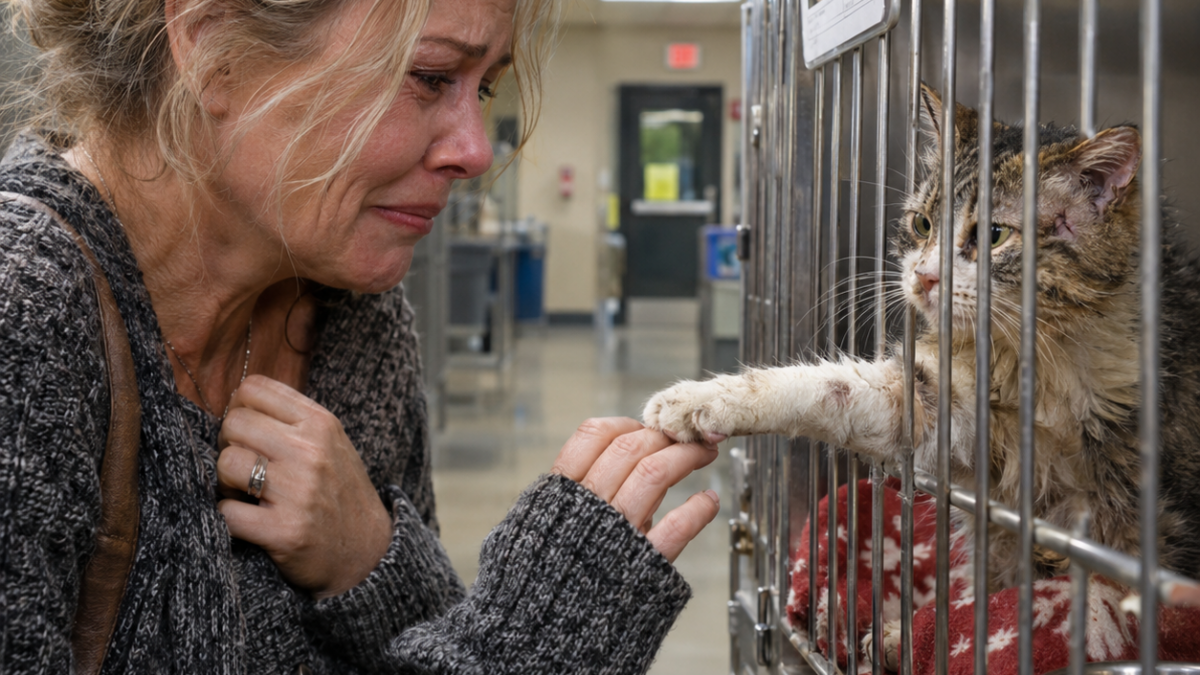
Shelter Cat Bit Everyone Who Tried to Touch Him—Then a Grieving Mother Walked Past His Cage and He Reached for Her
For sixty-three days, the scarred orange cat in Kennel C-12 had hissed, lunged, bitten through two pairs of handling gloves, and earned a red DANGEROUS ANIMAL card that was slowly becoming a death sentence nobody at our overcrowded shelter wanted to say out loud.
Then a forty-two-year-old mother named Mara Collins walked past his cage while looking for a calm cat for her daughter, and the animal who had refused every human hand suddenly pushed one trembling paw through the bars and caught the sleeve of her coat as if he had been waiting specifically for her.
I thought I was witnessing an impossible change of heart, but when Mara whispered a name the shelter had never used and the cat collapsed against the cage door crying, I realized there was a reason he had spent two months fighting everyone who came near him—and finding that reason would force us to reopen an intake file someone had been very eager to close.
My name is Elena Reyes.
I was thirty-nine years old when Jasper arrived at Westfield County Animal Shelter on a freezing Monday morning in January.
At least, Jasper was the name we gave him.
For the first eleven days, he was simply C-12.
Male.
Domestic shorthair.
Orange tabby.
Approximately six years old.
No microchip detected.
No collar.
No known owner.
Found behind a vacant rental house on Willow Street after a neighbor reported hearing a cat screaming beneath the back porch.
That was what the intake sheet said.
It was almost entirely wrong.
I did not know that then.
What I knew was that C-12 hated us.
Not disliked.
Not feared in the ordinary shelter-cat way.
Hated.
The animal-control officer who brought him in had wrapped the carrier in two moving blankets.
When I asked why, he said:
“You’ll see.”
I saw.
The carrier door opened approximately three inches.
An orange paw exploded through the gap.
Claws caught the officer’s glove.
The man jerked backward.
The cat inside screamed with a sound so deep and furious that three dogs in the next room began barking.
“Okay.”
I stepped back.
“Close it.”
The officer shoved the door shut.
“Friendly?”
He looked at me.
“Very.”
I had worked shelter medicine and behavior for almost eleven years.
I knew fear.
Fear hides.
Fear freezes.
Fear swats when cornered.
PART2:
Fear can look vicious if you do not know what you are seeing.
But something about C-12 was different.
He was terrified, yes.
Absolutely.
His pupils swallowed almost the entire visible iris.
His breathing was fast.
His body pressed against the rear wall of the carrier.
But he was not trying to disappear.
He was trying to keep us away.
There is a difference.
I crouched several feet from the carrier.
The cat stared.
One ear was torn.
There was an old scar across his nose.
His coat looked dusty rather than dirty.
Thin, but not starving.
I spoke softly.
“Hey, buddy.”
His mouth opened.
Hiss.
Then growl.
Cats can growl in a way people who do not know cats find surprising.
Low.
Almost canine.
“Okay.”
I did not move closer.
“My name’s Elena.”
PART3:
The officer laughed.
“You introducing yourself?”
“Yes.”
“He doesn’t care.”
“Neither do half the people I work with.”
The cat blinked once.
I waited.
Shelters create urgency.
Kennel needed.
Exam needed.
Vaccines.
Flea treatment.
Blood draw.
Photograph.
Intake.
Everything has to happen because twenty more animals may arrive behind the first.
But frightened animals do not care about your schedule.
If you treat the timetable as more important than the animal, you create problems that follow the animal for weeks.
So we gave C-12 time.
Carrier inside kennel.
Door opened remotely.
We stepped away.
For almost forty minutes, he did not move.
Then one orange paw appeared.
Head.
Shoulders.
He crawled into the kennel.
Not walked.
Crawled.
Body low.
He went directly behind the litter box and pressed himself against the wall.
The carrier stayed.
We covered half the kennel with a towel.
Food.
Water.
No touching.
That was day one.
On day two, he ate only after midnight.
Day three, same.
Day four, our veterinarian Dr. Hannah Price needed at least a limited exam.
She had been doing shelter medicine longer than I had.
Calm woman.
Fifty-one.
Short gray-blond hair.
Hands steady even around the worst fear cases.
We used the least invasive handling we could.
Dr. Price did not reach immediately.
She sat on a low stool outside the kennel.
Looked at him.
“You are very angry.”
C-12 growled.
She nodded.
“Fair.”
I smiled.
She slid a small dish of squeeze treat near the opening using a long spoon.
C-12 watched.
Did not approach.
Dr. Price waited.
“Any history?”
“Found under vacant house.”
“Owner?”
“None.”
“Chip?”
“Initial scan negative.”
“Try again once we can safely handle.”
She studied his posture.
“Pain?”
“Possibly.”
“Teeth?”
“Can’t see.”
“Rear left movement looks stiff.”
I had noticed that too.
The next day, with medication mixed into food and careful low-stress restraint, we finally examined him.
No fresh wounds.
One cracked upper canine.
Old pellet under the skin near his shoulder.
Arthritic change in the left hip that seemed too advanced for his estimated age.
Several healed rib fractures.
And scars.
More than I had seen beneath the fur.
Dr. Price ran her fingers gently along his side while he was sedated.
“Somebody’s been rough with this cat.”
I looked at the x-ray.
“Car accident?”
“Maybe some.”
She pointed.
“These fractures healed at different times.”
I hated that answer.
We vaccinated him.
Drew blood.
Repeated microchip scan.
Nothing.
Photographed him.
Trimmed claws while he was asleep because I knew we might not safely get another opportunity soon.
Then returned him.
When the sedation faded, he woke angry.
Very angry.
A tech named Colby tried changing the water bowl too quickly.
C-12 lunged.
Got his glove.
Did not break skin.
But the incident was documented.
Two days later, another bite.
That one did.
A new volunteer named Leah reached through the bars despite the red warning clipped outside.
She wanted to “show him humans can be kind.”
She needed antibiotics.
After that, shelter director Denise Rollins placed the red card.
CAUTION — HUMAN-DIRECTED AGGRESSION.
Then, in black marker beneath it:
DO NOT HANDLE.
Denise was not an evil woman.
I need to say that before I tell you the rest.
Real life is more dangerous than stories when we flatten people into monsters.
Denise had run Westfield County Shelter for nine years.
She knew the budget.
The county contracts.
The number of kennels.
The calls from taxpayers when a stray dog frightened someone.
The angry families when an animal was euthanized.
The equally angry families when an animal with behavioral history was adopted and later bit someone.
She carried impossible arithmetic every day.
But impossible arithmetic can make people hard.
And hard people can start treating fear like inconvenience.
By week three, Denise wanted C-12 evaluated for disposition.
That phrase means many things.
Transfer.
Behavior rehabilitation.
Long-term foster.
Euthanasia.
I was in her office when she said it.
She closed his file.
“We cannot warehouse one dangerous cat indefinitely.”
“He’s frightened.”
“He bit a volunteer.”
“The volunteer ignored signage.”
“He attempted to bite Colby.”
“He was cornered.”
“Elena.”
She rubbed the bridge of her nose.
“Every aggressive animal has a reason.”
“That doesn’t remove liability.”
“He’s not stalking people.”
“He is charging hands entering his cage.”
“That’s the part adopters tend to use.”
“We haven’t learned anything about him.”
“Sixty-three animals came through intake this week.”
“He’s been here nineteen days.”
“Exactly.”
I understood what she meant.
That was the worst part.
An animal occupying a kennel means another animal may not.
Compassion in shelters gets turned into fractions.
Still, I said:
“Give me thirty more days.”
Denise laughed once.
“For what?”
“To find his baseline.”
“His baseline is teeth.”
“No.”
“His baseline is terror.”
“Difference?”
“Everything.”
She stared.
Then leaned back.
“Twenty-one days.”
“Thirty.”
“Twenty-one.”
I took it.
That was how C-12 entered my life.
Not dramatically.
Not because he chose me.
Because I argued for three more weeks.
I started spending time outside his kennel after my shift.
No reaching.
No staring.
I sat.
Read emails.
Ate crackers.
Talked quietly.
The first evening, he stayed behind the litter box for forty minutes.
Second evening, thirty-two.
By the fifth, he came forward enough to eat while I sat six feet away.
By the eighth, four feet.
By the tenth, he ate squeeze treat from a spoon I held outside the bars.
Progress.
Tiny.
But progress.
I called him Jasper because I was tired of calling an animal by a kennel number.
The name came from his eyes.
Once his pupils relaxed enough to reveal the color, they were amber.
Almost copper.
I said:
“You look like a Jasper.”
He hissed.
“Democracy has limits.”
The name stuck.
Staff began using it.
Jasper.
The terrifying orange cat.
The shelter meme.
People joked.
“Careful. Jasper’s plotting.”
“He knows where you live.”
“Offer him a finger sacrifice.”
I laughed sometimes.
Shelter workers use dark humor because otherwise grief piles too high.
But I also watched how jokes changed behavior.
People approached his cage already expecting aggression.
Fast movements.
Tension.
Eyes on him.
He felt all of it.
Jasper responded exactly as expected.
I tried explaining.
“If you expect him to attack, your body tells him you expect danger.”
One tech said:
“My body expects danger because he attacks.”
Fair.
The loop was difficult.
Then something strange happened.
Jasper started reacting to women differently than men.
Not universally.
He still hissed at me some days.
But male maintenance staff approaching the kennel triggered immediate escalation.
Shoulders high.
Tail low.
Pupils wide.
Growl.
One particular man, Carl, caused Jasper to slam himself against the rear wall.
Carl was sixty.
Gentle.
Never touched him.
Nothing obviously threatening.
I wrote it down.
Another pattern:
Boots.
Heavy boots were worse.
Metal keys jangling near the kennel made Jasper hide.
Raised male voices from the hallway made him freeze.
A broom handle entering his peripheral vision produced instant panic.
History.
Animals do not tell stories with language.
They tell them with reactions.
I began collecting Jasper’s.
Male voice.
Boots.
Keys.
Long objects.
Hands reaching overhead.
He tolerated women sitting sideways.
He liked chicken.
Ignored catnip.
Feared spray bottles.
Did not care about dogs barking.
Interesting.
A cat who survived outdoors but was not bothered by dogs.
More history.
At day thirty-eight, I put a small stuffed fleece square in his kennel.
The shelter had received donated baby blankets.
One had purple stars.
I cut a section.
Jasper sniffed it.
Then did something that surprised me.
He kneaded.
One paw.
Then the other.
Slow.
His eyes softened.
He lowered himself onto the fabric.
First time I had seen him sleep in front of us rather than hiding.
I photographed it.
Sent it to Dr. Price.
She replied:
There’s your cat.
She was right.
For twenty minutes, the “dangerous animal” disappeared.
There was simply an orange cat sleeping on a purple blanket.
I posted a carefully worded adoption profile on the shelter’s internal transfer network.
Experienced rescue needed.
Adult male cat.
Significant fear-based handling sensitivity.
Evidence of progress with low-pressure interaction.
Medical history stable.
No children initially recommended.
Rescue organizations responded.
Two declined.
One said maybe.
A sanctuary three counties away asked for video.
I sent it.
Then nothing.
Shelter rescue is full of “maybe.”
Denise checked the file again.
“This is not sustainable.”
“He’s improving.”
“Can you touch him?”
“No.”
“Then what does improving mean?”
“He eats near me.”
“Elena.”
“I’m serious.”
“So am I.”
She looked toward the kennel wing.
“We have seventeen cats on waiting list.”
“I know.”
“One surrendered this morning because the owner died.”
“I know.”
“Friendly.”
“I know.”
“Adoptable today.”
I hated that word in that moment.
Adoptable.
As if being easy to love made one life more deserving.
I said:
“Jasper is adoptable to the right person.”
“Where is that person?”
I did not know.
Three days later, Mara Collins walked through the shelter door.
She was forty-two.
Brown hair tucked into a loose knot.
Navy wool coat.
No makeup.
Tired eyes.
She came with an eleven-year-old girl named Sophie.
Her daughter.
I was at the front desk because Celia had called out sick.
Mara filled out the adoption questionnaire.
Looking for:
Adult cat.
Calm.
Affectionate.
Good with children.
No significant medical issues.
Exactly the opposite of Jasper.
I asked why a cat now.
Mara looked at Sophie.
Sophie was drawing circles on the edge of the application with her finger.
Mara said:
“Our cat died last spring.”
“I’m sorry.”
“He was nineteen.”
“That’s a good long life.”
“It was.”
Sophie whispered:
“Too short.”
Mara looked at her.
“Yes.”
Then back to me.
“We waited.”
“What was his name?”
“Walter.”
“What kind?”
“Big gray thing.”
Sophie corrected:
“Domestic longhair.”
Mara smiled.
“Yes.”
“Very distinguished domestic longhair.”
We had several good candidates.
Bernie.
Eight-year-old black cat.
Friendly.
Lazy.
Loved kids.
Perfect.
Luna.
Five-year-old calico.
Gentle.
Misty.
Seven-year-old tabby who would sit on anyone with a pulse.
I took them through cat adoption.
Jasper’s kennel was near the end.
I warned them before we reached it.
“Last cat on the left isn’t available for general handling.”
Sophie looked.
“Why?”
“He’s scared.”
“Does he bite?”
“Sometimes when people get too close.”
Mara said:
“We’ll give him space.”
Good.
They met Bernie.
Sophie liked him.
Bernie liked Sophie.
He rolled over.
Purred.
Mara smiled for the first time since arriving.
I thought:
Done.
This is the match.
Then they walked past Jasper.
He was at the back of his cage.
Mara did not stop.
Did not look directly at him.
She simply passed.
Jasper moved.
Fast.
I heard claws against metal.
I turned.
He had crossed the kennel.
Not lunging.
Reaching.
One paw through the bars.
Mara’s coat sleeve was close enough that one claw caught the wool.
She stopped.
I froze.
“Don’t pull.”
Mara remained still.
Jasper’s paw held the sleeve.
Not striking.
Holding.
His eyes were wide.
But not with the usual terror.
He made a sound.
Low.
Broken.
Almost a question.
Mara slowly turned her head.
Saw him.
Something happened to her face.
Not recognition.
Not yet.
Something softer.
“Hey.”
Jasper pressed his face against the bars.
I had never seen him do that.
Not once.
Sophie whispered:
“Mom.”
Mara took one careful half-step closer.
I said:
“Please don’t reach.”
“I won’t.”
Jasper kept his paw on her sleeve.
Then vocalized again.
Mara stared.
And whispered:
“Oliver?”
Jasper collapsed against the cage door.
That is the only word.
Collapsed.
His whole body pressed forward.
Head against bars.
Shoulder.
Chest.
A cry came out of him.
Not a hiss.
Not a meow.
A long broken sound.
Mara’s hand flew to her mouth.
Sophie said:
“Mom?”
Mara whispered:
“Oh my God.”
I looked between them.
“What?”
She knelt.
I moved closer immediately.
“Mara, please don’t put your fingers inside.”
She nodded without looking at me.
“Oliver.”
The cat began rubbing his face against the bars so hard I worried he would hurt himself.
“Oliver.”
Another cry.
Mara started crying.
Sophie stood frozen.
I said:
“Do you know this cat?”
Mara looked up at me.
Her face had gone pale.
“I think…”
She could not finish.
She looked back.
“Oliver?”
Jasper—Oliver—closed his eyes.
Then pushed one paw out again.
This time not at her sleeve.
Open.
Reaching.
Mara held her palm a few inches outside the bars.
He stretched until the pads of his paw touched her skin.
No claws.
The cat who had bitten through handling gloves touched her hand like something fragile.
Sophie began crying too.
“Mom, is that him?”
Mara nodded.
“I think it is.”
I crouched beside them.
“Who is Oliver?”
Mara wiped her face.
“Our cat.”
Silence.
Then:
“Our old cat.”
I looked toward Sophie.
“I thought Walter was your cat.”
“He was.”
Mara stared at the orange cat.
“Oliver belonged to my son.”
I did not ask immediately.
Shelter work teaches you when silence is kinder.
Mara sat on the floor.
Jasper stayed at the bars.
Her hand remained against his paw.
Finally she said:
“My son’s name was Noah.”
Sophie sat beside her.
“Noah was sixteen when Oliver disappeared.”
“When?”
“Three years ago.”
I looked at Jasper.
“You lost him three years ago?”
Mara nodded.
“We thought he was dead.”
“What happened?”
Her eyes stayed on the cat.
“Noah died.”
The hallway seemed to change temperature.
Sophie looked down.
Mara took a breath.
“Car accident.”
“November.”
“Three years ago.”
“Oliver disappeared nine days later.”
I said nothing.
“He was Noah’s cat.”
“Only Noah’s, really.”
“We had Walter before.”
“Oliver showed up in our backyard as a kitten when Noah was twelve.”
“Noah fed him.”
“Against my instructions.”
Sophie almost smiled.
Mara continued.
“Eventually the cat moved in.”
“Oliver slept in Noah’s room.”
“Waited outside the bathroom.”
“Sat on his homework.”
“Followed him everywhere.”
“When Noah died…”
She stopped.
Jasper pushed his paw harder against her palm.
“When Noah died, Oliver spent days outside his bedroom.”
“He cried.”
“Wouldn’t eat unless I carried food upstairs.”
“Nine days after the funeral, a contractor came to repair our back fence.”
“The gate was open.”
“Oliver disappeared.”
“We searched.”
“Posters.”
“Shelters.”
“Microchip company.”
“Everything.”
I looked sharply at her.
“Microchip?”
“Yes.”
“You’re sure?”
“Absolutely.”
“What company?”
“HomeAgain, I think.”
“Name registered as Oliver?”
“Yes.”
“Orange tabby?”
“Yes.”
“Male?”
“Yes.”
I stood.
Jasper watched me and growled.
Mara whispered:
“It’s okay.”
The growl stopped.
That was the second impossible thing.
I went directly to intake.
Pulled his file.
Microchip scan:
NEGATIVE.
Twice.
I brought the handheld scanner.
Mara stayed outside the kennel.
I could not safely scan Jasper awake.
But I could scan through bars around his shoulders.
Slowly.
Beep.
Nothing.
Different angle.
Nothing.
Lower.
Nothing.
Then near the left side of his neck, farther back than normal.
Beep.
I froze.
Scanner displayed a number.
Fifteen digits.
I scanned again.
Same number.
“Dr. Price.”
My voice came out louder than intended.
She stepped from treatment.
“What?”
“Chip.”
“What?”
“Jasper has a chip.”
Mara began crying harder.
Dr. Price grabbed another scanner.
Verified.
The chip had migrated from the normal insertion area down toward the shoulder.
Our original scans had been too quick.
I felt sick.
I called the registry.
Mara gave her name.
Address.
Phone.
Old number.
Noah’s name.
The registry representative confirmed.
Oliver Collins.
Registered owner:
Mara Collins.
Secondary contact:
Noah Collins.
I sat down.
For sixty-three days, we had called him Jasper.
Dangerous.
Unknown owner.
No chip.
Disposition pending.
His family had been eleven miles away.
Mara had stopped checking shelters after nearly two years.
Because what sane person expects a missing cat to appear after three?
She stood outside the kennel with one hand over her mouth.
Sophie whispered:
“Can we take him home?”
That should have been easy.
It was not.
Denise entered.
She had heard enough from the front desk.
“What’s happening?”
I explained.
Her expression moved from surprise to concern.
Then professional caution.
“He has a bite history.”
Mara looked at her.
“He’s our cat.”
“Potentially.”
I said:
“Chip confirms.”
Denise looked at me.
“That confirms registered ownership three years ago.”
“He recognizes her.”
“I see that.”
Mara stood.
“What are you saying?”
Denise used the calm administrative voice I had heard a hundred times.
“I’m saying Oliver has documented aggression during his shelter stay.”
“He was scared.”
“He has bitten staff.”
“Because you were strangers.”
“Mrs. Collins, I’m not accusing you of anything.”
“But we have liability procedures.”
Mara stared.
“You found my son’s cat after three years and you’re telling me I might not be allowed to take him?”
“I am telling you we need to verify circumstances.”
“What circumstances?”
“How he became stray.”
“Whether home conditions are appropriate.”
“Whether there are children—”
Sophie stood beside her.
Mara’s face hardened.
“He lived with my daughter.”
“Three years ago.”
“He never hurt her.”
“His behavior may have changed.”
I stepped in.
“Denise.”
She looked at me.
“We need to slow down.”
“Yes.”
“That is what I’m doing.”
“No.”
“You’re making this sound like Mara is applying to adopt a dangerous unknown cat.”
“He’s hers.”
“We do not know what happened for three years.”
“And keeping him here longer helps how?”
Denise’s eyes narrowed.
“This conversation is not happening in front of the public.”
Mara said:
“I’m the public.”
Denise exhaled.
“Give us an hour.”
Mara looked at Oliver.
He had not left the front of the kennel.
Not once.
She said:
“I’m staying right here.”
No one argued.
We moved into the office.
Dr. Price joined.
So did Celia by phone.
We reviewed everything.
Intake location.
Willow Street.
Found beneath vacant rental.
Microchip missed.
Aggression.
Medical injuries.
Mara’s ownership.
The legal hold had long expired.
There was no active cruelty case.
No reason not to return a proven owned animal except behavioral safety.
Dr. Price said what I was thinking.
“His behavior with Mara is the most regulated I have ever seen him.”
Denise folded her arms.
“He has a child in the home.”
“Sophie is eleven.”
“And?”
“He lived with her.”
“Three years ago.”
I asked:
“What exactly are you proposing?”
“Behavior evaluation.”
“With who?”
“Dr. Feldman.”
“That could take two weeks.”
“Then two weeks.”
I stared.
“No.”
Denise looked at me.
“Excuse me?”
“He has been in a high-stress kennel for two months.”
“You want to test whether he can behave normally by keeping him in the environment causing abnormal behavior.”
“We cannot send a biting cat into a home with a child.”
“Mara is his legal owner.”
“Our county counsel—”
“Then call them.”
She did.
While she called, I went back to Mara.
She was still sitting on the floor.
Oliver had lain down directly against the kennel door.
Mara’s fingers rested against the outside.
He had one paw positioned opposite them.
Sophie sat several feet away.
Not crowding.
I crouched.
“Mara.”
“Are they going to keep him?”
“I don’t know yet.”
She looked at me.
“I won’t let Sophie touch him until we know.”
“I understand.”
“I’ll give him a room.”
“Whatever he needs.”
“I know he may be different.”
“I know three years is a long time.”
Her voice shook.
“But he knows me.”
“Yes.”
“He knows me.”
“Yes.”
She looked toward Oliver.
“Do you know what the last thing Noah asked me about was?”
I waited.
“The cat.”
She swallowed.
“The night before the accident, Oliver had thrown up.”
“Noah said, ‘Mom, if he does it again, can you call the vet?’”
She laughed once through tears.
“Teenage boy.”
“Couldn’t remember to move his laundry.”
“Could remember exactly when his cat threw up.”
Sophie leaned into her mother.
Mara whispered:
“When Oliver disappeared, it felt like losing the last piece of Noah that was still alive in our house.”
I understood then why she had whispered his name before she could logically know.
Memory is not always visual.
Movement.
Sound.
A scar.
The way an animal reaches.
Something in her body recognized him before paperwork did.
Denise came out twenty minutes later.
County counsel agreed ownership was established.
We could not legally treat Oliver as available for adoption.
But Denise required a veterinary release and written safety plan.
Reasonable.
I could live with that.
Dr. Price sedated Oliver lightly to remove him safely from the kennel and perform one complete exam before release.
Mara asked to remain nearby.
We allowed it.
Something extraordinary happened.
When Mara spoke during sedation recovery, Oliver’s heart rate decreased.
Dr. Price noticed first.
“Say something again.”
Mara looked confused.
“Oliver?”
Monitor changed.
Not dramatically.
Enough.
Dr. Price glanced at me.
“Again.”
“Hey, Ollie.”
There.
Lower.
Mara started crying.
“Sorry.”
Dr. Price shook her head.
“Don’t apologize.”
We took new x-rays.
Compared injuries.
Old fractures.
Pellet.
Arthritis.
Mara’s face changed when she saw them.
“He didn’t have those.”
“No.”
“What happened to him?”
“We don’t know.”
I looked at the original intake address.
Willow Street.
Something bothered me.
The house had been listed as vacant.
Why was Oliver living under it?
I pulled the animal-control narrative.
Neighbor complaint.
Cat screaming.
Trapping attempt.
But there was an additional line I had overlooked.
Property owner requested removal after prior occupant eviction.
Prior occupant.
Not vacant for long.
I searched county property records.
The owner was a rental company.
Called.
After some transfers, I reached a manager.
I asked who had occupied the property before January.
He would not tell me.
Privacy.
I explained we were investigating the history of an animal found there and possible cruelty.
He gave me a name after consulting his supervisor.
Raymond Pike.
The name meant nothing to me.
Mara went completely still.
“You know him?”
She nodded.
“My ex-brother-in-law.”
I felt cold.
“Related how?”
“My late husband’s brother.”
“Did he know Oliver?”
“Yes.”
Sophie looked at her mother.
Mara stared toward the exam room.
“Ray lived with us for six months after Noah died.”
I waited.
“He was not doing well.”
“Drinking.”
“Angry.”
“My husband and I had already separated before Noah died.”
“Ray blamed me for everything.”
“Oliver hated him.”
“What do you mean?”
“Hissed.”
“Wouldn’t go near him.”
“Ray said the cat was spoiled.”
“Then Oliver disappeared.”
The room went silent.
I asked:
“Did Ray have access to your house?”
“He was staying there.”
“Was he there the day Oliver disappeared?”
Mara’s face changed.
“Yes.”
Dr. Price stopped writing.
Mara whispered:
“He told me the contractor left the gate open.”
“What contractor?”
“Fence repair.”
“Do you have records?”
“I probably do.”
“Who hired the contractor?”
“Ray said he did.”
“Did you ever speak to them?”
“No.”
The story we had accepted for three years suddenly had another shape.
Mara pulled out her phone.
Scrolled.
Old emails.
Texts backed up.
She searched “fence.”
Nothing.
“Contractor.”
Nothing.
Then Raymond.
Hundreds.
She searched Oliver.
Found a message from three days before disappearance.
Ray:
That cat needs to go. He’s spraying everywhere and scratched me again.
Mara:
He is Noah’s cat. He stays.
Ray:
Noah is gone.
Mara stopped breathing.
Sophie did not see the screen.
I did.
Next message:
Do not ever say that to me again.
Then two days later:
If you’re keeping the animal at least lock him out of the guest room.
The next available message from Mara:
WHERE IS OLIVER?
Ray:
Back gate was open when I got home. Fence guy must’ve left it.
Mara sat down.
“Oh God.”
I said:
“This does not prove anything.”
She looked at me.
“No.”
But her face said she already knew.
We contacted animal control.
The original officer called a supervisor.
Because Oliver had evidence of prior injuries and a specific person now potentially connected to his disappearance, they opened an investigation.
That did not mean Raymond hurt him.
We stayed careful.
Facts.
Always facts.
Oliver was released to Mara that evening.
Getting him into a carrier was easier than anyone expected.
Mara placed the carrier inside his kennel.
Put Noah’s old sweatshirt inside.
She had driven home and retrieved it while we finished paperwork.
The sweatshirt was faded blue.
COLLINS TRACK & FIELD.
Oliver smelled it.
His entire body stopped.
Then he stepped into the carrier on his own.
No sedation.
No force.
He turned once.
Lay on the sweatshirt.
Mara closed the door.
He did not hiss.
Every staff member in the hallway went quiet.
Even Denise.
Mara carried him.
Sophie walked beside her.
Before leaving, Mara stopped at the desk.
“You said he bit people?”
“Yes.”
“Will he bite me?”
I answered honestly.
“Maybe.”
She looked surprised.
“He has been through something.”
“Recognition doesn’t erase stress.”
“Give him space.”
“Let him choose.”
“Keep Sophie from handling him until he settles.”
“Use one room.”
“Call us.”
She nodded.
Then:
“Thank you for not giving up on him.”
I looked toward Denise.
She heard.
So did I.
I thought about the disposition deadline.
How close we had come.
“Just take him home.”
Mara smiled through tears.
“I’m trying.”
Oliver’s first night home was not magical.
That matters.
He did not leap from the carrier and become his old self.
Mara sent updates.
Carrier open in Noah’s old room.
Oliver stayed inside for seven hours.
Ate at midnight.
Used litter at 2:00.
At 4:15, Mara woke on the floor beside the bed.
She had fallen asleep there.
Oliver was sitting three feet away.
Watching.
No touch.
Morning.
Sophie appeared at doorway.
Oliver hissed.
Sophie cried.
Mara called me.
“She thinks he doesn’t remember her.”
“He may.”
“Then why hiss?”
“Because memory and fear can coexist.”
“What do we do?”
“Nothing.”
“Nothing?”
“Let him learn the house is safe.”
Day two.
Oliver left carrier.
Hid beneath Noah’s bed.
Day three.
Mara sat reading.
Oliver came out.
Stayed opposite side of room.
Day four.
He ate while Mara was present.
Day six.
He touched her shoe.
Day seven.
Mara sent a photograph.
Orange paw resting on her ankle.
I showed Dr. Price.
She smiled.
Day ten, Sophie sat outside the room doing homework.
Not looking at Oliver.
He approached the doorway.
Stopped.
Sophie continued writing.
He watched.
Then retreated.
Day twelve, same.
Day fourteen, Oliver walked behind Sophie and sniffed her hair.
She did not move.
That girl had more self-control than most adults.
Day sixteen, he sat beside her.
No touch.
Day nineteen, Sophie woke on the couch with Oliver asleep near her feet.
She texted me from Mara’s phone:
HE REMEMBERS ME.
I saved that message.
Meanwhile, animal control investigated Raymond Pike.
The Willow Street landlord confirmed he had rented the property for nearly two years.
Neighbor interviews produced information.
One neighbor remembered an orange cat arriving with Raymond when he moved in.
Another said the cat often sat in a front window.
A third had seen Raymond yelling at the cat outside.
Nothing criminal by itself.
Then they found something stronger.
The previous tenant after Raymond’s eviction had photographed damage inside the house for the landlord.
One image showed an orange cat hiding beneath a kitchen cabinet.
Date:
Eleven months earlier.
Oliver had been there.
At least that long.
Meaning he had not simply wandered to Willow Street recently.
He had lived with Raymond.
Mara confronted no one.
Police instructed her not to.
But investigators did.
Raymond initially denied knowing Oliver.
Then claimed the cat followed him after he moved.
Then said Mara had given him the cat because she could not handle it after Noah’s death.
Mara had veterinary records, microchip registration, missing reports and text messages proving she was searching.
That story failed.
Then investigators recovered old messages from Raymond’s previous phone backup through a warrant connected to a broader property case.
I did not see every message.
I saw enough later through court records.
A message to a friend dated the day Oliver disappeared:
Finally got rid of Noah’s damn cat. Took him with me. She’ll never know.
Another months later:
Little bastard keeps hiding but he’s useful for mice.
Then one that made me physically sick:
Cat scratched me again. Taught him not to do that.
No details.
None needed.
Combined with veterinary evidence of repeated old injuries, prosecutors had enough to file animal-cruelty and theft-related charges.
The case was not dramatic.
No SWAT team.
No courtroom confession.
Raymond took a plea months later.
Animal cruelty.
Theft of property.
Probation.
Jail time.
Mandatory treatment.
No animal ownership during probation.
Restitution for veterinary expenses.
Some people thought the sentence was too light.
Mara did too at first.
Then she said something I remember.
“I don’t need his life destroyed.”
“I needed somebody official to say Oliver wasn’t his to take.”
That mattered.
Noah had lost his life.
Mara had lost her son.
Then Raymond had taken the animal most closely connected to him because grief and resentment had made cruelty feel justified.
The court record corrected that story.
Oliver belonged to Mara.
To Sophie.
To Noah’s memory.
He had never been abandoned.
Back at the shelter, another problem exploded.
The missed microchip.
Denise called an all-staff meeting.
She was angry.
Mostly at us.
Mostly at herself.
“We scanned him twice.”
I said:
“We scanned the standard placement area.”
“We scanned badly.”
Nobody spoke.
She was right.
The chip had migrated.
That happens.
Rarely enough to create complacency.
We changed policy.
Full-body scan on every incoming animal.
Two scanners if no chip found.
Repeat after sedation if behavior prevents complete initial scan.
Document scanner model.
Document operator.
We also reviewed Jasper’s behavior notes.
Some were awful.
Not false.
Awful in framing.
“Attacks without warning.”
He had warning signs.
“Unpredictable aggression.”
He was predictable around specific triggers.
“Cannot tolerate human contact.”
He tolerated human proximity under conditions.
Language had turned behavior into identity.
Denise removed the red handwritten DANGEROUS card from future use.
Not because danger never exists.
Because warning labels needed description, not judgment.
Instead:
FEARFUL — DO NOT REACH INTO KENNEL.
USE LOW-STRESS PLAN.
SEE BEHAVIOR NOTES.
Specific.
Useful.
One month after Oliver went home, Mara returned.
Without Oliver.
With cookies.
Sophie carried a photo album.
They showed us pictures.
Oliver beneath Noah’s bed.
Oliver on window.
Oliver beside Sophie.
Oliver asleep against Mara’s legs.
Then one photo stopped me.
Mara sitting on the couch.
Oliver on her chest.
His face tucked beneath her chin.
Exactly what the title of his story would become in my memory:
He found a mom.
Mara laughed when I said it.
“He already had one.”
“Fair.”
She looked at the photo.
“I think he had forgotten what that meant.”
Maybe.
Or maybe not.
Animals experience attachment differently.
I refuse to make Oliver into a tiny human.
But I watched the videos.
When Mara entered a room, his body softened.
When she spoke, his ears turned.
When Sophie came home from school, he appeared from wherever he had been sleeping.
He had rebuilt home around them.
Or rediscovered it.
Mara told us something else.
Oliver would not enter Noah’s bedroom closet.
Ever.
The door could be open.
He stopped at the threshold.
Mara did not force it.
Months later, she discovered why.
Raymond had stored his boots in that closet while living with them.
Heavy work boots.
Same kind Oliver panicked around at the shelter.
History again.
Behavior is information.
We had called it aggression.
Oliver had been telling us a story.
We had not known the language.
Mara started volunteering at Westfield.
Not immediately.
About six months later.
One afternoon a week.
Cat socialization.
Naturally.
Her specialty became scared cats.
She was patient.
Too patient sometimes.
She would sit thirty minutes without moving.
I once said:
“You know you are allowed to speak.”
She whispered:
“I’m busy.”
“Doing what?”
“Not bothering him.”
The cat in question eventually came forward.
Mara smiled.
She never told adopters:
“He’ll warm up.”
Because sometimes they do not.
She said:
“Let him decide.”
That became her phrase.
Let him decide.
Oliver had spent years having decisions made around him.
Taken.
Moved.
Handled.
Cornered.
At home, Mara returned choice.
Touch?
His choice.
Room?
His choice.
Approach?
His choice.
Within a year, Oliver became affectionate again.
Not universally.
Men still took longer.
Boots still bothered him.
He hated keys jangling.
He never liked being picked up.
That was fine.
He sat with Mara every night.
Sometimes Sophie.
Accepted Dr. Price with bribery.
No bite incidents after adoption.
Not one.
Denise had a hard time with that.
Not because she wanted him to fail.
Because success forced all of us to confront how environment shapes behavior.
One evening, she stood beside me watching a fearful new cat.
Black female.
Hiding.
Denise said:
“Do you think we almost killed Oliver?”
The question landed heavily.
Technically, no final euthanasia decision had been made.
But we both knew where the path pointed.
I said:
“Yes.”
She nodded.
No defensiveness.
Then:
“That should bother us.”
“It does.”
“Good.”
Denise changed after Oliver.
Not overnight.
Administrators still have budgets.
Kennels still fill.
Hard decisions remained.
But she began asking one additional question during behavior reviews:
“What are we missing?”
Not:
What excuse can we make?
Not:
Save every animal at any cost.
Simply:
What information might explain this?
Sometimes answer:
Nothing.
The animal still required placement we could not provide.
Sometimes explanation opened another option.
Pain.
Sensory loss.
Previous environment.
Trigger.
Bond.
Owner search.
Oliver did not solve sheltering.
He made us more humble.
That matters.
Mara’s life changed too.
I learned more over time.
Noah had been her first child.
Sophie came five years later.
Noah loved horses before Sophie did.
That was why Sophie loved them.
He had taken her to a stable when she was little.
Oliver used to sleep in Noah’s backpack.
Noah played guitar badly.
Wanted to study wildlife biology.
Died at sixteen when another driver ran a red light.
There had been no betrayal.
No reckless secret.
Just an ordinary intersection and one terrible second.
That kind of grief is particularly cruel because there is nowhere useful to put anger.
Raymond had put his somewhere.
At Mara.
At Oliver.
At the world.
That did not excuse what he did.
But it explained part.
Mara told me Raymond had loved Noah too.
Uncle and nephew.
Fishing.
Baseball.
After the death, Raymond drank harder.
Started saying Mara should have picked Noah up that day.
She had been working.
Noah got a ride with a friend.
The friend survived.
Raymond turned grief into blame.
Then Oliver became a living symbol of Noah.
A cat waiting outside Noah’s room.
Crying.
Raymond could not tolerate it.
Mara could.
Barely.
When Raymond took Oliver, he told himself he was helping the household move on.
At least, that was what he later claimed.
Cruel people often rename control as help.
Oliver paid for it.
So did Mara.
For three years, she believed she had failed the cat.
She told me:
“I thought grief made me careless.”
“I thought I forgot the gate.”
“Or didn’t notice something.”
“Every time I saw an orange cat, I looked.”
“Eventually I stopped.”
Sophie had been eight when Oliver vanished.
She remembered putting food on the porch every night for two months.
Mara knew raccoons ate most of it.
She never told Sophie.
One night after Oliver returned, Sophie put a bowl on the porch again.
Mara asked why.
“For the cat who doesn’t have a home yet.”
That became another tradition.
They started supporting a local TNR group.
Not because every story needs to become activism.
Because grief sometimes wants somewhere useful to go.
Oliver became older.
Seven.
Eight.
His arthritis worsened.
Dr. Price started pain medication.
The first time Mara gave it, he bit the pill pocket open, ate the treat and left the pill.
Normal cat.
We celebrated.
The monster of C-12 had become annoying about medication.
Perfect.
I visited once.
Mara invited me for coffee.
Oliver hid when I entered.
I laughed.
“Really?”
Mara said:
“He remembers you.”
“Apparently not fondly.”
“Give him time.”
I sat.
Twenty minutes.
Thirty.
Oliver appeared at the hallway.
Stared.
I did not approach.
He walked closer.
Stopped.
I put my hand on the floor.
Not toward him.
Just there.
He sniffed from several inches away.
Then rubbed his cheek once against my knuckles.
One time.
Walked away.
I cried.
Mara pretended not to notice.
Later she said:
“You know he forgave you, right?”
“I didn’t ask him to.”
“No.”
“He decided.”
Let him decide.
Years after Oliver’s return, Westfield built a small behavior room.
Nothing fancy.
Window.
Chair.
Climbing shelf.
Hide boxes.
Space away from kennel noise.
A donor paid after hearing an anonymized version of Oliver’s story.
We named it the Noah Room.
Mara insisted Oliver’s name not be used.
“People will think he died.”
Fair.
A brass plaque read:
FOR ANIMALS WHO NEED TIME TO TELL US WHO THEY ARE.
That sentence came from Sophie.
She was fourteen by then.
I cried when she showed me.
Denise pretended allergies.
Shelter workers are predictable.
The first cat placed in Noah Room was a tortoiseshell named June.
She had been labeled “feral” after owner surrender.
Three days in quiet space, she crawled into a volunteer’s lap.
Not every case ended that way.
Some remained difficult.
Some needed rescues.
Some could not safely be adopted.
But the room gave us better information.
Oliver had taught us the cost of judging an animal only in crisis.
Mara became one of our best volunteers.
She once met a man looking for a cat after his wife died.
He said:
“I need one who won’t need much.”
Mara replied:
“Then you might need a plant.”
He laughed.
She helped him adopt a twelve-year-old tabby named Beans.
They became inseparable.
Life continued.
That is the strange part after enormous events.
Groceries.
School.
Work.
Vet bills.
Cars need tires.
Sophie entered high school.
Mara changed jobs.
Oliver slept.
The story became less dramatic.
That is what healing should do.
One winter, almost four years after Oliver returned, Mara called me.
Her voice was calm.
Too calm.
“Elena.”
“What happened?”
“Oliver’s at emergency.”
My stomach dropped.
He had stopped eating.
Vomiting.
Ultrasound.
Mass.
Intestinal lymphoma.
Treatable sometimes.
Not curable in the way people want.
Mara pursued treatment.
Not everything.
Enough.
Quality first.
Steroids.
Chemotherapy protocol.
Oliver tolerated it surprisingly well.
He had months.
Good months.
Sunlight.
Sophie’s bed.
Mara’s lap.
Chicken.
One last Christmas.
Then spring.
His decline came quickly.
One Friday, Mara called.
“I think it’s time.”
I left work early.
Dr. Price drove to their house.
Oliver hated clinics.
No reason to make his last hour happen in one.
He lay on Noah’s old blue sweatshirt.
The same one Mara had placed in the carrier when bringing him home.
Sophie was sixteen now.
Same age Noah had been.
That symmetry was almost unbearable.
She sat on the floor.
Mara beside her.
Oliver between them.
I stayed back.
Dr. Price explained everything.
Mara cried silently.
Sophie stroked Oliver’s head.
He had become thin.
Old-looking.
But his eyes were still copper.
Jasper eyes.
I thought of C-12.
Red card.
Teeth.
Growl.
Then this.
Mara whispered:
“You found me again.”
Oliver blinked.
Sophie said:
“He found us.”
Mara nodded.
“Yes.”
Dr. Price gave the first medication.
Oliver relaxed.
His head sank into Mara’s palm.
For a few minutes, we simply sat.
No speeches.
No need.
Then Sophie asked:
“Mom?”
“Yes?”
“Do you think Noah knew Oliver came back?”
Mara closed her eyes.
When she opened them, she said:
“I think if there is any way to know, he knew.”
Sophie nodded.
That was enough.
Oliver died with Mara’s hand under his face.
No fear.
No cage.
No red card.
Home.
Afterward, Mara did something I did not expect.
She took the old purple fleece square from a box.
The one from the shelter.
I had forgotten it.
“How do you have that?”
“You sent it home in his belongings.”
I stared.
She placed it beside Oliver.
“He liked this.”
“Yes.”
“Maybe because it was the first soft thing in there.”
I had no answer.
We wrapped him in Noah’s sweatshirt and the purple fleece.
Mara had him cremated.
His ashes went on a shelf beside Noah’s photograph.
Not replacing.
Joining.
Two lives connected again.
The next week, Mara came to volunteer.
I tried to send her home.
She said:
“No.”
“Mara.”
“No.”
“You just lost him.”
“I know.”
“Take time.”
She looked toward the cat wing.
“I am taking time.”
“With them.”
I let her stay.
That afternoon, she sat outside a kennel containing a terrified brown tabby.
No touch.
No pressure.
Twenty minutes.
Thirty.
The cat came forward.
Mara smiled.
Not a big smile.
Enough.
I watched through the doorway and understood something Oliver had taught all of us.
People like rescue stories because they want a moment.
The cat finally lets someone touch him.
The dog runs into someone’s arms.
The child opens a door.
Moment.
But trust is rarely one moment.
Oliver reaching for Mara mattered because of everything before it.
Noah.
Loss.
Disappearance.
Three years.
Fear.
Sixty-three days at shelter.
Then recognition.
And everything after mattered more.
One room.
One meal.
One night.
One careful introduction to Sophie.
One pill hidden in food.
One vet visit.
One ordinary evening.
Trust rebuilt itself in repetition.
So did Mara.
Oliver did not heal her grief for Noah.
Animals are not medicine.
He gave her something different.
Continuity.
A living thread between before and after.
Then when Oliver eventually died, that thread did not snap.
It had already been woven into something larger.
Sophie.
Mara’s volunteer work.
Noah Room.
Shelter policy.
Me.
Denise.
Every frightened animal whose full body was scanned for a microchip.
Every cat given more descriptive behavior notes instead of a label.
Every person asked:
What are we missing?
One scared orange cat changed systems by being difficult enough that we had to learn.
I sometimes feel guilty saying that because Oliver paid too much for our lesson.
We should have known.
We should have scanned better.
We should have interpreted behavior better.
But guilt becomes useful only when converted into change.
We changed.
Years later, a young technician asked me about the photograph hanging in Noah Room.
Not Oliver.
No animals shown.
Just the brass plaque.
FOR ANIMALS WHO NEED TIME TO TELL US WHO THEY ARE.
She asked:
“Who wrote that?”
“A kid.”
“What happened?”
I told her the short version.
Orange cat.
Aggressive.
Missing.
Owner found.
She said:
“So he was sweet the whole time?”
I shook my head.
“No.”
She looked confused.
“He was scared.”
“He bit people.”
“He had trauma.”
“He was not secretly easy.”
“That’s not the lesson.”
“What is?”
“That behavior has context.”
“And sometimes love does not erase the hard parts.”
“It gives them somewhere safe to exist.”
She thought about that.
Good.
That is the story I wish more people understood.
Oliver was not valuable because Mara transformed him into an affectionate cat.
He was valuable while he was C-12 too.
Growling.
Biting.
Impossible.
His suffering did not make him worthless.
His difficulty did not make him disposable.
At the same time, shelters cannot save every animal indefinitely.
That is reality.
The answer is not pretending there are no limits.
The answer is better information before irreversible decisions.
Scan fully.
Ask questions.
Observe.
Look for pain.
Look for history.
Slow down when you can.
And never confuse:
I do not understand this behavior
with:
There is no reason for this behavior.
Oliver had reasons.
A man had taken him from home.
Years of instability.
Pain.
Hands he did not trust.
Then a kennel.
Strangers reaching.
Gloves.
Keys.
Boots.
Broom handles.
Everything we thought was irrational had roots.
When Mara walked past his cage, one familiar thing entered the room.
Her scent.
Voice.
Movement.
Maybe something else cats perceive that humans do not.
He reached.
I still see that paw catching her sleeve.
If it had missed, would she have continued walking?
Probably.
Would she have adopted Bernie?
Maybe.
Would we have eventually found the microchip before Oliver’s deadline?
I hope.
I cannot promise.
That thought has stayed with me.
Lives turn on seconds.
A claw in wool.
A whispered name.
A scanner held two inches farther down the shoulder.
That is frightening.
It is also why attention matters.
You cannot control luck.
You can improve the chance of noticing.
Mara still comes every Thursday.
Sophie is in college now.
Veterinary science.
Of course.
She claims Oliver had nothing to do with it.
Nobody believes her.
Denise retired last year.
At her farewell party, Mara gave her a small orange ceramic cat.
Denise laughed.
Then cried.
She keeps it on her desk at home.
Dr. Price still practices.
Slower now.
Threatens retirement every winter.
Never does.
I am fifty-four.
Still at Westfield.
More gray hair.
More scars on my hands.
Still occasionally arguing with county administrators.
Some things should remain stable.
Bernie, the cat Mara almost adopted, lived to fifteen with a retired schoolteacher who adored him.
I tell people that because secondary characters deserve endings too.
Sometimes I think about what title people would give Oliver if they only knew the first half.
Dangerous Shelter Cat Nobody Could Touch.
True.
Then the second half:
Until He Found a Mom.
Also true.
But the real story sits between.
He did not “find” a stranger who magically fixed him.
He found his mother again.
The woman who had searched until grief and time convinced her to stop.
The woman whose dead son had once told her to call the vet if Oliver threw up again.
The woman who had spent three years believing the cat had vanished because she failed to protect him.
He found her.
And she found proof that disappearance was not always abandonment.
Sometimes something you love is taken.
Sometimes lost things remain lost.
Sometimes they come back.
Not unchanged.
Not untouched.
But alive.
Oliver returned with scars.
Fear.
Arthritis.
Teeth ready.
Mara did not ask him to become the cat he had been before Noah died.
She loved the cat who came back.
That may be the most important thing she did.
People often say:
“I want the old you back.”
After trauma.
After grief.
After illness.
But there may be no old version waiting.
There is only the person—or animal—who survived.
Love has to meet them there.
Mara did.
The first night Oliver slept on her chest again, she sent me a photograph at 2:11 in the morning.
No text.
Just the picture.
Orange cat.
Eyes closed.
Mara’s hand resting lightly across his back.
I stared at it for a long time.
Then wrote:
Looks like he found home.
Mara replied:
No.
He remembered it.
At the time, I thought she was correcting me.
Years later, I understand both were true.
Home is not always the place you started.
Sometimes it is the place that still recognizes you after everything that happened in between.
Oliver found that.
So did Mara.
And every time a frightened cat enters Westfield now, ears flat, body shaking, ready to fight the first hand that reaches inside, I remember an orange paw slipping through Cage C-12 and catching the sleeve of a woman who had almost walked past.
Then I remind whoever is standing beside me:
“Don’t decide who he is yet.”
“Give him a minute.”
“Let him tell us.”








