She Worked as a Quiet Nurse for 5 Years—Then a Military K9 Exposed Her Combat Past
PART2:
His eyes scanned doorways, corners, hands, belts, shoes, reflective surfaces.
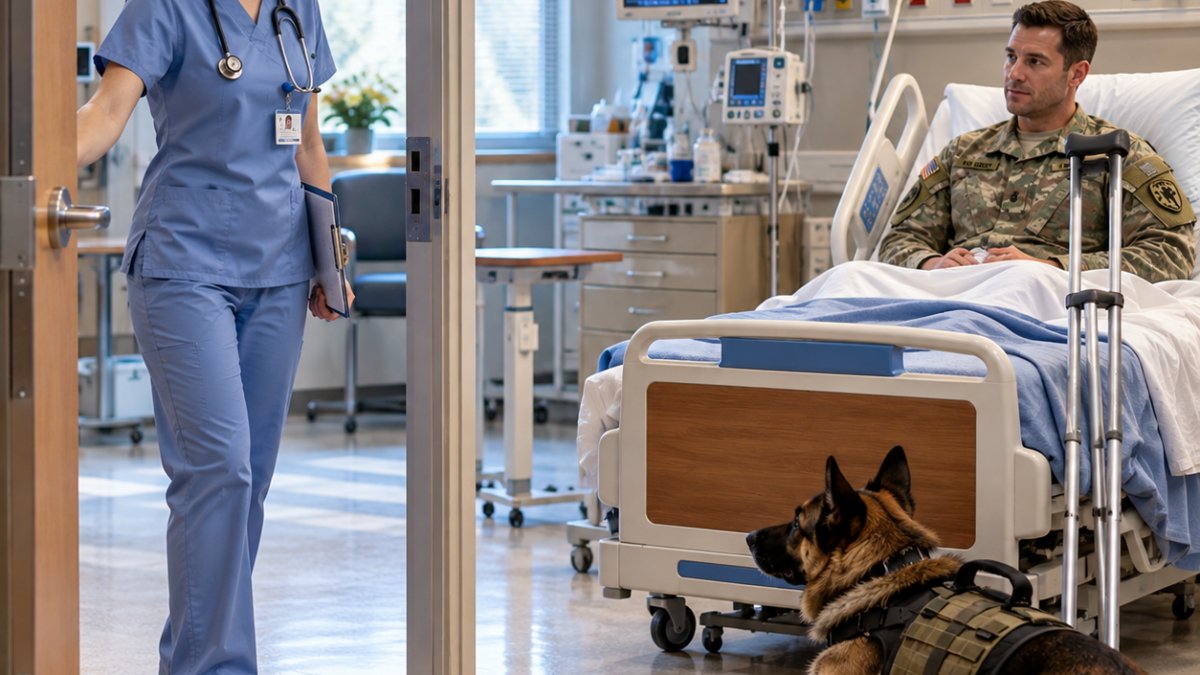
Someone had put a vest on him that said DO NOT PET in large letters.
The orderly was ignoring it.
The man in the wheelchair looked late thirties, maybe forty. He had a bandaged arm in a sling, a taped cut above one eyebrow, and the posture of someone who stayed straight even when seated.
Military, Norah thought.
Then she saw the tab on the dog’s vest.
Army Ranger.
She was already walking toward the nurse’s station when the dog’s head snapped toward her.
She felt it before she registered it.
A shift in the hallway.
A change in pressure.
The old instinct that told her something in the room had locked on.
Norah kept walking.
The Malinois made a low sound.
Not aggressive.
Not warning.
Recognition.
Her spine knew before her mind admitted it.
The charge nurse, Gail Moretti, barely looked up when Norah reached the station.
“Room 14 is yours,” Gail said. “New admit. Ranger. Arm fracture and soft tissue damage. He has a service dog, and administration is already losing its mind, so don’t engage with that unless you have to.”
“Understood,” Norah said.
She stood at the medication cart for several seconds after Gail walked away, staring at a screen she was not reading.
Then she picked up the chart and went to do her job.
His name was Captain Dex Callahan.
Thirty-nine.
Fort Braen.
Currently attached to a unit whose full designation was redacted so heavily it told Norah exactly what kind of work he did.
The radius fracture was clean and already set in the field.
The forearm laceration was deeper, field-dressed, holding for now, but would need monitoring.
Norah knocked twice and entered.
The dog was in the corner.
Someone had moved the guest chair so he had a clear line to the bed and the door.
Smart.
Or trained.
Probably both.
Captain Callahan lay in the bed, eyes open, staring at the ceiling.
“Morning,” Norah said. “I’m Norah. I’ll be your primary nurse today.”
“Great,” he said, in the tone of a man who had been in hospitals before and found them uniformly disappointing.
She checked the monitor, reviewed his vitals, confirmed medication timing, and moved to the dressing on his arm.
Professional.
Methodical.
Quiet.
The dog watched.
Norah heard him stand.
Soft paws on linoleum.
Weight shifting.
Muscle moving under trained restraint.
She did not turn.
She kept her focus on the wound site, the edges of the dressing, the color of the surrounding tissue, the temperature, the swelling.
The dog crossed the room and sat beside her.
Not between her and the patient.
Not in front of her.
Beside her.
Slightly behind her left shoulder.
Exactly where a working dog sat when flanking a handler.
Callahan’s eyes moved from the dog to Norah.
“He doesn’t do that,” he said.
“Hm.”
“With people he doesn’t know,” Callahan said. “He doesn’t do that.”
Norah smoothed a strip of tape down with her thumbnail.
“What’s his name?”
A pause.
“Striker.”
“How long have you worked together?”
“Four years.”
Striker stayed at her left shoulder.
Norah entered notes into the tablet.
The dog followed her two steps and sat again.
Callahan watched all of it.
“What did you do before this?”
“Nursing.”
“Before nursing.”
She looked up.
His expression was not accusatory.
Worse.
It was assessing.
“I went to school,” she said. “Then I worked in a trauma unit in Harland County. Then I came here.”
“Harland County,” he repeated.
“Yes.”
“Small place.”
“That’s why I liked it.”
Callahan looked at Striker.
The dog was still staring at her.
Norah clicked out of the chart.
“Your orthopedic consult is this afternoon. Do you need anything for pain before then?”
For a moment, Callahan said nothing.
Then he looked from the dog back to her.
“No,” he said quietly. “I’m fine.”
By ten o’clock, everyone on the third floor had heard that the Ranger’s dog had reacted strangely to Nurse Voss.
By eleven, Victor Hail had heard.
Victor Hail had been administrative operations director at Callaway for eleven years, which was long enough to learn where the power sat in every room and how to position himself closest to it.
He scheduled meetings to establish dominance.
He read personnel files like a man collecting leverage.
And he had a special resentment for competent women who did not seek his approval.
Norah had bothered him from the beginning.
She had no connections at Callaway.
No noisy social life.
No personnel complaints.
No mistakes worth weaponizing.
No weakness he could put a name to.
For years, he had assumed she was simply boring.
Then the dog reacted to her.
And Victor Hail decided boring had been a disguise.
By noon, he had pulled her employment file.
By two, he had found what he wanted.
A fourteen-month gap.
Between her documented position at a clinic in Morehead and her start at Harland County Regional.
No explanation.
No reference.
Nothing.
A gap was not a crime.
But to a man like Hail, absence was an invitation.
He took the file to HR.
Sandra Briggs, the HR manager, listened with the wary patience of a woman who had survived too many men discovering patterns where their egos wanted patterns to be.
“It could be anything,” Sandra said. “Career break. Family situation. Travel.”
“We require honest and complete employment history,” Hail said.
“There’s no documentation that she falsified anything.”
“There is an unexplained gap in a file that suddenly has a military dog reacting to her.”
Sandra looked at him.
“That is not evidence.”
“It is reason enough to investigate.”
By the end of Norah’s shift, Gail told her administration wanted to speak with her.
Norah nodded, finished a wound care procedure, documented it, and said nothing.
But for the rest of the afternoon, her hands were very still.
Hail’s office sat in a corner room with a window overlooking the staff lot.
His desk was arranged so that anyone sitting across from him sat slightly lower.
Norah noticed immediately.
Sandra sat off to the side with a legal pad.
She looked like someone who had already decided she did not like how this was going.
Hail opened a folder with theatrical care.
“There appears to be a gap in your work history,” he said. “Fourteen months.”
“Yes,” Norah said.
He waited.
She gave him nothing.
“Could you explain what you were doing during that time?”
“I was dealing with a personal matter.”
“Can you be more specific?”
“No.”
Hail leaned back.
“With clinical staff, we have an obligation to verify background history.”
“I haven’t falsified anything.”
“A gap is an omission.”
“The application asked for positions held,” Norah said. “I listed the positions I held.”
“The spirit of the requirement—”
“I’m familiar with the form.”
The room went quiet.
It was not rude.
It was worse.
It had no deference in it.
Hail’s eyes hardened.
“There was also the matter of the service animal in room 14.”
“I assessed a patient,” Norah said. “The service animal was present.”
“The animal reacted to you in a way staff described as unusual.”
“Dogs are unpredictable.”
“Not trained military working dogs. They are very predictable, which means deviation is meaningful.”
Norah said nothing.
“I am recommending a temporary reassignment while HR reviews your file,” Hail said. “Administrative support, effective tomorrow.”
“Administrative support.”
“Yes.”
“And if I decline?”
“Then I’ll recommend suspension pending investigation.”
Norah stood.
“Fine. Administrative support.”
At the door, she stopped and looked not at Hail, but at Sandra.
“Make sure you document this conversation accurately,” she said. “All of it.”
Then she left.
In the parking garage, Norah sat behind the wheel of her old Civic with the engine off and watched orange light cut through the concrete gaps.
Six years.
Six years of careful work.
Careful living.
Careful silence.
She had chosen Callaway because it was stable, practical, and connected to military patients without being important enough to draw much attention.
She had learned the staff rhythms.
The surgeons who read charts.
The attendings who cut corners.
The nurses who were stronger than they believed.
She had learned to like gas station coffee.
And now a dog had ruined it.
Not Striker’s fault.
She knew that.
Striker had recognized her the same way she had recognized him.
Through a grammar of training built below conscious thought.
She had worked with a Malinois named Hector once.
Eleven months.
An assignment that still did not officially exist.
She had not thought about Hector in years.
She had gotten good at not thinking about a lot of things.
Her phone buzzed.
Unknown number.
She let it ring three times.
Then answered.
“Still driving that old Civic?” a woman said.
Norah’s throat tightened.
“Who is this?”
“It’s been a long time.”
Norah went completely still.
“I know,” the woman continued, “but we have a problem. And your problem is going to get bigger before it gets smaller.”
“I don’t know who you are.”
“Captain Dex Callahan was not in that convoy by accident,” the woman said. “And Striker didn’t find you by accident either. Someone sent them.”
The parking garage was very quiet.
“I need forty-eight hours,” the woman said. “Don’t run. Don’t do anything stupid. And for the love of everything, do not let Victor Hail get into your sealed file.”
“I don’t have a sealed—”
Norah stopped.
“You do,” the woman said. “You’ve had one for six years. You just didn’t know it was there.”
Then the line went dead.
Norah sat there until the garage light shifted from orange to gray.
When she finally started the car, it was full dark.
The next morning, administrative support turned out to be a closet-sized room on the second floor with a desk, a computer, and a stack of patient comment forms no one had touched in months.
Her assignment was digitizing them.
It was so far removed from clinical care that it felt like punishment expressed in paper.
Norah sat down and scanned.
She was good at waiting.
At 10:15, raised voices moved through the hallway.
Clinical voices.
Not administrative.
Tobias, a third-floor nurse, rounded the corner half-running and saw her.
“You’re not supposed to be on the floor.”
“I’m not on the floor.”
“There’s a situation upstairs.”
She was already standing.
“What kind?”
“Room 14. Callahan. Vitals are going sideways. On-call doc is stuck in a procedure. Secondary team is five minutes out.”
She took the stairs.
“What’s the presentation?”
“BP dropping. Diaphoretic. Restless. Could be bleeding.”
When Norah entered room 14, Callahan was conscious but wrong.
Gray undertone.
Shallow breathing.
Sweat at the hairline.
Striker stood at the foot of the bed, rigid, watching her like he had expected her.
Norah went straight to the arm.
“When was the dressing changed?”
“This morning,” one of the nurses said.
“By who?”
A pause.
“I did it. Per protocol.”
Norah gently pressed near the wound edge.
Callahan hissed.
“Compartment pressure,” she said. “Call surgical. Possible compartment syndrome in the left forearm. Pressure check immediately.”
The room moved.
Norah checked the IV rate.
“Who ordered this fluid rate?”
“Attending last night.”
“Increase it. Get the attending on call. Dex, stay with me.”
Callahan looked at her.
The fog of dropping pressure moved through his eyes.
So did something sharper.
“Yeah,” he said. “I’m here.”
“You tell me if the pain changes in your hand or fingers.”
“It’s already—”
“Fingers?”
He looked at her.
Then nodded.
“Okay.”
Norah turned to the room.
“This needs surgical in the next twenty minutes or we risk permanent damage. Everyone clear?”
Eight minutes later, the surgical resident arrived, checked him, and did not waste time arguing about who had identified it.
“Good catch,” he said.
Norah said only, “The dressing change may have missed early signs.”
Callahan watched her.
“You knew what it was before he checked.”
“I had a differential.”
“No,” he said. “You walked in and you knew.”
She entered notes on the tablet.
“Where did you train?” he asked.
“Nursing school.”
“Not nursing.”
Norah left before he could ask anything else.
Back in the administrative closet, she picked up the next comment form.
Her hands were still steady.
Inside, something was building.
Pressure before rupture.
At two, Victor Hail walked in without knocking.
He had made inquiries, he said.
Her old reference from Morehead was unreachable.
Her public records were thin.
No property records.
No professional footprint.
Almost no trace before Harland County.
“You’re an absence,” he said, satisfied.
Norah looked at him.
“I am a private person.”
“You are being placed on administrative leave effective immediately. Badge access suspended. Surrender your badge to security.”
“Does Sandra Briggs know about this decision?”
“This is within my authority.”
“I want that documented.”
“It will be.”
She picked up her jacket.
At the door, she stopped.
“Victor.”
He looked up.
“Whatever you think you found, it is only the surface.”
A pause.
“Surfaces are designed to be found.”
Then she walked out.
Her phone buzzed in the elevator.
Unknown number again.
Three words.
It’s starting tonight.
That night, in her apartment, Norah opened a flat military case from the second bedroom closet.
Inside was a phone she had not turned on in three years.
A small notebook written in shorthand no one else would understand.
And a laminated identification card with a different name on it.
A name she had not used in six years.
She called the unknown number back.
The woman answered on the second ring.
“Tell me about the file,” Norah said.
“It is a JAG-adjacent record from six years ago,” the woman said. “Filed by someone inside the oversight structure that ran your last operation. It documents that you were extracted and relocated.”
“Who filed it?”
“Someone trying to protect you.”
A pause.
“Or someone who can hurt you very badly, depending on how the next forty-eight hours go.”
The name came later.
Garrett Fulsy.
A man Norah knew should not be anywhere near Victor Hail.
By late morning the next day, Fulsy was inside Callaway.
Civilian clothes.
Gray jacket.
Still face.
He went directly to administration.
By noon, Norah had heard enough from outside a conference room door to know this was no HR issue.
Oversight record.
That phrase belonged to a world she had buried.
At 12:30, her phone buzzed.
Fulsy is in the building.
Don’t react.
Don’t move.
Then another message.
He’s going up.
Room 14.
Norah was out of the administrative closet before she made the conscious decision.
She reached the third floor fast.
Room 14’s door was closed.
Inside, Callahan sat up in bed, tablet in his lap, Striker at the foot of the bed.
No one else.
“You look like you ran here,” Callahan said.
“I walked fast.”
“Your badge access is suspended.”
“I’m aware.”
“So you’re not supposed to be on this floor.”
“Also aware.”
She stepped inside and closed the door.
Striker came to her left shoulder.
This time, Norah put her hand on his head without thinking.
His tail moved once.
Callahan saw it.
“Someone is coming to see you,” she said. “Or they’re about to. Gray jacket. Fifties. Very still face.”
Callahan went still.
“What do you know about that?”
“Nothing. I’m asking you to be careful.”
“Nora.”
He said her name carefully.
“Sit down.”
“I can’t stay.”
“Sit down.”
She sat.
Callahan watched her.
“You knew Striker’s recognition signal. Your whole body responded, then you shut it down. That isn’t something you can fake.”
Norah said nothing.
The door opened.
Garrett Fulsy entered.
His eyes went to Norah first.
Then Callahan.
“Captain.”
“Mister Fulsy,” Callahan said.
The fact that he knew the name landed in the room like stone in water.
Fulsy produced a folded document.
“I filed that record six years ago,” he said. “I’m the one who sealed it.”
Norah looked at the paper.
She did not touch it.
“Why?”
“Because the operation that ended your career was not sanctioned,” Fulsy said. “And because three people died due to decisions made above your level and blamed on you.”
His voice remained flat.
Careful.
“And because I was the person who signed off on those decisions.”
The room went completely still.
“What kind of problem do we have?” Norah asked.
“The kind that means the people I was protecting you from now know where you are.”
Fulsy looked at Callahan.
“Dex didn’t know. He was told this transport was a welfare check on a former operative. He had no reason to question it.”
“But Striker found her,” Callahan said.
“Which means someone knew she would respond.”
“Yes.”
“Someone other than you knows what she is.”
“Yes.”
Norah unfolded the document.
The name at the top was not Norah Voss.
It was the name she had stopped being six years ago.
For a moment, she felt as if someone had knocked through drywall and exposed a load-bearing wall she had pretended was gone.
“How long do we have?” she asked.
Fulsy checked his watch.
“A vehicle left a location forty miles north about three hours ago. Based on the call Hail made this morning, I believe he told them you were here and that your access had been restricted.”
“What are they coming for?” Callahan asked.
Norah already knew.
She was the only living witness still quiet enough to control.
“They’re coming to make sure I stay silent,” she said.
Striker’s head turned toward the corridor.
His ears went forward.
The door handle moved.
Norah was already against the hinge-side wall before it opened.
Hands empty.
Body flat.
Every object in the room cataloged.
IV stand.
Chair.
Monitor cart.
Distances.
Angles.
The door opened.
Tobias stood there.
He looked at Callahan sitting rigid on the bed, Fulsy at the window, Striker coiled near the footboard, and Norah pressed against the wall beside him.
His face went through four different expressions in under one second.
“What is happening?”
Norah stepped away from the wall.
“What are you doing here?”
“Hail is looking for you,” Tobias said. “He knows you’re on the floor. Security is coming.”
Norah looked at Fulsy.
Then at Callahan.
Then back to Tobias.
“I need you to go downstairs. If Hail asks, you did not find me.”
“I’m not asking you to lie,” she said. “I’m asking you to take thirty minutes before you say anything.”
Tobias stared at her.
“Are you in danger?”
The question deserved honesty.
“I don’t know yet,” Norah said. “Possibly.”
He nodded once and left.
Moments later, the hospital PA sounded.
Code Silver.
Workplace violence.
Active threat.
Shelter in place.
Two people in scrubs appeared at the far end of the third-floor corridor, moving toward the medication room.
Their clothes were right.
Their movement was wrong.
People who worked in hospitals moved with a consciousness of space, bodies, beds, carts, lines, cords, and urgency.
These two moved like people imitating that awareness.
“They’re not staff,” Norah said.
Callahan was already getting out of bed.
“You are not doing this,” Norah snapped.
“I’ve operated in worse condition.”
“So have I.”
That sentence sat between them with its full weight.
Callahan looked at her.
Striker watched the door, waiting.
Norah turned to him and gave a flat-palmed hand signal.
Hold.
Striker sat immediately.
Callahan was silent for one second.
Then said, “He’s accepted you.”
Norah picked up the IV stand, collapsed it to its shortest configuration, and opened the door.
The man and woman in scrubs were fighting the medication room lock with nearly correct badges.
Nearly correct was often more dangerous than obviously wrong.
“Medication rooms are on bypass during Code Silver,” Norah said calmly. “You’ll need the charge nurse to override it.”
The man looked up.
The woman turned.
“Which unit are you from?” Norah asked.
Neither answered.
She kept walking.
At ten feet, she saw their decision forming.
The woman stepped into her path.
Controlled.
Deliberate.
“We just need to find the patient in room 14,” the woman said.
“Room 14 is back the other way.”
“He’s not in his room.”
“I can check with the station.”
The woman moved around her.
Norah stepped the same way.
A casual obstruction.
Accidental, if anyone later asked.
The woman stopped.
Behind Norah, the east maintenance door opened.
One.
Two.
Striker came through.
Not running.
Not charging.
Walking.
A working pace.
He placed himself between Norah and the two impostors.
He made no sound.
He did not need to.
The man took one step back.
The woman froze.
Military working dogs had a reputation among people who had seen them in the field.
The reputation was accurate.
“I’ll find someone to help you locate the patient,” Norah said in the same calm tone. “Wait here.”
She backed away three steps, then turned toward the nursing station.
Striker fell in at her left shoulder.
She picked up the phone and called security.
Not because security would solve it fast enough.
Because the call would be logged.
Timestamped.
On camera.
The two impostors disappeared toward the stairwell.
Norah hung up.
She looked down at Striker.
“Okay,” she said. “Let’s find them.”
They found Callahan and Fulsy in the service corridor two floors down.
A forced door.
A cracked frame.
Fulsy bleeding above one ear.
Callahan on one knee, pale and fighting gravity with stubbornness he did not have enough blood pressure to support.
“I’m fine,” he said before Norah could speak.
“You are not fine.”
“They didn’t get the drive,” Callahan said.
His good hand was clenched tight.
Norah helped him upright.
Striker positioned himself on Callahan’s other side, steady and deliberate.
Not like an animal.
Like a colleague.
Fulsy looked at Norah.
“I’m sorry,” he said.
“For what it is worth at this point.”
Norah held his gaze.
There were a lot of things she could have said.
She chose one.
“Help me get him upstairs. Then you can be sorry.”
On the stairs, they met Margot.
The woman from the phone.
Small.
Dark-haired.
Civilian clothes.
Moving with careful speed.
Fulsy knew her.
Norah knew her voice.
Margot had bad news.
Two impostors were in custody.
The case number was active.
The testimony Norah had given to a federal contact was now in the system.
But Victor Hail was not in his office.
His car was still in the lot.
And twelve minutes earlier, he had made a call.
The transcript ended with a location.
Room 14.
Norah moved before anyone finished speaking.
Striker beat her to the door.
Inside room 14, Victor Hail stood at the bedside with the drawer open, holding a sealed patient valuables envelope.
The bed was empty.
Callahan had been gone for at least twenty minutes.
Hail looked up.
For one second, his expression went blank.
Then authority rebuilt itself on his face.
“Voss,” he said. “You are not authorized to be on this floor.”
“Put the envelope down.”
“This is hospital property.”
“Victor.”
She said his name softly.
Flatly.
“Put it down.”
He set the envelope on the table.
Margot entered behind Norah, phone raised, recording or transmitting or both.
Inside the envelope was a folded page and a USB drive.
Not Fulsy’s.
Another one.
Labeled with a file code Norah recognized from systems she had never been meant to see.
She looked at Hail.
“You had a copy.”
He said nothing.
“All this time,” she said.
His silence turned dense.
Legal.
“You were not placed here to manage situations like me,” Norah said. “You were placed here to protect this.”
Hail’s face hardened.
“I want a lawyer.”
“That is your right,” Margot said. “And you can have one.”
Then she lowered the phone slightly.
“But federal investigators entered the building six minutes ago. What you do in the next thirty seconds will matter considerably.”
Hail looked at the door.
At Norah.
At Striker.
At the drive on the table.
The performance collapsed.
Without the desk, the title, the file folder, or the chair designed to make people sit lower, he looked suddenly smaller.
Not harmless.
Just human.
A man who had made decisions he could not unmake and maintained them until the cost finally came due.
“Sit down, Victor,” Norah said.
He sat.
The investigators arrived quietly.
No dramatic shouting.
No weapons drawn.
No spectacle.
Just credentials, documentation, and the weight of institutions finally moving.
The lead investigator, Reyes, introduced herself to Norah with a firm handshake and the look of someone who had already read enough to know this would not be simple.
“We have your testimony on record,” Reyes said. “The case number is active. Everything from here is documented in real time.”
Norah handed her the drive.
“It’s been a complicated morning,” she said.
The next hours happened in pieces.
Hail’s drive turned out to be a parallel record.
His own archive.
His own justification.
A confession that did not understand it was a confession.
Fulsy’s evidence filled other gaps.
Norah gave her statement again.
Dates.
Locations.
Sequence.
Orders.
Names.
The falsified after-action report.
The original report.
The three people who died.
The silence afterward.
Callahan gave his statement too.
So did Margot.
Hail, now accompanied by a lawyer, announced he would cooperate.
Cooperation.
The word people used when alternatives had closed.
Later, after the first formal session ended, Norah went to the third-floor family waiting area and sat by the window.
For five minutes, she was alone.
Then Callahan came in with Striker.
He had walked the length of the corridor with a broken arm and unstable blood pressure.
Norah chose not to comment.
He sat beside her, not across from her.
Striker put his chin on her knee.
“You okay?” Callahan asked.
Norah looked down at the dog.
“I don’t know yet.”
It was the most honest answer she had given anyone in a long time.
“Fair enough,” Callahan said.
Then, quietly, “I was used. Someone knew Striker’s training profile. Someone knew your background. Someone put us in the same building because they needed confirmation you were still here.”
Norah looked out the window.
The flags at the hospital entrance were moving in the cold wind.
“I was hiding,” she said. “And I don’t think being good at the work made that less true.”
Callahan nodded.
Not agreement.
Acknowledgment.
Then Margot entered with another message.
The senior oversight figure Norah had named in her testimony had resigned forty-five minutes earlier.
His resignation included a statement naming three others and describing years of operational misconduct.
“He broke,” Callahan said.
“People do,” Norah answered, “when the math stops working.”
Reyes brought one more revelation.
The sealed file had not been accessed by Fulsy.
Not by Hail.
Not by the oversight body.
Someone outside the framework had pulled it through an old database connection, copied it, and sent it to a watched contact.
The access code belonged to someone listed as deceased in the aftermath of the operation six years ago.
One of the three dead.
Norah went very still.
A memory moved inside her.
Petra Vain.
The third medic on the team.
Reported dead two days after the operation.
Internal hemorrhage.
Norah had never seen the body.
She had been relocated the morning after.
Reyes handed her the sealed document.
Norah unfolded the bottom section she had missed before.
Four handwritten words.
Dated five days ago.
She’s ready. Start it.
The signature beneath was small.
Careful.
Unsteady, like someone who had not written by hand in a very long time.
Norah knew the name.
“Petra Vain,” she said.
Callahan looked at her.
“Someone who should be dead.”
Norah went to the roof.
The hospital roof was cold, flat, and full of ventilation units, with a low concrete barrier facing the western edge of Duran and the brown ribbon of river below.
She sat with her jacket pulled tight and thought about Petra alive.
Six years of silence.
Six years of hiding.
Six years of letting Norah grieve her.
Six years of building a mechanism strong enough to make the truth surface.
The roof door opened behind her.
Norah did not turn right away.
She listened.
Light steps.
Quick.
Confident.
Not Callahan.
Not Reyes.
Not Fulsy.
Norah turned.
Petra Vain stood six feet away.
Thinner than she had been.
Hair different.
Jacket too large, the way Petra had always worn jackets because she ran cold and hated admitting it.
For a long time, neither woman spoke.
The wind moved between them.
“You cut your hair,” Petra said finally.
Her voice was exactly the same.
“You died,” Norah said.
“I didn’t do it on purpose.”
A pause.
“I did. But not the way they said.”
Norah stared at her.
“They told me internal hemorrhage.”
“I know what they told you.”
Petra stepped closer and stopped again, hands visible.
“Bad enough they thought I would die. When it became clear I wouldn’t, it was more useful to certain people for me to be dead than talking. So they faked it. I had two choices. Disappear the way they wanted me to, or disappear a different way.”
“You chose the different way.”
“For six years.”
“Alone?”
Petra’s face shifted.
“Mostly.”
Norah felt grief move through her in the wrong direction.
Not because Petra was dead.
Because she was not.
Because the person Norah had mourned had been alive somewhere, working, hiding, watching, waiting.
“Why now?” Norah asked. “Why not a year ago? Three years ago?”
“Three years ago, I didn’t have enough.”
Petra held out an unmarked drive.
“One year ago, I didn’t have this. Communication records from the forty-eight hours before the operation. They show who gave the final positioning order and who knew the intelligence was compromised before they sent us in.”
Norah looked at the drive.
Did not take it yet.
“I was waiting for Fulsy to finish what I knew he was building,” Petra said. “When he sealed your file, I knew he would try to fix it eventually. I needed his documentation strong enough that mine would close the gaps.”
“You coordinated with him?”
“Indirectly. He did not know I was alive.”
Petra looked toward the roof door.
“I came up here first because once I go downstairs, this becomes procedural. I needed to see you first.”
Norah’s voice came carefully.
“How did you know I was ready?”
Petra was quiet for a moment.
Then said, “Because you stayed.”
Norah looked at her.
“You could have run a dozen times in six years,” Petra said. “You had the training. You had the resources. There were moments when running would have been rational.”
She stepped closer.
“But you built something here. You put your hands on people who needed you. You showed up every shift. You made yourself matter to this place even while pretending to be invisible.”
A pause.
“That is not someone still hiding. That is someone ready to stop.”
Norah looked out over the city.
For six years, she had told herself she was living.
Maybe she had been.
But she had also been shrinking.
Making herself quiet.
Useful.
Small.
She had saved people without letting them know who was saving them.
She had been brave in pieces.
Petra had trusted that the pieces were enough.
Norah took the drive.
“Come on,” she said. “Let’s go downstairs.”
The weeks that followed did not deliver justice in one clean moment.
They delivered it in records.
Statements.
Hearings.
Suspensions.
Terminations.
Federal review.
Victor Hail was removed from Callaway.
His clearance was revoked.
The impostors in scrubs were held for questioning.
Roland Deech, the senior oversight figure whose name appeared in Petra’s communication records, resigned and became the subject of federal misconduct review.
The public announcement was plain.
A classified operation had been mismanaged.
Consequences had been concealed.
People responsible had been protected by institutional relationships that were now severed.
Norah read the announcement twice at her kitchen table.
She did not cry.
She did not celebrate.
Justice was too clean a word for this.
People had died.
Years had passed.
Petra had lost six years to a false death.
Norah had lost a version of herself she was still trying to understand.
But the thing had been named.
That mattered.
Petra’s return to life took longer.
The official correction was three lines in a document most people would never see.
Three lines for six years.
The human version was messier.
Phone calls.
Silences.
Arguments that were not really arguments.
A two-hour conversation about the night of the operation that left both women exhausted and lighter than before.
Two people who had carried the same thing separately now learning, awkwardly, how to carry it together.
Callahan’s review board cleared him.
His transport order had been processed through a compromised channel.
His arm needed hardware.
His recovery was slower than he wanted and faster than his surgeon expected, which Norah found typical.
He called six days after surgery.
“How’s the arm?” she asked.
“Full of metal and personally offensive in cold weather.”
“You live in a cold climate.”
“I know. It is a problem.”
A pause.
“Striker wants to know when he is going to see you again.”
“Striker has a phone?”
“He’s using mine. Very resourceful.”
Norah leaned against the corridor wall outside room 14, where a new patient now recovered from joint surgery.
“How is he actually?”
“Good. Reduced schedule while I recover. He is not handling it gracefully.”
A pause.
“Neither am I, honestly.”
Norah looked down the hall.
“What happens when leave ends?”
“Depends on a few things I’m figuring out,” Callahan said. “What about you?”
The answer came the next morning.
Dr. Pauline Ash, the hospital director, did not offer Norah an apology wrapped in performance.
She offered work.
A formal trauma preparedness program.
Not a compliance slideshow.
Not annual training that everyone clicked through.
A real program.
Scenario-based.
Interdisciplinary.
Built around degraded resources, multiple patients, communication failures, field medicine integration, and the kind of emergencies civilian hospitals pretended could be made orderly if the paperwork was right.
Ash wanted Norah to design it and lead it.
Real authority.
Training budget.
Permission to pull staff across units.
Norah listened to the full proposal before speaking.
“I’m not interested in this as compensation.”
“I know,” Ash said.
“I’ll take it because the work is worth doing.”
“I would expect nothing else.”
“I’ll need operational authority. Not advisory authority.”
“That is what I’m offering.”
Norah looked out the window.
She thought of Tobias, young and good, still rough because no one had given him the right tools yet.
She thought of the nurses who did not know what they did not know.
She thought of Petra fixing a chest wound with material from a vehicle dashboard and arguing it should become standard training.
Petra had been right.
“Yes,” Norah said. “I’ll do it.”
Ash extended her hand.
“Welcome back, Norah.”
Not welcome here.
Welcome back.
That was the part that mattered.
Six weeks later, Norah ran the first training session in the simulation lab.
Eight nurses.
Two residents.
One skeptical attending who had clearly been voluntold and arrived looking like a man serving a sentence.
Norah built the scenario herself.
Multi-patient trauma.
Limited supplies.
Bad information.
Communication breakdown.
The kind of thing real emergencies gave you while training manuals pretended they would not.
She ran them through once without stopping them.
Then stood at the front of the room.
“Everything you just did wrong can be corrected,” she said. “What I saw was not incompetence. It was the gap between what you know and what you have practiced.”
She looked at the attending.
“The gap closes. That is why we are here.”
They ran it again.
The second time was not perfect.
Nothing was.
But it was faster.
Cleaner.
And three choices changed the outcome.
Striker came to the first session with Callahan, who had returned to Duran two weeks after medical leave officially ended and had not offered a comprehensive explanation for why.
Norah had not asked for one.
Striker sat at the back of the simulation lab, watching controlled chaos with professional interest.
During the debrief, one of the nurses asked, “What is his role?”
“He’s observing,” Callahan said.
“Does he do anything?”
“He already did the important part,” Callahan said.
He looked at Norah.
Norah looked back.
Nothing needed to be added.
Later, after the room cleared, Norah stood by the simulation lab window.
The city below was lighting up for evening.
Callahan stood across the room with Striker beside him.
For six years, Norah had made herself small enough not to be seen.
Partly from necessity.
Partly from fear.
Partly from grief disguised as practicality.
Grief for the people who died.
Grief for the person she used to be.
Grief for the life rerouted by decisions made above her and buried under language no one was supposed to question.
The thing about hiding was that it cost the same every day.
Whether you were hiding from something real or from the fear of something that might happen.
It shaped the good things too.
It had lived in the background of every shift she worked, every patient she helped, every moment she allowed people to believe she was simply a quiet nurse who happened to be good in a crisis.
She was more than that.
She had always been more than that.
The hiding had not changed it.
It had only made her the only person in the room who knew.
That was over now.
Striker crossed the lab and sat beside her at the window.
He did not ask for anything.
He was just there.
Warm.
Solid.
Certain.
Not performing comfort.
Simply offering it by existing in the same space.
Norah placed her hand on his head.
Outside, the flags at Callaway Veterans Medical Center moved in the cold air.
Inside, monitors beeped, elevators opened, nurses moved, patients healed, families waited, and the hospital went about the ordinary, necessary work of keeping people alive.
Norah was exactly where she was supposed to be.
Not because anyone had given it to her.
Because she had stayed when leaving would have been easier.
Because she had told the truth when silence would have been safer.
Because even after six years of pretending to be invisible, she had never stopped being the kind of person who ran toward the thing that needed doing instead of away from it.
That was the part no one could take.
Not Hail.
Not the people above him.
Not the operation that tried to erase her.
Not the years she spent quiet.
Underneath all of it, she had remained intact.
Still there.
Still trained.
Still steady.
Still Norah.
She had always known it.
Now everyone else did too.








