She Woke Up From Surgery and Her 3 Kittens Were Gone — What She Did Next Changed 11,000 Shelters Forever
PART3:
But they were not completely dependent on milk.
Our adoption coordinator had also been receiving applications for kittens nonstop.
Spring.
Kitten season.
The building was full.
Every foster home was full.
Every cage seemed to contain tiny eyes and oversized ears.
Three healthy kittens could move into homes quickly.
That mattered.
Every kennel freed meant another intake we could accept.
That was the pressure underneath everything.
Not money alone.
Space.
Always space.
Willow went to surgery shortly after eight.
I helped transfer her.
Her kittens remained in the maternity unit.
She called to them once from the carrier.
The gray tabby answered.
I remember that because I said:
“Don’t worry, Mom. You’ll see them later.”
I wish I had not said it.
Not because I believe Willow understood the sentence.
Because I did.
And I was wrong.
Her surgery was uncomplicated.
Routine.
Anesthesia.
Spay.
Monitoring.
While she was under, a family arrived for the white-and-gray female kitten.
They had already been approved.
Another approved adopter arrived shortly afterward.
Then a foster-to-adopt placement opened for the third kitten.
The adoption coordinator looked at the schedule.
Then the cages.
Then the applications.
All three kittens had safe placements.
Today we would have paused.
Back then, we did not.
Nobody said:
“Let’s wait until Willow is awake.”
Nobody said:
“She is still actively mothering.”
Nobody said:
“Maybe let them leave gradually.”
The kittens were medically cleared.
They were eating independently.
The adopters were prepared.
The paperwork was correct.
So one by one, the kittens left.
The gray tabby first.
The white female second.
The black-and-white male last.
By noon, the maternity enclosure held only Willow’s towel.
A shallow bowl.
And smell.
So much smell.
At around one, Willow began waking.
We placed her in a recovery cage.
Normally, cats recovering from anesthesia are groggy.
Disoriented.
Some vocalize.
Some stare.
Some sleep.
Willow’s eyes opened halfway.
Her head lifted.
She tried to stand too quickly.
Her legs failed.
She collapsed onto one side.
I reached toward her.
“Easy.”
She blinked.
Then sniffed.
Her head turned sharply.
Toward the folded towel we had brought from the maternity enclosure.
The kittens’ towel.
We thought familiar scent would comfort her.
Instead, it became the first clue.
Willow pulled herself toward it.
Slow.
Still unsteady.
Reached the towel.
Sniffed hard.
Then began pushing her nose into the folds.
Once.
Twice.
She pawed at it.
I assumed anesthesia confusion.
“She’s looking for something.”
One of the technicians said it casually.
I knew what.
But I did not let the thought fully form yet.
Willow hooked a paw under the towel.
Flipped one corner.
Looked beneath.
Nothing.
She moved to the other side.
Sniffed.
Pushed her face into the fabric.
Then made the call.
Low.
Soft.
The same call from the day before.
The sound she had used when a kitten wandered.
I felt cold.
“She’s calling them.”
The technician stopped.
Willow called again.
No answer.
She stood.
This time successfully.
Walked to the front of the cage.
Looked through the bars.
Called.
I checked the maternity unit.
Empty.
Of course.
I already knew.
Still, I checked.
That is what guilt does.
Makes you repeat facts hoping they will change.
When I returned, Willow was circling.
Towel.
Door.
Towel.
Door.
Then the recovery cage latch failed.
Not completely.
It had not been seated properly after a temperature check.
Willow pushed.
The door opened.
She slipped out.
I could have grabbed her.
I did not.
Not immediately.
Because she was not running randomly.
She had a destination.
Every cage.
Willow went to the first recovery enclosure.
Raised herself onto her hind legs despite the fresh abdominal incision.
Looked inside.
A tabby male recovering from dental work hissed.
Willow dropped.
Next cage.
Look.
Call.
Next.
Look.
Call.
I followed.
“Hannah?”
A staff member came around the corner.
“Her cage opened.”
“Catch her.”
I reached.
Willow moved away.
Not panic.
Purpose.
She went beneath the counter.
Behind the cabinet.
Under the sink.
She came out with dust on her whiskers.
Then moved toward the linen shelf.
Called.
No answer.
She climbed halfway into a basket of towels.
Knocked the stack over.
Towels hit the floor.
Willow pushed through them.
Searching.
Someone said:
“What is she doing?”
I answered:
“Looking for the kittens.”
Silence.
The room changed.
Once someone says the obvious thing aloud, nobody can pretend not to understand.
We tried guiding Willow back toward the cage.
She turned around.
Went the opposite direction.
Another enclosure.
Another cabinet.
Under a rolling cart.
Behind the oxygen concentrator.
Every hidden space.
Every place a kitten might fit.
The entire room became a map of absence.
We eventually gave her a small dose of pain medication once her postoperative schedule allowed.
Not sedation.
Comfort.
She still searched.
Hour one.
Hour two.
Hour three.
Her steps became slower.
Fresh surgery.
Anesthesia still clearing.
Yet every few minutes:
Call.
Pause.
Listen.
Move.
A mother asking a question nobody in the room could answer.
We called the adopters.
Not to demand the kittens back.
The placements were legitimate.
The kittens were safe.
By then two were already home.
One was en route.
Could we have reversed it?
Technically, perhaps.
Should we have?
At the time, nobody knew.
We did not have a protocol for maternal reunification after adoption.
No one had anticipated the intensity of Willow’s response.
That is the part people later became angry about.
Why did we not simply get the kittens back?
I asked myself the same question for years.
The honest answer is that systems resist reversal.
Paperwork had been completed.
Families had taken animals home.
Kittens were medically old enough to separate according to our then-existing guidelines.
And we still believed Willow would settle.
Stress.
Temporary.
Hormonal.
We kept saying words that made the situation sound manageable.
Willow kept searching.
At hour four, she returned to the towel.
Sniffed.
Called.
Then resumed.
At hour five, she stopped at the door leading back toward the maternity room.
Sat.
Called.
Waited.
Nothing.
I crouched several feet away.
“Willow.”
She ignored me.
Another call.
I cried.
Quietly.
Not because I believed she was thinking in sentences like a human mother.
I cried because no theory was required to understand the behavior.
Her kittens had been there.
Now they were not.
She was searching.
That was enough.
Around hour six, Willow stopped.
No dramatic collapse.
She simply seemed to run out of places.
She walked slowly back to the recovery cage.
We left the door open.
She entered.
Went to the towel.
Turned twice.
Then lay on her side.
Belly exposed.
Fresh shaved skin around the incision.
Hind legs slightly bent.
Front paws relaxed.
It was the nursing position.
Exactly.
Not vaguely.
I had watched her feed the kittens the day before.
Same posture.
Same angle.
She left space against her abdomen.
Three spaces, my mind insisted.
That part may have been projection.
But there was empty room where bodies had been.
Willow stared at it.
Then stopped calling.
That silence was worse.
For the rest of the afternoon, she barely moved.
We offered food.
Nothing.
Water.
Barely a few laps.
Treat paste.
Turned her head.
The next morning, same position.
Dr. Alvarez examined her.
Incision clean.
Temperature normal.
No surgical complication.
Pain controlled.
“What’s happening?”
I asked.
He looked toward the towel.
“Acute stress.”
“Because of the kittens?”
“Most likely.”
“Can cats grieve?”
“Yes.”
The answer surprised me with how quickly it came.
“Like people?”
“Not exactly.”
“How then?”
“We know animals form attachment bonds.”
“Disruption changes behavior.”
“Appetite.”
“Sleep.”
“Vocalization.”
“Searching.”
He looked at Willow.
“We should be careful assigning human narratives.”
“But?”
“But you don’t need to anthropomorphize this to recognize distress.”
That sentence later became part of our training.
You do not need to anthropomorphize distress to respect it.
Day two.
Willow still barely ate.
She drank enough that we did not need aggressive intervention yet.
But not enough.
She lay on the towel.
Side.
Belly exposed.
Every few hours she lifted her head if another kitten cried elsewhere in the shelter.
That was almost unbearable.
The sound would come from another room.
Willow’s ears would rise.
Head lift.
Sometimes she stood.
Then after a few seconds, lay down again.
Wrong kittens.
Different voices.
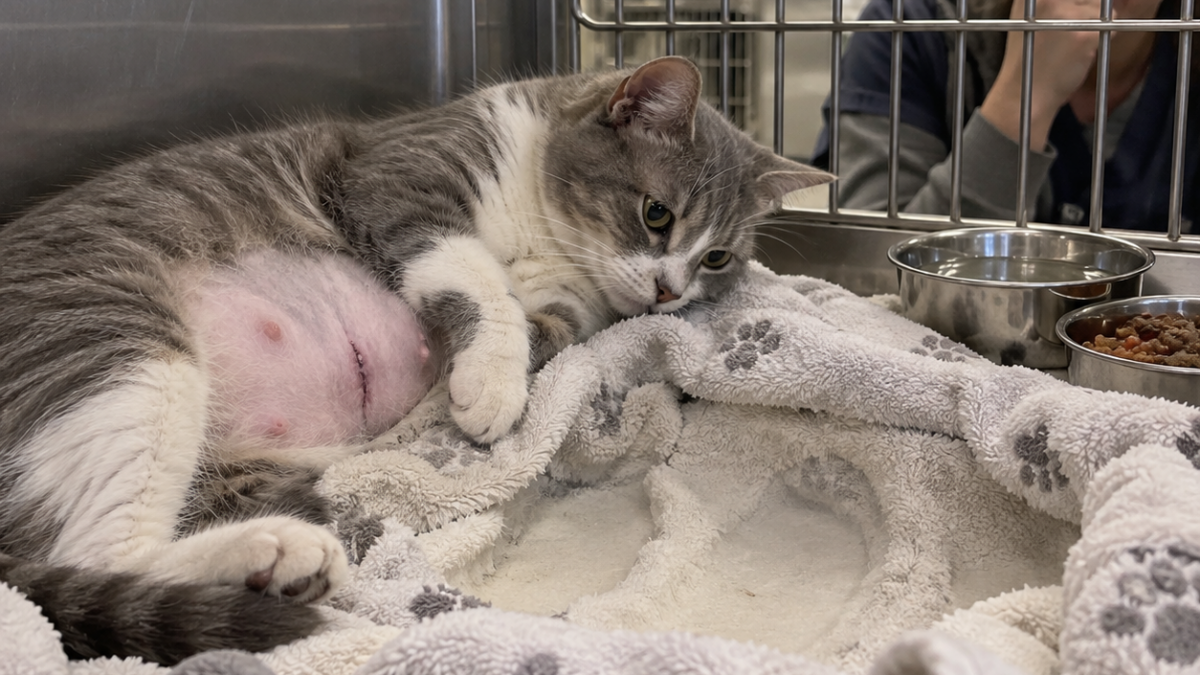
That afternoon, I took the photograph.
I wish I could say I knew it would matter.
I did not.
I took it because I wanted our director to see what I was seeing.
Willow lying in the nest.
Freshly shaved belly.
Small surgical incision visible.
Empty towel around her.
Nothing dramatic.
No blood.
No suffering anyone could accuse us of staging.
Just absence.
The photograph looked worse than the room felt.
Maybe because a camera removes explanation.
You see only the mother.
The space.
I posted it on the shelter volunteer page first.
Then, with permission, publicly.
I wrote:
She was spayed while her kittens were adopted. She woke up and they were gone. It has been two days, and she is still waiting.
That was all.
I did not name the shelter.
At first.
I did not accuse anyone.
I was part of the shelter.
I had helped move Willow to surgery.
I had watched the kittens leave without objecting.
There was no “them” to blame.
There was us.
The post exploded.
Not immediately.
By evening, hundreds of shares.
By next morning, thousands.
Comments ranged from heartbreak to fury.
How could they do this?
Bring the babies back!
This is cruel.
Cats don’t care that much. Stop anthropomorphizing.
Mother cats separate naturally.
Five weeks is too young.
This shelter should be shut down.
That last one hurt.
Because people who had never seen our intake numbers, our foster shortages, the animals we saved, the exhausted staff suddenly knew exactly who we were from one mistake.
And yet—
the mistake was real.
Defending ourselves too quickly would have missed the point.
Veterinarians began commenting.
Behaviorists.
Rescue directors.
Some said maternal cats often tolerate gradual weaning well.
Some said abrupt complete separation immediately following anesthesia could intensify disorientation and stress.
Others pointed out five weeks was earlier than ideal for full social separation even if kittens were eating independently.
There were debates about maternal behavior.
Hormones.
Attachment.
Weaning.
Surgical timing.
Adoption timing.
Recovery-room protocols.
Much of it became louder than Willow herself.
She remained in cage twelve.
Still lying in the same position.
Day three.
She ate a few bites.
That felt enormous.
We added a stuffed toy near her belly.
She sniffed.
Ignored it.
A volunteer suggested foster kittens.
Dr. Alvarez cautioned against introducing unknown kittens immediately while Willow recovered and while infectious-disease status varied.
Good intentions can create new risks.
So we waited.
Day four, Willow finally changed position.
She sat upright.
Groomed her chest.
Then her front paw.
She ate nearly half a meal.
I almost cried from relief.
But that evening, a kitten cried from intake.
Willow stood.
Walked to the cage door.
Called once.
Waited.
Then returned to the towel.
That single call became the sound I remembered most.
Not frantic anymore.
Almost habit.
Question.
No answer.
Our shelter director, Melissa Grant, called an emergency staff meeting.
Nobody was in a good mood.
The post had identified us by then.
People had figured it out.
Our phones were flooded.
Some abusive.
Some useful.
Donors angry.
Volunteers divided.
Melissa stood in front of us.
“We are not spending this meeting defending ourselves.”
That surprised everyone.
She continued:
“The kittens are safe.”
“Willow is safe.”
“Those facts matter.”
“But the process failed her.”
Nobody argued.
“We need to decide what changes.”
A technician said:
“Don’t adopt kittens while mom is under anesthesia.”
“Yes.”
Someone else:
“Wait through recovery.”
“Yes.”
“Minimum separation age review.”
“Yes.”
“Behavioral monitoring.”
“Yes.”
Then Dr. Alvarez added:
“No abrupt full separation while the mother is immediately postoperative unless medically necessary.”
We wrote it down.
Another staff member said:
“Gradual separation where possible.”
Written.
“Keep familiar scent items.”
Written.
“Mother gets visual or olfactory transition when safe?”
Discussed.
Not always practical.
Infection control matters.
Still, worth evaluating.
That afternoon, the first new policy went into effect.
Not after committees.
Immediately.
No lactating mother would wake from surgery to find all kittens gone unless emergency medical conditions required it.
Kittens cleared for adoption would remain until the mother had recovered from anesthesia and the team had assessed behavior.
Longer-term age and weaning standards were also revised.
It was not revolutionary.
Honestly, some better-funded rescues were already doing versions of it.
That embarrassed us.
We should have known.
But shame is only useful if it changes behavior.
Willow improved slowly.
Day five, full meal.
Day six, she left the towel voluntarily to sit near the cage window.
Day seven, accepted petting and purred.
Very softly.
I should have felt relieved.
Instead I felt guilty.
Because improvement did not erase what happened.
Her kittens were doing well.
We received updates.
The gray tabby slept with a teenage boy.
The white kitten had taken over an older woman’s pillow.
The black-and-white male was terrorizing shoelaces in a family with two children.
Safe.
Loved.
Healthy.
That mattered.
I printed their photographs.
Then hesitated.
Would showing them to Willow mean anything?
Probably not the way it would to a person.
So I kept them in my volunteer folder.
I needed them.
Maybe more than she did.
The viral post continued spreading.
Someone translated it into Spanish.
Then French.
Then German.
Rescue groups reposted it.
Training forums discussed it.
People sent us screenshots from shelters changing written procedures.
The number grew.
Hundreds.
Then thousands.
Eventually, advocates claimed more than eleven thousand organizations worldwide had reviewed or modified protocols after seeing the image or discussions connected to it.
Could I personally verify every one?
No.
I never could.
Internet numbers become slippery once stories travel.
What I can say is this:
We received emails from shelters in multiple countries.
Some said:
We changed our recovery protocol because of Willow.
Others:
We now delay kitten departure until mother is awake and stable.
One rescue in Canada wrote:
We showed your photo at staff training today.
A veterinary technician in Australia sent:
We never thought about what waking to an empty enclosure might add to post-anesthesia stress. We do now.
That mattered more than the exact number.
Willow had been failed by one procedure.
Her image made people question the procedure.
The photograph became larger than I wanted.
But maybe change sometimes begins with discomfort nobody can scroll past.
Willow herself did not become famous in the shelter.
We protected her from that.
No constant visitors.
No media in her face.
No using her as content while she recovered.
She remained a cat.
That mattered.
Her appetite returned.
Her incision healed.
Milk production gradually declined.
The shaved fur began growing.
Within two weeks she played with a feather wand.
The first time, she chased it only twice.
Then sat as if embarrassed.
I laughed.
“There you are.”
Willow looked at me.
We began spending more time together.
Not because I intended to adopt her.
I already had a twelve-year-old cat named Ruthie at home.
One cat was enough.
That is what I said.
Everyone at the shelter knew what usually happened after somebody said that.
Willow started greeting me.
Not dramatically.
She would stand when I entered.
Walk to the cage front.
Slow blink.
Sometimes rub her face against the bars.
I brushed her.
She loved the sides of her cheeks.
Hated her tail touched.
Fair.
At week three, we moved her to the adoption room.
Her profile emphasized:
Gentle.
Young.
Former mother.
Quiet home preferred.
No mention of the viral photograph in the main bio.
I insisted.
She deserved to be adopted for who she was, not as a symbol.
People applied.
Then backed out because they wanted kittens.
Of course.
The irony did not escape me.
Willow was two.
Still young.
Beautiful.
Healthy.
Yet kitten season turns adults invisible.
I knew that problem well.
Every day I walked past her cage, I remembered her empty nest.
Every day she seemed more like herself.
Whatever that meant after motherhood.
Then something happened at home.
Ruthie died.
Suddenly.
Stroke.
Twelve years old.
She had eaten breakfast.
By evening she could not stand.
Emergency vet.
Hours.
Then gone.
Grief rearranged my apartment overnight.
Food bowl.
Empty.
Window perch.
Empty.
Bed corner.
Empty.
I stopped volunteering for four days.
When I returned, Willow was still there.
Six weeks after her surgery.
No adopter.
I walked into the cat room.
She stood.
Came forward.
I opened the cage.
Willow climbed directly into my lap.
She had never done that.
Not once.
She turned twice.
Lay down.
Pressed her body against my stomach.
I began crying.
Not politely.
The kind of grief that embarrasses you in public because your body has stopped negotiating.
A coworker saw.
Started to come over.
I shook my head.
No.
Just let me.
Willow stayed.
Twenty minutes.
Maybe more.
Then she stood and returned to the cage.
I looked at her.
“You really have terrible timing.”
That evening I filled out the adoption form.
People later said:
“How perfect.”
I disagree.
Nothing about Ruthie dying was perfect.
Nothing about Willow losing her kittens was perfect.
Pain does not become good because two lonely beings eventually share a house.
But sometimes grief creates an empty space.
And sometimes another living thing fits there without replacing who was lost.
Willow came home with me three days later.
I brought the towel.
The nest towel.
The same one.
Was that wise?
I asked Dr. Alvarez.
“If she seeks it, let her have it.”
So I washed it gently.
Not enough to strip every scent if any remained.
Then placed it in my bedroom.
Willow explored the apartment cautiously.
Kitchen.
Living room.
Bedroom.
Ruthie’s old cat tree.
She sniffed it for several minutes.
That hurt.
Then she walked away.
First night, Willow slept under my bed.
Second, on the chair.
Third, near my feet.
By the end of week one, she owned the windowsill.
Good.
That was ordinary.
I wanted ordinary for her.
Then the ritual started.
At first I thought coincidence.
Around nine every evening, Willow went to the corner of my bedroom.
There was a small folded towel there.
Not the original one.
Just a hand towel I had dropped while organizing laundry.
She grabbed it in her mouth.
Dragged it about eighteen inches.
Spread it poorly.
Turned.
Lay down.
On her side.
Belly angled upward.
Front legs slightly bent.
I froze.
The nursing position.
She stayed maybe fifteen minutes.
Then got up.
Walked away.
Next night:
Same.
I moved the towel.
She found it.
Dragged it back.
Lay down.
Twenty minutes.
Next.
Same.
I stopped moving it.
For months, Willow repeated the ritual.
Not every night with perfect timing.
Stories become exaggerated when people want symbolism.
Some nights she skipped.
Some nights she lay differently.
But often enough that I could predict it.
Towel.
Corner.
Side.
Space beside belly.
Rest.
Then leave.
People asked:
“Is she waiting for the kittens?”
I do not know.
I need to be careful here.
Cats do not build memorial rituals in the same symbolic way humans do, as far as we can prove.
Could the behavior be comfort seeking?
Habit?
A posture associated with safety?
Residual maternal pattern?
Yes.
Could scent or routine cue it?
Yes.
Did it look exactly like nursing posture?
Also yes.
And did I sometimes sit on the floor beside her and think of those three kittens?
Every time.
Maybe the ritual belonged partly to me.
Humans are meaning-making animals.
We turn behavior into story.
That is not always wrong.
It simply needs humility.
Willow’s body had spent weeks organizing itself around three small lives.
Milk production.
Grooming.
Warmth.
Sleep positions.
Responses to cries.
You do not switch those systems off with adoption paperwork.
That much I knew.
The body remembers patterns.
Even after the reason for them disappears.
Humans know that too.
Reach for a spouse on the other side of the bed after death.
Listen for a child’s footsteps after they leave for college.
Keep setting two coffee cups for a week after a breakup.
Habit and grief are cousins.
Sometimes the body performs the memory before the mind understands.
That is what Willow taught me.
The photograph continued circulating for years.
Usually without context.
Sometimes distorted.
People wrote:
Her babies were stolen while she slept.
Not exactly.
Shelter sold her kittens.
No.
She never recovered.
False.
She stopped eating until she almost died.
Also false.
I began correcting people when I could.
Truth mattered.
Willow did suffer.
We did make a mistake.
The story did not need exaggeration.
Her kittens were safely adopted.
Willow recovered.
Our shelter changed.
Other shelters reconsidered procedures.
And six weeks later, she came home with me.
That was enough.
One journalist asked whether the shelter should have been punished.
I said:
“For what?”
“For cruelty.”
“We made a poor decision.”
“That’s different.”
“Animals were harmed emotionally.”
“Yes.”
“So?”
“So accountability and destruction are not the same thing.”
I explained.
If every shelter that makes a mistake gets publicly annihilated, staff learn to hide mistakes.
I wanted the opposite.
Document.
Discuss.
Change.
Train.
Transparency should make systems safer, not merely feed outrage.
Our director published the revised policy publicly.
She wrote:
We believed our procedure was acceptable. Willow showed us it was not sufficient. We are changing it immediately.
Some people still attacked.
Others appreciated the honesty.
Donations eventually recovered.
More importantly, practice improved.
The next nursing mother scheduled for surgery stayed with her kittens through recovery.
I watched.
Her name was Daisy.
Orange-and-white.
Four kittens.
She woke groggy.
Kittens in a warming enclosure nearby.
Once she was alert enough and medically safe, they were returned gradually.
Daisy sniffed them.
Licked one.
Then slept.
No searching.
No calling.
No empty towel.
I went into the supply closet and cried.
Not because Daisy knew anything about Willow.
Because change is often invisible unless you remember what came before.
That day was Willow’s legacy to me.
Not virality.
Not thousands of comments.
One mother waking up and finding her babies still there.
That is enough reason to admit a mistake.
Over time, Willow became playful.
She loved springs.
Hated laser pointers.
Would chase a bottle cap across the kitchen and then pretend she had not.
She developed an obsession with the bathroom sink.
She slept near my knees.
Never on my chest.
If I cried, she sat nearby but rarely climbed onto me.
The adoption-day cuddle remained unusual.
Willow was not magically transformed into an emotional support animal because our stories aligned.
She was a cat.
Independent.
Affectionate when she wanted.
Demanding at breakfast.
Wonderful.
I liked that.
Too many rescue stories imprison animals inside their trauma forever.
Willow was more than the mother from the photograph.
She was also the cat who stole rotisserie chicken.
The cat who knocked over a plant three times before I finally moved it.
The cat who watched birds from the window.
The cat who bit cardboard.
The cat who slept upside down in summer.
The cat who learned the sound of the treat drawer from across the apartment.
Pain was one chapter.
Not identity.
That mattered deeply.
About a year after adoption, I received an email from the family who had adopted the gray tabby kitten.
His name was Jasper.
They had recognized Willow’s story online.
The email included photographs.
Jasper grown.
Healthy.
Huge.
Sleeping on a teenage boy.
They wrote:
We didn’t know what happened with his mother until recently. We are so sorry. We love him more than we can explain.
I replied:
You have nothing to apologize for.
They did not.
They followed our procedure.
They gave Jasper a home.
The failure was organizational.
Not theirs.
They asked whether Willow could meet him.
That question stopped me.
Would reunion mean anything after a year?
Possibly not.
Could it stress both cats?
Yes.
Cats do not necessarily retain mother-offspring bonds indefinitely once kittens mature.
I asked Dr. Alvarez.
He recommended against manufacturing a reunion for human emotion.
Correct answer.
So we did not.
Instead, I showed Willow the photograph.
She sniffed my phone.
Walked away.
Perfect.
I laughed.
Humans want closure.
Cats want dinner.
The other kittens sent updates eventually too.
Luna, the white-and-gray female.
Bean, the black-and-white male.
All alive.
Loved.
Healthy.
I made a small private album.
Not for Willow.
For me.
Three lives safe.
One mother safe.
That helped.
Sometimes people ask whether I regret posting the photograph.
Yes and no.
I regret that Willow’s most vulnerable moment became public property.
I regret that strangers used her pain to threaten staff.
I regret misinformation.
But the image changed behavior.
There is no clean answer.
Photography can exploit.
It can also witness.
That photograph forced people to see a form of distress our procedures had ignored.
Maybe the ethical question is not whether suffering should ever be shown.
It is what you do after showing it.
Do you use it for outrage?
Clicks?
Money?
Or change?
We tried for change.
The original image hangs in our staff training room now.
Not in the public lobby.
Under it:
RECOVERY IS PART OF THE PROCEDURE. ATTACHMENT IS PART OF MEDICINE.
I wrote the second sentence.
Attachment is part of medicine.
Not sentiment.
Medicine.
Stress changes appetite.
Heart rate.
Immune function.
Healing.
Behavior.
A patient is not only an incision.
That sounds obvious.
It was not obvious enough to us that morning.
Years later, Willow still sometimes used the towel.
Less often.
The ritual faded.
First nightly.
Then several times a week.
Then occasionally.
By age eight, maybe once or twice a month.
Always in the same corner.
She would pull the towel.
Lie down.
Rest.
Leave.
I stopped interpreting it as sadness.
Maybe that is important.
At first I saw loss every time.
Later I saw habit.
Comfort.
Memory without crisis.
Perhaps healing is when a behavior associated with pain no longer hurts to witness.
Willow had moved forward.
So had I.
The three empty spaces existed mostly in my imagination by then.
She had a whole apartment.
Windows.
Food.
My bed.
Toys.
Sun.
No cage.
She was not waiting in grief every night.
I had to allow her that.
People sometimes romanticize sadness because it makes the story stronger.
That is unfair to survivors.
Willow survived emotionally too.
Her life did not remain frozen at the empty nest.
At ten, she developed mild arthritis.
At eleven, early kidney changes.
Routine senior-cat problems.
I smiled when Dr. Alvarez called her “geriatric.”
He had been there from the beginning.
“She can’t be old.”
“She’s eleven.”
“Rude.”
“Biology.”
Willow glared from the exam table.
Same green eyes.
We talked about the photograph once after the appointment.
“You think we overinterpret it?”
I asked.
“Probably.”
“That bothers you?”
“No.”
He thought.
“The behavior was real.”
“Searching.”
“Food refusal.”
“Maternal posture.”
“Those are observations.”
“The meaning people attach can vary.”
“So what’s the safest thing to say?”
He smiled.
“That she was distressed after abrupt separation.”
“And we changed the process.”
“Yes.”
“Less poetic.”
“More accurate.”
I agreed.
Then went home and watched Willow drag her towel into the corner.
Science and poetry can coexist if neither pretends to be the other.
One tells us what we can support.
The other tells us what it felt like to witness.
I saw a mother cat search six hours for kittens who were no longer there.
That happened.
I saw her return to an empty nest.
That happened.
I saw her lie in the same nursing position.
That happened.
I saw her barely eat for days.
That happened.
I watched a photograph of that moment force people to ask questions.
That happened.
Everything beyond that should be held gently.
Did Willow believe her kittens would return?
I do not know.
Did she “remember their places” years later?
I cannot prove it.
Did her body carry patterns built around them?
Absolutely.
Maybe that is enough.
The part I know most personally came six weeks later.
My lap.
My grief.
Willow climbing onto me.
Not curing anything.
Just staying.
Ruthie did not return because Willow arrived.
Willow’s kittens did not return because I adopted her.
Loss remained loss.
But neither of us had to live inside it alone.
That became the quieter story nobody shared as widely.
I think it is better.
Years after the original post, I received a message from a shelter worker in Oregon.
She wrote:
We had a mom cat scheduled for surgery today. Her kittens were ready for foster transfer. Someone on staff remembered Willow’s photo. We waited. Mom woke. We gave her three hours. She groomed them, ate, settled. Then the foster took everyone together for one more week. Thank you.
I read that message sitting on my bedroom floor.
Willow was asleep on her towel.
I cried.
Not because Willow had changed eleven thousand shelters.
I still do not know the number.
Because one mother did not wake up alone.
One.
That is enough.
Another shelter in Georgia wrote:
We now note maternal status on surgical recovery boards.
A rescue in the United Kingdom:
Your story changed how we schedule queen spays during active weaning.
A veterinarian:
We added attachment considerations to postoperative discharge timing.
Small changes.
Real.
That is how systems improve.
Not through perfection.
Through specific failures remembered accurately.
Willow became old.
Eventually twelve.
Then thirteen.
The towel ritual became rare.
One night I realized I had not seen her do it for months.
The towel still lay in the corner.
She slept on my bed instead.
I looked at it.
Considered moving it.
Could not.
Not yet.
A week later, Willow dragged it again.
Lay down.
Side.
Paws bent.
I sat nearby.
No sadness this time.
Just recognition.
“Thinking about old things?”
Willow closed her eyes.
Maybe.
Maybe not.
Twenty minutes later she got up.
Jumped badly onto the bed.
Demanded space near my legs.
Life went on.
That became the image I preferred over the viral photograph.
Not empty nest.
Willow leaving it.
Walking toward something else.
I wish cameras had captured that.
Survival stories focus too much on the moment of injury.
Not enough on departure from it.
If I could replace the photograph the world remembers, maybe I would choose another.
Willow years later.
Bedroom.
Old towel on the floor.
She has finished resting there.
She stands.
Turns.
Walks away.
Because remembering a place does not mean you must remain inside it forever.
When Willow reached fourteen, kidney disease progressed.
Fluids.
Diet.
Medication.
I knew the routine.
Shelter people know too much about the final stages of animals.
Knowledge does not protect you.
She had good months.
Then harder ones.
I stopped volunteering as many hours because she needed care.
Melissa, our director, understood.
“Full circle.”
“What?”
“You took care of her after we didn’t.”
“That’s not fair.”
“To us?”
“To everyone.”
The shelter had cared for her too.
Mistake and care can occupy the same organization.
People struggle with that.
But it is true.
Willow’s final week came quietly.
She stopped jumping.
Then eating.
Bloodwork terrible.
Dr. Alvarez came to my apartment.
Same veterinarian who examined her after the spay all those years earlier.
He sat on the floor beside her.
“Remember when she used to hate me?”
“She still does.”
Willow looked at him.
“See?”
He smiled sadly.
We discussed options.
No cure.
Only prolonging.
Willow lay on her favorite bed near the window.
Not the towel.
That mattered to me for reasons I could not explain.
I called Melissa.
She came.
So did Julia, the technician who had been in recovery the day Willow woke.
Three people from the original mistake.
One old cat.
No ceremony planned.
Yet it became one.
Julia touched Willow’s head.
“I’m sorry.”
I looked at her.
Willow did not need the apology.
We did.
Melissa whispered:
“We learned.”
That sentence felt more appropriate.
We did.
Before Dr. Alvarez gave sedation, Willow stood.
Walked toward the bedroom.
Slow.
We followed.
She stopped at the corner.
The towel.
Still there.
Faded.
Thin.
She sniffed it.
Lay down.
Side.
I lost it.
After all those years.
Not because I believed she was thinking of the kittens consciously.
Because the shape of the beginning had returned at the end.
Julia cried.
Melissa covered her mouth.
Dr. Alvarez sat quietly.
Willow stayed there several minutes.
Then lifted her head.
Looked toward me.
I picked her up.
She did not resist.
I carried her to the bed.
Placed her beside me.
That was where she died.
Not in the empty nest.
Beside me.
I needed that distinction.
Her life had started in our story with absence.
It ended with presence.
My hand on her.
Her head against my leg.
Dr. Alvarez listening to the final heartbeat.
Then silence.
I kept the towel.
Of course.
For months it remained in the corner.
Eventually I folded it.
Placed it in a box with Willow’s collar, photographs, and the three kitten updates.
Gray Jasper.
White Luna.
Black-and-white Bean.
Four lives.
One story.
All safe in different homes.
People still occasionally send me the old viral photograph without knowing I took it.
“Have you seen this?”
Yes.
I have seen it.
I was there.
Sometimes I tell them.
Sometimes I don’t.
The internet remembers Willow as the cat whose kittens disappeared while she was under anesthesia.
I remember more.
The way she stole chicken.
Her hatred of tail touching.
The bathroom sink.
The first time she chased a spring.
The night she climbed into my lap after Ruthie died.
The old-cat stiffness.
The kidney fluids.
The final walk toward the towel.
She was not a symbol.
She was Willow.
That is why I remain careful when people say:
“A mother’s body never forgets.”
Beautiful sentence.
Maybe true in ways.
But Willow’s body did more than remember.
It adapted.
Healed.
Played.
Aged.
Loved.
Bodies carry absence, yes.
They also learn new safety.
New routines.
New places to sleep.
New hands.
If there is a lesson in Willow’s life, I think it is not that she waited forever for kittens who never came back.
That version traps her.
The lesson is that grief can reveal what our systems overlook.
And if we are brave enough to pay attention, one animal’s distress can prevent another animal’s.
Willow never saw her three kittens again.
That remains sad.
I will not turn it into destiny.
We should have handled the separation differently.
We know that now because she showed us.
But the kittens were loved.
Willow was loved.
And what happened to her changed the way we cared for mothers afterward.
Every time I watched another nursing cat wake from anesthesia and find familiar kittens nearby, I thought of Willow.
Not as guilt.
Eventually, gratitude.
She made us better.
Not because suffering is valuable.
Because learning from suffering is our responsibility.
There is a photograph on my desk that almost nobody has seen.
It was taken years after the famous one.
Willow is lying on my bed in afternoon sunlight.
No towel.
No kittens.
No cage.
Her eyes closed.
One paw stretched over my pillow.
Completely ordinary.
That is my favorite.
Because nothing is missing from it.
When people ask what happened to the mother cat from the viral photo, that is the image I wish I could hand them.
Not:
She spent every night waiting.
Not:
She never recovered.
Not:
Her body was trapped forever in grief.
This:
She got a home.
She grew old.
She learned new routines.
She was loved.
And yes—
for many years, some evenings, she still dragged a little towel into the corner and lay down in the posture her body had once learned while feeding three tiny kittens.
Maybe memory.
Maybe comfort.
Maybe both.
She would remain there for a while.
Then eventually stand.
Stretch.
Walk away.
And come find me.
That last part matters most.
She always walked away.
Toward the life that was still there.
Toward home.








