She Watched Other Shelter Cats Go Home While No One Chose Her—Until One Patient Person Looked Past Her Fear and Gave Her the Safe Home She’d Been Waiting For
PART3:
“Four hundred and twelve days today,” Lily said softly.
The number landed hard.
Four hundred and twelve days of people entering the room.
Four hundred and twelve days of footsteps, voices, doors opening, cats leaving.
Four hundred and twelve days of not being chosen.
“Why?” I asked.
Lily looked toward the office door before answering.
“She doesn’t show well.”
“What does that mean?”
“She gets overwhelmed. At adoption events, she hides. When people reach for her too fast, she freezes. She’s not aggressive. Never. She just… disappears into herself.”
Hazel’s eyes moved toward us.
For the first time, she looked directly at me.
Not hopefully.
Not fearfully.
Just quietly.
As if she had learned that looking too eager invited disappointment.
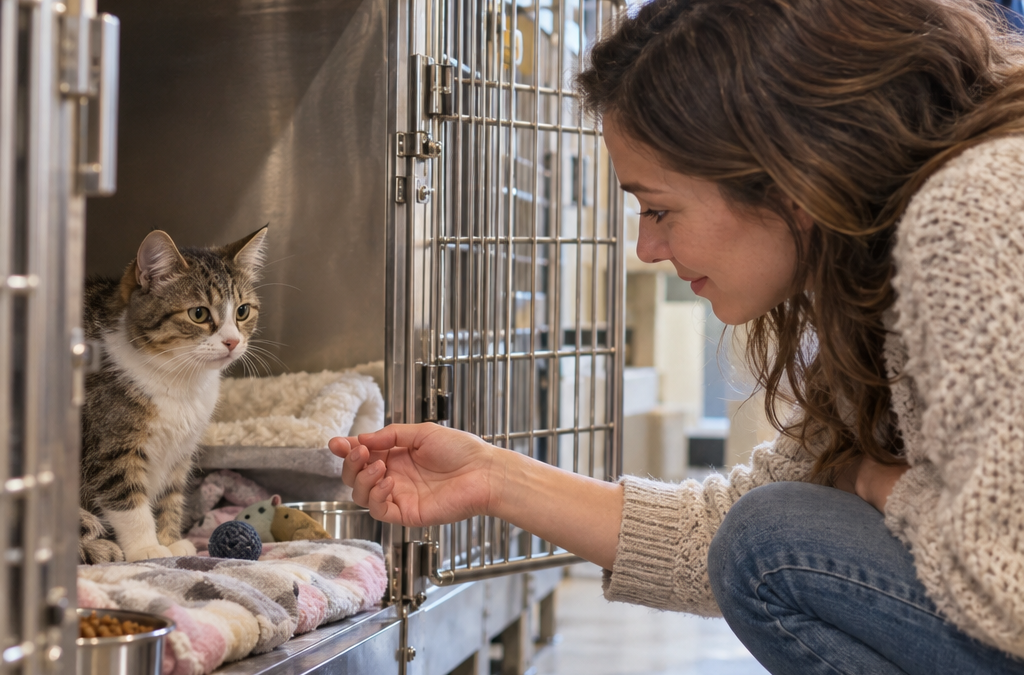
I placed my fingers near the bars but did not push them through.
She looked at my hand.
Then away.
“That’s okay,” I said. “You don’t have to.”
Lily exhaled, almost like she had been holding her breath.
“Most people try to touch her anyway.”
“Does she like being touched?”
“Sometimes. If she trusts you. If you go slow.”
“How slow?”
Lily smiled sadly.
“Hazel slow.”
I stayed there for twenty minutes.
Other cats entertained visitors around us. Pancake performed another upside-down climb. A Siamese mix shouted insults at a toy mouse. The tortoiseshell rolled and purred for a young couple. Hazel remained in her corner.
But once, when I shifted my weight, she lifted her head.
Once, when someone dropped a metal bowl across the room and the sound rang sharply, her whole body flinched so hard she bumped the back wall.
And once, when I whispered, “You’re safe,” she closed her eyes.
Not a slow blink exactly.
More like she was tired of wanting to believe it.
I left the shelter without adopting.
In the parking lot, I sat in my car while rain blurred the windshield and felt ashamed of myself.
Because I had wanted friendly.
I had wanted easy.
I had wanted a cat who would walk into my loneliness and fix it with soft paws and instant affection.
Hazel was not going to fix anything quickly.
Hazel was going to ask for patience.
And patience, I knew, was not the same as comfort.
I drove home.
That night, I dreamed of her sitting in the back corner while people walked past.
On Monday, I thought about her during math rotations.
On Tuesday, one of my students, a solemn little boy named Elijah, refused to read aloud because he was afraid of making mistakes. I watched him stare at his worksheet, shoulders tight, while louder children waved their hands around him.
I knelt beside his desk.
“You don’t have to read in front of everyone today,” I said quietly. “But I’ll sit with you while you read the first sentence to me.”
His eyes filled with tears.
“Just you?”
“Just me.”
He read the sentence in a whisper.
And while he did, I thought of Hazel.
Not everyone blooms in a crowd.
On Wednesday after school, I called Willow Creek.
Lily answered.
“This is Nora Ellis,” I said. “I was there Saturday. I met Hazel.”
There was a tiny pause.
Then her voice brightened.
“Hazel?”
“Yes.”
“Are you interested in meeting her in the quiet room?”
“I think so.”
Another pause.
This one different.
Hopeful.
“I can schedule that.”
“Lily?”
“Yes?”
“Can you tell me honestly what she needs?”
The line went quiet.
When Lily spoke again, her voice was lower.
“She needs someone who won’t punish her for being scared.”
That sentence decided me before I admitted it to myself.
I went back Friday afternoon.
The shelter was less crowded then. Rain had turned to sleet. The lobby lights flickered once as I signed in. Lily led me past the main cat room into a small side room with a couch, a cat tree, a low table, and a basket of toys that looked untouched. It smelled faintly of lavender cleaner and catnip.
“I’ll bring Hazel,” Lily said. “She may stay in the carrier. That’s normal.”
“That’s fine.”
“I mean it. She may not come out at all.”
“That’s fine too.”
Lily looked at me for a second, like she was checking whether I understood the shape of what I had said.
Then she left.
A few minutes later, she returned with a carrier covered by a towel. She set it on the floor, opened the door, and backed away.
Hazel stayed inside.
I sat on the floor across the room, not the couch.
Lily watched from the doorway.
“You can leave us,” I said.
“Are you sure?”
“I’ll just sit.”
When Lily closed the door, the room became very quiet.
I did not reach for Hazel.
I did not call her.
I took a book from my bag, opened it, and began reading silently.
Ten minutes passed.
Then twenty.
The carrier remained still.
My legs began to ache, but I did not move much.
At nearly thirty minutes, a white paw appeared at the carrier door.
Then disappeared.
I kept my eyes on the book.
A minute later, the paw returned.
Hazel stepped out low to the ground, every muscle ready to retreat. She moved behind the table, then under the chair, then froze when a dog barked somewhere beyond the wall.
“It’s okay,” I said softly, without looking at her.
She stayed frozen.
The bark did not repeat.
Hazel took two more steps.
By the end of the hour, she had made it to the far corner of the couch.
Not on the couch.
Behind it.
But she was out of the carrier.
When Lily came back in, she stopped so abruptly she almost hit the doorframe.
“She came out.”
“Yes.”
Lily’s eyes shone.
“Did you touch her?”
“No.”
“Did she come near you?”
“No.”
Lily looked puzzled.
I smiled.
“She came out.”
Lily smiled back slowly.
“Yes,” she said. “She did.”
I visited Hazel three more times.
The second visit, she came out after fifteen minutes.
The third, she sniffed the edge of my shoe.
The fourth, she sat beneath the side table while I read aloud from a book of essays, my voice low and steady. I was halfway through a paragraph about winter birds when I felt the lightest touch against my ankle.
I stopped reading.
Hazel had stretched one white paw from beneath the table and rested it on my sock.
Not gripping.
Not asking for anything.
Just touching.
I did not move.
Tears filled my eyes so quickly I had to blink them away.
“Hi, Hazel,” I whispered.
She pulled her paw back.
But she did not run.
Afterward, Lily found me in the hallway.
“There’s something you should know,” she said.
My stomach tightened.
“What?”
“Hazel has an application review next week.”
“That’s good, right?”
Lily hesitated.
“It’s complicated.”
She looked down the hall toward the office.
“We have a new board member, Brenda Whitlock. She’s been pushing to transfer long-stay cats to a rural partner facility.”
“What does that mean?”
“It means some cats who haven’t been adopted here would go there. More space. Different adopter base.”
“Is it a good facility?”
Lily did not answer quickly enough.
“Lily.”
“It’s licensed.”
“That’s not what I asked.”
She lowered her voice.
“I’ve never been. Marlene has. She said it’s overcrowded. Not cruel exactly, but… not right for Hazel.”
“When would they transfer her?”
“Maybe next week. Brenda says Hazel is taking up prime kennel space.”
I looked through the glass into the main cat room.
Hazel was back in her kennel, tucked in the corner.
Prime kennel space.
As if she were inventory on a shelf.
“Can I apply for her?”
Lily’s whole face changed.
“Yes. Yes, of course.”
“Today?”
“Yes.”
I filled out the adoption application with hands that trembled from anger and fear. I listed my job, income, landlord permission, veterinary references from the cat I had as a child, emergency contact, work schedule, home environment, and willingness to keep Hazel indoors. Under “Why are you interested in this animal?” I wrote:
Because she deserves to be chosen without being rushed to become someone else.
The adoption coordinator, a woman named Denise, called the next morning.
She was kind, professional, and careful.
“Hazel may hide for weeks,” she said.
“I know.”
“She may never be a lap cat.”
“I know.”
“She may bond slowly or selectively.”
“That’s okay.”
“She has a history we’re still clarifying.”
That made me sit up.
“What history?”
Denise sighed.
“She was adopted once before. Briefly.”
Lily had not told me that.
“What happened?”
“Returned after eleven days.”
“Why?”
“The adopter said she was defective.”
The word hit me like a slap.
“Defective?”
“I know.”
“What does that even mean?”
Denise’s voice grew tight.
“It means the woman expected Hazel to be affectionate immediately, tried to force handling, then claimed Hazel was ‘cold’ and ‘ungrateful.’”
I closed my eyes.
“What did Hazel do?”
“Hid under a bed. Didn’t eat much. Scratched when pulled out.”
“Pulled out?”
“Yes.”
I gripped the phone.
“Who was this adopter?”
“I can’t disclose that.”
“I understand.”
But I did not understand.
Not really.
Because a person had taken a frightened animal home, ignored every warning, dragged her from safety, punished her for fear, returned her with a cruel label, and then moved on with life while Hazel sat in the back of a kennel for more than a year, carrying the consequence.
Denise continued.
“There’s one more thing.”
“What?”
“Brenda Whitlock, the board member pushing the transfer? She knows Hazel’s prior adopter.”
My stomach went cold.
“What does that have to do with Hazel?”
“I don’t know yet.”
“Denise.”
“I’m telling you because I want your application processed before the meeting. Your home visit is Monday.”
“I’ll be ready.”
After we hung up, I cleaned my house like a person preparing for a sacred guest.
I set up a quiet room in my office: soft bed, covered cave, litter box, scratching post, water fountain, food station, hiding boxes, and a baby gate. I moved breakables off shelves. I bought calming pheromone diffusers. I read articles about shy-cat decompression until my eyes hurt. I watched videos of behaviorists explaining consent-based touch. I wrote a list and taped it to the office door.
Hazel’s Rules:
Move slowly.
No reaching into hiding places.
Let her choose.
Talk before entering.
Celebrate tiny bravery.
Love is not a demand.
On Monday, Denise came for the home visit with Lily.
Lily pretended she was there to assist.
I knew she wanted to see Hazel’s future room.
When she read the list on the door, she covered her mouth.
“Too much?” I asked.
She shook her head.
“No. It’s exactly enough.”
Denise inspected the windows, asked questions, checked the lease agreement, looked at the quiet room, and watched me demonstrate where Hazel could hide without being unreachable.
“You’ve thought this through,” she said.
“Yes.”
“You know she may disappoint your hopes at first.”
I looked at the small covered bed in the corner.
“I think people have been disappointing hers for a long time.”
Denise’s expression softened.
“I’m recommending approval.”
Lily cried.
I almost did too.
The board meeting happened Tuesday evening.
I was not supposed to attend, but Lily texted me afterward.
Approved. She’s yours. Pick up tomorrow before noon. Please.
Before noon.
Not celebratory.
Urgent.
I arrived at Willow Creek at 9:00 a.m.
The lobby felt tense. A woman in a red coat stood near the front desk speaking sharply to Denise. She was in her early sixties, with sculpted silver hair, pearl earrings, and the kind of posture that suggested she had spent years being obeyed.
Brenda Whitlock.
I knew before anyone said her name.
“This is irresponsible,” Brenda snapped. “That cat has been here over a year. Suddenly some woman visits four times and you hand her over?”
Denise’s voice remained calm.
“Ms. Ellis completed the application, reference checks, and home visit.”
“She’s emotionally attached.”
“That is not a disqualifier.”
“It should be when judgment is compromised.”
I stopped near the doorway.
Denise saw me.
Brenda turned.
Her eyes swept over me, taking in my raincoat, my canvas carrier, my teacher’s tote bag, my lack of pearls.
“You must be Nora,” she said.
“Yes.”
“You understand this cat is not normal.”
Behind the desk, Lily went pale.
I held Brenda’s gaze.
“I understand Hazel is scared.”
“She is not merely scared. She is unsocialized, avoidant, and unsuitable for most homes.”
“Then it’s good she isn’t going to most homes.”
Brenda’s mouth tightened.
“Do you have experience with difficult animals?”
“No.”
“At least you’re honest.”
“I have experience with frightened children,” I said. “That has taught me not to confuse silence with emptiness.”
Denise looked down quickly, hiding a smile.
Brenda did not.
“She scratched her previous adopter.”
“After being dragged from under a bed.”
Her expression changed.
Only slightly.
“Who told you that?”
“The person who cared enough to tell me the truth.”
Brenda stepped closer.
“You think patience will fix everything?”
“No.”
“Good. Because it won’t. Some animals never become what people want.”
I thought of Hazel touching my sock with one white paw.
“Then maybe people should want differently.”
For a moment, Brenda looked at me with something more personal than irritation.
Dislike, yes.
But also recognition.
As if my words had found an old door she preferred locked.
Then she turned to Denise.
“If this adoption fails, it is on your record.”
Denise’s voice was steady.
“If this adoption succeeds, I hope that’s on my record too.”
Brenda left.
The lobby exhaled.
Lily whispered, “I hate her.”
Denise said, “Lily.”
“I professionally dislike her.”
“Better.”
Hazel came home that morning in a carrier covered with the same towel from our first meeting.
She did not make a sound during the drive.
Every red light, I looked over and said, “Almost home.”
Home.
The word felt enormous.
At my house, I carried her into the office and closed the door behind us. I set the carrier on the floor, opened it, and sat across the room.
Hazel stayed inside for forty-eight minutes.
Then she walked out.
She did not explore.
She went straight into the covered cave bed and disappeared.
I smiled.
“Good choice.”
For the first three days, I barely saw her.
Food disappeared overnight. The litter box was used. Once, I glimpsed her white paw pulling a toy mouse into the cave. Mostly, there was only evidence of her life: a few paw prints in scattered litter, one blanket rearranged, the water level lower than before.
I talked to her anyway.
Every morning before work, I sat outside the baby gate with coffee and read aloud for ten minutes.
“Good morning, Hazel. I’m going to school. I’ll be back around four. You don’t have to come out.”
Every afternoon, I returned and said, “I came back.”
That sentence mattered.
I do not know how much Hazel understood.
But I knew what repetition could do.
It could build a bridge where trust had been burned.
On the fourth night, while I graded spelling tests on the office floor, Hazel came out of the cave.
I did not look directly at her.
She walked low along the wall, sniffed the bookshelf, paused beside the litter box, and then retreated when my pencil rolled off the clipboard.
The next night, she came out again.
The night after that, she ate while I sat in the room.
On the eighth day, she climbed onto the windowsill after I left the room. I saw her silhouette from the hallway: small, alert, watching the bare maple tree in my yard.
I stood there silently, hardly breathing.
Then she turned her head and saw me.
Her body tensed.
I stepped back immediately.
“Sorry,” I whispered. “That’s your window.”
She stayed.
That tiny choice carried me through the whole week.
People asked about her constantly.
My sister Beth texted, “Has your ghost cat decided you’re acceptable yet?”
I replied with a photo of an empty food bowl.
“Progress.”
At school, Elijah asked if my new cat liked me.
“She’s thinking about it,” I said.
He nodded seriously.
“Some people need lots of thinks.”
“Yes,” I said. “They do.”
By the third week, Hazel had claimed the office windowsill and a spot under my desk. She allowed me to sit closer, then closer still. She still hid from sudden sounds. She still vanished when the doorbell rang. She still looked at my hands like they were questions with dangerous answers.
Then came the first storm.
It rolled in late on a Thursday night, wind pressing rain hard against the windows. Thunder cracked over the neighborhood just after midnight. I woke instantly.
Not because of the thunder.
Because of the sound from my office.
A crash.
I ran down the hall.
Hazel had knocked over a stack of books trying to hide behind the shelf. Her body was wedged halfway into a space too narrow for her, shaking violently. Her eyes were huge. She was panting.
“Oh, Hazel,” I whispered.
I dropped to the floor several feet away.
Do not reach into hiding places.
Rule one.
Another thunderclap.
Hazel scrambled, claws skidding against the wood floor. She hit the side of the shelf and froze.
I wanted to scoop her up.
I wanted to protect her in the simple, human way that often terrifies animals more.
Instead, I lowered my body and spoke softly.
“You’re okay. You’re inside. I’m here.”
She trembled.
I stayed.
For nearly an hour, I lay on the floor in my pajamas, talking through thunder, telling her things that did not matter and everything that did.
I told her about my students.
About my mother’s terrible meatloaf.
About how I had once cried in a grocery store because they stopped selling the tea my ex-husband liked, and grief makes no sense about what it chooses.
I told her she never had to be brave on command.
I told her the storm would pass.
Eventually, she unwedge herself and ran into the cave bed.
I stayed on the floor until morning.
When the sun came up, I opened my eyes and found Hazel at the cave entrance, watching me.
“Good morning,” I said hoarsely.
She blinked.
Not fully slow.
Not yet.
But slower than before.
That afternoon, Denise called.
“How is she?”
I told her about the storm.
Denise was quiet.
“Poor girl.”
“Do you know if storms were an issue before?”
A pause.
“I don’t know.”
“Can I see her full file?”
Another pause.
“Why?”
“Because I think there’s more to her story than shy.”
Denise sighed.
“You’re not wrong.”
My hand tightened around the phone.
“What does that mean?”
“There are notes missing.”
“Missing?”
“Her original intake packet was scanned badly. Some pages are unreadable. Some aren’t in the digital system at all. I’ve asked for the paper archive.”
“And?”
“And Brenda blocked access, saying old files aren’t relevant to current care.”
A cold feeling moved through me.
“Why would she care?”
“I don’t know.”
But we both knew that was not entirely true.
When people block information about a powerless creature, it is rarely because the information is harmless.
The paper file arrived two days later because Lily, who was better at quietly disobeying bad authority than anyone her age should have needed to be, found it in a storage cabinet behind expired adoption banners.
She called me from her car.
“I shouldn’t have this.”
“Do you?”
“Yes.”
“Bring it.”
“I could get fired.”
“You could also save Hazel.”
She was at my door twenty minutes later, soaked from rain and holding a folder inside her jacket.
“I’m not leaving it,” she said. “You can read it while I’m here.”
We sat at my kitchen table.
Hazel watched from the office doorway, half-hidden in shadow.
The folder was thick.
Older than I expected.
On the top page was Hazel’s intake photo.
I barely recognized her.
She was thinner then, younger, maybe three and a half, crouched in the back of a trap with her eyes wide and one white paw lifted. The name on the intake form was not Hazel.
It was Daisy.
FOUND/OWNER SURRENDER?
Location: Whitlock residence, 1183 Garden Ridge Road
Brought by: Brenda Whitlock
Reason: Aggression, unsuitable pet
Notes: Cat belonged to elderly mother, now deceased. Family unable to keep.
Lily and I stared at the page.
“Brenda surrendered her?” I whispered.
Lily’s face had gone white.
“She told everyone Hazel was a stray transfer.”
I kept reading.
The second page was a behavior note from Marlene, the senior volunteer who had since retired.
Cat is extremely fearful but not aggressive. Cowers when approached by Brenda W. Attempts to hide. Allows gentle touch from staff after slow approach. Startles at raised voices. Strongly recommend quiet placement, no forced handling.
The third page was a veterinary note.
Small healed rib fracture visible on radiograph. Old injury, likely prior trauma. No current treatment needed. Monitor pain response.
I pressed my hand to my mouth.
Lily whispered, “Oh my God.”
There were more notes.
Daisy responds to older female voice recordings? Becomes alert when hearing “Martha.”
Daisy came with small blue blanket, per surrendering party “trash it.” Blanket retained temporarily.
Daisy hides during visits from Brenda W.
Daisy eats when staff sit quietly outside kennel.
Daisy not aggressive. Fear response mischaracterized?
The final note was handwritten on a torn piece of yellow legal paper.
It was dated fourteen months earlier.
Marlene’s handwriting, shaky but legible.
I am concerned about this cat’s surrender history. Brenda W. stated her mother’s cat “was impossible” and scratched her during estate clean-out. Cat appears terrified of Brenda specifically. Cat had healed injury. Recommend director review before allowing Brenda involvement in placement decisions. Do not transfer without full history.
Underneath, someone had written in red pen:
Noted. No action needed.
Lily looked like she might be sick.
“Brenda put herself on the board after surrendering Hazel?”
“When?”
“Six months ago.”
“She’s been trying to transfer her.”
We both turned toward the office.
Hazel stood in the doorway, silent, amber eyes reflecting kitchen light.
She had not been sitting in a shelter for 412 days because she was defective.
She had been sitting there because the person who discarded her had also helped bury the truth about why she was afraid.
I felt rage rise so quickly I had to grip the table.
Lily whispered, “What do we do?”
I looked at Hazel.
She took one step back.
My anger softened instantly.
Not gone.
Redirected.
“We document,” I said. “We protect her first.”
Miriam Voss was not technically an animal lawyer. She was a retired attorney who had once handled estate disputes and now spent her free time helping seniors, tenants, and rescue volunteers navigate systems designed to exhaust them. Denise gave me her number with the warning, “She is terrifying, but on our side.”
Miriam arrived at my house the next afternoon wearing red lipstick, black boots, and the expression of a woman who considered nonsense a personal insult.
She read Hazel’s file at my kitchen table.
Once.
Then again.
When she finished, she removed her glasses.
“Well,” she said. “Brenda Whitlock is either incompetent, cruel, or hiding liability.”
Lily, who had come over again despite my telling her not to risk it, swallowed.
“Could Hazel be taken away?”
“From Nora? No. Her adoption is finalized?”
“Yes,” I said.
“Then Hazel is safer here than anywhere. But the shelter has a governance problem.”
“What about the injury?” I asked.
“The old fracture?”
“Yes.”
Miriam’s gaze softened slightly.
“We cannot prove who caused it from this alone.”
“But Brenda lied.”
“Yes.”
“She surrendered Hazel, joined the board, and pushed to transfer her.”
“Yes.”
“Why?”
Miriam tapped the file.
“That is the question.”
The answer came from Mrs. Whitlock’s mother.
Not in person, of course.
Martha Whitlock had died almost two years earlier.
But she had left behind a voice.
Lily found the first clue in the note: “Daisy responds to older female voice recordings.”
“Do you think there are recordings?” she asked.
“Of Martha?”
“Maybe.”
Miriam leaned back.
“Old people leave more evidence than their families expect. Church bulletins, voicemail greetings, birthday videos, Facebook posts, donated phones.”
I searched online.
Martha Whitlock had been a retired music teacher. She had volunteered at the community center, played piano for church services, and led a small choir of seniors called the Silver Notes. There were videos online — grainy, cheerful clips of holiday concerts. In one, Martha sat at a piano, laughing as she introduced a song.
Her voice came through my laptop speakers warm and bright.
“Well, if we forget the words, we’ll just hum with confidence.”
From the office doorway, Hazel froze.
Her ears lifted.
Then she came forward.
Slowly.
One step.
Two.
She looked at the laptop.
Martha began playing piano in the video.
Hazel made a sound I had never heard before.
A tiny broken chirp.
Then she ran to the hallway and hid.
I closed the laptop immediately.
Lily had tears on her face.
“She remembers her.”
I could not speak.
That night, after Lily left, I sat outside Hazel’s cave bed and whispered, “I’m sorry. I didn’t know.”
Hazel did not come out.
But after a long time, I heard her sigh.
The next day, Miriam tracked down Martha’s former neighbor, a woman named Josephine Carter.
Josephine was eighty-four, lived in a yellow house beside Martha’s old home, and answered the phone by saying, “If this is about extending my car warranty, I have never owned a car and I hope you step on a Lego.”
Miriam liked her immediately.
When I visited with Miriam that weekend, Josephine served tea strong enough to remove paint and told us the truth.
“Martha loved that cat,” she said. “Daisy, she called her. Found her as a kitten under the rosebushes. That cat slept on her piano bench every afternoon.”
“What happened after Martha died?” Miriam asked.
Josephine’s mouth tightened.
“Brenda happened.”
She looked toward the window as if she could still see the house next door.
“Martha had a stroke first. Went to rehab. Daisy stayed in the house. I fed her. Martha begged Brenda to keep the cat safe. Brenda hated that cat.”
“Why?”
“Because Martha loved anything that did not obey Brenda.”
The sentence sat in the room like a struck match.
Josephine continued.
“Brenda was always sharp. Even as a girl. Wanted things perfect. Wanted her mother’s house, her mother’s silver, her mother’s piano. But Martha left some money to the music program at the community center and her piano to the church.”
Miriam’s eyes sharpened.
“Was there conflict over the estate?”
Josephine gave a humorless laugh.
“Honey, Brenda had conflict with a toaster if it didn’t brown evenly.”
I asked, “What about Daisy? Hazel?”
Josephine looked at me.
“When Martha died, Brenda came to clear the house. Daisy hid under the bed. Brenda tried to drag her out. I heard the crash from my porch.”
My whole body went still.
“What crash?”
“A lamp. Maybe a table. I went over, but Brenda told me to leave. Said the cat had attacked her. Next day, Daisy was gone.”
“Did you report it?”
Josephine’s face crumpled.
“I called the shelter. They said Daisy was safe.”
“She was. Physically.”
“I should have done more.”
Miriam leaned forward.
“Do you have anything from Martha about the cat?”
Josephine stood slowly and walked to a sideboard.
“Martha gave me a copy of a letter. Said if anything happened, I should make sure someone knew.”
She handed Miriam an envelope.
Inside was a letter written in careful, slanted handwriting.
To whoever cares for Daisy after I am gone,
She is shy with strangers but sweet when treated gently. She startles at loud voices and raised hands. She likes piano music, soft blankets, and sitting near the window in the morning. Please do not let Brenda take her if she does not truly want her. My daughter is not evil, but she has a hard heart where inconvenience is concerned. Daisy deserves patience. She has been my companion through widowhood, illness, and many quiet nights. If I cannot come home to her, please let her go somewhere kind.
Martha Whitlock
I read the letter three times.
The words blurred.
Please let her go somewhere kind.
Martha had tried.
Hazel had been loved.
Before the kennel, before the transfer threats, before the word defective, before 412 days of being passed by, Hazel had been Daisy, the cat who slept on a piano bench beside an old woman who understood her.
When we left Josephine’s house, Miriam held the letter like evidence and like something holy.
“What happens now?” I asked.
“Now Brenda learns that buried stories can still have witnesses.”
The shelter board meeting took place two weeks later.
This time, I attended with Miriam, Denise, Lily, Josephine, and a printed folder thick enough to make Brenda’s face change when she saw it.
The meeting room was small and overheated. Folding chairs lined the walls. A coffee urn hissed on a side table. Brenda sat at the board table wearing a cream sweater and pearls, looking annoyed rather than worried.
Until Josephine walked in.
Then her expression flickered.
“Josephine,” Brenda said.
“Brenda.”
No warmth.
No false sweetness.
Just history.
The board chair, a tired man named Aaron Cole, began with a statement about confidentiality and procedure. Miriam interrupted before he could hide behind either.
“This meeting concerns potential misconduct by a board member who appears to have concealed a conflict of interest involving an animal in the shelter’s care.”
Brenda laughed sharply.
“That is absurd.”
Miriam looked at her.
“I’m just getting started.”
Denise presented Hazel’s intake file. Lily confirmed the digital record had omitted key pages. Josephine read Martha’s letter aloud, her old voice trembling but clear.
When she reached “Please do not let Brenda take her if she does not truly want her,” Brenda stood.
“This is outrageous. My mother was ill when she wrote that.”
Josephine turned on her.
“Your mother knew exactly who you were.”
The room went silent.
Brenda’s face flushed.
“You have no right.”
“I lived beside her thirty years. I heard her cry when you stopped calling. I drove her to the doctor when you were busy. I fed Daisy when your mother was in rehab. Don’t talk to me about rights.”
Brenda gripped the edge of the table.
“That cat scratched me badly.”
“Because you dragged her out from under a bed,” Josephine said.
Brenda’s mouth opened.
No sound came.
Miriam placed photos on the table: Hazel’s intake picture, the vet note showing a healed rib fracture, Marlene’s handwritten concern, Brenda’s transfer recommendation, and the adoption records showing Brenda had repeatedly voted to move long-stay cats out.
“Whether you injured Hazel cannot be proven from these records,” Miriam said. “But we can prove you misrepresented your relationship to her, concealed relevant history, influenced her placement decisions, and attempted to remove her from the shelter without disclosing that conflict.”
Aaron rubbed his forehead.
“Brenda, is it true you surrendered Hazel?”
Brenda looked around the room.
For the first time, I saw fear.
Not remorse.
Fear of exposure.
“My mother’s cat was unmanageable,” she said. “I did what I had to do.”
“You marked her as aggressive,” Denise said. “She has never been aggressive in our care except when forced.”
“She attacked me.”
“After you cornered her.”
Brenda’s voice rose.
“You weren’t there.”
“No,” Josephine said. “But I heard her scream.”
That sentence ended something.
Not legally.
Not officially.
But morally.
The board voted to remove Brenda pending formal review. Aaron apologized to Denise and Lily. The shelter opened an audit of all long-stay and transfer recommendations Brenda had influenced. The rural facility partnership was suspended. Hazel’s file was corrected, and Martha’s letter was scanned into the archive with a note: Original owner requested patient placement.
But the moment that mattered most to me came after the meeting.
Brenda approached me in the hallway.
Her eyes were sharp with humiliation.
“You think you’ve saved her,” she said.
I looked at her.
“I know I have.”
“She’ll never be normal.”
There it was again.
Normal.
A word people use when they mean convenient.
I stepped closer.
“She was loved by your mother. She is loved by me. That is more normal than anything you’ve done here.”
Brenda’s face twisted.
“You know nothing about my mother.”
“I know she tried to protect Hazel from you.”
For one second, I thought Brenda might slap me.
Instead, her eyes filled with tears.
Angry tears.
Old tears.
“My mother chose that cat over me at the end.”
There it was.
The wound beneath the cruelty.
Not an excuse.
Never an excuse.
But the shape of it.
“No,” I said softly. “She asked you to be kind to something she loved. You chose to hear that as rejection.”
Brenda looked away.
I do not know if those words ever reached her.
Maybe not.
Some people build walls so thick that truth only bruises its knuckles knocking.
But I said them anyway.
That night, I came home exhausted.
Hazel was in the office window, watching the driveway.
She turned when I entered.
“I came back,” I said.
For once, she did not retreat.
I sat on the floor near the doorway and told her everything.
Not because she could understand board misconduct or estate grief or the way humans twist love into ownership. But because she deserved a witness.
I told her about Josephine.
About Martha’s letter.
About Daisy.
At the old name, her ears lifted.
“Daisy,” I whispered.
She stepped down from the windowsill.
Slowly, she crossed the room.
I did not move.
She stopped two feet away.
Then one foot.
Then she lowered herself onto the rug and tucked her paws beneath her.
Near me.
Not touching.
But near.
I cried silently.
“I know,” I whispered. “Hazel is your name now. But Daisy was loved too.”
She closed her eyes.
From then on, healing came in tiny, unpredictable pieces.
Hazel began waiting at the office door in the mornings.
She did not approach, but she was there.
She began eating while I moved around the room.
She began playing at night, first only when she thought I was asleep, then openly, batting a soft ball beneath the bookshelf and pretending she had no idea how it got there.
She let me touch her cheek with one finger.
Then two.
The first time she leaned into my hand, I forgot how to breathe.
Her fur was softer than I expected.
She tolerated three seconds.
Then five.
Then she walked away, tail high, leaving me sitting on the floor like a woman who had been handed a crown.
At school, Elijah asked every Monday, “Did Hazel do a brave thing?”
“Yes,” I would say.
“What?”
“She sat closer.”
Or, “She ate when I was in the room.”
Or, “She looked at a bird and forgot to be scared.”
Elijah would nod with deep respect.
“That is a medium brave.”
One day, he handed me a drawing.
It showed a brown cat sitting in a window. Beside her, a stick-figure woman stood with a speech bubble: “Take your time.”
At the bottom, he had written:
Some quiet things are still trying.
I taped it inside Hazel’s room.
By spring, Hazel had access to the whole house.
The first day I opened the office door and left it open, she stared at the hallway as though I had revealed a dangerous new planet.
“It’s okay,” I said. “You can explore whenever you want.”
She waited until midnight.
I know because I stayed awake pretending not to listen.
First came the soft click of claws.
Then a pause.
Then another step.
She explored the hallway, the bathroom, the kitchen. She sniffed the chair legs, inspected the baseboards, and fled back to the office when the refrigerator motor clicked on.
The next night, she made it to the living room rug.
The night after that, the couch.
On the fourth night, I woke to pressure at the foot of my bed.
I opened my eyes.
Hazel stood there, one white paw on the quilt, staring at me.
I did not speak.
She climbed up carefully, every muscle ready to flee. She walked to the corner of the bed, turned twice, and lay down facing the door.
Not near me.
But on the bed.
I stared at the ceiling with tears sliding into my hair.
At dawn, she was gone.
At breakfast, she behaved as if nothing historic had occurred.
That became Hazel’s style.
Grand emotional milestones followed by total denial.
The public part of her story grew too.
Willow Creek posted about the new long-stay cat policies without naming Brenda at first. Then a local reporter, who had followed earlier shelter controversies, requested board records. Brenda’s resignation became public. So did the fact that Hazel had been surrendered by a board member who later tried to have her transferred.
People were outraged.
Some for the right reasons.
Some because outrage is easier than reflection.
Donations came in for long-stay cats. Volunteers created “Hazel Rooms” — quiet meet-and-greet spaces where shy animals could be seen on their own terms. Adoption cards were rewritten to be honest without being discouraging. “Needs patient adopter” became a real support program, not a polite warning.
Lily became the coordinator for shy and fearful cats.
Denise told me Hazel’s case had changed everything.
I believed her.
But the change I cared about most was smaller.
One Saturday afternoon, three months after Hazel came home, I received a call from Josephine.
“I have something of Martha’s,” she said. “I should have given it sooner.”
She came by with a small wooden box.
Inside was a folded blue blanket, a worn toy mouse, and a cassette tape labeled MARTHA PIANO — DAISY’S FAVORITES.
I stared at it.
“I don’t even own a cassette player.”
Josephine smiled.
“I do. I’m old, not useless.”
She had brought that too.
We set the player on my living room table. Hazel watched from beneath the armchair.
“Are you sure?” Josephine asked.
“No,” I said honestly.
I pressed play.
For a moment, there was only static.
Then piano music filled the room.
Soft, imperfect, warm.
A hymn first.
Then a lullaby.
Then Martha’s voice, faint and amused:
“Daisy, darling, you cannot sit on the keys during this one.”
Hazel came out from under the chair.
She moved slowly toward the sound.
Josephine covered her mouth.
Martha continued playing.
Hazel reached the table, looked at the cassette player, then turned in a small circle as if searching for the woman who belonged to the voice.
My heart broke.
“She’s not here,” I whispered.
Hazel looked at me.
Then she walked to the blue blanket Josephine had placed on the floor.
She sniffed it for a long time.
Then she lay down on it.
Josephine began to cry.
“I’m sorry,” she whispered to Hazel. “I should have fought harder for you.”
Hazel rested her chin on the blanket.
The music played on.
That day changed something between us.
Not immediately.
Not magically.
But after Martha’s blanket came into the house, Hazel seemed to stop dividing her life into before and after quite so sharply. She slept on the blue blanket in the living room instead of only hiding in the office. She came out when Josephine visited. She began sitting near the cassette player when I played Martha’s music, not distressed anymore, just quiet.
As if memory could be painful and comforting at the same time.
By summer, Hazel greeted me at the door.
Not every day.
Only when she felt like it.
But sometimes, after a long day at school, I would unlock the door and find her standing six feet away, tail up, eyes bright.
“I came back,” I would say.
She would blink.
Eventually, she began answering with a tiny chirp.
The first time she climbed into my lap happened in September.
It was raining, but not storming. I sat on the couch with a stack of essays, Martha’s piano tape playing softly in the background. Hazel had been on the windowsill watching rain run down the glass.
Without warning, she jumped down, walked across the room, and stood beside my knee.
I froze.
She placed one white paw on my leg.
Then the other.
Slowly, awkwardly, as if she had forgotten how but remembered wanting to, she climbed into my lap.
She did not curl up right away.
She stood there, uncertain.
I kept my hands still.
“You can leave whenever you want,” I whispered.
Hazel turned once, then settled.
Her body was light but warm.
For a long time, neither of us moved.
Then she began to purr.
It was almost silent at first.
A vibration more than a sound.
But I felt it through my sweater, through my ribs, through every lonely room inside me.
I bowed my head over her and cried.
Not the sharp grief crying I had done after my divorce.
Not the hollow crying I had done after my mother died.
This was different.
This was the kind of crying that comes when something you thought would remain closed opens gently from the inside.
Hazel stayed for seven minutes.
Then she left.
Seven minutes was enough.
After that, she became a cat of small but deliberate affections. A paw on my ankle while I brushed my teeth. A head bump against my hand before breakfast. A careful nap beside my hip during Sunday grading. She never became the kind of cat who loved strangers. She never ran into a room demanding attention. She still hid when people came over too loudly. She still needed time, choice, and quiet.
But she loved.
Oh, how she loved.
Not loudly.
Not cheaply.
Not for everyone.
But with the whole force of a heart that had taken 412 days to believe someone might choose her and keep choosing her.
In October, Willow Creek held its first “Quiet Hearts Adoption Day.”
No balloons.
No loud music.
No crowds pressing into cat rooms.
Appointments only. Soft voices. Private meet-and-greet spaces. Profiles that told the truth: shy, cautious, affectionate once secure, needs time, startles easily, loves other cats, prefers women, hates being picked up, blossoms with routine.
Hazel’s photo hung at the entrance.
Not the intake photo.
Not the shelter-corner photo.
A new one.
Hazel on my windowsill, sunlight warming her brown stripes, one white paw resting on the blue blanket, amber eyes calm.
Underneath, Lily had written:
She was never hard to love. She was only waiting for someone willing to learn how.
By the end of the day, four shy adult cats had adoption applications.
A woman named Grace sat for forty minutes with a black cat who never came out from behind the chair. When the volunteer apologized, Grace said, “No, it’s okay. She stayed in the room with me. That’s a start.”
Lily called me crying that evening.
“Hazel did this,” she said.
“No,” I replied. “Hazel survived. You all decided to listen.”
Both were true.
Near Christmas, Brenda Whitlock wrote me a letter.
I almost threw it away.
Then I opened it because curiosity is one of my less noble qualities.
The handwriting was stiff and elegant.
Ms. Ellis,
I am not writing to ask forgiveness. I do not expect it. I have spent months being angry at how this matter was handled, then angry at Josephine, then at the shelter, then at you. It has taken me longer than I care to admit to understand that my anger existed long before Daisy.
My mother and I had a difficult relationship. That is not an excuse for my behavior. Daisy was a reminder that my mother had tenderness left for others when I believed there was none left for me. I treated that animal as if she had taken something from me. She had not.
I do not know whether I harmed her when I removed her from the house. I remember the lamp falling. I remember being scratched. I remember shouting. I remember wanting everything in that house gone because grief felt too much like accusation. If I caused her injury, I will carry that shame.
I have enclosed a donation for Willow Creek’s quiet-cat program in my mother’s name. You may tear up this letter if you wish. I only wanted to say that my mother was right about one thing: Daisy deserved somewhere kind. I am grateful, however painfully, that she found it.
Brenda Whitlock
A check was folded inside.
Large enough to matter.
I sat at the kitchen table for a long time.
Hazel sat on the windowsill, watching birds hop through snow.
I did not know what forgiveness required.
I still do not.
Some actions leave marks that apologies cannot erase. Hazel’s fear had not been symbolic. Her 412 days in that kennel had been real. Martha’s final wish had been ignored. Brenda’s grief had become cruelty, and cruelty had consequences.
But accountability, even late and imperfect, is still a kind of door opening.
I mailed the check to Willow Creek.
I kept the letter in Hazel’s file.
Not because Brenda deserved peace.
Because Hazel deserved the full truth of her story.
Years from now, if anyone ever asked where she came from, I would not begin with abandonment.
I would begin with love.
There was once an old music teacher named Martha who found a kitten under rosebushes and named her Daisy. Daisy slept on piano benches and listened to hymns. Daisy was loved through widowhood, illness, and quiet afternoons. Then life broke apart in human ways Daisy could not understand. She was surrendered, mislabeled, overlooked, and almost discarded again. But she waited. And one day, someone finally stopped.
The following spring, on the anniversary of Hazel’s adoption, Josephine and Lily came over for tea.
Hazel stayed in the living room.
That alone was a miracle.
Josephine sat in the armchair, thinner than before but still sharp-eyed. Lily sat cross-legged on the rug, now officially the shy-cat coordinator at Willow Creek, wearing a sweatshirt that read TAKE YOUR TIME.
Martha’s tape played softly.
Hazel rested on the blue blanket near the window.
After a while, Josephine looked at her and whispered, “You look happy, Daisy.”
Hazel opened one eye.
Then, with great dignity, she stood, walked across the room, and sat beside Josephine’s chair.
Josephine pressed both hands to her mouth.
“May I?”
I nodded.
“Slowly.”
Josephine lowered her hand.
Hazel sniffed her fingers.
Then she leaned her cheek into them.
Josephine cried so hard Lily had to bring tissues from the kitchen.
“I promised Martha I would know if you were safe,” she whispered. “Now I know.”
Hazel stayed for exactly twelve seconds.
Then she returned to her blanket.
Very generous, by Hazel standards.
That night, after everyone left, Hazel climbed onto the couch beside me. Not my lap this time. Just beside me. Her shoulder touched my thigh.
Outside, rain tapped the windows.
Inside, Martha’s piano played quietly.
I thought about the cat I had almost walked past.
The one sitting in the back of the kennel, still and silent, while brighter, louder, easier cats reached for attention.
I thought about all the times in life we mistake quiet for absence.
Quiet grief.
Quiet fear.
Quiet courage.
Quiet hope.
Hazel had been full of all of it.
She had not been empty.
She had been waiting for safety.
There is a difference.
I reached down slowly.
She allowed my hand to rest near her, not touching.
Then, after a moment, she shifted closer until my fingers brushed her fur.
Permission.
Trust.
A gift, not a debt.
“Thank you,” I whispered.
Hazel closed her eyes.
These days, Hazel still hides when the vacuum runs.
She still dislikes sudden laughter, raised voices, and men in heavy boots. She still approaches visitors on her own timeline, which can range from twenty minutes to never. She still prefers her food bowl near the wall and her water in the blue ceramic dish I bought because it matched Martha’s blanket. She still sleeps some nights in the office cave, because healing does not mean abandoning every safe place that helped you survive.
But most mornings, she waits outside my bedroom door.
When I open it, she chirps once.
Breakfast, obviously.
Then she leads me down the hallway with her tail high, as if she has never doubted for a second that this house belongs to her.
Maybe it does.
Maybe all the best homes belong first to the creatures who had to wait too long for them.
People sometimes ask why I chose a cat who did not choose me back right away.
I never know how to answer simply.
Because the truth is, Hazel did choose me.
Not in the dramatic way people expect.
Not by leaping into my arms or purring through the bars or making a perfect adoption video moment.
She chose me in increments.
A glance.
A paw on my sock.
A meal eaten while I sat nearby.
A night on the bed.
A cheek into my hand.
Seven minutes in my lap.
Trust is not always a lightning strike.
Sometimes it is a single thread offered again and again until one day you realize it has become a bridge.
And maybe I chose her the same way.
Not all at once.
Not with heroic certainty.
But by coming back.
Again and again.
To the shelter.
To the quiet room.
To the office floor.
To the storm.
To the truth.
To the small brown tabby with one white paw and a heart everyone had underestimated.
The last time I visited Willow Creek, I stopped by the main cat room. Pancake had long since been adopted by a family who sent annual holiday cards featuring him halfway up their curtains. Mr. Pickles had gone to a retired nurse who claimed she deserved his bites. The kennels had new cats now, new stories, new fear, new hope.
In the back corner, a shy black cat sat with his face turned away while people passed.
A little girl pointed.
“That one’s not friendly,” she said.
Her mother started to move on.
Lily, standing nearby with adoption folders, crouched beside them.
“Actually,” she said gently, “he’s still deciding if the room is safe. Some cats need someone patient enough to let them think.”
The little girl considered this.
Then she sat down on the floor outside his kennel.
“I can wait,” she said.
Lily looked at me across the room.
Her eyes shone.
I went home and told Hazel.
She listened from the windowsill, blinking slowly in the afternoon sun.
Maybe she understood none of the words.
Maybe she understood everything.
That night, she slept beside me, curled near my hip, warm and solid and real. Her white paw rested against my wrist. Not gripping. Not afraid I would leave. Just touching.
I lay awake for a while, listening to her breathe.
For so long, she had watched people walk past her kennel, hoping one day someone would stop and see more than fear. She had watched other cats leave for homes while she remained behind, quiet and reserved, carrying a history too heavy for an adoption card. She had been mislabeled by impatience, nearly discarded by resentment, and judged by people who wanted trust without earning it.
But she was never defective.
She was never empty.
She was never a waste of space.
She was a small, brave soul who had survived confusion, loss, rough hands, loud rooms, and 412 days of being overlooked without letting the gentle part of herself disappear completely.
All she needed was time.
A quiet room.
A soft blanket.
A person who kept saying, “I came back,” until the words became true enough to rest inside.
I cannot undo the year Hazel spent waiting.
I cannot give Martha more time with the cat she loved.
I cannot erase every frightened flinch from Hazel’s body or every cruel word once written in her file.
But I can give her this house.
This window.
This blue blanket.
This life where no one reaches into her hiding place, no one calls her defective, no one measures her worth by how quickly she performs affection for strangers.
I can give her mornings full of birdsong, evenings with piano music, fresh water, patient hands, and the promise that she never has to wonder whether someone will come back for her.
Because someone did.
And someone always will.
Some shelter cats do not know how to ask for love loudly.
Some have learned that reaching out can hurt.
Some sit in the back corner while the world chooses easier stories.
But quiet hearts are still hearts.
Shy love is still love.
And sometimes, the animal everyone walks past is the one who will teach you the most powerful lesson of all:
Being chosen is beautiful.
But being understood is what finally feels like home.








