She Was Waiting for Her First Child—Then a Stranger Arrived With Her Husband’s Bag
PART3:
Hollis had left the ranch a week earlier with a small herd of cattle. The sale money was supposed to settle part of our debt at the general store, pay toward lumber for the new barn, and buy the last things we needed before the baby came. Hollis had been worried about leaving me so close to my time, but the sale could not wait.
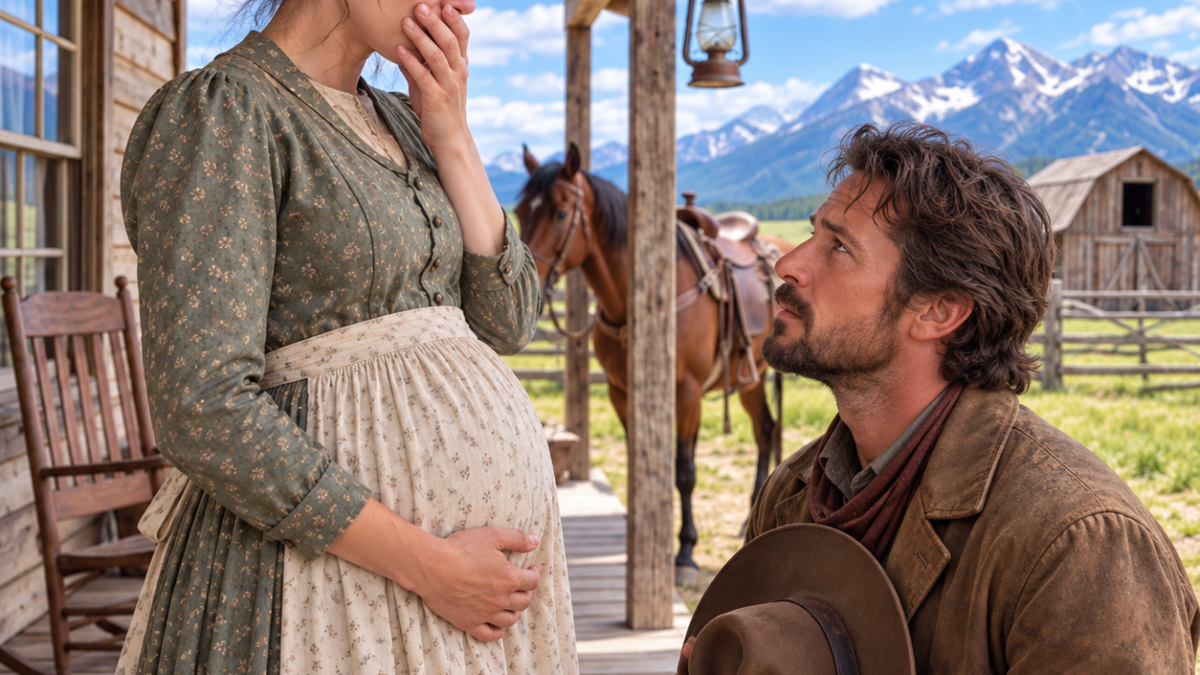
Before he rode out, he knelt in front of me right there on the porch, both hands spread over my belly, cheek pressed to the place where our child kicked hardest.
“I’ll be back before he decides to arrive,” he said.
“He?” I asked. “How do you know it’s a boy?”
Hollis grinned.
“I just know.”
“You just know everything, do you?”
“Everything important.”
He kissed my belly.
Then me.
Then he mounted his horse and rode out with cattle dust rising behind him, turning once at the hill to lift his hat.
That was the last time I saw my husband alive.
Emory told me he had met Hollis at the agreed cattle ground beyond the foothills. They had spent nearly the whole day inspecting stock, bargaining fairly, talking over coffee and cold biscuits. He said Hollis was a good rancher. He said he was sharper than most men who sold cattle and kinder than most men who knew they were sharp.
Then Emory’s voice changed.
He said Hollis had talked about me.
Constantly.
Embarrassingly, maybe.
The way happy men talk when they do not know they are spending their last day on earth.
He told Emory I was near eight months along. Told him I kept the ranch books better than he did. Told him I could shoot straighter when angry, bake better bread when calm, and spot a sick calf before any hired man noticed one was lagging. He pulled a small carved piece of wood from his pocket, a piece of the cradle he had started building, and turned it over in his rough hands.
“Started back in the fall,” Hollis had said, according to Emory. “Figured I had months to spare. Turns out barn work eats into cradle-building time.”
I looked toward the house when Emory said that.
The cradle sat unfinished in our front room.
One side assembled.
One rail still leaning against the wall.
Curled shavings beneath it because Hollis never cleaned up as he worked, claiming he needed to “see progress underfoot.”
The baby pressed under my ribs.
Emory continued.
The deal closed by late afternoon. Every dollar was paid. Hollis placed the money and papers inside the leather bag and secured it beneath his saddle.
Both men traveled the same direction for part of the journey home.
After days of heavy rain in the mountains, the river ran higher than expected.
Brown.
Fast.
Full of debris.
Emory told me Hollis studied the current for a long moment before crossing.
“Follow my line exactly,” he had warned. “Current’s meanest where it looks calm.”
Hollis made it across.
Emory did not.
His horse stumbled halfway through, maybe on a hidden rock, maybe in a hole carved by floodwater. The current took both horse and rider.
Emory’s voice grew rough.
He said he went under once, twice, came up choking, trying to grab mane, reins, anything. His boots filled. His coat dragged him down. The river was freezing and strong enough to turn a man into driftwood.
“Hollis was already safe,” Emory said.
He looked at me when he said it, as if he needed me to understand the cost.
“He could have stayed on the bank. No one would’ve blamed him.”
“But he didn’t.”
“No, ma’am.”
Of course he did not.
That was my Hollis.
Foolish, brave, infuriatingly certain that a man did what needed doing first and worried about the price afterward.
Emory said Hollis turned back into the river.
Fought his horse against the current.
Reached Emory just as his strength failed.
Pushed him toward a rock formation where he could grip and hold.
“Hold there!” Hollis shouted. “I’ll get a rope!”
Then a log came downriver.
Emory stopped speaking.
His throat worked.
I felt my hand tighten on the porch rail.
“It hit him,” he said finally. “Across the back. Knocked him from the saddle.”
The world narrowed to the sound of wind against the house.
“I tried to reach him,” Emory said. “I swear to you, Mrs. Caldwell, I tried. But my hands were numb. I could barely hold the rock. The current took him.”
He swallowed hard.
“Before he went around the bend, he shouted one thing.”
I already knew.
Somehow, I already knew.
Emory’s voice broke.
“My wife’s expecting our child.”
My knees nearly gave then.
Not because he died.
I had known that the moment I saw the bag.
Because his last thought had been us.
Not fear.
Not pain.
Not anger.
Me.
The baby.
The home he was trying to reach.
Emory held out the leather bag.
“Hollis’s horse made it to the bank,” he said. “The bag was still tied on. Every dollar is inside. I didn’t touch any of it except to dry the papers and keep them safe.”
I took the bag with both hands.
It was still stained darker in places from river water.
The leather smelled of mud and horse and Hollis.
I pressed it to my chest.
For a while, neither of us spoke.
Finally, I asked the only question that mattered in that moment.
“Did he know he was going to have a son?”
Emory lowered his eyes.
“Talked like he did.”
A sob moved through me, but it did not come out.
Not yet.
“He told me about the cradle,” Emory said. “About the house. About wanting the barn finished before winter. About you.”
The sun dropped lower behind the pasture.
The air cooled.
The stranger stood at the bottom of my porch steps holding his hat in both hands like a man awaiting judgment.
He had brought back my husband’s money.
He had brought back my husband’s last words.
He had brought back everything except Hollis himself.
When he turned to leave, I heard myself speak.
“You’ll stay for supper.”
It was not a question.
He looked startled.
“Mrs. Caldwell, I don’t want to impose.”
“You’ll stay.”
He studied my face.
Maybe he saw that I did not want company.
Maybe he saw that I could not survive being alone just yet.
Maybe both.
“Yes, ma’am,” he said.
We ate at opposite ends of the table.
Beans.
Cornbread.
Coffee.
Food I could barely swallow.
Emory ate like a man who had not allowed himself hunger for days. He thanked me after every serving, quietly, carefully, as if too much gratitude might break something.
I did not ask him more about the river.
He did not offer more.
The silence between us was not comfortable, but it was honest. It was the silence of two people who had been handed the same death from different sides and did not know where to set it down.
After supper, he stood and carried his plate to the wash basin.
“You don’t need to do that,” I said.
“Yes, ma’am.”
He washed it anyway.
Not performatively.
Not as if helping me proved anything.
Just because the dish was there and he had used it.
When he went to saddle his horse, I followed him as far as the porch.
The sky was full dark by then.
“The barn loft is dry,” I said.
He stopped with one hand on the saddle strap.
“I can ride out.”
“You can sleep in the barn.”
He looked toward the open land.
Then back at me.
“Yes, ma’am.”
That was the first night Emory Cole Ransom slept on Caldwell land.
He thought his obligation ended there.
So did I.
We were both wrong.
In the morning, I woke to hammering.
For one wild moment, grief gave me a gift and I thought Hollis was home.
The sound came from the corral.
Metal on wood.
Steady.
Practical.
I stepped outside wrapped in a shawl, my belly heavy, my back aching, my eyes swollen from the crying that had finally come in the night after I locked myself in the bedroom and pressed Hollis’s shirt to my face.
Emory stood near the fence with his sleeves rolled to the elbows, repairing a broken section I had been pretending not to notice for three days.
Anger saved me from collapsing.
“What are you doing?”
He did not stop hammering.
“Fixing this rail.”
“I can see that.”
“Yes, ma’am.”
“I didn’t ask you to.”
“No, ma’am.”
“Then stop.”
He paused.
Set the hammer down.
Turned toward me.
“Mrs. Caldwell, there are cattle on this ranch who will discover that break before noon and make the kind of trouble you do not need today.”
“I don’t need charity.”
“It isn’t charity.”
“It looks like charity.”
“Then don’t look at it until I’m done.”
I stared at him.
He picked up the hammer again.
My temper flared.
“My husband saved your life, Mr. Ransom. You brought back his money. Whatever debt you think exists between us is paid.”
The hammer stopped.
This time, when he looked at me, something steady and tired stood in his eyes.
“The money was his,” he said. “Returning it was decency. What he did in that river was something else.”
“I won’t have you spend your life paying for being alive.”
“I’m not here because I feel obligated to you.”
“Then why are you here?”
He looked at the broken fence.
The empty woodpile.
The roofline where a winter storm had loosened shingles.
The unfinished cradle visible through the front window.
Then he looked back at me.
“Because I would have left a good man’s pregnant wife with a broken fence, no firewood stacked, cattle needing sorting, and a barn half-ready for weather. That’s not something I can ride away from.”
The baby moved.
I hated that his answer was good.
I hated that it was not pity.
I hated that I needed help.
Most of all, I hated that Hollis was not there to refuse it with me.
“Fine,” I said.
Emory waited.
“When you’re done with the fence, you come inside and eat something.”
A faint shadow of relief crossed his face.
“Yes, ma’am.”
He finished the fence before noon.
He ate at my table again.
He slept in the barn again.
And the next morning, he was still there.
At first, I told myself it was temporary.
A week, maybe.
Enough time to make sure the cattle were safe, the firewood stacked, the barn secured, and the remaining sale work handled. Emory knew cattle better than almost any man I had met besides Hollis. He could judge weight at a glance, spot a weak buyer by the way he stepped near a pen, and silence a cheat without raising his voice.
That became useful almost immediately.
Word traveled fast.
A widow with cattle is an invitation to certain men.
They arrived with sad faces and low offers, hats in hands, voices softened just enough to insult me while pretending sympathy.
“Hard time to run a place alone, Mrs. Caldwell.”
“Market’s down, you know.”
“Cash now might be better than waiting.”
“Hollis was a good man. Shame. Real shame.”
Emory stood behind me during the first negotiation, silent as a fence post.
The buyer offered a price so low I nearly laughed.
Before I could answer, Emory said, “Cattle don’t get cheaper because her husband died.”
The man’s face tightened.
“I was speaking to Mrs. Caldwell.”
“So was I,” Emory said.
Then he looked at me.
Not over me.
Not past me.
At me.
Waiting.
My ranch.
My decision.
The difference mattered more than I expected.
I named my price.
The buyer objected.
I stood.
The meeting ended.
Two days later, he returned with better money.
Emory said nothing afterward, but when I poured coffee that evening, I filled his cup first without thinking.
He noticed.
So did I.
Neither of us mentioned it.
That was how the days went.
Small practical things.
A repaired gate.
A stacked cord of wood.
A cattle count corrected in the ledger.
A stubborn hinge fixed after supper.
Emory never entered the house without being invited. Never used Hollis’s tools without asking. Never sat in Hollis’s chair. Never touched the cradle unless I told him to move a board. Never once tried to become the man who was gone.
That restraint unsettled me more than presumption would have.
I knew how to resist a man who tried to take over.
I did not know what to do with one who kept asking.
One afternoon, I found him in the barn holding Hollis’s plane, the one used for smoothing wood.
He had it in both hands but had not begun.
“What are you doing?” I asked.
He looked almost guilty.
“Thought I might finish sanding that cradle rail.”
“You don’t need my permission for every tool.”
“Yes, ma’am. I do.”
I folded my arms.
“Why?”
His answer came after a long pause.
“Because this place is yours. His too, still. I won’t forget that just because he isn’t here to say it.”
My throat tightened.
I looked away.
“You can use the plane.”
“Thank you.”
“Not because I need you to.”
“No, ma’am.”
“Because the baby needs a cradle without splinters.”
A small almost-smile touched his face.
“That he does.”
He sanded the rail slowly, carefully, as if every stroke were an apology to a man he had known for one day and would owe for the rest of his life.
Three weeks after Hollis died, I went into labor.
It began before dawn with a tightening low in my back that woke me from a dream where Hollis was standing in the doorway, brushing river water from his sleeves, telling me he had been delayed but was home now.
I opened my eyes to darkness.
Empty doorway.
No Hollis.
Another pain came.
I gripped the quilt and called for Emory.
Not loudly.
I did not need to.
He had been sleeping in the barn for weeks, but somehow he heard the change in the house. Or maybe he had never slept deeply since the river. He was at the porch within minutes, boots half-laced, coat thrown over his shirt.
“What is it?”
“The baby.”
All color left his face.
“Now?”
“No, Mr. Ransom, next Christmas. Yes, now.”
That snapped him into motion.
“I’ll fetch Mrs. Bell.”
The midwife lived six miles away.
In daylight, it was a ride.
At night, with mud on the road and autumn cold settling in low places, it was punishment.
Emory saddled his horse and rode like a man chased by fire.
While he was gone, I labored alone.
I will not dress childbirth in ribbons.
It hurt.
It frightened me.
It made me angrier than I had ever been.
Not at the baby.
At the empty space beside the bed where Hollis should have been. At the river. At the log. At the fact that my husband had spent his last strength saving a stranger, and I hated myself for resenting that stranger while also praying he returned fast with the midwife.
Pain makes saints of very few people.
It made me honest.
Mrs. Bell arrived with Emory just after sunrise.
By then, I was on my knees beside the bed, soaked in sweat, gripping the quilt with both hands.
The midwife took over with the calm authority of women who have seen life enter the world under every possible condition and are impressed by none of them.
Emory stayed outside.
I heard his boots on the porch.
Back and forth.
Back and forth.
For hours.
At one point, Mrs. Bell muttered, “That man’s going to wear a trench in your boards.”
“Let him,” I gasped.
The baby came near noon.
A boy.
Red-faced.
Furious.
Alive.
Mrs. Bell placed him against my chest, and the world narrowed to his cry.
For a moment, grief and joy collided so violently inside me that I could not separate them.
Hollis had known.
He had known.
A son.
Our son.
“Wade,” I whispered.
Wade Caldwell.
Mrs. Bell opened the bedroom door after cleaning us both.
“He’s born,” she called.
The porch went silent.
Then, through the wall, I heard something hit the steps.
Later, I learned Emory had sat down hard, dropped his hat, and put both hands over his face.
When morning came again, I found him asleep on the porch steps, still wearing his boots, coat damp with mist, exhaustion carved into every line of him.
He had ridden for the midwife, paced through the birth, split firewood after, checked the cattle, and somehow made coffee before finally sitting down and losing the fight against sleep.
It was the first time I smiled after Hollis died.
Not because anything was funny.
Because there are kinds of devotion that are too awkward to announce themselves properly.
They simply fall asleep on your porch.
By the first snow, Emory had been at the ranch two months.
He said he would leave after the north fence.
Then after the cattle were sorted.
Then after the roof patch.
Then after the woodpile was high enough.
There was always one more task.
I pretended not to know he was making excuses.
He pretended not to know I was letting him.
Wade grew.
At first, he was only hunger, sleep, cries, and tiny fists curling around nothing. Emory treated him like something both breakable and holy. He would stand near the cradle with his hat in his hands, looking down at him with an expression I could not bear to watch for long.
“You can hold him,” I said one evening.
He stepped back.
“No, ma’am.”
“Why not?”
His eyes stayed on Wade.
“Hands feel too rough.”
“That child has Caldwell blood. He’ll survive rough hands.”
Emory looked at me.
I lifted Wade from the cradle and placed him in his arms before he could argue.
He froze.
Completely.
“Breathe,” I said.
“I am.”
“You are not.”
He inhaled carefully.
Wade squirmed, made a small offended sound, then settled against him.
Something changed in Emory’s face.
Not happiness.
Not exactly.
Wonder.
Fear.
A man holding a life he never expected to be trusted with.
“He’s small,” he whispered.
“He’ll grow.”
“Yes, ma’am.”
Wade opened his eyes.
Emory looked down.
“Your pa was a brave man,” he said softly. “And stubborn. Don’t take too much of that second part from him or your mama will have my hide.”
I turned away before Emory could see my tears.
That became his way.
He told Wade about Hollis before Wade could understand words.
At first, while rocking him near the stove.
Then later, while feeding calves.
Then on long evenings when Wade was old enough to ask questions that made my chest hurt.
“Did Papa Hollis ride fast?”
“Fast enough.”
“Did he have a big horse?”
“Good horse. Smart horse. Smarter than some men.”
“Did he know me?”
Emory always answered carefully.
“He knew you were coming.”
“But did he know me?”
He would glance at me before answering.
Then say, “He loved you before he ever saw your face. That’s a kind of knowing.”
Wade accepted that.
Children sometimes understand love better than adults because they have not yet learned to argue with comfort.
When Wade was three months old, fever nearly took him.
It came fast.
Too fast.
One afternoon he was fussy. By nightfall, he burned in my arms, his skin hot, breath uneven, little body limp with exhaustion. Snow had started before supper and thickened by dark.
I tried every remedy I knew.
Cool cloths.
Rocking.
Prayer.
Whispered bargains no respectable woman admits to making with God.
By midnight, I knew we needed a doctor.
Emory was already pulling on his coat.
“The road’s bad,” I said.
“I know.”
“It’s snowing hard.”
“I know that too.”
“You don’t know the road to town in snow.”
He wrapped his scarf around his neck.
“Then I’ll learn it fast.”
He rode into the storm.
For hours, I sat beside Wade’s cradle, listening to wind lash the windows, fearing I had sent another man to die on my behalf.
When Emory returned before dawn with Dr. Harlan, his face was gray with cold, his lashes frosted, his hands stiff around the reins.
The doctor worked for an hour.
Maybe more.
Time had no shape.
When he finally emerged from the bedroom, he said, “Fever’s breaking.”
I stepped into the hallway and found Emory sitting on the floor, back against the wall, hat crushed in his hands. His head lowered until his forehead nearly touched his knees.
“He’s sleeping,” I said. “Breathing easy.”
Emory nodded.
Did not speak.
I sat beside him.
That was not something I would have done before.
Rose Caldwell did not sit on hallway floors beside hired men or cattle traders or strangers who slept in barns.
But grief had already destroyed the life where rules like that mattered most.
So I sat.
For a few minutes, neither of us spoke.
Then I said, “Thank you. For the doctor.”
“Any man would’ve gone.”
“You went,” I said. “In a snowstorm. In the dark.”
He had no answer.
Neither did I.
Our hands touched when he stood to help me up.
Just hands.
Just a moment.
But when we let go, I felt the absence.
Years are built from such moments.
People like to believe love announces itself honestly when it arrives.
It does not always.
Sometimes it hides in errands, fence posts, coffee cups, fever nights, and the way a man waits outside a room where a child who is not his is fighting for breath.
Wade’s first word was Mama.
His second was calf.
His third, to my deep irritation, was Cole.
Not Emory.
Not Mr. Ransom.
Cole.
Emory’s middle name.
I used it only when I wanted his full attention.
“Emory Cole Ransom, do not let that child near the water trough.”
“Cole, the east gate is sticking again.”
“Tell me you did not give Wade molasses before supper, Cole.”
The name lodged in Wade’s little mind.
Soon it became Uncle Cole.
And once it did, none of us bothered correcting it.
By the time Wade was five, he followed Emory everywhere.
To the barn.
To the pasture.
To the creek when the water was low.
To the corral where Emory taught him to stand still around horses and move slow around anything frightened.
“Why do you have to be gentle first?” Wade asked once, watching Emory approach a skittish colt.
“Same reason you’d want someone gentle with you if you didn’t yet know whether they meant harm,” Emory said.
Wade considered that.
“Animals don’t know?”
“Not right away.”
“How do they find out?”
“You tell them without rushing.”
Wade nodded solemnly, as if this answered more than horses.
Maybe it did.
He copied Emory constantly.
The way he leaned on fences when thinking.
The way he tipped his hat back.
The way he said “yes, ma’am” when trying to avoid trouble.
One afternoon, I found them both leaning on the same fence, identical expressions on their faces.
“You’re doing the hat thing,” Emory told Wade.
“Mama says I do lots of things like you.”
“Does she mind?”
Wade shrugged.
“She smiles when she says it.”
Emory’s eyes flicked toward me across the yard.
I looked away too late.
That was the trouble.
I smiled too often when I said his name.
Not at first.
At first, Emory was the stranger who brought me the worst news of my life.
Then he became the man who fixed things.
Then the man I trusted with cattle, with tools, with night rides for the doctor, with the small daily burdens that do not look like grief but are.
Then my friend.
Then the person I looked for at the end of the day.
Then the absence I felt when he rode away on buying trips.
He never tried to take Hollis’s place.
That is exactly how he made room for himself.
If he had moved the photograph above the fireplace, I would have hated him.
He never touched it except to dust the mantle around it carefully.
If he had used Hollis’s saddle without asking, I would have sent him away.
He kept it oiled, repaired, and hanging in the barn, and when Wade was old enough, Emory taught him to ride in it.
If he had avoided speaking Hollis’s name, I would have known he was a coward.
He spoke it often.
Warmly.
Honestly.
“He was a better negotiator than me,” he told Wade once.
I laughed from the doorway.
Emory looked offended.
“He was.”
“No, he wasn’t.”
“He was less annoying, then.”
“That is not the same thing.”
Wade looked between us, delighted.
Those were the days that frightened me most.
The ordinary good ones.
Bad days are easy to name.
Lonely nights.
Bills.
Calving trouble.
Fever.
Snow.
Storms.
Those come wearing their own warnings.
Good days arrive quietly and make you want things you promised yourself never to want again.
One fall evening, after Wade was asleep, I found Emory on the porch repairing the little wooden horse he had carved for Wade. Its leg had broken during some dramatic battle involving blankets, kitchen chairs, and a toy soldier missing one arm.
Lantern light warmed Emory’s hands.
He worked slowly.
“You don’t have to mend everything that breaks around here,” I said.
He kept his eyes on the toy.
“I know.”
“Then why do you?”
For a long moment, only crickets answered.
Then he said, “Because this is the first place in a long while where anyone notices when I’m gone.”
I had no answer.
Because I had noticed.
Long before he said it.
That was when guilt entered fully.
Not the sharp guilt after Hollis died.
A different kind.
Quieter.
More confusing.
I loved my husband.
That had not changed.
Death does not turn love off. It changes its address. Hollis lived in the cradle rail, the photograph above the fireplace, Wade’s eyes, the saddle in the barn, the notch on the porch post where he once measured lumber wrong and refused to admit it. He lived in every story Emory told our son. He lived in me.
So what did it mean that Emory was beginning to live there too?
I fought the answer.
So did he.
For two more years, we stayed inside careful lines.
He slept in the barn.
Then, after a winter so brutal the loft nearly froze him through, he slept in the small back room off the kitchen—but only after I ordered it, and only because Wade had cried that Uncle Cole would “turn into a snow fence.”
He worked the ranch as if it were his own, but never called it that.
He made decisions only after asking.
He left on buying trips and returned with coffee, nails, bolts, cloth, peppermint sticks for Wade, and once, a pair of gloves for me wrapped in brown paper.
“I lost one pair,” I said.
“I noticed.”
“You notice too much.”
“So you keep saying.”
I wore them until the seams split.
The question finally came because he tried to leave.
A large cattle company offered him a position managing purchases in another territory. Better money. Real authority. The kind of opportunity he had spent years earning before Hollis’s death tied his life to ours in ways none of us knew how to name.
He told me over supper.
Wade was asleep.
The fire burned low.
Emory kept his eyes on his plate.
“They want me in the western territory by the end of the month.”
I set down my fork.
“For how long?”
“Permanent.”
The word struck harder than I expected.
I looked at him.
He did not look back.
“You accepted.”
“Yes.”
The room went quiet.
That specific silence returned.
The same kind from the first supper after he brought Hollis’s bag.
A grief neither of us knew where to set down.
“When do you leave?”
“End of the week.”
I nodded.
Passed the biscuits.
A ridiculous gesture.
A woman’s hands carrying bread because her heart had nowhere else to put itself.
We said nothing else about it that evening.
The next morning, Wade ran to Emory’s horse holding the small wooden horse, repaired so many times its joints were more glue than wood.
“When’s Uncle Cole coming back?”
Emory could not answer.
I watched from the porch as the truth rose between them.
Children know.
They do not always understand, but they know when adults are arranging words to avoid pain.
Wade’s face changed.
“Soon?” he asked.
Emory crouched.
His hand went to the boy’s shoulder.
“I don’t know.”
Wade looked toward me.
Then back at Emory.
“But you always come back.”
Emory closed his eyes briefly.
“I know.”
“Then come back.”
No one moved.
Finally, Wade ran inside because heartbreak is too large for a five-year-old body to hold in public.
I walked down the porch steps.
Emory stood beside his horse, hat in his hands.
“Why do you have to go?”
He swallowed.
“It’s a good job.”
“I didn’t ask whether it was good.”
“It’s what I was working toward before all this.”
“Before Hollis died, you mean.”
His face tightened.
“Yes.”
I stepped closer.
“Tell me the truth.”
He looked past me toward the house.
The porch.
The window where Wade’s face was pressed against the glass.
Then he looked at me.
“Hollis died so I could live.”
The sentence landed between us like a body pulled from water.
“And sometimes,” he continued, voice rough, “it feels wrong wanting the life that should have been his.”
I could not speak.
He looked down.
“Sometimes I think leaving is what I do when something starts to matter too much. It’s easier to go before it costs me something to stay.”
There he was.
Finally.
Not the capable man.
Not the cattle trader.
Not Uncle Cole.
Not the debt repaid through work.
Just Emory.
A man who had spent his life moving before love could ask him for an answer.
“Do you believe Hollis saved you so you could spend the rest of your life punishing yourself for being alive?” I asked.
His eyes lifted to mine.
“I don’t know.”
“I do.”
He went still.
I forced myself to continue before courage left me.
“I spent years believing that loving anyone again would mean leaving Hollis behind.”
The words hurt.
They also freed something.
“But you never tried to take his place. You taught Wade his father’s name. You kept his saddle in the barn. You speak about him like a man you respected, not like a man you are trying to erase.”
My voice shook.
“Maybe that is exactly why I started loving you.”
It was the first time either of us had named it.
The wind moved across the yard.
His face changed slowly.
Pain.
Hope.
Fear.
All of it.
“Rose.”
I wanted him to step toward me.
I wanted him to stay.
I wanted him to choose without being trapped by gratitude, guilt, or duty.
So I did the hardest thing.
I did not ask.
Wade watched from the window.
Emory saw him.
Then he mounted his horse.
“I have to know,” he said.
“Know what?”
“Whether I can come back by choice.”
Then he rode away.
I hated him a little for that.
I loved him more.
The weeks without him were hard in ways I refused to admit aloud.
The ranch still ran because I made it run.
Cattle needed water whether hearts were broken or not. Bread needed baking. Ledgers needed balancing. Wade needed stories, meals, clean shirts, patience. Fences needed checking. Horses needed brushing. Life, inconsiderately, continued.
Wade asked every day.
“Is Uncle Cole coming today?”
“No.”
“Tomorrow?”
“I don’t know.”
“Did he forget the road?”
“No.”
“Then why not?”
Because grown men are fools when love asks them to stand still.
I did not say that.
I said, “He’s thinking.”
Wade scowled.
“He thinks too long.”
“Yes.”
I agreed with that fully.
At night, after Wade slept, I sat on the porch with two cups of coffee by habit, then hated myself for making the second. I stopped after four days. Started again on the sixth.
Some habits are prayers wearing ordinary clothes.
The afternoon he returned, Wade saw him first.
“Mama!”
His voice tore through the yard.
I came out wiping my hands on my apron.
A rider moved down the road.
Even from a distance, I knew the shape of him.
Emory.
This time, he carried no leather bag.
No bad news.
No tools.
No contract.
Nothing but himself.
He stopped near the porch and dismounted.
Wade was already running.
Emory barely had time to brace before the boy crashed into him. He dropped to one knee and caught him fully, holding him so tightly I had to look away.
“You came back,” Wade said, delighted, as if the matter needed no further explanation.
“Seems I did,” Emory said.
He looked at me over Wade’s shoulder.
Something had changed in his face.
Not certainty without fear.
Something better.
Certainty despite it.
“Why did you come back?” I asked.
He stood, keeping one arm around Wade.
“Because a debt is something a man pays and leaves behind,” he said. “And I finally understood I wasn’t here because of debt anymore.”
I waited.
He took a breath.
“I rode nearly two hundred miles trying to convince myself the new territory was where I belonged. Woke every morning thinking about this porch.”
His eyes held mine.
“I’ve been leaving places my whole life before they could cost me anything. This is the first place I turned around for.”
Wade leaned against his leg.
Emory looked down at him, then back at me.
“If you’ll still have me, I’d like to stop pretending I’m not staying.”
The smart answer would have been complicated.
The honest one was simple.
“Supper’s in an hour.”
His smile broke slowly.
“Yes, ma’am.”
From that evening forward, we allowed the shape of our lives to change.
Not quickly.
Not carelessly.
There was no sudden declaration that wiped away years of restraint. No dramatic kiss in the yard. No forgetting. No replacing.
Emory courted me the way he had fixed the fence.
Patiently.
Respectfully.
Asking rather than assuming.
Offering rather than taking.
He brought coffee to the porch rail before dawn when he heard me wake early. He walked beside me to check the lower pasture but did not take my hand until I reached for his first. He sat at the table after Wade went to bed, and we talked about cattle, weather, bills, fear, Hollis, the future, and all the things two people say when they are learning whether love can grow without becoming theft.
The photograph of Hollis stayed above the fireplace.
The piece of cradlewood he carried on his last day sat beside it, worn smooth now from my thumb and later Wade’s. His saddle stayed in the barn. His name stayed in our mouths.
Emory made sure of that as much as I did.
When Wade asked about his father, Emory never shortened the story to make himself more comfortable.
“Hollis Caldwell turned back into a river for a man he’d known one day,” he would say. “That tells you what kind of man he was.”
“Were you scared?” Wade asked once.
“Terrified.”
“Was Papa Hollis scared?”
Emory paused.
“Likely. Brave men are often scared. They just move anyway.”
Wade absorbed that.
Then asked, “Are you brave?”
Emory looked toward me.
“Your mama would say I’m stubborn.”
“That too,” I said from the stove.
Wade nodded like this answered everything.
We married in the spring of 1889, when the Dakota Territory had begun turning green again and the wind carried the smell of thawed earth.
It was a small ceremony at the ranch.
Mrs. Bell came.
Dr. Harlan.
Two neighboring families.
Three ranch hands.
Frank Porter, who cried during every wedding and denied it every time.
Wade carried the rings with grave seriousness, both palms flat, as if he were transporting a newborn chick.
Emory stood beside me in a clean shirt, looking more nervous than he had looked facing hostile cattle buyers, winter roads, or my temper.
“You all right?” I whispered.
“No.”
I smiled.
“Good.”
His eyes flicked to Hollis’s photograph visible through the open front door, placed above the fireplace where it had always been.
Then back to me.
“You sure?” he asked quietly.
I knew what he meant.
Not about marrying him.
About loving him without betraying the dead.
I took his hand.
“The heart is not a room with only one chair.”
His fingers tightened around mine.
We spoke our vows under a sky wide enough for grief and joy to stand together.
That night, after everyone left and the ranch settled into quiet, Emory tucked Wade into bed.
I stood in the doorway.
Wade looked up at him with serious eyes.
“If I ever call you Papa,” he asked, “would my real father be angry?”
Emory went very still.
The question struck him harder than any blow could have.
He sat carefully on the edge of the bed.
“Wade…”
I stepped closer and answered because some burdens should not be handed to one man alone.
“Your father saved Emory so he could keep living,” I said.
Wade looked at me.
“I think he would be glad we managed to as well.”
My son thought about that.
Then hugged Emory and said nothing more.
The next morning, at breakfast, Wade reached for the biscuit plate.
“Pass the biscuits, Papa.”
Emory’s hand shook.
Just slightly.
He passed the biscuits.
Said nothing.
Some moments are too sacred to touch with comment.
I looked at Hollis’s photograph above the fireplace.
For the first time, the sight did not hurt like an open wound.
It felt like witness.
Years carried us forward.
Wade grew tall.
Emory’s hair silvered at the temples.
My hands became rougher from work and softer from living enough good days to balance the bad. We had hard seasons. Drought. Storm. A bank scare. Calves lost. Illness. Arguments. Repairs that cost too much. Nights when grief returned without invitation and sat at the table between us.
Love did not make life easy.
It made it worth staying for.
Emory never stopped telling Wade about Hollis.
Wade never stopped asking.
Even as a young man, nearly grown, he would sometimes stand before the mantle, holding that small piece of cradlewood.
“Tell it again,” he’d say.
Emory would lean against the fireplace, hat tipped back.
“You know it.”
“Tell it anyway.”
And he would.
He would tell how Hollis talked all day about Rose and the baby. How he grinned and said he knew it was a son. How he secured the money in the leather bag. How the river ran high. How he crossed safely. How Emory fell. How Hollis turned back.
Every time, Emory’s voice changed at the same place.
My wife’s expecting our child.
Every time, Wade listened as if hearing it for the first time.
Because some stories are not repeated for information.
They are repeated to keep the dead at the table.
When Wade was sixteen, he asked Emory something that had been waiting years to surface.
“Do you ever wish he hadn’t turned back?”
The room went still.
I looked up from mending.
Emory did not answer quickly.
Finally, he said, “Some days, when the guilt was strong, I thought the world might have been fairer if I had gone under instead.”
Wade’s face paled.
“But that was grief talking,” Emory continued. “And grief isn’t always honest.”
He looked at my son—our son.
“What your father gave me was life. Wasting it would not have honored him. Loving you and your mother did.”
Wade swallowed hard.
Then nodded.
I turned my face toward the window.
There are moments when you see the shape of a man’s healing and realize it took half a lifetime to arrive.
Emory had spent years believing he owed Hollis endless payment.
But Hollis had not turned back into that river to create a debt.
He had turned back because another human being was drowning.
That was all.
That was everything.
Years later, after Wade married and had children of his own, they asked about the leather bag.
It hung in the hall by then, too worn to use, carefully oiled, the strap I once stitched still holding. Our granddaughter Lucy liked to touch it with one finger and ask, “Is this the sad bag?”
“No,” Wade told her once.
I heard him from the kitchen.
“It’s the brave bag.”
Emory looked at me across the room.
His eyes were wet.
Mine were too.
The brave bag.
That was better.
Because grief had not been the only thing that rode to my porch that day.
Truth did.
Honor did.
A life saved by a life lost did.
A future none of us could imagine did.
Sometimes families begin in ways no one would choose.
Ours began with a river, a leather bag, a stranger on a porch, and words that nearly destroyed me.
Your husband saved my life.
But he couldn’t save his own.
For years, I thought that sentence was the worst one ever spoken to me.
Now I know it was also the beginning of everything that came after.
Not because Hollis died.
I would never call his death a blessing.
I would give up every acre, every dollar, every future comfort to see him ride over that hill again and lift his hat the way he did the last morning.
But life is not generous enough to offer such trades.
It takes.
And then, sometimes, when you are still standing in the wreckage, it leaves you with something you do not recognize yet.
A stranger who washes his own plate.
A fence repaired without being claimed.
A man who asks before touching another man’s tools.
A boy who grows up knowing two kinds of fatherhood.
A photograph that stays above the fireplace.
A saddle that remains cared for.
A piece of cradlewood worn smooth by generations.
A porch someone finally comes back to by choice.
I am an old woman now.
Older than Hollis ever got to be.
Older than I imagined becoming when I stood on that porch with one hand on my belly and death riding toward me in the shape of a tired stranger.
Emory is gone now too.
He passed in his sleep one autumn morning, quietly, after a life spent staying. His hat still hangs by the door. His coffee cup sits on the shelf where I can see it. He is buried on the hill beside Hollis, because Wade said two men who loved the same family properly ought not be made strangers in the ground.
Some people thought that odd.
I did not.
Love is not made smaller by sharing the soil.
When I visit them, I speak to both.
To Hollis, I say thank you for turning back.
To Emory, I say thank you for coming back.
Those are different debts.
Neither can be paid.
Both can be honored.
The leather bag is still in our house.
Wade’s children know the story.
Their children will too, if I have anything to say about it.
They will know Hollis Caldwell turned back into a rising river for a man he barely knew, because courage does not always ask whether the person drowning is familiar.
They will know Emory Cole Ransom carried every dollar home, then stayed long enough to learn the difference between duty and love.
They will know Wade grew up with his father’s name spoken warmly and his papa’s hands teaching him fences, horses, patience, and how to be gentle with frightened things.
They will know I loved twice.
Not the same way.
Never the same.
But truly both times.
Because the heart is not a fixed-size room.
It expands to hold what needs holding.
And if there is one thing I learned from the worst day of my life, it is this:
Sometimes the man who brings you the news that breaks you is not the man who ruins your life.
Sometimes he is carrying the last gift your husband managed to send home.
A truth.
A witness.
A promise kept.
A life that will spend years learning how to stay.
That evening long ago, I thought Emory had come to tell me my future was over.
Instead, he came carrying the sorrow that would become part of our foundation.
A leather bag.
A story of river water.
My husband’s last words.
And a life Hollis saved that eventually found its way back to my porch, my son, and me.
Not to replace what was lost.
Never that.
But to stand beside it.
Quietly.
Faithfully.
Until grief made room for love again.








