She Was Too Weak to Stand, But She Wouldn’t Leave Her Three Kittens—Then Rescuers Found What Was Cutting Into the Smallest One
She Was Too Weak to Stand, But She Wouldn’t Leave Her Three Kittens—Then Rescuers Found What Was Cutting Into the Smallest One
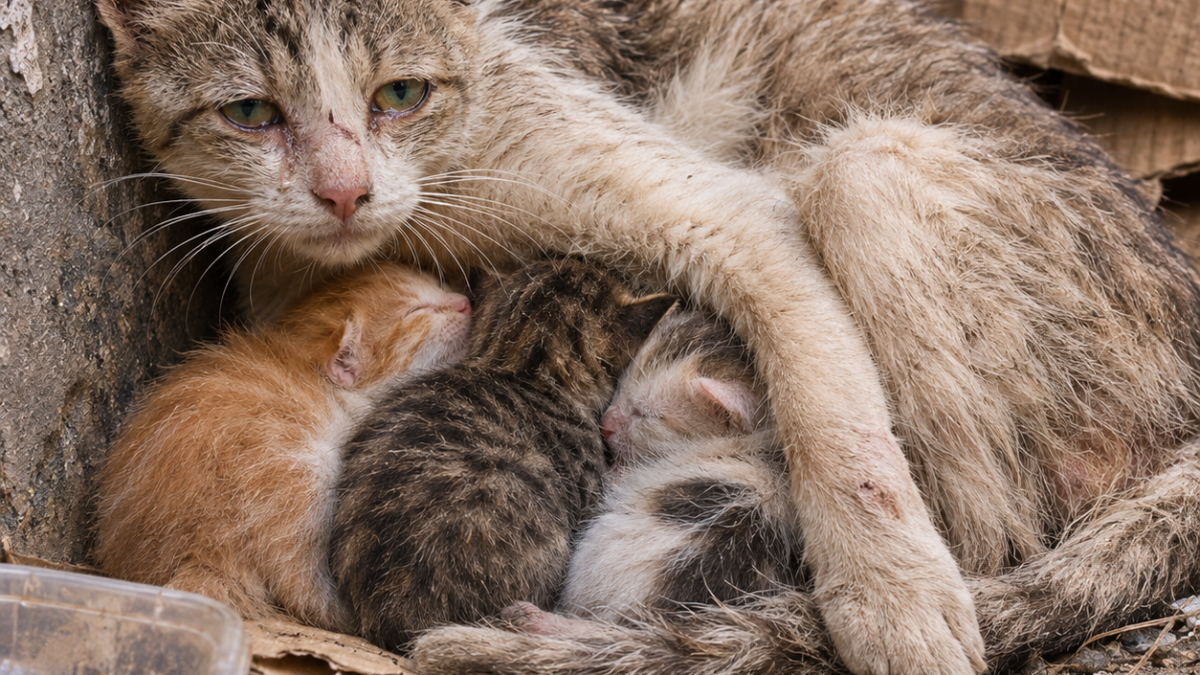
The starving mother cat had spent days pressed against a filthy concrete wall because she was too weak to carry her three newborn kittens somewhere safer, yet every time a stranger approached, she still stretched one trembling paw across their bodies as if she could protect them from the entire world by herself.
When rescuers finally lifted the smallest kitten from beneath her chest, they discovered a strip of plastic construction twine buried so deeply around his swollen back leg that the circulation was nearly gone—and the exhausted mother tried to crawl after him even though she could barely stand.
Then the veterinarian scanned a microchip hidden beneath the mother’s matted fur and uncovered a name, an address, and a promise someone had made six months earlier, revealing that the cat everyone in the neighborhood had dismissed as a lifelong stray had once belonged to a woman who died believing her beloved pet would be kept safe.
At first, Angela Morris thought the cat was dead.
She had already passed the old brick wall once that morning on her way to the bus stop, moving quickly because she was seven minutes behind schedule and had no intention of being late for another twelve-hour shift at St. Matthew’s Medical Center.
The alley cut between a shuttered furniture store and a row of aging duplexes on the west side of Pittsburgh.
It was not technically an alley.
The city called it a service lane.
Nobody who lived there called it anything.
It was simply the place where dumpsters overflowed, broken chairs appeared overnight, and people left cardboard boxes they did not want to carry to the recycling center.
Angela walked through it almost every day.
She knew the usual scenery.
The rusted shopping cart.
The cracked retaining wall.
The blue recycling bin someone had abandoned three houses from where it belonged.
The spray-painted utility box.
The stray cats.
There were always cats.
Orange.
Black.
Gray.
Some disappeared.
Others stayed for months.
Neighbors left food occasionally.
Nobody claimed responsibility.
That Wednesday morning, the gray-and-white cat beside the wall did not move when Angela passed.
Angela noticed.
She kept walking.
Then stopped.
Turned.
PART2:
The cat was lying on a patch of broken concrete between a crushed shipping box and a pile of masonry rubble.
Her body looked wrong.
Too flat.
Too thin.
Her fur, mostly gray with white along the chest and front paws, was dirty enough that the colors blended with the dust around her.
Angela stared.
The cat’s eyes were open.
Good.
Alive.
Probably.
“Hey.”
The cat did not move.
Angela checked her phone.
6:42 a.m.
Bus at 6:49.
She had worked three consecutive long shifts.
Her feet hurt.
Her coffee was already getting cold.
The reasonable thing was to call animal control during lunch.
Or tell somebody who lived there.
PART3:
Or put the problem into the large category of terrible things she could not personally solve before sunrise.
She took two steps toward the bus stop.
Then the cat lifted one paw.
Not high.
Barely off the concrete.
She extended it in front of her body.
Angela stopped.
The movement looked almost defensive.
Do not come closer.
She took one cautious step.
The cat did not run.
That worried her more than running would have.
Most street cats in that neighborhood treated people as mobile threats.
Angela had tried once to approach a black tomcat near the laundromat and watched him disappear beneath a fence before she got within fifteen feet.
This one stayed.
“Are you hurt?”
No answer.
The cat shifted.
Something beneath her moved.
Angela froze.
A tiny orange head appeared against the mother’s belly.
Then disappeared.
“Oh.”
She put down her coffee.
Slowly crouched.
There were kittens.
Three.
So small that Angela had not seen them against the dirt and tangled fur.
The orange one was nearest the mother’s hind leg.
A darker tabby was pressed against her stomach.
The third was almost completely hidden beneath her front leg.
Angela’s entire morning changed.
“Oh, baby.”
The mother cat raised her head.
Her eyes were yellow-green.
Exhausted.
Not dull.
Watching.
Angela held both hands where the cat could see them.
“I’m not touching them.”
The mother’s paw remained stretched across the kittens.
Angela had never seen anything quite like it.
The cat was not standing over them.
Not hissing.
Not swatting.
She seemed too weak for that.
She had simply put one leg between her babies and the approaching human.
The smallest barricade possible.
Angela took out her phone.
Photographed the location from a distance.
Then called her supervisor.
“Rachel.”
“You are not calling me at six forty-five to say you’re sick.”
“No.”
“I found kittens.”
Silence.
“Angela.”
“I’m serious.”
“You are a cardiac nurse.”
“I am aware.”
“We do not run a veterinary department.”
“I know.”
“Are you coming?”
Angela looked at the mother cat.
“I’m going to be late.”
Rachel sighed.
“How late?”
“I don’t know.”
Another sigh.
Then:
“Send me a picture.”
Angela did.
Twenty seconds later Rachel replied:
Okay. Be late.
Angela called Allegheny Second Chance Rescue next.
Voicemail.
She called county animal services.
They could send someone, but not immediately.
Forty-five minutes.
Maybe longer.
Angela looked at the mother.
The cat had lowered her head again.
The kittens nursed.
Or tried to.
Angela ran to the convenience store on the corner.
Cat food was not part of the morning inventory.
Tuna was.
She bought two cans and bottled water.
The cashier watched her.
“Breakfast?”
“For a cat.”
“Of course.”
Angela returned.
The mother had not moved.
She opened the tuna.
Placed it eight feet away.
The smell traveled.
The cat’s nose moved.
Her eyes followed the food.
She did not stand.
Angela moved it closer.
Six feet.
Four.
The mother looked down at the kittens.
Then back at the food.
She pulled herself forward.
Not stood.
Pulled.
Front paws first.
Hindquarters following.
Angela’s stomach tightened.
For one second she assumed the cat’s back legs were injured.
Then she saw them move.
Weakly.
The mother was simply exhausted.
She crawled to the tuna.
Took three bites.
Stopped.
Looked back.
The kittens were less than two feet away.
Still, she returned.
Curled around them again.
Angela stared.
“You can eat.”
The cat licked one kitten.
Angela pushed the food closer until it sat within reach of the mother’s face while she remained curled around them.
That worked.
She ate.
Slowly.
Never taking her eyes completely off Angela.
By 7:10, a white SUV with SECOND CHANCE ANIMAL RESCUE printed on the side pulled into the lane.
Mara Collins stepped out.
Angela recognized the name from local rescue posts but had never met her.
Mara looked around fifty.
Hair twisted into a bun.
Jeans.
Old sneakers.
A sweatshirt with a paw print so faded it looked archaeological.
She carried a plastic crate, towels, gloves, and the expression of someone who had seen too many emergencies before breakfast.
“You Angela?”
“Yes.”
Mara looked toward the wall.
“Mom?”
“Yes.”
“Three kittens?”
“I think.”
“You touch anybody?”
“No.”
“Good.”
“I fed her.”
“Better.”
Mara crouched several feet away.
The mother immediately raised her head.
Paw extended.
Mara stopped.
“Hi, mama.”
The cat’s ears flattened.
“No one’s stealing anybody.”
Angela watched.
“You think she understands?”
“No.”
Mara kept her voice soft.
“But I understand what I’m saying.”
She placed the open carrier near the wall.
Then food inside.
The mother looked.
Did not move.
Mara waited.
Five minutes.
Ten.
People passed.
A man carrying a tool bag stopped.
“What happened?”
Mara said:
“Cat family.”
He nodded as though that explained everything and kept going.
A woman walking a small dog crossed to the other side.
The mother watched every movement.
Angela sat on the curb.
“I should go.”
Mara looked at her.
“Yes.”
Angela did not move.
Mara smiled faintly.
“You’re staying.”
“Apparently.”
“First rescue?”
“First one I couldn’t walk away from.”
“That’s how it starts.”
The mother would not enter the carrier.
Mara did not force her.
She moved the food.
Waited.
Shifted the carrier angle.
Waited.
Finally, the mother stood.
Her legs shook violently.
Angela whispered:
“Oh my God.”
Mara’s face changed.
The cat was thinner than either had realized.
Her sides hollowed inward.
Spine visible beneath fur.
Milk production had taken what little body reserve she had left.
Still she turned first toward the kittens.
One orange.
One dark tabby.
One tiny gray-white bundle.
The smallest did not move much.
Mara noticed.
“That one worries me.”
Angela looked.
“Why?”
“Too quiet.”
The mother stepped toward the carrier.
Stopped.
Looked back.
Mara moved the kittens’ blanket—really a torn piece of cardboard—closer.
The cat returned immediately.
“Okay.”
Mara whispered.
“We move everybody together.”
She asked Angela to hold the carrier steady.
Mara slid a clean towel under the kittens without separating them far from the mother.
The mother tensed.
One paw rose.
Mara paused.
“See them?”
She kept all three visible.
The mother sniffed.
Mara moved the towel into the carrier.
The kittens squeaked.
The mother stood.
For one second Angela expected her to flee.
Instead she followed.
Straight into the carrier.
Mara shut the door.
The mother immediately turned around.
Counted with her nose.
One.
Two.
Three.
Then curled around them.
Angela exhaled.
“Done.”
Mara shook her head.
“No.”
“What?”
“We’ve only changed the address of the problem.”
The carrier was lifted.
That was when the smallest kitten cried.
A thin sound.
Mara stopped.
“Wait.”
She placed the carrier back down.
Opened the top carefully.
The mother’s head came up.
Mara reached toward the smallest kitten.
The mother gave the first real warning they had heard.
A low growl.
Mara froze.
“Okay.”
Angela crouched.
“What do you see?”
“Back leg.”
The kitten’s right hind leg looked larger than the left.
At first Angela thought it was dirt.
Then Mara separated the fur.
A thin strip of blue plastic was wrapped around the upper leg.
Construction twine.
Nearly hidden.
The tissue below it was swollen.
Dark red.
Angela’s nurse brain took over instantly.
“Tourniquet.”
Mara nodded.
“Exactly.”
“How long?”
“No idea.”
“Circulation?”
“Bad.”
Angela looked at the old wall.
Blue plastic twine was tangled among the debris nearby.
Probably from bundled bricks or construction material.
The kitten must have crawled through it.
Or been born into it.
Each day of growth tightened the loop.
Mara’s face hardened.
“We’re going now.”
The mother growled again when the kitten was touched.
Mara did not remove him.
Not there.
They loaded the entire family.
Angela got into her own car.
Mara looked over.
“You going to work?”
“Yes.”
Angela started the engine.
Then stopped.
“No.”
Mara smiled.
“Thought so.”
Pittsburgh Veterinary Emergency and Specialty Center was twenty minutes away.
Angela followed the rescue SUV.
The whole drive she thought about one thing.
The mother had been starving.
Could barely stand.
Yet the kittens looked warm.
Alive.
Clean enough around the faces.
She had spent whatever she had keeping them that way.
Angela knew that kind of depletion.
Human mothers arrived in hospitals with it sometimes.
Not physically identical.
Emotionally recognizable.
People who had run out of themselves before admitting they needed help.
At the clinic, Dr. Nora Callahan took one look at the kitten’s leg and moved fast.
“We need to cut that now.”
The mother cat remained in the carrier with the other two kittens.
She watched everything.
Nora used small scissors and forceps.
The twine was embedded.
The kitten weighed barely ten ounces.
His gums looked pale.
His body temperature was low.
When the plastic finally came free, the leg remained grotesquely swollen.
Nora checked capillary refill.
Then Doppler flow.
“Some circulation.”
Mara exhaled.
“Can we save it?”
“Maybe.”
That word would define the next several days.
Maybe.
The kitten could keep the leg.
Maybe.
He could lose it.
Maybe.
He would survive.
Maybe.
Nora examined the others.
Orange male.
Underweight but active.
Dark tabby female.
Small.
Mildly dehydrated.
Then the mother.
She resisted leaving the carrier until Mara moved the kittens with her.
Nora lifted her carefully.
The cat weighed six pounds.
She should have weighed closer to nine.
Severe flea burden.
Dehydration.
Anemia.
Mastitis developing in one mammary gland.
Old scratches.
No major fractures.
No fresh trauma.
Nora listened to her heart.
“Fast.”
Angela asked:
“How bad?”
“Bad enough.”
“Fatal?”
“Not if she responds.”
The mother looked toward the kittens.
Nora touched her head.
“She’s given them everything.”
Blood work confirmed it.
Anemia.
Low protein.
Electrolyte imbalance.
Evidence of infection.
Not dying that minute.
But far closer to collapse than anyone would have guessed from the way she still tried to guard the babies.
Mara looked at Angela.
“You should go to work.”
Angela checked the time.
8:38.
She had already missed the first hour.
Rachel had texted:
Cat update?
Angela replied:
Mom very weak. Smallest kitten may lose a leg.
Three dots appeared.
Then:
Take the day. Send pictures.
Angela laughed.
“What?”
Mara asked.
“My boss is an enabler.”
“Good.”
They admitted all four animals under Second Chance.
Mara began paperwork.
Temporary names were required.
Angela said:
“Mother should be Grace.”
Mara looked up.
“Why?”
Angela shrugged.
“She doesn’t have any left and somehow keeps giving it.”
Mara considered.
“Too sentimental.”
“You run an animal rescue.”
“Fair.”
The mother became Grace.
Orange kitten:
Sunny.
Dark tabby:
Mia.
Smallest:
Pip.
No one knew why Pip.
Mara said it.
Everyone accepted it.
Pip’s leg was flushed with warm fluids.
Pain medication.
Antibiotics.
The swelling monitored.
Nora warned them.
“If tissue dies, we amputate.”
“Can a kitten that small handle it?”
Angela asked.
“If he stabilizes first.”
“And if he doesn’t?”
Nora did not answer quickly.
Angela knew the answer.
Grace did too, in the only way a mother cat understands distress.
She refused to settle while Pip was on the treatment table.
Paced inside the kennel.
Called.
Not loudly.
A rough little chirp.
Nora finally placed Pip back beside her.
Grace sniffed him head to tail.
Licked his face.
Then the swollen leg.
Nora gently moved her away from the injured area.
Grace curled around him.
Only then did she lie down.
Mara whispered:
“She thinks he came back because she kept asking.”
Angela swallowed.
“Maybe he did.”
The first night was dangerous.
Pip’s blood sugar dropped.
Grace’s temperature rose.
Mastitis worsened.
She was not producing enough milk for all three kittens.
The team supplemented.
That created a new problem.
Grace did not trust hands near the babies.
Not aggressively.
She did not have the strength.
She simply dragged herself between every bottle and every kitten.
So they adapted.
One person fed.
Another kept Grace touching the kitten with her nose.
She learned.
By midnight, she allowed Mara to bottle-feed Sunny while Sunny remained pressed against Grace’s side.
By morning, she allowed Mia.
Pip took the longest.
Every time he cried, Grace stood.
Even when her legs shook.
Nora finally whispered:
“You’re going to kill yourself trying to supervise us.”
Grace stared.
Angela, who had returned after her actual shift ended, sat beside the kennel.
“She doesn’t know she doesn’t have to.”
That sentence stayed.
How would Grace know?
For weeks, maybe months, every danger had required her.
Cold.
Hunger.
Dogs.
People.
Cars.
Rain.
Noise.
If she stopped watching, something could disappear.
Trust was not a switch.
Safety did not become believable just because humans declared it.
They had to prove it through repetition.
Feed kitten.
Return kitten.
Touch kitten.
Return kitten.
Open kennel.
No one disappears.
Again.
Again.
Again.
By day three, Grace slept through one bottle feeding.
Mara photographed her.
Head down.
Eyes closed.
All three kittens touching her.
Caption to Angela:
She finally clocked out.
Angela smiled at work for ten straight minutes.
Then came the microchip.
No one had scanned Grace the first morning because survival mattered more.
On day four, technician Claire Bennett passed the scanner over her shoulders.
Beep.
Claire looked at the screen.
“Mara?”
Mara came over.
“What?”
“Chip.”
They had assumed Grace was a long-term stray.
Neighborhood people had seen her near dumpsters for months.
No collar.
Feral behavior.
Fear of people.
Thin.
Dirty.
The microchip changed that.
Registered name:
ROSIE.
Owner:
Evelyn Matthews.
Address:
314 Hanover Street.
Eight blocks from the wall.
Phone disconnected.
Registration last updated seven years earlier.
Mara stared.
“Rosie.”
Grace lifted her head.
Mara said it again.
“Rosie?”
One ear moved.
Angela felt something cold run down her back.
“You think she knows?”
“Could be tone.”
Mara looked at the registration.
“Let’s find out.”
314 Hanover Street belonged to a renovated duplex.
New owners.
They had never heard of Evelyn Matthews.
County property records showed the home had changed hands six months earlier.
Evelyn Matthews had died the previous November.
Seventy-nine.
Widowed.
No children.
A nephew handled the estate.
Mara found an obituary.
Photo.
Evelyn smiling.
In her lap:
A gray-and-white cat.
Grace.
Rosie.
Same face.
Full-bodied.
Clean.
Wearing a red collar.
Angela stared at the photo.
“That’s her.”
“Yes.”
“Six months.”
Mara’s voice hardened.
“Somebody put an owned cat outside six months ago.”
Maybe.
They did not know yet.
Mara contacted the nephew listed in probate documents.
His name was Kevin Matthews.
Forty-three.
Lived outside Columbus, Ohio.
He answered on the third call.
“Hello?”
“Mr. Matthews, my name is Mara Collins with Second Chance Animal Rescue in Pittsburgh.”
Pause.
“What’s this about?”
“A cat named Rosie.”
Silence.
Mara looked at Angela.
“Mr. Matthews?”
“Rosie’s dead.”
Mara’s expression changed.
“No.”
“What?”
“She’s alive.”
Longer silence.
“That’s impossible.”
“She’s in our veterinary care.”
“She has a microchip registered to Evelyn Matthews.”
Kevin’s voice became cautious.
“Where’d you find her?”
Mara told him.
He swore softly.
“Do you know how she got there?”
“No.”
“Were you responsible for her after Evelyn died?”
Pause.
“Sort of.”
Angela hated the phrase instantly.
Mara kept her voice calm.
“What does sort of mean?”
“My aunt asked me to handle the estate.”
“Did she leave instructions for Rosie?”
“Not really.”
That answer was a lie.
They learned it two days later.
But first Kevin told the version he preferred.
He claimed Rosie had been “semi-feral.”
Went in and out.
Could not be caught after Evelyn died.
He left food for weeks.
Then Rosie disappeared.
Mara asked:
“Did you report her missing?”
“No.”
“Notify the microchip registry?”
“No.”
“Contact a shelter?”
“No.”
“Any rescue?”
“No.”
“Why did you say she was dead?”
Kevin hesitated.
“I assumed.”
Mara looked at Angela.
“How long did you leave food?”
“I don’t remember.”
“When did you sell the house?”
“January.”
“Rosie was found in April.”
“I told you, she wandered.”
Mara ended the call without accusing him.
Then she called Evelyn’s attorney.
That changed everything.
Evelyn had left a handwritten pet-care instruction attached to her will.
Simple.
Rosie is to remain in my home if possible. If the house must be sold, Kevin has agreed to take her or place her directly with a rescue. There is $3,000 set aside for her care.
Mara closed her eyes.
“Directly with a rescue.”
Angela whispered.
“Not outside.”
“No.”
The attorney confirmed the $3,000 had been released to Kevin as estate executor for Rosie’s care.
Mara called him again.
This time Kevin was angry.
“I took care of that cat.”
“How?”
“I fed her.”
“For how long?”
“She wouldn’t come with me.”
“Did you contact a rescue?”
“No.”
“Why?”
“I had a lot going on.”
“What happened to the money?”
“That is an estate matter.”
“It was specifically for Rosie.”
“I used it on house-related expenses.”
Mara’s jaw tightened.
“Did Evelyn know you weren’t taking Rosie?”
“She was dead.”
That sentence ended any sympathy Angela might have had.
Mara remained controlled.
“Did you ever put Rosie outside?”
Silence.
“Mr. Matthews?”
“She kept scratching at the door.”
“Did you put her outside?”
“She was going outside anyway.”
“Answer the question.”
“I left the back door open.”
“In December?”
“She had shelter.”
“What shelter?”
“The porch.”
Mara looked sick.
Pittsburgh.
December.
An indoor cat.
Owner dead.
House empty.
Door open.
Kevin continued defensively.
“I was driving back and forth from Ohio.”
“I couldn’t live there.”
“I have dogs.”
“My wife is allergic.”
“I thought she’d stay around the property.”
“Then you sold the house.”
“Yes.”
“And left.”
“She was gone by then.”
“You did not verify.”
“No.”
“You did not contact anyone.”
“I told you I was busy.”
Mara ended the call.
Angela sat silently.
Grace—Rosie—lay curled around her kittens ten feet away.
The story inside her body suddenly had a shape.
The fear of doors.
The refusal to leave the kittens.
The hypervigilance.
Once, she had lived inside.
Had a person.
Had a bed.
Had a name.
Then Evelyn died.
A door opened.
Nobody came back.
Rosie survived winter outdoors.
Pregnant sometime afterward.
Found shelter beside a wall.
Gave birth.
Used her own body for insulation.
People called her feral.
People said she had learned not to trust humans.
They had no idea trust was exactly what had put her outside.
The rescue contacted humane investigators.
Not because every bad decision becomes a crime.
It does not.
But abandonment and misuse of designated animal-care funds needed review.
Kevin’s version shifted again when investigators interviewed him.
Then a neighbor produced doorbell-camera footage.
January 9.
Kevin carrying Rosie from Evelyn’s house in a plastic laundry basket.
Rosie struggling.
He opened the back gate.
Placed the basket outside.
Rosie jumped out.
Kevin went back inside.
January 11.
Moving truck.
January 12.
House empty.
Rosie visible on back steps.
Kevin had not “left the door open.”
He had physically put her outside.
He later pleaded no contest to an animal-abandonment citation and agreed to repay the remaining pet-care funds as restitution to Second Chance for Rosie’s veterinary expenses.
No prison.
No dramatic arrest.
But the probate court also ordered an accounting of the $3,000.
Kevin repaid it.
Mara thought the punishment was light.
Angela did too.
Then Evelyn’s attorney said something neither forgot.
“You cannot sentence him to experience the winter she experienced.”
That was the limitation of justice.
You could document.
Fine.
Repay.
Prohibit.
Correct records.
You could not give Rosie back the months she spent learning closed doors meant nobody was returning.
So the rescue focused on what could still be changed.
Pip’s leg improved.
Slowly.
The swelling decreased.
Pink returned to the toes.
Doppler flow strengthened.
Nora smiled for the first time on day five.
“I think we keep it.”
Angela almost hugged her.
“Really?”
“Don’t celebrate too early.”
“Too late.”
Pip kept the leg.
He would always have a slight deformity.
Probably.
Maybe a limp.
But no amputation.
Sunny gained weight first.
He became loud.
Hungry.
Orange in every stereotypical sense.
Mia became the climber.
At four weeks, she escaped the foster pen twice.
Grace—Rosie—became something else.
Healthy.
Not quickly.
But visibly.
Her coat softened.
Weight returned.
Mastitis resolved.
Anemia improved.
The first time she stood and stretched fully, Mara sent Angela a video.
Angela watched it six times.
No shaking.
No collapse.
Grace walked to the food bowl.
Ate.
Then walked away from her kittens for almost four minutes.
That was enormous.
She sat by a window.
Sunlight on her face.
Mara whispered behind the camera:
“Look at you taking a break.”
Grace closed her eyes.
For four minutes, nobody needed her.
That was healing.
Angela became their foster.
Officially.
She had never planned to.
Her apartment was small.
Her landlord allowed cats.
One cat.
Angela negotiated.
“Temporary family.”
The landlord, Mr. Perez, said:
“That sounds like more than one cat.”
“They weigh less than one adult.”
“That is not how leases work.”
“They’re four weeks old.”
“No.”
Angela showed him a picture.
He stared.
“Damn it.”
Temporary approval.
The family moved into Angela’s spare room.
Grace spent the first day beneath the bed.
Kittens explored.
The second night, Angela slept on the floor nearby.
Not because the cats needed her.
Because she needed to know Grace was eating.
At 2:00 a.m., she woke to purring.
Grace was sitting six inches away.
Watching.
Angela did not reach.
“Hi.”
Grace stayed.
Next night:
Closer.
Night four:
Grace touched Angela’s fingertips.
Night six:
Head bump.
Angela cried.
Quietly.
The mother cat who had once stretched a paw across the concrete to keep humans away now pressed her forehead into a human hand voluntarily.
Trust did not return overnight.
It returned in inches.
One bowl.
One returned kitten.
One closed door that did not become abandonment.
One hand that moved slowly.
One night followed by morning with the same person still there.
Grace never became a lap cat.
Not then.
She liked sitting beside.
That was enough.
The kittens grew.
Their personalities separated from the emergency that introduced them.
Sunny was fearless until the vacuum turned on.
Mia climbed curtains.
Pip, despite being the smallest, became stubborn.
The rescued leg worked.
Not perfectly.
He ran with a tiny sideways hop.
Angela loved it.
Nora called it a mild gait abnormality.
Angela called it style.
At eight weeks, adoption discussions began.
The kittens were ready.
Grace was not.
Physically, yes.
Emotionally?
Harder.
Second Chance wanted to avoid another mistake.
Mara refused to list her until they understood what kind of home she needed.
Quiet.
Patient.
No forced handling.
Indoor only.
Predictable routine.
Somebody who understood that being protected by a mother cat did not mean she herself had ever felt protected.
The kittens went first.
Mia and Sunny were adopted together by a young couple.
Angela cried.
Grace searched for them that night.
Not frantically.
But she walked the room.
Called twice.
Pip remained.
He and Grace slept together.
Then a family applied for Pip.
Two children.
Good veterinary reference.
Indoor cat history.
They visited.
Pip climbed directly into the younger boy’s lap.
Perfect.
Angela should have been thrilled.
Instead she watched Grace.
Grace sat behind the chair.
One paw resting near Pip’s tail.
Not gripping.
Just contact.
Angela called Mara.
“I don’t think we should separate them.”
Mara sighed.
“You’re becoming dangerous.”
“I’m serious.”
“We always knew Pip might stay with Grace longer.”
“Not longer.”
Mara went quiet.
“You think bonded?”
“I think he’s the last one.”
“That’s not enough.”
Angela knew.
Emotional reasoning had already failed Grace once.
They assessed.
Pip explored independently.
Grace ate when he was elsewhere.
No distress during short separations.
Not a bonded pair by shelter criteria.
Angela hated the result.
Because it was correct.
Pip could leave.
Grace could survive.
That did not mean it would not hurt.
Pip went home on a Sunday.
Grace watched the carrier leave.
Then sat by the door.
Angela sat beside her.
No touching.
They stayed like that for an hour.
The next morning, Grace ate.
Then slept on Angela’s bed for the first time.
Not under.
On.
Angela woke and found her curled near her feet.
She whispered:
“You stayed.”
Grace blinked.
“So did I.”
Two weeks later, Grace was listed for adoption.
Applications came.
One family wanted a cat “good with toddlers.”
No.
One man said he liked that she was “low-maintenance.”
Mara rejected the phrase immediately.
Grace had survived abandonment, pregnancy, street life, anemia, and raising three kittens beside concrete.
She had earned the right to be considered high-maintenance if she wanted.
Then came Sarah Mitchell.
Forty-one.
Widowed.
No children at home.
One elderly dog who had recently died.
Worked from home as a medical transcriptionist.
She read Grace’s entire profile twice.
Her application included one sentence Mara forwarded to Angela:
I don’t need her to love me quickly. I can be the person who keeps showing up until she decides what I am.
Angela read it three times.
“Damn.”
Mara said:
“Exactly.”
Sarah visited.
She sat on the floor.
Did not reach.
Grace watched from beneath a chair.
Twenty minutes.
Nothing.
Sarah talked to Angela.
About Evelyn.
Kevin.
The kittens.
Pip’s leg.
The winter.
At thirty-two minutes, Grace came out.
Sniffed Sarah’s shoe.
Returned under the chair.
Sarah smiled.
“I think that was a job interview.”
Angela laughed.
“First round.”
Second visit.
Grace stayed visible.
Third.
She accepted one chin scratch.
Sarah cried afterward in her car.
Not in front of Grace.
That mattered to Angela for some reason.
On adoption day, Angela packed the yellow blanket Grace had used with the kittens.
Food.
Records.
One photograph:
Grace beside the old wall.
Angela nearly did not include it.
Sarah asked why.
“So you know where she started.”
Sarah shook her head.
“I know.”
“Then keep that one.”
She pointed at another photograph.
Grace in sunlight on Angela’s bed.
Healthy coat.
Eyes closed.
“I want to remember where she got to.”
Angela changed the picture.
Grace went home.
The first week she hid under Sarah’s guest bed.
Sarah texted every day.
No panic.
No demands.
Day three:
She ate while I was in the room.
Day five:
She slept in the doorway.
Day nine:
She sat on the couch while I worked.
Day thirteen:
She touched my hand.
Day twenty-one:
Photo.
Grace asleep beside Sarah’s leg.
Not touching.
Almost.
Angela smiled.
Month two:
Grace in Sarah’s lap.
For the first time.
Angela cried at work.
Rachel, her nurse supervisor, caught her.
“You okay?”
“Cat.”
Rachel nodded.
“Of course.”
The kittens thrived.
Mia and Sunny became chaos twins.
Pip’s family sent videos of him running.
His limp almost disappeared.
His favorite activity became stealing socks.
Second Chance used his medical case to educate people about checking newborn animals for hair and string tourniquets.
They also started a small emergency fund in Evelyn Matthews’s name after her attorney asked where the repaid $3,000 should go once Grace’s bills were covered.
The attorney said Evelyn had loved animals.
Mara chose:
THE EVELYN FUND — KEEP THEM TOGETHER, KEEP THEM SAFE.
Angela thought the name was sentimental.
Mara said:
“You’re the one who named a mother cat Grace.”
Fair.
The legal case against Kevin ended quietly.
No viral courtroom.
No dramatic confession.
He paid restitution.
Completed community service.
Could not serve as custodian for another animal-care trust during his probation period.
The probate judge wrote that he had failed to carry out a specific responsibility entrusted to him.
That sentence mattered to Evelyn’s attorney.
It mattered to Mara.
Angela cared less.
She wanted one question answered.
Why?
Why put Rosie outside?
Kevin finally gave the closest thing to an answer in a statement submitted before sentencing.
He wrote:
I had never owned a cat and did not understand how dependent she was on the house and routine. I was overwhelmed by the estate and wanted the property empty. I told myself she had survived outside before because my aunt let her into the yard. I knew a rescue was an option and did not call one because it was easier not to. I regret that.
Mara read the statement.
Then handed it to Angela.
Angela hated him less afterward.
Not forgave.
Less.
Because cruelty is sometimes easier to understand when it looks monstrous.
The more dangerous version often looks like convenience.
Too busy.
Too far.
Too complicated.
Someone else will handle it.
She’ll be fine.
Animals survive.
It is easier not to call.
Kevin had not hated Rosie.
He had simply allowed her life to become less important than his schedule.
That was enough to nearly kill her.
Months later, Angela walked through the service lane again.
The old wall was gone.
Demolition.
New apartments planned.
The cardboard.
Rubble.
Blue construction twine.
All removed.
She stopped where Grace had been.
Nothing marked the spot.
Good.
Not every place of suffering needed a plaque.
She thought about that morning.
The paw.
The kittens.
Grace refusing food until she could remain touching them.
Angela had initially thought the cat was too weak to leave.
She had been wrong.
Grace could move.
She simply would not move away from her babies.
There is a difference.
People later turned it into a beautiful story.
“A mother’s love.”
“Hero cat.”
“She sacrificed everything.”
Angela understood why.
But after spending months with Grace, she felt differently.
Grace’s story was not beautiful because she starved for her kittens.
Starvation was not noble.
Abandonment was not meaningful.
The cold did not make her a better mother.
The twine around Pip’s leg was not destiny.
What was beautiful was that once help finally arrived, Grace slowly accepted something she had not been able to imagine:
Protection did not have to come only from her body.
Somebody else could carry the carrier.
Somebody else could warm Pip.
Somebody else could feed Sunny.
Somebody else could watch Mia.
Somebody else could stay awake.
Grace could sleep.
That was the real transformation.
The first night at the clinic, she lifted her head every time a kitten squeaked.
By week three in foster care, she sometimes slept through all three wrestling on top of her.
By the time she lived with Sarah, she slept belly-up in the afternoon sun.
Exposed.
Vulnerable.
Safe enough not to guard every direction.
Sarah sent Angela that photograph six months after adoption.
Grace on a cream-colored rug.
Legs loose.
Belly up.
One paw curled.
Eyes closed.
Angela stared at it for a long time.
Then sent it to Mara.
Mara replied:
She finally understands someone else has the night shift.
That sentence made Angela cry more than the rescue itself.
A year later, Sarah invited Angela over.
Grace had gained enough weight that Nora had used the word “diet,” which Angela considered one of the greatest achievements in veterinary history.
Grace met her at the door.
Stopped.
Stared.
Angela crouched.
“Remember me?”
No immediate response.
Then Grace walked forward.
Pressed her forehead against Angela’s hand.
Not dramatic.
No leap.
No meow.
Enough.
Sarah said:
“She sleeps on my chest now.”
Angela laughed.
“She never sat in my lap until the last month.”
“Maybe you trained her.”
“No.”
Angela looked at Grace.
“She trained us.”
They sat in the living room.
Sarah had framed one photograph.
Not the wall.
Not the kittens.
Not the carrier.
Grace sitting in the window.
Behind it, sunlight.
Below the frame was a small blue piece of plastic.
Angela stared.
“What is that?”
Sarah smiled.
“Mara gave me a piece of the twine from the evidence bag after the case closed.”
Angela looked horrified.
“You framed the thing that almost cost Pip his leg?”
“No.”
Sarah pointed.
The blue plastic sat beside a small metal tag engraved:
FOUND BEFORE IT WAS TOO LATE.
Angela understood.
Not celebration of harm.
Evidence of timing.
Five more days.
Maybe three.
Maybe one.
Pip could have lost the leg.
Grace could have collapsed.
The kittens could have stopped nursing.
Angela could have kept walking.
People love to ask which moment saved an animal.
Usually there is no single moment.
Angela stopped.
Mara arrived.
Nora cut the twine.
Technicians warmed the kittens.
A neighbor gave information.
A lawyer found paperwork.
Investigators followed records.
Fosters stayed awake.
Adopters said yes.
Dozens of small choices built the rescue.
That was how most saving worked.
Not one hero.
A chain that held because enough people decided not to be the weak link.
Two years after Grace’s rescue, Angela became a foster herself.
Not constantly.
She still worked long hospital shifts.
But once every few months.
Bottle kittens.
Recovering adults.
One elderly cat who hated men and loved microwave rotisserie chicken.
Her apartment became the temporary place where frightened animals learned that a closed door could mean safety instead of abandonment.
Rachel called it predictable.
“I knew that first morning ruined you.”
Angela smiled.
“Improved.”
“Debatable.”
Mara eventually asked Angela to speak at a volunteer orientation.
She hated public speaking.
Agreed anyway.
Someone asked:
“What was the biggest thing Grace taught you?”
Angela almost said maternal love.
That was the expected answer.
Instead:
“Don’t confuse endurance with wellness.”
The room went quiet.
Angela explained.
“Grace kept three kittens alive.”
“That did not mean she was okay.”
“She looked functional enough to people passing by.”
“She wasn’t.”
“She was anemic.”
“Dehydrated.”
“Infected.”
“Barely standing.”
“Sometimes the strongest-looking behavior is happening because an animal—or a person—has no safe option to stop.”
A volunteer nodded slowly.
Angela continued.
“Helping her wasn’t about admiring how much she could endure.”
“It was giving her permission not to.”
That became the line Second Chance later printed in their foster handbook.
Not because Angela wanted it there.
Mara stole everything.
Years passed.
Sunny lived with his sister Mia.
They became large.
Especially Sunny.
The orange kitten who had once weighed less than a coffee mug grew into a fifteen-pound menace who opened cabinets.
Pip stayed smaller.
His right hind leg never became perfectly straight.
He did not care.
He ran.
Jumped.
Climbed.
Slept on a twelve-year-old boy’s chest.
The family occasionally sent Angela videos.
She kept every one.
Grace aged.
Five.
Six.
Seven.
Her real age remained uncertain because the microchip had been implanted after adoption, not birth.
Sarah celebrated the rescue date instead.
April 9.
Grace Day.
No cake.
Chicken.
One year, Angela came.
Mara came.
Nora too.
They sat around Sarah’s kitchen while Grace ignored all of them and slept in a cardboard box.
Perfect.
At eight or nine, Grace developed kidney disease.
Early.
Manageable.
Sarah panicked.
Angela reminded her:
“She is allowed to become ordinary.”
“What?”
“Old cat problems.”
“Not everything has to come from the street.”
Sarah cried.
Then laughed.
“Right.”
They treated her.
Fluids later.
Diet.
Medication.
Grace remained happy.
She still became tense when unfamiliar people moved quickly.
Still disliked carriers.
Still checked rooms sometimes before lying down.
Trauma leaves habits.
Safety does not erase history.
It gives history somewhere else to live.
At ten or eleven, Grace slowed.
Arthritis.
Kidneys worse.
One summer, Sunny and Mia’s adopters visited with photos.
Pip’s family sent videos.
Sarah printed all of them.
Placed them near Grace.
Angela joked:
“Family reunion without family.”
Grace smelled the pictures.
Nothing.
Of course.
Humans needed symbols more than cats.
Still, it felt right.
Grace had done the impossible work.
All three kittens lived.
All three found homes.
All three grew older than she might have expected them to survive during those first nights by the wall.
That mattered to the people who knew.
When Grace’s final year came, Sarah called Angela first.
“Nora says maybe months.”
Angela closed her eyes.
“Okay.”
“Nothing is okay.”
“I know.”
Grace’s kidneys were failing.
Appetite inconsistent.
Weight down.
Still enjoying windows.
Still sleeping beside Sarah.
Still grooming.
They managed.
No rushing.
No pretending.
The last week, Grace stopped climbing onto the bed.
Sarah moved a mattress to the floor.
Angela visited.
Mara too.
Nora had retired but came once just to see her.
Grace accepted one scratch from Nora.
Then walked away.
“Same patient.”
Nora smiled.
“Still setting boundaries.”
On the final morning, Grace would not eat.
Would not drink.
Could barely stand.
Sarah sat on the rug.
Grace rested against her leg.
Angela arrived at nine.
Mara at ten.
The home veterinarian came at eleven thirty.
Nobody planned a gathering.
It happened because Grace’s life had touched theirs.
The blue twine tag sat on the shelf.
FOUND BEFORE IT WAS TOO LATE.
Angela looked at it.
Then Grace.
Old now.
Thin again, but not starved.
Different.
This body had been cared for.
Comforted.
Aged.
There is a difference between wasting away outside and reaching the end of a long, protected life.
Sarah stroked Grace’s head.
“I promised nobody would make you do everything alone.”
Grace closed her eyes.
Angela sat beside her.
She remembered the concrete.
The paw.
The kittens hidden beneath her.
“You can leave them.”
She whispered.
Not literally.
Those kittens had been adults for years.
But the sentence felt necessary.
“They’re okay.”
Sarah cried.
“Sunny’s fat.”
Mara laughed through tears.
“Mia runs the house.”
Angela continued.
“Pip has both legs.”
The whole room broke.
Grace breathed slowly.
“They’re okay.”
“You did it.”
Sarah added:
“And we’ve got you now.”
The veterinarian gave the sedative.
Grace relaxed.
Her body sank into Sarah’s lap.
No vigilance.
No paw stretched between danger and babies.
No wall behind her.
No dirt.
No cold.
Just a soft blanket.
Hands she knew.
Sunlight across the rug.
The final medication came.
Grace breathed once.
Then again.
Then stopped.
Nobody spoke for a long time.
Angela touched the white fur on her paw.
The same paw she remembered stretched across the concrete all those years before.
It had looked so small then.
A meaningless barrier against a huge world.
Yet it had told Angela everything.
Do not take them.
Do not come closer.
They are mine.
I am still here.
That paw had been the first conversation.
The rest of Grace’s life had been learning another sentence.
You don’t have to do this alone.
Her ashes were divided.
Most stayed with Sarah.
A small amount went beneath a maple tree at Second Chance’s foster garden.
Mara placed a plaque.
Angela argued about the wording for three weeks.
Mara won.
It read:
GRACE
SHE PROTECTED THEM UNTIL SOMEONE PROTECTED HER.
Below it, smaller:
SUNNY • MIA • PIP
ALL HOME.
Kevin never contacted the rescue again.
Evelyn’s attorney did.
Every April she donated to the emergency fund.
Not much.
Fifty dollars.
Sometimes one hundred.
In the memo:
For Rosie.
Angela always smiled.
Grace had carried two names.
Rosie, when she had a home.
Grace, when strangers found her.
Neither was more real.
Animals do not care about the narratives humans attach to names.
Still, Angela liked that she had both.
Rosie proved she had once belonged.
Grace proved belonging could happen again.
Years after everything, Angela still walked the service lane occasionally.
The new apartment building had landscaping.
Bright windows.
Bike racks.
A small coffee shop on the corner.
Nobody looking at it would know three kittens had once been born beside a broken wall there.
That was okay.
The story did not need the wall preserved.
The wall had never saved them.
Grace did.
Then people did.
That was enough.
Angela sometimes thought about how easily the entire thing could have ended differently.
If she had not looked back.
If she had caught the bus.
If the twine had remained another day.
If Mara had grabbed the kittens too quickly and Grace had bolted.
If Kevin had followed Evelyn’s instructions in the first place.
That last one stayed with her.
People preferred rescue stories that began with monsters.
This one began with something more ordinary.
A promise.
Then inconvenience.
Then a shortcut.
Kevin did not wake one morning planning to nearly kill a cat.
He simply kept choosing what was easier.
Do not call the rescue today.
Leave the door open.
She’ll be fine.
Finish the house.
Drive home.
Someone will feed her.
Every easy choice moved Grace farther from safety.
Then rescue worked in the opposite direction.
Stop walking.
Buy tuna.
Make a call.
Wait.
Move slowly.
Keep the kittens together.
Cut the twine.
Stay awake.
Return the kitten.
Again.
Again.
Again.
Small choices can abandon.
Small choices can rescue.
That became the lesson Angela carried into every foster home afterward.
When frightened animals arrived, she did not ask:
Why don’t they trust me?
She asked:
How many times do I need to return before they learn I do?
When exhausted mothers refused to rest, she did not call them heroic.
She made the room quieter.
Fed the babies.
Let the mother sleep.
When volunteers admired sacrifice too much, she reminded them:
Survival is not supposed to be a permanent job.
The point of rescue is not to celebrate how long an animal can endure suffering.
It is to end the suffering soon enough that endurance is no longer necessary.
Grace had spent nights beside a wall with three tiny bodies pressed against her belly because nobody else had taken the shift.
By the time Angela found her, she had almost nothing left.
No stored fat.
No clean coat.
No safe shelter.
No trust.
No reason to believe the next human would help instead of hurt.
Still, when footsteps came, Grace used the last strength she had to stretch one paw over her kittens.
That was what everyone remembered.
Angela remembered what came later.
The first uninterrupted nap.
The first time Grace walked away from the kittens to sit in sunlight.
The first head bump.
The first night on the bed.
The first photograph from Sarah showing a mother cat who had once slept with every muscle tense lying on her back with her belly exposed to the room.
That was the miracle, if Angela allowed herself to use the word.
Not that Grace sacrificed everything.
That eventually, she no longer had to.
The kittens survived.
Grace survived.
Pip kept his leg.
Kevin was forced to answer for the promise he ignored.
The money Evelyn set aside finally went where it had always been meant to go.
And the cat who once believed her own body was the only safe place left for her babies eventually learned that another kind of protection existed.
A carrier that took the whole family together.
A clinic that returned every kitten after treatment.
A foster who did not reach too fast.
An adopter who said, I can wait.
A home where no one disappeared because she closed her eyes.
Grace had refused to leave her babies behind.
In the end, nobody asked her to.
They simply made sure that, for the rest of her life, she would never be the one left behind again.








