She Was Buried Alive for 91 Hours—The Grey Cat Above the Rubble Refused to Stop Digging
She Was Buried Alive for 91 Hours—The Grey Cat Above the Rubble Refused to Stop Digging
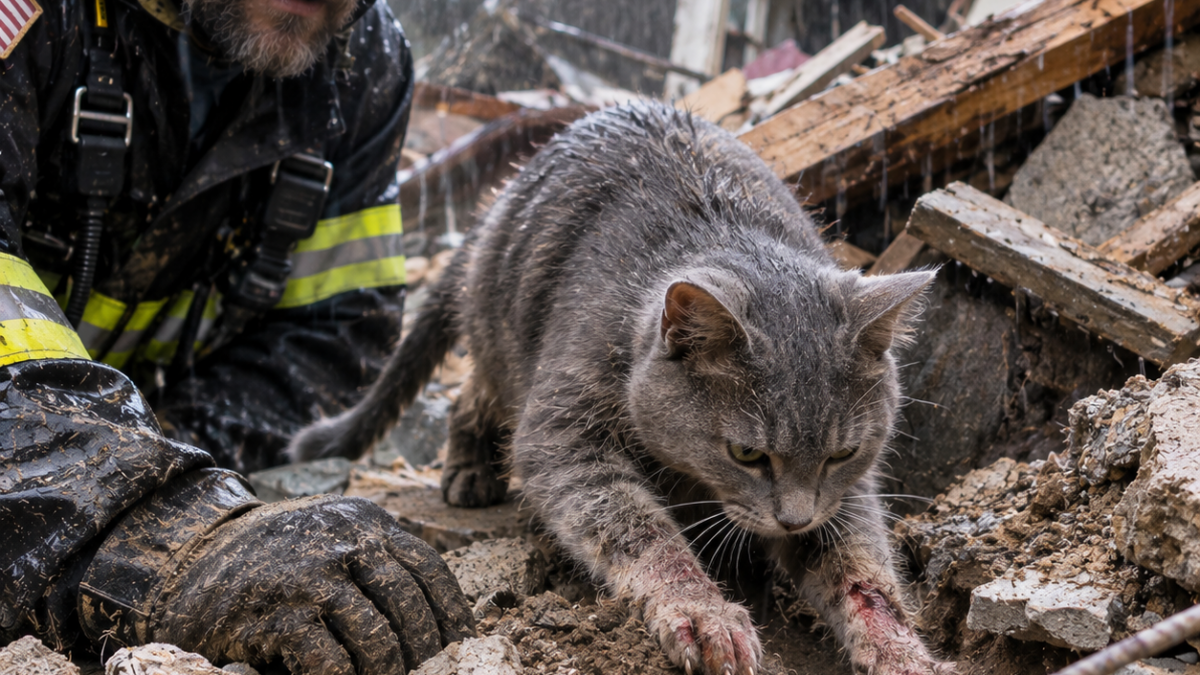
Everyone believed the 81-year-old woman beneath the collapsed Kentucky apartment building was already dead—everyone except the six-pound grey cat tearing her own paws apart on the rubble above her.
By the fourth day, rescuers had moved on, the rain had nearly erased every sign of life, and the cat’s claws were broken and bleeding, but she kept digging at one exact spot as if she could hear something no human could.
When a volunteer finally put his ear against the hole she had made, he heard three faint knocks from beneath the earth—and discovered that the animal everyone had tried to chase away had been right for ninety-one hours.
At 3:40 in the morning, the hillside gave way.
There was no warning loud enough to wake the entire valley.
No long rumble.
No dramatic crack that gave people time to run.
According to the few residents still awake that night, there was one deep sound from beneath the earth, almost like a truck shifting gears somewhere underground.
Then came the collapse.
The rear wall of the aging two-story apartment building folded inward.
A section of the roof dropped.
Windows burst outward.
Wet soil from the hillside crashed through the lower level with broken tree roots, stone, splintered lumber, insulation, plaster, kitchen cabinets, pipes, and pieces of furniture.
The whole thing took less than fifteen seconds.
By the time the noise stopped, the back half of the building no longer existed.
Where four small apartments had stood against the Kentucky hillside, there was now a mound of wreckage thirty feet wide and almost twelve feet high in places.
Rain fell on it without mercy.
Cold December rain.
The kind that soaked through coats, turned clay into glue, and made every surface slippery enough to betray a careless step.
Across the narrow road, a porch light clicked on.
Then another.
A man named Earl Dawson came running from a house fifty yards away wearing jeans, work boots, and no shirt beneath his unzipped hunting jacket.
“Mrs. Walker!”
He did not know whether she could hear him.
He did not even know where her bedroom had been anymore.
“Mrs. Walker!”
There was no answer.
The apartment building had been old long before the storm.
Everybody in the community knew it.
It had been built into the hillside sometime in the late 1940s, expanded twice, repaired cheaply more times than anyone could count, and divided into four rental units long before the current owner bought it.
People joked that the place leaned uphill because it was afraid of falling down.
But the joke had stopped being funny after three consecutive days of heavy rain.
By the previous afternoon, county emergency officials had issued a voluntary evacuation notice for several homes near the steepest slopes.
Three tenants from the apartment building left.
The fourth did not.
Her name was Evelyn Harper.
She was eighty-one years old.
Five-foot-two on the good days when her back allowed her to stand straight.
Thin silver hair.
Soft blue eyes.
Hands spotted with age and scarred from decades of work.
She lived alone in the ground-floor rear apartment.
Evelyn walked with a cane because of arthritis in both knees and an old hip injury from a factory accident forty-three years earlier.
She had a nephew in Ohio.
A niece in North Carolina.
PART2:
A cousin somewhere in Tennessee she had not seen in years.
Nobody close enough to reach her quickly.
The woman in the apartment above, Rachel Mills, had knocked on Evelyn’s door the afternoon before the collapse.
“You need to come with us.”
Rachel had two children and was packing them into her sister’s minivan.
Evelyn stood in the doorway wearing a blue cardigan and slippers.
Behind her, a grey cat sat on the kitchen table watching the rain streak down the glass.
“I’ll be all right.”
“Miss Evelyn, they’re telling everybody on this side of the hill to leave.”
“I heard them.”
“You can stay at my sister’s.”
Evelyn smiled.
“You’ve got two kids, a husband, three dogs, and a mother-in-law under one roof already.”
“One more person isn’t going to hurt.”
“It might hurt your mother-in-law.”
Rachel laughed despite herself.
Then she became serious.
“I don’t like this.”
Evelyn looked toward the window.
Neither did she.
But she had spent most of her life refusing to say when she was afraid.
Fear, to Evelyn, had always seemed like a private thing.
You carried it quietly.
PART3:
You did not hand it to someone else.
“I’ve seen worse storms.”
Rachel frowned.
“This isn’t about the storm. It’s the hill.”
“The hill’s been there longer than either of us.”
“That’s not comforting.”
Evelyn smiled again.
“I’ll stay away from the back rooms.”
“Promise?”
“I promise.”
Rachel hesitated.
Then looked down.
The grey cat had moved to Evelyn’s feet.
“She coming with you if you change your mind?”
Evelyn looked at the cat.
“That one doesn’t go anywhere because I tell her.”
The cat’s name was Gracie.
At least, that was what Evelyn called her.
Eight months earlier, the little grey animal had appeared behind the building during a late-April thunderstorm.
She was soaked.
Half-starved.
Missing fur around her neck.
Evelyn found her crouched beneath the back steps.
She had put down a saucer of tuna and gone inside.
The next morning, the saucer was empty.
The cat returned that evening.
Then the next.
Evelyn never tried to catch her.
She simply fed her.
After three weeks, Gracie allowed Evelyn to sit six feet away while she ate.
After six, she came inside during rain.
By midsummer, she slept at the foot of Evelyn’s bed.
“She’s yours now,” Rachel once said.
“No,” Evelyn replied. “She’s hers.”
“What does that mean?”
“It means she lives here because she wants to.”
Rachel had rolled her eyes.
Evelyn secretly loved that the cat stayed.
The apartment had been too quiet for years.
Evelyn’s husband, Thomas, died eleven years earlier.
They had been married for fifty-two.
Afterward, silence moved into the rooms like another tenant.
Gracie changed that.
Not dramatically.
She did not perform tricks.
She did not curl in Evelyn’s lap.
She was not especially affectionate.
But she existed in the room.
She jumped onto windowsills.
Tapped the refrigerator door when she wanted food.
Slept on the blue blanket at the end of the bed.
Sat outside the bathroom every morning as if supervising Evelyn’s survival.
That was enough.
On the night of December 4, Gracie was outside when the building collapsed.
Evelyn had let her out shortly before midnight.
It was one of the decisions she replayed later during the long hours beneath the wreckage.
The rain had eased for a while.
Gracie scratched at the back door.
“You’re crazy,” Evelyn told her.
Gracie scratched again.
Evelyn opened the door.
“Five minutes.”
The cat disappeared beneath the steps.
Evelyn never saw her return.
At 3:39 a.m., Evelyn woke to the sound of a drinking glass falling from the kitchen counter.
She sat up.
For one second, nothing happened.
Then the bed moved.
Not shook.
Moved.
The entire room shifted sideways.
Evelyn reached for the lamp.
The power went out.
There was a violent cracking sound behind the wall.
She heard dishes breaking.
Then the ceiling came down.
The collapse drove Evelyn from the edge of the bed onto the floor.
Something struck her shoulder.
Another impact hit her ribs.
She tried to scream and inhaled dust.
The world became noise.
Wood splitting.
Concrete striking concrete.
Glass breaking.
Earth moving.
She covered her head with both arms.
Then something heavy pinned her forearm.
The floor beneath her seemed to drop.
She felt herself slide.
Then everything stopped.
For a few seconds, Evelyn could hear nothing but her own breathing.
She opened her eyes.
Darkness.
Absolute.
Not nighttime darkness.
Not a room without lights.
The kind of darkness that felt physical.
She tried to move.
Pain exploded across her chest.
Her left shoulder would not cooperate.
Something sharp pressed against her forearm.
Her legs were cramped beneath her.
“Help!”
Her voice came back to her from inches away.
She coughed.
Dust filled her mouth.
“Help!”
No answer.
She reached upward with her right hand.
Her fingers touched wood.
A tabletop.
She knew it by the rounded edge.
The kitchen table.
Evelyn slowly understood where she was.
The table had collapsed sideways but had not flattened completely.
One end was wedged between a broken cabinet and a support beam.
It had created a space beneath it.
A pocket.
Barely tall enough for Evelyn’s chest.
She could not sit up.
Could not turn completely over.
Could not straighten her left arm.
But she could breathe.
That was the first miracle.
Outside, Earl Dawson continued shouting her name.
Then other neighbors arrived.
Flashlights moved through the rain.
Someone called 911.
A volunteer firefighter named Travis Bell reached the scene at 4:08 a.m.
He later said the building looked “like someone had pushed it into the hill with a giant hand.”
The biggest problem was instability.
Pieces were still moving.
Mud continued sliding from above.
Electrical lines were down.
A propane tank had been damaged.
Nobody could simply climb onto the pile and start digging.
They had to wait for more equipment.
More rescuers.
Daylight.
The first organized search began at 6:25.
Gracie appeared twenty minutes later.
Nobody noticed her at first.
There were too many people.
Firefighters.
Sheriff’s deputies.
Neighbors.
County emergency workers.
A utility crew.
Two men from the road department.
Rachel Mills came back from her sister’s house shortly after seven.
She stood behind yellow tape staring at the wreckage.
“Evelyn’s in there.”
Deputy Nathan Cole nodded.
“We know.”
“You have to find her.”
“We’re trying.”
“She couldn’t move fast.”
“I understand.”
“No, you don’t. She was on the ground floor.”
Nathan looked at the pile.
“We’re doing everything we can.”
Rachel started crying.
Then she saw the cat.
Gracie was sitting halfway up the mound.
Small.
Wet.
Perfectly still.
“Gracie.”
The cat turned her head.
Rachel pointed.
“That’s Evelyn’s cat.”
One firefighter looked over.
“She needs to get out of there.”
A young volunteer named Caleb Turner climbed carefully toward her.
“Come on, kitty.”
Gracie backed away.
Caleb reached again.
The cat hissed.
He laughed once.
“Okay. Mean little thing.”
He climbed down.
An hour later, Gracie was still there.
But she had moved.
She was now near the northwest corner of what had been Evelyn’s apartment.
She lowered her head.
Scratched.
Stopped.
Scratched again.
Nobody paid much attention.
Why would they?
There were professionals on-site with listening equipment.
Thermal imaging.
Search poles.
Training.
The cat had none of those things.
By noon, rescue crews had removed sections of roofing.
They called Evelyn’s name repeatedly.
No response.
A K9 team arrived from another county.
The dog worked the perimeter twice but could not establish a clear scent through the rain, mud, fuel, drywall dust, and collapsed household material.
The handler explained that scent conditions were terrible.
Rachel kept watching Gracie.
“She keeps going back to that spot.”
Nobody answered.
By late afternoon, the cat had begun digging.
Not continuously.
She would scratch at pieces of plaster.
Pull small fragments backward.
Stop.
Sniff.
Scratch again.
One firefighter shooed her away with a glove.
Gracie ran ten feet.
Five minutes later, she returned.
Under the rubble, Evelyn had no idea rescue teams were above her.
Time had become impossible.
She judged it by thirst.
By pain.
By the changing temperature of the air.
By periods when she thought she heard voices.
Once she heard what sounded like metal striking concrete.
She screamed until her throat burned.
Nobody heard.
Her forearm was bleeding.
She could feel warmth running toward her wrist.
She tore part of her nightgown with her teeth and right hand and tried to press the fabric against the wound.
Her ribs hurt every time she inhaled deeply.
At some point, she realized she could move the fingers of her left hand.
That comforted her.
She thought about Thomas.
Not dramatically.
Not as if he had appeared beside her.
She simply remembered him.
Thomas making coffee at five every morning.
Thomas yelling at baseball games.
Thomas refusing to throw away screws because “you never know.”
Thomas laughing when Evelyn bought yellow curtains he hated.
She whispered into the darkness.
“You would say I told you so.”
Her voice sounded weak.
She smiled anyway.
Then she thought about Gracie.
The realization came suddenly.
The cat had been outside.
A rush of relief moved through her.
“Good.”
At least Gracie had not been crushed.
She imagined the cat finding another porch.
Another bowl.
Another person willing to leave a back door open.
“That’s what you do,” Evelyn whispered. “You go.”
Above her, Gracie dug.
The first twenty-four hours passed.
Searchers found parts of Evelyn’s apartment.
Her refrigerator.
A broken chair.
A photograph frame.
Her cane.
Rachel saw the cane and turned away.
The second day was worse.
Rain intensified.
Water ran through the debris.
Rescue workers had to stop repeatedly because parts of the pile shifted.
One man nearly fell through a gap.
A section of masonry moved six inches while two volunteers were standing nearby.
The incident changed everything.
The county engineer warned that continued digging could cause another collapse.
Resources were already stretched because the same storm had damaged roads and triggered slides across three counties.
Late that afternoon, a second emergency came in.
A house eleven miles south had been hit by a mudslide.
Three people were missing.
One of them was a child.
The rescue coordinator made the decision.
They would scale back operations at the apartment site.
Not stop entirely.
But reduce personnel.
Move specialized equipment south.
Continue periodic checks.
Rachel overheard.
“You can’t leave.”
The coordinator, Mark Hensley, turned toward her.
“We’re not abandoning the site.”
“You’re taking people away.”
“We have another active rescue.”
“She’s still in there.”
Mark paused.
“We haven’t detected any sign of life in forty-eight hours.”
Rachel’s face changed.
“So you decided she’s dead?”
“I didn’t say that.”
“You didn’t have to.”
“Ma’am—”
“She’s eighty-one, not invisible.”
Mark absorbed that quietly.
He had been awake almost thirty hours.
There was mud on his coat.
Blood from a cut across his knuckle.
Exhaustion around his eyes.
“I know.”
Rachel shook her head.
“No, you don’t.”
Behind them, Gracie scratched at plaster.
Mark looked toward the sound.
“What is that cat doing?”
Rachel turned.
“The same thing she’s been doing since yesterday.”
Gracie pulled backward.
A small piece of drywall rolled loose.
Her paw left a faint red streak across the white surface.
Rachel stepped closer to the tape.
“She’s bleeding.”
A volunteer tried again to catch her.
Gracie fled.
Ten minutes later, she returned.
Night came.
Most of the lights disappeared.
Only one county truck remained.
Two volunteers checked the perimeter every few hours.
Gracie stayed.
She curled beneath a section of exposed roofing when the rain became heavy.
Then returned to the digging spot.
Scratch.
Pull.
Scratch.
Pull.
The edges of her front paw pads split.
One claw broke.
Another tore loose.
She licked at the blood.
Then resumed.
Below, Evelyn woke from a confused sleep.
Her mouth felt coated with sand.
She swallowed.
Nothing.
She had no water.
At some point, drops began falling through a crack near her face.
Rainwater.
Evelyn turned her head.
Opened her mouth.
A drop landed on her cheek.
Another near her lips.
She used a piece of fabric to catch moisture and sucked it.
It was dirty.
Tasted like plaster.
It may have helped keep her alive.
She remembered a hymn from childhood.
Could not remember all the words.
So she hummed.
Then pain forced her to stop.
She began knocking.
Three times.
Pause.
Three times.
Her right fist against the underside of the table.
Knock.
Knock.
Knock.
Wait.
Knock.
Knock.
Knock.
Nothing.
She did it until her hand hurt.
Then rested.
“Somebody,” she whispered.
Above her, Gracie suddenly froze.
The cat lowered her head toward the debris.
Her ears moved.
Then she dug harder.
The third morning came grey and cold.
The collapse site looked abandoned compared with the first two days.
A county truck arrived at 8:15.
Two men walked the perimeter.
No response.
At 10:30, a church volunteer brought coffee and sandwiches to the few people still there.
He saw Gracie.
“That cat been here the whole time?”
A deputy nodded.
“Pretty much.”
“Whose is it?”
“Missing woman’s.”
The volunteer stared at the animal.
“She’s still waiting?”
“Looks like.”
But Gracie was not waiting.
She was working.
Her body had changed.
Wet fur clung to her sides.
She had eaten almost nothing.
Rachel had left food several times, but Gracie barely touched it.
She drank rainwater from a depression in a tarp.
Then returned to the hole.
By that afternoon, she had created a shallow channel.
Maybe six inches.
Too narrow for a hand.
Too irregular to seem meaningful.
One rescuer looked at it and shook his head.
“Probably smells the apartment.”
Another said, “Or mice.”
They moved on.
That evening Rachel returned with a flashlight.
She crouched near the barricade.
“Gracie.”
The cat looked at her.
Rachel held out food.
“You need to eat.”
Gracie approached.
Sniffed.
Ate two bites.
Then turned around.
“Where are you going?”
Back to the hole.
Rachel watched her dig.
Something about it made her uncomfortable.
Not because she thought the cat understood building collapses.
She did not.
But because the behavior was too focused.
Too repetitive.
Too exact.
Rachel found the overnight volunteer.
“You need to check that spot.”
“We have.”
“No. Where she’s digging.”
“Ma’am, the whole area has been checked.”
“She keeps going there.”
“She probably smells her owner’s belongings.”
“What if she smells Evelyn?”
The volunteer hesitated.
“We had dogs.”
“And?”
“They didn’t alert.”
“So that means she can’t?”
“I didn’t say that.”
Rachel stared at him.
“Then listen.”
He did.
Nothing.
Only rain.
The fourth day began eighty-seven hours after the collapse.
A volunteer named Samuel Reed arrived shortly after six.
Sam was fifty-six.
Former coal miner.
Part-time mechanic.
Volunteer firefighter for twenty-seven years.
He had not been part of the initial rescue because flooding had stranded him on the other side of the county for the first two days.
He came that morning mainly to help secure the site.
He knew the search had been scaled back.
He knew what ninety hours usually meant.
He also knew better than to say it around families.
Sam saw the cat immediately.
Gracie was standing in the same northwest section.
Her front legs were dirty almost to the elbows.
She dug twice.
Stopped.
Dug again.
Sam watched for perhaps thirty seconds.
Then continued working.
Twenty minutes later, he looked again.
Same spot.
He walked over.
“Hey, little girl.”
Gracie ignored him.
Up close, Sam saw the blood.
Her paws were raw.
“What in the world have you been doing?”
She dug.
Sam crouched.
A hole had formed.
Not large.
Maybe four inches across.
But deeper than he expected.
He estimated ten to fourteen inches.
The cat had pulled lightweight material from between two pieces of collapsed framing.
Sam shone his flashlight inside.
Darkness.
“Probably chasing a smell.”
Gracie pushed her face toward the opening.
Then backed away.
Sam reached down.
“I’m not touching you.”
She did not leave.
That surprised him.
He leaned closer.
There was a faint current of air from the hole.
Very faint.
That caught his attention.
Air meant space.
Space meant there might be a void below.
Sam removed his cap.
Placed one knee carefully on the rubble.
Then lowered his ear toward the opening.
At first, he heard rain.
Water dripping somewhere inside.
A distant engine.
Then nothing.
He almost stood.
Then came the sound.
Tap.
Tap.
Tap.
Sam froze.
Silence.
His eyes widened.
He put his ear closer.
Ten seconds passed.
Tap.
Tap.
Tap.
Not debris.
Not water.
Three distinct impacts.
A pause.
Then three again.
Sam jumped up so fast he nearly lost his footing.
“Mark!”
The rescue coordinator was not there.
Sam shouted toward a deputy.
“Get Hensley on the radio!”
“What?”
“I heard knocking!”
The deputy stared.
“What?”
“Under here!”
Within minutes, the site transformed.
Radio traffic.
Calls.
Vehicles.
People running.
Someone contacted the rescue team that had been working south.
Another crew came from the county fire station.
Mark Hensley arrived thirty-four minutes later.
He climbed to the opening himself.
Listened.
Nothing.
His face tightened.
Sam stood beside him.
“I heard it.”
“You sure?”
“Yes.”
“Could’ve been shifting debris?”
“I worked underground eighteen years.”
Sam pointed at the hole.
“I know what rock sounds like. I know what timber sounds like. Somebody knocked.”
Mark listened again.
Silence.
Then faintly—
Tap.
Tap.
Tap.
Mark’s entire posture changed.
He stood.
“Get everyone back. We reopen full rescue.”
Rachel Mills received the phone call at 7:19 a.m.
She was halfway through making breakfast for her children.
The deputy said only one sentence.
“We may have a live signal.”
Rachel dropped the spoon in her hand.
“What?”
“We’re going back in.”
She began crying before the call ended.
The operation became painstaking.
They could not simply excavate directly downward.
The void could collapse.
Heavy machinery was too dangerous.
Crews mapped the likely location of Evelyn’s kitchen based on old apartment layouts and photographs.
Gracie’s hole sat almost exactly above it.
The rescue team began removing debris by hand.
Boards.
Plaster.
Insulation.
Small pieces of concrete.
Everything had to be stabilized.
Every few feet, they inserted supports.
Gracie remained near them until a firefighter finally wrapped her in a blanket and carried her to a truck.
She fought.
Scratched weakly.
Tried to turn back.
Rachel took her.
“I know.”
Gracie twisted in her arms.
“I know, baby.”
The cat stared toward the rubble.
“They’re listening now.”
Below, Evelyn heard the first unmistakable human sound sometime that morning.
A voice.
Muffled.
Far away.
She thought at first she was hallucinating.
Then came pounding.
Not from her.
From above.
Evelyn opened her eyes into darkness.
“Hello!”
The word came out as a rasp.
She hit the table.
Knock.
Knock.
Knock.
A voice.
“Evelyn!”
She began sobbing.
It hurt her ribs.
She did not care.
“Yes!”
Nobody heard the word.
But they heard the knocking.
“We have her!”
The rescue line erupted.
“Ma’am, if you can hear us, knock twice!”
Evelyn lifted her fist.
Knock.
Knock.
Men on the surface shouted.
For the first time in nearly four days, hope became something physical.
Rescuers worked faster but more carefully.
A paramedic prepared fluids.
A helicopter was placed on standby, though weather conditions made flight uncertain.
A trauma team at the nearest regional hospital was alerted.
Three hours into the renewed rescue, crews reached a beam blocking the main path.
Moving it could shift the table below.
They had to brace the surrounding structure.
Another hour.
Another foot.
Another layer.
The temperature dropped.
Gracie escaped Rachel’s arms once and ran toward the pile.
A firefighter intercepted her.
“Not now.”
The cat hissed.
Rachel picked her up again.
Her paw left blood on Rachel’s sleeve.
Rachel stared at it.
“Oh, sweetheart.”
She took Gracie to the mobile medical area.
A paramedic gently examined the paws.
The pads were split.
Two claws missing.
Others broken.
“She needs a vet.”
“She’s not leaving.”
The paramedic looked toward the rubble.
Then back at the cat.
“I don’t think she will.”
At ninety hours after the collapse, rescuers were close enough to speak to Evelyn.
“Mrs. Harper?”
Her voice came weakly through a gap.
“Yes.”
“My name is Travis. We’re coming to get you.”
A pause.
Then:
“Took you long enough.”
Travis stared at the others.
Someone laughed.
Someone else cried.
“That’s a good sign,” he said.
Evelyn tried to smile.
Then coughed.
“Don’t make me laugh.”
“You’re doing great.”
“No, I’m not.”
“Fair enough.”
Another pause.
“Can you move your legs?”
“A little.”
“Any trouble breathing?”
“Honey, I’ve got a house on top of me. I’m not breathing great.”
Travis laughed once despite himself.
“Understood.”
They worked another hour.
At 10:37 a.m., ninety-one hours after the building collapsed, they reached her.
The first rescuer to see Evelyn’s face later said her eyes were the bluest thing in the darkness.
She was pale.
Mud covered her hair.
Blood had dried on her left arm.
Her lips were cracked.
But she was conscious.
Alive.
Travis crawled forward.
“Evelyn?”
She looked at him.
“You Travis?”
“Yes, ma’am.”
“You sound younger in person.”
He laughed.
Then his eyes filled.
“We’ve got you.”
Evelyn studied his face.
Then asked the question nobody expected.
“Is the grey one still up there?”
Travis frowned.
“The what?”
“My cat.”
He looked backward toward another rescuer.
“Grey cat?”
Someone shouted up the tunnel.
A voice answered.
“Cat’s here!”
Travis looked back at Evelyn.
“She’s here.”
Evelyn closed her eyes.
For the first time, her body seemed to relax.
“Good.”
Travis stared at her.
“You knew she was out?”
“I let her outside.”
“She’s been here the whole time.”
Evelyn opened her eyes.
“What?”
Travis smiled.
“We found you because of her.”
Evelyn’s expression changed.
Confusion first.
Then disbelief.
Then something deeper.
“No.”
“Yes, ma’am.”
“She dug?”
“For four days.”
Evelyn turned her face slightly toward the darkness.
A tear slid through the dust on her cheek.
“That stupid little thing.”
Travis pretended not to notice his own tears.
Removing Evelyn took another forty minutes.
They stabilized her neck.
Protected her injured shoulder.
Cut away material trapping her arm.
The moment they lifted her from the hole, the crowd went silent.
Then erupted.
Applause.
Shouts.
Crying.
Rachel stood behind the barrier holding Gracie.
“Evelyn!”
The old woman was strapped to a rescue litter beneath blankets and oxygen tubing.
She turned her head.
Barely.
Gracie heard Rachel’s voice and began struggling.
Rachel moved closer to the ambulance.
“Can she see her?”
A paramedic hesitated.
Then nodded.
“Ten seconds.”
Rachel carried Gracie to the side of the stretcher.
“Miss Evelyn.”
Evelyn opened her eyes.
Gracie froze.
For nearly four days, the cat had been frantic.
Digging.
Pacing.
Fighting anyone who carried her away.
Now she became completely still.
Evelyn raised the fingers of her right hand.
“Hey, Grey.”
Gracie stretched forward.
Touched her nose to Evelyn’s fingertips.
The old woman smiled.
Then the ambulance doors closed.
At the hospital, doctors discovered how narrow the margin had been.
Severe dehydration.
Hypothermia.
Four fractured ribs.
A broken collarbone.
A deep laceration across the left forearm.
Heavy bruising.
Kidney strain.
A mild lung contusion.
Her blood pressure was dangerously low.
The trauma physician told Rachel later that another twelve to twenty-four hours might have changed the outcome completely.
The space that saved Evelyn was barely two feet wide at its broadest point.
Approximately eighteen inches high.
The kitchen table had landed at an angle.
One end rested against a collapsed cabinet.
The other was pinned beneath a beam.
That accidental triangle of wood had prevented several hundred pounds of material from crushing her.
A table Evelyn had owned for thirty-six years.
Thomas bought it at a yard sale after they moved into their first house.
Evelyn hated it at first.
“It’s ugly,” she told him.
“It’s solid.”
“It’s huge.”
“It’s solid.”
“The legs don’t match.”
“Solid.”
She kept it for the rest of her life.
While Evelyn lay in intensive care, Gracie was taken to veterinarian Dr. Hannah Cole in the neighboring town.
When Hannah unwrapped the towel around the cat, she stopped speaking.
Both front paws were badly damaged.
Pads split into raw tissue.
Multiple claws broken at the base.
Two claws completely missing.
Cuts between the toes.
Severe inflammation.
Gracie had also lost nearly a pound.
For a six-pound cat, the loss was significant.
“How long was she out there?” Hannah asked.
“Four days,” Rachel said.
“Doing what?”
“Digging.”
Hannah looked up.
Rachel nodded.
“She found her.”
The veterinarian looked back down at the paws.
“Well,” she whispered. “You certainly tried.”
Gracie required pain medication.
Antibiotics.
Bandages.
Fluids.
Several damaged nail beds had to be cleaned under sedation.
For five weeks, Hannah treated her.
Gracie hated the clinic.
She hated bandages.
She hated the protective collar.
She especially hated anyone touching her left front foot.
But she endured.
Each time Rachel visited Evelyn at the hospital, she brought photographs.
Gracie wearing pink bandages.
Gracie glaring from a carrier.
Gracie asleep beside Evelyn’s old blue cardigan, which Rachel had recovered from the wreckage.
Evelyn kept the photographs beside her bed.
One afternoon, a nurse named Lauren came in and found Evelyn staring at one.
“That your cat?”
“Apparently.”
Lauren smiled.
“Apparently?”
“She never signed any paperwork.”
Lauren laughed.
“I heard what she did.”
Evelyn looked toward the window.
“Everybody keeps telling me.”
“You don’t believe it?”
“Oh, I believe it.”
“Then what?”
Evelyn was quiet.
“She was starving when I found her.”
Lauren waited.
“I didn’t do anything special.”
“You took her in.”
“I fed her.”
“You gave her a home.”
“I gave her a dish.”
“Sounds like she disagrees.”
Evelyn smiled faintly.
“I suppose.”
By Christmas, Evelyn had moved from intensive care to rehabilitation.
Her niece, Margaret, arrived from North Carolina.
They had not seen each other in almost six years.
Margaret was fifty-three and carried guilt like luggage.
“I should’ve visited.”
Evelyn shook her head.
“Don’t start.”
“I mean it.”
“So do I.”
“I didn’t even know how bad things were.”
“You have a family.”
“That’s not an excuse.”
“Margaret.”
Her niece looked down.
Evelyn reached with her good hand.
“Come here.”
Margaret sat.
“You came when it mattered.”
Margaret began crying.
Evelyn sighed.
“Now you’re making me do emotional things.”
That made Margaret laugh through tears.
Their relationship changed during those three months.
Not instantly.
Old distance did not disappear because a building collapsed.
But they talked.
Really talked.
Margaret learned things she had never known.
That Evelyn had miscarried twice before deciding not to have children.
That Thomas had wanted to travel after retirement but got sick before they could.
That Evelyn had been afraid after he died.
That she hated asking for help because dependence terrified her more than loneliness.
Margaret confessed that she had always thought Evelyn preferred being alone.
“I didn’t prefer it,” Evelyn said.
“You never called.”
“I didn’t want to bother you.”
“You wouldn’t have.”
“I know that now.”
Margaret looked at her.
“Why didn’t you leave when they warned you?”
Evelyn took a long time answering.
Finally she said, “Because leaving would’ve meant admitting I couldn’t manage anymore.”
Margaret’s face softened.
“And could you?”
Evelyn smiled sadly.
“No.”
That became the hardest truth of her recovery.
The building collapse had not caused her frailty.
It had exposed it.
The apartment was gone.
Nearly everything she owned was gone.
Her mobility was worse.
Her shoulder would never regain full strength.
Her doctor was uncomfortable with her living alone.
Margaret offered to take her to North Carolina.
Evelyn refused.
Not angrily.
Simply.
“This is home.”
“But the apartment is gone.”
“The apartment was not Kentucky.”
Eventually they found an assisted-living facility in a neighboring county.
Maple Ridge.
Not luxurious.
Not bleak.
A brick building with a wide porch, flower beds, a dining room that smelled like coffee, and a policy allowing small pets.
That last detail mattered more than everything else.
The facility administrator reviewed Gracie’s records.
“She’s indoor?”
“Mostly,” Evelyn said.
“Vaccinated?”
“Now she is.”
“Friendly?”
Evelyn glanced at Gracie’s carrier.
The cat was glaring through the door.
“No.”
The administrator laughed.
“Honest answer.”
“She won’t bother anybody if they don’t bother her.”
“Sounds fair.”
So Gracie moved in too.
The first night, staff prepared a pet bed beside Evelyn’s chair.
Gracie ignored it.
They placed another by the window.
Ignored.
A soft blanket near the heater.
Ignored.
At 10:15, nurse assistant Monica Reyes checked Evelyn’s room.
Gracie was curled at the foot of the bed.
Exactly where she had slept before the collapse.
Monica smiled.
“She found her spot.”
Evelyn looked down.
“She always does.”
The story spread locally.
Then nationally for a short time.
A television station asked to interview Evelyn.
She refused twice.
On the third request, Margaret convinced her.
“Why?”
“Because people like good stories.”
“It wasn’t good while it was happening.”
“No.”
Margaret looked toward Gracie.
“But parts of it were.”
Evelyn finally agreed to a brief interview.
The reporter arrived at Maple Ridge with a cameraman.
They wanted dramatic details.
What had Evelyn thought while trapped?
Had she given up hope?
Did she pray?
What did she feel when she learned Gracie found her?
Evelyn answered politely.
Then the reporter asked, “Do you think animals understand love the way humans do?”
Evelyn looked down at Gracie.
“I don’t know.”
The reporter seemed disappointed.
Evelyn continued.
“I don’t know what she thought. People always want animals to think like we do because it makes the story easier.”
“So what do you believe happened?”
“I think she knew I was under there.”
“How?”
“I don’t know.”
“Smell?”
“Maybe.”
“Sound?”
“Maybe.”
“Instinct?”
“Could be.”
The reporter waited for something more emotional.
Evelyn gave it to her without realizing.
“She knew I belonged somewhere close to her.”
The room became quiet.
“That may be enough,” Evelyn said.
The interview aired that night.
People sent letters.
Cat toys.
Blankets.
Food.
One elementary school mailed thirty-two drawings of Gracie digging through rubble.
Evelyn kept every one.
Maple Ridge taped them along the hallway outside her room.
Gracie became a minor celebrity she did not appreciate.
Visitors wanted photographs.
She hid beneath Evelyn’s chair.
Children called her “the hero cat.”
Evelyn corrected them.
“She’s Gracie.”
One afternoon, a woman visiting her mother at the facility approached Evelyn.
“My husband says that cat probably just smelled you.”
Evelyn looked up from her book.
“He may be right.”
The woman seemed surprised.
“I thought you’d disagree.”
“Why?”
“Well… people make it sound like she understood the rescue.”
Evelyn closed her book.
“She doesn’t need to understand rescue operations.”
The woman smiled awkwardly.
“No.”
“She just needed not to leave.”
That sentence stayed with Monica Reyes.
Months later, she wrote it down in a notebook.
Gracie’s paws healed slowly.
The right front foot recovered almost completely.
The left did not.
Two claws grew back malformed.
Short.
Curved inward.
They required occasional trimming.
Cold weather made Gracie limp.
Evelyn noticed before anyone else.
“Her foot hurts.”
Staff would say, “She seems okay.”
Evelyn shook her head.
“Watch when she turns.”
They watched.
She was right.
Gracie noticed Evelyn’s bad days too.
After physical therapy, she sometimes sat beside Evelyn’s swollen knees.
When Evelyn had pneumonia the following winter, Gracie stopped roaming the hallway and remained near the bed.
The nurses joked that she was monitoring vital signs.
Evelyn never joked about it.
“She’s watching.”
“Watching what?”
“Me.”
As months passed, Evelyn grew stronger in some ways and weaker in others.
She learned to use a walker.
Made friends.
Played cards badly on purpose because she enjoyed irritating a retired accountant named Harold.
Complained about institutional coffee.
Joined a gardening group.
Taught Monica how to make biscuits without measuring.
She also began calling Margaret every Sunday.
Sometimes Margaret visited with her husband.
Once, she brought her teenage daughter, Sophie.
Sophie had met Evelyn only twice before.
At first she sat awkwardly in the chair.
Gracie solved that.
The cat jumped beside her.
Sophie looked terrified to move.
Evelyn laughed.
“She likes you.”
“How do you know?”
“She hasn’t left.”
“That’s liking?”
“For her.”
Sophie smiled.
By the end of the visit, Gracie was asleep against her leg.
Family returned to Evelyn’s life slowly.
Not because she suddenly became easier.
She remained stubborn.
Refused help.
Corrected everybody’s grammar.
Told doctors when their explanations were too vague.
Once accused Maple Ridge’s television remote of being “designed by a committee of idiots.”
But she let people in.
That mattered.
A year after the collapse, the county held a small recognition ceremony for rescue volunteers.
Sam Reed was invited.
So was Rachel.
Evelyn initially refused.
Margaret persuaded her again.
She arrived in a wheelchair wearing a navy dress and silver brooch.
Gracie stayed at Maple Ridge.
Sam approached.
“You’re looking a lot better than the last time I saw you.”
Evelyn examined him.
“You’re the one who listened?”
“Yes, ma’am.”
“To the hole?”
“Yes.”
She held out her hand.
Sam took it.
“Thank you.”
He shook his head.
“Thank your cat.”
“I have.”
Sam laughed.
“She worked harder than the rest of us.”
Evelyn’s expression became serious.
“No.”
Sam paused.
“You came back.”
He understood what she meant.
Rescue crews had scaled down.
He could have walked past.
Could have dismissed the hole.
Could have assumed the cat was chasing mice.
Instead, he listened.
“You came back,” Evelyn repeated.
Sam looked down.
Then nodded.
“Yeah.”
The county gave him a plaque.
He kept it in a drawer.
The item he displayed at home was a photograph Rachel had taken afterward.
Gracie sitting on the rubble.
Tiny.
Soaked.
One paw raised.
Staring at the hole.
Fourteen months after the collapse, winter came again.
Evelyn turned eighty-two.
Maple Ridge staff brought a cake.
She blew out four candles because eighty-two would have required “a fire permit.”
Margaret visited.
Sophie brought flowers.
Gracie stole frosting.
For a while, everything seemed ordinary.
Then, in late January, Evelyn’s heart began failing.
Not dramatically.
No collapse.
No ambulance.
Just exhaustion.
Swelling.
Shortness of breath.
Her doctor adjusted medication.
It helped briefly.
Then not enough.
Margaret came immediately when the facility called.
This time Evelyn did not tell her not to worry.
That frightened Margaret more than anything.
She sat beside the bed.
“Do you want the hospital?”
Evelyn shook her head.
“You sure?”
“Yes.”
“We can take you.”
“No more hospitals.”
Margaret squeezed her hand.
“Okay.”
Hospice care began in Evelyn’s room.
Monica changed shifts to spend extra time with her.
Gracie stopped leaving the bed.
At first staff thought the cat was simply reacting to the increased activity.
Then they noticed something.
Gracie had become quiet.
Unusually quiet.
She stopped asking for treats.
Stopped sitting at the window.
Stopped walking into the hallway.
She remained beside Evelyn’s legs.
When nurses moved her, she returned.
One afternoon, Evelyn opened her eyes and saw the cat beside her.
“Grey.”
Gracie lifted her head.
Evelyn moved her fingers.
The cat came closer.
“She still has that ugly foot?” Evelyn whispered.
Monica laughed softly.
“Yes.”
“Good.”
“Why good?”
“Proof.”
Monica understood.
The damaged claws were proof of the digging.
Proof that the story had happened.
That neither Evelyn nor Gracie had imagined the impossible four days between collapse and rescue.
That night, Margaret slept in a chair.
At 2:00 a.m., Evelyn woke.
“You awake?”
Margaret sat up.
“Yes.”
“Liar.”
Margaret smiled.
“What do you need?”
“Nothing.”
They sat quietly.
After a while Evelyn said, “I was scared.”
Margaret looked at her.
“Under the building?”
“Yes.”
Evelyn had rarely discussed the fear itself.
She talked about pain.
Thirst.
The knocking.
The table.
Never fear.
“I thought you said you knew they’d find you.”
“I lied.”
Margaret smiled sadly.
“I figured.”
“I thought I would die there.”
Margaret’s eyes filled.
Evelyn looked toward Gracie.
“The strange thing is, I wasn’t afraid of dying.”
“What were you afraid of?”
“Being forgotten before anyone found me.”
Margaret reached for her hand.
Evelyn squeezed weakly.
“And then I heard them.”
“The rescuers?”
“No.”
Margaret frowned.
Evelyn looked at the cat.
“The scratching.”
Margaret went still.
“You heard Gracie?”
“I thought it was rats at first.”
A faint smile.
“Then it kept coming back.”
“You never told anyone.”
“Didn’t seem important.”
Margaret stared at her.
“You heard her digging?”
“Sometimes. Not clearly.”
Evelyn closed her eyes.
“But there were times everything went quiet, and then I’d hear scratching. Same place. Same rhythm.”
Margaret looked at Gracie.
The cat was awake.
Watching Evelyn.
Evelyn whispered, “I didn’t know it was her.”
“But you knew something was there.”
“Yes.”
“Did it help?”
Evelyn opened her eyes.
“Yes.”
That was the first time the family learned the rescue had worked both ways.
Gracie’s digging had eventually led humans to Evelyn.
But long before anyone listened from above, the faint scratching may have told Evelyn she was not completely alone below.
Three days later, on a clear February morning, Evelyn began slipping away.
Her breathing became slow.
Then irregular.
Margaret sat on one side of the bed.
Monica stood on the other.
Gracie lay beside Evelyn’s right arm.
At 9:12, Margaret stroked her aunt’s hair.
“I’m here.”
Evelyn did not open her eyes.
Monica checked her pulse.
Weak.
Minutes passed.
At 9:26, Evelyn took one long breath.
Then another.
Then none.
Margaret bowed her head.
Monica waited.
Checked again.
Nothing.
Evelyn Harper died quietly at eighty-two years old.
No rubble.
No darkness.
No cold.
No fear.
Family beside her.
Morning light across the blanket.
And a grey cat pressed against her arm.
Staff gave Margaret time alone.
At first, nobody moved Gracie.
They expected the cat to jump down.
She did not.
Ten minutes.
Thirty.
An hour.
A nurse brought water.
Gracie ignored it.
Margaret sat near the window crying softly.
At one point, she stood and stroked the cat’s back.
“Come on, honey.”
Gracie did not move.
She remained against Evelyn’s arm.
Two hours.
Three.
Staff eventually needed to prepare Evelyn.
Margaret asked if they could wait a little longer.
They did.
By the sixth hour, Monica entered again.
Gracie had shifted only once.
Her face now rested against the sleeve of Evelyn’s nightgown.
Monica crouched beside the bed.
“Gracie.”
The cat opened her eyes.
Monica touched her gently.
“You stayed again.”
Gracie blinked.
For years afterward, Monica would remember that room.
Not because she believed cats understood death exactly as humans did.
She did not know what Gracie understood.
Nobody could.
Maybe the cat recognized Evelyn’s scent changing.
Maybe she heard the slowing heartbeat.
Maybe she sensed the stillness.
Maybe animals notice biological details people overlook.
But Monica knew what she had seen.
The same cat who refused to leave a pile of rubble when Evelyn was buried beneath it refused to leave the bed when Evelyn was gone.
Eventually, Margaret lifted Gracie.
This time, the cat did not fight.
She looked back once toward the bed.
Then rested against Margaret’s chest.
Margaret took her home to North Carolina.
That had been Evelyn’s request.
She had written it months earlier on a piece of paper tucked inside an envelope.
If anything happens to me, Gracie goes to Margaret.
Not a shelter.
Not “someone.”
Margaret.
Below that, Evelyn had added:
She’ll pretend she doesn’t like you. Don’t believe her.
Gracie spent her first week in Margaret’s house beneath the guest-room bed.
Sophie placed food nearby.
No one forced her out.
The second week, she began exploring at night.
By the third, she slept on Sophie’s chair.
One month after Evelyn’s death, Margaret woke at 3:00 a.m. and found Gracie standing in the hallway.
The cat looked toward her.
Then walked into the guest room.
Evelyn’s blue cardigan lay folded on the bed.
Gracie jumped up.
Circled twice.
Lay down.
Margaret stood in the doorway.
She did not cry.
Not immediately.
She simply watched.
Later, she would bring Gracie’s old veterinary records to a new clinic.
The veterinarian examined the left front foot.
“These claws grew strangely.”
Margaret nodded.
“She damaged them digging.”
“Digging what?”
Margaret paused.
“A building.”
The veterinarian looked up.
Margaret smiled.
“It’s a long story.”
It was.
A story about rain.
A weakened hillside.
An old woman too proud to leave.
A kitchen table bought at a yard sale.
A rescue team forced to choose between two disasters.
A volunteer willing to listen to a sound almost everyone else had stopped expecting.
And a six-pound cat who had no training, no equipment, no understanding of structural engineering, and no reason anyone could explain for believing the woman beneath her was still alive.
People later argued about what Gracie truly knew.
Some said she heard Evelyn knocking.
Others believed she detected her scent through gaps in the rubble.
Veterinarians pointed out that cats possess extraordinary hearing and can detect subtle sounds humans miss.
Others said Gracie was simply responding to the last place she had smelled her owner.
Evelyn herself never cared about the explanation.
Shortly before her death, a new employee at Maple Ridge once asked the question everyone eventually asked.
“How did she know where you were?”
Evelyn was sitting beside the window.
Gracie asleep near her feet.
Evelyn looked down.
“I don’t know.”
The employee smiled.
“But she did.”
“Yes.”
“That’s incredible.”
Evelyn considered the word.
Then shook her head.
“Not really.”
The employee looked confused.
Evelyn leaned back in her chair.
“When she was starving, she came to my steps.”
She nodded toward Gracie.
“I fed her.”
“When she was cold, I opened the door.”
“When she wanted to leave, I let her leave.”
“When she came back, I let her come back.”
The employee waited.
Evelyn smiled.
“Maybe after a while, animals learn where home is.”
She looked out the window.
“And maybe when home disappears, they look for it.”
That may have been all Gracie did.
For ninety-one hours, she looked for home.
Her home was not the apartment.
The apartment had collapsed.
It was not the blue blanket.
That was buried.
It was not the bowl on the back step.
That was gone too.
Her home was the woman beneath the rubble.
So Gracie stayed above her.
Rain fell.
People came.
People left.
Machines stopped.
Voices faded.
Search teams moved elsewhere.
Still Gracie dug.
Her claws broke.
She kept digging.
Her paws split open.
She kept digging.
She grew hungry.
She kept digging.
The humans eventually lost confidence in what they could not hear.
Gracie did not.
On the fourth morning, a man finally lowered his head to the hole she had made.
Three taps.
Silence.
Three more.
And suddenly the entire world began listening to the place where one small animal had been listening all along.
Ninety-one hours after the earth swallowed Evelyn Harper’s apartment, rescuers carried her back into the daylight.
Fourteen months later, when there was nothing left to rescue, Gracie stayed beside her one final time.
Perhaps she understood.
Perhaps she did not.
But twice, when the woman she loved disappeared somewhere Gracie could not follow, the little grey cat did the same thing.
She found the place where Evelyn was.
And she refused to leave.








