**She Was About to Marry the Man Everyone Trusted—Then a Quiet Cowboy Appeared at the Church Door**
PART3:
He walked with me in the garden after supper. He sent books. He asked questions. He listened when I said the bank’s smaller ranch clients needed more flexible repayment windows after drought years. He did not laugh when I spoke about numbers. He did not look over my shoulder to see if my father approved of my thoughts.
“You actually listen,” I told him once.
“Should I not?”
“Most men listen only long enough to prepare their next remark.”
“Then most men miss a great deal.”
I believed him.
That is the cruelest part.
Not that he lied.
Liars lie.
The cruel part is that I believed because some of what he offered touched a real hunger in me.
I wanted to be seen.
I wanted to be trusted.
I wanted to choose.
Adrien gave me the feeling of all three while quietly arranging to take something else.
Jonah Creed had worked for my father four years by then.
He was not the sort of man people noticed at first unless there was work to be done. Tall, lean, quiet, usually near horses, cattle, wagons, or anything requiring steady hands and few words. He transported cattle and occasionally bank deposits between the ranch and county seat. Father trusted him because Jonah did his job well, asked no unnecessary questions, and never drew attention to himself.
The other hands teased him for his silence.
“Man could go a whole week without a full sentence,” one said at supper once.
Jonah only shrugged.
“Saves trouble.”
That was Jonah.
Dry as dust.
Calm as fence wire.
He had been a familiar shape in the background of my life for years before I realized he had a mind sharp enough to cut.
It happened one spring morning near the stable. I was wrestling with a saddle strap, convinced the buckle had been designed by someone with a personal hatred of women, horses, and patience.
Jonah watched from the fence.
For a full minute.
Maybe longer.
“Wrong buckle,” he said finally.
I froze.
Then looked at him.
“You could have told me sooner.”
“You looked determined to discover it yourself.”
“And how long were you planning to enjoy the spectacle?”
He tilted his head slightly.
“Another minute, maybe.”
I should have been offended.
Instead, I laughed.
It surprised both of us.
“You are a good deal more amusing than your reputation suggests, Mr. Creed.”
“Don’t tell the hands,” he said. “I have a reputation to maintain.”
After that, I noticed him.
Not in the way people notice romance in dime novels.
No sudden music.
No fluttering hand to the heart.
I noticed practical things.
He saw everything.
If a gate sagged, he fixed it before anyone complained. If a horse favored one side, he noticed before the animal went lame. If my father misplaced a ledger pouch, Jonah knew where he had set it down. If rain was coming, he moved tack inside before the clouds committed to the threat.
Once, I mentioned idly that the hands would save time if the water trough sat nearer the second pasture instead of the first.
Two weeks later, it had been moved.
“Did you have this done?” I asked him.
He did not look up from the fence post he was mending.
“Seemed sensible.”
“I only mentioned it once.”
“Once was enough.”
That exchange stayed with me far longer than it should have.
Because Adrien listened beautifully.
Jonah listened quietly.
At the time, I did not understand the difference.
I also noticed Jonah went still whenever anyone mentioned New Mexico Territory.
Not visibly enough for most people to catch. He was too disciplined for that. But I learned his quiet had shades, and New Mexico brought a hard shade into his face.
“You don’t care for that country,” I said once.
He looked toward the horizon.
“Had some hard years out that way.”
“What happened?”
“Something I’d rather not carry into a pleasant afternoon.”
The boundary was not rude.
It was real.
So I left it alone.
Months later, that hard country came back for all of us.
Jonah was in the stable mending harness when Adrien came through arguing with a supplier. I was not there for the beginning. I heard raised voices from the garden and paused near the open stable doors.
Adrien’s polished manner had slipped.
Not greatly.
Just enough.
“I don’t care what excuse you’ve got,” he snapped. “Same as I told you the first time. I want it settled before sundown.”
Jonah looked up.
I remember that part because he went completely still.
Not curious.
Not annoyed.
Still.
His eyes moved to Adrien’s left hand as Adrien gestured sharply. I saw it too, only because Jonah did. Adrien’s left hand remained slightly curled even when relaxed, as if an old injury had taught the fingers not to open fully.
The moment passed.
Adrien recovered his charm.
The supplier left.
Jonah returned to the harness, but his face had changed.
The next day, he went to my father.
I learned later what he said.
“I believe I’ve seen Mr. Vale before, sir. Under a different name. Five years back. Connected to a payroll robbery in New Mexico Territory. Two men died.”
My father did not take it well.
That is putting it kindly.
I passed his office at the wrong—or perhaps right—moment and heard only pieces.
“Wild accusation.”
“Far above your station.”
“On the strength of a voice and a hand gesture?”
“Keep such claims to yourself before they cost you a position you cannot afford to lose.”
Then the door closed.
I stood in the hallway, my heart beating oddly.
Jonah came out moments later.
His expression revealed nothing.
But he saw me.
We looked at each other.
“Miss Ashford,” he said.
“What did you accuse Adrien of?”
His jaw tightened.
“That’s between me and your father.”
“I heard my father shouting.”
“Then you heard more than he likely intended.”
“Jonah.”
His eyes moved to mine.
For one second, I thought he would tell me.
Then he said, “Be careful.”
I hated that answer.
Be careful is what men say when they know something and still refuse to hand you the dignity of the truth.
“Of what?”
He looked past me toward the parlor, where Adrien’s laugh drifted faintly through the house.
“Of anyone who makes things too easy.”
Then he walked away.
I was angry.
Worse, I was unsettled.
Adrien noticed almost immediately that something had changed.
He was too observant not to.
“Your cowboy doesn’t like me,” he said that evening in the garden.
“Jonah barely likes conversation.”
Adrien smiled.
“Still. He watches me.”
“He watches everything.”
“That sounds exhausting.”
“It is also useful.”
His smile stayed.
His eyes did not.
“I hope you do not let hired men trouble your mind, Lillian.”
The words were gentle.
The meaning was not.
A woman knows the difference between concern and correction, even when spoken softly.
“My mind is my own to trouble,” I said.
Adrien paused.
Then laughed lightly.
“Of course.”
He kissed my hand.
I told myself I was being unfair.
I told myself Jonah’s suspicion came from old ghosts in New Mexico.
I told myself my father, for all his flaws, had judged Adrien soundly.
I told myself many things.
Meanwhile, Adrien began erasing himself.
Bank documents Jonah hoped might confirm a connection went missing.
An old ledger burned in a small fire blamed on a knocked-over lamp no one remembered lighting.
A clerk suddenly forgot a name he had known the week before.
A supplier left town.
Small things.
Separate things.
Things a man like Adrien could explain with a smile.
Jonah stopped smiling entirely.
Then, three days before the wedding, I found him saddling his horse with more gear than an ordinary errand required.
Bedroll.
Extra canteen.
Rifle.
Spare ammunition.
Food wrapped in cloth.
He tightened a strap without looking at me.
“Are you going somewhere?”
“Yes, ma’am.”
“For Father?”
“No.”
“For Adrien? Something for the wedding?”
His hands paused.
“Not exactly.”
“Jonah.”
He exhaled slowly.
The horse shifted under his palm.
“I need to settle something.”
“You always say almost enough to be infuriating.”
That earned the smallest glance.
“Almost enough is usually safer than too much.”
“For whom?”
“For now?” he said. “You.”
Before I could answer, he mounted and rode out.
I watched him until the dust swallowed him.
The unease that settled in me then did not leave.
Adrien was perfect the next day.
Too perfect.
He brought flowers. Asked whether I preferred the church ribbon in white or pale blue. Sat with Father over bank talk and made him laugh. Told me he could hardly believe that in two days I would be his wife.
I smiled.
I did what brides are supposed to do.
But that night, I lay awake thinking of Jonah’s warning.
Be careful of anyone who makes things too easy.
On the morning of the wedding, Father came to my room.
He stood in the doorway in his formal black coat, silver hair brushed neatly, eyes softer than usual.
“You look like your mother,” he said.
I touched the edge of my veil.
“Is that good?”
“It is enough to make an old man feel both proud and punished.”
I smiled despite myself.
He came closer.
“I know you have sometimes thought me severe.”
“Sometimes?”
He sighed.
“I wanted you safe.”
“I know.”
“And happy.”
“I know that too.”
He looked toward the window.
“Adrien is a good man.”
The words should have comforted me.
Instead, they pressed against the unease already living under my ribs.
“Do you believe that because you know him,” I asked, “or because he has never challenged you?”
Father frowned.
“Lillian.”
“I am asking honestly.”
He studied me.
Then his expression softened.
“I believe he will provide well, behave honorably, and treat you with respect.”
That was my father’s definition of a safe husband.
Not a cruel one.
Not a small one.
Just incomplete.
“I hope you are right,” I said.
He took my hand.
“So do I.”
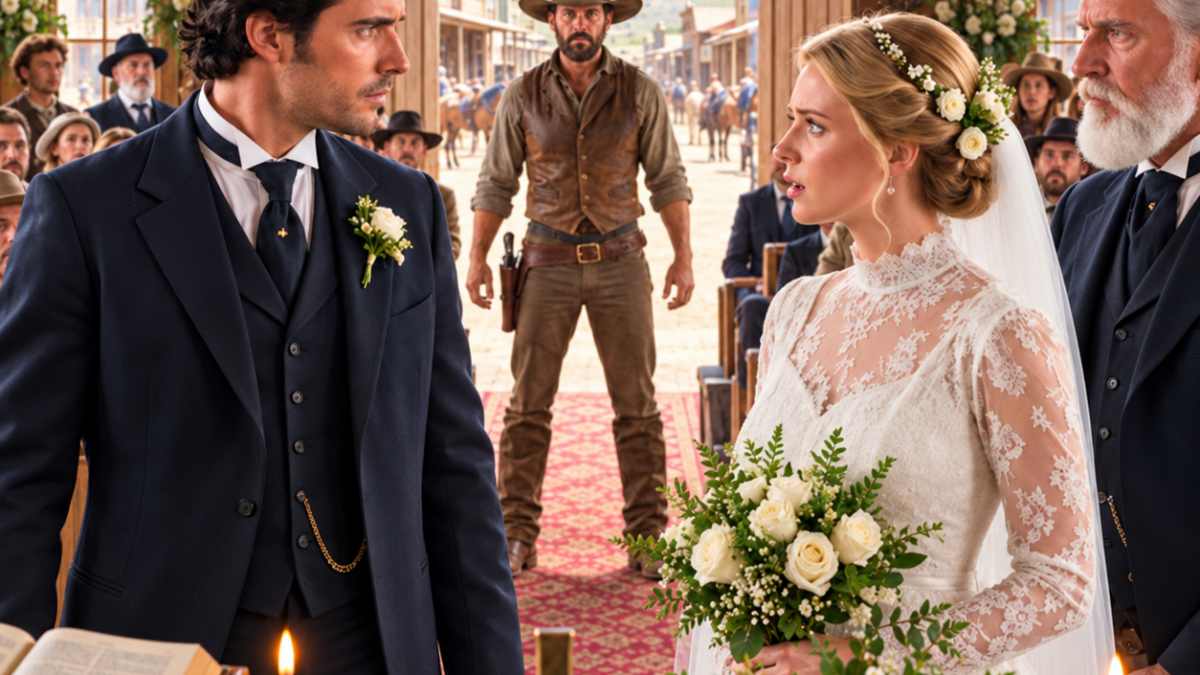
At the church, everyone stood when I entered.
Adrien waited at the altar.
He looked at me the way a man looks at something he has won and wants everyone to admire him for winning.
I did not see it then.
Or perhaps I did and gave it another name.
Father walked me down the aisle.
The preacher smiled.
Adrien took my hand.
His fingers were warm.
The ring waited.
The vows began.
Then the doors slammed open.
Every head turned.
Jonah Creed stood in the entrance, covered in dust, hat in one hand, coat dark with sweat from a horse ridden too hard. In his other hand, he held a worn paper.
A wanted poster.
The whole church inhaled.
Father rose half out of his seat.
“Creed, leave at once.”
Jonah ignored him.
Adrien went pale.
Only slightly.
But I was looking at him by then.
Really looking.
His face did something I had never seen before.
Not confusion.
Recognition.
Fear.
Jonah’s eyes found mine.
“Do you know who you’re marrying?”
No one moved.
The preacher lowered his book.
Adrien forced a laugh.
It sounded almost right.
Almost.
“This is absurd.”
Jonah stepped inside.
“Before the vows,” he said. “Not after.”
Father’s face reddened.
“This is neither the time nor the place.”
“It is precisely the time.”
The room erupted in whispers.
Adrien turned toward the congregation.
“The man has always resented what he could never have.”
That sentence struck me harder than I expected.
Not because it was true.
Because it was convenient.
He did not ask what proof Jonah had.
He did not deny with outrage.
He reached for jealousy.
A story the town would understand quickly.
A low cowboy humiliating himself over the banker’s daughter.
My father looked uncertain for the first time.
Jonah walked up the aisle.
Slowly.
Unhurried despite the scandal.
He held the poster so the nearest pews could see.
“Silas Ror,” he said.
Adrien’s smile died.
The name moved through the church like wind under a door.
Jonah stopped several feet away from the altar and turned the poster toward me.
The sketch showed a younger man with different hair and no polished mustache.
But the face was Adrien’s.
Not exactly.
But enough.
The eyes.
The jaw.
And beneath the sketch, in printed description:
Left hand held partially curled from old injury.
My gaze dropped.
Adrien’s left hand was closing into a fist.
Jonah removed another folded paper from inside his coat.
“A telegraph copy,” he said. “Sent by Adrien Vale three days ago.”
“Forged,” Adrien snapped.
Jonah held it toward my father.
Father took it.
I watched him read.
His face changed in stages: anger, disbelief, confusion, then the terrible collapse of a man seeing how thoroughly his pride had been used against him.
His voice shook as he read aloud.
“I’ll send the final hour once I’m inside Ashford’s private office.”
The church went dead silent.
Jonah looked at Father.
“He needed the final transfer time and vault combination. The bond and gold transfer scheduled after the wedding. You keep both in your private office until the morning of movement.”
Father sank back into the pew.
Adrien said nothing.
That silence convicted him more than shouting would have.
I turned to the man I had nearly married.
“Tell me it isn’t true.”
His eyes moved over my face.
For one strange second, I saw behind the mask.
Not remorse.
Calculation trying to become sorrow fast enough to save itself.
“Lillian,” he said softly.
“No. Tell me.”
His jaw tightened.
Then something in him gave up pretending.
“I came for the money,” he said.
Gasps broke from the pews.
He lifted one hand.
“I won’t insult you by denying what is plain.”
“How considerate.”
Pain flashed in his eyes.
Real?
Performed?
That was the cruelty.
I could no longer tell.
“But what I came to feel for you became real,” he said. “I did not plan that.”
I looked at him.
The church waited.
My father waited.
Jonah waited.
Adrien waited most of all, perhaps hoping the same attention he had used to win me might still hold some power.
I thought of garden walks.
Coffee remembered.
Books left by my bed.
Questions asked.
Smiles given.
Hands held.
Maybe some of it had become real.
Maybe none of it had.
But he had made certainty impossible.
I reached slowly for the ring.
Pulled it from my finger.
My hand did not tremble.
“Maybe some of it was real,” I said. “But you made certain I could never know which part.”
His face hardened.
“That is not love, Adrien.”
I set the ring on the altar rail.
“That is a very patient kind of theft.”
Then I stepped back.
Not behind my father.
Not toward Jonah.
Back onto my own ground.
Adrien bolted.
It happened so fast several people screamed before understanding why.
He lunged toward the side aisle, knocking over a flower stand. Two men outside shouted. The sheriff’s deputy near the back moved too slowly. Adrien shoved past him and ran through the open church doors into the yard.
Jonah moved like a man who had expected flight.
He was after him before anyone else reacted.
The church exploded into chaos.
My father shouted for the bank guards.
The sheriff’s wife screamed.
The preacher held both hands up as if trying to calm the entire county.
I lifted my skirts and ran after them.
“Lillian!” Father shouted.
I did not stop.
Outside, Adrien had nearly reached the fence bordering the churchyard. Two accomplices who had been waiting near the road spurred their horses forward, but bank guards and townsmen moved to block them.
Jonah caught Adrien at the fence.
They hit the ground hard.
Dust rose.
Adrien fought with the desperation of a man who understood the gallows had just become possible. Jonah took an elbow to the jaw, rolled, pinned Adrien’s left arm behind him, and drove one knee into the dirt beside his ribs.
No shot fired.
No grand violence.
Just stubborn, furious competence.
By the time the sheriff reached them, Jonah had Adrien face down in the dust.
The wanted poster lay nearby, trampled but visible.
I stood in my wedding dress at the edge of the yard, breathing hard.
Adrien turned his head enough to see me.
For a moment, his face softened.
Again, I did not know whether it was true.
“I did care for you,” he said.
I looked at him.
“No,” I said quietly. “You cared what I made possible.”
The sheriff hauled him up.
The accomplices were taken before afternoon.
The vault was secured.
The transfer was delayed.
Telegrams flew.
By sundown, the entire town knew Adrien Vale was Silas Ror, wanted in New Mexico Territory for a payroll robbery that had left two guards dead.
By nightfall, I was no longer a bride.
I was a cautionary tale.
People were kind at first.
Kindness can be unbearable when mixed with curiosity.
Women came by the house with pies, flowers, and soft voices. Men spoke gravely to Father in his office. Everyone wanted to know whether I had suspected anything. Whether Adrien had said something strange. Whether I had noticed his hand. Whether Jonah had loved me all along. Whether I felt betrayed, foolish, relieved, ashamed.
The answer was yes.
To almost everything.
For two weeks, I barely left the house.
Not because I missed Adrien.
That was what some whispered.
They were wrong.
I did not long for him.
I grieved the woman I had been before the church doors opened.
The woman who believed attention meant honesty.
The woman who mistook being studied for being known.
The woman who wanted so badly to choose that she nearly chose a lie.
One evening, I found Father in his office staring at nothing.
He looked older.
That frightened me more than I expected.
“I should have seen it,” I said.
He turned.
“So should I.”
“You approved him.”
“I did.”
“You approved him because he reflected every quality you already trusted.”
Father flinched.
I almost apologized.
Then did not.
Because it was true.
“He knew how to please me,” Father said quietly. “And I mistook that for character.”
I sat across from him.
“I mistook it for love.”
For once, he did not correct me.
After a long moment, he said, “Jonah gave you the truth and left the decision to you.”
I looked up.
It was the closest my father had ever come to admitting another man had judged me more fairly than he had.
“Yes,” I said.
Father leaned back.
“I owe him more than wages.”
“He sent half the reward to the families of the men killed in New Mexico.”
“I know.”
“Of course you do.”
A faint smile touched his mouth.
“I am still president of the bank.”
“You are also still impossible.”
“Less than before, perhaps.”
That was the beginning of something new between us.
Not easy.
But new.
I found Jonah near the stables three mornings later.
Or perhaps he allowed himself to be found.
He was brushing a horse with slow, even strokes. A bruise yellowed along his jaw where Adrien had struck him. His knuckles were scabbed. His hat sat low.
“You avoided the house,” I said.
He kept brushing.
“Figured you had enough people wanting words from you.”
“And you had none?”
His hand paused.
“I had too many.”
That was honest enough to make me step closer.
“Why did you ride two days?”
“To get proof.”
“Why?”
He looked at me then.
“Because you deserved to choose with the truth in front of you.”
The answer was simple.
Too simple to hide behind.
“You could have told me before.”
“I had suspicion before. Not proof.”
“You still might have warned me.”
“I tried poorly.”
“Be careful of anyone who makes things too easy?”
His mouth tightened.
“Like I said. Poorly.”
I leaned against the stall door.
“You trust me to choose for myself, Jonah. I see that plainly now.”
He said nothing.
“What I have not seen in four years is you trusting me enough to tell me what you want.”
That landed.
I watched him wrestle with it.
He was better with horses.
Better with miles.
Better with storms, fences, cattle, danger, silence.
Words cost him.
But I was done building my life around men who made decisions for me in silence, even respectful silence.
“You moved a water trough because I mentioned it once,” I said. “You crossed half the territory because I deserved truth. You nearly started a riot in a church rather than let me marry a lie.”
His eyes stayed on mine.
“But you have never once said what you wanted for yourself.”
He looked down at the brush.
“I suppose I’ve spent so long believing silence was respect that I forgot respect and honesty aren’t always the same thing.”
That answer surprised me.
So did the ache it caused.
“What do you want, Jonah?”
The stable went quiet.
A horse shifted.
Wind moved dust near the open door.
He took so long that I almost let him go.
Then he said, “I wanted you not to marry him.”
“Because he was a criminal?”
“Yes.”
“And?”
His jaw flexed.
“And because I knew he did not see you clear.”
I waited.
He looked like a man standing at the edge of a river he did not know how to cross.
“And because I did,” he said.
There.
Not enough.
But a beginning.
I did not smile.
Not because I was displeased.
Because some admissions deserve seriousness.
“You will need to get better at this,” I said.
He let out a breath that was almost a laugh.
“Yes, ma’am.”
“I am not marrying another man who makes me guess.”
“No, ma’am.”
“And if you say ma’am too many more times, I may throw this brush at you.”
His eyes warmed.
“I’d prefer you didn’t.”
“Then improve.”
He did.
Awkwardly.
Slowly.
Sometimes badly enough that I laughed until he looked offended.
A week later, while adjusting a saddle, he said, “I would rather you rode out with me tomorrow than went into town with your father.”
I turned to look at him.
He looked as though he had just stepped voluntarily into gunfire.
“That was very plain.”
“Felt unnatural.”
“I noticed.”
“Was it unwelcome?”
“No.”
He nodded, relieved.
“Good.”
Another time, as we walked near the corral, he said, “I like the way you laugh at things that aren’t especially funny.”
I stopped.
“That is not a compliment.”
“No.”
“Then what was it?”
“Honest.”
I considered that.
Then smiled.
“Considerably harder than compliments, I suppose.”
“Turns out.”
My father noticed everything.
Of course he did.
“You have developed a remarkable interest in horses,” he said one evening at supper as I returned from the stables later than usual.
“Perhaps I always liked horses.”
“You complained about their smell from age nine until last month.”
“People change.”
“Apparently.”
He hid his smile poorly behind his coffee.
Father’s pride had been wounded by Adrien’s deception, but something else had softened too. He no longer dismissed my judgment so quickly. He asked my opinion in bank matters and waited for the answer. Sometimes he disagreed. Sometimes he did not. The difference was not agreement.
It was respect.
Adrien’s betrayal had damaged us.
It had also revealed the fault lines already there.
My father had tried to protect me by choosing for me.
Jonah had protected me by making sure I could choose for myself.
I knew which kind of love I wanted.
Months later, Jonah prepared to ride cattle to the county seat. Not a dangerous trip, but long enough that he would be gone several days.
I found him at the corral tightening a saddle strap.
“When you come back,” I said, “do you intend to stay a while?”
His hand paused.
He looked at me.
“Depends whether someone is waiting.”
“I might find myself waiting.”
His eyes shifted with something like hope.
“Provided you are not gone too long about it,” I added. “And provided you tell me plainly when you return rather than leaving me to guess.”
“I can manage that.”
“And Jonah?”
“Yes?”
“If you say exactly when, I expect exactly when.”
A small smile touched his mouth.
“Yes, Lillian.”
Not ma’am.
Lillian.
That mattered.
He returned on the day he promised.
I waited on the porch openly, not pretending to admire the weather or inspect the roses or happen accidentally to occupy the exact place from which the road was most visible.
Father sat inside with a newspaper held upside down for nearly five minutes.
I did not tell him.
Jonah rode into the yard near sundown.
Dismounted.
Looked at me with dust on his coat and the same steady quiet that had once annoyed me because I did not know how much lived beneath it.
“Planning to stay this time?” I asked.
“If the request still stands.”
“It was not an offer,” I said. “It was a request.”
He considered that.
“I like that better.”
“So do I.”
He stepped onto the porch.
No dramatic kiss.
No grand declaration.
Those things have their place, I suppose.
But after everything I had lived through, what mattered most was simpler.
He had said when he would return.
He had returned.
He had told me what he wanted.
And I had chosen to be waiting.
Inside, the supper table had been set for three.
Father pretended this arrangement required no explanation.
We allowed him the dignity of that fiction.
The years that followed did not turn Jonah into a talkative man.
I would not have trusted such a miracle.
But he became honest in words as well as deeds. He still moved troughs when I mentioned them. Still noticed broken straps, tired horses, coming storms, and the small silences that meant I was troubled. But he also learned to say I missed you. I was worried. I want you beside me. That hurt. I was wrong.
The first time he said I love you, he did it while mending a gate.
I had been waiting long enough to recognize the shape of his courage.
He drove the nail badly.
I said yes anyway.
We married quietly the following spring.
Not in the same church.
Not because I feared it.
Because that church belonged to the day I nearly married a lie, and I wanted something that belonged only to truth.
We stood beneath an oak near my father’s ranch, with Father, a few friends, and half the hands pretending not to grin at Jonah’s discomfort in a proper coat.
When the preacher asked whether anyone objected, one of the cowboys coughed loudly.
Jonah turned his head.
The man immediately studied his boots.
I laughed.
Jonah looked at me, and for once, he smiled without hiding it.
Father walked me forward, then placed my hand in Jonah’s.
Quietly, he said, “You know who you’re marrying?”
I looked at Jonah.
“Yes,” I said. “I do.”
And I did.
Not everything.
No person ever knows everything about another.
But I knew enough.
I knew he had carried guilt from New Mexico for five years and still found courage to face it when it mattered.
I knew he valued truth over comfort.
I knew he would not choose for me, even when choice frightened him.
I knew he listened once and remembered.
I knew his silence could be shelter, but I had taught him it could not be a wall.
I knew his hands were steady.
I knew his heart was not quick to speak, but when it did, it did not lie.
Years later, people still told the story of my ruined wedding.
They told it with drama.
The church doors.
The wanted poster.
The outlaw groom.
The cowboy interrupting the vows.
The chase through the yard.
The banker’s daughter removing the ring.
They loved that part best.
I understand why.
It had spectacle.
But that was not the true turning point of my life.
The true turning point came afterward, near the stables, when I asked Jonah what he wanted and refused to accept silence as an answer.
Because love is not only rescue.
Love is not only arriving at the church in time.
Love is what happens after the scandal ends and the town stops whispering.
It is learning how to speak.
How to listen.
How to choose with open eyes.
Adrien Vale had given me attention that felt like devotion but was built around theft.
My father had given me protection that felt like love but often stood too close to control.
Jonah gave me truth.
At first, roughly.
Too late for comfort.
Almost too late for safety.
But truth all the same.
And then, when I asked for more than quiet sacrifice, he learned how to give that too.
I sometimes think of the girl I was at the altar.
Hands steady.
Heart full.
Seconds from saying I do to a man whose name was not even his own.
I do not hate her.
That matters.
For a while, I did.
I called her foolish.
Blind.
Naive.
But she was not foolish for wanting to be seen. She was not blind for believing a careful lie built precisely to fool her. She was a woman who wanted freedom and mistook imitation for respect.
I forgive her now.
Because she did choose rightly in the end.
When truth stood before her in a dusty coat, holding proof that humiliated her in front of everyone she knew, she did not cling to the lie just to save her pride.
She removed the ring.
Set it down.
Stepped back.
Chose herself.
That was the first real vow I made.
Long before I married Jonah.
I vowed never again to confuse being wanted with being valued.
Never again to accept protection that required my silence.
Never again to trust a man only because he knew how to please the room.
And never again to underestimate a quiet cowboy who listens once and remembers everything.
So when people ask me about the day Jonah Creed stopped my wedding, I tell them the truth.
He did not steal me from another man.
He did not claim me before the town.
He did not ask me to run away.
He asked one question.
Do you know who you’re marrying?
Then he gave me the proof and let me decide.
That is why I trusted him.
That is why I waited on the porch.
That is why, when he finally came back and told me plainly what I meant to him, I believed every word.
Because the man who loves you rightly does not hide the truth to keep you.
He gives you the truth.
Even if it costs him.
Even if you choose differently afterward.
Especially then.








