She Vanished Before Our Wedding—Five Years Later, I Found Her Raising My Twin Sons
PART3:
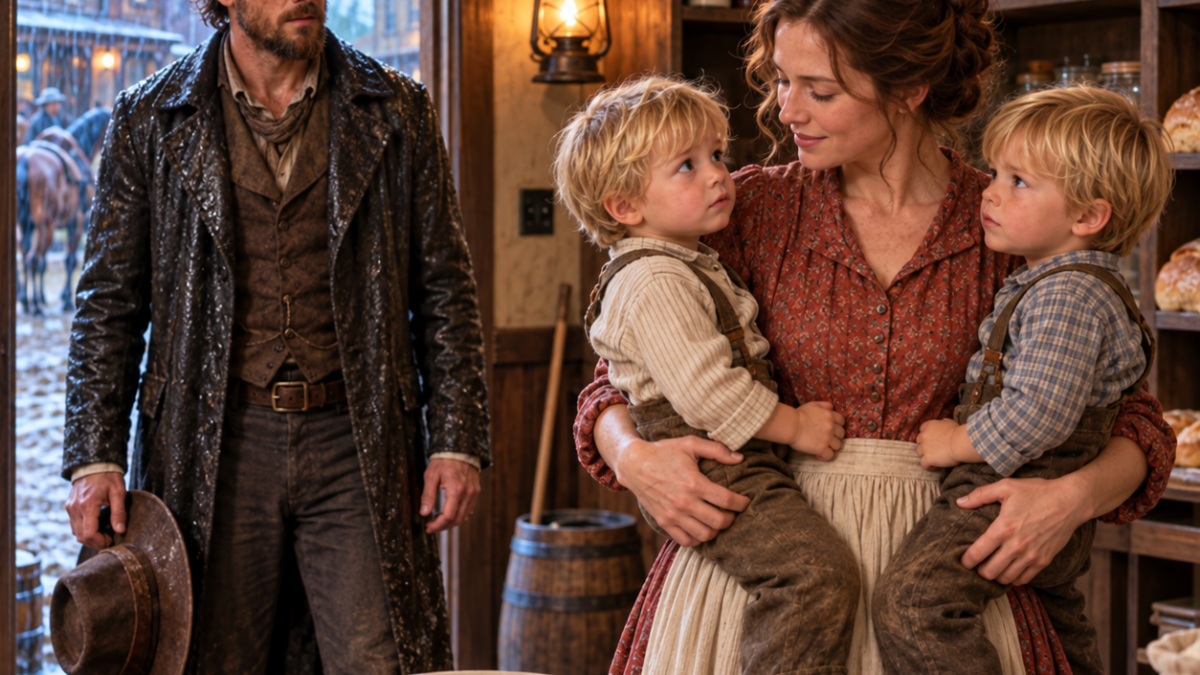
But there are some people a heart recognizes before the mind permits it.
Victoria.
She turned at the sound of the bell.
The tray slipped from her hand.
It struck the floor with a sharp metallic crash that made two children in the back room cry out.
For a moment, neither of us spoke.
Rain ran down my coat and dripped onto her clean floor.
Her face went white.
I had imagined seeing her again more times than I care to admit.
In some imaginings, I shouted.
In others, I walked away before she could speak.
Sometimes I demanded answers. Sometimes I said nothing at all, just let her see what she had made of me.
Never once, in all those cruel imaginings, did I picture her standing behind a bakery counter with two little boys coming around her skirts.
They were small, a little over four years old.
Blond-haired.
Blue-gray-eyed.
One bold enough to step forward.
One shy enough to half hide behind her.
Both staring at me like I was the stranger.
Which, God help me, I was.
The bold one looked from me to Victoria.
“Mama?”
Victoria closed her eyes for half a second.
When she opened them, something had settled in her face.
Not peace.
Decision.
“They’re mine,” she said before I could form a question.
Her voice trembled.
Then she corrected herself.
“Ours, Tails. Theo and Miles. They’re yours.”
I could not breathe.
The room tilted.
I looked at the boys again.
My hair.
My eyes.
My jawline softened by childhood.
My mother’s expression in the serious set of one small mouth.
Five years opened beneath me like a grave.
Five birthdays.
Five Christmas mornings.
First steps.
First words.
Fevers.
Laughing.
Crying.
The first time they asked where their father was.
The first time she answered.
All of it had happened somewhere beyond my reach while I sat in an empty farmhouse trying to make peace with silence.
I took one step back.
The bell above the door trembled from the movement.
“Five years,” I said.
My voice did not sound like mine.
Victoria flinched, but she did not look away.
“Five years you let me believe you walked away.”
“I never walked away because I stopped loving you.”
“That was not the question.”
Pain crossed her face.
“No,” she said softly. “I know.”
The shy boy—Miles, I would learn—held tighter to Victoria’s skirt. The bold one, Theo, stared at me as if trying to solve me.
“Are you angry?” Theo asked.
Victoria drew in a sharp breath.
I looked down at him.
Was I angry?
The answer was too large for one word.
“Yes,” I said carefully. “But not at you.”
Theo considered that.
“All right.”
Children accept what adults complicate.
Victoria sent the boys into the back room with a promise of honey biscuits if they stayed where she could see them. They went reluctantly, peeking through the doorway every few seconds.
I stood in the bakery, soaked through, staring at the woman I had buried without a body.
“Tell me,” I said.
Victoria gripped the counter’s edge.
The rain hammered the windows.
She looked older then. Not in years. In burden.
“It began before the wedding.”
I said nothing.
“Your brother’s debts.”
My mouth tightened.
My older brother had left this world and a trail of trouble behind him years ago. Gambling. Borrowing. Drinking. Making promises with other men’s money. I had known of some debts. Paid what I could legally and morally call mine. Refused the rest.
“Those were not my debts,” I said.
“I know.”
“I told everyone who came asking the same thing.”
“Yes,” Victoria whispered. “That was the problem.”
She told me then in broken pieces.
Weeks before the ceremony, men had cornered her outside the mercantile. Men tied to my brother’s gambling debts. Not ordinary creditors. Not the kind who filed papers with a county clerk and waited for judgment. These were men who smiled without warmth and spoke softly because they did not need volume to frighten someone.
They had wanted my farm.
I had refused them.
They had decided a stubborn farmer alone was difficult.
A stubborn farmer with a wife and child would be easier.
Victoria had discovered she was pregnant not long after.
The threat changed shape.
So did her fear.
“They told me,” she said, voice barely steady, “that a man says different things when someone he loves is sitting beside them instead of a lawyer.”
My hands curled into fists.
She saw.
“They said if I married you, I would be their leverage. Then when I knew about the baby, I understood it would not only be me.”
“You should have told me.”
“I know.”
“You should have let me protect you.”
“I thought leaving was protecting you.”
The words struck harder than I expected because I believed her.
Not forgave her.
Those were not the same.
But I believed that in her terror, in her youth, in the corner those men had backed her into, she had seen running as the only door left open.
“I knew you,” she said. “You would not have given up that farm. Not for yourself. Not for threats. Not for fear.”
“No.”
“But for me? For a child?”
She looked toward the back room.
“You might have. And if you did, you would lose everything your father left you. If you did not, they might hurt us to teach you the cost of refusing. I was afraid staying would place a blade in their hands and call it love.”
I hated how much sense fear could make when spoken plainly.
That did not make it right.
It only made the wound more complicated.
“You raised my sons,” I said slowly, “without giving me the chance to know they existed.”
Victoria’s eyes filled.
“Yes.”
The word was small.
Unprotected.
No excuse inside it.
“I understand why you ran that morning,” I said, though each word scraped my throat on its way out. “I do not know yet whether I can forgive losing five years with my own children. Those are different matters, Victoria.”
She nodded.
“I know.”
“I would rather be honest about that than pretend the first answer washes the second clean.”
Something in her face broke softly.
“That is fair.”
Fair.
I had not meant to be fair.
I had wanted to be furious.
I was furious.
But rage had two little boys listening from a back room, and one of them had my eyes.
That evening, I did not ride away.
I could have.
Part of me wanted to.
There is a clean satisfaction in leaving before pain asks too much of you. I could have walked back into the rain, mounted my horse, and told myself I owed her nothing. I could have returned to my quiet house, my unfinished cradle, my fields, my lonely peace that had never been peace at all.
Instead, I took a room at the town boarding house.
Mrs. Alden’s boarding house, as it turned out.
She was the widow who had taken Victoria in when she arrived pregnant, frightened, and alone. A sharp-eyed woman with silver hair, a straight back, and the manner of someone who had buried enough nonsense in her life to recognize it approaching from far off.
When I gave my name, Mrs. Alden studied me so long I began to feel like livestock at auction.
“So,” she said at last. “You’re him.”
“I expect I am.”
“About time.”
I did not know what to say to that.
She handed me a key.
“Room at the top of the stairs. Washstand leaks if you bump it. Supper’s at six if you’ve got sense.”
“Thank you.”
She held the key a moment longer before letting go.
“She suffered too,” Mrs. Alden said quietly. “Doesn’t undo what you suffered. But you should know it.”
“I do.”
“No,” she said. “You know the outline. Not the cost.”
She released the key.
“Sleep first. Men understand almost nothing properly when soaked and hungry.”
I nearly smiled despite myself.
The next morning, I went back to the bakery before it opened.
I told myself I needed answers.
That was partly true.
But when I reached the window and saw Victoria kneading dough in the soft gray light, Theo and Miles underfoot arguing over who should lick the mixing spoon, I knew answers were only one kind of hunger.
I stood outside longer than necessary.
Victoria moved with the capable rhythm of someone who had built survival one loaf at a time. She pressed the dough forward, folded it, turned it, pressed again. Flour marked her cheek. Her sleeves were rolled unevenly. The boys circled her like planets around a weary sun.
Miles noticed me first.
He froze.
Then whispered something to Theo.
Theo came to the door before Victoria could stop him.
“Are you leaving today?” he asked the moment I stepped inside.
The question hit harder than accusation.
Not Are you my papa?
He had asked that last night.
This was the next question.
The more important one.
I looked at Victoria.
Her hands had gone still in the dough.
“Not today,” I said.
Theo watched me with solemn suspicion.
“Tomorrow?”
“I don’t know about tomorrow yet.”
“That means maybe.”
“It means I’m telling the truth.”
He seemed to approve of that more than reassurance.
“Mama says truth matters even when it hurts.”
“She is right.”
Theo glanced back at her.
“She says that a lot.”
Victoria closed her eyes briefly.
I fought a smile and lost.
That first day, I stayed too long at the bakery.
Then the next day.
Then the next.
At first, I helped with practical things because practical help is safer than emotional conversation. I carried flour sacks. Repaired a loose shelf. Fixed the latch on the back door. Split wood for the oven. Took deliveries. Lifted heavy trays. Scrubbed a table because I needed something to do with my hands when my heart had too much to say.
Victoria let me.
She did not thank me too much.
I appreciated that.
The boys watched everything.
Children are not fooled by adult silence. They hear what is not said. They feel old grief moving around a room even when no one names it. Theo tested me with blunt questions. Miles tested me by quietly drawing near, then drifting away before I could expect anything.
“Do you have horses?” Theo asked the second morning.
“Yes.”
“How many?”
“Three working horses and one mare who believes work is beneath her.”
Theo’s eyes widened.
“Can I meet her?”
“If your mother allows it.”
He looked at Victoria.
Victoria looked at me.
There was a whole conversation inside that glance.
Eventually she said, “Perhaps.”
Theo punched the air as if perhaps meant guaranteed.
Miles asked fewer questions.
He studied my face.
My hands.
The way I stood.
Once, he reached up and touched my sleeve, then withdrew quickly, as if checking whether I was real.
I crouched slowly so I would not tower over him.
“You can ask me anything,” I said.
He looked toward Victoria, then back at me.
“Mama said our papa was far away.”
“I was.”
“Why?”
I swallowed.
“Because I didn’t know where to find you.”
His brow furrowed.
“If you knew, would you come?”
“Yes.”
“How fast?”
“As fast as my horse could carry me.”
He considered this.
“Your horse fast?”
“Fast enough.”
He nodded, satisfied for the moment.
Theo approached life like a hammer. Miles approached it like a candle flame, small and careful and easily disturbed by too much wind. I learned quickly that fatherhood, when it arrives five years late, does not come with the right to rush.
So I did not.
I let them come to me.
And they did.
In pieces.
Theo first.
He wanted stories about the farm, about cattle, about whether snakes could climb fences, about whether I had ever fought a bear. I told him no on the bear and regretted it because he looked deeply disappointed.
Miles came later.
One afternoon, I found him sitting behind the bakery with a broken wooden horse toy in his lap. One leg had snapped loose. He held it like something grieving.
“Can it be fixed?” he asked.
I sat beside him on the step.
“Most things can be mended if the break is clean and a man has patience.”
“Is it clean?”
I examined the toy.
“Clean enough.”
He watched me repair it with a small peg and glue from Victoria’s shelf. When I handed it back, he held it to his chest.
“Thank you,” he whispered.
That was the first time he smiled at me without looking frightened of his own wanting.
Every morning after, Theo asked the same question.
“Are you leaving today?”
“Not today.”
The second day.
The third.
The fourth.
By the end of the first week, the question had shortened. He would simply raise his eyebrows across the breakfast table at Mrs. Alden’s boarding house, where Victoria and the boys often came early with bread deliveries.
“Not today,” I would say.
Every time, I understood what he was truly asking.
Are you like other things that disappear?
Are you temporary?
Should I protect myself now?
I answered only what I could promise.
Not today.
Forgiveness did not arrive quickly.
Anyone who tells you love heals all wounds has either never been wounded deeply or has forgotten the honest shape of healing. Love can give you a reason to stay. It does not erase the years.
Some evenings, after the boys slept, Victoria and I talked in the bakery kitchen.
The room would be warm from the oven, quiet except for the settling of wood and the occasional distant hoofbeat from the street. She would sit with her hands around a mug. I would sit across from her, close enough to remember how natural it once felt to reach for her and far enough away to respect what we had broken.
“Why didn’t you write?” I asked one night.
The question had been waiting since the first evening.
She looked at the table.
“The first year, I told myself I was still afraid they would find us if I wrote.”
“Was that true?”
“Partly.”
“And after that?”
She took a slow breath.
“The second year, I was ashamed. Ashamed of how much time had already passed. Ashamed that you did not know about them. Ashamed that telling you then would mean admitting I had kept silent before.”
Her fingers tightened around the mug.
“After that, every month made the letter harder. I kept waiting for the shame to become smaller. It never did. It grew with the boys.”
I wanted to be angry.
I was angry.
But there was no satisfaction in watching her speak the truth without hiding from it.
“That is not an excuse,” she said.
“No.”
“It is only the truth.”
“I know.”
“And truth is not the same as forgiveness.”
“No,” I said. “It is not.”
She nodded.
A tear slipped down her cheek, but she did not wipe it away.
That mattered to me, though I could not have said why.
Maybe because we had both spent too long pretending pain was safer when hidden.
She told me about those first years in careful pieces.
Arriving in town with little money, no family, and fear riding behind her like another passenger. Taking a room above Mrs. Alden’s boarding house in exchange for cooking and cleaning. Growing heavy with pregnancy while scrubbing floors, making beds, and carrying water because pride was easier to manage than helplessness.
The twins came early, in a storm, because apparently my sons had inherited timing from their mother and stubbornness from me.
The midwife could not arrive in time.
Mrs. Alden delivered them herself.
“Miles came first,” Victoria told me.
I tried to imagine it.
Failed.
“The quiet one,” I said.
“He screamed loud enough then.”
“And Theo?”
“Theo arrived angry.”
“That sounds right.”
Victoria laughed softly.
The laugh faded.
“I nearly died,” she said.
My heart stopped.
She looked at me across the table.
“Mrs. Alden is the reason I did not. She stayed awake two nights. Fed them when I could barely lift my arms. Told everyone I was a widow so no one would ask questions I could not answer.”
“A widow,” I repeated.
“It was safer. Kinder too.”
The word stung, though I knew it had protected her.
Protected them.
An unmarried woman with two children in a frontier town could draw attention, judgment, danger. A widow drew sympathy. Casseroles. Work. A little room to survive.
Victoria sold bread door to door for two years before saving enough to lease the small bakery. She carried loaves in a basket and babies on her hips. She learned which customers paid on time, which men stood too close, which women were kinder when their husbands were not listening. She learned how to stretch flour, how to bargain for fuel, how to work through fever, exhaustion, loneliness, and fear.
“You built all this,” I said one evening, looking around the clean shelves, the flour bins, the ledger, the oven, the rows of bread cooling under cloth.
“Yes.”
“Believing you would likely do it alone.”
“Yes.”
“Did that make it easier?”
Her mouth twisted.
“No. It made it necessary.”
There is a kind of strength that looks admirable from far away and unbearable up close.
Victoria had become strong because she had no safe place to be weak.
I respected it.
I hated it.
Both were true.
After twelve days, I made the mistake of offering to help bake.
Victoria accepted with skepticism so visible it bordered on insult.
“You doubt me,” I said.
“I have seen you cook coffee until it becomes punishment.”
“Bread is different.”
“Indeed. Bread is less forgiving.”
She was right.
I put twice the salt into a batch and ruined it beyond redemption.
Victoria tasted the edge of one small loaf, closed her eyes, and set it down.
“Well?” I asked.
“You grow corn for a living.”
“That bad?”
“The corn should be grateful.”
Theo, perched on the counter, nodded solemnly.
“Mama says Papa shouldn’t bake.”
Victoria froze at the word.
Papa.
So did I.
Theo looked between us.
“What?”
“Nothing,” Victoria said quickly.
But it was not nothing.
The word hung in the air, warm and terrifying.
Miles, who had been half asleep on a chair, lifted his head.
“Papa burned bread?”
Theo nodded.
“Very badly.”
Miles looked at me with grave disappointment.
“You should practice.”
“I expect I should.”
Victoria turned away, but not before I saw her hand press briefly against her mouth.
Later that week, Miles climbed into my lap after a long afternoon at the creek.
We had gone fishing, though Theo caught mostly weeds and declared them “practice fish.” Miles, with quiet patience, caught a small trout and insisted on showing it to every person who entered the bakery until Victoria finally said the fish must either be cleaned or returned to God.
That evening, tired and sun-warmed, Miles crawled into my lap without asking. He rested his head against my chest.
“Thank you, Papa,” he murmured.
Then he fell asleep.
I went very still.
Victoria stood in the doorway watching us, her face caught between joy and grief.
I did not speak.
Some words are too holy to answer quickly.
I lowered my hand to Miles’s back and held him there.
Theo adopted the word fully within days, likely because he refused to let his brother own anything first.
“Papa, where do snakes sleep?”
“Papa, can horses sneeze?”
“Papa, did you ever get kicked by a mule?”
“Papa, are you leaving today?”
That last one came less often.
Then stopped.
The absence of it was a gift I did not deserve but accepted with both hands.
By the third week, I had stayed long enough for the town to begin pretending it had not noticed me staying. Frontier towns are excellent at noticing and poor at admitting it.
Mrs. Alden watched everything.
One afternoon, while Victoria served customers, the old woman found me repairing a loose hinge behind the bakery.
“You love her still,” she said.
I nearly hit my thumb with the hammer.
Mrs. Alden seemed unimpressed.
“That was not a question.”
“No,” I said.
“And you’re angry still.”
“That one wasn’t either, I suppose.”
“Anger and love can sit at the same table longer than people expect.”
I tightened the hinge.
“She should have written.”
“Yes.”
“I should have known my sons.”
“Yes.”
“She was afraid.”
“Yes.”
“I understand it.”
“Yes.”
“I have not forgiven it.”
Mrs. Alden leaned on her cane.
“Understanding often reaches the station before forgiveness. Doesn’t mean the second train isn’t coming.”
I looked at her.
“You always talk like this?”
“Only to stubborn men standing in doorways they pretend they might leave.”
I had no answer.
She smiled.
“Good. Silence suits you better than foolishness.”
The conversation Victoria and I had been circling came one rainy evening when the boys were asleep upstairs at Mrs. Alden’s and the bakery had closed early.
Victoria set a loaf on the table between us.
The bottom crust was too dark.
“You still burn the first loaf when you’re worried,” I said.
She looked up sharply.
“You remembered that?”
“I remembered more than I wanted to most days.”
Her eyes softened.
“Took real effort trying to forget you,” I admitted. “Never managed it properly.”
She touched the edge of the burnt loaf.
“I burned three loaves the week before the wedding.”
“Did you?”
“I told myself it was nerves.”
“It wasn’t?”
She shook her head.
“I think somewhere beneath everything, I already knew I was about to do something that would break both our hearts.”
I looked at the loaf because looking at her hurt.
“Was there anyone else?” she asked.
The question surprised me.
“These five years,” she added.
“There were women I liked well enough.”
Her face tightened, though she had no right to jealousy and knew it.
“But none of them were the woman I was still waiting to be angry with,” I said.
For half a breath, silence held.
Then Victoria laughed.
Not because it was funny.
Because it was true in the saddest possible way.
“That is a strange thing to wait five years for.”
“It kept better company than some things I tried instead.”
Not every evening ended gently.
Some nights anger found its teeth again.
“I watched you teach Theo his letters today,” I told her once, voice tighter than I meant it to be. “Same patient way you must have taught him a hundred things I never saw. His first steps. First fever. First word. Miles learning to hold a spoon. Theo falling and scraping his knee. All of it happened while I was thirty miles, fifty miles, a hundred miles away, thinking you had simply decided I was not enough.”
Victoria sat very still.
“I know.”
“I keep waiting for the anger to wash out now that I know why you left.”
“Has it?”
“No.”
Her eyes shone.
“Understanding and forgiving are not traveling at the same speed,” I said.
“No,” she whispered.
“I think they are traveling the same direction.”
She looked at me then.
Hope is dangerous when it enters a room quietly.
“I hope so,” she said.
A month after I arrived, the past found us.
Not through cleverness.
Through carelessness.
That is often how trouble travels.
A salesman passing through town recognized the Cassidy name when I introduced myself outside the mercantile. He thought nothing of it. Mentioned it later in another town. Someone heard. Someone remembered debts, threats, old refusals, and a farm that had not yet been taken.
Two riders came asking questions at the general store.
Careful questions.
About a woman named Victoria.
About twin boys.
About me.
Word reached the bakery within the hour.
Victoria went pale in a way I had not seen since that first rainy evening.
“They found me,” she said.
I was already reaching for my hat.
“They found us.”
She looked at me.
“That is different.”
“Yes.”
For a moment, I saw the old instinct rise in her.
Pack.
Run.
Disappear before fear can knock.
Her eyes moved toward the stairs where the boys were playing. Then toward the back door. Then toward the road.
I hated those men for putting that map in her body.
Then she took a breath.
“I’m going with you to the marshal.”
I stopped.
“You don’t have to prove anything to me.”
“I’m not proving it to you.”
Her voice steadied as she spoke.
“I ran from these men once alone, and it cost us five years. I will not send you to face them while I hide in my own bakery a second time.”
I wanted to tell her to stay safe.
The words nearly came.
Then I understood how insulting they would be.
She had built five years of safety with her own hands.
She did not need me to put her back behind a wall and call it protection.
So I nodded.
“Together, then.”
“Together.”
Marshal Jared Cole listened without interrupting.
He was a steady man, broad through the shoulders, with a gray mustache and eyes that suggested panic bored him. Victoria told the whole story. The threats before the wedding. The pregnancy. The men who wanted my farm for a debt I had not incurred. The years of fear.
The marshal took notes.
Then he leaned back.
“A gambling debt owed by your brother gives them no legal claim on your separate property,” he said.
“I told them that five years ago,” I replied.
“I expect they knew it then too.”
Victoria looked at him.
“Then why threaten me?”
“Because men with no lawful claim often try fear first. It is cheaper than court and works too often.”
He sent for county backup and placed a deputy near the bakery without making a show of it.
The next morning, the two men came.
They expected Victoria alone.
They found both of us in the doorway.
I saw recognition in one man’s face and irritation in the other’s. They were older than the monsters Victoria had carried in memory, but not enough. Men like that age without softening.
“Well,” one said. “Cassidy.”
“This debt was never hers to carry,” I said. “Nor mine.”
His smile thinned.
“Debts don’t vanish because a man says so.”
“No. They go through court if they’re lawful.”
Victoria stepped beside me.
Her hands trembled once, then stilled.
“You frightened me once,” she said.
The men looked at her as if she had become inconvenient by speaking.
“Frightened me enough to lose five years I will never get back,” she continued. “You will not decide where my children grow up a second time.”
The marshal stepped into view behind us.
“Gentlemen,” he said pleasantly, “I’d be glad to discuss your claim in my office.”
They left town within the hour.
Men who thrive in shadows rarely enjoy paperwork and witnesses.
When the danger passed, Victoria sat on the bakery floor and cried so hard Theo and Miles came running.
I knelt beside her.
For a moment, I did not know if I was allowed to hold her.
Then she reached for my hand.
I took it.
The boys climbed around us, frightened and confused, asking if Mama was hurt, if Papa was mad, if bad men were coming back.
“No,” Victoria said, pulling them close. “No, my loves. We are done running.”
Theo looked at me.
“Are we?”
I met his eyes.
“Yes.”
He searched my face.
“Are you leaving today?”
The old question.
The first question.
The deepest one.
I looked at Victoria.
Then at Miles.
Then back at Theo.
“No,” I said. “Not today.”
Something in Victoria’s face changed.
Theo nodded.
“Good.”
Later that evening, after the boys slept, Victoria and I sat on the bakery’s back steps. The air smelled of cooling bread and wet earth. For the first time since I had found her, the fear that had lived around her seemed quieter.
“We spent five years trying to protect each other by staying apart,” she said.
“Poor method.”
“Yes.”
“Costly too.”
She nodded.
“Maybe it is time we learned how to do it standing in the same room instead.”
“That is harder work.”
“I know.”
“Requires saying difficult things aloud instead of deciding them alone and calling it protection.”
“I know that too.”
I looked at her.
“Do you?”
She met my eyes.
“I intend to.”
That mattered.
Not because intention fixed everything.
Because it opened the door.
A few days later, she asked the question that truly mattered.
“If there were no boys,” she said quietly, “would you still be standing here?”
I knew at once what she was asking.
Not whether I loved my sons.
That was already beyond question.
She was asking whether she was only the road to them.
Whether I would take fatherhood and leave the woman who had wounded me standing beside it.
The answer needed honesty, not kindness.
“The boys gave me reason to stay long enough to know you again,” I said.
She held very still.
“But you are the reason I do not want to leave.”
Her breath trembled.
“That was true when I loved you five years ago. Turns out it is still true now, under all the anger and lost time.”
“Tails.”
“I cannot give those years back to myself,” I said. “I cannot give them back to the boys. I cannot pretend you did not choose silence long after fear stopped being the only reason.”
She lowered her eyes.
“But I also cannot pretend I stopped loving you just because pain made a ruin of the place where that love used to live.”
Tears slipped down her cheeks.
“What are you saying?”
I took her hand.
“Come home.”
She closed her eyes.
“Not because running is no longer an option,” I said. “Not because the boys need a father, though they do. Not because the past is forgiven neatly, because it is not. Come home because I would rather build whatever comes next in the open with you and our sons beside me than spend one more year of our lives deciding things alone that were meant to be decided together.”
Victoria cried then.
Quietly.
Deeply.
Like someone setting down a weight she had carried so long her body had mistaken it for bone.
“Yes,” she said.
One word.
Simple.
Impossible.
“Yes.”
We did not leave at once.
Victoria had built a life in that town. A business. Customers. Friendships. Independence forged through hardship. I would not insult it by acting as if the life she made while surviving was something to be folded up and abandoned because I had arrived.
Mrs. Alden agreed to manage the bakery day to day, though she informed me she was not doing it for me and I should avoid becoming proud.
Victoria would ride in twice a week to oversee accounts, recipes, supplies, and customers who apparently believed bread would lose quality if not personally judged by her eyes.
“You needn’t give it up,” I told her when she first raised the question.
She looked uncertain.
I hated that she thought marriage might require surrender.
“You built something considerable out of nothing,” I said. “Same as I did with the farm. I see no reason marrying me should cost you that.”
She smiled faintly.
“You still cannot bake.”
“I did not say I should manage it.”
“Good.”
Theo and Miles nearly climbed out of the wagon twice on the ride to the farm because every fence post required investigation.
“Is that ours?”
“Yes.”
“That tree?”
“Yes.”
“That cow?”
“Steer. And yes.”
“That rock?”
“No.”
“Why not?”
“Because I have standards.”
Theo accepted this poorly.
Miles watched everything with wide eyes. When the farmhouse came into view, he went quiet.
Victoria did too.
I wondered what she saw.
The life she had run from.
The home she had imagined.
The cost of absence.
The porch needed paint. The barn roof had one patch darker than the rest. The oak tree stood near the house, older and wider, a rope swing still hanging from the lowest branch. The fields stretched beyond it, familiar and strange at once.
“This is home?” Miles asked.
“If you want it to be,” I said.
Theo leaned over the wagon rail.
“Which room is ours?”
“Come see.”
I led them inside.
The house felt embarrassed by its own silence, as if it had been caught waiting.
I opened the door to the back room.
Victoria stopped behind me.
The unfinished cradle sat beneath the window.
Dust had gathered on the rail. One side remained rough. A small chest stood against the wall. Bare boards. Empty corners. A future paused so long it had become a memorial.
Victoria stepped inside slowly.
“You never finished it.”
“No.”
“Why?”
I looked at the cradle.
“Every time I tried, it felt too much like admitting you were never coming back. Easier to leave it half done and shut the door.”
She covered her mouth.
Theo walked to the cradle and touched the rough rail.
“What is it?”
“A cradle,” I said.
“For babies?”
“Yes.”
“We are not babies.”
“No,” I said, voice thick. “You are not.”
Miles looked up at me.
“Can we have beds?”
I laughed then.
Not because it was funny.
Because life had finally asked me to build something instead of mourn it.
“Yes,” I said. “You can have beds.”
That week, we built two.
Theo and Miles helped sand the wood, though “helped” meant creating more dust than progress and arguing about whose board was smoother. The joints were not perfect. The boys were prouder of that than if a master carpenter had made them.
“We built it,” Miles told Victoria, running his small hand along his headboard.
“You did,” she said.
Her eyes met mine.
“Better than what waited empty here so long.”
The farm changed faster than I thought a place could change.
Two boys can fill a house with more noise than ten grown men.
Boots thudded across floors.
Questions followed me from barn to field to table.
The rope swing became a battlefield, courthouse, ship, and flying horse depending on Theo’s mood. Miles adopted one of the gentler barn cats and named her Queen Abigail for reasons nobody was allowed to question. Victoria filled the kitchen with bread, order, and a kind of warmth the house had not known since my mother died.
At night, after the boys slept, Victoria and I learned how to be honest without using honesty as a weapon.
Some nights we succeeded.
Some nights old pain rose sudden and sharp.
There were moments when I would watch her braid Miles’s hair away from his face or hear Theo call for her after a bad dream, and grief would punch through me fresh.
“I missed everything,” I said one night.
She sat beside me on the porch.
“I know.”
“I hate that you had to do it alone.”
“I know.”
“I hate that you chose for me.”
Her eyes closed.
“I know.”
“I hate that part of me understands why.”
She looked at me then.
“That may be the cruelest part.”
“It is.”
She reached for my hand slowly, giving me time to refuse.
I did not.
We married that same season.
Not in the church where I had once waited alone.
At the farm.
Under the oak tree.
Mrs. Alden stood in the front row with a handkerchief and a stern expression that fooled no one. Marshal Cole attended with his wife. Neighbors came. Some from my town, some from hers. The boys stood beside us, unable to remain still for more than three seconds at a time.
Halfway through the vows, Theo pointed toward the fence.
“There’s a rabbit!”
Victoria squeezed her eyes shut.
The guests laughed.
I looked at my son, then at the woman beside me, then at the land around us.
For once, interruption felt like blessing.
When the minister asked whether I took Victoria, I answered with the full weight of five lost years behind the word.
“I do.”
When he asked her, she looked at me through tears.
“I do.”
It did not erase the first wedding morning.
Nothing could.
But it gave that grief a second room to live in, one with light through the windows and children laughing outside.
The years that followed were not perfect.
I mistrust stories that end at a wedding as if vows are the finish line instead of the beginning of harder, holier labor.
Victoria still burned bread when worried.
I still went quiet when hurt.
Theo still charged into life headfirst and learned through impact.
Miles still carried questions too carefully, as if words might break if spoken too hard.
But we learned.
Victoria learned to tell me when fear stirred instead of making plans alone in silence.
I learned to say when anger returned instead of letting it sharpen in the dark.
The boys learned the truth of their beginning slowly, in pieces suited to their age. We did not make Victoria a saint or me a victim or the past a simple villain’s tale. We told them their mother had been brave and afraid. Their father had been hurt and still stayed. Bad men had used fear where law would not serve them. Silence had cost us dearly. Love had survived, but survival did not mean nothing had been broken.
One afternoon, when the twins were nine, I overheard Theo explaining it to a friend near the barn.
“Mama kept us safe until Papa found us.”
Miles, quieter, added, “And Papa didn’t leave even when he was still angry.”
I sat on the porch with a cup of coffee going cold in my hands and found I had nothing better to say.
They had understood enough.
Victoria’s bakery prospered under Mrs. Alden’s fierce management and Victoria’s twice-weekly visits. As the boys grew older, they spent Saturdays there, dusted in flour, arguing over whose loaf rose better and accusing each other of stealing raisins. Theo loved the customers. Miles loved the recipes. Neither inherited my talent for ruining bread, which seemed a mercy.
Sometimes, in the evenings, I still caught myself watching the road.
Old habits are slower to die than pain.
Victoria caught me once.
“Waiting for someone?” she asked.
I looked at the road stretching beyond the gate, glowing faintly in sunset.
“No,” I said. “Just grateful nobody I love is out on it needing to be found.”
She sat beside me.
After a while, her hand found mine.
It still fit.
That surprised me every time.
Five years had changed us. Fear had changed her. Grief had changed me. Parenthood had changed both of us in unequal ways. We were not the same young man and woman who once thought love alone could carry a life forward without complication.
But maybe love that survives complication becomes less fragile.
Less pretty, perhaps.
More useful.
Like farm tools worn smooth by work.
Like bread made after the first burnt loaf.
Like two boys’ beds built where one unfinished cradle waited in dust.
The house that had once felt empty became impossible to keep clean, impossible to keep quiet, and impossible to imagine without them. There were muddy boots by the door, school slates on the table, toy soldiers under chairs, bread cooling on counters, harness leather needing mending, and laughter in rooms that had forgotten how to hold it.
My mother never met her grandsons.
That grief remained.
But sometimes I felt her near the kitchen doorway when Miles read aloud or Theo tried to sneak jam before supper. I liked to think she would have stood with one hand on her hip, pretending disapproval while failing to hide delight.
One spring morning, I finally finished the cradle.
Not because we needed it.
Not for a baby.
I took it out to the barn, sanded the rough rail smooth, fitted the last side properly, and oiled the wood until it shone warm beneath my hands.
Victoria found me there.
“What will you do with it?” she asked.
“I don’t know.”
She touched the rail.
For a long moment, neither of us spoke.
Then she said, “Maybe keep it.”
“For what?”
“For remembering that unfinished things do not always stay unfinished.”
So we kept it.
Years later, when the boys were nearly grown and taller than their mother, the cradle still sat by the back room window. Not as a shrine to what we lost, but as a witness to what waited.
Theo became bold in the way everyone expected, though kinder than his childhood bluntness had promised. Miles became patient and thoughtful, better with horses than any boy I had ever seen. They both carried pieces of Victoria and me, but also pieces entirely their own.
Sometimes I would watch them crossing the pasture together and feel the old ache.
Five years.
It never fully vanished.
I stopped needing it to.
Forgiveness, I learned, is not forgetting the cost.
It is deciding the debt will no longer be collected from the future.
Victoria and I had lost years we could not recover.
But we had years left to make.
So we made them.
With bread and harvests.
With arguments and apologies.
With boys growing too fast.
With roads no longer used for running.
With a farmhouse that had waited five patient years to become loud.
People sometimes ask how I forgave her.
They ask as if forgiveness was a single noble act performed in one dramatic moment, as if I stood in that bakery, saw my sons, heard her reason, and became generous enough to let pain go.
That is not how it happened.
I forgave her in pieces.
The first piece came when she told the truth without hiding.
Another when she stood beside me before the men who had frightened her.
Another when she asked whether I would stay if not for the boys.
Another when she agreed not to surrender the bakery just because marriage offered shelter.
Another when I watched her tell our sons the truth gently instead of making herself innocent at my expense.
Another when she reached for my hand on evenings when I did not deserve comfort but needed it anyway.
And perhaps she forgave me too.
For not finding her.
For not knowing.
For all the anger I carried into rooms where she was already full of regret.
For the ways grief made me hard before love made me honest again.
We were not saved by one revelation.
We were saved by choosing, again and again, not to disappear from each other.
That is the part I tell my sons now that they are old enough to understand.
Do not call silence protection when truth is what love deserves.
Do not make decisions alone and name the loneliness sacrifice.
Do not let fear become the architect of your whole life.
And if you lose years, do not give the lost years all the years still waiting.
The night I found Victoria, I had stepped into that bakery only to escape the rain.
I left with more questions than answers, more pain than I knew how to carry, and two small boys who looked at me as if I might become a promise or another disappearance.
I did not know then whether love would be enough.
It was not.
Love alone is rarely enough.
But love with truth became something sturdier.
Love with patience.
Love with anger spoken plainly.
Love with two little voices asking, “Are you leaving today?”
And one tired farmer answering, as honestly as he could, “Not today.”
I still think of that first moment often.
Victoria behind the counter.
The tray falling.
The rain on my coat.
Theo and Miles stepping into view.
My whole past rearranging itself in one breath.
For five years, I thought she had vanished from my life.
But the truth was stranger and sadder.
She had been living inside another life built from fear, courage, bread, and silence, raising my sons beneath a name that made people kind enough to leave her alone.
I found her by accident.
Or grace.
At my age, I am less certain there is a difference.
All I know is that I walked into a bakery to get out of the rain and found the family I had mourned without knowing it existed.
I found the woman I loved.
I found the children I had missed.
I found anger.
I found answers.
I found the beginning of forgiveness, though it wore no halo and made no promises about being easy.
And when one little boy looked up at me the next morning and asked whether I was leaving, I gave him the only answer I trusted myself to keep.
Not today.
Then I kept giving it.
Day after day.
Until not today became tomorrow.
Until tomorrow became home.
Until home became all of us.








