She Vanished After a Classified Navy Mission—Five Years Later, One Military Dog Exposed Her Secret
PART3:
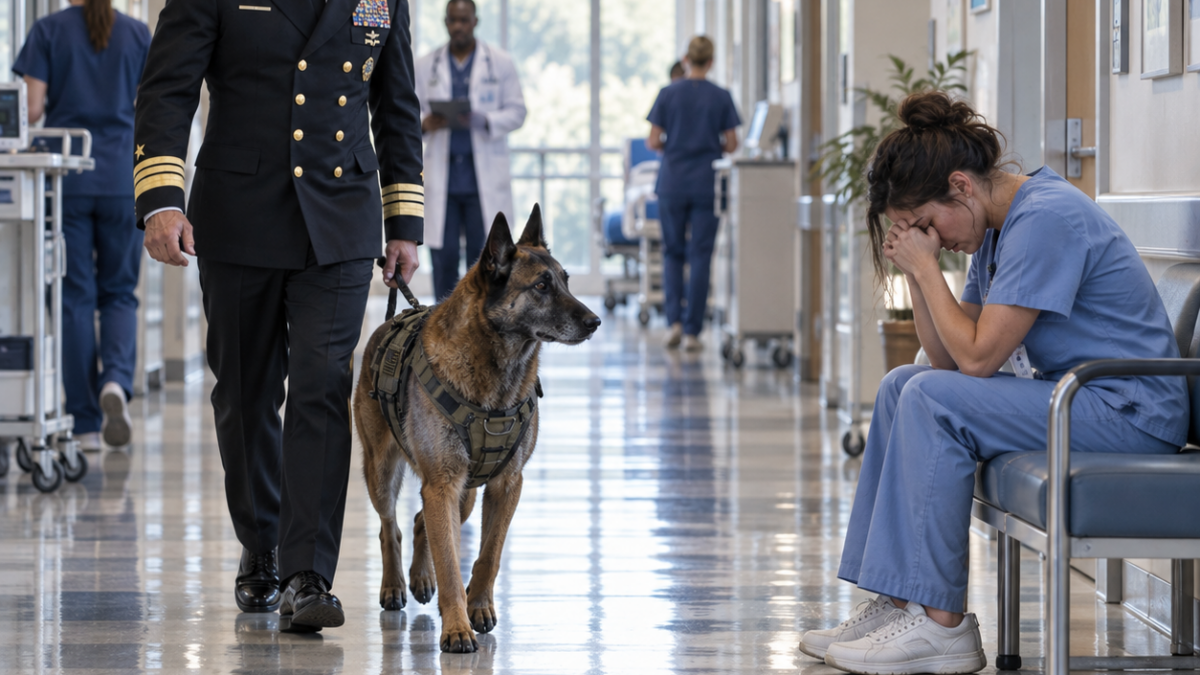
His harness identified him as a military working dog.
The name patch read:
ROGUE.
Elena stopped breathing.
For one second.
Only one.
But one second was enough.
Rogue entered the lobby moving fast, nails striking the tile, handler shortening the lead.
“Easy.”
The dog ignored him.
“Rogue. Heel.”
Nothing.
He moved two more steps.
Then froze.
Not slowed.
Stopped.
His head turned.
Patients.
Technicians.
Marcus.
A woman holding an elderly terrier.
Then Elena.
Rogue became perfectly still.
Elena felt five years collapse inside her chest.
No.
The word never left her mouth.
Rogue stared.
His brown eyes had always been unusually expressive.
She remembered them in darkness.
In smoke.
Watching doors.
Watching ridgelines.
Watching her.
She remembered whispering into his ear with blood on her gloves and seawater soaking her boots.
Stay with me.
She remembered him disappearing into smoke when Black Harbor broke apart.
She had spent years telling herself he died.
That everyone died.
Rogue took one step toward her.
The handler pulled the lead.
“Rogue.”
The German Shepherd did not even turn his head.
Another step.
“Sir,” one of the SEALs said quietly.
The handler frowned.
“I know.”
Elena lowered her eyes to the chart in her hand.
The words blurred.
One of the men looked from the dog to her.
“He’s reacting to the nurse.”
“No,” another said.
His voice changed.
“He’s recognizing her.”
Elena raised her head.
She hated herself for doing it.
Rogue saw her eyes.
His ears lifted.
And then something happened that made every trained man in the room become silent.
Rogue sat.
Straight-backed.
Front paws aligned.
Head high.
The posture was not submission.
It was attention.
Military stillness.
The handler tightened his grip.
“What the hell?”
Elena knew.
Years earlier, Riley Shaw had trained Rogue to do that whenever she returned after leaving him with another operator.
Sit.
Wait.
Confirm.
A private ritual.
Not regulation.
Not documented.
Something between them.
Rogue was waiting for her to release him.
Elena’s fingers tightened around the chart.
The senior officer stepped forward.
He was perhaps forty-two, tall, close-cropped hair beginning to gray, rain still shining on his shoulders.
“Ma’am.”
Elena looked at him.
“Do you know this dog?”
“No.”
Too quick.
Too calm.
The officer heard it.
So did she.
Rogue stood.
The handler gave another command.
The dog ignored him.
He walked straight toward Elena until less than three feet separated them.
Then he stopped.
Elena wanted to retreat.
She did not.
Rogue lowered his head.
His nose touched her fingers.
Her whole body remembered him before her mind allowed it.
The hospital disappeared.
She smelled saltwater.
Diesel.
Burning plastic.
She heard men screaming through radios.
Someone shouting her old name.
Riley!
The chart slipped slightly in her hand.
Rogue made a sound deep in his chest.
Not a growl.
Not a whine.
Something broken.
Almost human.
Elena’s eyes burned.
The handler whispered, “He’s been searching for someone.”
The officer looked sharply at him.
“What?”
“Since Black Harbor.”
Elena’s face changed.
Barely.
The officer caught it.
Rogue pressed his forehead into her palm.
The chart fell.
It struck the tile.
Nobody moved.
Elena closed her eyes.
For five years she had imagined the past finding her through men.
Records.
Surveillance.
A photograph.
A mistake.
She had never imagined four paws walking through a veterinary hospital.
“Who are you?” the officer asked.
Elena opened her eyes.
Rogue remained beneath her hand.
She removed it.
He followed.
“His medical records,” she said.
The officer frowned.
“What?”
“I need to see them.”
“You just said you don’t know him.”
“I know his behavior.”
“How?”
Elena looked at Rogue.
The German Shepherd looked back.
Marcus appeared beside her.
“Elena?”
She heard the concern in his voice.
That hurt more than suspicion.
She had worked beside Marcus for five years.
He had trusted her with his hospital.
His patients.
His staff.
He knew she hated mushrooms, drank coffee black, and always stayed late when an animal might not survive the night.
He did not know her name.
The officer stepped closer.
“Commander Daniel Hale.”
Elena’s eyes shifted to him.
He saw recognition there too.
“I’m responsible for the canine detachment that brought Rogue in.”
“What happened to him?”
“Possible cardiac episode during transport.”
Elena immediately crouched.
The civilian mask did not disappear.
It merged with something older.
Her hands moved over Rogue with practiced certainty.
Gums.
Pulse.
Breathing.
Chest.
She listened.
“His heart isn’t the immediate problem.”
The military veterinarian who had entered behind the team blinked.
“We haven’t finished assessment.”
“He’s hyperventilating because you restrained him when he was trying to orient.”
The veterinarian looked at Hale.
Elena continued.
“He’s older. He’s stressed. He recognized something and you increased pressure.”
“You,” Hale said.
Elena said nothing.
Rogue’s breathing began slowing under her hand.
She whispered without thinking.
“Easy, soldier.”
Rogue’s entire body relaxed.
The handler went pale.
Hale stared at her.
Marcus whispered, “Elena…”
She realized what she had done.
Too late.
Hale stepped nearer.
“What unit?”
“I told you—”
“What unit were you with?”
“I’m a veterinary nurse.”
Rogue gave a low exhale.
Hale’s expression became almost grimly amused.
“Your dog disagrees.”
“He isn’t my dog.”
Rogue leaned against her leg.
No one said anything.
Hale looked at the handler.
“Pull his archived assignments.”
The handler retrieved a secure device.
“Sir.”
“Do it.”
Elena stood.
“You don’t need to.”
Hale’s eyes snapped toward her.
That was another mistake.
The handler scrolled.
“Rogue was originally assigned to Coronado canine support.”
Elena already knew.
“Then transferred into restricted rotational support.”
Hale waited.
The handler’s face changed.
“What?”
“There’s a missing block.”
“How long?”
“Twenty-one months.”
Elena looked away.
“What appears afterward?”
“Reassignment evaluation, classified.”
“Before?”
The handler swallowed.
“Operation Black Harbor support.”
Rogue’s ears lifted at the words.
Elena felt him stiffen.
Hale saw it.
So did everyone.
The dog remembered the phrase.
That was impossible unless he had heard it often.
Hale looked at Elena.
Her face had gone pale.
“You know that name.”
She remained silent.
“Black Harbor.”
Rogue turned toward Hale.
Then back to Elena.
“Stop saying it.”
Hale’s voice dropped.
“Why?”
“Because you don’t understand what you’re opening.”
The room changed.
Until that moment, suspicion remained theoretical.
Now Elena had admitted knowledge.
Marcus stared at her.
Sophie had stopped pretending to organize supplies.
The handler’s hand hovered over his device.
Hale spoke carefully.
“What were you called?”
Elena’s pulse thudded.
Five years.
She had protected the name for five years.
She remembered standing in a windowless room while a man with no rank on his clothing explained her choices.
Disappear or disappear permanently.
She remembered signing documents with a hand bandaged from Black Harbor.
She remembered learning Elena Moore’s birthday.
Her invented college.
Her fabricated employment history.
She remembered arriving at Bayside with everything she owned in one suitcase.
Rogue touched his nose against her fingers.
Something broke.
Not discipline.
Something older than discipline.
Grief.
“My name was Riley.”
The handler stopped breathing.
Hale’s eyes narrowed.
“Last name.”
Elena looked at him.
“Shaw.”
No one moved.
Hale took one step backward.
“Commander Riley Shaw?”
Marcus looked between them.
“You know her?”
Hale did not answer him.
He was staring at Elena as if a dead woman had stepped from a photograph.
“I saw your name on a memorial authorization.”
Elena’s mouth tightened.
“There shouldn’t have been a memorial.”
“There wasn’t publicly.”
“Exactly.”
Hale turned to the handler.
“Secure the doors.”
Elena immediately said, “No.”
Hale looked back.
“You have a better idea?”
“Yes.”
“Which is?”
“Do not change anything.”
He stared at her.
“The moment you secure this building, anybody watching knows you found something.”
The old voice had returned.
Not loud.
Command.
Every SEAL in the room reacted before they consciously understood why.
Hale studied her.
“You think somebody’s watching?”
Elena looked toward the rain-dark windows.
“I think somebody has been waiting five years for me to become visible.”
The lights from the parking lot reflected against the glass.
Three military vehicles.
One ambulance.
Then Elena saw another vehicle.
Black SUV.
No government plate she recognized.
Engine running.
Parked beyond the reach of the hospital lights.
Her stomach dropped.
Rogue turned his head at the same moment.
The dog growled.
Low.
Controlled.
Hale followed his gaze.
“That yours?” Elena asked.
“No.”
The handler shook his head.
“Not convoy.”
Marcus stepped forward.
“What is happening?”
Elena could not answer him without destroying his understanding of her.
But that was already happening.
“Marcus, move everyone away from the front lobby.”
“Why?”
“Please.”
He stared at her.
In five years, Elena had never used that tone.
Marcus turned.
“Sophie, treatment rooms. Get clients into the back hallway.”
Hale touched his radio.
“Convoy, identify black vehicle east side of lot.”
Static.
Then a voice answered.
Not one of Hale’s men.
Male.
Calm.
Encrypted channel.
“You have something that belongs to us.”
Hale became motionless.
The handler looked at his radio.
“That isn’t our frequency access.”
The voice continued.
“Commander Hale.”
Hale’s jaw tightened.
“Identify yourself.”
A pause.
“Black Harbor Recovery.”
Elena closed her eyes.
Rogue pressed against her.
Hale watched her.
“You know them.”
“Yes.”
“I was told Black Harbor was dissolved.”
Elena looked at him.
“It was buried.”
The SUV door opened.
A man stepped out.
No uniform.
No visible weapon.
Dark raincoat.
Mid-fifties.
He walked toward the glass entrance as though arriving for a scheduled meeting.
Elena recognized his face.
Five years vanished.
She was back inside a temporary command center staring across a steel table.
Colonel Adrian Voss.
Technically not a colonel anymore.
Technically not anything that official records acknowledged.
He had been the civilian liaison overseeing Black Harbor.
The man who gave the extraction order.
The man who later told Riley that everyone besides her was dead.
The man who gave her the new identity.
Voss stopped beyond the locked glass.
He looked directly at Elena.
Then smiled.
Not warmly.
“Commander Riley Shaw.”
Rogue stepped in front of her.
Voss touched the intercom.
“You were not supposed to be found.”
Hale moved beside Elena.
“Who the hell are you?”
Voss ignored him.
His eyes dropped toward Rogue.
“Interesting.”
Elena’s hands curled.
“What?”
“We wondered where the animal ended up.”
Rogue growled.
Voss smiled faintly.
“Apparently loyalty lasts longer than classification.”
Hale approached the glass.
“You have no authority here.”
Voss finally looked at him.
“Authority is contextual, Commander.”
“This is a civilian medical facility.”
“Yes.”
“You will identify yourself and your agency.”
“No.”
Hale glanced toward his team.
Voss noticed.
“Do not turn this into something theatrical. We only want Commander Shaw.”
“Elena Moore,” Marcus said from behind them.
Everyone turned.
Marcus stood at the mouth of the hallway.
Fear in his face.
But also anger.
“Her name is Elena Moore.”
Elena felt something twist in her chest.
Voss looked through the glass at him.
“Not anymore.”
Elena stepped forward.
Rogue moved with her.
“No.”
Voss’s expression cooled.
“Riley.”
“You don’t get to call me that.”
“You accepted the arrangement.”
“You told me my team was dead.”
“They were.”
Rogue barked once.
Sharp.
Elena looked down.
A memory surfaced.
Black Harbor.
Night.
Her team running toward the southern extraction point.
Lieutenant Mason Cole beside Rogue.
Senior Chief Aaron Briggs covering the rear.
Petty Officer Luis Ortega on communications.
Then the blast.
Then separation.
Elena remembered waking on a boat with Voss above her.
Everyone’s gone.
You survived because we got lucky.
She had believed him because believing anything else hurt too much.
But Rogue survived.
If Rogue survived—
“Where did you find him?” she asked Hale.
Hale did not take his eyes off Voss.
“Storage rehabilitation program three years ago.”
“Where?”
“Virginia.”
“How was he identified?”
“Microchip flagged as reassigned military property.”
“Who brought him in?”
Hale looked toward the handler.
The young man searched the record.
“No origin listed.”
Elena’s pulse quickened.
“That isn’t possible.”
Voss touched the intercom again.
“You’re asking dangerous questions.”
Elena turned toward him.
“You should have killed the dog.”
Voss’s expression changed.
Only slightly.
There.
A reaction.
Hale saw it too.
Elena continued.
“But you couldn’t find him.”
Voss said nothing.
“And if you couldn’t find Rogue…”
She looked at the dog.
Hope was dangerous.
More dangerous than fear.
Because fear taught you to survive.
Hope made you vulnerable.
“Then maybe you didn’t find everyone else.”
Voss’s face hardened.
“Don’t do this.”
“Where is my team?”
“They died.”
“You lied about me.”
“For your protection.”
“You erased me.”
“You agreed.”
“I was drugged, wounded, and told twelve people were dead because I failed to extract them.”
Voss’s mouth tightened.
“You did fail.”
Hale looked sharply at Elena.
The words struck.
Even after five years.
Elena absorbed them.
Voss knew exactly where to place the knife.
“You were in command,” he continued. “The beach collapsed. Your people were compromised. You chose the northern route. People died because of it.”
Elena’s breathing changed.
Rogue leaned against her.
A memory flashed.
A map.
Orders changed twelve minutes before insertion.
A route Voss insisted on.
She had objected.
Her commander above Voss had overruled her.
Then communication failure.
Then hostile forces waiting at the extraction point.
Elena stared at Voss.
“No.”
He smiled slightly.
“What?”
“I didn’t choose the northern route.”
Silence.
Voss’s smile disappeared.
“You ordered it.”
“No.”
“You signed—”
“You ordered it.”
Elena remembered now.
Not everything.
But enough.
“You told us satellite coverage showed the south inlet compromised.”
Voss said nothing.
“You pushed us north.”
Hale watched both of them.
Elena stepped toward the glass.
“Who was waiting there?”
Voss’s hand dropped from the intercom.
“Riley.”
“Who was waiting?”
Hale turned to the handler.
“Record everything.”
Voss heard.
His eyes sharpened.
Then the hospital lights died.
Darkness swallowed the lobby.
Someone screamed in the rear hall.
Emergency lights came on seconds later.
Red.
Dim.
Rogue barked.
Hale’s men moved.
Elena did not.
Her old instincts arrived whole.
Not as memory.
As muscle.
“Back corridor,” she said.
Hale looked at her.
“What?”
“They want us focused on the front.”
A crash sounded somewhere behind the surgical wing.
Hale swore.
Elena was already moving.
Rogue followed.
“Riley!”
She stopped.
Hale stared at her.
That name hung between them.
Then he said, “What do you need?”
For the first time in five years, someone asked Commander Riley Shaw that question.
She looked at the building she knew better than anyone.
“Keep civilians in imaging. Concrete walls. One entrance.”
Hale nodded.
“Two men with them.”
“Done.”
“Do not pursue anybody outside.”
His eyes narrowed.
“You think this is a diversion?”
“I know Voss.”
Hale glanced toward the glass.
Voss had disappeared.
Riley’s stomach tightened.
“They don’t need to take me.”
“What do they need?”
“Evidence.”
“What evidence?”
Riley looked at Rogue.
“The one witness nobody thought could talk.”
The dog stared back.
Hale understood.
“They want him.”
Riley nodded.
A sound came from the kennel corridor.
Rogue turned instantly.
Hale raised a hand.
The SEALs shifted.
Riley grabbed his arm.
“No gunfire unless you have no choice.”
“This from a SEAL?”
“This from a veterinary nurse standing twenty feet from oxygen tanks.”
Hale almost smiled despite everything.
“Fair point.”
They moved toward the corridor.
Two intruders had entered through a maintenance door.
The encounter ended quickly.
No heroic theatrics.
No blood-soaked hallway.
Hale’s team overwhelmed one near the laundry room.
The second fled when Rogue’s barking exposed his position before he reached the canine ward.
Riley never fired a weapon.
She did not carry one.
That mattered.
Five years earlier she would have been armed automatically.
Now her hands smelled like antiseptic and dog shampoo.
Yet command returned to her as naturally as breathing.
“Check the external cameras,” she told Marcus.
Marcus stared at her.
“Are you giving me orders now?”
Riley stopped.
The hurt in his voice cut through everything.
She lowered hers.
“I’m asking.”
Marcus looked toward Rogue.
Then back.
“You’ve been lying to me for five years.”
“Yes.”
“About everything?”
“No.”
“How am I supposed to know that?”
Riley had no answer.
Marcus’s eyes shone with anger.
“You stood beside me when my father died.”
“I remember.”
“You helped me close his eyes.”
“Yes.”
“You knew my kids.”
“Yes.”
“You came to Thanksgiving.”
“I know.”
“And I never even knew your name.”
Riley swallowed.
“Elena became real.”
Marcus laughed once without humor.
“That’s not an answer.”
“It’s the only one I have.”
He stared.
She continued.
“I didn’t fake caring about you.”
“Did you fake anything else?”
“My birthday.”
Despite himself, Marcus blinked.
Riley looked down.
“And I hate mushrooms less than I claimed.”
Marcus almost laughed.
Almost.
Then his face hardened.
“This isn’t funny.”
“No.”
“What happened to you?”
Riley glanced toward the rain.
“I survived something I wasn’t meant to survive.”
Marcus waited.
“And I was afraid if anyone knew me, they would become part of it.”
He looked toward the frightened hospital staff.
“We’re part of it now.”
“I know.”
For the first time that night, Riley looked ashamed.
“I’m sorry.”
Marcus breathed slowly.
Then nodded toward Rogue.
“Save your apology. Keep him alive.”
Riley looked at her old partner.
“Working on it.”
Hale approached with the military veterinarian.
“We found something.”
The veterinarian held Rogue’s recent imaging records.
“There’s an object under the scar tissue near his left shoulder.”
Riley frowned.
“What kind?”
“Metallic. Very small.”
“Tracking device?”
“Not like anything standard.”
Hale looked at Riley.
Her face changed.
“Get it out.”
The veterinarian hesitated.
“We need anesthesia.”
“Do it.”
“Riley,” Hale said.
She looked at him.
“If Black Harbor implanted him with something—”
“They didn’t.”
“How do you know?”
“Because I did.”
Everyone stared.
Riley moved closer to Rogue and touched the fur over the old scar.
Five years earlier.
Black Harbor.
Ortega had carried a small encrypted storage wafer.
Mission logs.
Raw communications.
Satellite packets.
Command changes.
Everything.
When their radio network became compromised, Ortega had told Riley they needed somewhere nobody would search.
Rogue had already been injured by debris.
Riley remembered kneeling beside him.
A tiny incision.
A sealed data capsule beneath damaged tissue.
Not standard procedure.
Not in any manual.
Desperate.
Then the mission collapsed.
Riley whispered, “Oh my God.”
Hale understood before she finished.
“You hid data in the dog.”
“I thought he died.”
“And whoever covered this up never found it.”
Riley looked toward the black windows.
“That’s why Voss is here.”
The surgery took forty-three minutes.
Riley did not perform it.
She stood beside Rogue’s head while Marcus and the military veterinarian removed the capsule.
The German Shepherd slept beneath anesthesia.
Riley stroked the fur between his ears.
Five years ago she had been the one cutting into him.
Five years ago bullets had cracked through concrete nearby.
Ortega had held a flashlight while cursing her improvisation.
“If we live through this,” he had whispered, “I’m filing the weirdest medical complaint in Navy history.”
Riley had laughed.
She had forgotten that laugh.
Now tears slid down the sides of her face.
Marcus noticed.
He said nothing.
The capsule emerged intact.
Tiny.
Corroded around the edges.
Hale stared.
“This can end careers.”
Riley shook her head.
“If it says what I think, it should.”
They connected it only to an isolated forensic system brought in by Hale’s communications specialist.
The encryption required two keys.
One was Ortega’s unit code.
Riley remembered it.
The second was biometric.
Her old military credentials were technically dead.
Hale tried them anyway.
The system accepted Commander Riley Shaw.
A folder appeared.
BLACK HARBOR / RAW.
Riley stared at the screen.
Hale looked at her.
“Ready?”
“No.”
He waited.
Riley breathed.
“Open it.”
The first file contained audio.
Static.
Then Ortega’s voice.
“Black Harbor team, stand by. Updated shoreline intelligence received.”
Voss answered.
“North extraction confirmed.”
Riley heard her younger self.
“Negative. South route remains cleaner based on our last feed.”
Voss again.
“New intelligence supersedes previous package.”
“Source?”
“Above your classification.”
Riley closed her eyes.
Hale kept listening.
Her voice continued.
“I want that route change logged as external command.”
Voss sounded irritated.
“Commander Shaw, execute.”
Another file.
Satellite photographs.
The northern inlet.
Hostile personnel positioned there nearly an hour before Riley’s team arrived.
Someone had known.
A third file contained financial transfers through shell security companies.
Hale stared.
“What is this?”
Riley recognized one name.
“Victor Dane.”
“Who?”
“Private defense contractor.”
She scrolled.
“They were providing equipment to both sides.”
Hale looked sick.
“You’re telling me Black Harbor wasn’t compromised by accident.”
“No.”
The real operation emerged piece by piece.
Black Harbor had not been designed to recover endangered intelligence personnel.
That was the official cover.
The mission’s hidden purpose was to erase evidence of an illegal private operation run through people connected to Voss.
A covert unit had discovered the network.
Riley’s SEAL medical extraction team was sent supposedly to rescue them.
Instead, Voss rerouted the extraction into an ambush.
Anyone who survived would be managed afterward.
Riley had survived.
So Voss erased her.
The data also revealed something else.
Three members of Riley’s team had survived initial extraction.
Not just her.
Mason Cole.
Aaron Briggs.
Luis Ortega.
Riley stared at the names.
Status beside them:
TRANSFERRED.
Not deceased.
Transferred.
Her knees nearly failed.
Hale caught her elbow.
She jerked away automatically.
Then stopped.
“Sorry.”
“No need.”
Riley pointed.
“Where?”
The records were old.
Most destinations were coded.
But Ortega had added a hidden note.
Numbers.
Coordinates.
Hale’s specialist decoded them.
A rehabilitation facility outside Norfolk.
Formerly military.
Later privatized.
Closed two years ago.
Riley whispered, “They kept them alive.”
Hale looked grim.
“Or did for some period.”
Hope returned.
Painfully.
“Find them.”
Hale nodded.
“I will.”
“No.”
She looked at him.
“We will.”
The word changed him.
Maybe changed her too.
The next seventy-two hours shattered what remained of Elena Moore’s quiet life.
Federal investigators arrived.
Naval Criminal Investigative Service arrived.
Then military legal teams.
Then intelligence officers whose names Riley did not recognize and whose authority Hale verified three times before allowing them into the building.
Voss disappeared.
The black SUV was found abandoned six miles away.
One captured operative refused to speak.
The other admitted only that they had orders to recover classified material and return Riley to “administrative custody.”
Riley slept two hours.
Rogue woke from surgery groggy and furious at the bandage on his shoulder.
The moment Riley entered the recovery room, he thumped his tail once.
She sat on the floor.
“Still getting me in trouble.”
Rogue rested his chin on her knee.
“You remember Ortega?”
The dog’s ears moved.
Riley laughed softly through tears.
“Of course you do.”
Hale found her there before dawn.
“We found Briggs.”
Riley stood so quickly Rogue lifted his head.
“Alive?”
“Yes.”
The room tilted.
“Where?”
“Arizona.”
“What?”
“Living under another identity.”
Riley stared.
“He thinks everyone else died.”
Her hand covered her mouth.
Hale continued.
“We made contact through investigators. He refused to believe Riley Shaw survived.”
A laugh escaped her.
Broken.
“Sounds like Briggs.”
“He wants proof.”
Riley looked at Rogue.
“Tell him Whiskey Seven.”
Hale frowned.
“What?”
“Ask him who drank the Whiskey Seven bottle in Kuwait.”
Hale relayed the message.
Ten minutes later his phone rang.
He listened.
Then handed it to Riley.
She put it to her ear.
Silence.
Then a man breathed on the other end.
“Riley?”
Her eyes closed.
“Aaron.”
He started crying.
Senior Chief Aaron Briggs, a man Riley had once seen carry a wounded teammate half a mile under fire, cried so hard he could not speak.
Riley cried with him.
No one in the recovery room looked away.
They let them have it.
When Briggs finally managed words, they were the ones Riley had dreamed of hearing for five years.
“It wasn’t your fault.”
She could not answer.
He continued.
“Do you hear me? The beach wasn’t your fault. We knew the route was wrong. You fought it.”
Riley pressed her fist against her mouth.
“They told me you were dead.”
“They told me the same about you.”
“Why didn’t you look?”
“I did.”
Her eyes opened.
“What?”
“For two years.”
Briggs’s voice roughened.
“Every request got blocked. Every contact closed. Then somebody came to my house.”
Riley became still.
“They threatened your family.”
“Yes.”
He had a daughter.
Riley remembered.
Emily.
Eight years old when Black Harbor happened.
“They showed me photographs of Emily walking to school.”
Riley closed her eyes.
“So I stopped looking.”
“No.”
“Riley—”
“You protected your child.”
Silence.
Then Briggs whispered, “So did you.”
She looked toward Marcus through the glass.
Her hospital.
Her friends.
Her borrowed civilian life.
Maybe that was what Elena Moore had been.
Not cowardice.
Protection.
But protection without truth eventually became another kind of prison.
The investigation found Mason Cole next.
Alive.
Living in Oregon.
Ortega was harder.
For eight days, there was nothing.
Then a property record led investigators to a rural town in Pennsylvania.
Luis Ortega had lived there for three years under the name Anthony Ruiz.
He had died eighteen months earlier from complications related to injuries from Black Harbor.
Riley sat alone when Hale told her.
No dramatic collapse.
No screaming.
She simply stared at the wall.
“Was anyone with him?”
“A woman named Teresa.”
“Wife?”
“Partner.”
“Did she know?”
“Not everything.”
Riley nodded slowly.
“Did he have children?”
“A boy.”
Riley’s throat tightened.
“How old?”
“Two.”
She looked down.
Ortega had wanted children.
He used to talk about it during long transport flights.
A loud house.
Three kids.
A grill he did not know how to use.
He got two years.
Riley closed her eyes.
“Does Teresa know what he did?”
“Not yet.”
“Tell her.”
Hale studied her.
“Everything we legally can.”
“She deserves the truth.”
“So do you.”
Riley looked at him.
“Truth arrived five years late.”
“Still arrived.”
The investigation became public three weeks later.
Not all of it.
Black Harbor remained partly classified.
But enough emerged.
A defense contracting network.
Illegal financial relationships.
Falsified intelligence.
An extraction deliberately rerouted despite warnings.
Suppressed survival records.
Witness intimidation.
Destruction of evidence.
Adrian Voss.
His name finally appeared where Riley had once feared hers would.
On warrants.
On charging documents.
On television.
Voss was arrested trying to cross into Canada using false identification.
The photograph showed him without his expensive calm.
Tired.
Gray.
Smaller than Riley remembered.
She watched the report from the Bayside break room.
Marcus stood beside her.
“You feel better?”
“No.”
“Good.”
Riley looked at him.
He shrugged.
“Would’ve worried me if one arrest fixed five years.”
She almost smiled.
Marcus poured coffee.
“So.”
“So?”
“Elena or Riley?”
She stared into her cup.
“I don’t know.”
“Helpful.”
“I was Riley for thirty-three years.”
“And Elena for five.”
“She was fake.”
Marcus shook his head.
“No.”
Riley looked up.
“The paperwork was fake. The person who worked here wasn’t.”
She said nothing.
Marcus continued.
“Fake Elena didn’t sit with Mrs. Carpenter for four hours when her Labrador died.”
Riley’s eyes dropped.
“Fake Elena didn’t spend Christmas here because the shelter puppies had parvo.”
“I was scheduled.”
“You volunteered.”
He poured sugar into his coffee.
“You lied to us. I’m still angry.”
“I know.”
“But don’t insult us by saying none of the last five years counted.”
Riley looked through the window.
Rogue lay asleep in recovery.
“What am I supposed to do with two names?”
Marcus shrugged.
“Keep both.”
She laughed quietly.
“You make identity reconstruction sound simple.”
“I treat dogs for a living. My psychological advice is worth exactly what you’re paying.”
Months passed before the formal hearings began.
Riley testified behind closed doors first.
Then publicly, to the extent classification permitted.
The hearing room was crowded.
Uniforms.
Attorneys.
Reporters.
Families.
She wore Navy dress blues again for the first time in five years.
Putting them on nearly broke her.
Her hands shook while fastening the buttons.
Not because she had forgotten how.
Because she remembered.
Rogue waited near the hotel door wearing a service harness.
He had been formally retired from active military duty after the investigation began.
His age and medical history made the decision easy.
Where he would retire was apparently not considered difficult either.
The handler brought him to Riley and handed over the lead.
“He already made the choice.”
Riley knelt.
Rogue licked her chin.
She laughed.
“Undignified.”
His tail moved.
“You used to have standards.”
At the hearing, Aaron Briggs sat behind Riley.
Mason Cole sat beside him.
Teresa Ortega was there too.
She held her son.
Luis’s son.
When Riley first met the boy, she almost could not speak.
Teresa hugged her.
Not politely.
Hard.
“He talked about you.”
Riley froze.
“What?”
“Not your name. He couldn’t.”
Teresa wiped her eyes.
“He said there was a commander who refused to leave people behind.”
Riley looked at the little boy.
“He deserved more time.”
“I know.”
“I’m sorry.”
Teresa shook her head.
“Don’t carry what belongs to other people.”
Those words stayed with Riley when she took the witness chair.
Voss sat across the room with attorneys.
His expression returned to the calm one she remembered.
He wanted her to see him as powerful.
He wanted her to become the wounded survivor again.
Riley looked at Rogue near Hale’s chair.
The dog watched her.
Sit.
Wait.
Confirm.
She understood.
The attorney asked about the route change.
Riley answered.
The intercepted intelligence.
She answered.
The ambush.
She answered.
The data capsule.
She answered.
Then Voss’s attorney stood.
His strategy became obvious immediately.
Make Riley responsible.
“You were the commanding officer on the ground?”
“Yes.”
“You had authority to alter tactical movement?”
“Under certain circumstances.”
“You proceeded toward the northern extraction point?”
“Yes.”
“Your team suffered casualties.”
“Yes.”
“Therefore, regardless of outside recommendations, you ultimately led them there.”
Aaron shifted behind her.
Riley remained still.
“That is incomplete.”
“It is factual.”
“It excludes the falsified intelligence used to compel the decision.”
“You could have refused.”
Riley looked toward Voss.
For five years that sentence had lived inside her.
You could have refused.
Maybe.
Maybe she should have.
Maybe a perfect commander would have seen the trap.
Maybe someone smarter would have saved everyone.
Trauma loved impossible standards.
It rewrote hindsight into prophecy.
Riley looked back at the attorney.
“Yes.”
The room quieted.
The attorney seemed surprised.
“You agree?”
“I could have refused.”
Voss’s mouth almost smiled.
Riley continued.
“And I have asked myself every day for five years whether I should have.”
The attorney waited.
“But my failure to predict a deliberate betrayal does not erase the betrayal.”
Voss’s smile disappeared.
Riley leaned slightly forward.
“I will carry the decisions that belonged to me.”
Silence.
“I will not carry his.”
She pointed no finger.
She did not need to.
For the first time since Black Harbor, Adrian Voss looked away.
The hearings lasted twelve days.
The legal proceedings lasted much longer.
Voss and several others were convicted on multiple federal charges connected to obstruction, conspiracy, falsification, and unlawful covert contracting activity.
Some charges remained sealed.
Some names never became public.
Justice was incomplete.
It usually was.
But it existed.
Families received corrected records.
Aaron Briggs had his service history restored.
Mason Cole received formal recognition that had been denied him.
Luis Ortega’s son received a box.
Inside were his father’s decorations.
A corrected citation.
A photograph of Luis in uniform.
And a letter from Riley.
She wrote it by hand.
She did not tell the boy his father had been fearless.
That would have been a lie.
Luis had been afraid often.
He admitted it.
Joked about it.
Complained through it.
Worked anyway.
So Riley wrote that courage did not mean his father never felt fear.
It meant fear never convinced him to abandon people who needed him.
She believed that was a better inheritance.
Riley’s own official status took months to resolve.
Technically she had never been legally discharged.
Technically her death classification had never existed in the normal system.
Technically Elena Moore’s life was built through a protected identity process that had later been abused to isolate her.
Every technical explanation made her more tired.
One afternoon, Hale found her outside Bayside sitting on the curb.
Rogue lay beside her.
“You know,” Hale said, “most commanders disappear somewhere tropical.”
Riley glanced at him.
“I was busy.”
“You’re still Navy until the paperwork closes.”
“I know.”
“They offered reinstatement.”
“I know.”
“Medical command.”
“I said no.”
Hale sat beside her.
“I heard.”
Rogue lifted his head and sniffed his sleeve.
Hale scratched behind his ear.
“They’d give you captain.”
“Probably.”
“Tempted?”
Riley looked through the veterinary hospital windows.
Sophie was carrying a terrier.
Marcus argued with a printer.
A child pressed both hands against a kennel window.
“I miss parts of it.”
“That wasn’t my question.”
“No.”
Hale waited.
Riley sighed.
“I spent a long time thinking if Riley Shaw came back, Elena Moore had to disappear.”
“And?”
“I’m tired of disappearing.”
Hale nodded.
“What will you do?”
She looked at Rogue.
“I’m not sure.”
Rogue thumped his tail.
Hale stood.
“For what it’s worth, he seems comfortable with uncertainty.”
Riley watched the dog.
“He once jumped out of a moving helicopter because Ortega dropped a sausage.”
Hale stared.
“You’re lying.”
Riley smiled.
“Yes.”
He shook his head and walked away.
Bayside did not return to normal.
Normal was impossible.
Reporters occasionally waited outside.
Strangers sent letters.
Veterans came by hoping to meet Riley.
She disliked all of it.
Marcus eventually put a sign on the reception desk.
STAFF DO NOT DISCUSS PRIVATE MILITARY HISTORY.
Sophie added beneath it:
INCLUDING THE DOG.
Riley pretended to object.
The sign stayed.
The hardest part was not publicity.
It was trust.
Her coworkers forgave her at different speeds.
Some immediately.
Some slowly.
One technician transferred.
That hurt.
Riley understood.
People were allowed to feel betrayed.
She could explain why she lied.
Explanation was not entitlement to forgiveness.
Marcus took the longest in one way and the shortest in another.
He trusted Riley with animals immediately.
He trusted her personally more carefully.
For months, whenever she said something about her past, he would occasionally ask, “Real answer?”
She always replied.
Even when the answer embarrassed her.
Especially then.
Her real birthday was March 4.
She had grown up in Virginia.
Her mother taught high school chemistry.
Her father repaired marine engines.
She had one sister, Catherine.
Alive.
Estranged because Catherine had been told Riley died overseas.
That reunion frightened Riley more than the hearing.
She postponed it twice.
Then Catherine appeared at Bayside without warning.
Riley came around the corner carrying a bag of dog food.
The bag dropped.
Catherine stood near reception.
Older.
Hair shorter.
Same eyes.
Neither moved.
Then Catherine slapped her.
Hard.
Everyone froze.
Riley did not react.
Catherine slapped her again.
Then grabbed her and began sobbing.
Riley held her.
“I’m sorry.”
“You were alive.”
“I know.”
“I buried you.”
“I know.”
“There wasn’t even a body.”
“I know.”
“You let me bury an empty coffin.”
Riley’s face broke.
“I thought it kept you safe.”
Catherine pushed away.
“You don’t get to decide that for me.”
Riley closed her eyes.
Another lesson.
The same one wearing different clothes.
“I know.”
“No, you don’t.”
“You’re right.”
Catherine stared.
Riley continued.
“I’m learning.”
Catherine laughed through tears.
“You always hated being wrong.”
“I still do.”
“Good.”
They sat for three hours.
They argued.
Cried.
Stopped talking.
Started again.
Rogue eventually put his head in Catherine’s lap.
She looked down.
“This is the dog?”
“Yes.”
“The one who ruined your secret identity?”
Riley glanced at him.
“That’s one interpretation.”
Catherine scratched his ear.
“I like him.”
“Of course you do.”
A year after the rainy night when Rogue walked into Bayside, the hospital held a small retirement ceremony for him.
Riley hated the idea.
Marcus insisted.
“No reporters.”
“I don’t want speeches.”
“No speeches.”
“No giant flag cake.”
Marcus looked offended.
“That was Sophie’s idea.”
“No.”
“Fine.”
The ceremony consisted of hospital staff, Hale, Briggs, Cole, Teresa, Catherine, and several people who had worked with Rogue over the years.
There was a small American flag near the entrance because Bayside always kept one there.
No dramatic decorations.
No television cameras.
Rogue received a new collar.
Then ate half a steak he had absolutely not been medically cleared to eat.
Riley looked accusingly at Marcus.
He pointed at Hale.
Hale pointed at Briggs.
Briggs pointed at the two-year-old.
No one believed him.
Near sunset, Riley walked outside with Rogue.
The rain had stopped hours earlier.
The pavement still smelled wet.
One year.
She remembered him coming through those doors.
The impossible recognition.
His head beneath her hand.
She crouched.
“You know what’s strange?”
Rogue looked at her.
“I thought you found me.”
His ears shifted.
“But I think maybe you reminded me where I was.”
She had spent five years believing Riley Shaw was the dangerous identity.
So she buried her.
Then she built Elena Moore as shelter.
But over time shelter became hiding.
The truth was simpler.
She was both women.
Riley knew what people could do to each other.
Elena knew how to heal frightened animals.
Riley could command a room during disaster.
Elena knew when silence mattered more than orders.
Riley had spent years learning how to bring wounded people out.
Elena had spent years learning some wounds did not need extraction.
They needed patience.
Neither woman was false.
Neither needed to disappear.
Marcus came through the door.
“You closing?”
“In a minute.”
“You said that an hour ago.”
“I’m consistent.”
He leaned against the wall.
“Got a call today.”
“From?”
“Naval veterinary program.”
Riley frowned.
“What do they want?”
“A consulting partnership.”
“No.”
“You haven’t heard it.”
“No uniforms?”
“No.”
“No classified operations?”
“No.”
“No people showing up in black SUVs?”
“I specifically requested fewer black SUVs.”
She gave him a look.
Marcus smiled.
“They want us to help with retired military working dogs. Transition medicine. Handler education. Trauma cases.”
Riley looked at Rogue.
Marcus continued.
“They asked for you.”
“Of course.”
“You can say no.”
That mattered.
Five years earlier, choices had been taken from her.
Then she had taken choices from herself.
Now Marcus gave one back without pressure.
Riley looked through the hospital doors.
“Tell them I’ll listen.”
Marcus nodded.
“Just listen?”
“For now.”
“Progress.”
“Go home.”
“Yes, Commander.”
She glared.
Marcus disappeared inside laughing.
Riley stood.
“Come on, old man.”
Rogue rose slowly.
Age had reached him.
His muzzle had gone gray.
Stairs took longer.
Some mornings the old scar near his shoulder bothered him.
Riley noticed everything.
She knew what time would eventually do.
She had worked in veterinary medicine too long to lie to herself.
That frightened her.
For years, fear of loss had made her avoid attachment.
Now she understood the cost.
Loss was not proof that love had been a mistake.
Grief was what remained when something mattered.
That winter Rogue slowed dramatically.
Tests showed cancer.
Aggressive.
Marcus explained treatment options.
Riley already understood them.
She had helped other owners through this conversation hundreds of times.
Now every word felt impossible.
“There’s a surgery.”
“Yes.”
“And chemotherapy.”
“Yes.”
“Could buy months.”
“Maybe.”
Marcus waited.
Riley looked at Rogue asleep on the blanket.
“What would you tell me if he belonged to someone else?”
Marcus’s eyes filled.
“I’d tell you to treat the dog, not your fear.”
Riley nodded.
She had said those words herself.
They chose comfort.
Good food.
Short walks.
Sunlight.
No heroic treatment that would make Rogue sick merely because Riley could not bear to lose him.
Aaron visited.
Mason visited.
Catherine came often.
Teresa brought Luis’s son, now old enough to throw a ball badly while Rogue watched with saintly patience.
One warm afternoon, Riley took him to the beach.
Not the kind associated with missions.
No weapons.
No radios.
No night vision.
Just sand.
Wind.
Children building castles.
Families under umbrellas.
Rogue walked slowly beside her.
They sat near the water.
Riley removed her shoes.
A wave reached her ankles.
Rogue looked offended when foam touched his paws.
“You’ve survived explosions and you’re scared of two inches of Pacific Ocean?”
He moved backward.
She laughed.
People nearby glanced over.
They saw a woman and an old dog.
That was all.
For once, Riley liked being ordinary.
She placed one hand on Rogue’s back.
“You know something?”
His breathing was slow.
“You were never a weapon.”
The phrase mattered to her.
People had called military dogs assets.
Equipment.
Resources.
But Rogue remembered names.
Faces.
Grief.
He chose.
He waited five years.
Then found her.
Or maybe found himself too.
“You were my partner.”
Rogue leaned against her.
“And my witness.”
Another wave rolled in.
“And a colossal pain in the ass.”
His tail moved once.
Riley smiled.
Weeks later, Rogue stopped eating.
She knew.
Marcus knew.
Everyone knew.
Riley sat with him in the quiet room at Bayside after closing.
No uniform.
No cameras.
No grand military farewell.
His head rested in her lap.
Catherine sat nearby.
Marcus stood at the door.
Aaron and Mason had called earlier.
Hale had sent a message.
Riley stroked Rogue’s gray muzzle.
Five years earlier, she had whispered through smoke:
Stay with me.
Now she understood love sometimes asked the opposite.
“You don’t have to stay.”
Rogue breathed slowly.
“You did your job.”
Tears fell onto his fur.
“No.”
She corrected herself.
“You did more than your job.”
She bent close.
“You brought me home.”
Rogue’s eyes remained on hers.
Riley smiled through tears.
“Stand down, soldier.”
His breathing softened.
Minutes later, Rogue died beneath her hand.
The hospital was silent.
Riley remained on the floor long afterward.
She cried without shame.
No command voice.
No discipline.
No Elena mask.
No Riley armor.
Just grief.
Marcus eventually sat beside her.
Neither spoke.
There was nothing useful to say.
Months later, Bayside placed a small photograph near the staff entrance.
Rogue sitting upright.
One ear imperfect.
Scar across his muzzle.
No medals.
No military title.
Below the photograph was a simple brass plate.
ROGUE
PARTNER. SURVIVOR. HOME.
Riley chose the words.
She returned to work.
Of course she did.
There were still animals arriving frightened.
Owners arriving exhausted.
Military dogs learning how to sleep without waiting for commands.
Handlers learning that retirement could be disorienting for both ends of the leash.
Bayside’s new program expanded.
Riley helped design it.
She refused publicity.
Mostly.
Occasionally she spoke to young military medical personnel.
When they asked about Black Harbor, she rarely discussed operational details.
She spoke instead about moral injury.
Grief.
Responsibility.
The difference between accountability and self-destruction.
“Leadership doesn’t mean carrying every bad thing that happens,” she told one class.
A young officer raised his hand.
“How do you know which parts are yours?”
Riley thought about Voss.
Ortega.
Briggs.
Mason.
Rogue.
Five lost years.
“You ask whether you made the decision with the truth you had—or whether someone else manipulated the truth and convinced you their betrayal was your burden.”
The officer nodded slowly.
Riley continued.
“Own your decisions.”
She looked across the room.
“But don’t volunteer to carry someone else’s crimes.”
Afterward, Hale found her outside.
“You’ve become inspirational.”
“Don’t say that.”
“Terrifyingly inspirational.”
“I can still leave.”
“You’ve threatened that before.”
She smiled.
He handed her an envelope.
Inside was the final administrative order.
Commander Riley Shaw.
Honorably retired.
Service restored.
Awards corrected.
Black Harbor record amended.
She stared.
Hale said quietly, “It’s done.”
Riley looked at the paper for a long time.
Then folded it.
“Not done.”
He frowned.
She touched the photograph of Rogue she carried inside her wallet.
“But enough.”
Years later, people still occasionally came to Bayside because they had heard the story.
The vanished SEAL.
The dog who recognized her.
The classified mission.
Most of the stories exaggerated something.
Some said Rogue broke through a door to reach Riley.
He did not.
Some claimed she commanded him with a secret word.
She did not.
Some said the moment their eyes met, she immediately confessed everything.
Definitely not.
The truth was quieter.
A dog walked into a hospital.
He saw a woman who had spent five years telling herself the person he remembered no longer existed.
And he refused to believe her.
He sat.
Waited.
Remembered.
That was enough.
One rainy evening, years after Black Harbor became history instead of threat, Riley locked the hospital.
Marcus had gone home.
The hallway lights were low.
Rain streaked the windows almost exactly as it had that night.
Riley stood beneath Rogue’s photograph.
She was older now.
Gray beginning in her own hair.
She had never remarried because she had never been married in the first place.
Never had children.
For years she used those facts as evidence that Black Harbor had stolen an entire possible life.
Eventually she stopped measuring herself by lives she had not lived.
Her life was here.
Messy.
Late.
Unexpected.
Real.
Catherine called every Sunday.
Aaron sent terrible fishing photographs.
Mason mailed Christmas cards.
Teresa’s son had started middle school.
Marcus still printed schedules nobody followed.
And retired military dogs came through Bayside carrying their own invisible wars.
Riley helped them.
Sometimes one would stop and stare at her longer than expected.
Each time her heart tightened.
But none was Rogue.
That was okay.
No one needed to replace him.
She touched two fingers to the edge of the frame.
“Good night.”
Then she walked toward the doors.
For five years she had believed survival meant disappearing.
Rogue taught her something else.
Survival could also mean being recognized.
Not for rank.
Not for medals.
Not for the worst night of your life.
Recognized as the person beneath all of it.
The person who remained after uniforms changed, names changed, records vanished, and fear tried to convince you that hiding was the same thing as healing.
Rogue had recognized Riley Shaw.
But he had not destroyed Elena Moore.
He connected them.
He forced one woman to understand that she had not become someone else after Black Harbor.
She had become more.
A commander.
A survivor.
A nurse.
A sister.
A friend.
A witness.
Someone who had failed sometimes.
Someone who had been betrayed.
Someone who had carried guilt that belonged to another man.
Someone who eventually learned to put it down.
Riley stepped outside.
Rain touched her face.
She did not flinch.
For years, storms had returned her to the shoreline.
To radios cutting out.
To black water.
To the belief that twelve people died because she had made the wrong choice.
Now rain was simply rain.
She stood beneath it for a moment.
Then smiled.
Five years earlier, a scarred German Shepherd had ignored every command in a crowded veterinary hospital because somewhere beneath a borrowed name, a changed face, civilian clothes, and carefully controlled breathing, he had recognized the person he trusted.
Everyone else thought he had exposed her secret.
They were wrong.
Rogue had done something far more important.
He had reminded her that being found was not the same thing as being captured.
Sometimes, being found was how you finally came home.








