She Refused Every Family at the Christmas Adoption Fair—Then One Dog Appeared Outside, and Her Sudden Reaction Sent the Shelter Staff Searching Through Old Records
PART3:
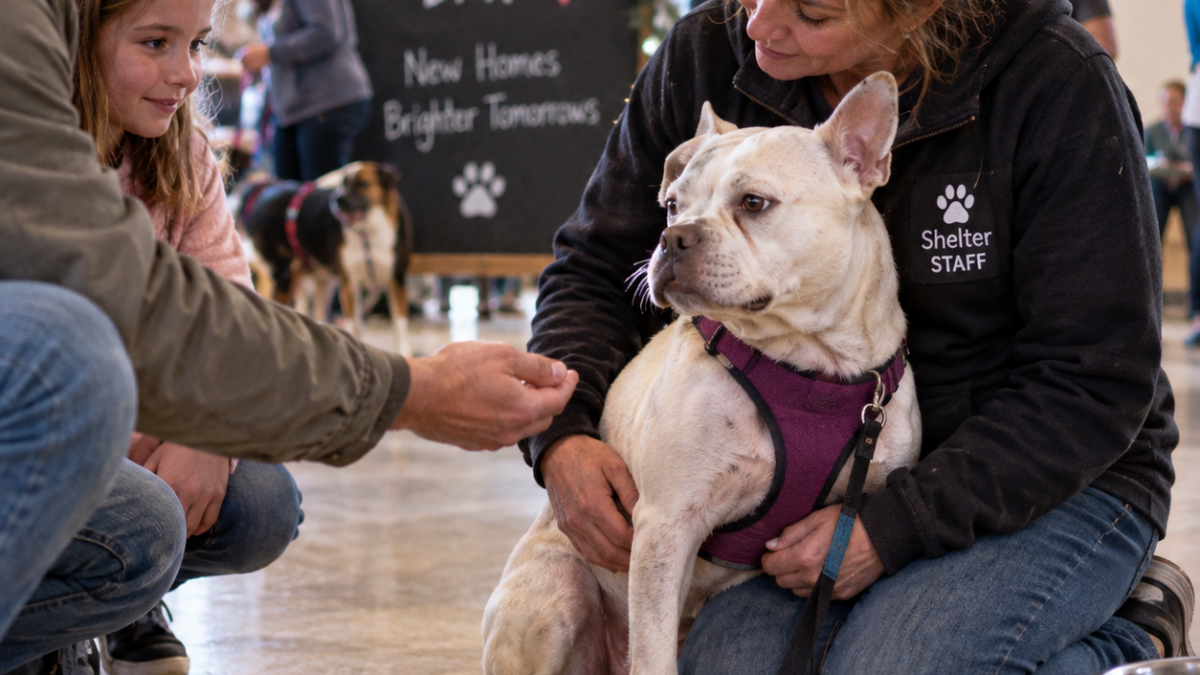
They did not crowd her. They did not squeal. They did not push a hand toward her face. The daughter set the treat on the floor and slid it slightly closer, then looked away to reduce pressure.
Mars did not take it.
After another minute, she turned her whole body away and moved back to my side.
Not frantic.
Not trembling.
Not aggressive.
Just no.
I felt the family’s disappointment like a draft through the room.
The mother tried to hide it.
“She’s shy.”
“She’s cautious,” I said. “That’s not a bad thing. It just means she needs the right pace.”
The daughter swallowed.
“She doesn’t like us?”
I hated that question because it was both simple and impossible.
“She doesn’t know you yet,” I said. “And today might be a big day for her.”
We ended the meeting kindly.
They later met another dog named Pippa, a scruffy terrier mix who crawled into the father’s lap within thirty seconds and stole the daughter’s hair tie. By noon, Pippa had a pending adoption.
That is the strange joy and sorrow of adoption fairs.
One dog’s no becomes another dog’s yes.
Mars watched Pippa leave through the hall doors wearing a red bow someone had tied loosely to her collar.
Then she looked up at me.
I rubbed the side of her neck.
“Your turn will come,” I whispered.
I believed it then.
The second meeting was with an older man named Graham who lived alone on a small property outside town. He wanted a calm adult dog. He brought photos of his yard, his shaded porch, and the old couch he said any dog would be allowed on, though his daughter had told him not to admit that in case we thought he was too permissive.
He was gentle.
Mars still turned away.
The third meeting was a young couple who worked from home. They sat on the floor before I even suggested it. They had read her profile three times. They asked thoughtful questions.
Mars moved away.
The fourth was a nurse with grown children and a quiet house.
Mars sniffed her shoe, then came back to me.
The fifth had experience with bully breeds.
Mars refused the treat.
The sixth said, “Maybe she’s just not a people dog,” and laughed awkwardly.
I did not laugh.
“She’s a dog who has an answer,” I said.
He left soon afterward.
By early afternoon, other dogs were beginning to connect with new families. A black Lab mix named Tui left with a retired couple who had brought a cooling mat in the car because they were worried the day would be too warm. A three-legged little terrier named Beans charmed a family of four by immediately rolling onto his back in front of their youngest child. Old Samson, gray-faced and half deaf, fell asleep with his head on the shoe of the woman who eventually signed his adoption agreement with tears running down her cheeks.
Each time a dog left, the hall changed.
A space opened.
A water bowl disappeared.
A volunteer folded a blanket.
The sound softened.
By three o’clock, the room had the bittersweet feeling adoption events always have near the end: happiness moving out the door one dog at a time, and worry settling heavier around the ones still waiting.
Mars was still with me.
She had not melted down.
That was important.
She drank water. She accepted a few pieces of chicken from my hand. She rested near my feet between appointments and watched the room with steady eyes. She was not frantic. She was not pulling toward the exits. She was not hiding beneath chairs. She was simply choosing not to connect with anyone offered to her.
That made it harder.
If she had panicked, the decision would have been clear: end the day, take her home, try quieter introductions later.
But Mars was coping.
She was just refusing.
One of our volunteers, Tessa, came over carrying a clipboard and a half-eaten biscuit.
“We have one more approved household who asked about her,” she said.
I looked down at Mars.
Mars looked back with the tired patience of someone who had already explained herself several times.
“Do you think we should?”
Tessa lowered her voice.
“If we don’t, she goes back to kennels tonight.”
I knew that.
Every shelter worker knows the sentence even when no one speaks it.
Back to kennels.
Back to concrete floors, barking, staff rotations, fluorescent lights, morning cleaning, evening feeding, waiting.
Mars leaned against my shoe.
“One more,” I said. “Then we stop.”
The last family was a woman named Elise with her twelve-year-old son, Noah. They had a small, quiet home. No other pets. Good references. Elise had grown up with staffies and understood dogs who needed time. Noah sat on the floor and did not move until Mars looked at him.
For a second, I thought maybe.
Mars took two steps closer.
Noah smiled, not too big.
He placed a treat near his knee and looked at the wall instead of directly at her.
Mars sniffed.
My heart lifted.
Then someone outside dropped a metal bowl in the courtyard.
The clang rang through the hall.
Mars flinched, turned, and moved back to me.
The moment was gone.
Noah’s face fell.
Elise nodded before I could speak.
“She’s not ready.”
“She might be, in a quieter setting.”
Elise looked at Mars with real tenderness.
“Maybe. But I think she’s waiting for something else.”
At the time, I thought she meant safety.
Now I wonder if somehow she felt the truth before we did.
By four o’clock, Mars had refused every family.
That was how people would say it later, because people like clean summaries.
She refused every family.
But that was not exactly what happened.
She did not reject them rudely. She did not perform defiance. She did not embarrass anyone. She simply placed a small distance between herself and each life offered to her, then returned to the one familiar person in the room.
Me.
That familiarity made me feel important in a way I knew was dangerous.
Rescue can tempt you into thinking trust belongs to you.
It does not.
Trust is something you hold temporarily until a dog is ready to place it elsewhere.
But Mars kept bringing hers back to my feet, and as the hall emptied, I began to worry she was telling us there was nowhere else she wanted it to go.
The last scheduled human introduction ended.
Tessa stacked chairs near the wall. A volunteer refilled the water bowls. Someone took down one paper garland because the tape had failed and it had begun drooping across the registration table. The old fans kept turning lazily as though nothing meaningful had happened all day, though families were driving away with new dogs in their back seats, and empty kennels were waiting at the rescue facility.
Mars lay beside my chair with her chin on her paws.
I sat with the lead looped loosely around my wrist, watching her.
“You really weren’t having it today, were you?” I whispered.
Her eyes moved toward me.
I sighed.
“That’s okay. You’re allowed.”
I meant it.
Mostly.
The part of me that loved her wanted to respect every no she had given.
The shelter worker in me counted available kennel space, December intake calls, holiday closures, foster homes already full, and the crushing math behind every dog who did not leave.
Dogs do not know that math.
Thank God.
At 4:18, the courtyard gate creaked.
I did not pay attention at first.
We still had one dog-to-dog compatibility appointment scheduled, but it was not for Mars. A pre-approved adopter named Hannah was bringing her resident dog to meet a different rescue dog, a sweet brown mixed breed named Niko who had shown strong interest in other dogs. The courtyard was enclosed for exactly that purpose—safe introductions, leads attached, handlers ready, enough space for dogs to curve and sniff without being forced nose-to-nose.
Mars had not shown much interest in the courtyard all day.
The old exterior door was near the rear of the hall, propped at times for airflow but kept controlled because dogs and open doors are a bad combination. Through it, you could see a slice of shaded concrete, the water bowl, and the lower part of the fence. Earlier, dogs had gone in and out for breaks, introductions, and toileting. Mars had glanced over occasionally but never pulled toward it.
That changed when Toby arrived.
I did not know his name yet.
All I saw at first was a compact white dog waiting in the courtyard on a muted red lead. He had a sturdy body, a broad muzzle, and a warm tan patch over his right ear. His owner, a woman in her early forties with dark hair pulled into a loose knot, stood beside him holding the lead carefully but not tensely. He looked around the courtyard with interest, then lowered his head to sniff the concrete near the water bowl.
Mars stood.
Not slowly.
Not casually.
She stood as if a sound had passed through the room that only she could hear.
Her ears lifted.
Her body went still.
Then she began moving toward the door.
I shortened the navy lead reflexively.
“Mars?”
She did not look at me.
Her eyes fixed on the courtyard.
This was not like the introductions.
Not withdrawal.
Not avoidance.
Not stress displacement.
She was not trying to get away from something.
She was trying to get to something.
Tessa saw it too.
“What’s she doing?”
“I don’t know.”
Mars pulled harder.
Not wildly. Purposefully. Her body leaned forward, paws braced, every part of her aimed at the door.
The courtyard door opened as one of the volunteers came through carrying a clipboard.
For one second, the gap widened.
Mars surged.
The lightweight lead slid through my hand.
“Mars!”
She slipped through the open doorway before it closed.
My heart stopped.
There was no open road beyond that door. The courtyard was enclosed, thank God, but any sudden movement between unfamiliar dogs can become a problem quickly. A dog’s excitement does not guarantee safety. Friendly-looking dogs can become overwhelmed. Dogs who desperately want contact can still panic when they get it. I had seen too many introductions go wrong because humans let emotion move faster than body language.
I hurried into the courtyard.
“Mars, easy.”
The white dog with the tan ear lifted his head.
Mars stopped six feet from him.
For one suspended moment, everything froze.
The courtyard noise faded. The hall behind us disappeared. Volunteers stopped moving. Hannah, the adopter holding the red lead, looked from her dog to Mars, startled but calm.
Mars’s tail began to move.
Slowly at first.
Then faster.
The other dog’s tail answered.
Mars took one step.
He took one step.
Their bodies curved slightly, not straight-line confrontational. They sniffed the air between them. Mars made a sound I had never heard from her before, a small breathy whine that seemed to come from somewhere deeper than excitement.
The other dog pulled toward her.
Hannah looked at me.
“Is this okay?”
“Hold steady,” I said, though my voice was less steady than I wanted.
One of our handlers reached Mars’s navy lead and picked it up carefully.
We reset the space.
Not because we wanted to interrupt, but because safe meetings matter more when feelings are high. Mars trembled at the delay. Not with fear. With urgency.
I had watched her all day.
This was a different dog.
Inside the hall, she had been quiet, reserved, polite in her refusals.
In the courtyard, she became alive.
Her eyes brightened. Her body softened and wiggled. Her whole posture leaned toward that dog on the red lead with a certainty none of us understood yet.
“Who is this?” I asked.
Hannah looked down at him.
“Toby.”
Toby.
The name meant nothing to me.
He had not come through our branch. Hannah explained that she had adopted him from a partner rescue months earlier. She had applied to adopt a second dog and was approved to bring Toby for a compatibility meeting.
“He’s usually good with dogs,” she said. “But I’ve never seen him do this.”
Toby was pulling gently now, ears forward, mouth soft, tail wagging in wide sweeps.
We moved into a controlled introduction.
Two handlers. Leads attached. Loose enough to avoid tension, short enough for safety. Parallel movement first. Curved approach. Breaks. Watch the shoulders, mouths, tail height, eye contact, weight shifts.
I knew the protocol.
I had taught it.
But my hands were shaking.
Because Mars stayed near him.
That was the part that made my chest ache.
She did not sniff once and disengage.
She did not return to me.
She circled Toby, then came back to his side. He leaned toward her. She pressed her shoulder against his. He accepted it. They moved together like two dogs remembering a rhythm they had not practiced in a long time.
Tessa whispered behind me, “Linda.”
“I see it.”
“What is this?”
“I don’t know.”
Mars tucked herself near Toby’s chest.
Toby lowered his head and sniffed along her ear, then paused with his muzzle resting near her neck. Mars closed her eyes.
Closed them.
In a courtyard full of humans, after a whole day of refusing touch, Mars stood with her eyes closed beside a dog she had supposedly never met.
My throat tightened.
Hannah’s eyes filled.
“Toby,” she whispered. “Do you know her?”
He wagged harder at the sound of his name but did not move away from Mars.
No one said the word miracle yet.
Rescue workers are cautious with miracle.
We know better than to trust a feeling without checking records.
Two compatible dogs can meet for the first time and behave beautifully. It happens. Chemistry exists. Some dogs simply understand each other quickly. Mars’s reaction was extraordinary, yes, but extraordinary is not evidence.
Paperwork would have to answer what emotion could not.
“Hannah,” I said carefully, “do you still have Toby’s original adoption documents?”
“Yes. In the car, I think. I brought his vaccination records.”
“Can you get them?”
Her face changed.
“You think—?”
“I don’t know. I want to check something.”
While Hannah went to her car, I stayed in the courtyard with Mars and Toby. We gave them space, then gentle movement, then another break. Mars refused to turn away from him. When Toby walked three steps toward the water bowl, Mars followed. When he drank, she stood beside him. When she moved back toward the shade, he followed her.
It was not frantic.
That somehow made it more powerful.
They were not exploding with chaotic excitement.
They were settling into each other.
Like two pieces of a life quietly moved back into place.
Hannah returned with a folder.
We took it to the old trestle table inside the hall.
Mars objected to leaving Toby.
Not with barking or panic, but with a firm plant of her feet and a look over her shoulder so clear I almost apologized out loud.
“We’re checking,” I told her. “I promise we’re checking.”
That was a dangerous thing to say to a dog.
Promises should not be used casually around beings who cannot understand the conditions.
But I said it anyway.
At the table, Hannah opened Toby’s file.
Vaccination record.
Adoption contract.
Microchip form.
Old intake summary from the partner rescue.
Toby’s current name appeared on the adoption paperwork.
But his rescue name, before Hannah adopted him, was printed in a box halfway down the intake sheet.
I read it once.
Then again.
“Cooper,” I said.
Hannah nodded. “That was his name before I adopted him. I changed it to Toby. He didn’t seem attached to Cooper.”
The room tilted slightly.
Cooper.
I knew that name.
Not from memory exactly. From the back of my mind, where details of too many dogs lived in untidy drawers.
I went to the file box we had brought for the event and pulled Mars’s intake folder.
My fingers moved too slowly.
The folder was thin. Too thin for a whole life.
Mars.
Adult female.
White.
French Bulldog/Pit Bull mix.
Shared household surrender.
Transferred through partner network due to space limitations.
Lived with another dog.
I turned the page.
There.
An old printed photograph, slightly grainy, clipped to the file.
Two dogs on a faded couch.
One was Mars.
The other was a compact white dog with a tan patch over his right ear.
Under the photo, someone had written in blue pen:
Mars + Cooper. Littermates. Bonded but separated for transfer. Monitor stress.
For a moment, no one spoke.
The old fans kept turning.
Somewhere near the entrance, a volunteer laughed softly at something another dog had done. A chair scraped. A child asked if the Christmas tree was allowed to have dog biscuits on it. Ordinary sounds continued because the world rarely stops, even when your heart does.
Hannah covered her mouth.
“Oh my God.”
Tessa leaned over my shoulder.
“They’re littermates?”
I nodded, though my eyes had blurred.
“They lived together.”
Hannah looked toward the courtyard door.
“How long?”
I checked the dates.
“About five months apart.”
Five months.
For humans, five months can be a difficult season.
For a dog who cannot understand adoption networks, transport, kennel rotations, new names, new homes, and why one familiar body vanished from beside her, five months might as well be forever.
I thought of Mars all day in the hall.
Turning away.
Returning to me.
Refusing treat after treat, hand after hand, family after family.
People could call it shyness.
Stress.
Event overwhelm.
All of those might have been partly true.
But now another possibility sat open on the table.
Maybe Mars had not been waiting for a person.
Maybe she had been waiting for the part of her life that had been taken out of the frame.
I took the old photo in my hand and looked at it closely.
Mars and Cooper—Toby now—curled on a couch together, younger, softer, pressed hip to hip. Mars’s head rested against his shoulder. His tan ear stood out even in the faded print. Behind them, someone’s living room blurred into a pattern of curtains and light.
A whole life reduced to one photograph and a note.
Bonded but separated for transfer.
Monitor stress.
My chest hurt.
Not because someone had been careless, exactly. Rescue is full of impossible decisions. Limited space required separation sometimes. One organization takes one dog; another takes the second. Transport leaves at dawn. Foster homes fall through. Names change. Files move. Staff do their best with too little money, too few kennels, too many animals.
But knowing why something happens does not make the result painless.
Mars had carried the result in her body all day.
Hannah touched the edge of the photo.
“I came to find Toby a friend,” she said softly. “I didn’t know he already had one.”
We returned to the courtyard with the file.
Mars saw Toby again and immediately leaned toward him.
This time, I did not just see excitement.
I saw recognition.
Not because I could prove what memory lived inside her.
No human can say exactly what a dog remembers.
But I could see what was observable: the dog who had refused every family now animated and calm beside this one particular dog; the records confirming he had once shared her home; the way Toby stayed with her as if leaving was not even a question.
Still, we had to do the work.
Being littermates did not automatically mean they could live together again. Dogs change. Stress changes them. New homes change them. Adult dogs who once shared space can become incompatible after separation. Emotion could not replace assessment.
So we watched.
We walked them together in the courtyard.
They moved side by side.
We offered water.
They drank without guarding.
We created small distance.
Mars looked but did not panic.
Toby looked back but did not strain.
We allowed a little more contact.
They circled, sniffed, softened.
No stiff posturing.
No hard staring.
No pressure that needed interrupting.
At one point, Mars pressed her side fully against Toby and exhaled.
Toby glanced at her, then leaned back.
Hannah sat on a low bench with both leads loose in her hands and tears on her face.
“I need to ask the practical questions,” I said.
She wiped her cheeks quickly.
“Ask.”
“Toby has been in your home how long?”
“Four months.”
“Any issues with resource guarding?”
“No. He eats in the kitchen. I can pick up toys, bowls, anything. He’s polite.”
“Separation anxiety?”
“A bit at first, but better now. He sleeps on the couch even though he has three beds.”
“That tracks,” Tessa murmured.
“Fence?”
“Six-foot, fully enclosed. You already checked it.”
“Work hours?”
“I’m part-time at the library. My sister comes by on long days. Toby gets midday breaks.”
“Are you ready for two dogs?”
The question hung there.
Hannah looked at Toby.
Then at Mars.
“No,” she said.
I appreciated that answer more than an easy yes.
Then she continued, “I mean, I’m not ready in the way people say they’re ready when they want to sound impressive. I came to see if Toby could find a second dog. I knew that part. I budgeted for another adoption. I talked to my landlord. I bought a second bed. But I didn’t know it would be her.”
Mars leaned against Toby.
Hannah looked at me.
“I don’t know if anyone can be ready for a moment like this. But I can be responsible for it.”
That answer did something to me.
Because love is wonderful.
Responsibility is what lets love survive Tuesday mornings, vet bills, muddy paws, training setbacks, and ordinary life.
We moved back inside to the trestle table.
The hall looked emptier than before. Chairs stacked along one wall. A few families still finishing paperwork. Volunteers tired but smiling. The plastic Christmas tree still leaning. Paper decorations fluttering slightly in the fan breeze.
Mars stood at the courtyard door.
She did not return to my feet.
For the first time all day, that did not hurt.
It should have, maybe.
I had been her safe person through the fair, her familiar point in the room. Part of me had wanted that to mean something permanent. But rescue, at its best, is the art of becoming unnecessary.
Mars had found the one presence stronger than her fear.
Not me.
Toby.
And Toby came with Hannah.
That was the path forward.
The paperwork was ordinary.
That surprised me, though it should not have.
A life can change completely while someone checks a microchip number, initials a paragraph about veterinary care, signs a line confirming return policy, and prints a name in black ink.
Hannah completed Mars’s adoption agreement at the old trestle table. We prepared the microchip transfer. We attached copies of the shared history notes, Toby’s prior file name, the photograph, and our compatibility assessment. We reviewed feeding separately at first, decompression, slow home integration, not overwhelming Mars with visitors, maintaining routines for Toby, watching for stress.
Hannah listened to every word.
No rushing.
No “I know, I know.”
No treating the emotional moment as permission to skip responsibility.
Toby waited beside her on the muted red lead.
Mars stood beside Toby on the navy one, occasionally pressing her shoulder against him as if checking that he remained real.
When the paperwork was complete, Hannah took both leads.
That was the moment my throat closed.
I had walked dogs out before.
I had handed leads to adopters hundreds of times.
Sometimes I cried afterward. Sometimes before. Sometimes not at all because another dog needed medication or a kennel needed cleaning and grief had to wait its turn.
But Mars looked back at me just once.
Not with fear.
Not with refusal.
Not with the quiet question she had worn all day.
She looked back the way a dog looks at someone who kept watch until the right door opened.
I crouched.
Mars came to me.
For a second, I thought she might press into my legs the way she had all day.
Instead, she touched her nose to my chin.
One small, cool, deliberate touch.
Then she turned back to Toby.
That was goodbye.
Not dramatic.
Not enough for anyone watching from across the room to understand.
But I understood.
The exterior door opened.
Earlier, it had nearly become a problem when Mars slipped through it. Now it became part of the ending none of us could have planned.
Mars crossed the threshold under control on her navy lead.
Toby walked beside her on the red one.
Hannah held both.
They stepped from the scuffed timber floor onto the shaded courtyard concrete, then through the gate toward the car park where summer light spilled gold across the gravel.
The hall behind them remained what it had been all day.
Imperfect.
Warm.
A little noisy.
Paper decorations taped to cream walls.
Old fans turning.
Faded floor lines beneath chairs.
But Mars was no longer the dog left behind as the room emptied.
She was leaving with her brother.
I stood in the doorway long after they passed through the courtyard gate.
Tessa came beside me.
“You okay?”
I nodded.
A lie.
Then shook my head.
Closer.
“I thought she was going back with me tonight,” I said.
“I know.”
“I kept thinking no one was right for her.”
“Maybe no one was. Until him.”
I wiped my face with the back of my wrist.
“That sounds like something people say in a movie.”
“Still true.”
Through the fence, I watched Hannah open the back door of her car. Toby hopped in first, confident, familiar with the routine. Mars paused.
My heart tightened.
Then Toby shifted over, making room.
Mars jumped in.
They sat side by side.
Not piled in panic.
Not clinging.
Just together.
The car door closed.
Hannah looked back toward us and lifted one hand.
Then she drove away.
For a few seconds, the world was only dust from the car park, warm wind, and the echo of a day that had nearly ended differently.
I went back inside because there was still work to do.
There is always still work.
Niko had his compatibility meeting rescheduled. Beans’s adopter had forgotten the medical packet. Someone needed to load crates into the van. Samson’s new owner called from the parking lot because he had fallen asleep in her passenger seat and she did not want to wake him but also did not know how to drive with his head on the gear shift.
Life continued.
But every person in that hall moved a little differently after Mars left.
Even the tired volunteers smiled through the last cleanup like they had been given a gift they did not know how badly they needed.
Rescue work can harden people.
Not because we stop caring.
Because we care past what a body can comfortably hold.
You learn to celebrate small wins and brace for losses. You learn that not every dog gets the ending you fight for. You learn that people lie on applications. You learn that good people return animals because life collapses under them. You learn that love is not enough if fences are broken, rent is unpaid, or someone in the house is unsafe. You learn that sometimes the kindest decision still hurts.
And then a day like that happens.
A dog refuses everyone.
Another dog walks in.
A file opens.
A photograph explains what no one knew to ask.
And for one bright moment, the universe feels less random than it did that morning.
Hannah sent the first update that night.
A photo.
Toby and Mars asleep on a rug near a sliding glass door. Not stacked on top of each other. Not tense. Mars’s back touched Toby’s side. His tan ear rested partly over her neck. Two bowls sat in the background, separated but visible. A soft blue bed lay ignored in the corner.
The message read:
She ate half her dinner. Toby keeps checking on her. She follows him from room to room. I think she knows.
I read it three times.
Then I saved the photo.
The next morning, another update came.
Mars had slept through the night.
Not perfectly. She woke once and paced until Toby got up and walked to her. Then they both settled near Hannah’s couch.
A week later, Hannah reported that Mars had discovered the sunny spot in the kitchen and claimed it, allowing Toby only partial access. Two weeks later, Mars barked for the first time in her new home, not from fear, but because Toby had stolen her chew and apparently justice required sound.
A month later, Hannah brought them to the rescue center for a follow-up visit.
I was in the intake room when Tessa called down the hall, “Linda, you need to come outside.”
I knew before I saw them.
Mars came through the gate beside Toby, both dogs wearing harnesses, Hannah holding the leads with the confidence of someone who had practiced. Mars’s body looked different. Not because she had gained weight, though she had a little. Not because her coat looked shinier, though it did.
She moved differently.
The low caution was still part of her. Mars would likely always assess before trusting. But the heaviness had lifted. She walked with purpose now, not toward escape, not toward withdrawal, but forward.
When she saw me, she paused.
Then trotted over.
I crouched.
“Mars Bar.”
She wiggled once, pressed her head into my hands, and then—because Mars remained Mars—turned away after three seconds to check where Toby was.
He stood behind her, wagging.
“I see how it is,” I said. “I was a bridge.”
Hannah laughed.
“She still loves you.”
“She loves me on a schedule.”
Mars ignored us both and sniffed the treat pouch at my waist.
That was progress too.
We let them into the secure yard. Toby rolled in the grass immediately, legs in the air, shameless. Mars sniffed the fence line, then ran three sudden circles around him, low and fast, her compact body surprisingly quick. Toby sprang up and chased her. They looped the yard together while Hannah covered her mouth.
“I’ve never seen him run like that,” she said.
I watched Mars dart, spin, dodge, and return to Toby again and again.
“She brought something back to him too,” I said.
Hannah nodded.
“I thought I was getting him a friend. But I think I got him his history.”
That sentence stayed with me.
His history.
Dogs do not tell us what they remember in words. We cannot ask them which scents carry meaning, which faces remain, which losses they understand as permanent, which reunions feel like repair. But bodies speak. Behavior speaks. Rest speaks.
Mars had spent adoption day saying no in the only language available to her.
No to hands.
No to treats.
No to families who might have been perfectly good but were not the answer to the ache she carried.
Then Toby appeared, and every part of her said yes.
Months passed.
Mars and Toby became one of the rescue’s favorite update stories, though we were careful telling it. The internet loves reunion stories so much that it sometimes turns animals into fairy tales and forgets the practical work that keeps them safe. We never said Mars recognized her brother with human certainty. We never claimed magic. We said what was true.
Mars refused human introductions at the fair.
Mars changed dramatically when Toby arrived.
Records confirmed Toby was formerly Cooper, Mars’s littermate and previous household companion.
A controlled meeting showed compatibility.
An approved adopter completed the process.
The two dogs went home together.
That was enough.
Truth does not need embellishment when it is already extraordinary.
Still, privately, I believed Mars knew.
I believed it because I had held her lead all day and felt the difference pass through it.
A lead tells you things.
Fear tightens one way.
Curiosity another.
Avoidance has a backward softness to it.
Desperation pulls jagged.
But recognition—if that is what it was—moved through Mars’s lead like a current finding its old riverbed.
The following December, we held another Christmas adoption fair in the same old hall.
Same cream walls.
Same faded court lines.
Same leaning plastic tree because no one had the heart to replace it.
The fans turned again, though one made a clicking noise that drove Tessa mad. We had new dogs, new families, new hopes, new risks. I wore the same rescue polo, though the logo had begun peeling near the sleeve.
Halfway through the afternoon, Hannah arrived.
Not for adoption.
For a visit.
Toby walked in first, tan ear bright as ever. Mars came beside him, wearing a red bandana with tiny white stars. She paused at the entrance to the hall.
I held my breath.
Sometimes places hold memories. Not always in ways we expect.
Mars looked around.
The chairs.
The fans.
The tables.
The courtyard door.
Then she leaned into Toby and kept walking.
No fear.
No shutdown.
No desperate pull.
Just awareness.
Then forward.
Hannah smiled at me.
“She’s okay.”
“I see that.”
Mars greeted Tessa, ignored two volunteers she did not know, accepted a treat from me after making me wait for it, and then sat beside Toby near the registration table like she owned the place.
A little girl visiting with her parents pointed at Mars.
“Is that dog getting adopted?”
Hannah looked at me.
I looked at Mars.
Mars yawned.
“No,” I said gently. “She already found her family.”
The girl considered this.
“She looks happy.”
Mars leaned against Toby, who leaned back.
“She is.”
Late in the day, after Hannah left, one of the new volunteers asked me to tell her the story. She had heard pieces but not the whole thing.
So I told her.
About Mars turning away.
About every family leaving.
About the courtyard door.
About Toby arriving for a different appointment.
About the file.
The photograph.
The leads.
The way they walked out together.
The volunteer wiped her eyes.
“That must be why you keep doing this.”
I looked around the hall.
At a nervous dog sniffing a potential adopter’s shoe.
At a senior terrier asleep under a table.
At a family filling out paperwork with trembling smiles.
At a volunteer cleaning up spilled water for the fifth time that day.
At the empty spaces where dogs had been.
“Yes,” I said.
Then, after a moment, “And no.”
She looked confused.
I smiled.
“One happy ending doesn’t erase the hard parts. But it reminds you the hard parts are not the whole story.”
That is the truth I have carried from Mars.
She reminded me that silence can be an answer.
That refusal is sometimes wisdom.
That what looks like being difficult may be loyalty to something we do not yet understand.
That an animal’s no deserves respect, even when humans are impatient for a yes.
And that sometimes the family meant for you is not the one standing politely in front of you with good intentions, but the one waiting just beyond the door, wearing a different name, carrying the same history, and recognizing you before anyone else can read the file.
Mars refused every family on adoption day.
That was what people said.
But now, when I remember that day, I think of it differently.
Mars did not refuse love.
She recognized that the love being offered was not yet complete.
She waited until the missing piece walked in on a muted red lead.
And when the old door opened one last time, she did not run away.
She ran toward her brother.
Then she walked out beside him.








