She Lost Both Front Legs and One Eye—But the Tiny Meow She Gave Her Rescuers Made Them Refuse to Give Up
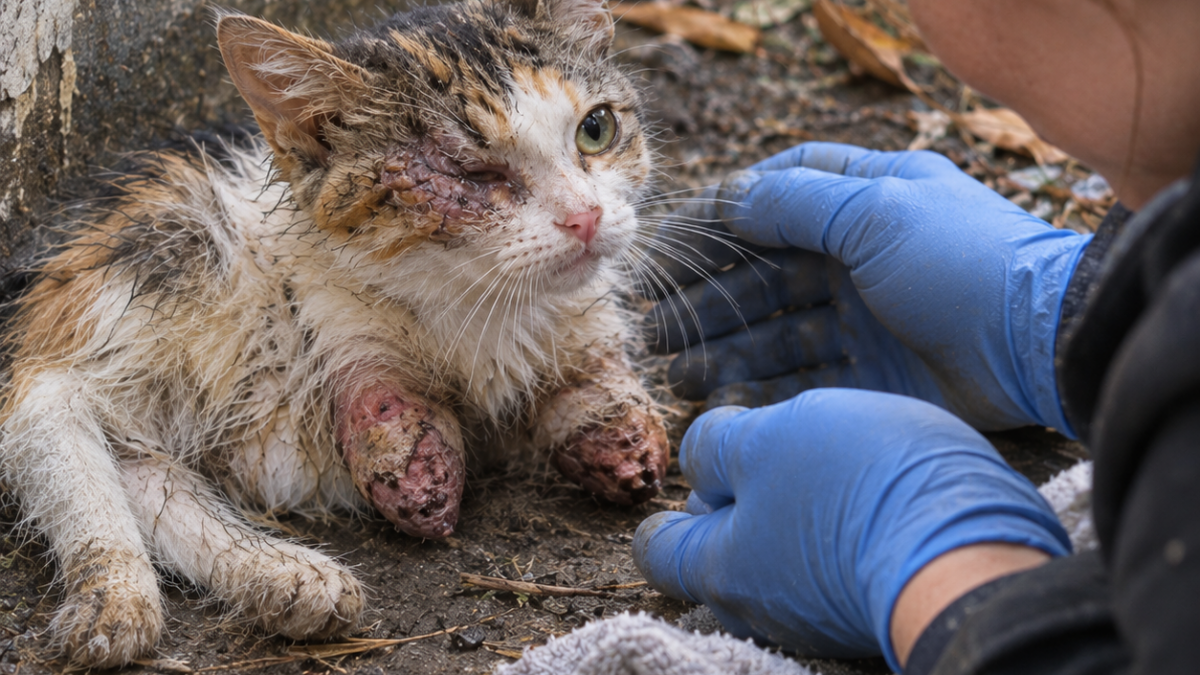
She Lost Both Front Legs and One Eye—But the Tiny Meow She Gave Her Rescuers Made Them Refuse to Give Up
Eklerka was barely alive when rescuers found her, her fragile body overwhelmed by injuries and infection.
She had lost the use of both front legs, one eye was beyond saving, and even the veterinarians could not promise she would survive the weeks ahead.
But whenever someone softly called her name, Eklerka answered with the faintest little meow.
The sound was almost too quiet to hear.
That was what everyone remembered afterward.
Not the wounds.
Not the blood.
Not the terrible condition of her body.
The voice.
A tiny, exhausted meow from a cat who seemed to have almost nothing left.
Her name was Eklerka.
She was about three years old.
Young enough that most of her life should still have been ahead of her.
Yet when rescuers first saw her, she looked like an animal who had already endured more than one body should be asked to carry.
She barely moved.
Her body was dehydrated.
Weak.
Dirty.
Large areas of tissue were badly damaged.
Infection had spread through wounds that should have been treated long before anyone reached her.
One eye was so severely injured that even from the first examination, the medical team feared there would be no way to save it.
Part of her tail was damaged too.
And then there were her front legs.
Both were catastrophically injured.
The rescuers did not yet know exactly what the veterinarians would be able to preserve.
They only knew the situation was serious.
Very serious.
Someone crouched beside Eklerka.
“Hey, sweetheart.”
Her eyes moved.
One healthy enough to focus.
The other damaged beyond anything that could be understood without medical examination.
“Can you hear me?”
A pause.
Then:
“Meow.”
Barely a sound.
The rescuer looked at the person beside her.
Eklerka had answered.
They lifted her carefully.
She did not struggle.
That frightened them.
PART2:
A frightened healthy cat often fights restraint.
Twists.
Claws.
Bites.
Tries to disappear.
Eklerka seemed too weak for any of it.
Her body simply settled into the blanket.
But whenever someone spoke to her—
her ear moved.
Her eye followed.
Sometimes that tiny voice appeared again.
Meow.
As if she needed them to know that although her body was failing, she had not disappeared inside it.
The drive to the veterinary hospital was quiet.
One rescuer sat beside the carrier.
Every few minutes, she checked Eklerka’s breathing.
Still there.
Then she spoke.
“Eklerka?”
The little head shifted.
“Meow.”
It became a ritual.
Not because anyone wanted to force her to respond.
Because they needed reassurance too.
At that point, nobody knew whether Eklerka would survive the drive.
Nobody knew whether she was in shock.
Whether infection had already progressed too far.
Whether her organs were beginning to fail.
Whether surgery was possible.
Whether she could tolerate anesthesia.
There were more questions than answers.
Yet that little voice kept appearing.
The emergency team took her immediately.
No long wait.
No casual examination.
The severity of her condition was obvious.
Fluids were started because her dehydration was dangerous.
Pain medication came next.
Whatever happened before she was found had left her body under enormous stress.
The first responsibility was not to repair everything.
It was to stabilize her enough to begin.
The veterinarians worked carefully through the injuries.
Wound after wound.
Damaged tissue.
Infection.
Severe weakness.
The more they examined, the heavier the room became.
Eklerka’s body had been trying to survive despite conditions that had overwhelmed its ability to heal.
Even obtaining blood for testing was difficult.
Her anemia was profound.
The laboratory results mattered enormously because the team needed to understand whether her body could withstand what came next.
But there was little choice about some of the injuries.
One eye had been destroyed beyond repair.
Leaving it would mean pain and risk.
Part of the tail had irreversible damage.
And the front legs—
the front legs could not be saved.
That was the conversation nobody wanted to have.
Removing one limb changes an animal’s life.
Removing both front limbs sounds, at first, almost impossible.
Cats use their front legs for nearly everything.
Walking.
Landing.
Climbing.
Balancing.
Grooming.
Playing.
Holding objects.
Steadying the body when jumping.
A healthy cat distributes weight across four limbs.
Eklerka would wake with only two.
Both at the back.
Even if surgery saved her life, nobody could guarantee what kind of life would follow.
Could she stand?
Could she move independently?
Could she eat comfortably?
Could she maintain balance?
Would she develop pressure injuries?
Would her spine tolerate the unusual posture?
Would she be frightened by a body that no longer worked the way it once had?
Those questions came later.
The first question remained:
Could she survive?
The medical team explained the reality to the rescuers.
Surgery would be extensive.
Her body was already severely compromised.
Infection increased the risk.
Anemia increased the risk.
Dehydration increased the risk.
But the injured tissue itself was also threatening her life.
Doing nothing was not a neutral choice.
The rescuers listened.
Then one person walked over to Eklerka.
She was lying beneath a blanket.
Eyes partly open.
“Hey, girl.”
Eklerka turned slightly.
Meow.
That little sound again.
Nobody pretended the cat had consented to surgery.
Animals cannot make medical decisions in the human sense.
People had to make the decision for her.
That responsibility was heavy.
But Eklerka was still responsive.
Still accepting food when she could.
Still reacting to voices.
Still present.
They chose treatment.
They chose to give her the chance.
The operating room took away almost everything familiar.
The people who had rescued her could not follow.
They waited.
There are hours in animal rescue when nothing can be done except wait for someone else to save the life you carried through the door.
Those are long hours.
Every phone vibration feels dangerous.
Every staff member walking toward you becomes a question.
Nobody talks normally.
Coffee goes cold.
People stare at walls.
One of the rescuers kept hearing Eklerka’s meow in her mind.
Not loud.
Not dramatic.
Almost conversational.
As though the cat were saying:
Yes, I’m still here.
The surgery removed what could no longer be saved.
Both front legs.
The destroyed eye.
The damaged portion of her tail.
Damaged and infected tissue had to be managed carefully.
When it was over, Eklerka no longer looked like the cat who had entered the hospital.
Her body had changed permanently.
But she was alive.
That was the only outcome anyone allowed themselves to celebrate at first.
Alive did not mean safe.
The next hours mattered.
Then the next day.
Then the next.
Her temperature.
Blood values.
Hydration.
Wounds.
Pain.
Infection.
Appetite.
Every small change mattered.
When Eklerka began waking from anesthesia, someone stood nearby.
She looked tiny beneath the medical bedding.
One visible eye.
Body wrapped and protected.
No front paws to place beneath her chest.
No familiar way to push herself upright.
The nurse expected confusion.
Perhaps panic.
Perhaps complete exhaustion.
Eklerka opened her eye.
Blinking slowly.
The nurse spoke.
“Hi, Eklerka.”
Her head moved.
And then—
meow.
The nurse froze.
It was not strong.
But it was unmistakably Eklerka.
“You’re awake.”
Meow.
Someone else heard and came closer.
Eklerka looked between them.
Then something else happened.
Food was offered.
Only a small amount.
Nobody expected enthusiasm.
Her body had just survived major surgery.
But Eklerka sniffed.
Licked.
Then took a tiny bite.
One nurse smiled.
“Seriously?”
Another bite.
Not much.
It did not need to be much.
The clinic had spent hours looking at numbers, wounds and risks.
Now the patient was eating.
A small action.
But it changed the feeling in the room.
Fear remained.
No one forgot the infection.
No one forgot the anemia.
No one forgot that major wounds had to heal.
But hope entered.
Carefully.
Not the kind of hope that says everything will be fine.
The kind that says:
We have another day.
The veterinarians warned everyone not to move emotionally faster than Eklerka’s body could.
The next two weeks would be critical.
Infection remained a serious threat.
Blood work needed close monitoring.
Wounds needed repeated cleaning.
Damaged tissue might reveal itself gradually.
Complications could appear.
Her body had been pushed to its limits before treatment even began.
Surgery had solved some problems while creating an enormous healing demand.
So nobody declared victory.
They built a routine.
Morning assessment.
Medication.
Wound care.
Nutrition.
Cleaning.
Blood work when necessary.
Rest.
Then repeat.
Eklerka learned the clinic schedule.
Or perhaps the clinic learned Eklerka’s.
A nurse entered.
“Good morning.”
Meow.
Another entered later.
“Are we eating today?”
Meow.
Sometimes the little sound seemed like an answer.
Sometimes a complaint.
Sometimes simply acknowledgement.
The voice became stronger before the rest of her did.
That amused everyone.
Her body could still look painfully fragile, yet her opinion of the person approaching might arrive immediately.
One technician began calling her “the supervisor.”
Eklerka listened to the joke without visible amusement.
But she meowed.
“See?” the technician said. “She agrees.”
Those moments mattered because they gave everyone something beyond the medical crisis.
Eklerka was not just wounds.
Not just an unusual surgical case.
She had personality.
And personality was beginning to occupy space again.
The first two weeks demanded patience.
Every wound-cleaning session was careful.
Some damaged tissue had to be addressed repeatedly.
Antibiotics fought infection internally while the team protected the surgical areas externally.
Eklerka could not scratch at her wounds with front paws.
That helped in one sense.
But she also could not reposition herself normally.
Nurses needed to ensure that pressure did not remain too long against the same areas of her body.
Soft bedding mattered.
Position mattered.
Cleanliness mattered.
Almost everything mattered.
At night, the hospital became quieter.
The rhythm of daytime slowed.
One nurse would check Eklerka and find her awake.
“Can’t sleep?”
Meow.
The nurse might sit for a minute.
No procedure.
No needle.
Just company.
Eklerka learned that not every person entering her space came to do something uncomfortable.
Sometimes a hand simply stroked her head.
At first, she accepted touch without much response.
Later, the muscles around her eye softened.
Her ear relaxed.
Then, one night, a nurse scratched gently beneath her chin.
A vibration started.
Tiny.
The nurse stopped.
Listened.
Purring.
Eklerka was purring.
The nurse continued.
The purr strengthened.
A cat missing both front legs, recovering from removal of an eye and part of her tail, severely anemic only days before, was lying beneath a hospital blanket and purring.
No one needed to make that moment larger than it was.
It was already enough.
For several minutes, Eklerka was comfortable.
That was everything.
Her blood tests gradually improved.
Not perfectly.
But enough.
The infection began losing ground.
Her wounds looked cleaner.
Her appetite remained one of the most encouraging parts of her recovery.
Eklerka rarely refused food.
That became a clinic joke.
Medication?
She might object.
Wound cleaning?
Definitely objections.
Food?
Acceptable.
One nurse walked into the room carrying a bowl.
Eklerka immediately raised her head.
“You recognize this?”
Meow.
“Of course.”
The nurse placed the bowl carefully.
Without front legs, eating required adjustment.
Eklerka could not brace herself in the normal feline position.
At first, staff helped support her.
They experimented with height.
Angle.
Bowl shape.
Soft positioning.
The goal was not simply getting calories into her.
It was helping her discover how to participate.
That principle would guide almost everything that came later.
Do not do more for Eklerka than necessary.
Help enough.
Then let her learn.
The first weeks were too early for independence.
Healing came first.
But even during hospitalization, Eklerka began experimenting.
She shifted her back legs.
Tried to lift her chest.
Lost balance.
Rested.
Tried again later.
Every movement looked strange.
There was no normal template for a cat with two hind legs and no front limbs.
The veterinarians did not want anyone pushing her.
The surgical areas had to heal.
But they watched.
Eklerka’s back legs were strong.
That was important.
They had carried only part of her body weight before.
Now they would eventually have to become her main source of support and movement.
Nobody knew exactly what she would invent.
Eklerka apparently intended to find out.
One morning, a nurse placed her on a supportive surface while changing bedding.
Eklerka shifted her hips.
Her back feet planted.
Her chest rose.
For less than a second.
Then she tipped forward.
The nurse caught her gently.
“Whoa.”
Eklerka gave a sharp meow.
“I know.”
The nurse repositioned her.
“You did that yourself.”
Eklerka attempted it again.
Not immediately.
But the idea had entered.
The human desire to celebrate nearly overwhelmed everyone.
They restrained themselves.
She was still healing.
The goal was not to turn every attempt into a performance.
But after the nurse left the room, she told everyone.
“She tried to stand.”
Someone asked,
“Really?”
“Barely.”
“Still counts.”
It did.
Not because standing would determine Eklerka’s worth.
Because it suggested her brain and body were already beginning to negotiate a new reality.
Animals can be astonishingly practical.
Humans imagine the future.
Animals often begin with the next movement.
Eklerka did not need to understand:
I will never have front legs again.
She needed to understand:
How do I get from here to there?
The difference is enormous.
As the days passed, the team began introducing safe positioning exercises.
Nothing aggressive.
Nothing that risked wounds.
The rear legs were encouraged to bear weight for short periods when medically appropriate.
Her core muscles needed time.
Her balance needed time.
Eklerka often looked offended by the process.
That was encouraging too.
Irritation required energy.
A cat who complained about rehabilitation was stronger than the cat who barely responded on arrival.
One afternoon, someone said,
“She’s getting bossy.”
Another nurse answered,
“Good.”
They all meant it.
Eklerka’s personality grew louder as her body stabilized.
She wanted food on time.
Preferred certain kinds.
Liked some people immediately.
Needed longer with others.
She enjoyed head scratches.
She sometimes turned her face away when she had enough.
Her one healthy eye became expressive.
Bright when food appeared.
Narrowed when somebody disturbed a comfortable position.
Soft when she was relaxed.
Curious when something moved.
People stopped seeing the missing eye first.
They saw Eklerka’s look.
That was a subtle transition.
At first, her physical losses dominated every impression.
Two front legs gone.
One eye gone.
Tail shortened.
Then familiarity changed perception.
People who worked with her daily no longer mentally listed what was absent.
They knew the whole cat.
That was important preparation for the life she might have outside the hospital.
After about a month, Eklerka was finally strong enough to leave.
Not cured.
Not finished healing in every sense.
But stable enough that hospital life no longer offered more benefit than a carefully prepared home environment.
The day of discharge carried excitement and fear.
The clinic had become predictable.
A home would be larger.
More complicated.
Furniture.
Floors.
Corners.
Sounds.
Movement.
No nurse watching every hour.
Everything needed planning.
The people taking her in prepared before she arrived.
Soft blankets covered large areas of floor.
Smooth surfaces were reduced or covered where possible.
Her resting areas were low.
No need to jump.
Food and water placed where she could reach them safely.
Furniture arranged to create stable pathways.
Nothing sharp at the height where a fall might hurt her.
The environment did not need to become a hospital.
It needed to become understandable.
Eklerka entered in a carrier.
The door opened.
She remained inside at first.
One eye watching.
New smell.
New room.
New voices.
Nobody pulled her out.
They waited.
Eventually, Eklerka moved.
Her back legs pushed.
Body shifted.
She came forward in the strange manner that was becoming hers.
The first attempt to stand outside the hospital lasted only seconds.
She lifted herself.
Balanced precariously on her hind legs.
Then lowered herself.
The caregiver stayed close enough to catch her but did not hold her upright.
Eklerka tried again later.
That became the pattern.
Stand.
Seconds.
Sit.
Rest.
Try again.
There was no dramatic first walk.
No sudden transformation.
Balance is learned through thousands of tiny corrections.
Eklerka’s nervous system needed to understand where her center of gravity lived now.
A four-legged cat is built horizontally.
Eklerka was asking her body to perform something very different.
Her hind legs were becoming almost like the primary supports of a small upright animal.
Her spine shifted.
Tail—what remained of it—could contribute some balance, but not the way a complete tail might.
Her head had to compensate.
Every successful second taught her something.
The caregiver learned to watch without staring.
That was difficult.
Eklerka’s every movement felt important.
But nobody wants to spend life being observed like an experiment.
So the humans started doing ordinary things.
Making coffee.
Cleaning.
Reading.
Talking.
Eklerka practiced in the background.
Sometimes she fell.
Soft blankets caught her.
She rested.
Then tried again.
One afternoon, a small catnip fish lay near her bed.
Eklerka noticed.
Her eye focused.
The toy had been offered before, but she showed little interest while healing.
This time something changed.
She shifted her body.
Raised herself.
Moved toward it.
Not far.
Several inches.
Then another small movement.
She reached the fish.
Without front paws, she could not bat it the way most cats would.
She lowered her face.
Sniffed.
Bit the toy.
The caregiver smiled.
There she was.
Play had returned.
Not rehabilitation.
Not survival.
Play.
That distinction meant everything.
A sick animal focuses on staying alive.
A safer animal begins spending energy on things that serve no survival purpose.
Toys.
Exploration.
Attention.
Mischief.
Eklerka was entering that world.
The catnip fish became important.
She could grip it with her mouth.
Carry it.
Drop it.
Rub her face against it.
Sometimes she slept beside it.
Sometimes she ignored it for hours and then became obsessed again because she was still a cat and consistency was optional.
The toy gave her a reason to move.
Not because someone demanded exercise.
Because she wanted something.
Desire is powerful rehabilitation.
Eklerka began traveling farther across the room.
At first, “traveling” looked like a series of carefully controlled shifts.
Balance.
Small hop.
Rest.
Another.
Her back legs worked together.
She learned to use momentum.
If she leaned too far forward, she fell.
Too far back, she sat abruptly.
Every mistake became information.
The caregiver resisted correcting every movement.
Safety first.
But independence required experimentation.
Eklerka needed to discover her own mechanics.
Weeks passed.
Her legs strengthened.
The small hops became more confident.
The pauses shortened.
She could cross a rug.
Then a room.
Visitors watching for the first time often gasped.
Not because Eklerka looked helpless.
Because she did not.
She moved unlike any cat they had seen.
But she moved with purpose.
One person said,
“Does she know she’s missing her front legs?”
The caregiver looked at Eklerka.
“She knows her body.”
That was the better answer.
Eklerka certainly understood that movement required effort.
She watched other cats.
Saw them land on four paws.
Saw them climb.
Saw them reach.
But there was no evidence she spent time grieving comparison.
She solved problems.
That was all.
A cushion was too high.
She examined it.
Tried.
Failed.
Tried from another angle.
The caregiver added a lower cushion beside it.
Eklerka used that.
Soon the larger cushion became accessible.
Not because she suddenly developed front legs.
Because the environment offered a route.
That became the philosophy of her home.
Do not ask:
How can we make Eklerka do everything exactly like another cat?
Ask:
What does she want to do, and what safe path allows her to do it?
Sometimes the answer was adaptation.
Sometimes assistance.
Sometimes the answer was:
She cannot safely do that.
Limitations existed.
No one denied them.
But every limitation did not need to become tragedy.
A high surface was inaccessible.
Fine.
Create a comfortable low one.
Eklerka cared more about warmth than altitude anyway.
She discovered sunlight.
A patch crossed the floor each morning.
The first time she found it, she stopped.
Lowered herself.
Closed her eye.
The caregiver watched.
That became another routine.
Morning.
Food.
Care.
Then sun.
Eklerka adjusted her route as the season shifted the sunlight across the room.
That tiny detail revealed how well she was mapping her environment.
She knew where things were.
She remembered.
She planned movement.
She was not merely reacting.
Her world had become navigable.
That brought confidence.
Confidence brought speed.
At first, nobody expected speed from Eklerka.
Balance alone seemed ambitious enough.
Then one day, someone walked into the kitchen carrying food.
Eklerka heard the bowl.
Her head snapped toward the sound.
The caregiver laughed.
“Dinner.”
Eklerka moved.
Fast.
Not gracefully.
Not in the familiar four-legged sprint.
A quick series of powerful hops carried her across the floor.
The person holding the food froze.
“Oh my God.”
Eklerka reached the feeding area.
Meow.
Everyone laughed.
Apparently dinner had accelerated rehabilitation.
From then on, her speed grew.
The more she trusted her balance, the less she hesitated between movements.
Her hind legs became muscular.
The body adapted.
Core strength improved.
She learned how much momentum she could control.
Falls still happened.
But less often.
And when they did, Eklerka recovered faster.
No panic.
No long hesitation.
Get up.
Continue.
That resilience looked different from the dramatic resilience people often celebrate.
Eklerka did not give speeches.
She simply refused to interpret falling as evidence she should stop moving.
She had somewhere to go.
So she continued.
Her caregivers began introducing other rooms gradually.
One at a time.
A new room means new geography.
Furniture.
Textures.
Distances.
Eklerka entered cautiously.
Sniffed.
Listened.
Then experimented.
Doorways could be tricky because surfaces changed.
She learned them.
Rugs became useful markers.
Her favorite resting places multiplied.
A bed in one room.
A cushion near the window.
A blanket beside a person.
Each new spot represented territory she had claimed.
The house stopped being adapted space.
It became Eklerka’s space.
That shift happened quietly.
People no longer said:
“We put this here so she can use it.”
They said:
“That’s Eklerka’s cushion.”
Belonging replaces accommodation with routine.
Her interaction with people also changed.
At the clinic, she meowed whenever someone called her.
That habit stayed.
A familiar person entered.
“Eklerka?”
Meow.
Sometimes loud.
Sometimes tiny.
Occasionally she answered from another room before they could see her.
Her voice became part of the household.
People joked that she announced attendance.
But the sound still moved those who remembered the beginning.
That first weak meow in the rescue carrier.
The same voice now stronger.
Cheerful.
Demanding.
Alive.
One caregiver noticed that when Eklerka was especially content, she combined the meow with a purr.
A strange little conversational sound.
“Are you happy?”
Meow.
Purr.
“Hungry?”
Louder meow.
That one needed no translation.
Her appetite remained strong.
Nutrition helped her body rebuild after the initial devastation.
Healthy weight returned.
Her coat improved dramatically.
The stressed, neglected appearance faded.
Fur became soft.
Clean.
Bright.
The missing eye no longer looked shocking once the surgical site healed.
It became simply part of her face.
People meeting Eklerka often noticed it.
Then quickly forgot because she was too busy doing something.
Movement drew attention.
Personality kept it.
She became playful.
That surprised some visitors more than mobility.
Perhaps people unconsciously expect severely disabled animals to become solemn.
Eklerka had no reason to cooperate with that expectation.
She liked toys.
Especially the catnip fish.
She carried it in her mouth.
Sometimes across an entire room.
Imagine a cat balancing on two hind legs while hopping with a toy clenched proudly between her teeth.
That was Eklerka.
She did not know the image was extraordinary.
She knew the fish belonged somewhere else.
So she moved it.
The first time she carried it successfully onto a cushion, the caregiver applauded.
Eklerka dropped the toy and stared.
The applause was apparently unnecessary.
After that, the humans learned to celebrate more quietly.
Eklerka did not need an audience.
Her achievements belonged to her.
Her growing independence raised new questions.
Could she climb?
Not traditionally.
But low surfaces became possible.
She learned to use her chin, chest, hind legs and momentum in combinations the humans had not anticipated.
A soft cushion slightly above floor level became her first climbing goal.
She approached.
Lifted.
Pushed.
Slid back.
Tried again.
The caregiver almost helped.
Stopped.
Eklerka repositioned.
A stronger push.
Her chest crossed the edge.
Back legs drove.
She made it.
Then immediately lay down as though nothing had happened.
The caregiver smiled.
Five minutes later Eklerka fell asleep.
What looked heroic from across the room was simply a tiring afternoon for her.
The environment continued evolving.
More stable cushions.
Low ramps where useful.
Non-slip surfaces.
No exposed edges likely to injure her if she fell.
Food bowls at appropriate heights.
Everything designed around her actual behavior rather than theoretical disability.
This required observation.
What works?
What frustrates her?
Where does she slip?
What does she avoid?
What does she repeatedly attempt?
Eklerka became the expert.
The humans took notes.
By the third month, her movement was almost unrecognizable from the first weeks.
She could remain upright longer.
Cross rooms.
Turn.
Change direction.
Recover balance.
Her hind legs looked powerful.
She used them with confidence.
The phrase “two-legged cat” sounded limiting.
Watching Eklerka made it feel almost descriptive in the same way “orange cat” would be descriptive.
Yes.
Two legs.
And?
Her life had expanded beyond the number.
She also began showing preferences about people.
Some were greeted immediately.
Others needed a few minutes.
She liked voices she recognized.
The original little meow-response remained one of her sweetest behaviors.
Call her name gently.
Often:
Meow.
It became difficult to imagine how faint that response had once been.
One rescuer visited after months away.
She stood in the doorway.
Eklerka was across the room.
“Eklerka?”
The cat’s head turned.
Meow.
The rescuer covered her mouth.
She had heard that exact sound on the day Eklerka was found.
Only then, it had come from an animal barely holding onto life.
Now it came from a cat sitting upright on two muscular hind legs with a toy beside her.
The rescuer crouched.
Eklerka hopped toward her.
Three months earlier, nobody would have dared imagine that.
The rescuer cried before Eklerka even arrived.
Eklerka stopped in front of her.
The woman gently stroked the side of her head.
The cat leaned.
Purr.
“I remember you.”
Nobody knew whether Eklerka remembered.
The woman did.
Sometimes that is enough.
She remembered carrying almost no weight in a blanket.
The terrible wounds.
The hospital.
The conversations about infection.
The uncertainty.
Now Eklerka pressed her face into the same kind of human hand she once answered only with a weak meow.
“Look at you.”
Eklerka meowed.
Everyone laughed through tears.
By the fourth month, people stopped hovering.
That was another milestone.
At first, every movement brought a hand forward.
Ready to catch.
Ready to help.
Fear made people protective.
But constant intervention became unnecessary.
Eklerka was competent now.
Not invulnerable.
Competent.
The humans learned to trust her judgment.
Mostly.
Cats occasionally have terrible judgment no matter how many limbs they possess.
Eklerka once decided a particular cushion was reachable from an angle everyone else knew was bad.
She attempted it.
Missed.
Landed safely on a soft mat.
Immediately looked back at the cushion.
“No.”
The caregiver moved the cushion.
Eklerka stared at her with deep personal disappointment.
Physical adaptation had not removed stubbornness.
Good.
That was part of her.
As she moved more, her world became richer.
Window watching.
Following familiar people.
Exploring bags.
Investigating new scents.
Sleeping in warm places.
Choosing which blanket deserved her.
Playing.
Eating.
Complaining.
All the ordinary things that make up a cat’s life.
That ordinariness became precious because the early story had been so extreme.
People often imagine recovery as returning to what existed before injury.
Eklerka could never return to that body.
There would always be one eye.
Two hind legs.
A shortened tail.
That made “recovery” the wrong word if it meant restoration.
Eklerka built something new.
A way of living that had not existed before.
The body she had after surgery became a body she understood.
The house became an environment she understood.
The people became people she understood.
Life did not return.
Life reorganized itself.
That is different.
And perhaps more honest.
At the five-month mark, the impossible-looking things became routine.
Eklerka could stand.
Not for two seconds.
Comfortably.
She could move across the floor.
She could run in her unusual way.
She could hop.
Turn.
Climb onto low soft furniture.
Jump short controlled distances.
Carry toys.
Seek people.
Retreat when she wanted privacy.
She no longer needed someone positioned beside her every moment.
Her body had become capable enough that observers sometimes forgot how extraordinary the mechanics were.
Five months.
That was all it had taken for “How could she possibly live without both front legs?” to become:
“Eklerka, where are you going?”
That change in language captured everything.
Her family and caregivers no longer monitored every second as a medical event.
They lived with her.
She was the cat who might appear unexpectedly beside them.
The cat who announced herself.
The cat who stole attention.
The cat who wanted her favorite toy.
The cat who moved surprisingly fast when food was involved.
The disability was not gone.
It no longer controlled the narrative.
People who met her online or through rescue updates often called her brave.
Courageous.
Inspirational.
Those words came from kindness.
But the people closest to Eklerka sometimes wondered whether she would understand any of them.
Did it require courage to move in the only body available?
Perhaps.
Or perhaps it required practice.
Eklerka had no alternative body to compare herself with each morning.
She did not wake thinking:
Today I must bravely be a two-legged cat.
She woke.
She was hungry.
Something moved.
A person called her name.
Meow.
That practical relationship with life may have been one reason she adapted so beautifully.
Humans carry expectations.
Eklerka carried herself.
Literally.
Her hind legs became her foundation.
She developed a posture that would have looked impossible during her first week.
Chest lifted.
Head high.
Back legs planted.
Her shortened tail behind.
One bright eye watching.
There was pride in the image, though perhaps that too belonged to human interpretation.
What was definitely there was confidence.
The hesitation of early rehabilitation faded.
She knew where her center was.
Knew how to correct.
Knew which surfaces she could manage.
Knew when something was too difficult.
Most of the time.
Confidence does not require believing you can do everything.
It requires understanding enough to move without constant fear.
Eklerka had that.
Yet one thing was still missing.
A permanent home.
The people caring for her loved her.
That was obvious.
But rescue care and a forever family are not always the same thing.
Eklerka needed someone willing to accept everything.
Not only the delightful videos of her hopping across a room.
Not only the cheerful meows.
Not only the toy-carrying.
She would always be a special-needs cat.
She might require environmental modifications throughout life.
Her unusual posture could create future physical concerns.
Her remaining eye needed protection.
Her mobility depended heavily on the health of two legs that now did the work of four.
Future veterinary care mattered.
Weight management mattered.
Safe surfaces mattered.
A permanent adopter needed to understand the beautiful parts and the practical parts.
So her caregivers waited.
Applications came.
Some people were moved by her story.
A few imagined adopting immediately.
Then came questions.
“Can she use stairs?”
Not safely in the ordinary way.
“Can she jump onto a high bed?”
Not without adaptation.
“Does she need help all the time?”
No.
But her environment matters.
“Will she ever grow front legs back?”
No.
That question actually came once.
The rescuer answered gently.
No.
Eklerka’s body was permanent.
The goal was not to wait for it to become normal.
The goal was to find people who already understood that it was normal for her.
Some potential adopters stepped away.
That was okay.
Better honesty now than disappointment later.
Others remained interested but had homes with risks.
Large energetic dogs.
Open staircases.
Children too young to understand safe handling.
Every match had to center Eklerka.
Not the emotional desire to save her.
She did not need rescuing from her current life anymore.
She needed the right next one.
Meanwhile, Eklerka continued becoming more herself.
She developed a habit of greeting familiar people.
A person would enter.
“Hi, Eklerka.”
Meow.
“Did you miss me?”
Meow.
“Did you eat?”
Silence.
“Of course you ate.”
Meow.
Conversation.
One-sided by human standards.
Perfectly understandable to everyone who knew her.
She loved affection but not constantly.
She liked cheek scratches.
Chin scratches.
Gentle attention around the head.
Because she had no front paws to push a hand away, her caregivers paid close attention to other signals.
Turn away.
Ear movement.
Body tension.
Enough.
Consent still existed even when an animal could not physically shove someone away.
That awareness mattered.
Eklerka had lost enough control over her body during injury and treatment.
Her home life should include choices.
She could move away.
Approach.
Ask.
Refuse.
That was part of dignity.
People sometimes assume disabled animals need more control from humans.
Often they need more opportunities for control over what they can decide.
Eklerka’s environment was structured around that.
Her favorite sleeping areas remained accessible.
Food predictable.
People responsive.
When she wanted interaction, she could initiate.
When tired, she rested.
That balance helped her remain confident.
One afternoon, her catnip fish disappeared.
The household searched.
Under furniture.
Behind cushions.
Near the bed.
Nothing.
Eklerka sat in the middle of the room watching everyone.
Finally someone found the toy wedged beside a low cushion.
“How did you get it there?”
Eklerka meowed.
“Very helpful.”
The fish was returned.
Eklerka immediately carried it away.
Everyone laughed.
She had become capable of creating ordinary household mysteries.
What greater sign of recovery could there be?
The hospital photographs stayed on someone’s phone.
Occasionally they resurfaced.
Eklerka before surgery.
Eklerka bandaged.
Eklerka thin.
Eklerka unable to stand.
Seeing them next to current images almost felt unfair.
The differences were dramatic.
But the caregivers resisted reducing her story to before-and-after photographs.
Because the important part existed between them.
The days.
The wound care.
The antibiotics.
The meals.
The blood tests.
The falls.
The balancing attempts.
The first toy.
The first longer crossing of the room.
The first successful climb.
The hundreds of repetitions nobody filmed.
Transformation is photogenic.
Process usually is not.
Yet process built Eklerka.
One movement at a time.
One meal at a time.
One safe interaction at a time.
Her caregivers began talking less about what she survived and more about what she enjoyed.
That was healthy.
Trauma should not become an animal’s permanent identity.
Eklerka deserved to be known for things that happened after the worst day.
Her toy.
Her voice.
Her appetite.
Her stubbornness.
Her unusual speed.
The way she looked at people.
The way she settled into soft places.
Her habit of appearing when food was prepared.
Her remarkable balance.
Her curiosity.
That was the larger story now.
Her physical losses remained visible enough that strangers always asked.
“What happened to her?”
The caregivers answered.
Severe injuries.
Infection.
One eye lost.
Both front legs removed because they could not be saved.
Part of tail.
Very sick.
Long recovery.
Then they added:
“She’s doing great.”
Not as a way to minimize what happened.
As current information.
What happened is not always who an animal is.
Eklerka was doing great.
That mattered more today.
At one follow-up appointment, the veterinarian who had seen her during the early crisis watched her cross the examination-room floor.
Eklerka moved quickly.
Stopped.
Balanced.
Turned.
The veterinarian smiled.
“I remember when we didn’t know if she would make it through the week.”
The caregiver looked down.
Eklerka was investigating a bag.
“She apparently had other plans.”
The veterinarian laughed.
They checked her back legs carefully.
Everything depended heavily on those limbs now.
Healthy joints.
Muscles.
Paw pads.
Weight.
Any small problem could affect mobility significantly.
The exam was reassuring.
The remaining eye looked good.
The surgical areas had healed.
Eklerka objected to part of the examination.
Loudly.
The veterinarian smiled.
“She definitely feels better.”
That was the same cat who once answered voices with little more than a whisper.
Now her opinion filled the room.
Outside the clinic, Eklerka returned home and immediately went to food as though the examination had been a minor interruption in a busy schedule.
Her caregivers watched.
There was something deeply satisfying about being ignored by an animal you once feared losing.
It means survival has become ordinary enough that the animal has more important things to do.
Months continued.
Eklerka’s search for the right family continued too.
The rescuers became patient.
They refused to turn her into a desperation story.
No:
“Someone please take her before it’s too late.”
Eklerka was safe.
Loved.
Cared for.
The right home could take time.
That was better.
One family showed serious interest.
They asked detailed questions.
Not whether Eklerka would become easier.
Whether they could make their house suitable.
They sent pictures of the rooms.
Stairs could be blocked.
Rugs added.
Low resting platforms.
Other animals introduced carefully.
They wanted to meet her.
Everyone became cautiously hopeful.
The meeting happened quietly.
Eklerka watched from a familiar blanket.
The visitors sat down.
They did not immediately grab her.
That helped.
One person spoke.
“Hi, Eklerka.”
Meow.
Everyone smiled.
The woman laughed softly.
“She really does answer.”
Yes.
That tiny habit had survived everything.
The visitors stayed.
Let Eklerka approach in her own way.
She moved closer eventually.
Sniffed.
Accepted a cheek scratch.
Then left.
The family did not look disappointed.
One said:
“She’s independent.”
The caregiver nodded.
“Very.”
That answer mattered.
Nobody wanted a family expecting a helpless cat.
Eklerka had worked too hard for independence to have it removed by overprotection.
The family returned again.
Learned how she moved.
How to lift her safely if necessary.
How to support without restricting.
What floors worked.
Why weight management mattered.
What signs might indicate soreness.
How she ate.
How she used her environment.
The practical conversations were less exciting than the emotional ones.
They were more important.
Whether that family or another ultimately became permanent mattered less than one truth:
Eklerka was ready to be chosen for who she was now.
Not rescued from death.
Not pitied.
Chosen.
There is a profound difference.
The three-year-old cat who entered the emergency clinic had almost no control over anything.
Her body.
Treatment.
Pain.
Movement.
By five months later, Eklerka controlled much of her day.
Where she went.
When she rested.
Which toy she carried.
Who she approached.
Whether she wanted attention.
Where she sat.
How quickly she moved.
That restored agency was one of the most beautiful things about recovery.
Her injuries had taken limbs.
An eye.
Part of a tail.
Care gave her choices back.
Eklerka never became a four-legged cat again.
She never became a two-eyed cat again.
Her body remained visibly changed.
Yet the people who knew her best eventually found that those facts occupied less and less emotional space.
They stopped looking at her and thinking:
What she lost.
They thought:
Eklerka.
That was the destination all along.
Not pretending disability did not matter.
Allowing the individual to become larger than it.
One evening, Eklerka sat near a window.
Outside, something moved.
A bird.
Her eye locked onto it.
Body upright.
Back legs supporting.
The bird hopped along a railing.
Eklerka made a small chattering sound.
Completely cat.
The caregiver watched.
If Eklerka had four legs, she might have crouched.
Prepared to pounce.
Perhaps launched herself toward the glass.
Instead, she balanced.
Tracked.
Vocalized.
Her hunting body worked within different possibilities.
Still instinct.
Still interest.
Still life.
The bird flew away.
Eklerka watched until it vanished.
Then turned.
Hopped across the room toward her toy.
Nothing had been lost in the moment that mattered.
She had been engaged.
That is what quality of life often looks like.
Not perfection.
Engagement.
Eklerka was deeply engaged in her world.
Food interested her.
People interested her.
Toys.
Sounds.
Sunlight.
Other animals.
Rooms.
Movement.
She had preferences.
Frustrations.
Pleasures.
That is a life.
A full one does not require every physical ability.
It requires enough comfort and opportunity for the animal to care about what happens next.
Eklerka always seemed to care about what happened next.
That might have been present from the first rescue.
The tiny meow.
The response to voices.
Perhaps that was why it touched everyone.
Even before she could show much else, she answered.
Someone called.
Eklerka responded.
Connection.
The entire story grew from that.
When people asked the rescuer what convinced her to keep fighting, she did not say:
“I knew Eklerka would eventually run on two legs.”
Nobody knew that.
She did not say:
“I knew she would have a perfect life.”
Impossible to know.
She said she remembered the voice.
A cat nearly too weak to move still acknowledging the person speaking to her.
It was not proof of what would happen.
It was proof that Eklerka was still there.
That was enough to begin.
The medical team did the rest one step at a time.
Or perhaps, in Eklerka’s case, one hop.
The wounds closed.
Blood improved.
Infection receded.
Food rebuilt her.
Time strengthened her.
Practice taught balance.
Safety created confidence.
Affection created trust.
Freedom allowed personality to return.
Nothing happened instantly.
That is important because rescue stories are often compressed.
Found.
Surgery.
Recovery.
Happy cat.
Real life is slower.
Between those words are nights.
Fear.
Laundry.
Medication.
Blood tests.
Wound cleaning.
Setbacks.
Questions.
Fatigue.
Money.
Appointments.
More questions.
An animal refusing to cooperate.
Humans doubting themselves.
Then trying again.
Eklerka’s story required all of that.
Love was not just an emotion directed toward her.
Love was work.
People cleaned infected wounds because love required clean wounds.
Measured medication because love required accuracy.
Adjusted floors because love required safe movement.
Waited while she learned because love required patience.
Did not force affection because love required respect.
Maintained her weight because love sometimes means not giving another treat.
Prepared a home around her needs because love is architectural sometimes.
Practical.
Unromantic.
Repeated.
That is how Eklerka survived long enough for the inspirational part to exist.
Today, people meeting her often find it difficult to imagine the first days.
She can move too confidently.
Her fur looks too healthy.
Her voice too clear.
Her curiosity too bright.
The body still tells part of the story.
No front legs.
One eye.
Shortened tail.
But the expression tells another.
Awake.
Interested.
Present.
Sometimes impatient.
Eklerka is not waiting for life to return to the way it was.
She has no need.
This is her life now.
And she has become extremely good at living it.
She can cross a room on two legs.
Run with a strange rhythm that makes first-time visitors stare.
Jump onto low surfaces.
Balance.
Carry her toy.
Seek affection.
Investigate.
Demand food.
Rest.
Purr.
Answer when someone says her name.
Especially that.
“Eklerka?”
Meow.
The sound is stronger now.
Sometimes playful.
Sometimes demanding.
Sometimes sleepy.
But those who heard the original response still feel something when she does it.
Because they remember.
A weak cat in emergency care.
A body overwhelmed.
A future uncertain.
Someone calling gently.
And that little sound coming back.
Meow.
The first promise in the story was never that Eklerka would walk.
It was simply that she was still there.
Everything else came afterward.
Perhaps someday Eklerka’s permanent family will hear that meow from another room every morning.
They will know how she likes her food.
Where she prefers to sleep.
Which surfaces are easiest.
How to recognize when she is tired.
How to keep her remaining eye safe.
How much she loves the catnip fish.
How quickly she can move when she wants something.
They may eventually stop thinking of themselves as people caring for a remarkable rescue cat.
They will simply think:
Eklerka is yelling because breakfast is late.
That would be perfect.
Because the best ending for an extraordinary survival story is sometimes a thoroughly ordinary life.
Meals.
Naps.
Play.
Warmth.
Annoyance.
Routine.
Someone returning home.
Someone calling her name.
Eklerka answering.
The terrible beginning becoming only the explanation people give when someone new asks:
“What happened to her?”
Not the first thing they think when they look at her.
That is what it means for the story to become bigger than the injuries.
Eklerka does not erase what happened.
She lives beyond it.
Her missing legs remain missing.
Her eye does not return.
The damaged part of her tail does not regrow.
Love cannot reverse anatomy.
But love can change what anatomy means inside a life.
Without care, the loss of her front legs might have meant helplessness.
With rehabilitation, it became adaptation.
Without a safe environment, one eye might have made the world more dangerous.
With protection, it became something she adjusted around.
Without people willing to stay through the difficult weeks, her injuries could have become the end.
Instead, they became history.
That is not the same as saying love heals everything.
It does not.
Medicine mattered.
Surgery mattered.
Antibiotics mattered.
Fluids mattered.
Nutrition mattered.
Veterinary skill mattered.
Careful rehabilitation mattered.
Love mattered because it kept people doing all of those things long enough for Eklerka to benefit.
Kindness is powerful precisely because it turns into action.
Eklerka needed action.
She received it.
And then she did something no veterinarian could do for her.
She learned her new body.
No one could teach exactly how to balance on two hind legs.
They could support.
Protect.
Encourage.
But Eklerka had to make thousands of corrections herself.
Her muscles had to learn.
Her nervous system had to adapt.
Her confidence had to grow through experience.
That achievement belongs to her.
The humans created the chance.
Eklerka used it.
That is why people smile when they watch her run.
Not because the missing limbs magically stopped mattering.
Because every hop contains months of learning nobody can see.
Every successful turn contains falls.
Every jump contains failed attempts.
Every effortless-looking movement contains a body that once could remain upright for only seconds.
Five months transformed difficulty into habit.
That is extraordinary.
And yet, to Eklerka now, it is simply movement.
She does not celebrate every crossing of a room.
Why would she?
She has somewhere to go.
One afternoon, her caregiver called her from across the room.
“Eklerka.”
The cat lifted her head.
Meow.
“Come here.”
Eklerka stood.
Balanced.
Then hopped quickly across the floor.
Her catnip fish was in her mouth.
Halfway there, she dropped it.
Stopped.
Picked it up again.
Continued.
When she reached the caregiver, she lowered herself onto a cushion.
The woman scratched her cheek.
Eklerka purred.
The toy remained between them.
Nothing else happened.
No emergency.
No surgery.
No dramatic breakthrough.
Just an ordinary afternoon.
Perhaps that was the moment that best explained everything.
Months earlier, a quiet meow had convinced people there was still someone inside the broken body worth fighting for.
Now that same cat could cross the room under her own power simply because someone she trusted had called her.
The distance was short.
The journey was not.
Eklerka had lost both front legs.
One eye.
Part of her tail.
She had faced severe infection.
Dehydration.
Profound anemia.
Surgeries that permanently changed her body.
Weeks when nobody could promise survival.
Then months when no one knew exactly how independent she could become.
None of those facts disappeared.
But neither did she.
That tiny voice was the first thing that refused to disappear.
Maybe that is why everyone remembers it.
When the rest of her looked broken beyond imagining, Eklerka still answered.
Meow.
When she woke from surgery—
meow.
When nurses entered—
meow.
When she became stronger—
meow.
When familiar people arrived months later—
meow.
The body changed.
The voice remained.
And eventually the life around that voice became enormous.
Rooms to explore.
Toys to carry.
People to love.
Meals to demand.
Soft cushions to climb.
Sunlight to find.
Visitors to inspect.
A future still unwritten.
That is who Eklerka is now.
Not the cat who lost everything.
Not the animal people nearly had to say goodbye to.
Not a collection of missing parts.
Eklerka.
Three years old when the worst happened.
One-eyed.
Two-legged.
Alive.
Playful.
Opinionated.
Adapted.
Still looking for the place where all of those things will be accepted as one complete cat.
She does not need someone to love her despite her body.
That phrase would miss the point.
She needs someone to love the whole animal.
The strong hind legs.
The missing front ones.
The single eye.
The shortened tail.
The cheerful meow.
The stubbornness.
The appetite.
The toy obsession.
The incredible balance.
The need for a carefully arranged environment.
The future veterinary responsibilities.
The purr.
All of it.
Because Eklerka is not a damaged version of the cat someone should have had.
She is the cat who exists.
And she is more than enough.
Maybe one day, someone will carry her through a new front door.
The room will already be prepared.
Soft floors.
Low places.
Safe pathways.
A bowl waiting.
A familiar toy brought from the place she knows.
They will put her down.
Eklerka will watch.
Listen.
Then begin examining everything.
Because that is what she does.
Perhaps she will hesitate.
New places require mapping.
Perhaps she will answer when someone calls.
Perhaps the little catnip fish will help.
Then, one day, the house will stop being new.
It will simply be hers.
And the people there will no longer marvel every morning that a cat without front legs can cross the room.
They will be annoyed because she crossed it too quickly and reached something she was not supposed to have.
They will recognize the sound of her hopping before she appears.
They will know which meow means food.
Which means hello.
Which means move this object immediately because Eklerka has decided it is unacceptable.
They will learn that the queen of the house has only two legs and still somehow manages to supervise everyone.
That is the future she deserves.
Not because she suffered.
Suffering does not earn love.
Animals should not have to survive terrible things before becoming worthy.
Eklerka deserved care before anyone ever hurt her.
She deserved safety before the infection.
She deserved comfort before the dehydration.
She deserved love while she still had four legs and two eyes.
She deserved it when rescuers found her.
She deserved it while unconscious in surgery.
She deserved it when her body looked frighteningly different afterward.
She deserves it now.
Her worth did not grow because she became inspiring.
The people around her simply learned to see it.
That may be the deepest truth in Eklerka’s story.
She never had to prove that she deserved a life.
The proof was already there in the first quiet answer.
Someone called her name.
And she responded.
Meow.
A tiny sound.
But inside it was a living animal.
A personality.
A future nobody could yet see.
Months later, that future is running across rooms on two powerful hind legs.
Carrying a fish toy.
Calling back to people.
Purring beneath gentle hands.
Falling sometimes.
Getting up differently.
Continuing.
Her deepest wounds did not disappear.
They became scars.
Her body did not become what it once was.
It became something she learned to trust again.
And perhaps the most remarkable part is not that Eklerka can stand, walk, run or jump on two legs.
It is that those things eventually stopped feeling remarkable to her.
They became life.
The same life that almost ended in the emergency room.
The same life people guarded through those critical first two weeks.
The same life rebuilt through bowls of food, blood tests, antibiotics, clean wounds, soft blankets and endless patience.
The life behind that first weak meow.
Eklerka is still answering.
And now her voice is strong enough to fill the room.








