She Hid the Tattoo on Her Wrist for 5 Years—Then a Navy Jet Crashed Off the Coast and the Operators Who Walked Into Her ER Recognized It Immediately
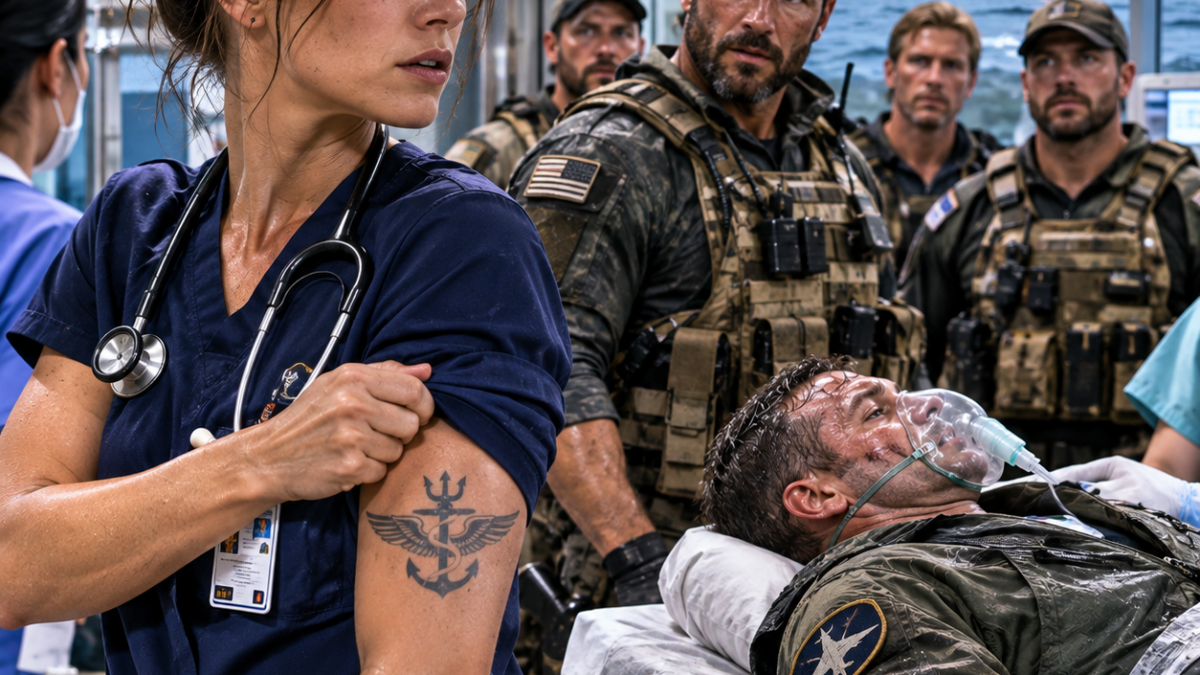
She Hid the Tattoo on Her Wrist for 5 Years—Then a Navy Jet Crashed Off the Coast and the Operators Who Walked Into Her ER Recognized It Immediately.
For three years, Vera Colton had worked the night shift at a Virginia Beach emergency room where almost everyone mistook her silence for weakness—until the sound of a crippled Navy jet crossed the coast, an explosion rolled through the hospital floor, and five operators carried a dying pilot through her ambulance doors.
Dr. Aldous Fry ordered imaging while the pilot’s right lung was collapsing, but Vera stepped into the trauma bay, named the emergency before anyone else did, and performed the intervention that brought his vital signs back—only for her cracked canvas watch to slide aside and expose a small guardian-angel tattoo the operators recognized instantly.
Then the wounded pilot looked at the quiet nurse everyone had spent years overlooking and whispered a call sign that was supposed to belong to a woman who had died five years earlier: “Vigil.”
Vera Colton had spent five years learning how not to be remembered.
Three of those years had been spent at Bayside Community Hospital in Virginia Beach.
Night shift.
Emergency department.
Blue scrubs.
Hair pulled back.
No jewelry except an old canvas-strapped watch with a crack across the crystal.
She charted cleanly.
Arrived early.
Stayed late when asked.
Never volunteered stories about herself.
Never joined conversations about military service, even though Bayside sat only a few miles from Naval Air Station Oceana and half the emergency department seemed to know somebody who flew, maintained, or supported military aircraft.
When fighter jets crossed the sky, Vera did not look up.
That took practice.
Dr. Aldous Fry noticed almost nothing about her except the things he considered deficiencies.
She was too quiet.
Too cautious in meetings.
Too reluctant to challenge physicians publicly.
Too small, in his opinion, to project authority in a chaotic emergency department.
Aldous was fifty-three.
Silver hair.
Expensive glasses.
Published.
Respected.
The sort of physician who could explain a complicated diagnosis in front of six residents and make each one feel lucky to be standing near him.
He was also very good at turning humiliation into instruction.
That evening, a patient in Bay Four arrived with chest pain.
Vera completed the initial assessment and used wording Fry did not prefer.
He found her note at the nursing station.
Instead of correcting it privately, he read part of it aloud.
Slowly.
PART2:
Like a teacher reviewing homework from a disappointing student.
“Does anyone know why standardized terminology exists?”
Two residents glanced at Vera.
One looked away.
The other smiled.
Vera stood beside the medication station.
Still.
Fry continued.
“So that when someone with actual responsibility reads the chart, they don’t have to translate whatever creative language the nursing staff has invented.”
Vera said:
“I’ll update it.”
“That would be useful.”
Bev Ochoa, the night charge nurse, looked across the station at Vera.
Bev was compact, practical, and better than the department deserved.
She hated the way Fry treated people.
She also understood the institution.
Fry generated revenue.
Fry published.
Fry brought prestige.
PART3:
Complaints about Fry tended to become conversations about whether the complainant was “comfortable working in a high-performance environment.”
So Bev had learned when to push.
And when not to.
Vera had learned something more extreme.
Give men like Fry nothing.
No anger.
No visible wound.
No argument they could win in public.
Silence could be armor.
She had learned that in places where mistakes weighed more than embarrassment.
Places where people did not write incident reports because sometimes the incident itself was classified.
Silas, an older hospital orderly, seemed to be the only person at Bayside who had ever suspected anything.
Silas had spent twenty-two years in the Navy before becoming invisible in hospital housekeeping.
One Tuesday morning, he and Vera waited for an elevator.
His eyes moved to her wrist.
“You wear that watch like a dog tag.”
Vera looked at him.
Plain canvas strap.
Analog face.
Cracked crystal.
Nothing special.
“I know the difference,” Silas said.
The elevator opened.
He stepped inside.
Never mentioned it again.
Vera appreciated him for that.
There were questions whose kindness was measured by not asking them.
At 10:47 that night, Vera was preparing medication when she heard an aircraft engine.
Nobody else looked up.
Jets were ordinary near Virginia Beach.
They crossed the sky all day.
Sometimes late into the night.
But this engine was wrong.
Vera’s hands stopped.
The sound was too low.
Uneven.
Straining.
A machine that should have been producing one continuous note was producing something broken.
She had heard engines like that before.
Not from hospital floors.
From inside aircraft.
From ramps.
From missions that began with people saying the weather was acceptable and ended with people using every piece of medical equipment they carried.
Vera turned toward the east-facing windows.
Three seconds.
That was all it took.
Then came the impact.
Not a movie explosion shaking ceiling tiles loose.
The crash happened far enough toward the water that the hospital received it as pressure.
A deep sound.
Then a tremor through the floor.
Two fluorescent fixtures flickered.
Bev appeared immediately.
Radio already in hand.
“What was that?”
Vera said:
“Aircraft.”
Bev’s radio came alive.
Fragments.
Military jet down.
Training flight.
Water impact near coast.
Secondary fuel fire reported near a support area.
Possible multiple casualties.
Bev pulled the mass-casualty binder.
Dr. Fry emerged from his office.
Something in his posture changed the moment he heard the word “casualties.”
He became larger.
More visible.
The center of the room.
“Everybody stays within scope,” he announced.
“Every procedure by the book.”
Residents gathered.
“Trauma bays one through three clear.”
“Respiratory notified.”
“Blood bank alerted.”
Then his eyes settled on Vera.
“No improvisation.”
He never used her name.
He didn’t need to.
Vera said nothing.
The first ambulances arrived nine minutes later.
Then another.
Then two black government vehicles.
Vera saw the men before she understood exactly who they were.
Five.
No obvious unit insignia.
No bright identifiers.
No unnecessary movement.
One went ahead through the double doors and scanned the department as if walls, doors, personnel, and exits were parts of one equation.
Two carried a litter.
Another stayed near the rear.
The fifth walked beside the patient with one hand planted on the wounded man’s shoulder.
They did not move like frightened friends.
They moved like people who had trained so thoroughly for catastrophe that urgency had become quiet.
Vera’s chest tightened.
She knew that rhythm.
She had spent five years avoiding it.
The patient was a pilot.
Late thirties.
Flight suit cut open.
Tourniquet high on the right leg.
Applied properly.
Face gray.
Breathing fast.
Too fast.
The man beside him—tall, early forties, silver beginning near his temples—looked around once.
Later Vera would learn his name was Gunnery Sergeant Trent Adair.
Call sign Tide.
At that moment she only knew what type of man he was.
The kind who had already counted exits.
Just like she had.
“Trauma One!” Bev called.
The team moved inside.
Dr. Fry followed.
“Everybody else out.”
The operators remained.
Fry looked at them.
“You’ll need to wait outside.”
Nobody moved.
The youngest operator, maybe twenty-four, kept one hand on the pilot’s boot.
Fry apparently reconsidered the argument.
He turned to the patient.
“Full trauma series.”
“Portable chest.”
“Labs.”
“CT as soon as he’s stable.”
The younger operator said:
“Sir, look at his chest.”
Fry did not look at him.
“I don’t take clinical direction from soldiers.”
The man’s jaw tightened.
Tide placed a hand slightly outward.
A silent signal.
Wait.
Vera stood outside the glass.
And saw the thing everyone else was missing.
The pilot’s chest was moving unevenly.
The right side lagged.
His breathing became shallower.
Neck veins stood out.
His blood pressure was falling.
Vera watched the monitor.
Then his face.
Then chest.
The old calculation began.
It did not ask permission.
It simply returned.
Tension pneumothorax.
Pressure building.
Circulation compromised.
Every breath making the situation worse.
Fry ordered imaging again.
Vera’s fingers pressed against the corridor wall.
Five years.
She had spent five years becoming someone who did not step forward.
Five years obeying sealed instructions.
Five years pretending that the name attached to one memorial wall belonged to somebody else.
She had accepted that bargain.
Not happily.
But deliberately.
The patient’s oxygen saturation fell.
Fry said:
“Get radiology down here.”
Vera looked at the pilot.
Thirty seconds.
Maybe less.
She stepped through the door.
The room changed.
Fry looked up.
“What are you doing?”
Vera heard her own voice.
It sounded unfamiliar.
Not because it was loud.
Because it carried.
“Tension pneumothorax.”
Fry stared.
“Right side.”
“I need you outside, Nurse Colton.”
“He needs immediate decompression.”
“We are evaluating him.”
“He will arrest while you evaluate him.”
One of the residents stopped moving.
Fry’s expression flattened.
The same expression he used when a nurse challenged an order.
“Nurse Colton.”
Vera walked toward the bedside.
“You have maybe forty seconds to be the physician who fixes this.”
She pulled on gloves.
“After that, we’re discussing why we waited while he died.”
Fry’s face reddened.
“Get her out.”
Tide moved.
Only two steps.
He positioned himself between Fry and the doorway without touching anybody.
“Let her work.”
His voice was quiet.
Fry turned.
“I am the attending physician.”
“And he is dying.”
“You are interfering with medical care.”
Tide never raised his voice.
“Then save him.”
Fry looked back at the pilot.
The monitor alarm accelerated.
Vera did not wait for another debate.
She moved with a certainty nobody in Bayside had ever seen from her.
Her hands did not tremble.
That surprised her.
The same hands Fry had mocked twice that year.
Steady.
Completely.
The emergency intervention took seconds.
Then came the sound.
A release of trapped pressure.
The respiratory therapist beside Vera inhaled sharply.
The pilot’s right shoulder lowered.
His breathing changed.
Not normal.
Better.
Monitor numbers began turning in the correct direction.
Blood pressure rose.
Color began returning slowly.
The youngest operator at the foot of the bed closed his eyes for one second.
Tide kept staring at Vera.
Not thanking her.
Not yet.
Studying.
Trying to solve something.
The pilot opened his eyes.
Unfocused at first.
Ceiling.
Lights.
Then Vera.
His lips moved.
Nothing.
She leaned closer.
“What?”
One word escaped.
“Vigil.”
Vera froze.
Nobody else understood.
Tide did.
His eyes dropped to her wrist.
During the intervention, the cracked watch had shifted.
The canvas strap slid toward her hand.
For the first time in three years at Bayside, the inside of Vera’s wrist was exposed.
Two inches of black ink.
A small guardian angel.
Simple wings.
A symbol a civilian might interpret as personal art.
The youngest operator stared.
“That’s a PJ angel.”
Silence.
Vera slowly looked toward him.
Tide’s expression changed completely.
“Jesus.”
He whispered the word like a man finding a name on a casualty list and then seeing the casualty walk through a door.
Vera pulled glove off.
But did not cover tattoo.
Not this time.
Tide stared directly into her eyes.
Five years collapsed.
A desert runway.
Night-vision green.
Rotor wash.
Blood.
A radio call.
Seven names.
A report she had never been allowed to correct.
Tide said:
“Vigil?”
Vera exhaled.
Then, quietly:
“Hey, Tide.”
The youngest operator looked between them.
Dr. Fry remained beside the tray.
Completely still.
The pilot—Hugh Dalton, call sign Cardinal—found more of his voice.
“They said…”
He coughed.
Vera adjusted oxygen.
“Don’t talk.”
“They said your chute didn’t open.”
Her hands paused.
Hugh continued.
“Kandahar.”
“They said you went down with the team.”
“I know what they said.”
“We put your name on the memorial.”
Vera looked at him.
For once, there was no place left to hide.
“I know.”
Hugh stared.
“You’ve been alive?”
“Yes.”
“Five years?”
“Yes.”
Tide’s jaw tightened.
“What happened?”
Vera looked around the room.
Fry.
Residents.
Respiratory therapist.
Bev now standing at doorway.
This was not where that story belonged.
“Not here.”
Tide understood immediately.
Hugh whispered:
“You were my instructor’s best medic.”
Vera almost smiled.
“You were my instructor.”
Hugh’s eyes filled.
Twelve years earlier, at Kirtland Air Force Base, Hugh Dalton had been one of the instructors who looked at a twenty-six-year-old pararescue candidate and decided she had something the others did not.
She was not the biggest.
Not the fastest.
But when everybody else was exhausted, Vera remained.
When the exercise was over, she checked again.
When casualties were accounted for, she counted again.
When people said:
“That’s enough.”
Vera asked:
“Are we sure?”
One night at two in the morning, Hugh told her:
“You need a call sign.”
She said:
“I don’t need a call sign.”
“Everybody needs one.”
“Why?”
“Because your real name is too long when somebody is bleeding.”
Then he said:
“Vigil.”
She frowned.
“Why Vigil?”
“Because a vigil is what stays burning when everyone else goes home.”
The name followed her across three continents.
Until Kandahar.
Until seven people died.
Until the official report said Vera Colton died too.
The trauma-room doors opened.
Security.
Hospital administration.
Too many questions arriving at once.
Vera pulled her sleeve down.
Too late.
Cover gone.
At 8:00 the following morning, a conference room filled.
Vera had not slept.
Four injured service members were alive upstairs.
One civilian support worker injured near the crash zone was stable after surgery.
The pilot was improving.
And Vera was sitting alone on one side of a long table while Vice President of Operations Celeste Monroe listed reasons she might be fired.
Celeste had a folder.
She liked folders.
Folders made uncertainty look organized.
“Unauthorized procedure.”
“Operating outside documented credentials.”
“Interference by armed federal personnel.”
“Potential liability.”
“Failure to follow physician direction.”
Dr. Fry sat several chairs away.
He looked different.
Not guilty exactly.
More like a man who had discovered the scale he used to measure people was defective.
Chief Medical Officer Dr. Joan Spence sat at head of table.
Quiet.
Celeste continued.
“We cannot simply ignore policy because outcome happened to be favorable.”
Vera finally spoke.
“Four service members are alive upstairs.”
Celeste stopped.
“A civilian is recovering.”
“This department moved faster last night than it has in three years.”
“And you have a folder describing me as the problem.”
Celeste’s face tightened.
“This is not about character.”
“No.”
Vera looked toward Fry.
“It’s about what happened.”
Then:
“You have one version in that folder.”
“And another version in those hospital beds.”
Celeste started to answer.
A knock came.
Door opened.
A woman in service khakis entered.
Commander Alicia Forsyth.
Naval Air Station Oceana.
Fifty-one.
Controlled posture.
Folder under arm.
She placed it on table.
“I’ll be brief.”
Celeste straightened.
Commander Forsyth looked at Vera.
For one second, professional mask softened.
Then returned.
“The Navy is not here to direct civilian hospital administration.”
“What this hospital does with its employees is its decision.”
She placed one hand on folder.
“But certain facts concerning Ms. Colton’s prior military service were sealed under circumstances that prevented her from correcting the public record.”
Vera’s jaw tightened.
Forsyth continued.
“The record is being formally reviewed and corrected through the appropriate military channels.”
“She served as a pararescueman.”
“Her performance placed her among the strongest operators in her community.”
“She participated in missions and recoveries whose details remain restricted.”
“Five years ago, after an operation in Afghanistan, her death was reported under circumstances connected to a classified investigation.”
Nobody moved.
Forsyth looked at Vera again.
“She remained silent because she had been instructed that doing so protected an ongoing investigation and the families of people killed during that mission.”
Celeste looked down at her folder.
Forsyth’s voice hardened slightly.
“That silence cost her name.”
“Career.”
“Reputation.”
“And five years of her life.”
Vera looked away.
Commander Forsyth picked up her folder.
“The United States military owes this woman a debt that cannot be represented by a corrected personnel file.”
“I wanted that said somewhere with witnesses.”
She turned toward door.
Then stopped.
“One more thing.”
She looked at Vera.
“You are no longer required to carry their version of what happened.”
Then she left.
Silence.
Long.
Dr. Fry stood.
Everyone expected him to defend himself.
He placed both hands on table.
Looked at them.
“I reviewed last night’s chart.”
Celeste said:
“Doctor, perhaps—”
“No.”
Fry’s voice had lost its performance.
“Every call Nurse Colton made was correct.”
He swallowed.
“Several were faster than I would have made them.”
He paused.
“Two were decisions I’m not sure I would have had the courage to make in time.”
Vera stared.
Fry continued.
“For three years, I interpreted her silence as incompetence.”
“I used her because she didn’t fight back.”
No one moved.
He looked toward Vera.
“I told myself I was improving standards.”
“What I was doing was making myself feel authoritative.”
His voice lowered.
“She was right.”
“I was wrong.”
Fry picked up his jacket.
“I’ll file a report on my own conduct with the medical staff office.”
“That isn’t conditional on what this committee decides.”
At door, he stopped.
Did not turn.
“I am fifty-three years old.”
“I should have learned this earlier.”
Then he left.
The vote was not close.
Vera remained employed.
But she did not want vindication turned into spectacle.
No press release.
No “hero nurse” banner.
No ceremony in lobby.
When administration offered her an emergency preparedness leadership position, she asked for something smaller.
And harder.
“Let me build trauma readiness on night shift.”
Dr. Spence raised an eyebrow.
“You don’t want the title?”
“I want people ready.”
“What would that require?”
“Protocols.”
“Drills.”
“Cross-training.”
“Everyone knowing what they do when equipment fails.”
“Everyone allowed to speak when they see something.”
Bev leaned forward.
“I’ll help.”
Vera looked at her.
Bev’s eyes lowered.
“I should have helped sooner.”
Vera said:
“Maybe.”
Bev accepted it.
No fake absolution.
Silas found Vera that afternoon in supply corridor.
She was counting trauma kits because counting things was easier than being congratulated.
He pushed linen cart.
Stopped.
Nodded toward her wrist.
“Called it.”
Vera looked at him.
“The watch.”
He smiled.
“I told you it was a dog tag.”
“You did.”
Silas looked deeply satisfied.
Then pushed cart away.
Hugh was awake when Vera visited that evening.
Rook slept in chair.
The youngest operator had apparently reached the point where human body simply shut off.
Tide stood near window.
Hugh looked at Vera.
“Kirtland feels like another century.”
“Twelve years.”
“I know.”
He looked at tattoo.
Then watch.
“The seven.”
Vera went still.
“We heard pieces.”
“Not everything.”
“But enough.”
She had not spoken about Kandahar in five years.
Not openly.
She expected words to come broken.
They didn’t.
“I was eleven meters outside the perimeter.”
Hugh listened.
“The compound collapsed.”
“Everyone inside died.”
Tide said nothing.
Vera continued.
“The investigation started immediately.”
“There had been questions about who authorized the route.”
“Who approved the timing.”
“Who ignored intelligence.”
She looked toward floor.
“I survived.”
“That became inconvenient.”
Hugh’s expression darkened.
“They offered me two versions.”
“Either I died with them.”
“Or I stayed alive publicly and became part of years of classified proceedings that would drag every family back through it.”
Tide asked:
“So they declared you dead?”
Vera’s face tightened.
“The report was allowed to stand.”
Hugh whispered:
“Jesus.”
“The families received benefits.”
“No hearings.”
“No public accusations against men who couldn’t defend themselves.”
“And the people who gave the bad order?”
Vera looked at him.
“Retired.”
“Full pensions.”
The room stayed quiet.
Tide clenched jaw.
Vera said:
“Don’t.”
“What?”
“Don’t make me carry your anger too.”
Tide exhaled.
Then nodded.
Hugh asked:
“Did it work?”
“What?”
“Staying dead.”
Vera thought.
“The families were left alone.”
“That was what I wanted.”
“And you?”
Vera almost laughed.
“That wasn’t part of agreement.”
Hugh looked at her for a long time.
“You carried seven people alone.”
“No.”
“Yes.”
“They aren’t heavy.”
Tide frowned.
Vera explained.
“That’s the thing people get wrong about grief.”
“It isn’t heavy.”
“It’s just always there.”
No one had answer.
Commander Forsyth had already offered options.
Formal correction.
Reinstatement possibilities.
Training billet.
Recognition.
Ceremony, if Vera wanted it.
She wanted none.
She asked to stay.
Not hide.
Stay.
There was a difference now.
She wanted to return to Bayside nights.
Build the program.
Teach people what to do before next aircraft fell out of sky.
Before next highway pileup.
Before next hurricane.
Before next ordinary person walked into emergency room having worst night of life.
One protocol at time.
One drill.
One shift.
Dr. Spence approved before conference room emptied.
That evening, Vera drove to inlet.
Concrete seawall.
Not really beach.
Water darkening beneath gold Virginia sky.
She sat.
Removed cracked watch.
Tattoo fully visible.
The guardian angel was not the seven people she carried.
It was older than that.
Pararescue heritage.
A marker.
A reminder:
That others may live.
The words had sounded simple when she was younger.
Nothing about them was simple later.
Vera said seven names aloud.
Slowly.
One at a time.
The living owed the dead time.
Not spectacle.
Not slogans.
Time.
When she finished, she put watch back on.
Someone stood twenty feet away.
Tide.
Two coffees.
He walked over.
Held one out.
Vera accepted.
Neither spoke for a while.
They had learned silence together in another life.
Tide finally said:
“Rook asked what Vigil meant.”
“What did you tell him?”
“The truth.”
Vera looked toward water.
“Which truth?”
“That Vigil is the person who stays when everyone else decides the fight is finished.”
Vera took coffee.
“Sounds dramatic.”
“You always hated it.”
“I still do.”
Tide smiled.
Then became serious.
“We thought you were dead.”
“I know.”
“I went to the memorial.”
“I know.”
“I said your name.”
Vera looked down.
“I’m sorry.”
Tide shook his head.
“No.”
“Don’t apologize for being alive.”
She looked at him.
The sentence reached somewhere very old.
She nodded once.
Monday night, Bayside posted new schedule.
Under trauma readiness:
VERA COLTON.
Her full name.
No alias.
No softened history.
No attempt to pretend previous five years had not happened.
Almost every nurse on night shift volunteered for her first training rotation.
Vera walked into trauma bay.
Bev was already there.
Silas passed door with linen cart.
Dr. Fry stood at the back.
He had asked permission to attend.
Vera said yes.
Not because everything was forgiven.
Because preparation mattered more than performance.
She looked around.
“Tonight we’re not practicing heroics.”
Nobody spoke.
“We’re practicing the boring parts.”
“Communication.”
“Roles.”
“Equipment.”
“When to escalate.”
“How to tell someone above you that they are missing something.”
A young nurse smiled nervously.
Fry looked at floor.
Vera continued.
“If the room only works when the smartest person is right every time, the room is already broken.”
That sentence became the beginning.
Three months later, Bayside’s emergency department looked different.
Not transformed magically.
Institutions rarely change that way.
But people spoke sooner.
Bev backed nurses publicly.
Fry stopped using humiliation as teaching.
At least most of the time.
When he slipped once, Vera caught him.
He stopped himself.
“Sorry.”
Then corrected privately.
That mattered.
The hospital added mass-casualty drills.
Military liaison contact.
Trauma equipment checks.
Clear escalation pathways.
People who had been silent became less silent.
Two young nurses came separately to Vera.
Both said same thing differently.
They were ashamed they had watched Fry belittle her for years.
Vera told them:
“Shame is useless if you turn it into self-punishment.”
“What do we do?”
“Remember exactly what you did.”
“Then behave differently when it happens to someone else.”
They did.
Years later, both became charge nurses.
The kind of charge nurses who stepped between power and somebody quieter.
Hugh recovered.
Before discharge, he asked Vera to come by.
He held a small envelope.
“What?”
“Open it later.”
“No.”
“Vigil.”
“Hugh.”
“Take it.”
Inside was an old photograph.
Kirtland.
Training class.
Twelve years earlier.
Vera younger.
Mud on face.
Hair shorter.
Hugh standing behind group.
On back:
THE CANDLE THAT WON’T GO OUT.
Vera stared.
“You kept this?”
“Apparently.”
“Why?”
“Because good instructors keep evidence they were occasionally right.”
Vera laughed.
Hugh’s expression softened.
“You were never dead to everyone.”
She stopped.
“The report said—”
“I’m not talking paperwork.”
He touched his chest.
“Every guy you brought home carried you somewhere.”
“That sounds worse than memorial.”
“Probably.”
Rook walked in.
Saw tattoo.
Then asked:
“Ma’am, is it true you once jumped into—”
Tide appeared behind him.
“No.”
Rook stopped.
“I wasn’t even finished.”
“You were going to ask for war story.”
“Yes.”
“No.”
Rook sighed.
Vera looked at Tide.
“Thank you.”
“I’m learning boundaries.”
“Slowly.”
Rook pointed between them.
“You people are exhausting.”
It was one of first times Vera laughed loudly in hospital.
Silas heard from hallway.
He smiled without stopping.
Months later, a civilian trauma patient arrived after a boat collision.
Young nurse recognized deterioration before physician.
She spoke.
Immediately.
No hesitation.
Vera watched from across bay.
Doctor listened.
Treatment changed.
Patient stabilized.
Nobody called Vera.
Nobody needed her.
That night, she sat in break room holding coffee.
Bev joined.
“You look disappointed.”
“No.”
“Then what?”
“That worked.”
Bev nodded.
“Yes.”
“Without me.”
“That’s usually goal of training.”
Vera smiled.
For years, she had believed usefulness meant being the person who stayed after everyone else failed.
Now she was learning another definition.
Build people who do not fail alone.
One year after jet crash, Tide invited her to memorial.
The official record had been corrected.
Her name was being removed from casualty list.
Vera almost refused.
Then went.
Not ceremony.
After hours.
Quiet.
Seven names remained.
Her name no longer among them.
She stood in front of stone.
Felt strange.
For five years, memorial had said she belonged with dead.
Now it didn’t.
She had expected relief.
Instead she felt guilt.
Tide stood several steps behind.
He knew not to crowd.
Vera touched the empty space where temporary plaque had once included her.
Whispered:
“I’m still here.”
Nothing happened.
No sign.
No wind.
No absolution.
Just fact.
She was still there.
Sometimes fact is enough.
Back at Bayside, she stopped hiding tattoo.
Not displaying it intentionally.
Just stopped arranging sleeves around it.
The watch remained.
Cracked crystal.
Canvas strap.
She could have replaced it.
Did not.
A new resident eventually asked:
“What happened to your watch?”
Vera looked down.
“Something hit it.”
“That’s it?”
“That’s it.”
He sensed boundary.
“Cool.”
Walked away.
Vera smiled.
Progress.
Dr. Fry found her later.
“Can I ask you something?”
“Depends.”
“Why didn’t you expose me?”
She frowned.
“When?”
“After crash.”
“You could have told administration everything I’d said to you.”
“They already knew enough.”
“That isn’t answer.”
Vera looked at him.
“I don’t want your life.”
“I wanted your behavior to change.”
Fry was quiet.
“Has it?”
“Some.”
He laughed once.
“Fair.”
Then:
“I’m sorry.”
She had heard apology before.
This one sounded less polished.
“Keep doing better.”
“I’m trying.”
“That’s more useful.”
He nodded.
Walked away.
Five years of invisibility did not disappear because people finally recognized tattoo.
That was never point.
Vera’s healing was not that hospital discovered she had been elite.
It was that she stopped believing being unseen was only way to survive.
The night the jet crashed, five operators walked into her emergency department looking for help.
They did not know they were also walking toward a ghost.
A woman whose name had already been carved into memory as dead.
A medic who had allowed world to believe she was gone because silence seemed cheaper than surviving publicly.
The pilot recognized her first.
Not face.
Hands.
Voice.
Then call sign.
Tide recognized tattoo.
Rook recognized symbol.
Silas had recognized watch years before.
But the person who took longest to recognize Vera was Vera herself.
Not Vigil.
Not the pararescueman.
Not the dead name.
Not the invisible nurse.
Just Vera Colton.
Alive.
Capable.
Still allowed to choose what came next.
At the end of her first full year leading trauma readiness, Vera finished a night shift at 6:10 in the morning.
She walked outside.
Jets crossed sky toward Oceana.
For three years she had trained herself not to look.
This time she stopped.
Raised her face.
Watched them pass.
No panic.
No salute.
No dramatic revelation.
Just watched.
Then Silas rolled a laundry cart behind her.
“You’re going to be late.”
“For what?”
“Breakfast.”
“I didn’t know we had plans.”
“We don’t.”
He kept walking.
Vera laughed.
Followed him back inside for coffee.
Her cracked watch stayed on her wrist.
The guardian angel remained visible beneath it.
Seven names remained where they had always been.
And for the first time since Kandahar, Vera did too.








