She Had Nothing Left but Her Mother’s Pie Recipes—Then a Rancher’s Little Girl Took One Bite and Began to Cry
PART3:
She stopped so suddenly Marshall took another step before realizing she was no longer beside him.
“Papa,” she said.
He turned.
“Yes, sweetheart?”
“Could I have a slice?”
She was looking at my table.
At my pie.
My hands tightened around the cloth I had been folding.
Marshall looked at me.
“How much for a slice?”
I told him.
He paid without bargaining.
That alone made me like him a little.
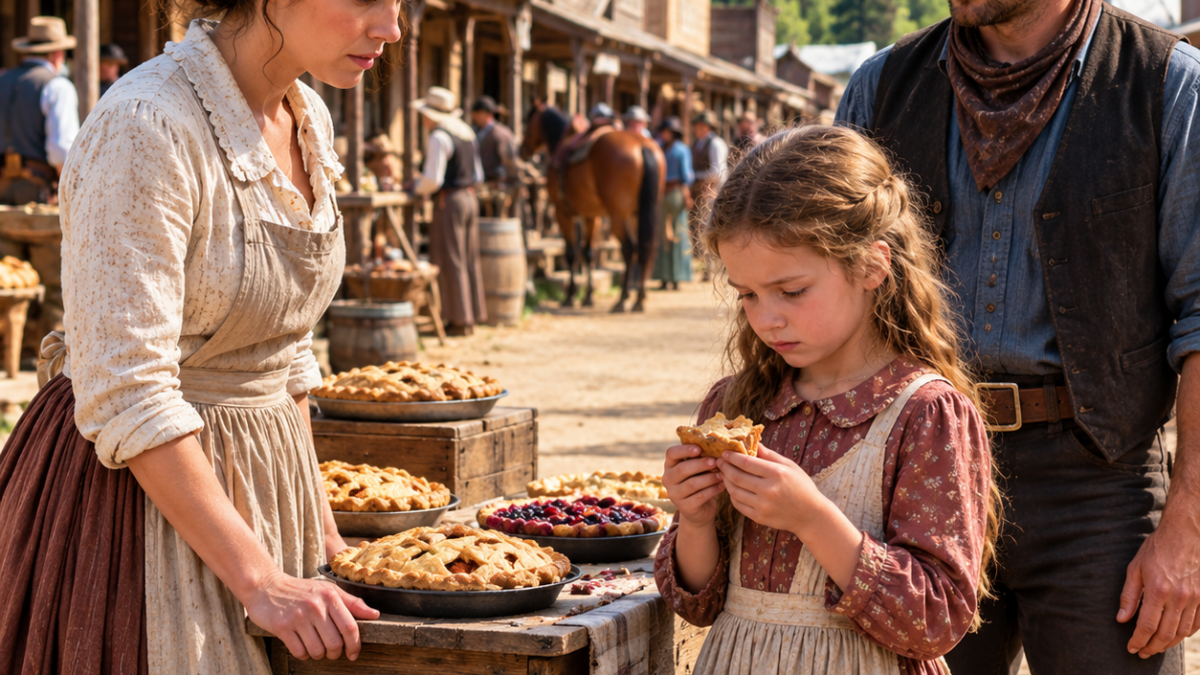
I cut the slice carefully, choosing the cleanest portion, the one where the crust had browned just right and the filling held together without running. I placed it on a small tin plate and handed it down to Sophie.
She took it with both hands.
“Thank you, ma’am.”
“You are very welcome.”
She took one bite.
Then she stopped chewing.
I felt the blood leave my face.
Something was wrong.
Too much cinnamon.
Bad apples.
Crust underbaked.
Butter turned.
My mind raced through every possible failure in the space of one breath.
“Is it all right?” I asked quickly.
Sophie looked at the pie in her hands.
Her small shoulders tightened.
Then her eyes filled with tears.
Marshall went completely still.
“Sophie?”
She swallowed.
Her voice came out small.
“My mama used to make pies like this.”
The market noise faded around us.
Or perhaps I stopped hearing it.
A woman buying eggs turned to look. Two boys carrying a sack of potatoes slowed. A man at the next stall lowered his coin purse. I wanted to move, to say something, but every word that came to me felt wrong.
I had not known Ellen Hale.
I had never seen her kitchen.
I did not know whether she used more cinnamon or less, whether she cut butter the way my mother had, whether her crust browned dark at the edges or stayed pale and tender.
But Sophie stood there with my pie in her hands and grief on her face, and suddenly the recipe was no longer mine alone.
Food can do that.
It can carry the dead into a room before anyone is ready.
Marshall crouched beside his daughter.
“Sweetheart,” he said softly.
Sophie wiped at her face with the back of her hand, embarrassed by her own tears.
“I’m sorry.”
“No,” he said. “No, don’t be sorry.”
I wanted to offer her the whole pie. I wanted to take it back. I wanted to tell her grief was allowed to sit at my little stand as long as it needed. Instead, I stood uselessly behind the table with flour under my nails and my heart aching for a child I had met less than a minute ago.
Marshall stood slowly.
“I’ll take the rest of that pie,” he said.
His voice was rough.
“Of course.”
I wrapped it carefully.
He paid full price, though I would have given it to him if I had been rich enough to afford generosity without consequence.
Before they left, Sophie looked back at me.
“It tastes like Sunday,” she said.
Then Marshall led her away.
I believed I would never see either of them again.
I was wrong.
The next Saturday, Sophie returned with purpose in her steps.
Marshall followed behind her with the resigned expression of a man who had learned that six-year-old daughters may be guided but rarely redirected once their hearts have chosen a destination.
She came straight to my stand.
“Do you have apple today?”
“I do.”
“Could I have a slice?”
I glanced at Marshall.
He nodded.
“Of course,” I said.
This time, when Sophie ate, she did not cry immediately. She ate slowly, as if trying to locate the memory without frightening it away. Marshall watched her with a tenderness that made me look down at the pie tin because seeing love that careful felt too private.
When she finished, she stayed at the edge of the stand.
I began arranging the remaining pies, giving her a task to watch so she would not feel exposed.
“How does the dough get so flaky?” she asked.
“Cold butter,” I said. “And not overworking it.”
She leaned closer.
“Why?”
“Because dough is particular. Most people are too impatient with it. It punishes impatience.”
Sophie considered this gravely.
“Could you teach me?”
“Sophie,” Marshall said, caution in his voice.
“I don’t mind,” I said before I could think better of it.
Both of them looked at me.
I reached for a small bowl and the bit of flour I kept for patching edges.
“Come around here.”
She did.
Carefully, as if stepping behind my little pie stand were entering a sacred place.
I showed her how to cut butter into flour with two knives, how the pieces should stay small and cold, how her fingers must be gentle if she used them at all. Her hands were clumsy, eager, and dusted white within seconds.
Marshall watched from the front of the stand, hat in his hands.
He looked as if something painful and hopeful were happening at the same time, and he did not know which feeling deserved more room.
Sophie came back the next Saturday.
And the next.
It became a quiet habit before any of us admitted it was one.
She would eat a slice, then spend a few minutes behind my stand helping with small tasks. She stacked plates. Counted empty tins. Asked why peach filling bubbled differently than apple. Informed me, once, that I used more flour on the counter than her mama had.
“That keeps the dough from sticking,” I said.
“Mama used less.”
“Then perhaps your mama had steadier hands than mine.”
Sophie thought about that.
“She did have very steady hands.”
“I believe it.”
Another afternoon, she said, without warning, “She used to sing when she baked.”
I stilled.
Marshall was speaking to a man two stalls away, too far to hear.
“Your mama?”
Sophie nodded.
“Off-key.”
I smiled gently.
“Did she know?”
“Papa never told her because he liked it too much to fix.”
“What did she sing?”
Sophie’s face changed.
“I don’t remember anymore.”
I understood then that grief for a child was not only missing a person. It was losing pieces of them slowly. A voice. A smell. A song. The exact way a hand felt on the forehead during fever. Time did not simply carry sorrow away; it stole details too.
“That is still worth remembering,” I said.
“What is?”
“That she sang. Even if the words are gone.”
Sophie looked at me for a long moment.
Then she nodded.
I never tried to take Ellen’s place.
That mattered to me more than anything.
I never called Sophie mine. Never asked her to speak of her mother. Never filled silences with easy comfort. I let Ellen remain exactly who she was: beloved, absent, irreplaceable.
Maybe that was why Sophie trusted me.
Maybe it was why Marshall began lingering longer than pie buying required.
At first, I told myself he stayed only for his daughter’s sake.
He liked watching Sophie smile. Of course he did. What father would not? He bought pies because they brought warmth back into a house that had gone too long without it. He carried whole pies home because his daughter asked for them, and because grief sometimes needs a ritual before it can breathe.
But then Sophie would wander to another stall, and Marshall would remain.
He helped stack empty tins one afternoon while the market thinned around us.
“Do you ever bake anything you don’t sell?” he asked.
“The ugly ones.”
“The ugly ones?”
“Crust tears. Filling leaks. Edges collapse. I eat those myself. Waste of good fruit otherwise.”
He looked amused.
“Those sound cheaper than the ones I’ve been buying.”
“They are. You are welcome to one if you would rather stop paying full price for a pie your daughter has already decided is perfect.”
“I don’t mind paying full price.”
“That is fortunate for my rent.”
His mouth lifted at the corner.
Then he said, more quietly, “Seems a fair trade for what it has brought back to my house these past weeks.”
I had no ready answer.
I busied myself with tins.
My fingers suddenly seemed far too aware of where his hands were.
That was when I began making a deliberate effort not to encourage anything.
Not because I disliked him.
Because I did not.
That was the trouble.
A woman in my position had to be careful. People could twist kindness into strategy, friendship into ambition, work into scheming. I had no family name to shield me, no husband, no property, no wealth. Marshall Hale had land, reputation, and a motherless daughter half the town already believed needed “a new mother.”
I had heard that phrase.
It soured my stomach every time.
Sophie did not need a new mother.
She had one.
The fact that Ellen was gone did not create a vacancy to be advertised.
“You needn’t buy a whole pie every Saturday,” I told Marshall once after he overpaid again.
“Sophie eats considerably more than her fair share.”
“Papa does not know anything about pie,” Sophie announced, appearing within earshot.
“Sophie.”
“You burned toast yesterday.”
Marshall straightened.
“That is not relevant.”
“It was black.”
“It was well done.”
“It was smoke.”
I looked at Marshall, fighting a smile.
“Your reputation is deteriorating rapidly, Mr. Hale.”
“I will have you know I am an excellent judge of pie, whatever my toast-related failings.”
I laughed.
Properly.
The sound surprised all three of us.
Sophie smiled first.
Marshall looked at me in a way that made me look away.
One quiet evening, he walked me part of the way back to Mrs. Whitcomb’s after the market closed.
Not all the way.
He was too careful for that.
He carried two empty tins and spoke of weather, cattle prices, and whether my stand needed a stronger awning before winter. We reached the corner where he should turn back toward the livery.
There, he paused.
“If you had enough money to do anything at all with those pies,” he asked, “what would you do?”
I almost gave a practical answer.
Buy more tins.
Rent a better kitchen.
Save for hard months.
But something about the way he asked made practical answers feel dishonest.
I looked down the street toward the market square.
“I would have a door with my own name over it,” I said.
The words came out softly.
Once spoken, they could not be gathered back.
“Not a stand I pack up every evening. Somewhere that stayed put whether I did or not.”
Marshall held the tins at his side.
“That seems a reasonable thing to want.”
“It is foolish on a pie seller’s income.”
“Foolish things are not always unreasonable.”
I looked at him.
He did not smile as if teasing.
He simply looked thoughtful, as though he had taken my dream seriously and placed it somewhere safe inside his mind.
That frightened me more than laughter would have.
The week everything changed began with bad news in Mrs. Whitcomb’s kitchen.
I arrived before dawn on a Thursday and found her sitting at the table with a letter in front of her and guilt written plainly across her face.
“What happened?” I asked.
“The house has been sold.”
For a moment, the stove, the table, the bowls, even the air seemed to move away from me.
“Sold?”
“My nephew arranged it. I knew he meant to, but not so quickly. The new owner wants the back kitchen cleared by Monday.”
Monday.
Four days.
Without that kitchen, there would be no pies.
Without pies, there would be no market stand.
Without the stand, there would be no rent, no flour, no reason to remain in Maple Ridge beyond stubbornness.
Mrs. Whitcomb reached for my hand.
“I am sorry, Naomi. I argued, but the papers were already signed.”
I believed her.
That did not change anything.
By noon, I had begun packing.
Tins.
Bowls.
Rolling pin.
Recipe box.
Sacks of flour tied tight.
I moved with the efficient sadness of a woman who had done this before. That was the part I hated most. My hands knew how to leave. Wrap breakables in cloth. Stack useful things first. Keep sentiment small. Do not stand too long in any room or it will start asking you to stay.
I told no one.
Not Sophie.
Not Marshall.
Especially not Marshall.
Because buying my pies did not mean he owed me rescue.
Because kindness becomes dangerous when you begin expecting it.
Because I had spent years proving I could survive on my own, and I would not let one man with steady eyes and a grieving child make me forget the difference between help and dependence.
Saturday came.
My stand was empty for the first time in months.
I was behind Mrs. Whitcomb’s house loading tins into a borrowed wagon when Marshall found me.
I heard his horse before I saw him.
He dismounted quickly.
“Naomi.”
I kept tying the crate.
“Good afternoon, Mr. Hale.”
“Ruth said you were not at market.”
“Ruth notices everything.”
“Sophie found the stand empty.”
I tied the knot too tightly.
“She should not have had to find out that way.”
“No,” he said. “She should not.”
The words landed sharper than I expected.
I looked up.
His face was not angry.
Hurt, yes.
Worried.
But not angry.
“Why didn’t you ask for help?” he asked.
The question struck the rawest part of me.
“Because buying my pies does not mean you owe me my whole life fixed.”
He absorbed that quietly.
“I am not trying to fix your life.”
“Then what are you doing?”
His gaze held mine.
“Trying to keep you from disappearing out of ours.”
I went still.
For one breath, everything I had been refusing to name stood between us.
Sophie’s laughter.
Marshall lingering at the stand.
The question about my dream.
The way I had begun looking forward to Saturdays.
The way my room at Mrs. Whitcomb’s had started feeling less like a place I occupied and more like a place from which I returned.
Marshall cleared his throat.
“There is an old kitchen at the ranch.”
I looked away immediately.
“No.”
“You have not heard the offer yet.”
“I heard enough.”
“It is larger than you need. Hardly used since Ellen passed. You could bake there temporarily and still sell at market.”
“Temporarily,” I repeated.
“Yes.”
“I would keep my room in town.”
“Of course.”
“I would ride out in the mornings and return evenings.”
“If that is what you want.”
“It is.”
“Then that is what we will do.”
I studied him, suspicious of how easily he accepted my conditions.
“Temporary help is not the same as taking up residence, Mr. Hale. I want that distinction plain for both our sakes and the town’s.”
Something like respect crossed his face.
“Understood.”
“Temporarily,” I said again.
He nodded.
But something in the air shifted when I said it.
As though both of us had heard the word and doubted it for different reasons.
I rode out to the Hale ranch before dawn on Monday.
The house stood large and quiet beneath the pale morning sky. Not grand in the way eastern houses were grand, but solid, well-built, and tended by people who believed a board should do its work without complaint. The kitchen was at the back, with windows facing east and shelves lined with jars arranged so neatly it felt almost like trespassing.
Ellen’s kitchen.
That was how I thought of it immediately.
Not Marshall’s.
Not mine.
Hers.
Her chair still sat near the window.
Her spice jars remained where her hands had placed them.
A blue cloth hung from a peg near the stove.
The pantry had been preserved with such care that it seemed less like memory and more like a room holding its breath.
I stood in the doorway for a long time.
Then I set my tins down.
“I will not take your place,” I whispered.
To whom, I do not know.
Maybe Ellen.
Maybe myself.
For the first few mornings, I changed almost nothing.
I baked around the kitchen instead of in it, careful not to move more than necessary. I used one corner of the table, one shelf for my ingredients, one hook for my apron. Sophie came in before breakfast, hair loose and eyes bright with something I had not seen fully at market.
“You’re here.”
“I am baking.”
“In our kitchen.”
“For now.”
She came closer.
“Can I help?”
“If your father allows it and you wash your hands.”
“I already washed them.”
“Wash them again.”
She did, joyfully.
That morning, the smell of apple pie crossed the Hale house for the first time in three years.
I did not know a smell could change a place so quickly.
By the time the first crust browned, Sophie was dusted with flour, humming a tune she claimed she did not remember. Marshall came in from the yard and stopped in the doorway.
He did not speak.
His eyes moved from Sophie to the pies to the chair by the window.
Then to me.
“I can leave if this is too much,” I said quietly.
He shook his head.
“No.”
The next week, I moved Ellen’s chair three inches.
Only three.
I needed room for a flour sack, and the chair’s old position made the corner impossible to use. I stood there debating it longer than sense required, then finally shifted it with both hands.
When Marshall came in that evening, he noticed.
Of course he did.
“You moved Ellen’s chair,” he said.
My stomach tightened.
“A few inches. I can put it back.”
He stood in the doorway for a long moment.
Then he said, “No. Leave it.”
I searched his face.
“Seems it needed moving,” he added, voice low, “and I hadn’t the sense to do it myself.”
That was the first time I understood what grief had done to the house.
Marshall had not preserved Ellen’s kitchen because it made him feel close to her. Not anymore. Perhaps in the beginning. But after three years, preservation had hardened into stillness. The chair, the jars, the cloth, the untouched recipes—all of it had become proof that time had stopped in the room where she had once been most alive.
Then I came in and moved a chair three inches.
Not to erase her.
To make room for flour.
Somehow, that small movement gave the house permission to breathe.
Sophie laughed more.
Marshall came in from ranch work earlier than he used to.
At least, that was what his foreman, Mr. Briggs, implied one afternoon when I carried a cooled pie to the porch.
“Boss home early again,” he said.
“Is he?”
“Ranch has developed a sudden talent for running itself.”
I looked at him.
His weathered face remained innocent.
“Remarkable,” I said.
“Powerful remarkable.”
I returned to the kitchen before I smiled.
Some evenings, after Sophie had gone to bed, Marshall and I found ourselves lingering at the kitchen table.
At first, we spoke of practical things.
How many pies for Saturday.
Whether the oven ran hotter on the left.
Which road washed out first after rain.
How early I should ride if frost came.
Then less practical things arrived.
“What did you want to be?” I asked him once.
He looked surprised.
“Before the ranch was yours to manage.”
He leaned back.
“Honestly?”
“I prefer honestly.”
“A blacksmith.”
I smiled.
“Truly?”
“I liked the thought of making something with my hands and pointing to it by sundown. Saying, There. I built that start to finish.”
“Cattle take longer.”
“Considerably.”
“Why didn’t you?”
“Land came to me instead.”
He looked toward the dark window.
“A man does not always choose the life he ends up loving. Sometimes it arrives, and he decides later whether to resent it or make peace with it.”
“And did you?”
“Make peace?”
“Yes.”
“Eventually.”
The word carried more than ranches.
I looked down at my hands.
“What about you?” he asked.
“I wanted a kitchen that was mine.”
“That is not the same as a bakery?”
“No. A bakery is business. A kitchen is…” I paused, searching. “A place where no one can tell you to pack before Monday.”
Marshall’s expression changed.
“I’m sorry.”
“It is not your fault.”
“No. But I am sorry.”
That was another thing about him.
He did not apologize for things he had not done as if trying to gather praise for sensitivity. He apologized because he recognized the wound.
I had very little defense against that.
The trouble began with Mrs. Kellerman.
She was always polite to my face.
That was the worst kind.
Rude women gave you something solid to push against. Polite women could cut you while smiling and leave others wondering why you bled.
She came to my stand one Saturday, examined a peach pie, and said, “You seem to see quite a lot of the Hales these days.”
I placed another pie on the table.
“I bake in their kitchen temporarily.”
“So I heard.”
The pause after heard was full of teeth.
I let it pass.
But within weeks, the suggestion grew.
At first, it was only glances. Then whispers that stopped too quickly when I approached. Then words spoken just loudly enough near the market pump.
“Poor Sophie is so attached.”
“Well, of course. That is how some women make themselves necessary.”
“She came with nothing, didn’t she?”
“And now she bakes at the Hale ranch.”
“Convenient.”
I told myself not to care.
I cared.
Not because of me.
Or not only because of me.
I had been spoken about before. I knew gossip’s stale flavor. But Sophie was a child. A grieving child. I would not have people turn her trust into evidence against me. I would not have Ellen’s memory turned into a doorway I was accused of sneaking through.
That evening, I began packing again.
I folded my spare dress.
Unfolded it.
Packed my recipe box.
Took it out.
Set it on the table.
Stared at it for so long the lamplight burned low.
Leaving had never before cost this much effort.
That alone told me something I did not want to know.
I baked one final pie that night in the ranch kitchen.
Apple.
I worked slowly, carefully, pouring far more tenderness into it than the occasion required. I used the right amount of cinnamon. Cold butter. Light hands. I crimped the edges the way my mother had taught me. While it baked, I wrote Sophie a note.
For you to make when you miss me.
Beneath it, I copied the recipe.
Not the market version.
The real one.
My mother’s.
At dawn, I placed the pie and note on the kitchen table.
Then I left.
I made it less than an hour down the road before Marshall caught up.
I heard the horse behind me and knew.
Still, I did not stop until he called my name.
“Naomi.”
I pulled the borrowed wagon to the side.
The road stretched open around us, pale beneath the morning light.
He dismounted.
I kept my hands on the reins.
“Sophie found the note,” he said.
My throat tightened.
“She should have the recipe.”
“She wants you.”
I closed my eyes briefly.
“I cannot come back for Sophie.”
“I know.”
That made me open my eyes.
Marshall stepped closer but stopped several feet away.
“My daughter will miss you considerably,” he said. “But it was not Sophie who sent me after you.”
Silence moved across the road.
“I spent three years trying to preserve everything exactly as it was before Ellen died,” he said. “I thought moving forward would mean forgetting her. Then you walked into that kitchen, baked pie, moved a chair three inches, and I realized loving a memory and turning your whole life into a monument are not the same thing.”
My hands trembled on the reins.
“The town has already decided what I am doing at your ranch.”
“I know.”
“I will not have Sophie caught in gossip because of me.”
“No.”
“I will not be spoken of as a woman scheming after your name.”
“Then we will give the town something honest to talk about.”
I stared at him.
He took another breath.
“I am not asking you back to fill Ellen’s kitchen.”
The morning seemed to hold still.
“I am asking because I have watched my daughter laugh again. Because I have found myself coming home early for the first time in three years. Because the house smells alive. Because I look for you in doorways before I remember whether you are due there.”
My eyes burned.
“And because none of this was ever really about pie.”
“What was it about then?” I asked, barely above a whisper.
“You.”
One word.
Plain.
Unadorned.
More dangerous than any speech.
“Marshall.”
“I know you are afraid of being made dependent.”
“Yes.”
“I know you have built survival out of leaving before anyone could take too much.”
I looked away.
“I know you want a door with your own name over it.”
That brought my gaze back.
“You remembered?”
“Seemed worth remembering.”
“No one remembers things like that.”
“I do.”
He reached into his coat and pulled out a folded paper.
“There is a lot along the road between town and the ranch. Not on my main property, if that matters to you. Close enough for business from both. I will deed it properly. You will pay a fair price if you insist, and I expect you will.”
“I will.”
His mouth softened.
“I know.”
“You cannot simply build me a bakery.”
“I am not trying to buy you.”
“That is not what I meant.”
“I know what you meant.”
He held out the paper but did not push it toward me.
“I am offering a place for your dream to stand. Yours. Legally. Plainly. With your name over the door exactly as you said.”
My tears slipped free then, and I hated them because they made speech harder.
“And what are you asking in return?”
“Nothing you do not choose freely.”
“That is too careful an answer.”
“It is the only answer I have that respects you.”
I looked back toward Maple Ridge.
Toward the market.
The gossip.
The ranch kitchen.
Sophie’s note.
Ellen’s chair moved three inches.
A house breathing again.
My recipe box sat in the wagon behind me.
I thought of my mother’s voice.
You cannot bully tenderness into behaving.
Maybe you could not run from it forever either.
“I have conditions,” I said.
Marshall’s shoulders lowered slightly, as if he had been holding his breath.
“Name them.”
“I pay for the lot.”
“Yes.”
“At a fair price, not some sentimental number meant to flatter my pride while hiding charity.”
His eyes warmed.
“Yes.”
“The bakery is mine.”
“Yes.”
“I keep my accounts.”
“Of course.”
“I am not Sophie’s new mother.”
His expression turned serious.
“No.”
“I will love her in whatever way she allows, but I will not let anyone, including you, pretend Ellen can be replaced.”
Marshall removed his hat.
“I would never ask that.”
“I know,” I said softly. “But it needed saying.”
“Yes.”
“And if I come back, I do not come back because you rescued me on a road.”
“Why, then?”
I looked at him.
“Because I was already tired of leaving.”
For a long moment, neither of us moved.
Then Marshall stepped forward and took the reins, not from my hands, but beside them.
“May I walk with you back?”
I nodded.
We walked slowly.
The wagon creaked behind us.
The sun rose higher.
By the time we reached the ranch kitchen, Sophie was waiting on the porch with red eyes and flour on her dress because apparently she had tried to begin the recipe alone and failed at the first instruction.
When she saw me, she ran.
I crouched just in time.
She threw herself into my arms.
“You left the recipe,” she sobbed.
“I did.”
“But you came back.”
“Yes.”
“Are you staying?”
I looked at Marshall over her shoulder.
Then down at the child who had cried over a slice of pie and accidentally opened my whole life.
“I am staying long enough to build something properly,” I said.
Sophie pulled back.
“A bakery?”
“Yes.”
“With your name?”
“With my name.”
She smiled through tears.
“Can I help?”
“Only if you wash your hands twice.”
She laughed.
That laugh settled the matter more than any paper could have.
Marshall and I married later that year.
Not quickly enough to satisfy gossip, and not slowly enough to silence it.
But by then, I had learned that a woman cannot build a life by making every decision according to what cruel mouths might say. Let them speak. The truth had a sturdier foundation.
I paid Marshall for the lot.
Properly.
I signed papers.
So did he.
The bakery took shape through autumn.
A small building along the road, with a front window wide enough to display pies in morning light and a kitchen large enough for two people to work without elbowing each other unless Sophie was involved, in which case collisions remained unavoidable.
When the sign arrived, wrapped in cloth, I stood outside with my hands pressed together so tightly my fingers hurt.
Marshall lifted it carefully.
Naomi Prescott’s Bakery.
Painted plainly.
Just as I had wanted.
I touched the letters.
“You remembered exactly,” I said.
He stood beside me.
“You had never asked me for anything else the whole time I knew you.”
“That made it important?”
“That made it sacred.”
I could not answer.
So I kissed him instead.
The women who whispered came eventually.
At first, they arrived pretending curiosity.
Then politeness.
Then hunger.
Good pie has a way of making pride negotiate with itself.
Mrs. Kellerman stood in line one cold morning nearly a year after the gossip began. She purchased an apple pie and looked at me with more discomfort than the transaction required.
“Best pie in the county,” she said.
I smiled.
“I appreciate you saying so.”
Her mouth tightened, as if she expected me to make her apologize properly.
I did not.
Some corrections are better accepted quietly.
Besides, I had work to do.
Months later, Sophie stood behind the bakery counter attempting her first pie entirely on her own.
Marshall and I watched from what we hoped was a careful distance, though Sophie told us twice to stop hovering.
Flour dusted her cheek.
Her braid had come loose.
The crust was uneven, the filling too close to the edge, and the crimping looked as if a small animal had walked around the pie with determined feet.
It was beautiful.
When it cooled enough, Sophie cut a slice.
She took one bite.
Marshall went still.
So did I.
That was how all of this had begun.
A child.
A bite.
A memory too large for a small body.
Sophie chewed thoughtfully.
“It is not quite like Mama’s,” she said.
Marshall’s face tightened, bracing for the old grief.
Sophie took another bite.
Then she looked at me.
Then at her father.
“It tastes like ours.”
That was when I understood fully what I had only hoped was true.
I had not taken Ellen’s place.
No one had.
We had built something new in the space grief left behind.
Not borrowed.
Not stolen.
Ours.
A daughter came two years later.
Round-cheeked, loud, cheerful, and born with fists closed as if prepared to argue with the world at once. We named her Margaret, after my mother.
When little Margaret was old enough to stand on an overturned crate, I brought out the very same one I had used as a child, worn smooth at the edges.
Sophie was the one who taught her.
“Cold butter,” she said seriously, guiding Margaret’s tiny hands. “And do not rush. Dough punishes impatience.”
“That is what Mama Naomi says,” Margaret replied.
“That is because it is true.”
I stood in the doorway with Marshall’s arm around my shoulders, watching three generations of hands live inside one lesson.
My mother’s recipe box sat on the bakery counter, its corners worn softer than ever.
Some things, I came to understand, were never meant to end with one pair of hands.
They were meant to be passed along.
A recipe.
A kindness.
A room made warm again.
A dream spoken once on an ordinary road and remembered by someone who loved you enough to make space for it without taking ownership of it.
I sold pies to survive.
That was the truth at first.
Every apple peeled, every crust rolled, every market morning begun before sunrise had been one more way to remain standing when the world offered no easy place to lean.
Then Sophie Hale took one bite and cried.
I thought I had wounded her.
But grief had simply recognized the door it needed to walk through.
Her tears brought her back to my stand.
Her questions brought laughter.
Her father’s quiet presence brought warmth I had stopped expecting.
The kitchen at the ranch taught me that memory could move three inches and still remain loved.
The gossip taught me that leaving is not always strength.
Marshall taught me that help does not have to become ownership.
Sophie taught me that love can taste like what came before and still become something new.
And my mother, whose hands had been gone for so many years, somehow taught all of us through butter, flour, cinnamon, and patience.
Now, when I unlock the bakery each morning, I still pause beneath the sign.
Naomi Prescott’s Bakery.
My name.
My door.
My place that stays.
Inside, the ovens wait.
The counters wait.
The recipe box waits.
Some mornings, Sophie arrives early with Margaret trailing behind her, both of them already arguing over whether apple or peach should be baked first. Marshall comes in later, pretending he only stopped by to check the hinges or bring wood, though we all know he wants the first broken edge of crust.
He still burns toast.
He remains an excellent judge of pie.
And every Sunday, when cinnamon fills the room and morning light touches the counter, I think of the little girl I once was, standing on a crate beside my mother.
I think of the woman I became, packing tins into a wagon because leaving had always been easier than needing.
I think of a rancher’s daughter holding a slice of apple pie with tears in her eyes.
And I understand that survival was never the end of my story.
It was only the crust.
The filling came later.
Warm.
Unexpected.
A little messy at the edges.
Sweet enough to make a child cry.
Strong enough to make a house breathe again.
And patient enough to teach all of us that you do not have to lose the old love to let a new one begin.
Sometimes, if you are very blessed, the life you build after grief does not taste like forgetting.
It tastes like ours.








