She Gave an Abandoned Military K9 the Quiet Home No One Else Would—Then, at Midnight, a Navy SEAL Appeared at Her Ranch and Whispered the Dog’s Name
PART2:
The process was not like adopting a pet from a local shelter. These dogs had served. They had searched for explosives, tracked targets, guarded bases, moved through gunfire, and taken commands in languages civilians never needed. Some retired because of age. Some because of injuries. Some because they could not safely work anymore.
Sarah had medical experience.
Secure acreage.
No children.
No other pets.
A fenced property.
A calm home.
She applied.
Three months later, she flew to San Antonio.
The transitional kennel facility at Lackland was louder than she expected.
Barking echoed against concrete walls. Malinois threw themselves at chain-link gates with athletic fury. German Shepherds paced, ears pricked, eyes sharp. Handlers moved with calm precision through controlled chaos. Every dog in the main kennel seemed alive with purpose, impatience, and energy.
Sergeant Reynolds met Sarah near the entrance.
He was in his late forties, broad in the shoulders, with tired eyes and a voice that had given thousands of commands and wasted very few.
“You understand these aren’t rescue puppies,” he said after shaking her hand.
“Yes.”
“You understand some of these dogs come with behaviors civilian homes cannot handle.”
“Yes.”
“And you understand that if we place a dog with you, and it goes wrong, you call us before you try to fix it yourself.”
Sarah nodded.
“I understand.”
Reynolds studied her for another second.
Then he said, “I have one dog in mind. But I need to warn you, he isn’t what most adopters want.”
“I’m not most adopters.”
“No,” he said. “Most adopters say that too.”
He did not take her to the main runs.
Instead, he led her down a quieter hallway at the back of the facility. The barking faded behind them. The air grew cooler. The kennels here were reinforced, each one separated by solid barriers instead of simple chain-link dividers.
At the last enclosure, Reynolds stopped.
Inside sat a massive sable German Shepherd.
He was beautiful in the way old weapons are beautiful — not soft, not decorative, but built for purpose. He weighed nearly ninety pounds, with a broad chest, thick neck, and powerful shoulders. A jagged scar crossed his left side, disappearing into dense fur. A piece of his right ear was missing. His muzzle was graying earlier than it should have.
But what made Sarah’s breath catch was not his scars.
It was his stillness.
He did not pace.
He did not bark.
He did not even look at them.
He sat perfectly rigid, facing the concrete wall, his dark eyes fixed on nothing Sarah could see.
“This is Ranger,” Reynolds said.
His voice dropped.
“He did three tours attached to Special Operations units in Afghanistan. Highly trained. Extremely capable. But severely traumatized.”
Sarah stepped closer.
Ranger’s ear flicked.
Nothing else moved.
“What happened?”
Reynolds folded his arms.
“Korengal Valley. IED blast. His handler was killed in action. Ranger stayed with the body for two days before extraction teams reached them.”
Sarah looked at the dog again.
He still stared at the wall.
“They said he had to be physically dragged away,” Reynolds continued. “Since then, he refuses to bond. Refuses normal play. Refuses most touch. He eats only when no one is looking. He has unpredictable threat responses. Most dogs come back with physical injuries. Ranger came back hollowed out.”
Sarah knelt slowly outside the enclosure.
Ranger did not turn.
“Hi,” she said softly.
No reaction.
Reynolds watched her.
“If you take him, Ms. Jenkins, understand what you’re getting. This is not a family pet. This is not a companion animal in the usual sense. He may never wag his tail. He may never sleep beside your bed. He may never let you pet him.”
Sarah kept her eyes on Ranger.
“What will happen if no one takes him?”
Reynolds did not answer immediately.
That was answer enough.
“We keep trying,” he said finally. “But dogs like Ranger don’t place easily.”
The dog’s scarred ear flicked again at his name.
Sarah noticed.
So did Reynolds.
“He hears us,” she said.
“He hears everything.”
“He just doesn’t care to respond.”
Reynolds gave the smallest smile.
“That is one interpretation.”
Sarah sat back on her heels.
In the dog’s dead-eyed stare, she saw something she recognized.
Not because she had been to war.
She would never pretend that.
But she knew what it looked like when the body remained present and the soul stayed trapped in the worst moment it had survived.
She had seen it in patients.
In families.
In mirrors.
“Can I sit here a while?” she asked.
Reynolds looked surprised.
“He won’t come to you.”
“I didn’t ask if he would.”
For nearly forty minutes, Sarah sat outside Ranger’s kennel.
She did not reach through the gate.
She did not click her tongue again.
She did not coax.
She simply sat on the concrete floor with her back against the opposite wall and let the dog ignore her.
At one point, a metal cart clanged somewhere down the hallway.
Ranger’s entire body tensed.
Not startled like a pet.
Activated.
Every muscle came online.
His head shifted two inches toward the sound.
Then he returned to the wall.
Sarah did not move.
After a while, she said quietly, “I don’t like loud noises either.”
Reynolds, standing down the hall, heard her.
Ranger gave no sign that he had.
But when Sarah stood to leave, the dog’s eyes moved.
Not his head.
Just his eyes.
They tracked her to the door.
She signed the paperwork that afternoon.
The first month in Montana was brutal.
Ranger did not settle into the ranch.
He occupied it.
There was a difference.
He refused to sleep inside the cabin, no matter how cold the nights became. Instead, he positioned himself on the front porch with his body angled toward the driveway and tree line, as if waiting for a threat report no one had given Sarah permission to read.
He did not eat from a bowl.
If Sarah placed food in a dish, he stared at it until she left. Then, sometimes, it remained untouched until morning. Eventually, she learned to scatter kibble on the ground in a wide pattern near the barn. He would eat only when she was back inside and the curtains were closed.
He did not play.
He did not respond to praise.
He did not approach her for affection.
He followed the fence lines with tactical precision, pausing at corners, scanning ridges, watching ravens lift from the pines as if they might be signaling enemy movement.
The first time Dr. Emily Henderson came for a house call, she left visibly shaken.
“I’ve treated working dogs,” Emily said while packing her bag, keeping Ranger in the corner of her vision. “Police dogs, search dogs, even a retired explosive detection dog out near Missoula. But this one…”
Ranger sat in the open barn doorway, unmoving, eyes fixed on the veterinarian’s hands.
“He’s not just watching me,” Emily continued. “He’s evaluating. Throat. Belt line. Posture. Escape route. He’s doing threat assessment like breathing.”
“Is he dangerous?”
Emily looked at her.
“Potentially.”
Sarah absorbed that.
“Can he heal?”
The vet’s expression softened.
“I don’t know. But if anyone tries to rush him, they’ll make him worse.”
So Sarah did not rush him.
She built routine instead.
Breakfast at six.
Fence walk at seven.
Barn chores at eight.
Coffee on the porch at nine, even if Ranger stood twelve feet away facing the road.
Dinner at five.
House lights low after dark.
No sudden movements.
No strangers without warning.
No reaching.
No cornering.
No pity.
She spoke to him in the same calm voice every day.
Not baby talk.
Never that.
Just quiet narration.
“I’m opening the feed bin.”
“Wind’s coming from the west today.”
“Generator test at noon. Loud for ten seconds.”
“Coffee tastes like burnt mud. You’re lucky you’re a dog.”
He never answered.
But he began to listen.
The first breakthrough came during a thunderstorm.
It was late June. Lightning rolled over the valley just after sunset, turning the sky white behind the mountains. Sarah had been making soup when a crack of thunder slammed directly overhead.
A pan slipped from her hand and hit the kitchen floor.
The sound exploded through the cabin.
Ranger, who had been lying by the front door, vanished beneath the heavy oak dining table so fast Sarah barely saw him move.
Then came the shaking.
Not mild trembling.
Violent, whole-body shaking.
His breath came in short bursts. His pupils blew wide. His scarred shoulder pressed against the table leg.
Sarah froze halfway to him.
Every instinct told her to go closer.
Every trauma lesson she had learned told her not to.
So she sat down on the floor across the room.
Far enough away that he had space.
Close enough that he was not alone.
She picked up the book she had been reading and opened it with hands that were steadier than she felt.
Then she read aloud.
Not because the story mattered.
Because her voice did.
The thunder continued.
Ranger shook.
Sarah read.
After fifteen minutes, his breathing slowed.
After thirty, his head lowered onto his paws.
After forty, his eyes closed.
The next morning, Ranger followed her to the barn at a distance of exactly six feet.
He had never followed that closely before.
Six feet became their measure.
He never crossed it.
But he kept it.
In the second month, he came inside at night, but slept only by the front door, body placed like a barricade.
In the third month, he began eating while Sarah was visible through the kitchen window.
In the fourth, he accepted chicken from her hand without taking her fingers with it.
In the fifth, he rested his chin on his paws while she read in the armchair instead of staring at the road.
He still never wagged his tail.
Never barked.
Never played.
But he watched over her.
And slowly, without Sarah fully noticing, the ranch stopped feeling empty.
It became inhabited by two survivors who respected each other’s distance.
She thought they were healing.
She thought Ranger was learning that war had ended.
She did not understand yet that Ranger had never believed it ended.
He had been waiting.
November came hard.
The Bitterroot Valley did not ease into winter. It turned.
One week, golden grass moved under pale sun.
The next, wind screamed through the pines and the mountains disappeared behind sheets of sleet. Temperatures plunged. Ice formed along trough edges. The county warned residents to stay home unless travel was necessary.
At 9:12 p.m. on a Tuesday, the power went out.
Sarah was not worried.
The ranch had a backup generator strong enough to keep essential systems running. The wood stove heated the main living area almost too well. She lit two battery lanterns, poured black coffee, added another log to the stove, and settled into her leather armchair with a thriller novel she had already decided was unrealistic because the nurse character had too much free time.
Ranger lay in his usual place by the front door.
His chin rested on his paws.
His eyes were closed.
His ears moved constantly.
At exactly 11:42 p.m., Ranger stood.
Sarah looked up immediately.
The change was absolute.
No hesitation.
No sleepy stretch.
One second he was lying down.
The next he was fully alert, hackles rising in a stiff ridge from shoulders to tail.
A low hum vibrated deep in his chest.
Not a growl.
A warning system coming online.
“Ranger?”
He did not look at her.
His eyes were fixed on the large reinforced window overlooking the porch and driveway.
“Just the wind, buddy,” Sarah said, though she did not believe it.
Ranger stepped toward the glass.
Then he did something he had not done once in six months.
He paced.
Not anxious circling.
Tactical movement.
Window.
Door.
Window.
Door.
Three silent steps each way.
Sarah set her coffee down carefully.
Her heart rate lifted.
Ranger had ignored coyotes close enough to wake her.
He had ignored elk scraping fence posts.
He had ignored a black bear that wandered near the barn in September.
This was different.
A targeted alert.
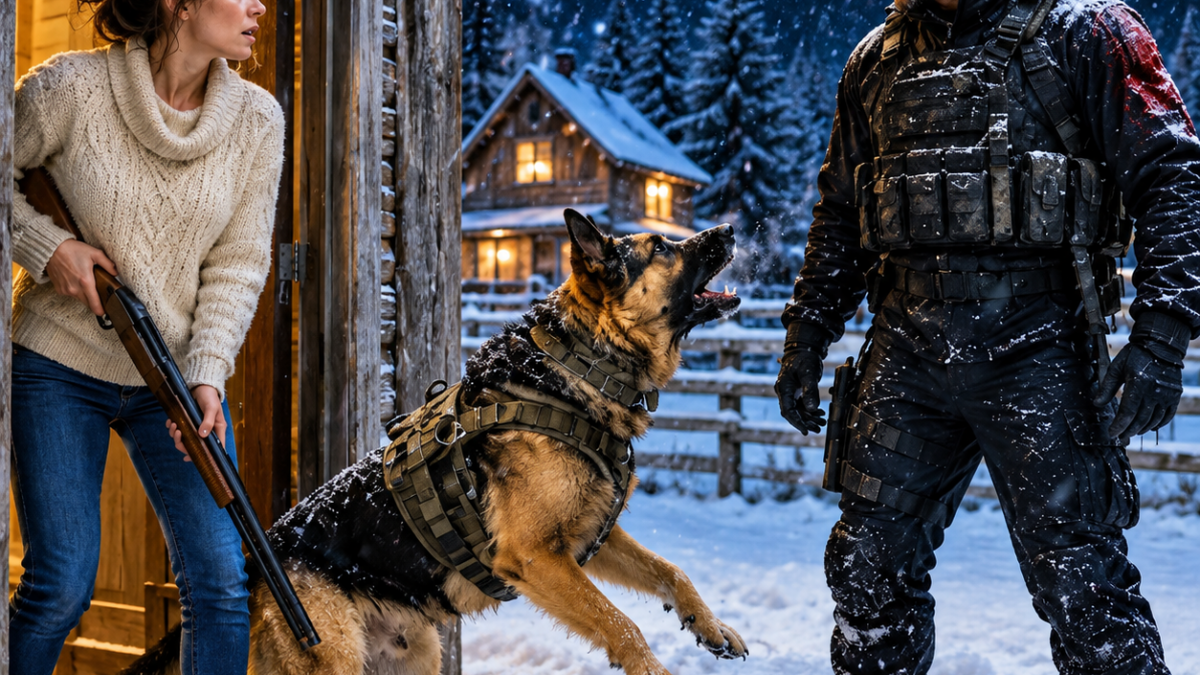
Sarah stood slowly and moved to the hall gun safe. Her fingers entered the code from muscle memory. The beep sounded deafening in the cabin.
She removed the Remington 870 pump-action shotgun, checked it, and racked a shell into the chamber.
Clack-clack.
Usually, that sound felt final.
Ranger did not even flinch.
That scared her more than anything.
Sarah killed the lanterns.
Darkness swallowed the room.
The storm outside became visible in pale motion through the glass: sleet slashing sideways, snow twisting across the porch light, pine branches thrashing like black arms.
Then the motion lights near the barn flared.
A figure stood in the driveway.
Sarah stopped breathing.
No vehicle.
No headlights.
No sound of an engine.
Just a man walking through the storm.
He was tall, broad-shouldered, dressed in dark tactical winter gear crusted with ice. He moved with exhaustion, but not confusion. His pace was deliberate. Controlled. Dangerous.
Not a lost hiker.
Not a stranded rancher.
A man who had crossed miles of wilderness in a storm and still knew exactly where his hands were.
Sarah raised the shotgun and rested the barrel near the edge of the window frame.
“Sheriff Boyd is thirty minutes away,” she whispered to herself.
On a good day.
This was not a good day.
The man reached the porch steps.
His boots thudded against the wood.
Ranger stopped pacing.
He stood dead center in front of the door.
Silent.
Coiled.
Every muscle in his body trembled with readiness.
He was not barking.
Of course he was not barking.
Sarah suddenly remembered something Sergeant Reynolds had said during a follow-up call.
Special operations dogs are often trained for silent alerts. Noise gives away position.
Ranger was not warning the intruder.
He was preparing for a breach.
The man reached the front door.
A gloved hand tested the knob.
Locked.
Sarah stepped into the hallway, shotgun leveled at the center of the door.
“I am armed!” she shouted. “Step away from the door. Law enforcement has been called.”
The man froze.
He did not retreat.
For a moment, only the storm answered.
Then a voice came through the heavy oak.
Rough.
Hoarse.
Nearly swallowed by wind.
“Ranger.”
The dog changed as if struck by lightning.
The lethal posture collapsed.
A high, broken whine tore from him — a sound Sarah had never heard from Ranger, not during storms, not during nightmares, not when he had cut his paw on the barn latch and let her clean it without a sound.
He threw his body against the door, scratching frantically at the wood.
Sarah’s blood went cold.
“Ranger, no!”
He ignored her.
The man outside spoke again, louder.
“Hier.”
German.
Come.
Ranger sat instantly.
Hard.
His hips hit the floor.
He trembled violently, eyes locked on the knob, tiny cries escaping his throat.
Sarah’s mind raced.
Korengal Valley.
Handler killed in action.
Stayed with the body for two days.
Refuses to bond.
Dead-eyed for three years.
The impossible took shape before she could reject it.
Slowly, she moved toward the door.
She did not lower the shotgun.
Her hand shook as she turned the deadbolt.
When she opened the door, the storm exploded into the cabin.
Snow and sleet whipped across the threshold.
On the porch stood a man who looked as if he had walked through hell and brought part of it with him.
His face was weathered, bruised, and half-covered in an ice-crusted beard. His pale blue eyes were sunken with exhaustion. Blood seeped through the dark fabric along his left ribs. He held one arm tight against his side. His lips were nearly gray from cold.
He did not look at the shotgun aimed at his chest.
He did not look at Sarah.
He looked at Ranger.
“Stand down, buddy,” he whispered. “I’m here.”
Ranger crawled forward.
Crawled.
The massive dog Sarah had been warned could become a weapon at any sudden movement lowered himself onto his belly and pushed his head into the man’s boots.
The man dropped to his knees.
Ranger pressed into him, whining, shaking, folding his huge body against the wounded stranger like a puppy reunited with the only safe thing in the world.
The man buried his face in Ranger’s neck.
“I came back,” he said, voice breaking. “I promised you. I came back.”
Sarah lowered the shotgun one inch.
“Who are you?”
The man looked up.
His eyes were haunted.
“My name is Wyatt Bennett. United States Navy.”
Sarah already knew what he would say next.
But it still hit her like a physical blow.
“I was this dog’s handler.”
Ranger pushed harder against him.
Wyatt grimaced, nearly collapsing.
“And if you don’t let us inside right now,” he added, “the men hunting me are going to kill us all.”
Sarah stopped being shocked.
She became a nurse.
She grabbed Wyatt by the front of his tactical jacket and hauled him over the threshold with more strength than she knew she had. Ranger stayed glued to him, so close Sarah nearly tripped over him.
She slammed the door against the storm and threw the deadbolt.
“Kitchen,” she snapped.
Wyatt tried to stand on his own.
Failed.
Sarah slung his uninjured arm over her shoulder and dragged him toward the kitchen island.
“You bleeding anywhere besides the ribs?”
“Probably.”
“Not helpful.”
“Sorry.”
“Be sorry sitting down.”
She eased him into a wooden chair beneath the battery lantern. He was shivering violently, leaving melting snow and dark drops of blood across the floor. Ranger pressed against his leg, whining under his breath.
Sarah grabbed the trauma kit she kept above the counter.
Not a normal first-aid box.
A real kit.
Old habits.
She took trauma shears and cut away the blood-soaked fabric.
Wyatt did not protest.
The wound along his left rib cage was ugly: a deep graze from a high-velocity round, torn through flesh but not deep enough to collapse a lung. Blood ran sluggishly, slowed by cold and pressure from his own arm.
“You’re lucky,” Sarah muttered.
Wyatt gave a strained laugh.
“Doesn’t feel like it.”
“Half an inch to the right and you’d be drowning in your own blood.”
“Then I’ll update my definition.”
She poured saline over the wound.
His jaw clenched, but he did not flinch.
His eyes remained on Ranger.
The dog sat with his chin on Wyatt’s knee, gaze soft and devastated, as if afraid the man might vanish again if he blinked.
Sarah packed gauze against the wound.
“Sergeant Reynolds told me Ranger’s handler was killed.”
Wyatt’s face hardened.
“They thought I was.”
“He said Ranger stayed with your body for two days.”
Wyatt swallowed.
“He stayed with where I fell.”
Sarah paused.
Wyatt looked toward the dark window.
“The IED threw me down a ravine. I was unconscious, buried under debris. My team was hit. Extraction couldn’t reach the valley for two days. Ranger stayed at the blast site because that was the last place he saw me alive.”
His hand moved into Ranger’s fur.
“When they pulled him out, I was gone.”
Sarah taped the pressure bandage down tightly.
“What happened to you?”
Wyatt’s expression changed.
Whatever softness Ranger had drawn from him disappeared.
“Apex Security Solutions.”
Sarah waited.
“A private military contractor,” he said. “Officially, they provided regional logistics and security support. Unofficially, they were moving stolen U.S. ordnance and selling it through black channels.”
Sarah’s stomach tightened.
“My SEAL team found one of their staging sites in the Korengal. We didn’t know what we were walking into at first. We were supposed to be tracking a high-value target. Instead, we found crates of weapons that should have been under U.S. military lock and key.”
“The IED?”
“Wasn’t Taliban.”
Sarah felt the room grow colder.
“Apex rigged our route,” Wyatt said. “They needed the site erased and my team dead before we could transmit proof.”
“But you survived.”
“Barely.”
“Where were you for three years?”
Wyatt looked down at Ranger.
“In a concrete room no one was supposed to know existed.”
Sarah’s hands stilled.
“A prison?”
“A black site. Run by Apex personnel in hostile territory. They thought I had transmitted evidence before the blast. They kept me alive to find out where it went.”
“Had you?”
Wyatt’s mouth twisted.
“No. Not then.”
“Then why keep you alive?”
“Insurance. Leverage. Habit. I stopped asking after the first year.”
Sarah stared at him.
There were injuries on his face she had mistaken for storm damage. Old scars along his jaw. A barely healed split above one eyebrow. Bruising beneath his collarbone. The haunted stillness of a man whose body had been treated like information.
“How did you escape?”
“Two weeks ago, they got careless during a transfer. I found a weakness in the perimeter. Took a guard’s knife. Then his radio. Then his boots.”
Sarah looked at his feet.
His left boot was tied with wire.
He noticed.
“They weren’t my size.”
Despite everything, a hysterical laugh nearly escaped her.
She swallowed it.
“Why come here?”
“I contacted one person I still trusted. Admiral Keene. He told me to disappear while he worked to secure a protected indictment. I needed somewhere off-grid. Somewhere Apex wouldn’t expect immediately.”
His hand tightened in Ranger’s fur.
“I accessed a military working dog registry through an old backdoor and found Ranger’s adoption record. Montana. Remote ranch. Civilian owner. I thought…”
His voice broke.
For the first time, Sarah heard not a SEAL, not a fugitive, not a hunted man.
A grieving handler.
“I thought if I was going to die, I wanted to see him first.”
Ranger made a low sound and pressed closer.
Sarah looked away for one second.
Only one.
Then Ranger’s head snapped up.
Everything in him changed again.
The reunion vanished.
The war returned.
His ears pinned back. His lips peeled from his teeth in a silent snarl. He stared not at the front door, but toward the back of the house.
The mudroom.
Wyatt pushed himself up from the chair, ignoring the wound.
“How many entrances?”
Sarah grabbed the Glock 19 from the drawer beneath the counter and racked the slide.
“Front door. Back mudroom. Sliding glass door in the bedroom.”
Wyatt looked at her.
A flicker of respect crossed his face.
“You know how to use that?”
“I lived in Chicago.”
She shoved the shotgun toward him.
“You take this.”
He checked it automatically.
“Any exterior cameras?”
“Power’s unstable. Generator is feeding essentials, but the storm keeps triggering the motion lights.”
“How many shells?”
“Six loaded. More in the hall closet.”
“Phone?”
“No signal in the storm. Landline died with the power.”
“Sheriff?”
“Thirty minutes on clear roads.”
Wyatt looked toward the dark windows.
“They’ll be faster.”
Sarah felt her mouth go dry.
“How many?”
“Three intercepted me on the county road. I lost them in the tree line.”
“You led them here.”
Regret flashed across his face.
“I had nowhere else to go.”
Ranger gave one silent, vibrating growl.
Wyatt’s voice dropped into command.
“Lights off. All of them.”
Sarah killed the remaining lantern.
The cabin went black.
Outside, wind screamed through the pines.
Wyatt moved with the shotgun tucked tight to his shoulder, wound or no wound. Ranger glued himself to Wyatt’s left side, a perfect shadow. Sarah saw it even in the dark — the seamless communication, the old rhythm snapping back into place.
The ghost dog was gone.
This was Ranger as he had been before the blast.
Not healed.
Activated.
“Ranger,” Wyatt whispered. “Fuss.”
The German Shepherd pressed even closer.
They moved into the living room and took cover near the stone fireplace.
Sarah crouched behind the opposite side, Glock gripped in both hands, pulse hammering so loud she was sure everyone could hear it.
Through the frosted back window, a beam of tactical light swept across the snow.
Then another near the front.
Wyatt breathed, “They’re splitting. One back. Two front. They’ll breach on a count.”
“What do we do?”
“Break their timing.”
Glass shattered down the hallway.
The sliding door.
One of them had not waited.
Wyatt pivoted and fired once into the dark.
The shotgun blast lit the hallway in a violent flash.
A man screamed.
A body hit the floorboards.
“One,” Wyatt said.
The mudroom door exploded inward.
Cold rushed through the cabin.
A massive figure in snow camouflage stepped inside with a suppressed weapon raised.
Before he could find a target, Wyatt gave the command Sarah had feared since the day she signed Ranger’s adoption papers.
“Ranger. Packen.”
Attack.
The dog launched.
No hesitation.
No fear.
A ninety-pound missile of muscle, training, and fury crossed the kitchen in a blur. He hit the mercenary in the chest and drove him backward into the mudroom. The weapon fired wildly into the ceiling. Ranger clamped down on the man’s arm with terrifying force.
The mercenary screamed.
Sarah froze for half a breath.
Wyatt moved toward the mudroom to secure the man.
Then the front door splintered.
The third mercenary kicked through what the deadbolt did not hold. He entered fast, rifle sweeping. A red laser cut across the darkness and landed on Wyatt’s back.
Sarah did not think.
That came later.
In the moment, there was only the red dot and the knowledge that Wyatt had come back from the dead to a dog who had waited three years.
She stepped out from behind the fireplace.
Raised the Glock.
Fired three times.
The shots cracked through the cabin.
Two rounds struck body armor.
The third hit the mercenary’s shoulder.
He staggered backward onto the porch, cursing, rifle falling from his hand.
Wyatt spun, racked the shotgun, and leveled it at the man’s head.
“Don’t move.”
The mercenary froze.
From the mudroom came a dragging sound.
Ranger hauled the second attacker by the tactical vest into the kitchen, the man groaning, one arm useless. Ranger released on command and sat beside him, eyes locked on Wyatt, waiting.
Not out of control.
Not a monster.
A soldier under command.
Then another sound cut through the storm.
Helicopter rotors.
Deep.
Heavy.
Approaching fast.
White floodlights pierced the blizzard, turning the front of Sarah’s ranch into daylight.
A voice boomed through a loudspeaker.
“This is the Federal Bureau of Investigation. Drop your weapons and step out with your hands visible.”
Wyatt closed his eyes.
For the first time that night, he smiled.
Barely.
“The admiral came through.”
Within minutes, the ranch was swarming.
Federal agents in tactical gear.
Paramedics.
Floodlights.
Shouted commands.
Snow blown sideways by helicopter wash.
The surviving mercenaries were taken into custody. The wounded were secured. Sarah’s Glock was gently but firmly taken as evidence after she explained what happened with shaking hands. Paramedics examined Wyatt and praised her bandage. One said, “Whoever packed this probably kept him from bleeding out.”
Sarah almost said, I know.
Instead, she sat on the stone hearth wrapped in an EMT blanket, watching Ranger.
He stayed beside Wyatt through everything.
Not rigid.
Not scanning.
Not dead-eyed.
He sat with his body pressed against Wyatt’s leg, head tucked beneath the man’s uninjured arm.
Then Sarah saw something that made the whole ruined cabin blur.
Ranger’s tail moved.
Once.
Then again.
A slow, uncertain thump against the ambulance bumper.
Wyatt looked down and laughed softly.
It was not a joyful laugh.
Not yet.
But it was alive.
When the paramedics prepared to load Wyatt, he looked at Sarah.
“They’ll take me to Missoula. Federal hospital. Debriefing. Medical. Probably a month of people asking the same questions.”
“You need it.”
“I know.”
“Good. Saves me the lecture.”
His smile deepened.
Then faded as he looked down at Ranger.
“They’ll officially retire him to me now.”
Sarah’s chest tightened.
Of course.
Of course they would.
Ranger was his.
Had always been his in every way that mattered.
She had only been his safe place in between.
Wyatt seemed to read her face.
“I don’t know where we go after that,” he said. “I don’t have a house. Or a job. Or anything that hasn’t been burned, seized, or buried under classified paperwork.”
Sarah looked around.
The front door hung shattered. Snow blew into the entryway. Glass covered the hall. Blood marked the kitchen floor. Her quiet, safe ranch had been broken open by a war she had never asked to join.
Then she looked at Ranger.
The dog who had slept by her door for six months.
The dog who had watched her fences, tolerated her voice, learned her routines, and guarded her loneliness without ever asking for touch.
She looked at Wyatt.
A dead man returned.
A handler who had crossed half the world to reach the dog who thought he had lost him.
Sarah had come to Montana looking for isolation.
But isolation had not saved her.
A pack had.
“The roof still holds,” she said.
Wyatt blinked.
“What?”
“The wood stove works. I know how to replace glass. Sheriff Boyd knows a carpenter who owes me money because I stitched his thumb for free last spring.”
Wyatt stared at her.
Sarah pulled the blanket tighter around her shoulders.
“When they clear you, bring him back.”
Wyatt’s eyes softened.
“You sure?”
“No,” she said honestly. “But that hasn’t stopped me so far.”
Ranger looked between them.
Sarah smiled.
“I think he likes the snow.”
Wyatt looked down at the dog.
For the first time, Ranger leaned his head toward Sarah too.
Not all the way.
Not like he leaned into Wyatt.
But enough.
A bridge.
Wyatt extended his hand.
Sarah took it.
“We’ll come back,” he said.
And somehow, through the shattered door, the blood on the floor, the storm still raging beyond the porch, Sarah believed him.
The weeks that followed were louder than Sarah liked.
Agents came and went.
Sheriff Boyd arrived the next morning looking pale and furious that a federal gunfight had happened in his county without his permission. Insurance adjusters asked questions that made Sarah want to hit them with broken door trim. Reporters left messages she never returned. Federal investigators photographed everything from shell casings to dog prints in melted snow.
Wyatt disappeared into classified debriefings and surgeries.
Apex Security Solutions became a headline first, then a scandal, then a national disgrace. Executives were arrested. Contracts suspended. Congressional hearings announced. Men in suits used careful words like rogue elements and procurement irregularities while trying not to say treason too plainly on live television.
Sarah watched none of it unless absolutely necessary.
She repaired the ranch.
New front door.
New mudroom frame.
New glass.
New locks.
New cameras.
For the first time since moving to Montana, she hated the silence.
Ranger was gone.
The cabin felt wrong without his weight by the door.
That surprised her.
She had known she cared for him.
She had not known how completely he had become part of the shape of her days.
Breakfast at six felt useless with no kibble to scatter.
Barn chores felt exposed without him six feet behind her.
Storms felt bigger.
The front door looked naked.
She told herself Ranger belonged with Wyatt.
That was true.
She told herself she should be grateful.
That was also true.
But grief does not ask truth for permission.
Three weeks after the attack, a black government SUV came up the driveway.
Sarah watched from the porch with one hand near the shotgun mounted just inside the door.
The vehicle stopped.
Wyatt climbed out slowly.
Thinner than before.
Cleaner.
Still bruised.
Moving like every rib had filed a formal complaint.
Then the back door opened.
Ranger stepped down.
For one second, the dog looked around, scanning the ranch.
Driveway.
Barn.
Tree line.
Porch.
Sarah.
His ears lifted.
Wyatt unclipped the leash.
Ranger crossed the yard at a trot.
Not a run.
He would probably never be that kind of dog.
But he came straight to her.
Sarah stood still.
Ranger stopped six feet away.
Their old distance.
Then he took one more step.
And another.
He stood beside her.
Not touching.
But close enough that his shoulder brushed her thigh when the wind shifted.
Sarah closed her eyes.
“Hi, buddy,” she whispered.
His tail moved once.
Wyatt, watching from the SUV, smiled.
Behind him, a federal agent cleared his throat.
“We were told this would be a short visit.”
Wyatt looked at Sarah.
“Was it?”
She looked at Ranger.
Then at the house.
Then at Wyatt.
“No,” she said. “It wasn’t.”
The agent sighed like a man who had lost an argument he had not known he was in.
There were still hearings.
Still medical appointments.
Still legal processes.
Wyatt had to give testimony under protective conditions. Apex’s reach had not vanished simply because three men failed at Sarah’s ranch. Admiral Keene remained involved. The military had to untangle how Wyatt had been abandoned, misclassified, and erased.
But when Wyatt was not required elsewhere, he returned to the ranch.
At first, he stayed in the guest room.
Then he slept in the renovated bunkhouse near the barn because he said the main house was too quiet at night.
Sarah laughed at that.
“You survived a black site, a gunfight, and three years off the grid, but my guest room is too quiet?”
Wyatt looked serious.
“Yes.”
So she gave him the bunkhouse.
Ranger divided his time.
Nights by Wyatt’s bed.
Mornings on Sarah’s porch.
Afternoons shadowing both of them at a distance that changed depending on who needed him more.
Slowly, life reorganized.
Wyatt helped repair fences once his ribs healed. He moved like a man who knew labor could be therapy if nobody called it that. Sarah taught him where tools were, which gate stuck, which horse from the neighboring ranch liked to push through loose wire, and why Montana mud was worse than snow.
He taught her better perimeter habits, how to read tire tracks in slush, how to clear a room without pretending movies were accurate, and how to stop apologizing to her shotgun every time she cleaned it.
They argued.
Often.
Usually about safety.
“You need exterior floodlights on the south side,” Wyatt said one morning.
“I need coffee first.”
“Coffee won’t stop a breach.”
“It may stop me from shooting the electrician.”
He stared at her.
She stared back.
Ranger sat between them, looking faintly disappointed in both.
They laughed more than either expected.
Not easily at first.
But it came.
A short laugh when Ranger stole half a sandwich from Wyatt’s plate and pretended nothing happened.
A startled laugh when Sarah slipped in mud and Wyatt caught her with a fence post in one hand and a string of curses in the other.
A soft laugh the first time Ranger rolled onto his side in front of the wood stove and sighed like an old man who had paid taxes and deserved peace.
That was the moment Sarah truly understood.
Ranger was not returning to the dog he had been before the war.
Neither was Wyatt.
Neither was she.
Healing was not return.
Healing was building a life where the damage no longer had to stand guard every second.
In February, official papers arrived.
Wyatt Bennett’s service record was corrected.
His death classification reversed.
His captivity acknowledged, though much of it remained sealed.
Ranger was officially retired and transferred to Wyatt as his handler.
A medal ceremony was offered.
Wyatt declined.
A private recognition was offered.
He almost declined that too, until Sarah said, “If you don’t let people honor Ranger, I will personally invite them all here and make it worse.”
He believed her.
So in early spring, beneath a pale Montana sky, a small group gathered at the ranch.
Admiral Keene came.
Sergeant Reynolds flew in from Texas.
Dr. Emily Henderson attended with a medical bag because she still did not trust any gathering involving Ranger not to become complicated.
Sheriff Boyd stood near the porch pretending not to be emotional.
Wyatt wore a dark suit that looked uncomfortable on him.
Ranger wore his old working harness, cleaned and restored.
Sarah stood near the fence, arms crossed against the cold.
The admiral spoke briefly.
About service.
Sacrifice.
Failures that must be acknowledged.
Loyalty.
Then he presented Ranger’s official commendation.
Ranger sat beside Wyatt, steady and watchful.
When the admiral stepped back, Wyatt crouched beside the dog and pressed his forehead to Ranger’s.
No one moved.
No one took a photo.
Some moments are too sacred to turn into proof.
Afterward, Sergeant Reynolds approached Sarah.
“I didn’t think he’d survive civilian placement,” he admitted.
Sarah looked at Ranger, who was leaning against Wyatt while also keeping one eye on a squirrel near the barn.
“He didn’t need civilian placement.”
“No?”
“He needed a safe harbor until his handler came back.”
Reynolds nodded slowly.
“And you?”
Sarah did not answer right away.
Wyatt looked up then, as if sensing the question from across the yard.
Ranger’s tail moved once.
Sarah smiled.
“I think maybe I did too.”
By summer, the ranch had a name.
Not officially at first.
Wyatt carved it into a plank above the barn door after Sarah complained that “Jenkins Ranch” sounded like a tax document.
The sign read:
HAVEN RIDGE
Sarah stood beneath it, hands on her hips.
“You named my ranch?”
“You said the old name was boring.”
“I did not authorize unilateral branding.”
“You were in town.”
“That is not how property law works.”
Wyatt stepped back to admire the sign.
“Ranger likes it.”
Ranger, lying in the shade, did not comment.
Sarah rolled her eyes.
But she kept the sign.
Haven Ridge slowly became more than a ranch.
Word spread quietly through the military working dog community. Not publicly. Not as a business. But through handlers, veterinarians, adoption coordinators, and people who knew which phone calls to make when a dog needed a place that understood silence.
The first temporary guest was a retired Belgian Malinois named Echo, who had lost vision in one eye and trusted no one in hats.
Then came a Labrador detection dog named Murphy with arthritis and a fondness for stealing socks.
Then a Dutch Shepherd named Voss, whose handler had died by suicide and whose new foster family could not manage his panic during fireworks.
Sarah and Wyatt did not call it a rescue.
They called it respite.
Some dogs stayed a week.
Some a month.
A few never left.
Ranger became the quiet center of the place.
He did not play with the newcomers.
He supervised them.
He stood near anxious dogs without crowding them. He corrected young ones with one look. He taught panicked animals that storms could be survived by lying near the stove and listening to Sarah read aloud.
Wyatt watched this one evening from the kitchen doorway.
“He’s better at this than we are,” he said.
Sarah sat on the floor with Voss trembling under the table during a thunderstorm.
“Most dogs are.”
Wyatt lowered himself beside her with a grunt.
Ranger lay six feet away.
Always six feet when he knew someone needed space.
Sarah looked at him.
“Remember when he wouldn’t come closer than that?”
Wyatt nodded.
“He still does it when he thinks someone needs room.”
“Think he learned that from me?”
“No,” Wyatt said. “I think you learned it from each other.”
She smiled faintly.
The storm rolled over the mountains.
Inside, no one rushed anyone out from under the table.
The first anniversary of the night Wyatt returned arrived with snow.
Not a blizzard.
A gentle fall, softening fences and covering old scars in the ground.
Sarah woke before dawn and found Wyatt on the porch.
Ranger sat beside him.
Both looked out toward the driveway.
She stepped outside wrapped in a blanket.
“Couldn’t sleep?”
“No.”
“Pain?”
“Some.”
“Memories?”
He looked at the driveway where he had walked bleeding through sleet, half-dead and hunted, carrying only the hope that a dog might still recognize him.
“Some.”
Sarah stood beside him.
For a while, they said nothing.
Then Wyatt said, “I thought he’d forgotten me.”
She looked at Ranger.
The dog leaned against Wyatt’s leg.
“He didn’t.”
“I know that now.”
“But you didn’t then.”
Wyatt shook his head.
“I had three years in that cell to imagine him moving on. Being happier without me. Or dead. Or turned into something they couldn’t save.”
Sarah’s voice softened.
“He waited.”
Wyatt swallowed.
“So did you.”
She gave a quiet laugh.
“For what?”
He turned to her.
“For someone to knock on your door and ruin your isolation.”
“That is a terrible romantic line.”
“I’m rusty.”
“It shows.”
He smiled.
Then grew serious.
“You could have turned me away.”
“No.”
“You had every reason.”
“I had Ranger.”
“He could have been wrong.”
“He wasn’t.”
Wyatt looked down.
“I brought danger to your house.”
“Yes.”
“I still hate that.”
“I know.”
Sarah looked out at the snow.
“But you also brought him back to life.”
Wyatt’s hand rested on Ranger’s head.
“No. You kept him alive long enough for me to come back.”
The truth of that settled between them.
Warm and heavy.
Ranger sighed.
Sarah stepped closer.
Not all the way.
Just enough that her shoulder brushed Wyatt’s arm.
Six feet had become three.
Then one.
Then none.
Wyatt did not move.
Neither did she.
Ranger’s tail thumped once against the porch.
Years would pass before Sarah ever fully understood how that midnight had divided her life.
Before, she had thought safety meant distance.
After, she learned safety could also mean belonging.
Before, Wyatt had thought survival meant staying hidden.
After, he learned being found could be a kind of rescue.
Before, Ranger had stood guard over a door because his war had never ended.
After, he still guarded doors.
But now he also slept.
Deeply.
Sometimes on his side, paws twitching, no longer trapped in the same nightmare every time his eyes closed.
Apex fell piece by piece.
Not quickly enough.
Never quickly enough.
But the indictments held. Executives went to prison. Contracts dissolved. Classified reports eventually confirmed what Wyatt had lived through: corruption, cover-up, betrayal, and abandonment.
The Navy offered him a place in a training advisory role.
He declined.
Then accepted part-time after Sarah told him he was allowed to help fix the world without moving back into it completely.
Sarah returned to nursing in a way she had not expected.
Not in Chicago.
Never there.
But once a week, she worked with a rural trauma outreach program in western Montana. She trained ranch families on emergency care, stocked trauma kits, and taught people how to keep someone alive until help arrived from too far away.
Wyatt sometimes drove her.
Ranger always came.
At community events, children asked if they could pet him.
The answer was usually no.
Then, sometimes, Ranger surprised everyone by stepping forward and lowering his head to one careful hand.
Sarah never forced it.
Wyatt never did either.
Consent mattered for dogs too.
One autumn afternoon, Sergeant Reynolds visited Haven Ridge again.
He stood by the fence watching Ranger lie beneath a cottonwood tree while Echo, Murphy, and Voss sprawled nearby.
“I warned you he might never be normal,” Reynolds said.
Sarah leaned against the fence.
“You were right.”
He glanced at her.
She smiled.
“Normal was never the goal.”
Ranger lifted his head at Wyatt’s whistle from the barn.
His ears pricked.
His body rose slower now, but with purpose. He trotted toward his handler, then paused halfway and looked back at Sarah.
Waiting.
She laughed softly.
“I’m coming.”
Only then did he continue.
Reynolds watched them go.
“He has two handlers now,” he said.
Sarah stopped.
Ranger looked between her and Wyatt.
Wyatt, standing by the barn, heard Reynolds and smiled.
Sarah’s throat tightened.
“No,” she said quietly. “He has a pack.”
That evening, after Reynolds left, Sarah found Wyatt in the barn repairing a saddle rack that did not need repairing.
“You heard him,” she said.
“Who?”
“Don’t.”
Wyatt kept sanding.
“He was right.”
“About what?”
“You’re Ranger’s handler too.”
Sarah leaned against a stall door.
“I didn’t serve with him.”
“No.”
“I didn’t train him.”
“No.”
“I didn’t know his commands.”
“You learned the important ones.”
She looked at him.
Wyatt set the sandpaper down.
“Stay. Wait. Breathe. Eat when you can. Sleep where it’s warm. Come back when you’re ready.”
Sarah looked away first.
Outside, Ranger barked once.
A real bark.
Sharp.
Commanding.
They both froze.
Then Sarah rushed to the barn door.
Ranger stood in the yard, front paws planted, tail high, staring toward the driveway.
A truck was coming.
Not a threat.
A familiar red pickup.
Sheriff Boyd.
Ranger barked again.
Then looked deeply proud of himself.
Sarah stared.
“He barked.”
Wyatt grinned.
“Guess he had something to say.”
Sheriff Boyd stepped out of the truck holding a paper bag.
“I brought pie,” he called. “Tell your wolf not to judge me.”
Ranger barked once more, then trotted to Wyatt’s side.
Sarah laughed so hard she had to sit on the porch steps.
That bark became legend.
Not because it was loud.
Because it was ordinary.
A dog barking at a truck.
A ranch evening.
Pie cooling on the counter.
Snow not yet falling.
No one bleeding.
No one running.
No one dead returning from the storm.
Just life.
That was what they had fought for, though none of them had known how to name it that night.
Not victory.
Not revenge.
Life.
Years later, when people asked Sarah why she bought an abandoned military K9, she never answered simply.
Sometimes she said, “I needed a guardian.”
Sometimes, “He needed land.”
Sometimes, “We were both tired of cities.”
But the truest answer was one she saved for people who could understand.
“I thought I was giving a broken dog a quiet place to disappear,” she would say. “Instead, he brought a dead man back to my door and taught me that quiet isn’t the same as healing.”
Ranger grew old at Haven Ridge.
His muzzle turned white. His scarred shoulder stiffened in cold weather. His missing ear tip made him look permanently suspicious, which, to be fair, he often was. He slowed down on fence walks, then took shorter ones, then mostly supervised from the porch.
Wyatt aged beside him in smaller ways.
A deeper line between his brows.
Less tension in his shoulders.
More laughter.
Sarah changed too.
She stopped calling the ranch isolated.
She called it remote.
There was a difference.
Isolated meant cut off.
Remote meant hard to reach, but worth finding.
One winter night, long after Apex had become history and Haven Ridge had become home to more wounded dogs and people than Sarah could count, a storm rolled through the Bitterroot Valley.
Wind screamed through the pines.
Snow struck the windows.
The generator kicked on after a power flicker.
Sarah sat in the leather armchair with a book she was not reading. Wyatt sat on the floor by the stove, cleaning an old leather leash. Ranger lay between them, asleep.
At 11:42 p.m., Sarah looked at the clock.
Then at the door.
Wyatt noticed.
“Thinking about it?”
“Always.”
“Me too.”
Ranger sighed in his sleep.
His paws twitched.
Sarah lowered herself onto the rug beside him.
Slowly, careful of his old joints, she placed her hand near his shoulder.
Not on him.
Near him.
Ranger opened one eye.
Then, with the faintest huff, he shifted until her fingers touched his fur.
Permission.
Even after all these years, he still gave it deliberately.
Wyatt watched them.
“He chose you,” he said.
Sarah stroked Ranger’s shoulder, feeling scar tissue beneath thick fur.
“He chose us both.”
Outside, the storm kept raging.
Inside, the dog who had once stared at walls and waited for a dead man slept between the two people who had become his world.
Sarah thought of the first day at Lackland, the reinforced kennel, Sergeant Reynolds’s warning.
You are not getting a normal dog.
He had been right.
Ranger was not normal.
He was extraordinary.
Not because he had attacked men in the dark, or guarded a ranch, or survived war, grief, and betrayal.
But because after everything that had been taken from him, he still recognized love when it returned.
He still let himself belong.
And belonging, Sarah had learned, was sometimes the bravest thing a wounded soul could do.
Near midnight, the wind struck the front door hard enough to rattle it.
Years ago, that sound would have brought Ranger to his feet.
Tonight, he only opened his eyes.
Wyatt looked toward the door.
Sarah looked too.
Nothing.
Just weather.
Ranger lowered his head again.
The house settled.
The fire burned.
Wyatt reached across the rug and took Sarah’s hand over Ranger’s back.
No one spoke.
They did not need to.
The ranch that had once been Sarah’s hiding place had become a haven.
The dog she had bought as a deterrent had become the heart of it.
And the Navy SEAL who had appeared at midnight, bleeding and half-frozen, had not brought the end of her peace.
He had brought the beginning of her pack.








