She Dragged Herself Across the Parking Lot at Midnight—Then I Realized She Was Crawling Toward Me
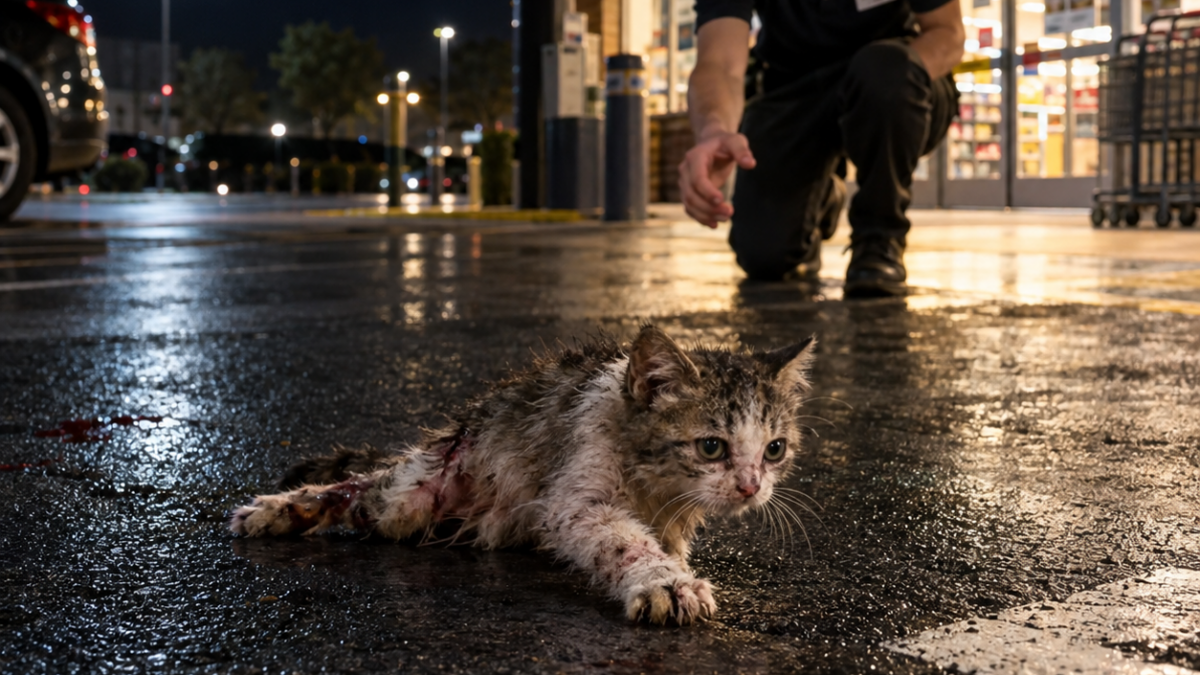
PART3:
From the driveway.
Across the lot.
Toward the light.
Inch by inch.
Using only her front paws.
I felt something inside me go cold.
I do not know what happened to her before that moment. Maybe she had been hit by a car. Maybe someone had left her there. Maybe she had crawled from somewhere nearby after being hurt. I still do not know the whole beginning of her story.
But I know what she did after the worst of it.
She kept moving.
I took off my work hoodie and held it open in my hands.
“I’m going to pick you up,” I whispered, though I had no idea if she understood my words. “Okay? I’m going to help you.”
I expected fear.
Any animal in that much pain has every reason to bite, scratch, panic, and fight. Pain changes the rules. Fear makes even gentle creatures desperate. I was ready for that. I would not have blamed her.
But when I reached for her, she did not fight.
She did not hiss.
She did not claw.
She simply looked at me.
I slid one arm carefully under her chest and wrapped the hoodie around her lower body as gently as I could. The moment I lifted her, I felt how small she was. How light. How fragile beneath all that suffering.
Her body trembled once.
Then she rested her head against my arm.
That was the moment I nearly lost it.
She had dragged herself across a parking lot with two broken legs, through cold and darkness, toward a door she had no guarantee would open. And when someone finally picked her up, she did not fight the hands holding her.
She trusted them.
She trusted me.
“Jenna!” I called, my voice shaking. “Open the door!”
Jenna was already there, one hand over her mouth, eyes full of tears. The doors slid open, and I carried the cat inside. My manager, Mr. Lawson, came out from the back holding the deposit bag, his expression annoyed for half a second before he saw what was in my arms.
His face changed completely.
“What happened?”
“I don’t know,” I said. “She was crawling across the lot.”
He stepped closer, then stopped, unsure how to help without making it worse.
The cat’s eyes were half closed now. She was breathing fast, tiny breaths against my sleeve. Her front paws were scraped. Her claws looked worn down, as if the pavement had filed them away while she pulled herself forward. There were raw places on her belly where the asphalt had rubbed her skin.
Jenna started crying quietly.
“She came to the store,” she said. “She came here.”
Mr. Lawson pulled out his phone.
“Emergency vet,” he said. “Now.”
I looked at him.
“I can take her.”
“You have a car?”
“Yes.”
“Go.”
“I’m still on shift.”
He stared at me as if I had said something ridiculous.
“Clock out later. Go.”
Jenna grabbed a clean towel from the back. We made a little nest in a box used for shipments, but when I tried to place the cat down, she lifted her head weakly and pressed it back against my arm.
I could not leave her in the box.
Not yet.
So I carried her to my car wrapped in my hoodie and the towel, holding her like something breakable and holy.
The drive to the emergency clinic took eighteen minutes.
I remember every red light feeling personal.
I kept one hand near her, touching the towel lightly whenever I could. She made almost no sound. Every few minutes, I said something because silence felt too close to losing her.
“You’re okay.”
“We’re almost there.”
“Stay with me.”
“I’ve got you.”
I did not know if any of it was true.
But I needed her to hear a voice that was trying.
At the clinic, the technician took one look at her and moved fast.
“What’s her name?” she asked.
“I don’t know,” I said.
For some reason, that made my throat tighten.
She did not even have a name yet.
She had a body full of pain, a trail across a parking lot, and no one to claim her.
The technician softened.
“We’ll call her sweetheart for now.”
They took her from me carefully, and the moment her weight left my arms, I felt cold. My hoodie was still wrapped around her. I did not ask for it back. It felt like it belonged to her now.
I sat in the waiting room with my hands shaking.
The fluorescent lights were too bright. A vending machine hummed near the wall. Somewhere behind the double doors, a dog barked once, then stopped. A woman across from me held a carrier in her lap and looked at me with the tired kindness of someone who knew emergency vets were where people met on some of the worst nights of their lives.
Jenna texted every few minutes.
Any update?
Is she okay?
Mr. Lawson says tell us everything.
I had no answers.
After what felt like forever, the vet came out.
She was a woman with calm eyes and the kind of voice people use when they have bad news but refuse to make it cruel.
“She’s alive,” she said first.
I did not realize I had been holding my breath until that moment.
“But she has serious injuries. Both hind legs are fractured. Her pelvis is injured. She has abrasions on her belly and paws from dragging herself. Her front claws are worn down badly.”
I covered my mouth.
The vet continued gently.
“She must have pulled herself quite a distance.”
“She crossed the whole parking lot,” I said.
The vet nodded, and something in her face shifted.
“She wanted help.”
That sentence stayed with me.
She wanted help.
Not in the human way.
Not with words.
But with everything her body had left.
She had moved toward people.
Toward light.
Toward a door.
The vet explained the options. X-rays. Pain control. Surgery. Stabilization. Recovery. Possible complications. The words came in pieces because my brain was still stuck on both hind legs fractured.
Then came the cost.
It was more money than I had ever held at one time.
At nineteen, my bank account was mostly gas money, textbook money, and the fragile hope that nothing expensive would happen before payday. I looked at the estimate and felt my stomach drop.
The vet saw my face.
“We can also contact rescue partners,” she said. “But she needs care quickly.”
I nodded, though I did not know what nodding meant.
“I can’t pay all of this tonight,” I admitted.
Saying it felt awful.
Like I had carried her all that way only to fail at the desk.
The vet did not shame me.
“She’s here now,” she said. “That matters. Let’s make some calls.”
I called Mr. Lawson.
I barely got the words out before he said, “Send me the estimate.”
“I don’t think—”
“Send it.”
So I did.
Five minutes later, the store group chat, usually reserved for schedule swaps and complaints about broken scanners, turned into something I will never forget.
Jenna: I can do $40.
Marcus from produce: I can do $75 Friday.
Mr. Lawson: I’ll cover the emergency exam tonight.
Tanya: I know a rescue group. Calling now.
Drew: Put me down for $100.
Someone else: I’ll share it.
Someone else: What’s her name?
I stared at that question.
What’s her name?
In the waiting room, under lights too bright for midnight, after seeing the blood spot and the trail and the broken little body that had kept moving, only one word came to me.
Hope.
Her name is Hope.
I typed it into the chat.
For a moment, nobody replied.
Then Jenna wrote:
Of course it is.
A local rescue group answered Tanya’s call. They could not cover everything, but they could help raise funds, coordinate with the clinic, and share Hope’s story. Mr. Lawson paid the first emergency costs. Coworkers sent what they could. People who had never met me, never met Hope, began contributing because sometimes a story reaches the part of people that still wants to believe saving one life matters.
By two in the morning, Hope was on pain medication and resting.
The vet let me see her briefly before I left.
She was lying on a soft blanket, eyes half open, body still, finally not dragging itself forward. My hoodie was folded near her like a familiar smell. When I stepped close, her eyes moved toward me.
“Hey, Hope,” I whispered.
Her ear twitched.
“I’m coming back.”
She blinked slowly.
I do not know if she knew me.
I like to think she did.
I went home that night with an empty hoodie sleeve and the smell of clinic disinfectant on my hands.
I did not sleep.
Every time I closed my eyes, I saw her crossing the asphalt.
Pull.
Stop.
Pull.
Stop.
Toward the light.
The next morning, I returned to the store even though I had slept maybe one hour. The parking lot looked ordinary in daylight, which felt wrong. Customers pulled in. Carts rolled. Someone complained about a receipt. The sun shone on the asphalt as if nothing important had happened there.
But I could still see the trail.
Not clearly anymore. The marks were faint. Some had been disturbed by tires and footsteps. But I knew where she had started. I knew where I had found her. I knew where I had lifted her.
Jenna came outside and stood beside me.
“She crossed all this?” she asked.
“Yeah.”
Neither of us spoke for a while.
Then she said, “She’s tougher than anyone I know.”
“She shouldn’t have had to be.”
“No,” Jenna said. “But she was.”
That became the truth everyone carried.
Hope should not have needed to be brave.
But she was.
The rescue group posted her story later that day. They kept the details honest but careful. Injured cat found dragging herself across a parking lot toward a store entrance. Serious fractures. Emergency care needed. Worker who found her named her Hope.
Donations came slowly at first.
Then faster.
Ten dollars.
Twenty.
Five.
A hundred from someone anonymous.
A message from a woman who said her own cat had survived after being hit by a car.
A message from a retired man who wrote, “For the little fighter.”
A message from someone who said, “I don’t have much, but she kept going, so I can help.”
My coworkers checked for updates constantly.
Mr. Lawson pretended not to be emotional and failed.
Jenna printed a picture of Hope from the clinic and taped it inside the break room. In the photo, she looked impossibly small under the blanket, eyes tired but open.
Under it, Jenna wrote:
She made it to us. Now we help her the rest of the way.
That sentence became our promise.
Hope’s surgery happened two days later.
I waited through it at work because I could not afford to miss another shift, but my mind was not at the register. Every beep of the scanner felt far away. Every customer asking ordinary questions reminded me how strange life is. One person can be deciding between brands of cereal while a little cat is under anesthesia fighting for the chance to walk again.
The call came in the afternoon.
The surgery went well.
Both legs had been repaired.
Her pelvis would need time.
Recovery would be long.
But the vet believed she had a real chance to walk again.
I had to step into the stockroom because my eyes filled so quickly I could not see the shelves.
Jenna found me there.
“She made it?” she asked.
I nodded.
Jenna started crying first, which gave me permission.
“She made it,” I said.
When I visited Hope after surgery, she looked smaller somehow, shaved in places, bandaged, exhausted, and deeply unimpressed with the world. But she was alive. She watched me approach. Her eyes were clearer than before.
“Hi, Hope,” I said.
This time, when I placed my hand near her, she moved her head just enough to rest her cheek against my fingers.
That was it.
That tiny motion.
After everything her body had been through, she still chose contact.
I sat beside her for as long as the clinic allowed.
I told her about the store.
About Jenna’s break room sign.
About Mr. Lawson pretending he was only helping because “an injured animal in the parking lot is bad for business,” which nobody believed.
About strangers sending money.
About how many people knew her name now.
She blinked like a queen receiving reports from a very emotional servant.
I visited whenever I could.
Before shifts.
After shifts.
Between classes.
On days when I could only stay ten minutes, I went anyway. At first, I told myself I was visiting because she needed encouragement. But the truth was, I needed to see her too. I needed proof that the small body I had lifted from the parking lot was still here. Still warm. Still fighting.
Recovery was not pretty.
People like rescue stories to move quickly from suffering to sweetness. They like the before picture and the after picture, with the messy middle softened or skipped. But Hope’s middle was hard.
She hurt.
She was tired.
She had to be handled carefully.
There were medications, bandage checks, restricted movement, follow-up X-rays, and days when progress seemed too small to measure.
Sometimes she looked at me with eyes that seemed to ask why her body still would not do what she wanted.
I had no answer.
So I gave her the only thing I could.
I kept showing up.
“Remember the parking lot?” I whispered once. “You crossed that whole thing. This part is hard, but you don’t have to cross it alone.”
A vet tech overheard me and quietly turned away, wiping her eyes.
The first time Hope stood with assistance, everyone in the clinic acted professionally for about three seconds.
Then someone cried.
Her back legs trembled. Her paws did not land perfectly. Her body wobbled. She sat down quickly, exhausted by the effort.
But she had stood.
The vet smiled at me.
“That’s a very good sign.”
Hope looked offended by all the attention.
I laughed for the first time in days.
“There she is,” I said. “That’s my girl.”
My girl.
The words came out before I planned them.
Once they existed, I could not take them back.
I had been trying not to get ahead of myself. Trying not to assume. Trying to be practical. Hope’s medical care was still ongoing. Her future was not guaranteed. A rescue group was officially involved. Adoption would need approval. My apartment was small. My schedule was busy.
But the truth had been forming since the parking lot.
Maybe since the moment she rested her head on my arm.
I wanted her.
Not because she was easy.
Not because the story was touching.
Not because people online were calling me a hero, which made me uncomfortable every time.
I wanted her because she had crawled toward the light, and I had been lucky enough to be standing there when she arrived.
I wanted to be the person who stayed after the emergency ended.
A few weeks later, the rescue coordinator met me at the clinic.
Her name was Elise, and she had the calm, tired energy of someone who had seen too much cruelty and still answered the phone.
“You’re serious about adopting her?” she asked.
“Yes.”
“She may need long-term care.”
“I know.”
“She may walk differently.”
“That’s okay.”
“She may have arthritis later. She may need more vet visits than a typical cat.”
“I understand.”
Elise studied me carefully.
“You’re nineteen.”
“I know.”
“That’s young for a commitment like this.”
“I know that too.”
She did not say it unkindly.
She was doing her job.
I respected that.
So I told her the truth.
“I can’t explain it perfectly,” I said. “But she came to our door. She kept going until someone saw her. I saw her. I don’t want to be just the person who found her. I want to be the person she gets to come home to.”
Elise’s expression softened.
“That,” she said, “is a better answer than most adults give.”
Hope came home six weeks after the night in the parking lot.
By then, I had prepared my apartment like a nervous parent. Low-entry litter box. Soft bedding. Food and water. Medication chart. Restricted space. No high furniture access. A little ramp I built badly and rebuilt better after watching three videos and asking Mr. Lawson for help with tools.
Jenna came over with a welcome-home toy.
Mr. Lawson sent a gift card for pet supplies and claimed it was from the store, though the envelope was in his handwriting.
The rescue group sent instructions.
The clinic sent records.
Hope arrived in a carrier lined with the same hoodie I had wrapped around her that first night.
I had washed it, but somehow it still felt like part of the story.
When I opened the carrier door, Hope did not rush out.
She looked around.
Sniffed.
Took one careful step.
Then another.
Her back legs moved awkwardly, but they moved.
I held my breath.
She crossed the small space from the carrier to the blanket.
Not dragging now.
Walking.
Unsteady.
Slow.
Alive.
When she reached the blanket, she turned in a careful circle, lowered herself down, and looked at me.
I sat on the floor.
“You made it,” I whispered.
Hope blinked.
Then, very slowly, she stretched one front paw forward and placed it on my knee.
I cried harder than I had cried in the parking lot.
Because this time, I was not crying from fear.
I was crying because she was home.
The first months were full of small victories.
Hope taking five steps without sitting.
Hope using the litter box without help.
Hope batting weakly at her toy mouse.
Hope discovering sunlight.
Hope purring loud enough to be heard across the room.
Hope deciding that my pillow was actually our pillow.
Her walk never became perfect.
It became hers.
A little uneven.
A little careful.
Sometimes stiff after naps.
Sometimes surprisingly quick when food was involved.
The vet had warned me recovery would not be a straight line, and it was not. There were days when she moved less. Days when I worried over every limp. Days when medication felt impossible and Hope expressed her opinions with dramatic betrayal.
But there were more good days.
Many more.
She learned my schedule.
She waited near the door when I came home from work. Not always standing. Sometimes sitting, sometimes lying comfortably like she wanted me to know she was not desperate, merely available for worship.
I called her name, and her ears lifted.
“Hope.”
It fit her better every day.
Not because she was always brave.
Not because she was some perfect symbol.
Because hope is not the absence of pain.
Hope is movement while pain is still there.
Hope is pulling yourself one more inch across the dark because somewhere ahead, there might be light.
Hope is accepting the arms that lift you when your own body has carried you as far as it can.
Hope is healing slowly and still reaching for affection.
Hope is a tiny cat with repaired legs learning that the floor beneath her is safe.
The store never forgot her.
For a long time, customers who had heard the story would ask, “How’s the parking lot cat?”
I always said, “Her name is Hope.”
Then I would show a picture.
Hope in the sun.
Hope on her blanket.
Hope glaring at her medication.
Hope sitting beside the badly built ramp as if questioning my craftsmanship.
The coworkers who helped save her became part of her extended family. Jenna visited often. Marcus from produce, who insisted he was not an animal person, bought Hope treats shaped like tiny fish. Mr. Lawson kept her picture in the office, though he pretended Jenna had put it there against his will.
One night, months later, I was closing again.
Same store.
Same buzzing lights.
Same smell of floor cleaner and cardboard.
I stepped outside after locking the door and looked across the parking lot.
The asphalt had no trace of that night anymore.
Rain had washed it.
Cars had crossed it.
People had walked over it without knowing.
The blood spot was gone.
The scrape marks were gone.
But I could still see the path.
From the driveway.
Across the dark.
Toward the entrance.
Toward the light.
I stood there for a long time.
At nineteen, I had thought being brave meant not being scared. Hope taught me something else. She was not fearless that night. She must have been terrified. She must have hurt more than I could imagine. Every inch must have cost her something.
But courage is not a feeling.
It is a direction.
Hers was toward the light.
When I got home, Hope was waiting on the rug by the door.
She rose slowly, stretched, and came toward me with her uneven little walk.
I crouched.
She pressed her head into my hand.
“You still coming toward me?” I whispered.
She purred.
I thought about the first time I lifted her. How she had rested her head against my arm like she understood she did not have to keep going alone.
Now she did not.
She would never have to cross a parking lot alone again.
She had a soft bed.
A full bowl.
A name.
A home.
And when her body ached, there were hands that knew how to help. When she was tired, there was a place to rest. When she moved slowly, no one rushed her. When she stumbled, it did not mean she was failing.
It meant she was still here.
Still trying.
Still Hope.
Sometimes people say, “You saved her.”
I understand why.
I picked her up. I drove her to the clinic. I asked for help. I brought her home.
But the truth is, Hope started saving herself before I ever opened those doors.
She was the one who moved.
She was the one who refused to stop in the dark.
She was the one who saw light and pulled herself toward it.
All I did was meet her there.
And maybe that is what rescue really is sometimes.
Not one person becoming a hero.
Not one dramatic moment that erases all the pain.
But two lives meeting at the edge of what one of them can survive alone.
She came as far as she could.
Then I carried her the rest of the way.
Hope is sleeping beside me now as I write this, curled in a soft blanket near the window. Her back legs twitch sometimes when she dreams. I like to imagine she is running in those dreams, not from anything, but toward something bright and warm and safe.
Outside, cars pass.
Their lights move across the wall.
She does not wake.
That feels like a miracle.
A quiet one.
The kind no one sees unless they know the story.
Just before midnight, in a dark parking lot, a broken little cat dragged herself across cold asphalt because somewhere ahead, a store entrance was still glowing.
Her body told her to stop.
Pain told her to stop.
The darkness must have felt endless.
But she kept moving.
And someone saw her.
That is the part I carry with me.
Not just that she was hurt.
Not just that she survived.
But that even at her weakest, Hope moved toward the possibility of kindness.
And when she reached it, kindness opened the door.








