She Came to the Ranch With Nothing but a Job to Hold On To—Then Two Brothers Began Looking at Her Differently
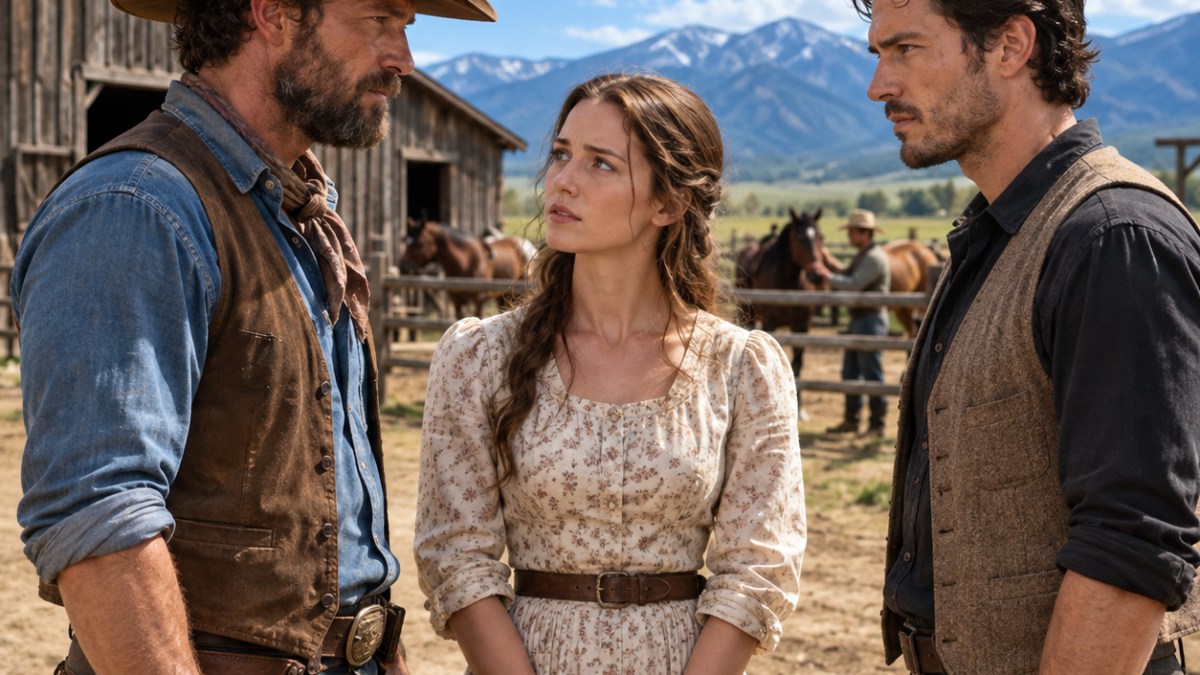
PART3:
“It suits me.”
“Reverend says you cooked at the Granger Hotel.”
“Two years.”
“And for your mother’s household since.”
“Three years.”
“You can handle ranch meals?”
“I can handle hungry men who think hunger makes them interesting.”
This time, the smile appeared fully.
Briefly.
“I can see that.”
I learned later that from Thomas Callaway, those four words counted as high praise.
I started Wednesday.
The kitchen had once been a good room.
I knew that immediately.
The stove was placed right. The worktable caught morning light. The pantry shelves were deep and cool. The water pump outside stood close enough for sense and far enough from mud. Whoever arranged it originally understood the rhythm of feeding a household.
Two months without a proper cook had not ruined it.
Only confused it.
Skillets hung where ladles should be. Flour sat too near the stove. Knives had been sharpened but placed carelessly. Dried herbs were kept in jars without labels because men who do not cook often believe all green things announce themselves by moral character.
I reorganized everything.
Without asking.
By noon, the same kitchen held the same tools, but the room had begun breathing properly again.
Thomas came in, stopped, looked around, poured coffee, and left without comment.
I took it as approval.
William came in ten minutes later and stopped in the doorway.
“You moved everything.”
“It makes more sense this way.”
He picked up a skillet, glanced toward the stove, and set it down again.
“It does.”
A pause.
“Margaret kept it the way Mother had it.”
I looked at him carefully.
“I did not mean disrespect.”
“No.”
His voice softened.
“I think Mother would have done it this way herself if she had started over.”
Then he left before I could decide whether I had been complimented or tested.
I decided compliment.
Richard ate breakfast at six, dinner at noon, supper at six, and outside those hours he was nearly never in the house.
He was not rude.
Rudeness would have been easier.
He said thank you when I placed food near him. He cleaned his plate. He moved out of my way without making me ask. If I needed wood brought in, he brought it before I finished noticing the box was low. If the pump handle stuck, he fixed it. If the pantry door creaked, it stopped creaking by morning.
But warmth?
No.
Not from Richard.
At first, I read him as indifferent.
Then I noticed he ate slower when I made something new.
I noticed he always took the slightly burned biscuit from the edge of the tray so no hand would complain about it.
I noticed he listened.
Not like William, who listened openly, cheerfully, asking questions and filling the kitchen with talk.
Richard listened as if he had taught himself not to be caught needing anything from what he heard.
The first almost-smile came in the barn.
I had gone there to ask where Thomas preferred extra sacks of flour stored against damp. Richard was mending a saddle, a young gelding leaning over the stall door and nudging at my apron pocket as if I had arrived carrying a legal obligation to provide apples.
“Don’t encourage him,” Richard said without looking up.
“I haven’t done anything.”
“That’s how he gets you.”
The horse pushed at my hand again.
“He seems to have learned persistence somewhere.”
Richard glanced at me.
For one second, something like amusement touched his face.
Then he put it away.
That became Richard’s way.
A feeling would appear, realize it had been seen, and retreat at once.
At the end of my first week, I made ginger biscuits.
Extra.
Not because of him, I told myself.
Because ranch hands appreciated variety.
Because ginger settled the stomach.
Because I had found a jar of molasses pushed too far back in the pantry.
Because any reason except the truth, which was that I had seen Richard pause outside the kitchen three evenings in a row when sweet baking cooled on the sill, and I knew a man who did not ask for things might still want them.
I left a plate on the barn worktable.
That evening at supper, Richard said without looking at me, “The ginger biscuits were good.”
The entire table seemed to pause, because apparently Richard offering a direct compliment was an event of local significance.
“Thank you,” I said.
He looked at me then.
Only briefly.
I filed the moment carefully and did not draw conclusions.
William drew conclusions from everything and announced half of them before breakfast.
He came into the kitchen most mornings before Thomas and Richard, poured coffee, and talked while I cooked. Not nervous talk. Not the meaningless chatter of men uncomfortable with silence. William was simply interested in the world and did not see why interest should be hidden.
He talked about cattle, weather, a horse he was training, a broken wagon axle, a neighboring rancher who cheated at cards but badly enough to be forgiven, and the north range where wildflowers came in thick each May.
“You don’t talk much,” he observed one morning.
“You talk enough for both of us.”
He laughed.
It was a real laugh.
Unprotected.
The kind that made the room warmer whether I wanted it to or not.
“What are you thinking about?” he asked.
“The bread.”
“You always say the bread.”
“I am often thinking about bread.”
“Always?”
I turned the dough beneath my hands.
“Not always.”
He went quiet.
For once, he understood enough not to ask.
That silence was louder than his talking had been.
I found out about Richard by accident.
It was before dawn in my second week. I had gone to the garden to cut early herbs and was returning by the barn when I heard his voice.
Not instructing.
Not cursing.
Talking.
Low and rough, speaking to a horse the way I had spoken to my mother in her final months when she was too tired to answer but needed to know she was not alone.
“I know he’d do the same for either of us,” Richard said.
A horse shifted.
“I know that. I know it.”
A pause.
“It doesn’t change anything.”
I stopped behind the corner of the barn, basket in my hands.
“William never had to know if he belonged here,” Richard continued. “Never had to wonder. I wonder every morning.”
His voice dropped.
“And I don’t know when I’m going to stop.”
I backed away.
Slowly.
Quietly.
I went around the long side of the barn and returned to the kitchen as if I had heard nothing.
But I thought about it all morning.
The particular loneliness of wondering whether you belong in a place that has already told you that you do.
I understood something about that.
My mother’s house had been a fixed point for years. Hard, exhausting, grief-filled, yes, but mine. Then she died, and the fixed point disappeared. People said I was free now, as if freedom and not belonging could not wear the same face.
Richard was fighting something no one else in that family could see clearly because none of them knew where to look.
I said nothing.
It was not mine to reveal.
April became May.
Montana spring arrived in pieces: cold mornings, warm afternoons, mud drying into dust, the valley turning a green no painter could keep honest. The kitchen became mine, not by conquering it but by inhabiting it. Bread rose. Coffee waited. The men ate better and complained less, which Thomas claimed was proof of civilization advancing.
William came earlier every week.
“Breakfast is not served until six,” I told him one morning when he appeared before dawn.
“I know.”
“It is five-thirty.”
“I like being prepared.”
“You like talking while I cook.”
“That too.”
Thomas caught him three mornings in a row and finally said, “You’ve developed a surprising interest in breakfast.”
“I’ve always liked breakfast.”
“Not at five-thirty.”
Then Thomas poured coffee and left the observation to sit there like a loaded rifle.
I worked very hard not to laugh.
William asked me to ride out to the north range on a Sunday.
The wildflowers were in, he said. Supper did not need to be started until late. Thomas could survive a cold plate at noon if history demanded it.
Richard had come into the kitchen just before him.
I remember that now.
At the time, I saw only William in the doorway with hope made casual on his face.
“Would you like to see them?” he asked.
I looked down at my hands.
For three years, every decision had been shaped by my mother’s needs. Before that, by hotel work. Before that, by family duty. It felt strange to be asked what I would like simply because someone wanted to know.
“Yes,” I said.
Richard said nothing.
I did not notice him leave.
I regret that sometimes, though regret is not always proof that a different choice would have been kinder.
The north range was everything William promised.
The valley opened along a creek, wildflowers moving in yellow, white, and pale purple sheets beneath the May wind. The Bitterroot peaks held snow along their shoulders. Our horses stood hipshot in the grass as if they too understood beauty and meant to take their time with it.
“You were right,” I said.
“I usually am.”
“Are you?”
“About important things. Unimportant things I get wrong constantly.”
“Such as?”
“Weather predictions. Horse trading. Whether patience is worth practicing before I absolutely must.”
“And the important things?”
He looked at me.
“People.”
The wind moved between us.
“I’m usually right about people.”
I thought of his laughter.
His questions.
His steadiness that never needed to be hidden.
“What do you think of me, then?” I asked.
His expression changed.
Careful now.
“Someone who has spent years being needed and has not yet decided what she wants now that she is allowed to want something.”
I looked away toward the flowers.
That was far too accurate.
“Do you always say things like that on Sunday rides?”
“No. Usually I talk about cattle.”
“Safer.”
“Much.”
A little later, he said, “I want to ask you something, and I want you to tell me honestly if the answer is no.”
I turned back.
“Would you let me court you properly? Not because you work here. Not because you are alone. Because I would like to know you better than this ranch gives me occasion to.”
My first feeling was fear.
Not of William.
Of wanting.
Wanting after grief feels disloyal at first, as if joy has arrived too early and found you underdressed.
But my mother was gone.
And before she died, on one of her clearer mornings, she had gripped my hand and said, “Do not make a shrine of my sickroom.”
I had not understood.
I did then.
“Yes,” I said.
William’s smile came slowly, like sunrise over a field.
We rode back different.
Not publicly.
Nothing changed enough for the hands to gossip with confidence.
But something had been named.
And once named, it began growing.
What grew between William and me was not fast.
It grew like the kitchen garden, with attention and the patience of someone who knew rushing would ruin the thing. We rode Sunday mornings. He told me the ranch’s history, not merely its acreage. The year Thomas bought the first parcel. The drought of 1880. The winter that nearly took half the herd. His mother Eleanor’s roses that never survived but were replanted every year because she disliked surrender in all forms.
I told him about my mother.
How she had taught school for twenty years and remembered every child’s name even when she forgot what day it was near the end.
How she refused to write down her bread recipe because “a recipe you have to read is one you have not learned properly.”
“Is it written anywhere?” William asked.
“In my head.”
“You are the most stubborn woman I have ever met.”
“That is probably accurate.”
He smiled, and I found I liked being known without being managed.
Richard watched.
I learned that later.
At the time, I sensed distance but not pain. He still came to meals. Still thanked me. Still repaired what needed repairing. But he withdrew further into work, and because Richard’s work had always been his refuge, no one noticed quickly enough that he had begun using it as a hiding place.
He fixed three things that needed fixing and started a fourth that did not.
He spent more time in the barn.
He spoke less at table.
William, happy and distracted, missed it.
Thomas, who saw more than he said, did not.
Neither did I, though I understood only pieces.
The trouble with buried wounds is that they rarely announce themselves as wounds.
They come out sideways.
Through small omissions.
Through silence.
Through a word left unfinished.
Through a rumor repeated by a man who tells himself it is not quite a lie.
The Henderson parcel began it.
Eighty acres east of the Callaway boundary, with a creek tributary that would improve water access and secure grazing in dry years. Old Henderson had died without heirs, and the land became available sooner than anyone expected.
Thomas called both sons into the office.
I was not present, but kitchens have ears when office doors sit too near them.
The purchase meant selling spring cattle earlier than planned, taking current prices instead of waiting for fall, and delaying wages for both brothers until later in the season.
William agreed immediately.
Richard agreed too.
More slowly.
At supper that night, he was quiet in a way even William noticed.
“You against the Henderson purchase?” William asked.
“No.”
“You sound against it.”
“I agreed.”
“Agreement can still sound like a funeral if you manage it correctly.”
Richard looked at him.
“Then stop holding services over my tone.”
William laughed, but the matter did not dissolve.
A few days later, Richard said something to Harlan Cooper, who ran the neighboring Grayson place and talked more than wisdom permitted. Richard mentioned that William was negotiating for the Henderson parcel.
Not false.
But incomplete.
William had gone as the family representative, with Thomas’s full authority.
Richard left that part unsaid and let the wrong impression form.
That wrong impression reached the estate man.
Then the county recorder.
Then Thomas.
The sale did not collapse.
Thomas corrected it.
But something sour entered the house.
At dinner, William explained plainly. Thomas believed him.
Immediately.
Richard looked at his plate.
I poured coffee and said nothing.
Not because I saw the full shape.
Because I saw enough to know words from me would not help yet.
I wish that had been the end.
It was not.
Richard wrote an unsigned note to the Henderson estate representative, implying the Callaway finances were not sound, that another buyer might close faster, that waiting on the family could be a mistake.
That note delayed the purchase nearly two weeks.
Thomas had to prove his own solvency to a stranger over a deal already settled in principle.
He did it.
But humiliation is not made smaller because it is survived.
The bank clerk in Missoula revealed the note’s odd wording to Thomas, including a phrase about the spring cattle sale that matched something Richard had said at dinner.
Thomas said nothing at first.
But one evening, across the supper table, he looked at Richard in a way that made Richard go pale.
I had seen Thomas stern.
I had seen him displeased.
This was worse.
This was grief finding anger’s clothes.
The next morning, Thomas found Richard in the barn before the hands were up.
I was in the kitchen with bread in the oven and the door cracked for air. Their voices carried only in pieces.
“The note to Henderson was you.”
“Yes.”
“You nearly cost this family land your grandfather’s water rights should have included forty years ago.”
Silence.
“Over what, Richard? Tell me plainly, because I find I don’t understand it, and I have known you most of your life.”
Richard answered so low I had to stop breathing to hear.
“I don’t entirely understand it myself.”
Then louder.
“I’ve been telling myself twenty years that I don’t belong here the same way William does. I know it isn’t true. Knowing hasn’t ever been enough.”
The kitchen blurred.
Thomas was quiet a long time.
Then he said, “You are my son. Same as him. That was decided the day we took you in, and it was never something you had to earn twice.”
“I know that.”
Richard’s voice broke on the next part.
“I’ve never once managed to believe it.”
I stood with both hands on the worktable, flour under my palms, and felt an ache so old it could not have belonged only to him.
Thomas said, “Then we had better find a way to fix that. Because I will not lose another season to this.”
A pause.
“But Henderson deserves an apology from you directly. So does your brother.”
Two days later, Richard came through the kitchen door.
The kitchen door.
He never did that. He used the side entrance near the boot room, practical as breathing. To come through my kitchen was to ask for something he did not know how to ask.
I turned from the stove.
“Richard?”
He stood just inside, hat in his hands.
“I need to tell you something.”
So he did.
Not all of it.
Not at first.
But enough.
The rumor.
The note.
The voice in his head that had told him for twenty years he was less truly a son than William. The way being taken in after his parents died had become a gift he never stopped feeling he had to earn. The way Thomas’s love, real as it was, had not erased the missing paper, the missing certainty, the missing moment when someone official said you belong here every bit as much as the child born in the next room.
I listened.
Completely.
That was something my mother’s illness taught me: do not rush to comfort a truth because the truth may need air before it needs a blanket.
When he finished, he looked ashamed in a way I did not know how to bear.
“You need to tell William,” I said.
His jaw tightened.
“I know.”
“Not me. Me is not enough.”
“I know.”
He looked around the kitchen, at the organized shelves, the bread cooling beneath cloth.
“My mother used to bake Thursday mornings.”
I knew he meant Eleanor.
Not the mother who had birthed him.
The mother who had taken him in.
“She was a good woman,” I said.
“How do you know?”
“Because of how she arranged this kitchen.”
He frowned slightly.
“You can tell a great deal about a person by how she arranges a kitchen.”
For the first time in weeks, something almost gentle crossed his face.
Then he went to find his brother.
I did not hear the whole conversation.
Only William’s voice once, raised but not shouting.
The sound of a man choosing not to become angrier than he had already decided was fair.
Richard’s voice came lower.
Steadier.
Then nothing for a long while.
When William came into the kitchen an hour later, he did not talk.
That frightened me more than anger.
He sat across from me at the table.
“He told me everything.”
“I know some of it,” I said. “Not all.”
“Twenty years,” William said.
He stared at his hands.
“I grew up in the same house as that voice and never heard it.”
I reached across the table and covered his hand with mine.
“You cannot know what someone is not saying.”
His fingers turned under mine.
“No. But I can ask going forward.”
“That is not nothing.”
“No,” he said. “It is not nothing. It is also not enough by itself.”
I loved him for that answer.
Not because it was easy.
Because it was honest.
The summer became a season of difficult truth.
Richard rode to Milbrook and apologized to the Henderson representative directly. It cost him far more than writing the note had. Cowardice is often quick. Repair takes time.
He apologized to William, not once in a dramatic speech, but repeatedly in choices. He stopped leaving half-truths where suspicion could grow. He asked for clarification instead of assuming exclusion. He worked beside William without turning every decision into evidence of old fear.
Thomas did not turn him out.
He also did not pretend the matter was small.
He and Richard had conversations I was not part of and did not ask about. I could see their traces at breakfast: Thomas looking worn but lighter, Richard looking like a man who had spent the previous evening hearing hard love and surviving it.
One morning, Richard came early while I kneaded dough.
“The voice doesn’t just stop,” he said.
I did not ask which voice.
“I imagine not.”
“Some days I say it out loud and it sounds foolish. Other days it still sounds true.”
“Some days is a beginning.”
He looked at me.
“You believe that?”
“Yes.”
“Because of your mother?”
I pressed my palms into the dough.
“Because after she died, people told me I was free. Some days that felt true. Some days it felt like I had been cut loose from the only place I belonged. Both were real.”
Richard sat quietly.
Then said, “You understand more than is convenient.”
“So I’ve been told.”
The Henderson purchase closed in August.
Thomas insisted both sons’ names appear beside his on the deed. Richard asked for that himself, though Thomas had always intended it. The asking cost him something. The receiving gave something back.
Not everything.
Belonging does not become unbroken because ink dries on paper.
But it gave him a place to begin believing what had always been true.
William waited until October to ask me properly.
He took me back to the north range on a cold, clear morning. The wildflowers were gone. The hillside had turned brown beneath early snow. The creek ran silver below us. The peaks were hard white against the sky.
“It looks different now,” he said.
“You promised me wildflowers.”
“I promised the north range. The flowers were only passing through.”
I looked at him.
“That sounds like something you practiced.”
“Several times.”
“Did it sound better in rehearsal?”
“No.”
I laughed.
He dismounted and helped me down. His hand stayed around mine after my boots touched ground.
“I told you in May I wanted to ask something properly,” he said. “I have had all summer to think about exactly how, and I find I still have nothing better than the plain truth.”
I waited.
The wind moved cold around us.
“I love you, Elena. Not only for the bread, though I admit the bread helped.”
I smiled, but my eyes filled.
“I love the way you make a room honest by entering it. I love that you do not rush to comfort what needs to be spoken. I love that you rebuilt our kitchen without asking and somehow helped rebuild the rest of us too.”
His voice shook slightly.
“Will you marry me?”
I looked over the valley.
Brown now where it had been gold.
Quiet where it had once been full of flowers.
I thought of my mother telling me not to make a shrine of her sickroom.
I thought of Eleanor Callaway’s kitchen.
I thought of Richard’s voice finally named.
Thomas’s stern kindness.
William at five-thirty breakfast, pretending hunger had brought him.
I thought of work becoming belonging.
“Yes,” I said.
William exhaled like a man who had been holding his breath since spring.
We married in November, the first Saturday after fall work ended.
The church in Milbrook was small, whitewashed, and cold enough that everyone kept their coats on until the preacher began. Thomas gave me away. It was not the usual arrangement, but I had no family left, and when he offered, I understood it was not only practical.
“You came here with a letter,” Thomas said before we walked inside. “Seems right you stand with family now.”
I could not answer.
So I took his arm.
Richard stood as witness.
I had asked him myself in the kitchen.
“You could ask one of the hands,” he said, holding his coffee cup too carefully.
“I asked you.”
He looked away.
Then nodded.
“All right.”
After the ceremony, in the churchyard beneath low November light, Richard approached me while William spoke with Thomas near the wagon.
“Be good to him,” Richard said.
“I will.”
He nodded and turned.
“Richard.”
He stopped.
“He is going to be good to you too.”
His shoulders went still.
“He already has been,” I added.
For a long moment, he looked toward the Bitterroot Range rising beyond town.
Then he said, “I know.”
And walked back toward Thomas.
Spring returned as it always does, unconcerned with how much people change during winter.
Cold mornings softened into warm afternoons. The garden woke. The Henderson cattle crossed into pasture that now belonged to Callaway land by deed and by work. The kitchen smelled of bread on Thursdays because I had kept my mother’s rhythm and Eleanor’s room had made space for it.
William came in one morning talking before he cleared the doorway.
“Elena, I’ve been thinking—”
“That is rarely quiet.”
“—that the south pasture rotation may need adjusting if the creek runs high.”
He reached toward the bread cooling on the table.
I swatted his hand away without looking.
“Too hot.”
He sucked his fingers anyway.
Richard sat at the table with coffee.
“You’ve been married six months,” he said. “You should know better by now.”
“Marriage has not improved my judgment,” William said.
“Nothing has,” Thomas added from behind his newspaper.
I laughed so hard I had to set down the knife.
After a moment, Richard laughed too.
The real kind.
Unguarded.
The sound filled the kitchen and stayed there.
That was when I understood fully what had happened that year.
I had come to the Callaway Ranch looking for work.
I found a kitchen.
Then wages.
Then a place at the table.
Then William’s love.
But I also found a family carrying a silence so old they had mistaken it for structure.
Thomas had loved Richard like a son but had not known love sometimes needs saying in the exact language fear understands.
William had trusted his brother but had not known trust must sometimes ask where someone hurts.
Richard had belonged all along but had not known how to believe belonging without proof he could hold.
And I, who thought I had lost the only place that needed me, learned that being needed is not the same as being trapped.
Some work feeds bodies.
Some feeds futures.
Some, if you are blessed and brave enough to stay through the hard part, feeds the empty rooms people stop admitting they have.
The Callaway kitchen became the center of our house again.
Not mine alone.
Not Eleanor’s ghost alone.
Ours.
Thomas reading ledgers at one end of the table.
Richard drinking coffee in the morning quiet.
William stealing bread too early.
Hands coming in hungry.
Children later, with flour on their cheeks and questions no adult could answer properly.
And me, standing at the stove, no longer wondering whether a woman could begin again after grief.
She can.
But not by forgetting.
By carrying forward what taught her how to love, and allowing new love to meet her there.
Years later, people still told the story simply.
Elena Marsh came looking for work.
Both Callaway brothers fell in love with her.
She married William.
That version was true, as far as it went.
But it missed the heart of it.
Richard’s love was not a villain’s love.
It was quiet, painful, restrained, tangled in a wound that existed long before I arrived. He cared for me, yes. I knew that eventually. William knew too. So did Thomas. So did Richard, though he would rather have mended every fence in Montana than say it plainly.
But love is not owed a future simply because it is real.
Richard understood that before most men would have.
He did not try to take what William and I chose. He did not turn his hurt into cruelty once the truth came out. His worst mistakes came from old fear about belonging, not from loving me. And when that fear was named, he did the harder thing.
He stayed.
He apologized.
He became honest.
He let himself be loved by the family that had been loving him all along.
That is its own kind of happy ending.
Not the kind songs prefer.
The kind life often requires.
William and I built our marriage one ordinary morning at a time. We argued. We laughed. We lost cattle. We raised children. We returned to the north range every May when the flowers came in, and every October when they were gone, because beauty matters both when it blooms and when it teaches you what remains after.
Sometimes he would ask, “Do you regret coming here?”
I always answered the same way.
“I regret the grief that sent me.”
Then I would look toward the kitchen, the barn, the table, his father, his brother, whatever child was tracking mud across my clean floor.
“But not where I arrived.”
Because that is the truth.
I came with a carpetbag.
A letter.
A practiced composure.
A heart too tired to know what it wanted.
I thought I had come to cook for a ranch that needed feeding.
Instead, I found a family that needed truth.
And somehow, while I was kneading bread, pouring coffee, listening at the right moments and speaking at the harder ones, that family made room for me too.
Not as the cook Reverend Hail sent.
Not as the woman both brothers noticed.
As Elena Callaway.
The woman who came looking for work and found, at last, a place where she belonged.








