She Brought Her Quiet Grandfather to Boot Camp Graduation—Then the Command Sergeant Major Left the Reviewing Stand
PART3:
She stayed.
At seventeen, when she told him she was joining the Army, Buford was silent for so long she thought he disapproved.
Then he said, “Make sure you know why.”
“That’s it?”
“That’s most of it.”
“You’re not going to tell me whether I should?”
“No.”
“Why?”
“Because you’re the one signing.”
She had laughed.
Now, on graduation morning, the empty section of bleachers designated for Second Platoon families bothered her more than she wanted to admit.
Formation discipline prevented her from searching constantly.
She searched anyway.
Small movements.
Eyes only.
No Grandpa.
Maybe parking was slow.
Maybe Grandma changed her mind and came.
Maybe the old truck overheated.
Then the drill sergeant barked a correction down the line.
Kira snapped forward.
At the gate, Fairchild gestured toward a younger soldier.
“Walk Mr. Gant to overflow.”
Buford lifted his bag again.
The private said quietly, “Sir, I’m sorry about the mix-up.”
Buford looked at him.
“No mix-up.”
The private frowned.
“The list says what it says.”
“You’re not upset?”
“Would it change the list?”
“No, sir.”
“Then seems like wasted energy.”
They walked.
Buford moved slowly.
Not weakly.
There was a difference.
His right shoulder did not rotate properly, so he turned his entire body slightly when he needed to change direction.
The private noticed.
“Should I carry that?”
Buford looked at the canvas bag.
“No.”
“It looks heavy.”
“It isn’t.”
The old man’s grip tightened on the reinforced handle.
The private understood the answer had nothing to do with weight.
“Yes, sir.”
The overflow viewing area sat behind the main bleachers.
Technically, Fairchild had told the truth.
You could still see the parade field.
If you stood.
If nobody taller moved in front of you.
If a family with balloons did not arrive.
The folding chairs were arranged in uneven rows beneath partial shade.
Buford chose one near the aisle.
He placed the bag on his lap.
Then checked his watch.
10:58.
Final review scheduled 11:40.
Forty-two minutes.
Enough.
He looked at his phone.
One missed call.
Ruth.
He called back.
His wife answered immediately.
“You there?”
“I’m here.”
“Good seat?”
Buford looked past two folding chairs, a trash can, and the corner of a portable restroom toward the distant field.
“Chair works.”
“That wasn’t my question.”
He smiled.
After fifty-four years, lying to Ruth remained nearly impossible.
“Had a manifest issue.”
“A what?”
“My name wasn’t listed.”
Silence.
Buford knew that silence.
“Buford.”
“It’s handled.”
“They put you outside, didn’t they?”
“Not outside.”
“Where?”
“Ruth.”
“Where?”
“Overflow.”
“Oh, for heaven’s sake.”
“It’s fine.”
“You drove six hours.”
“Five and forty-five.”
“That is not helping.”
Buford smiled again.
“Ceremony hasn’t started.”
“You call me when it does.”
“I will.”
“And you better see that girl march.”
“I will.”
“How?”
“I have eyes.”
“One of them needs stronger glasses.”
“Goodbye, Ruth.”
“I love you.”
“Love you too.”
He ended the call.
A woman seated nearby had overheard enough to understand.
She leaned over.
“You came alone?”
“My daughter-in-law’s parking.”
“Your granddaughter graduating?”
“Yes.”
“You must be proud.”
Buford looked toward the formation.
“Yes.”
The woman smiled.
“My son is First Platoon.”
“Good day.”
“Very.”
She nodded toward the canvas bag.
“Were you military?”
Buford looked down.
“Once.”
“What branch?”
“Army.”
“How long?”
“Long enough.”
She laughed softly.
“My husband answers questions like that.”
Buford smiled.
Conversation ended naturally.
That was how he preferred it.
Twenty minutes later, Fairchild walked through overflow.
Not because Buford required anything.
Because some part of him wanted to confirm the old man had accepted the situation.
He was explaining seating rules to another family when he noticed Buford still holding the bag.
Fairchild stepped toward him.
“Everything okay here?”
Buford nodded.
“Fine.”
Fairchild glanced toward the sky.
The flag near the reviewing stand hung almost motionless.
Heat shimmered above the pavement.
Buford said, “You should move the color guard up about twenty feet.”
Fairchild stared.
“Excuse me?”
“Wind’s going to back northeast.”
Fairchild looked toward the flag.
“What wind?”
“Not here yet.”
Fairchild almost smiled.
The old man had apparently moved from Army veteran to weather forecaster.
Buford continued.
“About forty minutes.”
“What happens in forty minutes?”
“That flag starts fighting the formation if they stay where they are.”
Fairchild glanced at his watch.
11:04.
He looked up.
Blue sky.
A few distant clouds.
Nothing.
“Appreciate it.”
He walked away.
Buford watched him go.
No offense.
People ignored information for many reasons.
Rank.
Age.
Habit.
Sometimes the person delivering it did not look like someone worth listening to.
Buford had learned that half a century earlier.
At 11:20, a recruit collapsed.
He stood three companies away.
The heat had been building steadily.
The recruit swayed once.
Recovered.
Swayed again.
Then folded sideways.
The formation around him reacted.
Hands caught him.
Commands snapped.
“Medic!”
Fairchild moved instantly.
Training took over.
Families murmured.
A young corporal near overflow stepped forward, craning his neck.
Buford watched.
He could not cross that distance quickly anymore.
His right knee would not tolerate running.
The shoulder was worse.
But his eyes still worked.
So did his mind.
The medics laid the recruit down.
One slid something beneath his head.
Another began cooling measures.
Buford frowned.
“Corporal.”
The young soldier looked over.
“Sir?”
“Tell them to elevate his legs.”
The corporal hesitated.
“Sir?”
“Legs. Not the head.”
The soldier looked toward the medics.
Buford continued.
“If it’s heat syncope and they’re trying to restore central circulation, putting more elevation under his head isn’t helping.”
The corporal stared.
“Go.”
The authority in the word moved him before he had time to question why.
He jogged across.
Spoke to the NCO.
The NCO looked toward Buford.
Then toward the recruit.
“Legs up.”
Two soldiers adjusted.
Minutes later, the recruit’s color improved.
Buford sat back.
The woman beside him stared.
“You were a medic.”
Buford looked at his watch.
“Something like that.”
“What does that mean?”
“Means the boy’s doing better.”
She understood she would get no more.
At 11:37, the wind changed.
The flag snapped.
Fairchild looked toward it.
Then toward overflow.
Buford was checking his watch.
Fairchild felt an uncomfortable prickling along his neck.
Three minutes later, the final review began.
Kira’s heart hammered harder than it had during any obstacle course.
The cadence started.
Formation moved.
Boots struck pavement together.
For weeks, her drill sergeants had told them the graduation march was not complicated.
They were right.
It was just walking.
But after ten weeks, nothing felt like “just walking.”
Every synchronized step contained mornings in darkness.
Blisters.
Sweat.
Arguments.
Homesickness.
Humiliation.
Small victories nobody outside would understand.
Kira kept her eyes front.
Do not search.
Do not search.
She searched.
Main bleachers.
Mother?
There.
Melissa stood near the middle.
Waving despite being told not to.
Kira almost smiled.
Grandma absent, expected.
Grandpa?
Nothing.
Her stomach sank.
Maybe he could not get in.
Maybe something happened.
Keep marching.
At the reviewing stand, Command Sergeant Major Jared Ainsworth sat beside the installation commander.
Ainsworth was fifty-eight and had spent nearly forty years in uniform.
He had attended more graduations than he could count.
He usually watched details.
Arm swing.
Spacing.
Cadence.
Standards.
Today was no different.
Until something pulled his attention away from the formation.
Later he could not explain why he looked toward overflow.
Maybe the canvas bag.
Maybe the way the old man sat.
Maybe memory recognized posture before conscious thought did.
Ainsworth stared.
His face changed.
The post commander leaned toward him.
“Sergeant Major?”
Ainsworth stood.
“Excuse me, sir.”
“What?”
Ainsworth was already moving.
He descended the reviewing stand.
Two steps at a time.
Every drill sergeant along the parade field noticed.
Command sergeant majors did not casually leave final review.
Not in front of hundreds of families.
Not while companies were moving.
Fairchild turned.
“What the hell?”
Ainsworth crossed open ground.
Directly toward overflow.
One drill sergeant took half a step to intercept, then recognized the rank and reconsidered his entire life.
The formation continued.
Kira caught the movement from the corner of her eye.
A command sergeant major crossing the field.
Toward—
Her breathing stopped.
Grandpa.
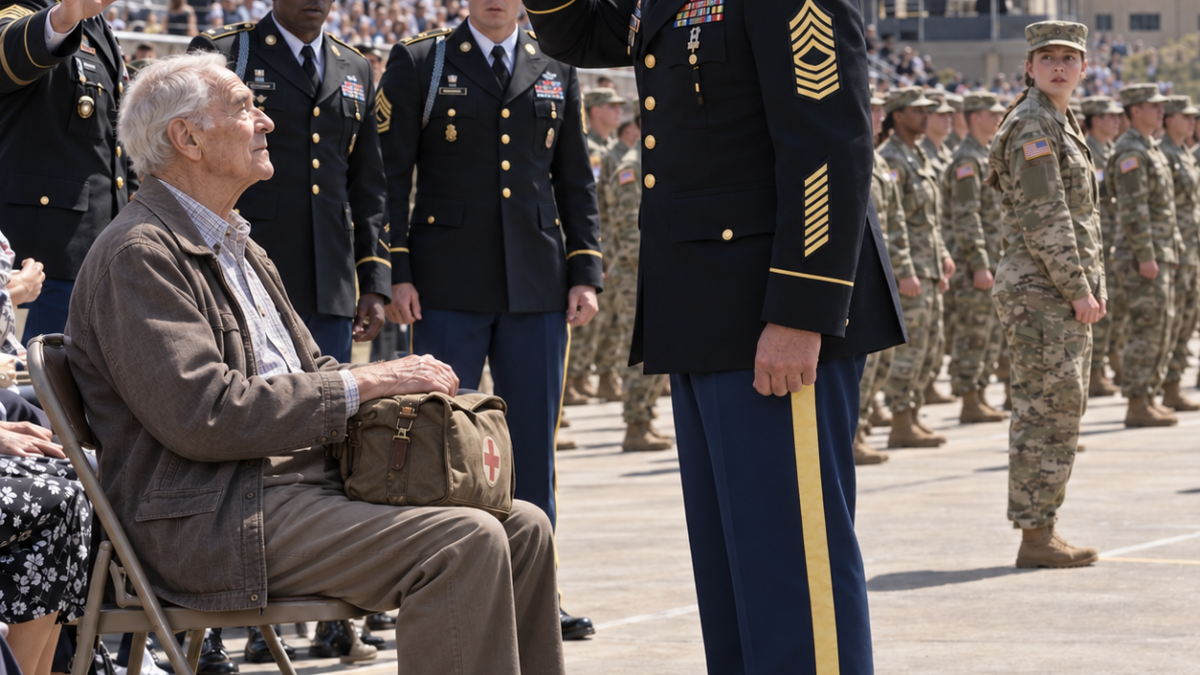
Buford sat with his canvas bag across his knees.
He saw Ainsworth approaching.
His expression did not change.
Ainsworth stopped in front of him.
For a moment, the senior enlisted leader of Fort Merrow looked nineteen years old.
“Sergeant First Class Gant?”
The people nearby became silent.
Buford turned his whole body toward him.
“Ainsworth.”
The command sergeant major swallowed.
“You remember me?”
“You had red hair.”
Ainsworth laughed once.
It broke in the middle.
“That was a long time ago.”
“Yes.”
Ainsworth stared at him.
“Field Hospital detachment. River crossing. Spring 1970.”
Buford nodded.
“You were the replacement medic.”
Ainsworth’s eyes filled.
“I was nineteen.”
“I remember.”
“You ran that aid station.”
Buford shook his head.
“We ran it.”
“No.”
Ainsworth took another breath.
“You ran it.”
Fairchild had reached the edge of the scene.
He stopped.
Families around them whispered.
Ainsworth continued.
“We had no radio after the second strike.”
Buford’s eyes lowered.
“Not for a while.”
“Eleven hours.”
“Maybe.”
“I counted.”
Buford looked at him.
Ainsworth laughed through tears.
“Of course you didn’t.”
Kira’s formation passed.
She could not hear the conversation.
But she saw every drill sergeant in range looking toward her grandfather.
She saw Fairchild standing rigid.
She saw the command sergeant major facing Buford like a junior soldier addressing someone infinitely senior.
Her entire understanding of the day shifted.
After the final unit cleared, the ceremony continued.
Ainsworth did not immediately return to his seat.
Instead, he bent slightly toward Buford.
“Why are you sitting back here?”
Buford looked at Fairchild.
The staff sergeant felt his stomach drop.
“Manifest.”
Ainsworth turned.
Fairchild stepped forward.
“Sergeant Major, his name wasn’t—”
Ainsworth lifted one hand.
Fairchild stopped.
Buford said, “He did his job.”
Ainsworth looked at him.
“They kept you out?”
“Put me in a chair.”
“You should have been in distinguished seating.”
“No.”
“Sergeant Gant—”
“I came for Kira.”
Ainsworth stared.
“You never changed.”
“My wife would disagree.”
That finally made Ainsworth smile.
The installation commander approached.
“What’s going on?”
Ainsworth straightened.
“Sir, this is Sergeant First Class Buford Gant.”
The commander extended his hand.
“Army retired?”
Buford shook it.
“Long time ago.”
Ainsworth said, “Sir, he ran the aid station at the Merrow River crossing in 1970.”
The commander’s expression sharpened.
“That Merrow River?”
“Yes, sir.”
Fort Merrow had been named partly in remembrance of operations from that era.
The river crossing was part of installation history.
Training videos mentioned it.
Old photographs hung in the historian’s wing.
Several units carried lineage references connected to it.
But the individual names associated with the medical response were incomplete.
The commander stared at Buford.
“I thought the senior surviving medic from that action died in the eighties.”
Ainsworth looked toward the canvas bag.
“So did I.”
Buford said, “Rumors get energetic.”
Ainsworth laughed.
The commander asked, “Are you staying after graduation?”
Buford looked toward the field where Kira’s company was beginning to break formation.
“If my granddaughter lets me.”
He saw her then.
She was not allowed to run.
She ran anyway.
“Grandpa!”
Every drill sergeant in the area pretended not to see the violation.
Kira reached him.
Stopped two feet away because suddenly she did not know whether she was a soldier or his granddaughter.
Then she threw both arms around him.
Buford winced.
“Shoulder.”
She released instantly.
“Sorry.”
He smiled.
“You did good.”
Her eyes filled.
“You saw?”
“Most of it.”
“Where were you?”
He glanced at the chair.
Kira looked at Fairchild.
Fairchild looked like he wanted to become invisible.
“What happened?”
Buford said, “Nothing worth ruining graduation.”
Ainsworth stepped forward.
“Private Gant.”
Kira straightened.
“Sergeant Major.”
“Your grandfather and I know each other.”
She looked between them.
“How?”
Ainsworth smiled.
“He saved my life.”
Buford’s face hardened.
“Ainsworth.”
The older command sergeant major ignored him.
Kira stared.
“What?”
Ainsworth looked at Buford.
“He hates this part.”
“What part?”
“People telling the truth where he can hear it.”
Buford muttered something under his breath.
Ainsworth continued.
“I arrived at the river aid station nineteen years old and convinced I knew medicine because I’d finished training.”
His expression turned distant.
“Then the casualties came.”
Kira looked at her grandfather.
Ainsworth said, “Your grandfather worked eleven hours without relief.”
Buford corrected, “Everybody worked.”
“He triaged men while rounds were still coming in.”
“A lot of us did.”
“He ran out of proper tourniquets.”
Buford said nothing.
Ainsworth’s eyes moved toward the canvas bag.
“He started cutting moleskin and webbing from whatever equipment we had.”
Kira followed his gaze.
The bag suddenly looked different.
She had seen it her whole childhood.
In the hall closet.
Then beside Grandpa’s chair.
Sometimes in his truck.
She assumed it contained tools.
Maybe old medical things.
“Why do you still have it?” she asked.
Buford looked down.
“Habit.”
Ainsworth laughed.
“No.”
Buford gave him a warning look.
Ainsworth ignored it again.
“He carried that bag at Merrow.”
Kira stared.
Her grandfather had told her he served.
That was almost all.
When she asked about Vietnam, he usually answered with things like:
Hot.
Wet.
Bad coffee.
Good people.
He had never described heroism.
Never described combat.
Never claimed anything.
“Why didn’t you tell me?”
Buford looked at her.
“Tell you what?”
“That you did all this.”
“You knew I was a medic.”
“That’s not the same.”
“It was to me.”
Before Kira could answer, a captain hurried toward Ainsworth.
“Sergeant Major.”
Ainsworth turned.
“Sir, Colonel Northcott from the historian’s wing is requesting you.”
Ainsworth frowned.
“Now?”
“Yes, Sergeant Major.”
The captain looked at Buford.
“He specifically requested Sergeant First Class Gant as well.”
Buford’s eyes narrowed.
“Northcott.”
The name meant something.
Ainsworth noticed.
“You asked about him?”
“This morning.”
“Why?”
Buford rested both hands on the bag.
“I wanted to see whether something had ever been corrected.”
“What?”
Buford stood.
Slowly.
“Kira.”
“Yes?”
“Go see your mother.”
“What?”
“You’ve got family waiting.”
“I’m coming with you.”
“This is your graduation.”
“Exactly.”
Buford looked at her.
She gave him the expression he recognized from Ruth.
Argument already over.
He sighed.
“Fine.”
Fairchild stepped forward.
“Private Gant.”
She looked at him.
His voice softened.
“I’ll walk you all over.”
Kira’s eyes narrowed.
He accepted it.
“I owe your grandfather that much.”
Buford said, “You don’t owe me.”
Fairchild looked at him.
“With respect, sir, I think I do.”
Buford considered.
“Then walk.”
The historian’s wing stood at the far edge of post.
Low brick.
Few windows.
Ainsworth walked beside Buford.
Kira and Fairchild followed.
The canvas bag remained in Buford’s hand.
Kira watched it.
“Grandpa.”
“Hm?”
“What’s inside?”
“Things.”
“Very helpful.”
“You asked.”
She smiled despite everything.
Fairchild stayed quiet.
He replayed the morning repeatedly.
Not on the manifest.
Overflow.
This gentleman.
He remembered lightly touching Buford’s arm to redirect him.
The thought now embarrassed him.
Not because Buford turned out to be famous.
That realization came later.
He was embarrassed because none of the facts known now changed the simple fact known then.
Buford was a person.
Fairchild had treated him like an administrative inconvenience.
Rank had nothing to do with that.
They reached Northcott’s office.
Colonel Kellen Northcott stood behind his desk.
Mid-fifties.
Gray at the temples.
Historian by assignment, infantry by background.
A thin folder rested open in front of him.
When Buford entered, Northcott stared as though a photograph had walked into the room.
“Sergeant Gant.”
Buford nodded.
“Colonel.”
“Please sit.”
“I’ve sat enough.”
Ainsworth almost smiled.
Northcott glanced at the others.
“Private Gant can stay.”
Kira straightened.
“Thank you, sir.”
“Staff Sergeant Fairchild…”
Fairchild began backing toward the door.
Buford said, “He stays.”
Everyone looked at him.
Fairchild looked most surprised.
Buford continued.
“He was part of the morning. Might as well see the afternoon.”
Northcott nodded.
“Very well.”
He looked down at the folder.
“This file was opened in 1970.”
Buford said nothing.
“Final citation processing occurred in 1972.”
Still nothing.
“There were irregularities.”
Ainsworth stepped forward.
“Irregularities?”
Northcott rubbed one thumb against the edge of the paper.
“Several individual recommendations from the river crossing were consolidated into unit recognition.”
Kira frowned.
“What does that mean?”
Northcott looked at her.
“It means specific names disappeared.”
“Why?”
“That depends how generous you want to be.”
Buford finally spoke.
“Paperwork.”
Northcott looked at him.
“My father ran this office from 1968 through 1979.”
Silence.
“He signed the correction.”
Fairchild shifted.
Ainsworth’s face hardened.
“What correction?”
Northcott turned the file.
A typed line had been marked through.
Beneath it, handwritten notation.
MEDICAL TEAM — UNIT RECOGNITION SUFFICIENT.
Ainsworth stared.
“That’s it?”
Northcott continued.
“Sergeant Gant had been recommended for an individual valor decoration.”
Kira stopped breathing.
Buford did not react.
Northcott looked toward him.
“Did you know?”
“Yes.”
Kira turned.
“You knew?”
“Someone told me once.”
“And you never—”
“It was fifty-four years ago.”
“That doesn’t answer me.”
Buford looked at her.
“Kira.”
“No.”
Everyone became still.
She was a brand-new private standing in a colonel’s office.
She did not care.
“You taught me records matter.”
“I taught you doing the right thing matters.”
“You were recommended for a medal and someone deleted your name.”
“Folded it.”
“That’s not better.”
Buford smiled faintly.
“No.”
Northcott said, “Private Gant is correct.”
Everyone looked at him.
He continued.
“I discovered the original recommendation fourteen years ago.”
Ainsworth’s face changed.
“You knew?”
“Yes.”
“And you never corrected it?”
Northcott’s jaw tightened.
“No.”
“Why?”
The colonel looked toward the folder.
“At first because I was new in the office.”
He spoke carefully.
“Then because reopening a historical valor record required review.”
Ainsworth stared.
“That takes paperwork.”
“Yes.”
“So you didn’t.”
Northcott met his eyes.
“No.”
Kira looked shocked.
Northcott continued.
“Every year, I found a reason.”
Audit cycles.
Documentation gaps.
Witness availability.
Administrative priorities.
He did not list all of them aloud.
He did not need to.
“I told myself the recipient was probably deceased.”
Buford said, “Convenient.”
Northcott flinched.
It was the first sharp word Buford had used all day.
“I deserve that.”
Buford shook his head.
“I wasn’t insulting you.”
“That’s worse.”
Northcott closed the folder.
“There is a plaque scheduled for recasting today.”
Ainsworth frowned.
“What plaque?”
“River Crossing Memorial.”
Buford looked toward the wall.
Northcott continued.
“The updated version still uses the consolidated language.”
Kira stared at him.
“So his name is being left off again?”
Northcott did not answer immediately.
Fairchild spoke for the first time.
“Sir.”
Everyone looked at him.
His voice was careful.
“Can I ask something?”
Northcott nodded.
Fairchild looked at Buford.
“If this man hadn’t been here today, would anybody have fixed it?”
Northcott looked down.
“No.”
The room became silent.
Fairchild swallowed.
That answer hurt him personally.
Because he recognized the mechanism.
A name missing from a manifest.
A name missing from a plaque.
A person becoming an administrative problem instead of a human being.
Different scale.
Same reflex.
Buford saw something move across Fairchild’s face.
“Sergeant.”
“Yes, sir?”
“You’re learning.”
Fairchild nodded.
“Yes, sir.”
Northcott moved toward a filing cabinet.
He opened a long lower drawer.
Inside were sleeves containing unidentified artifacts.
He removed one.
A small yellowed strip of moleskin sat inside plastic.
Two inches long.
Diagonal cut.
Hand stitching at one edge.
Ainsworth leaned forward.
“What is that?”
Northcott looked at Buford.
“Recovered from the river aid station.”
Buford’s face finally changed.
Northcott continued.
“The inventory note says improvised pressure dressing component.”
Kira looked at her grandfather.
He set his canvas bag on the desk.
Unfastened the leather closure.
Opened it.
Inside were old medical instruments.
Scissors.
Forceps.
Bandage rolls hardened with age.
A metal stethoscope.
Several small cloth packets.
A faded photograph.
And inside one narrow pocket, Buford removed another strip of moleskin.
He laid it beside the artifact.
The cuts matched.
The cross-stitch matched.
Even the spacing was nearly identical.
Kira stared.
“What is it?”
Buford touched the old strip.
“When supplies got low, I cut these.”
“For bandages?”
“Padding.”
Ainsworth said softly, “He stitched everything like that.”
Northcott looked at him.
“You remember?”
“I watched his hands for eleven hours.”
Ainsworth’s voice roughened.
“Because I was trying to learn fast enough not to get someone killed.”
Northcott sat.
For the first time, the historian looked shaken.
Kira looked inside the canvas bag.
“Why did you keep one?”
Buford shrugged.
“Forgot to throw it out.”
She stared at him.
“Fifty-four years?”
“Been busy.”
Ainsworth laughed.
Northcott did not.
He held the old folder.
“My father shortened the citation.”
Buford looked at him.
“He was doing a job.”
“He erased four names.”
“He was doing a job badly.”
Northcott’s eyes lifted.
Buford continued.
“That happens.”
“No anger?”
“Had plenty in 1972.”
“What happened to it?”
Buford thought.
“Got expensive.”
Kira frowned.
“Expensive?”
“Anger costs.”
He looked at her.
“Sometimes it’s worth paying.”
He glanced at Northcott.
“Sometimes you stop paying because the person you’re angry at is dead, your children need raising, your roof leaks, your wife wants a garden, and Tuesday still comes.”
Kira’s eyes filled.
Buford touched the bag.
“I didn’t forget.”
“That’s not the same as spending my life inside it.”
Northcott looked at the original recommendation.
“What do you want?”
Buford’s answer came immediately.
“Fix the plaque.”
“That’s all?”
“No.”
Northcott straightened.
Buford pointed toward the consolidated medical team line.
“My name goes with theirs.”
Northcott nodded.
“Of course.”
“Same size.”
“Yes.”
“No special heading.”
Northcott hesitated.
“You were the senior medic.”
“Same line.”
Ainsworth smiled.
Buford continued.
“No ceremony.”
Kira opened her mouth.
Buford looked at her.
“No.”
She closed it.
“No press.”
Northcott nodded reluctantly.
“No cameras.”
“Yes.”
“I came here for her graduation.”
Buford gestured toward Kira.
“Today stays hers.”
Kira’s throat tightened.
“Grandpa…”
He shook his head.
Northcott looked at the unsigned updated plaque order.
“I can stop casting.”
“Do that.”
“Then begin correction review.”
Buford’s expression hardened.
“No.”
Northcott looked surprised.
“You said fix it.”
“Fix it.”
“I need authorization.”
“You have the original recommendation.”
“Yes.”
“You have a living witness.”
He nodded toward Ainsworth.
“Yes.”
“You have artifact confirmation.”
Northcott looked at the matching moleskin.
“Yes.”
“You’re the historian.”
“Yes.”
“So history’s in your office asking you to stop delaying.”
Fairchild almost smiled.
Northcott did too.
A sad smile.
“You should have been an officer.”
Buford looked offended.
Ainsworth laughed loudly.
Kira finally understood where she got some of her stubbornness.
Northcott made the call.
“Stop the casting.”
A voice answered.
He continued.
“Yes, immediately.”
Pause.
“No, do not pour.”
He looked at Buford.
“We have a correction.”
Across the post, molten bronze waited.
At 1:40 that afternoon, the revised design was approved.
Buford Gant’s name appeared beneath the medical detachment designation.
Same font.
Same size.
No special embellishment.
Exactly as he requested.
But before that happened, Kira still had graduation photographs to take.
Buford stood.
Fairchild stepped toward her.
“Private Gant.”
“Yes, Staff Sergeant?”
“I’ll walk you back.”
Kira looked at Buford.
He nodded.
Fairchild and Kira left the historian’s wing.
For the first minute, neither spoke.
Then Fairchild said, “I owe you an apology.”
Kira kept walking.
“You already apologized to him?”
“Not properly.”
“Then I’m the wrong Gant.”
Fairchild nodded.
“Fair.”
They crossed the parade grounds.
Families filled the area.
Graduates posed for photographs.
Children climbed onto shoulders.
Mothers cried.
Fathers pretended they were not crying.
Fairchild said, “I didn’t know who he was.”
Kira stopped.
He realized immediately how wrong the sentence sounded.
She looked at him.
“Would it matter?”
Fairchild exhaled.
“No.”
She waited.
“No,” he repeated. “It shouldn’t.”
Kira resumed walking.
Fairchild continued.
“I keep thinking that if he’d been some regular grandfather who worked construction his whole life and never wore a uniform, I’d still have treated him like he was in the way.”
Kira looked at him.
“That bothers you?”
“Yes.”
“Good.”
Fairchild almost laughed.
“You sound like him.”
“I get that a lot.”
They reached Melissa.
Kira’s mother had spent the past hour furious, confused, then stunned as pieces of the story reached her.
She hugged Kira.
Then demanded, “Where is Grandpa?”
“Historian’s office.”
“Why?”
Kira laughed.
“I don’t even know where to start.”
Buford arrived twenty minutes later with Ainsworth.
Melissa stared.
“Dad.”
“Hello.”
“You never told me.”
He sighed.
“Kira already did this.”
“Told us what?”
“Mom.”
“No.”
Melissa planted both hands on her hips.
“You spent my entire childhood saying Vietnam was ‘a job overseas.’”
“It was.”
“You ran a field aid station under fire.”
“Apparently.”
Ainsworth laughed.
Buford glared.
“You’re enjoying this.”
“Immensely.”
Ruth called at 2:06.
Melissa answered on speaker before Buford could stop her.
“Mom, did you know Dad was recommended for a valor medal?”
Silence.
Then Ruth said, “Oh, that.”
Everyone stared.
Buford closed his eyes.
Kira shouted, “Grandma!”
“What?”
“You knew?”
“Of course.”
“And nobody told me?”
Ruth sounded puzzled.
“Why would we?”
Kira looked toward the sky.
“Because that’s enormous.”
Ruth laughed.
“Honey, your grandfather unclogged our septic line during an ice storm in 1994. You want heroism, start there.”
Even Ainsworth bent over laughing.
Buford smiled.
“That’s why I married her.”
Ruth continued.
“Buford, did you see Kira march?”
“Yes.”
“How’d she look?”
“Good.”
Kira leaned toward the phone.
“Good?”
Buford looked at her.
“Very good.”
“That’s better.”
Ruth said, “Then the important thing happened.”
Conversation shifted.
Exactly as Buford wanted.
Not to the river.
Not to the medal.
To Kira.
Her boots.
Her next assignment.
Whether she had eaten.
Whether she had enough photographs.
That afternoon, Fairchild returned to the gate.
Something had changed.
Not dramatically.
He did not become sentimental.
The manifest still mattered.
Security still mattered.
Rules still mattered.
But when an elderly man approached and said his son had forgotten to list him, Fairchild did not gesture toward overflow while speaking about him to someone else.
He looked directly at the man.
“What’s your name, sir?”
He checked.
Called the unit.
Found a solution.
Later, the younger private from that morning noticed.
“Different system?”
Fairchild shook his head.
“Same system.”
“What changed?”
Fairchild glanced toward the distant historian’s wing.
“Operator.”
The private laughed.
Fairchild did not.
Nine months later, Fort Merrow held another graduation.
Buford had been invited.
This time his name appeared on three separate lists because Fairchild personally checked.
Reserved seating waited near the front.
Buford arrived wearing the same gray suit.
Ruth had altered it again.
“She claims I’m getting thicker,” he told Ainsworth.
The command sergeant major looked at his waist.
“She’s right.”
“Disloyal.”
They stood together.
Buford no longer carried the canvas bag.
It remained at home beside his chair.
The plaque had been mounted on the north wall of the training command building.
Kira had seen it before leaving for advanced training.
She stood in front of the bronze for a long time.
MEDICAL DETACHMENT.
Four names beneath.
Buford Gant among them.
Nothing larger.
Nothing elevated.
No special paragraph.
Exactly as he requested.
She photographed it anyway.
Then sent the picture to Ruth.
Her grandmother replied:
About time.
Kira eventually learned more.
Not everything.
Buford refused to turn the past into entertainment.
But some nights, when they sat on the porch and she asked carefully, he answered.
He told her about Ainsworth arriving young and pale after a helicopter flight.
“You were afraid?” she asked.
“Everybody was afraid.”
“You?”
“Yes.”
She looked surprised.
“You never seem afraid.”
“That’s because you’ve mostly known me in grocery stores.”
She laughed.
Then asked, “What did you do when you were afraid?”
“Work.”
“That’s it?”
“Usually.”
“What if you couldn’t?”
“Then admit you’re afraid and keep breathing until there’s something you can do.”
Kira thought about basic training.
“Is that courage?”
Buford shrugged.
“People spend too much time naming things.”
One afternoon she asked about the missing medal.
“Do you wish you got it?”
Buford looked across the yard.
Ruth’s tomatoes grew along the fence.
His answer took time.
“At twenty-five?”
“Yes.”
“And now?”
He smiled.
“I got your grandmother.”
“That’s disgustingly sweet.”
“Don’t tell her.”
“She knows.”
“Probably.”
Kira persisted.
“Grandpa.”
He sighed.
“The medal mattered then because we were young.”
He rubbed his right shoulder.
“We wanted somebody to say what happened counted.”
Kira stayed quiet.
“Then time passes.”
“Does it stop counting?”
“No.”
He looked at her.
“You stop needing strangers to count it for you.”
That answer stayed with her.
So did something else.
At graduation, she had watched hundreds of people change their behavior toward Buford only after Ainsworth recognized him.
Before:
Old man.
Not on manifest.
Overflow.
After:
Sergeant First Class Gant.
River crossing.
Legend.
Distinguished guest.
Same person.
Same suit.
Same canvas bag.
Nothing about Buford changed in the thirty seconds between being ignored and being honored.
Only what everyone else knew.
That bothered Kira.
It bothered Fairchild too.
Three years later, Fairchild became a senior drill sergeant.
On the first morning he briefed a new group of NCOs assigned to graduation detail, he held up the access manifest.
“This matters.”
They nodded.
“Security matters.”
More nodding.
“Organization matters.”
He lowered the sheet.
“But don’t let paper convince you the person standing in front of you is less real than the name printed here.”
One drill sergeant smiled.
Fairchild did not.
“If somebody’s confused, explain.”
He looked around.
“If somebody’s old, give them time.”
Another pause.
“And talk to people, not around them.”
A staff sergeant asked, “Something happen to you?”
Fairchild considered.
“Yes.”
“What?”
“I learned something late.”
That was all he said.
The lesson spread anyway.
Posts remembered stories.
Sometimes inaccurately.
A rumor developed that Buford had been a Medal of Honor recipient.
He had not.
Someone else claimed he had secretly been Special Forces.
Not true.
Another story said the command sergeant major saluted him from across the entire parade field.
Also not true.
Buford hated all versions equally.
When Kira told him, he groaned.
“This is why people should mind their business.”
“You’re becoming a legend.”
“I’m going fishing.”
“Legends fish.”
“Then I’m quitting.”
Ruth laughed from the kitchen.
“You’ve threatened retirement from fame for three years.”
“I never joined fame.”
Kira smiled.
The truth was smaller than legend and more meaningful.
Buford Gant had been a young Army medic placed in a terrible situation.
He did his job.
He made difficult decisions.
He saved people.
He failed to save others.
He lived with both.
Then paperwork reduced four names into one line.
Nobody corrected it for decades.
Life continued.
He married Ruth.
Raised children.
Worked at a county hospital.
Then a hardware store.
Built a shed.
Lost a brother.
Became a grandfather.
Taught Kira how to fish.
Complained about television volume while refusing to admit his hearing was worsening.
Loved the same woman for more than half a century.
Then one morning, he put on an old suit because his granddaughter was graduating from Army basic training.
He did not go looking for vindication.
He wanted a seat.
A view of the field.
A photograph afterward.
That was all.
The remarkable thing was not that an important man had been treated like an ordinary old man.
Buford would have hated that interpretation.
The remarkable thing was how differently ordinary people were treated once others discovered they had once done something extraordinary.
Years later, when Kira became a sergeant herself, that lesson mattered more than the plaque.
She used it with nervous privates.
With elderly veterans at ceremonies.
With civilian workers nobody saluted.
With young soldiers who made mistakes.
She discovered respect was easiest when rank made it mandatory.
Character revealed itself when nothing required it.
One winter evening, Kira came home on leave.
She entered Buford and Ruth’s house carrying a duffel bag.
Buford sat in his chair.
Older.
Smaller somehow.
The canvas medical bag rested on the shelf beside him.
Kira stopped in the doorway.
Then stood straight.
Her heels came together.
She saluted.
Buford stared.
“What are you doing?”
“Tradition.”
“Whose?”
“Mine.”
He sighed.
His right arm could no longer rise properly.
It had not for years.
So he lifted it as far as it would go.
Slow.
Imperfect.
Then returned the salute.
Kira dropped her hand.
“Hi, Grandpa.”
“Hi, kid.”
Ruth called from the kitchen.
“If you two are finished pretending this is Fort Merrow, dinner’s getting cold.”
Kira laughed.
She dropped her duffel.
Then noticed the old canvas bag.
“Can I ask something?”
Buford looked suspicious.
“You’ve never let that stop you.”
“When you’re gone…”
Ruth shouted from the kitchen.
“Don’t kill him before supper.”
Kira smiled.
Buford waited.
“The bag.”
She pointed.
“What happens to it?”
He looked at the worn canvas.
The leather closure.
The repaired handle.
The object that had traveled halfway around the world and through half a century.
“Want it?”
Kira swallowed.
“Yes.”
“Why?”
She thought.
“Because it mattered.”
Buford shook his head.
“No.”
Her face fell.
Then he continued.
“It matters.”
Present tense.
Kira looked at him.
“There’s a difference.”
He stood slowly.
Took the bag.
Handed it to her.
For the first time in her life, someone else carried it with his permission.
It was lighter than expected.
Kira held it carefully anyway.
“Don’t put it in a museum,” Buford said.
“I thought you’d want that.”
“No.”
“Why?”
“Museums are full.”
He pointed at her.
“You use it to remember.”
“Remember what?”
Buford looked toward Ruth in the kitchen.
Then through the window.
Then back at Kira.
“That nobody walking toward you comes with their whole story printed on their shirt.”
Kira tightened her grip.
“That what happened at the gate?”
“Among other places.”
He sat again.
“Most people you meet will never have a command sergeant major run across a parade ground to explain why they matter.”
Kira said nothing.
Buford continued.
“They shouldn’t need one.”
Years after Buford died peacefully at home, Kira still carried that sentence.
The canvas bag stayed in her house.
Not displayed beneath glass.
Not hidden.
On a shelf near the front door.
Inside remained the faded medical instruments.
The old bandage material.
A photograph Kira had finally been allowed to see.
Buford at twenty-five.
Thin.
Tired.
Standing beside three other medics.
Ainsworth barely visible behind them.
And the moleskin strip with the cross-stitch Buford’s hands had repeated so many times it became a signature stronger than official ink.
Fort Merrow’s plaque remained where it belonged.
Weather darkened the bronze.
New soldiers walked past it every cycle without knowing every name.
That was fine.
Names on walls were not meant to create celebrities.
They were meant to prevent disappearance.
And every year, when graduation season returned, Staff Sergeant Fairchild’s old checkpoint story passed quietly among the drill sergeants.
Not as a legend about a hidden war hero.
As a warning.
The old man at the gate might be a decorated veteran.
Or he might be a retired mechanic.
A grandfather.
A widower.
A schoolteacher.
A farmer.
Someone who had never worn a uniform at all.
You probably would not know.
That was the point.
Respect given only after a biography impressed you was not respect.
It was admiration.
Buford Gant had never asked to be admired.
He had asked one question at the gate.
Is Colonel Northcott’s office still behind the historian’s wing?
Nobody answered.
Then he asked for almost nothing afterward.
Fix the plaque.
Same line.
Same size.
Walk my granddaughter back to her family.
Let her day stay hers.
Those requests told Kira more about him than any citation ever could.
The Army eventually corrected the historical record.
It documented Buford’s actions during the river crossing.
The original valor recommendation was restored to the archive with notation explaining why it had been consolidated.
No grand campaign followed.
Buford refused one.
He accepted a formal letter at home.
Ruth framed it.
He complained.
She ignored him.
It hung in the hallway beside Kira’s basic-training graduation photograph.
In that photograph, Kira stood in uniform.
Proud.
Exhausted.
Buford stood beside her in his old gray suit.
One shoulder lower than the other.
Canvas bag in his hand.
Fairchild stood unexpectedly at the edge of the frame because Melissa had called him over.
He looked uncomfortable.
Buford looked amused.
Years later, Kira loved that photograph most.
Not because it captured a forgotten hero being recognized.
Because it captured the exact moment after recognition when everybody was again simply human.
A granddaughter.
Her grandfather.
A staff sergeant who had made a mistake.
A family celebrating.
No reviewing stand.
No sealed file.
No legend.
And maybe that was the ending Buford would have chosen.
Some names are left off walls because of war.
Some because of paperwork.
Some because somebody decides correcting the record can wait another year.
But history is not only what gets written down.
History also survives in people.
In old men carrying bags nobody thinks to ask about.
In scars hidden beneath pressed suits.
In wives who remember the letter their husbands tried to throw away.
In young medics who become command sergeants major and recognize a face half a century later.
In granddaughters who discover the quiet man who raised them had already lived an entire life before they were born.
And sometimes all it takes to bring that history back is for one person to look across a crowded parade field and remember.
Buford never needed everyone to know his name.
He only needed the record to stop pretending he had never been there.
And on the morning his granddaughter graduated from boot camp, fifty-four years after the Army shortened his story into someone else’s line, that was finally what happened.
Not because he demanded a medal.
Not because he raised his voice at the gate.
Not because he told anyone who he had once been.
But because the men who remembered him refused to let the silence continue.
And because Kira Gant, standing in a brand-new uniform with her whole future ahead of her, learned the most important lesson her grandfather ever taught her without intending to teach it at all.
Never decide how much a person matters before you know their story.
Better yet—
Treat them like they matter even if you never learn it.








