She Bit My Husband the Moment He Reached for Her—By the Next Day, She Was Fast Asleep in His Arms
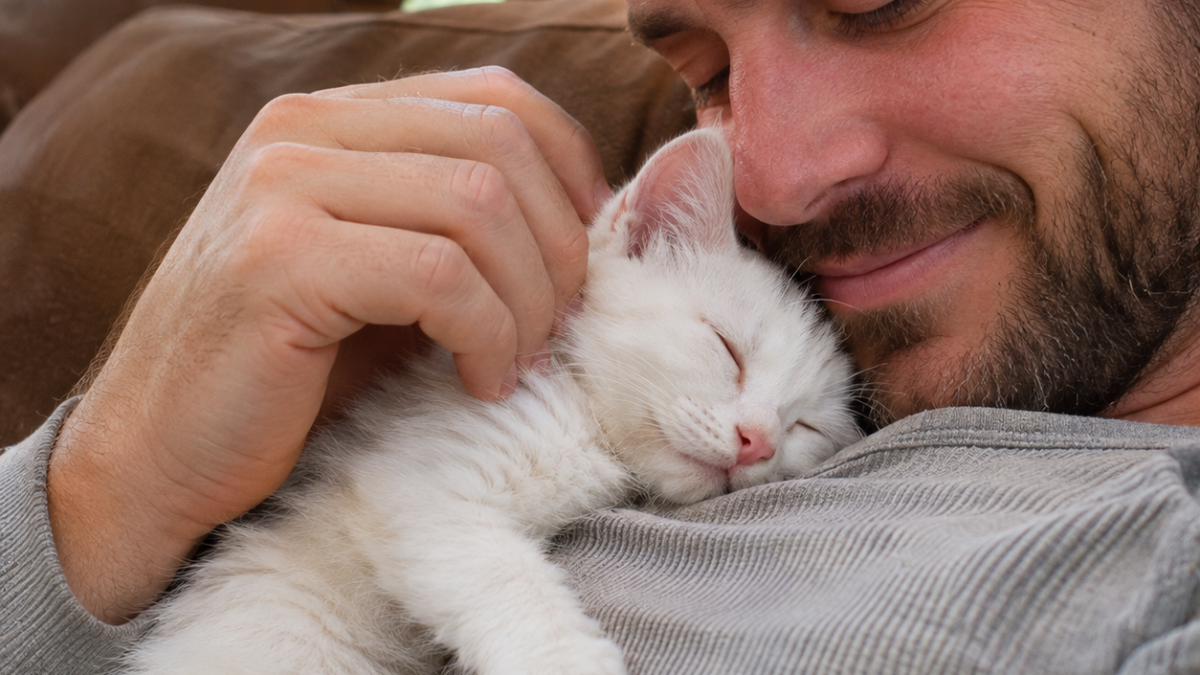
She Bit My Husband the Moment He Reached for Her—By the Next Day, She Was Fast Asleep in His Arms.
The little white stray bit my husband hard enough to leave marks on his hand the first time he tried to touch her, but instead of getting angry, he crouched in the mud and whispered that she was only scared.
I kept telling him to leave the kitten alone and go get his shot, yet he carried her home against his chest, cleaned his own wound, found her a bed, and refused to leave until she finally stopped trembling.
By the next afternoon, the same kitten who had hissed at both of us was curled against him with her face buried in his shirt, sleeping so deeply that he sat almost perfectly still because he was afraid even breathing too hard might wake her.
We had barely parked when my husband opened the car door and jumped out.
I remember thinking he had seen someone he knew.
Then I saw what he was looking at.
A tiny white cat sat near the edge of the muddy ground beside the road.
She was so small that from inside the car she looked more like a crumpled piece of cloth than an animal.
Her fur was dirty.
Not gray exactly.
White underneath, but streaked with mud around her paws, belly, face, and ears.
There was a faint darker patch on the top of her head that later became one of my favorite things about her.
At that moment, though, she looked frightened and exhausted.
My husband walked toward her immediately.
He has always been like that with animals.
No hesitation.
No careful discussion.
If there is a frightened animal somewhere near him, he somehow decides within seconds that the animal is now his responsibility.
I opened my door and called after him.
“Be careful.”
He reached down.
The kitten bit him.
Fast.
One second she was sitting there.
The next, her tiny mouth closed around his hand.
He jerked back.
I jumped out of the car.
“What happened?”
“She bit me.”
I hurried over.
There were already little marks on his hand.
I looked at the kitten.
She had backed away toward the mud.
Her body was low.
Ears slightly back.
Eyes enormous.
PART2:
I was scared for my husband and irritated at the same time, so my first reaction was not especially gentle.
“Why did you bite him?”
Of course she had no idea what I was saying.
She hissed directly at me.
I stared.
“Oh, really?”
She hissed again.
My husband laughed.
“Stop arguing with the cat.”
“She bit you.”
“I moved too fast.”
“She bit you.”
“She was scared.”
“She has teeth.”
“I noticed.”
Then he crouched down again.
I could not believe it.
“Why are you reaching for her again?”
He ignored me.
PART3:
Very slowly, he held out two fingers.
Not toward her body.
Just toward the top of her little head.
The kitten froze.
He spoke quietly.
“It’s okay.”
I stood there watching.
His hand had just been bitten.
I could still see the marks.
And yet he was kneeling in the dirt as if nothing had happened.
Two fingers touched the kitten’s forehead.
Once.
Then again.
Slow, tiny strokes.
She did not bite.
She did not run.
She just stared at him.
He rubbed between her ears.
Her body loosened slightly.
Then he slid one hand under her.
The kitten tensed.
I thought she was going to attack again.
Instead, he lifted her.
Not casually.
He cupped her as carefully as if she were something fragile enough to break.
One hand beneath her body.
The other around her back.
He brought her against his chest.
The little white cat stayed there.
I looked at his hand.
“You need to wash that and get your shot.”
“In a minute.”
“No. Not in a minute.”
“She’s scared.”
“You’re bleeding.”
“It’s not bad.”
“She bit you.”
He looked down at the kitten.
“I scared her.”
That became his explanation for everything.
She was not bad.
She was scared.
She did not attack him.
He moved too quickly.
She did not hate people.
She simply did not understand what was happening.
Every time I tried to complain, he defended her.
I finally said:
“You cannot keep carrying around the cat that just bit you.”
He looked at me.
“I want to keep her.”
I thought he was joking.
He was not.
“Keep her?”
“We can raise her.”
“She just bit you.”
“She’s tiny.”
“That doesn’t answer anything.”
He looked down at her again.
The kitten had tucked herself against his chest.
Her ears were still uncertain.
But she was no longer struggling.
And then he gave me the look.
Anyone who lives with an animal lover knows the look.
The decision has already been made.
The conversation is simply being held out of politeness.
I sighed.
“Fine. For now.”
He smiled.
That was all the permission he needed.
We did not have a proper carrier with us.
So he went into a nearby little store and asked for a cardboard box.
He came back carrying one with both hands.
We lined it as best we could.
He lowered the kitten inside.
Then instead of closing it completely, he folded the top so there was a small opening.
“She needs to see out.”
“She also has teeth.”
“She’s scared.”
There it was again.
I got into the car.
He placed the box carefully.
The kitten’s little face appeared through the opening.
Two bright eyes.
Dirty white fur.
One small nose.
For the entire drive home, my husband kept looking over.
Talking to her.
Quietly.
“You’re okay.”
“We’re going home.”
“You’ll be fine.”
I said:
“She cannot understand you.”
He answered:
“She knows the voice.”
Maybe he was right.
When we got home, the first thing he did was wash his hands.
I was relieved.
He stood at the sink for what felt like forever.
Water.
Soap.
Rinse.
More soap.
Then iodine.
He frowned the entire time.
Not because he was angry with her.
Because he was making sure he cleaned the bite properly.
I kept telling him:
“We need to go get your shot.”
“We will.”
“Now.”
“Let me get her settled.”
“You are unbelievable.”
He smiled.
The kitten had not moved much inside the box.
She was still so tense.
We found a small cat bed.
Soft.
New.
My husband lifted her out.
She did not bite this time.
He placed her inside.
The kitten curled into herself immediately.
She looked smaller in the bed than she had outside.
A little white ball.
She did not explore.
Did not meow.
Did not move.
She simply froze.
I looked at her.
My anger faded a little.
It is easy to be offended by an animal when you are looking at the bite mark.
Harder when you look at the animal and realize how frightened it is.
“She really is scared,” I said.
My husband gave me a look.
“Don’t.”
“What?”
“That face.”
“What face?”
“The I-told-you-so face.”
He laughed.
Then he sat beside the kitten.
I told him again:
“Hospital.”
“In a little bit.”
“You said that already.”
“I want her to settle first.”
“You are the one who got bitten.”
“She doesn’t know where she is.”
“That doesn’t change your hand.”
“She’s not bad.”
I rolled my eyes.
“I know. She’s scared.”
“Exactly.”
He spoke to her quietly for a long time.
Not baby talk.
Not loud.
Just the same calm voice he had used beside the road.
Every few minutes, she looked toward him.
Then tucked her head down again.
He did not force her to move.
Did not pick her up again.
He simply stayed.
Eventually her body loosened.
Her eyes became heavy.
She fell asleep.
Only then did my husband stand.
“Okay. Let’s go.”
I stared at him.
“So now we can take care of the human?”
He smiled.
“Now.”
We left to get his shot.
The entire way there, I was still annoyed.
Not at the kitten exactly.
At the whole situation.
We had gone from parking the car to adopting a biting stray in less time than it took most people to order dinner.
That was my husband.
I told him:
“You realize you could have just left her somewhere safe and called someone.”
He shook his head.
“She came with us.”
“You decided that.”
“She stayed in my arms.”
“She had no transportation.”
He laughed.
His hand was sore.
He got the proper medical care.
I felt better.
And somehow, even while we were dealing with the bite, we were both talking about the kitten.
Would she eat?
Would she use the bed?
Would she hide?
Would she be terrified when we returned?
My husband kept saying:
“I hope she’s sleeping.”
I said:
“I hope she’s not destroying the house.”
He gave me a look.
“She weighs almost nothing.”
“Tiny criminals still commit crimes.”
By the time we came home, the front door had barely opened before she appeared.
That surprised me.
I expected her to stay hidden.
Instead, we heard quick little steps.
Then the white kitten came running toward us.
Straight to our feet.
My husband crouched instantly.
“There you are.”
He scooped her up in both hands.
She did not bite.
She did not hiss.
Her paws kicked lightly in the air while she looked around.
I watched her face.
That same animal had sunk her teeth into him only hours earlier.
Now she was being held like something precious.
And somehow she already seemed different.
Not fully relaxed.
But curious.
He carried her to a small table and set her down.
The kitten began walking back and forth.
Tail straight up.
That tail changed everything.
Outside, she had been low and defensive.
Now she walked like she owned the place.
One side of the table.
Turn.
Other side.
Turn again.
I found myself smiling.
I was still technically annoyed about the bite.
But it was difficult to stay angry at something that small.
We had bought fresh food.
Fresh water.
Clean bowls.
She went straight to the kibble.
The first few bites were almost frantic.
Crunch.
Crunch.
Crunch.
Little crumbs stuck to her whiskers.
She barely stopped to breathe.
I looked at my husband.
“She was hungry.”
He nodded.
No smug face this time.
Neither of us needed to say more.
The thought of how hungry she might have been before we found her made my chest tighten.
When she finished, she wandered across the wooden floor.
Under the table.
Out again.
Behind a chair.
Peeking around one leg.
Then another.
Sunlight came through the window at an angle.
She stepped directly into it.
And for the first time, I really saw her.
White.
Almost completely white.
Underneath all that dirt, her fur was beautiful.
Soft-looking.
Bright.
The little gray patch on her head sat there like a tiny hat.
I said:
“Oh.”
My husband looked at me.
“What?”
“She’s actually pretty.”
He laughed.
“Actually?”
“You know what I mean.”
“I knew already.”
“Of course you did.”
He picked her up.
This time she relaxed immediately.
She lay against his chest.
He stroked her head.
Then looked at the dirt around her eyes and nose.
“Time for a face wash.”
I heated water.
Not hot.
Just warm.
Soaked a soft towel.
Wrung it out.
Handed it to him.
Before touching her, he pressed the towel against the inside of his wrist.
Checking the temperature.
That tiny detail stayed with me.
He had been bitten by her.
Had gone for a shot because of her.
Had defended her all day.
And now he was making sure the towel was not even slightly too warm for her face.
He started at her forehead.
Slowly.
A little wipe.
Then another.
Around one ear.
Other ear.
Nose.
Chin.
The dirty fur began turning white.
She did not resist.
Her eyes slowly closed halfway.
He wiped so carefully around her eyes.
Then stopped to check her reaction.
Another small stroke.
No hurry.
No roughness.
No “hold still.”
Just patience.
I stood nearby watching.
Something inside me softened completely.
All the complaints I had made earlier suddenly felt silly.
Not because I had been wrong to worry about the bite.
I was right.
A bite needs proper care.
But looking at them together, I understood what he had seen before I did.
He had not looked at her and seen an animal that attacked him.
He had seen a frightened kitten.
And because he responded to fear with gentleness instead of anger, she changed right in front of us.
When he finished cleaning her face, she looked almost like another cat.
White fur.
Tiny gray cap.
Clean little nose.
Bright eyes.
He rubbed her head once.
She pushed forward.
Buried her face against his chest.
Then, within maybe two minutes, fell asleep.
Just like that.
No struggle.
No cautious half-sleep.
Completely asleep.
Her little body sank into him.
Front paws crossed.
Face against his shirt.
Breathing slow.
My husband froze.
His hands lifted slightly away from her.
He looked at me.
“What do I do?”
I almost laughed.
“She’s sleeping.”
“I know.”
“So?”
“Can I move?”
“No.”
He stared at me.
I was teasing.
Mostly.
Then he very gently lowered his hands onto her back.
The kitten did not wake.
He sat completely still.
I pulled out my phone.
Started filming.
He whispered:
“Is this okay for her?”
“She’s fine.”
“She looks really asleep.”
“She is.”
“Should I put her in the bed?”
“No.”
“Why?”
“Because now you’re trapped.”
He smiled.
The entire time we talked, the kitten never woke.
Her paws remained crossed.
Not one twitch.
She had gone from biting him to sleeping against his heartbeat in less than a day.
That hour remains one of the clearest memories I have from when she first arrived.
Nothing dramatic happened.
Nobody went anywhere.
We accomplished nothing.
My husband sat in one position.
The kitten slept.
I watched.
That was all.
And somehow it felt important.
Trust had happened while we were not looking.
Maybe it began when he crouched after being bitten.
Maybe when he blamed himself instead of her.
Maybe when he carried her carefully.
Maybe when he stayed beside the bed until she slept.
Maybe she simply became exhausted and realized nobody in this house was going to hurt her.
Whatever the reason, she slept like she believed she was safe.
That evening, we went shopping.
All of us.
By then I had completely lost the argument I had been having with myself about whether she should stay.
I knew she was staying.
My behavior proved it before I admitted it.
We went to the biggest pet store nearby.
Rows and rows of food.
Kibble.
Wet food.
Freeze-dried treats.
Cat litter.
Beds.
Toys.
Bowls.
I stood in front of one bag of kitten food reading the label for so long that my husband finally said:
“You know she can’t read that.”
“I’m checking the ingredients.”
“She bit me, not you. Why are you suddenly the responsible one?”
“Be quiet.”
Then I moved to the treats.
Picked one up.
Read it.
Put it down.
Picked up another.
My husband started laughing.
“You didn’t even want the cat.”
“I still don’t.”
“You are holding three bags of treats.”
“That proves nothing.”
We bought toys too.
More than one.
Because apparently one tiny kitten needed options.
The drive home felt completely different from the drive that had brought her there.
The first trip had been worry.
Bite.
Mud.
Confusion.
Should we keep her?
Is she sick?
Is she scared?
Now we were discussing food.
Names.
Which toy she would like.
Whether she needed another blanket.
We had changed before she had.
When we got home, my son opened the treats immediately.
He crouched on the floor.
The kitten approached.
Sniffed.
Then licked the treat carefully.
My son barely breathed.
That was another thing she did to us.
She made grown people and children freeze in place because we were afraid to interrupt whatever tiny thing she had decided to do.
One lick.
Another.
Then she ate.
My son looked at us like he had just witnessed a miracle.
“She likes it.”
“Yes.”
He opened the wand toy.
A feather dangled from the end.
The kitten had probably never seen anything like it.
The feather moved.
Her eyes went huge.
Body low.
Tail twitching.
Then—
Pounce.
She missed.
Tumbled sideways.
Got up.
Pounced again.
My son laughed so hard he had to sit down.
The kitten did not care.
Again.
Again.
Across the floor.
Under the chair.
Around the couch.
Leap.
Roll.
Get up.
The living room filled with laughter.
Even my husband crouched nearby laughing.
She chased that feather as if catching it would determine the future of the world.
Every time she caught it, she held on with both front paws.
My son gently pulled.
She refused to release it.
Then suddenly she would let go and attack again.
For a kitten who had looked frozen with fear the day before, she had a lot of life inside her.
When she became tired, she returned to the food.
A few bites.
Then wandered.
Then played again.
By later that evening, the house already felt arranged around her.
Watch where you step.
Close that door.
Move that cable.
Check under the chair before sitting.
Leave the water here.
Do not leave that little gap open.
She was tiny.
Yet somehow she occupied every room.
At one point, my husband and son sat near the treadmill with her.
I crouched nearby watching.
She sat between them like she had always belonged there.
I thought about the roadside.
How different everything had looked.
A scared white kitten.
Mud.
Hissing.
Teeth.
My husband’s bleeding hand.
Now she was surrounded by people who were discussing whether she preferred one treat over another.
That is how quickly life can turn for an animal.
Sometimes there is no long transition.
One afternoon, nobody.
One evening, family.
From that day forward, she began coming out every time the door opened.
Those tiny legs would appear.
Trotting straight toward whoever came home.
No hesitation.
She wanted to know who had entered.
My husband developed a routine.
Every time he came home, he checked her face.
If there was dirt near her nose or eyes, he took a tissue.
Little wipe.
Forehead.
Eye corner.
Nose.
Chin.
Exactly the way he had cleaned her the first time.
She allowed it.
Sometimes she even leaned into him.
I would watch and remember:
This is the cat who bit him.
We eventually talked about names.
A lot.
Nothing sounded right at first.
Then we settled on Maodou.
Maodou.
It fit her.
Especially after she became clean.
White as cotton.
That little gray patch on top of her head like a tiny cap.
Once the dirt disappeared completely, she was almost shockingly white.
My husband joked that the animal I had scolded beside the road had transformed overnight.
I said:
“She still bit you.”
He answered:
“Once.”
“You will defend her forever, won’t you?”
“Yes.”
He did.
Maodou grew stronger quickly.
Every day she became faster.
At first she ran only short distances.
From behind the couch.
Across the room.
Then she would stop.
Tiny sides moving quickly.
Two steps and tired.
But the curiosity in her eyes never stopped.
She wanted to touch everything.
Smell everything.
Climb everything.
If there was a corner, she investigated it.
If there was a box, she entered it.
If there was a bag, she inspected it.
If something moved, she chased it.
If nothing moved, sometimes she chased that too.
She would burst from behind the couch without warning.
Slide slightly on the floor.
Roll.
Turn.
Attack an invisible enemy.
Then flop onto her back with her pink toe beans in the air.
I used to stand over her and ask:
“What exactly are you doing?”
She never explained.
My husband would appear.
Pick her up in both hands.
Lift her high.
Bring her close to his face.
Her expression would change immediately.
Tail up.
Eyes bright.
She seemed happiest when he held her.
Not fearful.
Not defensive.
She trusted those hands completely.
The same hands she had bitten.
That part never stopped amazing me.
Animals do not seem to carry embarrassment the way people do.
She did not spend the rest of her life thinking:
I attacked this man once.
He did not spend the rest of his life reminding her.
The moment passed.
Fear left.
Trust replaced it.
Simple.
Maodou eventually learned to put herself to sleep.
That was one of the cutest things she did when she was tiny.
After dinner, when the house became quiet, she would climb into her little bed without anyone carrying her.
Above it hung a small white pom-pom.
She loved that thing.
She would lie on her side.
Lift one paw.
Tap.
The pom-pom swung.
Her eyes followed it.
Tap again.
Swing.
Watch.
Tap.
Swing.
Watch.
Then her eyes became heavier.
The paw moved slower.
Tap.
Pause.
Half-open eyes.
Another tap that barely reached.
Then nothing.
Her mouth sometimes stayed slightly open.
Completely asleep.
I would stand nearby and watch.
My son would whisper:
“Is she sleeping?”
“Yes.”
“Why is her mouth open?”
“She’s probably dreaming.”
“What about?”
“I don’t know.”
Maybe chasing feathers.
Maybe eating.
Maybe nothing at all.
The entire house learned to lower its voice when she drifted off.
None of us had planned that.
She trained us quickly.
That weekend, my husband and I went out early.
When we returned, my son had already taken care of her.
He had wiped her face.
Refilled her kibble.
Cleaned around her little area.
He crouched beside her while she ate.
So serious.
I stood at the doorway watching him.
Children change around small animals too.
Responsibility becomes something they can hold in their hands.
He was not cleaning because we told him.
He wanted Maodou comfortable.
Then he brought out a bag of goat milk formula.
Maodou immediately followed.
She circled the bag twice.
Sniffing.
My son crouched down.
He read the instructions as if she were listening.
“How much water?”
Maodou sniffed the bag.
“How many scoops?”
She walked around his knee.
He talked to her the entire time.
Very serious.
As though they were preparing something important together.
He mixed the formula.
Poured it into a small bottle.
Brought the nipple toward her mouth.
Maodou turned her head.
He tried again.
No.
Again.
No.
I tried.
She refused me too.
We all looked at each other.
Apparently Maodou had opinions.
The nipple was too large.
Finally I poured a little milk into my palm.
She approached.
Sniffed.
Then licked.
There.
Tiny tongue.
One lick.
Another.
She liked it.
So we soaked some kibble in the goat milk.
She ate.
And ate.
Her belly became round.
A perfect kitten belly.
Afterward, she sat beside a chair grooming herself.
Paw first.
Lick.
Rub face.
Other paw.
Lick.
Rub.
She was learning how to be clean without us.
My son picked up the wand toy.
Immediately—
Maodou’s attention locked.
Tired or not, the hunt resumed.
She launched herself.
Caught the feather.
Held it.
My son laughed and tried gently to move it.
She clung harder.
Tiny paws gripping like she had captured prey ten times her size.
Eventually she wore herself out.
She climbed onto my son’s lap.
Collapsed.
Then looked up at him.
Stuck out her tongue.
He looked down at her.
Started talking.
She stared at him.
Tongue still slightly out.
He began laughing.
I laughed too.
Then Maodou jumped down.
Ran across the floor.
Straight toward me.
Before I could react, she hooked tiny claws into my pant leg.
Climbed.
One inch at a time.
I froze.
“Help.”
My husband laughed.
“Don’t move.”
“I know.”
Maodou kept climbing.
Up.
Higher.
Until I could support her.
I lifted her into my arms.
She settled.
Just like that.
No biting.
No hissing.
No fear.
She tucked herself against me.
Closed her eyes.
I looked down at her.
And realized something.
Somewhere between the roadside and that moment, I had stopped thinking of her as the cat my husband insisted on keeping.
She was mine too.
Not ownership.
Love.
That sneaky kind of love that arrives while you are busy pretending you are still deciding.
I thought about how annoyed I had been.
Why did you pick her up again?
Why are you defending her?
Why are you waiting to go to the hospital?
Why are we buying this much cat food?
Why are we reading treat labels?
Why does she need this many toys?
Then there I was, standing completely still because Maodou had fallen asleep in my arms and I was afraid to wake her.
My husband saw my face.
He smiled.
I knew what he was thinking.
“Don’t say it.”
“I didn’t say anything.”
“You were going to.”
“No.”
“You were.”
He laughed.
Maodou slept.
That became the pattern.
Whoever she fell asleep on became furniture.
No movement.
No complaints.
If your arm became numb, unfortunate.
If you needed water, too bad.
If your phone was across the room, you had made a serious planning mistake.
Maodou was sleeping.
The rules were clear.
The strangest thing was how quickly her personality emerged once the fear disappeared.
She had not been mean.
Not aggressive.
Not “bad.”
She had been terrified.
That first bite was the loudest way she knew to say:
I don’t know you.
Do not grab me.
I am scared.
My husband understood before I did.
He never interpreted the bite as betrayal because she had never promised trust in the first place.
He approached too quickly.
She defended herself.
Then he slowed down.
And she noticed.
That was the entire beginning of their relationship.
He slowed down.
I think about that often.
People want frightened animals to become grateful immediately.
We rescue you.
We feed you.
Why don’t you trust us?
But the animal does not know our intentions.
It only knows what has already happened in its life.
Hands may have hurt before.
Voices may have meant danger.
Being picked up may have been frightening.
A safe house still smells unfamiliar.
Kind people are still strangers.
Maodou did not know my husband was kind when he first reached for her.
How could she?
She knew only that a giant hand came down.
So she bit.
He could have responded with anger.
He could have shouted.
Could have pushed her away.
Could have decided:
This cat is aggressive.
Not worth the trouble.
Instead he crouched.
Lowered himself.
Used two fingers.
Spoke softly.
Let her decide.
That changed everything.
By the next day she slept against him.
I do not think it was magic.
I think it was patience.
Patience can look like magic when an animal has rarely received it.
Even after Maodou became comfortable, my husband stayed gentle.
He never grabbed her suddenly.
When cleaning her face, he always tested the towel.
When holding her, he supported her entire body.
When she wanted down, he let her down.
When she wanted to sleep, he became still.
Maybe that consistency was why she attached to him so deeply.
He had shown her from the first day:
You can tell me no.
I will still care for you.
That is a powerful thing.
The bite became almost funny later.
Not because getting bitten is funny.
We still took it seriously.
He cleaned the wound carefully.
Got medical care.
Did exactly what needed to be done.
But once everything was safe, the contrast became impossible not to laugh about.
First meeting:
Bite.
Next day:
Sleeping in his arms.
My husband would sometimes hold her and say:
“You remember what you did to me?”
Maodou would blink.
No remorse.
None.
I would answer for her.
“She says you deserved it.”
He would say:
“I moved too fast.”
Still defending her.
Always.
As she grew, the kitten awkwardness slowly changed.
Her legs became longer.
Her running became smoother.
She stopped getting winded after two steps.
She learned where her food lived.
Which doors opened to which rooms.
Where the sunniest places were.
Which person was easiest to persuade for treats.
She learned the sound of the treat bag.
That sound could wake her from what looked like death.
Crinkle.
Eyes open.
Head up.
Running.
She learned that my son controlled the wand toy.
That my husband cleaned her face.
That I usually noticed when the food bowl was nearly empty.
She learned our footsteps.
And we learned hers.
The light patter across the floor.
The little jump from furniture.
The sudden sprint from nowhere.
The silence that usually meant she was doing something suspicious.
Some nights I would wake and think I heard her.
Then listen.
Nothing.
Then a tiny thump somewhere outside the room.
Maodou.
Always busy.
She also remained incredibly affectionate.
The kitten who had hissed at me on the first day began seeking me out.
At first, cautiously.
Sit nearby.
Touch my leg.
Then leave.
Later:
Climb onto me.
Curl up.
Sleep.
She would rub her head against my hand.
Sometimes lick my fingers.
Those moments affected me because I remembered the mud.
I remembered standing over her feeling offended.
“You bit him.”
She had hissed.
Now the same little face pressed into my palm.
Trust does not announce itself.
It accumulates.
One meal.
One gentle touch.
One safe night.
One door opening and nobody throwing you outside.
One hand reaching and not hurting.
One day becomes a week.
A week becomes a routine.
And somewhere inside all that repetition, the animal stops preparing to leave.
That was what I think happened to Maodou.
In the beginning, every new thing made her body alert.
A noise.
A door.
A hand.
A different room.
Later, she sprawled.
Belly up.
Paws loose.
Sleep so deep we could speak beside her.
An animal shows safety with its entire body.
We only have to notice.
My favorite proof remained the way she slept with my husband.
The first time was special because of what had happened the day before.
But it was not the last.
She kept returning.
His lap.
His chest.
Beside his leg.
Sometimes directly in the most inconvenient possible position.
If he was sitting, she climbed up.
If he was lying down, she settled on him.
If he tried to stand too soon, she looked offended.
I would say:
“She bit you because she knew you were useful furniture.”
He would answer:
“Worth it.”
He meant it.
I sometimes wondered what would have happened if we had not stopped that day.
Another person might have found her.
Maybe someone kind.
Maybe not.
Maybe she had somewhere she belonged.
Maybe not.
We never knew.
What we did know was the version of Maodou we met.
Dirty.
Small.
Alone.
Scared enough to bite.
Hungry enough to eat as if the food might disappear.
And what she became once she felt safe.
Bright.
Playful.
Affectionate.
Curious.
Very white after cleaning.
Very proud of that tail.
Completely convinced the entire house existed for her convenience.
There is a lesson in that transformation that I try not to make too sentimental.
Love did not magically solve every problem in one minute.
We still had to clean the bite.
Get medical treatment.
Feed her.
Watch her.
Choose the right food.
Give her time.
Learn her behavior.
Clean her face.
Make the house safe.
Patience is work.
Care is work.
But it is often quiet work.
A wet towel.
A clean bowl.
A soft bed.
Sitting still for an hour because a kitten finally fell asleep.
Those things do not look heroic.
They change lives anyway.
The day we found Maodou, my husband looked ridiculous to me.
Bitten hand.
Mud.
Crouching beside a hissing kitten.
Defending her while I scolded both of them.
“She’s scared.”
“She’s not bad.”
“I moved too fast.”
Again and again.
At the time I thought he was making excuses for her.
Now I think he was simply seeing her more clearly.
Fear was not her personality.
It was her condition.
And conditions can change.
That little white kitten taught me that sometimes the worst moment of an introduction tells you almost nothing about who someone really is.
If we had judged Maodou only by the first thirty seconds, she was a cat who bit.
If we judged her by the next day, she was a cat who slept with her paws crossed on the chest of the man she had bitten.
Both things were true.
The difference was safety.
The difference was patience.
The difference was what happened between them.
Years later, when I remember Maodou as a kitten, I do not first remember the bite.
I remember the towel.
My husband testing the warm cloth against his wrist.
Wiping the dirt from her forehead.
Around her ears.
Under her chin.
Slowly.
Carefully.
And then that tiny head disappearing into his chest.
Her body getting heavier.
Her eyes closing.
His hands hovering awkwardly because he did not know whether touching her would wake her.
His whispered question:
“Is this okay for her?”
My answer:
“She’s fine.”
Then his complete refusal to move.
That was the moment Maodou stopped looking like a stray we had brought home.
She looked like a kitten who had found where she wanted to sleep.
That evening we went shopping for her.
By the next weekend, my son was mixing goat milk.
Soon we were all lowering our voices when she slept.
And by the time she climbed my pant leg and curled into my arms, whatever resistance I had left disappeared.
Watching her sleep, I understood my husband.
How could I not love her?
Maybe she understood us too.
Not our words.
Not the arguments.
Not the name we eventually chose.
Something simpler.
Hands that fed her.
Hands that washed her.
Hands that played with her.
Hands that held her without hurting.
The first time one of those hands reached toward her, she bit it.
By the next day, she trusted those same hands enough to fall asleep inside them.
And somehow, that has always felt like the most important part of her story.








